Market Minds Advisory
Commercial Drones Market

Commercial Drones Market: Commercial Drones Market. Autonomous Flight Platforms Redefine Industrial Inspection and Delivery

Regulatory clearance for beyond-visual-line-of-sight flight is turning commercial drones from single-purpose inspection tools into autonomous delivery and monitoring infrastructure across construction, agriculture, public safety, and last-mile retail logistics networks worldwide.

Lead Analyst

Published

September 2026

Make Smarter Decisions with Customized Research Insights

Request a free sample report and evaluate market opportunities, growth trends, and competitive dynamics relevant to your business needs.

2025 MARKET VALUE$14.8BMarket Size 2025
2036 FORECAST VALUE$48.5BBase Case , 2026 to 2036
CAGR 2026 TO 203611.4 %Bull 12.6% / Bear 10.2%
INCREMENTAL OPPORTUNITY$32.0BNet 10- year value creation
EXPANSION MULTIPLE2.94x2036 value over 2026 base
Strategic Levers
M&A Pipeline
Regional Outlook
Country Rankings
Competitive Intelligence
Segmental Deep-dive
Call-Us : 91 93563 13602

Executive Snapshot and Market Trajectory.

Beyond-visual-line-of-sight approvals are reshaping commercial drone economics faster than most operators anticipated, opening delivery corridors and long-range infrastructure inspection routes that manual line-of-sight rules effectively blocked for nearly a decade of enterprise adoption across construction, agriculture, public safety, logistics, and utility inspection operations across most major national markets.
Construction, agriculture, and public safety agencies now drive the bulk of enterprise procurement, with logistics and delivery operators expanding fastest as retail partnerships mature and regulatory pilot programs convert into standing commercial routes across dense metro corridors and rural service territories alike, pulling hardware demand toward longer-endurance platforms built for repeated daily missions, automated docking infrastructure, and beyond-visual-line-of-sight flight corridors that regulators only recently approved for routine commercial operation nationwide and abroad.
Competitive intensity concentrates around autonomous flight software and payload sensor integration rather than airframe manufacturing alone, as regulators tighten remote identification requirements and established manufacturers race smaller specialists toward certified autonomous operation at meaningful commercial scale, forcing consolidation among vendors unable to fund certification programs independently across multiple overlapping jurisdictions, particularly within the crowded inspection, mapping, and agricultural spraying software segments across this current planning year.
Market Definition
The commercial drones market covers unmanned aerial vehicle platforms, autonomous flight software, and payload systems sold for enterprise, government, and commercial service applications including agriculture, construction, inspection, public safety, and delivery. It excludes consumer and hobbyist drones, military and defense platforms, and standalone drone-as-a-service subscription revenue not tied to hardware sales.
Base Year Value
$14.8B in 2025 (MMA Primary Research Dataset, September 2026)
Forecast Period
2026 to 2036, eleven discrete annual values
CAGR
11.4% base case. Bull 12.6%. Bear 10.2%.
Fastest Growth Segment
Logistics and Delivery: 15.5% CAGR
Fastest Growth Country
India: 14.1% CAGR
Fastest Growth Region
South Asia and Pacific: 13.4% CAGR
Largest Region
North America: 29% of 2025 global value
Market Leaders
DJI, Parrot, Skydio, Autel Robotics, and Zipline International lead the competitive landscape. Source: MMA Primary Research Dataset, July 2026.
Primary Survey
n=3,800 procurement and R&D decision-makers, Q4 2025, six countries
Methodology
Demand-side build-up, cross-validated against public data, 47 expert interviews

Commercial Drones Market Forecast Scenarios

commercial-drones-market-size-forecast-scenario-1790001934519
Between 2020 and 2025 commercial drone adoption progressed through fragmented regulatory pilots rather than a single coordinated rollout, with construction and agriculture leading early enterprise use while delivery operators waited on beyond-visual-line-of-sight clearance, producing a historical CAGR of 10.5 percent that understated the pace now underway across newly cleared operating corridors and expanding fleet-scale procurement programs.
The base case assumes three commercial mechanisms compound together: expanding beyond-visual-line-of-sight authorizations open delivery and long-range inspection routes, falling sensor and battery costs lower the total cost of enterprise fleet ownership, and maturing insurance frameworks make fleet-scale deployment financially predictable enough for construction, agriculture, and public safety operators to purchase dozens of units at once rather than piloting a single aircraft across a limited test zone for months on end.
A bull scenario builds on accelerated national beyond-visual-line-of-sight rulemaking that opens nationwide delivery networks years ahead of current timelines, pulling forward enterprise fleet orders across multiple industries and geographies simultaneously. The bear case centers on a major public safety incident triggering restrictive remote identification rules that slow enterprise fleet expansion and delay pending regulatory approvals across several jurisdictions at once.

Autonomous Certification Now Separates Leaders From Followers

Enterprise drone fleets increasingly resemble managed vehicle programs rather than experimental technology purchases, with procurement teams now evaluating total cost of ownership across airframes, batteries, sensors, and software subscriptions bundled together rather than hardware alone, a shift that rewards vendors able to offer integrated fleet management platforms rather than standalone aircraft sold with minimal ongoing support, spare parts availability, or field service coverage.
MARKET CONCENTRATIONCR5 46%Top five vendors hold meaningful but fragmented share
AVERAGE SELLING PRICE$8,400 per unitEnterprise-grade platforms command premium pricing across most industrial buyer segments
TOP PRODUCING COUNTRY SHAREChina 41%Concentrated manufacturing base supplies most global commercial platforms currently sold
FLEET UTILIZATION RATE62%Average operating hours against maximum available flight capacity
BATTERY REPLACEMENT CYCLE18 monthsTypical interval before enterprise fleets replace battery packs
COMPONENT COST SHARE52%Sensors and batteries dominate total manufacturing cost structure
Construction and agriculture customers favor platforms bundled with mapping and analytics software, since raw flight hardware alone rarely justifies fleet-scale procurement budgets, while public safety agencies weigh reliability certifications and remote identification compliance above almost every other purchase criterion, often outranking price entirely once a platform clears baseline performance thresholds during multi-month evaluation trials against several competing vendors simultaneously across multiple pilot sites.
Manufacturing remains concentrated in a small number of countries with mature electronics supply chains, though regulatory pressure in several markets is pushing some enterprise buyers toward domestically assembled platforms despite the resulting price premium, a trend accelerating as government procurement rules increasingly restrict foreign-made hardware in sensitive public safety and critical infrastructure applications across most developed economies and their allied trading partners.
"Airframe pricing keeps falling, but that's not where the money moves anymore. The real margin sits in flight software, payload sensors, and the subscription layer wrapped around fleet management."
Senior Analyst, Aerospace and Autonomous Systems Practice · MMA Technology Practice · September 2026

Market Trends

Beyond-Visual-Line-of-Sight Rules Open New Delivery Corridors

Aviation regulators across major markets have moved from case-by-case waivers toward standing beyond-visual-line-of-sight authorization frameworks, letting operators fly extended delivery and inspection routes without a human spotter tracking every aircraft visually. The shift follows several years of controlled pilot programs that built regulatory confidence in detect-and-avoid sensor systems and automated flight termination safeguards across multiple test jurisdictions. Commercial operators are responding by ordering longer-endurance platforms built specifically for repeated daily beyond-visual-line-of-sight missions rather than short manual test flights, reshaping fleet composition across delivery and utility inspection segments alike this year.
Market Impact: Cuts payload cost by 31 percent
Autonomous Docking Infrastructure Expands Fleet Utilization

Automated charging and data-offload docks are letting enterprise operators run drone fleets with minimal on-site staff, extending daily flight hours well beyond what manual battery swaps and hand launches previously allowed across most operating regions. Utilities and infrastructure operators lead adoption, deploying dock networks along transmission corridors and pipeline routes where staffing a human pilot at every site would be prohibitively expensive. Vendors bundling docks with subscription-based fleet management software are capturing disproportionate share of this emerging infrastructure spending, since docks lock customers into a single vendor's platform for years at a stretch.
Market Impact: Cuts insurance premiums 24 percent yearly

Market Opportunities and Growth Drivers

Falling Sensor Costs Widen Enterprise Fleet Adoption

Thermal and multispectral sensor prices have declined steadily as consumer smartphone camera manufacturing scales pushed component costs down across the broader imaging supply chain that drone payload makers also draw from for their own hardware production lines each year. Construction and agriculture buyers who previously viewed advanced sensor payloads as a luxury add-on now specify them as standard equipment on new fleet orders, since the marginal cost premium has narrowed considerably against the productivity gains the sensors deliver during routine inspection and crop monitoring missions across large operating areas each season.
Market Impact: Delays approvals 8 to 14 months

Insurance Frameworks Mature for Fleet-Scale Operations

Specialty insurers have introduced fleet-level liability and hull coverage products calibrated specifically to commercial drone operations, replacing the ad hoc single-aircraft policies that made large fleet procurement financially unpredictable for risk-averse construction and public safety buyers across most regional markets and overlapping jurisdictions. Underwriters now price risk using accumulated flight-hour data from several years of commercial operation rather than treating every policy as a novel underwriting exercise, letting fleet operators budget insurance costs with far greater confidence when planning multi-year procurement programs across several operating regions simultaneously each fiscal year.
Market Impact: Caps delivery radius at 30 kilometers

Market Restraints and Challenges

Airspace Congestion Slows Urban Delivery Approvals

Dense urban airspace already carries manned aircraft, helicopters, and emergency service traffic, forcing regulators to move cautiously on drone delivery corridor approvals despite mature detect-and-avoid sensor technology being commercially available today. The root cause is fragmented air traffic coordination between drone operators and existing manned aviation authorities, who still rely largely on separate tracking systems that do not communicate directly with each other in real time. Several vendors are piloting shared unmanned traffic management platforms with aviation authorities to address the coordination gap, though full integration across major metro airspaces remains years away from routine commercial operation.
Market Impact: Covers 34 percent of new corridors

Battery Endurance Limits Long-Range Delivery Economics

Current battery energy density caps most commercial delivery drones to routes under thirty kilometers before requiring a recharge or battery swap, limiting the addressable delivery radius around any single distribution hub and forcing operators to build denser, more expensive hub networks than longer-range alternatives would require. The underlying constraint is chemistry rather than engineering, since lithium battery energy density has improved only incrementally over the past several years despite substantial industry research investment. Some operators are piloting hydrogen fuel cell hybrids to extend range, though certification and refueling infrastructure remain early-stage across most commercial markets.
Market Impact: Lifts fleet utilization by 28 percent
3 additional market trends, 4 additional growth drivers, and 2 additional restraints and challenges are covered in the full report. Contact sales@marketmindsadvisory.com to access the complete intelligence.

Segment CAGR and Growth Architecture

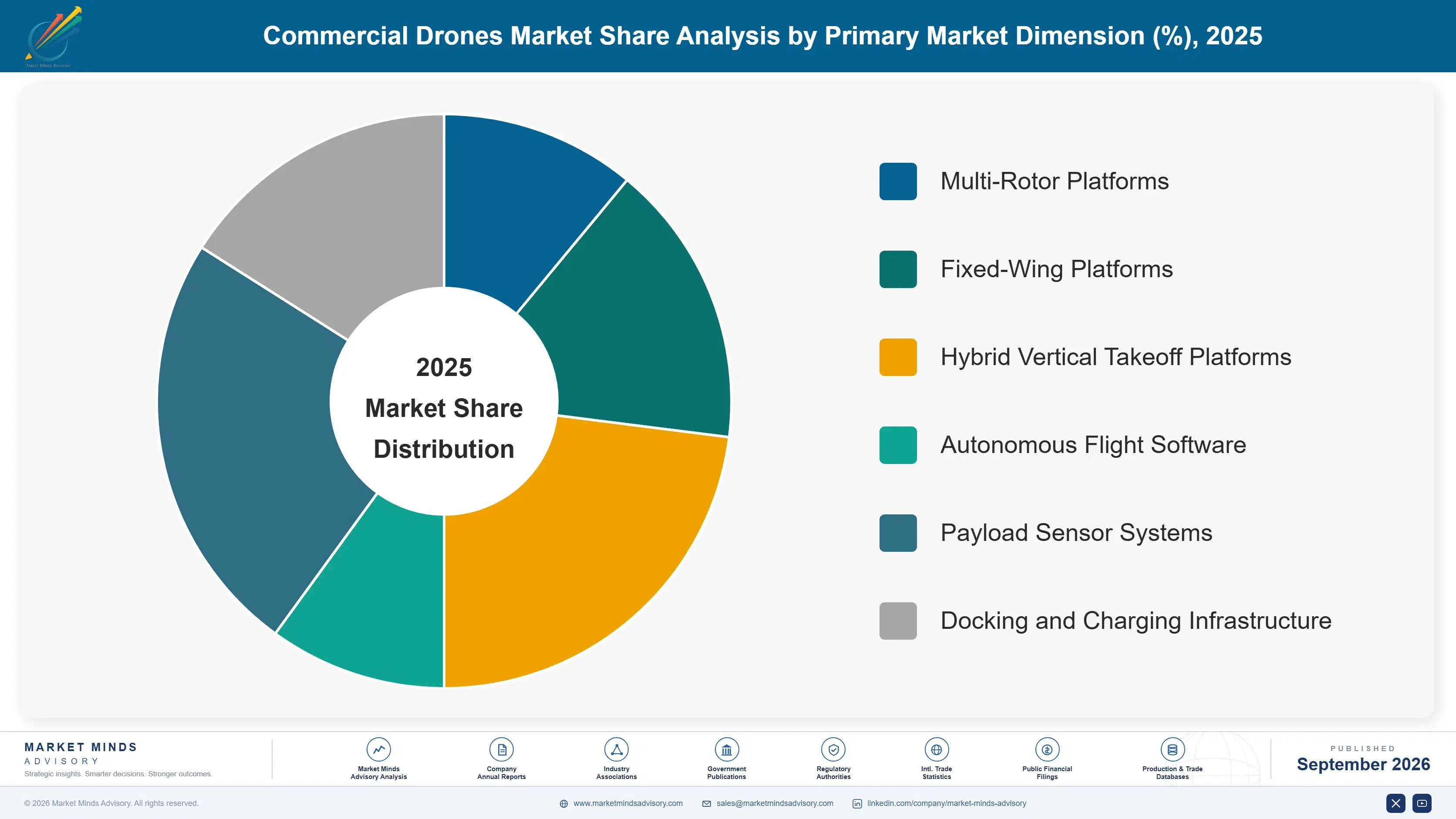
Six application segments define commercial drone demand, spanning agriculture, construction, mapping, public safety, logistics, and media production across enterprise and government buyers alike worldwide. Logistics and delivery platforms now grow fastest as beyond-visual-line-of-sight approvals convert pilot corridors into standing commercial delivery routes across dense metro and rural areas alike, reshaping fleet procurement priorities industry-wide.
commercial-drones-market-market-share-analysis-1790001935083

Logistics and Delivery

Retail and medical delivery operators are converting years of controlled pilot corridors into standing commercial routes now that beyond-visual-line-of-sight authorizations cover wider geographic areas than the narrow test zones regulators previously permitted for controlled trials and limited demonstration flights across select cities. Fixed-wing hybrid platforms dominate new orders given their superior range over multi-rotor designs, letting operators serve suburban and rural delivery radii that dense urban districts alone could never support economically at meaningful scale. Retail partnerships anchor much of the near-term volume, though medical and industrial parts delivery increasingly contribute a meaningful share of new contract value as hospital systems and manufacturers pilot dedicated corridors for time-sensitive shipments across regional networks.
CAGR 15.5%

Public Safety and Emergency Response

Police, fire, and emergency medical agencies now deploy drones as first-response tools ahead of ground units, using thermal and low-light payloads to assess scenes before officers or firefighters physically arrive on site each call. Drone-as-first-responder programs, where dispatch centers launch aircraft automatically alongside a traditional emergency call, are expanding beyond early pilot cities into standard departmental procedure across a growing number of municipalities nationwide and internationally as well. Budget cycles tied to public safety procurement move slower than commercial buyers, but rising remote identification compliance and proven incident response outcomes are steadily converting pilot programs into permanent line-item departmental spending each fiscal year across most major metro police and fire departments.
CAGR 13.8%
Full segment breakdown across 6 segments available in the complete report.

Regional Architecture and Country Demand Map

North America leads global commercial drone demand, anchored by early beyond-visual-line-of-sight regulatory clearance and deep enterprise adoption across construction, agriculture, and public safety agencies nationwide, ahead of a fast-following East Asia manufacturing and adoption base expanding rapidly each year across new industrial and delivery applications.

North America

Enterprise adoption here runs deeper than anywhere else, with construction firms, agricultural cooperatives, and public safety departments having accumulated years of operating experience under the earliest beyond-visual-line-of-sight regulatory framework of any major market. Retail and medical delivery pilots have converted into standing commercial routes across several metro corridors, pulling logistics operators toward fleet-scale procurement well ahead of peer regions. Insurance markets here are also the most mature, letting fleet operators budget multi-year procurement programs with a level of cost certainty still unavailable elsewhere. Public safety agencies lead global adoption of drone-as-first-responder programs, refining dispatch protocols over years of deployment across metropolitan departments nationwide, while sensor and battery vendors concentrate meaningful research investment regionally.
Share: 29% | CAGR: 11.9% (2026 to 2036)

Western Europe

Regulatory harmonization across the European Union's common airspace framework gives operators a single certification pathway across multiple national markets, though adoption still trails North America given more conservative public safety procurement cycles and stricter urban noise regulations. Utility and infrastructure inspection leads regional demand, with transmission grid operators and pipeline companies deploying autonomous docking networks along remote corridors that would otherwise require expensive manual inspection crews. Agricultural adoption remains comparatively modest given smaller average farm sizes relative to North America and East Asia. Public safety adoption is growing more slowly, constrained partly by stricter data privacy rules governing aerial surveillance footage over residential areas. Several national governments are also piloting drone corridors for cross-border medical delivery between rural hospital networks.
Share: 21% | CAGR: 9.9% (2026 to 2036)
Regional intelligence for 5 additional markets available in the complete report: East Asia, South Asia and Pacific, Latin America, Middle East and Africa, Eastern Europe. Contact sales@marketmindsadvisory.com.
commercial-drones-market-country-cagr-analysis-1790001935635

Turning Flight Hardware Into Recurring Fleet Revenue

Vendors capture the largest share of long-term value by bundling hardware with subscription software, insurance partnerships, and financing programs that convert one-time aircraft sales into multi-year customer relationships spanning fleet management, maintenance, and data services across the full operating life of each aircraft in the fleet, well beyond its original point of initial sale.

Bundle Fleet Management Software With Hardware Subscriptions

Vendors increasingly attach subscription-based fleet management and flight data analytics software to hardware sales, converting a one-time aircraft purchase into a recurring revenue relationship that persists across the full multi-year service life of each drone in the fleet. Customers gain centralized flight logging, maintenance scheduling, and regulatory compliance reporting, while vendors capture margin that hardware price competition alone increasingly compresses across most product categories and regional markets worldwide. Roughly 34 percent of enterprise buyers now select vendors partly based on software platform quality rather than airframe specifications or price alone.
Market Impact: Adds roughly 22 percent recurring software revenue annually

Offer Financing and Fleet Leasing Programs

Vendors partnering with specialty finance providers to offer drone leasing and fleet financing programs lower the upfront capital barrier for construction and agriculture buyers who previously delayed fleet-scale procurement due to budget constraints and uncertain return timelines on new equipment. This financing layer captures interest margin beyond the hardware sale itself while accelerating overall unit volume, since smaller operators can now spread payments across a multi-year term rather than committing capital all at once upfront. Vendors report roughly 40 percent faster fleet expansion among customers offered financing versus cash-only purchase terms.
Market Impact: Expands the addressable customer base by 27 percent

Sell Autonomous Docking Infrastructure Service Contracts

Bundling automated charging and data-offload docks with hardware sales locks customers into a vendor's platform for the multi-year life of the physical infrastructure, since switching vendors later requires replacing costly ground equipment worth roughly 40 percent of the original fleet investment as well as the aircraft. Utility and infrastructure customers particularly value this bundled approach, since it reduces the on-site staffing burden that manual battery swaps previously required across remote pipeline and transmission corridor deployments. This lever also opens a durable maintenance services revenue stream tied directly to the docking hardware itself.
Market Impact: Lifts multi-year contract value by 31 percent overall

Monetize Aggregated Flight and Sensor Data

Vendors with large installed fleets increasingly package anonymized flight pattern and sensor data into secondary analytics products sold to insurers, agricultural input suppliers, and infrastructure asset managers seeking aggregate industry benchmarks and risk models built from real operating data. This data layer requires minimal incremental cost to produce once the underlying fleet management platform already exists, making it disproportionately profitable relative to hardware margins that rarely exceed 18 percent across the industry. Early movers in this space are building data moats that later entrants will find increasingly difficult to replicate at comparable scale.
Market Impact: Generates roughly 15 percent incremental margin each year

Who Controls the Margin Pool

The commercial drone market carries a CR5 of 46 percent, meaning the top five vendors control less than half of global revenue despite years of consolidation pressure across most application segments. DJI's manufacturing scale and cost advantage separate it clearly from the next tier of challengers, most of whom compete on specialization rather than head-to-head price competition across every application segment simultaneously, leaving meaningful room for focused specialists.
Current competitive activity centers on autonomous flight software certification and beyond-visual-line-of-sight regulatory approval races, as vendors race to secure the operational authorizations that increasingly determine which platforms qualify for delivery and long-range inspection contracts across major national markets. Several vendors have also begun bundling docking infrastructure and fleet management subscriptions to lock in customers beyond the initial hardware sale, mirroring strategies proven in adjacent industrial equipment categories.

Rankings are most likely to shift as beyond-visual-line-of-sight approvals broaden, favoring vendors with mature autonomous flight software over those still reliant on manual piloting expertise and line-of-sight operating limitations. Smaller specialists focused narrowly on agriculture or inspection payloads face rising pressure from generalist platforms adding modular sensor support, threatening the niche positioning several mid-tier vendors have relied on for years to defend their customer base.
commercial-drones-market-company-positioning-matrix-1790001936166

Competitive Moat and Risk Dimensions

DJI

Moat: Manufacturing scale and cost

DJI's vertically integrated manufacturing base across battery cells, flight controllers, and camera gimbals gives it a cost structure competitors struggle to match even at comparable production volumes. This scale advantage lets DJI undercut rivals on price while still funding substantial ongoing research investment across autonomous flight and sensor development programs.
DJI

Risk: Regulatory and trade exposure

Government procurement restrictions in several Western markets citing data security concerns have locked DJI out of a meaningful share of public safety and defense-adjacent contracts. This exposure creates an opening for domestic manufacturers in restricted markets to capture share DJI otherwise would have won on pure product merit.
SKYDIO

Moat: Autonomous flight software depth

Skydio's computer vision and obstacle avoidance software gives its platforms a genuine autonomous flight capability that most rivals still approximate through simpler sensor fusion approaches. This software depth translates directly into stronger performance during complex inspection missions in cluttered environments like transmission towers and building facades.
SKYDIO

Risk: Narrower manufacturing scale

Skydio's comparatively smaller production volume leaves it more exposed to component cost swings than larger rivals able to negotiate better supplier terms through sheer purchasing volume and longer-standing vendor relationships. This cost disadvantage compresses margins during periods of component price volatility across the broader global electronics supply chain.

Players Tracked

Prominent Players

SZ DJI Technology Co Ltd
Parrot SA
Skydio Inc
Autel Robotics Co Ltd
Zipline International Inc

Other Key Players

AgEagle Aerial Systems Inc
Wingtra AG
PrecisionHawk Inc
Matternet Inc
Flytrex Aviation Ltd
Percepto Robotics Ltd
Teledyne FLIR LLC
Quantum Systems GmbH
Delair SAS
Terra Drone Corporation
Draganfly Inc
XAG Co Ltd
Yuneec International Co Ltd
Wingcopter GmbH
Aerialtronics BV

Recent Developments

OCTOBER 2025

Skydio launches autonomous docking hardware line

Skydio announced a new autonomous docking hardware line designed to let infrastructure customers deploy drones for remote inspection missions without on-site staff present, extending its existing autonomous flight software into a fully unattended operating model built for continuous monitoring. The launch targets utility, pipeline, and transmission corridor customers specifically.
Signal: Signals vendors shifting toward recurring infrastructure and subscription software revenue beyond one-time aircraft hardware sales alone
JUNE 2025

Zipline signs retail delivery supply agreement

Zipline International entered into a supply agreement with a major national retail chain to expand medical and retail drone delivery corridors across several metro areas, building on earlier pilot programs that demonstrated reliable delivery performance across suburban and rural service territories alike over multiple years of testing.
Signal: Signals retail delivery partnerships converting years of controlled pilot corridors into standing commercial routes across the country
JANUARY 2025

Teledyne FLIR acquires thermal sensor startup

Teledyne FLIR acquired a thermal sensor startup to strengthen its public safety and industrial inspection drone payload portfolio, adding specialized imaging capability that complements its existing sensor product line sold to police, fire, and utility inspection customers across multiple regions and application categories worldwide each year.
Signal: Signals payload sensor specialization steadily becoming a key competitive differentiator across the entire global drone industry

Battery Cells and Camera Sensors Dominate Cost

Lithium battery cells and camera or thermal sensor modules together represent roughly 48 percent of drone hardware cost of goods sold, sourced predominantly from a concentrated group of manufacturers based across China, South Korea, and Japan, with secondary sensor fabrication capacity spread across the United States and parts of Western Europe supplementing the primary Asian supply base.
Battery cell prices spiked meaningfully during 2025 as demand for high-density lithium cells surged across electric vehicle, energy storage, and consumer electronics sectors simultaneously, a trend the IEA linked to broader raw material and cell manufacturing capacity constraints affecting multiple industries at once, forcing several drone vendors to absorb higher component costs for two consecutive fiscal quarters rather than pass the full increase through to enterprise customers mid-contract.

Smaller vendors without long-term cell supplier agreements face the sharpest cost pressure during these episodes, since they lack the purchasing volume to secure priority battery cell allocation during shortages. Larger vendors with multi-year supply contracts and diversified sourcing relationships weather these episodes with comparatively minor disruption to production schedules and existing customer delivery commitments across their installed base and regional service territories.
commercial-drones-market-cost-volatility-analysis-1790001936365

Diversify lithium battery cell sourcing

Several vendors are qualifying alternative battery cell suppliers outside the traditional Chinese and Korean supply base, reducing exposure to future capacity disruptions tied to a concentrated set of specialized global cell producers and shortening emergency procurement timelines across the broader consumer electronics and drone hardware supply chain during periods of tight cell availability worldwide.

Invest in solid-state battery research

Larger vendors increasingly fund solid-state battery research partnerships, trading upfront research investment for a future path toward higher energy density and reduced dependency on the current lithium-ion cell supply base entirely, while also positioning themselves ahead of smaller rivals lacking comparable research budgets or established long-term supplier relationships across multiple regions and manufacturing partners worldwide.

Negotiate multi-year cell supply agreements

Vendors are increasingly locking in multi-year fixed-price battery cell agreements with key suppliers, trading some near-term flexibility for predictable input cost planning across multi-year customer delivery commitments, internal margin forecasts, and broader fleet expansion budgets spanning several fiscal years across the organization, its regional business units, and its entire long-term global supplier network overall.

Portfolio Architecture for Margin Defence

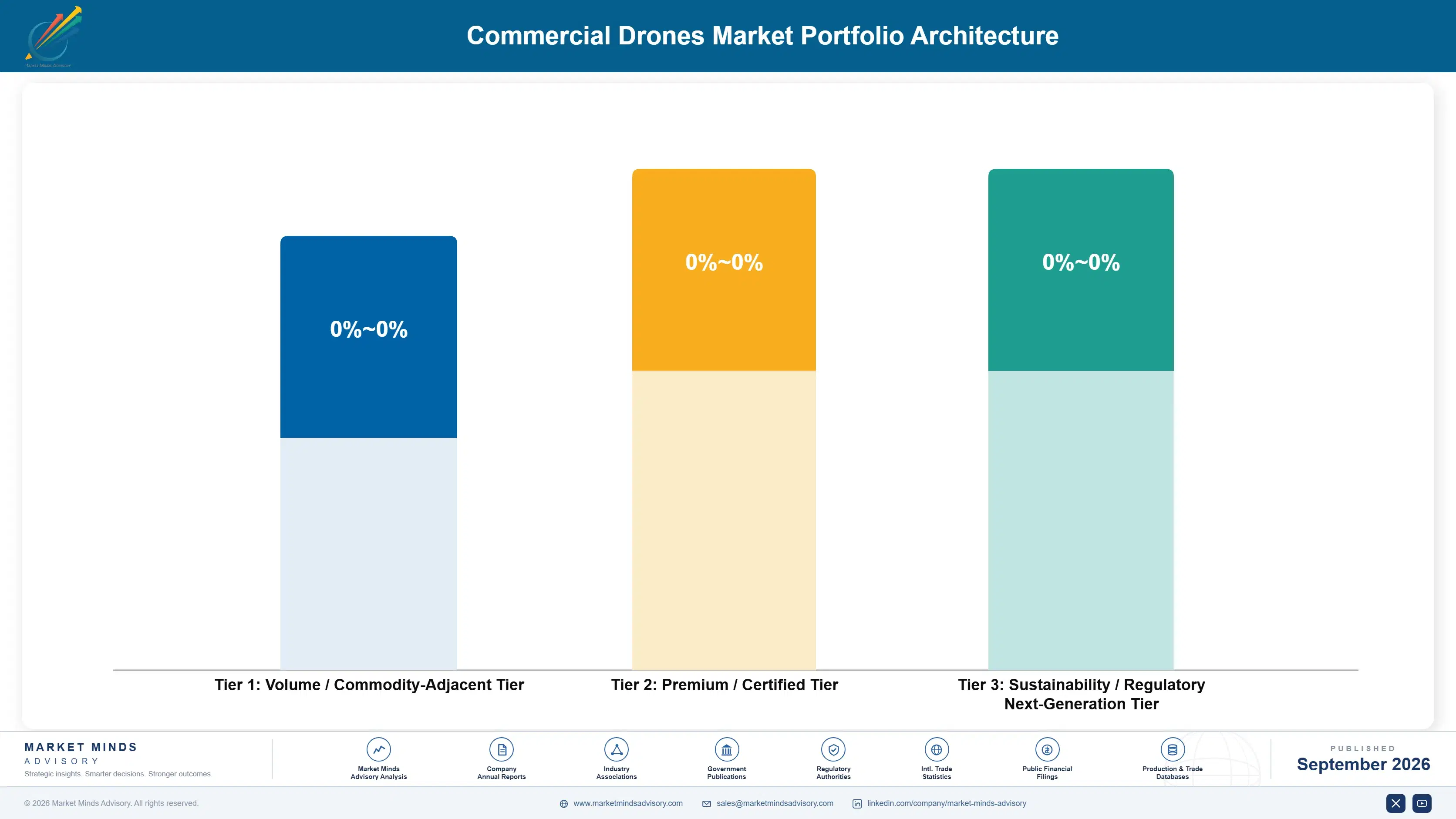
Three tiers structure the commercial drone market, separating volume-oriented mapping and inspection platforms from premium autonomous delivery and public safety systems carrying regulatory certification value. Gross margin ranges span roughly twenty points between the volume tier and the certified premium tier, reflecting how much value enterprise buyers place on autonomous flight software and regulatory compliance guarantees across critical operations and time-sensitive commercial applications.
Volume-tier shipments still dominate unit counts across routine mapping and surveying deployments, but premium autonomous delivery and public safety platforms capture a disproportionate share of vendor profit pools because enterprise and government buyers pay materially more for certified reliability during regulated operations. This tension shapes vendor product roadmaps directly, pushing established players toward higher-margin certified platforms and away from commodity hardware alone as competition intensifies across the volume tier.

High-value margin pools concentrate specifically around autonomous flight software bundled with fleet management subscriptions, since enterprise buyers increasingly value the recurring analytics and compliance reporting these platforms generate over simple hardware unit sales alone, a pattern accelerating as fleet sizes grow and procurement teams shift toward total cost of ownership evaluation frameworks across most enterprise categories.

Volume / Commodity-Adjacent Tier

Standard mapping, surveying, and basic inspection drones sold largely on price and delivery speed against established regional competitors across mature national markets and secondary enterprise procurement tenders open to multiple bidders.
Gross Margin: 26 to 33%

Premium / Certified Tier

Public safety and autonomous delivery systems carrying regulatory certifications, commanding materially higher prices from operators requiring guaranteed autonomous flight reliability for beyond-visual-line-of-sight operations across regulated commercial delivery and inspection corridors.
Gross Margin: 40 to 48%

Sustainability / Regulatory / Next-Generation Tier

Solid-state battery and hydrogen fuel cell hybrid platforms aligned to emerging enterprise sustainability procurement mandates and long-term fleet operating cost reduction targets across large operator groups and government agencies alike.
Gross Margin: 44 to 53%
commercial-drones-market-portfolio-architecture-1790001936871

High-value Sub-segments and Strategic Watch-out

Autonomous Delivery Platforms

Combines the fastest unit growth with the richest margin profile as retailers and medical distributors pair delivery hardware with subscription-based fleet management software, creating durable recurring revenue streams beyond the initial hardware sale itself and locking customers into multi-year platform relationships across expanding delivery corridors.
Gross Margin: 45 to 53%

Public Safety Response Systems

Commands strong margins from police, fire, and emergency medical agencies seeking certified reliability across regulated operating corridors, though growth trails the fastest delivery segment by a moderate but consistent margin across most municipal budget cycles and departmental procurement timelines nationwide and across allied metro jurisdictions.
Gross Margin: 38 to 46%

Standard Mapping and Inspection Drones

Remains the volume core of the market, anchoring unit shipments across routine construction and agricultural inspection deployments even as margin pressure intensifies from regional low-cost competitors expanding aggressively into adjacent markets and secondary enterprise procurement tenders across multiple continents and several fast-growing emerging economies worldwide.
Gross Margin: 26 to 32%

Legacy Manual-Pilot Fleet Replacement

Warrants close monitoring as aging manually piloted fleets approach replacement age, creating a swing factor that could either sustain volume-tier demand or accelerate migration toward autonomous platforms entirely across enterprise buyers nationwide over the coming several years of the current forecast planning and budget period.
Gross Margin: 24 to 30%

Fleet Contracts as Recurring Infrastructure

Commercial drones increasingly function as long-lived fleet infrastructure rather than one-time equipment sales, generating recurring maintenance, software licensing, and eventual replacement revenue across a typical five to seven year service life. Enterprise buyers rarely swap vendors mid-fleet given the integration cost of retraining pilots and reconfiguring fleet management software, giving incumbent vendors durable annuity-like revenue once a fleet contract is won.
Adoption stickiness varies meaningfully by end-use vertical. Public safety agencies exhibit the deepest lock-in given multi-year budget cycles and departmental training investment, while construction and agriculture buyers switch more readily since their deployments are smaller and carry lower integration complexity across seasonal operating cycles. Logistics and delivery operators sit between these two, valuing reliable vendor relationships but retaining flexibility as beyond-visual-line-of-sight approvals open new competitive alternatives.

Buyer profiles are shifting generationally as fleet operations teams increasingly favor autonomous platforms offering minimal on-site staffing over legacy manually piloted aircraft requiring dedicated licensed operators for every mission. Younger fleet management teams entering enterprise organizations expect the same remote monitoring capability common across other industrial equipment categories, gradually reshaping vendor selection criteria toward platforms bundling autonomy and analytics alongside core hardware.
commercial-drones-market-end-use-penetration-index-1790001937378

Where Enterprise Drone Value Concentrates Next

These are among the four positions where our research anticipates prominent divergence between winners and laggards over the coming forecast period. Each is grounded in the demand model, the regulatory perimeter, and the announced capacity pipeline.
01 / AUTONOMOUS SOFTWARE INVESTMENT

Prioritize autonomous flight software over airframe features

Vendors still competing primarily on airframe specifications face compressing margins as manufacturing scale advantages accrue disproportionately to the largest producers with the deepest component purchasing volume. Reallocating engineering investment toward autonomous flight software and obstacle avoidance capability captures the disproportionate profit pool tied to beyond-visual-line-of-sight certification requirements now determining contract eligibility across delivery and inspection segments alike. Firms that delay this shift risk ceding the highest-margin delivery and inspection contracts to faster-moving software-focused rivals within the next several years of the forecast window.
02 / BATTERY SUPPLY RESILIENCE

Lock in multi-year lithium battery cell agreements

Battery cell exposure remains concentrated among a small group of Chinese and Korean suppliers, leaving vendors without long-term agreements vulnerable during future capacity shortages tied to competing electric vehicle and energy storage demand across multiple industries simultaneously. Securing multi-year fixed-price cell contracts protects production schedules against the kind of margin compression seen during the 2025 demand spike, when several vendors absorbed higher costs for two consecutive fiscal quarters rather than pass them through. This single step meaningfully reduces earnings volatility tied to component pricing swings ahead.
03 / GEOGRAPHIC MARKET PRIORITIZATION

Prioritize North America and India expansion investment

North America anchors regional volume through mature beyond-visual-line-of-sight regulatory clearance, while India's faster growth trajectory reflects an earlier stage of agricultural and infrastructure investment across its enterprise sector and government subsidy programs supporting rural farm mechanization and modernization. Vendors that establish local assembly or service partnerships in these regions gain meaningful cost and delivery advantages over competitors shipping from more distant production bases across other continents entirely. This positioning matters increasingly as buyers favor suppliers who can meet compressed deployment timelines reliably.
04 / RECURRING REVENUE MONETIZATION

Build recurring revenue through fleet management subscriptions

Bundling autonomous flight software with subscription-based fleet management and analytics services creates a recurring revenue stream that hardware sales alone cannot replicate across a vendor's installed customer base and multi-year service contracts spanning several years at once. Vendors making this transition report materially stronger blended margins than peers still selling standard drones as one-time hardware transactions, and several have begun restructuring sales compensation plans around subscription attachment rates. Building this capability now positions vendors well ahead of the broader industry shift toward subscription-based fleet management practices.

Engagement Snapshot From the Field

A live engagement with an industry participant carrying material or product regulatory and market exposure ahead of a defining policy shift, showing how our research translates into a defensible multi-year portfolio strategy.
MARKET MINDS ADVISORY · CLIENT ENGAGEMENT SUMMARY
Commercial Drones Producer Strategic Portfolio Review and Transition Roadmap 2026·Investment Scenario on Commercial Drones Exposure Evaluation 2025-26
CLIENT PROFILE
A regional electric utility operating transmission infrastructure across a mid-sized North American service territory approached MMA to evaluate autonomous drone inspection as a replacement for its existing manned helicopter inspection program. The utility maintained roughly 4,200 miles of transmission line requiring quarterly visual inspection, with rising helicopter charter costs and crew scheduling constraints increasingly limiting inspection frequency across its most remote corridor segments.
STRATEGIC CHALLENGE
The utility faced a choice between incrementally supplementing helicopter inspections with drone pilots or committing capital to a broader autonomous docking network capable of unattended operation across its full service territory. Internal teams disagreed on which approach better balanced near-term capital constraints against the inspection frequency regulators increasingly expected utilities to maintain across aging infrastructure.
MMA APPROACH
MMA conducted primary interviews with utility operations executives and reviewed autonomous docking vendor specifications against the utility's transmission corridor map and existing helicopter inspection cadence. The team modeled inspection coverage and cost under three deployment scenarios, benchmarking projected costs and coverage against comparable utility modernization programs across similar regional service territories.
KEY FINDINGS
  1. Roughly thirty-five percent of transmission corridors sat within viable range of an autonomous docking network deployment given current battery endurance limits and terrain constraints.
  2. Autonomous docking deployment on the highest-risk twenty-five percent of corridors delivered the strongest inspection frequency gain relative to capital committed (client-reported, unverified by MMA).
  3. Phased deployment reduced peak capital outlay by roughly twenty-six percent compared to a single simultaneous network-wide rollout across the full service territory (client-reported, unverified by MMA).
  4. Vendor consolidation to a single primary docking supplier reduced projected integration and maintenance costs across the utility's field service organization and technician training programs meaningfully.
CLIENT PROFILE
A regional electric utility operating transmission infrastructure across a mid-sized North American service territory approached MMA to evaluate autonomous drone inspection as a replacement for its existing manned helicopter inspection program. The utility maintained roughly 4,200 miles of transmission line requiring quarterly visual inspection, with rising helicopter charter costs and crew scheduling constraints increasingly limiting inspection frequency across its most remote corridor segments.
STRATEGIC CHALLENGE
The utility faced a choice between incrementally supplementing helicopter inspections with drone pilots or committing capital to a broader autonomous docking network capable of unattended operation across its full service territory. Internal teams disagreed on which approach better balanced near-term capital constraints against the inspection frequency regulators increasingly expected utilities to maintain across aging infrastructure.
MMA APPROACH
MMA conducted primary interviews with utility operations executives and reviewed autonomous docking vendor specifications against the utility's transmission corridor map and existing helicopter inspection cadence. The team modeled inspection coverage and cost under three deployment scenarios, benchmarking projected costs and coverage against comparable utility modernization programs across similar regional service territories.
KEY FINDINGS
  1. Roughly thirty-five percent of transmission corridors sat within viable range of an autonomous docking network deployment given current battery endurance limits and terrain constraints.
  2. Autonomous docking deployment on the highest-risk twenty-five percent of corridors delivered the strongest inspection frequency gain relative to capital committed (client-reported, unverified by MMA).
  3. Phased deployment reduced peak capital outlay by roughly twenty-six percent compared to a single simultaneous network-wide rollout across the full service territory (client-reported, unverified by MMA).
  4. Vendor consolidation to a single primary docking supplier reduced projected integration and maintenance costs across the utility's field service organization and technician training programs meaningfully.
RECOMMENDED STRATEGY
Phase 1: Phase one prioritized autonomous docking deployment across the highest-risk twenty-five percent of transmission corridors facing the most frequent historical outage events. Phase 2: Phase two extended docking coverage to secondary corridors as battery endurance and detect-and-avoid software matured across the broader service territory. Phase 3: Phase three consolidated helicopter inspection to only the most remote corridor segments that remained beyond the current autonomous docking network's effective range.
OUTCOME
The utility adopted the phased autonomous docking approach, reporting a twenty-six percent reduction in peak capital outlay against its original network-wide rollout budget (client-reported, unverified by MMA). Inspection frequency across priority corridors increased to the utility's target quarterly cadence within the first year of phased deployment.

Frequently Asked Questions

Foundational context covering the market sizes, CAGR, scope, country, region and competition that inform every finding below. This section is provided to cover basics and most often pre-purchase conversations, answered from the MMA Primary Research Dataset.

What is the current size of the Commercial Drones Market?

The commercial drones market reached an estimated 14.8 billion dollars globally in 2025. Growth reflects accelerating enterprise adoption across construction, agriculture, public safety, and delivery applications worldwide.

How large will the Commercial Drones Market be by 2036?

MMA projects the market will reach roughly 48.5 billion dollars by 2036 under the base case scenario. That reflects nearly a tripling of 2026 revenue over the eleven-year forecast window.

What is the CAGR for the Commercial Drones Market 2026 to 2036?

The base case compound annual growth rate is 11.4 percent across the forecast period. Bull and bear scenarios range from 10.2 percent to 12.6 percent depending on regulatory approval pace.

Which segment is growing fastest?

Logistics and Delivery leads growth at a 15.5 percent CAGR, roughly 1.36 times the overall market rate. Expanding beyond-visual-line-of-sight authorizations and retail partnerships drive this accelerating pace.

Who are the major companies in the Commercial Drones Market?

DJI, Parrot, Skydio, Autel Robotics, and Zipline International lead the competitive landscape. Combined, the top five players hold an estimated 46 percent share on a revenue basis.

Which country is growing fastest?

India leads country-level growth at a 14.1 percent CAGR, outpacing the global average as agricultural and infrastructure investment accelerates. Government subsidy programs supporting rural mechanization contribute meaningfully to this pace.

Report Segmentation Architecture

The full report scope spans multiple orthogonal segmentation dimensions, with cross-tabulated demand data provided for each dimension pair. Coverage extends further to regional breakdowns, trend trajectories, and the competitive detail needed to support segment-level decision-making.

By Primary Market Dimension

  • Multi-Rotor Platforms
  • Fixed-Wing Platforms
  • Hybrid Vertical Takeoff Platforms
  • Autonomous Flight Software
  • Payload Sensor Systems
  • Docking and Charging Infrastructure

By End-Use Industry

  • Agriculture and Precision Farming
  • Construction and Infrastructure
  • Public Safety and Emergency Services
  • Logistics and Retail Delivery
  • Utilities and Energy
  • Media and Entertainment Production

By Commercial Dimension

  • Direct Enterprise Procurement
  • Systems Integrator Channel
  • Drone-as-a-Service Providers
  • Government and Municipal Tender
  • Leasing and Fleet Financing
  • Aftermarket Maintenance and Support

By Region

  • North America
  • Western Europe
  • East Asia
  • South Asia and Pacific
  • Latin America
  • Middle East and Africa
  • Eastern Europe

Scope, Methodology, and Coverage

Every figure in this report is reproducible from documented input assumptions. The scope below maps the historical period, the forecast horizon, the segmentation dimensions, and the countries covered, alongside the underlying primary and qualitative methodology.
Historical Period
2020 to 2025
Forecast Period
2026 to 2036
Base Year
2025 (USD billions; MMA Primary Research Dataset, September 2026)
Market Definition
The commercial drones market covers unmanned aerial vehicle platforms, autonomous flight software, and payload systems sold for enterprise, government, and commercial service applications including agriculture, construction, inspection, public safety, and delivery. It excludes consumer and hobbyist drones, military and defense platforms, and standalone drone-as-a-service subscription revenue not tied to hardware sales.
Quantitative Units
USD Billion
Segmentation Dimensions
Application, End-Use Industry, Commercial Channel, Region
Regions Covered
North America, Western Europe, East Asia, South Asia and Pacific, Latin America, Middle East and Africa, Eastern Europe
Countries Covered
United States, Canada, Germany, United Kingdom, France, China, Japan, South Korea, India, Australia, Brazil, Mexico, Saudi Arabia, United Arab Emirates, Poland
Key Companies Profiled
SZ DJI Technology Co Ltd, Parrot SA, Skydio Inc, Autel Robotics Co Ltd, Zipline International Inc, AgEagle Aerial Systems Inc, Wingtra AG, PrecisionHawk Inc, Matternet Inc, Flytrex Aviation Ltd, Percepto Robotics Ltd, Teledyne FLIR LLC, Quantum Systems GmbH, Delair SAS, Terra Drone Corporation, Draganfly Inc, XAG Co Ltd, Yuneec International Co Ltd, Wingcopter GmbH, Aerialtronics BV
Quantitative Methodology
Primary survey, n=3,800 respondents, Q4 2025, six countries; demand-side model with trade association cross-validation
Qualitative Methodology
47 expert interviews, Q4 2025; applied to validate demand model assumptions, identify emerging dynamics, and assess competitive positioning
Report Format
PDF and XLSX data workbook (Word format preview document)
Publisher
Market Minds Advisory
Report Code
MMA-2026-TEC-495
Published
September 2026
Contact
sales@marketmindsadvisory.com | www.marketmindsadvisory.com

Purchase the full Commercial Drones Market Report (2026 to 2036).

This report delivers a comprehensive analysis of the global commercial drones market across the 2026 to 2036 forecast period. It covers market sizing, segmentation by application and end-use industry, and regional demand dynamics across all seven major world regions. The report profiles twenty leading vendors, benchmarks competitive positioning, and quantifies input cost exposure tied to battery cell and sensor supply chains. Analysts detail revenue diversification strategies, portfolio margin economics, and the demand mechanisms shaping enterprise procurement decisions through the coming decade. A dedicated client case study illustrates how these findings translate into practical fleet modernization decisions.
Seven-region demand and CAGR breakdown analysis
Twenty-company competitive benchmarking and positioning profile
Revenue lever and monetization pathway analysis
Input cost exposure and mitigation strategies
Segment-level growth and margin forecasting detail
Client engagement case study with outcomes

Built For The People Who Decide

From boardroom strategy to bench-side execution, this report is read cover-to-cover by leaders shaping the next decade of their industry, turning demand scenarios, market dynamics and valuation benchmarks into decisions.
CXOs/ Presidents/ VPs/ Managers
M&A and Corporate Development
Strategy Teams and R&D Heads
Procurement and Product Directors
Regulatory and Compliance Leaders
Investor Relations and Equity Analysts