Market Minds Advisory
Commercial Aircraft Landing Gear Market

Commercial Aircraft Landing Gear Market: Commercial Aircraft Landing Gear: Forging Capacity, Overhaul Intervals And The Two Suppliers Every Programme Depends On

Two companies design most of the landing gear flying on Western commercial aircraft, and the bottleneck underneath both of them is a handful of forging presses nobody has built since the seventies.

Lead Analyst

Published

September 2026

Make Smarter Decisions with Customized Research Insights

Request a free sample report and evaluate market opportunities, growth trends, and competitive dynamics relevant to your business needs.

2025 MARKET VALUE$9.4BMarket Size 2025
2036 FORECAST VALUE$17.1BBase Case , 2026 to 2036
CAGR 2026 TO 20365.6 %Bull 6.8% / Bear 4.4%
INCREMENTAL OPPORTUNITY$7.2BNet 10- year value creation
EXPANSION MULTIPLE1.72x2036 value over 2026 base
Strategic Levers
M&A Pipeline
Regional Outlook
Country Rankings
Competitive Intelligence
Segmental Deep-dive
Call-Us : 91 93563 13602

Executive Snapshot and Market Trajectory.

Two designers hold most of the Western commercial fleet between them. Underneath both sits a supply chain of large forgings and specialty steel with very few qualified producers, and no amount of programme urgency creates press capacity that does not exist. Urgency does not forge steel.
Overhaul, exchange and life extension services grow fastest at 8.4%, because operators keeping aircraft longer are reaching gear overhaul intervals that fleet renewal used to skip. A gear shop visit costs a substantial fraction of a new shipset and recurs every ten to twelve years. Aftermarket now carries 54% of revenue, which is a higher share than almost anywhere in aerostructures. That share is considerably higher than most observers of this market assume.
Concentration is extreme at 71% and the barriers are metallurgical rather than commercial. Qualifying a landing gear requires fatigue testing across years, forging supply nobody else can obtain, and a certification basis specific to each airframe. Nothing about that yields to capital, and no serious new entrant has appeared in three decades. Capital has never been the obstacle, and everybody who tried discovered that in the same expensive order.
Market Definition
Revenue from landing gear systems for commercial aircraft, covering main and nose gear structural assemblies, wheels, brakes and braking control systems, actuation, retraction and steering systems, gear-mounted sensing and health monitoring, forgings, machining and specialty material supply, and overhaul, exchange and life extension services. Excludes military and rotorcraft landing gear, tyres, aircraft structure outside the gear attachment interface, and ground support equipment used for aircraft handling.
Base Year Value
$9.4B in 2025 (MMA Primary Research Dataset, August 2026)
Forecast Period
2026 to 2036, eleven discrete annual values
CAGR
5.6% base case. Bull 6.8%. Bear 4.4%.
Fastest Growth Segment
Overhaul, Exchange and Life Extension Services: 8.4% CAGR
Fastest Growth Country
India: 7.6% CAGR
Fastest Growth Region
South Asia and Pacific: 7.6% CAGR
Largest Region
North America: 30% of 2025 global value
Market Leaders
Safran Landing Systems, Collins Aerospace, Liebherr-Aerospace, Héroux-Devtek and Honeywell Aerospace lead on commercial landing gear system revenue. Source: company annual reports and MMA Primary Research Dataset, July 2026.
Primary Survey
n=3,800 procurement and R&D decision-makers, Q4 2025, six countries
Methodology
Demand-side build-up, cross-validated against public data, 47 expert interviews

Commercial Aircraft Landing Gear Market Forecast Scenarios

commercial-aircraft-landing-gear-market-size-forecast-scenario-1788025448067
The 2020 to 2025 period showed how differently the two halves of this market behave. New shipset deliveries collapsed with production rates and recovered slowly, while overhaul demand held up because aircraft that stopped flying still reached calendar-driven gear intervals. Forging supply constraints emerged during the recovery and have not eased since. Revenue compounded near 4.5%, with aftermarket carrying the period far more than original equipment did.
Three mechanisms carry the base case. Production rate recovery on single-aisle programmes drives shipset volume through the whole forecast period. Fleet retention rather than renewal pushes more aircraft through gear overhaul intervals they would previously have been retired before reaching. And braking system content per aircraft continues rising as electric braking replaces hydraulic architecture on newer programmes. None of the three depends on any new aircraft programme being launched anywhere at all.
The bull catalyst is a new single-aisle programme launch, which would set gear architecture and supplier position for two decades of production. The bear risk is forging supply: a single large press going down would constrain shipset deliveries across multiple programmes at once, and there is no alternative capacity anywhere to absorb it. There is no slack.

Everything Rests On Few Presses

Landing gear is the most highly loaded structure on an aircraft and it has to work every time. That produces a supplier base of two designers holding most of the Western fleet, and a certification burden running roughly 54 months from selection to a certified gear. Fatigue testing alone consumes years. Nothing in that sequence responds to money the way airframers hope it might.
MARKET CONCENTRATION CR571%Share of commercial landing gear revenue held by leading suppliers
AFTERMARKET REVENUE SHARE54%Portion of revenue from overhaul and exchange rather than delivery
GEAR OVERHAUL INTERVAL11 yearsTypical period between scheduled main gear shop visits
QUALIFIED FORGING SUPPLIERS6Producers worldwide able to supply large gear structural forgings
SHIPSET QUALIFICATION CYCLE54 monthsTypical time from selection to certified gear on programme
OVERHAUL COST RATIO38%Shop visit cost against the price of a new shipset
The genuine bottleneck sits further upstream than most people realise. Large gear structural forgings come from perhaps six qualified producers worldwide, using presses largely installed decades ago that nobody has replicated since. Specialty steel and titanium supply for those forgings is narrower still. A single press outage constrains shipset delivery across several programmes at once, and there is no spare capacity anywhere.
Aftermarket is where this business actually earns. Gear reaches scheduled overhaul roughly every eleven years, a shop visit costs around 38% of a new shipset, and 54% of revenue arrives through overhaul and exchange rather than delivery. Operators keeping aircraft longer are pushing more airframes through intervals that fleet renewal used to skip entirely. That demand is calendar-driven and largely indifferent to whatever production rates happen to be doing.
"You can order a new airframer programme into existence with enough money. You cannot order a forging press, and the ones this industry depends on were installed when the people running it were children."
Director, Aircraft Structures and Systems Practice · MMA Aerospace Systems and Equipment Practice · August 2026

Market Trends

Forging Capacity Became The Binding Constraint On Deliveries

Large gear structural forgings come from roughly six qualified producers worldwide operating presses largely installed decades ago, and demand recovery exposed how little slack exists across all of them. Shipset delivery schedules now track forging availability rather than machining or assembly capacity. Airframers have begun engaging forging suppliers directly rather than through gear designers, which is unusual and reflects genuine alarm. Nobody is building new presses, because the payback assumptions never work at these volumes. The delivery constraint sits two tiers above anybody who thinks they compete in this market.
Market Impact: Supplies 1 shipset per aircraft built
Fleet Retention Pushes Aircraft Through Intervals Renewal Used To Skip

Operators keeping aircraft eighteen to twenty-two years rather than replacing them earlier are reaching main gear overhaul at around eleven years for a second time, on airframes that a decade ago would have been retired instead. Each shop visit costs roughly 38% of a new shipset. That converts a demand stream that used to end at first overhaul into one that recurs, and it is why aftermarket now carries 54% of revenue across this market. A demand stream that used to end has become one that repeats more or less indefinitely.
Market Impact: Adds 14% content per shipset

Market Opportunities and Growth Drivers

Single Aisle Production Rate Recovery Drives Shipset Volume

Narrowbody programmes returning toward and beyond pre-downturn build rates carry gear shipset demand with them directly, since every aircraft needs one and there is no substitution available anywhere. The volumes are large, the schedules are published years ahead, and the supplier positions were settled at programme launch decades ago. What limits realisation is forging supply rather than demand. Gear suppliers have spent this period constrained by their own upstream rather than by any order book. Order books have not been the problem in this market for several years now at all.
Market Impact: Limits supply to 6 producers

Electric Braking Raises Content Per Aircraft Steadily

Electrically actuated braking replacing hydraulic architecture adds control electronics, actuation and monitoring content that hydraulic systems never carried, raising value per shipset without changing the number of aircraft built. Maintenance benefits from removing hydraulic distribution across the gear bay support the case commercially rather than technically. Newer programmes specify it from the outset and modification interest is growing. The content increase accrues to whoever holds the braking position rather than the structural one. Suppliers entirely absent from gear structure can still capture that additional content on exactly the same aircraft.
Market Impact: Requires 54 months to certify

Market Restraints and Challenges

Forging Supply Cannot Expand Within Any Useful Timeframe

Roughly six qualified producers supply large gear forgings using presses installed decades ago, and building a new one takes years and capital that these volumes have never justified. The root cause is that press capacity was sized for a different industrial era and nobody has needed to replace it until now. Commercially it caps deliveries regardless of order book. Mitigation runs through near-net-shape processes reducing forging size, additive repair extending component life, and long-term capacity agreements with the producers who exist. None of those mitigations produces a press that does not exist.
Market Impact: Depends on 6 qualified producers

Certification Burden Excludes Every Potential New Entrant

Roughly 54 months from selection to certified gear, with fatigue testing consuming years of that, means a supplier funds development long before revenue arrives and against an airframe-specific certification basis. The root cause is that landing gear failure is not survivable and the authorities treat it accordingly. Commercially it produces a two-designer market that no capital has entered in three decades. Mitigation runs through subsystem supply to incumbents, overhaul and exchange work, and regional programmes with lower barriers to qualification. Every one of those routes accepts somebody else's certification basis as given.
Market Impact: Recurs every 11 year interval
4 additional market trends, 3 additional growth drivers, and 2 additional restraints and challenges are covered in the full report. Contact sales@marketmindsadvisory.com to access the complete intelligence.

Segment CAGR and Growth Architecture

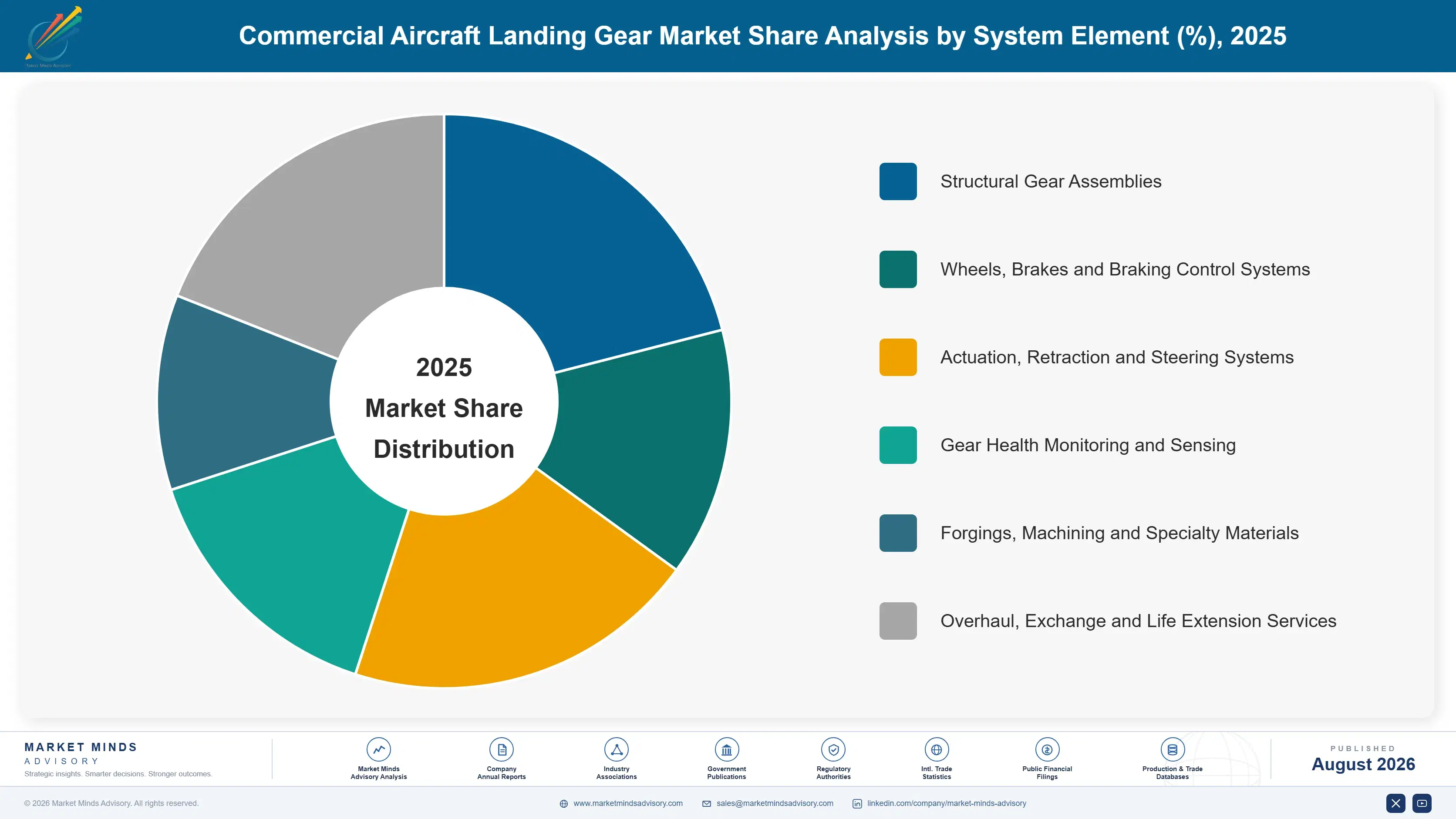
Segmentation follows system element, because structure, braking, actuation, materials and services carry different qualification paths, different suppliers and entirely different economics. Six elements describe the market completely, from structural assemblies where two designers hold nearly everything through to overhaul services where the recurring money and the growth both quite plainly sit at the moment.
commercial-aircraft-landing-gear-market-market-share-analysis-1788025448624

Overhaul, Exchange and Life Extension Services

The fastest element grows at 8.4%, half again the market rate of 5.6%, and fleet behaviour rather than technology explains all of it. Operators keeping aircraft eighteen to twenty-two years reach main gear overhaul at around eleven years for a second time on airframes that would previously have been retired first. A shop visit costs roughly 38% of a new shipset, which makes this genuinely large money rather than a service line. Aftermarket now carries 54% of total market revenue. The demand is calendar-driven, largely indifferent to production rates, and considerably more profitable than delivering new shipsets ever was. Nothing about that pattern depends on what the airframers happen to build next.
CAGR 8.4%

Wheels, Brakes and Braking Control Systems

Braking systems grow at 7.1% on two mechanisms working together rather than one. Electric actuation replacing hydraulic architecture raises content per shipset by around 14% through control electronics, actuation and monitoring that hydraulic systems never carried at all. Underneath that, carbon brake discs are consumable and replaced on a landing cycle count rather than a calendar, which produces steady recurring demand entirely independent of any structural work. The competitive position here is separate from gear structure, and several suppliers hold strong braking content on programmes where they supply no structural assemblies whatsoever. Content that rises without the aircraft count rising is unusually valuable in a market growing at just 5.6% overall.
CAGR 7.1%
Full segment breakdown across 6 segments available in the complete report.

Regional Architecture and Country Demand Map

Landing gear capability follows programme participation and metallurgical infrastructure rather than aircraft operation. Western Europe and North America hold design authority, with East Asia expanding on manufacture and overhaul and South Asia growing fastest from a small engineering base. Metallurgy explains more than geography does.

North America

The largest share at 30% rests on braking system leadership, overhaul capacity and a substantial share of the qualified forging base that everything else depends on. Collins and Honeywell hold braking content across programmes where structural design authority sits elsewhere entirely. Overhaul capacity here serves the largest single fleet and generates the recurring revenue that carries this market. Specialty steel and titanium supply for gear forgings concentrates here to a degree that constrains programmes on other continents. Material supply is the part of this position that matters most and gets discussed least, because a programme anywhere in the world can be constrained by an allocation decision taken here, quietly and without notice.
Share: 30% | CAGR: 5.8% (2026 to 2036)

Western Europe

Structural design authority concentrates here more heavily than in any other region, with Safran and Liebherr holding gear positions across essentially every European programme and several American ones. Forging capacity exists but is narrow, and European programmes compete for the same presses that supply everybody else. Overhaul networks are well established across the region. Research funding treating electric braking and health monitoring as decarbonisation and efficiency work has supported development that programme revenue alone would not have justified. Holding design authority without holding the forging capacity underneath it is an uncomfortable position, and European suppliers have spent the recovery period discovering exactly how uncomfortable it can become, at some cost.
Share: 26% | CAGR: 4.2% (2026 to 2036)
Regional intelligence for 5 additional markets available in the complete report: East Asia, South Asia and Pacific, Latin America, Middle East and Africa, Eastern Europe. Contact sales@marketmindsadvisory.com.
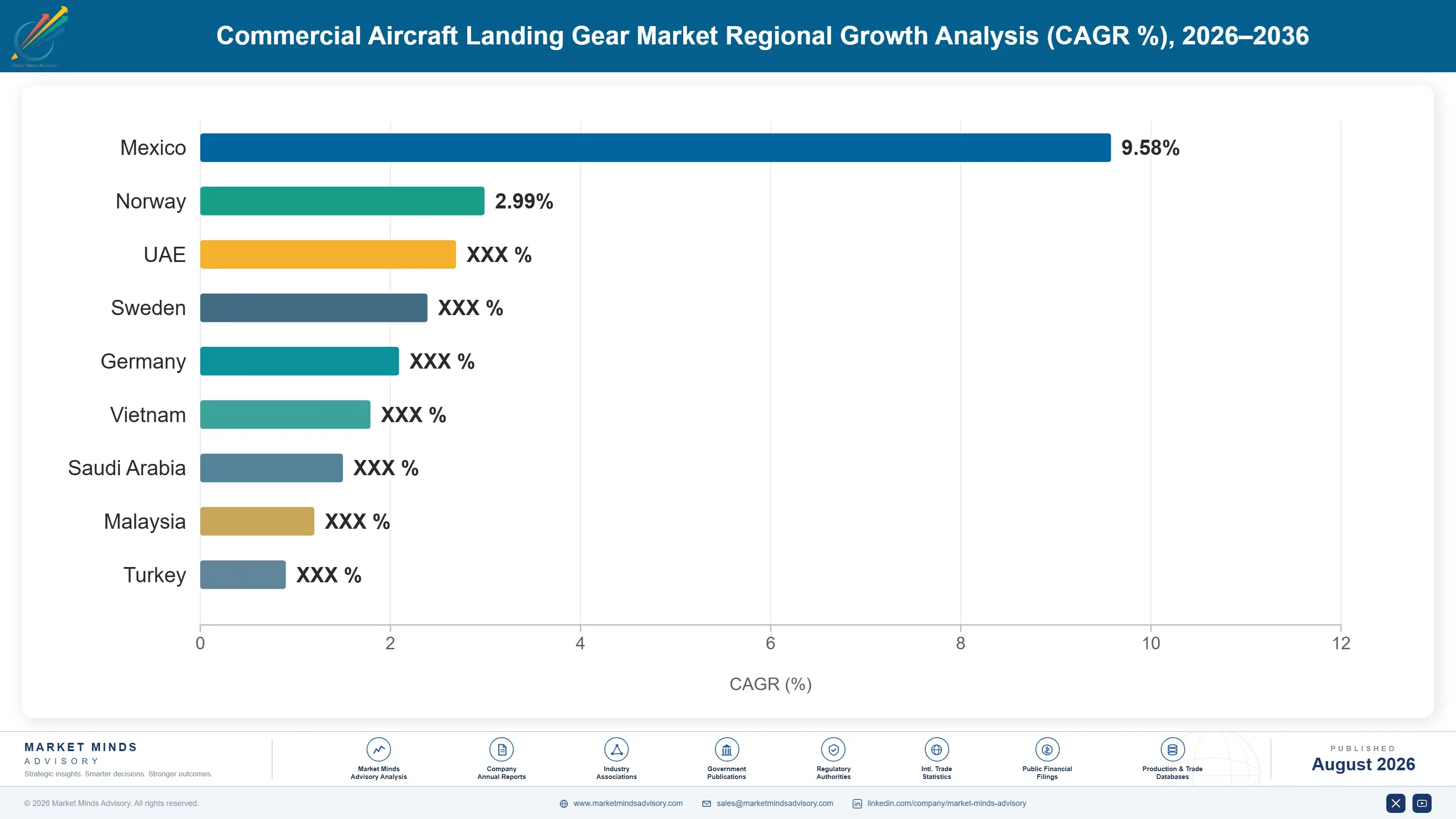
commercial-aircraft-landing-gear-market-country-cagr-analysis-1788025449147

Where Landing Gear Margin Sits

Four levers work on aftermarket capture, upstream security and content position rather than on structural design capability, which is settled and unlikely to move. Overhaul channel control, forging capacity agreements, braking content and life extension each address something a supplier can pursue immediately. None of the four requires winning a new structural design position anywhere.

Control The Overhaul Channel Rather Than Ceding It

Aftermarket carries 54% of market revenue at margins new shipsets never approach, and a shop visit costing roughly 38% of a new gear is placed wherever the operator finds capacity and approval. Designers who allow independent shops and operator facilities to capture that work surrender the most profitable part of their own product. Authorised networks with parts control and pricing discipline typically recover 15 to 22 percent of the value leaking outward. The work is commercial rather than technical. Operators would generally prefer authorised overhaul and are rarely offered it competitively.
Market Impact: Recovers roughly 18% of the leaking aftermarket value

Secure Forging Capacity Under Long Term Agreement

Roughly six qualified producers supply large gear forgings from presses nobody is replacing, and shipset delivery now tracks their availability rather than any downstream capacity. Long-term capacity agreements, prepayment and joint investment secure allocation that spot purchasing cannot obtain at any price during a constrained period. Suppliers without such agreements have missed delivery schedules for reasons entirely outside their own factories. The agreements take 2 years to negotiate and are worth considerably more than that delay suggests. A 2 year negotiation is nothing against a decade of constrained delivery performance.
Market Impact: Secures forging allocation from just 6 qualified producers

Build Braking Content Where Structure Is Closed

Structural design authority is settled across essentially every current programme and will not move, but braking systems are competed separately and carry content rising around 14% as electric actuation replaces hydraulic architecture. Carbon disc replacement on landing cycle count adds recurring consumable demand independent of any structural position. Suppliers locked out of structure entirely hold strong braking positions on the same aircraft. It is the only genuinely contestable content on most programmes today. Carbon discs are consumed on cycle count rather than replaced on a calendar, which is a better demand pattern than structure ever offers.
Market Impact: Adds roughly 14% more content to each shipset

Sell Life Extension Instead Of Replacement

Operators keeping aircraft eighteen to twenty-two years want gear life extended rather than replaced, and additive repair, advanced inspection and component-level refurbishment can extend service life by 6 to 8 years at a fraction of replacement cost. Suppliers who fear cannibalising new shipset sales are protecting a business that fleet retention has already reduced. The customer will buy life extension from somebody, and the designer holding the certification basis is best placed to sell it. Extending life by 7 years on a retained aircraft is worth more to the operator than a new shipset.
Market Impact: Extends gear service life by roughly 7 years

Who Controls the Margin Pool

Concentration is very high at around 71% across the five largest participants measured on commercial landing gear system revenue, and it reflects metallurgical and certification barriers rather than any commercial consolidation. Two designers hold most Western structural positions. Braking, actuation and monitoring content is competed more openly, which is why suppliers absent from structure still hold meaningful positions on the same aircraft.
Competition runs on qualification position, upstream security and aftermarket control. Qualification position is effectively settled on current programmes and only reopens at a new launch. Upstream security has become decisive because forging availability rather than order book now governs delivery. Aftermarket control decides profitability, since 54% of revenue arrives through overhaul and much of it can be captured by others.

Pressure is arriving from the aftermarket rather than from new manufacturers. Independent overhaul shops, operator facilities and parts manufacturers approved outside the original designer compete for the most profitable revenue in this market. Airframers meanwhile are engaging forging suppliers directly. Rankings will shift toward suppliers combining secured upstream capacity with genuine aftermarket channel control, since delivery and profitability now depend on those rather than on design.
commercial-aircraft-landing-gear-market-company-positioning-matrix-1788025449665

Competitive Moat and Risk Dimensions

SAFRAN LANDING SYSTEMS

Moat: Structural authority across major programmes

Safran holds landing gear structural design authority across a large share of the Western commercial fleet, and those positions persist for the full production run, because requalification costs roughly 54 months nobody funds twice. Integrated braking and structure capability lets it bid at system level. The certification barrier that protects it has admitted no new entrant in three decades.
SAFRAN LANDING SYSTEMS

Risk: Upstream forging dependence beyond control

Delivery performance now depends on forging producers numbering roughly six worldwide, operating presses nobody is replacing, and a single outage constrains shipsets across programmes regardless of downstream capacity. Customers experience the shortfall as a supplier failure whatever its actual cause. Securing allocation requires capital commitment and negotiation measured in years.
COLLINS AEROSPACE

Moat: Braking content and aftermarket reach

Collins holds wheel and braking positions across programmes where structural design authority sits with competitors, which is the most contestable and fastest growing content on most aircraft. Carbon disc replacement on landing cycle count produces recurring consumable demand independent of any structural position. Its aftermarket network reaches operators directly rather than through the gear designer.
COLLINS AEROSPACE

Risk: Excluded from structural design positions

Structural authority is settled across current programmes and reopens only at a new launch, which may be years away and will be contested by incumbents holding decades of certification history. Braking content is valuable and smaller than structure. Electric braking advantage may also narrow as competitors qualify comparable architectures on later programmes.

Players Tracked

Prominent Players

Safran Landing Systems
Collins Aerospace
Liebherr-Aerospace
Héroux-Devtek
Honeywell Aerospace

Other Key Players

Sumitomo Precision Products
Meggitt
Parker Aerospace
Triumph Group
Eaton
Crane Aerospace and Electronics
Magellan Aerospace
Whippany Actuation Systems
Aequs
Aubert et Duval
ATI Specialty Materials
Precision Castparts
Kawasaki Heavy Industries
AVIC Landing Gear Advanced Manufacturing
SIA Engineering Company

Recent Developments

JULY 2024

Airframer engaged forging suppliers directly on capacity allocation

An airframer began engaging large forging producers directly on capacity allocation rather than working solely through gear designers, responding to shipset delivery schedules constrained by upstream availability rather than by assembly capacity. This was a supply chain management decision rather than any acquisition, merger or joint venture between the parties.
Signal: Airframers reaching past their own suppliers to forging producers signals genuine alarm about upstream capacity constraints.
JANUARY 2025

Gear supplier agreed long term forging capacity arrangement

A landing gear supplier agreed a multi-year capacity arrangement with a specialty forging producer, committing volume and prepayment in exchange for allocation certainty across a constrained period. This was a long-term supply agreement rather than an acquisition, merger or joint venture between the two companies concerned.
Signal: Capacity secured by commitment rather than by price shows how constrained this upstream supply actually is.
MAY 2025

Operator adopted life extension in place of gear replacement

A commercial operator adopted additive repair and component refurbishment to extend main gear service life rather than purchasing replacement shipsets, on aircraft retained beyond the age at which replacement was originally planned. This was an operator maintenance decision rather than any corporate transaction between the parties involved.
Signal: Life extension displacing replacement follows directly from operators keeping aircraft considerably longer than they once did.

What A Gear Shipset Costs

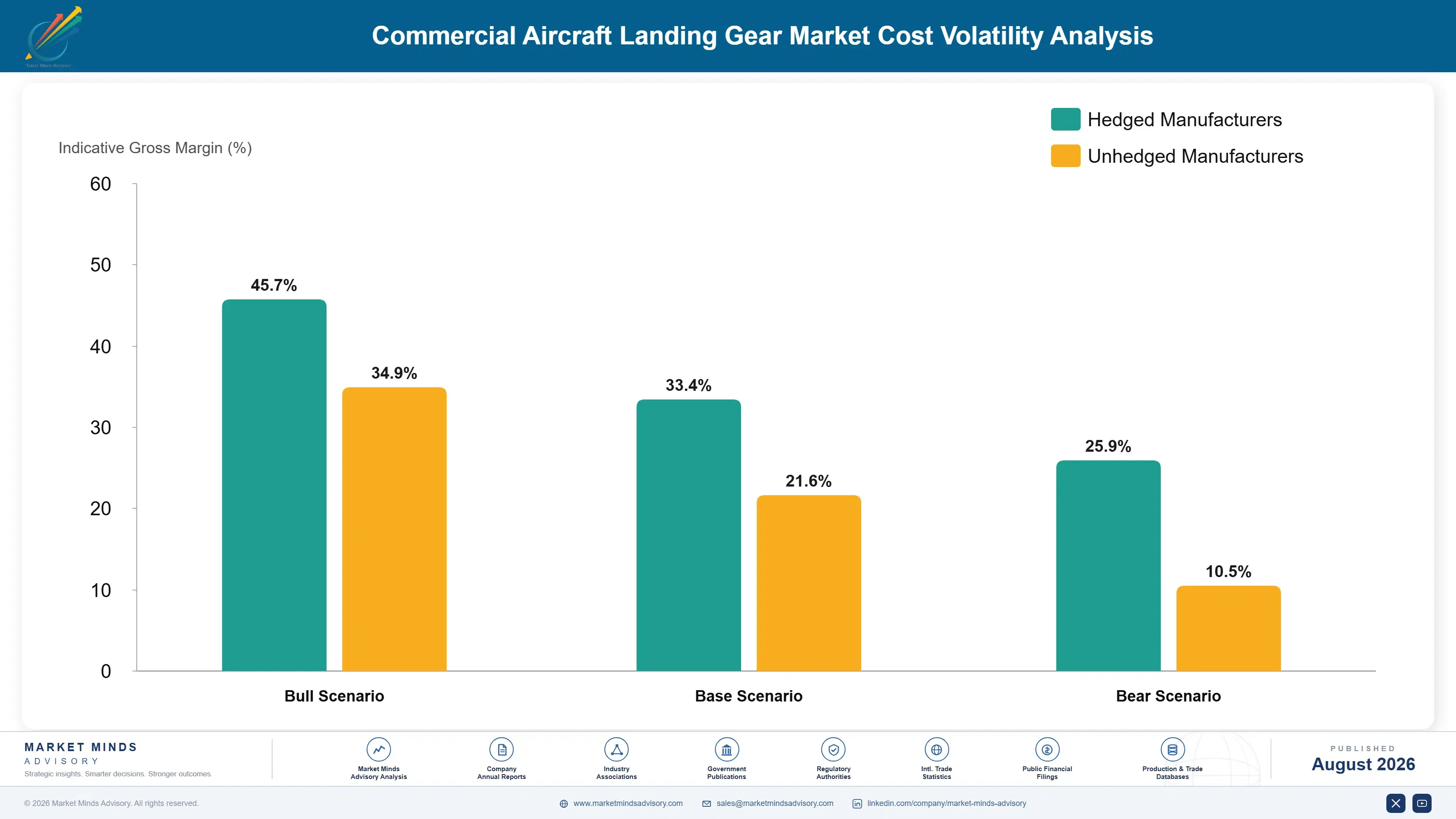
Cost divides four ways and raw material dominates far more than in most aerospace systems. Forgings, specialty steel and titanium absorb roughly 37% of shipset cost, machining and surface treatment near 26%, qualification and certification amortisation near 21%, and assembly with test the remaining 16%. Landing gear is essentially a metallurgy business wearing an aerospace systems label, which suppliers pricing on engineering content consistently misjudge.
Specialty steel and titanium pricing moved sharply across recent years and moved shipset economics with it, since qualified aerospace grades come from very few producers with no substitution available under any certification basis. Safran and Héroux-Devtek have both discussed material cost and supply conditions across recent reporting periods. Forging capacity constraint compounds it, because allocation now carries a premium that spot purchasing simply cannot overcome during constrained periods.

Exposure varies by contract structure rather than by geography. Suppliers holding long-term airframer agreements with material indexation pass movement through, while those on fixed-price terms absorb it entirely. Aftermarket-heavy suppliers recover cost across 54% of revenue that reprices more freely than original equipment does. Participants without overhaul positions carry material exposure against delivery pricing set years earlier and cannot recover any of it.
commercial-aircraft-landing-gear-market-cost-volatility-analysis-1788025449865

Material indexation negotiated into airframer agreements

Forgings, specialty steel and titanium absorb roughly 37% of shipset cost and price on cycles far shorter than the airframer agreements they sit inside. Indexation clauses transfer that movement rather than leaving suppliers to absorb it against pricing set years earlier. Airframers resist indexation and concede it when the alternative is a supplier unable to deliver at agreed rates.

Near net shape forging reducing material input volume

Machining a gear component from an oversized forging wastes expensive qualified material and consumes scarce press capacity producing metal that becomes swarf. Near-net-shape processes reduce both, though qualification takes time and the metallurgical case must be made carefully. Suppliers who invested in it early are consuming considerably less of a constrained forging supply than competitors are.

Aftermarket pricing freedom offsetting delivery cost exposure

Aftermarket carries 54% of revenue and reprices far more freely than original equipment agreements signed years earlier ever can. Suppliers holding overhaul channel control recover material cost movement there rather than absorbing it entirely on delivery. Participants who ceded aftermarket to independent shops have no such recovery available and carry the full exposure themselves.

Portfolio Architecture for Margin Defence

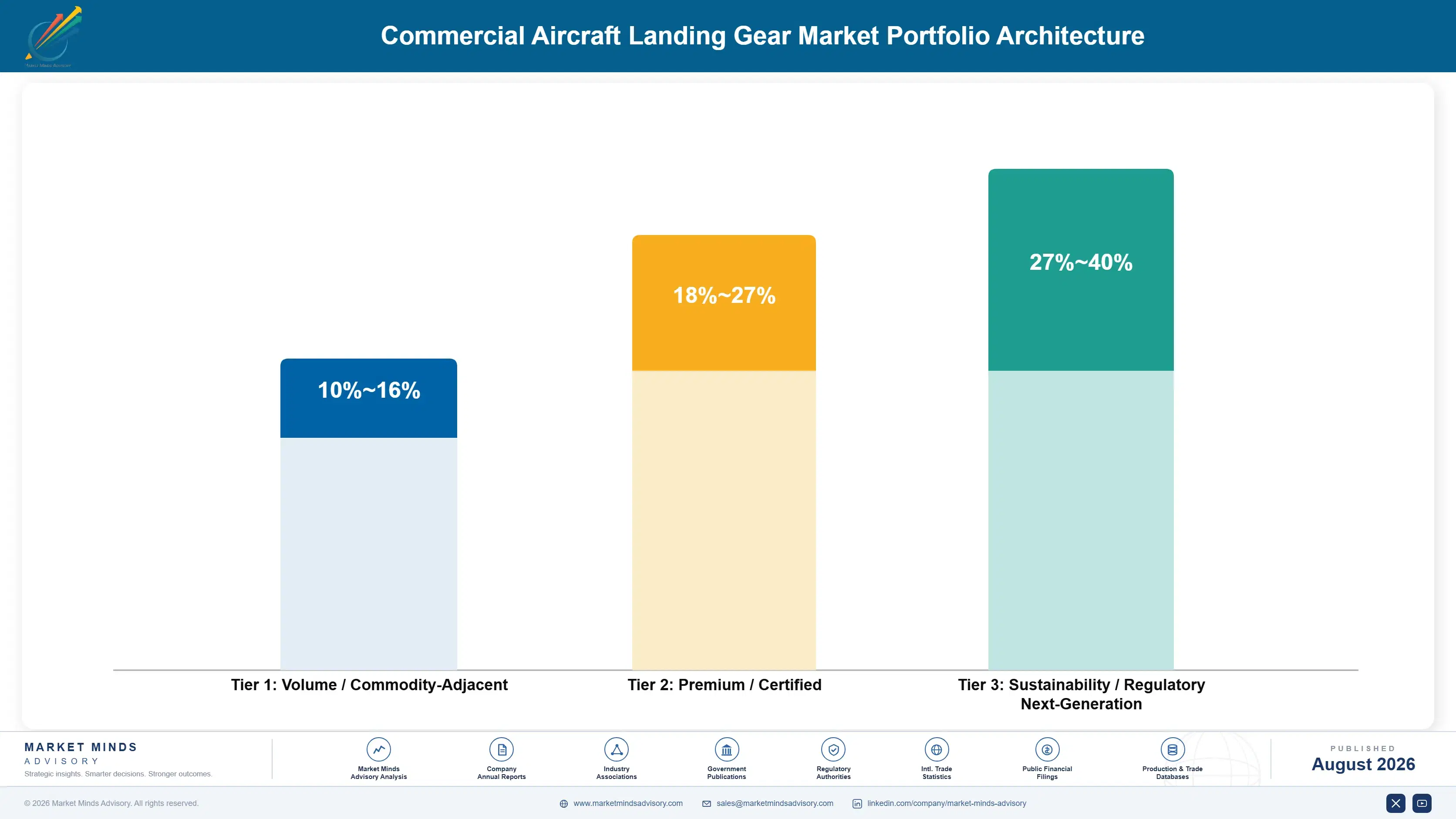
The portfolio separates by whether a position is settled or contestable. Structural assemblies are the largest revenue block and the least available: two designers hold most Western programmes, positions run for the full production life, and nothing reopens until a new aircraft launches. Enormous revenue, genuinely durable, and closed to anybody not already holding it. The two designers were chosen decades ago.
Margin concentrates in aftermarket and in braking. Overhaul carries 54% of revenue at margins delivery never approaches, and a shop visit at roughly 38% of a new shipset is large money placed wherever the operator finds capacity. Braking content is the one genuinely contestable element on current programmes, rising around 14% per shipset as electric actuation replaces hydraulic architecture. Both are worth more than the structure.

The overlooked pool is life extension. Operators keeping aircraft eighteen to twenty-two years want gear life extended rather than replaced, and additive repair with advanced inspection can add six to eight years. Designers fear cannibalising shipset sales that fleet retention has already reduced. Somebody will sell that work, and the holder of the certification basis is best placed to. Somebody will sell it either way.

Volume / Commodity-Adjacent

Component machining, surface treatment, subassembly and material supply into other participants' shipsets. Range spans six points because volume and process efficiency decide outcomes far more than any technical distinction does.
Gross Margin: 10-16%

Premium / Certified

Structural gear assemblies, actuation and retraction systems delivered as original equipment under airframer agreements. Range spans nine points because material indexation terms vary enormously between suppliers who negotiated them and those who did not.
Gross Margin: 18-27%

Sustainability / Regulatory / Next-Generation

Overhaul and exchange services, braking systems, health monitoring and life extension work. Range spans thirteen points because aftermarket channel control separates participants more sharply than any other factor here. Channel control decides everything.
Gross Margin: 27-40%
commercial-aircraft-landing-gear-market-portfolio-architecture-1788025450364

High-value Sub-segments and Strategic Watch-out

Overhaul, Exchange and Life Extension Services

High value and high growth at 8.4%, carrying 54% of market revenue on calendar-driven demand indifferent to production rates. The eleven point range separates designers holding authorised channel control from those whose work is captured by independent overhaul shops. Calendar intervals do not negotiate with anybody.
Gross Margin: 29-40%

Wheels, Brakes and Braking Control Systems

High value with moderate growth at 7.1%, and the only genuinely contestable content on most current programmes anywhere. The eight point range reflects carbon disc consumable positions, which produce recurring demand entirely independent of structural work. Content rises without the aircraft count rising at all.
Gross Margin: 25-33%

Structural Gear Assemblies

The largest revenue block and the least available to anybody not already holding it. Positions run for the full production life, reopen only at a new programme launch, and have admitted no new entrant anywhere in three decades. Nothing in this block is available to buy.
Gross Margin: 18-27%

Qualified Forging Capacity

The strategic watch-out rather than a growth pool. Roughly six producers operate presses nobody is replacing, delivery now tracks their availability rather than any order book, and a single outage constrains several programmes at once. Nobody is building replacement presses and nobody intends to start.
Gross Margin: Variable

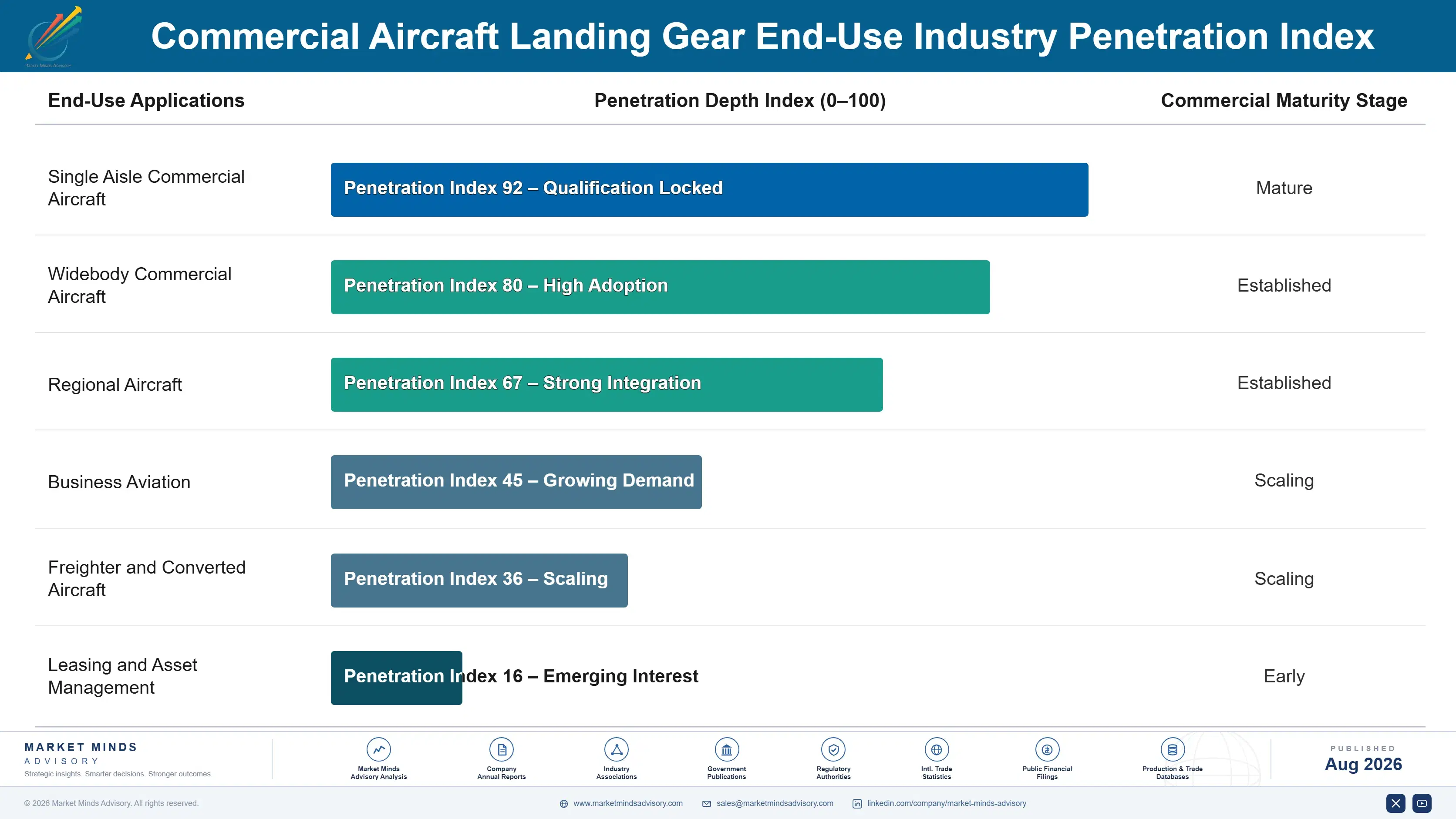
Why Gear Positions Never Reopen

A gear position produces annuity economics across an unusually long horizon. A supplier selected at programme launch delivers every shipset for twenty years of production and supports the fleet for decades beyond, and requalifying a replacement costs roughly 54 months against an airframe-specific certification basis nobody funds twice. Aftermarket at 54% of revenue arrives on exactly that foundation. The decision is made once and settles the commercial outcome for a generation.
Stickiness varies by element rather than by customer. Structural positions are effectively permanent, since certification, fatigue substantiation and airframe integration all sit behind them. Braking positions are contested at programme level and can change between aircraft families. Overhaul work is the least sticky of all, despite being the most profitable, because an operator places a shop visit wherever capacity and approval exist rather than with whoever designed the gear.

Buyers have changed in one respect that matters commercially. Airframer procurement once evaluated design capability and delivered cost. It now asks about upstream forging allocation, material indexation and delivery assurance, because those rather than engineering have caused every recent schedule failure. Suppliers who cannot evidence secured capacity find the conversation considerably harder than they expected it to be.
commercial-aircraft-landing-gear-market-end-use-penetration-index-1788025450851

Where Gear Suppliers Should Commit

These are among the four positions where our research anticipates prominent divergence between winners and laggards over the coming forecast period. Each is grounded in the demand model, the regulatory perimeter, and the announced capacity pipeline.
01 / AFTERMARKET CHANNEL CONTROL

Fifty-four percent of revenue is placed by somebody else

Aftermarket carries 54% of market revenue at margins that new shipset delivery never comes close to approaching, and a shop visit costing roughly 38% of a new gear gets placed wherever the operator finds available capacity and approval. Designers allowing independent shops and operator facilities to capture that work are surrendering the most profitable part of their own product entirely. Authorised networks with parts control and pricing discipline typically recover fifteen to twenty-two percent of the value currently leaking outward.
02 / UPSTREAM CAPACITY SECURITY

Delivery now depends on presses you do not own

Roughly six qualified producers supply the large forgings that this entire industry rests on, operating presses that nobody is replacing, and shipset delivery now tracks their availability rather than any downstream capacity or any downstream order book. Long-term capacity agreements, prepayment and joint investment together secure allocation that spot purchasing cannot obtain at any price during any constrained period at all. Suppliers without any such arrangements have already missed schedules for reasons lying entirely outside their own factory walls entirely.
03 / BRAKING CONTENT POSITION

The only contestable content left on these aircraft

Structural design authority is settled across essentially every current programme and will not reopen until an entirely new aircraft launches, which leaves braking as the one genuinely contestable element left available to anybody at all now. Electric actuation replacing hydraulic architecture raises the content per shipset by around 14%, and carbon disc replacement on landing cycle count adds recurring consumable demand on top. Suppliers locked out of structure altogether still hold strong braking positions on those very same aircraft today.
04 / LIFE EXTENSION CAPTURE

Stop protecting shipset sales retention already reduced

Operators keeping aircraft eighteen to twenty-two years want gear life extended rather than replaced, and additive repair with advanced inspection and component refurbishment can add six to eight years at a small fraction of replacement cost. Suppliers who fear cannibalising new shipset sales are protecting a business that fleet retention behaviour has already reduced very substantially indeed. The customer will buy life extension from somebody, and the holder of the certification basis is best placed to sell it to them.

Engagement Snapshot From the Field

A live engagement with an industry participant carrying material or product regulatory and market exposure ahead of a defining policy shift, showing how our research translates into a defensible multi-year portfolio strategy.
MARKET MINDS ADVISORY · CLIENT ENGAGEMENT SUMMARY
Commercial Aircraft Landing Gear Producer Strategic Portfolio Review and Transition Roadmap 2026·Investment Scenario on Commercial Aircraft Landing Gear Exposure Evaluation 2025-26
CLIENT PROFILE
A landing gear supplier holding structural positions on two commercial programmes and braking content on a third, selling original equipment under airframer agreements with overhaul work handled largely by independent shops. Delivery performance had deteriorated across two years for reasons the company attributed to its own machining capacity, and aftermarket revenue had never been measured as a distinct business at all.
STRATEGIC CHALLENGE
The board needed to establish whether delivery problems originated inside its own operations or upstream in forging supply, and whether building an authorised overhaul network justified the investment against continuing to cede that work. It also faced material cost movement it was absorbing entirely under fixed-price airframer agreements signed several years earlier.
MMA APPROACH
MMA traced delivery delays to their actual origin across two years of production records, separating internal capacity from upstream allocation. It sized aftermarket value leaking to independent shops on the client's own installed base. Expert interviews with operators, overhaul providers, forging producers and airframer procurement established where the constraints and the money genuinely sit.
KEY FINDINGS
  1. Roughly seven in ten delivery delays originated in forging allocation rather than internal machining capacity, which the client had never separated in its own reporting.
  2. Aftermarket work on the client's installed base was worth substantially more annually than its original equipment revenue, and it captured almost none of that value.
  3. Material cost movement absorbed under fixed-price agreements had removed several margin points, and comparable suppliers had negotiated indexation the client never requested.
  4. Operators interviewed would prefer authorised overhaul from the designer, and had never been offered it at competitive turnaround by the client at all.
CLIENT PROFILE
A landing gear supplier holding structural positions on two commercial programmes and braking content on a third, selling original equipment under airframer agreements with overhaul work handled largely by independent shops. Delivery performance had deteriorated across two years for reasons the company attributed to its own machining capacity, and aftermarket revenue had never been measured as a distinct business at all.
STRATEGIC CHALLENGE
The board needed to establish whether delivery problems originated inside its own operations or upstream in forging supply, and whether building an authorised overhaul network justified the investment against continuing to cede that work. It also faced material cost movement it was absorbing entirely under fixed-price airframer agreements signed several years earlier.
MMA APPROACH
MMA traced delivery delays to their actual origin across two years of production records, separating internal capacity from upstream allocation. It sized aftermarket value leaking to independent shops on the client's own installed base. Expert interviews with operators, overhaul providers, forging producers and airframer procurement established where the constraints and the money genuinely sit.
KEY FINDINGS
  1. Roughly seven in ten delivery delays originated in forging allocation rather than internal machining capacity, which the client had never separated in its own reporting.
  2. Aftermarket work on the client's installed base was worth substantially more annually than its original equipment revenue, and it captured almost none of that value.
  3. Material cost movement absorbed under fixed-price agreements had removed several margin points, and comparable suppliers had negotiated indexation the client never requested.
  4. Operators interviewed would prefer authorised overhaul from the designer, and had never been offered it at competitive turnaround by the client at all.
RECOMMENDED STRATEGY
Phase 1: Phase one: negotiate long-term forging capacity with prepayment terms, and separate upstream allocation from internal delay reporting immediately and permanently. Phase 2: Phase two: build an authorised overhaul network with parts control and turnaround commitments across both of the structural programmes currently held. Phase 3: Phase three: request material indexation at the next airframer agreement renewal rather than absorbing movement across the whole of the term.
OUTCOME
The client reported delivery performance recovering within four quarters and aftermarket revenue rising sharply from a negligible base (client-reported, unverified by MMA). Forging allocation was secured under a multi-year arrangement. Indexation was agreed on one programme renewal, and overhaul turnaround commitments won work back from two independent shops.

Frequently Asked Questions

Foundational context covering the market sizes, CAGR, scope, country, region and competition that inform every finding below. This section is provided to cover basics and most often pre-purchase conversations, answered from the MMA Primary Research Dataset.

What is the current size of the Commercial Aircraft Landing Gear Market?

The market is valued at USD 9.4 billion in 2025, measured as revenue from landing gear systems, materials and overhaul services for commercial aircraft worldwide.

How large will the Commercial Aircraft Landing Gear Market be by 2036?

MMA forecasts USD 17.12 billion by 2036, up from USD 9.93 billion in 2026. That represents incremental revenue of USD 7.19 billion and an expansion multiple of 1.72 times.

What is the CAGR for the Commercial Aircraft Landing Gear Market 2026 to 2036?

The base case CAGR is 5.6%, with a bull case of 6.8% and a bear case of 4.4%. Overhaul demand from fleet retention supplies most of that growth.

Which segment is growing fastest?

Overhaul, exchange and life extension services grow at 8.4%, half again the market rate of 5.6%, because operators keeping aircraft longer reach gear intervals that renewal used to skip.

Who are the major companies in the Commercial Aircraft Landing Gear Market?

Safran Landing Systems, Collins Aerospace, Liebherr-Aerospace, Héroux-Devtek and Honeywell Aerospace lead on system revenue, holding around 71% between them across the entire commercial aircraft market.

Which country is growing fastest?

India grows fastest at 7.6%, driven by machining, component manufacture and overhaul capability developing under offset arrangements and indigenisation policy across several commercial and defence programmes.

Report Segmentation Architecture

The full report scope spans multiple orthogonal segmentation dimensions, with cross-tabulated demand data provided for each dimension pair. Coverage extends further to regional breakdowns, trend trajectories, and the competitive detail needed to support segment-level decision-making.

By System Element

  • Structural Gear Assemblies
  • Wheels, Brakes and Braking Control Systems
  • Actuation, Retraction and Steering Systems
  • Gear Health Monitoring and Sensing
  • Forgings, Machining and Specialty Materials
  • Overhaul, Exchange and Life Extension Services

By End-Use Industry

  • Single Aisle Commercial Aircraft
  • Widebody Commercial Aircraft
  • Regional Aircraft
  • Business Aviation
  • Freighter and Converted Aircraft
  • Leasing and Asset Management

By Commercial Dimension

  • Airframer Programme Agreements
  • Subsystem Supply To Gear Designers
  • Authorised Aftermarket Networks
  • Independent Overhaul Providers
  • Operator Direct Contracting
  • Material and Forging Supply

By Region

  • North America
  • Western Europe
  • East Asia
  • South Asia and Pacific
  • Latin America
  • Middle East and Africa
  • Eastern Europe

Scope, Methodology, and Coverage

Every figure in this report is reproducible from documented input assumptions. The scope below maps the historical period, the forecast horizon, the segmentation dimensions, and the countries covered, alongside the underlying primary and qualitative methodology.
Historical Period
2020 to 2025
Forecast Period
2026 to 2036
Base Year
2025 (USD billions; MMA Primary Research Dataset, August 2026)
Market Definition
Revenue from landing gear systems for commercial aircraft, spanning structural gear assemblies, wheels, brakes and braking control systems, actuation, retraction and steering systems, gear health monitoring and sensing, forgings, machining and specialty material supply, and overhaul, exchange and life extension services. Airframer programme agreements, subsystem supply, authorised aftermarket networks, independent overhaul providers, operator direct contracting and material supply are all included. Military and rotorcraft landing gear, tyres, aircraft structure outside the gear attachment interface, and ground support equipment used for aircraft handling are excluded.
Quantitative Units
USD billions, commercial landing gear system and service revenue
Segmentation Dimensions
System element, aircraft category, commercial supply model, region
Regions Covered
North America, Western Europe, East Asia, South Asia and Pacific, Latin America, Middle East and Africa, Eastern Europe
Countries Covered
United States, Canada, France, Germany, United Kingdom, Switzerland, China, Japan, South Korea, India, Australia, Brazil, Poland, United Arab Emirates
Key Companies Profiled
Safran Landing Systems, Collins Aerospace, Liebherr-Aerospace, Héroux-Devtek, Honeywell Aerospace, Sumitomo Precision Products, Triumph Group, Magellan Aerospace, Aubert et Duval, Precision Castparts
Quantitative Methodology
Primary survey, n=3,800 respondents, Q4 2025, six countries; demand-side model with trade association cross-validation
Qualitative Methodology
47 expert interviews, Q4 2025; applied to validate demand model assumptions, identify emerging dynamics, and assess competitive positioning
Report Format
PDF and XLSX data workbook (Word format preview document)
Publisher
Market Minds Advisory
Report Code
MMA-2026-CON-401
Published
August 2026
Contact
sales@marketmindsadvisory.com | www.marketmindsadvisory.com

Purchase the full Commercial Aircraft Landing Gear Market Report (2026 to 2036).

The full report follows this market to the place its constraints actually sit, which is upstream of everybody who thinks they are competing in it. It quantifies forging capacity against shipset demand, separates aftermarket from original equipment economics properly, and assesses life extension as the demand fleet retention has created and nobody wants to sell. Segment analysis covers all six system elements, with particular attention to overhaul services where the recurring money and the growth both sit. Competitive assessment ranks twenty participants on commercial landing gear system revenue.
Six system element segmentation with growth rates
Forging capacity mapped against shipset delivery demand
Twenty participant assessment on landing gear revenue
Aftermarket value traced through overhaul channel structures
Braking content increase quantified across programme architectures
Life extension economics compared against replacement shipsets

Built For The People Who Decide

From boardroom strategy to bench-side execution, this report is read cover-to-cover by leaders shaping the next decade of their industry, turning demand scenarios, market dynamics and valuation benchmarks into decisions.
CXOs/ Presidents/ VPs/ Managers
M&A and Corporate Development
Strategy Teams and R&D Heads
Procurement and Product Directors
Regulatory and Compliance Leaders
Investor Relations and Equity Analysts