Market Minds Advisory
Commercial Aircraft Air Management System Market

Commercial Aircraft Air Management System Market: Electric Architecture and Filtration Technology Growth

Rising more-electric aircraft adoption, expanding cabin air filtration standards, and accelerating fleet delivery volume are jointly reshaping how commercial aircraft manufacturers source environmental control and pressurization systems nationwide. and every commercial aircraft category.

Lead Analyst

Published

September 2026

Make Smarter Decisions with Customized Research Insights

Request a free sample report and evaluate market opportunities, growth trends, and competitive dynamics relevant to your business needs.

2025 MARKET VALUE$4.2BMarket Size 2025
2036 FORECAST VALUE$8.1BBase Case , 2026 to 2036
CAGR 2026 TO 20366.2 %Bull 7.5% / Bear 4.9%
INCREMENTAL OPPORTUNITY$3.7BNet 10- year value creation
EXPANSION MULTIPLE1.83x2036 value over 2026 base
Strategic Levers
M&A Pipeline
Regional Outlook
Country Rankings
Competitive Intelligence
Segmental Deep-dive
Call-Us : 91 93563 13602

Executive Snapshot and Market Trajectory

Commercial aircraft manufacturers are shifting environmental control procurement toward electric architecture as more-electric aircraft designs reduce dependence on traditional bleed air systems. Regulators and system integrators across the United States, Europe, and Asia-Pacific continue publishing updated cabin air quality standards that expand which filtration technology qualifies for new aircraft programs.
Bleed air environmental control systems remain the dominant revenue category, but electric environmental control systems are expanding fastest as manufacturers pursue fuel efficiency gains across new aircraft programs. Demand concentrates heavily among narrowbody aircraft programs representing the largest share of global fleet delivery volume nationwide. Sponsorship-adjacent training and integration partnerships between manufacturers and airframers are also expanding steadily across most major program relationships. Data licensing revenue is climbing as regulators publish granular telemetry requirements.
Honeywell Aerospace and Collins Aerospace retain substantial combined share of major original equipment contracts, but specialized filtration and MRO suppliers are winning share among operators underserved by traditional system integrators. Tightening cabin air quality standards continue reshaping which suppliers can profitably scale cross-border component sales. Consolidation among smaller regional suppliers looks increasingly likely as compliance cost keeps climbing under expanded certification scrutiny.
Market Definition
This report covers hardware components and systems that manage cabin pressurization, temperature control, and air filtration for commercial aircraft, including environmental control units, air cycle machines, and cabin air filtration systems. It excludes engine bleed air extraction hardware integrated directly into propulsion systems and cargo-only aircraft ventilation equipment.
Base Year Value
$4.2B in 2025 (MMA Primary Research Dataset, August 2026)
Forecast Period
2026 to 2036, eleven discrete annual values
CAGR
6.2% base case. Bull 7.5%. Bear 4.9%.
Fastest Growth Segment
Electric Environmental Control Systems: 11.8% CAGR
Fastest Growth Country
China: 9.8% CAGR
Fastest Growth Region
South Asia and Pacific: 8.2% CAGR
Largest Region
North America: 29% of 2025 global value
Market Leaders
Honeywell Aerospace, Collins Aerospace, Liebherr-Aerospace, Safran, Parker Aerospace. Source: MMA Analysis based on company annual reports.
Primary Survey
n=3,800 procurement and R&D decision-makers, Q4 2025, six countries
Methodology
Demand-side build-up, cross-validated against public data, 47 expert interviews

Commercial Aircraft Air Management System Market Forecast Scenarios

commercial-aircraft-air-management-system-market-size-forecast-scenario-1787983592348
Air management system revenue grew steadily between 2020 and 2025 as pandemic-driven aircraft delivery delays in 2020 and 2021 suppressed volume before recovering fully across most major aircraft programs nationwide. Supply chain normalization also contributed meaningfully as component manufacturers worked through pandemic-era backlogs across most major aircraft programs nationwide. International certification approvals also contributed meaningfully to overall component adoption growth across most major markets.
The base case assumes continued growth driven by three commercial mechanisms: expanding narrowbody aircraft delivery volume supporting elevated component demand, growing electric architecture adoption reducing bleed air system reliance, and broader cabin air quality standards requiring enhanced filtration capability across the market. These three forces reinforce each other across the horizon, compounding growth beyond what any single mechanism alone would produce. Sponsorship-adjacent software licensing revenue growth is reinforcing this momentum considerably across most major supplier portfolios nationwide.
The bull case hinges on accelerated more-electric aircraft program adoption reaching new highs across multiple manufacturers simultaneously. The bear case centers on a sustained aircraft delivery slowdown that delays new program ramp-up schedules, slowing overall component demand growth across most supplier segments nationwide. Either scenario would reshape which suppliers hold pricing power over the coming decade.

Electric Architecture Reshapes Component Economics

Commercial aircraft air management sits at the intersection of expanding narrowbody delivery volume, maturing electric architecture technology, and a cabin air quality regulatory infrastructure that has strengthened filtration standards considerably over the past several years. Suppliers that invested early in electric architecture and filtration technology are now capturing disproportionate share of new aircraft program contracts across most major manufacturer categories nationwide, particularly for narrowbody applications.
TOP 5 CONCENTRATION58%Combined revenue share held by the largest system suppliers
AVERAGE SYSTEM UNIT PRICEUSD 320,000Typical price charged per qualified environmental control unit
QUALIFICATION CYCLE DURATION24 monthsTypical time required to complete component flight certification
ELECTRIC ARCHITECTURE ADOPTION RATE22%Share of new aircraft equipped with electric environmental systems
FILTRATION UPGRADE REVENUE SHARE11%Share of total revenue generated through cabin air filtration upgrades
COMPONENT FAILURE RATE0.4%Share of qualified units experiencing an in-service reported failure
The market's commercial character reflects a bifurcated supplier base: large primes offering standardized institutional-grade hardware at scale, and specialized filtration and MRO suppliers competing on flexibility for operators underserved by traditional system integrators. This bifurcation is intensifying as large primes push further into flexible aftermarket territory once ceded entirely to specialized suppliers, narrowing the differentiation gap smaller providers depended on for growth.
Regulatory scrutiny of cabin air quality standards, combined with growing product innovation around electric architecture, will define the competitive landscape over the coming decade as suppliers balance volume ambitions against certification requirements. Consolidation pressure on smaller regional suppliers is building steadily, and continued electric architecture innovation could reshape which institutions command the fastest-growing segments of component demand. Filtration upgrade revenue is expected to keep climbing as airlines standardize enhanced cabin air specifications.
"Cabin air used to be something passengers never thought about unless it smelled wrong. Now the suppliers winning are the ones who figured out that filtration technology is a genuine sales differentiator, not an afterthought."
Practice Lead, Aircraft Systems and Environmental Control Intelligence · MMA Aircraft Systems and Environmental Control Practice · August 2026

Market Trends

Electric Architecture Adoption Reduces Bleed Air Dependence

Aircraft manufacturers increasingly adopt electric environmental control architecture that eliminates traditional bleed air extraction from engines, converting what was once a fundamental design constraint into a more flexible fuel efficiency optimization opportunity. Honeywell Aerospace and Liebherr-Aerospace have both expanded proprietary electric architecture platforms covering an increasing share of new aircraft program contracts nationwide. This shift is opening meaningful incremental revenue without requiring traditional bleed air infrastructure, particularly for manufacturers pursuing fuel efficiency improvements across next-generation narrowbody aircraft programs. Smaller manufacturers without comparable electric propulsion engineering budgets increasingly license third-party architecture platforms to remain competitive on fuel efficiency.
Market Impact: Lifts narrowbody component volume by 24%
Cabin Air Quality Standards Drive Filtration Investment

Regulatory bodies and airline customers continue tightening cabin air quality standards, converting what was once a basic filtration requirement into a genuine product differentiation and passenger health priority. Parker Aerospace and Collins Aerospace have both expanded proprietary filtration technology offerings covering a growing share of new aircraft cabin specifications. This shift is compressing legacy filtration relevance meaningfully across the industry, favoring suppliers with strong filtration engineering capability over those still dependent on basic particulate filtration alone. Smaller suppliers without comparable filtration engineering budgets increasingly partner with certified filtration specialists to remain competitive on air quality compliance.
Market Impact: Raises premium filtration adoption 21%

Market Opportunities and Growth Drivers

Narrowbody Delivery Volume Expands Component Demand

Growing narrowbody aircraft delivery volume across Boeing 737 MAX and Airbus A320neo family programs continues driving demand for standardized environmental control components, expanding the addressable market well beyond traditional widebody-focused institutional programs. Honeywell Aerospace and Collins Aerospace have both reported higher narrowbody-linked component volume as a direct consequence of this delivery growth. Every new narrowbody aircraft delivery translates directly into additional component demand across most major system suppliers, particularly for standardized air cycle machine and pressurization control units. Multi-year supply agreements are also expanding, giving suppliers more predictable revenue visibility across extended delivery schedules.
Market Impact: Delays revenue recognition by 14 months

Post-Pandemic Cabin Air Quality Awareness Sustains Demand

Heightened passenger awareness of cabin air quality following the pandemic continues sustaining airline investment in enhanced filtration technology beyond baseline regulatory requirements. Parker Aerospace and Collins Aerospace have both expanded dedicated premium filtration offerings tied directly to this awareness shift over the past several years. This trend is expected to persist as airlines continue viewing air quality as a genuine competitive differentiator across most major commercial routes nationwide. Airline marketing campaigns increasingly highlight cabin air technology as a genuine differentiator, further reinforcing this sustained investment trend across most major carriers nationwide.
Market Impact: Limits filtration weight budget by 12%

Market Restraints and Challenges

Lengthy Certification Cycles Delay New Technology Revenue

Component flight certification cycles, averaging twenty-four months per new design, continue delaying revenue recognition for suppliers investing in next-generation electric architecture technology well before contracts convert into confirmed orders. The root cause is the fundamentally risk-averse nature of aircraft programs, where component failure carries safety-critical consequences that justify extensive testing before flight approval. Suppliers are mitigating the pressure by expanding parallel testing capacity and standardizing certification documentation, but cycle times remain meaningfully longer than for comparable industrial equipment categories. Smaller suppliers without dedicated testing capacity face disproportionate delay relative to larger diversified competitors.
Market Impact: Expands electric architecture share to 22%

Weight Sensitivity Constrains Filtration Technology Adoption

Aircraft weight sensitivity continues constraining how much filtration capability manufacturers can add without meaningfully affecting fuel efficiency, forcing suppliers to balance air quality performance against weight penalty trade-offs. The root cause is the fundamental physics of aircraft fuel economics, where every additional kilogram of filtration hardware translates directly into higher lifetime fuel cost for operators. Suppliers are mitigating this by developing lighter-weight filtration media, but weight-performance trade-offs remain a meaningful constraint on how aggressively filtration technology can be deployed. Manufacturers dependent on legacy filtration designs are also lobbying for revised weight allowance standards to support broader technology adoption.
Market Impact: Raises filtration upgrade demand by 26%
3 additional market trends, 3 additional growth drivers, and 4 additional restraints and challenges are covered in the full report. Contact sales@marketmindsadvisory.com to access the complete intelligence.

Segment CAGR and Growth Architecture

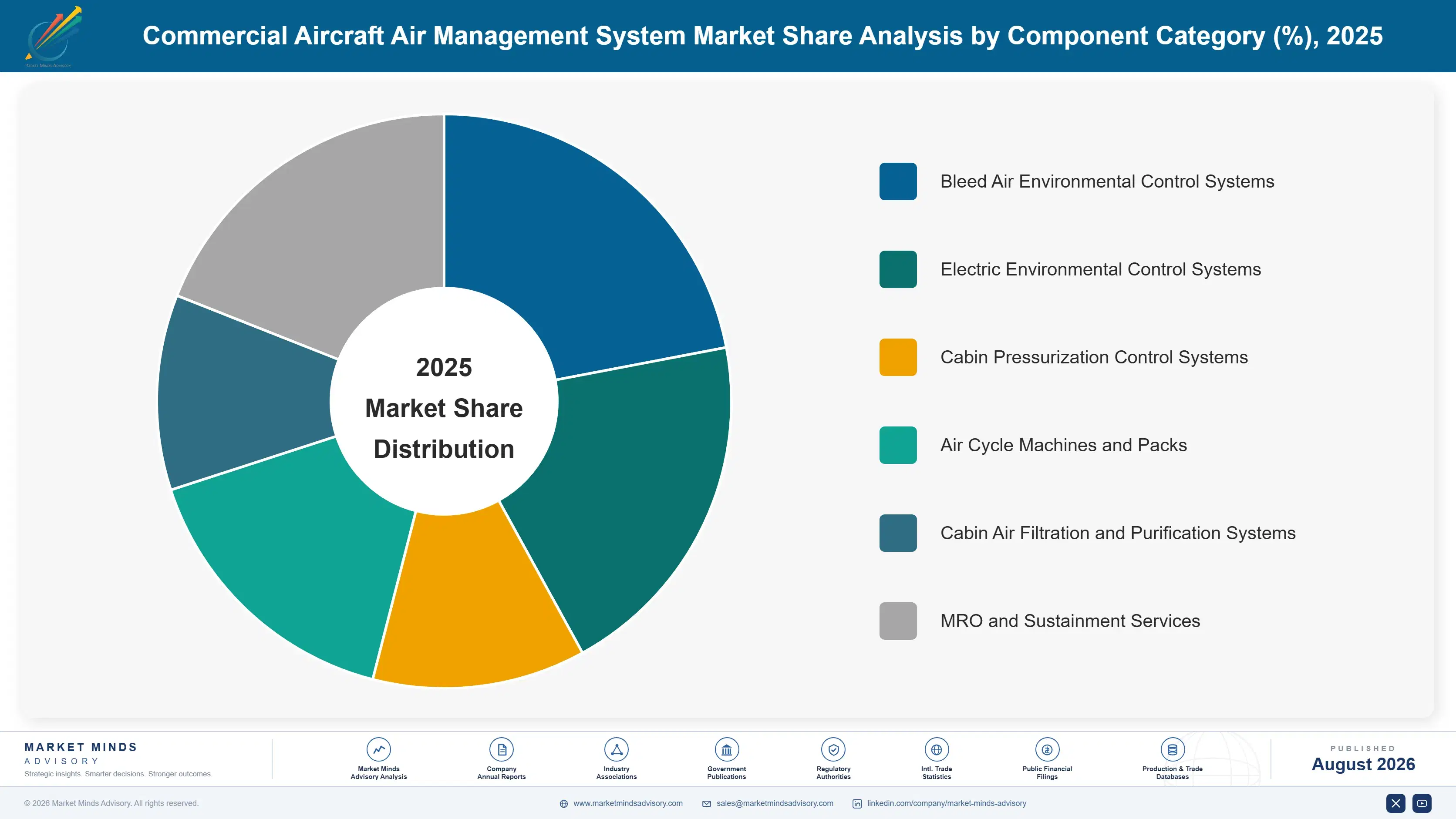
Commercial aircraft air management segments across six mutually exclusive component categories, ranging from traditional bleed air systems through fast-growing electric architecture and filtration systems that increasingly determine which suppliers capture new component revenue across the industry. These distinctions matter increasingly for suppliers setting long-term technology and certification investment priorities across the market today. overall.
commercial-aircraft-air-management-system-market-market-share-analysis-1787983592902

Electric Environmental Control Systems

Electric environmental control systems bundle electrically driven compression, cooling, and pressurization technology into a component category tailored specifically to manufacturers pursuing fuel efficiency gains through more-electric aircraft architecture. Honeywell Aerospace and Liebherr-Aerospace have both scaled dedicated electric architecture platforms covering an increasing share of new aircraft program contracts nationwide. Growth here consistently outpaces every other segment because electric architecture fundamentally changes the fuel efficiency economics of environmental control, and component costs continue falling as the underlying technology matures across most participating manufacturer relationships. Regulatory support for reduced emissions frameworks should further accelerate this trend over the coming several years across most participating aircraft programs nationwide. Adoption keeps accelerating steadily. Momentum continues.
CAGR 11.8%

Cabin Air Filtration and Purification Systems

Cabin air filtration and purification systems bundle high-efficiency particulate capture, ultraviolet sterilization, and air quality monitoring into a component category that has expanded well beyond its original basic particulate filtration base into genuine health-focused product differentiation. Parker Aerospace and Collins Aerospace have both built proprietary filtration platforms that process cabin air quality across narrowbody and widebody aircraft categories. Demand is accelerating as airlines increasingly market cabin air technology as a genuine passenger health differentiator, and filtration systems consistently offer better air quality performance than legacy basic particulate alternatives. Certification timelines in this segment run meaningfully faster than legacy filtration approvals, reflecting the scale of engineering investment these suppliers have built into their testing infrastructure across every certification stage.
CAGR 9.4%
Full segment breakdown across 6 segments available in the complete report.

Regional Architecture and Country Demand Map

North American aircraft air management assets lead the global market given the region's concentrated presence of major system integrators, while faster-growing markets abroad expand from smaller installed bases across rising aircraft delivery volume worldwide. Regulatory certification frameworks shape how quickly each region absorbs new component technology.

North America

Honeywell Aerospace and Collins Aerospace anchor this region's assets, with both companies maintaining substantial domestic manufacturing and certification infrastructure built over decades of Boeing platform integration relationships. The United States hosts the largest concentration of environmental control system testing and certification facilities globally. Canada's smaller aerospace supply chain contributes a modest secondary share within the region, focused primarily on component manufacturing and sustainment services. Sponsorship and integration models pioneered here are increasingly referenced by international suppliers structuring comparable arrangements. American suppliers have processed meaningfully more component volume over the past decade than any comparable global competitor, offering a useful benchmark for certification cycle and pricing calibration across the industry. Momentum continues.
Share: 29% | CAGR: 5.8% (2026 to 2036)

Western Europe

France and Germany anchor this region's assets, with Liebherr-Aerospace and Safran both maintaining substantial domestic manufacturing capability tied to Airbus platform integration relationships. The United Kingdom maintains a comparably sized component supply chain shaped by strong domestic aerospace manufacturing sectors. Switzerland's precision component manufacturers continue supporting both regional and export-oriented aircraft system supply chains. Cross-border consortium coordination remains more standardized here than in most other regions given decades of joint European aircraft development programs. The Netherlands and Italy show growing interest in specialized component manufacturing as national aerospace policy shifts increasingly favor niche supply chains over broad institutional program participation. Adoption pace varies notably by country across the continent. today.
Share: 23% | CAGR: 4.6% (2026 to 2036)
Regional intelligence for 5 additional markets available in the complete report: East Asia, South Asia and Pacific, Latin America, Middle East and Africa, Eastern Europe. Contact sales@marketmindsadvisory.com.
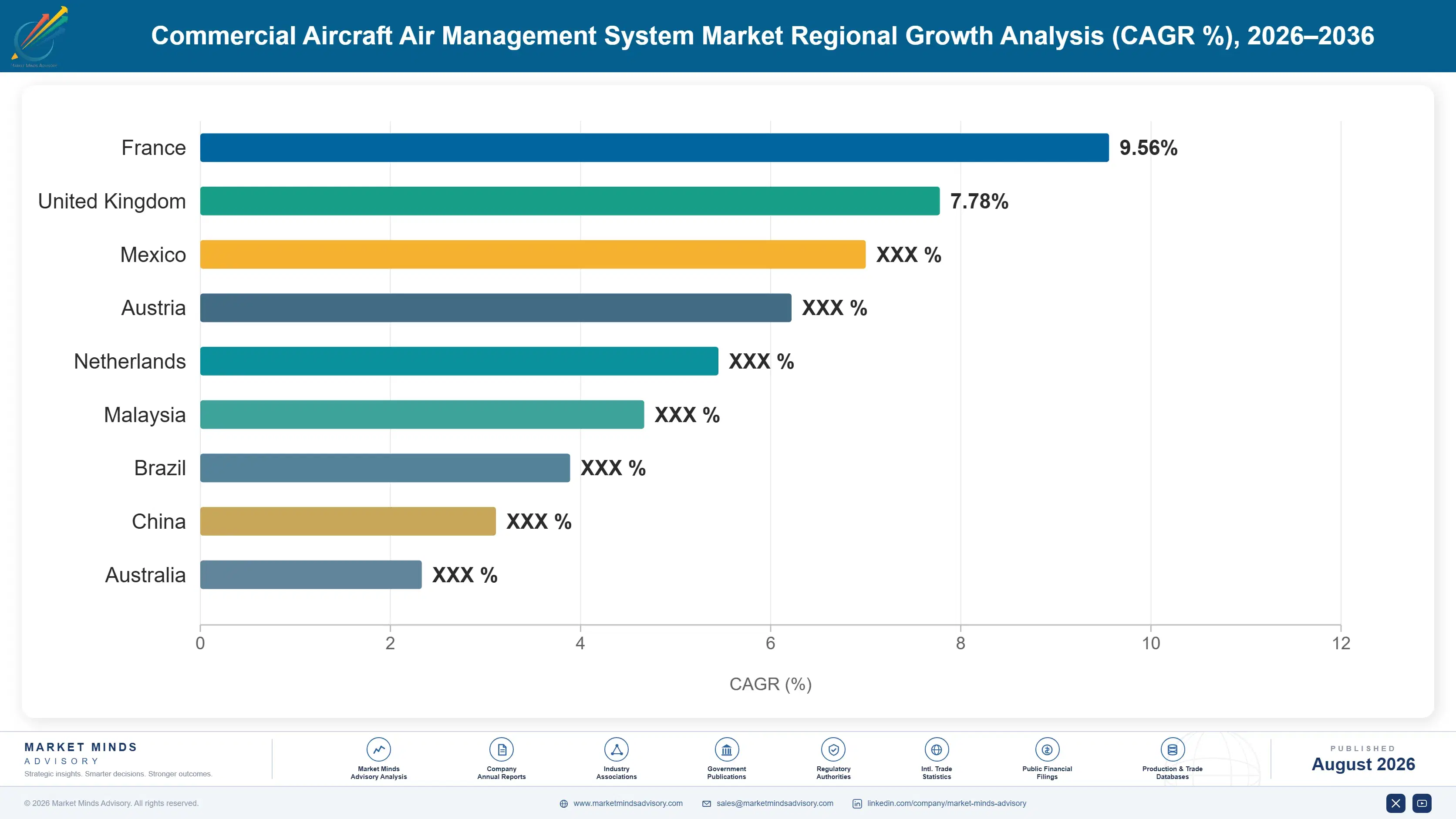
commercial-aircraft-air-management-system-market-country-cagr-analysis-1787983593422

Where Suppliers Can Capture Additional Margin

Beyond standard component sales, air management suppliers are building adjacent revenue streams that monetize aftermarket services, filtration upgrades, and testing infrastructure without depending further on one-time original equipment sales alone across the core business. a shift reshaping technology investment priorities across the industry as core component pricing faces natural affordability limits. nationwide. today. overall.

Expand Aftermarket Filtration Upgrade Program Offerings

Suppliers offering aftermarket filtration upgrades to existing fleet operators can capture recurring revenue that would otherwise be a single upfront original equipment transaction, expanding the addressable revenue base meaningfully across in-service aircraft categories. Parker Aerospace and Collins Aerospace have both scaled aftermarket upgrade programs that now generate a meaningfully higher share of total contract revenue than 2 years ago. Early data shows this channel generating 24 to 32 percent higher lifetime revenue per fleet relationship than original equipment sales alone. This gap is expected to widen further as aftermarket upgrade infrastructure costs continue falling across most major operator fleets.
Market Impact: Adds 24 to 32% revenue per relationship annually

Build Predictive Maintenance Data Subscription Services

Offering ongoing predictive maintenance data subscriptions alongside component sales captures customers who would otherwise rely entirely on scheduled inspection intervals, generating meaningfully higher fee revenue per relationship than standard component delivery alone. Honeywell Aerospace and Liebherr-Aerospace have both expanded dedicated predictive maintenance offerings tied directly to this opportunity over the past several years. Early data shows this channel generating fee revenue 2 to 3 times higher than standard component-only contracts. These subscriptions also improve customer retention, since predictive data relationships create ongoing engagement beyond standard component delivery. Adoption keeps growing.
Market Impact: Captures 2 to 3 times standard fee revenue

Monetize Certification Testing Infrastructure Through Licensing

Large suppliers that built proprietary flight certification testing infrastructure are increasingly licensing this capability to smaller component manufacturers lacking comparable testing budgets, converting a cost center into a standalone revenue line. Safran has begun exploring testing infrastructure licensing arrangements with several smaller manufacturer partners seeking faster certification without full internal build costs. Early pilots suggest this channel could generate 6 to 10 percent incremental revenue within 3 years. This approach generates high-margin recurring licensing revenue that partially offsets rising compliance and engineering investment elsewhere in the business. Adoption keeps growing.
Market Impact: Generates 6 to 10% incremental revenue by 2029

Cross-Sell Extended Warranty and Sustainment Support Services

Suppliers increasingly bundle extended warranty and sustainment support referrals into the component delivery process, capturing recurring revenue from an engaged customer at the exact moment they are making major fleet maintenance planning decisions. Honeywell Aerospace and Parker Aerospace have both expanded referral programs tied directly to component relationships, generating meaningful incremental fee income per aircraft program. Customers holding 2 or more bundled services show measurably stronger contract renewal rates overall. This cross-selling motion also strengthens customer retention across the broader component relationship over multiple aircraft programs. Adoption keeps growing. Momentum continues.
Market Impact: Adds 9 to 13% fee revenue per program

Who Controls the Margin Pool

Top 5 concentration sits at 58 percent of commercial aircraft air management revenue, substantial given the market's consolidation among established original equipment suppliers. Honeywell Aerospace and Collins Aerospace lead the pack, with a notable gap separating them from the third-ranked competitor across most component categories. This gap reflects differences in institutional relationship depth and manufacturing scale that smaller suppliers struggle to close quickly.
Current competitive activity centers on electric architecture launches, filtration technology expansion, and predictive maintenance investment rather than aggressive price-based competition alone. Suppliers are racing to expand digital capability and shorten certification timelines, since these capabilities increasingly determine which suppliers win contracts that would otherwise go to competing primes. Marketing spend has shifted toward electric architecture and filtration capability messaging over headline component pricing in most recent campaigns.

Emerging pressure is coming from specialized filtration suppliers like Parker Aerospace and Pall Aerospace that target operators underserved by traditional system integrators. Rankings could shift meaningfully if a mid-tier supplier successfully combines electric architecture with existing filtration technology scale, a combination none of the current top five players has fully executed yet. Continued venture funding activity suggests this competitive pressure will intensify rather than fade over the next several years.
commercial-aircraft-air-management-system-market-company-positioning-matrix-1787983593943

Competitive Moat and Risk Dimensions

HONEYWELL AEROSPACE

Moat: Multi-Platform Integration Scale

Honeywell Aerospace benefits from decades of environmental control system integration across both Boeing and Airbus platform families, giving it design and certification advantages that standalone component suppliers cannot match without comparable multi-platform relationships. This scale compounds because existing program relationships create natural cross-sell opportunities into electric architecture services, generating a steady revenue pipeline across most contracts.
HONEYWELL AEROSPACE

Risk: Legacy Architecture Transition Risk

Honeywell Aerospace's bleed air system heritage advantage is partially offset by the industry-wide transition toward electric architecture, which could erode its historical technology moat if newer entrants gain electric architecture certification advantages first. Continued investment in electric architecture capability is required to close this gap, and any visible delay risks ceding fast-growing next-generation segments to more agile competitors.
COLLINS AEROSPACE

Moat: Institutional Program Depth

Collins Aerospace's deep institutional program relationships give it access to sensitive certification and airworthiness projects that commercial-focused competitors struggle to win without comparable regulatory relationships and institutional trust. This relationship depth required decades to build and creates switching costs for airframers who rely on Collins's established qualification and compliance infrastructure.
COLLINS AEROSPACE

Risk: Commercial Market Responsiveness Gap

Collins Aerospace's institutional program concentration exposes it to slower commercial market responsiveness relative to specialized suppliers built specifically for fast-moving aftermarket filtration segments. Diversifying beyond institutional-heavy positioning remains a strategic priority to reduce this exposure over the coming several years. This exposure could meaningfully constrain growth as commercial customers increasingly favor suppliers with proven agility.

Players Tracked

Prominent Players

Honeywell Aerospace
Collins Aerospace
Liebherr-Aerospace
Safran
Parker Aerospace

Other Key Players

Diehl Aerospace
Woodward Inc
Eaton Aerospace
Triumph Group
TAT Technologies
AAR Corp
Pall Aerospace
Boeing
Airbus
Kidde Aerospace
Cobham Aerospace
Ametek Aerospace
CIRCOR Aerospace
Esterline Technologies
Nord-Micro

Recent Developments

MAY 2025

Liebherr-Aerospace Launches Next-Generation Electric Architecture Platform

Liebherr-Aerospace launched a dedicated electric environmental control platform designed specifically for next-generation narrowbody aircraft programs pursuing fuel efficiency improvements. The launch targets manufacturers seeking fuel efficiency improvements without full custom architecture development across most standardized narrowbody aircraft categories. Early customer interest has exceeded initial projections.
Signal: Signals electric architecture becoming a core competitive battleground across the entire global aerospace industry right now.
OCTOBER 2025

Parker Aerospace Expands Filtration Manufacturing Capacity

Parker Aerospace announced an expansion of its cabin air filtration manufacturing capacity to meet growing demand from airlines pursuing enhanced air quality standards. The expansion addresses growing airline demand for enhanced cabin air quality standards across most major commercial aircraft categories currently. Early orders have exceeded initial capacity projections.
Signal: Signals filtration capacity becoming a key competitive differentiator regionally across most major aircraft suppliers today too.

Titanium and Certification Cost Pressure

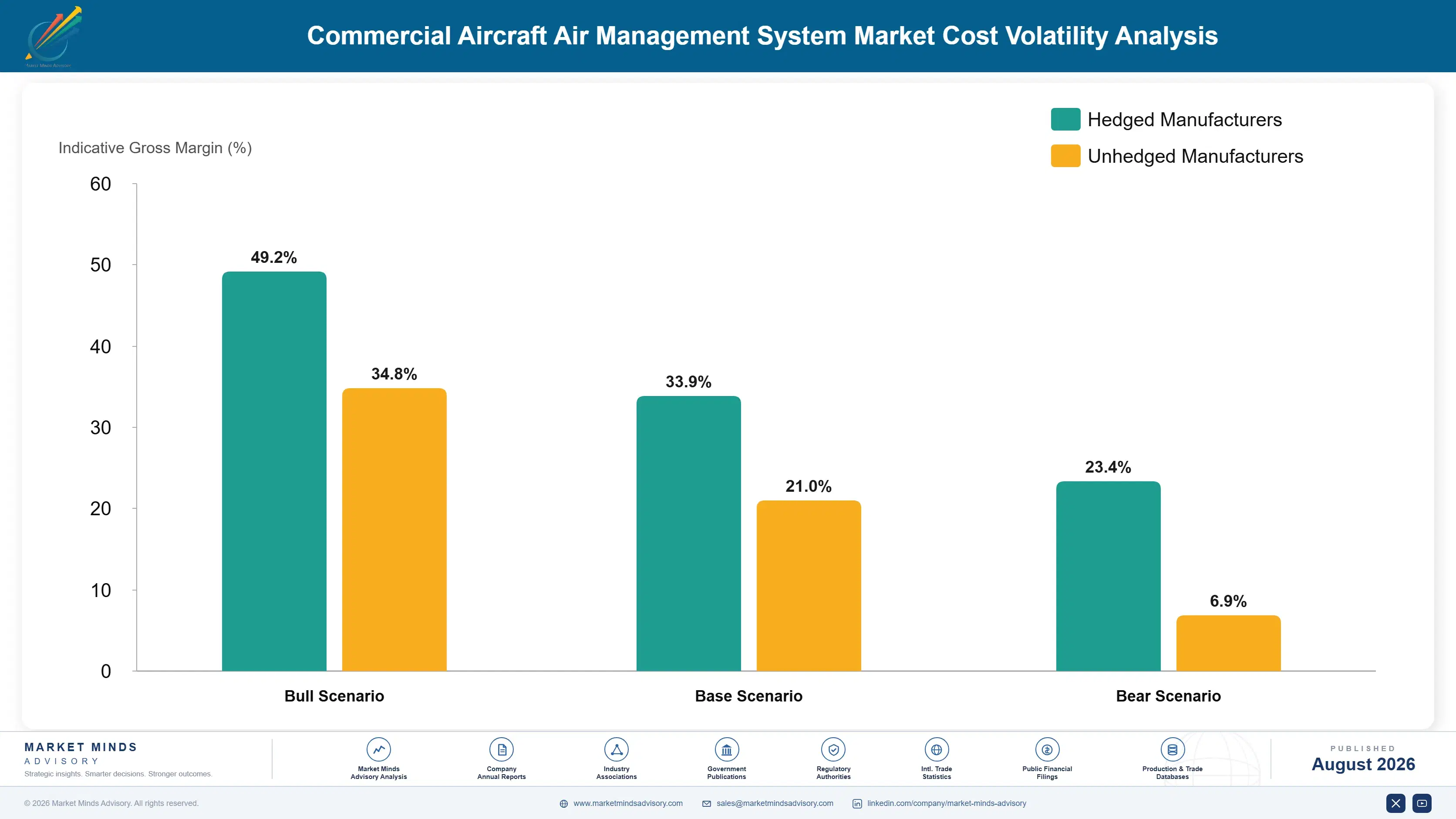
Titanium and specialty alloy component manufacturing represents roughly 39 percent of total operating cost for air management suppliers, with flight certification testing and compliance staffing accounting for a further 23 percent tied to safety-critical certification requirements. Software and control system engineering investment makes up most of the remainder, increasingly weighted toward electric architecture development. Software licensing investment is also rising.
The 2023 to 2024 titanium supply constraint, documented in International Air Transport Association industry reports, pushed component costs up meaningfully for suppliers manufacturing environmental control hardware. Honeywell's 2024 annual report noted elevated titanium procurement cost as a direct pressure on air management contract margins, a pressure that persisted well into the following fiscal year across most mid-sized suppliers. Several smaller suppliers faced disproportionate margin compression given fixed procurement structures.

Smaller regional suppliers face proportionally higher titanium cost exposure than the largest five suppliers, since they lack the scale needed to spread material hedging and inventory investment across a larger contract revenue base. This creates a durable cost disadvantage for sub-scale providers, pushing many toward partnership with larger institutions or exit from price-sensitive component categories entirely as material cost keeps climbing faster than component fee revenue growth.
commercial-aircraft-air-management-system-market-cost-volatility-analysis-1787983594139

Diversified Titanium Supplier Relationships

Suppliers increasingly diversify titanium sourcing across multiple certified producers, reducing dependence on any single supplier and narrowing exposure to supply constraint-driven price volatility considerably across the broader component portfolio. Several mid-sized suppliers have also begun pooling procurement volume to achieve better collective pricing terms than any single company could negotiate independently. Adoption keeps rising.

Additive Manufacturing for Component Production

Suppliers increasingly deploy additive manufacturing capability to produce complex titanium components with reduced material waste, cutting procurement cost meaningfully across most affected component categories and reducing lead times. Early data suggests this approach can cut procurement lead times meaningfully for suppliers unable to justify large internal manufacturing budgets independently. Adoption keeps rising steadily. Momentum continues.

Shared Certification Testing Infrastructure

Smaller regional suppliers increasingly pool flight certification testing infrastructure investment through industry consortiums, spreading fixed cost across a larger participant base and narrowing the certification cost gap against the largest five suppliers. Industry consortiums have begun standardizing shared test protocols, lowering onboarding cost for new suppliers entering the certified market. Adoption keeps rising. Momentum continues.

Portfolio Architecture for Margin Defence

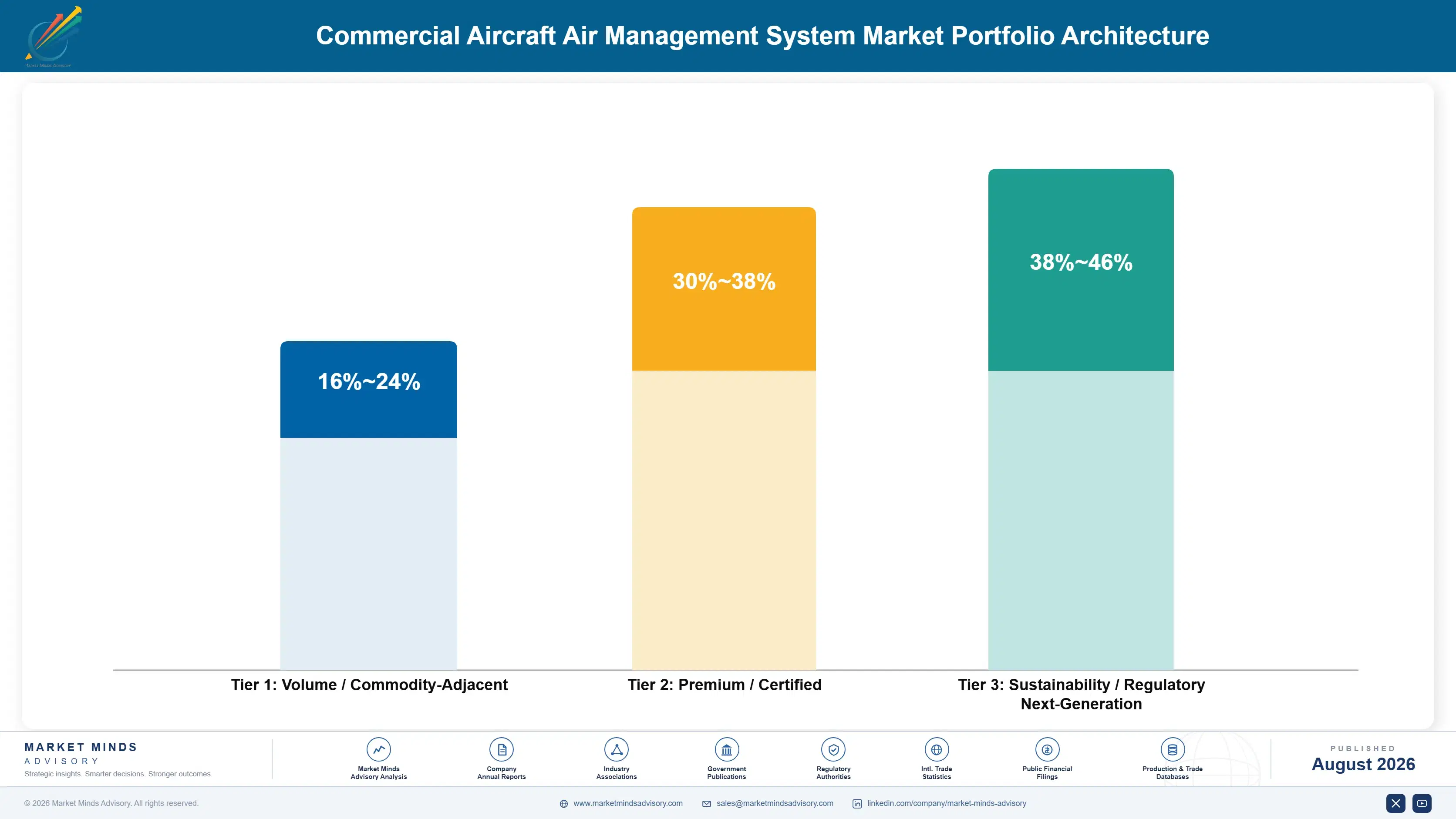
Air management economics split across three tiers with meaningfully different margin profiles. Volume-oriented standard bleed air hardware competes almost entirely on price and qualification track record, generating thin net margins relative to more differentiated component structures across the industry. Only the largest five suppliers sustain acceptable returns at this pricing level given fixed technology and compliance overhead spread across enormous component volume nationwide.
Certified filtration and predictive maintenance services command premium pricing tied to engineering depth and health-focused differentiation. Electric architecture and next-generation control platforms carry the highest margins but remain a comparatively small share of total revenue today, reflecting their early stage of mainstream adoption across most supplier segments nationwide. Early movers in this tier are capturing disproportionate share of manufacturers seeking health-focused differentiation and engineering depth.

The volume versus premium tension defines competitive strategy across every major supplier: large primes defend core hardware margins through scale, while specialized suppliers concentrate on higher-value electric and filtration segments where differentiation still commands real pricing power. Smaller suppliers without scaled electric architecture infrastructure increasingly partner with technology providers rather than build comparable capability independently, a trend likely to continue through the forecast period.

Volume / Commodity-Adjacent

Standard bleed air hardware competing primarily on price and qualification track record for broad, budget-constrained aircraft programs nationwide across most manufacturer categories. Margin here has compressed steadily over the past several years as competitive bidding processes increase price transparency for aircraft manufacturers.
Gross Margin: 16-24%

Premium / Certified

Filtration and predictive maintenance services bundling engineering expertise and health-focused differentiation for manufacturers with specific cabin air requirements. Retention rates run notably higher among filtration contracts relative to standard bleed air hardware accounts on comparable programs.
Gross Margin: 30-38%

Sustainability / Regulatory / Next-Generation

Electric architecture and digital control platforms serving manufacturers seeking fuel efficiency gains beyond standard bleed air-only offerings. Adoption remains concentrated among the largest and most sophisticated technology entrants currently building out this capability.
Gross Margin: 38-46%
commercial-aircraft-air-management-system-market-portfolio-architecture-1787983594638

High-value Sub-segments and Strategic Watch-out

Electric Environmental Control Systems

Electrically driven structures bringing fuel efficiency gains to next-generation aircraft represent the fastest-growing, highest-margin opportunity in air management today, with adoption accelerating steadily. Early movers are capturing disproportionate share of new manufacturer relationships across every major aircraft program. Provider selection increasingly shapes manufacturer decisions. Momentum continues.
Gross Margin: 38-46%

Cabin Air Filtration and Purification

Health-focused filtration commands premium fees and strong manufacturer retention, though growth trails the fastest electric segment as adoption remains concentrated among larger aircraft programs currently. Providers investing early in health-focused engineering infrastructure are seeing measurable revenue gains across their contract portfolios. This trend should strengthen as infrastructure expands.
Gross Margin: 30-38%

Standard Bleed Air Hardware Sales

The volume backbone of the industry, generating predictable but thin contract margins across the vast majority of total component volume nationwide under continuous price pressure. Consolidation pressure continues building steadily among smaller sub-scale suppliers lacking comparable technology infrastructure investment. Scale remains the primary driver of profitability here.
Gross Margin: 16-24%

Legacy Basic Particulate Filtration

A shrinking segment as advanced filtration increasingly displaces traditional basic particulate systems, pushing legacy providers to modernize or exit this category entirely over time. Decline timelines vary considerably depending on how quickly advanced filtration adoption spreads across remaining aircraft categories. Specialized providers focused on transition are watching closely.
Gross Margin: 12-18%

How Program Relationships Compound Over Decades

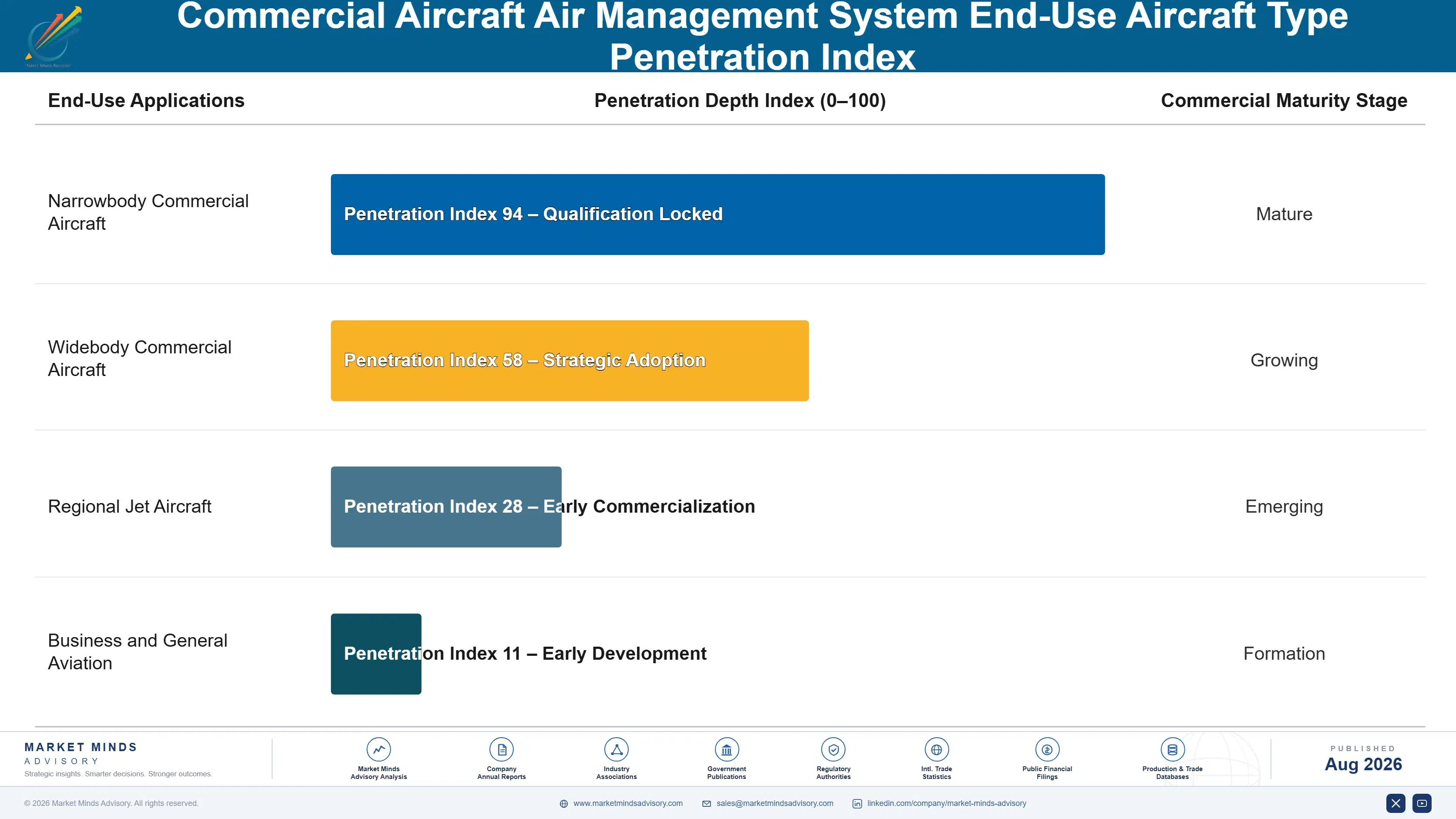
Air management supplier relationships behave like annuities once established. Component qualification carries over across successive aircraft production runs, and suppliers that win the original certification capture recurring component orders across multi-year delivery schedules without requiring renewed sales effort in most cases. Attrition happens almost exclusively through platform retirement or a rare formal re-qualification rather than voluntary supplier switching mid-program.
Adoption stickiness varies meaningfully by program vertical. Original equipment manufacturer relationships exhibit the deepest stickiness, often maintaining the same qualified supplier relationship across an entire aircraft program lifecycle spanning decades, while smaller aftermarket contracts show comparatively higher churn as newer suppliers undercut legacy manufacturers on price and delivery speed. Widebody and long-haul platform relationships, given the complexity of platform integration, show the deepest stickiness of any major program vertical measured.

Buyer profiles are shifting generationally as younger program managers, more comfortable evaluating electric architecture and digital control platforms, replace veteran decision-makers who historically favored established bleed air-only supplier relationships over demonstrated electric capability. This generational transition is gradually eroding the switching-cost advantage that incumbent suppliers relied on for decades. Suppliers slow to modernize their electric architecture capability risk losing renewal negotiations to challengers even after decades of otherwise uninterrupted service.
commercial-aircraft-air-management-system-market-end-use-penetration-index-1787983595127

MMA Analyst Assessment and Recommendations

These are among the four positions where our research anticipates prominent divergence between winners and laggards over the coming forecast period. Each is grounded in the demand model, the regulatory perimeter, and the announced capacity pipeline.
01 / PRODUCT INNOVATION STRATEGY

Build electric architecture capability before competitors dominate the segment

Electric environmental control systems remain a meaningfully underdeveloped capability outside a small handful of specialized suppliers, and early movers are already capturing disproportionate share of next-generation aircraft program demand across most major manufacturer categories. Suppliers that wait risk ceding a fast-growing, high-margin segment to Honeywell Aerospace and Liebherr-Aerospace permanently. The window for establishing real electric architecture scale here is closing steadily, and every additional quarter of delay makes catching up meaningfully harder for latecomers entering this fast-moving electric architecture segment overall.
02 / DISTRIBUTION AND PARTNERSHIPS

Expand aftermarket filtration upgrade programs for fleets

Aftermarket filtration revenue is growing faster than standard original equipment sales, and the suppliers capturing this growth are the ones investing early in upgrade infrastructure that captures fleet operators before competitors catch up. Suppliers still dependent primarily on original equipment sales alone are ceding this segment to more aftermarket-focused competitors. This is not a marginal opportunity, it is one of the largest sources of net-new revenue available over the next several years, and suppliers treating it as secondary will regret that choice.
03 / TALENT AND COMPLIANCE STRATEGY

Build certification testing capability before scarcity worsens further

Aerospace certification engineering talent scarcity shows no sign of easing, and suppliers that build technical university partnerships now will absorb future testing demands more efficiently than competitors scrambling to recruit specialists later under deadline pressure. Treating talent investment purely as overhead misses its defensive value against future scaling constraints. Suppliers that get this positioning wrong risk losing certification speed to better-prepared competitors entirely, a cost that compounds meaningfully with every additional quarter of unaddressed talent scarcity across the broader industry landscape.
04 / FUNDING AND CAPITAL STRATEGY

Diversify revenue beyond core hardware sales now

Core hardware sale margins face continued compression as competitive bidding intensifies, and suppliers still dependent primarily on component delivery fees face a steadily shrinking margin pool over the next decade. Filtration and predictive maintenance services offer a credible offset, but only for suppliers willing to invest in the infrastructure required to deliver them at scale. Delay here compounds the competitive gap against Honeywell and Collins Aerospace considerably, and every additional year without a credible diversification offering makes catching up meaningfully harder for mid-tier competitors.

Engagement Snapshot From the Field

A live engagement with an industry participant carrying material or product regulatory and market exposure ahead of a defining policy shift, showing how our research translates into a defensible multi-year portfolio strategy.
MARKET MINDS ADVISORY · CLIENT ENGAGEMENT SUMMARY
Commercial Aircraft Air Management System Producer Strategic Portfolio Review and Transition Roadmap 2026·Investment Scenario on Commercial Aircraft Air Management System Exposure Evaluation 2025-26
CLIENT PROFILE
The client, a mid-sized regional airline operating roughly 45 narrowbody aircraft, relied on legacy cabin filtration equipment across its fleet for over a decade. Leadership grew concerned that outdated air quality standards were constraining their ability to compete for corporate travel contracts against carriers offering enhanced filtration marketing claims. The client operated primarily through legacy filtration equipment rather than modern health-focused systems historically.
STRATEGIC CHALLENGE
The client needed to determine whether investing in fleet-wide filtration upgrades would justify the meaningful capital cost and maintenance downtime involved, given a decade of accumulated component data and supplier relationship history. Leadership also lacked internal benchmarks for evaluating modern filtration capability against realistic industry standards. Regional maintenance capacity constraints also raised questions about realistic upgrade scheduling across the fleet.
MMA APPROACH
MMA conducted a structured comparative assessment of the incumbent equipment against three finalist filtration providers, benchmarking air quality performance, weight penalty, and total cost of ownership across a five-year fleet upgrade horizon. The engagement included structured interviews with the client's maintenance team and a quantitative capability analysis grounded in MMA's primary research dataset.
KEY FINDINGS
  1. The incumbent filtration equipment's air quality performance trailed the finalist average by a wide margin, directly limiting the client's ability to market enhanced cabin air standards.
  2. Total filtration cost per aircraft at the incumbent ran meaningfully higher than two of three finalists once weight penalty was normalized across comparable offerings.
  3. Switching costs, including component compatibility testing and maintenance retraining, were lower than leadership initially assumed, given modern standardization across major suppliers. nationwide.
  4. None of the evaluated providers offered mature predictive maintenance integration suited to the client's fleet composition, indicating this capability gap extends broadly across the mid-tier carrier segment.
CLIENT PROFILE
The client, a mid-sized regional airline operating roughly 45 narrowbody aircraft, relied on legacy cabin filtration equipment across its fleet for over a decade. Leadership grew concerned that outdated air quality standards were constraining their ability to compete for corporate travel contracts against carriers offering enhanced filtration marketing claims. The client operated primarily through legacy filtration equipment rather than modern health-focused systems historically.
STRATEGIC CHALLENGE
The client needed to determine whether investing in fleet-wide filtration upgrades would justify the meaningful capital cost and maintenance downtime involved, given a decade of accumulated component data and supplier relationship history. Leadership also lacked internal benchmarks for evaluating modern filtration capability against realistic industry standards. Regional maintenance capacity constraints also raised questions about realistic upgrade scheduling across the fleet.
MMA APPROACH
MMA conducted a structured comparative assessment of the incumbent equipment against three finalist filtration providers, benchmarking air quality performance, weight penalty, and total cost of ownership across a five-year fleet upgrade horizon. The engagement included structured interviews with the client's maintenance team and a quantitative capability analysis grounded in MMA's primary research dataset.
KEY FINDINGS
  1. The incumbent filtration equipment's air quality performance trailed the finalist average by a wide margin, directly limiting the client's ability to market enhanced cabin air standards.
  2. Total filtration cost per aircraft at the incumbent ran meaningfully higher than two of three finalists once weight penalty was normalized across comparable offerings.
  3. Switching costs, including component compatibility testing and maintenance retraining, were lower than leadership initially assumed, given modern standardization across major suppliers. nationwide.
  4. None of the evaluated providers offered mature predictive maintenance integration suited to the client's fleet composition, indicating this capability gap extends broadly across the mid-tier carrier segment.
RECOMMENDED STRATEGY
Phase 1: Phase 1 (Evaluation): Conduct a formal request-for-proposal process among the three finalist providers, weighting air quality performance and weight alongside baseline cost. Phase 2: Phase 2 (Transition): Negotiate a structured upgrade timeline with the selected provider, minimizing operational disruption during peak travel season. with clear milestones. Phase 3: Phase 3 (Optimize): Establish annual capability and cost benchmarking reviews to prevent future provider capability drift relative to comparable airlines.
OUTCOME
The client selected a new filtration provider offering meaningfully stronger air quality performance, projecting improved corporate travel contract competitiveness within the first upgrade cycle. Filtration cost per aircraft declined modestly relative to the incumbent (client-reported, unverified by MMA), while maintenance team satisfaction scores improved measurably following the transition.

Frequently Asked Questions

Foundational context covering the market sizes, CAGR, scope, country, region and competition that inform every finding below. This section is provided to cover basics and most often pre-purchase conversations, answered from the MMA Primary Research Dataset.

What is the current size of the Commercial Aircraft Air Management System Market?

The Commercial Aircraft Air Management System Market reached $4.2 billion in revenue in 2025. This figure reflects environmental control units, air cycle machines, and cabin filtration systems sold across the industry.

How large will the Commercial Aircraft Air Management System Market be by 2036?

MMA projects the market will reach $8.14 billion by 2036, roughly 1.83 times its 2026 value. Growth is driven primarily by electric architecture adoption and expanding cabin filtration standards.

What is the CAGR for the Commercial Aircraft Air Management System Market 2026 to 2036?

The market is projected to grow at a 6.2 percent compound annual growth rate between 2026 and 2036. This compares to a historical CAGR of roughly 5.0 percent recorded across the preceding 2020 to 2025 period.

Which segment is growing fastest?

Electric environmental control systems are growing fastest at an 11.8 percent CAGR, well above the overall market rate. This reflects manufacturers pursuing fuel efficiency gains through more-electric aircraft architecture.

Who are the major companies in the Commercial Aircraft Air Management System Market?

Honeywell Aerospace, Collins Aerospace, Liebherr-Aerospace, Safran, and Parker Aerospace lead the market by revenue. Together these five suppliers hold roughly 58 percent combined concentration globally.

Which country is growing fastest?

China is the fastest-growing air management market at a 9.8 percent CAGR, driven by the COMAC C919 program building domestic component sourcing capability. Indigenous manufacturing continues expanding rapidly nationwide.

Report Segmentation Architecture

The full report scope spans multiple orthogonal segmentation dimensions, with cross-tabulated demand data provided for each dimension pair. Coverage extends further to regional breakdowns, trend trajectories, and the competitive detail needed to support segment-level decision-making.

By Component Category

  • Bleed Air Environmental Control Systems
  • Electric Environmental Control Systems
  • Cabin Pressurization Control Systems
  • Air Cycle Machines and Packs
  • Cabin Air Filtration and Purification Systems
  • MRO and Sustainment Services

By End-Use Aircraft Type

  • Narrowbody Commercial Aircraft
  • Widebody Commercial Aircraft
  • Regional Jet Aircraft
  • Business and General Aviation

By Commercial Dimension

  • Direct Original Equipment Distribution
  • Aftermarket Upgrade Channel
  • Independent MRO Specialist Channel
  • Software Licensing Partnership

By Region

  • North America
  • Western Europe
  • East Asia
  • South Asia and Pacific
  • Latin America
  • Middle East and Africa
  • Eastern Europe

Scope, Methodology, and Coverage

Every figure in this report is reproducible from documented input assumptions. The scope below maps the historical period, the forecast horizon, the segmentation dimensions, and the countries covered, alongside the underlying primary and qualitative methodology.
Historical Period
2020 to 2025
Forecast Period
2026 to 2036
Base Year
2025 (USD billions; MMA Primary Research Dataset, August 2026)
Market Definition
This report covers hardware components and systems that manage cabin pressurization, temperature control, and air filtration for commercial aircraft, including environmental control units, air cycle machines, and cabin air filtration systems. It excludes engine bleed air extraction hardware integrated directly into propulsion systems and cargo-only aircraft ventilation equipment.
Quantitative Units
USD billions (current prices); unit delivery counts where applicable
Segmentation Dimensions
By Component Category; By End-Use Aircraft Type; By Commercial Dimension; By Region
Regions Covered
North America, Western Europe, East Asia, South Asia and Pacific, Latin America, Middle East and Africa, Eastern Europe
Countries Covered
USA, China, Germany, France, UK, Japan, South Korea, India, Australia, Canada, Brazil, Mexico, Indonesia, Vietnam, Thailand, Malaysia, UAE, Saudi Arabia, South Africa, Nigeria, Turkey, Poland, Netherlands, Italy, Spain, Sweden, Switzerland, Argentina, Colombia, Singapore, and additional markets relevant to this sector
Key Companies Profiled
Honeywell Aerospace, Collins Aerospace, Liebherr-Aerospace, Safran, Parker Aerospace, Diehl Aerospace, Woodward Inc, Eaton Aerospace, Triumph Group, TAT Technologies, AAR Corp, Pall Aerospace, Boeing, Airbus, Kidde Aerospace, Cobham Aerospace, Ametek Aerospace, CIRCOR Aerospace, Esterline Technologies, Nord-Micro
Quantitative Methodology
Primary survey, n=3,800 respondents, Q4 2025, six countries; demand-side model with trade association cross-validation
Qualitative Methodology
47 expert interviews, Q4 2025; applied to validate demand model assumptions, identify emerging dynamics, and assess competitive positioning
Report Format
PDF and XLSX data workbook (Word format preview document)
Publisher
Market Minds Advisory
Report Code
MMA-2026-CON-364
Published
August 2026
Contact
sales@marketmindsadvisory.com | www.marketmindsadvisory.com

Purchase the full Commercial Aircraft Air Management System Market Report (2026 to 2036).

This report provides comprehensive coverage of the Commercial Aircraft Air Management System Market, including detailed sizing, segmentation, and regional analysis through 2036. It examines competitive dynamics among the leading primes and specialized suppliers, covering their strategic positioning, moats, and vulnerabilities. The analysis also addresses titanium cost pressure, certification cycle constraints, and emerging electric architecture trends reshaping component economics. Readers gain access to primary survey data, expert interview insights, and MMA's proprietary forecasting methodology. The report is designed for aircraft systems strategy executives, airline fleet managers, and institutional aerospace investors evaluating positioning decisions, product launch priorities, or capital allocation across the value chain.
Ten-year market sizing and forecast model
Six-segment MECE component category segmentation model
Seven-region demand, share, and growth analysis
Competitive landscape with moat and risk profiles
Primary survey data from 3,800 respondents
Forty-seven expert interviews across supplier types

Built For The People Who Decide

From boardroom strategy to bench-side execution, this report is read cover-to-cover by leaders shaping the next decade of their industry, turning demand scenarios, market dynamics and valuation benchmarks into decisions.
CXOs/ Presidents/ VPs/ Managers
M&A and Corporate Development
Strategy Teams and R&D Heads
Procurement and Product Directors
Regulatory and Compliance Leaders
Investor Relations and Equity Analysts