Market Minds Advisory
Combustion Controls, Equipment, and Systems Market

Combustion Controls, Equipment, and Systems Market: Combustion Controls, Equipment, and Systems Market. Industrial Burner and Emissions Technology Through 2036

Industrial operators are retrofitting decades-old boilers and furnaces with digital combustion controls to meet tightening emissions rules, wagering that sensor-driven fuel efficiency gains can offset compliance costs before older mechanical control systems become unsupportable liabilities.

Lead Analyst

Published

September 2026

Make Smarter Decisions with Customized Research Insights

Request a free sample report and evaluate market opportunities, growth trends, and competitive dynamics relevant to your business needs.

2025 MARKET VALUE$6.8BMarket Size 2025
2036 FORECAST VALUE$11.0BBase Case , 2026 to 2036
CAGR 2026 TO 20364.5 %Bull 5.7% / Bear 3.2%
INCREMENTAL OPPORTUNITY$3.9BNet 10- year value creation
EXPANSION MULTIPLE1.55x2036 value over 2026 base
Strategic Levers
M&A Pipeline
Regional Outlook
Country Rankings
Competitive Intelligence
Segmental Deep-dive
Call-Us : 91 93563 13602

Executive Snapshot and Market Trajectory.

Combustion control systems are shifting from mechanical flame safeguard hardware to digital burner management platforms as emissions regulation and fuel efficiency mandates converge on industrial boiler and furnace operators worldwide, reshaping decades-old equipment replacement cycles across nearly every major process industry and manufacturing sector tracked in this analysis.
Emissions monitoring systems and combustion analyzers are capturing outsized growth as regulators tighten reporting requirements for nitrogen oxide and carbon monoxide output across power generation and heavy manufacturing facilities worldwide today. East Asia holds the largest share given a concentrated industrial boiler installed base and continued capacity expansion, while flame safeguard controls remain the largest deployed technology by unit count across process industries including chemicals, refining, and food processing operations across every major market worldwide.
Competition splits between diversified automation giants bundling combustion controls into broader process control platforms and specialized burner equipment manufacturers competing on flame safety certification and fuel flexibility across multiple fuel sources. Regulatory pressure around industrial emissions reporting is reshaping retrofit demand, forcing equipment operators to replace legacy mechanical controls with certified digital systems well ahead of previously planned replacement schedules across the wider industry.
Market Definition
The combustion controls, equipment, and systems market covers burner management systems, flame safeguard controls, combustion analyzers, industrial burners, fuel metering and control valves, and emissions monitoring systems used in industrial boilers, furnaces, and process heaters. It excludes residential heating appliances, internal combustion engines, and general purpose process control software not centered on combustion management.
Base Year Value
$6.8B in 2025 (MMA Primary Research Dataset, September 2026)
Forecast Period
2026 to 2036, eleven discrete annual values
CAGR
4.5% base case. Bull 5.7%. Bear 3.2%.
Fastest Growth Segment
Emissions Monitoring Systems: 7.0% CAGR
Fastest Growth Country
China: 6.5% CAGR
Fastest Growth Region
South Asia and Pacific: 6.5% CAGR
Largest Region
East Asia: 30% of 2025 global value
Market Leaders
[object Object]
Primary Survey
n=3,800 procurement and R&D decision-makers, Q4 2025, six countries
Methodology
Demand-side build-up, cross-validated against public data, 47 expert interviews

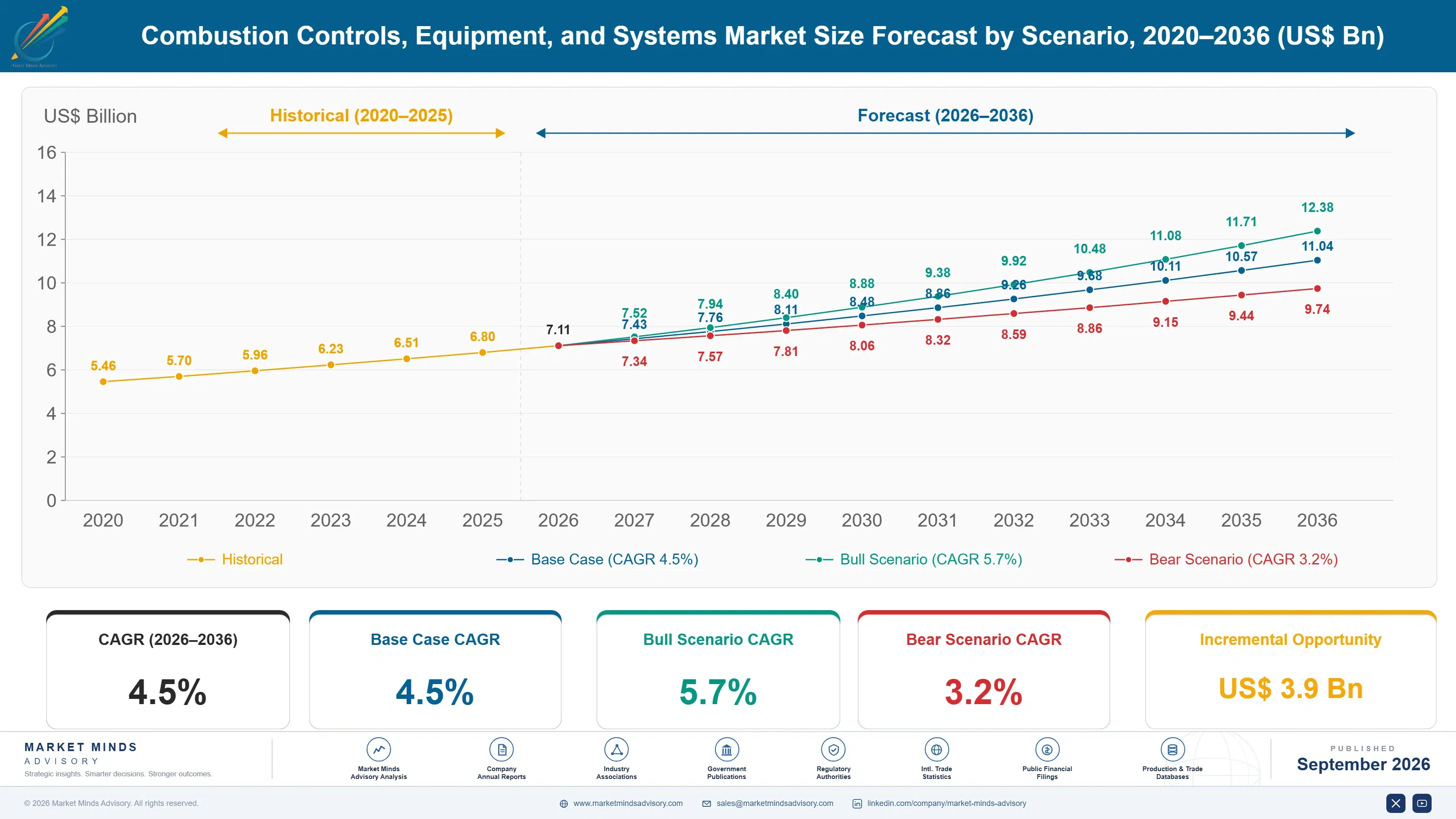
Combustion Controls, Equipment, and Systems Market Forecast Scenarios

combustion-controls-equipment-and-systems-market-size-forecast-scenario-1790006146667
Between 2020 and 2025 combustion control adoption progressed steadily rather than explosively, as industrial operators replaced aging flame safeguard hardware on a scheduled maintenance basis rather than in response to sudden demand shocks across most regions. Historical annual growth ran near 3.8 percent, reflecting the mature, replacement-driven character of this equipment category across most process industries tracked in this analysis.
The base case assumes 4.5 percent annual growth through 2036, driven by three mechanisms: tightening emissions reporting requirements forcing accelerated replacement of uncertified legacy controls across regulated facilities worldwide, continued industrial capacity expansion in East Asia sustaining new equipment installation well beyond simple retrofit activity, and rising fuel flexibility requirements as operators blend hydrogen and alternative fuels into existing combustion systems across multiple heavy industry segments and geographic markets studied closely.
A bull scenario centers on accelerated hydrogen co-firing mandates forcing widespread combustion system retrofit across power generation facilities faster than currently planned replacement schedules across the entire regulated fleet. The bear risk is prolonged industrial capital expenditure caution delaying planned boiler and furnace modernization projects across cost-sensitive manufacturing operators globally this coming cycle and beyond.

Digital Burner Management Replaces Aging Mechanical Flame Safeguards

Fuel and feedstock costs together represent the largest share of operating cost for combustion equipment end-users, since natural gas and alternative fuel pricing directly determines whether an efficiency-driven controls upgrade delivers meaningful payback within a reasonable capital planning horizon for most industrial operators across every major process industry tracked in this analysis.
MARKET CONCENTRATIONCR5 45%Top five suppliers hold a moderate combined market presence overall
REPLACEMENT CYCLE LENGTH15-20 yearsReplacement cycles keep spanning many years before major renewal
TOP PRODUCING COUNTRYChina 28%One country generates a large share of new installations
CAPACITY UTILISATION74%Facilities keep running units well below theoretical maximum efficiency
TRADE INTENSITYModerateImport and export activity remains moderate across this category
STEEL COST SHARE45% of COGSSteel and sensor components represent the largest vendor cost
Plant operators increasingly differentiate suppliers by digital integration capability and remote diagnostics support rather than raw hardware specifications alone. Companies comparing vendors now weigh predictive maintenance analytics and emissions compliance documentation as heavily as unit price, narrowing the room for suppliers offering only basic mechanical controls without digital upgrade paths. Fuel flexibility certification has also become a meaningful differentiator as operators plan for blended and alternative fuel transitions in coming years.
Replacement cycles for combustion control equipment typically span fifteen to twenty years, giving incumbent suppliers with existing installed base relationships a durable advantage over new entrants lacking comparable long-term maintenance contracts and spare parts distribution networks across a wide service territory. That dynamic keeps switching costs high for operators evaluating alternative suppliers during scheduled plant turnaround windows and major capital project cycles.
"Nobody retrofits a boiler for fun, they do it because the compliance officer or the gas bill finally forced the decision. Suppliers still selling uncertified mechanical flame safeguards will find their addressable market shrinking with every new emissions rule that passes."
Principal Analyst, Industrial Process Heating Practice · MMA Construction and Industrial Equipment: Process Heating Systems Practice · September 2026

Market Trends

Emissions Reporting Regulation Forces Legacy Combustion Control Replacement

Tightening nitrogen oxide and carbon monoxide reporting requirements across power generation and heavy manufacturing facilities are forcing operators to replace uncertified mechanical flame safeguard systems with digital combustion controls capable of continuous emissions data logging. Regulatory agencies in multiple jurisdictions have shortened compliance grace periods for older equipment, compressing what were once decade-long voluntary replacement timelines into mandatory multi-year retrofit programs. Operators facing repeated compliance citations are increasingly prioritizing full combustion system modernization over incremental component replacement, since regulators now expect integrated emissions documentation across the entire combustion train rather than isolated component certification.
Market Impact: Adds 8 gigawatts new capacity annually

Hydrogen Co-Firing Trials Reshape Industrial Burner Design

Utilities and heavy industrial operators are running hydrogen and natural gas co-firing trials at growing numbers of facilities, forcing burner manufacturers to redesign combustion chambers and control algorithms to handle the different flame characteristics and flashback risk profile that hydrogen blending introduces. Equipment certified for hydrogen blends above 20 percent by volume commands meaningful price premiums over conventional natural gas only systems, reflecting the additional engineering and safety certification investment required. Suppliers unable to demonstrate hydrogen compatibility are increasingly excluded from utility and refinery procurement shortlists as decarbonization commitments accelerate across the power generation sector broadly.
Market Impact: Cuts unplanned downtime by 30 percent

Market Opportunities and Growth Drivers

Industrial Capacity Expansion in East Asia Sustains Equipment Demand

Continued industrial capacity expansion across China, South Korea, and Southeast Asia is sustaining new combustion equipment installation well beyond simple retrofit activity seen in more mature Western markets. New chemical processing and power generation facilities coming online across the region require complete combustion train installation rather than component-level upgrades, generating meaningfully larger per-project equipment value than replacement work in established facilities. Equipment suppliers with established regional manufacturing and service presence are capturing a disproportionate share of this new capacity investment, since local presence shortens delivery timelines considerably for time-sensitive plant construction schedules across the wider region.
Market Impact: Extends replacement cycles past 15 years

Predictive Maintenance Analytics Reduce Unplanned Combustion Downtime

Digital combustion control platforms increasingly embed predictive maintenance analytics that flag component wear and combustion inefficiency before an unplanned shutdown occurs, sustaining operator investment in platform upgrades even during periods of broader capital expenditure caution elsewhere in the business. Operators calculate return on investment against actual realized downtime cost reduction rather than theoretical efficiency estimates, strengthening the business case considerably across nearly every heavy industry vertical studied closely. Facilities with the highest historical unplanned shutdown frequency report the fastest payback periods and the strongest internal appetite for continued digital platform expansion across additional plant units.
Market Impact: Delays commissioning by 4 weeks

Market Restraints and Challenges

Long Equipment Replacement Cycles Slow Digital Control Adoption

Combustion control equipment typically operates for fifteen to twenty years before replacement, meaning even strong digital adoption trends translate slowly into installed base turnover across the broader industrial equipment population. The root cause is the genuine reliability of well-maintained mechanical flame safeguard systems, which continue functioning adequately for their core safety purpose long after digital alternatives become commercially available and technically superior. The commercial impact falls hardest on digital-only suppliers lacking a retrofit-friendly product line, limiting their addressable market to new installations. Several suppliers now offer modular retrofit kits as a mitigation approach to shorten replacement cycles.
Market Impact: Shortens grace periods to 3 years

Skilled Technician Shortage Limits Field Service Capacity

A persistent shortage of combustion control technicians qualified to calibrate and certify digital burner management systems is limiting how quickly suppliers can complete installation and commissioning work across a growing project backlog. The root cause is an aging specialist workforce combined with limited formal training pipelines for this narrow technical discipline compared to broader industrial automation careers. The commercial impact falls hardest on suppliers without in-house training academies, facing extended project commissioning timelines and delayed revenue recognition. Several equipment manufacturers are now funding dedicated technical training partnerships with community colleges as a mitigation approach.
Market Impact: Enables blends above 20 percent hydrogen
3 additional market trends, 4 additional growth drivers, and 2 additional restraints and challenges are covered in the full report. Contact sales@marketmindsadvisory.com to access the complete intelligence.

Segment CAGR and Growth Architecture

Combustion controls and equipment segment by core component function, spanning burner management systems and flame safeguard controls through combustion analyzers, industrial burners, fuel metering valves, and emissions monitoring systems installed across a wide range of facilities. Emissions monitoring and combustion analyzers lead growth as regulatory reporting requirements tighten across power generation and heavy manufacturing worldwide today.
combustion-controls-equipment-and-systems-market-market-share-analysis-1790006147246

Emissions Monitoring Systems

Emissions monitoring systems continuously measure nitrogen oxide, carbon monoxide, and particulate output from industrial combustion processes, feeding data directly into regulatory compliance reporting platforms rather than relying on periodic manual stack testing alone. Demand concentrates among power generation, cement, and chemical processing facilities facing the strictest regulatory audit requirements and highest non-compliance penalty exposure across their respective jurisdictions. Operators increasingly mandate continuous emissions monitoring as a baseline permit requirement rather than an optional enhancement, pushing suppliers to embed monitoring capability directly into new combustion system contracts instead of selling it as a separate retrofit package. Deployment complexity remains manageable compared to full burner replacement, letting even smaller facilities adopt this capability relatively quickly.
CAGR 7.0%

Combustion Analyzers

Combustion analyzers measure flue gas composition and combustion efficiency in real time, letting plant operators fine-tune air-fuel ratios to reduce fuel consumption and unburned fuel losses across industrial boilers and furnaces. Demand spans nearly every heavy industry vertical, from power generation and refining to food processing and pulp and paper operations seeking measurable fuel cost reduction. This segment commands premium pricing tied to measurement accuracy and integration depth with plant-wide control systems rather than simple standalone readout displays, creating a meaningfully different competitive dynamic than basic instrumentation products. Suppliers compete heavily on calibration stability and long-term measurement drift performance, since accuracy degradation directly undermines the fuel savings case operators use to justify the purchase.
CAGR 6.5%
Full segment breakdown across 6 segments available in the complete report.

Regional Architecture and Country Demand Map

Regional demand tracks industrial capacity investment, emissions regulation strictness, and installed equipment age, with East Asia leading on new capacity installation while North America and Western Europe drive retrofit demand tied to older aging boiler and furnace fleets nationwide across the wider industrial base overall.

North America

The United States drives the overwhelming majority of North American demand, where aging industrial boiler and furnace installations built decades ago are reaching the end of their certified service life across chemical, food processing, and power generation facilities nationwide. Environmental Protection Agency emissions reporting requirements are accelerating retrofit decisions that operators previously deferred during periods of lower natural gas pricing. Canada contributes a smaller but steadily growing share, tied to its own emissions reporting requirements for regulated heavy industry facilities operating near the border. Replacement demand outweighs new installation considerably in this mature market, favoring suppliers with strong existing service and spare parts distribution networks over new entrants lacking comparable regional presence.
Share: 26% | CAGR: 4.0% (2026 to 2036)

Western Europe

Germany and France lead regional adoption, where stringent European Union industrial emissions directive requirements are forcing accelerated replacement of legacy mechanical combustion controls across chemical and power generation facilities nationwide today. The United Kingdom maintains a broadly similar regulatory trajectory despite operating under a separate post-Brexit framework, sustaining meaningful retrofit demand across its own aging industrial base overall. Growth trails East Asia considerably since most Western European industrial capacity is already built out, limiting demand primarily to component replacement and efficiency upgrades rather than new combustion train installation. Nordic countries are increasingly early adopters of hydrogen co-firing combustion technology tied to broader regional decarbonization commitments and long-term industrial policy goals.
Share: 20% | CAGR: 3.2% (2026 to 2036)
Regional intelligence for 5 additional markets available in the complete report: East Asia, South Asia and Pacific, Latin America, Middle East and Africa, Eastern Europe. Contact sales@marketmindsadvisory.com.
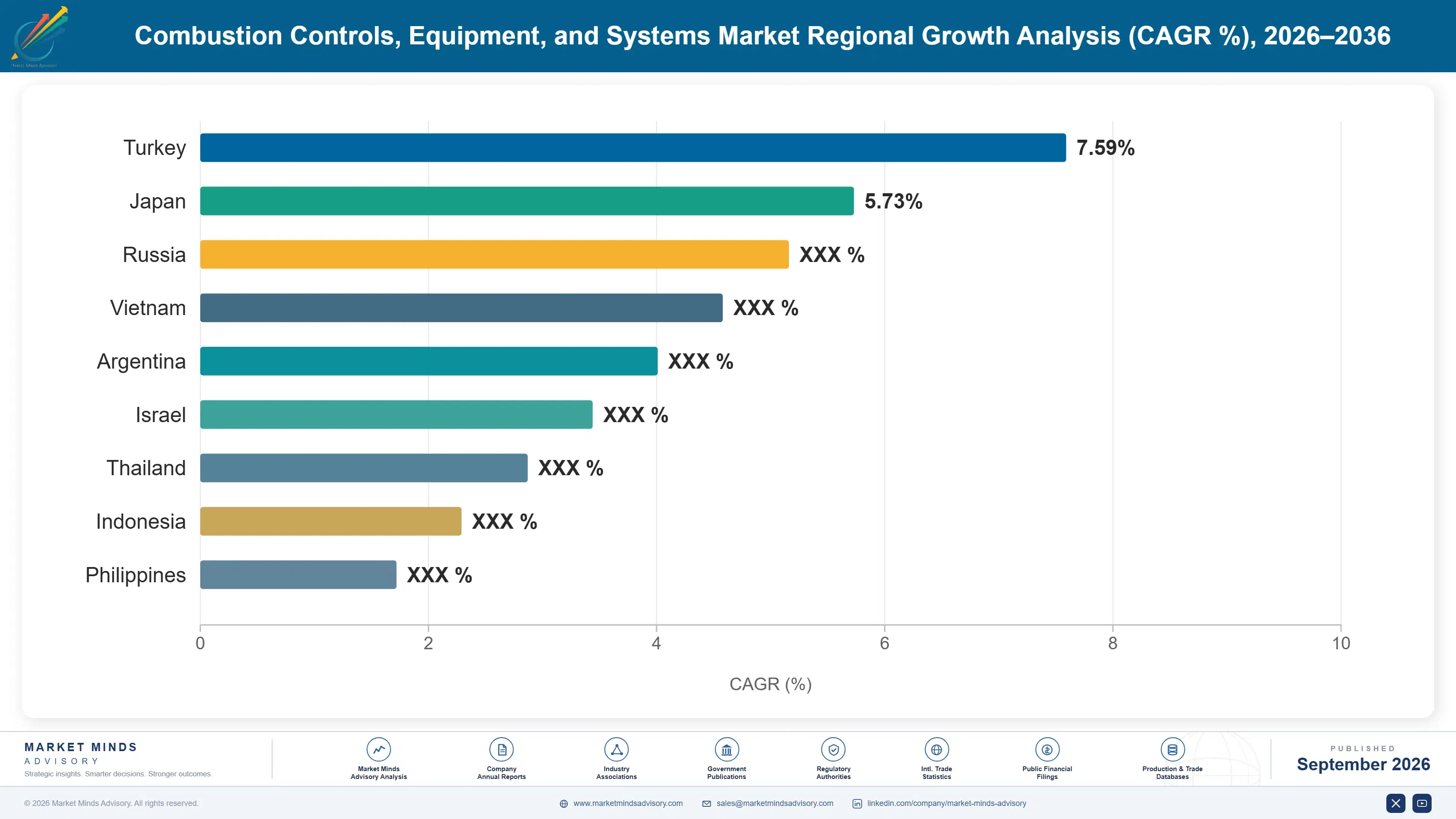
combustion-controls-equipment-and-systems-market-country-cagr-analysis-1790006147777

Monetizing Emissions Compliance and Service Contracts

Combustion equipment margins increasingly depend on multi-year service contracts and emissions compliance documentation fees rather than one-time hardware sales alone. Suppliers that build deep digital diagnostics and regulatory reporting capability capture disproportionate lifetime value from every installed unit across successive plant turnaround cycles spanning many years of continuous operation, ongoing maintenance, and periodic recalibration work.

Multi Year Combustion Service Contract Bundling

Bundling scheduled calibration visits, firmware updates, and emissions compliance documentation into a single multi-year service contract converts a one-time equipment sale into recurring revenue that scales directly with the installed base rather than requiring a new sale each cycle. Suppliers report service contract attachment increases average customer lifetime value by roughly 40 percent compared to equipment sold without an attached service agreement across the full plant lifecycle. Operators accept this pricing structure because it guarantees regulatory documentation continuity and reduces the internal compliance burden considerably compared to managing calibration schedules independently.
Market Impact: Raises customer lifetime value by 40 percent overall

Emissions Compliance Documentation Premium Pricing Model

Charging a premium for automated emissions compliance documentation and regulatory reporting integration lets suppliers capture additional revenue from a capability that operators increasingly view as mandatory rather than optional given tightening reporting deadlines worldwide. This documentation premium now represents close to 15 percent of total contract value for facilities operating under the strictest regulatory reporting regimes, reflecting the genuine compliance risk reduction it provides. Operators favor this approach since it transfers documentation liability partly to the supplier, reducing the internal compliance team burden considerably during regulatory audit cycles each year.
Market Impact: Captures roughly 15 percent of total contract value overall

Retrofit Kit Modular Upgrade Path Sales

Selling modular retrofit kits that upgrade existing mechanical flame safeguard systems to digital burner management capability without requiring full combustion train replacement lets suppliers capture revenue from operators unwilling to commit to complete system replacement right away this budget cycle. This retrofit approach typically costs 30 percent less than full replacement while still delivering most of the emissions compliance and efficiency benefit operators need to satisfy regulators. Suppliers offering proven retrofit pathways are winning deals against competitors insisting on full system replacement, particularly among cost-conscious mid-market operators facing real capital constraints.
Market Impact: Costs 30 percent less than full replacement cost

Who Controls the Margin Pool

Concentration is moderate, with the top five suppliers by annual shipment revenue holding roughly 45 percent combined share of a market split between diversified automation giants and specialized burner equipment manufacturers. Honeywell leads by a meaningful margin over the next closest challenger, built on decades of installed base relationships across process industries worldwide that newer entrants struggle to match at comparable scale and depth.
Current competitive activity centers on emissions monitoring integration, hydrogen co-firing certification, and predictive maintenance analytics bundling across nearly every supplier product roadmap tracked in this analysis. Diversified automation giants continue bundling combustion controls deeper into broader process control platforms, while specialized manufacturers compete on flame safety certification depth and fuel flexibility for regulated industrial buyers evaluating multiple competing proposals simultaneously.

Emerging pressure comes from Chinese domestic equipment manufacturers expanding internationally, threatening to reshape competitive dynamics beyond their traditional home market stronghold within the next several years. Rankings could shift meaningfully if any top-five supplier secures a dominant hydrogen co-firing certification win with a major utility operator or suffers a significant safety incident that damages customer trust considerably across the broader installed base.
combustion-controls-equipment-and-systems-market-company-positioning-matrix-1790006148312

Competitive Moat and Risk Dimensions

HONEYWELL

Moat: Diversified installed base breadth

Honeywell benefits from decades of installed base relationships spanning process industries worldwide, giving it distribution reach and spare parts logistics that specialized burner manufacturers cannot match without years of comparable investment. That existing footprint means many operators default to Honeywell for combustion retrofit work without formally evaluating competing suppliers during routine plant turnaround planning.
HONEYWELL

Risk: Slower niche innovation pace

Honeywell moves more cautiously on niche innovations like hydrogen co-firing certification than smaller specialist manufacturers solely focused on advanced combustion technology, since legacy product lines represent a larger share of its overall revenue base. If nimble competitors continue capturing early hydrogen certification wins through faster product development, Honeywell could lose share in the fastest-growing segments.
SIEMENS

Moat: Deep process automation integration

Siemens built its reputation through deep integration between combustion controls and broader plant-wide process automation platforms, giving it an advantage with large industrial customers seeking a single vendor relationship across their entire operations technology stack. That integration depth attracts operators running complex multi-unit facilities who specifically want to avoid managing separate combustion and automation vendor relationships.
SIEMENS

Risk: Premium pricing limits smaller buyers

Siemens premium pricing tied to its broader automation platform integration makes it a harder sell for smaller and mid-market operators seeking standalone combustion controls without a full plant-wide automation commitment attached. If specialized manufacturers continue offering comparable combustion capability at meaningfully lower price points without the broader platform requirement, Siemens could lose share among cost-sensitive mid-market facilities.

Players Tracked

Prominent Players

Honeywell
Siemens
Emerson Electric
ABB
Yokogawa Electric

Other Key Players

Fives Group
Bloom Engineering
Maxon Corporation
Eclipse Inc
Webster Combustion
Nu-Way Ltd
Baltur
Riello
Cleaver-Brooks
Fulton Boiler Works
Forbes Marshall
Mesa Labs
Land Instruments
KROHNE
Endress+Hauser

Recent Developments

JANUARY 2026

Honeywell: product launch

Honeywell announced an expanded emissions monitoring module compatible with its existing burner management system installed base, letting current customers add continuous compliance reporting capability without full system replacement. The launch targets power generation and chemical processing operators seeking incremental compliance upgrades ahead of tightening regulatory deadlines.
Signal: Signals established suppliers racing to add emissions compliance capability to installed hardware bases very quickly now
APRIL 2026

Siemens: product launch

Siemens launched a hydrogen co-firing certified burner management platform targeting utility operators pursuing decarbonization commitments, expanding its addressable market beyond conventional natural gas combustion systems considerably. The launch responds directly to accelerating utility demand for combustion equipment capable of handling blended hydrogen fuel streams safely.
Signal: Signals automation giants racing to certify hydrogen co-firing capability well ahead of rapidly accelerating utility demand
AUGUST 2026

Emerson Electric: acquisition

Emerson Electric acquired a smaller combustion analyzer manufacturer to add advanced flue gas measurement capability to its existing process control portfolio for industrial customers managing increasingly complex fuel blending requirements. The deal accelerates Emerson entry into the fast-growing combustion analyzer segment without years of internal development work.
Signal: Signals established process control vendors acquiring smaller specialists quickly to capture emerging combustion analyzer market demand

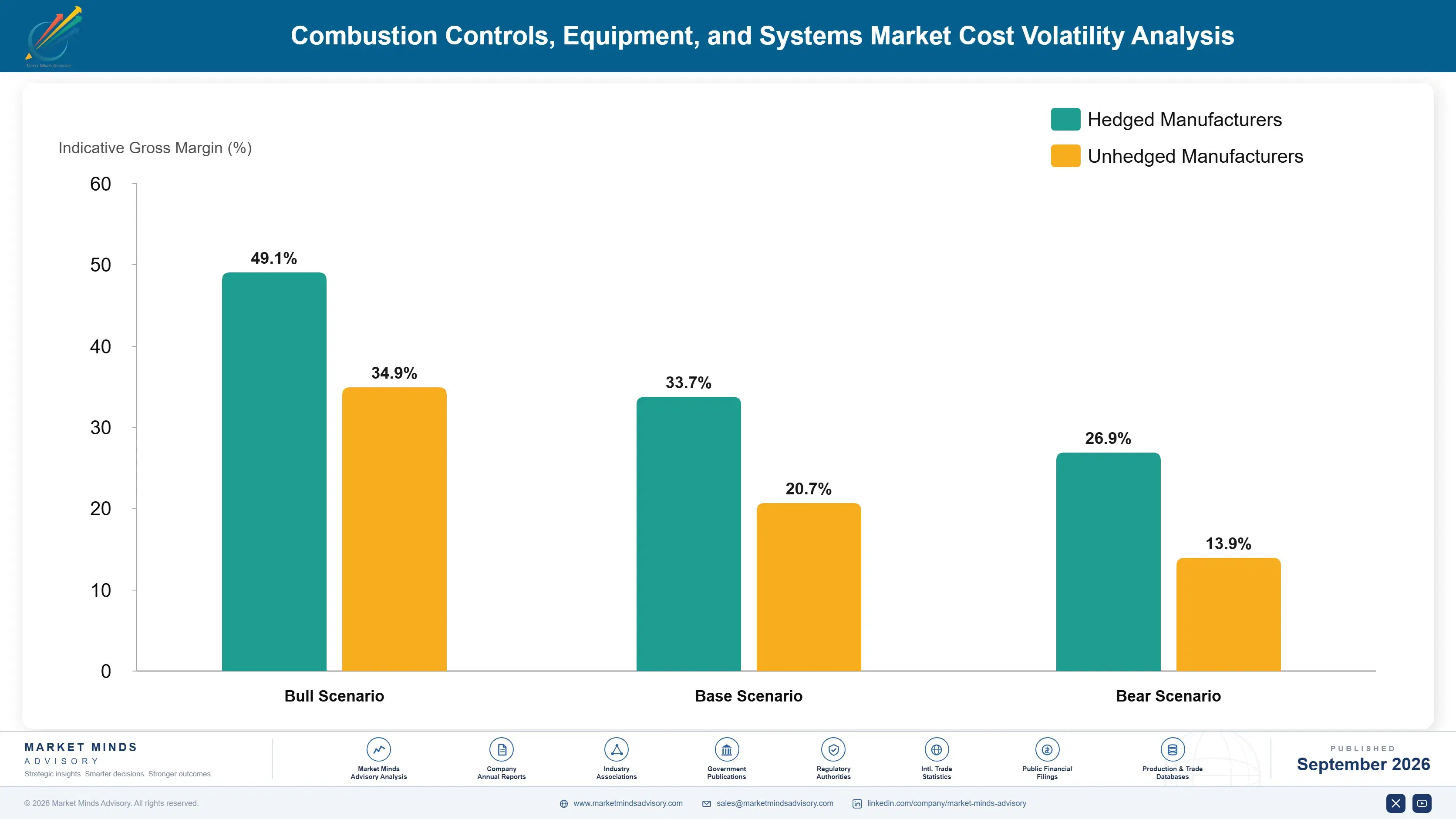
Fuel and Steel Input Exposure

Steel and specialty alloy components together with electronic sensor modules represent roughly 45 percent of combustion equipment cost of goods sold, sourced predominantly from global steel producers and specialized electronics manufacturers concentrated in East Asia and North America. Precision machining and assembly labor make up most of the remaining structured cost base for a typical burner management system.
Steel prices spiked meaningfully during 2021 and 2022 as global supply chains struggled with pandemic-related production disruptions, according to a Nucor Corporation annual report, squeezing margins for equipment manufacturers without long-term fixed-price steel supply agreements locked in advance. Smaller manufacturers renegotiating steel contracts during that period faced cost increases exceeding 25 percent, forcing several to delay planned capacity expansion and pass some cost through to customers via price increases.

Scaled manufacturers with direct steel producer relationships absorbed that disruption with far less margin compression than smaller competitors buying steel through general distributors at marked-up prices. This exposure gap compounds further since large diversified automation vendors can shift steel sourcing across multiple product lines and regions more easily than specialized burner manufacturers dependent on a single regional supply chain for their entire product portfolio.
combustion-controls-equipment-and-systems-market-cost-volatility-analysis-1790006148508

Fixed Price Steel Supply Agreements

Locking in steel pricing through multi-year fixed-price agreements with primary producers shields larger manufacturers from spot market volatility, though it requires forecasting production volume years in advance and carries meaningful penalty exposure if actual order volume falls well short of contracted minimums during an unexpected industry-wide demand slowdown or sudden shift in customer orders.

Component Standardization Across Product Lines

Standardizing steel components and sensor modules across multiple product lines lets manufacturers negotiate better volume pricing and simplifies inventory management during supply disruptions across the entire product portfolio and manufacturing footprint. This approach sacrifices some product differentiation flexibility but meaningfully reduces exposure to any single specialized component shortage affecting the broader manufacturing business overall.

Regional Supplier Sourcing Diversification

Qualifying alternative steel and electronics suppliers across multiple geographic regions reduces single-source dependency risk, though it requires additional testing and certification work for each new supplier relationship established over time and additional cost. Manufacturers that diversified sourcing before the last steel price spike recovered margin considerably faster than single-source competitors still relying on just one region.

Portfolio Architecture for Margin Defence

Gross margins vary meaningfully across the combustion equipment portfolio, from thin margins on basic mechanical flame safeguard hardware up to strong margins on emissions monitoring, combustion analyzers, and digital burner management platforms sold to regulated industrial customers worldwide. Volume sits overwhelmingly in the commodity-adjacent mechanical tier, but value concentrates in the smaller digital and monitoring tiers instead, across nearly every regional market this study tracks in fine detail.
The tension between chasing unit volume and protecting margin plays out visibly in supplier sales strategy, where companies must decide how much to discount basic mechanical hardware to win large industrial accounts against how much to recoup through attached emissions monitoring and service contracts that actually drive long-term profit across the full multi-year customer relationship each supplier maintains with its largest industrial accounts.

High-value pools concentrate in emissions monitoring, combustion analyzers, and digital burner management, where operators pay for measurable regulatory compliance and fuel efficiency gains rather than raw mechanical hardware alone. That is where most suppliers are now directing new product development spend, well ahead of any planned expansion in commodity-tier mechanical flame safeguard functionality currently under consideration at most equipment manufacturers today.

Mechanical Flame Safeguard Hardware

Thin margin mechanical flame safeguard hardware sold primarily on price and basic reliability through industrial procurement channels, competing almost entirely on unit cost rather than digital capability or advanced diagnostics.
Gross Margin: 12-20%

Certified Digital Burner Management

Certified digital burner management systems carrying proven safety certification and compliance documentation support, sold through direct sales relationships at a meaningful premium over basic mechanical alternatives and unproven newer suppliers.
Gross Margin: 25-35%

Emissions Monitoring and Combustion Analytics

Advanced emissions monitoring and combustion analyzer platforms built around continuous compliance data and predictive maintenance analytics, targeting operators willing to pay for measurable regulatory risk reduction over the long term.
Gross Margin: 36-46%
combustion-controls-equipment-and-systems-market-portfolio-architecture-1790006149006

High-value Sub-segments and Strategic Watch-out

Emissions Monitoring Systems

Emissions monitoring systems represent the highest value, fastest growing pocket of the market, driven by tightening regulatory reporting mandates and recurring compliance documentation revenue that extends supplier lifetime value considerably across every installed unit and renewal cycle for years to come across the wider industry overall.
Gross Margin: 36-46%

Combustion Analyzers

Combustion analyzers are a high-value, moderate-growth pocket where measurement accuracy and calibration stability support durable pricing power even as unit growth moderates relative to newer emissions monitoring categories gaining share steadily across nearly every heavy industry vertical tracked worldwide over the coming decade and beyond.
Gross Margin: 25-35%

Flame Safeguard Controls

Flame safeguard controls remain the volume core of the market, competing largely on reliability and price through industrial procurement channels, generating thinner margins but still sustaining the largest absolute deployment base across nearly every process industry segment tracked globally each and every single year without exception.
Gross Margin: 12-20%

Hydrogen Co-Firing Compatibility

Hydrogen co-firing compatibility is a strategic watch-out rather than a true revenue segment today, where suppliers lacking certified hydrogen blend capability risk exclusion from utility and refinery procurement shortlists as decarbonization commitments accelerate across the power generation sector broadly worldwide over the coming several years ahead.
Gross Margin: n/a

Recurring Service and Compliance Revenue

Combustion control revenue increasingly resembles annuity revenue through service contracts, calibration visits, and spare parts supply, rather than a one-time equipment sale that concludes the customer relationship. Operators that install a digital burner management system typically sign multi-year service agreements covering scheduled inspections and firmware updates, creating a durable revenue tail that extends well beyond the initial equipment purchase across the full plant lifecycle.
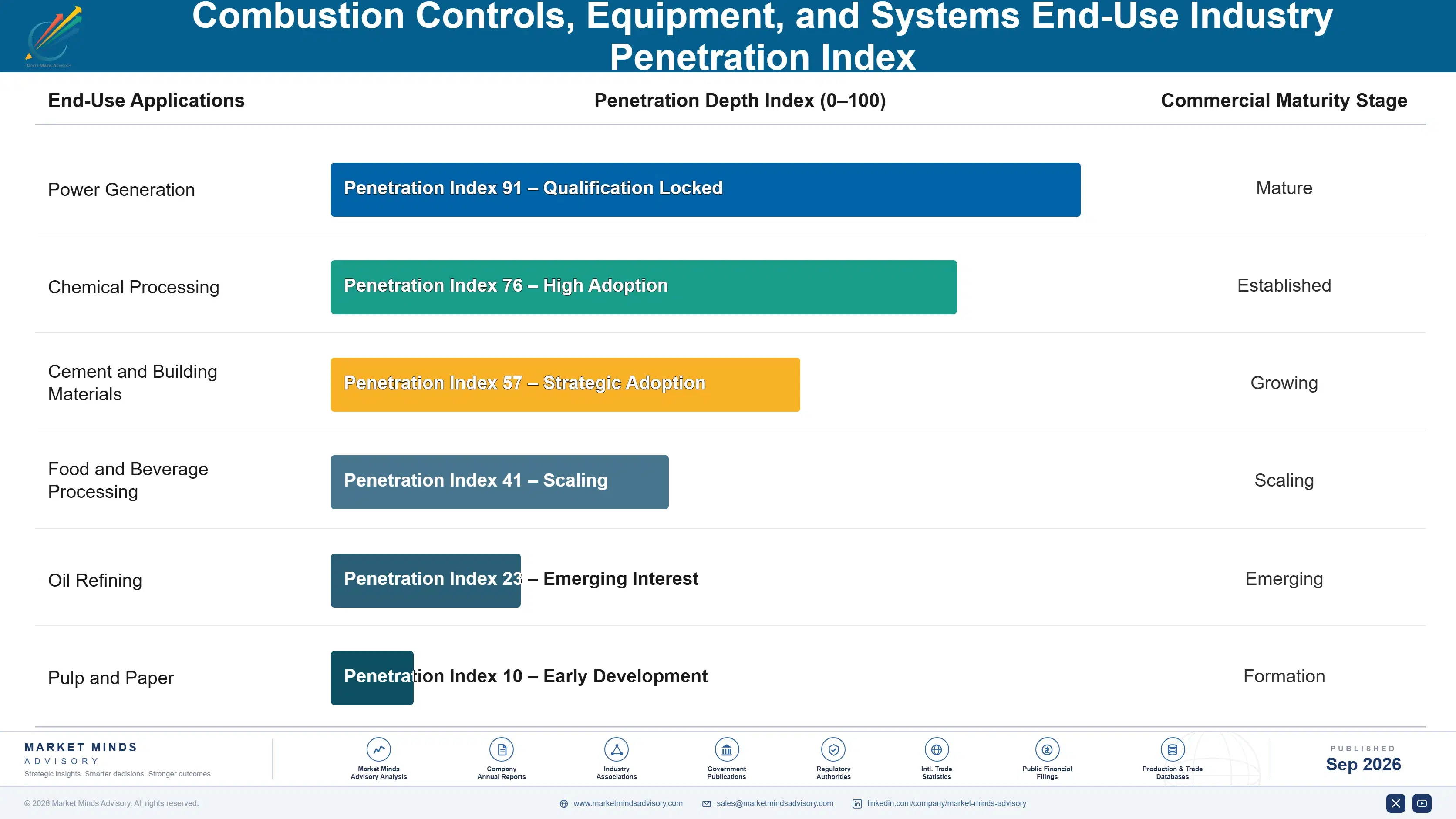
Adoption depth varies sharply by end-use vertical. Power generation and chemical processing operators adopt advanced emissions monitoring and digital burner management aggressively given strict regulatory audit requirements, while food processing and smaller manufacturing facilities upgrade more cautiously, prioritizing basic flame safeguard reliability over advanced analytics capability, creating a meaningfully different adoption curve within each specific vertical entirely across the wider industry.

Buyer profiles are shifting as younger plant engineers increasingly expect combustion control systems to integrate directly with plant-wide digital twin and predictive maintenance platforms rather than operating as standalone mechanical systems isolated from broader operations technology infrastructure. This generational shift is broadening the addressable buyer base considerably beyond traditional maintenance engineers toward digital operations teams overseeing plant-wide efficiency programs today.
combustion-controls-equipment-and-systems-market-end-use-penetration-index-1790006149504

Where Combustion Equipment Value Concentrates

These are among the four positions where our research anticipates prominent divergence between winners and laggards over the coming forecast period. Each is grounded in the demand model, the regulatory perimeter, and the announced capacity pipeline.
01 / EMISSIONS COMPLIANCE INVESTMENT STRATEGY

Compliance documentation depth separates durable suppliers from commodity hardware providers

Suppliers that build deep emissions monitoring and compliance documentation capability capture disproportionate lifetime value that competitors selling mechanical hardware alone cannot easily match at comparable price or speed. That advantage compounds as regulated operators keep favoring suppliers with proven compliance certification depth over vendors offering only basic flame safeguard functionality across nearly every industry segment tracked. Suppliers treating compliance documentation as optional will find their addressable customer base shrinking steadily as reporting requirements keep tightening across nearly every regulated sector this study tracks closely.
02 / HYDROGEN CO-FIRING CERTIFICATION STRATEGY

Hydrogen certification becomes the new utility procurement baseline requirement

Hydrogen co-firing certification is shifting from experimental pilot capability to baseline procurement requirement faster than most supplier roadmaps anticipated just a few years ago at this point. Suppliers committing engineering resources to hydrogen blend compatibility now will capture disproportionate share of new utility and refinery contracts through 2036 as buyers increasingly treat natural-gas-only combustion as an outdated liability across nearly every regulated power market. Competitors relying solely on conventional combustion technology risk losing customers to whichever supplier certifies hydrogen blending first.
03 / STEEL SOURCING DIVERSIFICATION STRATEGY

Sourcing diversification reduces supplier cost and delivery exposure meaningfully

Suppliers that diversify steel and electronics sourcing beyond a single regional supply chain reduce cost and delivery exposure that competitors relying on one region cannot absorb as easily during periods of real supply chain stress or pricing disruption. The 2021 steel price spike demonstrated how quickly margin compression can spread for manufacturers lacking diversified sourcing relationships across multiple geographic regions and supplier networks worldwide already operating at scale. Suppliers that diversify sourcing earliest will hold a meaningful cost and resilience advantage over slower-moving rivals for years ahead.
04 / DIGITAL PREDICTIVE MAINTENANCE STRATEGY

Predictive maintenance analytics becomes the next competitive battleground overall

Diversified automation giants and specialized burner manufacturers are converging on digital predictive maintenance and remote diagnostics as the next major competitive battleground across the entire combustion equipment industry today. Suppliers investing in connected sensor platforms and analytics now will protect installed base contracts that competitors relying on standalone mechanical hardware risk losing entirely as buyer expectations keep rising steadily across every regulated sector. This protection becomes more valuable as emissions enforcement keeps intensifying across every major regulated industry tracked in this analysis.

Engagement Snapshot From the Field

A live engagement with an industry participant carrying material or product regulatory and market exposure ahead of a defining policy shift, showing how our research translates into a defensible multi-year portfolio strategy.
MARKET MINDS ADVISORY · CLIENT ENGAGEMENT SUMMARY
Combustion Controls, Equipment, and Systems Producer Strategic Portfolio Review and Transition Roadmap 2026·Investment Scenario on Combustion Controls, Equipment, and Systems Exposure Evaluation 2025-26
CLIENT PROFILE
The client is a regional utility operator running 6 natural gas power generation plants across the midwestern United States facing tightening state-level emissions reporting requirements and an aging combustion control installed base averaging 18 years old. Annual emissions compliance remediation spend was approximately 12 million dollars (client-reported, unverified by MMA) prior to the engagement, with monitoring handled through periodic manual stack testing.
STRATEGIC CHALLENGE
The client faced mounting regulatory pressure following new state-level continuous emissions monitoring mandates, but leadership remained uncertain whether a phased combustion control retrofit could be completed without taking generation units offline during peak seasonal demand periods. Leadership needed a credible risk-based retrofit sequencing framework before committing significant capital to plant modernization.
MMA APPROACH
MMA conducted primary interviews with combustion equipment suppliers and comparable utility operators already running continuous emissions monitoring retrofits, benchmarked compliance certification coverage across multiple vendor proposals, and modeled financial outcomes across three retrofit sequencing scenarios ranging from single-unit pilot deployment to full fleet-wide replacement spanning multiple future fiscal years and plant units.
KEY FINDINGS
  1. Generation units with the oldest combustion control installations showed the strongest projected return on retrofit investment, given the highest current compliance risk exposure relative to unit age.
  2. Comparable utility operators running mature continuous emissions monitoring systems reported audit finding reduction exceeding 60 percent within twelve months of full retrofit deployment across generation fleets.
  3. Plant operations staff reported meaningfully faster compliance reporting turnaround once automated monitoring replaced manual stack testing procedures, reducing average reporting preparation time significantly.
  4. Phased single-unit retrofit sequencing tested better than simultaneous fleet-wide conversion, preserving generation capacity during peak demand while still capturing meaningful compliance gains ahead of deadlines.
CLIENT PROFILE
The client is a regional utility operator running 6 natural gas power generation plants across the midwestern United States facing tightening state-level emissions reporting requirements and an aging combustion control installed base averaging 18 years old. Annual emissions compliance remediation spend was approximately 12 million dollars (client-reported, unverified by MMA) prior to the engagement, with monitoring handled through periodic manual stack testing.
STRATEGIC CHALLENGE
The client faced mounting regulatory pressure following new state-level continuous emissions monitoring mandates, but leadership remained uncertain whether a phased combustion control retrofit could be completed without taking generation units offline during peak seasonal demand periods. Leadership needed a credible risk-based retrofit sequencing framework before committing significant capital to plant modernization.
MMA APPROACH
MMA conducted primary interviews with combustion equipment suppliers and comparable utility operators already running continuous emissions monitoring retrofits, benchmarked compliance certification coverage across multiple vendor proposals, and modeled financial outcomes across three retrofit sequencing scenarios ranging from single-unit pilot deployment to full fleet-wide replacement spanning multiple future fiscal years and plant units.
KEY FINDINGS
  1. Generation units with the oldest combustion control installations showed the strongest projected return on retrofit investment, given the highest current compliance risk exposure relative to unit age.
  2. Comparable utility operators running mature continuous emissions monitoring systems reported audit finding reduction exceeding 60 percent within twelve months of full retrofit deployment across generation fleets.
  3. Plant operations staff reported meaningfully faster compliance reporting turnaround once automated monitoring replaced manual stack testing procedures, reducing average reporting preparation time significantly.
  4. Phased single-unit retrofit sequencing tested better than simultaneous fleet-wide conversion, preserving generation capacity during peak demand while still capturing meaningful compliance gains ahead of deadlines.
RECOMMENDED STRATEGY
Phase 1: Phase one: retrofit the two oldest generation units with continuous emissions monitoring within the first nine calendar months of the program. Phase 2: Phase two: expand retrofit deployment to three more additional generation units based on phase one compliance results measured extremely carefully. Phase 3: Phase three: evaluate full fleet-wide retrofit completion based on financial and compliance performance across all five newly retrofitted generation units.
OUTCOME
Within eighteen months of initial retrofit deployment, the client reported full compliance with new state-level continuous emissions monitoring mandates across all retrofitted units and secured regulatory approval for phased completion of the remaining fleet (client-reported, unverified by MMA), well ahead of the original compliance deadline set.

Frequently Asked Questions

Foundational context covering the market sizes, CAGR, scope, country, region and competition that inform every finding below. This section is provided to cover basics and most often pre-purchase conversations, answered from the MMA Primary Research Dataset.

What is the current size of the Combustion Controls, Equipment, and Systems Market?

The global combustion controls, equipment, and systems market was valued at approximately 6.8 billion dollars in 2025, covering burner management systems, flame safeguard controls, combustion analyzers, industrial burners, fuel metering valves, and emissions monitoring systems.

How large will the Combustion Controls, Equipment, and Systems Market be by 2036?

The market is projected to reach approximately 11.04 billion dollars by 2036, up from 7.11 billion dollars in 2026, an incremental gain of roughly 3.93 billion dollars over the forecast period.

What is the CAGR for the Combustion Controls, Equipment, and Systems Market 2026 to 2036?

The market is expected to grow at a compound annual rate of 4.5 percent between 2026 and 2036, with a bull case near 5.7 percent and a bear case near 3.2 percent annually.

Which segment is growing fastest?

Emissions monitoring systems lead segment growth at 7.0 percent annually, roughly 1.56 times the overall market rate, as regulators tighten reporting requirements for industrial combustion sources.

Who are the major companies in the Combustion Controls, Equipment, and Systems Market?

Honeywell, Siemens, Emerson Electric, ABB, and Yokogawa Electric lead the market on annual shipment revenue, together holding roughly 45 percent of combined global market share overall.

Which country is growing fastest?

China leads country-level growth given continued industrial capacity expansion across chemical processing, cement, and power generation sectors requiring extensive new combustion equipment installation nationwide each year.

Report Segmentation Architecture

The full report scope spans multiple orthogonal segmentation dimensions, with cross-tabulated demand data provided for each dimension pair. Coverage extends further to regional breakdowns, trend trajectories, and the competitive detail needed to support segment-level decision-making.

By Product Type

  • Burner Management Systems
  • Flame Safeguard Controls
  • Combustion Analyzers
  • Industrial Burners
  • Fuel Metering and Control Valves
  • Emissions Monitoring Systems

By End-Use Industry

  • Power Generation
  • Chemical Processing
  • Cement and Building Materials
  • Food and Beverage Processing
  • Oil Refining
  • Pulp and Paper

By Commercial Dimension

  • New Installation Sales
  • Retrofit and Upgrade Sales
  • Service and Maintenance Contracts
  • Systems Integrator Channel

By Region

  • North America
  • Western Europe
  • East Asia
  • South Asia and Pacific
  • Latin America
  • Middle East and Africa
  • Eastern Europe

Scope, Methodology, and Coverage

Every figure in this report is reproducible from documented input assumptions. The scope below maps the historical period, the forecast horizon, the segmentation dimensions, and the countries covered, alongside the underlying primary and qualitative methodology.
Historical Period
2020 to 2025
Forecast Period
2026 to 2036
Base Year
2025 (USD billions; MMA Primary Research Dataset, September 2026)
Market Definition
The combustion controls, equipment, and systems market covers burner management systems, flame safeguard controls, combustion analyzers, industrial burners, fuel metering and control valves, and emissions monitoring systems used in industrial boilers, furnaces, and process heaters. It excludes residential heating appliances, internal combustion engines, and general purpose process control software not centered on combustion management.
Quantitative Units
USD Billion, CAGR (%) 2026-2036
Segmentation Dimensions
Product Type, End-Use Industry, Commercial Dimension, Region
Regions Covered
North America, Western Europe, East Asia, South Asia and Pacific, Latin America, Middle East and Africa, Eastern Europe
Countries Covered
US, Canada, Germany, UK, France, China, Japan, South Korea, India, Australia, Brazil, Mexico, Saudi Arabia, South Africa, Poland
Key Companies Profiled
20
Quantitative Methodology
Primary survey, n=3,800 respondents, Q4 2025, six countries; demand-side model with trade association cross-validation
Qualitative Methodology
47 expert interviews, Q4 2025; applied to validate demand model assumptions, identify emerging dynamics, and assess competitive positioning
Report Format
PDF and XLSX data workbook (Word format preview document)
Publisher
Market Minds Advisory
Report Code
MMA-2026-CON-704
Published
September 2026
Contact
sales@marketmindsadvisory.com | www.marketmindsadvisory.com

Purchase the full Combustion Controls, Equipment, and Systems Market Report (2026 to 2036).

The full report delivers a complete strategic assessment of the combustion controls, equipment, and systems market, spanning detailed segment-level forecasts, regional demand modeling, and competitive benchmarking across the top twenty market participants. It includes proprietary primary survey data covering three thousand eight hundred respondents and forty-seven expert interviews conducted in the fourth quarter of 2025. Buyers receive access to editable data tables alongside the narrative analysis for internal strategic planning use across engineering, procurement, and operations teams. The analysis is designed to support decisions on vendor selection, retrofit sequencing, and capital investment over the coming decade.
Segment level revenue forecasts through the year 2036
Regional market sizing across seven world regions
Competitive benchmarking of twenty key market participants
Editable data tables for internal strategic planning
Primary survey data from 3,800 global respondents
Expert interview insights from 47 industry practitioners

Built For The People Who Decide

From boardroom strategy to bench-side execution, this report is read cover-to-cover by leaders shaping the next decade of their industry, turning demand scenarios, market dynamics and valuation benchmarks into decisions.
CXOs/ Presidents/ VPs/ Managers
M&A and Corporate Development
Strategy Teams and R&D Heads
Procurement and Product Directors
Regulatory and Compliance Leaders
Investor Relations and Equity Analysts