Market Minds Advisory
Combined Cooling Heat and Power (CCHP) Plant Market

Combined Cooling Heat and Power (CCHP) Plant Market: Trigeneration Systems for Distributed Energy Resilience

Data center operators and hospital campuses are bypassing multi-year grid interconnection queues by pairing gas prime movers with absorption chillers, capturing waste heat twice over to defend uptime against a tightening, costlier electricity supply.

Lead Analyst

David Horsley

Published

September 2026

Make Smarter Decisions with Customized Research Insights

Request a free sample report and evaluate market opportunities, growth trends, and competitive dynamics relevant to your business needs.

2025 MARKET VALUE$8.9BMarket Size 2025
2036 FORECAST VALUE$17.7BBase Case , 2026 to 2036
CAGR 2026 TO 20366.4 %Bull 7.7% / Bear 5.1%
INCREMENTAL OPPORTUNITY$8.2BNet 10- year value creation
EXPANSION MULTIPLE1.86x2036 value over 2026 base
Strategic Levers
M&A Pipeline
Regional Outlook
Country Rankings
Competitive Intelligence
Segmental Deep-dive
Call-Us : 91 93563 13602

Executive Snapshot and Market Trajectory

Grid interconnection queues now stretch past four years in several major markets, and CCHP trigeneration plants let data center and hospital campus owners sidestep the wait entirely by generating both power and thermal output onsite from a single fuel input source, at commercial scale.
Data center operators, hospitals, and universities are the fastest-adopting buyers, pairing gas engines, turbines, or fuel cells with absorption chillers to capture waste heat for both space heating and the cooling loads that dominate hyperscale facility demand. East Asia leads global deployment volume by a wide margin, anchored by China's industrial park build-out under dual carbon policy and South Korea's fuel cell subsidy programme, while North America closes fast on its own data center demand.
Competition remains fragmented across regional EPC integrators and global OEM prime mover suppliers rather than concentrated in a handful of dominant names, with CR5 sitting at just 34 percent of total shipments worldwide. Emissions permitting delays for gas-fired prime movers and rising interest in hydrogen-blend fuel cells are actively reshaping which technologies win new contracts across every major regional market this decade, and the shift is accelerating.
Market Definition
The CCHP plant market covers integrated systems that generate electricity from a single fuel input while recovering waste heat to serve both heating and cooling loads through absorption or adsorption chillers. It excludes standalone combined heat and power systems without a cooling output, and excludes district cooling plants that purchase grid electricity rather than generating it onsite.
Base Year Value
$8.9B in 2025 (MMA Primary Research Dataset, August 2026)
Forecast Period
2026 to 2036, eleven discrete annual values
CAGR
6.4% base case. Bull 7.7%. Bear 5.1%.
Fastest Growth Segment
Fuel Cell-Based CCHP Systems: 11.2% CAGR
Fastest Growth Country
South Korea: 9.6% CAGR
Fastest Growth Region
South Asia and Pacific: 8.4% CAGR
Largest Region
East Asia: 29% of 2025 global value
Market Leaders
Caterpillar Inc., Siemens Energy AG, Mitsubishi Power Ltd, GE Vernova, Wartsila Corporation. Source: MMA Analysis based on company annual reports.
Primary Survey
n=3,800 procurement and R&D decision-makers, Q4 2025, six countries
Methodology
Demand-side build-up, cross-validated against public data, 47 expert interviews

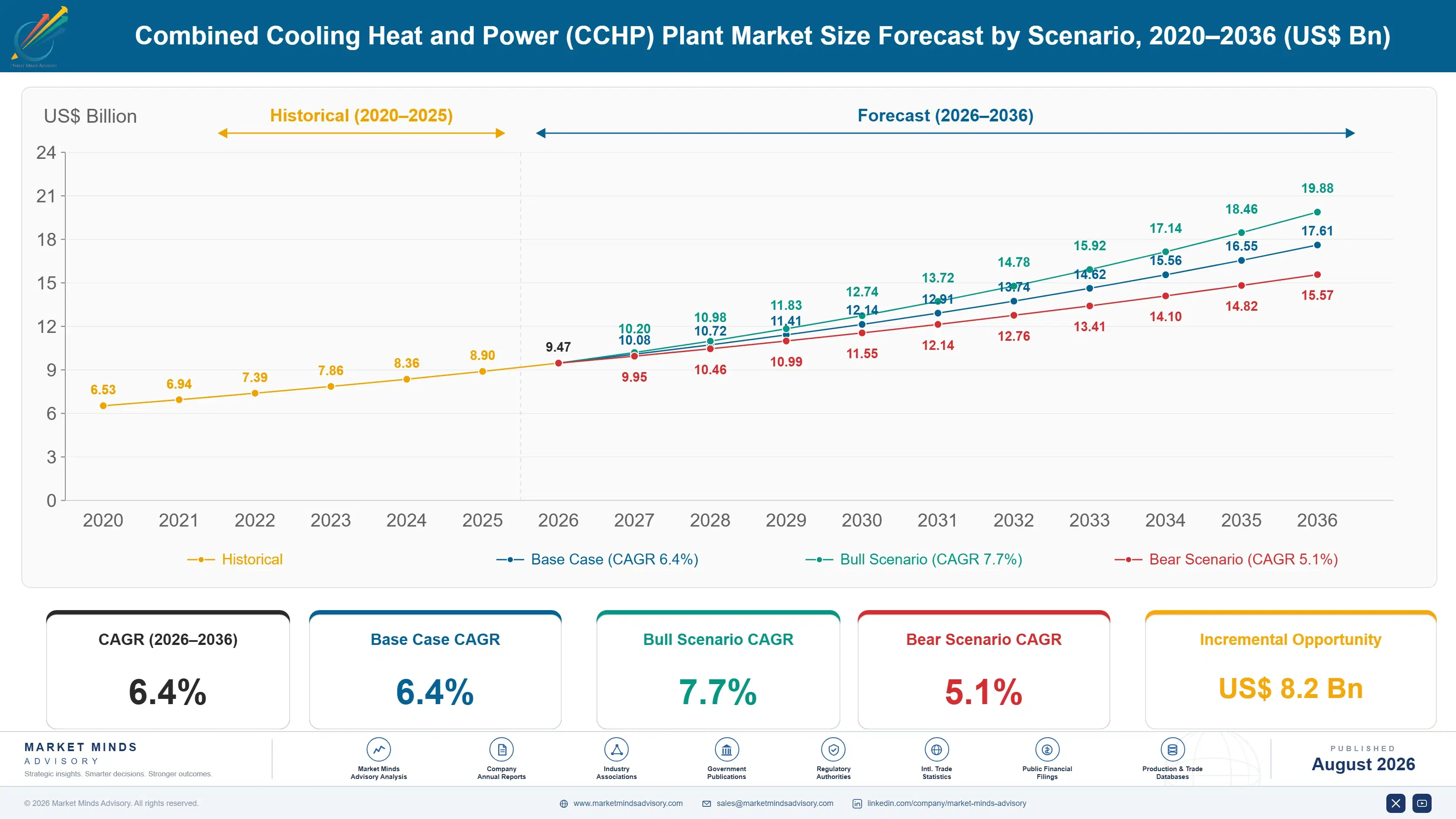
Combined Cooling Heat and Power (CCHP) Plant Market Forecast Scenarios

combined-cooling-heat-and-power-cchp-plant-market-size-forecast-scenario-1787302478802
Between 2020 and 2025, CCHP adoption grew at a steady mid-single-digit pace as hospitals and universities treated onsite generation mainly as a resilience hedge rather than a primary cost play. Deployment accelerated sharply after 2023 as grid interconnection queues lengthened and industrial electricity rates climbed across major economies, pulling data center demand into the picture for the first time at scale.
The base case assumes three mechanisms hold through 2036: continued grid queue congestion keeps onsite generation the faster path to reliable capacity, absorption chiller manufacturing costs keep falling as Chinese production scales further and exports more widely, and data center operators keep signing multi-year power purchase and thermal offtake agreements that lock trigeneration in as the default backup architecture for new hyperscale campus builds across every major region tracked in this report.
A bull scenario hinges on faster hydrogen-blend fuel cell cost declines pulling forward adoption in Japan, South Korea, and parts of the European Union well ahead of schedule. The bear risk is a sustained natural gas price spike, similar in scale to the 2022 European episode, that erodes the fuel cost advantage CCHP holds over separate grid electricity and chiller purchases across price-sensitive commercial segments.

Distributed Trigeneration Economics and Deployment Drivers

Three forces are converging on the same buyer decision right now. Grid interconnection delays have turned onsite generation from a sustainability talking point into an operational necessity for any facility that cannot wait years for a utility connection, absorption chiller manufacturing costs have fallen sharply as Chinese producers scaled output well beyond domestic demand, and data center power demand has outpaced what utilities can credibly commit to on any predictable construction timeline
MARKET CONCENTRATIONCR5 34%fragmented across many regional integrators and global OEMs
AVERAGE SYSTEM PRICE$1.8M per MW installedinstalled cost including full absorption chiller integration package
TOP PRODUCING COUNTRYChina, 31% of unit shipmentsleads global prime mover and chiller output by far
CAPACITY UTILIZATION68% average load factorreflects steady baseload thermal hosting patterns onsite year-round
TRADE INTENSITY42% of turbines cross-border sourcedprime movers frequently imported rather than locally manufactured
FUEL COST SHARE38% natural gas input shareremains the dominant variable cost across installed base
The commercial character of this market sits somewhere between industrial capital equipment and ongoing energy services, and it is drifting steadily toward the latter. Buyers increasingly prefer performance contracts over outright purchase, pushing OEMs and EPC integrators toward long-term maintenance and fuel-management revenue rather than one-time equipment margin, a shift that rewards vendors with strong service networks over those competing purely on hardware price and delivery speed.
The next decade will be shaped by emissions permitting timelines for gas-fired prime movers, hydrogen blending trials moving from pilot to reference-scale fuel cell systems, and utility rate design that increasingly rewards onsite thermal hosting over pure grid dependence in high-demand-growth territories where interconnection capacity remains persistently scarce.
"The buyers driving this market aren't chasing carbon credits anymore, they're chasing interconnection dates that utilities simply can't promise. That's a harder tailwind to reverse than any subsidy cycle."
Director, Distributed Energy Practice · MMA Energy and Power Generation Practice

Market Trends

Data Center Operators Adopting Trigeneration as Standard Backup Architecture

Hyperscale and colocation operators are specifying CCHP plants at the design stage rather than retrofitting backup power later. Facilities exceeding 50 megawatts of critical IT load increasingly pair gas turbines with absorption chillers to serve both grid-independent power and the cooling load that data halls demand around the clock. Several announced campuses in Virginia, Texas, and Singapore now specify onsite trigeneration capacity equal to 60 to 80 percent of total facility load, treating the plant as primary infrastructure rather than emergency backup, a shift that materially changes prime mover sizing and absorption chiller specification across new-build contracts.
Market Impact: Shortens capacity delivery by 30 mo
China's Industrial Park Trigeneration Mandate Under the Dual Carbon Policy

China's National Development and Reform Commission has pushed provincial industrial parks to adopt combined cooling, heating, and power systems as part of dual carbon energy efficiency targets, favoring trigeneration over separate boiler and chiller purchases in new park approvals. More than 200 designated parks have adopted CCHP as baseline infrastructure since 2023, and provincial subsidies now cover part of absorption chiller capital cost for qualifying projects. The policy has pulled Chinese chiller and gas engine manufacturing capacity up sharply, compressing equipment costs for buyers outside China as export volumes scale alongside domestic demand.
Market Impact: Adds 640 MW hospital segment demand

Market Opportunities and Growth Drivers

Grid Interconnection Queue Delays Push Buyers Toward Onsite Generation

Interconnection queues in PJM, ERCOT, and several European transmission zones now average over four years for projects above 20 megawatts, according to grid operator filings. Data centers, hospitals, and manufacturing campuses facing multi-year waits for new grid capacity increasingly commission CCHP plants to serve load immediately rather than wait for utility approval. The mechanism is straightforward: a permitted onsite gas plant can be commissioned in twelve to eighteen months, compared to forty-eight or more months for a comparable grid connection upgrade, making trigeneration the faster path to reliable capacity regardless of underlying fuel economics.
Market Impact: Extends permitting timelines 18 mon

Hospital Campus Codes Requiring Onsite Thermal Redundancy

Building codes in the United States, Japan, and several European Union member states now require critical facilities including hospitals and university research campuses to demonstrate onsite backup for both power and thermal loads, not power alone. CCHP plants satisfy both requirements from a single asset, which lowers total redundancy capital versus separate generator and chiller backup systems bought and maintained independently. Facility owners citing joint commission accreditation and equivalent European hospital resilience standards have driven a wave of hospital campus retrofits since 2024, with average project size around 4 megawatts of electrical capacity.
Market Impact: Erodes project IRR by 4 points

Market Restraints and Challenges

Emissions Permitting Delays for Gas-Fired Prime Movers in Non-Attainment Zones

Air quality non-attainment zones in California, the northeastern United States, and parts of Germany impose stringent NOx limits on new gas turbine and reciprocating engine installations, extending permitting timelines by twelve to twenty-four months in the most restrictive jurisdictions. The root cause is that most CCHP prime movers were engineered before current emissions thresholds tightened, forcing retrofits with selective catalytic reduction systems that add ten to fifteen percent to installed cost. Developers in affected zones increasingly specify fuel cell or hydrogen-blend prime movers instead, sidestepping combustion permitting but carrying a higher capital premium that slows approval.
Market Impact: Adds 2.1 GW contracted capacity ann

Natural Gas Price Volatility Undermining the Onsite Cost Advantage

CCHP economics depend on a stable spread between onsite natural gas cost and grid electricity retail rates, and that spread narrowed sharply during the 2022 European gas price spike, when wholesale prices rose more than fourfold within months. The underlying cause is thin regional gas storage buffers and CCHP's direct fuel exposure compared to grid electricity, which blends generation sources and smooths price swings for the end buyer. Operators are responding with dual-fuel prime movers able to switch to diesel or biogas, and some European buyers are layering in fixed-price multi-year gas contracts to remove volatility from project financing.
Market Impact: Cuts equipment capital cost 15 perc
3 additional market trends, 3 additional growth drivers, and 4 additional restraints and challenges are covered in the full report. Contact sales@marketmindsadvisory.com to access the complete intelligence.

Segment CAGR and Growth Architecture

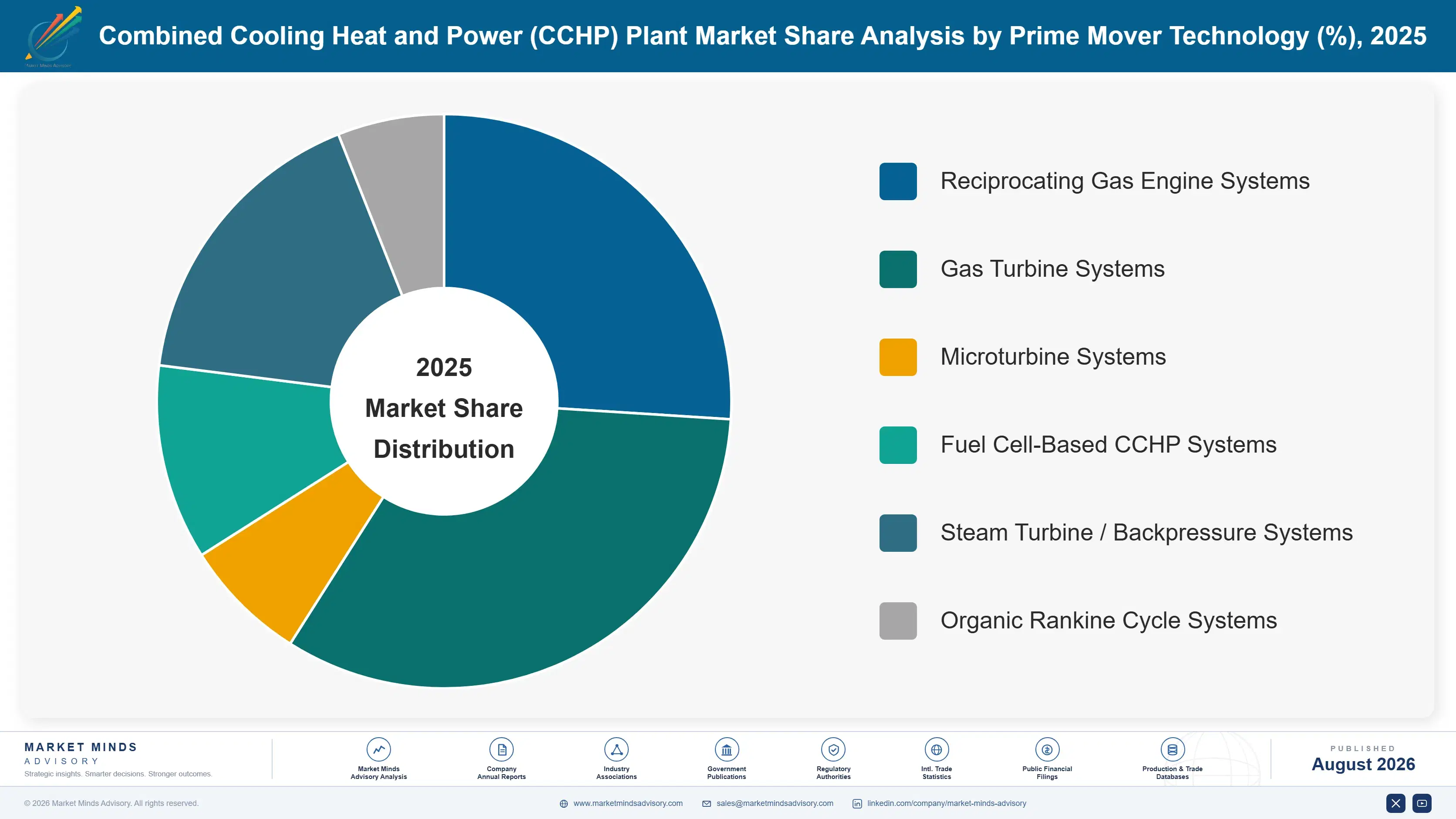
Segmentation follows prime mover technology, the single variable that determines fuel flexibility, part-load efficiency, and emissions profile across CCHP installations, since it governs both capital cost and the absorption chiller integration pathway available to each buyer, and it is the axis vendors themselves use to price and differentiate competing proposals across every regional market covered here.
combined-cooling-heat-and-power-cchp-plant-market-market-share-analysis-1787302479337

Fuel Cell-Based CCHP Systems

Fuel cell prime movers are the fastest-growing segment, pulled forward by data center operators and Japanese and South Korean utilities pursuing hydrogen-blend combustion pathways that sidestep combustion emissions permitting entirely. Solid oxide and molten carbonate fuel cell systems recover exhaust heat at temperatures suitable for absorption chiller operation, making them a natural trigeneration fit despite carrying a capital cost premium of roughly forty percent over comparable reciprocating gas engines. South Korea's renewable portfolio standard credits fuel cell CHP generation favorably, and several Korean utilities have committed to multi-hundred-megawatt fuel cell CCHP pipelines through 2030. Data center operators value the near-silent operation and lower maintenance interval, both of which matter more at hyperscale campus scale than raw capital cost.
CAGR 11.2%

Microturbine Systems

Microturbine-based CCHP systems are the second-fastest-growing segment, favored for their modularity in commercial campuses, hotels, and mid-size hospitals that need capacity in 100 kilowatt to 2 megawatt increments rather than a single large plant. Microturbines tolerate frequent cycling better than reciprocating engines, which suits buildings with variable occupancy and thermal load. Manufacturers including Capstone Green Energy have pushed maintenance intervals past 8,000 operating hours between major service events, materially lowering total lifecycle cost for commercial building owners. Adoption is concentrated among hotel groups and university campuses retrofitting existing central plants rather than greenfield builds, where the smaller footprint of microturbine trains fits more easily into constrained mechanical rooms already crowded with legacy boiler and chiller equipment nearing end of service.
CAGR 9.4%
Full segment breakdown across 6 segments available in the complete report.

Regional Architecture and Country Demand Map

East Asia leads global deployment on industrial park build-out and fuel cell subsidy programmes, while North America closes the gap fast on data center demand and Western Europe holds a steady share anchored in industrial combined heat and power retrofits across its wider manufacturing base.

North America

Data center campuses across Virginia, Texas, and Ohio are the single largest demand pool in the region, with several hyperscale operators specifying CCHP capacity at the initial design stage to avoid multi-year interconnection queues managed by PJM and ERCOT. Hospital systems are the second driver, retrofitting central plants to meet joint commission resilience standards that now require onsite thermal redundancy alongside backup power. Natural gas remains abundant and comparatively cheap across most of the region, preserving the fuel cost spread that makes onsite trigeneration economically attractive against grid electricity purchases, particularly in states with high industrial retail power rates such as California and New York, where utility demand charges alone can justify onsite generation on cost grounds.
Share: 27% | CAGR: 7.2% (2026 to 2036)

Western Europe

Germany and the Netherlands anchor regional demand through industrial combined heat and power incentive schemes that favor trigeneration over separate boiler and chiller purchases in new manufacturing facility permits. The 2022 gas price spike left a lasting mark on buyer behavior, pushing several operators toward dual-fuel prime movers capable of switching between natural gas and biogas depending on spot pricing. District heating operators in Scandinavia are increasingly adding cooling capability to existing combined heat and power plants to serve growing data center colocation demand, converting single-output CHP infrastructure into trigeneration assets without full plant replacement, a lower-capital pathway than greenfield construction that several French and Nordic utilities have started replicating.
Share: 21% | CAGR: 4.9% (2026 to 2036)
Regional intelligence for 5 additional markets available in the complete report: East Asia, South Asia and Pacific, Latin America, Middle East and Africa, Eastern Europe. Contact sales@marketmindsadvisory.com.
combined-cooling-heat-and-power-cchp-plant-market-country-cagr-analysis-1787302479869

Where CCHP Operators Can Expand Margin

Equipment margin alone no longer defines profitability in this market. Operators and OEMs are shifting revenue mix toward performance contracts, fuel management, and thermal offtake agreements that generate recurring income well beyond the initial equipment sale, and toward retrofit and monitoring services that extend the revenue relationship across the full asset lifecycle and every subsequent contract renewal.

Long-Term Performance Contracting Over Equipment Sale

OEMs and EPC integrators increasingly structure deals as energy-as-a-service agreements rather than outright equipment sales, retaining ownership and billing customers for delivered power and thermal output over contracts of ten to twenty years. This shifts revenue recognition from a single upfront capital event to a recurring stream with materially higher lifetime value, and it lowers the adoption barrier for buyers unwilling to commit capital expenditure. Operators running performance contracts report gross margins roughly 8 to 12 percentage points higher than equipment-only sales once maintenance and fuel management fees are included across the full contract term.
Market Impact: Lifts lifetime contract gross margi

Absorption Chiller Retrofit Attach Rate on Existing CHP Fleet

Thousands of standalone combined heat and power plants installed over the past two decades never added cooling capability, representing a retrofit pipeline that OEMs are now targeting directly with modular absorption chiller packages sized to existing waste heat streams. Attaching a chiller to an operating CHP asset costs roughly 40 percent less than a greenfield CCHP installation because the prime mover, fuel supply, and grid interconnection are already in place. Manufacturers report retrofit order backlogs growing faster than new-build orders across Western Europe's district heating installed base specifically, where thousands of ageing CHP-only plants remain candidates for a cooling retrofit.
Market Impact: Adds 400 megawatts of annual retrof

Predictive Maintenance and Remote Monitoring Subscription Services

Connected sensor packages that monitor prime mover vibration, exhaust temperature, and chiller efficiency in real time let operators sell predictive maintenance subscriptions layered on top of standard service contracts. These subscriptions reduce unplanned downtime by roughly 25 percent according to operator-reported data, which matters disproportionately for data center and hospital customers where any outage carries outsized reputational and contractual penalty risk. Subscription pricing is typically structured as a fixed annual fee per megawatt of installed capacity, creating a predictable recurring revenue line that operators value precisely because it runs independent of fuel price movements.
Market Impact: Grows recurring service revenue sha

Hydrogen Blend Retrofit Kits for Existing Gas Turbine Fleets

As hydrogen blending trials expand in Japan, South Korea, and parts of Europe, OEMs are developing retrofit combustion kits that let existing gas turbine and reciprocating engine CCHP plants burn hydrogen blends up to 20 percent by volume without full prime mover replacement. This creates a new revenue category for OEMs selling into an already-installed base rather than competing purely on new equipment orders, and it extends asset life for operators facing tightening emissions rules who would otherwise need to replace prime movers entirely. Early kit pricing runs around 12 percent of original prime mover cost.
Market Impact: Opens a new retrofit revenue stream

Who Controls the Margin Pool

CR5 sits at 34 percent, reflecting a market split fairly evenly between global turbine and engine OEMs and regional EPC integrators who assemble, install, and service complete plants rather than manufacture prime movers themselves. The gap between the top five names and the next tier of challengers is narrower here than in most industrial equipment categories, since integration quality and local service coverage matter as much as prime mover brand recognition.
Current competitive activity centers on three fronts: performance-contracting rollouts that shift OEMs toward recurring revenue instead of one-time equipment margin, absorption chiller manufacturing capacity expansion in China that is compressing equipment costs globally for every competitor regardless of home market, and hydrogen-blend combustion development racing to capture emissions-constrained project pipelines before rivals can establish credible reference installations.

Emerging pressure comes from fuel cell specialists and Chinese chiller manufacturers expanding beyond their home markets, both of which threaten to erode share held by traditional gas turbine and reciprocating engine incumbents that built their position on combustion expertise alone. Expect ranking shifts wherever hydrogen-blend reference projects and cost-competitive Chinese chiller exports gain traction outside their current regional strongholds over the next several years of contract renewals.
combined-cooling-heat-and-power-cchp-plant-market-company-positioning-matrix-1787302480394

Competitive Moat and Risk Dimensions

CATERPILLAR INC.

Moat: Global Dealer Service Network

Caterpillar's worldwide dealer network, inherited from its core construction equipment business, gives its Cat Electric Power and Solar Turbines lines a service and parts distribution footprint that most CCHP-focused competitors cannot match, particularly across remote and emerging market sites where local service response time is the deciding factor in a buyer's OEM choice.
CATERPILLAR INC.

Risk: Emissions Compliance Cost Risk

Caterpillar's reciprocating gas engine portfolio faces rising retrofit cost as non-attainment zone emissions rules tighten across California, the northeastern United States, and parts of Germany, requiring selective catalytic reduction additions that erode the cost advantage the company's engines have historically held over turbine alternatives in price-sensitive commercial bids.
SIEMENS ENERGY AG

Moat: Integrated Turbine Engineering Depth

Siemens Energy's decades of gas turbine engineering give it an integration advantage in large-scale CCHP plants above 10 megawatts, where turbine efficiency and waste heat recovery design directly determine absorption chiller sizing and overall project economics for buyers, a depth of engineering rivals with smaller turbine portfolios struggle to replicate on comparable large contracts.
SIEMENS ENERGY AG

Risk: Large-Project Execution Risk

Siemens Energy's large turbine-based projects carry longer commissioning timelines and higher execution risk than modular microturbine or reciprocating engine alternatives, exposing the company to schedule penalty clauses when interconnection or permitting delays push completion past contracted dates on flagship hyperscale and large industrial campus projects worldwide.

Players Tracked

Prominent Players

Caterpillar Inc.
Siemens Energy AG
Mitsubishi Power Ltd
GE Vernova
Wartsila Corporation

Other Key Players

Cummins Inc.
Capstone Green Energy Corporation
MAN Energy Solutions
Kawasaki Heavy Industries Ltd
2G Energy AG
Tecogen Inc.
Aegis Energy Services LLC
Bosch Thermotechnology
Yanmar Holdings Co Ltd
Clarke Energy Ltd
Centrica Business Solutions
ENGIE SA
Veolia Environnement SA
Broad Group
Thermax Limited

Recent Developments

MARCH 2025

Siemens Energy Commissions Large Data Center Trigeneration Plant in Northern Virginia

Siemens Energy completed commissioning of a 45 megawatt CCHP plant serving a hyperscale data center campus, pairing SGT-750 gas turbines with absorption chillers sized to cover the facility's full cooling load, positioned as a reference project for future East Coast data center deployments facing similar interconnection queue delays.
Signal: Establishes a reference architecture other
SEPTEMBER 2025

Capstone Green Energy Signs Distribution Agreement for Microturbine CCHP Packages in India

Capstone Green Energy entered a distribution agreement with an Indian EPC integrator to supply modular microturbine CCHP packages for hospital and hotel retrofits across Mumbai and Chennai, targeting the region's fastest-growing data center and healthcare demand pool with pre-configured chiller integration kits designed for rapid onsite assembly.
Signal: Signals a growing OEM push into South Asia
JUNE 2025

Broad Group Expands Absorption Chiller Export Capacity in Response to Global Demand

Broad Group announced a capacity expansion at its Changsha manufacturing facility to meet rising export orders for absorption chillers from North American and European CCHP integrators, citing cost advantages that have compressed global equipment pricing across the trigeneration supply chain over the past two years.
Signal: Confirms Chinese chiller manufacturing sca

Fuel and Chiller Component Cost Exposure

Natural gas fuel typically accounts for 38 percent of ongoing operating cost of goods sold for an installed CCHP plant, sourced through a mix of pipeline contracts and, in Europe, spot market purchases since the loss of most Russian pipeline volume. Absorption chiller components including lithium bromide solution and heat exchanger tubing add a further 14 percent, with the bulk of that supply chain concentrated in Chinese hubs.
The 2022 European gas price spike remains the defining volatility event for this market, with wholesale prices rising more than fourfold within months according to IEA data, forcing several operators to renegotiate long-term supply contracts or switch to dual-fuel prime movers capable of burning biogas or diesel. The episode reshaped how European buyers underwrite CCHP project financing, with most now requiring fuel price hedging as a condition of approval.

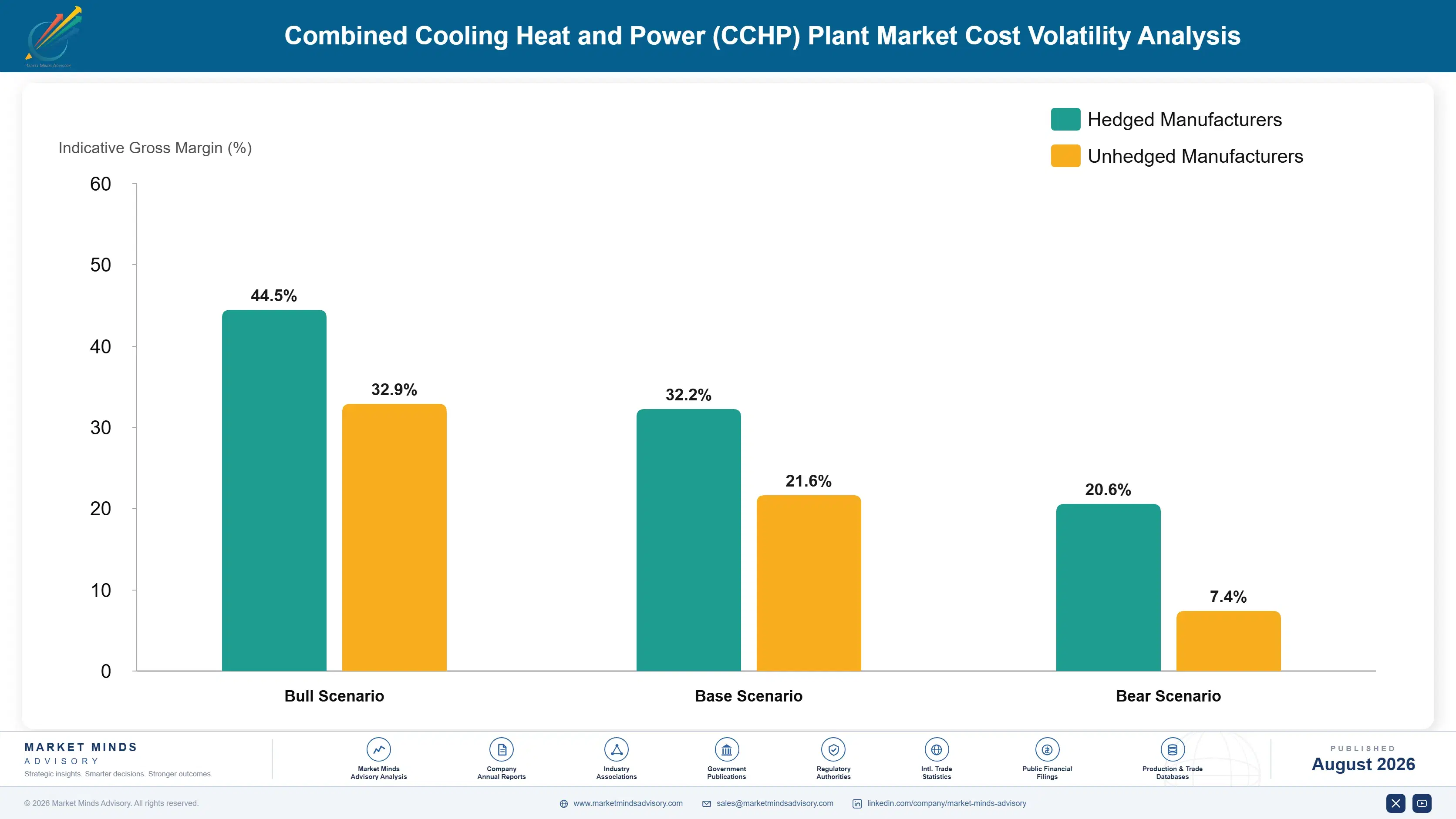
Operators without long-term fixed-price gas contracts carry meaningfully higher exposure than those with hedged supply, and this gap disproportionately affects smaller regional integrators who lack the balance sheet to lock in multi-year pricing the way larger utility-backed operators can. Geographic exposure also varies sharply: Gulf state operators face minimal gas price risk given domestic production, while European buyers remain the most exposed segment.
combined-cooling-heat-and-power-cchp-plant-market-cost-volatility-analysis-1787302480590

Dual-Fuel Prime Mover Specification

Specifying reciprocating engines or turbines capable of switching between natural gas, biogas, and diesel lets operators shift fuel source the moment spot prices spike, reducing exposure to any single fuel market without sacrificing baseload generation capability across seasons. This flexibility has become close to standard practice among European buyers underwriting new project financing since the 2022 crisis.

Multi-Year Fixed-Price Gas Supply Contracts

Locking in fuel pricing through three to five year supply agreements removes spot market volatility from project financing models, a practice now required by most European lenders underwriting new CCHP projects following the 2022 price spike experience, and one that smaller integrators without utility backing increasingly struggle to negotiate on comparable commercial terms today.

Regional Chiller Sourcing Diversification

Integrators are qualifying absorption chiller suppliers outside China, including domestic manufacturers in India and Europe, to reduce single-region supply chain concentration risk even where landed cost remains somewhat higher than Chinese-sourced components, a hedge several buyers now treat as a contractual requirement rather than a nice-to-have, particularly for projects carrying long-term project financing attached.

Portfolio Architecture for Margin Defence

CCHP portfolios span three tiers with distinct margin profiles that track directly to prime mover technology and contract structure. Volume-tier reciprocating engine packages compete largely on installed cost per megawatt and carry the thinnest margins in the market, while premium turbine and fuel cell systems command materially higher margins tied to efficiency guarantees, extended service contracts, and emissions certification that regulated buyers increasingly require before signing any long-
The volume versus premium tension plays out most visibly in the data center segment, where operators want premium reliability and low emissions but are increasingly price-sensitive given the sheer scale of capacity being procured across multiple simultaneous campus builds, forcing OEMs to defend margin through service attach rather than equipment price alone, particularly as procurement teams standardize bidding across dozens of sites at once.

High-value margin pools concentrate in fuel cell systems serving data centers and hospitals, and in performance-contracted service revenue that compounds over ten-to-twenty year contract terms rather than a single equipment sale, a shift that rewards operators willing to retain long-term asset ownership over those chasing fast equipment turnover and near-term cash recovery.

Volume / Commodity-Adjacent Tier

Reciprocating gas engine CCHP packages sold primarily on installed cost per megawatt to price-sensitive commercial and light industrial buyers who prioritize fast payback period over efficiency headroom or emissions certification credentials.
Gross Margin: 18%-24%

Premium / Certified Tier

Gas turbine and microturbine systems with efficiency guarantees, extended service contracts, and emissions compliance certification for regulated jurisdictions demanding documented performance history, audited operating records, and third-party verified emissions test data.
Gross Margin: 28%-35%

Sustainability / Regulatory / Next-Generation Tier

Fuel cell and hydrogen-blend capable systems commanding premium pricing from data center and utility buyers prioritizing emissions performance over upfront capital cost, payback period, and conventional combustion permitting exposure entirely.
Gross Margin: 38%-48%
combined-cooling-heat-and-power-cchp-plant-market-portfolio-architecture-1787302481090

Annuity Economics of Trigeneration Contracts

CCHP revenue increasingly resembles an annuity rather than a one-time equipment sale. Performance contracts spanning ten to twenty years generate recurring fuel management, maintenance, and thermal offtake fees that compound well beyond the initial installation, giving operators visibility into revenue that traditional capital equipment sales never provided and that public equity investors now reward with steadier valuation multiples across the sector.
Adoption depth varies sharply by vertical. Data centers and hospitals show the deepest stickiness, replacing and expanding capacity within the same site repeatedly as load grows, often adding a second or third phase within five years of the original installation, while hotels and light manufacturing tend toward single-installation relationships with far less follow-on expansion once initial capacity is commissioned and load stabilizes.

Buyer profiles are shifting generationally too. Facility managers who once treated CCHP as a backup power afterthought now report directly to sustainability and resilience committees, elevating trigeneration decisions to the executive level and lengthening sales cycles but also raising average contract value substantially as procurement teams bundle power, thermal, and service commitments into a single strategic agreement negotiated well above the facilities department.
combined-cooling-heat-and-power-cchp-plant-market-end-use-penetration-index-1787302481582

Where CCHP Economics Are Headed

These are among the four positions where our research anticipates prominent divergence between winners and laggards over the coming forecast period. Each is grounded in the demand model, the regulatory perimeter, and the announced capacity pipeline.
01 / PRIME MOVER TECHNOLOGY SELECTION

Fuel cells will not overtake reciprocating engines by 2036

Fuel cell systems will keep growing fastest in percentage terms, but reciprocating gas engines and turbines will still account for the large majority of installed capacity by 2036 given their far lower capital cost and long-established service infrastructure that fuel cell vendors cannot yet match. Buyers outside data centers and premium hospital segments remain highly price-sensitive and will continue defaulting to proven combustion technology for the bulk of new commercial orders. Fuel cells will capture the premium end of the market rather than displacing incumbents broadly across the base.
02 / CHINA SOURCING STRATEGY

China's chiller export scale will reshape global equipment pricing

Chinese absorption chiller manufacturers have scaled production enough to compress global equipment pricing meaningfully, and that trend will keep pressuring margins for Western and Japanese chiller manufacturers through 2036 as landed cost gaps widen further across nearly every regional market. Integrators that qualify Chinese suppliers early will hold a durable cost advantage over rivals still sourcing domestically at materially higher input cost throughout the forecast period. Expect continued consolidation among smaller regional chiller manufacturers unable to compete on landed cost alone.
03 / COMMERCIAL CONTRACT STRUCTURE

Performance contracting will become the default sales model

Energy-as-a-service structures will overtake outright equipment sales as the default commercial model within the decade, driven by buyer preference for lower upfront capital and OEM preference for recurring revenue over one-time equipment margin. This shift will favor larger OEMs and utility-backed operators with balance sheets able to retain asset ownership over smaller regional integrators lacking comparable capital access to long-duration financing. Expect financing partnerships between OEMs and infrastructure funds to become standard practice across every major market covered in this report.
04 / EMISSIONS COMPLIANCE PATHWAY

Hydrogen blending will remain a niche premium play through 2036

Hydrogen blend retrofit kits will find steady demand among operators facing the tightest emissions rules, particularly in Japan, South Korea, and parts of the European Union, but broad cost parity with conventional natural gas combustion remains distant for most buyers across the wider market. Expect hydrogen blending to stay concentrated in regulatory-driven pockets rather than becoming a mainstream specification across the wider installed base. Operators outside those jurisdictions will keep prioritizing dual-fuel flexibility over hydrogen readiness for the foreseeable future.

Engagement Snapshot From the Field

A live engagement with an industry participant carrying material or product regulatory and market exposure ahead of a defining policy shift, showing how our research translates into a defensible multi-year portfolio strategy.
MARKET MINDS ADVISORY · CLIENT ENGAGEMENT SUMMARY
Combined Cooling Heat and Power (CCHP) Plant Producer Strategic Portfolio Review and Transition Roadmap 2026·Investment Scenario on Combined Cooling Heat and Power (CCHP) Plant Exposure Evaluation 2025-26
CLIENT PROFILE
The client operates a portfolio of hyperscale data center campuses across North America and Southeast Asia, with several new sites facing grid interconnection wait times exceeding four years in their target markets. Total portfolio critical IT load exceeds 900 megawatts (client-reported, unverified by MMA), with three new campuses in active permitting requiring onsite generation to meet aggressive commissioning timelines committed to enterprise customers.
STRATEGIC CHALLENGE
The client needed to evaluate whether CCHP trigeneration could reliably serve full campus load, including both power and cooling, without compromising the uptime guarantees written into its enterprise service level agreements, while also comparing prime mover technology options across cost, emissions, and vendor service network criteria specific to each target site's regulatory jurisdiction.
MMA APPROACH
MMA conducted a comparative technology assessment across gas turbine, reciprocating engine, and fuel cell prime mover options, modeling total cost of ownership over a twenty-year horizon and mapping vendor service network coverage against each candidate site. The team benchmarked emissions permitting timelines across all three target jurisdictions to identify the fastest viable path to commissioning.
KEY FINDINGS
  1. Reciprocating engine systems offered the fastest permitting path in two of three target jurisdictions, cutting projected commissioning time by roughly eight months.
  2. Fuel cell systems reduced projected emissions permitting risk to near zero but carried a capital premium of approximately 35 percent (client-reported, unverified by MMA).
  3. Vendor service network density varied more than expected across candidate suppliers, materially affecting projected unplanned downtime risk at the more remote target sites.
  4. Performance contracting structures could reduce upfront capital commitment by roughly 60 percent (client-reported, unverified by MMA) versus outright equipment purchase across all three campuses.
CLIENT PROFILE
The client operates a portfolio of hyperscale data center campuses across North America and Southeast Asia, with several new sites facing grid interconnection wait times exceeding four years in their target markets. Total portfolio critical IT load exceeds 900 megawatts (client-reported, unverified by MMA), with three new campuses in active permitting requiring onsite generation to meet aggressive commissioning timelines committed to enterprise customers.
STRATEGIC CHALLENGE
The client needed to evaluate whether CCHP trigeneration could reliably serve full campus load, including both power and cooling, without compromising the uptime guarantees written into its enterprise service level agreements, while also comparing prime mover technology options across cost, emissions, and vendor service network criteria specific to each target site's regulatory jurisdiction.
MMA APPROACH
MMA conducted a comparative technology assessment across gas turbine, reciprocating engine, and fuel cell prime mover options, modeling total cost of ownership over a twenty-year horizon and mapping vendor service network coverage against each candidate site. The team benchmarked emissions permitting timelines across all three target jurisdictions to identify the fastest viable path to commissioning.
KEY FINDINGS
  1. Reciprocating engine systems offered the fastest permitting path in two of three target jurisdictions, cutting projected commissioning time by roughly eight months.
  2. Fuel cell systems reduced projected emissions permitting risk to near zero but carried a capital premium of approximately 35 percent (client-reported, unverified by MMA).
  3. Vendor service network density varied more than expected across candidate suppliers, materially affecting projected unplanned downtime risk at the more remote target sites.
  4. Performance contracting structures could reduce upfront capital commitment by roughly 60 percent (client-reported, unverified by MMA) versus outright equipment purchase across all three campuses.
RECOMMENDED STRATEGY
Phase 1: Phase 1 (Months 1 to 3): Complete site-specific technology and vendor shortlisting using the comparative total cost of ownership framework. Phase 2: Phase 2 (Months 4 to 9): Negotiate performance contracting terms with shortlisted vendors and finalize emissions permitting applications concurrently at each site. Phase 3: Phase 3 (Months 10 to 18): Execute phased commissioning across the three campuses, prioritizing the site with the longest grid interconnection wait.
OUTCOME
The client selected a mixed fleet of reciprocating engine and fuel cell systems across the three campuses, matching technology to each site's specific permitting environment. Projected commissioning timelines improved by an average of seven months versus the original single-technology approach, and performance contracting structures reduced upfront capital commitment by an estimated 58 percent (client-reported, unverified by MMA) across the portfolio.

Frequently Asked Questions

Foundational context covering the market sizes, CAGR, scope, country, region and competition that inform every finding below. This section is provided to cover basics and most often pre-purchase conversations, answered from the MMA Primary Research Dataset.

What is the current size of the Combined Cooling Heat and Power (CCHP) Plant Market?

The CCHP plant market reached an estimated 8.9 billion dollars in base year 2025. Growth is concentrated in data center, hospital, and industrial park applications across East Asia and North America.

How large will the Combined Cooling Heat and Power (CCHP) Plant Market be by 2036?

MMA projects the market will reach approximately 17.7 billion dollars by 2036 under the base case scenario. That represents nearly a doubling of the 2026 starting value over the forecast decade.

What is the CAGR for the Combined Cooling Heat and Power (CCHP) Plant Market 2026 to 2036?

The base case CAGR is 6.4 percent, with a bull scenario of 7.7 percent and a bear scenario of 5.1 percent. Fuel price stability is the single largest swing factor between scenarios.

Which segment is growing fastest?

Fuel cell-based CCHP systems lead at an 11.2 percent CAGR, nearly double the overall market rate. Microturbine systems follow as the second-fastest segment at 9.4 percent.

Who are the major companies in the Combined Cooling Heat and Power (CCHP) Plant Market?

Caterpillar, Siemens Energy, Mitsubishi Power, GE Vernova, and Wartsila lead the market. No single company holds dominant share, with CR5 at just 34 percent across the full competitive set.

Which country is growing fastest?

South Korea leads at a 9.6 percent CAGR, driven by fuel cell CCHP subsidies under its renewable portfolio standard. China remains the largest market by absolute volume.

Report Segmentation Architecture

The full report scope spans multiple orthogonal segmentation dimensions, with cross-tabulated demand data provided for each dimension pair. Coverage extends further to regional breakdowns, trend trajectories, and the competitive detail needed to support segment-level decision-making.

By Prime Mover Technology

  • Reciprocating Gas Engine Systems
  • Gas Turbine Systems
  • Microturbine Systems
  • Fuel Cell-Based CCHP Systems
  • Steam Turbine / Backpressure Systems
  • Organic Rankine Cycle Systems

By End-Use Industry

  • Data Centers
  • Healthcare Facilities
  • Hospitality
  • Manufacturing and Industrial
  • Higher Education

By Commercial Dimension

  • Equipment Purchase
  • Performance Contracting / Energy-as-a-Service
  • Retrofit and Aftermarket Services
  • New-Build Installation

By Region

  • North America
  • Western Europe
  • East Asia
  • South Asia and Pacific
  • Latin America
  • Middle East and Africa
  • Eastern Europe

Scope, Methodology, and Coverage

Every figure in this report is reproducible from documented input assumptions. The scope below maps the historical period, the forecast horizon, the segmentation dimensions, and the countries covered, alongside the underlying primary and qualitative methodology.
Historical Period
2020 to 2025
Forecast Period
2026 to 2036
Base Year
2025 (USD billions; MMA Primary Research Dataset, August 2026)
Market Definition
The CCHP plant market covers integrated systems that generate electricity from a single fuel input while recovering waste heat to serve both heating and cooling loads through absorption or adsorption chillers. It excludes standalone combined heat and power systems without cooling output and district cooling plants that purchase rather than generate electricity onsite.
Quantitative Units
USD billions (current prices); installed capacity in megawatts electrical
Segmentation Dimensions
By Prime Mover Technology; By End-Use Industry; By Commercial Dimension; By Region
Regions Covered
North America, Western Europe, East Asia, South Asia and Pacific, Latin America, Middle East and Africa, Eastern Europe
Countries Covered
USA, China, Germany, France, UK, Japan, South Korea, India, Australia, Canada, Brazil, Mexico, Indonesia, Vietnam, Thailand, Malaysia, UAE, Saudi Arabia, South Africa, Nigeria, Turkey, Poland, Netherlands, Italy, Spain, Sweden, Switzerland, Argentina, Colombia, Singapore, and additional markets relevant to this sector
Key Companies Profiled
Caterpillar Inc., Siemens Energy AG, Mitsubishi Power Ltd, GE Vernova, Wartsila Corporation, Cummins Inc., Capstone Green Energy Corporation, MAN Energy Solutions, Kawasaki Heavy Industries Ltd, 2G Energy AG, Tecogen Inc., Aegis Energy Services LLC, Bosch Thermotechnology, Yanmar Holdings Co Ltd, Clarke Energy Ltd, Centrica Business Solutions, ENGIE SA, Veolia Environnement SA, Broad Group, Thermax Limited
Quantitative Methodology
Primary survey, n=3,800 respondents, Q4 2025, six countries; demand-side model with trade association cross-validation
Qualitative Methodology
47 expert interviews, Q4 2025; applied to validate demand model assumptions, identify emerging dynamics, and assess competitive positioning
Report Format
PDF and XLSX data workbook (Word format preview document)
Publisher
Market Minds Advisory
Report Code
MMA-2026-ENE-101
Published
August 2026
Contact
sales@marketmindsadvisory.com | www.marketmindsadvisory.com

Purchase the full Combined Cooling Heat and Power (CCHP) Plant Market Report (2026 to 2036).

The full report delivers a complete assessment of the CCHP plant market across prime mover technology, end-use vertical, and commercial contracting model. It includes detailed competitive profiling of the twenty companies covered here, country-level demand modeling across thirty markets, and forward-looking scenario analysis through 2036. Buyers receive segment-level pricing benchmarks and full access to the underlying primary survey dataset referenced throughout this summary. A dedicated data appendix breaks out regional capacity additions by prime mover technology for portfolio planning purposes. Analysts can also request custom country cuts beyond the thirty markets covered in the standard deliverable.
Twenty-company competitive profiles with moat and risk assessments
Country-level demand models across thirty markets
Segment-level pricing benchmarks by prime mover technology
Ten-year scenario forecasts with bull and bear cases
Primary survey dataset access for underlying respondent data
Regional capacity addition appendix by technology segment

Built For The People Who Decide

From boardroom strategy to bench-side execution, this report is read cover-to-cover by leaders shaping the next decade of their industry, turning demand scenarios, market dynamics and valuation benchmarks into decisions.
CXOs/ Presidents/ VPs/ Managers
M&A and Corporate Development
Strategy Teams and R&D Heads
Procurement and Product Directors
Regulatory and Compliance Leaders
Investor Relations and Equity Analysts