Market Minds Advisory
Combi Boiler Market Report 2033

Combi Boiler Market Report 2033: The Installer Chooses the Brand, Not the Homeowner

Roughly four in five replacements are decided by whoever is standing in the kitchen holding a spanner, which makes installer loyalty worth considerably more than any consumer advertising budget ever will.

Lead Analyst

David Horsley

Published

September 2026

Make Smarter Decisions with Customized Research Insights

Request a free sample report and evaluate market opportunities, growth trends, and competitive dynamics relevant to your business needs.

2025 MARKET VALUE$9.8BMarket Size 2025
2036 FORECAST VALUE$15.1BBase Case , 2026 to 2036
CAGR 2026 TO 20364.0 %Bull 5.2% / Bear 2.8%
INCREMENTAL OPPORTUNITY$4.9BNet 10- year value creation
EXPANSION MULTIPLE1.48x2036 value over 2026 base
Strategic Levers
M&A Pipeline
Regional Outlook
Country Rankings
Competitive Intelligence
Segmental Deep-dive
Call-Us : 91 93563 13602

Executive Snapshot and Market Trajectory

Around 79% of combi boiler replacements are specified by the installer rather than chosen by the householder, usually while standing next to a failed unit. That single fact explains the trade discounts, the loyalty schemes, and why consumer brand advertising in this market achieves so little.
Growth runs at 4.0% and the transition-hedged products lead it. Hydrogen-ready and hybrid-compatible boilers grow at 6.0%, exactly 1.50 times the market rate, because buyers facing an eventual heat pump mandate want equipment that will not strand them. Western Europe holds the largest share at 34%, since the combi format itself is a European domestic heating convention. Condensing gas units follow at 4.4% and still carry most of the volume.
Concentration is high at 62% across the top five measured on units shipped. Installer network reach rather than product engineering holds it there, and a manufacturer without merchant availability and trained installers is invisible regardless of how good the heat exchanger happens to be. Heat pump manufacturers are competing for exactly the same installer relationships with a technology policy favours. Turkish and Korean producers supply European markets at costs Western manufacturing simply cannot match.
Market Definition
This market covers wall-hung combination boilers providing instantaneous domestic hot water and space heating from a single appliance, spanning condensing gas combi boilers, hydrogen-ready and hybrid-compatible boilers, electric and heat pump ready combination units, oil and liquefied petroleum gas combis, and controls and flue accessories supplied with them. System and heat-only boilers with separate cylinders, standalone heat pumps, commercial and industrial boilers, water heaters without space heating, and installation labour fall outside scope.
Base Year Value
$9.8B in 2025 (MMA Primary Research Dataset, August 2026)
Forecast Period
2026 to 2036, eleven discrete annual values
CAGR
4.0% base case. Bull 5.2%. Bear 2.8%.
Fastest Growth Segment
Hydrogen-Ready and Hybrid-Compatible Boilers: 6.0% CAGR
Fastest Growth Country
India: 5.4% CAGR
Fastest Growth Region
South Asia and Pacific: 6.2% CAGR
Largest Region
Western Europe: 34% of 2025 global value
Market Leaders
BDR Thermea, Vaillant Group, Bosch Thermotechnology, Ariston Group, Viessmann Climate Solutions. Source: MMA Analysis based on company annual reports.
Primary Survey
n=3,800 procurement and R&D decision-makers, Q4 2025, six countries
Methodology
Demand-side build-up, cross-validated against public data, 47 expert interviews

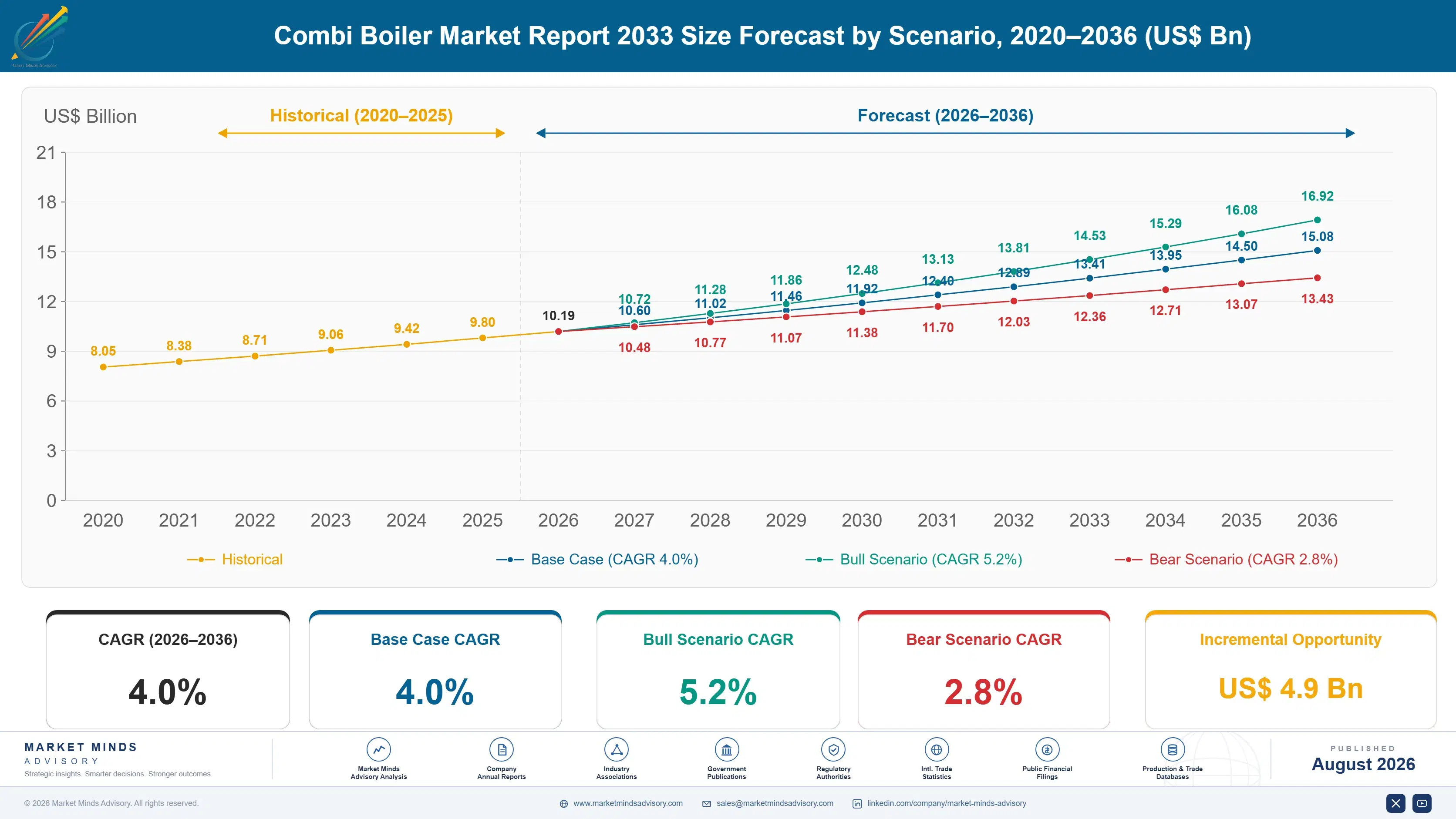
Combi Boiler Market Forecast Scenarios

combi-boiler-market-size-forecast-scenario-1787301847662
The 2020 to 2025 period grew at 3.0% and replacement rather than new build carried almost all of it. Household heating spending held up through the disruption because a failed boiler is not deferrable, while new housing completions fell and recovered unevenly. Energy price increases from 2022 pushed efficiency up the buying criteria briefly and heat pump interest considerably further, without moving many actual installations.
Three mechanisms carry the 4.0% base case. Replacement of an ageing installed base is the largest, since boilers fail on a cycle nobody controls and the replacement is urgent when it happens. Transition hedging is the second, where hydrogen-ready and hybrid-compatible units sell against uncertainty rather than performance. And emerging market gas network extension is the third, adding first-time installations. None of the three depends on new housing construction recovering at all.
The 5.2% bull case rests on hydrogen blending decisions arriving with enough clarity that hedged products become the default replacement choice across European markets. The 2.8% bear case is heat pump mandates arriving faster than the installer base can retrain, which would compress boiler replacement demand while producing installation bottlenecks in the technology replacing it.

Who Actually Makes the Decision

Manufacturers in this market spend on consumer advertising and it does very little. Roughly 79% of combi boiler replacements are specified by the installer, and about 63% of installations follow a failure rather than any planned upgrade, which means the decision is taken by a tradesperson standing beside a cold house with a homeowner who wants hot water back today. Brand preference has almost no room to operate there.
INSTALLER SPECIFIED SHARE79%Of replacements chosen by the installer rather than the householder
EMERGENCY REPLACEMENT RATE63%Of installations following a failure rather than any planned upgrade
MERCHANT STOCK AVAILABILITY48 hoursWithin which a unit must be obtainable to be specified
TOP FIVE CONCENTRATION62%High, held by installer network reach rather than product engineering
HEAT EXCHANGER WARRANTY12 yearsNow offered as standard, which shifts risk onto manufacturers
AVERAGE APPLIANCE LIFE14 yearsBefore replacement, setting the natural cycle of demand
What matters instead is whether the installer can obtain the unit within roughly 48 hours from a local merchant, whether they have fitted it before and know its quirks, and whether the manufacturer's technical support answers the phone. Those three things decide specification far more reliably than efficiency ratings, and they are logistics and training questions rather than engineering ones.
Warranty has become the other battleground, with heat exchanger cover now reaching twelve years as standard across the premium end. That shifts long-term failure risk from the householder onto the manufacturer, and it is offered because installers use it as a selling point with customers who cannot evaluate anything technical. It also creates a liability that a manufacturer carries well beyond the sale.
"We asked homeowners why they chose their boiler. Most said the engineer recommended it. We asked engineers why they recommended it. Most said the merchant round the corner had three in stock."
Director, Building Services and Domestic Heating Practice · MMA Building Service

Market Trends

Transition Uncertainty Sells The Hedged Products

Householders replacing a boiler in markets with announced heat pump ambitions want equipment that will not be stranded, and hydrogen-ready and hybrid-compatible units answer that anxiety whether or not the transition arrives as announced. They grow at 6.0% against 4.0% for the market. Installers find them easy to recommend precisely because the argument requires no technical explanation, and manufacturers price the hedge rather than any demonstrated performance difference. Whether hydrogen blending actually arrives matters far less commercially than whether the anxiety persists. Installers can make the argument in a kitchen without any technical explanation at all.
Market Impact: Some 63% follow a failure
Warranty Length Becomes The Installer's Selling Argument

Heat exchanger cover has extended to twelve years across the premium end, and installers use it to close a conversation with a homeowner who cannot assess efficiency, modulation range, or build quality independently. That shifts long-term failure liability onto manufacturers who then carry it for over a decade after the sale. Warranty length is now competed on directly rather than following from build quality, which is a considerably more expensive dynamic. Manufacturers extending cover on units designed before current materials arrived carry uncosted risk. Accelerated life testing before extension costs laboratory time and considerably less than a campaign.
Market Impact: Stock needed within 48 hours

Market Opportunities and Growth Drivers

Failure Driven Replacement Cannot Be Deferred

Around 63% of installations follow a failure rather than a planned upgrade, and a household without heating or hot water replaces the appliance within days regardless of economic conditions or energy policy announcements. That makes this demand unusually recession-resistant compared with most building products, and it explains why the market held up through disruption that removed new housing completions. Appliance life around fourteen years sets the underlying rhythm. Energy policy announcements move interest and move very few actual installations at all. A household without hot water is not weighing a heat pump quotation that week.
Market Impact: Life averages 14 years

Merchant Availability Determines Which Unit Gets Fitted

An installer facing an emergency replacement specifies whatever they can collect from a local merchant within roughly 48 hours, and a boiler that is technically superior but three days away is simply not a candidate. Distribution depth therefore functions as product specification in this market. Manufacturers with strong merchant relationships and regional stock holding win installations that no amount of product development would otherwise deliver to them. Merchant branch rationalisation therefore specifies boilers more effectively than any manufacturer campaign does. Regional stock depth correlates directly with installation share in practice.
Market Impact: Warranty extends to 12 years

Market Restraints and Challenges

Heat Pump Policy Threatens The Whole Category

Announced phase-out dates for gas heating across several European markets put a defined end on combi boiler demand, and the root cause is decarbonisation policy rather than any product deficiency. Commercial impact is manufacturers investing in a category that carries a stated expiry, while heat pump capability gets built elsewhere. Mitigation runs through hydrogen-ready and hybrid designs, heat pump manufacturing investment, and early installer retraining programmes that keep the trade relationship intact through whatever transition arrives. Appliance life around fourteen years leaves considerably less preparation time than those dates suggest.
Market Impact: Hedged products growing at 6.0%

Twelve Year Warranties Carry Uncosted Liability

Heat exchanger cover now reaching twelve years shifts failure risk onto manufacturers for longer than most product development cycles, and the root cause is competitive escalation rather than any improvement in demonstrated reliability. Commercial impact is provisioning against failures in units designed before current materials were adopted. Mitigation runs through accelerated life testing before warranty extension, field failure data collection, and resisting the escalation where build quality does not support it. Very few manufacturers treat the heat exchanger as a warranty decision rather than a cost line. Buying exchangers to a target price transfers a risk purchasing never actually assessed.
Market Impact: Warranty now reaches 12 years
3 additional market trends, 4 additional growth drivers, and 2 additional restraints and challenges are covered in the full report. Contact sales@marketmindsadvisory.com to access the complete intelligence.

Segment CAGR and Growth Architecture

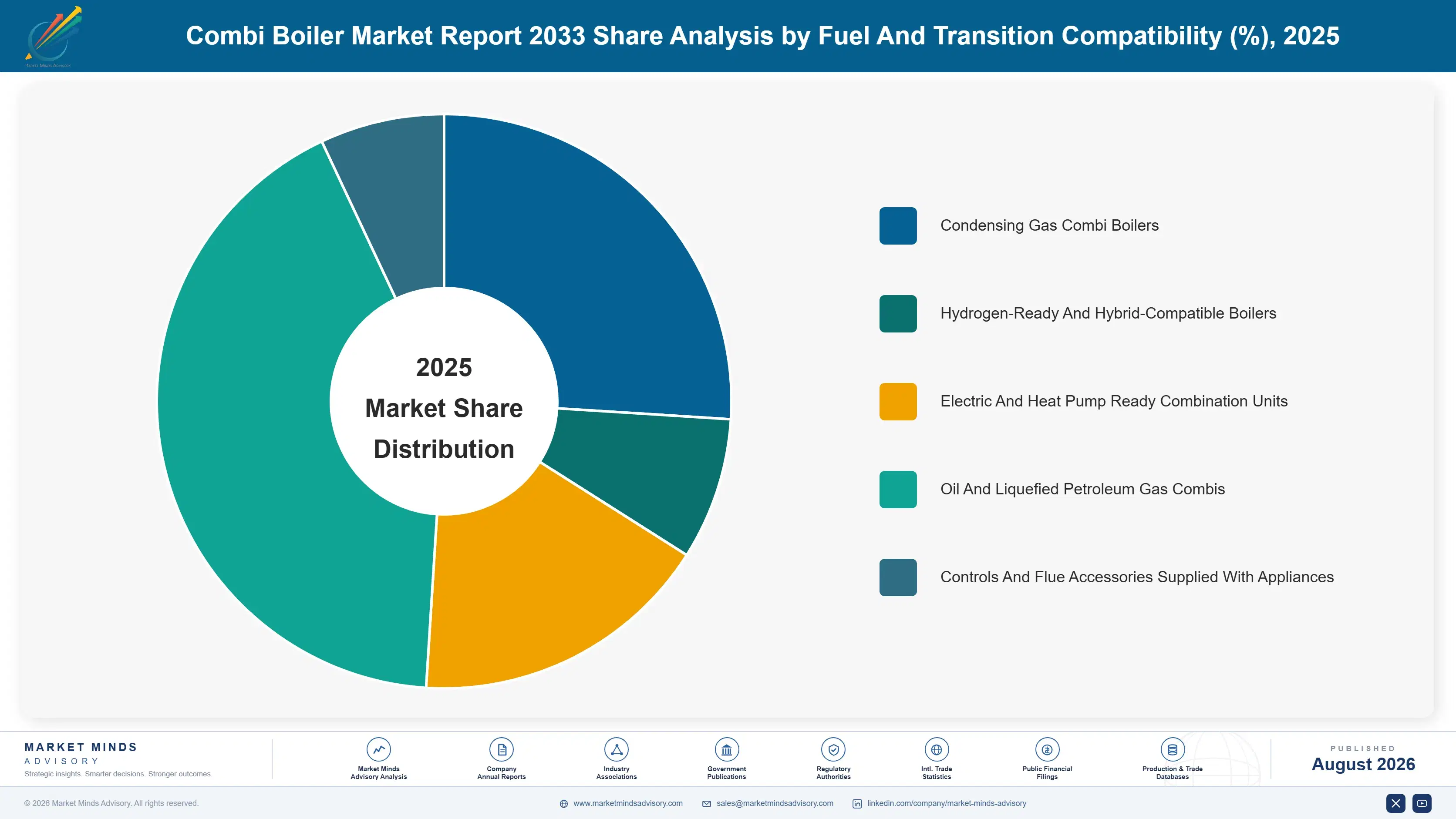
Segmentation follows fuel and transition compatibility, because those determine regulatory exposure, installer training requirements, and whether an appliance can survive the heating policy changes announced across several major markets. Output rating and building type both cut across every fuel category rather than separating them, which makes either a weaker primary dimension. Fuel compatibility decides regulatory survival more than performance does.
combi-boiler-market-market-share-analysis-1787301848541

Hydrogen-Ready And Hybrid-Compatible Boilers

The fastest category at 6.0%, exactly 1.50 times the market rate, and the one selling against uncertainty rather than measurable performance. Householders replacing an appliance in markets with announced gas phase-out dates want equipment that will not leave them stranded, and installers find the argument easy to make because it requires no technical explanation at all. Manufacturers price the hedge rather than any demonstrated difference. Whether hydrogen blending actually arrives matters far less commercially than whether the anxiety persists through the replacement cycle. Installers recommend them readily because the reassurance argument needs no technical support at all. Manufacturers price that reassurance directly rather than any measurable difference in actual performance.
CAGR 6.0%

Condensing Gas Combi Boilers

Second fastest at 4.4% and overwhelmingly the volume category, replacing an installed base that fails on a cycle of roughly fourteen years regardless of policy announcements. Condensing operation is mandatory across European markets and standard elsewhere, so efficiency differences between manufacturers are narrow and rarely decide anything. Merchant availability within 48 hours and installer familiarity decide these installations instead. The category has a stated expiry date in several markets and continues generating most of the revenue meanwhile. Turkish and Korean production supplies these units at costs Western manufacturing cannot approach. Emergency replacement favours availability over positioning, which suits low-cost supply almost perfectly. Warranty length is where any real differentiation now happens.
CAGR 4.4%
Full segment breakdown across 5 segments available in the complete report.

Regional Architecture and Country Demand Map

Western Europe leads at 34% because the wall-hung combi format is a European domestic heating convention rather than a global one. East Asia follows on Korean and Chinese demand, ahead of Eastern Europe. South Asia and Pacific grows fastest. Every share here reflects that format convention rather than population.

Western Europe

Thirty-four percent, well above the framework band and justified because the wall-hung combination boiler is a European domestic convention rather than a worldwide one. British, Italian, Spanish, and Dutch housing stock is built around it, with no separate hot water cylinder and no room for one in most properties. That installed base drives replacement demand independent of policy. It is also where gas phase-out dates have been announced most firmly. Growth at 2.6% is the slowest anywhere, reflecting policy overhang rather than any current demand weakness. Merchant distribution here is the deepest anywhere, and it determines specification more than any brand does. Installer training networks are correspondingly well developed across the region.
Share: 34% | CAGR: 2.6% (2026 to 2036)

East Asia

Twenty-five percent, and Korean and Chinese demand carries almost all of it. Korean housing uses wall-hung combination units at penetration comparable with European markets, and domestic manufacturers there supply both home and export demand at competitive cost. Chinese urban apartment heating has adopted the format in gas-networked cities across the north, though from a far lower base relative to population. Japanese demand runs through different appliance conventions entirely. Growth at 5.0% runs above the market rate on continued Chinese urban gas connection. Korean manufacturers export substantial volume into European and Middle Eastern markets on cost. Chinese urban gas connection programmes continue extending the addressable installed base northward. Warranty competition here is considerably lighter.
Share: 25% | CAGR: 5.0% (2026 to 2036)
Regional intelligence for 5 additional markets available in the complete report: Eastern Europe, North America, South Asia and Pacific, Middle East and Africa, Latin America. Contact sales@marketmindsadvisory.com.
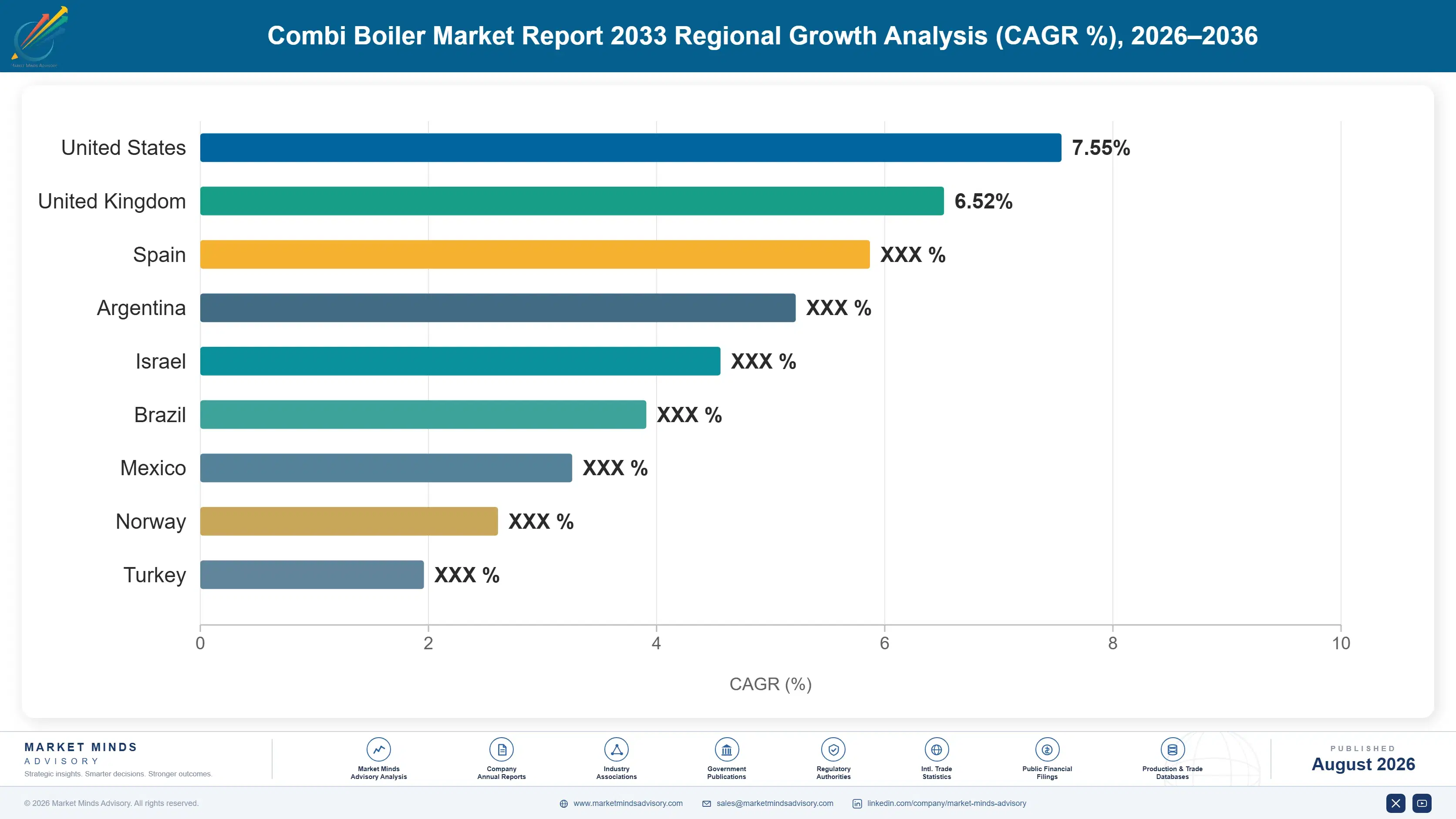
combi-boiler-market-country-cagr-analysis-1787301849398

Winning the Installer, Not the Household

Around 79% of replacements are installer-specified, 63% follow a failure, units must be available within 48 hours, and warranties now reach twelve years. Value comes from merchant depth, from installer training and loyalty, and from provisioning warranty honestly. The tradesperson standing in the kitchen decides everything here. Households have essentially no opinion at all.

Buy Merchant Shelf Space Before Consumer Advertising

Roughly 79% of replacements are specified by the installer and about 63% follow a failure, so the decision happens beside a cold boiler with a homeowner who wants hot water restored today. An installer fits whatever a local merchant can supply within roughly 48 hours. Regional stock depth and merchant relationships therefore function as product specification, and they deliver installations that no amount of consumer brand spending would ever reach. Merchant branch rationalisation decisions specify boilers more effectively than any campaign ever could. Installation share correlates directly with local stock holding rather than with marketing spend.
Market Impact: Around 79% of all units are install

Train Installers Because Familiarity Beats Specification

An installer facing an emergency fits the appliance they have fitted before, because they know its commissioning quirks, its fault codes, and roughly how long it takes. Training programmes, accessible technical support, and clear documentation therefore build specification share more reliably than efficiency improvements do. Around 63% of installations are emergencies where an unfamiliar product carries real risk to the installer's own day, and they will not take it. Fault code recognition and commissioning familiarity matter more than any efficiency rating does. Technical support that answers the phone is worth more than a brochure.
Market Impact: Roughly 63% are emergency replaceme

Provision Twelve Year Warranties On Actual Failure Data

Heat exchanger cover reaching twelve years shifts long-term liability onto manufacturers for longer than most product development cycles run, and the escalation is competitive rather than evidence-driven. Provisioning against field failure data from accelerated life testing rather than against a marketing decision is what separates a durable offer from an expensive one. Manufacturers extending cover on units designed before current materials were adopted are carrying risk nobody has properly costed. Heat exchangers carry roughly 26% of manufactured cost and drive the entire warranty exposure. Buying them to a target price transfers a risk purchasing never assessed at all.
Market Impact: Warranty cover now extends to 12 fu

Keep The Trade Relationship Through The Heat Pump Transition

Announced gas phase-out dates put a defined end on this category in several markets, and the installer relationship is the asset that survives it while the product does not. Manufacturers retraining their installer base on heat pumps carry that network across the transition, and those that do not will find the same tradespeople specifying somebody else's equipment. Appliance life around fourteen years leaves less preparation time than the phase-out dates suggest. Around 79% of specifications come from that installer rather than from the household. Losing the trade relationship loses the specification regardless of what product replaces the boiler.
Market Impact: Appliance life averages around 14 y

Who Controls the Margin Pool

Concentration is high at 62% across the top five measured on units shipped, and installer network reach rather than product engineering holds it there. A manufacturer without merchant availability and trained installers is effectively invisible regardless of heat exchanger quality, modulation range, or efficiency rating. The leader to challenger gap is wide in mature European markets and considerably narrower in Turkey, Korea, and China where domestic manufacturers hold strong local positions.
Competitive activity runs on three fronts. Merchant and distribution depth is the first and most decisive, since availability within roughly 48 hours determines what gets fitted in an emergency. Installer training and technical support is the second, which builds the familiarity that decides specification. And warranty length is the third, escalating competitively in a way that transfers liability rather than demonstrating quality.

Pressure comes from two directions. Heat pump manufacturers are competing for the same installer relationships with a technology policy favours. And Turkish and Korean producers supply European markets at costs that Western manufacturing cannot match. Both pressures attack the same installer relationship rather than the product itself. Retraining that network early is the only available defence.

Rankings shift on merchant listings rather than product launches.
combi-boiler-market-company-positioning-matrix-1787301850243

Competitive Moat and Risk Dimensions

BDR THERMEA

Moat: Merchant depth and multi-brand reach

Operating multiple brands across different merchant channels lets one group appear in more places an installer might collect a boiler from, which matters enormously when availability within roughly 48 hours decides specification. Installer training networks built around each brand then reinforce familiarity. Neither the distribution footprint nor the trained installer base can be assembled quickly by a competitor.
BDR THERMEA

Risk: Category carries a stated expiry

Announced gas phase-out dates in several core European markets put a defined end on combi boiler demand regardless of how well the distribution position performs meanwhile. Heat pump capability requires different manufacturing and different installer skills entirely. A strong position in a category with an expiry date is a timing problem rather than a competitive one.
VAILLANT GROUP

Moat: Installer loyalty and heat pumps

Deep installer loyalty built through training, technical support, and consistent product behaviour transfers across product categories in a way that brand advertising never does, which matters because the same tradespeople will fit whatever replaces gas boilers. Established heat pump manufacturing then gives that network something to move onto rather than losing it entirely.
VAILLANT GROUP

Risk: Premium position under cost pressure

Turkish and Korean manufacturers supply European markets at costs Western production cannot match, and in emergency replacements an installer frequently fits what is available rather than what is best. Premium positioning defends specification where installers are loyal and contributes little in a merchant collecting a cheaper equivalent. Cost gaps widen faster than loyalty deepens.

Players Tracked

Prominent Players

BDR Thermea
Vaillant Group
Bosch Thermotechnology
Ariston Group
Viessmann Climate Solutions

Other Key Players

Baxi Heating
Ideal Heating
Worcester Bosch
Immergas
Ferroli
Beretta
Vokera
Navien
Kyungdong Navien
Rinnai
Demirdokum
Vaillant Turkey
Alarko Carrier
Vantage Heating
Haier Smart Home

Recent Developments

FEBRUARY 2025

Manufacturer extends heat exchanger warranty across full range

A boiler manufacturer extended heat exchanger cover to twelve years across its complete domestic range, matching a competitor rather than responding to any change in demonstrated field reliability. The extension was a commercial marketing decision rather than any product revision, joint venture, or arrangement with an insurer.
Signal: Warranty escalation transfers liability co
MAY 2025

Merchant group rationalises boiler ranges across branch network

A national builders merchant group reduced the number of boiler brands stocked across its branches, concentrating shelf space and consequently determining what installers could collect at short notice. The decision was a procurement and inventory choice rather than any acquisition, joint venture, or exclusivity agreement with a manufacturer.
Signal: Merchant shelf decisions specify boilers m
SEPTEMBER 2025

Manufacturer launches installer heat pump retraining programme

A heating manufacturer opened a large-scale heat pump training programme for its existing gas installer network, aiming to retain those trade relationships through an announced transition rather than losing them. The programme was internal investment rather than any joint venture, acquisition, or partnership with a training provider.
Signal: The installer relationship outlives the pr

Heat Exchangers, Controls and Steel

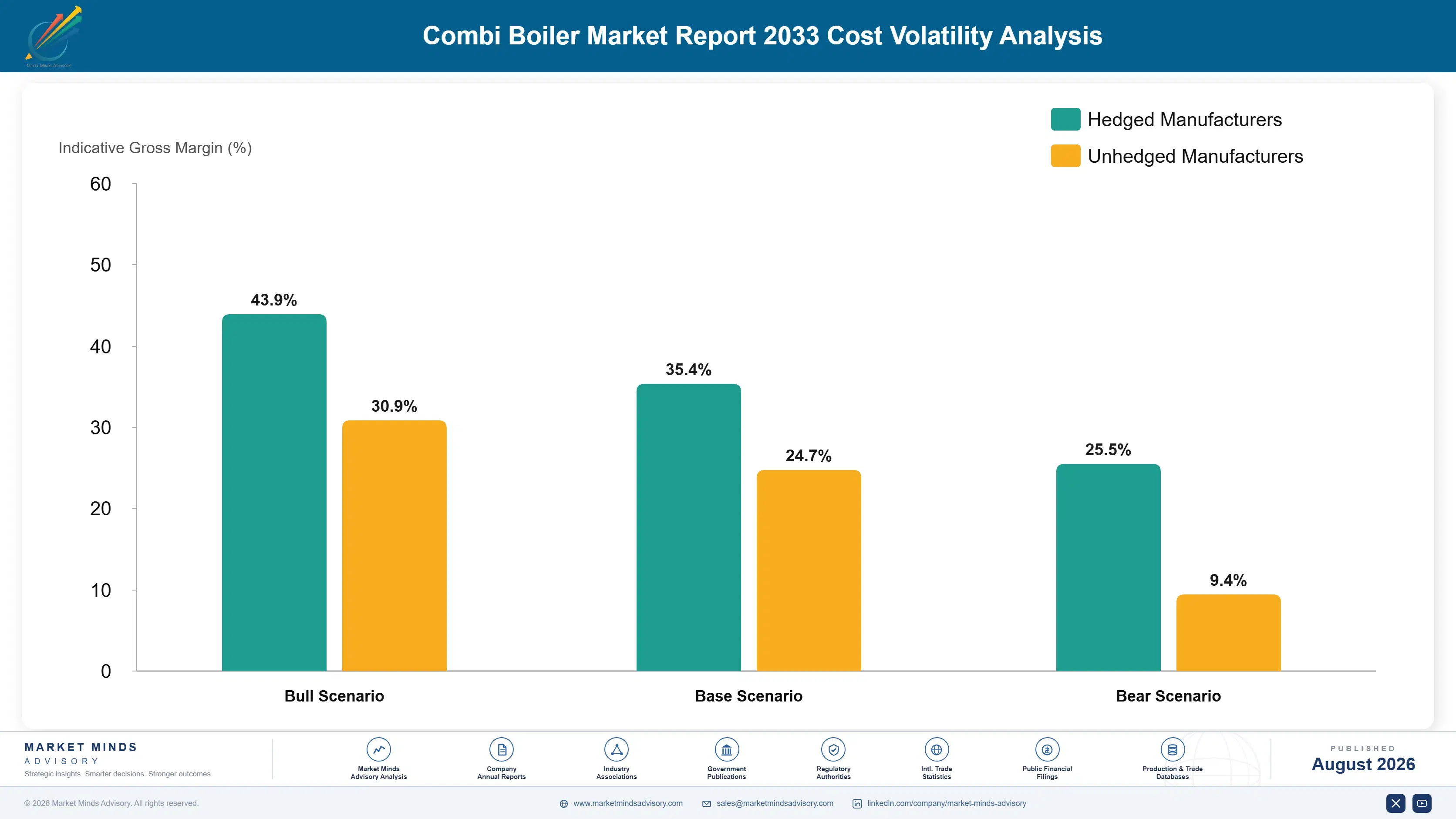
Heat exchangers carry roughly 26% of manufactured cost, spanning stainless steel and aluminium silicon assemblies whose material choice determines both efficiency and warranty exposure. Controls, electronics, and sensors add about 21%, pumps and fans near 15%, casing and hydraulic components around 14%, and assembly, testing, certification, and packaging the balance across a typical wall-hung unit.
Stainless steel, copper, and electronic component pricing all moved sharply through 2021 and 2022, and several heating manufacturers disclosed material cost increases and component shortages in annual filings covering those years. Controls electronics were the more acute constraint, with semiconductor allocation delaying production across the sector. Component availability has normalised while pricing has not fully retreated to earlier levels. Component lead times have since normalised. Pricing has settled at a higher level.

The competitive disadvantage mechanism runs through heat exchanger sourcing and warranty provisioning rather than through general purchasing. A manufacturer buying exchangers to a price and then offering twelve year cover carries a liability it cannot quantify, while one producing its own with accelerated life data can provision honestly. Casing and controls cost broadly the same for everyone; the exchanger does not, and it drives the warranty.
combi-boiler-market-cost-volatility-analysis-1787301850594

Provision warranty against accelerated life testing data

Heat exchanger cover reaching twelve years commits a manufacturer beyond most product development cycles, and provisioning against a marketing decision rather than field evidence produces liabilities nobody has sized. Accelerated life testing before extending cover costs laboratory time and considerably less than a warranty campaign. Manufacturers who extended first and tested afterward are discovering that sequence was expensive.

Control heat exchanger specification rather than buying to price

Heat exchangers carry roughly 26% of manufactured cost and determine both efficiency and warranty exposure, so buying them down to a target price simply transfers a risk that the purchasing decision itself never actually priced. Producing in-house or specifying the material and the process directly gives real control over the failure mode driving warranty cost.

Standardise control platforms across model ranges

Controls, electronics, and sensors carry about 21% of manufactured cost, and developing a separate platform for every range prevents volume with semiconductor suppliers while multiplying certification and software maintenance. Shared platforms across ranges spread that cost and simplify installer familiarity at the same time. Installers learning one fault code system across a whole range specify it more readily.

Portfolio Architecture for Margin Defence

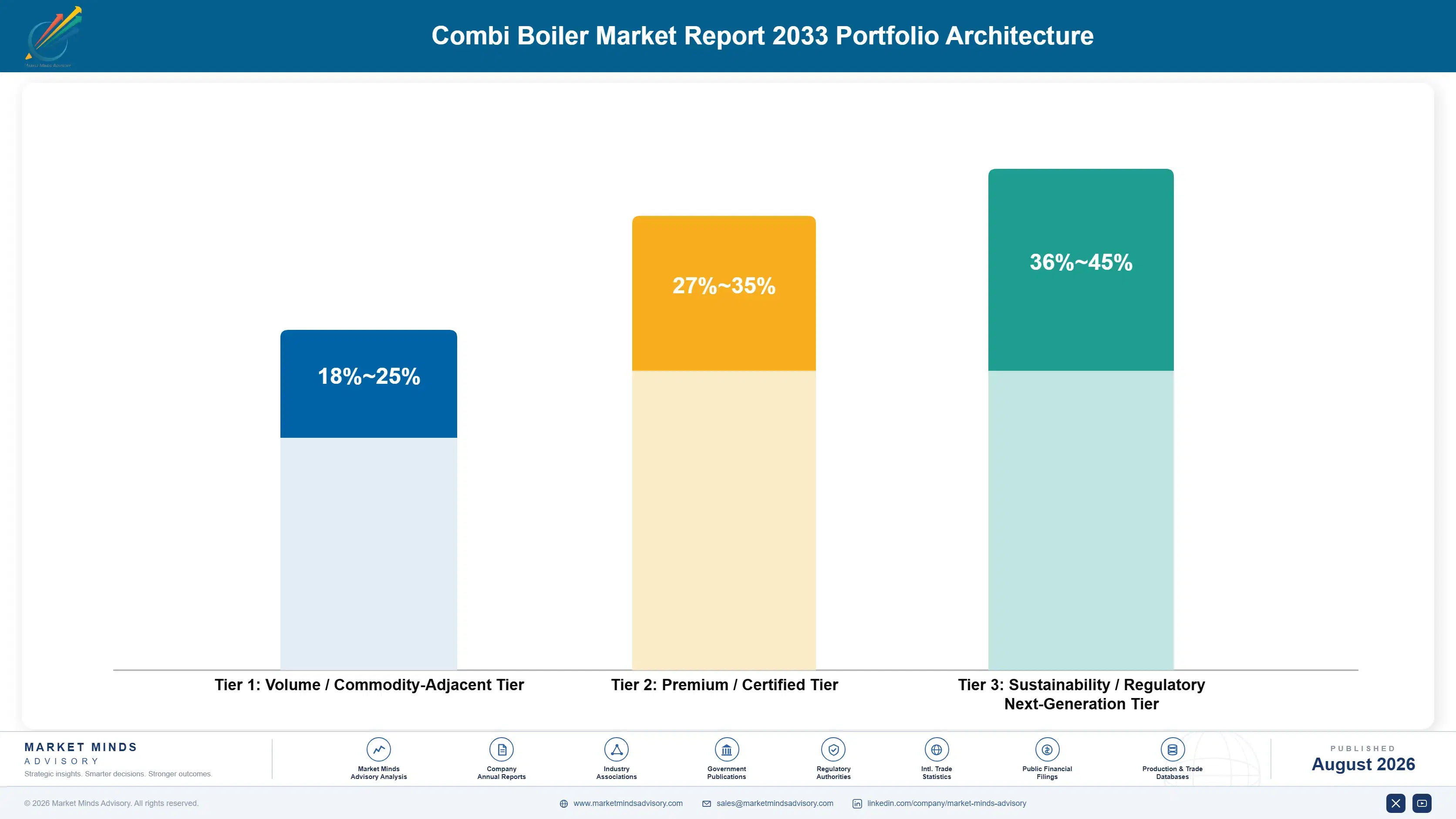
Three tiers describe this business and the spread follows warranty and transition positioning rather than technical performance. Entry condensing units sit at the bottom, competing on merchant price where Turkish and Korean production sets the terms. Mainstream branded units occupy the middle, defended by installer familiarity and technical support. Hydrogen-ready, hybrid, and extended warranty products sit at the top, priced on reassurance rather than measurable difference.
The tension is that the tier carrying the margin sells against an uncertainty nobody can resolve, while the volume tier faces cost competition that Western manufacturing cannot answer. A manufacturer weighted toward premium hedged products depends on transition anxiety persisting. One weighted toward volume competes with Turkish and Korean cost positions directly. Neither position is comfortable and most groups hold both.

High-value pools concentrate where the installer needs an argument they can make in a kitchen. Twelve year warranties and transition-hedged products both supply exactly that, which is why they command premium pricing against products that perform almost identically. Installer familiarity pools value similarly, because an emergency replacement is no time to learn a new appliance. All three depend on the trade rather than the household.

Volume / Commodity-Adjacent Tier

Entry condensing combi units competing on merchant price where Turkish and Korean production sets the terms Western manufacturing cannot match. Efficiency differences are narrow and rarely decide anything at the point of installation.
Gross Margin: 18-25%

Premium / Certified Tier

Mainstream branded units defended by installer familiarity, technical support, and fault code recognition rather than by measurable product advantage. Familiarity in an emergency replacement is worth more than specification on paper.
Gross Margin: 27-35%

Sustainability / Regulatory / Next-Generation Tier

Hydrogen-ready, hybrid-compatible, and extended warranty products priced on reassurance rather than demonstrated performance difference. Best margin by a clear distance, and the argument requires no technical explanation to a homeowner at all.
Gross Margin: 36-45%
combi-boiler-market-portfolio-architecture-1787301851388

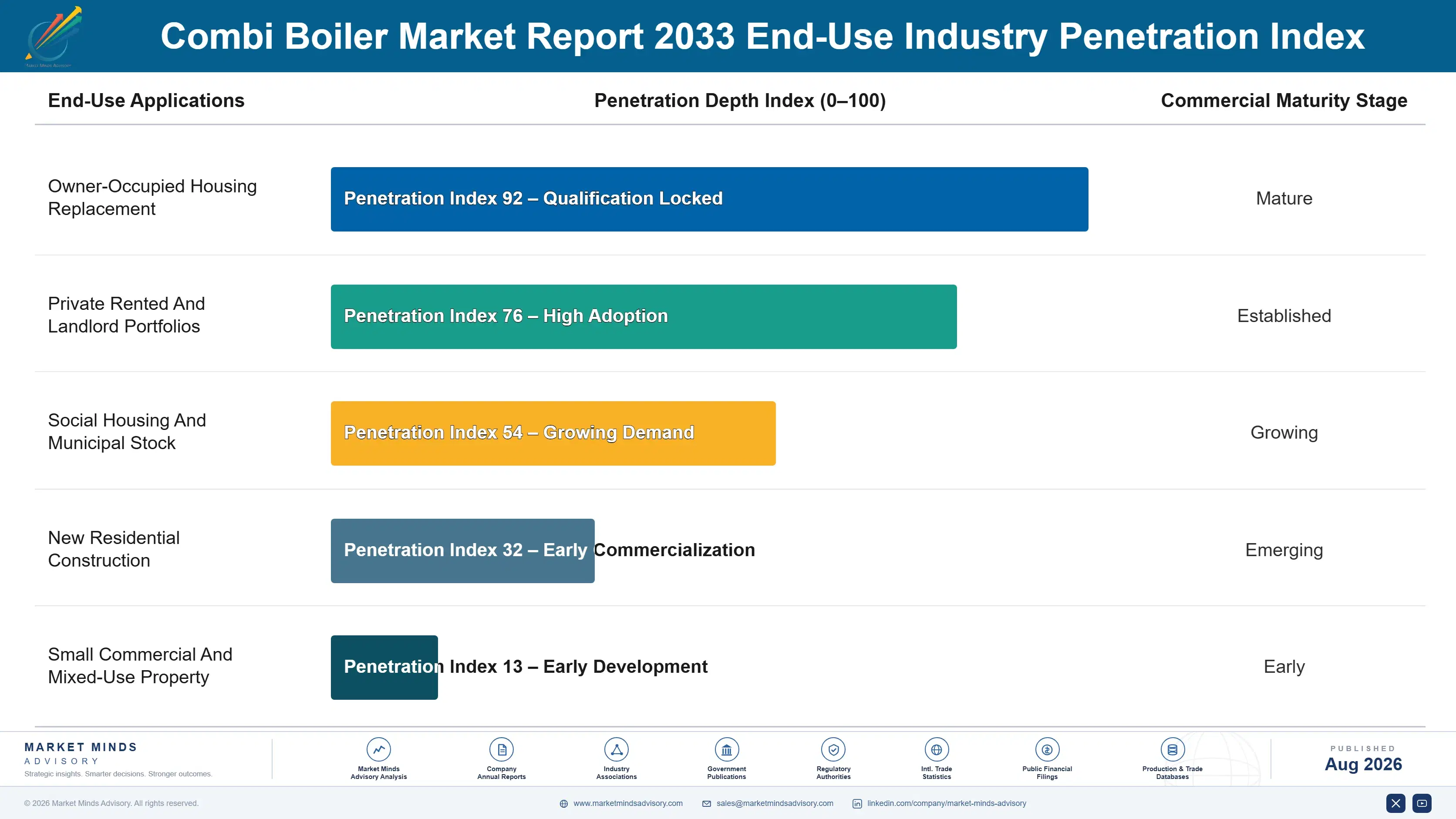
Failures, Merchants and Trades

Demand arrives when appliances fail, which happens on a cycle of roughly fourteen years and produces around 63% of installations as emergencies. That pattern makes total volume unusually predictable and individual purchases entirely unplanned, so a manufacturer cannot cultivate a household relationship in advance because the household is not thinking about boilers until the morning theirs stops working.
Stickiness runs entirely through the installer rather than the homeowner. A tradesperson who knows a range's fault codes, commissioning sequence, and technical support line will fit it repeatedly across hundreds of installations, and that habit is worth more than any consumer loyalty could be. Merchant listings reinforce it, since availability and familiarity compound. Households show effectively no brand persistence between replacements fourteen years apart.

Buyer profiles are shifting as heat pump policy advances. The installer specifying gas combis today is the same tradesperson who will fit whatever replaces them, which makes the trade relationship the asset that survives the category. Manufacturers retraining that network early hold it; those who wait will find it specifying somebody else's equipment entirely. Around 79% of specifications currently come from that same trade relationship.
combi-boiler-market-end-use-penetration-index-1787301852237

What We Would Tell a Board

These are among the four positions where our research anticipates prominent divergence between winners and laggards over the coming forecast period. Each is grounded in the demand model, the regulatory perimeter, and the announced capacity pipeline.
01 / MERCHANT CHANNEL INVESTMENT

Shelf space specifies more boilers than advertising does

Roughly 79% of replacements are specified by the installer and about 63% follow an outright failure, so the decision happens beside a cold appliance with a homeowner who simply wants hot water restored today. An installer will fit whatever a local merchant can actually supply within roughly 48 hours of that conversation happening. Regional stock depth and merchant relationships therefore function as the actual product specification, and they deliver installations that no amount of consumer brand spending would ever reach.
02 / INSTALLER TRAINING PRIORITY

Familiarity beats specification in every emergency call

An installer facing an emergency replacement will fit the appliance they have fitted before, because they already know its commissioning quirks, its fault codes, and roughly how long the whole job will take them. Training programmes, accessible technical support, and clear documentation together build specification share far more reliably than any efficiency improvement has ever managed to. Around 63% of all installations are emergencies, where an unfamiliar product carries a genuine risk to the installer's own working day and reputation.
03 / WARRANTY PROVISIONING DISCIPLINE

Twelve years is a liability, not a marketing decision

Heat exchanger cover now reaching twelve years shifts long-term failure liability onto manufacturers for considerably longer than most product development cycles actually run, and the escalation to that point has been competitive rather than evidence-driven. Provisioning against field failure data and accelerated life testing, rather than against a marketing decision, is what separates a durable offer from an expensive one. Manufacturers extending cover on units designed before current materials arrived are carrying a risk that nobody in the business has properly costed.
04 / TRANSITION RELATIONSHIP RETENTION

The installer network outlives the product category

Announced gas phase-out dates now put a defined end on this whole category across several major European markets, and the installer relationship is the only asset that genuinely survives it while the product itself does not. Manufacturers retraining their existing gas installer base on heat pumps will carry that network across the transition intact. Those that wait will find exactly the same tradespeople specifying somebody else's equipment instead, and appliance life leaves considerably less preparation time than the dates suggest.

Engagement Snapshot From the Field

A live engagement with an industry participant carrying material or product regulatory and market exposure ahead of a defining policy shift, showing how our research translates into a defensible multi-year portfolio strategy.
MARKET MINDS ADVISORY · CLIENT ENGAGEMENT SUMMARY
Combi Boiler Report 2033 Producer Strategic Portfolio Review and Transition Roadmap 2026·Investment Scenario on Combi Boiler Report 2033 Exposure Evaluation 2025-26
CLIENT PROFILE
A domestic heating manufacturer with approximately 480 million dollars in annual revenue (client-reported, unverified by MMA), selling combi boilers across three European markets through merchant distribution and an installer network. Consumer marketing spending had grown for four consecutive years, market share had drifted downward across the same period, and management had proposed a further brand campaign.
STRATEGIC CHALLENGE
The board questioned whether consumer advertising was reaching anybody who actually made the decision, and wanted an independent view on where specification was genuinely being determined before approving a campaign larger than any the company had previously run. Specification routes had never been researched at all. Marketing effectiveness was entirely unmeasured.
MMA APPROACH
We surveyed householders on how their boiler had been chosen and surveyed installers separately on how they selected what to fit. Merchant branch stock holdings were audited against the client's installation share by region. Installer training participation was compared against specification rates, and warranty provisioning was reviewed against field failure data.
KEY FINDINGS
  1. Householders overwhelmingly reported that the installer had chosen the appliance, and almost none recalled the client's consumer advertising at all. Recall was essentially nil.
  2. Installer selection tracked merchant availability and prior familiarity closely, and brand preference appeared only after those two conditions were satisfied. Brand ranked third at best.
  3. The client's installation share by region correlated strongly with local merchant stock holding rather than with any consumer marketing spend deployed there.
  4. Twelve year warranty cover had been extended without accelerated life testing, and provisioning rested on assumptions rather than any field failure evidence.
CLIENT PROFILE
A domestic heating manufacturer with approximately 480 million dollars in annual revenue (client-reported, unverified by MMA), selling combi boilers across three European markets through merchant distribution and an installer network. Consumer marketing spending had grown for four consecutive years, market share had drifted downward across the same period, and management had proposed a further brand campaign.
STRATEGIC CHALLENGE
The board questioned whether consumer advertising was reaching anybody who actually made the decision, and wanted an independent view on where specification was genuinely being determined before approving a campaign larger than any the company had previously run. Specification routes had never been researched at all. Marketing effectiveness was entirely unmeasured.
MMA APPROACH
We surveyed householders on how their boiler had been chosen and surveyed installers separately on how they selected what to fit. Merchant branch stock holdings were audited against the client's installation share by region. Installer training participation was compared against specification rates, and warranty provisioning was reviewed against field failure data.
KEY FINDINGS
  1. Householders overwhelmingly reported that the installer had chosen the appliance, and almost none recalled the client's consumer advertising at all. Recall was essentially nil.
  2. Installer selection tracked merchant availability and prior familiarity closely, and brand preference appeared only after those two conditions were satisfied. Brand ranked third at best.
  3. The client's installation share by region correlated strongly with local merchant stock holding rather than with any consumer marketing spend deployed there.
  4. Twelve year warranty cover had been extended without accelerated life testing, and provisioning rested on assumptions rather than any field failure evidence.
RECOMMENDED STRATEGY
Phase 1: Phase 1 (months one to nine): halt the consumer campaign, redirect the budget into merchant stock support and branch coverage. Phase 2: Phase 2 (months nine to twenty-one): expand installer training capacity and commission accelerated life testing behind the warranty offer. across all three markets. Phase 3: Phase 3 (months twenty-one to thirty-six): begin heat pump retraining across the existing installer network before phase-out dates arrive. in every core market.
OUTCOME
The consumer campaign was cancelled. Merchant branch coverage improved materially within three quarters and installation share recovered in the regions where stock depth increased, while accelerated life testing began behind the warranty offer and heat pump retraining was funded (client-reported, unverified by MMA). Consumer marketing spend was permanently reduced.

Frequently Asked Questions

Foundational context covering the market sizes, CAGR, scope, country, region and competition that inform every finding below. This section is provided to cover basics and most often pre-purchase conversations, answered from the MMA Primary Research Dataset.

What is the current size of the Combi Boiler Market?

The market is valued at USD 9.8 billion in 2025, rising to USD 10.19 billion in 2026. Scope covers wall-hung combination boilers providing instantaneous hot water and space heating, not system boilers, heat pumps, or water heaters.

How large will the Combi Boiler Market be by 2036?

MMA forecasts USD 15.09 billion by 2036, an increase of USD 4.90 billion over the 2026 base. That represents an expansion multiple of 1.48 times across the forecast period.

What is the CAGR for the Combi Boiler Market 2026 to 2036?

The base case CAGR is 4.0%, with a bull case of 5.2% and a bear case of 2.8%. The historical rate from 2020 to 2025 was 3.0%, carried almost entirely by replacement rather than new build.

Which segment is growing fastest?

Hydrogen-ready and hybrid-compatible boilers at 6.0%, exactly 1.50 times the market rate. They sell against transition uncertainty rather than any measurable performance difference from standard condensing units.

Who are the major companies in the Combi Boiler Market?

BDR Thermea, Vaillant Group, Bosch Thermotechnology, Ariston Group, and Viessmann Climate Solutions lead on units shipped. The top five hold 62%, held there by installer network reach rather than product engineering.

Which country is growing fastest?

India at 5.4%, where urban piped gas network extension is reaching apartment developments in more cities each year. Instantaneous hot water suits housing with limited space for storage cylinders.

Report Segmentation Architecture

The full report scope spans multiple orthogonal segmentation dimensions, with cross-tabulated demand data provided for each dimension pair. Coverage extends further to regional breakdowns, trend trajectories, and the competitive detail needed to support segment-level decision-making.

By Fuel And Transition Compatibility

  • Condensing Gas Combi Boilers
  • Hydrogen-Ready And Hybrid-Compatible Boilers
  • Electric And Heat Pump Ready Combination Units
  • Oil And Liquefied Petroleum Gas Combis
  • Controls And Flue Accessories Supplied With Appliances

By End-Use Industry

  • Owner-Occupied Housing Replacement
  • Private Rented And Landlord Portfolios
  • Social Housing And Municipal Stock
  • New Residential Construction
  • Small Commercial And Mixed-Use Property

By Commercial Model

  • Builders Merchant And Distributor Supply
  • Direct Supply To Installer Networks
  • Housebuilder And Contractor Framework Agreements
  • Social Housing Procurement Contracts
  • Online And Retail Channel Sales

By Region

  • Western Europe
  • East Asia
  • Eastern Europe
  • North America
  • South Asia and Pacific
  • Middle East and Africa
  • Latin America

Scope, Methodology, and Coverage

Every figure in this report is reproducible from documented input assumptions. The scope below maps the historical period, the forecast horizon, the segmentation dimensions, and the countries covered, alongside the underlying primary and qualitative methodology.
Historical Period
2020 to 2025
Forecast Period
2026 to 2036
Base Year
2025 (USD billions; MMA Primary Research Dataset, August 2026)
Market Definition
This market comprises wall-hung combination boilers that provide instantaneous domestic hot water and space heating from a single appliance without a separate storage cylinder, measured at manufacturer revenue across merchant, direct, and contract channels. Coverage spans condensing gas combi boilers, hydrogen-ready and hybrid-compatible boilers, electric and heat pump ready combination units, oil and liquefied petroleum gas combis, and the controls and flue accessories supplied with those appliances. System and heat-only boilers requiring separate hot water cylinders, standalone air and ground source heat pumps, commercial and industrial boiler plant, unvented and storage water heaters without space heating capability, radiators and pipework, and installation labour fall outside scope.
Quantitative Units
USD billions (current prices); appliance units shipped annually; installer-specified against householder-selected share; replacement against new installation split
Segmentation Dimensions
By Fuel And Transition Compatibility; By End-Use Industry; By Commercial Model; By Region
Regions Covered
Western Europe, East Asia, Eastern Europe, North America, South Asia and Pacific, Middle East and Africa, Latin America
Countries Covered
United Kingdom, Italy, Spain, Netherlands, Belgium, France, Germany, Ireland, Poland, Romania, Czechia, Hungary, Turkey, South Korea, China, Japan, United States, Canada, India, Australia, Argentina, Chile, Brazil, and additional markets relevant to this sector
Key Companies Profiled
BDR Thermea, Vaillant Group, Bosch Thermotechnology, Ariston Group, Viessmann Climate Solutions, Baxi Heating, Ideal Heating, Worcester Bosch, Immergas, Ferroli, Beretta, Vokera, Navien, Kyungdong Navien, Rinnai, Demirdokum, Vaillant Turkey, Alarko Carrier, Vantage Heating, Haier Smart Home
Quantitative Methodology
Primary survey, n=3,800 respondents, Q4 2025, six countries; demand-side model with trade association cross-validation
Qualitative Methodology
47 expert interviews, Q4 2025; applied to validate demand model assumptions, identify emerging dynamics, and assess competitive positioning
Report Format
PDF and XLSX data workbook (Word format preview document)
Publisher
Market Minds Advisory
Report Code
MMA-2026-CON-700
Published
August 2026
Contact
sales@marketmindsadvisory.com | www.marketmindsadvisory.com

Purchase the full Combi Boiler Market Report 2033 Report (2026 to 2036).

The full report sizes combi boilers across five fuel and compatibility categories, five end-use segments, five commercial models, and seven regions, with installer-specified volume separated from householder-selected purchases throughout. Merchant stock depth is analysed against regional installation share, since availability rather than product merit decides most emergency replacements. Warranty provisioning is assessed against field failure evidence. Competitive profiling covers twenty companies on units shipped, gas phase-out timing is mapped against installed base replacement cycles by market, and emergency against planned replacement volume is quantified separately.
Installer-specified volume separated from householder-selected purchases
Merchant stock depth analysed against regional installation share
Warranty provisioning assessed against available field failure evidence
Gas phase-out timing mapped against installed base replacement cycles
Emergency against planned replacement split quantified by market
Installer training participation compared with specification share outcomes

Built For The People Who Decide

From boardroom strategy to bench-side execution, this report is read cover-to-cover by leaders shaping the next decade of their industry, turning demand scenarios, market dynamics and valuation benchmarks into decisions.
CXOs/ Presidents/ VPs/ Managers
M&A and Corporate Development
Strategy Teams and R&D Heads
Procurement and Product Directors
Regulatory and Compliance Leaders
Investor Relations and Equity Analysts