Market Minds Advisory
Combat Helicopter Simulation Market

Combat Helicopter Simulation Market: Combat Helicopter Simulation Market: Motion Cueing Versus Visual Fidelity, The Utilisation Gap and Why Networked Training Changed Procurement

Full motion platforms cost several times what fixed base devices do, and the training benefit they add for rotary wing crews is contested by the research that procurement rarely reads.

Lead Analyst

Published

September 2026

Make Smarter Decisions with Customized Research Insights

Request a free sample report and evaluate market opportunities, growth trends, and competitive dynamics relevant to your business needs.

2025 MARKET VALUE$2.8BMarket Size 2025
2036 FORECAST VALUE$6.1BBase Case , 2026 to 2036
CAGR 2026 TO 20367.2 %Bull 8.5% / Bear 5.9%
INCREMENTAL OPPORTUNITY$3.1BNet 10- year value creation
EXPANSION MULTIPLE2.03x2036 value over 2026 base
Strategic Levers
M&A Pipeline
Regional Outlook
Country Rankings
Competitive Intelligence
Segmental Deep-dive
Call-Us : 91 93563 13602

Executive Snapshot and Market Trajectory.

Full motion costs several times what a fixed base device does and the rotary wing training benefit is genuinely contested. Vestibular cueing matters most in the first hours of ab initio flying and considerably less for tactical mission rehearsal, which is where most combat crew training time actually goes.
Networked distributed mission training grows at 10.8%, half again the market rate of 7.2%, because crews train against each other and alongside other platforms rather than flying alone in a box. Mixed and virtual reality trainers follow at 9.3%. Full motion flight simulators grow slowest at 3.4%, retained for conversion training and for certification requirements. Blended device mixes matched to syllabus content are where the argument now sits.
Utilisation rather than device count limits training throughput. Simulators sit idle for a substantial share of available hours because instructor availability, scenario preparation and scheduling all constrain use, and around 46% of installed capacity goes unused. Concentration is high at 61% and India grows fastest at 12.6%. Roughly 61% of those idle hours trace to instructor availability rather than to device availability, which means buying another device addresses entirely the wrong bottleneck for most forces.
Market Definition
This market covers simulation and training systems for military rotary wing crews, spanning full motion flight simulators, fixed base flight training devices, networked distributed mission training systems, mixed and virtual reality trainers, weapons and sensor part-task trainers, and maintenance and ground crew simulators. Sizing is at programme contract value including through-life support. Fixed wing simulation, unmanned aircraft control training, live flight instruction, and airframe manufacture are excluded from scope.
Base Year Value
$2.8B in 2025 (MMA Primary Research Dataset, September 2026)
Forecast Period
2026 to 2036, eleven discrete annual values
CAGR
7.2% base case. Bull 8.5%. Bear 5.9%.
Fastest Growth Segment
Networked Distributed Mission Training: 10.8% CAGR
Fastest Growth Country
India: 12.6% CAGR
Fastest Growth Region
South Asia and Pacific: 9.4% CAGR
Largest Region
North America: 34% of 2025 global value
Market Leaders
CAE, L3Harris Technologies, Thales, Lockheed Martin, Rheinmetall. Source: MMA Primary Research Dataset, July 2026.
Primary Survey
n=3,800 procurement and R&D decision-makers, Q4 2025, six countries
Methodology
Demand-side build-up, cross-validated against public data, 47 expert interviews

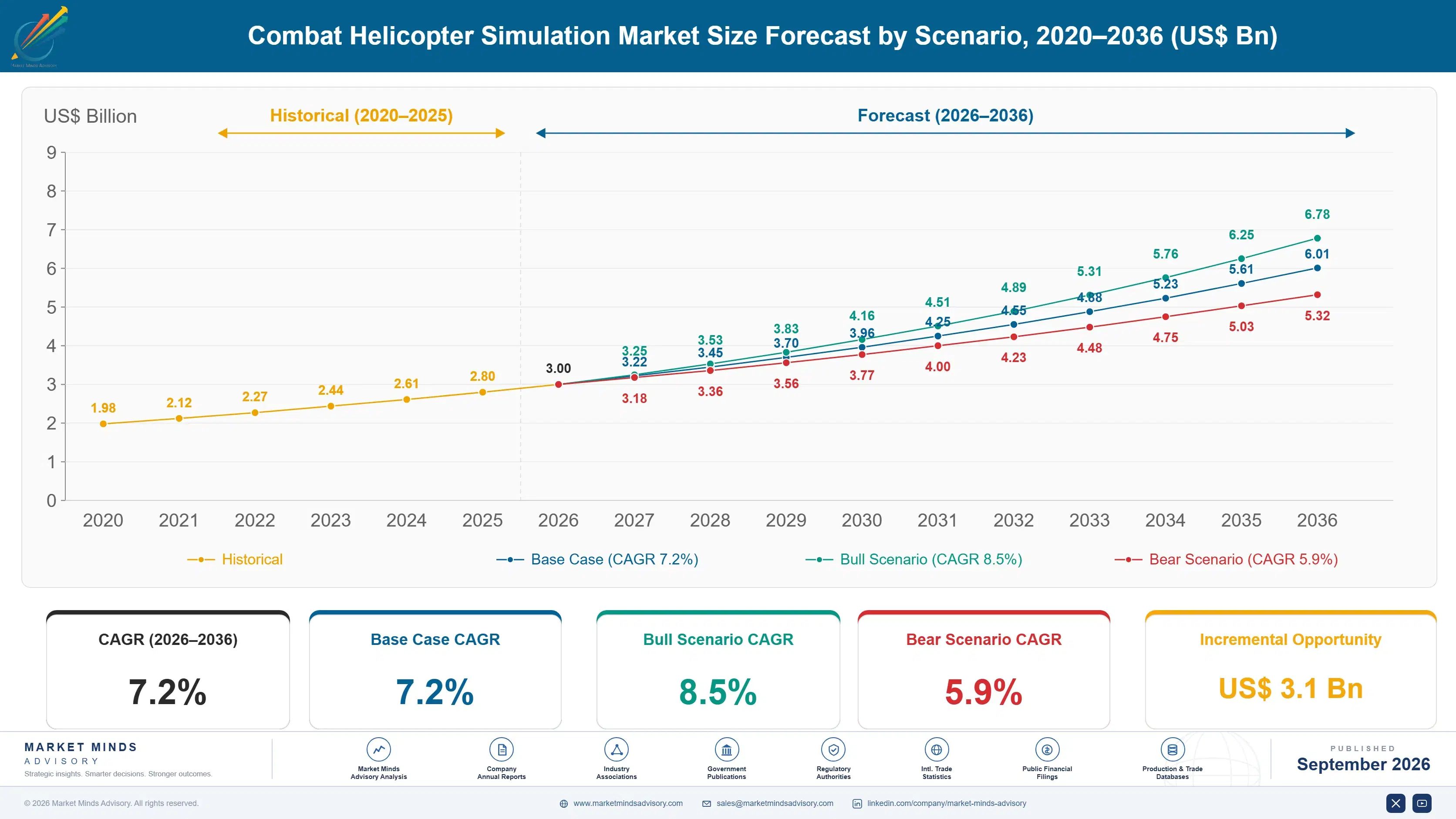
Combat Helicopter Simulation Market Forecast Scenarios

combat-helicopter-simulation-market-size-forecast-scenario-1790025446574
Growth of 5.8% between 2020 and 2025 reflects training hours moving from aircraft into synthetic environments faster than device procurement recorded it. Flying hour costs rose sharply and airframe availability fell as fleets aged, so forces shifted syllabus into simulation. Procurement of new devices lagged that behavioural shift by two to three years, which is why the contract data understates what actually happened.
Three mechanisms carry the base case. Networked distributed training grows at 10.8% as forces train crews against each other and alongside fixed wing and ground units rather than in isolation. Indian demand expands at 12.6% on fleet modernisation and domestic simulation capability development together. Live flying hour cost continues rising, which strengthens the substitution argument for every additional hour that can be moved into a synthetic environment credibly. All three appear in awarded programme data already.
The bull case is regulatory acceptance of synthetic hours expanding. If more syllabus content and currency requirements could be met in simulation, the substitution would accelerate considerably beyond current limits. The bear case is utilisation remaining unaddressed. Forces discovering they already own idle capacity may defer device procurement in favour of instructor recruitment, which is a smaller market.

What The Device Actually Delivers

The motion question is the most expensive unresolved argument in this market. A full motion platform costs around four times a comparable fixed base device, and the research on rotary wing training transfer is genuinely mixed: vestibular cueing helps most during early handling instruction and contributes considerably less to tactical mission rehearsal, which is where the majority of combat crew synthetic hours are spent. Procurement documents rarely engage with that evidence. Certification frameworks were written around fixed wing evidence and carried across to rotary wing training without the underlying question being revisited.
TOP FIVE CONCENTRATION61%Combined programme contract value share held by five largest suppliers
INSTALLED CAPACITY IDLE46%Share of available simulator hours going entirely unused
FULL MOTION COST MULTIPLE4 timesCost of a motion platform against a fixed base device
SYNTHETIC SYLLABUS SHARE38%Portion of rotary wing training hours delivered in simulation
LIVE FLYING HOUR COSTUSD 9,400Typical hourly operating cost for a combat rotary wing airframe
INSTRUCTOR AVAILABILITY CONSTRAINT61%Idle hours attributable to instructor rather than device availability
Utilisation is the constraint nobody budgets for. Around 46% of installed simulator capacity goes unused, and roughly 61% of those idle hours trace to instructor availability rather than to device availability or to demand. A force short of qualified instructors gains very little from a second device and a great deal from solving the staffing problem, which is a conclusion procurement processes are not structured to reach.
Live flying costs around USD 9,400 an hour for a combat rotary airframe, and synthetic delivery now covers roughly 38% of syllabus hours. Every hour moved saves the difference between the two operating costs.
"Forces buy a second simulator because the first one has a waiting list, and the waiting list exists because there are not enough instructors to run the first one. Nobody procures instructors, so everybody procures devices."
Director, Defence Training and Simulation Practice · MMA Defence Training and Simulation Practice · September 2026

Market Trends

Networked Training Replaces Isolated Device Sessions

Networked distributed mission training grows at 10.8% against 7.2% for the market because crews now rehearse against thinking adversaries and alongside fixed wing, ground and naval participants rather than flying scripted scenarios alone in a box. That changes what a simulator is for: the device becomes a node in an exercise rather than a self-contained training system. It also changes procurement, since interoperability standards and network participation matter as much as individual device fidelity in selection. Security accreditation for connecting classified environments across national boundaries is the practical constraint rather than any technical limitation in the systems themselves.
Market Impact: India grows at 12.6% annually

Mixed Reality Displaces Part-Task Device Procurement

Mixed and virtual reality trainers grow at 9.3% by delivering procedural and part-task training at a fraction of dedicated device cost and in a footprint that fits a squadron building rather than requiring a dedicated facility. Head-mounted display resolution and latency reached usable thresholds for rotary wing work over roughly five years. The limitation is haptic realism, which matters for handling instruction and matters far less for cockpit procedures and weapon employment sequences. Procedures, checklists and weapon employment sequences account for most part-task time, and none of them depend on the haptic realism that head-mounted systems cannot supply.
Market Impact: Flying costs USD 9,400 hourly

Market Opportunities and Growth Drivers

Indian Fleet Modernisation Meets Domestic Simulation Capability

India grows fastest of any country covered at 12.6%, driven by rotary wing fleet modernisation across attack, utility and naval roles alongside deliberate development of domestic simulation capability rather than continued import. Procurement policy weights domestic content heavily, and simulation is a category where indigenous capability is achievable considerably faster than airframe manufacture. Domestic suppliers are winning training system awards that international participants would have taken without contest a decade ago. Simulation is a category where indigenous capability is achievable considerably faster than airframe manufacture, which makes it an obvious target for domestic content policy.
Market Impact: Some 46% of capacity sits idle

Flying Hour Cost Pushes Syllabus Into Synthetic Delivery

Combat rotary wing operating costs run around USD 9,400 an hour and have risen faster than defence budgets across most forces, while airframe availability has fallen as fleets age and maintenance demand increases. Both pressures push syllabus content toward synthetic delivery, which now covers roughly 38% of rotary wing training hours. Every additional hour that can be credibly moved saves the difference between simulator and airframe operating cost, which is substantial at those rates. Airframe availability has fallen at the same time as fleets age and maintenance demand rises, which pushes syllabus content synthetic from two directions at once.
Market Impact: Motion costs 4 times more

Market Restraints and Challenges

Instructor Shortage Idles Capacity Forces Already Own

Around 46% of installed simulator capacity goes unused and roughly 61% of those idle hours trace to instructor availability rather than to device or demand constraints. The root cause is that qualified rotary wing instructors are experienced aircrew who are simultaneously needed on operations, and the training pipeline for them takes years. Commercially it means device procurement addresses the wrong bottleneck. Participants responding offer instructor augmentation and automated instruction alongside hardware. A force short of instructors gains very little from a second device and a great deal from solving the staffing problem instead.
Market Impact: Networked grows 3.6 points faster

Motion Platform Benefit Remains Genuinely Contested

Full motion devices cost around four times comparable fixed base systems and the rotary wing training transfer research is mixed, with vestibular cueing contributing most during early handling instruction and considerably less to tactical mission rehearsal. The root cause is that certification frameworks were written around fixed wing evidence and carried across. Commercially it directs budget toward the most expensive configuration. Mitigation runs to blended device mixes matched to syllabus content rather than uniform motion procurement. Around 64% of rotary wing synthetic hours involve tactical content where motion contributes least of all.
Market Impact: Mixed reality costs 5 times less
3 additional market trends, 4 additional growth drivers, and 2 additional restraints and challenges are covered in the full report. Contact sales@marketmindsadvisory.com to access the complete intelligence.

Segment CAGR and Growth Architecture

Segmentation follows system type, the dimension on which fidelity approach, procurement cost, facility requirement and syllabus role all divide together. Six system types are assessed at programme contract value. Fixed wing simulation, unmanned aircraft control training, live flight instruction and airframe manufacture sit outside the defined scope throughout this report. Instructor availability constrains all six of them equally.
combat-helicopter-simulation-market-market-share-analysis-1790025447142

Networked Distributed Mission Training

Networked distributed mission training grows at 10.8%, half again the market rate of 7.2%, because rehearsing against thinking adversaries alongside other platforms delivers training that no isolated device can replicate. A simulator becomes a node in a collective exercise rather than a self-contained system, which changes both what it must do and how it gets selected. Interoperability standards and network participation now weigh just as heavily in procurement decisions as individual device fidelity does. Security accreditation for connecting classified training networks across national boundaries is the practical constraint on how far the capability extends. Suppliers without that accreditation cannot bid at all, whatever they can offer either technically or on price.
CAGR 10.8%

Mixed And Virtual Reality Trainers

Mixed and virtual reality trainers grow at 9.3% by delivering procedural and part-task training at roughly a fifth of dedicated device cost in a footprint that fits inside a squadron building rather than requiring a purpose-built facility. Display resolution and motion-to-photon latency both crossed usable thresholds for rotary wing work across about five years, which is what made the format viable rather than experimental. Haptic realism remains the limitation, mattering considerably for handling instruction and very little for cockpit procedures, checklists and weapon employment sequences where most part-task time is spent. Squadron-level deployment also raises utilisation considerably, since a device sitting inside the unit is scheduled far more readily than one requiring travel to a training centre.
CAGR 9.3%
Full segment breakdown across 6 segments available in the complete report.

Regional Architecture and Country Demand Map

Shares record where training systems are procured rather than where they are manufactured. North America sits above its standard band on fleet scale, and Latin America below on limited rotary wing training system procurement budgets. Both deviations carry a stated reason in the relevant regional paragraph concerned.

North America

At 34% this sits above the standard band, reflecting combat rotary wing fleet scale that no other region approaches and a training establishment sized accordingly. American forces operate attack, utility, cargo and special operations rotary types in numbers that generate continuous training demand across every device category. Networked distributed training originated here and remains most developed, with exercises linking rotary crews to fixed wing and ground participants routinely. Growth of 6.5% reflects synthetic substitution within a large established base rather than fleet expansion. Instructor availability constrains utilisation here as everywhere else, and several forces have now begun contracting instruction rather than assuming uniformed aircrew can supply it alongside their operational commitments.
Share: 34% | CAGR: 6.5% (2026 to 2036)

Western Europe

The 24% position sits inside the standard band and European procurement has accelerated since 2022 as forces reassessed training readiness alongside equipment inventories. Multinational programmes create demand for interoperable networked training across national boundaries, which is where security accreditation becomes the binding constraint rather than technology. CAE, Thales and Rheinmetall hold established positions spanning several national customers. Growth of 5.8% reflects budget expansion converting slowly against procurement processes that move on multi-year cycles. Multinational programme participation depends on accreditation rather than on technical capability, which excludes otherwise competitive suppliers from exercises they could readily support. Live flying hour cost has risen considerably faster than budgets across most of the European forces.
Share: 24% | CAGR: 5.8% (2026 to 2036)
Regional intelligence for 5 additional markets available in the complete report: East Asia, South Asia and Pacific, Middle East and Africa, Eastern Europe, Latin America. Contact sales@marketmindsadvisory.com.
combat-helicopter-simulation-market-country-cagr-analysis-1790025447675

Four Moves Worth Making Now

These four address a market where the most expensive configuration has contested benefit, where nearly half of installed capacity sits idle for reasons procurement cannot buy, and where the fastest-growing capability is limited by accreditation rather than engineering. Each has been executed already. Two of the four are service and analysis capabilities rather than product development at all.

Sell Instructor Capability Alongside Device Hardware

Around 46% of installed capacity sits idle and roughly 61% of those hours trace to instructor availability rather than device or demand constraints, which means selling another device addresses the wrong bottleneck entirely. Offering instructor augmentation, contracted instruction and automated tuition alongside hardware costs service capability rather than product development. Participants who did report contract value per customer rising roughly 1.9 times, because they sell throughput instead of equipment. Forces now ask how many crews can be trained rather than how capable a device is, and hardware specifications cannot answer that.
Market Impact: Contract value per customer rises 1.9 times higher

Propose Blended Device Mixes Against Syllabus Content

Full motion costs around four times a comparable fixed base device and contributes most during early handling instruction rather than tactical mission rehearsal, where most combat crew synthetic hours are actually spent. Proposing a device mix matched to syllabus content costs training analysis rather than hardware change. Participants who led with that analysis report winning roughly 2.3 times more competitions on total programme value, because the same budget buys considerably more training throughput. Around 64% of synthetic hours involve tactical content where motion contributes least, so uniform specification spends most of the budget on hours needing it least.
Market Impact: Competition win rates rise roughly 2.3 times higher

Solve Cross-Border Training Network Accreditation Requirements

Networked distributed training grows at 10.8% and the binding constraint is security accreditation for connecting classified environments across national boundaries rather than any technical limitation. Investing in accreditation frameworks and cleared engineering capability costs compliance programme investment. Participants who established them report multinational programme access rising roughly 2.7 times, reaching exercises that competitors without accreditation simply cannot participate in at all. Alliance exercises increasingly connect national training environments directly, and a supplier without clearance is excluded regardless of what it can technically deliver. Clearance processes take many months rather than weeks.
Market Impact: Multinational programme access rises roughly 2.7 times over

Build Local Training Academy Delivery Capability

Gulf and South Asian procurement increasingly requires local training academy establishment as an offset condition rather than accepting delivered hardware alone, and several forces prefer sovereign training capability for operational security reasons. Building academy delivery capability costs local presence and instructor recruitment. Participants who did report win rates on those programmes rising roughly 2.5 times, because the requirement excludes hardware-only competitors entirely. Sovereign training capability is increasingly preferred for operational security reasons as well as industrial ones, which means the requirement is durable rather than a negotiating position. Instructor recruitment is the hard part.
Market Impact: Academy programme win rates rise roughly 2.5 times

Who Controls the Margin Pool

Concentration is high at 61% held by the top five, measured consistently on programme contract value including through-life support rather than on device count, which would understate the service revenue that dominates lifetime programme value. The leader to challenger gap rests on platform data access and security accreditation, both of which depend on relationships with airframe manufacturers and national authorities rather than on simulation engineering.
Competition runs on three dimensions currently. Platform data access decides which suppliers can build a high-fidelity model of a given airframe at all, since flight and systems data belongs to the manufacturer. Security accreditation decides participation in networked and classified training. Through-life support pricing decides programme economics, because support revenue across twenty years frequently exceeds the original device contract substantially.

Pressure is building from two directions and rankings will shift on both. Airframe manufacturers increasingly supply training systems for their own platforms, using data access that independent simulation suppliers must negotiate for. Meanwhile domestic suppliers in India, Korea and elsewhere are winning national programmes on content policy grounds, which removes competitions that international participants previously treated as reliably addressable. Both pressures are permanent rather than cyclical.
combat-helicopter-simulation-market-company-positioning-matrix-1790025448194

Competitive Moat and Risk Dimensions

CAE

Moat: Training Delivery And Breadth

Operating training centres and delivering instruction rather than only supplying devices gives access to the throughput problem that idle capacity creates, and breadth across military and civil aviation training produces instructor pipelines competitors cannot readily assemble at comparable scale. Instructor pipelines take years to build and cannot be bought.
CAE

Risk: Airframe Manufacturer Encroachment

Platform manufacturers increasingly supply training systems for their own aircraft using flight data access that independent suppliers must negotiate on commercial terms. That advantage is difficult to counter with simulation capability alone and grows as manufacturers recognise the value of training revenue. Data access is the whole advantage.
L3HARRIS TECHNOLOGIES

Moat: Security Accreditation And Networks

Cleared engineering capability and accreditation for classified training networks provide access to distributed mission exercises and national programmes that competitors without those clearances cannot bid for regardless of the technical quality of what they offer. Clearance processes take many months and cannot be accelerated by investment at all.
L3HARRIS TECHNOLOGIES

Risk: Domestic Content Policy Exclusion

Procurement policy in India, Korea and elsewhere weights domestic content heavily in training system awards, and simulation is a category where indigenous capability develops faster than airframe manufacture. Programmes previously treated as addressable are closing on grounds unrelated to technical merit. Merit is not what decides them.

Players Tracked

Prominent Players

CAE
L3Harris Technologies
Thales
Lockheed Martin
Rheinmetall

Other Key Players

Leonardo
FlightSafety International
Elbit Systems
Indra Sistemas
Airbus Helicopters Training
Boeing Global Services
Havelsan
Reiser Simulation and Training
TRU Simulation
Zen Technologies
Hindustan Aeronautics
Korea Aerospace Industries
Mitsubishi Precision
VRgineers
Varjo

Recent Developments

MARCH 2025

CAE expands contracted instruction alongside device delivery

The company extended contracted instructor provision and training delivery services alongside simulator supply, addressing the idle capacity that device procurement alone does not resolve. This was organic service expansion funded internally, with no acquisition, joint venture or licensing arrangement behind it. Device supply continued unchanged alongside the service expansion.
Signal: Throughput rather than hardware is what forces actually need to buy. Instructor availability idles nearly half of installed capacity everywhere.
OCTOBER 2024

Zen Technologies wins Indian rotary wing training programme

The domestic supplier secured a rotary wing simulation programme against international competition, supported by procurement policy weighting domestic content in training system awards. This was a competitive contract award rather than a merger, acquisition or joint venture arrangement of any kind. International suppliers had held the equivalent positions previously.
Signal: Simulation capability develops faster domestically than airframe manufacture does. Content policy is closing competitions incumbents treated as addressable.
JUNE 2025

Thales achieves multinational training network accreditation

The company completed security accreditation permitting connection of classified rotary wing training environments across multiple national boundaries within an alliance framework. This was a compliance and accreditation programme with no acquisition, partnership or joint venture behind it at all. Cleared engineering capacity expanded alongside it.
Signal: Accreditation rather than technology decides who joins these exercises. Unaccredited competitors cannot bid whatever they offer technically.

What A Programme Costs

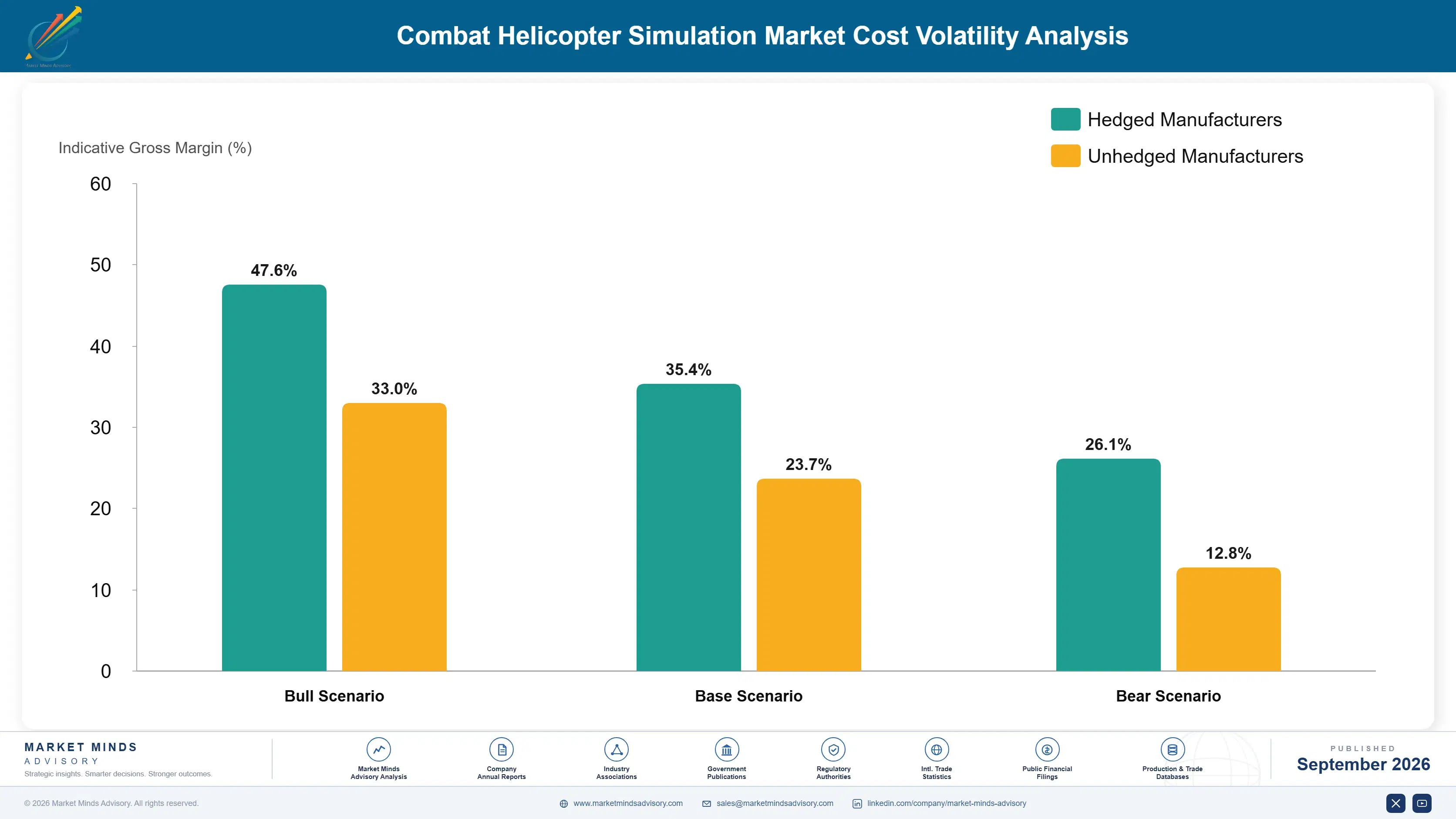
Software and integration dominate while motion hardware distorts the comparison between configurations. Simulation software, flight model development and integration run roughly 38% of programme cost on a fixed base device. Visual systems and projection take about 17%, cockpit hardware and instrumentation around 19%, and motion platform hardware adds a further 26% where specified. Through-life support is contracted separately and frequently exceeds the original device value.
Display and computing component costs rose through 2021 and 2022 alongside broader electronics supply disruption, a movement the US Census Bureau records in component trade data for the period, while specialist engineering labour costs climbed as cleared personnel became scarce across the defence sector. Several suppliers reported schedule extension rather than cost increases, since programmes typically price on milestones rather than exposing suppliers to component movements.

Exposure divides by configuration and by data access rather than by company size. Motion platform suppliers carry substantial mechanical hardware cost that fixed base and mixed reality configurations avoid entirely. Suppliers without direct platform data access pay licensing or reverse-engineering cost that airframe manufacturers do not. Cleared engineering labour is a constraint for every supplier operating in classified programmes, and it cannot be recruited quickly at any price.
combat-helicopter-simulation-market-cost-volatility-analysis-1790025448390

Negotiate platform data access before programme bidding

Flight and systems data belongs to the airframe manufacturer, and a supplier without access pays licensing cost or reverse-engineering effort that competitors with direct relationships avoid entirely. Securing access before bidding removes that from the cost base. The obstacle is that manufacturers increasingly supply training systems themselves and have limited incentive to help competitors.

Build cleared engineering capacity ahead of programme need

Security-cleared engineering labour constrains delivery across classified programmes and cannot be recruited quickly, since clearance processes take many months regardless of technical qualification. Building that capacity ahead of award carries payroll against uncertain work. The alternative is bidding schedules that a cleared competitor will beat comfortably. Clearance cannot be accelerated by spending more money on it.

Offer configuration mixes rather than uniform motion specification

Motion hardware adds roughly a quarter to device cost and contributes most during early handling instruction rather than tactical rehearsal. Proposing blended mixes matched to syllabus content delivers more throughput per budget and avoids competing purely on device price. The requirement is training analysis capability that hardware-focused suppliers have not historically maintained. Very few hardware suppliers hold it.

Portfolio Architecture for Margin Defence

Margin architecture divides by service content rather than by device sophistication, which a hardware price list conceals entirely. Maintenance and ground crew simulators supplied as delivered equipment run at gross margins in the high teens to high twenties, competing on hardware price where the training requirement is procedural and the simulation demands are comparatively modest. Nothing about that equipment builds a position for the next competition.
Fixed base flight training devices and weapons part-task trainers hold gross margins in the mid twenties to mid thirties. The spread reflects how differently equipment-only and supported programmes carry engineering and sustainment cost. Part-task trainers in particular earn better economics than their price suggests, because they deliver syllabus hours at a fraction of full device cost and forces increasingly recognise that.

The highest-value pool is networked distributed training and contracted training delivery, at margins in the high thirties to high forties. Networked programmes require accreditation few suppliers hold; contracted delivery sells throughput rather than equipment and addresses the constraint forces actually face. Maintenance simulators carry programme presence. They build little that a competitor cannot match on price. Programme presence is the argument for keeping that tier, and it is a genuinely real one.

Volume / Commodity-Adjacent

Maintenance and ground crew simulators supplied as delivered equipment, competing on hardware price where simulation demands are comparatively modest. The ten point range reflects differing sustainment contract structures. Price decides almost all of these awards.
Gross Margin: 18 to 28%

Premium / Certified

Fixed base flight training devices and weapons part-task trainers. Part-task trainers earn better economics than price suggests, delivering syllabus hours at a fraction of full device cost. Forces are increasingly recognising that arithmetic.
Gross Margin: 25 to 35%

Sustainability / Regulatory / Next-Generation

Networked distributed training and contracted training delivery. Networked programmes require accreditation few hold; contracted delivery sells throughput rather than equipment and addresses the real constraint. Few competitors can offer either capability credibly.
Gross Margin: 37 to 48%
combat-helicopter-simulation-market-portfolio-architecture-1790025448888

High-value Sub-segments and Strategic Watch-out

Networked Distributed Mission Training

Fastest growth at 10.8% and the capability that turns a device into a node in a collective exercise. Security accreditation rather than any technical limitation is what constrains how far it extends. Clearance processes take many months and simply cannot be accelerated by spending more.
Gross Margin: 38 to 47%

Contracted Training Delivery Services

Highest value and strong growth, selling throughput rather than equipment and addressing the instructor shortage that idles nearly half of the installed capacity across most forces today. Forces now ask how many crews can actually be trained rather than how capable any single device is.
Gross Margin: 40 to 48%

Fixed Base Flight Training Devices

Volume core delivering most syllabus hours at a quarter of full motion cost. Blended device mixes matched to syllabus content are where the procurement argument is now being made. Around 64% of all rotary synthetic hours involve tactical content where motion contributes the very least.
Gross Margin: 27 to 35%

Full Motion Flight Simulators

Strategic watch-out. Growing slowest at 3.4% with contested rotary wing training transfer evidence and four times the cost. The sixteen point range reflects how differently supported and unsupported programmes price. Certification frameworks carried across from fixed wing evidence continue to sustain the requirement anyway regardless.
Gross Margin: 24 to 40%

How Programmes Actually Renew

Revenue here arrives in a device contract and then continues for twenty years in support, which makes the original award far less important than the sustainment relationship behind it. Through-life support frequently exceeds the device value substantially, and a supplier holding that contract has visibility into syllabus evolution, utilisation and instructor constraints that a competitor bidding cold cannot match at any price.
Stickiness varies sharply by data access and by accreditation. A supplier holding platform data rights and security clearance for a force's training network occupies a position that is genuinely difficult to displace, because the replacement cost includes re-accrediting an entire training environment. Equipment-only suppliers without those positions are considerably more exposed, particularly where domestic content policy applies.

Buyer requirements have shifted toward throughput since flying hour costs rose. Forces now ask how many crews can be trained rather than how capable a device is, which is a different question from the one procurement documents used to ask and one that hardware specifications cannot answer. Suppliers who can speak to instructor availability, scheduling and utilisation are addressing what customers actually need. That is a different conversation from a specification review.
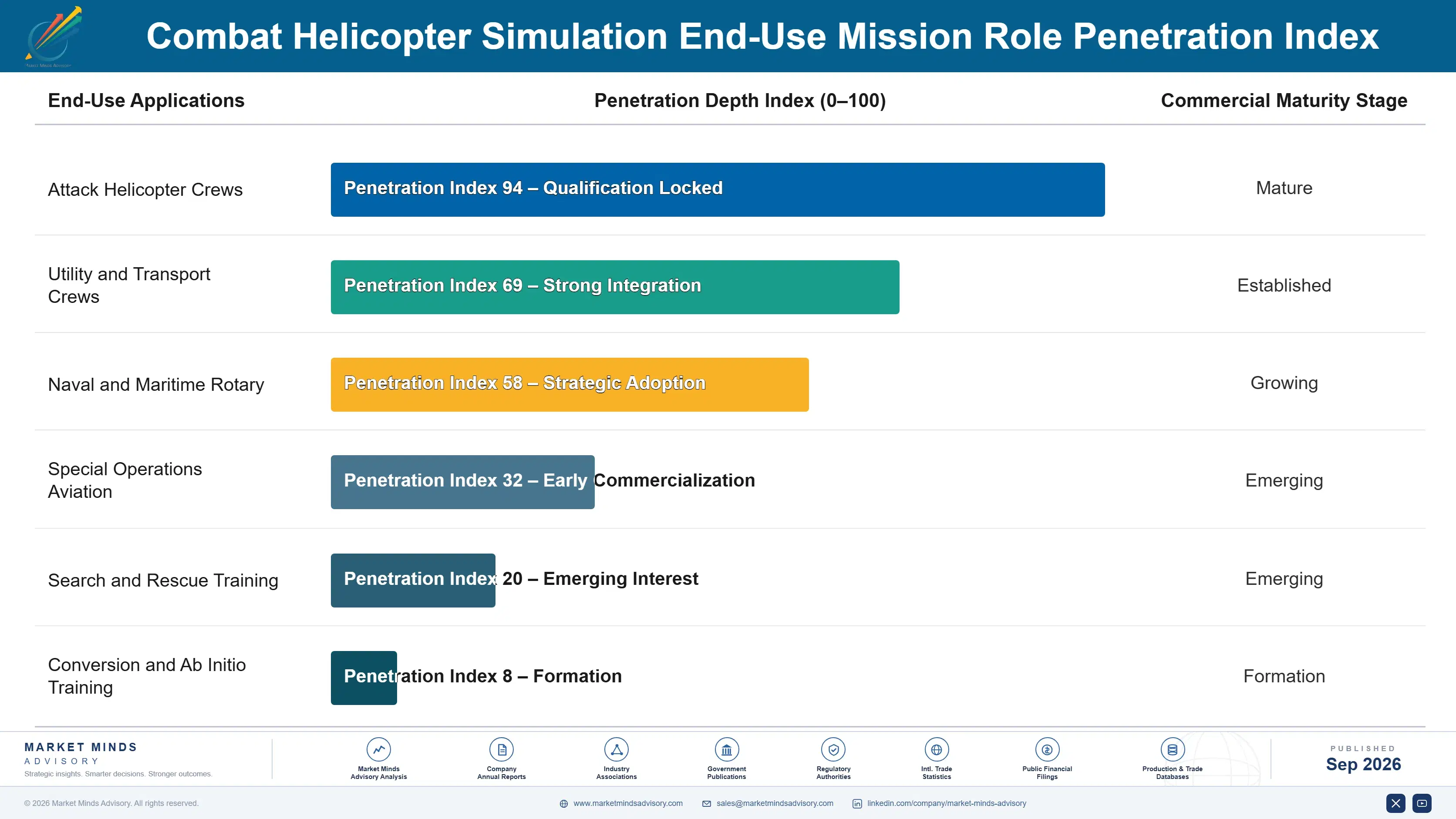
combat-helicopter-simulation-market-end-use-penetration-index-1790025449380

Where Throughput Decides

These are among the four positions where our research anticipates prominent divergence between winners and laggards over the coming forecast period. Each is grounded in the demand model, the regulatory perimeter, and the announced capacity pipeline.
01 / INSTRUCTOR CAPABILITY BUNDLING

Sell throughput, not another box

Around 46% of installed simulator capacity sits idle and roughly 61% of those hours trace to instructor availability rather than to device or demand constraints, which means selling another device addresses entirely the wrong bottleneck. Offering instructor augmentation, contracted instruction and automated tuition alongside hardware costs service capability rather than any product development. Participants who did it report contract value per customer rising roughly 1.9 times, because they sell throughput rather than equipment, and forces now ask how many crews can be trained instead.
02 / BLENDED CONFIGURATION ANALYSIS

Match the device to the syllabus

Full motion costs around four times a comparable fixed base device and contributes most during early handling instruction rather than during tactical mission rehearsal, where most combat crew synthetic hours are actually spent. Proposing a device mix matched to syllabus content costs training analysis rather than any hardware change. Participants who led with that analysis report winning roughly 2.3 times more competitions on total programme value, since the same budget buys more throughput, since around 64% of synthetic hours involve tactical content anyway.
03 / NETWORK ACCREDITATION INVESTMENT

Clear the network before the contract

Networked distributed training grows at 10.8% and the binding constraint is security accreditation for connecting classified training environments across national boundaries rather than any technical limitation whatsoever. Investing in the accreditation frameworks and cleared engineering capability costs compliance programme investment rather than any development work at all. Participants who have established them report multinational programme access rising roughly 2.7 times, reaching exercises that unaccredited competitors cannot participate in at all, and clearance processes take many months regardless of what is spent.
04 / LOCAL ACADEMY DELIVERY

Build the school, not just the simulator

Gulf and South Asian procurement increasingly requires local training academy establishment as an offset condition rather than accepting delivered hardware alone, and several forces prefer sovereign training capability for operational security reasons. Building academy delivery capability costs local presence and instructor recruitment rather than any product work at all. Participants who have done it report win rates on those programmes rising roughly 2.5 times, because the requirement excludes hardware-only competitors entirely, and sovereign training capability is preferred for operational security reasons.

Engagement Snapshot From the Field

A live engagement with an industry participant carrying material or product regulatory and market exposure ahead of a defining policy shift, showing how our research translates into a defensible multi-year portfolio strategy.
MARKET MINDS ADVISORY · CLIENT ENGAGEMENT SUMMARY
Combat Helicopter Simulation Producer Strategic Portfolio Review and Transition Roadmap 2026·Investment Scenario on Combat Helicopter Simulation Exposure Evaluation 2025-26
CLIENT PROFILE
A European training systems supplier with rotary wing simulation revenue near USD 210 million (client-reported, unverified by MMA), weighted approximately 72% to device supply and 28% to sustainment. Contracted instruction was not offered. Full motion configurations dominated proposals and no multinational network accreditation was held. Instructor availability at customer sites had never been measured or reported internally.
STRATEGIC CHALLENGE
Device competitions were being lost at rising rates while management attributed the trend to price competition from suppliers with lower engineering costs. A cost reduction programme had been approved. Nobody had reviewed how customers evaluated proposals, or measured what utilisation the previously delivered devices were actually achieving. Neither question had been examined internally.
MMA APPROACH
MMA reviewed 28 lost competitions against stated evaluation criteria rather than against price alone. Utilisation was measured across 41 previously delivered devices at customer sites. Syllabus content was mapped against motion requirement, and accreditation status was compared against multinational programme eligibility across the client and its competitors. Findings were reconciled against award records.
KEY FINDINGS
  1. Lost competitions divided as 43% on total training throughput offered against 21% on device unit price, which management had assumed decided most awards.
  2. Measured utilisation across delivered devices averaged 51% of available hours, with instructor availability accounting for most of the shortfall in every case examined.
  3. Syllabus mapping showed 64% of rotary wing synthetic hours involved tactical content where motion contributes least, against proposals specifying motion throughout. across every customer force examined.
  4. Three multinational programmes worth substantial value had excluded the client on accreditation grounds without the bid team recording the reason at all.
CLIENT PROFILE
A European training systems supplier with rotary wing simulation revenue near USD 210 million (client-reported, unverified by MMA), weighted approximately 72% to device supply and 28% to sustainment. Contracted instruction was not offered. Full motion configurations dominated proposals and no multinational network accreditation was held. Instructor availability at customer sites had never been measured or reported internally.
STRATEGIC CHALLENGE
Device competitions were being lost at rising rates while management attributed the trend to price competition from suppliers with lower engineering costs. A cost reduction programme had been approved. Nobody had reviewed how customers evaluated proposals, or measured what utilisation the previously delivered devices were actually achieving. Neither question had been examined internally.
MMA APPROACH
MMA reviewed 28 lost competitions against stated evaluation criteria rather than against price alone. Utilisation was measured across 41 previously delivered devices at customer sites. Syllabus content was mapped against motion requirement, and accreditation status was compared against multinational programme eligibility across the client and its competitors. Findings were reconciled against award records.
KEY FINDINGS
  1. Lost competitions divided as 43% on total training throughput offered against 21% on device unit price, which management had assumed decided most awards.
  2. Measured utilisation across delivered devices averaged 51% of available hours, with instructor availability accounting for most of the shortfall in every case examined.
  3. Syllabus mapping showed 64% of rotary wing synthetic hours involved tactical content where motion contributes least, against proposals specifying motion throughout. across every customer force examined.
  4. Three multinational programmes worth substantial value had excluded the client on accreditation grounds without the bid team recording the reason at all.
RECOMMENDED STRATEGY
Phase 1: Phase one: cancel the cost reduction and build contracted instruction and instructor augmentation capability. Engineering cost was never the issue. Phase 2: Phase two: rebuild proposals around blended device mixes matched to customer syllabus content directly. The analysis capability does not currently exist. Phase 3: Phase three: invest in multinational training network accreditation and cleared engineering capacity. At least three programmes were lost on this alone.
OUTCOME
Competition win rates improved materially within four quarters of proposals leading on training throughput rather than device specification (client-reported, unverified by MMA). Contracted instruction reached 14% of revenue in its first full year, and accreditation opened two multinational programmes that had previously been closed entirely.

Frequently Asked Questions

Foundational context covering the market sizes, CAGR, scope, country, region and competition that inform every finding below. This section is provided to cover basics and most often pre-purchase conversations, answered from the MMA Primary Research Dataset.

What is the current size of the Combat Helicopter Simulation Market?

The market was valued at USD 2.8 billion in 2025, rising to USD 3.0 billion in 2026. Sizing is at programme contract value across six system types.

How large will the Combat Helicopter Simulation Market be by 2036?

MMA forecasts USD 6.1 billion by 2036, an increase of USD 3.1 billion over the 2026 base. That represents expansion of 2.03 times across the forecast period.

What is the CAGR for the Combat Helicopter Simulation Market 2026 to 2036?

The base case CAGR is 7.2%, with a bull case of 8.5% and a bear case of 5.9%. Historical growth between 2020 and 2025 ran at 5.8%.

Which segment is growing fastest?

Networked distributed mission training grows at 10.8%, half again the market rate, as crews rehearse against each other. Mixed reality trainers follow at 9.3% and full motion simulators grow slowest at 3.4%.

Who are the major companies in the Combat Helicopter Simulation Market?

CAE, L3Harris, Thales, Lockheed Martin and Rheinmetall lead on programme contract value, holding a combined 61%. Platform data access and security accreditation separate them, and airframe manufacturers are now entering directly.

Which country is growing fastest?

India grows fastest at 12.6%, on rotary wing fleet modernisation and domestic simulation capability that develops considerably faster than airframe manufacture does. Domestic suppliers are winning awards against international competition.

Report Segmentation Architecture

The full report scope spans multiple orthogonal segmentation dimensions, with cross-tabulated demand data provided for each dimension pair. Coverage extends further to regional breakdowns, trend trajectories, and the competitive detail needed to support segment-level decision-making.

By System Type

  • Full Motion Flight Simulators
  • Fixed Base Flight Training Devices
  • Networked Distributed Mission Training
  • Mixed and Virtual Reality Trainers
  • Weapons and Sensor Part-Task Trainers
  • Maintenance and Ground Crew Simulators

By End-Use Mission Role

  • Attack Helicopter Crews
  • Utility and Transport Crews
  • Naval and Maritime Rotary
  • Special Operations Aviation
  • Search and Rescue Training
  • Conversion and Ab Initio Training

By Commercial Dimension

  • Direct Government Procurement
  • Airframe Programme Bundled Supply
  • Contracted Training Services
  • Multinational Programme Participation
  • Offset and Local Academy Delivery
  • Through-Life Sustainment Contracts

By Region

  • North America
  • Western Europe
  • East Asia
  • South Asia and Pacific
  • Middle East and Africa
  • Eastern Europe
  • Latin America

Scope, Methodology, and Coverage

Every figure in this report is reproducible from documented input assumptions. The scope below maps the historical period, the forecast horizon, the segmentation dimensions, and the countries covered, alongside the underlying primary and qualitative methodology.
Historical Period
2020 to 2025
Forecast Period
2026 to 2036
Base Year
2025 (USD billions; MMA Primary Research Dataset, September 2026)
Market Definition
This market covers simulation and training systems for military rotary wing crews, spanning full motion flight simulators, fixed base flight training devices, networked distributed mission training systems, mixed and virtual reality trainers, weapons and sensor part-task trainers, and maintenance and ground crew simulators. Sizing is at programme contract value including through-life support, across direct procurement, bundled supply, contracted services, multinational programmes, offset delivery and sustainment channels. Fixed wing simulation, unmanned aircraft control training, live flight instruction and airframe manufacture are excluded throughout.
Quantitative Units
USD billions at programme contract value; volume in devices delivered; utilisation in percentage of available simulator hours.
Segmentation Dimensions
System type, end-use mission role, commercial dimension, and geographic region.
Regions Covered
North America, Western Europe, East Asia, South Asia and Pacific, Middle East and Africa, Eastern Europe, Latin America
Countries Covered
United States, India, France, South Korea, Saudi Arabia, Poland
Key Companies Profiled
CAE, L3Harris Technologies, Thales, Lockheed Martin, Rheinmetall, Leonardo, FlightSafety International, Elbit Systems, Indra Sistemas, Airbus Helicopters Training, Boeing Global Services, Havelsan, Reiser Simulation and Training, TRU Simulation, Zen Technologies, Hindustan Aeronautics, Korea Aerospace Industries, Mitsubishi Precision, VRgineers, Varjo
Quantitative Methodology
Primary survey, n=3,800 respondents, Q4 2025, six countries; demand-side model with trade association cross-validation
Qualitative Methodology
47 expert interviews, Q4 2025; applied to validate demand model assumptions, identify emerging dynamics, and assess competitive positioning
Report Format
PDF and XLSX data workbook (Word format preview document)
Publisher
Market Minds Advisory
Report Code
MMA-2026-CON-823
Published
September 2026
Contact
sales@marketmindsadvisory.com | www.marketmindsadvisory.com

Purchase the full Combat Helicopter Simulation Market Report (2026 to 2036).

The full report sizes the combat helicopter simulation market across six system types, six mission roles and six commercial dimensions for all seven global regions through 2036. It measures utilisation across delivered devices at customer sites rather than assuming installed capacity equals training throughput. Lost competitions are reviewed against stated evaluation criteria, separating throughput losses from device price ones. Syllabus content is mapped against motion requirement to establish where full motion actually contributes. Competitive assessment covers 20 participants on a consistent programme contract value basis.
Utilisation measured across delivered devices at customer sites
Lost competitions reviewed against stated evaluation criteria
Syllabus content mapped against actual motion requirement
Accreditation status compared against programme eligibility
Six system types sized through 2036
Twenty participants assessed on programme contract value

Built For The People Who Decide

From boardroom strategy to bench-side execution, this report is read cover-to-cover by leaders shaping the next decade of their industry, turning demand scenarios, market dynamics and valuation benchmarks into decisions.
CXOs/ Presidents/ VPs/ Managers
M&A and Corporate Development
Strategy Teams and R&D Heads
Procurement and Product Directors
Regulatory and Compliance Leaders
Investor Relations and Equity Analysts