

Market Minds Advisory
Colombia Defense Market

Colombia Defense Market: Colombia Defence: Budget Reality, One Dominating Programme and a State Industrial Group

Personnel and pension obligations consume most of the headline budget, one fighter programme absorbs much of what remains, and the jungle produces requirements that almost nobody else designs any equipment for.

Lead Analyst

Published

September 2026

Make Smarter Decisions with Customized Research Insights

Request a free sample report and evaluate market opportunities, growth trends, and competitive dynamics relevant to your business needs.

2025 MARKET VALUE$2.4BMarket Size 2025
2036 FORECAST VALUE$5.0BBase Case , 2026 to 2036
CAGR 2026 TO 20366.8 %Bull 8.0% / Bear 5.6%
INCREMENTAL OPPORTUNITY$2.4BNet 10- year value creation
EXPANSION MULTIPLE1.92x2036 value over 2026 base
Strategic Levers
M&A Pipeline
Regional Outlook
Country Rankings
Competitive Intelligence
Segmental Deep-dive
Call-Us : 91 93563 13602

Executive Snapshot and Market Trajectory.

The headline defence budget badly overstates what can actually be bought. Personnel costs and pension obligations consume the great majority of it, leaving an investment share in the low teens, so the procurable market is a fraction of the number usually quoted in comparisons with its regional neighbours.
One programme now dominates what remains. The fighter replacement decision is the largest acquisition in the country's history and its payment schedule absorbs much of the investment budget for a decade, which crowds out everything competing for the same money. Combat aircraft and air systems grow fastest at 10.2%, half again the market rate of 6.8%, and for that one single reason alone.
Domestic industry is state-owned and organised as a business group, which makes industrial participation policy rather than preference. Five suppliers hold 58%, and three of them are Colombian. The operating environment here also produces requirements that almost nobody else designs for: riverine patrol in jungle conditions is not a niche here, it is the main effort, and the domestic shipyard exists precisely because imported designs did not work well enough in those conditions at all.
Market Definition
This report covers defence equipment and systems procured by Colombian armed forces and national police, together with the domestic industrial content delivered into those programmes. Scope includes combat aircraft and air systems, naval and riverine vessels, land systems and vehicles, small arms and ammunition, surveillance and intelligence systems, and communications and command systems. Excluded are personnel costs and pension obligations, military healthcare and welfare provision, base infrastructure and construction, civilian police equipment procured outside defence budgets, demining services, and veterans programmes.
Base Year Value
$2.4B in 2025 (MMA Primary Research Dataset, September 2026)
Forecast Period
2026 to 2036, eleven discrete annual values
CAGR
6.8% base case. Bull 8.0%. Bear 5.6%.
Fastest Growth Segment
Combat Aircraft And Air Systems: 10.2% CAGR
Fastest Growth Country
Cartagena: 9.8% CAGR
Fastest Growth Region
South Asia and Pacific: 8.8% CAGR
Largest Region
Latin America: 31% of 2025 global value
Market Leaders
COTECMAR, Indumil, Saab, CIAC, Airbus Defence and Space. Source: MMA Analysis based on contracted programme value and delivered equipment content, July 2026.
Primary Survey
n=3,800 procurement and R&D decision-makers, Q4 2025, six countries
Methodology
Demand-side build-up, cross-validated against public data, 47 expert interviews

Colombia Defense Market Forecast Scenarios

colombia-defense-market-size-forecast-scenario-1790026334289
Growth averaged 5.5% across 2020 to 2025 and it was constrained throughout by budget composition rather than by political will. Defence spending held up as a share of output, but personnel and pension obligations absorbed most of the increase, leaving investment flat in real terms. Domestic naval construction continued while air force recapitalisation was deferred repeatedly.
Base case growth of 6.8% rests on three mechanisms. The fighter replacement programme converts a long-deferred requirement into a contracted payment schedule that raises investment spending materially across the forecast period. Domestic naval construction continues on a surface platform programme that sustains the state shipyard and its supply chain. And internal security requirements have not diminished after the peace process, which keeps surveillance, riverine and light aviation demand steady rather than declining as some forecasts assumed.
The bull case at 8.0% assumes economic growth supports a rising defence share and that industrial participation from the fighter programme generates genuine domestic capability and export revenue. The bear case at 5.6% follows from fiscal pressure: pension obligations grow faster than the budget, the fighter payment schedule consumes the investment line, and every other programme waits behind it for most of the decade.

What the Budget Actually Buys

Any analysis starting from the headline defence budget will be wrong by a wide margin. Personnel costs and a pension obligation covering a large retired population consume the great majority of it, leaving roughly 14% available for equipment acquisition. That investment share is what suppliers compete for, and it is a fraction of the figure normally quoted when Colombian defence spending is compared regionally.
FIVE-FIRM CONCENTRATION58%Three of the five leading suppliers are domestic entities
INVESTMENT BUDGET SHARE14%Portion of defence spending available for equipment acquisition
DOMESTIC CONTENT SHARE31%Programme value delivered by Colombian industry and suppliers
DOLLAR-DENOMINATED PROCUREMENT63%Equipment acquisition priced in currency other than pesos
RIVERINE FLEET SIZE240 vesselsPatrol craft operating on inland waterways and river systems
FIGHTER PROGRAMME BUDGET SHARE38%Single programme claim on acquisition spending across the period
Within that constrained investment line, one programme now takes a commanding share. Fighter replacement had been deferred for well over a decade while the existing fleet aged, and the decision when it came committed roughly 38% of acquisition spending across the forecast period to a single acquisition. Every other requirement queues behind that payment schedule, which is an uncomfortable arithmetic fact rather than a matter of priority setting.
Domestic industry sits inside a state business group, which makes industrial participation a policy requirement rather than a negotiating preference. Around 31% of programme value is delivered by Colombian entities, and the naval shipyard in particular exists because riverine and jungle operating conditions produced requirements that imported designs did not meet. That shipyard now exports vessels to neighbours with comparable conditions, which was not the original objective.
"Suppliers arrive quoting the national defence budget and leave surprised. Take out pensions and payroll, then take out the fighter schedule, and what remains would not fund a mid-sized programme anywhere else."
Director, Defence Procurement and Industrial Base Practice · MMA Defence / National Procurement and Industrial Base Practice · September 2026

Market Trends

One Acquisition Reshapes The Entire Procurement Pipeline

Fighter replacement had been deferred for more than a decade while the existing fleet aged beyond reasonable service, and the eventual decision committed roughly 38% of acquisition spending across the forecast period. That payment schedule now governs what else can proceed and when, which makes programme sequencing rather than requirement merit the deciding factor for every other capability. Suppliers pursuing land, communications or surveillance requirements are competing for a residual line rather than for a budget, and several have not yet adjusted their expectations accordingly. Several suppliers have not adjusted expectations at all.
Market Impact: Commits USD 1.9 billion across period

Domestic Naval Capability Turns Into An Export Business

The state shipyard was established because riverine and jungle operating conditions produced requirements that imported hull designs did not meet, and the vessels built for those conditions have proved exportable to neighbouring countries facing identical problems. That export revenue now supports capability the domestic programme alone could not sustain, and it changes the industrial argument entirely. Regional navies with river systems and limited budgets are a genuine market that established shipbuilders have never addressed seriously at all. Capability built for one country's rivers now earns revenue from several others nearby.
Market Impact: Sustains 240 riverine patrol vessels

Market Opportunities and Growth Drivers

Fighter Replacement Converts Deferred Requirement Into Contracted Spending

The air force operated an ageing fighter fleet well past sensible service life while replacement decisions were repeatedly deferred for want of funding, and the eventual commitment converts a long-standing capability gap into a contracted multi-year payment schedule. That raises investment spending materially and brings industrial participation obligations attached to the acquisition. The programme also drags supporting requirements with it, including infrastructure, training systems and weapons integration. Roughly USD 1.9 billion in programme value falls within the forecast period. A capability gap open for a decade closes on a payment schedule.
Market Impact: Leaves only 14% for equipment

Internal Security Requirements Persist After The Peace Process

Expectations that the 2016 agreement would allow substantial defence reductions proved optimistic, as armed groups reorganised and illicit economies persisted across the same territory. Surveillance, riverine patrol, light aviation and intelligence requirements have therefore continued rather than declining, and the equipment profile they demand is distinctive: rugged, cheap to operate and suited to jungle and river conditions. That sustains demand in categories global suppliers often treat as secondary. Around 240 riverine vessels remain in service requiring continuous replacement and support. Reductions expected after 2016 have not materialised in any form at all.
Market Impact: Exposes 63% of acquisition spending

Market Restraints and Challenges

Pension And Personnel Obligations Crowd Out Equipment Spending

Personnel costs and a pension obligation covering a large retired military population consume the great majority of defence spending, leaving roughly 14% for equipment acquisition. The root cause is a benefit structure established when force levels and service conditions were entirely different, and it grows with retirement rather than with policy. Commercially this means the procurable market is far smaller than headline comparisons suggest and grows more slowly than the budget does. Mitigation is limited: reform is politically difficult, so suppliers must plan against the investment line rather than the budget.
Market Impact: Claims 38% of acquisition spending

Currency Exposure Makes Dollar-Priced Programmes Unpredictable

Around 63% of equipment acquisition is priced in dollars or euros while the budget is appropriated in pesos, so exchange rate movement changes what a fixed appropriation actually buys. The root cause is that domestic industry cannot supply most major capabilities, and no supplier will price a multi-year programme in a currency with Colombia's volatility history. Commercially this produces programme deferrals unrelated to requirement or politics. Participants are responding through peso-denominated offset content, multi-year hedging arrangements and phased delivery schedules that spread currency risk across budget years. Requirement and politics had nothing to do with it.
Market Impact: Exports reach 22% of yard revenue
3 additional market trends, 4 additional growth drivers, and 2 additional restraints and challenges are covered in the full report. Contact sales@marketmindsadvisory.com to access the complete intelligence.

Segment CAGR and Growth Architecture

Procurement is segmented here by capability domain, because domain determines which force buys it, which industrial base can supply it and how the requirement is justified. Mixing domain with service branch or funding source produces categories no procurement document recognises. Six domains cover the field from small arms through to combat aircraft, and one now dominates the others entirely.
colombia-defense-market-market-share-analysis-1790026334879

Combat Aircraft And Air Systems

Growing at 10.2%, half again the market rate of 6.8%, this domain grows for one reason: a fighter replacement programme deferred for more than a decade finally converted into a contracted payment schedule. That single acquisition claims roughly 38% of acquisition spending across the forecast period, which makes the domain's growth arithmetic rather than a reflection of broad air capability investment. Supporting requirements travel with it, including infrastructure, training systems, weapons integration and industrial participation obligations. The commercial implication for suppliers in other domains is severe, because they are competing for what remains rather than for a growing budget of their own. Growth here is arithmetic rather than any broad capability judgement.
CAGR 10.2%

Naval And Riverine Vessels

Naval and riverine construction grows at 7.6% on a domestic surface platform programme and on continuous replacement across a riverine fleet of roughly 240 vessels. This domain is distinctive because domestic industry genuinely leads it: the state shipyard was built because imported hull designs did not suit jungle rivers, and the vessels it produces now export to neighbouring countries facing identical conditions. Export revenue sustains capability the domestic programme alone could not fund. International suppliers participate through design support, propulsion and combat systems rather than through hulls, which is a narrower but more durable position than competing for construction. Design support, propulsion and combat systems are where international suppliers actually participate.
CAGR 7.6%
Full segment breakdown across 6 segments available in the complete report.

Regional Architecture and Country Demand Map

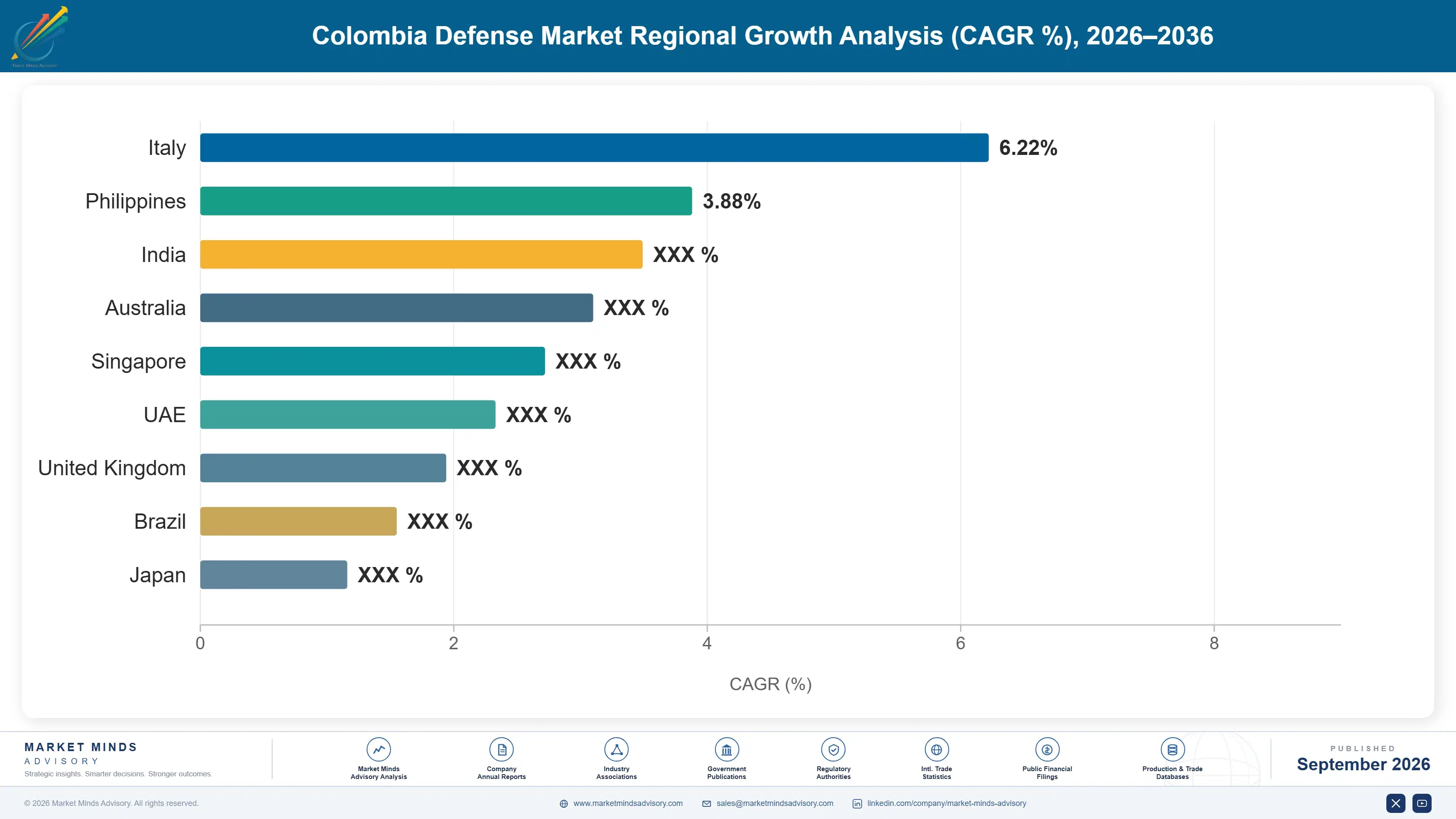
This is a country-scoped report, so the regional table records where the equipment and content serving Colombian forces originates rather than where demand sits. Domestic and regional industry holds the largest single share, with European supply elevated by the fighter programme and Israeli content unusually significant.

Latin America

At 31%, far above the 5 to 9% band applied to this region elsewhere in this report, domestic and regional industry holds the largest single share because Colombian state entities supply a substantial portion of what the forces actually buy. The naval shipyard in Cartagena builds riverine and surface vessels, the state munitions enterprise supplies small arms and ammunition, and the aeronautical corporation handles maintenance and light aircraft. Brazilian aerospace and vehicle supply adds a further regional layer. Growth of 7.2% sits above the market rate, supported by naval construction and by export revenue that sustains capability the domestic programme could not fund alone. Export revenue sustains capability the domestic programme alone could not fund.
Share: 31% | CAGR: 7.2% (2026 to 2036)

Western Europe

At 27%, above the 18 to 26% band used elsewhere, European supply is elevated principally by the fighter replacement programme, which alone accounts for a substantial share of the figure. Swedish, Dutch, French, Italian and German suppliers provide combat aircraft, naval design support, sensors, communications and vehicle content across the forces. Growth of 5.8% sits below the market rate despite the fighter programme, because the elevated share already reflects that acquisition and the payment schedule is front-loaded into the period rather than accelerating through it. Industrial participation obligations attached to the programme will move some of this content domestic over time. The fighter programme alone accounts for a substantial share of this figure.
Share: 27% | CAGR: 5.8% (2026 to 2036)
Regional intelligence for 5 additional markets available in the complete report: North America, Middle East and Africa, East Asia, Eastern Europe, South Asia and Pacific. Contact sales@marketmindsadvisory.com.
colombia-defense-market-country-cagr-analysis-1790026335393

Where Suppliers Actually Win In Colombia

Programme value is the visible number here and a poor guide to what a supplier earns. Industrial participation structure, currency terms and sustainment position decide returns instead. The four levers below reflect approaches suppliers have used to improve outcomes measurably rather than to win headline awards. The budget is smaller than it looks. Headline value misleads.

Structure Industrial Participation Through The State Group

Domestic industry sits inside a state business group and industrial participation is policy rather than preference, so offset content routed through those entities carries weight that generic local sourcing does not. Suppliers structuring participation with the shipyard, the munitions enterprise or the aeronautical corporation report evaluation outcomes materially better than those offering equivalent value elsewhere. Around 31% of programme value already flows to domestic entities, and proposals that raise it meaningfully have won competitions on that basis rather than on price or capability. Generic local sourcing carries no weight at all here.
Market Impact: Domestic content already reaches roughly 31% of value

Price Multi-Year Programmes With Peso Components

Roughly 63% of acquisition is priced in foreign currency against a peso appropriation, which means exchange movement changes what a fixed budget buys and produces deferrals unrelated to requirement. Suppliers offering peso-denominated components, usually sustainment and locally produced content, remove part of that risk for the customer and make programmes considerably easier to approve. Participants doing this report programme approval cycles roughly 11 months shorter than those quoting entirely in dollars, which in a constrained budget environment matters enormously. Approval risk matters considerably more than price in this budget environment here.
Market Impact: Programme approval cycles shorten roughly 11 months overall

Compete On Sustainment Rather Than Acquisition

Acquisition spending is roughly 14% of the defence budget and one programme claims much of it, but sustainment of the installed base continues regardless and is funded from a different and more protected line. Suppliers positioned in spares, overhaul and support capture revenue that does not compete against the fighter payment schedule at all. Sustainment revenue on a typical installed platform exceeds original acquisition value across a service life, and it is far less exposed to the budget arithmetic that governs new programmes here. None of it waits behind the fighter payment schedule.
Market Impact: Sustainment exceeds acquisition value across 20 service years

Design For Riverine And Jungle Operating Conditions

The operating environment produces requirements that global product lines do not address, which is precisely why the state shipyard exists and why it now exports. Suppliers offering equipment genuinely suited to shallow water, high humidity, poor infrastructure and minimal maintenance support face far less competition than in conventional categories. Products designed for these conditions have achieved win rates roughly 2.4 times those of adapted standard equipment. The requirement also exists across neighbouring countries, which makes the engineering investment reusable. Global product lines here simply do not address any of this at all.
Market Impact: Win rates run roughly 2.4 times higher overall

Who Controls the Margin Pool

Concentration is 58% for the top five, measured on contracted programme value and delivered equipment content, the basis used throughout this section, and three of those five are Colombian state entities. That composition tells most of the story: domestic industry is not a marginal participant here but a policy instrument, and international suppliers compete alongside it rather than against it on most programmes.
Competition currently turns on three dimensions. Industrial participation structure decides evaluation outcomes more reliably than price or capability does. Currency terms decide whether a programme can be approved within a peso appropriation at all. And sustainment positioning decides who earns revenue that does not compete against the fighter payment schedule. Headline capability comparisons feature in evaluations and rarely determine them on their own.

Positions will shift through the industrial participation attached to the fighter programme, which will move content toward domestic entities over a decade. Suppliers who structure that participation well will build durable local relationships, while those treating it as a compliance exercise will find it delivers nothing beyond the contract. South Korean expansion across Latin America is the other variable worth watching, since it competes precisely where budget constraint bites hardest.
colombia-defense-market-company-positioning-matrix-1790026335917

Competitive Moat and Risk Dimensions

COTECMAR

Moat: Riverine Design Authority Position

The state shipyard holds design authority for vessels suited to jungle rivers and shallow coastal waters, requirements imported designs did not meet and global shipbuilders never addressed seriously. Its position inside the state business group makes it a policy instrument as well as a supplier, and its export success has validated the capability commercially rather than only politically.
COTECMAR

Risk: Single Customer Budget Dependence

Domestic demand depends on an acquisition budget of roughly 14% of defence spending, much of which is now committed to a fighter programme for a decade. Export revenue helps but remains a minority of the yard's work, and expanding it means competing in markets where established shipbuilders will respond once the segment looks commercially worthwhile to them.
SAAB

Moat: Fighter Programme Anchor Position

Winning the fighter replacement gives Saab a claim on roughly 38% of acquisition spending across the forecast period and an industrial participation relationship that will run for decades. That position carries training, weapons integration, infrastructure and sustainment with it, and it establishes the company inside Colombian defence planning in a way no subsequent competitor can easily displace.
SAAB

Risk: Currency And Fiscal Schedule Exposure

The programme is priced in foreign currency against a peso appropriation in a country where pension obligations grow faster than the budget, which makes the payment schedule vulnerable to fiscal pressure rather than to any performance issue. Restructuring a schedule mid-programme is commercially painful, and the alternative of deferral damages the capability the acquisition was meant to deliver.

Players Tracked

Prominent Players

COTECMAR
Indumil
Saab
CIAC
Airbus Defence and Space

Other Key Players

Lockheed Martin
Textron
Embraer
Thales
Leonardo
Rafael Advanced Defense Systems
Elbit Systems
Israel Aerospace Industries
Damen Shipyards
Rheinmetall
KNDS
Hanwha Aerospace
Colt CZ Group
General Dynamics
Beretta Holding

Recent Developments

JUNE 2025

Colombia commits to fighter replacement after more than a decade of deferral

Colombia committed to a fighter replacement programme covering its ageing combat aircraft fleet, concluding a requirement deferred repeatedly for want of funding. This was a national procurement decision rather than any corporate transaction, and it establishes a payment schedule shaping acquisition spending for the following decade.
Signal: One acquisition now governs the sequencing of every other capability requirement in the country for a decade
NOVEMBER 2024

State shipyard secures riverine vessel export order from neighbouring navy

The state naval shipyard secured an export order for riverine patrol vessels from a neighbouring country with comparable operating conditions. This was a commercial export contract rather than any corporate transaction, and it extends a pattern of regional sales built on capability developed for domestic requirements.
Signal: Export demand validates that jungle river requirements exist regionally and remain largely unaddressed by established shipbuilders
FEBRUARY 2025

Industrial participation terms agreed covering domestic aerospace and naval entities

Industrial participation arrangements were agreed routing programme content through domestic state defence entities across aerospace and naval capability. These were contractual offset provisions rather than any equity transaction of any kind, and they direct substantial work toward Colombian state industry across the whole programme's life.
Signal: Participation routed through state entities is policy compliance rather than a negotiable commercial preference for any supplier here

What Determines Delivered Programme Cost

Four inputs dominate. Imported equipment and systems priced in foreign currency run roughly 63% of acquisition spending, domestic labour and fabrication about 18%, raw materials including steel and copper close to 11%, and integration with certification the remaining 8%. Imported content is priced in dollars or euros, while the appropriation funding it arrives in pesos, which is the defining cost characteristic of this market.
Currency movement was the decisive cost event. The peso depreciated substantially against the dollar across parts of the period, with IMF exchange rate data showing the extent, while copper pricing relevant to ammunition production moved on the IMF commodity index. Saab and Damen both discussed currency and programme cost conditions in annual reporting. Programmes were deferred on exchange rate movement rather than on any change in requirement or political priority.

Exposure separates sharply between domestic and international suppliers. Colombian state entities incur costs largely in pesos and are therefore insulated, which is part of the industrial argument for using them. International suppliers price in hard currency and watch appropriations lose purchasing power between budget approval and contract signature. That asymmetry explains why industrial participation routed through domestic entities carries weight beyond its nominal value in evaluations.
colombia-defense-market-cost-volatility-analysis-1790026336113

Offer peso-denominated sustainment and local content components

Pricing sustainment, training and locally produced content in pesos removes part of the currency mismatch that causes deferrals, and it makes programmes easier to approve within a fixed appropriation. The supplier carries currency risk it hedges more efficiently than a ministry can. Doing this requires local presence or a partnership, which is a commitment rather than a pricing adjustment.

Phase deliveries across budget years to spread exchange exposure

Concentrating payments into a single budget year maximises exposure to whatever the exchange rate does in that year, while phasing across several years averages it. Colombian programme offices have become considerably more receptive to phased structures since currency movement deferred several acquisitions outright. The trade is delivery schedule against financial predictability, and the customer now frequently prefers predictability.

Source ammunition inputs through domestic production arrangements

Copper and propellant costs move on global commodity markets while the state munitions enterprise produces in pesos with domestic labour, which makes domestic production a genuine hedge as well as policy. International suppliers partnering on ammunition production access that position rather than compete against it. The constraint is capacity, which domestic production has not always expanded fast enough to meet.

Portfolio Architecture for Margin Defence

Margin architecture here is shaped by currency and by policy more than by product. Imported major platforms sit at the bottom for the customer and are competitive on price for suppliers, but they carry approval risk that delays revenue unpredictably. Domestic production under the state group sits in the middle, insulated from currency and protected by policy. Sustainment, riverine-specific design and industrial participation content sit at the top, earning without competing against the acquisition budget arithmetic.
The volume-versus-premium tension is unusual because volume is capped by the budget rather than by demand. Acquisition spending is roughly 14% of defence funding and one programme claims much of it, so competing for major platform awards means competing for a residual that keeps shrinking. Premium here means revenue lines funded separately: sustainment, ammunition, export-supported domestic capability and participation content, none of which waits behind the fighter schedule.

High-value pools concentrate in three places: sustainment of the installed base funded outside the acquisition line, riverine and jungle-specific equipment where competition is genuinely thin, and industrial participation content routed through state entities where policy rather than price decides the outcome.

Volume / Commodity-Adjacent Tier

Imported major platforms and vehicles competed on price against a constrained acquisition budget, with currency exposure and approval delay carried by the supplier. The nine point range reflects currency terms and how much local content a proposal includes.
Gross Margin: 8-17%

Premium / Certified Tier

Domestic production under the state business group, including naval construction, ammunition and aeronautical maintenance. Peso costs and policy position defend the margin here. The nine point range tracks export share, which materially improves utilisation at the domestic yards and plants.
Gross Margin: 20-29%

Sustainability / Regulatory / Next-Generation Tier

Sustainment of the installed base, riverine-specific design and industrial participation content. Funded separately from acquisition and largely insulated from the budget arithmetic. The fifteen point range spans a support business and a design business with genuinely different economics.
Gross Margin: 31-46%
colombia-defense-market-portfolio-architecture-1790026336620

High-value Sub-segments and Strategic Watch-out

Installed Base Sustainment

Funded from a separate and more protected line than acquisition, so it does not queue behind the fighter payment schedule at all. Sustainment across a platform life exceeds original acquisition value. The fourteen point range reflects whether support is contracted locally or supplied from abroad.
Gross Margin: 32-46%

Riverine And Jungle Specific Equipment

Competition is genuinely thin because global product lines do not address these conditions, and win rates run roughly 2.4 times those of adapted standard equipment. Regional export demand makes the engineering reusable. The twelve point range reflects domestic against international supply of the same category.
Gross Margin: 28-40%

Domestic Naval Construction

Growing at 7.6% on a surface platform programme and continuous riverine replacement across roughly 240 vessels. Export revenue sustains capability that the domestic programme alone could never fund. The nine point range reflects export share, which changes yard utilisation and therefore unit economics quite considerably.
Gross Margin: 20-29%

Imported Major Platforms

Thinnest margins and the most exposed position, priced in foreign currency against a peso appropriation that loses purchasing power between approval and signature. One programme claims 38% of the acquisition line. The nine point range reflects currency terms and how much local content is included.
Gross Margin: 8-17%

What The Forces Fund Every Year

The annuity here is sustainment, and it is funded from a line that acquisition pressure does not reach. Colombian forces operate equipment for far longer than most comparable countries, because replacement funding is scarce, which makes spares, overhaul and life extension protected spending. Across a platform's service life that support revenue substantially exceeds the original acquisition value, and it accrues regardless of the acquisition budget in any given year.
Demand depth varies sharply by force and by mission. The air force and navy fund complete capability relationships including training, infrastructure and support, because their platforms are complex and cannot be maintained otherwise. Land forces buy equipment in volume with minimal support content, reflecting large personnel numbers against constrained budgets. The national police and riverine units need rugged cheap equipment in quantity, maintained locally, with no tolerance for support requiring foreign technicians.

The buying process has become more institutional. Procurement was historically shaped by security cooperation relationships and assistance programmes rather than by open competition, and much of the installed base arrived that way. Competitive procurement with formal evaluation and industrial participation requirements is now the norm, which favours suppliers prepared to structure offers around policy rather than capability alone.
colombia-defense-market-end-use-penetration-index-1790026337109

Where Suppliers Should Concentrate Effort

These are among the four positions where our research anticipates prominent divergence between winners and laggards over the coming forecast period. Each is grounded in the demand model, the regulatory perimeter, and the announced capacity pipeline.
01 / BUDGET REALITY RECOGNITION

Plan against the investment line, never the headline budget

Personnel costs and a growing pension obligation consume the great majority of defence spending, leaving roughly 14% available for equipment acquisition, and one fighter programme now claims around 38% of that remaining line across the forecast period. Suppliers sizing the opportunity from published defence budgets are overstating it by a wide margin and they will misallocate campaign effort accordingly as a result. The procurable market here is small, heavily contested and sequenced by a payment schedule that nobody can move.
02 / INDUSTRIAL PARTICIPATION STRUCTURE

Route offset content through the state defence entities

Domestic industry sits inside a state business group, which makes industrial participation a policy requirement rather than a negotiating preference, and around 31% of programme value already flows to those entities. Suppliers structuring participation through the shipyard, munitions enterprise or aeronautical corporation report materially better evaluation outcomes consistently than those offering equivalent local value elsewhere. Treating participation as a compliance exercise delivers nothing beyond the contract, while structuring it properly builds a relationship that outlasts the programme itself by years.
03 / CURRENCY TERMS ENGINEERING

Quote peso components to get programmes actually approved

Roughly 63% of acquisition is priced in foreign currency against a peso appropriation, so exchange rate movement changes what a fixed budget actually buys, which has deferred programmes for reasons unrelated to requirement or politics entirely. Suppliers offering peso-denominated sustainment and local content components report programme approval cycles roughly 11 months shorter than those quoting entirely in hard currency. In a budget environment this constrained, removing approval risk is worth considerably more to a supplier than shaving price ever is.
04 / ENVIRONMENT SPECIFIC DESIGN FOCUS

Build for the rivers, because almost nobody else does

Jungle rivers, shallow water, extreme humidity and minimal maintenance infrastructure together produce requirements that global product lines simply do not address, which is exactly why the state shipyard exists at all and why it now exports to neighbours facing precisely the same conditions. Equipment genuinely designed for these conditions achieves win rates roughly 2.4 times those of adapted standard product lines. The same requirement exists across several of the neighbouring countries, which makes the engineering investment genuinely reusable rather than narrowly country-specific.

Engagement Snapshot From the Field

A live engagement with an industry participant carrying material or product regulatory and market exposure ahead of a defining policy shift, showing how our research translates into a defensible multi-year portfolio strategy.
MARKET MINDS ADVISORY · CLIENT ENGAGEMENT SUMMARY
Colombia Defense Producer Strategic Portfolio Review and Transition Roadmap 2026·Investment Scenario on Colombia Defense Exposure Evaluation 2025-26
CLIENT PROFILE
A European defence systems supplier with roughly USD 890 million in annual revenue (client-reported, unverified by MMA) pursuing Latin American expansion. The company had bid three Colombian programmes across four years without success, despite competitive pricing and independent assessments rating its systems ahead of the winning bids in two of those three competitions outright on capability.
STRATEGIC CHALLENGE
Management believed the losses reflected incumbent relationships and political factors it could not influence. Evaluation records told a different story: two competitions had been decided on industrial participation content, and the third on currency terms the client had not addressed at all. The board needed to know whether Colombia was worth continued campaign investment or should be abandoned.
MMA APPROACH
MMA reconstructed the three evaluations against published criteria, quantified the acquisition budget genuinely available after personnel, pension and fighter programme commitments, and assessed partnership options with the state defence entities. Expert interviews with programme office and industrial participation staff established what participation structures actually carried weight in the formal scoring process.
KEY FINDINGS
  1. Industrial participation content decided two of the three competitions outright, and the client's offers had proposed generic local sourcing rather than any arrangement with state defence entities.
  2. The third competition turned on currency terms, where a competitor offered peso-denominated sustainment that resolved an approval obstacle the client had never identified as relevant.
  3. Acquisition budget genuinely available after personnel, pension and fighter programme commitments was roughly a third of what the client's market sizing had assumed throughout.
  4. Sustainment of the existing installed base was funded separately and remained wholly uncontested by the client, despite matching its capability profile closely.
CLIENT PROFILE
A European defence systems supplier with roughly USD 890 million in annual revenue (client-reported, unverified by MMA) pursuing Latin American expansion. The company had bid three Colombian programmes across four years without success, despite competitive pricing and independent assessments rating its systems ahead of the winning bids in two of those three competitions outright on capability.
STRATEGIC CHALLENGE
Management believed the losses reflected incumbent relationships and political factors it could not influence. Evaluation records told a different story: two competitions had been decided on industrial participation content, and the third on currency terms the client had not addressed at all. The board needed to know whether Colombia was worth continued campaign investment or should be abandoned.
MMA APPROACH
MMA reconstructed the three evaluations against published criteria, quantified the acquisition budget genuinely available after personnel, pension and fighter programme commitments, and assessed partnership options with the state defence entities. Expert interviews with programme office and industrial participation staff established what participation structures actually carried weight in the formal scoring process.
KEY FINDINGS
  1. Industrial participation content decided two of the three competitions outright, and the client's offers had proposed generic local sourcing rather than any arrangement with state defence entities.
  2. The third competition turned on currency terms, where a competitor offered peso-denominated sustainment that resolved an approval obstacle the client had never identified as relevant.
  3. Acquisition budget genuinely available after personnel, pension and fighter programme commitments was roughly a third of what the client's market sizing had assumed throughout.
  4. Sustainment of the existing installed base was funded separately and remained wholly uncontested by the client, despite matching its capability profile closely.
RECOMMENDED STRATEGY
Phase 1: Phase 1 (six months): Open partnership discussions with the relevant state defence entity and restructure future offers around participation rather than price. Phase 2: Phase 2 (13 months): Develop peso-denominated sustainment pricing and bid the uncontested support requirements the client had previously ignored entirely before. Phase 3: Phase 3 (22 months): Resize the Colombian campaign budget against the genuine investment line rather than the headline defence figure.
OUTCOME
The client signed a cooperation agreement with a state entity and won a sustainment contract within fifteen months, its first Colombian award (client-reported, unverified by MMA). Campaign spending was reduced to match the real opportunity, and the participation relationship put the company into two subsequent competitions it would previously not have been shortlisted for.

Frequently Asked Questions

Foundational context covering the market sizes, CAGR, scope, country, region and competition that inform every finding below. This section is provided to cover basics and most often pre-purchase conversations, answered from the MMA Primary Research Dataset.

What is the current size of the Colombia Defense Market?

The equipment and systems market was worth USD 2.4 billion in 2025 and reaches USD 2.6 billion in 2026. That covers acquisition and sustainment across air, naval, land, munitions, surveillance and communications domains.

How large will the Colombia Defense Market be by 2036?

MMA forecasts USD 5.0 billion by 2036, an increase of USD 2.4 billion over the 2026 base. That represents an expansion multiple of 1.92 times across the forecast period.

What is the CAGR for the Colombia Defense Market 2026 to 2036?

The base case CAGR is 6.8%, with a bull case of 8.0% if economic growth supports a rising defence share. The bear case of 5.6% assumes pension obligations outgrow the budget.

Which segment is growing fastest?

Combat aircraft and air systems grow at 10.2%, half again the market rate of 6.8%. A fighter replacement programme deferred for over a decade now claims roughly 38% of acquisition spending.

Who are the major companies in the Colombia Defense Market?

COTECMAR, Indumil, Saab, CIAC and Airbus Defence and Space lead on contracted programme value and delivered equipment content. Lockheed Martin, Textron and Elbit Systems follow in the next tier.

Which country is growing fastest?

This is a country-scoped report, so growth is assessed within Colombia, where Cartagena leads at 9.8% on naval construction and export orders. Other countries appear only as sources of equipment supply.

Report Segmentation Architecture

The full report scope spans multiple orthogonal segmentation dimensions, with cross-tabulated demand data provided for each dimension pair. Coverage extends further to regional breakdowns, trend trajectories, and the competitive detail needed to support segment-level decision-making.

By Capability Domain

  • Combat Aircraft And Air Systems
  • Naval And Riverine Vessels
  • Land Systems And Vehicles
  • Small Arms And Ammunition
  • Surveillance And Intelligence Systems
  • Communications And Command Systems

By End-Use Industry

  • Colombian Air Force
  • Colombian Navy And Marine Infantry
  • Colombian National Army
  • National Police Special Units
  • Riverine And Border Security Forces

By Commercial Dimension

  • Direct Acquisition Contract
  • Industrial Participation Content
  • Sustainment And Support Agreement
  • Domestic State Entity Production

By Region

  • Latin America
  • Western Europe
  • North America
  • Middle East and Africa
  • East Asia
  • Eastern Europe
  • South Asia and Pacific

Scope, Methodology, and Coverage

Every figure in this report is reproducible from documented input assumptions. The scope below maps the historical period, the forecast horizon, the segmentation dimensions, and the countries covered, alongside the underlying primary and qualitative methodology.
Historical Period
2020 to 2025
Forecast Period
2026 to 2036
Base Year
2025 (USD billions; MMA Primary Research Dataset, September 2026)
Market Definition
This report covers defence equipment and systems procured by Colombian armed forces and national police, together with the domestic industrial content delivered into those programmes and the sustainment supporting them. Scope includes combat aircraft and air systems, naval and riverine vessels, land systems and vehicles, small arms and ammunition, surveillance and intelligence systems, and communications and command systems. Excluded are personnel costs and pension obligations, military healthcare and welfare, base infrastructure and construction, civilian police equipment outside defence budgets, demining services, and veterans programmes.
Quantitative Units
USD billions (current prices); contracted programme value; acquisition budget share; domestic content share
Segmentation Dimensions
By Capability Domain; By End-Use Industry; By Commercial Dimension; By Region
Regions Covered
Latin America, Western Europe, North America, Middle East and Africa, East Asia, Eastern Europe, South Asia and Pacific
Countries Covered
Colombia, with equipment and content supply origin also assessed across Sweden, the Netherlands, France, Italy, Germany, Spain, the USA, Canada, Brazil, Israel, South Korea, Japan, Czech Republic, Poland, Turkey, India and Australia
Key Companies Profiled
COTECMAR, Indumil, Saab, CIAC, Airbus Defence and Space, Lockheed Martin, Textron, Embraer, Thales, Leonardo, Rafael Advanced Defense Systems, Elbit Systems, Israel Aerospace Industries, Damen Shipyards, Rheinmetall, KNDS, Hanwha Aerospace, Colt CZ Group, General Dynamics, Beretta Holding
Quantitative Methodology
Primary survey, n=3,800 respondents, Q4 2025, six countries; demand-side model with trade association cross-validation
Qualitative Methodology
47 expert interviews, Q4 2025; applied to validate demand model assumptions, identify emerging dynamics, and assess competitive positioning
Report Format
PDF and XLSX data workbook (Word format preview document)
Publisher
Market Minds Advisory
Report Code
MMA-2026-CON-923
Published
September 2026
Contact
sales@marketmindsadvisory.com | www.marketmindsadvisory.com

Purchase the full Colombia Defense Market Report (2026 to 2036).

The full report sizes Colombian defence equipment procurement across six capability domains with programme values and budget shares behind every figure, and assesses where the equipment serving Colombian forces originates. It separates the genuine acquisition line from the headline defence budget throughout, because personnel and pension obligations consume most of the total and sizing from published budgets overstates the opportunity substantially. Competitive analysis covers 20 participants on contracted value and delivered content, including industrial participation structures by supplier. Currency exposure between dollar pricing and peso appropriation is quantified as a programme approval risk. Sustainment funding is tracked separately from acquisition throughout.
Six-domain sizing with programme values and budget shares
Acquisition line separated from headline defence budget
Industrial participation structures mapped by supplier
Currency exposure quantified as approval risk
Sustainment funding tracked separately from acquisition
Riverine and jungle requirement profile assessed distinctly

Built For The People Who Decide

From boardroom strategy to bench-side execution, this report is read cover-to-cover by leaders shaping the next decade of their industry, turning demand scenarios, market dynamics and valuation benchmarks into decisions.
CXOs/ Presidents/ VPs/ Managers
M&A and Corporate Development
Strategy Teams and R&D Heads
Procurement and Product Directors
Regulatory and Compliance Leaders
Investor Relations and Equity Analysts