Market Minds Advisory
Colloidal Alumina Market

Colloidal Alumina Market: Semiconductor Polishing Demand and Ceramics Manufacturing Growth Through 2036

Semiconductor fabrication plants are consuming chemical mechanical polishing grade colloidal alumina faster than chip production volume alone would suggest, as advanced node manufacturing demands progressively finer particle control, reshaping capacity investment across the supply chain.

Lead Analyst

Bilal Shaikh

Published

September 2026

Make Smarter Decisions with Customized Research Insights

Request a free sample report and evaluate market opportunities, growth trends, and competitive dynamics relevant to your business needs.

2025 MARKET VALUE$0.7BMarket Size 2025
2036 FORECAST VALUE$1.3BBase Case , 2026 to 2036
CAGR 2026 TO 20366.5 %Bull 7.7% / Bear 5.3%
INCREMENTAL OPPORTUNITY$0.6BNet 10- year value creation
EXPANSION MULTIPLE1.88x2036 value over 2026 base
Strategic Levers
M&A Pipeline
Regional Outlook
Country Rankings
Competitive Intelligence
Segmental Deep-dive
Call-Us : 91 93563 13602

Executive Snapshot and Market Trajectory

Colloidal alumina occupies a narrow but genuinely important niche in semiconductor manufacturing, since chemical mechanical polishing operations depend on precisely controlled particle size distributions that few other abrasive chemistries can match at advanced process nodes, and that dependency has made semiconductor-grade purity control a genuine competitive differentiator.
Nyacol Nanotechnologies and Nissan Chemical Corporation are expanding semiconductor-grade production capacity as chip manufacturers push toward smaller process nodes requiring progressively finer and more uniform particle distributions than earlier generations ever demanded. Ceramics and refractory applications remain the largest single volume category, growing steadily alongside industrial furnace and kiln construction rather than tracking semiconductor cycles, even as broader chip production volume growth itself moderates across several major manufacturing regions.
Sasol and Evonik Industries are investing in catalyst support grade production as refining and chemical processing customers seek higher-purity alumina substrates for demanding catalytic applications. Suppliers without semiconductor-grade purity control increasingly find themselves confined to lower-margin ceramics and coatings applications where specification requirements remain considerably less stringent, particularly as refining customers formalize documented purity requirements across their supplier scorecards.
Market Definition
The colloidal alumina market covers semiconductor CMP grade colloidal alumina, ceramics and refractory grade colloidal alumina, catalyst support grade colloidal alumina, coatings and surface treatment grade, water treatment grade colloidal alumina, and polishing and abrasive compound grade sold to semiconductor, ceramics, chemical processing, and industrial manufacturers. It excludes bulk alumina powder and calcined alumina sold outside colloidal dispersion form.
Base Year Value
$0.7B in 2025 (MMA Primary Research Dataset, August 2026)
Forecast Period
2026 to 2036, eleven discrete annual values
CAGR
6.5% base case. Bull 7.7%. Bear 5.3%.
Fastest Growth Segment
Semiconductor CMP Grade Colloidal Alumina: 9.5% CAGR
Fastest Growth Country
China: 8.5% CAGR
Fastest Growth Region
South Asia and Pacific: 8.5% CAGR
Largest Region
East Asia: 30% of 2025 global value
Market Leaders
Nyacol Nanotechnologies, Nissan Chemical Corporation, Sasol, Evonik Industries, Alfa Aesar. Source: MMA Analysis based on company annual reports.
Primary Survey
n=3,800 procurement and R&D decision-makers, Q4 2025, six countries
Methodology
Demand-side build-up, cross-validated against public data, 47 expert interviews

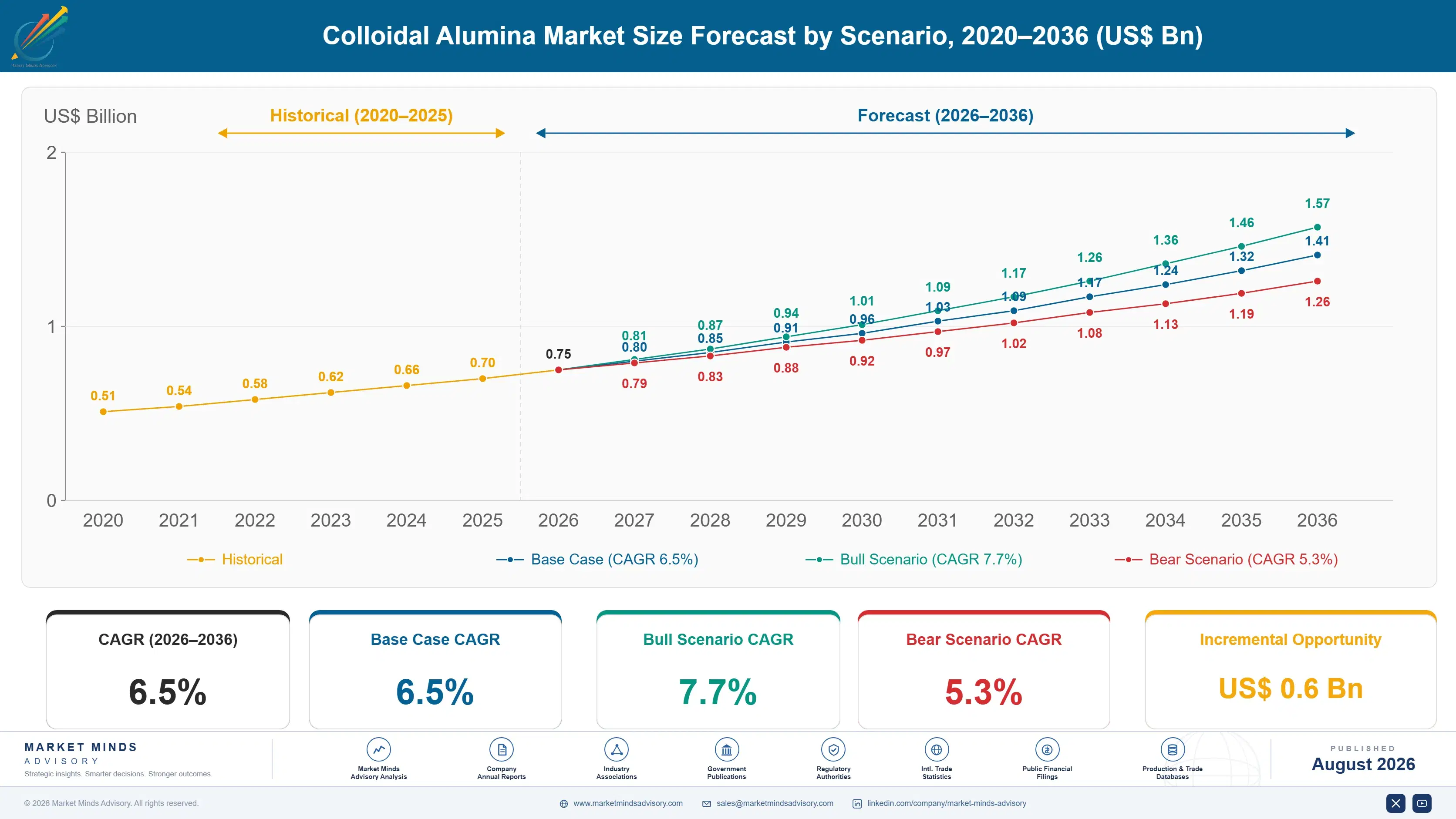
Colloidal Alumina Market Forecast Scenarios

colloidal-alumina-market-trends-size-forecast-scenario-1787464553780
Between 2020 and 2025 the market grew at roughly 5.7 percent a year, with pandemic-era semiconductor supply chain disruptions briefly slowing polishing chemical shipments before chip demand recovery and new fabrication plant construction accelerated growth through the back half of the period, and semiconductor-grade shipment orders climbed steadily as more fabrication plants finalized capacity expansion.
The base case assumes 6.5 percent annual growth to 2036, built on three mechanisms: semiconductor fabrication plant construction requiring progressively finer polishing chemistry as process nodes shrink further, ceramics and refractory manufacturing sustaining steady baseline demand tied to industrial construction activity, and catalyst support applications expanding as chemical processing customers seek higher-purity alumina substrates. Together these three mechanisms sustain growth above simple industrial production trends, beyond the industry's traditional pace.
A bull case near 7.7 percent depends on semiconductor fabrication plant construction accelerating faster than currently planned across additional markets. The bear case near 5.3 percent assumes chip manufacturing capacity expansion slows enough that polishing chemical demand growth tracks closer to simple ceramics and industrial baseline levels, and chip manufacturers postpone finalizing capacity expansion decisions where demand signals stay uncertain.

Particle Precision Separates Grades and Margins

Colloidal alumina economics run on particle size control above almost everything else, since the same base chemistry serves applications ranging from commodity ceramics to semiconductor polishing purely based on how tightly a producer can control particle distribution and purity, and that single variable has shaped supplier investment strategy across the entire industry for decades too.
PRODUCER CONCENTRATIONCR5 48%top five suppliers hold roughly half of global shipments
AVERAGE SELLING PRICE$8,500/tonneblended price across all colloidal alumina grades sold today
EAST ASIA PRODUCTION SHARE32%share of global production capacity located within this region
SEMICONDUCTOR GRADE PENETRATION18%share of total volume sold into chip polishing applications today
TRADE INTENSITY44%share of tonnage crossing a border before reaching final customers
FEEDSTOCK COST SHARE36% of COGSaluminum precursor cost burden within colloidal production expense
Commercially, the market splits between mature ceramics and refractory grade material priced close to commodity levels and a faster-growing semiconductor grade tier commanding a substantial premium as chip manufacturers demand progressively finer particle control. Margins concentrate in semiconductor-grade purity and consistency, where certification history matters more than simple production scale, as chip manufacturers increasingly weigh documented particle consistency data before committing to a supplier relationship.
Over the next decade, semiconductor-grade purity control and particle engineering capability will matter more to competitive position than ceramics-grade manufacturing scale, since basic colloidal alumina production technology itself is now widely accessible across multiple regional suppliers, particularly as manufacturers weigh certification depth alongside simple unit cost carefully, ahead too indeed.
"The same chemical formula sells for ten times more once you can guarantee particle size within a few nanometers. That gap is the entire business model for the suppliers who've made it into semiconductor supply chains."
Director, Chemicals and Materials Practice · MMA Chemicals and Materials Practice · August 2026

Market Trends

Advanced Semiconductor Nodes Demand Finer Particle Control

Semiconductor manufacturers advancing toward smaller process nodes require chemical mechanical polishing chemistry with progressively finer and more uniform particle size distributions than earlier generations ever demanded, since even minor particle inconsistency can damage increasingly delicate circuit structures. Nyacol Nanotechnologies and Nissan Chemical Corporation have both expanded semiconductor-grade production capacity specifically to serve this demand rather than adapting existing ceramics-grade production lines. This trend is spreading from leading-edge fabrication plants into mature node facilities as advanced polishing chemistry costs decline across the broader supply base, reflecting how quickly process node advancement is reshaping supplier investment priorities industry-wide.
Market Impact: Global fab construction grows 5-6% annually

Catalyst Support Applications Expand Purity Requirements

Chemical processing and refining customers are specifying higher-purity alumina substrates for catalytic applications as process efficiency requirements tighten across the broader refining industry. Sasol and Evonik Industries have both expanded catalyst support grade production capacity specifically to serve this purity-driven demand wave rather than relying on standard industrial grade material. This trend is spreading from premium refining applications into broader chemical processing as purity requirements gradually tighten across additional customer segments, reinforcing how quickly purity standards are reshaping supplier qualification requirements across the supply base, and this shift is likely to continue as purity requirements keep tightening steadily.
Market Impact: Ceramics demand grows 4-5% annually

Market Opportunities and Growth Drivers

Semiconductor Fabrication Plant Construction Sustains Demand

Global semiconductor fabrication plant construction continues expanding as chip demand grows across most major markets, and every new fabrication facility requires substantial polishing chemistry supply regardless of which specific process node it targets. This volume relationship gives colloidal alumina suppliers a demand floor tied directly to broader fabrication capacity growth rather than depending on any single chip manufacturer's individual technology roadmap within the competitive specialty chemical landscape shaping the industry across every major producing region worldwide, sustaining predictable order volume for suppliers year after year indeed too now indeed too.
Market Impact: Certification adds 18-24 months to entry

Industrial Ceramics Demand Sustains Baseline Volume

Industrial ceramics and refractory manufacturing continues expanding steadily as construction and heavy industry activity grows across most major markets, and that demand provides colloidal alumina suppliers a stable baseline volume independent of semiconductor industry cycles. Sumitomo Chemical and Showa Denko have both maintained steady ceramics-grade production capacity specifically to serve this baseline demand, capturing revenue that smooths overall category volatility, a trend expected to continue as industrial construction activity keeps expanding further, even as semiconductor-specific demand cycles introduce meaningfully more volatility elsewhere in the category too now indeed too now.
Market Impact: Feedstock price swings cut margins by 25%

Market Restraints and Challenges

Semiconductor Certification Costs Limit New Entrants

Qualifying colloidal alumina for semiconductor polishing applications requires extensive testing and certification with individual chip manufacturers, and the underlying cause is that even minor particle inconsistency can damage delicate circuit structures, making manufacturers extremely cautious about qualifying new suppliers. The commercial impact limits new entrant access to the highest-margin semiconductor segment regardless of underlying technical capability. Suppliers are mitigating this through partnerships with established semiconductor-grade producers seeking additional capacity, particularly across smaller suppliers lacking the capital to fund extended qualification programs, and this barrier persists despite years of process improvement effort across the industry.
Market Impact: Semiconductor grade penetration reached 18%

Aluminum Feedstock Price Volatility Compresses Margins

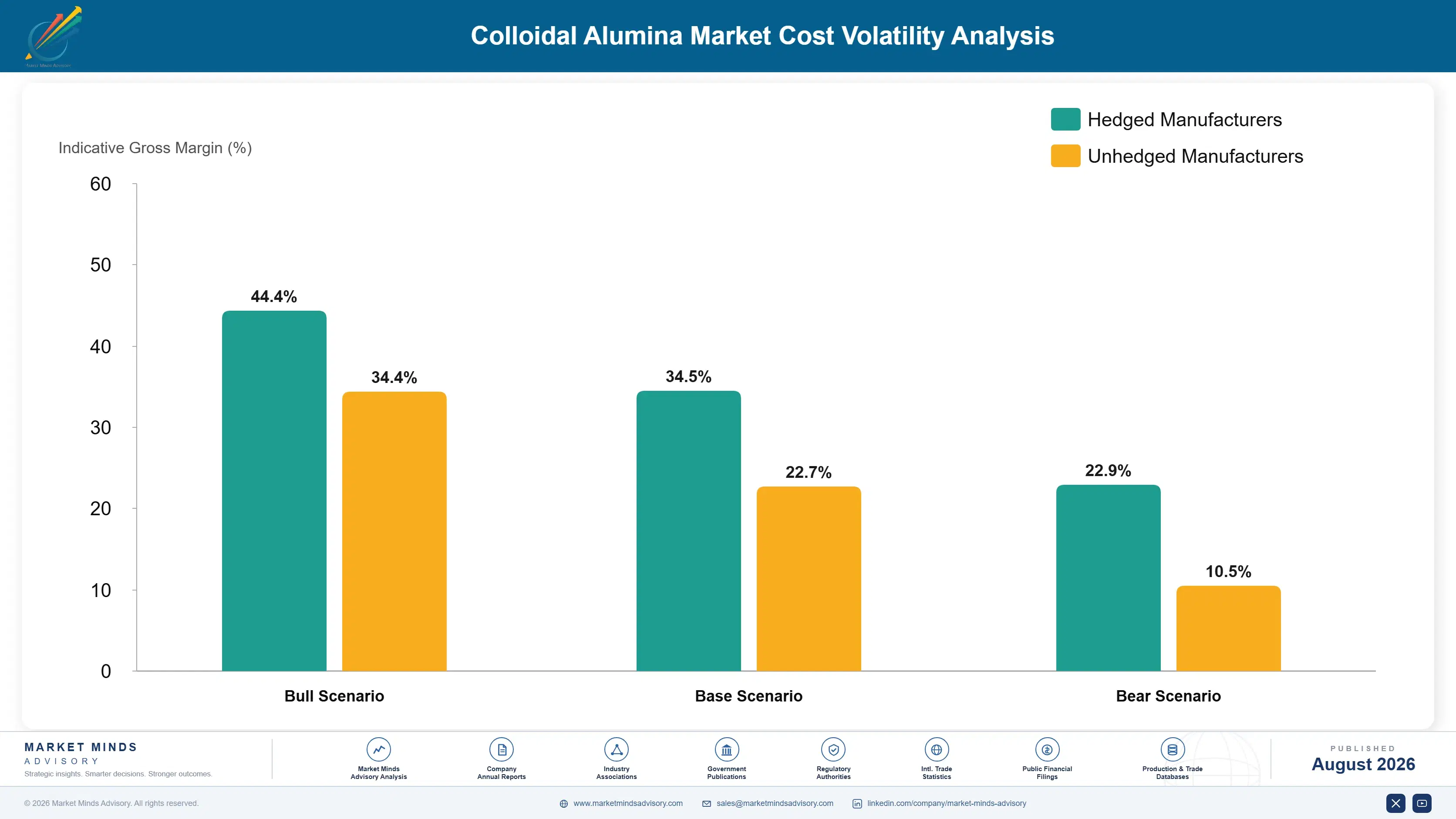
Colloidal alumina margins remain exposed to aluminum precursor price volatility, and the underlying cause is that feedstock costs represent a substantial share of total production cost that even modest price swings translate directly into meaningful margin pressure regardless of operational efficiency elsewhere. The commercial impact has forced some suppliers to renegotiate contract terms mid-cycle during periods of high feedstock prices. Suppliers are mitigating this through long-term feedstock supply agreements and index-linked pricing contracts, particularly for smaller regional suppliers lacking the purchasing scale to negotiate favorable long-term terms too now too.
Market Impact: Catalyst support demand grew 12% in 2yrs
3 additional market trends, 4 additional growth drivers, and 3 additional restraints and challenges are covered in the full report. Contact sales@marketmindsadvisory.com to access the complete intelligence.

Segment CAGR and Growth Architecture

The market splits into six categories by application grade, from semiconductor polishing through abrasive compounds. Semiconductor CMP grade is growing fastest as advanced node manufacturing demands finer particle control, while catalyst support grade follows closely given tightening purity requirements across chemical processing, as purity specifications tighten across every major end-use industry served today too.
Section default visual

Semiconductor CMP Grade Colloidal Alumina

Semiconductor CMP grade colloidal alumina is growing faster than any other category because chip manufacturers advancing toward smaller process nodes require progressively finer and more uniform particle size distributions than earlier generations ever demanded, since even minor particle inconsistency can damage increasingly delicate circuit structures. Nyacol Nanotechnologies and Nissan Chemical Corporation have both expanded semiconductor-grade production capacity specifically to serve this demand rather than adapting existing ceramics-grade production lines. Alfa Aesar has pursued a similar strategy, and the category's technical complexity, spanning both particle engineering and purity certification, gives established suppliers a meaningful engineering advantage over new entrants lacking comparable qualification history, particularly for suppliers lacking comparable qualification track records with major foundries.
CAGR 9.5%

Catalyst Support Grade Colloidal Alumina

Catalyst support grade colloidal alumina is growing quickly as chemical processing and refining customers specify higher-purity alumina substrates for demanding catalytic applications where process efficiency requirements continue tightening. Sasol and Evonik Industries compete most directly in this category, where documented purity consistency increasingly differentiates suppliers from those serving less demanding industrial applications. This combination of tightening purity requirements and expanding refining industry investment gives catalyst support grade a growth rate meaningfully above the broader colloidal alumina market average across most major producing regions, Nabaltec has similarly expanded catalyst support production to serve this growing purity-driven demand across multiple regions, regardless of broader macroeconomic swings affecting the specialty chemical industry more generally.
CAGR 8.0%
Full segment breakdown across 7 segments available in the complete report.

Regional Architecture and Country Demand Map

East Asia leads global colloidal alumina demand, anchored by semiconductor fabrication capacity concentrated in Taiwan, South Korea, and China alongside deep ceramics manufacturing. South Asia and Pacific posts the fastest growth as new fabrication plants come online, backed by government semiconductor manufacturing incentive programs across several countries.

North America

US semiconductor fabrication plants are expanding capacity under domestic manufacturing incentive programs, generating steady demand for chemical mechanical polishing chemistry tied directly to new plant construction timelines rather than simple replacement cycles. Alfa Aesar maintains significant domestic distribution and specialty chemical manufacturing capacity serving both semiconductor and catalyst support customers. Canada's smaller industrial base follows similar demand patterns tied to broader North American supply chain integration. Catalyst support demand from the region's substantial refining industry adds further steady volume beyond semiconductor applications, and reinforcing established supplier relationships built over years of continuous fabrication plant development, across every major manufacturing hub in the region, and their tier-one partners, sustaining stable long-term revenue.
Share: 22% | CAGR: 6.8% (2026 to 2036)

Western Europe

Germany hosts substantial specialty chemical manufacturing capacity serving both domestic ceramics producers and semiconductor customers, with Evonik Industries anchoring significant regional research investment in high-purity alumina production. The region's semiconductor manufacturing base remains smaller than East Asia or North America, keeping semiconductor-grade demand comparatively modest relative to the region's substantial ceramics and catalyst support consumption. Growth here trails faster-growing Asian markets because semiconductor fabrication capacity itself has expanded more slowly across the region, and helping domestic suppliers maintain technical relevance as global purity standards keep tightening further, and export markets alike across the continent, for years to come as well, sustaining stable long-term revenue further, each cycle, and beyond too.
Share: 21% | CAGR: 5.2% (2026 to 2036)
Regional intelligence for 5 additional markets available in the complete report: East Asia, South Asia and Pacific, Latin America, Middle East and Africa, Eastern Europe. Contact sales@marketmindsadvisory.com.
colloidal-alumina-market-trends-market-share-analysis-1787464554719

Capturing Value as Particle Control Matters

Suppliers capture the largest margin gains not from selling more colloidal alumina but from shifting what they sell: semiconductor-grade purity, catalyst support certification, and long-term feedstock agreements that stabilize margins. Each lever depends on capability incumbents already have and challengers must still build, and it favors suppliers who move on it early across every channel.

Expand Semiconductor-Grade Purity Certification Capacity Further

Suppliers with mature semiconductor-grade purity certification can capture a price premium of roughly 8 to 10 times standard ceramics-grade pricing, capturing value from chip manufacturers racing to qualify supply for progressively smaller process nodes. Nyacol Nanotechnologies and Nissan Chemical Corporation have both prioritized this expansion with existing customers rather than competing purely for new qualification contracts, since incumbent suppliers already hold the certification history and testing data needed to win the upgrade without a fully competitive tender process, and this advantage is widening as more chip manufacturers finalize their process node roadmaps.
Market Impact: Semiconductor grade helps command an 8-10x price premium

Build Catalyst Support Certification Programs Further

Suppliers that build documented catalyst support certification capture recurring refining industry contracts worth an estimated 15 to 20 percent margin above conventional ceramics-grade material, generating income that basic commodity sales alone cannot match. Sasol has expanded this certification capability specifically to serve refining customers seeking documented purity consistency for demanding catalytic applications across their processing operations, and this certification approach is increasingly viewed as essential across the broader refining industry as purity standards tighten further, across every major regional refining hub currently expanding operations today indeed overall too now indeed.
Market Impact: Catalyst certification helps add a 15-20% margin gain

Secure Long-Term Aluminum Feedstock Agreements Further

Suppliers that secure long-term aluminum precursor supply agreements avoid the margin compression that periodically strikes competitors during feedstock price spikes by an estimated 25 percent, giving them a meaningful cost stability advantage over competitors exposed to spot market pricing. Evonik Industries has pursued this strategy through direct long-term supplier arrangements, while several smaller suppliers are now pursuing comparable agreements to defend margin stability, across every major regional market currently served by the supply chain, and this stability advantage compounds meaningfully across each multi-year supply contract cycle too indeed overall now.
Market Impact: Feedstock agreements help avoid a 25% margin drop

Who Controls the Margin Pool

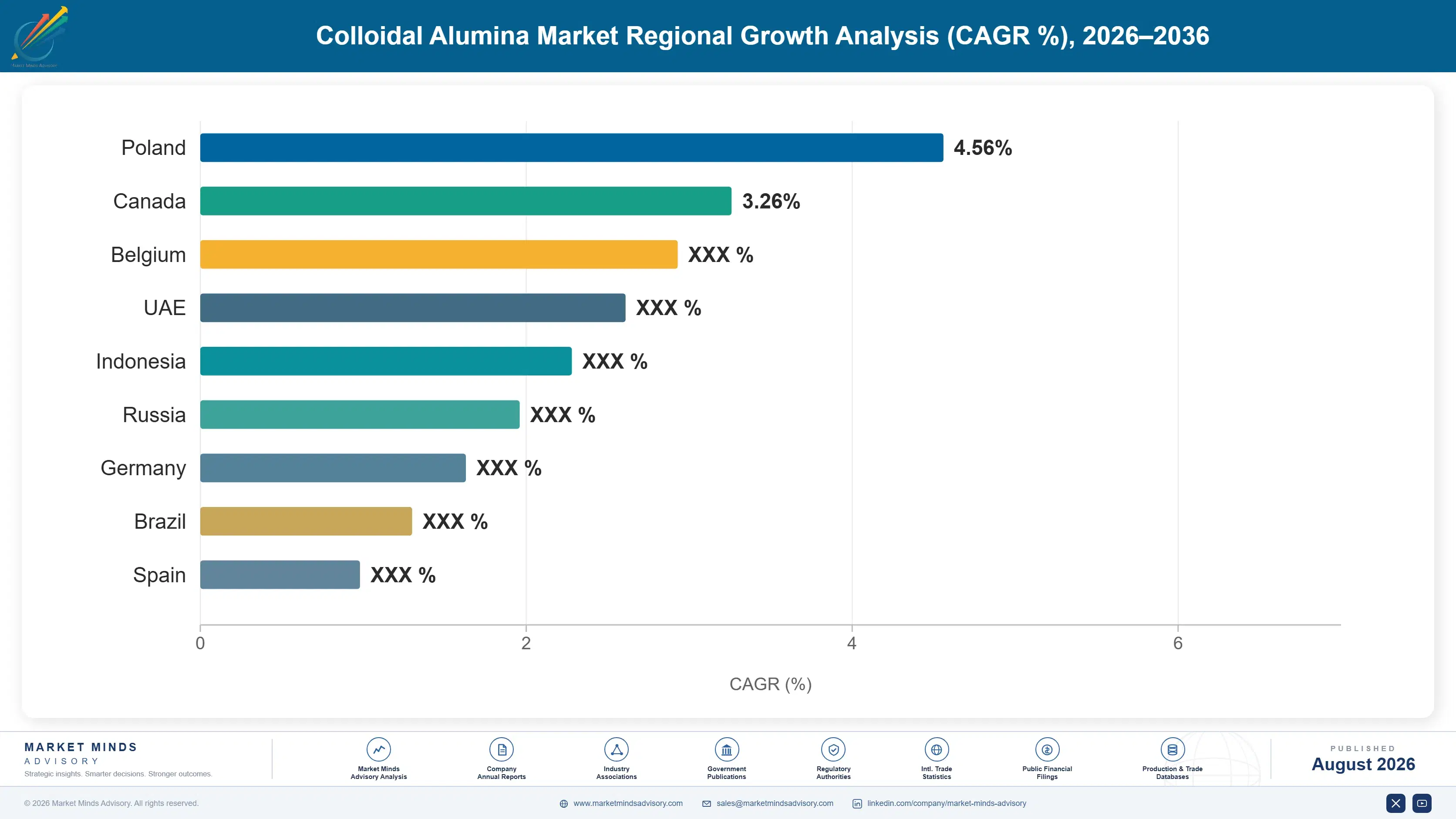
colloidal-alumina-market-trends-country-cagr-analysis-1787464555685

Input cost volatility and margin defence.

colloidal-alumina-market-trends-company-positioning-matrix-1787464556014

Portfolio Architecture for Margin Defence

Section default visual

End-use penetration and the annuity logic.

Section default visual

Four calls that define the decade.

These are among the four positions where our research anticipates prominent divergence between winners and laggards over the coming forecast period. Each is grounded in the demand model, the regulatory perimeter, and the announced capacity pipeline.

Engagement Snapshot From the Field

A live engagement with an industry participant carrying material or product regulatory and market exposure ahead of a defining policy shift, showing how our research translates into a defensible multi-year portfolio strategy.
MARKET MINDS ADVISORY · CLIENT ENGAGEMENT SUMMARY
Colloidal Alumina Producer Strategic Portfolio Review and Transition Roadmap 2026·Investment Scenario on Colloidal Alumina Exposure Evaluation 2025-26
CLIENT PROFILE
STRATEGIC CHALLENGE
MMA APPROACH
KEY FINDINGS
    CLIENT PROFILE
    STRATEGIC CHALLENGE
    MMA APPROACH
    KEY FINDINGS
      RECOMMENDED STRATEGY
      OUTCOME

      Frequently Asked Questions

      Foundational context covering the market sizes, CAGR, scope, country, region and competition that inform every finding below. This section is provided to cover basics and most often pre-purchase conversations, answered from the MMA Primary Research Dataset.

      Report Segmentation Architecture

      The full report scope spans multiple orthogonal segmentation dimensions, with cross-tabulated demand data provided for each dimension pair. Coverage extends further to regional breakdowns, trend trajectories, and the competitive detail needed to support segment-level decision-making.

      By Region

      • North America
      • Western Europe
      • East Asia
      • South Asia and Pacific
      • Latin America
      • Middle East and Africa
      • Eastern Europe

      Scope, Methodology, and Coverage

      Every figure in this report is reproducible from documented input assumptions. The scope below maps the historical period, the forecast horizon, the segmentation dimensions, and the countries covered, alongside the underlying primary and qualitative methodology.
      Historical Period
      2020 to 2025
      Forecast Period
      2026 to 2036
      Base Year
      2025 (USD billions; MMA Primary Research Dataset, August 2026)
      Market Definition
      The colloidal alumina market covers semiconductor CMP grade colloidal alumina, ceramics and refractory grade colloidal alumina, catalyst support grade colloidal alumina, coatings and surface treatment grade, water treatment grade colloidal alumina, and polishing and abrasive compound grade sold to semiconductor, ceramics, chemical processing, and industrial manufacturers. It excludes bulk alumina powder and calcined alumina sold outside colloidal dispersion form.
      Quantitative Units
      USD billions
      Segmentation Dimensions
      Regions Covered
      North America, Western Europe, East Asia, South Asia and Pacific, Latin America, Middle East and Africa, Eastern Europe
      Countries Covered
      Key Companies Profiled
      Quantitative Methodology
      Primary survey, n=3,800 respondents, Q4 2025, six countries; demand-side model with trade association cross-validation
      Qualitative Methodology
      47 expert interviews, Q4 2025; applied to validate demand model assumptions, identify emerging dynamics, and assess competitive positioning
      Report Format
      PDF and XLSX data workbook (Word format preview document)
      Publisher
      Market Minds Advisory
      Report Code
      MMA-2026-CHM-104
      Published
      August 2026
      Contact
      sales@marketmindsadvisory.com | www.marketmindsadvisory.com

      Purchase the full Colloidal Alumina Market Report (2026 to 2036).

      Built For The People Who Decide

      From boardroom strategy to bench-side execution, this report is read cover-to-cover by leaders shaping the next decade of their industry, turning demand scenarios, market dynamics and valuation benchmarks into decisions.
      CXOs/ Presidents/ VPs/ Managers
      M&A and Corporate Development
      Strategy Teams and R&D Heads
      Procurement and Product Directors
      Regulatory and Compliance Leaders
      Investor Relations and Equity Analysts