Market Minds Advisory
Collapsible Wardrobe Market

Collapsible Wardrobe Market: Collapsible Wardrobe Market: Rail Load Ratings, Return Economics and the Connector Nobody Specifies

These products fail at the plastic corner connector and the sagging hanging rail rather than the fabric, and barely one in twelve publishes any load rating for the rail at all.

Lead Analyst

Published

September 2026

Make Smarter Decisions with Customized Research Insights

Request a free sample report and evaluate market opportunities, growth trends, and competitive dynamics relevant to your business needs.

2025 MARKET VALUE$2.4BMarket Size 2025
2036 FORECAST VALUE$4.8BBase Case , 2026 to 2036
CAGR 2026 TO 20366.4 %Bull 7.6% / Bear 5.2%
INCREMENTAL OPPORTUNITY$2.2BNet 10- year value creation
EXPANSION MULTIPLE1.85x2036 value over 2026 base
Strategic Levers
M&A Pipeline
Regional Outlook
Country Rankings
Competitive Intelligence
Segmental Deep-dive
Call-Us : 91 93563 13602

Executive Snapshot and Market Trajectory.

The fabric never fails. What fails is the plastic corner connector and the hanging rail, which bows under load and then lets go, usually overnight and usually with everything on it. About 8% of products state a rail load rating anywhere. Nobody stocks the connector as a spare part either.
Modular cube wardrobe systems grow at 9.6%, half again the market rate of 6.4%, and the reason is that they have no rail span to sag. Interlocking panels carry load through the structure rather than across it. Garment racks with covers follow at 7.4%. Hanging fabric organisers grow slowest at 4.6%, since they solve a smaller problem and compete with a shelf. Modular panels also ship worse, because nothing folds flat.
Return economics govern profitability more than manufacturing does. Roughly 21% of online units come back, mostly for transit damage or missing hardware, and only about 14% of returns are resold rather than written off. Reverse logistics on a bulky low-value item is uneconomic, so every avoidable return is a near-total loss. Most returns trace to transit damage or missing hardware rather than the product.
Market Definition
This market covers freestanding collapsible and portable garment storage furniture assembled by the consumer without tools, spanning fabric-covered steel tube wardrobes, zippered portable closets, modular cube systems, covered garment racks, hanging fabric organisers and wheeled collapsible units. Sizing is at retail value. Built-in and fitted wardrobes, rigid flat-pack case goods requiring tools, luggage, laundry hampers, shoe racks and under-bed storage containers are excluded.
Base Year Value
$2.4B in 2025 (MMA Primary Research Dataset, September 2026)
Forecast Period
2026 to 2036, eleven discrete annual values
CAGR
6.4% base case. Bull 7.6%. Bear 5.2%.
Fastest Growth Segment
Modular Cube Wardrobe Systems: 9.6% CAGR
Fastest Growth Country
India: 9.4% CAGR
Fastest Growth Region
South Asia and Pacific: 8.5% CAGR
Largest Region
East Asia: 34% of 2025 global value
Market Leaders
IKEA, Whitmor, Household Essentials, Honey-Can-Do International, Aosom. Source: MMA Primary Research Dataset, July 2026.
Primary Survey
n=3,800 procurement and R&D decision-makers, Q4 2025, six countries
Methodology
Demand-side build-up, cross-validated against public data, 47 expert interviews

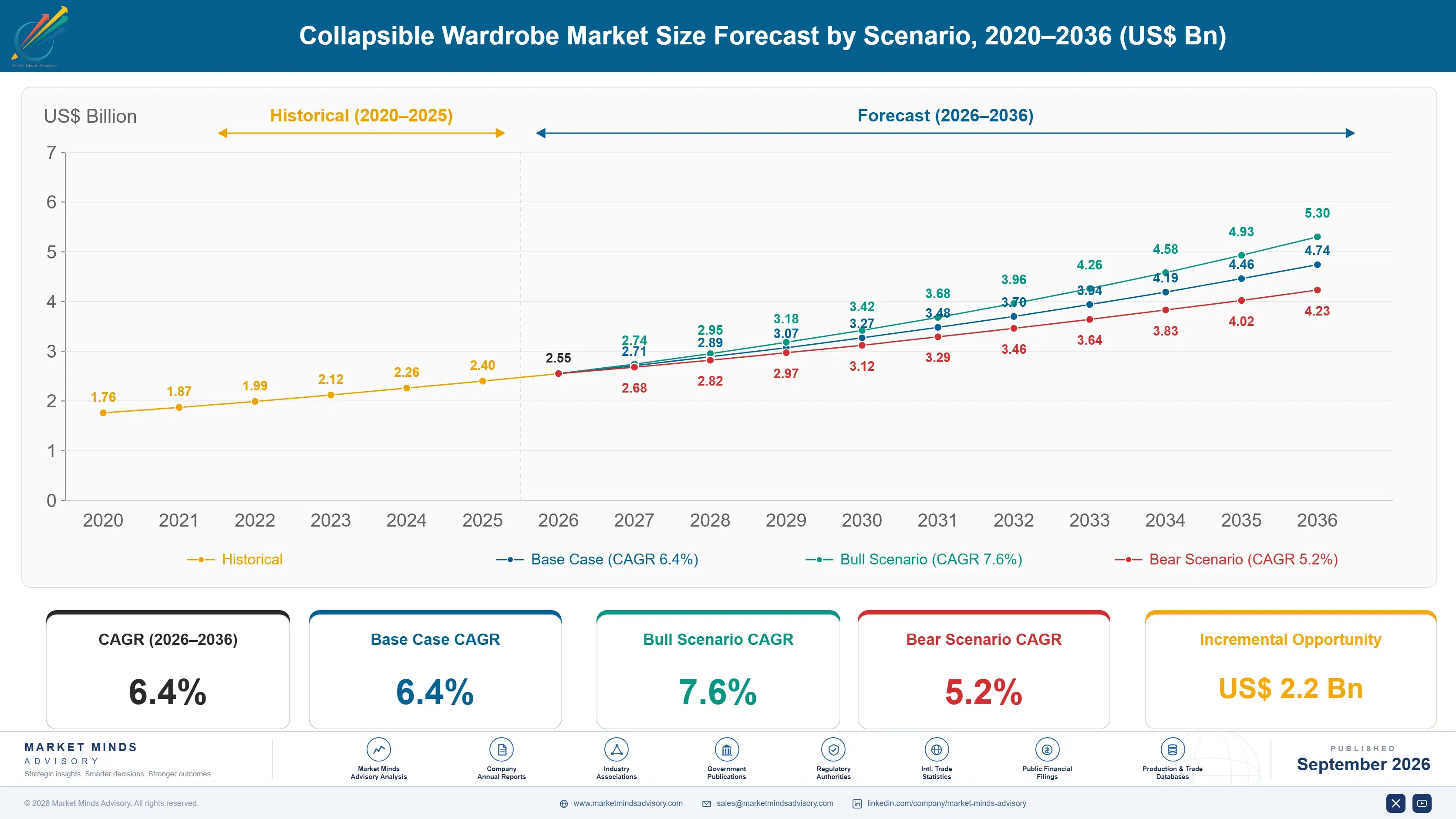
Collapsible Wardrobe Market Forecast Scenarios

collapsible-wardrobe-market-size-forecast-scenario-1790022169854
Growth of 5.3% between 2020 and 2025 was pulled forward and then paid back. Home reorganisation through 2020 and 2021 produced a surge that emptied inventories, and 2022 and 2023 corrected as those units were still in use and the product lasts around 2.7 years. Container freight then made the economics of shipping air across an ocean briefly untenable for everyone.
Three mechanisms carry the base case. Rental tenure and urban household formation drive this category rather than furniture spending, and both keep expanding. Modular cube systems grow at 9.6% because they eliminate the rail sag that ends most units early. Indian demand grows at 9.4% as urban rental households form faster than fitted storage can be built into the housing stock serving them, and none of the three mechanisms depends on furniture spending.
The bull case is durability disclosure. If any major retailer requires a stated rail load rating as a listing condition, the products that can support one take share immediately and average selling prices rise with the specification. The bear case is freight. This is a bulky, low-density, low-value product, and a repeat of 2021 container pricing removes margin from every unit crossing an ocean.

Where These Products Actually Fail

Nobody buys one of these for the fabric and nobody discards one because of it. The failure sequence is consistent: the rail bows under a load nobody specified, the connector holding it deforms, and the unit comes down. Tube diameter and wall thickness decide whether that happens. Nobody sells the connector as a spare, so the part ends the product.
TOP FIVE CONCENTRATION19%Combined retail value share held by the five largest participants
ONLINE RETURN RATE21%Units returned from online channels after delivery to buyers
AVERAGE SELLING PRICEUSD 42Weighted global retail price across all construction formats
RAIL LOAD RATING STATED8%Products publishing a hanging rail weight capacity figure
RETURNS RESOLD14%Returned units restocked rather than written off entirely
PRODUCT LIFE EXPECTANCY2.7 yearsAverage service life before a unit is replaced
Only about 8% of products state a rail load rating anywhere on pack or listing. That is not an oversight so much as a decision, since publishing a figure invites comparison against competitors who publish nothing and creates a warranty exposure that silence avoids. The consumer consequently cannot distinguish a unit that will hold a winter coat collection from one that will not.
Return economics decide who makes money in this category. Roughly 21% of online units come back and only 14% of those are resold, because inspecting, repacking and restocking a bulky low-value item costs more than the item is worth. Most returns trace to transit damage or missing hardware rather than to the product itself. Numbered tube ends and a single sealed hardware bag would remove most of both causes at a cost of cents.
"This is a category where a few cents of extra steel wall thickness would eliminate the failure that ends most of these products, and almost nobody spends it because nobody has to publish what the rail will hold."
Director, Home Furnishings and Storage Practice · MMA Consumer and Industrial Goods Practice · September 2026

Market Trends

Modular Panels Remove The Rail Span Entirely

Interlocking cube systems built from resin or wire panels carry load through the structure rather than across an unsupported rail, which eliminates the sag that ends most collapsible wardrobes early. They grow at 9.6% against a category rate of 6.4% as a direct result. The trade is assembly time and a less familiar appearance, both of which buyers accept once they have replaced a collapsed unit. Unit prices run above fabric-covered tube products, and the format is genuinely more expensive to ship because panels do not fold flat the way fabric does.
Market Impact: India grows 3.0 points faster
Retail Listings Begin Demanding Assembly And Weight Data

Several large online retailers now require dimensional and weight information at listing level for storage furniture, and a small number have begun asking for load capacity where a product supports hanging. The direction is clear even though coverage remains patchy. Products that can support a stated rail rating gain a comparison advantage the moment it becomes a filterable field, and roughly 8% of the category could currently supply one. Participants building to a specification rather than to a price point are positioning for a requirement that has not fully arrived.
Market Impact: Replacement every 2.7 years

Market Opportunities and Growth Drivers

Urban Rental Households Form Faster Than Fitted Storage

This category tracks rental tenure and household formation rather than furniture expenditure, which is why it grows in cities where fitted wardrobes are rare and stalls where they are standard. Indian metropolitan rental household formation is the clearest example, and India grows at 9.4%, the fastest national market covered here. The product suits a tenancy that may not outlast the furniture, and it moves without a van. German rental stock is the unusual Western case, since apartments there routinely come without built-in wardrobes of any kind. That housing quirk supports higher German price points.
Market Impact: Only 14% of returns resold

Replacement Cycle Runs Short Enough To Compound

Average service life sits near 2.7 years, which is short for furniture and long for a consumable, and it means a household that adopts the format returns to the category repeatedly. The mechanism is failure rather than fashion, since the rail sags or a connector cracks and the unit is discarded rather than repaired. Nobody sells spare connectors. Participants who improve durability lose replacement volume and gain brand preference, and the arithmetic favours durability once average selling prices rise above roughly forty dollars. Very few participants have run that calculation.
Market Impact: Just 8% publish a rating

Market Restraints and Challenges

Return Rates Destroy Margin On Bulky Low Value Goods

Around 21% of online units are returned and only about 14% of those are resold, because inspecting, repacking and restocking a bulky item worth forty dollars costs more than the unit is worth. The root cause is packaging rather than product: most returns trace to transit damage or missing hardware. Commercially each avoidable return is close to a total loss on that unit. Participants are addressing it with corner protection, hardware sealed in a single bagged kit and numbered tube ends, all of which cost cents and reduce both damage and confusion.
Market Impact: Grows 3.2 points above category

Load Ratings Stay Unpublished Because Silence Is Safer

About 8% of products state a hanging rail capacity, and the root cause is competitive rather than technical: publishing a figure invites comparison with competitors who publish nothing while creating a warranty exposure that silence avoids. Consumers therefore cannot distinguish a unit that will hold a coat collection from one that will not, and they buy on price. The commercial impact is a category that competes downward on cost. Some participants now publish ratings and use them as a selling point, which only works while most competitors stay quiet. It stops working the moment two competitors do the same.
Market Impact: Only 8% could state ratings
3 additional market trends, 4 additional growth drivers, and 2 additional restraints and challenges are covered in the full report. Contact sales@marketmindsadvisory.com to access the complete intelligence.

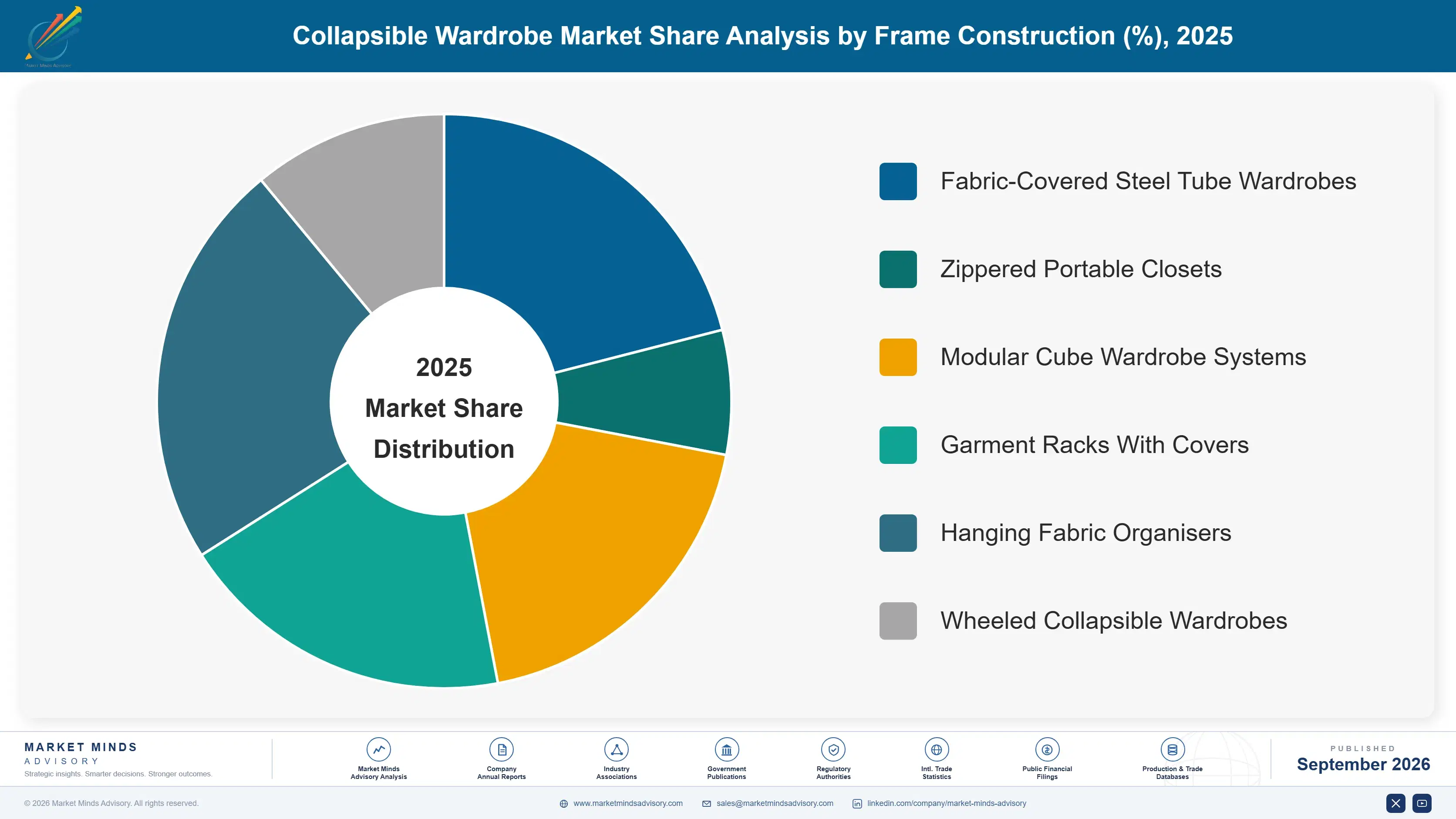
Segment CAGR and Growth Architecture

Segmentation follows frame construction, the dimension on which load behaviour, assembly method, shipping density and retail price all divide together in this category. Six constructions are assessed at retail value. Fitted wardrobes, rigid flat-pack case goods, luggage, hampers, shoe racks and under-bed containers sit outside the defined scope. Fitted and rigid wardrobe furniture is a separate category.
collapsible-wardrobe-market-market-share-analysis-1790022170427

Modular Cube Wardrobe Systems

Modular cube systems grow at 9.6%, half again the market rate of 6.4%, because they remove the failure mode that ends most of this category early. Interlocking resin or wire panels carry load through the structure rather than across an unsupported rail, so there is nothing to bow and no corner connector holding a horizontal member under bending load. The trade is longer assembly and an appearance buyers find less familiar, and both objections weaken considerably once someone has replaced a collapsed unit. Shipping cost is genuinely higher because panels will not fold the way fabric does, which caps how far the format can travel from where it is made.
CAGR 9.6%

Garment Racks With Covers

Covered garment racks grow at 7.4% and occupy an honest middle position that the enclosed formats do not. The rack is engineered as a rack, with a rail sized for the load it carries, and the cover is a separate item that protects from dust without pretending to be a wall. That separation means the load path is visible to the buyer and the failure mode is much rarer. Prices sit above fabric-covered tube wardrobes and below modular systems. The format sells particularly well where the unit sits in a bedroom rather than a spare room, since a rack looks deliberate in a way a fabric box never quite manages.
CAGR 7.4%
Full segment breakdown across 6 segments available in the complete report.

Regional Architecture and Country Demand Map

Regional shares measure retail value where units are sold. East Asia and South Asia sit above their standard bands and Western Europe marginally below, driven by rental housing stock and fitted storage prevalence rather than by income. Fitted storage prevalence explains most of this table.

East Asia

At 34% this sits above the standard band, and China is both the manufacturing base for nearly the whole category and its largest single market. Urban apartment sizes across Chinese and Japanese cities leave little room for fitted storage, and rental tenure among younger urban households is long enough to need furniture but too uncertain to justify built-in solutions. Domestic manufacturers sell at price points international brands cannot approach, since the product ships from where it is made rather than across an ocean. Japanese demand skews toward smaller, better-finished units from Nitori and Ryohin Keikaku. Growth runs at 7.3%. Return economics barely apply where product ships domestically and cheaply, since a nearby warehouse restocks what a distant one writes off.
Share: 34% | CAGR: 7.3% (2026 to 2036)

North America

The 22% position sits at the bottom of the standard band and the demand character differs from Asia entirely. Fitted closets are standard in most American and Canadian housing, so these products serve overflow, seasonal storage and temporary situations rather than primary garment storage. That places the purchase closer to an organising product than a furniture one, which caps price and shortens consideration. Online channels carry a very large share, and return rates here run above the global figure because delivery damage on bulky items is common. Growth of 5.6% reflects a supplementary rather than primary role. Buyers compare these against an organising purchase rather than a furniture one, which caps price.
Share: 22% | CAGR: 5.6% (2026 to 2036)
Regional intelligence for 5 additional markets available in the complete report: Western Europe, South Asia and Pacific, Latin America, Middle East and Africa, Eastern Europe. Contact sales@marketmindsadvisory.com.
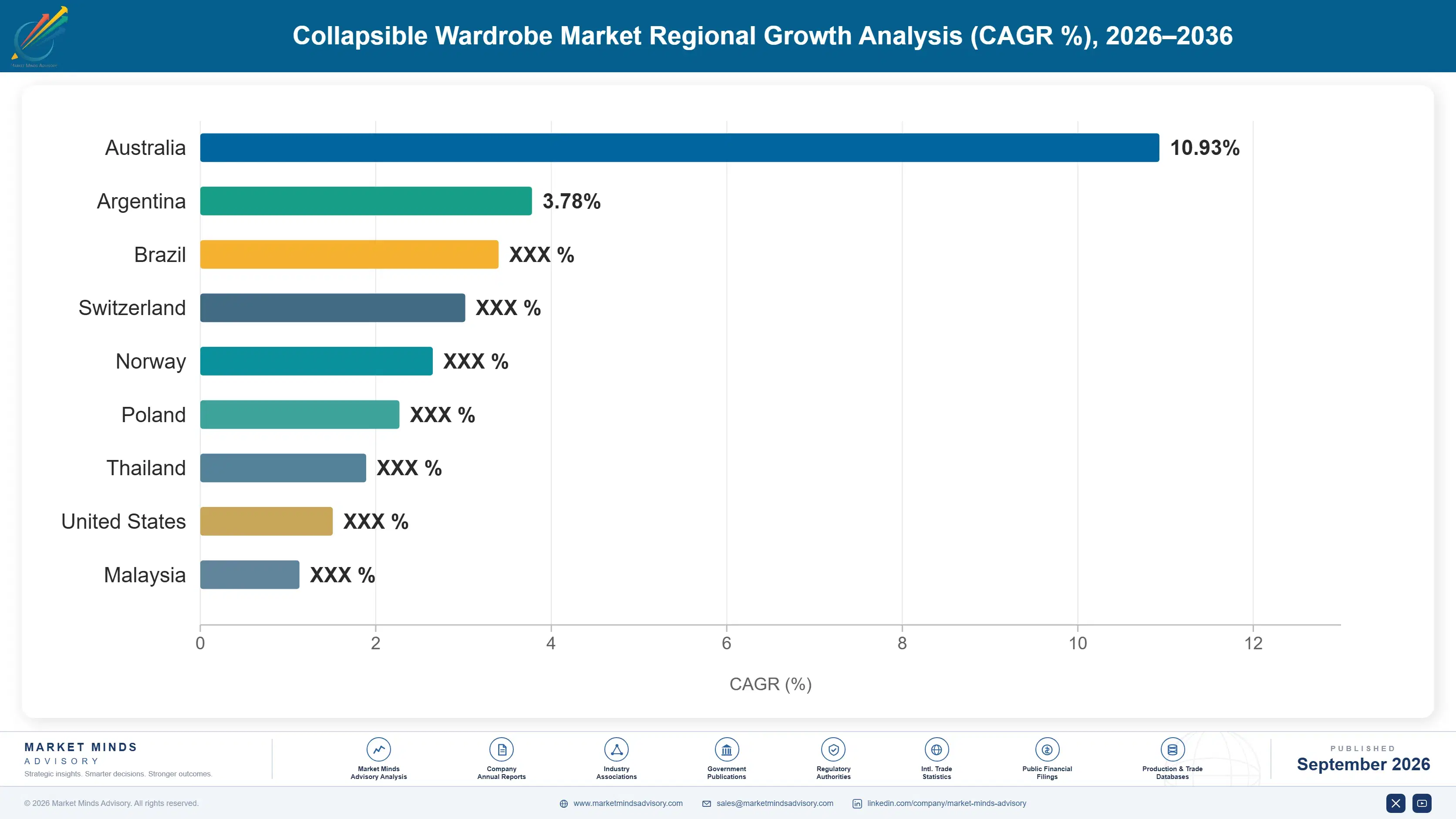
collapsible-wardrobe-market-country-cagr-analysis-1790022170955

Four Changes Worth A Few Cents

Each of these four costs a few cents per unit and addresses either the failure that ends the product or the return that removes its margin. All have been executed by at least one participant with measurable results, and none requires new tooling, a different factory or any change to existing retail relationships. Three of the four are specification decisions.

Publish A Hanging Rail Load Rating

About 8% of products state what the rail will hold, because publishing invites comparison and creates warranty exposure that silence avoids. That leaves the buyer with price as the only visible variable. Participants who publish a rating and build to it report realised prices around 1.4 times comparable unrated products in the same channel. Several large retailers have begun asking for load data at listing level, so the disclosure is likely to arrive as a requirement eventually. Arriving first with a specification that supports the number is worth considerably more than arriving late.
Market Impact: Lifts realised price to roughly 1.4 times higher

Move To Heavier Wall Tube On Load Bearing Members

Rail sag and connector deformation are the failure sequence that ends most units, and both trace to tube diameter and wall thickness chosen at the bottom of what will stand up in a showroom. A heavier gauge on load-bearing members adds roughly USD 0.40 to a bill of materials on a product retailing near USD 42. Participants who have done it report warranty and complaint volumes falling by about 46%. The change requires a specification decision rather than new tooling, since the same forming equipment handles both gauges. Purchasing specifications written to a landed cost target are what block it.
Market Impact: Cuts warranty and complaint volumes by roughly 46%

Seal Hardware In One Bagged Kit And Number Tubes

Most returns trace to transit damage or missing hardware rather than to any product defect, and around 21% of online units come back with only 14% resold. Numbering or colour-coding tube ends and sealing all fasteners into one bag costs a few cents and removes the two most common return causes at once. Participants doing both report return rates falling by roughly 7 points. On a product where a returned unit is close to a total write-off, that recovery flows directly and immediately to contribution margin. The carton is the only packaging an online unit ever gets.
Market Impact: Cuts online return rates by roughly 7 points

Sell Replacement Connectors As A Stocked Part

Nobody sells spare corner connectors, so a cracked plastic part worth under a dollar ends a forty dollar product and a household relationship at the same time. Offering connectors and rails as stocked spares costs little, since the parts are already being moulded, and it converts a disposal event into a repeat contact. Participants offering spares report brand repurchase running about 1.6 times their range average. The environmental argument is real and the commercial one is stronger, because the customer stays. A cracked part worth under a dollar currently ends a forty dollar relationship.
Market Impact: Raises brand repurchase to roughly 1.6 times higher

Who Controls the Margin Pool

Concentration is very low at 19% held by the top five, measured consistently on retail sales value of collapsible garment storage units rather than on volume. The leader to challenger gap is wide in retail shelf access and in return logistics capability, both of which take scale to build, and effectively absent in manufacturing, where hundreds of Chinese and Indian factories produce comparable product and will supply anyone placing an order.
Competition runs on three dimensions currently. Online listing position decides most volume, since this is an overwhelmingly search-driven purchase with very little brand loyalty attached. Landed cost decides price, and it is dominated by shipping density rather than by materials. Perceived durability decides the small premium tier, and almost nobody supports it with a published specification that a buyer could actually check.

Pressure is building on specification disclosure and on return economics, and that is where positions will move. Participants who can state a rail load rating are positioned for a listing requirement that several large retailers are moving toward. Those without return logistics scale are absorbing write-offs on a fifth of their online volume, which is a cost structure that only works while average selling prices hold.
collapsible-wardrobe-market-company-positioning-matrix-1790022171483

Competitive Moat and Risk Dimensions

IKEA

Moat: Shipping Density And Scale

Flat-pack engineering discipline applied to a category that ships mostly air gives the company a landed cost advantage no competitor matches, and its store network removes the return logistics problem that governs online-only participants. Products are also specified against internal standards rather than to whatever passes at a price point.
IKEA

Risk: Rigid Furniture Cannibalises Collapsible

The company's own rigid wardrobe ranges compete directly with collapsible formats at overlapping price points, and store staff routinely steer customers toward the more durable option. That is correct advice and it caps how far the collapsible range can grow inside a channel where the alternative sits in the next aisle.
WHITMOR

Moat: Retail Relationships In Storage

Long-standing supply positions with American mass and home retailers give the company shelf access in a category where shelf and listing position drives most volume. Category management depth in home organisation means buyers treat it as a range partner rather than a single-product vendor, which is a position built over decades.
WHITMOR

Risk: Exposure To Freight Cycles

Product sourced from Asian manufacture and sold into North America carries full ocean freight exposure on a bulky, low-density, low-value item where shipping is a large share of landed cost. A repeat of 2021 container pricing removes margin across the range at once, with no ability to reprice quickly against retailers on annual terms.

Players Tracked

Prominent Players

IKEA
Whitmor
Household Essentials
Honey-Can-Do International
Aosom

Other Key Players

Simple Houseware
mDesign
Zinus
Sterilite
IRIS Ohyama
Nitori Holdings
Ryohin Keikaku
Dunelm Group
Nilkamal
Supreme Industries
Yamazaki Home
Umbra
Cello Group
SONGMICS Home
Amazon Basics

Recent Developments

APRIL 2025

IKEA introduces reinforced rail specification across freestanding range

The company revised hanging rail gauge and connector design across its freestanding and collapsible garment storage products. This was internal product development taken against its own specification standards, with no partnership, licence or external technology involved at any point. Fabric and zip specifications were left unchanged across the range.
Signal: Specification rather than price is beginning to differentiate at the top of this category. Load path is finally being engineered.
NOVEMBER 2024

Aosom opens additional European distribution centre

The company brought a further European fulfilment facility online serving home storage and furniture categories, shortening delivery distances and reducing transit handling. This was organic capital investment funded internally with no joint venture or third party logistics partnership involved. Existing facilities continued operating unchanged alongside it.
Signal: Reducing transit handling has become a margin decision here rather than only a customer service one.
AUGUST 2024

Nitori signs Vietnamese manufacturing supply agreement

The company entered a multi-year supply agreement with a Vietnamese furniture manufacturer covering storage and garment organisation products for Japanese and export markets. The arrangement is a commercial supply contract involving no equity stake or joint venture structure whatever. Existing Chinese supply arrangements were retained in parallel.
Signal: Sourcing is diversifying away from single country manufacture even in the very lowest value product categories.

Where Landed Cost Concentrates

Steel tube accounts for roughly 28% of manufacturing cost, drawn overwhelmingly from Chinese and Indian mills, with gauge selection driving more variation than the steel price itself does. Non-woven and polyester fabric adds about 19%, and injection-moulded plastic connectors around 12%, which is modest against how much of the failure risk they carry. Zips, packaging and printing account for most of the remainder before any freight is added.
The 2021 and 2022 period was the worst possible combination for this category. Steel prices rose sharply while container rates on Asia to Europe and Asia to North America routes multiplied several times over, and this product ships mostly air by volume. Inter IKEA Group and Nitori Holdings reporting for that period both identify raw material and logistics inflation as requiring price action across home furnishing ranges.

Exposure varies almost entirely by shipping distance and product density, which decides who can hold a price. Modular panel systems ship worst because they will not fold, while fabric-covered tube products compress well and travel cheaply. Manufacturers selling where they produce, as Chinese and Indian domestic brands do, avoid the freight layer completely, which explains most of the price gap in every region.
collapsible-wardrobe-market-cost-volatility-analysis-1790022171679

Specify tube gauge for load rather than for showroom appearance

Rail sag and connector failure both trace to a gauge chosen at the minimum that stands up unloaded, and a heavier wall adds under half a dollar to a product retailing near forty. The forming equipment handles both gauges without change. What blocks it is a purchasing specification written to a landed cost target rather than to a load requirement.

Design packaging around transit damage rather than shelf appearance

Most returns trace to transit damage on a bulky carton that was designed to look right in a store aisle. Corner protection and internal bracing cost a few cents and remove the largest single return cause. The change matters far more in online channels, where the carton is the only packaging the product ever gets.

Qualify manufacturing outside a single sourcing country

Concentrated Chinese sourcing exposes the whole category to one freight route and one policy environment simultaneously. Qualifying Vietnamese, Indian or Eastern European capacity spreads that risk and shortens transit into some destination markets. The obstacle is minimum order quantity rather than capability, since the manufacturing itself is not technically demanding anywhere. Minimum order quantity is the real obstacle.

Portfolio Architecture for Margin Defence

Margin architecture divides by shipping density and by whether a durability claim can be supported, which is not what a materials cost model would predict. Fabric-covered tube wardrobes and hanging organisers sold through online marketplaces run at gross margins in the high teens to mid twenties, competing against hundreds of nearly identical products from factories that will supply any buyer. Search position rather than product attribute decides which listing a buyer sees.
Covered garment racks and wheeled formats hold gross margins in the thirties, and the spread reflects channel more than construction. A product sold through a home retailer with a range relationship earns considerably more than the same item listed on a marketplace against a search result. Return absorption also differs sharply, since store returns can be resold and online returns usually cannot.

The highest-value pool sits where a stated load rating meets a construction that supports it. Modular systems and specification-led racks carry margins in the high thirties to mid forties, because the buyer chooses against a published number rather than a photograph. Marketplace tube wardrobes keep factories running. They fund nothing beyond their own freight. A published number is the only durable differentiation available in this category.

Volume / Commodity-Adjacent

Fabric-covered tube wardrobes and hanging organisers sold through online marketplaces. Hundreds of nearly identical products compete on search position and price, and no supplier holds any specification advantage a buyer can see.
Gross Margin: 18 to 24%

Premium / Certified

Covered garment racks and wheeled formats sold through home retail range relationships. The eight-point range reflects channel rather than construction, since store returns can be resold while online returns are usually written off.
Gross Margin: 30 to 38%

Sustainability / Regulatory / Next-Generation

Modular systems and specification-led products carrying published rail load ratings and stocked spare parts. The buyer chooses against a number rather than a photograph, which removes most direct price comparison.
Gross Margin: 38 to 45%
collapsible-wardrobe-market-portfolio-architecture-1790022172186

High-value Sub-segments and Strategic Watch-out

Modular Panel Wardrobe Systems

High value and high growth at 9.6%. Interlocking panels carry load through the structure rather than across a rail, which eliminates the failure that ends most units. Shipping cost is the constraint, since panels will not fold flat. That caps how far the format travels from where it is made.
Gross Margin: 40 to 45%

Products With Published Load Ratings

High value and moderate growth. Only about 8% of the category could currently state a rail capacity, and participants who publish report realised prices around 1.4 times unrated equivalents. Several retailers are moving toward requiring the data. Arriving first with a supportable number is worth considerably more.
Gross Margin: 36 to 43%

Marketplace Fabric Tube Wardrobes

Volume core, competing on search position against hundreds of nearly identical listings. It keeps factories running and absorbs the return write-offs. No participant holds a durable position anywhere in this tier. Factories will supply any buyer placing an order, so no participant holds a durable position at this tier.
Gross Margin: 18 to 23%

Imported Product In Distant Markets

Strategic watch-out. This is a low-density product that ships mostly air, so freight is a large share of landed cost. The ten-point range reflects how differently participants fared through the last container pricing cycle. Modular panel formats suffer worst of all, since nothing about them folds.
Gross Margin: 16 to 26%

What Brings Buyers Back

Repeat demand is failure-driven and the interval is short, which makes this behave more like a consumable than like furniture. Average service life sits near 2.7 years and the ending is almost always the same: the rail bows, the corner connector cracks, and the unit is discarded because nobody sells the part. A household that adopts the format therefore returns to the category several times over a decade.
Stickiness varies sharply by why the product was bought. Households using these units as primary garment storage, common across Indian, Chinese and Latin American rental housing, replace reliably and increasingly trade upward after a collapse. Overflow and seasonal users in fitted-closet markets replace irregularly and buy on price. Expatriate and short-tenancy buyers in the Gulf treat the product as disposable at the end of a posting.

Buyer profiles have shifted in one direction since 2020. The cohort that bought during the home reorganisation surge experienced a first failure roughly three years later and now arrives at replacement knowing what went wrong. That group asks about rail capacity and connector material in a way first-time buyers never do, and it will pay more for a product that states them.
collapsible-wardrobe-market-end-use-penetration-index-1790022172677

Where Cents Buy Margin

These are among the four positions where our research anticipates prominent divergence between winners and laggards over the coming forecast period. Each is grounded in the demand model, the regulatory perimeter, and the announced capacity pipeline.
01 / LOAD RATING DISCLOSURE

Publish what the rail will actually hold

Only about 8% of products state a hanging rail capacity, because publishing invites comparison against competitors who publish nothing and creates warranty exposure that silence avoids. That leaves price as the only visible variable and drives the whole category downward on cost. Participants who publish a rating and build to it report realised prices around 1.4 times comparable unrated products, and several large retailers are already moving toward requiring the data at listing level, and arriving first with a supportable number beats arriving late.
02 / LOAD BEARING SPECIFICATION

Spend forty cents on the tube that fails

Rail sag and connector deformation are the sequence that ends most units, and both trace to a tube gauge chosen at the minimum that stands up unloaded in a showroom. A heavier wall on load-bearing members adds roughly USD 0.40 to a product retailing near USD 42, and the same forming equipment handles both. Participants who have made the change report warranty and complaint volumes falling by about 46%, on a specification decision rather than any capital investment, which purchasing specifications written to a landed cost target currently prevent.
03 / RETURN CAUSE ELIMINATION

Number the tubes and bag the hardware

Around 21% of online units are returned and only 14% of those are resold, because inspecting and repacking a bulky forty dollar item costs more than the item is worth. Most returns trace to transit damage or missing hardware rather than to any defect in the product. Numbering tube ends and sealing all fasteners into one bag costs a few cents, and participants doing both report return rates falling by roughly 7 points straight to contribution, which matters most where the carton is the only packaging a unit gets.
04 / SPARE PART AVAILABILITY

Sell the connector instead of losing the customer

Nobody stocks spare corner connectors, so a cracked plastic part worth under a dollar ends a forty dollar product and the household relationship attached to it. The parts are already being moulded, so offering them as stocked spares costs very little and converts a disposal event into a repeat contact with the buyer. Participants offering spares report brand repurchase running about 1.6 times their range average across subsequent purchases, and the environmental argument for doing it is real while the commercial one is considerably stronger.

Engagement Snapshot From the Field

A live engagement with an industry participant carrying material or product regulatory and market exposure ahead of a defining policy shift, showing how our research translates into a defensible multi-year portfolio strategy.
MARKET MINDS ADVISORY · CLIENT ENGAGEMENT SUMMARY
Collapsible Wardrobe Producer Strategic Portfolio Review and Transition Roadmap 2026·Investment Scenario on Collapsible Wardrobe Exposure Evaluation 2025-26
CLIENT PROFILE
An Asian manufacturer supplying collapsible garment storage to European and North American retailers and marketplaces, with category revenue near USD 74 million (client-reported, unverified by MMA). Fabric-covered tube wardrobes accounted for roughly 78% of volume. No product in the range stated a rail load rating, and returns were handled by destination-market third parties whose costs had never been analysed by anyone internally.
STRATEGIC CHALLENGE
Contribution margin had fallen for two consecutive years while unit volumes held, and management attributed it to price pressure from competing suppliers. A cost reduction programme targeting materials had been approved. Nobody had examined return volumes or causes, and no complaint data from retail partners had ever been consolidated into a single view.
MMA APPROACH
MMA consolidated return and complaint records across four retail partners over two years, coding each event by cause. Failed units returned from the field were physically examined to establish the failure sequence. Tube gauge and connector specification were benchmarked against eight competitors, and landed cost was decomposed by construction format and destination.
KEY FINDINGS
  1. Returns ran at 23% of online units against 9% through physical retail, and only 11% of returned units were resold, making each avoidable return close to a total write-off.
  2. Missing hardware and transit damage together accounted for 64% of coded return causes, and neither traced to any defect in the assembled product itself.
  3. Physical examination of 60 field-failed units showed rail bowing preceding connector fracture in 51 cases, with tube wall thickness below every benchmarked competitor.
  4. The proposed materials cost reduction programme targeted tube gauge specifically, which would have accelerated the failure mode already driving warranty and replacement volumes.
CLIENT PROFILE
An Asian manufacturer supplying collapsible garment storage to European and North American retailers and marketplaces, with category revenue near USD 74 million (client-reported, unverified by MMA). Fabric-covered tube wardrobes accounted for roughly 78% of volume. No product in the range stated a rail load rating, and returns were handled by destination-market third parties whose costs had never been analysed by anyone internally.
STRATEGIC CHALLENGE
Contribution margin had fallen for two consecutive years while unit volumes held, and management attributed it to price pressure from competing suppliers. A cost reduction programme targeting materials had been approved. Nobody had examined return volumes or causes, and no complaint data from retail partners had ever been consolidated into a single view.
MMA APPROACH
MMA consolidated return and complaint records across four retail partners over two years, coding each event by cause. Failed units returned from the field were physically examined to establish the failure sequence. Tube gauge and connector specification were benchmarked against eight competitors, and landed cost was decomposed by construction format and destination.
KEY FINDINGS
  1. Returns ran at 23% of online units against 9% through physical retail, and only 11% of returned units were resold, making each avoidable return close to a total write-off.
  2. Missing hardware and transit damage together accounted for 64% of coded return causes, and neither traced to any defect in the assembled product itself.
  3. Physical examination of 60 field-failed units showed rail bowing preceding connector fracture in 51 cases, with tube wall thickness below every benchmarked competitor.
  4. The proposed materials cost reduction programme targeted tube gauge specifically, which would have accelerated the failure mode already driving warranty and replacement volumes.
RECOMMENDED STRATEGY
Phase 1: Phase one: halt the tube gauge reduction, increase wall thickness on load-bearing members, and requalify against the benchmarked competitors. The forming equipment handles both gauges. Phase 2: Phase two: seal all hardware in one bag and number tube ends, then redesign cartons around transit damage rather than shelf appearance. Phase 3: Phase three: publish rail load ratings across the range and offer connectors and rails as stocked spare parts. Both are already being moulded in-house.
OUTCOME
Return rates fell from 23% to 15% on online volume across three quarters (client-reported, unverified by MMA), with complaint volumes falling by roughly half after the gauge change reached the field. The materials cost reduction programme was cancelled and contribution margin recovered above its prior level within four quarters.

Frequently Asked Questions

Foundational context covering the market sizes, CAGR, scope, country, region and competition that inform every finding below. This section is provided to cover basics and most often pre-purchase conversations, answered from the MMA Primary Research Dataset.

What is the current size of the Collapsible Wardrobe Market?

The market was valued at USD 2.4 billion in 2025, rising to USD 2.6 billion in 2026. Sizing is at retail value across six frame construction formats.

How large will the Collapsible Wardrobe Market be by 2036?

MMA forecasts USD 4.8 billion by 2036, an increase of USD 2.2 billion over the 2026 base. That represents expansion of 1.85 times across the forecast period.

What is the CAGR for the Collapsible Wardrobe Market 2026 to 2036?

The base case CAGR is 6.4%, with a bull case of 7.6% and a bear case of 5.2%. Historical growth between 2020 and 2025 ran at 5.3%.

Which segment is growing fastest?

Modular cube wardrobe systems grow at 9.6%, half again the market rate, because interlocking panels carry load through the structure with no rail to sag. Covered garment racks follow at 7.4%.

Who are the major companies in the Collapsible Wardrobe Market?

IKEA, Whitmor, Household Essentials, Honey-Can-Do and Aosom lead on retail value, holding a combined 19%. The category is unusually fragmented, with hundreds of factories supplying comparable product.

Which country is growing fastest?

India grows fastest at 9.4%, as urban rental households form faster than fitted storage can be built into the housing stock available to them. Tenancies are often shorter than the furniture would last.

Report Segmentation Architecture

The full report scope spans multiple orthogonal segmentation dimensions, with cross-tabulated demand data provided for each dimension pair. Coverage extends further to regional breakdowns, trend trajectories, and the competitive detail needed to support segment-level decision-making.

By Frame Construction

  • Fabric-Covered Steel Tube Wardrobes
  • Zippered Portable Closets
  • Modular Cube Wardrobe Systems
  • Garment Racks With Covers
  • Hanging Fabric Organisers
  • Wheeled Collapsible Wardrobes

By End-Use Household Situation

  • Primary Garment Storage
  • Seasonal and Overflow Storage
  • Student and Dormitory Accommodation
  • Short-Term Rental Tenancy
  • Shared and Multi-Occupancy Housing
  • Temporary Relocation and Renovation

By Distribution Channel

  • Online Marketplaces
  • Home and Furnishing Retail
  • Mass and Discount Retail
  • Brand Direct Online
  • Traditional Trade and Independent Retail
  • Institutional and Bulk Supply

By Region

  • East Asia
  • North America
  • Western Europe
  • South Asia and Pacific
  • Latin America
  • Middle East and Africa
  • Eastern Europe

Scope, Methodology, and Coverage

Every figure in this report is reproducible from documented input assumptions. The scope below maps the historical period, the forecast horizon, the segmentation dimensions, and the countries covered, alongside the underlying primary and qualitative methodology.
Historical Period
2020 to 2025
Forecast Period
2026 to 2036
Base Year
2025 (USD billions; MMA Primary Research Dataset, September 2026)
Market Definition
This market covers freestanding collapsible and portable garment storage furniture assembled by the consumer without tools, spanning fabric-covered steel tube wardrobes, zippered portable closets, modular cube systems, covered garment racks, hanging fabric organisers and wheeled collapsible units. Sizing is at retail value across marketplace, home retail, mass, direct and traditional trade channels. Built-in and fitted wardrobes, rigid flat-pack case goods requiring tools, luggage, laundry hampers, shoe racks and under-bed storage containers are excluded throughout.
Quantitative Units
USD billions at retail value; volume in millions of units; rail load ratings in kilograms.
Segmentation Dimensions
Frame construction, end-use household situation, distribution channel, and geographic region.
Regions Covered
East Asia, North America, Western Europe, South Asia and Pacific, Latin America, Middle East and Africa, Eastern Europe
Countries Covered
China, India, United States, Germany, Brazil, Japan
Key Companies Profiled
IKEA, Whitmor, Household Essentials, Honey-Can-Do International, Aosom, Simple Houseware, mDesign, Zinus, Sterilite, IRIS Ohyama, Nitori Holdings, Ryohin Keikaku, Dunelm Group, Nilkamal, Supreme Industries, Yamazaki Home, Umbra, Cello Group, SONGMICS Home, Amazon Basics
Quantitative Methodology
Primary survey, n=3,800 respondents, Q4 2025, six countries; demand-side model with trade association cross-validation
Qualitative Methodology
47 expert interviews, Q4 2025; applied to validate demand model assumptions, identify emerging dynamics, and assess competitive positioning
Report Format
PDF and XLSX data workbook (Word format preview document)
Publisher
Market Minds Advisory
Report Code
MMA-2026-CON-771
Published
September 2026
Contact
sales@marketmindsadvisory.com | www.marketmindsadvisory.com

Purchase the full Collapsible Wardrobe Market Report (2026 to 2036).

The full report sizes the collapsible wardrobe market across six frame constructions, six household situations and six distribution channels for all seven global regions. It includes return and complaint records coded by cause across multiple retail partners, separating transit damage and missing hardware from genuine product defects. Field-failed units are examined physically to establish the failure sequence, and tube gauge and connector specification are benchmarked participant by participant. Landed cost is decomposed by construction format and shipping distance, and competitive assessment covers 20 participants on a consistent retail value basis.
Return and complaint records coded by cause
Field failed units examined to establish sequence
Tube gauge benchmarked participant by participant
Landed cost decomposed by format and distance
Six frame constructions sized through 2036
Twenty participants assessed on retail sales value

Built For The People Who Decide

From boardroom strategy to bench-side execution, this report is read cover-to-cover by leaders shaping the next decade of their industry, turning demand scenarios, market dynamics and valuation benchmarks into decisions.
CXOs/ Presidents/ VPs/ Managers
M&A and Corporate Development
Strategy Teams and R&D Heads
Procurement and Product Directors
Regulatory and Compliance Leaders
Investor Relations and Equity Analysts