Market Minds Advisory
Collapsible Rigid Containers Market

Collapsible Rigid Containers Market: Folding Saves Freight and Costs Cycles

A hinged wall that folds is also a hinged wall that breaks, and buyers comparing purchase price against a fixed bulk bin consistently miss where the whole cost difference actually lands.

Lead Analyst

Bilal Shaikh

Published

September 2026

Make Smarter Decisions with Customized Research Insights

Request a free sample report and evaluate market opportunities, growth trends, and competitive dynamics relevant to your business needs.

2025 MARKET VALUE$5.6BMarket Size 2025
2036 FORECAST VALUE$12.0BBase Case , 2026 to 2036
CAGR 2026 TO 20367.2 %Bull 8.4% / Bear 6.0%
INCREMENTAL OPPORTUNITY$6.0BNet 10- year value creation
EXPANSION MULTIPLE2.01x2036 value over 2026 base
Strategic Levers
M&A Pipeline
Regional Outlook
Country Rankings
Competitive Intelligence
Segmental Deep-dive
Call-Us : 91 93563 13602

Executive Snapshot and Market Trajectory

Collapsing a bulk container to a quarter of its erected height saves roughly 74% of return freight, and that saving is what every purchase decision is built on. The cost nobody prices is the hinge. Folding walls fail near 340 cycles against triple that for a fixed bin.
Growth runs at 7.2%, and the liquid handling segment is pulling hardest. Collapsible intermediate bulk containers for liquids grow at 10.8%, exactly 1.50 times the market rate, where the alternative is a one-trip composite unit and the return economics genuinely work. East Asia holds the largest share at 29%, on food processing and electronics component volume rather than on any single national programme.
Concentration reaches 31% across the top five measured on annual container units shipped, split between injection moulders, returnable packaging specialists, and pooling operators. Food safety cleaning requirements are the fastest-moving constraint, since hinge cavities and folding joints are exactly the geometry that validated washing protocols struggle to reach reliably. Fixed bin suppliers keep winning back short return leg applications where folding saves too little. Flexible bulk bags take volume wherever return logistics are impractical.
Market Definition
This market covers rigid collapsible containers for bulk industrial and agricultural handling, spanning collapsible bulk bins and pallet boxes, collapsible intermediate bulk containers for liquids, collapsible produce and harvest crates, collapsible sleeve pack systems with separable walls, and pooled or rental collapsible container fleets. Fixed non-collapsible bulk containers, flexible bulk bags, steel folding containers and stillages, small stackable totes below fifty litres, and corrugated bulk packaging fall outside scope.
Base Year Value
$5.6B in 2025 (MMA Primary Research Dataset, August 2026)
Forecast Period
2026 to 2036, eleven discrete annual values
CAGR
7.2% base case. Bull 8.4%. Bear 6.0%.
Fastest Growth Segment
Collapsible Intermediate Bulk Containers for Liquids: 10.8% CAGR
Fastest Growth Country
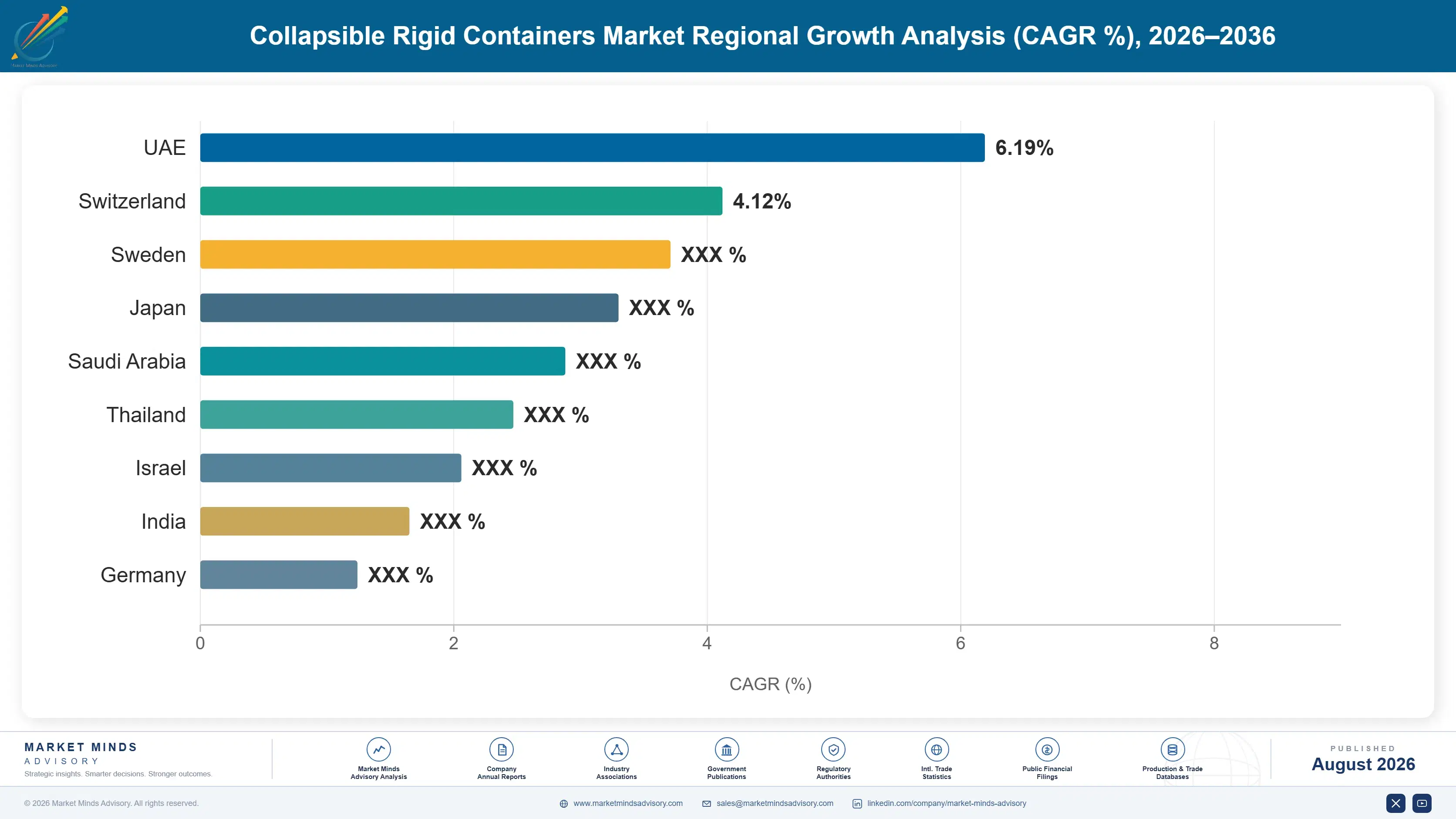
India: 9.4% CAGR
Fastest Growth Region
South Asia and Pacific: 9.2% CAGR
Largest Region
East Asia: 29% of 2025 global value
Market Leaders
Schoeller Allibert, Cabka, Georg Utz Holding, Buckhorn, Myers Industries. Source: MMA Analysis based on company annual reports.
Primary Survey
n=3,800 procurement and R&D decision-makers, Q4 2025, six countries
Methodology
Demand-side build-up, cross-validated against public data, 47 expert interviews

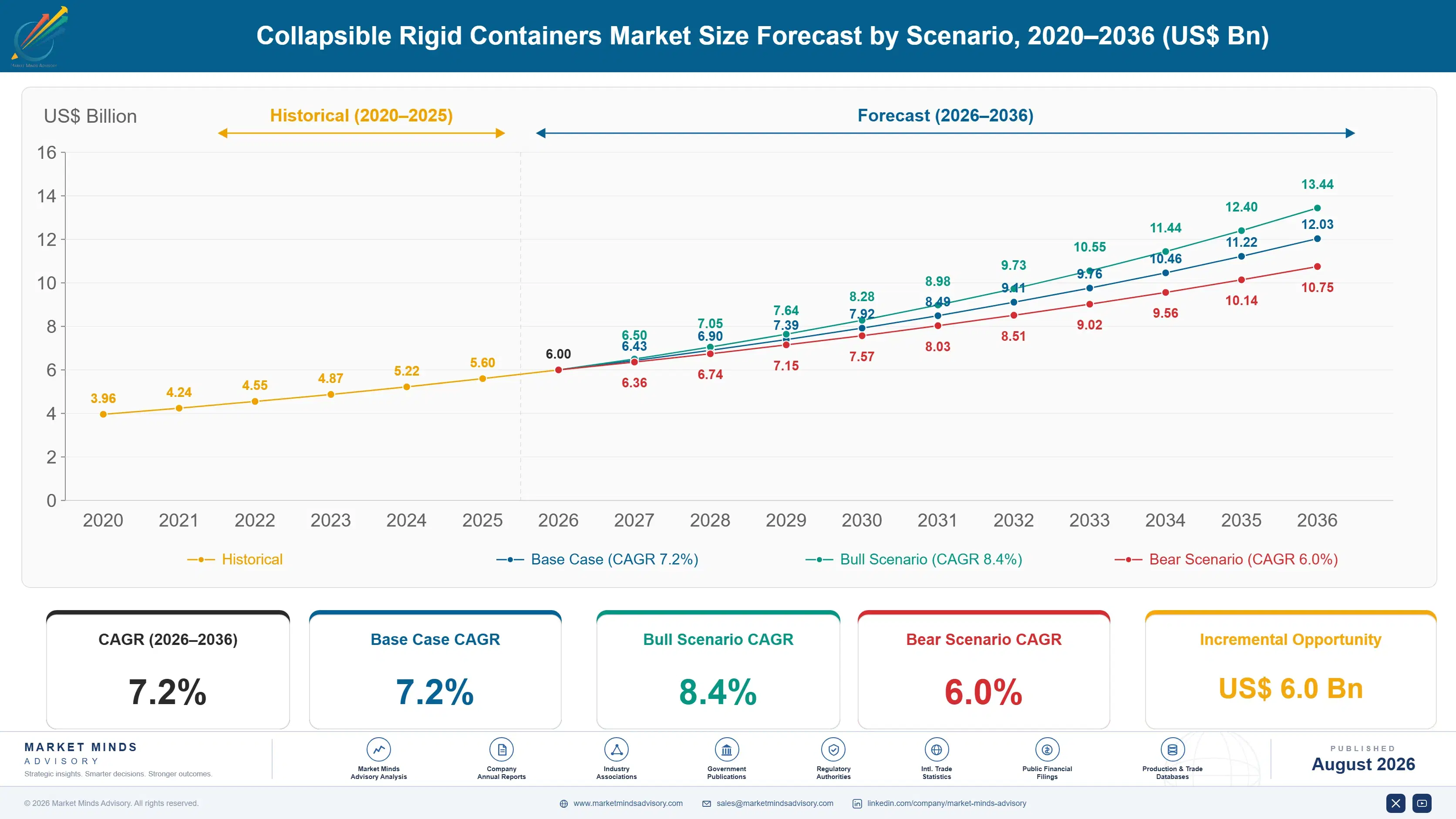
Collapsible Rigid Containers Market Forecast Scenarios

collapsible-rigid-containers-market-size-forecast-scenario-1787300379510
The 2020 to 2025 period ran at 6.2% and resin pricing shaped revenue more than unit volume did. Food and agricultural handling held up well through disruption, while automotive and industrial applications fell sharply and recovered slowly afterward. Buyers who had specified collapsible units purely on freight saving began measuring hinge failure properly, and several reverted to fixed bins.
Three mechanisms carry the 7.2% base case. Liquid intermediate bulk container conversion is the largest, since replacing one-trip composite units with returnable collapsible ones removes a disposal cost as well as a purchase. Food safety cleaning validation is the second, where cleanable folding geometry commands a genuine premium. And agricultural produce handling is the third, driven by cold chain expansion across regions where harvest packaging was previously single use. None depends on any hinge design advance.
The 8.4% bull case rests on hinge designs reaching fixed-bin cycle life, which would remove the one objection that keeps buyers on non-folding units in demanding applications. The 6.0% bear case is resin price weakness combined with a general reversion toward fixed bins in industrial handling, where return distances are short enough that folding saves little anyway.

The Hinge Is the Whole Argument

Every purchase decision in this market starts from the same arithmetic. A collapsible container folds to roughly a quarter of its erected height, which cuts return freight by around 74% against a fixed bin. Buyers run that number, compare it against a purchase price premium near 2.3 times, and calculate a payback period. The calculation is correct as far as it goes and it stops at the wrong place.
FOLDING WALL CYCLE LIFE340 cyclesBefore hinge failure, against roughly triple for fixed bins
RETURN FREIGHT SAVING74%On the empty leg against an equivalent non-folding container
RESIN SHARE OF COGS52%Making revenue follow polymer pricing more than unit demand
PURCHASE PRICE PREMIUM2.3 timesPaid against a fixed bin of equivalent load capacity
TOP FIVE CONCENTRATION31%Low, across moulders, packaging specialists, and pooling operators
WASH CYCLE REJECTION RATE11%Of units failing food contact inspection after validated cleaning
Folding walls carry hinges, and hinges fail. Folding wall life runs near 340 cycles against close to triple that for a fixed bin in the same polymer. Where return legs are frequent and short, the container reaches end of life before the accumulated freight saving covers the price premium. Where legs are long and infrequent, the arithmetic works comfortably. Very few buyers model that distinction before purchasing.
Food contact applications add a second problem that has nothing to do with mechanics. Hinge cavities and folding joints create geometry that validated washing protocols reach unreliably, and roughly 11% of units fail food contact inspection after a standard wash cycle. Designs with sealed hinges and drainable joints carry a premium buyers accept, because the alternative is a rejected batch.
"A produce packer told me their collapsible crates paid back in fourteen months on freight. They also replaced a third of the fleet in that period on broken hinges. Nobody had put those two numbers on the same page."
Principal, Bulk Handling and Returnable Packaging Practice · MMA Industrial Pack

Market Trends

Liquid Bulk Conversion Pulls Growth Away From Dry

Collapsible intermediate bulk containers for liquids grow at 10.8% against 7.2% for the market, and the reason is that they displace one-trip composite units rather than competing against another returnable. Removing a disposal cost alongside a purchase cost makes the payback far stronger than any dry bulk comparison delivers. Chemical, food ingredient, and lubricant shippers are converting the fastest of any user group, and the containers involved carry considerably more engineering content than dry bulk equivalents. A hinge failure on a liquid unit is a spill rather than a replacement, which changes specification entirely.
Market Impact: Return freight falls about 74%
Cleanable Geometry Becomes A Specification Requirement

Food contact users are writing hinge and joint geometry into purchase specifications rather than treating cleaning as an operational matter, after wash cycle rejection rates near 11% proved that folding joints and validated protocols do not sit well together. Sealed hinge designs, drainable cavities, and removable wall systems all address it at a price premium buyers accept. The requirement is spreading from meat and dairy handling into produce and prepared foods, where it barely existed five years ago. Suppliers pricing cleanable geometry at standard margin are giving that advantage away. Revalidation cost is what makes buyers accept the premium.
Market Impact: Segment grows at 10.8%

Market Opportunities and Growth Drivers

Cold Chain Expansion Replaces Single-Use Harvest Packaging

Agricultural produce handling across South and Southeast Asia, Latin America, and parts of Africa is shifting from single-use crates and sacks toward returnable collapsible units as cold chain infrastructure is built out. The driver is loss reduction rather than packaging economics, since produce damaged in transit costs far more than any crate. Collapsible units suit these routes particularly well because return legs are long, infrequent, and run through consolidation points where folded volume matters enormously. Cycle life pressure is also lowest on these routes, which suits a folding format particularly well.
Market Impact: Cycle life near 340 trips

One-Trip Composite Displacement In Liquid Handling

Chemical, lubricant, and food ingredient shippers using one-trip composite intermediate bulk containers carry a purchase cost and a disposal cost on every shipment, and disposal is rising as waste regulation tightens across most jurisdictions. Returnable collapsible units remove both at once, which produces a payback considerably faster than dry bulk conversions achieve. Growth in this segment runs at 10.8% against 7.2% for the market, and it is the clearest displacement story anywhere in this sector. Containment engineering and fitting compatibility also make these accounts considerably stickier than dry bulk. Certification behaves like a switching cost.
Market Impact: About 11% fail inspection

Market Restraints and Challenges

Hinge Failure Undermines The Freight Saving Entirely

Folding walls reach end of life near 340 cycles against roughly triple that for fixed bins, and the root cause is that a hinge concentrates stress into a thin section that flexes under load every single trip. Commercial impact is buyers reverting to fixed bins after their first full replacement cycle, having modelled freight saving without modelling cycle life. Mitigation runs through reinforced hinge sections, replaceable wall panels, and honest cycle life disclosure at the point of sale. Buyers reverting to fixed bins after a first replacement cycle rarely come back afterward.
Market Impact: Liquid segment growing at 10.8%

Folding Joints Fail Food Contact Cleaning Validation

Roughly 11% of units fail food contact inspection after a validated wash cycle, and the root cause is geometry rather than protocol: hinge cavities and folding joints trap material and resist both spray reach and drainage. Commercial impact is rejected batches, revalidation cost, and exclusion from higher-value food applications entirely. Mitigation runs through sealed hinge designs, drainable cavity geometry, and separable wall systems that open fully flat for cleaning access. Food contact users now write hinge and joint geometry directly into purchase specifications. Sealed designs carry a premium accepted without much argument. Revalidation cost is the reason.
Market Impact: Rejection rates reach 11%
4 additional market trends, 3 additional growth drivers, and 2 additional restraints and challenges are covered in the full report. Contact sales@marketmindsadvisory.com to access the complete intelligence.

Segment CAGR and Growth Architecture

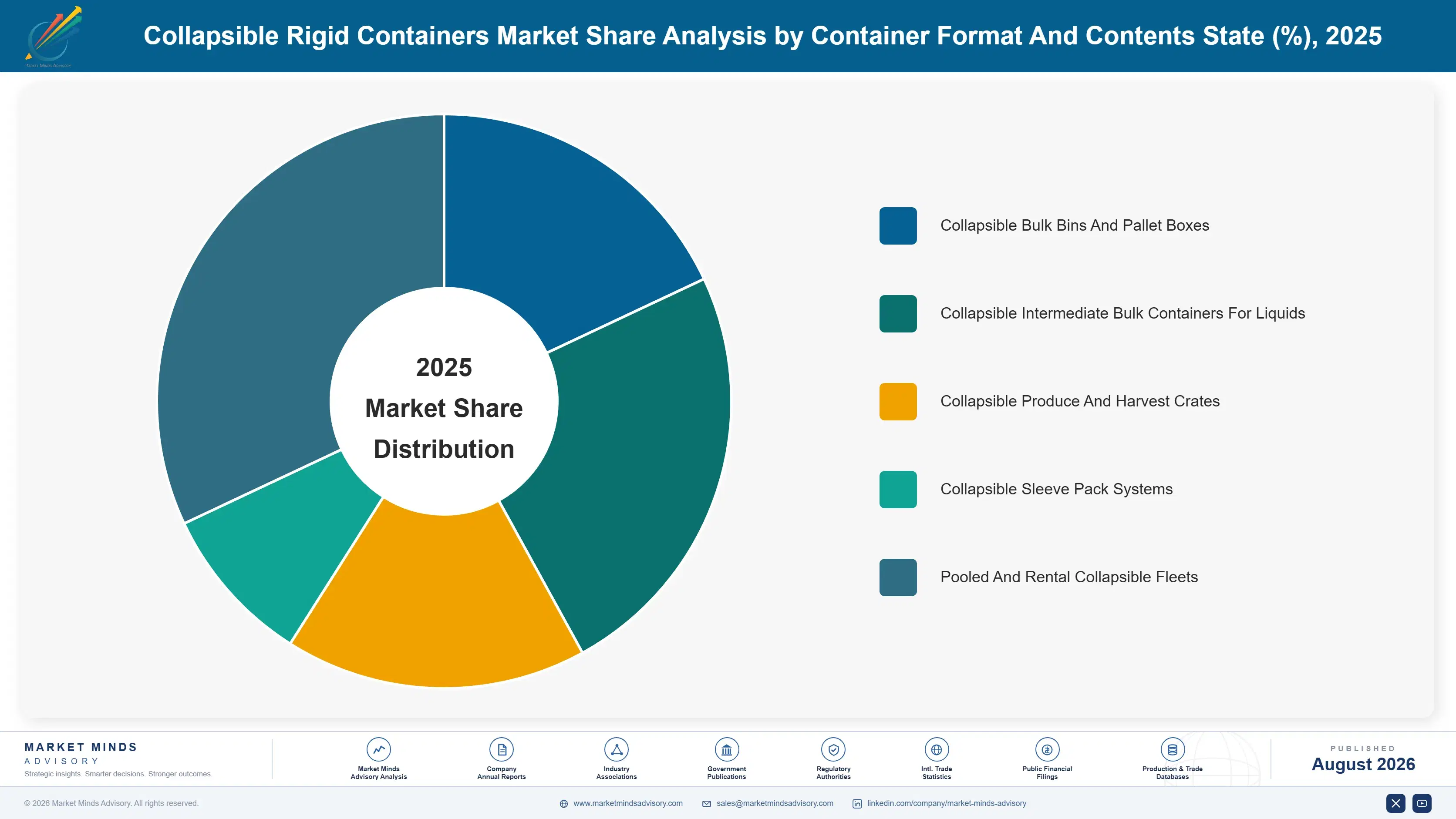
Segmentation here follows the container format and the material state it carries, because those two things together determine wall construction, cleaning requirement, expected cycle life, and what each format actually ends up competing against. The contents state decides the cleaning and the containment requirement outright, which makes end-use industry a considerably weaker primary dimension.
collapsible-rigid-containers-market-market-share-analysis-1787300380044

Collapsible Intermediate Bulk Containers For Liquids

The fastest format at 10.8%, exactly 1.50 times the market rate, and the only one displacing a single-use alternative rather than competing against another returnable. Chemical, lubricant, and food ingredient shippers replacing one-trip composite units remove a disposal cost alongside a purchase cost, which produces payback that dry bulk conversions cannot approach. Engineering content is higher, since liquid containment demands sealed folding joints and defined discharge fittings. Cycle life matters more here too, because a hinge failure on a liquid unit is a spill rather than merely a replacement. Fitting compatibility and containment certification make these accounts considerably stickier than dry bulk handling ever becomes. Disposal cost on composite units continues rising as waste regulation tightens.
CAGR 10.8%

Collapsible Produce And Harvest Crates

Second fastest at 9.0%, driven by cold chain build-out across South and Southeast Asia, Latin America, and parts of Africa where harvest packaging was previously single use. Return legs on these routes are long and infrequent and run through consolidation points, which is exactly the pattern where folded volume pays and cycle life pressure is lowest. Food contact cleaning is the binding constraint rather than mechanics, since roughly 11% of units fail inspection after a validated wash. Drainable joint geometry commands a premium buyers accept without argument. Loss reduction rather than packaging economics drives the conversion, since damaged produce costs far more than any crate. Export markets impose the importing country's food contact rules.
CAGR 9.0%
Full segment breakdown across 5 segments available in the complete report.

Regional Architecture and Country Demand Map

East Asia leads at 29% on food processing and electronics component volume rather than any single programme. Western Europe follows on food safety specification and pooling infrastructure, ahead of North America. South Asia and Pacific grows fastest as cold chain infrastructure replaces single-use harvest packaging.

East Asia

Twenty-nine percent, the largest share, and it rests on the sheer volume of food processing and electronics component handling rather than on any national programme or regulation. Chinese food processing operates returnable crate fleets at enormous scale, and Japanese and Korean electronics supply chains use collapsible bulk formats for component movement between assembly sites. Injection moulding capacity is also concentrated here, which means regional producers supply both domestic demand and export volume. Growth at 8.0% runs above the market rate, driven mainly by continued food processing consolidation and cold chain investment across China. Liquid intermediate bulk conversion is following food processing rather than leading it here. Cleaning specification lags Western European requirements across most domestic applications.
Share: 29% | CAGR: 8.0% (2026 to 2036)

Western Europe

Food safety specification rather than volume explains this 23%. German, Dutch, French, and Nordic food handling regulations pushed cleanable geometry into purchase specifications years before other regions considered it, and the region consequently buys the higher engineering content formats. Pooling infrastructure is also mature, with third-party crate pools operating across national borders in produce and meat handling. That maturity limits headroom: fleet populations already match throughput. Growth at 5.6% is the slowest here, reflecting replacement demand rather than any expansion of the installed base. Cross-border pool operation also means container populations are managed rather than merely owned. Higher engineering content formats therefore carry a larger revenue share here than anywhere else. Replacement dominates new fleet build.
Share: 23% | CAGR: 5.6% (2026 to 2036)
Regional intelligence for 5 additional markets available in the complete report: North America, South Asia and Pacific, Latin America, Middle East and Africa, Eastern Europe. Contact sales@marketmindsadvisory.com.
collapsible-rigid-containers-market-country-cagr-analysis-1787300380560

Selling Cycle Life Not Folded Volume

Folding walls fail near 340 cycles, freight falls about 74%, resin carries 52% of cost of goods sold, and 11% of units fail food contact inspection after washing. Value comes from selling total cost across cycle life, from cleanable geometry, from replaceable panels, and from indexing resin exposure. Route length decides whether a folding format pays at all.

Quote Total Cost Across Actual Cycle Life

Buyers model a 74% freight saving against a purchase premium near 2.3 times and stop there, which produces a payback figure that ignores hinge failure near 340 cycles entirely. A supplier quoting total cost across realistic cycle life loses some deals on short return legs and wins durably on long ones, because the customer who buys on honest arithmetic does not revert to fixed bins two years later. Reversion after the first replacement cycle is the largest single source of lost accounts here. Route length is the single variable that decides whether this format pays.
Market Impact: Cycle life sits near 340 folding trips only

Engineer Hinges For Replacement Not For Life

A hinge that lasts 340 cycles inside a container body good for triple that is a replaceable component being treated as a permanent one. Designs with field-replaceable wall panels or hinge assemblies convert an end-of-life event into a maintenance transaction, extending fleet life and creating aftermarket revenue priced well above the component cost. Customers value it because the capital they were budgeting for replacement gets deferred, and the supplier keeps an account it would otherwise have lost. Container bodies routinely outlast their hinges by a factor of three. Aftermarket panel revenue prices well above component cost.
Market Impact: Panels extend life beyond the 340 cycle limit

Charge Properly For Cleanable Joint Geometry

Roughly 11% of units fail food contact inspection after a validated wash cycle because hinge cavities and folding joints trap material and resist drainage. Sealed hinges, drainable cavities, and separable wall systems solve it and carry a genuine premium buyers accept without much argument, since the alternative is a rejected batch and a revalidation. Suppliers pricing cleanable geometry at standard margin are giving away the one attribute food handling buyers will not compromise on. The requirement is spreading from meat and dairy into produce and prepared foods. Sealed hinge designs and drainable cavities both address it directly.
Market Impact: Roughly 11% of units fail a cleaning inspection

Index Resin Exposure Out Of Multi-Year Agreements

Resin carries around 52% of cost of goods sold, so multi-year supply agreements at fixed prices convert every polymer increase directly into margin loss. Indexation against a published polymer benchmark moves that exposure to a customer generally better placed to absorb it and frequently indexing their own contracts already. Buyers resist the clause until the alternative is explained, which is several years of material risk priced defensively into the opening quote instead. Polyolefin movement through 2021 and 2022 demonstrated that exposure plainly enough. European moulding energy cost compounded it further. Indexed clauses have spread considerably since.
Market Impact: Resin carries about 52% of cost of goods

Who Controls the Margin Pool

Concentration is low at 31% across the top five measured on annual container units shipped, and the fragmentation reflects genuinely different business models rather than a market waiting to consolidate. Injection moulders compete on tooling scale and resin buying, returnable packaging specialists compete on format engineering and cleaning performance, and pooling operators compete on fleet management. The leader to challenger gap is narrow enough that a single large food processing or retail fl
Competitive activity runs on three fronts. Hinge and joint engineering is the first and least visible, since cycle life and cleanability both trace back to it and neither shows up in a product photograph. Tooling investment is the second, because collapsible formats need considerably more complex moulds than fixed bins and the capital is not recoverable across low volumes. Pooling and fleet service capability is the third.

Pressure comes from two directions. Fixed bin suppliers keep winning back short return leg applications where folding saves too little to justify the premium. And flexible bulk bag producers take liquid and powder volume wherever return logistics are impractical.

Rankings shift on large retail and food processing fleet awards.
collapsible-rigid-containers-market-company-positioning-matrix-1787300381072

Competitive Moat and Risk Dimensions

SCHOELLER ALLIBERT

Moat: Format breadth and tooling scale

Carrying collapsible formats across produce crates, bulk bins, liquid containers, and sleeve pack systems lets a supplier answer a whole handling specification rather than one line of it, which matters when a food processor standardises across product streams. Tooling investment across that range is substantial and unrecoverable at low volume, so the position resists attack.
SCHOELLER ALLIBERT

Risk: Tooling capital limits format agility

Heavy tooling investment across many formats makes responding to a changed hinge or joint specification slow and expensive, since new geometry means new moulds rather than a process adjustment. Competitors with narrower ranges can retool faster against an emerging cleaning requirement. Format breadth and format agility pull against each other in a business this capital intensive.
CABKA

Moat: Recycled polymer processing capability

Manufacturing collapsible containers from recycled polymer at consistent mechanical performance is genuinely difficult, since hinge sections demand predictable material properties that mixed recyclate rarely delivers. A producer holding that capability meets recycled content requirements competitors satisfy only by buying virgin resin. Resin carries roughly 52% of cost of goods sold, so the advantage is material.
CABKA

Risk: Recyclate quality constrains hinge design

Recycled polymer variability limits how thin and how highly stressed a hinge section can be designed, which caps achievable cycle life against virgin material equivalents. In applications where 340 cycle life is already the binding objection, that constraint bites directly. Sustainability positioning and mechanical performance therefore trade against each other in exactly the wrong place.

Key Players

Schoeller Allibert
Cabka
Georg Utz Holding
Buckhorn
Myers Industries

Others

Brambles
SSI Schaefer
Rehrig Pacific
IFCO Systems
Craemer Group
Bito Lagertechnik
Suzhou Dasen
Nilkamal
Supreme Industries
Sintex Plastics
Kyoraku
Sanko
Tri-Pack Plastics
Wanzl
K. Hartwall

Recent Developments

FEBRUARY 2025

Food processor specifies sealed hinge geometry across crate fleet

A large food processing group rewrote its returnable crate specification to require sealed hinge cavities and drainable folding joints, following wash cycle rejection rates it judged unacceptable. The change was a procurement specification revision rather than any joint venture, acquisition, or development agreement with a container supplier.
Signal: Cleaning geometry has moved from an operational concern into a purchasing specification requirement across food handling.
MAY 2025

Chemical shipper converts one-trip composite fleet to returnables

A specialty chemical shipper replaced one-trip composite intermediate bulk containers with returnable collapsible units across several product lines, citing rising disposal cost alongside purchase cost. The conversion was an internal procurement decision rather than any joint venture, acquisition, or equity arrangement with the container manufacturer involved.
Signal: Removing disposal cost alongside purchase cost is what makes liquid conversion pay so quickly against dry bulk.
SEPTEMBER 2025

Manufacturer launches field-replaceable folding wall panels

A container manufacturer introduced collapsible bulk bins with folding wall panels replaceable in the field without tooling, addressing hinge failure well ahead of container body end of life. The launch was organic product development rather than any acquisition, joint venture, or licensing arrangement with another manufacturer.
Signal: Treating the hinge as a consumable turns an end-of-life event into a maintenance transaction and retains the account.

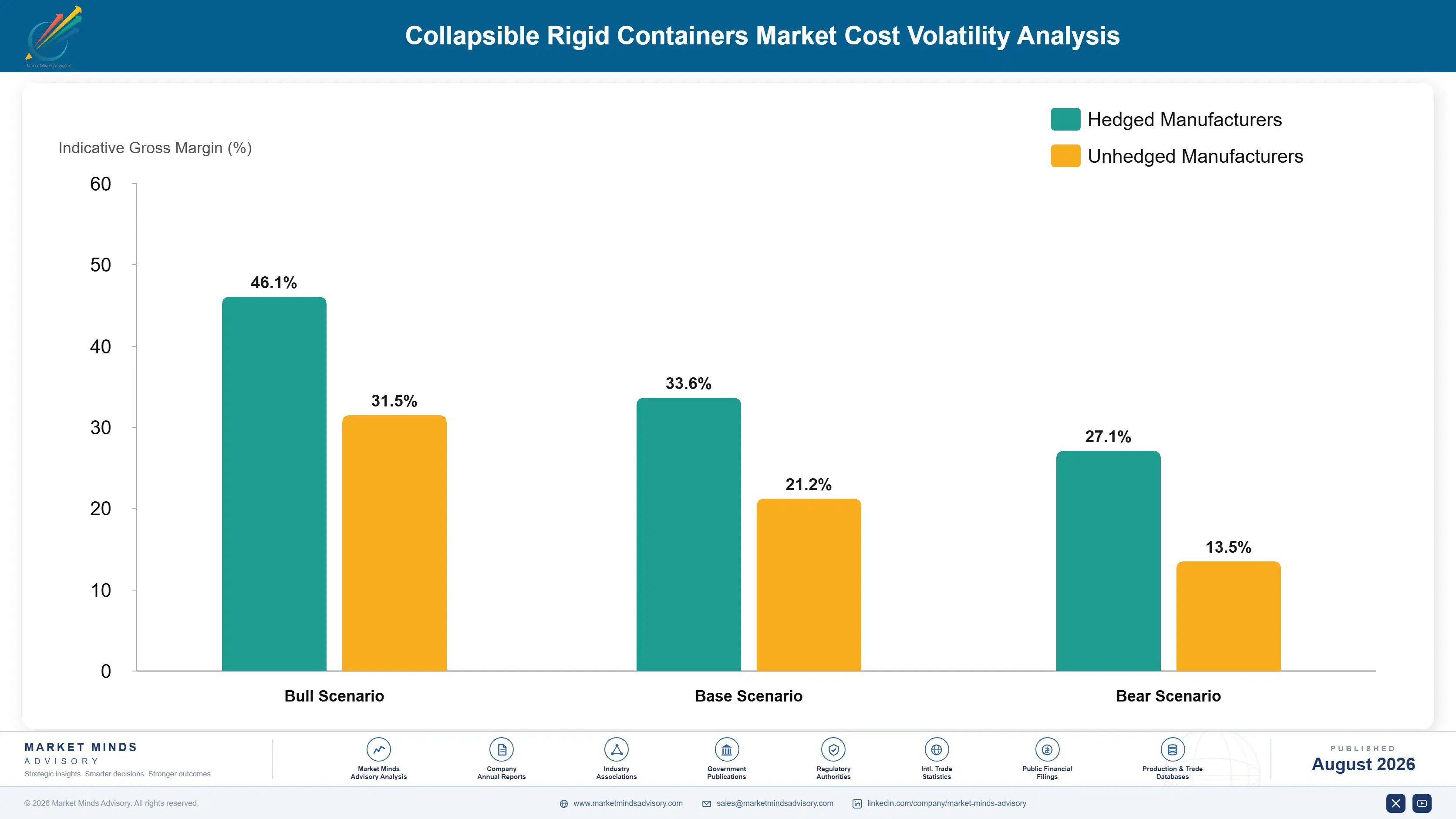
Resin, Tooling and Moulding Energy

Polymer resin carries roughly 52% of cost of goods sold, predominantly high-density polyethylene and polypropylene sourced regionally, since freight on resin pellets makes distant sourcing uneconomic at this material intensity. Moulding energy adds about 14%, tooling amortisation near 12%, hinge and latch hardware around 7%, and labour, finishing, and freight the balance. Material dominance means revenue tracks polymer pricing considerably more closely than unit demand.
Polyolefin pricing moved sharply through 2021 and 2022 across North American and European markets, and container producers holding multi-year fixed-price agreements with food processors and retailers absorbed the increase directly into margin. Several disclosed the compression in annual filings for those years. Energy cost for moulding rose simultaneously across European operations, compounding the effect, and indexed pricing clauses have become considerably more common since. Recovery required renegotiation that customers resisted.

The competitive disadvantage mechanism runs through resin sourcing quality rather than through purchasing scale. Producers using recycled polymer face material variability that constrains hinge section design and therefore cycle life, while virgin resin users pay more and achieve better mechanical performance. Regional exposure differs too, since European energy pricing for moulding operations sits well above North American and Asian equivalents and has done so persistently.
collapsible-rigid-containers-market-cost-volatility-analysis-1787300381267

Index multi-year agreements to a published polymer benchmark

Resin carries around 52% of cost of goods sold here, and multi-year food processing and retail agreements at fixed prices convert every polyolefin increase directly into margin loss. Indexation against a published polymer benchmark transfers that exposure to a customer who generally indexes their own input contracts already. Buyers resist at first and then accept.

Reserve virgin resin for hinge sections specifically

Recycled polymer variability constrains how thin and how highly stressed a hinge section can be designed, which caps achievable cycle life in exactly the application where cycle life is already the binding commercial objection. Using virgin material in hinge sections while running recyclate through wall and base panels holds performance and meets content requirements.

Site moulding capacity against regional energy pricing

Moulding energy carries around 14% of cost of goods sold, and European electricity pricing has sat persistently above North American and Asian equivalents rather than moving cyclically. Producers with capacity concentrated in high-cost energy regions carry a permanent disadvantage on standard formats. Higher engineering content formats absorb that difference and commodity crates do not, which should drive siting decisions directly.

Portfolio Architecture for Margin Defence

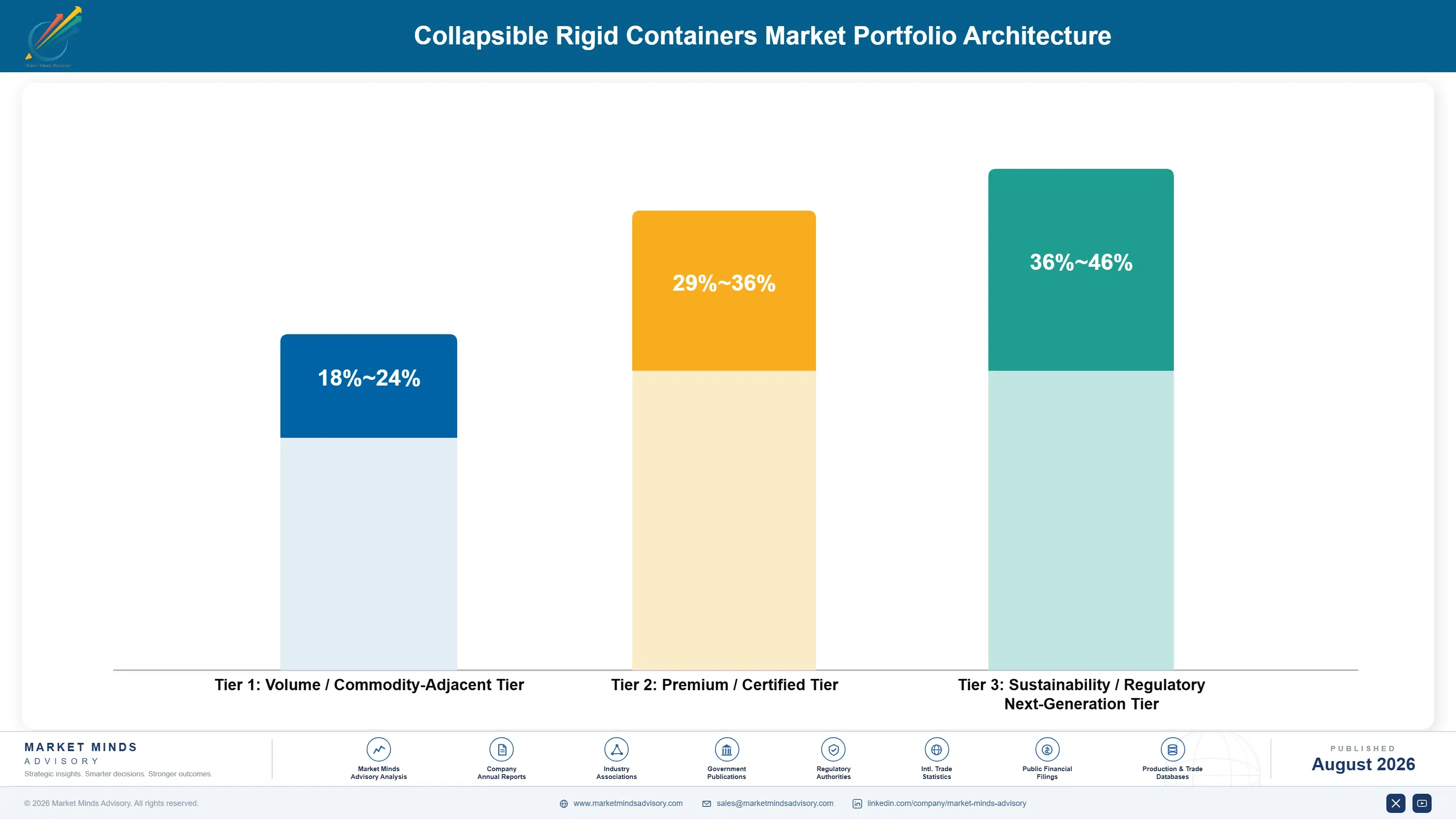
Three tiers describe this business and the spread between them is set by engineering content rather than by size. Standard collapsible bulk bins and produce crates sit at the bottom, competing on price against regional moulders with resin at 52% of cost leaving little room. Cleanable food contact formats occupy the middle. Liquid intermediate bulk containers and pooled fleet services sit at the top, where containment engineering and service pricing both apply.
The tension is that volume crates build the tooling scale and the customer base that make higher formats sellable, while the higher formats carry the margin. Producers chasing volume alone found themselves competing against regional moulders on resin buying, which is not a contest tooling scale wins. Those leading with engineered formats struggled to reach the volumes tooling amortisation demands. Durable positions carry both, generally across shared tooling platforms.

High-value pools concentrate where failure is expensive rather than merely inconvenient. Liquid containment is the clearest case, since a hinge failure there is a spill and a clean-up rather than a replacement unit. Food contact formats pool value similarly, because a validated geometry is not revalidated casually for a price difference. Both pools sit well above volume crate margins.

Volume / Commodity-Adjacent Tier

Standard collapsible bulk bins and produce crates competing on price against regional moulders. Resin at roughly 52% of cost of goods sold leaves limited room between polymer price and customer price, and tooling scale advantage is smaller than producers expect.
Gross Margin: 18-24%

Premium / Certified Tier

Cleanable food contact formats with sealed hinge cavities and drainable joints, addressing wash cycle rejection near 11%. Buyers accept the premium without much argument, since the alternative is a rejected batch and a costly revalidation exercise.
Gross Margin: 29-36%

Sustainability / Regulatory / Next-Generation Tier

Liquid intermediate bulk containers and pooled fleet services, where containment engineering and circulation pricing both apply. Best margin by a clear distance, and the fastest growing position because it displaces single-use composite units rather than other returnables.
Gross Margin: 36-46%
collapsible-rigid-containers-market-portfolio-architecture-1787300381759

High-value Sub-segments and Strategic Watch-out

Liquid Intermediate Bulk Containers

Fastest growth at 10.8%, exactly 1.50 times the market rate, displacing one-trip composite units rather than competing against other returnables. Removing disposal cost alongside purchase cost produces payback dry bulk conversions cannot approach at any specification. Containment engineering and discharge fitting design both support the pricing throughout.
Gross Margin: 36-46%

Cleanable Food Contact Formats

Strong growth on sealed hinge and drainable joint geometry, addressing the roughly 11% of units failing food contact inspection after validated washing. Premium pricing holds because buyers face rejected batches and revalidation cost as the alternative. Validated geometry also behaves as a genuine switching cost.
Gross Margin: 29-36%

Standard Bulk Bin And Crate Volume

The volume core, competing on price against regional moulders where resin at 52% of cost dominates the comparison. Still builds the tooling scale and customer base that higher engineering formats depend on commercially, and margin remains under steady pressure. Tooling scale advantage is smaller than producers expect.
Gross Margin: 18-24%

Short Return Leg Industrial Applications

The strategic watch-out, since folding saves too little freight on short legs to cover hinge failure near 340 cycles. Fixed bin suppliers keep winning these applications back, and buyers reverting after a replacement cycle rarely return afterward. Honest route length qualification is the only real defence.
Gross Margin: 18-24%

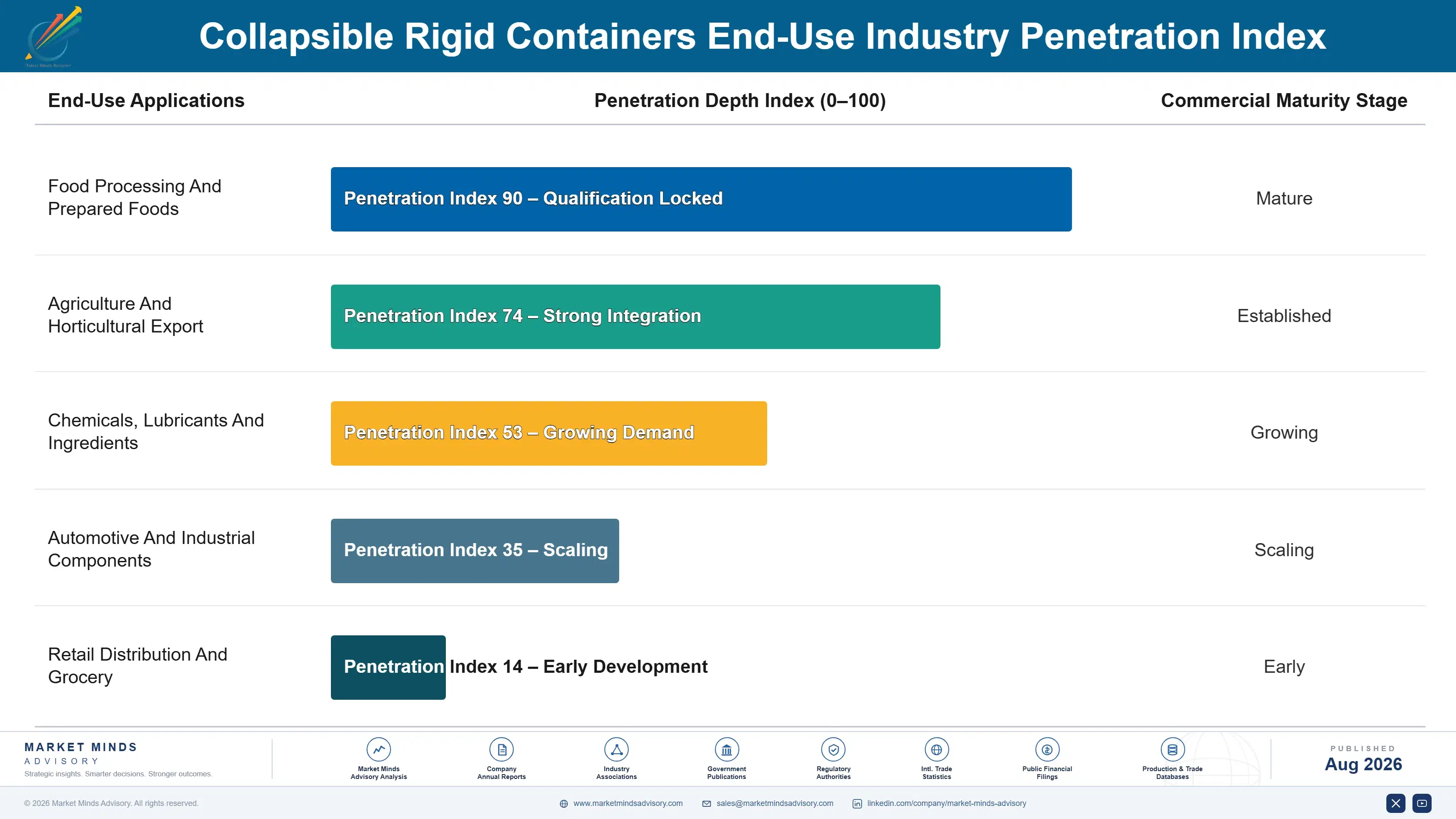
Fleet Build and Replacement

Revenue splits between initial fleet build and the replacement stream underneath it, and the second is where account economics actually sit. Fleet builds are competitive, tendered, and priced accordingly. Replacement driven by hinge failure near 340 cycles arrives steadily and largely without tender, which makes it considerably more valuable per unit. The awkward consequence is that a supplier's best revenue comes from the failure mode buyers most object to.
Stickiness varies sharply by application depth. Food contact users who have validated a specific container geometry against their cleaning protocol will not revalidate casually for a price difference, and that qualification behaves like a switching cost. Liquid containment users are similarly locked by fitting compatibility and containment certification. General industrial bulk handling sticks hardly at all and is retendered on price routinely.

Buyer profiles shifted as purchasing moved from plant operations toward central packaging and food safety functions. The earlier buyer compared freight saving against purchase price. The current one asks for cycle life data, cleaning validation evidence, and replacement cost modelling before committing to anything. Cleaning validation evidence has become a qualifying document in food handling tenders. Plant operations still influence the choice and no longer decide it.
collapsible-rigid-containers-market-end-use-penetration-index-1787300382247

What We Would Tell a Board

These are among the four positions where our research anticipates prominent divergence between winners and laggards over the coming forecast period. Each is grounded in the demand model, the regulatory perimeter, and the announced capacity pipeline.
01 / CYCLE LIFE HONESTY

Quote replacement cost or lose the account later

Buyers model a 74% freight saving against a purchase premium near 2.3 times and stop there, which produces a payback number that ignores hinge failure near 340 cycles altogether. A supplier quoting total cost across realistic cycle life loses some short-leg deals and wins durably on long ones, because customers who buy on honest arithmetic do not revert to fixed bins two years afterward. Reversion to fixed bins after a first replacement cycle is the largest single source of lost accounts anywhere in this market.
02 / HINGE COMPONENT STRATEGY

Design the hinge as a consumable, not a permanent part

A hinge lasting around 340 cycles inside a container body good for roughly triple that is a replaceable component being treated as a permanent one throughout the industry. Field-replaceable wall panels and hinge assemblies convert what is an end-of-life event into a routine maintenance transaction, extending fleet life while creating aftermarket revenue priced well above component cost. Customers value it because replacement capital they had already budgeted simply gets deferred, and the supplier retains an account it would otherwise have lost outright.
03 / FOOD CONTACT PREMIUM

Price cleanable geometry as the differentiator it is

Roughly 11% of units fail food contact inspection after a validated wash cycle, because hinge cavities and folding joints trap material and resist both spray reach and proper drainage. Sealed hinges, drainable cavities, and separable wall systems all solve that problem, and they carry a premium that food handling buyers accept without very much argument at all. Suppliers who price cleanable geometry at standard margin are giving away the single attribute that those buyers will not compromise on at any price.
04 / POLYMER COST INDEXATION

Fixed multi-year pricing hands you every resin increase

Resin carries around 52% of cost of goods sold, so a multi-year food processing or retail agreement at fixed prices converts each polyolefin increase directly into margin loss with no recovery mechanism at all. Indexation against a published polymer benchmark moves that exposure onto a customer who is generally indexing their own input contracts already. Buyers resist the clause until the alternative is explained properly, which is several years of material price risk priced defensively into the opening quote instead.

Engagement Snapshot From the Field

A live engagement with an industry participant carrying material or product regulatory and market exposure ahead of a defining policy shift, showing how our research translates into a defensible multi-year portfolio strategy.
MARKET MINDS ADVISORY · CLIENT ENGAGEMENT SUMMARY
Collapsible Rigid Containers Producer Strategic Portfolio Review and Transition Roadmap 2026·Investment Scenario on Collapsible Rigid Containers Exposure Evaluation 2025-26
CLIENT PROFILE
A returnable plastic packaging producer with approximately 210 million dollars in annual revenue (client-reported, unverified by MMA), manufacturing collapsible bulk bins and produce crates across food, agricultural, and general industrial customers in two regions. Volume formats carried most of the revenue, engineered formats were a small share, and customer retention had weakened in agricultural handling accounts over three years.
STRATEGIC CHALLENGE
Management read the retention problem as price competition from lower-cost regional moulders and proposed a defensive price reduction across volume crate lines. The board wanted independent evidence on why customers were leaving before committing to a move that would remove most of the remaining margin on the largest part of the business.
MMA APPROACH
We analysed lost accounts against application route length, replacement order history, and whether each customer had moved to a competitor or reverted to fixed bins. Warranty and field failure records were reviewed for hinge failure patterns by format. Food contact customers were interviewed separately on cleaning validation experience, and engineered format margins were benchmarked against volume lines.
KEY FINDINGS
  1. The majority of lost agricultural accounts had reverted to fixed bins rather than moving to a competing collapsible supplier, which pointed away from price competition entirely.
  2. Reverting accounts shared short return legs where folded volume saved too little freight to cover the observed rate of hinge replacement over time.
  3. Field failure records showed hinge sections failing well before container bodies across every format, with no replaceable panel option offered anywhere in the range.
  4. Food contact customers reported wash cycle rejection consistent with market norms, and engineered cleanable formats carried gross margins far above volume lines.
CLIENT PROFILE
A returnable plastic packaging producer with approximately 210 million dollars in annual revenue (client-reported, unverified by MMA), manufacturing collapsible bulk bins and produce crates across food, agricultural, and general industrial customers in two regions. Volume formats carried most of the revenue, engineered formats were a small share, and customer retention had weakened in agricultural handling accounts over three years.
STRATEGIC CHALLENGE
Management read the retention problem as price competition from lower-cost regional moulders and proposed a defensive price reduction across volume crate lines. The board wanted independent evidence on why customers were leaving before committing to a move that would remove most of the remaining margin on the largest part of the business.
MMA APPROACH
We analysed lost accounts against application route length, replacement order history, and whether each customer had moved to a competitor or reverted to fixed bins. Warranty and field failure records were reviewed for hinge failure patterns by format. Food contact customers were interviewed separately on cleaning validation experience, and engineered format margins were benchmarked against volume lines.
KEY FINDINGS
  1. The majority of lost agricultural accounts had reverted to fixed bins rather than moving to a competing collapsible supplier, which pointed away from price competition entirely.
  2. Reverting accounts shared short return legs where folded volume saved too little freight to cover the observed rate of hinge replacement over time.
  3. Field failure records showed hinge sections failing well before container bodies across every format, with no replaceable panel option offered anywhere in the range.
  4. Food contact customers reported wash cycle rejection consistent with market norms, and engineered cleanable formats carried gross margins far above volume lines.
RECOMMENDED STRATEGY
Phase 1: Phase 1 (months one to six): cancel the price reduction and requalify the pipeline by route length, declining short-leg opportunities the format cannot serve. Phase 2: Phase 2 (months six to eighteen): develop field-replaceable wall panels across the main volume formats and launch an aftermarket replacement offer. Phase 3: Phase 3 (months eighteen to thirty-six): expand cleanable food contact formats and shift mix deliberately toward liquid intermediate bulk containers.
OUTCOME
The price reduction was cancelled. Requalifying the pipeline by route length reduced quoted volume and improved win rates materially within two quarters, replaceable panel development entered tooling within three, and the first aftermarket panel revenue arrived ahead of the internal plan (client-reported, unverified by MMA).

Frequently Asked Questions

Foundational context covering the market sizes, CAGR, scope, country, region and competition that inform every finding below. This section is provided to cover basics and most often pre-purchase conversations, answered from the MMA Primary Research Dataset.

What is the current size of the Collapsible Rigid Containers Market?

The market is valued at USD 5.6 billion in 2025, rising to USD 6.0 billion in 2026. Scope covers rigid collapsible bulk containers and pooled fleets, but not flexible bulk bags, steel folding stillages, or small totes.

How large will the Collapsible Rigid Containers Market be by 2036?

MMA forecasts USD 12.03 billion by 2036, an increase of USD 6.03 billion over the 2026 base. That represents an expansion multiple of 2.01 times across the forecast period.

What is the CAGR for the Collapsible Rigid Containers Market 2026 to 2036?

The base case CAGR is 7.2%, with a bull case of 8.4% and a bear case of 6.0%. The historical rate from 2020 to 2025 was 6.2%, shaped more by resin pricing than by unit volume.

Which segment is growing fastest?

Collapsible intermediate bulk containers for liquids at 10.8%, exactly 1.50 times the market rate. They displace one-trip composite units, removing a disposal cost alongside a purchase cost.

Who are the major companies in the Collapsible Rigid Containers Market?

Schoeller Allibert, Cabka, Georg Utz Holding, Buckhorn, and Myers Industries lead on annual container units shipped. The top five hold only 31%, across moulders, packaging specialists, and pooling operators.

Which country is growing fastest?

India at 9.4%, where cold chain infrastructure is being built where none existed and harvest packaging moves straight from sacks to returnable collapsible units. Long consolidation routes suit the format particularly well.

Report Segmentation Architecture

The full report scope spans multiple orthogonal segmentation dimensions, with cross-tabulated demand data provided for each dimension pair. Coverage extends further to regional breakdowns, trend trajectories, and the competitive detail needed to support segment-level decision-making.

By Container Format And Contents State

  • Collapsible Bulk Bins And Pallet Boxes
  • Collapsible Intermediate Bulk Containers For Liquids
  • Collapsible Produce And Harvest Crates
  • Collapsible Sleeve Pack Systems
  • Pooled And Rental Collapsible Fleets

By End-Use Industry

  • Food Processing And Prepared Foods
  • Agriculture And Horticultural Export
  • Chemicals, Lubricants And Ingredients
  • Automotive And Industrial Components
  • Retail Distribution And Grocery

By Commercial Model

  • Outright Purchase By End User
  • Pooled Fleet Service Per Trip
  • Long-Term Rental And Leasing
  • Aftermarket Panel And Component Supply
  • Contract Moulding For Third Party Brands

By Region

  • East Asia
  • Western Europe
  • North America
  • South Asia and Pacific
  • Latin America
  • Middle East and Africa
  • Eastern Europe

Scope, Methodology, and Coverage

Every figure in this report is reproducible from documented input assumptions. The scope below maps the historical period, the forecast horizon, the segmentation dimensions, and the countries covered, alongside the underlying primary and qualitative methodology.
Historical Period
2020 to 2025
Forecast Period
2026 to 2036
Base Year
2025 (USD billions; MMA Primary Research Dataset, August 2026)
Market Definition
This market comprises rigid collapsible containers used for bulk industrial and agricultural handling, measured at manufacturer and service provider revenue across container sales, rental, and pooled fleet arrangements. Coverage spans collapsible bulk bins and pallet boxes, collapsible intermediate bulk containers for liquids, collapsible produce and harvest crates, collapsible sleeve pack systems with separable walls, and pooled or rental collapsible container fleets. Fixed non-collapsible bulk containers, flexible intermediate bulk bags, steel folding containers and stillages, stackable totes below fifty litres, corrugated bulk packaging, and pallets sold independently fall outside scope.
Quantitative Units
USD billions (current prices); container units shipped annually; deployed fleet size; folding wall cycle life and replacement rates
Segmentation Dimensions
By Container Format And Contents State; By End-Use Industry; By Commercial Model; By Region
Regions Covered
East Asia, Western Europe, North America, South Asia and Pacific, Latin America, Middle East and Africa, Eastern Europe
Countries Covered
China, Japan, South Korea, Germany, Netherlands, France, Spain, Italy, United States, Canada, Mexico, Brazil, Chile, Peru, India, Thailand, Vietnam, Australia, Poland, Romania, Saudi Arabia, South Africa, Kenya, and additional markets relevant to this sector
Key Companies Profiled
Schoeller Allibert, Cabka, Georg Utz Holding, Buckhorn, Myers Industries, Brambles, SSI Schaefer, Rehrig Pacific, IFCO Systems, Craemer Group, Bito Lagertechnik, Suzhou Dasen, Nilkamal, Supreme Industries, Sintex Plastics, Kyoraku, Sanko, Tri-Pack Plastics, Wanzl, K. Hartwall
Quantitative Methodology
Primary survey, n=3,800 respondents, Q4 2025, six countries; demand-side model with trade association cross-validation
Qualitative Methodology
47 expert interviews, Q4 2025; applied to validate demand model assumptions, identify emerging dynamics, and assess competitive positioning
Report Format
PDF and XLSX data workbook (Word format preview document)
Publisher
Market Minds Advisory
Report Code
MMA-2026-PAC-574
Published
August 2026
Contact
sales@marketmindsadvisory.com | www.marketmindsadvisory.com

Purchase the full Collapsible Rigid Containers Market Report (2026 to 2036).

The full report sizes collapsible rigid containers across five formats, five end-use industries, five commercial models, and seven regions, with hinge cycle life and replacement rates quantified separately from shipment volume. Return leg length is analysed against payback, since that single variable determines whether a collapsible format pays at all or drives a customer back toward fixed bins. Food contact cleaning validation performance is assessed by joint geometry. Competitive profiling covers twenty companies on annual container units shipped. Resin cost pass-through is analysed by contract structure.
Hinge cycle life quantified separately from shipment volume
Return leg length analysed against total cost payback
Cleaning validation performance assessed across joint geometries
Resin cost pass-through analysed by contract structure type
Liquid container conversion economics modelled against composite alternatives
Aftermarket panel replacement economics benchmarked across major formats

Built For The People Who Decide

From boardroom strategy to bench-side execution, this report is read cover-to-cover by leaders shaping the next decade of their industry, turning demand scenarios, market dynamics and valuation benchmarks into decisions.
CXOs/ Presidents/ VPs/ Managers
M&A and Corporate Development
Strategy Teams and R&D Heads
Procurement and Product Directors
Regulatory and Compliance Leaders
Investor Relations and Equity Analysts