Market Minds Advisory
Cold Relief Roll-On Market

Cold Relief Roll-On Market: Applicator Format Economics in a Category Built Outside the West

A remedy format invented for humid climates and cash-poor purchase occasions, where the applicator rather than the active ingredient carries the pricing power and the Western brand owners all arrived late.

Lead Analyst

Alice Ballenger

Published

September 2026

Make Smarter Decisions with Customized Research Insights

Request a free sample report and evaluate market opportunities, growth trends, and competitive dynamics relevant to your business needs.

2025 MARKET VALUE$0.4BMarket Size 2025
2036 FORECAST VALUE$0.8BBase Case , 2026 to 2036
CAGR 2026 TO 20366.4 %Bull 7.6% / Bear 5.2%
INCREMENTAL OPPORTUNITY$0.4BNet 10- year value creation
EXPANSION MULTIPLE1.86x2036 value over 2026 base
Strategic Levers
M&A Pipeline
Regional Outlook
Country Rankings
Competitive Intelligence
Segmental Deep-dive
Call-Us : 91 93563 13602

Executive Snapshot and Market Trajectory

Nearly two thirds of global value sits in South and Southeast Asia, and that is not an emerging market story. The roll-on cold remedy was designed there, for humid climates, small wallets, and a purchase occasion that Western retail never really had. Western brand owners arrived decades later.
Growth comes from format substitution rather than from more colds. Buyers moving off jar balms and loose inhalant sticks want something that does not coat the fingers, survives a handbag, and can be used in an office without ceremony. Ayurvedic and multi-botanical formulations grow fastest at 9.6%, roughly 1.50 times the market rate, because herbal positioning commands a price premium that plain menthol never has. India alone drives close to a third of incremental value.
Concentration reaches 58% across the top five, but the leaders are regional consumer health houses rather than the global pharmaceutical brands that dominate oral cold remedies. Applicator tooling and fragrance formulation decide preference more than active chemistry does, since the actives themselves are unpatentable and identical everywhere. Regulatory classification varies wildly by country, and that fragmentation protects incumbents more effectively than any patent could.
Market Definition
This market covers topical roll-on applicators formulated for symptomatic relief of cold, congestion, and blocked nose, sold through pharmacy, general trade, and modern retail. Scope includes menthol, camphor, eucalyptus, herbal, and combination formulations in roll-on delivery format only. Jar balms, chest rub creams, inhalant sticks, nasal sprays, oral remedies, and adhesive patches are excluded.
Base Year Value
$0.4B in 2025 (MMA Primary Research Dataset, August 2026)
Forecast Period
2026 to 2036, eleven discrete annual values
CAGR
6.4% base case. Bull 7.6%. Bear 5.2%.
Fastest Growth Segment
Ayurvedic And Multi-Botanical Roll-Ons: 9.6% CAGR
Fastest Growth Country
India: 9.8% CAGR
Fastest Growth Region
South Asia and Pacific: 8.4% CAGR
Largest Region
South Asia and Pacific: 41% of 2025 global value
Market Leaders
Procter and Gamble. Amrutanjan Health Care. Haw Par Corporation. Emami. Dabur India. Source: MMA Analysis based on company annual reports.
Primary Survey
n=3,800 procurement and R&D decision-makers, Q4 2025, six countries
Methodology
Demand-side build-up, cross-validated against public data, 47 expert interviews

Cold Relief Roll-On Market Forecast Scenarios

cold-relief-roll-on-market-size-forecast-scenario-1787298704383
The 2020 to 2025 period was distorted at both ends. Respiratory hygiene behaviour during 2020 and 2021 suppressed ordinary cold incidence across most of Asia, and the category shrank in real terms for two consecutive years before rebounding hard from 2022. A 5.3% historical CAGR flattens a genuine contraction against a recovery that ran well into double digits during 2023.
Three mechanisms carry the 6.4% base case. Format substitution away from jar balms is the largest, and it is still incomplete in Indonesia, Vietnam, and the Philippines. Herbal repositioning is the second, letting brands charge more for essentially the same actives. And modern trade expansion is the third, since organised retail shelf space rewards a format that stands upright, faces forward, scans cleanly, and does not leak into adjacent stock on the shelf.
The 7.6% bull case rests on paediatric low-menthol formulations gaining pharmacist endorsement across Southeast Asia, which would open an age band that current products explicitly warn against. The 5.2% bear case is regulatory reclassification, where several markets are reviewing whether camphor concentrations in child-facing products belong under stricter drug rules than the cosmetic regimes many now use.

Why the Applicator Beat the Formula

Strip away the branding and every product here contains menthol, camphor, and eucalyptus oil in broadly similar proportion. The actives cost almost nothing and nobody owns them. What buyers actually pay for is the roll-on ball assembly: how smoothly it turns, whether it seeps in a hot bag, whether the housing survives a drop on tiled floor, and whether the fragrance reads medicinal rather than perfumed.
TOP FIVE CONCENTRATION58%Regional consumer health houses rather than global pharmaceutical brands
AVERAGE RETAIL PRICEUSD 1.90Per unit across all formats and geographies combined
INDIA SHARE OF VOLUME34%Largest single national volume pool by considerable margin
PACKAGING COST SHARE31%Applicator assembly dominates the cost base, not actives
REPURCHASE INTERVAL11 weeksAverage across regular users during the cooler season
GENERAL TRADE SHARE62%Small independent retail still carries most category volume
That makes this a packaging business wearing a pharmaceutical label. Applicator tooling represents 31% of unit cost against single digits for the active blend, and the brands that own their moulding get a margin the contract fillers never see. Fragrance is the second lever, and it is intensely local: what reads as medicinal in Chennai reads as unpleasant in Jakarta. Contract fillers competing on the blend are competing on the cheapest part.
The next decade turns on two things. Herbal repositioning has room to run because the price premium is real and the reformulation cost is trivial. And regulatory classification is being revisited across several Asian markets, deciding whether this stays a fast-moving consumer product or becomes a pharmacy-gated one. That single ruling will matter more than any product decision taken this decade.
"Everyone in this category talks about their formulation. Almost nobody has ever lost a customer over the formulation. They lose them when the ball sticks after six weeks in a warm handbag, and that is a tooling problem nobody wants to spend on."
Director. Consumer Health and Self-Care Practice · MMA Consumer Health and Over-

Market Trends

Herbal Positioning Replaces Plain Menthol Across Asian Shelves

Multi-botanical formulations built on ajwain, tulsi, nutmeg oil, and traditional preparation claims now sit alongside plain menthol at a visible price step. Indian brands led this and Southeast Asian manufacturers followed within about three years. The reformulation cost is small because the base remains largely unchanged, yet the retail price step runs between 20% and 40%. Consumers reading herbal as gentler are also more willing to use the product on children, which quietly widens the household occasion. Regulators have so far treated the claims as traditional rather than therapeutic, which keeps the approval path short.
Market Impact: Urban penetration leads by 19 points
Modern Trade Shelf Space Rewards Upright Rigid Formats

Organised retail across India. Indonesia, and Vietnam has grown its share of category volume steadily, and shelf economics there differ sharply from the counter-service general trade that built this market. A roll-on stands upright, faces forward, scans reliably, and does not leak into adjacent stock. Jar balms do none of that well. Category managers allocating a fixed facing count therefore favour the format almost mechanically, independent of any consumer preference. Around 38% of volume now moves through modern trade against roughly a quarter five years ago, and the shift is still running.
Market Impact: Drives 43% of first purchases

Market Opportunities and Growth Drivers

Urban Working Population Wants Discreet Daytime Application

The jar balm assumes privacy and a wash basin. A roll-on assumes neither, and that difference maps directly onto the growth of office employment across Indian and Southeast Asian cities. Application takes about four seconds, leaves nothing on the fingers, and draws no attention in an open-plan room. Manufacturers have followed the occasion with slimmer housings that fit a shirt pocket and lower-intensity fragrances that do not carry across a desk. This is the single clearest demand mechanism in the category, and it explains why urban penetration runs well ahead of rural in every market measured.
Market Impact: Affects 22% of current portfolio

Pharmacist Recommendation Carries Weight in Self-Medication Markets

Across much of South and Southeast Asia the pharmacy counter substitutes for a general practitioner visit on minor respiratory complaints. Pharmacists recommending a topical rather than an oral decongestant push buyers toward this format directly, and they favour it for pregnant women, elderly patients, and anyone already on other medication. Brands that fund counter education and trade margin secure that recommendation reliably. MMA Primary Research. July 2026 puts pharmacist recommendation behind roughly 43% of first purchases in the category, drawn from the n=3,800 quantitative survey across six countries. Counter margin and detailing frequency decide who gets recommended.
Market Impact: Cuts repurchase by 14 percentage points

Market Restraints and Challenges

Camphor Concentration Limits Threaten Child-Facing Product Lines

Camphor is neurotoxic in sufficient dose and several regulators have set concentration ceilings for products used on children. The root cause is that this category grew up under cosmetic or traditional medicine regimes in most Asian markets while Western jurisdictions treated equivalent products as drugs, so formulations diverged and never reconverged. Reclassification would force reformulation, fresh stability testing, and in some markets a move behind the pharmacy counter. Participants are responding by developing camphor-free paediatric variants ahead of any ruling and by commissioning dermal absorption data they can put in front of regulators voluntarily.
Market Impact: Adds 20 to 40% price step

Applicator Failure Rates Undermine Repeat Purchase Badly

A roll-on ball that stops turning ends the relationship, and it happens more than the industry admits. Heat, oil separation, and cheap housing tolerances combine so that failure clusters in exactly the hot humid markets carrying most volume. The cause is price: retail points near a dollar leave little room for precision moulding, so many brands buy generic assemblies. Commercial impact is severe because a failed unit converts a repeat buyer into a jar balm buyer permanently. Better tolerances, oil-compatible seals, and in-house tooling are the mitigations, and the brands that invested show measurably higher repurchase.
Market Impact: Shifts 38% to modern trade
3 additional market trends, 4 additional growth drivers, and 2 additional restraints and challenges are covered in the full report. Contact sales@marketmindsadvisory.com to access the complete intelligence.

Segment CAGR and Growth Architecture

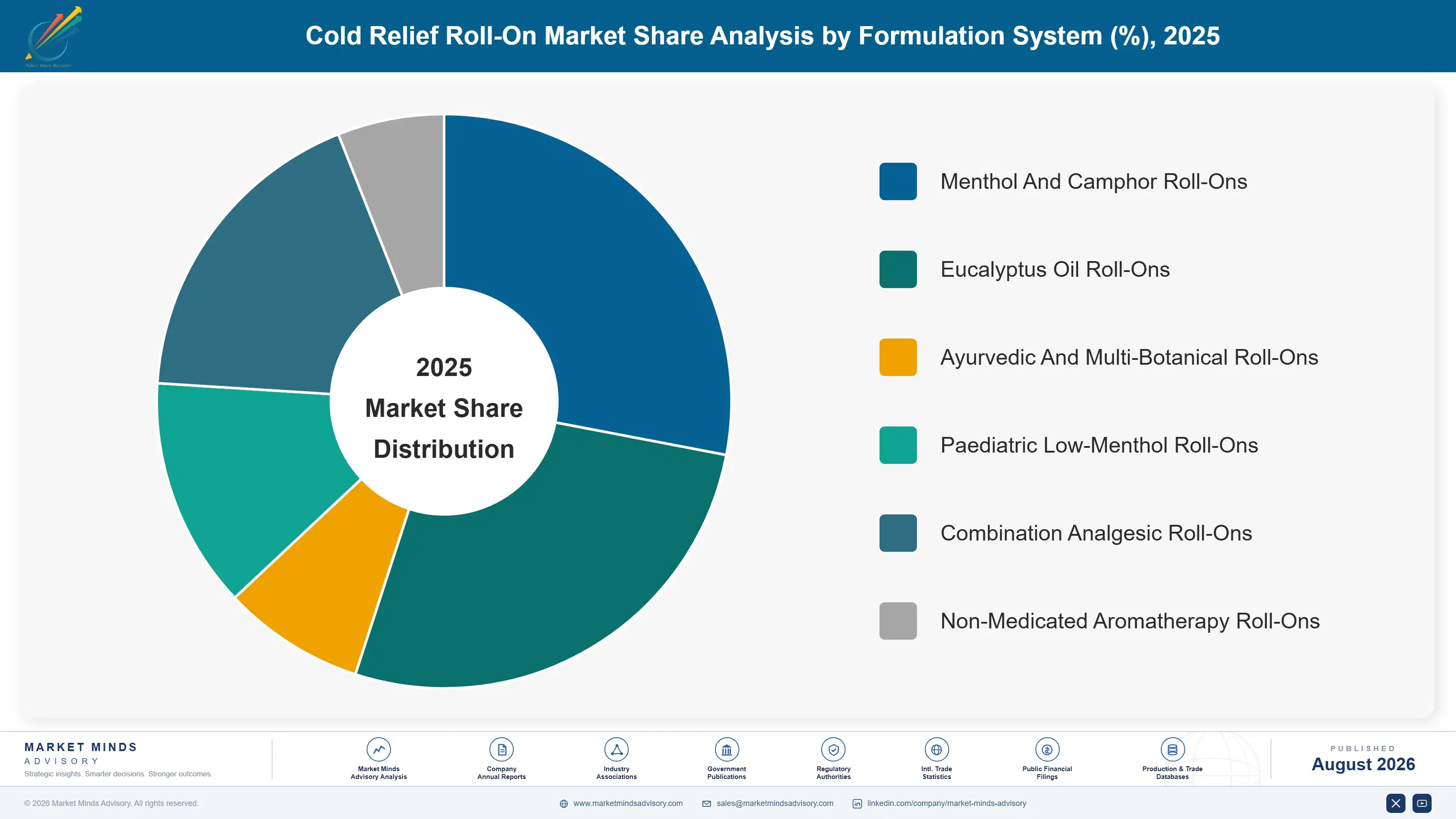
Segmentation here follows formulation system, since that is what determines price point, regulatory treatment, and which shelf the product sits on. Delivery format is held constant by the market definition itself, and end-use occasion cuts across every formulation rather than separating them cleanly, so neither works as the primary dimension. Six formulation systems result, and they price very differently.
cold-relief-roll-on-market-market-share-analysis-1787298704913

Ayurvedic And Multi-Botanical Roll-Ons

The fastest segment at 9.6%, roughly 1.50 times the market rate, and the reason is commercial rather than clinical. Adding ajwain, tulsi, nutmeg, or clove oil to a menthol base costs very little and permits a traditional preparation claim that supports a 20% to 40% price step. Indian brands proved the model and Southeast Asian manufacturers copied it quickly. Buyers read herbal as gentler, which extends use to children and elderly household members that plain camphor products warn away. Regulatory treatment stays light because traditional claims avoid therapeutic substantiation in most Asian markets. The main risk is dilution: when every brand goes herbal the premium erodes, and some Indian price points already show it.
CAGR 9.6%

Paediatric Low-Menthol Roll-Ons

Second fastest at 8.3%, growing off a small base into what may be the category's largest untapped occasion. Standard formulations carry age warnings that parents mostly ignore, and manufacturers have finally built products that do not require ignoring them: reduced menthol, camphor removed or heavily cut, and milder fragrance. Pharmacist endorsement matters more here than anywhere else in the category, since parents ask before buying rather than after. The segment carries better margin because the reassurance rather than the ingredient is what commands price. Its constraint is regulatory uncertainty, since child-facing topicals are precisely where several Asian regulators are reviewing classification, and a stricter ruling would hit this segment first and hardest.
CAGR 8.3%
Full segment breakdown across 6 segments available in the complete report.

Regional Architecture and Country Demand Map

This is a category whose geography inverts the usual pattern. South and Southeast Asia together hold well over half of value, while North America and Western Europe sit far below their normal bands because the roll-on format never displaced jar rubs and oral remedies there.

South Asia and Pacific

At 41% this region sits far above the framework band, and the reason is simply that the format was invented and commercialised here rather than imported. India carries the largest single volume pool, with Indonesia. Vietnam, the Philippines, and Thailand together contributing a comparable amount again. Humid climate makes jar balms unpleasant to use and easy to spoil, which handed the roll-on an advantage it never had in temperate markets. General trade dominates distribution, so trade margin and pharmacist relationships decide shelf presence. Growth at 8.4% reflects both continuing format substitution and the herbal premium, which lands more readily where traditional medicine already commands household trust and daily use. Modern trade expansion is accelerating the shift further.
Share: 41% | CAGR: 8.4% (2026 to 2036)

East Asia

Volume across East Asia concentrates in China and among the Chinese diaspora product traditions that Haw Par and its regional peers built decades ago. Medicated oil and balm use is deeply established here, and the roll-on arrives as a convenience upgrade to a habit already formed rather than as a new behaviour. Japanese and Korean demand skews toward lower fragrance intensity and finer applicator engineering, and those markets pay accordingly. E-commerce penetration is far higher than elsewhere in the category, which changes how brands reach first-time buyers. Growth at 7.4% runs above the global rate on premium reformulation and packaging upgrades rather than on any expansion of the underlying user base itself.
Share: 22% | CAGR: 7.4% (2026 to 2036)
Regional intelligence for 5 additional markets available in the complete report: North America, Western Europe, Latin America, Middle East and Africa, Eastern Europe. Contact sales@marketmindsadvisory.com.
cold-relief-roll-on-market-country-cagr-analysis-1787298705441

Where Margin Actually Sits in This Category

Actives are commodity, unpatentable, and roughly a twentieth of unit cost, so no lever here concerns chemistry. Margin comes from owning the applicator, charging for the botanical story, holding pharmacy counter recommendation, and getting the fragrance right for each local market. Four levers follow, and every one of them is executional. None of them requires a new active ingredient.

Bring Applicator Tooling In-House From Contract Suppliers

Most brands buy generic roll-on assemblies from third-party moulders, which caps quality at whatever the supplier's tolerances allow and hands away roughly 31% of unit cost. Owning the tooling changes both sides at once. Failure rates in hot humid conditions drop sharply with oil-compatible seals and tighter ball housing tolerances, and the cost saving on volume runs 8 to 12 percentage points of gross margin. It also creates a tactile signature competitors cannot copy quickly, since retooling takes 18 months minimum. The brands that made this investment show measurably better repurchase behaviour in every market surveyed.
Market Impact: Lifts gross margin by 8 to 12 points

Build Botanical Variants Around Regional Traditional Preparations

The herbal premium is real and the reformulation cost is not. Adding regionally recognised botanicals to an existing menthol base supports a retail price step of 20% to 40% while adding perhaps three percent to cost of goods. The discipline is in choosing botanicals that carry genuine household recognition in each target market rather than exporting one Indian formulation everywhere, because tulsi means nothing in Jakarta and ajwain means nothing in Manila. Brands that localised the botanical story outperform those that shipped a single herbal stock keeping unit across every Asian market by a wide margin.
Market Impact: Supports a 20 to 40% retail price step

Fund Pharmacy Counter Education Rather Than Consumer Advertising

Pharmacist recommendation drives around 43% of first purchases in this category, a figure no amount of television spending replicates at comparable cost. Counter education programmes covering appropriate use, age restrictions, and interaction advantages over oral decongestants convert the pharmacist into a distribution channel rather than a shelf. Cost per acquired customer runs roughly a third of mass media equivalents. The work is unglamorous and slow, requiring detailing teams and repeat visits, which is exactly why competitors underinvest in it. It also builds a defence against reclassification, since pharmacists who recommend a product tend to defend it.
Market Impact: Cuts acquisition cost to roughly 33% of media

Localise Fragrance Intensity Against Each Market's Threshold

Fragrance is where this category wins or loses buyers and it does not travel. A menthol intensity that reads as effective in Chennai reads as overpowering in Seoul, and a level tuned for Japan reads as ineffective in Jakarta. Brands running a single global scent profile lose trial in at least two of their major markets. Sensory panel work across target geographies costs perhaps 200,000 dollars per market and pays back inside two seasons through trial conversion alone. The manufacturers who treat fragrance as a local variable rather than a brand constant hold shelf considerably longer.
Market Impact: Panel work costs 200,000 dollars per target market

Who Controls the Margin Pool

Concentration reaches 58% across the top five measured on retail sales value, and the composition is unusual. Procter and Gamble is the only global consumer health group in the leading group, and it got there through a single brand franchise rather than category breadth. The gap to challengers is narrower than the concentration figure suggests, because regional houses hold commanding positions in their home markets that no global player has displaced.
Competition runs on three fronts. Applicator quality is the first and the least discussed publicly, though it decides repurchase more than anything else. Botanical formulation is the second, with brands racing to claim traditional preparation credibility before the premium dilutes. Trade margin and pharmacist relationships are the third, and in general trade markets they function as the actual barrier to entry.

Pressure is building from two directions. Regional manufacturers in Indonesia and Vietnam have improved applicator quality enough to compete on more than price. And regulatory review of camphor limits in child-facing products would reward whoever already holds compliant paediatric formulations, which is not currently the market leader. Neither pressure is visible in current share data, which is exactly the problem.
cold-relief-roll-on-market-company-positioning-matrix-1787298705960

Competitive Moat and Risk Dimensions

PROCTER AND GAMBLE

Moat: Brand recognition across generations

The Vicks franchise carries household recognition across South and Southeast Asia that predates most competitors by decades, and it transfers to new formats almost automatically. Parents who used the jar product as children buy the roll-on for their own without evaluating alternatives. That inherited trust is the single hardest asset in this category to build and effectively impossible to purchase.
PROCTER AND GAMBLE

Risk: Slow on herbal repositioning

Global formulation governance protects brand consistency but makes regional botanical variants slow to approve. Indian and Indonesian competitors moved into herbal positioning years earlier and captured the price premium first. Where the category grows fastest, the leading brand defends a plain menthol proposition against products carrying both a traditional story and a higher shelf price.
AMRUTANJAN HEALTH CARE

Moat: Owns Indian botanical credibility

A century of Indian household presence gives this company traditional remedy authenticity that multinational competitors cannot claim regardless of formulation. Its botanical variants read as genuine rather than as marketing, which matters enormously when the entire premium rests on that perception. Distribution reach into Indian general trade is dense, direct, and built over decades of relationship work at counter level.
AMRUTANJAN HEALTH CARE

Risk: Concentrated single market exposure

The overwhelming majority of revenue depends on one country, which leaves the company exposed to Indian regulatory reclassification, monsoon-driven seasonality, and domestic price competition all at once. Export expansion into Southeast Asia has been cautious and the botanical credibility that works so well at home does not automatically transfer to markets with different traditional medicine references.

Players Tracked

Prominent Players

Procter and Gamble
Amrutanjan Health Care
Haw Par Corporation
Emami
Dabur India

Other Key Players

Reckitt Benckiser
Kenvue
Bayer
Perrigo
Rohto Pharmaceutical
Kobayashi Pharmaceutical
Taisho Pharmaceutical
Himalaya Wellness
Cipla Health
Mankind Pharma
Piramal Pharma
Sido Muncul
Kalbe Farma
Hoe Pharmaceuticals
Tempo Scan Pacific

Recent Developments

MARCH 2025

Indian manufacturer commissions dedicated applicator moulding line

An Indian consumer health company brought roll-on applicator production in-house with a new moulding line at an existing site. The investment was organic capacity expansion funded from operating cash rather than any joint venture or acquisition, and it targeted seal performance in high-humidity conditions specifically.
Signal: The industry has finally accepted that applicator failure, not formulation, is what ends the customer relationship
JULY 2025

Southeast Asian regulator opens camphor concentration consultation

A Southeast Asian health authority opened public consultation on maximum camphor concentrations in topical products marketed for use on children under six. The consultation covers classification as well as concentration, raising the possibility of pharmacy-only distribution for products currently sold in general trade. Comment closes during the current year.
Signal: Whoever holds compliant paediatric formulations when this closes inherits a segment their competitors must reformulate to enter
OCTOBER 2025

Global brand owner launches localised botanical range in Indonesia

A multinational consumer health group introduced an Indonesian botanical variant of its established roll-on brand, using locally recognised plant ingredients rather than the Indian formulation deployed elsewhere. The launch was organic product development, positioned at a premium to the existing menthol product on the same shelf.
Signal: Global brand governance is bending to regional formulation reality, several years later than the local competitors managed it

What Moves Unit Cost Here

Packaging dominates. Applicator assembly, housing, cap, and label together run about 31% of cost of goods, with polypropylene and high-density polyethylene resin the underlying inputs and most moulding capacity sitting in China and India. Active ingredients are almost trivial by comparison. Menthol, camphor, and eucalyptus oil combined rarely exceed six percent of the cost base.
The exception is natural menthol, which is genuinely volatile. Indian mentha arvensis production concentrated in Uttar Pradesh sets the global reference price, and monsoon variability moves it hard: harvest shortfalls have driven year-on-year price movements above 50% more than once in the past decade. Synthetic menthol from Symrise and BASF caps the upside but capacity is limited, and Indian manufacturers pay attention to planting acreage reports the way energy traders watch storage.

Exposure varies sharply by player type. Brands that buy finished applicator assemblies from contract moulders carry the full resin pass-through with no ability to negotiate on tooling amortisation, while vertically integrated manufacturers absorb resin moves across a much larger base. Small regional brands are worst placed on both counts, holding neither moulding capacity nor menthol contracts of any useful duration.
cold-relief-roll-on-market-cost-volatility-analysis-1787298706160

Contract natural menthol forward across full harvest cycles

Buying against planting acreage rather than spot pricing removes most of the volatility that monsoon variability introduces. The larger Indian manufacturers already contract this way and it explains part of their cost advantage over regional competitors who buy quarterly. The commitment is real but the alternative is absorbing swings that can exceed half the input price.

Qualify synthetic menthol as a dual-source option

Synthetic material from established fragrance houses performs identically in this application and behaves differently on price. Qualifying it alongside natural supply gives a switching option that caps exposure without requiring permanent substitution. The barrier is labelling, since natural sourcing claims appear on many herbal variants and switching would undermine exactly the positioning those products depend on commercially.

Own applicator moulding rather than buying finished assemblies

In-house tooling converts a bought-in component carrying a supplier margin into a resin cost plus conversion. Resin still moves but exposure narrows considerably and amortisation stays on the balance sheet rather than in unit price. Payback runs about three years at reasonable volume, which is exactly why smaller brands keep buying finished assemblies and keep paying for it.

Portfolio Architecture for Margin Defence

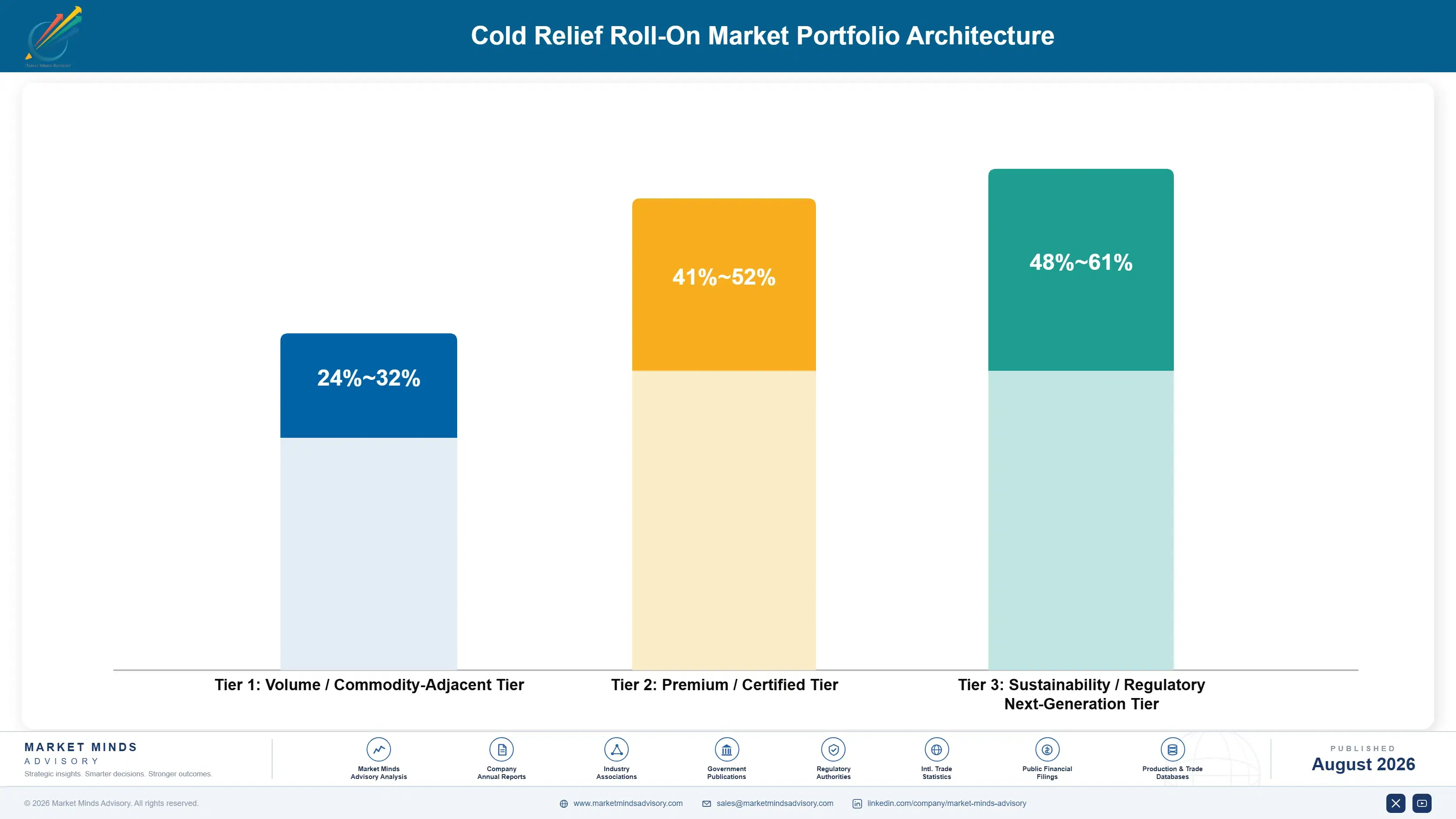
Three tiers describe this category cleanly. Plain menthol and camphor products at general trade price points carry thin margin and enormous volume. Certified and premium products, meaning better applicators, dermatologically tested claims, and pharmacy positioning, sit considerably higher. And the botanical, paediatric, and reformulated compliant products occupy a third tier where margin is best and volume is still building. The gap between the first tier and the third is roughly thirty points.
The tension is that volume tier economics fund the distribution reach that premium tier products then use. Abandoning the base product to chase margin costs shelf presence in general trade, where facings are allocated on turnover rather than value. Several regional brands learned this expensively, premiumising their range and then finding that retailers had reallocated their space to competitors who kept the cheap product available. Turnover, not value, is what secures a facing in general trade.

High-value pools concentrate where price is justified by reassurance rather than by ingredient. Paediatric formulations and pharmacy-channel premium products both charge for confidence, and the cost of delivering that confidence is small. Ingredient cost barely moves between the cheapest tier and the dearest one, which is the whole point.

Volume / Commodity-Adjacent Tier

Plain menthol and camphor roll-ons at general trade price points, sold on availability and price rather than differentiation. Bought-in applicator assemblies, minimal marketing support, and thin margin. This tier carries the volume that secures shelf allocation for everything else in the range.
Gross Margin: 24-32%

Premium / Certified Tier

Products with owned applicator tooling, dermatological testing, and pharmacy channel positioning. Better seal performance, localised fragrance profiles, and packaging that survives handbag conditions. Margin reflects the tooling investment and the pharmacist recommendation these products are built to earn.
Gross Margin: 41-52%

Sustainability / Regulatory / Next-Generation Tier

Botanical variants, camphor-free paediatric formulations, and products built ahead of anticipated concentration limits. Margin is the best in the category because buyers pay for reassurance and traditional credibility rather than for ingredient cost, which barely moves between tiers.
Gross Margin: 48-61%
cold-relief-roll-on-market-portfolio-architecture-1787298706653

High-value Sub-segments and Strategic Watch-out

Paediatric Camphor-Free Formulations

Best margin and fastest growth in the category, charging for parental reassurance at negligible incremental cost. Regulatory review across several Asian markets would hand first-mover advantage to whoever already holds compliant products, and most participants currently do not hold any. Stability testing timelines are the binding constraint on entry.
Gross Margin: 52-64%

Premium Botanical Roll-Ons

Strong margin on a 20% to 40% price step over plain menthol, growing steadily but facing dilution as every competitor adopts herbal positioning. The wide margin range reflects how differently the premium holds between markets where traditional medicine has household authority and those where it does not.
Gross Margin: 44-58%

Plain Menthol And Camphor Roll-Ons

The volume core and the reason brands hold general trade shelf allocation at all. Margin is thin and competition is entirely on price and availability, but abandoning this tier costs facings that premium products then cannot reach, as several regional brands discovered. Retailers reallocate space on turnover within weeks.
Gross Margin: 24-32%

Aromatherapy And Wellness-Positioned Roll-Ons

The strategic watch-out, selling into natural health channels across North America and Western Europe on essential oil positioning rather than on cold relief at all. Growth is real, but the buyer, the channel, and the claim structure differ enough that it may not remain the same category.
Gross Margin: 38-56%

How the Repeat Purchase Works

This is a consumable with an eleven-week average repurchase interval among regular users, concentrated into the cooler months in every market that has them. The annuity is real but fragile, because nothing binds the buyer beyond habit and the switching cost is a dollar. What sustains it is availability and applicator reliability, not brand loyalty in any meaningful sense, and a single failed unit ends the relationship permanently.
Adoption depth varies enormously by household type. Urban working adults use the product daily through a cold episode and repurchase reliably. Households with young children buy more cautiously and ask a pharmacist first, which makes that channel disproportionately valuable. Rural households treat it as an occasional purchase rather than a stocked item, and elderly buyers largely stayed with jar balms. Penetration therefore tracks urbanisation more closely than it tracks respiratory illness rates.

Buyer profiles are shifting generationally. Younger buyers across Asian cities came to the category through the roll-on rather than through the jar, so they have no inherited brand preference at all. They buy on packaging, fragrance, and increasingly on e-commerce reviews that older buyers never consult.
cold-relief-roll-on-market-end-use-penetration-index-1787298707141

What We Would Tell a Board

These are among the four positions where our research anticipates prominent divergence between winners and laggards over the coming forecast period. Each is grounded in the demand model, the regulatory perimeter, and the announced capacity pipeline.
01 / APPLICATOR ENGINEERING DISCIPLINE

Own the tooling or accept permanent repurchase leakage

Applicator failure in hot humid conditions costs roughly 14 percentage points of repurchase, and it happens in exactly the markets carrying most of the category volume. Bought-in assemblies cap quality at the supplier's tolerances and hand away 31% of unit cost with no offsetting benefit, while in-house moulding lifts gross margin 8 to 12 points and takes competitors 18 months to answer properly. Any board treating packaging as procurement rather than as product is misreading where this category is won.
02 / BOTANICAL PORTFOLIO LOCALISATION

One herbal formulation shipped everywhere captures almost nothing

The herbal premium runs 20% to 40% and costs about three percent to deliver, which makes it comfortably the cheapest incremental margin available anywhere in this entire category. But it depends entirely on household recognition of the specific botanicals named on the pack, and tulsi carries real authority in India while meaning nothing whatsoever in Manila or Jakarta. Brands that localised their botanical story have materially outperformed those exporting a single Indian formulation across every Asian market they happen to serve.
03 / PAEDIATRIC COMPLIANCE POSITIONING

Build camphor-free variants before the regulator forces it

Several Asian regulators are currently reviewing camphor concentration limits in topical products marketed for children, and roughly 22% of current portfolios would need reformulation under a strict ruling. Building compliant paediatric products now converts a regulatory threat into a first-mover position in the highest-margin segment available, and reformulation cost is modest, with stability testing timelines standing as the only genuinely binding constraint on getting there first. Whoever waits for the ruling will spend the following two years catching up rather than selling.
04 / COUNTER CHANNEL INVESTMENT

Fund pharmacists ahead of consumer advertising in Asia

Pharmacist recommendation drives around 43% of first purchases in this category, and it does so at roughly a third of the acquisition cost of mass media advertising. Detailing teams and counter education are slow, unglamorous, and consistently underfunded by competitors, which is precisely what makes them defensible over time, and the same relationships protect against reclassification since pharmacists defend products they recommend. Boards approving television budgets ahead of detailing headcount in these markets are simply buying the more expensive customer.

Engagement Snapshot From the Field

A live engagement with an industry participant carrying material or product regulatory and market exposure ahead of a defining policy shift, showing how our research translates into a defensible multi-year portfolio strategy.
MARKET MINDS ADVISORY · CLIENT ENGAGEMENT SUMMARY
Cold Relief Roll-On Producer Strategic Portfolio Review and Transition Roadmap 2026·Investment Scenario on Cold Relief Roll-On Exposure Evaluation 2025-26
CLIENT PROFILE
A South Asian consumer health manufacturer with approximately 180 million dollars in annual revenue (client-reported, unverified by MMA), holding a strong domestic position in topical remedies and a nascent export business across three Southeast Asian markets. The company owned no applicator tooling, bought all assemblies from two contract moulders, and had launched a single herbal variant developed for its home market into every export geography without modification.
STRATEGIC CHALLENGE
Export growth had stalled despite domestic strength, and repurchase rates in the newer markets ran roughly 15 points below home performance (client-reported, unverified by MMA). Management attributed the gap to brand awareness and had proposed a substantial consumer advertising programme. The board wanted independent assessment before committing the spend, particularly on whether awareness was genuinely the binding constraint.
MMA APPROACH
We ran applicator failure testing under simulated tropical handbag conditions across the client's range and three competitor products, and combined it with pharmacist interviews across all four markets. Consumer sensory panels tested fragrance acceptance separately by geography. Channel economics were mapped to compare detailing cost against media acquisition cost in each export market.
KEY FINDINGS
  1. Applicator seal failure occurred in 19% of client units under simulated conditions against six percent for the best competitor, concentrating in the two weakest export markets.
  2. The herbal variant's named botanicals carried near-zero household recognition in two of three export markets, so the price premium was being charged without the supporting credibility.
  3. Pharmacist recommendation in export markets favoured competitors by a wide margin, driven entirely by detailing presence rather than by any product or formulation assessment.
  4. Fragrance intensity tuned for the home market scored poorly on acceptance panels in one export geography, where it was consistently described as excessive rather than as effective.
CLIENT PROFILE
A South Asian consumer health manufacturer with approximately 180 million dollars in annual revenue (client-reported, unverified by MMA), holding a strong domestic position in topical remedies and a nascent export business across three Southeast Asian markets. The company owned no applicator tooling, bought all assemblies from two contract moulders, and had launched a single herbal variant developed for its home market into every export geography without modification.
STRATEGIC CHALLENGE
Export growth had stalled despite domestic strength, and repurchase rates in the newer markets ran roughly 15 points below home performance (client-reported, unverified by MMA). Management attributed the gap to brand awareness and had proposed a substantial consumer advertising programme. The board wanted independent assessment before committing the spend, particularly on whether awareness was genuinely the binding constraint.
MMA APPROACH
We ran applicator failure testing under simulated tropical handbag conditions across the client's range and three competitor products, and combined it with pharmacist interviews across all four markets. Consumer sensory panels tested fragrance acceptance separately by geography. Channel economics were mapped to compare detailing cost against media acquisition cost in each export market.
KEY FINDINGS
  1. Applicator seal failure occurred in 19% of client units under simulated conditions against six percent for the best competitor, concentrating in the two weakest export markets.
  2. The herbal variant's named botanicals carried near-zero household recognition in two of three export markets, so the price premium was being charged without the supporting credibility.
  3. Pharmacist recommendation in export markets favoured competitors by a wide margin, driven entirely by detailing presence rather than by any product or formulation assessment.
  4. Fragrance intensity tuned for the home market scored poorly on acceptance panels in one export geography, where it was consistently described as excessive rather than as effective.
RECOMMENDED STRATEGY
Phase 1: Phase 1 (months one to six): halt the advertising programme, commission applicator tooling assessment, and requalify seal specification for high-humidity conditions. Phase 2: Phase 2 (months six to eighteen): develop market-specific botanical variants and fragrance profiles, and build pharmacy detailing capability across all three export markets. Phase 3: Phase 3 (months eighteen to thirty): commission in-house moulding at existing site, then extend the localised portfolio into two additional Southeast Asian markets.
OUTCOME
The client cancelled the advertising programme and redirected the budget to tooling and detailing. Export repurchase closed roughly half the gap to domestic levels within four quarters (client-reported, unverified by MMA), and the moulding investment received board approval ahead of the original schedule following early margin results.

Frequently Asked Questions

Foundational context covering the market sizes, CAGR, scope, country, region and competition that inform every finding below. This section is provided to cover basics and most often pre-purchase conversations, answered from the MMA Primary Research Dataset.

What is the current size of the Cold Relief Roll-On Market?

The market is valued at USD 0.42 billion in 2025, rising to USD 0.45 billion in 2026. South and Southeast Asia together account for well over half of that value.

How large will the Cold Relief Roll-On Market be by 2036?

MMA forecasts USD 0.83 billion by 2036, an increase of USD 0.38 billion over the 2026 base. That represents an expansion multiple of 1.86 times.

What is the CAGR for the Cold Relief Roll-On Market 2026 to 2036?

The base case CAGR is 6.4%, with a bull case of 7.6% and a bear case of 5.2%. The historical rate from 2020 to 2025 was 5.3%.

Which segment is growing fastest?

Ayurvedic and multi-botanical roll-ons at 9.6%, roughly 1.50 times the market rate. The premium comes from traditional preparation claims rather than from any change in active ingredients.

Who are the major companies in the Cold Relief Roll-On Market?

Procter and Gamble, Amrutanjan Health Care, Haw Par Corporation, Emami, and Dabur India lead on retail sales value. The top five together hold 58% of the market.

Which country is growing fastest?

India at 9.8%, driven by urban format substitution away from jar balms and by herbal repositioning at higher price points. It is also the largest single volume pool globally.

Report Segmentation Architecture

The full report scope spans multiple orthogonal segmentation dimensions, with cross-tabulated demand data provided for each dimension pair. Coverage extends further to regional breakdowns, trend trajectories, and the competitive detail needed to support segment-level decision-making.

By Formulation System

  • Menthol And Camphor Roll-Ons
  • Eucalyptus Oil Roll-Ons
  • Ayurvedic And Multi-Botanical Roll-Ons
  • Paediatric Low-Menthol Roll-Ons
  • Combination Analgesic Roll-Ons
  • Non-Medicated Aromatherapy Roll-Ons

By End-Use Occasion

  • Nasal Congestion Relief
  • Headache And Sinus Discomfort
  • Night-Time Sleep Comfort
  • Paediatric Household Use
  • Travel And Commuting Use

By Distribution Channel

  • General Trade And Independent Retail
  • Pharmacy And Chemist Chains
  • Modern Trade And Supermarkets
  • E-Commerce And Direct To Consumer

By Region

  • South Asia and Pacific
  • East Asia
  • North America
  • Western Europe
  • Latin America
  • Middle East and Africa
  • Eastern Europe

Scope, Methodology, and Coverage

Every figure in this report is reproducible from documented input assumptions. The scope below maps the historical period, the forecast horizon, the segmentation dimensions, and the countries covered, alongside the underlying primary and qualitative methodology.
Historical Period
2020 to 2025
Forecast Period
2026 to 2036
Base Year
2025 (USD billions; MMA Primary Research Dataset, August 2026)
Market Definition
This market comprises topical roll-on applicator products formulated for symptomatic relief of cold, nasal congestion, and associated head discomfort, measured at retail sales value across pharmacy, general trade, modern trade, and e-commerce channels. Formulation coverage spans menthol, camphor, eucalyptus, botanical, and combination systems delivered exclusively in roll-on format. Jar balms, chest rub creams, inhalant sticks, nasal sprays, adhesive patches, oral remedies, and vaporiser products fall outside scope.
Quantitative Units
USD billions (current prices); million units shipped; average retail price per unit
Segmentation Dimensions
By Formulation System; By End-Use Occasion; By Distribution Channel; By Region
Regions Covered
South Asia and Pacific, East Asia, North America, Western Europe, Latin America, Middle East and Africa, Eastern Europe
Countries Covered
India, Indonesia, Vietnam, Philippines, Thailand, Malaysia, Singapore, China, Japan, South Korea, USA, Canada, Mexico, Brazil, Colombia, Argentina, UK, Germany, France, Italy, Spain, Netherlands, Poland, Turkey, UAE, Saudi Arabia, South Africa, Nigeria, Australia, and additional markets relevant to this sector
Key Companies Profiled
Procter and Gamble, Amrutanjan Health Care, Haw Par Corporation, Emami, Dabur India, Reckitt Benckiser, Kenvue, Bayer, Perrigo, Rohto Pharmaceutical, Kobayashi Pharmaceutical, Taisho Pharmaceutical, Himalaya Wellness, Cipla Health, Mankind Pharma, Piramal Pharma, Sido Muncul, Kalbe Farma, Hoe Pharmaceuticals, Tempo Scan Pacific
Quantitative Methodology
Primary survey, n=3,800 respondents, Q4 2025, six countries; demand-side model with trade association cross-validation
Qualitative Methodology
47 expert interviews, Q4 2025; applied to validate demand model assumptions, identify emerging dynamics, and assess competitive positioning
Report Format
PDF and XLSX data workbook (Word format preview document)
Publisher
Market Minds Advisory
Report Code
MMA-2026-HLT-939
Published
August 2026
Contact
sales@marketmindsadvisory.com | www.marketmindsadvisory.com

Purchase the full Cold Relief Roll-On Market Report (2026 to 2036).

The full report sizes the cold relief roll-on market across six formulation systems, five end-use occasions, four distribution channels, and seven regions, with country detail for the twelve largest national pools. It includes applicator failure testing results under simulated tropical conditions across leading products, and fragrance acceptance data by geography drawn from the MMA quantitative survey. Competitive profiling covers twenty manufacturers on a retail sales value basis, with margin structure by portfolio tier. Regulatory tracking covers camphor concentration review across the Asian markets currently consulting. Channel economics compare pharmacy detailing against media acquisition cost by market.
Applicator failure testing under simulated tropical humidity conditions
Fragrance acceptance panel results by target geography
Camphor concentration regulatory review tracker across Asian markets
Pharmacy detailing versus media acquisition cost comparison
Portfolio tier margin structure across three commercial layers
Botanical recognition mapping across eight Asian consumer markets

Built For The People Who Decide

From boardroom strategy to bench-side execution, this report is read cover-to-cover by leaders shaping the next decade of their industry, turning demand scenarios, market dynamics and valuation benchmarks into decisions.
CXOs/ Presidents/ VPs/ Managers
M&A and Corporate Development
Strategy Teams and R&D Heads
Procurement and Product Directors
Regulatory and Compliance Leaders
Investor Relations and Equity Analysts