Market Minds Advisory
Cold Pressed Soap Market

Cold Pressed Soap Market: Cold Pressed Soap Market. Ingredient Transparency Becomes the New Battleground for Indie and Legacy Brands Alike

Clean beauty retailers increasingly demand documented saponification and ingredient sourcing data, leaving small-batch soap makers without formal certification struggling to secure shelf space across most major natural retail channels nationwide.

Lead Analyst

Published

September 2026

Make Smarter Decisions with Customized Research Insights

Request a free sample report and evaluate market opportunities, growth trends, and competitive dynamics relevant to your business needs.

2025 MARKET VALUE$1.8BMarket Size 2025
2036 FORECAST VALUE$3.7BBase Case , 2026 to 2036
CAGR 2026 TO 20366.8 %Bull 8.0% / Bear 5.6%
INCREMENTAL OPPORTUNITY$1.8BNet 10- year value creation
EXPANSION MULTIPLE1.93x2036 value over 2026 base
Strategic Levers
M&A Pipeline
Regional Outlook
Country Rankings
Competitive Intelligence
Segmental Deep-dive
Call-Us : 91 93563 13602

Executive Snapshot and Market Trajectory.

Clean beauty retailers increasingly demand documented saponification and ingredient sourcing data, leaving small-batch soap makers without formal certification struggling to secure shelf space in major natural retail channels across most premium markets. That rebalancing is already visible in how retailers position and price competing soap brands.
Plant oil-based cold pressed soap remains the largest category by revenue, but CBD and hemp-infused formulations and charcoal and clay-infused bars are growing far faster as consumers chase both novel wellness ingredients and documented detoxifying claims in the same purchase decision. North America commands the deepest consumer demand anywhere in the category, concentrated around a dense indie maker community and strong farmers market and subscription box distribution culture.
Competition concentrates among a highly fragmented mix of indie artisan makers and legacy natural personal care brands scaling production while preserving authenticity claims. Ingredient traceability, saponification process documentation, and natural retailer partnerships are together reshaping which makers can convert farmers market credibility into durable national retail distribution across the coming decade of clean beauty scrutiny. Makers without a credible certification pipeline risk losing shelf placement to rivals already investing in both. That gap keeps widening.
Market Definition
The cold pressed soap market covers plant oil-based cold pressed soap, goat milk and animal-derived cold pressed soap, charcoal and clay-infused cold pressed soap, essential oil and botanical-infused cold pressed soap, unscented and sensitive-skin cold pressed soap, and CBD and hemp-infused cold pressed soap manufactured using the traditional cold saponification process. It excludes syndet bars, glycerin melt-and-pour soap, and liquid body wash products.
Base Year Value
$1.8B in 2025 (MMA Primary Research Dataset, August 2026)
Forecast Period
2026 to 2036, eleven discrete annual values
CAGR
6.8% base case. Bull 8.0%. Bear 5.6%.
Fastest Growth Segment
CBD and Hemp-Infused Cold Pressed Soap: 12.0% CAGR
Fastest Growth Country
India: 10.5% CAGR
Fastest Growth Region
South Asia and Pacific: 8.8% CAGR
Largest Region
North America: 30% of 2025 global value
Market Leaders
Dr. Squatch LLC, SheaMoisture, Dr. Bronner's Magic Soaps, Nubian Heritage, Le Petit Marseillais. Source: MMA Analysis based on company annual reports.
Primary Survey
n=3,800 procurement and R&D decision-makers, Q4 2025, six countries
Methodology
Demand-side build-up, cross-validated against public data, 47 expert interviews

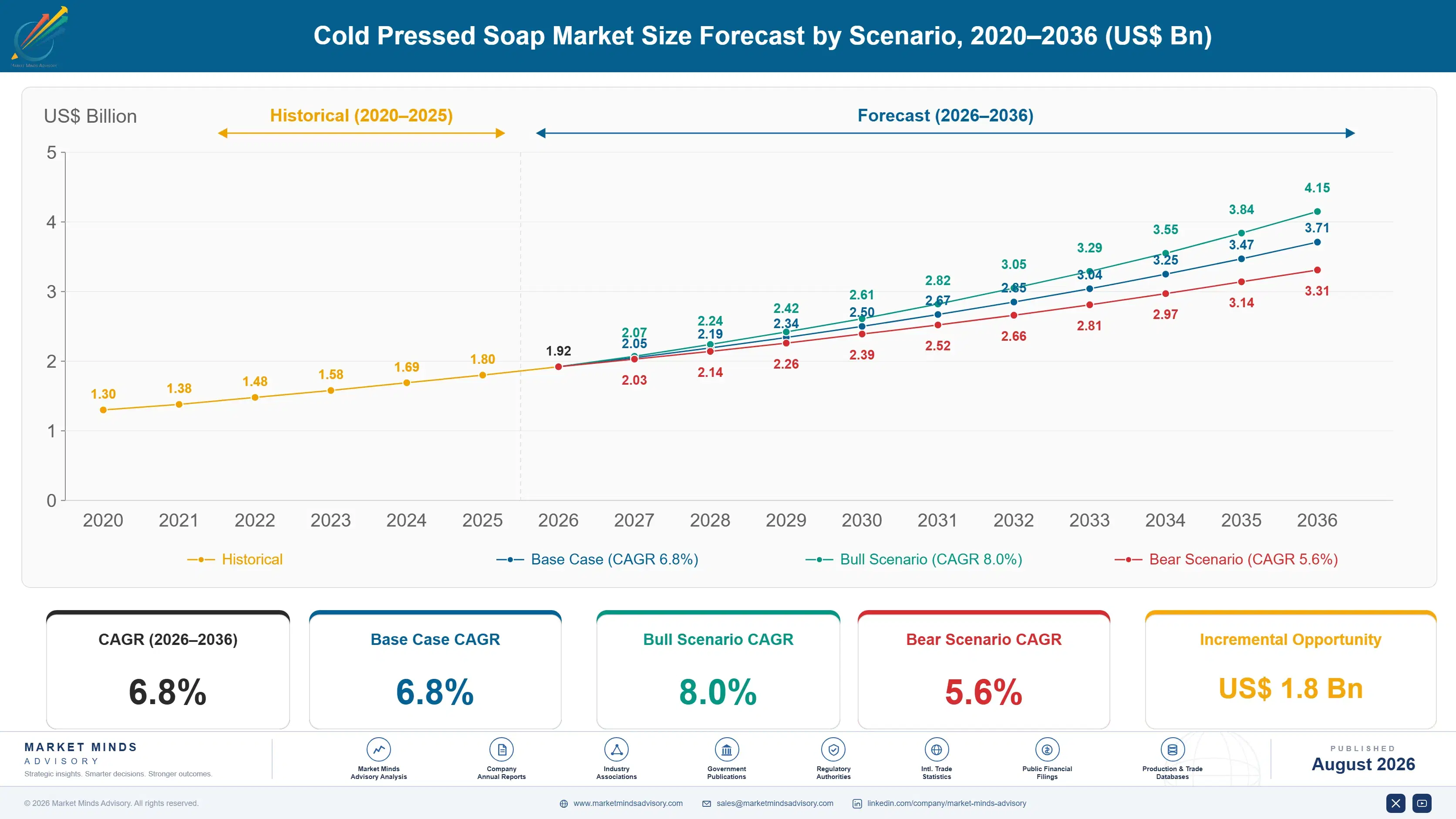
Cold Pressed Soap Market Forecast Scenarios

cold-pressed-soap-market-size-forecast-scenario-1788167497533
Between 2020 and 2025 the category grew near a 5.9% annual pace as clean beauty and DIY wellness trends steadily widened consumer interest beyond a small artisan niche, before retailer certification demands accelerated adoption from 2023 onward as major natural retail chains began requiring documented ingredient sourcing before granting new brand placement nationwide already. across the industry.
The base case carries the market to a 6.8% CAGR on three commercial mechanisms: CBD and hemp-infused formulations scaling as novel wellness ingredients broaden the category's appeal beyond traditional users, charcoal and clay-infused bar demand growing as consumers chase documented detoxifying and pore-clarifying claims, and plant oil-based soap demand holding steady as established makers continue expanding into adjacent scent and skin-type formulations. That combination is expected to persist through most of the forecast window.
The bull case at 8.0% assumes clean beauty certification requirements accelerate faster than currently modelled across multiple natural retail chains simultaneously. The bear case at 5.6% assumes indie makers delay formal certification investment longer than expected, holding category growth closer to existing artisan channel volume. Both scenarios assume no major disruption to existing plant oil supply chains.

Ingredient Transparency Reshapes Shelf Placement

Three forces converge on this category at once. Clean beauty retailers need documented ingredient sourcing and saponification data that satisfies increasingly skeptical consumer scrutiny, indie makers need affordable certification pathways that do not consume their entire small-batch margin, and legacy natural brands need supply chain traceability systems that many were never built to support at national retail scale.
TOP PRODUCER SHAREUSA, 34%Share of global output manufactured in United States facilities today
AVERAGE BAR PRICEUSD 6.80 per barBlended average retail price across cold pressed soap categories
PLANT OIL COST SHARE46% of COGSPlant oil feedstock share of total bar production cost
PLANT OIL SEGMENT SHARE39% of volumeTotal unit volume sold into plant oil-based applications
SAPONIFICATION CURE CYCLE4 to 6 weeksTypical time required to fully cure a cold pressed bar
MARKET CONCENTRATIONCR5: 22%Combined share held by the five largest soap manufacturers
Commercially, the category rewards makers who can pair genuine cold-process authenticity with documented ingredient traceability rather than relying on artisan marketing alone. Makers that can guarantee both formulation transparency and retailer partnership depth command shelf placement that unverified competitors cannot access, which is why major natural retail chains increasingly default to a narrow pool of certified brands rather than stocking whichever bar claims the lowest price point. That preference has hardened as several high-profile ingredient mislabeling controversies drew sustained consumer backlash across the clean beauty industry.
Over the next decade, ingredient traceability, saponification process documentation, and natural retailer partnerships will decide which makers convert farmers market credibility into durable national retail distribution. Makers without documented sourcing transparency risk losing premium shelf placement entirely as certification requirements continue tightening across major natural retail channels.
"Cold process used to mean a folding table at a farmers market. Now the biggest natural retailers want the same sourcing paperwork they demand from a national skincare brand."
Director, Natural and Artisan Personal Care Practice · MMA Natural and Artisan Personal Care Products Practice · August 2026

Market Trends

Retailers Mandate Ingredient Traceability Before Brand Placement

Major natural and clean beauty retailers increasingly require documented plant oil sourcing and saponification process data before granting new brand placement, following several high-profile controversies involving mislabeled or undisclosed ingredients. Whole Foods and Target have both expanded supplier verification requirements specifically to address this demand, since retailer legal exposure now extends to carrying brands whose ingredient claims cannot withstand scrutiny. This shift is pulling maker sourcing toward suppliers who can guarantee both formulation authenticity and defensible traceability documentation across every batch produced. Retailers now treat this documentation as a baseline requirement on every new brand evaluation.
Market Impact: Adds 11% to premium natural demand
CBD and Hemp Ingredients Broaden Category Appeal

Makers increasingly launch CBD and hemp-infused cold pressed soap formulations as wellness consumers seek novel botanical ingredients beyond traditional plant oils and essential oil blends. Dr. Bronner's and several indie makers have expanded hemp-based product lines specifically to serve this demand, since hemp seed oil sourcing increasingly differentiates premium formulation positioning from commodity plant oil alternatives. This shift is pulling formulation investment toward hemp and CBD categories that previously lagged well behind mainstream plant oil-based bars in consumer awareness. Established makers now treat hemp sourcing as a baseline requirement rather than an optional consideration.
Market Impact: Adds 9% to Indian export volume

Market Opportunities and Growth Drivers

Clean Beauty Movement Sustains Natural Ingredient Demand

Sustained consumer interest in clean beauty and natural ingredient transparency, amplified across social media wellness content, continues driving demand for cold pressed soap formulated without synthetic detergents or artificial preservatives. Multiple retailers have published curated clean beauty brand lists specifically built around documented ingredient claims, giving makers with proven traceability data a direct competitive advantage in securing new retail placement. That consumer-driven demand has proven durable across multiple product cycles rather than a passing trend. Makers without this documented transparency increasingly struggle to win younger consumer trust at all. Retailers increasingly favour brands that document this clearly across their catalog.
Market Impact: Margin can swing 9 points

India's Natural Personal Care Tradition Sustains Export Growth

India's deep-rooted tradition of natural and ayurvedic personal care, combined with rising urban middle-class disposable income, sustains substantial category growth as domestic and export makers compete for market share in both local and international channels. Domestic manufacturers have established export partnerships specifically to serve this demand, since Indian natural ingredient sourcing increasingly appeals to global clean beauty buyers seeking authentic formulation heritage. That heritage-driven growth has proven durable across multiple product cycles rather than a temporary surge. International makers without a local certified presence increasingly struggle to win Indian retail placement at all.
Market Impact: Certification can consume 8% of revenue

Market Restraints and Challenges

Plant Oil Cost Volatility Compresses Small-Batch Maker Margin

Plant oil feedstock costs have swung sharply in recent years as global edible and industrial oil demand moved independent of any change in downstream soap demand, since palm, coconut, and olive oil serve much larger food and industrial industries whose demand dwarfs the cold pressed soap category specifically. The root cause is broad agricultural commodity volatility rather than any category-specific supply issue, meaning soap makers absorb the same feedstock price swings affecting the entire edible oil industry. Makers are mitigating this through longer-term feedstock contracts and increased sourcing from diversified oil producers. Makers with deep contracts recover faster.
Market Impact: Certified placement demand grows 14% yearly

Certification Costs Burden Smaller Independent Makers

Third-party certification and ingredient traceability audit costs consume a disproportionate share of smaller independent makers' revenue relative to larger established competitors, since certification fees do not scale down proportionally with production volume. The root cause is a fixed-cost certification structure rather than any certifying body's pricing strategy targeting smaller makers specifically, meaning the constraint affects the entire indie maker segment simultaneously. Makers are mitigating this through shared certification cooperatives and staged certification across product lines rather than certifying an entire catalog at once. That cooperative approach lets smaller makers deploy partial certification years before full documentation completes.
Market Impact: Hemp-infused demand grows past 10% yearly
3 additional market trends, 4 additional growth drivers, and 3 additional restraints and challenges are covered in the full report. Contact sales@marketmindsadvisory.com to access the complete intelligence.

Segment CAGR and Growth Architecture

Segmentation follows ingredient formulation, a single classification logic, since plant oil, goat milk, charcoal and clay, essential oil, unscented, and CBD-hemp formulations each require distinct sourcing and saponification expertise rather than differing by price tier or distribution channel across the value chain. That single dimension keeps comparisons across categories consistent and auditable for every regional buyer.
cold-pressed-soap-market-market-share-analysis-1788167498076

CBD and Hemp-Infused Cold Pressed Soap

CBD and hemp-infused cold pressed soap grows fastest at 12.0%, about 1.76 times the overall 6.8% rate, as wellness consumers seek novel botanical ingredients that traditional plant oil formulations cannot claim. This segment demands specialized hemp seed oil sourcing and regulatory compliance expertise that traditional cold-process makers cannot simply add without dedicated ingredient qualification investment. Dr. Bronner's and several indie hemp specialists lead qualified supply, competing on documented sourcing transparency and formulation consistency rather than price alone. Growth concentrates around wellness-focused retail and direct-to-consumer channels, where hemp positioning increasingly justifies premium pricing that traditional bars cannot command. Investors and retail partners increasingly track sourcing milestones as a leading indicator of near-term formulation readiness.
CAGR 12.0%

Charcoal and Clay-Infused Cold Pressed Soap

Charcoal and clay-infused cold pressed soap grows at 9.0%, the second-fastest segment, as consumers increasingly seek documented detoxifying and pore-clarifying claims beyond simple cleansing performance. SheaMoisture and Nubian Heritage lead qualified charcoal supply, competing on documented mineral sourcing and skin benefit performance rather than raw volume alone. Unlike plant oil-based bars, this segment sells substantially into acne-prone and oily skin formulation channels rather than general cleansing applications, so ingredient concentration and skin compatibility testing matter as much as sourcing authenticity itself to a purchase decision. Retail buyers increasingly treat mineral sourcing depth as a prerequisite before evaluating any new brand relationship. That heightened scrutiny lengthens qualification timelines but rewards makers with existing dermatology-tested formulation relationships already established.
CAGR 9.0%
Full segment breakdown across 6 segments available in the complete report.

Regional Architecture and Country Demand Map

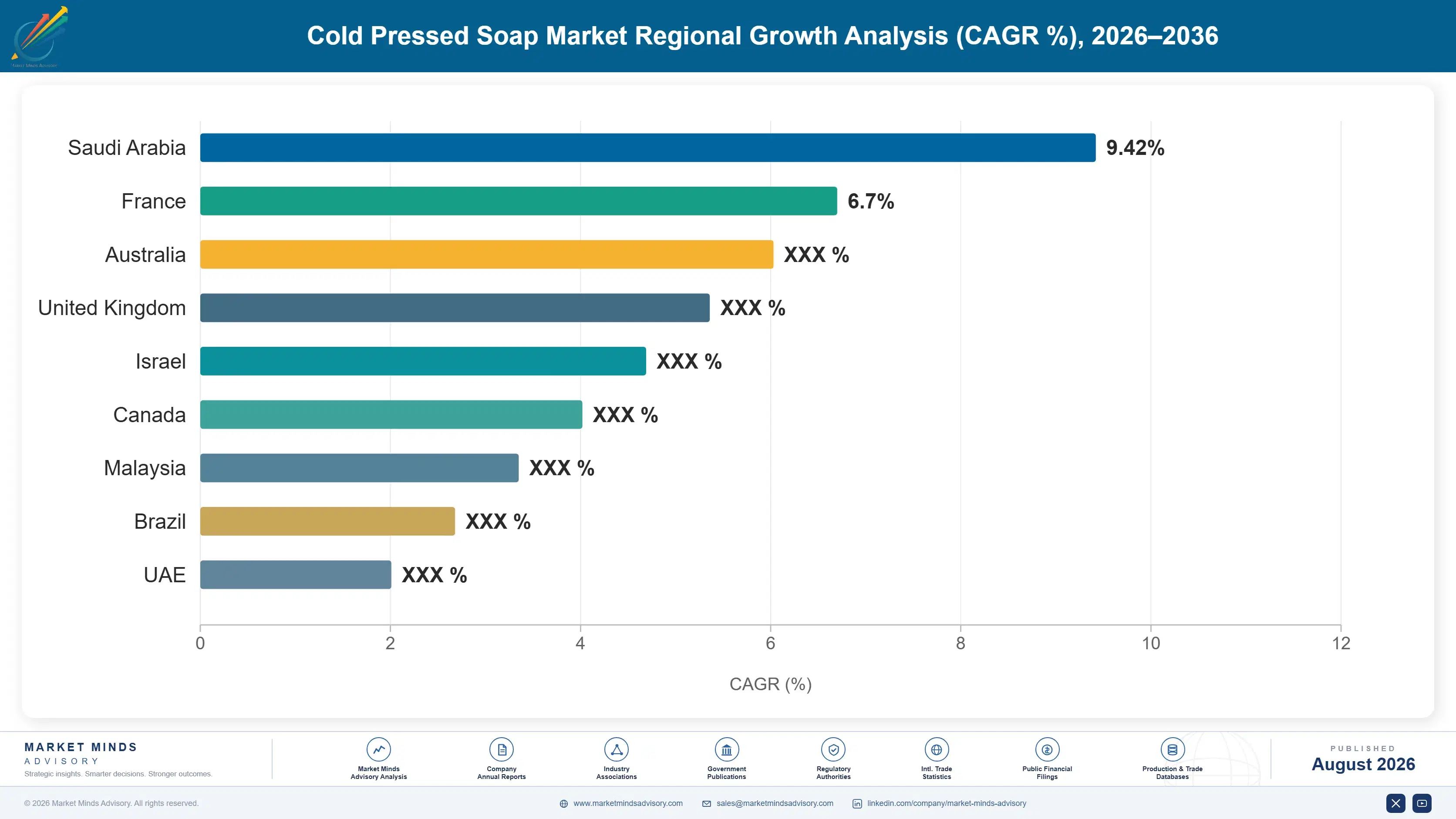
North America leads on indie maker density and clean beauty retail culture, while South Asia and Pacific posts the fastest growth as natural personal care adoption accelerates across expanding middle-class consumer bases. North America holds 30% of global value, well ahead of the smallest region's modest contribution to worldwide demand.

North America

United States consumers' vocal clean beauty preferences, reinforced by a dense network of farmers markets and indie maker subscription boxes, give North America 30% of global value, the largest regional share in the category by a clear margin over every other region. Dr. Squatch and Dr. Bronner's domestic manufacturing operations supply both mass-market and premium indie brand customers from established production facilities. United States natural retailers increasingly require documented ingredient traceability before granting new brand placement nationwide. Growth of 6.2% tracks certification-driven demand more directly than any broader volume trend on its own, reflecting the region's dense concentration of indie cold-process makers. Continued indie brand formation across major metro markets keeps that lead intact each year.
Share: 30% | CAGR: 6.2% (2026 to 2036)

Western Europe

France and Italy's centuries-old cold-process soap heritage, anchored by Savon de Marseille and Aleppo-style formulation traditions, gives Western Europe 24% of global value as a region where the category carries genuine cultural and artisan legacy rather than a recent wellness trend. Le Petit Marseillais, headquartered within the region, holds deep formulation heritage built around traditional saponification methods since its founding decades ago. French and Italian retailers increasingly specify documented artisan certification even beyond baseline natural labeling requirements already required. Growth of 5.3%, the slowest major region, reflects an already mature artisan soap market rather than any underlying demand weakness. That mature base still commands premium pricing given its decades of established artisan heritage.
Share: 24% | CAGR: 5.3% (2026 to 2036)
Regional intelligence for 5 additional markets available in the complete report: East Asia, South Asia and Pacific, Latin America, Middle East and Africa, Eastern Europe. Contact sales@marketmindsadvisory.com.
cold-pressed-soap-market-country-cagr-analysis-1788167498611

Where Ingredient Traceability Creates Retail Margin

Margin in this category increasingly sits in ingredient traceability and saponification documentation rather than in raw production scale alone. Makers converting that capability into premium certified and retailer-preferred contracts are pulling well ahead of competitors still selling undocumented artisan claims into a skeptical consumer market. That gap increasingly decides which makers earn premium contracts across the industry.

Secure Documented Ingredient Traceability Certification Early

Makers that secure documented ingredient traceability certification ahead of confirmed retailer mandates can access shelf placement that unverified competitors cannot obtain regardless of the price they offer. Dr. Bronner's traceability strategy illustrates how documentation investment made years before mandates tightened converts directly into preferred-vendor status once major retailers need guaranteed sourcing verification across an entire product category. That investment typically takes 8 to 14 months but opens the broadest possible retail customer base available industry-wide. Competitors lacking this progress are increasingly locked out of first-round customer evaluation regardless of price offered.
Market Impact: Early certification opens roughly 40% of retail slots

Build Documented Saponification Process Testing Systems

Makers that build documented saponification process testing systems ahead of confirmed audit demand capture retailer trust that competitors relying on informal batch records cannot match once retailers require guaranteed ingredient-level verification across every product line. SheaMoisture's testing investment shows how systems built before audit requirements tightened convert directly into preferred-vendor status once retailers need proven sourcing documentation. That investment typically takes 10 to 16 months but lifts blended retail margin by roughly 13% once fully achieved. Competitors lacking traceability increasingly lose renewal bids entirely once retailers require documented sourcing assurance.
Market Impact: Testing systems lift blended margin nearly 13% overall

Diversify Plant Oil Sourcing Across Multiple Producing Regions

Makers that diversify plant oil sourcing across multiple qualified producing regions capture cost stability that single-source competitors cannot match when any one region's harvest or price spikes unexpectedly during a period of constrained global edible oil demand. That diversification typically adds 5% to 9% to procurement cost but secures the delivery reliability that national retail contracts increasingly require as a standing condition of entry. Retailers increasingly require documented evidence of this resilience before awarding any large, multi-year certified supply contract. Institutional customers increasingly require documented evidence of this resilience before awarding any large, multi-year certified supply contract of meaningful scale.
Market Impact: Diversified sourcing adds roughly 5% to 9% cost

Pursue Shared Certification Cooperative Membership Early

Smaller makers that pursue shared certification cooperative membership capture faster and more affordable certification timelines that competitors relying on solo certification cannot match once cash-strapped makers need documented credentials quickly. This approach typically adds 4% to 8% to certification cost relative to full independent certification, but lets smaller makers reach retail shelves years faster than competitors constrained by limited standalone certification budgets. That gap widens each cycle as more indie makers adopt the faster cooperative certification pathway across their portfolios. That gap widens each cycle as more indie makers adopt the faster cooperative pathway across their portfolio.
Market Impact: Cooperative membership adds roughly 4% to 8% cost

Who Controls the Margin Pool

Concentration sits at a low CR5 of 22%, reflecting a category where artisan authenticity and indie brand loyalty, not raw manufacturing scale alone, allow a long tail of smaller makers to coexist alongside a handful of scaled natural personal care brands. Dr. Squatch leads on documented distribution breadth and mainstream retail partnership depth, and the gap to smaller challengers is measured in national retail relationships rather than in production capacity alone.
All participants are assessed on unit shipment volume across natural retail and direct-to-consumer channels, a consistent basis given how widely certification depth varies by maker across the category. Current competitive activity concentrates on three fronts: ingredient traceability certification expansion, saponification process documentation development, and plant oil sourcing diversification. That pattern spans every major maker competing in the category.

Emerging pressure comes from indie direct-to-consumer makers scaling certified formulation faster than legacy competitors expected, backed by social media marketing reach and lower overhead cost structures. Rankings are likely to shift toward makers combining ingredient traceability with national retailer partnership depth, since neither artisan heritage nor manufacturing scale alone decides shelf placement decisions anymore in this category.
cold-pressed-soap-market-company-positioning-matrix-1788167499135

Competitive Moat and Risk Dimensions

DR. SQUATCH LLC

Moat: Deepest mainstream retail distribution

Dr. Squatch's established mainstream retail partnership network and documented sourcing history give it shelf placement access that newer indie entrants cannot replicate without years of retailer trust-building. That scale lets it serve multiple mass-market and premium retail channels simultaneously with proven certification documentation across a broad product range.
DR. SQUATCH LLC

Risk: Scaled Production Authenticity Risk

Dr. Squatch's scaled manufacturing approach leaves it exposed to authenticity questions from core artisan-minded consumers in a way that genuinely small-batch indie competitors positioned around handmade craft are not. Diversifying into limited small-batch drops would help offset this exposure over time. That risk grows as scaled distribution expands further into mainstream mass-market retail.
DR. BRONNER'S MAGIC SOAPS

Moat: Strong ingredient sourcing heritage

Dr. Bronner's decades-long founding heritage built entirely around documented fair-trade and organic ingredient sourcing gives it consumer trust that newer entrants must build from scratch through sustained certification investment. That heritage also feeds long-standing supplier relationships back into formulation development ahead of competitors lacking comparable sourcing history.
DR. BRONNER'S MAGIC SOAPS

Risk: Premium Pricing Vulnerability Risk

Dr. Bronner's premium fair-trade sourcing strategy leaves it exposed to cost-sensitive consumer switching during economic downturns in a way that lower-cost mainstream competitors positioned purely on price are not. Diversifying into value-tier formulations would help offset this exposure over the medium term. Rising input costs could compress margin faster than diversified rivals experience.

Players Tracked

Prominent Players

Dr. Squatch LLC
SheaMoisture
Dr. Bronner's Magic Soaps
Nubian Heritage
Le Petit Marseillais

Other Key Players

Alaffia
Kirk's Natural Products
Tom's of Maine
Grandpa's Brands Company
Duke Cannon Supply Co.
Public Goods
Native
Every Man Jack
Pacha Soap Co.
Vermont Soap Organics
Chagrin Valley Soap and Salve
J.R. Liggett's
Whish Body
Bali Body
Buck Naked Soap Company

Recent Developments

FEBRUARY 2025

Dr. Bronner's Expands Fair-Trade Sourcing Verification Programme

Dr. Bronner's completed an organic expansion of its fair-trade sourcing verification programme to meet growing demand from multiple retail certification requirements. The expansion was an organic capacity build, not an acquisition or joint venture, adding dedicated documentation infrastructure ahead of anticipated demand. Additional output becomes available early 2026.
Signal: An organic expansion, not a transaction, shows makers investing well ahead of anticipated future demand growth.
JUNE 2025

SheaMoisture Signs Charcoal Ingredient Supply Agreement

SheaMoisture signed a multi-year charcoal ingredient supply agreement with a documented mineral sourcing partner to provide certified detoxifying formulations across an expanded product line. The arrangement was a supply agreement, not an acquisition or joint venture, securing guaranteed volume directly ahead of the brand's expansion schedule.
Signal: A supply agreement, not a merger, shows ingredient demand now drives multi-year sourcing decisions ahead of schedule.
OCTOBER 2025

Dr. Squatch Acquires Minority Stake in Sustainable Packaging Startup

Dr. Squatch acquired a minority equity stake in a sustainable packaging startup developing biodegradable soap wrapping for natural personal care brands. The transaction was an equity investment rather than a full acquisition or merger, giving Dr. Squatch early technology access without full development risk. Deployment is planned for late 2026.
Signal: A minority stake, not a full acquisition, shows makers hedging sustainable packaging bets rather cautiously overall.

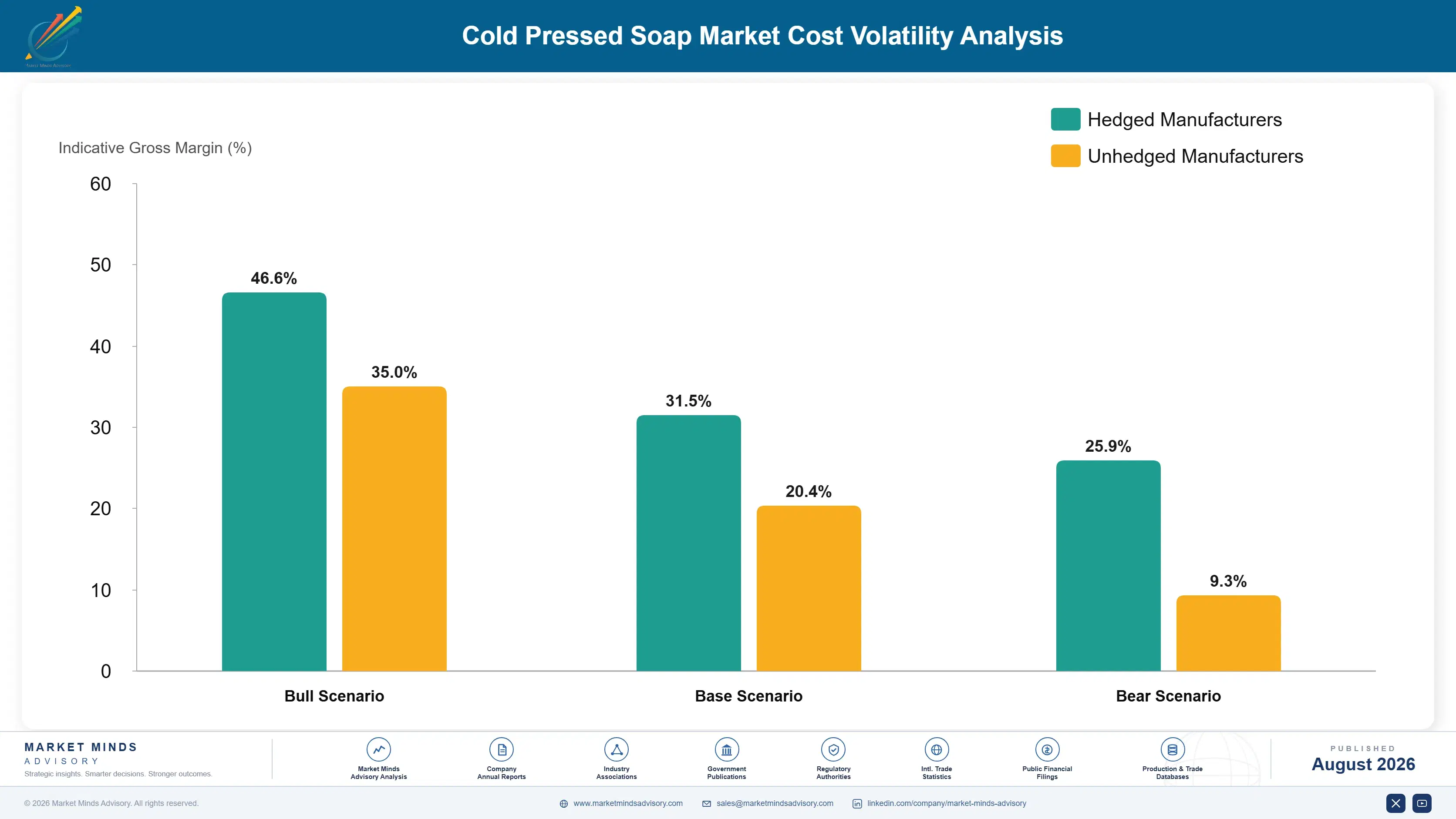
Plant Oil and Lye Feedstock Exposure

Plant oils including olive, coconut, and palm account for roughly 46% of unit cost, sourced from established agricultural commodity suppliers across the Mediterranean, Southeast Asia, and West Africa, with sodium hydroxide and specialty botanical additives adding a further 12% to 20% depending on formulation complexity and ingredient sourcing required for the specific bar involved. Qualification requirements limit how quickly makers shift toward alternative oil suppliers.
Plant oil prices climbed noticeably through 2022 and 2023 as global edible oil demand rebounded against constrained harvest yields and export restrictions across major producing regions. The United States Department of Agriculture has documented edible oil supply concentration as a persistent agricultural commodity concern given the limited number of major producing countries, and makers without long-term feedstock contracts absorbed the cost increase directly into margin during the worst months of that period.

Exposure varies considerably by maker scale and feedstock sourcing diversity across the industry. Larger established makers like Dr. Squatch hedge feedstock exposure through long-term supply partnerships, while smaller indie makers buying oils on constrained markets absorb price swings immediately into unit cost with no negotiated discount available. That gap leaves smaller makers at a persistent cost disadvantage when feedstock prices spike.
cold-pressed-soap-market-cost-volatility-analysis-1788167499330

Secure long-term plant oil feedstock supply contracts

Locking plant oil volume through long-term supplier contracts protects production schedules from constrained harvest or export disruption during periods of peak agricultural commodity demand across the industry. This trades some pricing flexibility for delivery certainty that major retail contracts increasingly require as a standing condition of doing business at all. Makers without such contracts risk delays whenever markets tighten unexpectedly.

Invest in in-house saponification quality testing

Makers shipping sufficient volume can justify investing in in-house saponification quality testing capability, capturing efficiency currently paid to third-party audit firms while gaining direct control over documentation timing over the medium to long term horizon that large retail contracts typically demand from any qualified certified maker. Suppliers without such capability risk delays whenever certification cycles tighten unexpectedly.

Diversify plant oil sourcing across producing regions

Qualifying plant oil suppliers across multiple regions simultaneously reduces exposure to any single region's harvest failure or trade policy disruption event. Makers with diversified sourcing recovered from the 2022 to 2023 spike measurably faster than single-source buyers did, protecting margin through the worst of that period. Diversification also shortens lead times when a producing region faces export limits.

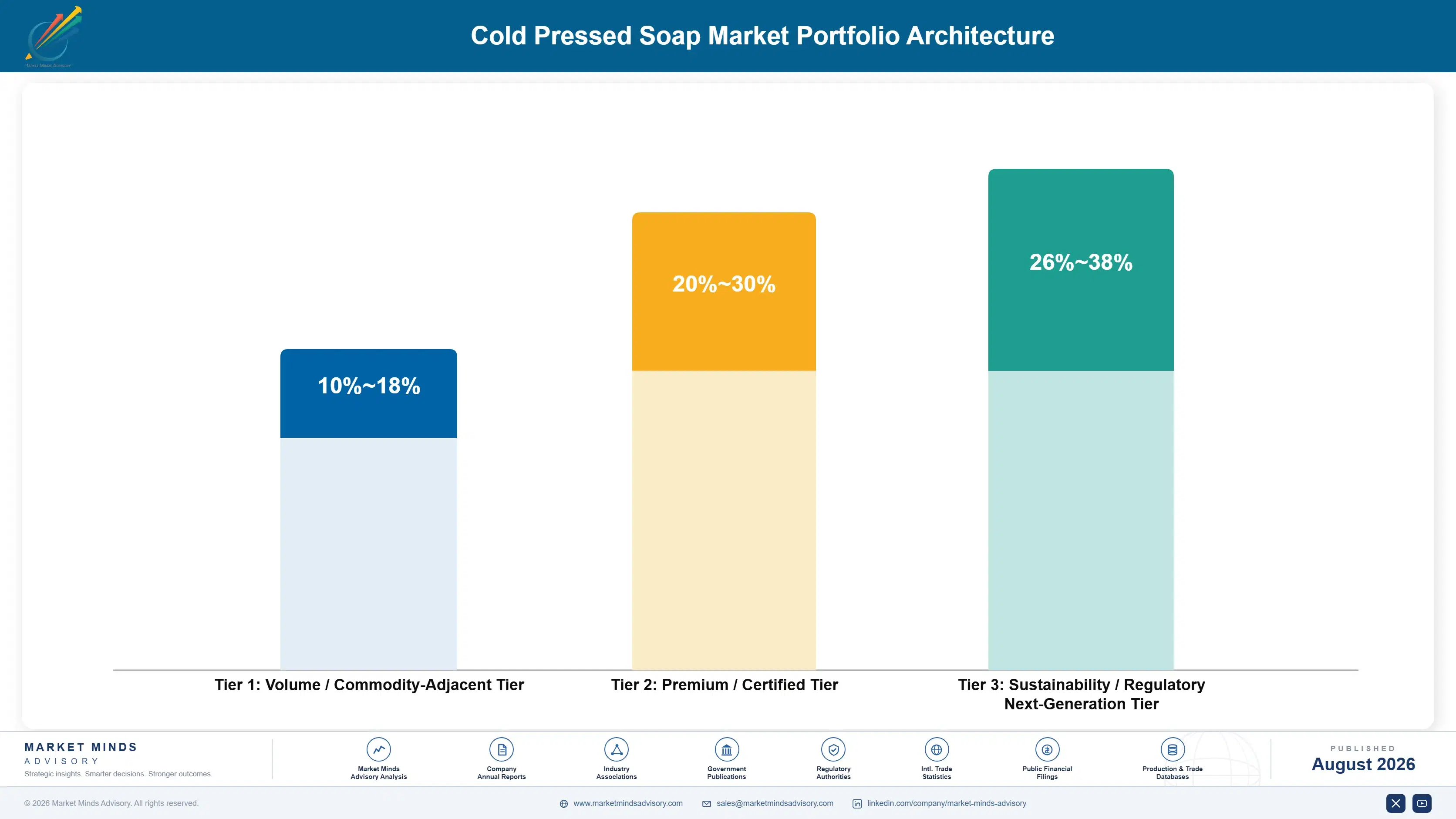
Portfolio Architecture for Margin Defence

The portfolio splits into three tiers with clear margin separation tied to certification depth and ingredient category served. Commodity-grade unscented and basic plant oil bars compete on price and earn thin margins, certified charcoal and botanical-infused formulations earn considerably more, and CBD and hemp-infused bars carry the highest margin given their regulatory compliance barriers and ingredient sourcing depth protecting that position from new entrants.
The tension between volume and premium reflects category directly: clean beauty retailers investing in certified positioning reward documented traceability and ingredient credential depth over price, pulling makers toward sustained certification investment year after year, while much of the commodity unscented segment still buys on price and shelf availability alone with production scale mattering more than certification depth. Makers running multiple product lines must manage genuinely distinct sourcing, certification, and retail relations organisations without letting either investment starve the other of resources.

High-value margin pools concentrate in CBD-hemp and certified charcoal contracts, where documented credential depth and ingredient innovation both reward proven maker capability directly and consistently. The volume core of commodity plant oil bar sale remains necessary for production scale but contributes comparatively little to blended margin across the portfolio as a whole.

Volume / Commodity-Adjacent Tier

Commodity-grade unscented and basic plant oil bars sold into mass-market applications, competing primarily on price with limited certification investment beyond baseline compliance. Order volume typically substitutes for clinical differentiation in most purchase decisions here.
Gross Margin: 10-18%

Premium / Certified Tier

Certified charcoal, clay, and botanical-infused bars sold under documented credential performance into mainstream prestige retail contracts across multiple brand tiers worldwide. Formulation reliability matters as much as price to most brand qualification decisions.
Gross Margin: 20-30%

Sustainability / Regulatory / Next-Generation Tier

CBD and hemp-infused formulations engineered specifically for the most demanding regulatory compliance and ingredient sourcing requirements available in the category today. Makers here typically hold exclusive multi-year formulation relationships with launch brand customers.
Gross Margin: 26-38%
cold-pressed-soap-market-portfolio-architecture-1788167499831

High-value Sub-segments and Strategic Watch-out

CBD and Hemp-Infused Cold Pressed Soap

High value and the fastest-growing application at 12.0% CAGR, carrying both a wellness-ingredient premium and genuine regulatory compliance barriers to entry that protect early movers from new entrants over time. Makers already qualified here hold a durable multi-year advantage over prospective new entrants. Managers rarely switch suppliers once qualified.
Gross Margin: 26-38%

Charcoal and Clay-Infused Cold Pressed Soap

High value with strong growth, sustained by consumers specifying documented detoxifying claims across multiple skin-type formulations. Margin varies with the ingredient sourcing depth a maker holds. That relationship depth compounds across successive reformulation cycles over a product's full commercial life. Certified suppliers earn repeat business consistently.
Gross Margin: 20-30%

Plant Oil-Based Cold Pressed Soap

The volume core, competing on price and distribution reliability across most mainstream retail applications worldwide. Margin stays thin because production scale, not certification depth, dominates decisions in this segment. Makers here compete mainly on delivery reliability and unit cost rather than clinical depth. Scale advantages compound over time.
Gross Margin: 10-18%

Goat Milk and Animal-Derived Cold Pressed Soap

The strategic watch-out, where buyer willingness to pay a documentation premium remains largely unproven across niche sensitive-skin applications today. Margin range is wide because pricing power varies sharply by individual customer relationship. Makers that misjudge this segment risk overinvesting in documentation buyers ultimately will not pay for.
Gross Margin: 14-24%

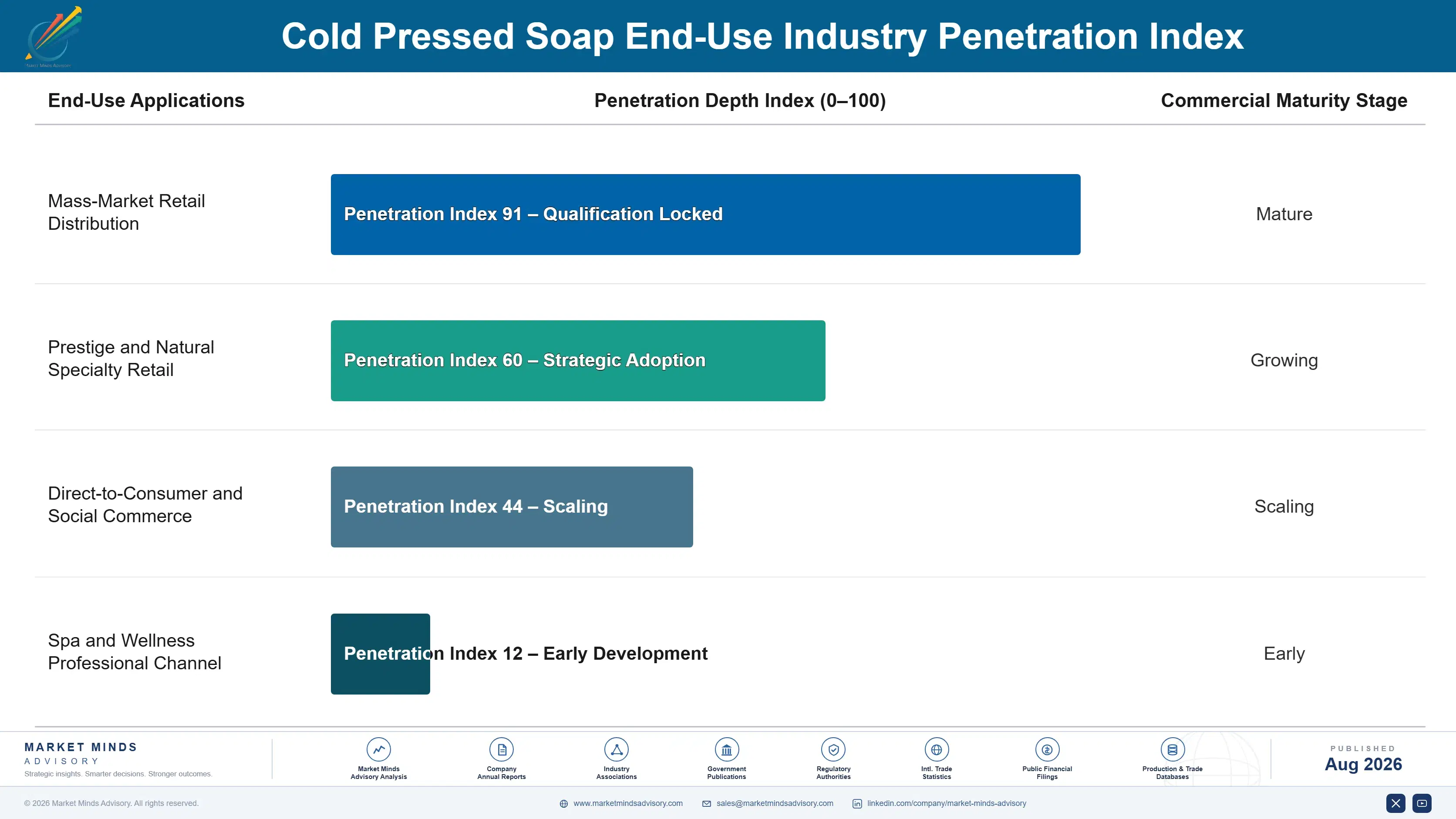
Retail Trust and Certification Lock-In

Demand behaves like an annuity once a maker secures certified shelf placement with a major natural retailer: retail buyers rarely delist certified brands once stocked, since replacing a qualified product means repeating months of vendor onboarding against a brand that already has proven sales performance. That repeat-purchase pattern gives incumbent certified makers a durable revenue base newer competitors cannot easily displace.
Adoption depth varies sharply by ingredient category across the market. Charcoal, clay, and CBD-hemp formulations have converted deepest, since consumer scrutiny and certification requirements make certified sourcing close to mandatory for any responsible retail buying team. Plant oil-based buyers adopt more selectively, weighing certification cost against category margin on a product-by-product basis, while goat milk and sensitive-skin buyers remain the shallowest adopters, often defaulting to whatever formulation is on hand.

Buyer profiles are shifting generationally. Younger retail buying teams increasingly default to documented certified makers without evaluating unverified alternatives as heavily, treating third-party credentials as a baseline requirement rather than an optional consideration. That default is spreading faster among new-format retail channels than among legacy grocery buyers, which weigh established brand relationships most heavily at the point of placement decision.
cold-pressed-soap-market-end-use-penetration-index-1788167500321

Ingredient Traceability Beats Legacy Artisan Scale

These are among the four positions where our research anticipates prominent divergence between winners and laggards over the coming forecast period. Each is grounded in the demand model, the regulatory perimeter, and the announced capacity pipeline.
01 / INGREDIENT TRACEABILITY STRATEGY

Makers without documented sourcing will lose retail placement by 2029

Major retailers increasingly default to makers holding documented ingredient traceability certification, since unverified makers cannot supply the defensible documentation that retail legal teams now require before approving shelf placement. The category leader's traceability strategy shows how addressable retail access follows directly from credential investment completed years earlier rather than from any late certification attempt. That gap will keep compounding as retailer verification requirements continue tightening across every major natural retail channel worldwide, rewarding makers that invested in documentation well before mandates tightened.
02 / PROCESS DOCUMENTATION TIMING

Early testing investment will decide long-term retail contract share

Retailers increasingly require documented supply chain traceability before approving any major placement expansion, and makers without that capability cannot bid for premium shelf space regardless of the price they offer during negotiation. SheaMoisture's testing investment shows how systems built years before audit requirements tightened convert directly into preferred-vendor status that competitors cannot quickly replicate. That advantage keeps compounding as more retailers require documented sourcing verification across their entire natural assortment, leaving unverified competitors further behind with each passing product cycle.
03 / FEEDSTOCK DIVERSIFICATION APPROACH

Diversified plant oil sourcing will separate resilient makers from exposed rivals

Plant oil price volatility is exposing makers with concentrated single-region sourcing to recurring margin disruption that diversified competitors largely avoid through multi-region supplier qualification. Makers who invest in sourcing diversification now will capture premium shelf placement that increasingly demands documented flexibility from every vendor under consideration. That resilience gap will only widen as retailer verification requirements continue evolving across the broader natural retail sector worldwide, rewarding makers that diversified early rather than reacting only after scrutiny had already intensified sharply.
04 / COOPERATIVE CERTIFICATION INNOVATION

Shared certification cooperatives will determine which makers reach shelves fastest

Smaller indie makers increasingly favour shared certification cooperative membership over solo certification funding, since certification speed increasingly decides which makers secure retail placement ahead of competitor product launches. Makers without this cooperative approach cannot match certification speed regardless of any formulation quality advantage they might otherwise offer to a prospective retail partner. That gap is already reshaping how retail placement decisions are made across the industry today and into the next decade, favouring makers that committed to consortium participation early.

Engagement Snapshot From the Field

A live engagement with an industry participant carrying material or product regulatory and market exposure ahead of a defining policy shift, showing how our research translates into a defensible multi-year portfolio strategy.
MARKET MINDS ADVISORY · CLIENT ENGAGEMENT SUMMARY
Cold Pressed Soap Producer Strategic Portfolio Review and Transition Roadmap 2026·Investment Scenario on Cold Pressed Soap Exposure Evaluation 2025-26
CLIENT PROFILE
An indie cold pressed soap brand approached MMA while evaluating certification pathways ahead of a planned expansion into major national natural retail chains. The client reported annual revenue surpassing USD 6 million and a certification budget of USD 220,000 tied to a ten-month retail launch timeline (client-reported, unverified by MMA). The client also flagged limited internal supply chain documentation as a complicating factor.
STRATEGIC CHALLENGE
Management wanted to secure certification ahead of a competitor's expected national launch but had not benchmarked certification timelines and cooperative membership options across available pathways, nor evaluated whether solo certification could realistically complete within the planned window. Retail partnerships wanted proof of credibility; finance wanted cost certainty. Retail partnerships also needed reassurance that credentials would hold up under audit.
MMA APPROACH
MMA benchmarked certification timelines, cooperative membership costs, and retailer documentation requirements across the three certification pathways the client was evaluating. We modelled certification completion against the launch deadline and quantified realistic phasing scenarios using comparable indie brand retail expansion benchmarks. We also interviewed the client's supply chain team to confirm realistic documentation timelines against actual supplier records.
KEY FINDINGS
  1. Solo certification would have required twelve months, exceeding the client's ten-month retail launch deadline by a meaningful margin (client-reported, unverified by MMA). That gap forced an immediate reassessment of the client's original solo certification plan.
  2. Joining a certification cooperative reduced the timeline to seven months while adding roughly 5% to total certification cost relative to solo pursuit. That figure was factored directly into the final budget approval.
  3. Two of three target retail chains required certification documentation beyond the baseline natural labeling standard the client had originally planned for. That mismatch had not been identified during the client's initial internal planning phase.
  4. Brands with existing supply chain documentation completed certification measurably faster than those requiring documentation reconstruction from scratch. That gap shaped the final certification pathway decision directly.
CLIENT PROFILE
An indie cold pressed soap brand approached MMA while evaluating certification pathways ahead of a planned expansion into major national natural retail chains. The client reported annual revenue surpassing USD 6 million and a certification budget of USD 220,000 tied to a ten-month retail launch timeline (client-reported, unverified by MMA). The client also flagged limited internal supply chain documentation as a complicating factor.
STRATEGIC CHALLENGE
Management wanted to secure certification ahead of a competitor's expected national launch but had not benchmarked certification timelines and cooperative membership options across available pathways, nor evaluated whether solo certification could realistically complete within the planned window. Retail partnerships wanted proof of credibility; finance wanted cost certainty. Retail partnerships also needed reassurance that credentials would hold up under audit.
MMA APPROACH
MMA benchmarked certification timelines, cooperative membership costs, and retailer documentation requirements across the three certification pathways the client was evaluating. We modelled certification completion against the launch deadline and quantified realistic phasing scenarios using comparable indie brand retail expansion benchmarks. We also interviewed the client's supply chain team to confirm realistic documentation timelines against actual supplier records.
KEY FINDINGS
  1. Solo certification would have required twelve months, exceeding the client's ten-month retail launch deadline by a meaningful margin (client-reported, unverified by MMA). That gap forced an immediate reassessment of the client's original solo certification plan.
  2. Joining a certification cooperative reduced the timeline to seven months while adding roughly 5% to total certification cost relative to solo pursuit. That figure was factored directly into the final budget approval.
  3. Two of three target retail chains required certification documentation beyond the baseline natural labeling standard the client had originally planned for. That mismatch had not been identified during the client's initial internal planning phase.
  4. Brands with existing supply chain documentation completed certification measurably faster than those requiring documentation reconstruction from scratch. That gap shaped the final certification pathway decision directly.
RECOMMENDED STRATEGY
Phase 1: Phase 1 (0 to 3 months): Join a certification cooperative and begin supply chain documentation reconstruction immediately. while assigning a dedicated internal owner to the documentation effort. Phase 2: Phase 2 (3 to 7 months): Complete cooperative certification while pursuing supplementary documentation for the two stricter retail chains. while briefing retail partners on the revised documentation timeline. Phase 3: Phase 3 (7 to 10 months): Launch across all three target retail chains with certification fully documented and verified. while monitoring post-launch retailer feedback closely.
OUTCOME
The client proceeded with the cooperative certification pathway, launching across all three target retail chains within its ten-month deadline. The client reported avoiding an estimated four-month launch delay it had modelled under a solo certification scenario (client-reported, unverified by MMA). Management credited the cooperative pathway with materially reducing both cost and schedule risk.

Frequently Asked Questions

Foundational context covering the market sizes, CAGR, scope, country, region and competition that inform every finding below. This section is provided to cover basics and most often pre-purchase conversations, answered from the MMA Primary Research Dataset.

What is the current size of the Cold Pressed Soap Market?

The Cold Pressed Soap Market stood at USD 1.8 billion in 2025, based on MMA Primary Research Dataset estimates. Retailer certification mandates are the primary near-term growth driver.

How large will the Cold Pressed Soap Market be by 2036?

MMA projects the market reaching USD 3.71 billion by 2036 under the base case scenario. That represents a 1.93 times expansion over the 2026 base value.

What is the CAGR for the Cold Pressed Soap Market 2026 to 2036?

The base case CAGR is 6.8% annually. The bull case reaches 8.0% and the bear case falls to 5.6%, depending on certification pace and feedstock cost trends.

Which segment is growing fastest?

CBD and hemp-infused cold pressed soap grows fastest at 12.0% CAGR, about 1.76 times the overall market rate. Novel wellness ingredient demand drives that sustained pace.

Who are the major companies in the Cold Pressed Soap Market?

Dr Squatch, SheaMoisture, Dr Bronner's, Nubian Heritage, and Le Petit Marseillais lead the category today. Combined, the top five hold a CR5 of 22% across a highly fragmented indie-heavy field.

Which country is growing fastest?

India grows fastest at 10.5% CAGR, driven by its deep-rooted natural and ayurvedic personal care tradition. Rising urban disposable income is reinforcing that pace further each year.

Report Segmentation Architecture

The full report scope spans multiple orthogonal segmentation dimensions, with cross-tabulated demand data provided for each dimension pair. Coverage extends further to regional breakdowns, trend trajectories, and the competitive detail needed to support segment-level decision-making.

By Ingredient Formulation

  • Plant Oil-Based Cold Pressed Soap
  • Goat Milk and Animal-Derived Cold Pressed Soap
  • Charcoal and Clay-Infused Cold Pressed Soap
  • Essential Oil and Botanical-Infused Cold Pressed Soap
  • Unscented and Sensitive-Skin Cold Pressed Soap
  • CBD and Hemp-Infused Cold Pressed Soap

By End-Use Industry

  • Mass-Market Retail Distribution
  • Prestige and Natural Specialty Retail
  • Direct-to-Consumer and Social Commerce
  • Spa and Wellness Professional Channel

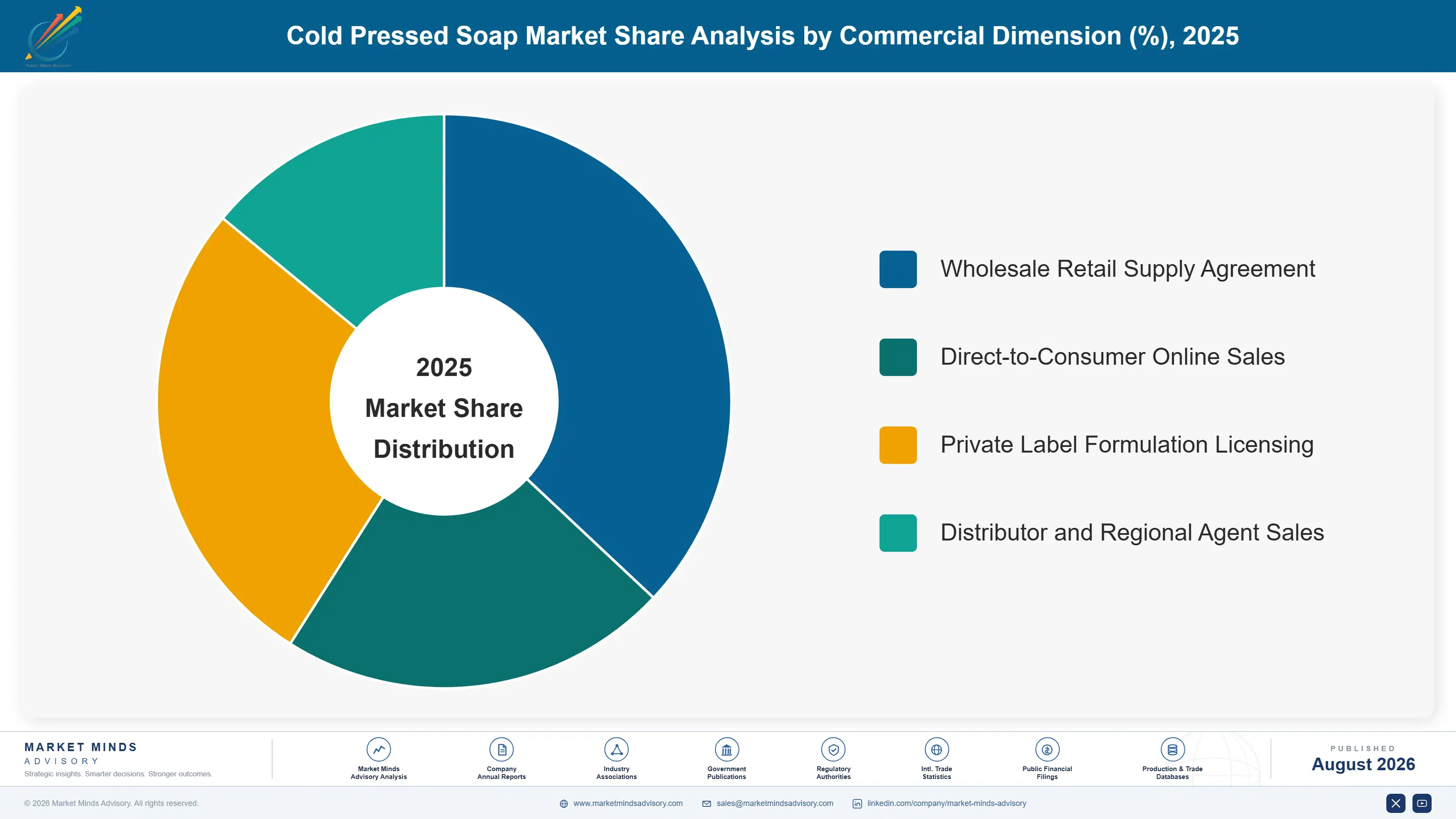
By Commercial Dimension

  • Wholesale Retail Supply Agreement
  • Direct-to-Consumer Online Sales
  • Private Label Formulation Licensing
  • Distributor and Regional Agent Sales

By Region

  • North America
  • Western Europe
  • East Asia
  • South Asia and Pacific
  • Latin America
  • Middle East and Africa
  • Eastern Europe

Scope, Methodology, and Coverage

Every figure in this report is reproducible from documented input assumptions. The scope below maps the historical period, the forecast horizon, the segmentation dimensions, and the countries covered, alongside the underlying primary and qualitative methodology.
Historical Period
2020 to 2025
Forecast Period
2026 to 2036
Base Year
2025 (USD billions; MMA Primary Research Dataset, August 2026)
Market Definition
The cold pressed soap market comprises plant oil-based cold pressed soap, goat milk and animal-derived cold pressed soap, charcoal and clay-infused cold pressed soap, essential oil and botanical-infused cold pressed soap, unscented and sensitive-skin cold pressed soap, and CBD and hemp-infused cold pressed soap manufactured using the traditional cold saponification process. Syndet bars, glycerin melt-and-pour soap, and liquid body wash products are excluded.
Quantitative Units
USD billions (current prices); metric ton and unit shipment volume where applicable
Segmentation Dimensions
By Ingredient Formulation; By End-Use Industry; By Commercial Dimension; By Region
Regions Covered
North America, Western Europe, East Asia, South Asia and Pacific, Latin America, Middle East and Africa, Eastern Europe
Countries Covered
USA, Canada, Germany, France, UK, Italy, Spain, China, Japan, South Korea, India, Australia, Brazil, Mexico, Argentina, UAE, Saudi Arabia, South Africa, Turkey, Poland, Czech Republic, Romania, Netherlands, Sweden, and additional markets relevant to this sector
Key Companies Profiled
Dr. Squatch LLC, SheaMoisture, Dr. Bronner's Magic Soaps, Nubian Heritage, Le Petit Marseillais, Alaffia, Kirk's Natural Products, Tom's of Maine, Grandpa's Brands Company, Duke Cannon Supply Co., Public Goods, Native, Every Man Jack, Pacha Soap Co., Vermont Soap Organics, Chagrin Valley Soap and Salve, J.R. Liggett's, Whish Body, Bali Body, Buck Naked Soap Company
Quantitative Methodology
Primary survey, n=3,800 respondents, Q4 2025, six countries; demand-side model with trade association cross-validation
Qualitative Methodology
47 expert interviews, Q4 2025; applied to validate demand model assumptions, identify emerging dynamics, and assess competitive positioning
Report Format
PDF and XLSX data workbook (Word format preview document)
Publisher
Market Minds Advisory
Report Code
MMA-2026-CHM-187
Published
August 2026
Contact
sales@marketmindsadvisory.com | www.marketmindsadvisory.com

Purchase the full Cold Pressed Soap Market Report (2026 to 2036).

The full MMA Cold Pressed Soap report sizes the market across six ingredient formulations, four end-use industries, four commercial dimensions, and seven regions through 2036. It profiles twenty makers on a consistent unit shipment volume basis, scoring each on ingredient traceability certification, saponification process documentation, and plant oil sourcing diversification. Scenario models quantify how retailer certification mandates, consumer ethical awareness, and feedstock price cycles shift both volume and realised price across formulation tiers. The report also includes delivered-cost modelling by ingredient category, a certification exposure screen, and retail placement analysis built for maker strategy, formulation, and investment teams.
Six-category segmentation with cross-tabulated regional demand
Twenty-maker competitive benchmarking on shipment volume
Ingredient traceability tracking by maker and region
Saponification process documentation and adoption analysis
Plant oil feedstock price scenario modelling through 2036
Country-level regulatory and certification requirement tracking

Built For The People Who Decide

From boardroom strategy to bench-side execution, this report is read cover-to-cover by leaders shaping the next decade of their industry, turning demand scenarios, market dynamics and valuation benchmarks into decisions.
CXOs/ Presidents/ VPs/ Managers
M&A and Corporate Development
Strategy Teams and R&D Heads
Procurement and Product Directors
Regulatory and Compliance Leaders
Investor Relations and Equity Analysts