

Market Minds Advisory
Cold Laser Therapy Market

Cold Laser Therapy Market: Photobiomodulation Moves From Clinic to Home Use

Physical therapy and chiropractic clinics are expanding cold laser therapy from a niche add-on into a core pain management offering, while direct-to-consumer home devices pull growth toward a new channel.

Lead Analyst

Alice Ballenger

Published

September 2026

Make Smarter Decisions with Customized Research Insights

Request a free sample report and evaluate market opportunities, growth trends, and competitive dynamics relevant to your business needs.

2025 MARKET VALUE$1.1BMarket Size 2025
2036 FORECAST VALUE$2.7BBase Case , 2026 to 2036
CAGR 2026 TO 20368.5 %Bull 9.8% / Bear 7.2%
INCREMENTAL OPPORTUNITY$1.5BNet 10- year value creation
EXPANSION MULTIPLE2.26x2036 value over 2026 base
Strategic Levers
M&A Pipeline
Regional Outlook
Country Rankings
Competitive Intelligence
Segmental Deep-dive
Call-Us : 91 93563 13602

Executive Snapshot and Market Trajectory

Physical therapists and chiropractors increasingly treat cold laser therapy as a standard pain management tool rather than an optional upsell, reflecting a growing clinical evidence base. Payers increasingly reinforce that shift through updated coverage policy for specific diagnosed conditions. Patients now expect this option before considering pharmacological approaches.
Home-use and veterinary devices are the clearest growth story, expanding the category well beyond its traditional clinical footing, and commercial momentum concentrates in North America, where physical therapy and chiropractic clinic density outpace every other region MMA tracks by a considerable margin. That regional concentration is unlikely to narrow before the decade ends. Vendors report growing confidence in this outlook as reimbursement coverage continues to expand across most markets tracked here.
No single manufacturer holds more than a modest share of this fragmented category, and competitive activity centers on clinical evidence generation and channel expansion rather than on price alone. FDA clearance class and reimbursement coding shape purchasing decisions as much as raw laser power output does across every device tier, and emerging Asian manufacturers are chipping away at established players' share fastest in the price-sensitive consumer channel.
Market Definition
The Cold Laser Therapy Market covers low-level and high-power laser therapy devices used for pain management, tissue healing, and inflammation reduction, spanning Class III and Class IV clinical systems, portable handheld units, and home-use devices. It excludes surgical and ablative laser systems and general phototherapy devices sold for dermatological or cosmetic use.
Base Year Value
$1.1B in 2025 (MMA Primary Research Dataset, August 2026)
Forecast Period
2026 to 2036, eleven discrete annual values
CAGR
8.5% base case. Bull 9.8%. Bear 7.2%.
Fastest Growth Segment
Home-Use Cold Laser Devices: 12.5% CAGR
Fastest Growth Country
China: 10.5% CAGR
Fastest Growth Region
South Asia and Pacific: 10.5% CAGR
Largest Region
North America: 36% of 2025 global value
Market Leaders
Multi Radiance Medical Inc, THOR Photomedicine Ltd, Erchonia Corporation, LiteCure LLC, Apira Science Inc. Source: MMA Analysis based on company annual reports.
Primary Survey
n=3,800 procurement and R&D decision-makers, Q4 2025, six countries
Methodology
Demand-side build-up, cross-validated against public data, 47 expert interviews

Cold Laser Therapy Market Forecast Scenarios

cold-laser-therapy-market-size-forecast-scenario-1787306686793
Between 2020 and 2025 the market grew steadily as physical therapy practices expanded cold laser adoption beyond early specialist clinics, interrupted briefly by pandemic-era deferrals of elective outpatient therapy visits before recovering fully through 2022 as backlogged patient volumes cleared across most developed healthcare markets. Vendors report order volumes largely normalized to a new, higher baseline by early 2023 across most markets.
The base case assumes steady 8.5% annual growth through 2036, anchored to three mechanisms: expanding clinical evidence supporting cold laser therapy for a broadening range of musculoskeletal conditions, direct-to-consumer home devices reaching patients who previously required a clinic visit, and veterinary rehabilitation adoption growing as pet owners increasingly seek non-pharmacological pain management options for their animals. Group purchasing and clinical evidence publication activity have reinforced this trajectory across most recent fiscal quarters.
The bull case centers on insurer reimbursement coverage expanding faster than currently modeled as clinical evidence accumulates. The bear case centers on regulatory scrutiny of unsubstantiated home-use marketing claims slowing consumer channel growth, stretching adoption timelines by a year or more. Neither scenario shifts the leading five manufacturers' relative rankings materially within the coming decade.

Photobiomodulation Expands Beyond the Clinic

Physical therapy and chiropractic practices increasingly bill cold laser therapy as a distinct treatment code rather than bundling it into a general therapy visit, a shift that has meaningfully changed how clinics justify equipment purchases to their own finance teams. Vendors that cannot demonstrate this billing pathway increasingly lose consideration at the earliest purchasing conversation. That professionalization has raised the bar for how vendors demonstrate value.
MARKET CONCENTRATIONCR5 42%Reflects a fragmented field of specialized device makers
AVERAGE SELLING PRICE$150-25,000 per deviceVaries considerably by power class and sales channel
TOP PRODUCING COUNTRYUnited States, 27% shareLargest base of manufacturing and device assembly capacity
TRADE INTENSITY44% cross-border volumeShare of devices sold outside their country of manufacture
REPLACEMENT CYCLE LENGTH5-7 yearsReflects the typical clinical device lifespan before replacement
FEEDSTOCK COST SHARE25% of COGSLaser diode arrays and optical components as input cost
Clinical evidence depth now shapes purchasing decisions nearly as much as raw device specifications do, since a high-power laser without peer-reviewed outcome data struggles to win physician referral regardless of how favorably its optical output compares to competing systems. A high-power laser without peer-reviewed data struggles to reach volume regardless of its underlying optical specifications. Manufacturers increasingly treat evidence generation as a core commercial function rather than a peripheral research exercise.
Over the next decade, home-use devices will likely capture a meaningful share of patients who currently receive treatment exclusively in a clinical setting, narrowing the gap between professional and consumer-grade device categories as home formulations improve. Manufacturers still reliant entirely on clinical-only distribution risk losing ground to faster-moving consumer-focused rivals. Companies positioned early stand to capture disproportionate share of the growing consumer segment.
"Evidence is the real product now. A laser with three peer-reviewed studies behind it outsells one with twice the power and none."
Director, Medical Technology Practice · MMA Medical Devices Practice &midd

Market Trends

Clinical Evidence Base Expands Reimbursement Eligibility

Peer-reviewed clinical evidence supporting cold laser therapy has expanded meaningfully since 2020, covering a broadening range of musculoskeletal and inflammatory conditions beyond the therapy's traditional use in acute soft tissue injury. Several major insurers have updated coverage policy to include cold laser therapy for specific diagnosed conditions where evidence now meets their reimbursement threshold, and physical therapy associations have incorporated updated treatment guidance reflecting this expanding evidence base. Manufacturers report meaningfully higher clinic purchasing activity in markets where reimbursement coverage has already been extended to cover these conditions. Group purchasing organizations increasingly specify evidence-backed devices as a standard contract requirement.
Market Impact: Adds 4% annual patient pool growth
Direct-to-Consumer Home Devices Reach a New Patient Population

Home-use cold laser devices have moved from a niche wellness category into a meaningful commercial channel, letting patients manage chronic pain conditions between clinic visits or in place of one entirely for milder cases. Retail and e-commerce distribution has expanded considerably as manufacturers simplify device design for non-clinical users, and several manufacturers now report direct-to-consumer sales growing faster than their traditional clinical channel. This shift has meaningfully broadened the category's total addressable market beyond patients who have direct access to a physical therapy or chiropractic clinic nearby. Vendors report this channel expansion accelerating faster than most planning models originally forecast.
Market Impact: Expands the addressable market 15%

Market Opportunities and Growth Drivers

Rising Chronic Pain Prevalence Drives Non-Pharmacological Demand

Chronic musculoskeletal pain prevalence continues rising alongside an aging population, and growing physician and patient wariness of long-term opioid use is pushing demand toward non-pharmacological pain management alternatives including cold laser therapy. National health surveys report meaningfully rising chronic pain diagnosis rates in several major markets, and each additional diagnosed patient represents a potential cold laser therapy candidate as physicians increasingly recommend non-drug approaches before considering long-term medication management. This shift shows no sign of reversing given sustained regulatory and clinical attention to opioid alternative therapies across most developed healthcare systems.
Market Impact: Limits reimbursed access to roughly

Veterinary Rehabilitation Adoption Expands the Addressable Market

Veterinary rehabilitation and pain management adoption has grown quickly as pet owners increasingly seek non-pharmacological treatment options for aging or post-surgical animals, widening the addressable market considerably beyond human clinical and consumer channels. Veterinary professional associations report growing practitioner training program enrollment specifically covering laser therapy techniques, and specialty veterinary rehabilitation practices increasingly list cold laser therapy as a standard offering rather than a specialty add-on service. Manufacturers report specialty veterinary practices now serving as reference sites for broader adoption among general practitioners considering the modality for the first time.
Market Impact: Slows consumer growth by 15%

Market Restraints and Challenges

Inconsistent Reimbursement Coding Limits Clinical Adoption

Reimbursement coding for cold laser therapy remains inconsistent across insurers and regions, with some payers treating it as a bundled therapy component while others decline coverage entirely, creating pricing and adoption uncertainty for clinics considering equipment purchases. The root cause is that many payers still evaluate cold laser therapy coverage requests case by case rather than under a standardized national policy framework. Manufacturers and physical therapy trade associations are lobbying for standardized reimbursement coding to reduce this friction, though progress has been gradual and inconsistent across different insurer types. Progress remains gradual given the number of distinct payer types involved.
Market Impact: Expands reimbursement eligibility b

Unsubstantiated Marketing Claims Draw Regulatory Scrutiny

Regulatory bodies have increased scrutiny of home-use device marketing claims that exceed what current clinical evidence actually supports, creating reputational risk for the broader category when individual manufacturers face enforcement action over overstated efficacy claims. The root cause is that direct-to-consumer marketing has outpaced the pace at which rigorous clinical evidence has accumulated for some specific use cases. Established manufacturers are increasingly investing in their own clinical trials to differentiate evidence-backed products from less rigorously supported competitors in the consumer channel. Established manufacturers increasingly view this investment as necessary to protect broader category credibility over time.
Market Impact: Adds 25% of new category revenue
3 additional market trends, 4 additional growth drivers, and 3 additional restraints and challenges are covered in the full report. Contact sales@marketmindsadvisory.com to access the complete intelligence.

Segment CAGR and Growth Architecture

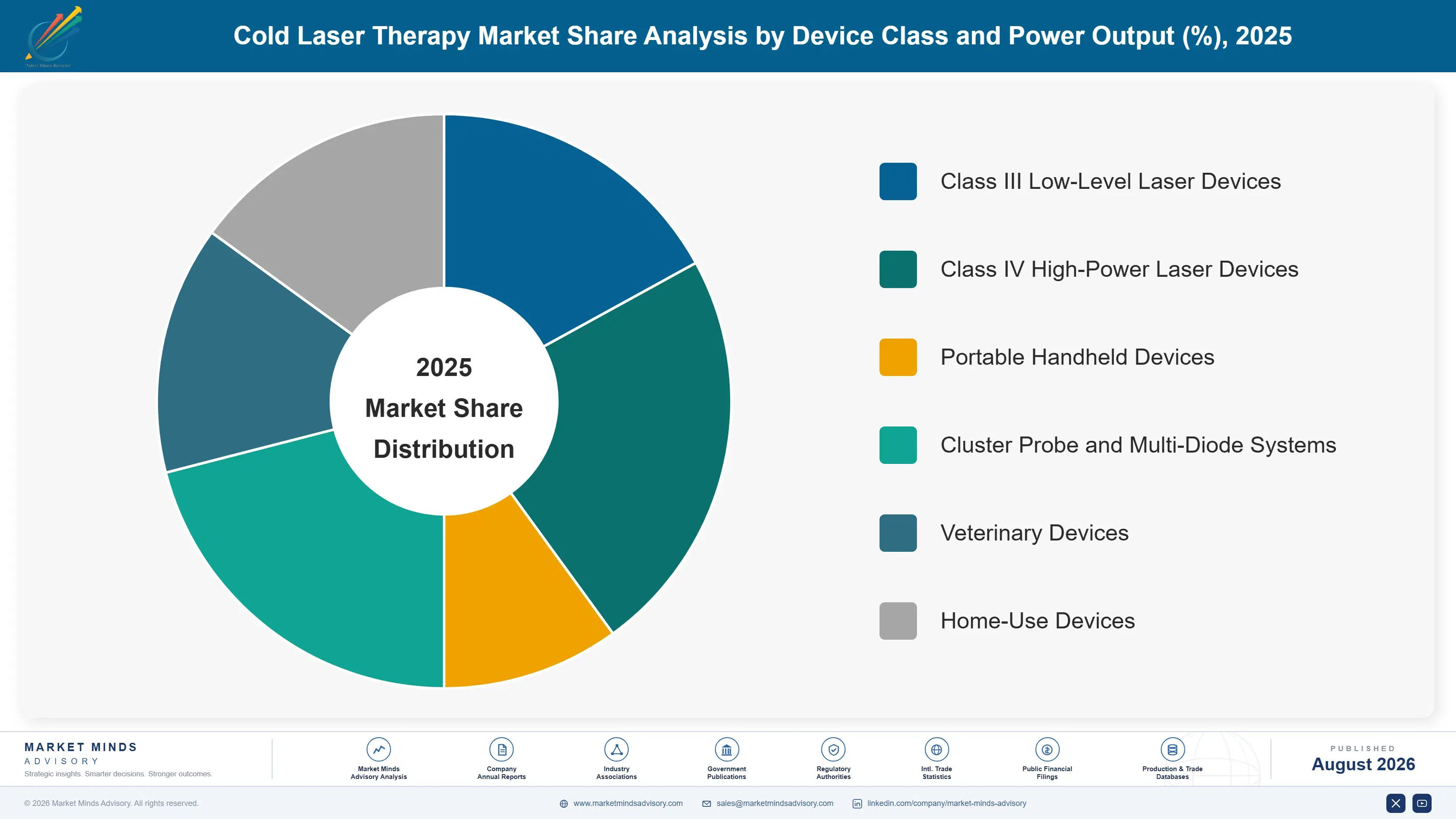
The market segments by device class and power output, spanning Class III low-level systems, Class IV high-power systems, portable handheld units, veterinary devices, and home-use devices, since each class follows a distinct regulatory pathway and clinical application across use settings. No single device class alone dominates purchasing decisions across every treatment or consumer setting.
cold-laser-therapy-market-market-share-analysis-1787306687367

Home-Use Cold Laser Devices

Home-use devices are the fastest-growing segment as manufacturers simplify design for non-clinical users and direct-to-consumer distribution channels mature considerably beyond their early wellness-category positioning. Manufacturers have invested heavily in simplifying dosing guidance and automated treatment protocols, addressing safety and efficacy concerns that historically limited consumer confidence in self-administered laser therapy. Retail and e-commerce partnerships continue expanding distribution reach, and several manufacturers report this channel growing faster than their traditional clinical business as patients increasingly seek at-home options for chronic pain management between clinic visits. Regulatory clearance activity for home-use formats has accelerated meaningfully since 2022, giving manufacturers a credible pathway to expand this category well beyond its current modest share of overall device revenue.
CAGR 12.5%

Veterinary Cold Laser Devices

Veterinary devices are growing quickly as specialty rehabilitation practices increasingly list cold laser therapy as a standard offering for aging and post-surgical animals rather than a specialty add-on service. Manufacturers have invested in veterinary-specific protocols and practitioner training programs, addressing the specialized knowledge gap that historically limited broader veterinary adoption beyond a handful of dedicated rehabilitation specialists. Pet owner willingness to invest in non-pharmacological treatment options continues rising alongside broader pet healthcare spending trends, and veterinary practices report meaningfully higher client acceptance of laser therapy recommendations than in prior years. Insurance coverage for veterinary care continues expanding, further supporting client acceptance of these treatment recommendations. This client acceptance pattern continues strengthening as more veterinarians share positive outcome experiences with peers.
CAGR 11.5%
Full segment breakdown across 6 segments available in the complete report.

Regional Architecture and Country Demand Map

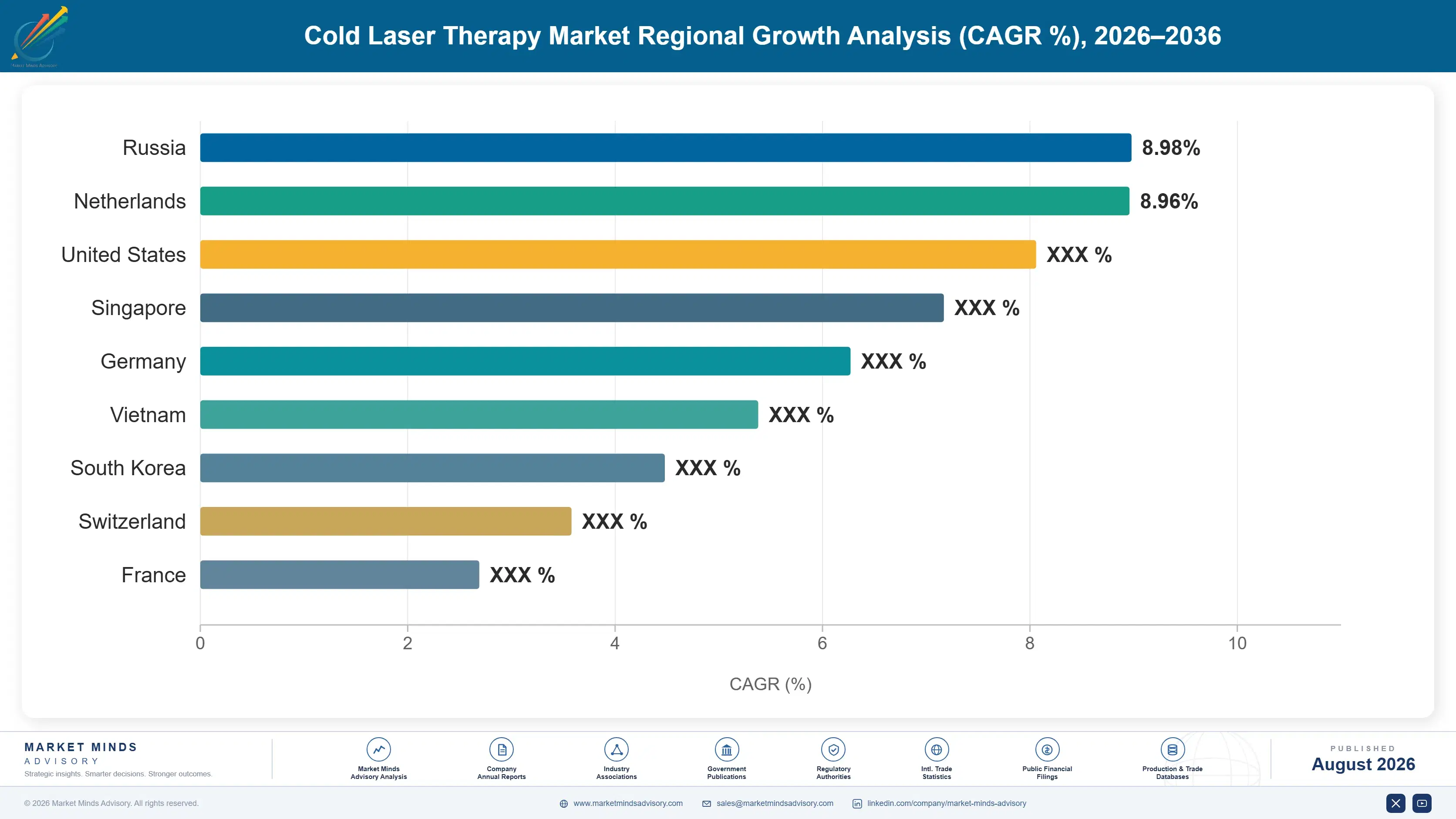
North America accounts for well over a third of global revenue, reflecting the deepest physical therapy and chiropractic clinic density anywhere, while South Asia and Pacific posts the fastest regional growth off a smaller existing base. Every region shows steady expansion, though pace varies by clinic and consumer channel maturity.

North America

The United States carries the largest share of any market MMA tracks, a concentration well above the standard regional band that reflects the deepest concentration of physical therapy and chiropractic clinics found anywhere globally, alongside the broadest insurer reimbursement coverage for cold laser therapy. FDA clearance activity has concentrated here first for nearly every new device class, giving domestic manufacturers a first-mover advantage before international regulatory bodies grant equivalent approvals. Canada's smaller clinic base keeps overall regional volume concentrated in the United States, though steady growth continues there as well. Direct-to-consumer retail and e-commerce channels across both countries have expanded considerably, reinforcing steady equipment purchasing across most major markets tracked in this region.
Share: 36% | CAGR: 7.5% (2026 to 2036)

Western Europe

Germany and the United Kingdom carry the largest share of regional demand, supported by well-established physiotherapy sectors and gradually expanding public health system coverage for cold laser therapy. France and the Nordic countries follow with steady adoption tied to national health service treatment guidelines that increasingly recognize laser therapy for specific musculoskeletal conditions. Regulatory harmonization under the EU Medical Device Regulation has raised compliance costs for smaller manufacturers, consolidating market share toward established players with the resources to maintain full regulatory documentation. Consumer awareness campaigns remain more modest here than in North America, so growth leans more heavily on clinical adoption than on direct-to-consumer retail purchasing. Reimbursement timelines here typically lag United States purchasing cycles by several months.
Share: 23% | CAGR: 7.0% (2026 to 2036)
Regional intelligence for 5 additional markets available in the complete report: East Asia, South Asia and Pacific, Latin America, Middle East and Africa, Eastern Europe. Contact sales@marketmindsadvisory.com.
cold-laser-therapy-market-country-cagr-analysis-1787306687889

Where Laser Therapy Makers Can Grow Margin

Beyond unit volume growth, manufacturers have several concrete paths to lift revenue per account, spanning clinical evidence licensing, treatment protocol subscriptions, financing structures, and veterinary practitioner training programs layered on top of the core device sale. None require heavy capital investment beyond routine research and training staffing. Each applies broadly across clinical and consumer relationships already engaged with the manufacturer.

Developing and Licensing Clinical Evidence Data

Manufacturers that fund rigorous clinical trials supporting specific treatment indications capture disproportionate reimbursement eligibility and physician referral relative to competitors without comparable evidence, often justifying a price premium of 20 to 30% over devices lacking peer-reviewed outcome data for the same indication. This evidence investment typically pays back over several years as reimbursement coverage expands to include newly validated conditions, creating a durable competitive moat that later entrants must overcome through their own costly trial investment. This dynamic reinforces the advantage held by manufacturers with the deepest existing evidence portfolios.
Market Impact: Commands 20 to 30% premium over unp

Treatment Protocol Software and Dosing Subscriptions

Manufacturers increasingly bundle treatment protocol software with device sales, offering updated dosing guidance and condition-specific treatment libraries as a recurring subscription typically priced between $50 and $150 monthly per clinic. Clinics value staying current with evolving best-practice protocols enough to justify the ongoing fee, and this software layer creates a switching cost that reinforces the original hardware purchase decision well beyond the point of sale. Vendors report subscription attach rates climbing steadily as more clinics digitize treatment recordkeeping. This software layer creates meaningful lock-in that reinforces the original hardware purchase relationship over time.
Market Impact: Adds $50 to $150 monthly revenue pe

Equipment Leasing and Practice Financing Programs

Leasing and financing structures lower the upfront capital barrier for smaller clinics and individual practitioners who cannot justify a five-figure outright purchase, expanding the addressable buyer base into practices that would otherwise defer adoption indefinitely. These structures typically carry a financing premium of roughly 12 to 18% over the equivalent cash purchase price spread across the contract term, compensating manufacturers for extended payment risk while still closing sales a straight capital requirement would have lost. Manufacturers report meaningfully higher close rates when financing options are presented alongside a purchase quote.
Market Impact: Expands the buyer base by roughly 2

Veterinary Practitioner Training and Certification Programs

Manufacturers increasingly fund veterinary practitioner training and certification workshops, converting a one-time device sale relationship into a durable commercial partnership as newly certified veterinarians overwhelmingly continue purchasing from the manufacturer whose training program they completed. This loyalty pattern reinforces itself as more veterinarians complete training each year, typically expanding a manufacturer's veterinary account base by 15 to 20% within a given regional training cohort. This loyalty pattern reinforces itself as more veterinarians complete training programs each fiscal year. Manufacturers report this expanding account base translating directly into steady equipment and consumable purchasing.
Market Impact: Expands the veterinary account base

Who Controls the Margin Pool

Five manufacturers hold 42% of global revenue, a meaningfully fragmented field reflecting the relatively low regulatory barrier for lower-power device classes. Multi Radiance Medical and Erchonia form a leading pair whose combined clinical evidence base and channel reach give them a moderate gap over the next tier of challengers, including THOR Photomedicine, LiteCure, and Apira Science. None matches their combined clinical evidence base and channel reach built over years.
Current competitive activity centers on three dimensions: funding clinical trials that expand reimbursement eligibility ahead of rivals, building direct-to-consumer distribution partnerships for home-use devices, and expanding veterinary practitioner training programs that create durable channel loyalty. Vendors that lag on any one of these three dimensions increasingly cede ground to faster-moving rivals in this fragmented market.

Emerging pressure comes from lower-cost Asian manufacturers entering the home-use and portable device segments, gaining ground fastest in price-sensitive consumer channels where clinical evidence matters less to purchasing decisions than it does in the professional clinical channel. Rankings among established clinical-channel leaders are unlikely to shift materially before 2030, but the consumer channel is becoming considerably more contested territory. Several established manufacturers have begun launching dedicated value-tier sub-brands to defend that ground directly.
cold-laser-therapy-market-company-positioning-matrix-1787306688414

Competitive Moat and Risk Dimensions

MULTI RADIANCE MEDICAL INC

Moat: Multi-Diode Technology Depth

Multi Radiance Medical's patented multi-diode super pulsed laser technology gives it clinical differentiation that single-diode competitors struggle to replicate, and its established physical therapy channel relationships reinforce steady prescribing volume even as newer entrants introduce competing device designs into the professional channel. This differentiation supports steady account retention even as newer, lower-cost entrants target the same channel.
MULTI RADIANCE MEDICAL INC

Risk: Limited Consumer Channel Presence

Multi Radiance Medical's business remains concentrated in the professional clinical channel relative to competitors building stronger direct-to-consumer distribution, leaving it more exposed as home-use device revenue grows faster than the traditional clinical channel the company has historically prioritized. Manufacturers with stronger consumer channel investment could capture disproportionate future growth as a result.
ERCHONIA CORPORATION

Moat: Clinical Trial Evidence Portfolio

Erchonia's extensive portfolio of FDA-cleared indications backed by dedicated clinical trials gives it reimbursement eligibility advantages that competitors without comparable evidence investment cannot easily match, and this evidence depth supports premium pricing across its professional clinical product line. Competitors without comparable evidence investment struggle to justify similar pricing to skeptical purchasing committees.
ERCHONIA CORPORATION

Risk: High Ongoing Trial Investment Burden

Erchonia's evidence-driven strategy requires sustained clinical trial investment to defend its reimbursement advantage as new conditions emerge for potential indication expansion, creating an ongoing cost burden that smaller, less evidence-focused competitors do not carry. Manufacturers with lighter evidence obligations can undercut on price more easily in less regulated markets.

Players Tracked

Prominent Players

Multi Radiance Medical Inc
THOR Photomedicine Ltd
Erchonia Corporation
LiteCure LLC
Apira Science Inc

Other Key Players

DJO Global Inc
BioFlex Laser Therapy
Avant Wellness Systems
K-Laser USA
Theralase Technologies Inc
Summus Medical Laser
Diowave LLC
Companion Animal Health
Respond Systems Inc
MedX Health Corp
Microlight Corporation
Vetrolaser LLC
Chattanooga Group Inc
Zimmer MedizinSystems
Class 4 Laser Therapy Inc

Recent Developments

FEBRUARY 2026

Erchonia Secures Expanded FDA Clearance for New Indication

Erchonia secured expanded FDA clearance for its Class IV laser system covering an additional musculoskeletal indication, following multi-year clinical trial data demonstrating outcome benefit for the newly cleared condition. The clearance broadens reimbursement eligibility for clinics using the device to treat this patient population. Trial data accompanied the clearance.
Signal: Expanded FDA indication clearance is quick
SEPTEMBER 2025

LiteCure Acquires Home-Use Device Distribution Platform

LiteCure completed the acquisition of a specialty direct-to-consumer distribution platform focused on home-use wellness device delivery. The deal brought expanded consumer channel distribution capability in-house, broadening LiteCure's reach considerably beyond its prior clinical-channel-only sales model. Deal terms were not disclosed publicly by either company involved.
Signal: Direct-to-consumer distribution platforms
MAY 2025

Multi Radiance Medical Signs Veterinary Training Partnership

Multi Radiance Medical entered a multi-year training partnership with a national veterinary rehabilitation association covering practitioner certification across the association's full member network. The agreement was a training partnership, not a joint venture or acquisition, covering certification programming across the full multi-year term. Financial terms were not disclosed.
Signal: Multi-year, national training partnerships

Laser Diode and Optical Component Exposure

Laser diode arrays and optical components together represent roughly 25% of cost of goods sold for a complete cold laser therapy device, sourced predominantly from specialized photonics manufacturers concentrated in the United States, Germany, and Japan, with the highest-precision diode arrays sourced from an even smaller number of qualified global suppliers. Few alternate sourcing regions exist at comparable precision and purity levels.
The 2021 to 2022 global semiconductor shortage disrupted photonics component manufacturing broadly, with several manufacturers reporting extended lead times for laser diodes in company annual reports covering that period. The International Energy Agency's supply chain analysis of that period noted the shortage's disproportionate impact on specialized photonics manufacturers reliant on a concentrated supplier base not easily substituted on short notice. Manufacturers report continued monitoring of this supplier base given persistent trade risk.

Smaller manufacturers without long-term supply agreements or in-house diode assembly capability bear considerably more exposure to price swings than the largest players, who can negotiate volume discounts and secure priority allocation during shortages. This dynamic reinforces the advantage already held by the leading manufacturers, since a component shortage can delay a smaller competitor's shipments while larger players continue fulfilling orders on schedule.
cold-laser-therapy-market-cost-volatility-analysis-1787306688611

Dual-Sourcing Laser Diode Suppliers

Larger manufacturers are qualifying second diode suppliers to reduce dependence on any single source, a step that adds qualification cost upfront but meaningfully reduces disruption risk during future shortages. Qualification cycles for precision laser diodes typically run twelve to eighteen months before volume production begins. Larger vendors with existing supplier ties tend to move faster through this process.

Long-Term Fixed-Price Component Supply Agreements

Several manufacturers have moved from spot purchasing to multi-year fixed-price agreements with photonics component suppliers, trading some pricing flexibility for supply certainty and predictable input costs across budget planning cycles. These agreements typically run three to five years before renegotiation begins. Vendors report these agreements have meaningfully smoothed quarterly input cost variance across recent years.

In-House Diode Assembly Capability Investment

The largest manufacturers are investing in in-house diode assembly capability to reduce reliance on external suppliers entirely for at least a portion of production volume, insulating margin from supplier-side price increases over a multi-year investment horizon smaller rivals generally cannot fund. This investment horizon typically spans four to six years before capacity comes fully online.

Portfolio Architecture for Margin Defence

The market organizes into three tiers by power class and margin profile. Volume-tier Class III devices cover standard low-level therapy sold largely through established clinical relationships. Premium-tier Class IV and evidence-backed systems command meaningfully higher prices tied to clinical outcome data and expanded reimbursement eligibility. A growing next-generation tier layers protocol software subscriptions on top of the underlying evidence-backed hardware sale entirely.
Gross margins widen considerably moving up the tiers, since evidence-backed premium systems carry disproportionate pricing power relative to their incremental manufacturing cost, while Class III devices compete primarily on price against a growing field of lower-cost manufacturers. Clinics rarely downgrade once physicians have grown accustomed to the outcome data premium systems provide. Consumable revenue partially offsets this dynamic for manufacturers with the largest standard-tier installed base.

High-value margin pools concentrate in evidence-backed Class IV systems bundled with treatment protocol software subscriptions, where recurring digital revenue carries substantially wider margin than the underlying device sale that first brought the clinic into a manufacturer's broader relationship. That gap is likely to widen further as evidence-backed features mature and subscription attach rates climb across the base.

Volume / Commodity-Adjacent Tier

Standard Class III low-level laser devices sold largely through established clinical relationships, competing primarily on price against a growing field of manufacturers with limited premium differentiation. Established relationship pricing determines most of the margin outcome for this tier's vendors.
Gross Margin: 26-34%

Premium / Certified Tier

Class IV high-power systems carrying stronger clinical outcome credentials and expanded reimbursement eligibility, commanding meaningfully wider margins than standard Class III equivalents. Clinics increasingly view these as the appropriate default for outcome-focused treatment programs.
Gross Margin: 42-52%

Sustainability / Regulatory / Next-Generation Tier

Evidence-backed systems paired with treatment protocol software subscriptions, representing the newest category and commanding the highest margins in the market given their reimbursement advantage. Manufacturers are racing to expand this offering as reimbursement continues favoring evidence.
Gross Margin: 54-64%
cold-laser-therapy-market-portfolio-architecture-1787306689108

High-value Sub-segments and Strategic Watch-out

Evidence-Backed Systems With Protocol Subscriptions

Evidence-backed systems paired with treatment protocol subscriptions combine the category's widest margins with strong clinical channel loyalty, drawing concentrated manufacturer investment as clinics increasingly demand outcome data to justify reimbursement claims. MMA expects vendor investment here to keep climbing steadily through 2036 nationally. each fiscal quarter.
Gross Margin: 56-66%

Home-Use Direct-to-Consumer Devices

Home-use devices deliver the category's fastest unit growth as direct-to-consumer distribution matures, though margins sit a tier below clinical evidence-backed systems, supported by expanding retail and e-commerce channel reach across most major markets. Growth should persist as retail and e-commerce distribution channels continue maturing globally.
Gross Margin: 38-48%

Standard Class III Clinical Devices

Standard Class III devices remain the category's volume backbone across established clinical relationships worldwide, competing on price that leaves thin margins and limited room for feature differentiation beyond power output. Consolidation among smaller manufacturers looks likely as scale becomes key to survival. across most channels worldwide.
Gross Margin: 24-32%

Unregulated Low-Evidence Consumer Devices

Unregulated low-evidence consumer devices warrant monitoring as regulatory scrutiny of marketing claims intensifies, a dynamic that could compress this once-growing segment considerably faster than smaller manufacturers currently plan for in their own strategies. Vendors that diversify into evidence-backed formats early could offset this segment's continued softness.
Gross Margin: 30-40%

Treatment Volume and Channel Depth

Devices generate recurring revenue through consumable accessories and protocol software subscriptions far more than through any single device sale, since clinics and consumers alike typically continue purchasing treatment supplies and updated protocol content well beyond the original purchase, giving manufacturers an annuity-like revenue stream tied to the ongoing treatment relationship rather than a single transaction. That recurring revenue stream typically compounds further as clinics and con
Adoption depth varies considerably by end-use vertical. Physical therapy and chiropractic clinics adopt evidence-backed premium systems fastest and often serve as reference sites manufacturers use to influence broader physician referral patterns, while veterinary and home-use channels typically adopt devices based on practitioner recommendation and peer usage rather than formal clinical guideline review. Veterinary practices sit closer to community clinics than to academic centers in the speed of their own adoption.

Buyer profiles are shifting generationally as younger physical therapists and veterinarians who trained during the evidence-based photobiomodulation era show far greater comfort recommending cold laser therapy than an older cohort that historically viewed the modality with more clinical skepticism. This generational shift is accelerating adoption rates at the fastest-moving physical therapy training programs nationwide.
cold-laser-therapy-market-end-use-penetration-index-1787306689599

Positioning for the Consumer Channel Shift

These are among the four positions where our research anticipates prominent divergence between winners and laggards over the coming forecast period. Each is grounded in the demand model, the regulatory perimeter, and the announced capacity pipeline.
01 / CLINICAL EVIDENCE STRATEGY

Manufacturers without dedicated clinical trials will lose reimbursement ground

Evidence-backed devices command meaningfully higher reimbursement eligibility and pricing than devices lacking peer-reviewed outcome data, and manufacturers without dedicated clinical trial investment risk losing physician referral to competitors already building this evidence base. This gap is widening as more insurers formalize coverage criteria requiring specific outcome data, and delayed investment here carries real commercial cost. Companies that build this evidence early stand to capture disproportionate reimbursement share, and that advantage compounds as coverage policies solidify further across major commercial and public payers alike.
02 / CONSUMER CHANNEL INVESTMENT

Direct-to-consumer distribution will separate growth leaders from clinic-only sellers

Home-use device revenue is growing faster than the traditional clinical channel, and manufacturers without direct-to-consumer distribution capability increasingly cede this expansion opportunity to competitors already building retail and e-commerce partnerships. This gap is widening as more patients seek at-home options between clinic visits, and delayed channel investment carries real commercial cost. Companies that build this capability early stand to capture disproportionate share, and that advantage compounds as the fastest-growing segment continues expanding across most markets manufacturers currently track and forecast.
03 / VETERINARY TRAINING INVESTMENT

Practitioner training programs will separate durable channel loyalty from one-time sales

Newly certified veterinarians overwhelmingly continue purchasing from the manufacturer whose training program they completed, and companies without dedicated veterinary training infrastructure increasingly lose new practitioner relationships to competitors who have already built that training pipeline. This gap is widening as veterinary rehabilitation specialty programs expand nationally, and delayed training investment carries real commercial cost. Manufacturers that invest in training early stand to capture disproportionate account loyalty, and that advantage compounds as more veterinarians complete certification each year across the growing veterinary network.
04 / REGULATORY COMPLIANCE DEPTH

Marketing claim discipline will separate durable brands from short-term consumer sellers

Regulatory scrutiny of unsubstantiated home-use marketing claims is intensifying, and manufacturers that overstate efficacy risk enforcement action that damages both their own brand and broader category credibility with regulators and consumers alike. Companies that invest in rigorous, defensible marketing claims backed by their own clinical evidence position themselves to capture share as less disciplined competitors face enforcement action. That gap widens further as regulators increasingly publicize enforcement actions, shaping consumer trust across the entire category and every manufacturer competing within it.

Engagement Snapshot From the Field

A live engagement with an industry participant carrying material or product regulatory and market exposure ahead of a defining policy shift, showing how our research translates into a defensible multi-year portfolio strategy.
MARKET MINDS ADVISORY · CLIENT ENGAGEMENT SUMMARY
Cold Laser Therapy Producer Strategic Portfolio Review and Transition Roadmap 2026·Investment Scenario on Cold Laser Therapy Exposure Evaluation 2025-26
CLIENT PROFILE
The client is a regional physical therapy group practice operating fourteen clinic locations across the western United States, serving approximately 38,000 active patients annually. The practice reported approximately $95 million in annual revenue (client-reported, unverified by MMA) and had offered cold laser therapy at only four of its fourteen locations. Its patient volume has grown steadily as regional referral relationships have expanded over time.
STRATEGIC CHALLENGE
The practice's leadership lacked clear data on whether expanding cold laser therapy to its remaining ten locations would meaningfully improve patient outcomes and revenue relative to the upfront equipment and staff training investment required across a large multi-site network. Leadership needed clear data before committing scarce capital to new equipment and staff training across the network.
MMA APPROACH
MMA benchmarked patient outcome and revenue-per-visit data across the practice's four existing cold laser locations against its ten non-equipped locations, incorporating reimbursement coverage status across the practice's major commercial payers. The analysis modeled projected outcomes over a five-year forward planning horizon under two expansion scenarios. Interviews with clinical staff supplemented the desk-based financial and outcome analysis.
KEY FINDINGS
  1. Locations offering cold laser therapy showed meaningfully higher patient-reported outcome scores than locations without the service. This pattern held consistently across every treatment category the practice tracked internally.
  2. Revenue per visit was considerably higher at cold laser-equipped locations despite the additional equipment and training cost. This finding removed the largest source of leadership hesitation around the network-wide investment.
  3. Three of the practice's major commercial payers already reimbursed cold laser therapy for the practice's most common diagnosed conditions. This coverage significantly strengthened the financial case for expanding across all remaining locations.
  4. Staff training time for new equipment was shorter than practice leadership had initially assumed based on vendor materials. Faster onboarding freed meaningful staff capacity for direct patient scheduling instead.
CLIENT PROFILE
The client is a regional physical therapy group practice operating fourteen clinic locations across the western United States, serving approximately 38,000 active patients annually. The practice reported approximately $95 million in annual revenue (client-reported, unverified by MMA) and had offered cold laser therapy at only four of its fourteen locations. Its patient volume has grown steadily as regional referral relationships have expanded over time.
STRATEGIC CHALLENGE
The practice's leadership lacked clear data on whether expanding cold laser therapy to its remaining ten locations would meaningfully improve patient outcomes and revenue relative to the upfront equipment and staff training investment required across a large multi-site network. Leadership needed clear data before committing scarce capital to new equipment and staff training across the network.
MMA APPROACH
MMA benchmarked patient outcome and revenue-per-visit data across the practice's four existing cold laser locations against its ten non-equipped locations, incorporating reimbursement coverage status across the practice's major commercial payers. The analysis modeled projected outcomes over a five-year forward planning horizon under two expansion scenarios. Interviews with clinical staff supplemented the desk-based financial and outcome analysis.
KEY FINDINGS
  1. Locations offering cold laser therapy showed meaningfully higher patient-reported outcome scores than locations without the service. This pattern held consistently across every treatment category the practice tracked internally.
  2. Revenue per visit was considerably higher at cold laser-equipped locations despite the additional equipment and training cost. This finding removed the largest source of leadership hesitation around the network-wide investment.
  3. Three of the practice's major commercial payers already reimbursed cold laser therapy for the practice's most common diagnosed conditions. This coverage significantly strengthened the financial case for expanding across all remaining locations.
  4. Staff training time for new equipment was shorter than practice leadership had initially assumed based on vendor materials. Faster onboarding freed meaningful staff capacity for direct patient scheduling instead.
RECOMMENDED STRATEGY
Phase 1: Phase 1 (Months 1-2): Complete reimbursement verification and vendor selection across all ten remaining locations. under close coordination with practice finance leadership. Phase 2: Phase 2 (Months 3-6): Train clinical staff and install equipment at the five highest-volume locations first. with outcome tracking built into the pilot design. Phase 3: Phase 3 (Months 7-10): Complete rollout to the remaining five locations based on initial outcome data. with ongoing patient outcome monitoring built in.
OUTCOME
The practice expanded cold laser therapy to all fourteen locations, with early data from the first wave showing meaningfully improved patient outcome scores within six months. Projected annual revenue growth reached approximately $2.9 million (client-reported, unverified by MMA) against the prior four-location baseline across the practice's full clinic network.

Frequently Asked Questions

Foundational context covering the market sizes, CAGR, scope, country, region and competition that inform every finding below. This section is provided to cover basics and most often pre-purchase conversations, answered from the MMA Primary Research Dataset.

What is the current size of the Cold Laser Therapy Market?

The Cold Laser Therapy Market was valued at approximately $1.1 billion globally in 2025. This includes Class III and Class IV clinical devices along with home-use and veterinary systems.

How large will the Cold Laser Therapy Market be by 2036?

The market is projected to reach approximately $2.7 billion by 2036, roughly 2.26 times its 2026 value. Growth is driven by expanding clinical evidence and direct-to-consumer channel adoption.

What is the CAGR for the Cold Laser Therapy Market 2026 to 2036?

The base case CAGR is 8.5% annually, with a bull case of 9.8% and a bear case of 7.2%. This reflects steady clinical channel growth alongside expanding home-use and veterinary adoption.

Which segment is growing fastest?

Home-use cold laser devices are the fastest-growing segment, expanding at roughly 12.5% annually. Direct-to-consumer distribution is reaching patients who previously required a clinic visit for treatment.

Who are the major companies in the Cold Laser Therapy Market?

Leading companies include Multi Radiance Medical, THOR Photomedicine, Erchonia, LiteCure, and Apira Science. Together these five hold 42% of global revenue in a fragmented category.

Which country is growing fastest?

China is the fastest-growing country, expanding at roughly 10.5% annually through 2036. This reflects expanding domestic manufacturing and rising middle-class wellness spending across the country.

Report Segmentation Architecture

The full report scope spans multiple orthogonal segmentation dimensions, with cross-tabulated demand data provided for each dimension pair. Coverage extends further to regional breakdowns, trend trajectories, and the competitive detail needed to support segment-level decision-making.

By Device Class and Power Output

  • Class III Low-Level Laser Devices
  • Class IV High-Power Laser Devices
  • Portable Handheld Devices
  • Cluster Probe and Multi-Diode Systems
  • Veterinary Devices
  • Home-Use Devices

By End-Use Industry

  • Physical Therapy Clinics
  • Chiropractic Practices
  • Veterinary Practices
  • Hospitals and Sports Medicine Centers
  • Direct-to-Consumer Home Use

By Commercial Dimension

  • Outright Purchase
  • Leasing and Financing
  • Protocol Software Subscription
  • Practitioner Training Bundle

By Region

  • North America
  • Western Europe
  • East Asia
  • South Asia and Pacific
  • Latin America
  • Middle East and Africa
  • Eastern Europe

Scope, Methodology, and Coverage

Every figure in this report is reproducible from documented input assumptions. The scope below maps the historical period, the forecast horizon, the segmentation dimensions, and the countries covered, alongside the underlying primary and qualitative methodology.
Historical Period
2020 to 2025
Forecast Period
2026 to 2036
Base Year
2025 (USD billions; MMA Primary Research Dataset, August 2026)
Market Definition
The Cold Laser Therapy Market covers low-level and high-power laser therapy devices used for pain management, tissue healing, and inflammation reduction, spanning Class III and Class IV clinical systems, portable handheld units, and home-use devices. It excludes surgical and ablative laser systems and general phototherapy devices sold for dermatological or cosmetic use.
Quantitative Units
USD billions (current prices); unit shipment volume where applicable
Segmentation Dimensions
By Device Class and Power Output; By End-Use Industry; By Commercial Dimension; By Region
Regions Covered
North America, Western Europe, East Asia, South Asia and Pacific, Latin America, Middle East and Africa, Eastern Europe
Countries Covered
USA, China, Germany, France, UK, Japan, South Korea, India, Australia, Canada, Brazil, Mexico, Indonesia, Vietnam, Thailand, Malaysia, UAE, Saudi Arabia, South Africa, Nigeria, Turkey, Poland, Netherlands, Italy, Spain, Sweden, Switzerland, Argentina, Colombia, Singapore, and additional markets relevant to this sector
Key Companies Profiled
Multi Radiance Medical Inc, THOR Photomedicine Ltd, Erchonia Corporation, LiteCure LLC, Apira Science Inc, DJO Global Inc, BioFlex Laser Therapy, Avant Wellness Systems, K-Laser USA, Theralase Technologies Inc, Summus Medical Laser, Diowave LLC, Companion Animal Health, Respond Systems Inc, MedX Health Corp, Microlight Corporation, Vetrolaser LLC, Chattanooga Group Inc, Zimmer MedizinSystems, Class 4 Laser Therapy Inc
Quantitative Methodology
Primary survey, n=3,800 respondents, Q4 2025, six countries; demand-side model with trade association cross-validation
Qualitative Methodology
47 expert interviews, Q4 2025; applied to validate demand model assumptions, identify emerging dynamics, and assess competitive positioning
Report Format
PDF and XLSX data workbook (Word format preview document)
Publisher
Market Minds Advisory
Report Code
MMA-2026-MED-142
Published
August 2026
Contact
sales@marketmindsadvisory.com | www.marketmindsadvisory.com

Purchase the full Cold Laser Therapy Market Report (2026 to 2036).

The full report delivers detailed segmentation across all six device class and product categories, with country-level sizing for all thirty-one covered markets. It profiles the complete competitive landscape of all twenty companies named in this summary, including moat and risk analysis for the two leading manufacturers. Multi-year forecast models are provided under base, bull, and bear scenarios. Primary survey data drawn from physical therapists, veterinarians, and consumer channel distributors across six countries supports every major finding, and purchasers receive editable data files alongside the formatted report.
Clinical evidence and reimbursement eligibility tracker
Direct-to-consumer channel distribution benchmark model tracker
Veterinary practitioner training program database monitor
Class III versus Class IV pricing comparison model
Regulatory enforcement activity monitor by market
Competitive benchmarking across key device manufacturers

Built For The People Who Decide

From boardroom strategy to bench-side execution, this report is read cover-to-cover by leaders shaping the next decade of their industry, turning demand scenarios, market dynamics and valuation benchmarks into decisions.
CXOs/ Presidents/ VPs/ Managers
M&A and Corporate Development
Strategy Teams and R&D Heads
Procurement and Product Directors
Regulatory and Compliance Leaders
Investor Relations and Equity Analysts