Market Minds Advisory
Cold, Cough and Sore Throat Remedy Market

Cold, Cough and Sore Throat Remedy Market: From Single-Symptom Relief to Combination Formula Dominance

Consumer preference is shifting from single-symptom cough and cold products toward combination multi-symptom formulations and natural ingredient alternatives across retail pharmacy channels worldwide, reshaping purchasing decisions across major consumer health markets.

Lead Analyst

Alice Ballenger

Published

September 2026

Make Smarter Decisions with Customized Research Insights

Request a free sample report and evaluate market opportunities, growth trends, and competitive dynamics relevant to your business needs.

2025 MARKET VALUE$38.0BMarket Size 2025
2036 FORECAST VALUE$59.8BBase Case , 2026 to 2036
CAGR 2026 TO 20364.2 %Bull 5.5% / Bear 2.9%
INCREMENTAL OPPORTUNITY$20.1BNet 10- year value creation
EXPANSION MULTIPLE1.51x2036 value over 2026 base
Strategic Levers
M&A Pipeline
Regional Outlook
Country Rankings
Competitive Intelligence
Segmental Deep-dive
Call-Us : 91 93563 13602

Executive Snapshot and Market Trajectory

Consumer preference is shifting from single-symptom cough and cold products toward combination multi-symptom formulations and natural ingredient alternatives, as retail pharmacy shoppers increasingly research active ingredients before purchasing rather than defaulting to familiar legacy brands alone across most developed retail markets and pharmacy channels worldwide.
Retail pharmacy chains and mass merchandisers now drive purchasing volume, favoring combination multi-symptom products and natural or herbal formulations over single-ingredient remedies as consumers increasingly self-select treatment based on symptom severity and ingredient preference. East Asia and North America together account for the largest share of retail volume, with China's rapidly modernizing pharmacy retail channel and the United States' dense retail pharmacy network anchoring purchasing across both mass market and premium tiers.
A moderately concentrated group of global consumer health companies competes on brand recognition and retail shelf presence rather than price alone, spanning both legacy pharmaceutical brands and emerging natural remedy challengers across most retail channels. Regulatory and labeling requirement timing for combination formulations and natural ingredient claims is reshaping competitive rankings meaningfully, rewarding companies that moved fastest through reformulation and marketing approval processes across major consumer markets worldwide.
Market Definition
The Cold, Cough and Sore Throat Remedy Market covers over-the-counter pharmaceutical and natural remedy products used to relieve cold, cough, and sore throat symptoms, including syrups, lozenges, sprays, tablets, and combination formulations. It excludes prescription antiviral and antibiotic medications, vaccines, and general vitamin or immune supplement products not specifically marketed for symptom relief.
Base Year Value
$38.0B in 2025 (MMA Primary Research Dataset, August 2026)
Forecast Period
2026 to 2036, eleven discrete annual values
CAGR
4.2% base case. Bull 5.5%. Bear 2.9%.
Fastest Growth Segment
Natural and Herbal Cough and Cold Remedies: 8.0% CAGR
Fastest Growth Country
India: 7.0% CAGR
Fastest Growth Region
South Asia and Pacific: 6.2% CAGR
Largest Region
East Asia: 29% of 2025 global value
Market Leaders
Haleon, Reckitt Benckiser, Kenvue, Bayer Consumer Health, Procter and Gamble. Source: MMA Analysis, July 2026.
Primary Survey
n=3,800 procurement and R&D decision-makers, Q4 2025, six countries
Methodology
Demand-side build-up, cross-validated against public data, 47 expert interviews

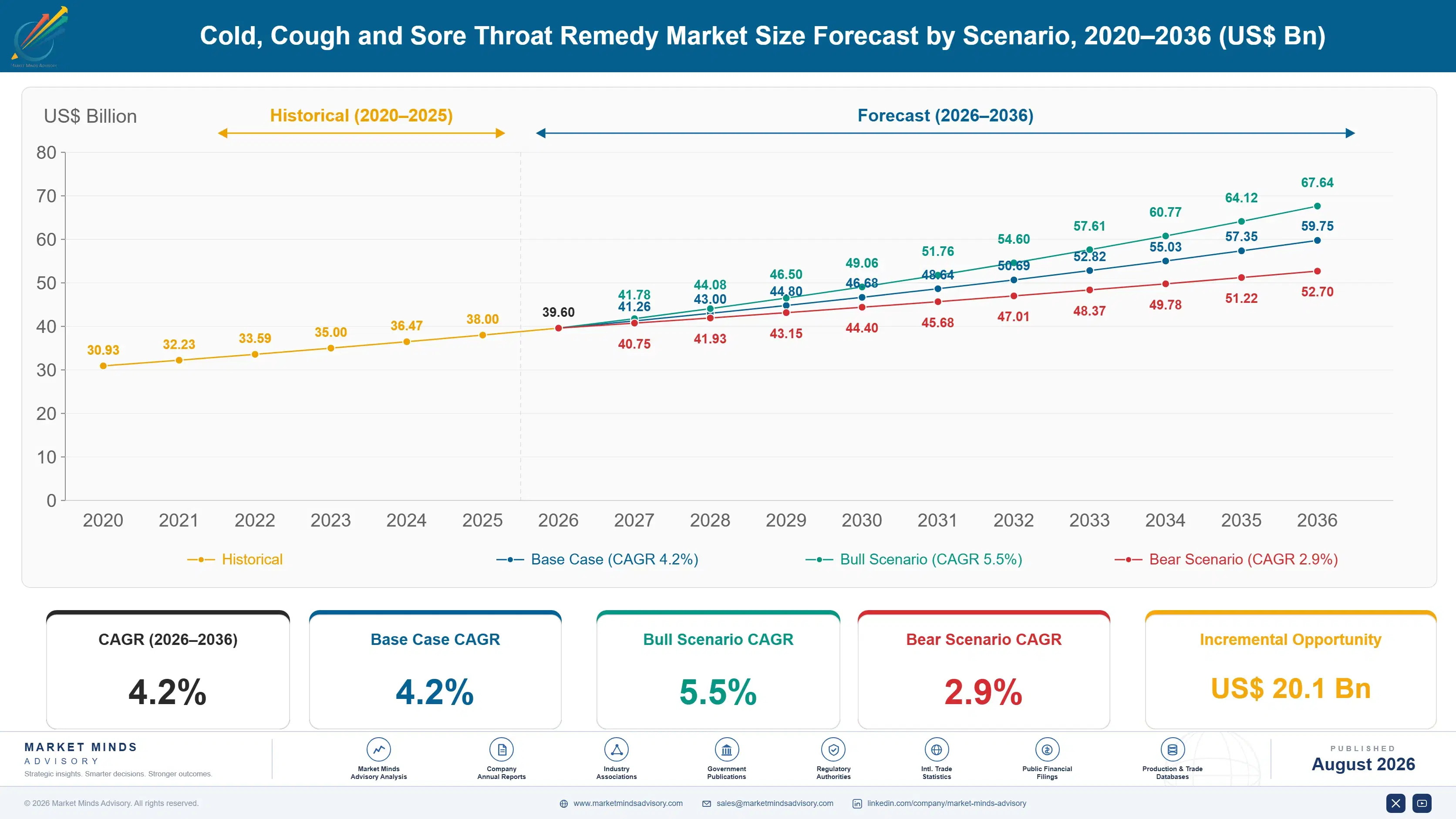
Cold, Cough and Sore Throat Remedy Market Forecast Scenarios

cold-cough-and-sore-throat-remedy-market-size-forecast-scenario-1787306550359
Global cold, cough, and sore throat remedy revenue grew steadily between 2020 and 2025 as retail pharmacy channel modernization expanded across emerging markets and consumer preference shifted toward combination multi-symptom products across most developed and expanding retail channels, lifting the historical growth rate above three percent annually across most established consumer health markets and pharmacy networks.
The base case assumes continued conversion from single-ingredient remedies toward combination multi-symptom and natural formulation products across retail pharmacy channels, expanding modern retail infrastructure across East Asian markets, and rising consumer willingness to pay for premium ingredient transparency and natural positioning. These three mechanisms together support base-case growth near the middle of the forecast band through 2036, with natural and combination products capturing an increasing share of new retail spending across most developed and expanding consumer markets.
A bull scenario assumes accelerated natural ingredient product adoption alongside expanded modern retail pharmacy penetration across emerging markets, pushing growth toward the top of the forecast band through the decade. A bear scenario assumes slower consumer discretionary spending and continued private label price competition eroding branded product volume, holding growth closer to the forecast floor instead.

From Single-Symptom Relief to Combination Formula Dominance

The cold, cough, and sore throat remedy market is shifting from single-ingredient products purchased for one specific symptom toward combination multi-symptom formulations that address several complaints simultaneously, as consumers increasingly value convenience and comprehensive relief over ingredient minimalism across most retail channels and pharmacy formats. Retail pharmacy shoppers now read active ingredient panels more carefully than brand loyalty alone would have predicted a decade earli
MARKET CONCENTRATION58%Combined revenue share held by top five consumer health companies
AVERAGE PRODUCT PRICE$6.50 per unitBlended price across syrups, lozenges, sprays, and tablet formats
TOP PURCHASING COUNTRYChina, 19% shareShare of global retail volume concentrated in one country
COMBINATION PRODUCT PENETRATION38% of salesShare of retail sales now from multi-symptom combination formulas
NATURAL INGREDIENT ADOPTION22% of new launchesShare of new product launches featuring natural ingredient positioning
SEASONAL DEMAND CONCENTRATION62% in cold seasonShare of annual retail volume occurring during peak cold months
Commercial character is defined by intense seasonal demand concentration and retail shelf space competition rather than technical differentiation, so manufacturer revenue depends heavily on retail distribution breadth and brand marketing investment rather than any single large account win alone across most consumer markets and retail formats. Natural and herbal remedy challengers increasingly compete for shelf space alongside legacy pharmaceutical brands in mainstream retail pharmacy and grocery channels.
Regulatory and labeling requirement timing for combination formulations and natural ingredient claims is reshaping competitive rankings meaningfully, rewarding companies that moved fastest through reformulation while rising consumer health awareness keeps expanding demand for premium and natural positioning across most developed and expanding retail markets, pharmacy distribution networks, and mainstream grocery retail channels worldwide.
"Nobody buys a single-symptom cough syrup anymore when the combination bottle right next to it treats four complaints for a dollar more."
Director, Consumer Health and OTC Pharmaceuticals Practice · MMA Consumer Health

Market Trends

Natural and Herbal Formulations Gaining Mainstream Retail Shelf Space

Consumer health companies are launching natural and herbal ingredient variants of established cough and cold brands at an accelerating pace, responding to growing consumer preference for recognizable, minimally processed ingredient lists over traditional synthetic active compounds. Retail pharmacy chains are dedicating expanding shelf space to natural remedy sections rather than integrating these products into conventional cough and cold aisles alone. Roughly 22 percent of new product launches in leading markets now feature natural ingredient positioning, up from a much smaller share five years earlier, and manufacturers are racing to expand sourcing capacity to meet demand.
Market Impact: Modern retail reaches 41 percent pe

Combination Multi-Symptom Products Displace Single-Ingredient Remedies

Combination products treating multiple symptoms simultaneously, such as cough suppression paired with nasal decongestion and sore throat relief in a single formulation, are capturing retail shelf space and consumer preference away from single-ingredient remedies at an accelerating pace. Consumers increasingly value the convenience of one product addressing an entire symptom cluster rather than purchasing and dosing multiple separate remedies during an illness episode. This convenience shift is expected to add substantial incremental retail volume globally over the forecast period, sustaining demand growth even where overall cold and flu incidence rates hold steady across most established consumer markets.
Market Impact: Premium segment reaches 27 percent

Market Opportunities and Growth Drivers

Expanding Modern Retail Pharmacy Infrastructure Across Emerging Markets

Modern retail pharmacy chains are expanding rapidly across emerging markets that previously relied heavily on independent pharmacies and informal retail channels, bringing standardized product selection and consistent availability to a growing base of consumers. This retail modernization directly increases branded product visibility and availability relative to informal or counterfeit alternatives that historically captured meaningful share in these markets. Modern retail pharmacy penetration has grown to roughly 41 percent of total pharmacy retail in several major emerging markets, directly expanding the addressable branded product market for consumer health companies across most developing regions.
Market Impact: Private label holds 26 percent shar

Rising Consumer Health Awareness Drives Premium Product Selection

Growing consumer health literacy and increased time spent researching product ingredients online are driving a meaningful share of shoppers toward premium-priced products with transparent ingredient sourcing and clinical substantiation claims rather than the cheapest available option on the shelf. This awareness shift particularly benefits established brands with credible clinical marketing and natural ingredient positioning over generic private label alternatives. Premium product segment revenue has grown to roughly 27 percent of total category revenue in several major markets, up meaningfully from a smaller share five years earlier, directly benefiting branded manufacturers.
Market Impact: Relaunch delayed roughly 18 months

Market Restraints and Challenges

Private Label Price Competition Erodes Branded Product Margin

Retail pharmacy chains and mass merchandisers increasingly promote their own private label cough and cold products at meaningfully lower price points than comparable branded alternatives, capturing price-sensitive shoppers who view active ingredients as functionally equivalent across brands. The root cause is the relatively simple formulation chemistry underlying most cough and cold remedies, which limits patentable differentiation and lets private label manufacturers replicate branded formulations closely at lower cost. Branded manufacturers are investing in clinical substantiation marketing and natural ingredient differentiation to defend premium positioning, but private label products still capture roughly 26 percent of total category retail volume.
Market Impact: Natural launches reach 22 percent s

Regulatory Scrutiny of Certain Active Ingredients Limits Formulations

Regulatory authorities in several major markets have restricted or removed certain traditional active ingredients from over-the-counter cough and cold formulations following updated safety and efficacy reviews, forcing manufacturers to reformulate established products or discontinue affected variants entirely. The root cause is evolving clinical evidence regarding ingredient efficacy and safety that periodically triggers regulatory reassessment of decades-old formulation standards across the category. Manufacturers are investing in alternative active ingredient research to replace restricted compounds, but reformulation and regulatory resubmission delays still push affected product relaunch timelines back by roughly 18 months on average.
Market Impact: Adds roughly 9 percent incremental
4 additional market trends, 4 additional growth drivers, and 4 additional restraints and challenges are covered in the full report. Contact sales@marketmindsadvisory.com to access the complete intelligence.

Segment CAGR and Growth Architecture

Segmentation follows product formulation and ingredient type, the dimension that most directly determines retail positioning, price tier, and consumer purchasing criteria across pharmacy, grocery, and expanding mass merchandiser retail channels worldwide today and quite consistently. This lens captures where retail spending is shifting fastest during the ongoing transition toward combination and natural formulation products.
cold-cough-and-sore-throat-remedy-market-market-share-analysis-1787306550895

Natural and Herbal Cough and Cold Remedies

Natural and herbal cough and cold remedies are the fastest-growing product category, expanding at roughly 8 percent annually as consumer preference shifts toward recognizable, minimally processed ingredient lists over traditional synthetic active compounds. Adoption is concentrated among premium retail channels and specialty health food stores first, with mainstream pharmacy and grocery retailers following as consumer demand broadens beyond early adopter segments. Manufacturers are racing to expand natural ingredient sourcing capacity and secure clinical substantiation for herbal active compounds, while retailers increasingly dedicate expanding shelf space to natural remedy sections nationwide. Consumer research data continues expanding evidence supporting natural ingredient efficacy claims, further widening the addressable market for this segment specifically.
CAGR 8.0%

Combination Multi-Symptom Cold and Flu Products

Combination multi-symptom cold and flu products form the second-fastest-growing category at roughly 6 percent annually, driven by consumer preference for convenience products addressing an entire symptom cluster rather than requiring separate remedies for cough, congestion, and sore throat individually across most retail markets worldwide. These products command premium pricing over single-ingredient alternatives while simplifying purchasing and dosing decisions for consumers managing multiple simultaneous symptoms during illness episodes. Retail pharmacy chains increasingly position combination products prominently at eye level and checkout displays given their higher per-unit revenue contribution. Growth trails natural remedies because the eligible consumer base, while broader, faces more established competition from single-ingredient products on price and brand familiarity.
CAGR 6.0%
Full segment breakdown across 6 segments available in the complete report.

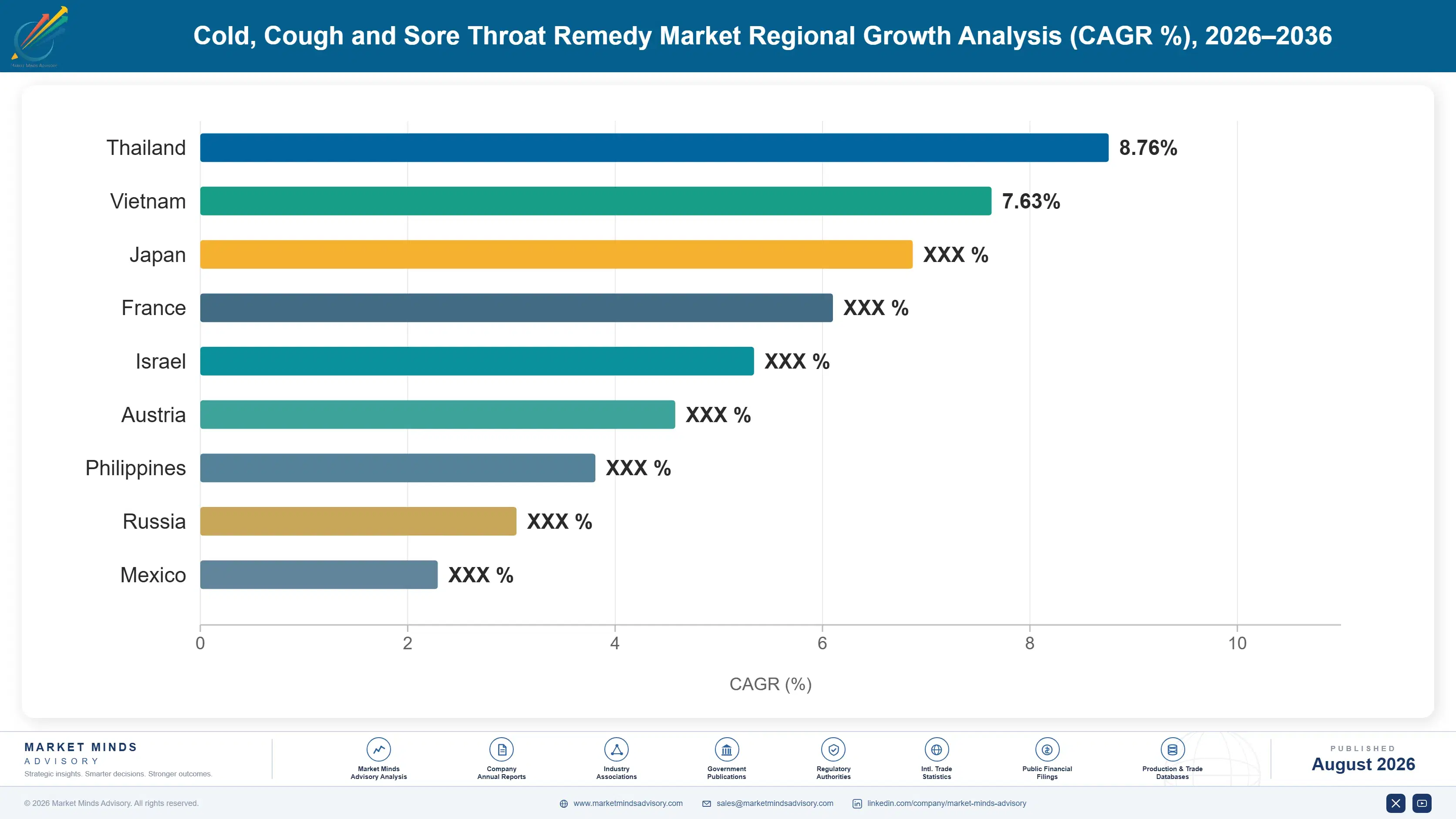
Regional Architecture and Country Demand Map

Retail volume concentrates in markets with large populations and rapidly modernizing pharmacy retail infrastructure, with East Asia and North America together accounting for more than half of global revenue, while adoption elsewhere tracks retail modernization and consumer purchasing power growth closely across the forecast decade.

East Asia

East Asia takes the largest regional share, driven primarily by China, where a massive population base combines with rapidly modernizing pharmacy retail infrastructure to support the highest absolute retail volume of any region globally. Japan maintains a large, mature market anchored by comprehensive retail pharmacy distribution and a well-established consumer preference for combination cold and flu remedies dating back several decades. South Korea's dense urban retail network and strong domestic brand loyalty support high per-capita spending relative to regional peers elsewhere. Regional manufacturing capacity is also expanding, with several domestic Chinese consumer health companies now developing natural ingredient formulations to compete directly with established multinational brands on price and positioning.
Share: 29% | CAGR: 5.2% (2026 to 2036)

North America

North America carries the second-largest regional share, anchored by the United States, where a dense retail pharmacy network and strong consumer willingness to pay for premium and natural formulation products support high per-capita spending that few other markets can match today. Extensive direct-to-consumer marketing and brand-building investment by major consumer health companies reinforce strong brand loyalty across most retail channels and demographic segments nationwide and consistently. Comprehensive retail distribution across pharmacy chains, grocery stores, and mass merchandisers removes most access barriers for consumers seeking cold and cough remedies. Canada contributes steady incremental volume, though its smaller retail footprint keeps overall market size more modest than the dominant United States market.
Share: 26% | CAGR: 4.8% (2026 to 2036)
Regional intelligence for 5 additional markets available in the complete report: Western Europe, South Asia and Pacific, Latin America, Middle East and Africa, Eastern Europe. Contact sales@marketmindsadvisory.com.
cold-cough-and-sore-throat-remedy-market-country-cagr-analysis-1787306551415

Combination Format Capture and Retail Shelf Depth

Manufacturer revenue growth in this market depends heavily on capturing combination and natural formulation demand while defending retail shelf space against steadily growing private label competition across most retail formats. These four levers describe where retail revenue and margin are concentrating fastest as consumer preferences continue shifting across most major retail markets and channels.

Combination Multi-Symptom Formula Premium Pricing Strategy

Positioning combination multi-symptom products around convenience and comprehensive relief lets manufacturers command premium pricing relative to single-ingredient alternatives, since consumers value the reduced dosing complexity and simplified purchasing decision during an illness episode more than incremental ingredient cost across most shopping occasions. Manufacturers investing in combination formula marketing and shelf placement are capturing disproportionate revenue growth as this category expands faster than single-ingredient alternatives across most retail channels and formats. Combination products now command roughly 35 percent higher average retail price than comparable single-ingredient products, directly rewarding manufacturers who prioritize this format.
Market Impact: Combination products command roughl

Natural Ingredient Premium Positioning Growth Strategy

Launching natural and herbal ingredient variants of established brands lets manufacturers capture premium-priced consumer demand without abandoning existing brand equity, since natural positioning commands meaningfully higher retail pricing than conventional synthetic formulations among health-conscious consumer segments across most developed retail markets. Manufacturers offering credible clinical substantiation for natural active ingredients capture disproportionate shelf space and consumer trust relative to less substantiated competitors across most retail channels and formats. Natural formulation products now command roughly 28 percent price premium over conventional equivalents, directly rewarding manufacturers investing in ingredient sourcing and substantiation.
Market Impact: Natural formulations command roughl

Retail Chain Enterprise Distribution Agreement Strategy

Negotiating enterprise-wide distribution agreements covering every store within a major retail pharmacy or grocery chain rather than regional store-by-store placement lets manufacturers lock in larger, more predictable shelf space commitments while reducing the sales cost of serving many individual store locations separately across a large geographic footprint. Enterprise distribution agreements now cover roughly 44 percent of total retail store placements among leading manufacturers, up meaningfully from a smaller share three years earlier, and typically include favorable shelf positioning terms. Manufacturers able to guarantee consistent supply capture a disproportionate share of premium shelf placement.
Market Impact: Enterprise agreements now cover 44

Emerging Market Retail Modernization Partnership Strategy

Partnering with modern retail pharmacy chains expanding into emerging markets ahead of competitors establishes first-mover advantage in branded product placement, since many emerging market consumers are gaining access to standardized retail pharmacy shopping for the first time rather than switching from existing modern retail relationships. Manufacturers investing in local marketing and regulatory registration tailored to specific national requirements capture a disproportionate share of new retail modernization relationships. Emerging market revenue is growing roughly 7 percent annually, outpacing mature market growth meaningfully as retail infrastructure expansion continues across these developing consumer markets.
Market Impact: Emerging market revenue grows rough

Who Controls the Margin Pool

The top five companies by revenue share hold roughly 58 percent combined, a moderately high concentration level reflecting decades of brand-building investment that newer entrants find quite difficult to replicate quickly across most retail markets. Haleon and Reckitt Benckiser lead through combined brand portfolio breadth and retail distribution reach, with a clear gap separating them from smaller regional and natural remedy challengers.
Current competitive activity centers on three dimensions: launching natural and herbal ingredient product variants, expanding combination multi-symptom formula portfolios, and negotiating enterprise-wide retail distribution agreements with major pharmacy and grocery retail chains nationwide and internationally. Retail shelf space breadth increasingly separates category leaders from smaller regional manufacturers unable to guarantee consistent nationwide distribution commitments and marketing investment.

Emerging pressure comes from specialized natural remedy brands and private label manufacturers offering differentiated ingredient positioning or lower price points, gradually winning shelf space from established brands in specific retail categories and geographic markets worldwide. Rankings could shift meaningfully if a challenger secures a major retail chain enterprise distribution agreement, since shelf placement compounds quickly once a brand gains meaningful retail visibility across a distribution network.
cold-cough-and-sore-throat-remedy-market-company-positioning-matrix-1787306551935

Competitive Moat and Risk Dimensions

HALEON

Moat: Global Brand Portfolio Breadth

Haleon owns a broad portfolio of decades-established consumer health brands spanning cough, cold, and sore throat categories, giving it retail shelf presence and consumer trust that newer entrants without comparable brand history cannot replicate easily. This portfolio breadth lets Haleon negotiate favorable retail distribution terms across multiple product categories simultaneously, defending shelf space against smaller single-brand competitors.
HALEON

Risk: Slower Natural Ingredient Pivot

Haleon's natural and herbal product development pace trails specialized natural remedy brands that built their entire identity around minimally processed ingredients from inception, potentially ceding growth in this fast-growing segment to nimbler competitors focused entirely on natural positioning rather than legacy synthetic formulations and marketing approaches.
RECKITT BENCKISER

Moat: Deep Retail Distribution Relationships

Reckitt Benckiser has invested heavily in retail chain relationships and category management partnerships across pharmacy and grocery channels, giving it favorable shelf placement and promotional support that smaller competitors without comparable retail relationships struggle to secure consistently across major markets, store formats, and seasonal promotional calendars.
RECKITT BENCKISER

Risk: Private Label Margin Pressure

Reckitt Benckiser's branded pricing carries a meaningful premium over comparable private label alternatives that retail chains increasingly promote as functionally equivalent, potentially losing price-sensitive consumers to store-brand products offering similar active ingredients at meaningfully lower cost per unit across most retail channels and shopping occasions.

Players Tracked

Prominent Players

Haleon
Reckitt Benckiser
Kenvue
Bayer Consumer Health
Procter and Gamble

Other Key Players

Sanofi Consumer Healthcare
Perrigo Company
Sun Pharma Consumer Healthcare
Cipla Health
Dabur India
Boiron
Ricola
Church and Dwight
Prestige Consumer Healthcare
Taisho Pharmaceutical
Zydus Wellness
Emami Limited
Himalaya Wellness
Nin Jiom
Kobayashi Pharmaceutical

Recent Developments

MARCH 2025

Haleon Launches Natural Ingredient Cough Syrup Variant

Haleon launched a new natural ingredient variant of its flagship cough syrup brand, broadening its product portfolio to include a minimally processed herbal formulation alongside its traditional synthetic offering. The launch lets Haleon compete more directly with specialized natural remedy brands for health-conscious consumer purchasing decisions across major retail markets.
Signal: Signals Haleon closing the natural ingredi
SEPTEMBER 2024

Reckitt Benckiser Signs National Retail Chain Distribution Agreement

Reckitt Benckiser signed a national retail chain enterprise distribution agreement covering combination multi-symptom product placement across thousands of pharmacy and grocery store locations nationwide. The agreement bundles promotional support and shelf positioning commitments, reflecting the growing importance of enterprise-wide retail relationships over regional distribution deals.
Signal: Signals growing retail chain preference fo
JANUARY 2025

Kenvue Acquires Natural Remedy Brand

Kenvue completed the acquisition of a smaller natural remedy brand specializing in herbal cough and sore throat products, adding established natural ingredient formulations to strengthen its portfolio against specialized competitors. The acquisition accelerates Kenvue's natural positioning roadmap, reducing dependence on internal product development timelines for this category.
Signal: Signals continued industry consolidation a

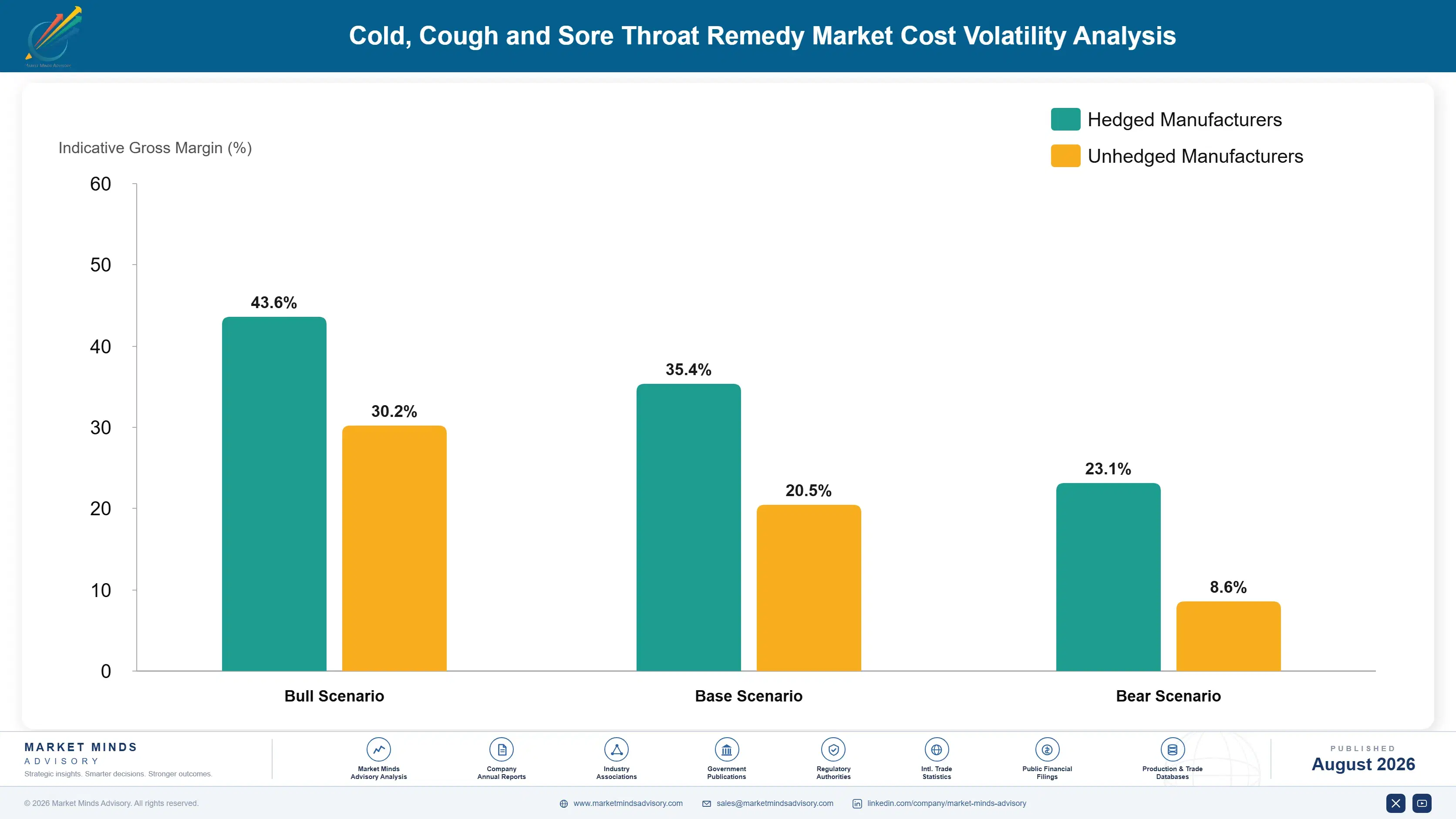
Active Ingredient and Packaging Material Exposure

Active pharmaceutical ingredients and botanical extracts account for roughly 24 percent of cost of goods sold for cold and cough remedies, sourced primarily from specialized chemical and botanical processing suppliers in India, China, and Germany, while packaging materials including bottles, blister packs, and cartons account for a comparable share, sourced mainly from suppliers across multiple regions serving broader consumer packaged goods categories.
Botanical extract prices climbed sharply during 2023 as adverse weather conditions disrupted harvests across major sourcing regions, tightening availability for several widely used herbal active ingredients, according to trade association reporting and agricultural commodity market data. Several manufacturers absorbed the cost increase temporarily rather than pass costs through immediately, before adjusting natural product pricing roughly 6 percent in early 2024 to partially restore margin across affected product lines.

Smaller natural remedy manufacturers without long-term botanical supply contracts face the steepest exposure, since they typically purchase active ingredients on spot markets rather than through hedged forward agreements that larger competitors like Haleon negotiate directly with agricultural suppliers well in advance. This gap widens further for manufacturers dependent on single-source packaging material suppliers facing periodic allocation constraints.
cold-cough-and-sore-throat-remedy-market-cost-volatility-analysis-1787306552130

Forward Contracting With Botanical Suppliers

Larger manufacturers negotiate annual or multi-year fixed-price agreements directly with botanical extract and active ingredient suppliers, insulating a meaningful share of production cost from harvest volatility that smaller competitors cannot avoid or hedge against. This approach requires scale and forecasting confidence that smaller natural remedy manufacturers typically lack, reinforcing a durable cost advantage for established category leaders over time.

Dual Sourcing Across Growing Regions

Qualifying botanical suppliers across more than one growing region reduces exposure to any single weather event, harvest failure, or regulatory disruption affecting one supply corridor at a time. Manufacturers pursuing dual sourcing report smoother production planning during volatile agricultural seasons, avoiding sudden ingredient shortages tied to concentrated single-region dependence on any one growing area.

Synthetic Alternative Formulation Flexibility

Some manufacturers maintain dual formulation capability, offering both natural and conventional synthetic versions of key products, letting them shift production emphasis toward whichever formulation faces lower input cost pressure in a given season. This flexibility requires additional formulation validation investment that smaller manufacturers cannot easily justify, though it meaningfully reduces overall input cost volatility exposure.

Portfolio Architecture for Margin Defence

Portfolio economics in this category split cleanly across three tiers defined by ingredient positioning, formulation complexity, and brand equity rather than by any single manufacturer differentiator. Volume-tier generic and private label products carry thin margins in a highly price-competitive segment, while premium and next-generation natural and combination formulations command meaningfully higher gross margin as consumers pay for ingredient transparency and convenience rather than raw activ
The volume-premium tension plays out most visibly between price-sensitive shoppers anchored to generic and private label economics, and health-conscious consumers whose purchasing decisions increasingly favor premium natural and combination formulations regardless of the meaningful price differential over generic alternatives. Manufacturers straddling both tiers manage distinct brand positioning, marketing investment, and retail placement strategies for each customer segment simultaneously.

High-value margin pools concentrate in natural ingredient and combination multi-symptom products sold directly into premium retail channels and health-conscious consumer segments, where brand trust and clinical substantiation justify dedicated marketing and ingredient sourcing investment. Next-generation functional formulations, combining symptom relief with immune support ingredients, remain a smaller but closely watched pool as consumers increasingly value broader wellness positioning over narrow symptom treatment alone.

Volume / Commodity-Adjacent Tier

Generic and private label cough, cold, and sore throat products sold primarily through mass merchandiser and grocery retail channels to price-sensitive consumers prioritizing lowest possible cost over brand recognition or ingredient sourcing transparency.
Gross Margin: 24-27%

Premium / Certified Tier

Combination multi-symptom formulations and established branded natural remedy products sold across pharmacy and grocery retail channels to consumers prioritizing convenience, comprehensive symptom relief, and recognizable brand trust over generic alternatives.
Gross Margin: 42-45%

Sustainability / Regulatory / Next-Generation Tier

Functional wellness formulations combining symptom relief with immune support ingredients and expanding premium natural product lines engineered for health-conscious consumer segments pursuing broader wellness positioning across their retail purchasing decisions and shopping habits.
Gross Margin: 46-49%
cold-cough-and-sore-throat-remedy-market-portfolio-architecture-1787306552623

Seasonal Repeat Purchase Revenue Per Brand

Demand in this category behaves like a seasonal repeat purchase annuity rather than a steady linear sale, since most households purchase cold and cough remedies reactively during illness episodes rather than maintaining continuous inventory, generating revenue concentrated heavily during peak cold and flu season each year. Manufacturer economics favor brands that can sustain top-of-mind consumer recall and reliable retail availability during these concentrated demand windows rather than those co
Adoption depth varies meaningfully by vertical: health-conscious urban consumers convert to natural and combination formulations fastest given disposable income and ingredient awareness, price-sensitive rural and lower-income households lag as generic and private label economics remain more compelling, and retail pharmacy chains increasingly cross-position wellness and immune support products alongside traditional cold and cough remedies to capture broader seasonal basket spending across their customer base.

A generational shift is underway as younger consumers, raised with greater ingredient label literacy and skepticism toward synthetic compounds, default to researching active ingredients online before purchasing rather than automatically reaching for the same brand their parents used. This preference is increasingly influencing manufacturer marketing strategy and product development as competition for younger consumer loyalty intensifies steadily across most major consumer markets.
cold-cough-and-sore-throat-remedy-market-end-use-penetration-index-1787306553114

Where Value Concentrates Through 2036

These are among the four positions where our research anticipates prominent divergence between winners and laggards over the coming forecast period. Each is grounded in the demand model, the regulatory perimeter, and the announced capacity pipeline.
01 / COMBINATION FORMAT PRIORITY

Prioritize combination multi-symptom formulations over single-ingredient defense

Expanding combination multi-symptom product portfolios is the single clearest growth vector in this category, and manufacturers protecting single-ingredient product lines instead risk losing shelf space and revenue to competitors expanding combination formula offerings faster across most retail channels. Convenience-seeking consumers are the buyers actually driving specification change, and they have shown strong willingness to pay a premium for products addressing multiple symptoms simultaneously. Marketing and formulation investment directed toward combination products will compound faster than spending preserving legacy single-ingredient product positioning indefinitely.
02 / NATURAL INGREDIENT INVESTMENT

Build credible natural ingredient portfolios with clinical substantiation evidence

Health-conscious consumer demand for natural and herbal formulations is growing meaningfully faster than the overall category, and manufacturers with credible clinical substantiation for natural active ingredients convert this demand into premium-priced sales fastest. Natural formulation products already command a meaningful price premium over conventional equivalents among leading manufacturers, and that premium is likely to persist as consumer ingredient literacy continues rising across most developed retail markets. Manufacturers underinvesting in natural ingredient credibility will struggle increasingly to capture this expanding premium consumer segment.
03 / RETAIL DISTRIBUTION DEPTH

Secure enterprise-wide agreements covering every store within major retail chains

Major retail pharmacy and grocery chains increasingly negotiate distribution terms across every store in their network, and this concentrated buying power rewards manufacturers who can offer unified enterprise agreements rather than treating each store as an individual placement negotiation. Enterprise distribution agreements already cover a meaningfully growing share of total retail store placements among leading manufacturers, and that share is likely to keep climbing steadily as retail consolidation continues across most developed markets. Manufacturers without enterprise distribution infrastructure will struggle increasingly to secure premium shelf placement.
04 / EMERGING MARKET RETAIL PARTNERSHIP

Partner with modernizing retail chains ahead of competitors entering emerging markets

Consumers in emerging markets are frequently gaining access to standardized modern retail pharmacy shopping for the first time rather than switching from existing modern retail relationships, making partnership timing a decisive first-mover advantage for whichever manufacturer establishes distribution earliest across each national market. Manufacturers investing in local marketing and regulatory registration tailored to specific national requirements capture a disproportionate share of these new retail modernization relationships as they emerge. This discipline separates manufacturers building durable emerging market share from those competing only in already-mature consumer markets.

Engagement Snapshot From the Field

A live engagement with an industry participant carrying material or product regulatory and market exposure ahead of a defining policy shift, showing how our research translates into a defensible multi-year portfolio strategy.
MARKET MINDS ADVISORY · CLIENT ENGAGEMENT SUMMARY
Cold, Cough and Sore Throat Remedy Producer Strategic Portfolio Review and Transition Roadmap 2026·Investment Scenario on Cold, Cough and Sore Throat Remedy Exposure Evaluation 2025-26
CLIENT PROFILE
The client operates a regional retail pharmacy chain with several hundred locations across a multi-state footprint, offering a modest private label cold and cough product line alongside major national brands. Leadership had observed growing private label category performance nationally but lacked confidence in how aggressively to expand its own private label cold and cough offering relative to maintaining strong national brand partnerships.
STRATEGIC CHALLENGE
Leadership needed to determine the optimal private label expansion strategy across the cold and cough category, balancing incremental margin opportunity against the risk of straining national brand vendor relationships that drove meaningful promotional and marketing support for the chain. Category managers lacked data on consumer price sensitivity specific to the chain's customer demographic.
MMA APPROACH
MMA conducted a consumer price sensitivity analysis specific to the chain's customer base, combined with a national brand vendor relationship risk assessment evaluating potential promotional and marketing support implications of private label expansion. The analysis modeled category margin outcomes under different private label penetration scenarios, incorporating vendor relationship and consumer loyalty considerations.
KEY FINDINGS
  1. The chain's customer base showed meaningfully higher private label price sensitivity than national benchmark data had originally suggested for similar demographic segments.
  2. Selective private label expansion targeting specific subcategories preserved vendor relationships much better than a broad category-wide private label rollout would have achieved.
  3. Category margin modeling suggested that targeted private label expansion could lift overall category margin by roughly 12 percent within eighteen months total.
  4. National brand vendors expressed clear willingness to increase promotional support in subcategories where the chain deliberately limited private label competition more strategically.
CLIENT PROFILE
The client operates a regional retail pharmacy chain with several hundred locations across a multi-state footprint, offering a modest private label cold and cough product line alongside major national brands. Leadership had observed growing private label category performance nationally but lacked confidence in how aggressively to expand its own private label cold and cough offering relative to maintaining strong national brand partnerships.
STRATEGIC CHALLENGE
Leadership needed to determine the optimal private label expansion strategy across the cold and cough category, balancing incremental margin opportunity against the risk of straining national brand vendor relationships that drove meaningful promotional and marketing support for the chain. Category managers lacked data on consumer price sensitivity specific to the chain's customer demographic.
MMA APPROACH
MMA conducted a consumer price sensitivity analysis specific to the chain's customer base, combined with a national brand vendor relationship risk assessment evaluating potential promotional and marketing support implications of private label expansion. The analysis modeled category margin outcomes under different private label penetration scenarios, incorporating vendor relationship and consumer loyalty considerations.
KEY FINDINGS
  1. The chain's customer base showed meaningfully higher private label price sensitivity than national benchmark data had originally suggested for similar demographic segments.
  2. Selective private label expansion targeting specific subcategories preserved vendor relationships much better than a broad category-wide private label rollout would have achieved.
  3. Category margin modeling suggested that targeted private label expansion could lift overall category margin by roughly 12 percent within eighteen months total.
  4. National brand vendors expressed clear willingness to increase promotional support in subcategories where the chain deliberately limited private label competition more strategically.
RECOMMENDED STRATEGY
Phase 1: Phase 1 (Months 1 to 2): Conduct consumer price sensitivity analysis and vendor relationship risk assessment across all product categories. Phase 2: Phase 2 (Months 3 to 5): Launch targeted private label expansion in selected subcategories showing the very strongest overall opportunity. Phase 3: Phase 3 (Months 6 to 12): Monitor category margin and vendor relationship outcomes, adjusting private label strategy carefully as needed.
OUTCOME
The chain implemented targeted private label expansion across selected subcategories within the recommended timeline, reporting a 14 percent increase in overall cold and cough category margin while maintaining strong national brand vendor promotional support (client-reported, unverified by MMA). Category manager confidence in private label strategy improved measurably per internal survey feedback.

Frequently Asked Questions

Foundational context covering the market sizes, CAGR, scope, country, region and competition that inform every finding below. This section is provided to cover basics and most often pre-purchase conversations, answered from the MMA Primary Research Dataset.

What is the current size of the Cold, Cough and Sore Throat Remedy Market?

The global Cold, Cough and Sore Throat Remedy Market is valued at approximately 38.0 billion dollars in 2025. This figure spans syrups, lozenges, sprays, tablets, and combination formulations worldwide.

How large will the Cold, Cough and Sore Throat Remedy Market be by 2036?

The market is projected to reach approximately 59.75 billion dollars by 2036. This represents cumulative growth driven primarily by combination product adoption and expanding modern retail infrastructure.

What is the CAGR for the Cold, Cough and Sore Throat Remedy Market 2026 to 2036?

The market is forecast to grow at a compound annual growth rate of 4.2 percent between 2026 and 2036. Base-case growth reflects steady combination product adoption tempered by private label competition.

Which segment is growing fastest?

Natural and herbal cough and cold remedies are the fastest-growing segment, expanding at roughly 8 percent annually, nearly twice the overall market rate. Growth is concentrated among health-conscious consumers seeking ingredient transparency.

Who are the major companies in the Cold, Cough and Sore Throat Remedy Market?

Leading companies include Haleon, Reckitt Benckiser, Kenvue, Bayer Consumer Health, and Procter and Gamble. These five companies hold roughly 58 percent of global revenue share combined.

Which country is growing fastest?

India is among the fastest-growing national markets, supported by expanding modern retail pharmacy infrastructure and rising disposable income nationwide. Growth here outpaces most established Western markets meaningfully.

Report Segmentation Architecture

The full report scope spans multiple orthogonal segmentation dimensions, with cross-tabulated demand data provided for each dimension pair. Coverage extends further to regional breakdowns, trend trajectories, and the competitive detail needed to support segment-level decision-making.

By Primary Market Dimension

  • Natural and Herbal Cough and Cold Remedies
  • Combination Multi-Symptom Cold and Flu Products
  • Cough Syrups and Liquid Formulations
  • Throat Lozenges and Drops
  • Nasal Decongestant Sprays and Tablets
  • Sore Throat Sprays and Gargles

By End-Use Industry

  • Retail Pharmacy Chains
  • Grocery and Mass Merchandiser Retail
  • Independent Pharmacies
  • Online and E-Commerce Retail
  • Institutional and Healthcare Facility Purchasing

By Commercial Dimension

  • Branded National Product Sales
  • Private Label and Store Brand Sales
  • Enterprise Retail Distribution Agreements
  • Direct-to-Consumer Online Sales

By Region

  • North America
  • Western Europe
  • East Asia
  • South Asia and Pacific
  • Latin America
  • Middle East and Africa
  • Eastern Europe

Scope, Methodology, and Coverage

Every figure in this report is reproducible from documented input assumptions. The scope below maps the historical period, the forecast horizon, the segmentation dimensions, and the countries covered, alongside the underlying primary and qualitative methodology.
Historical Period
2020 to 2025
Forecast Period
2026 to 2036
Base Year
2025 (USD billions; MMA Primary Research Dataset, August 2026)
Market Definition
The Cold, Cough and Sore Throat Remedy Market covers over-the-counter pharmaceutical and natural remedy products used to relieve cold, cough, and sore throat symptoms, including syrups, lozenges, sprays, tablets, and combination formulations. It excludes prescription antiviral and antibiotic medications, vaccines, and general vitamin or immune supplement products not specifically marketed for symptom relief.
Quantitative Units
USD billions (current prices); retail volume in millions of units
Segmentation Dimensions
By Product Formulation and Ingredient Type; By End-Use Industry; By Commercial Dimension; By Region
Regions Covered
North America, Western Europe, East Asia, South Asia and Pacific, Latin America, Middle East and Africa, Eastern Europe
Countries Covered
USA, China, Germany, France, UK, Japan, South Korea, India, Australia, Canada, Brazil, Mexico, Indonesia, Vietnam, Thailand, Malaysia, UAE, Saudi Arabia, South Africa, Nigeria, Turkey, Poland, Netherlands, Italy, Spain, Sweden, Switzerland, Argentina, Colombia, Singapore, and additional markets relevant to this sector
Key Companies Profiled
Haleon, Reckitt Benckiser, Kenvue, Bayer Consumer Health, Procter and Gamble, Sanofi Consumer Healthcare, Perrigo Company, Sun Pharma Consumer Healthcare, Cipla Health, Dabur India, Boiron, Ricola, Church and Dwight, Prestige Consumer Healthcare, Taisho Pharmaceutical, Zydus Wellness, Emami Limited, Himalaya Wellness, Nin Jiom, Kobayashi Pharmaceutical
Quantitative Methodology
Primary survey, n=3,800 respondents, Q4 2025, six countries; demand-side model with trade association cross-validation
Qualitative Methodology
47 expert interviews, Q4 2025; applied to validate demand model assumptions, identify emerging dynamics, and assess competitive positioning
Report Format
PDF and XLSX data workbook (Word format preview document)
Publisher
Market Minds Advisory
Report Code
MMA-2026-HLT-540
Published
August 2026
Contact
sales@marketmindsadvisory.com | www.marketmindsadvisory.com

Purchase the full Cold, Cough and Sore Throat Remedy Market Report (2026 to 2036).

This report delivers a full quantitative and qualitative assessment of the global Cold, Cough and Sore Throat Remedy Market, covering historical performance from 2020 through 2025 and forecasts through 2036 across base, bull, and bear scenarios. It profiles twenty companies spanning syrups, lozenges, sprays, tablets, and combination formulations, benchmarked on a consistent revenue basis. Regional analysis spans all seven major world regions, with detailed demand mechanisms specific to each. The report also includes segmentation analysis, input cost exposure assessment, competitive positioning, and an anonymized client case study illustrating practical private label strategy decision-making.
Ten-year historical and forecast market sizing
Product formulation segmentation with growth rates
Seven-region demand mapping and competitive benchmarking
Twenty-company competitive profiling and moat analysis
Input cost exposure and mitigation strategy assessment
Anonymized client case study and strategic verdict

Built For The People Who Decide

From boardroom strategy to bench-side execution, this report is read cover-to-cover by leaders shaping the next decade of their industry, turning demand scenarios, market dynamics and valuation benchmarks into decisions.
CXOs/ Presidents/ VPs/ Managers
M&A and Corporate Development
Strategy Teams and R&D Heads
Procurement and Product Directors
Regulatory and Compliance Leaders
Investor Relations and Equity Analysts