

Market Minds Advisory
Cognitive Supply Chain Market

Cognitive Supply Chain Market: Cognitive Supply Chain Market. AI Forecasting Reshapes Disruption Response

Manufacturers and retailers are adopting AI-powered cognitive supply chain platforms to predict disruptions and automate replanning decisions, as demand volatility and geopolitical trade shifts outpace what traditional linear planning systems can realistically handle.

Lead Analyst

Published

September 2026

Make Smarter Decisions with Customized Research Insights

Request a free sample report and evaluate market opportunities, growth trends, and competitive dynamics relevant to your business needs.

2025 MARKET VALUE$8.5BMarket Size 2025
2036 FORECAST VALUE$45.6BBase Case , 2026 to 2036
CAGR 2026 TO 203616.5 %Bull 17.8% / Bear 15.2%
INCREMENTAL OPPORTUNITY$35.7BNet 10- year value creation
EXPANSION MULTIPLE4.61x2036 value over 2026 base
Strategic Levers
M&A Pipeline
Regional Outlook
Country Rankings
Competitive Intelligence
Segmental Deep-dive
Call-Us : 91 93563 13602

Executive Snapshot and Market Trajectory.

Manufacturers and retailers worldwide are increasingly deploying AI-powered cognitive supply chain platforms that predict disruptions before they occur and automatically recommend replanning actions, replacing static planning cycles that could not react fast enough to demand volatility, tariff changes, and shifting global trade conditions across every industry.
AI-driven demand sensing and forecasting tools are growing fastest as machine learning models finally deliver forecast accuracy improvements that traditional statistical methods could not match given increasingly volatile and non-linear demand patterns across every product category and channel. Consumer goods and automotive sector customers drive the largest current share of demand, reflecting their disproportionate exposure to multi-tier supplier networks vulnerable to cascading disruption events and shortages.
Competitive intensity is rising as established supply chain software vendors add AI capability while specialized cognitive platform startups compete on genuine prediction accuracy and autonomous replanning depth rather than dashboard breadth alone or brand recognition. Integration complexity with legacy enterprise resource planning systems is shaping which vendors can credibly win large manufacturer contracts without lengthy multi-year implementation timelines and consulting overhead. Vendors demonstrating clear accuracy gains over legacy baselines win competitive procurement evaluations.
Market Definition
This market covers software platforms that use artificial intelligence to forecast demand, predict supply chain disruptions, and automate replanning decisions across manufacturing, distribution, and retail supply networks. It excludes traditional enterprise resource planning software without embedded predictive or autonomous decision-making capability and standalone logistics tracking tools.
Base Year Value
$8.5B in 2025 (MMA Primary Research Dataset, September 2026)
Forecast Period
2026 to 2036, eleven discrete annual values
CAGR
16.5% base case. Bull 17.8%. Bear 15.2%.
Fastest Growth Segment
AI-Driven Demand Sensing and Forecasting: 21.0% CAGR
Fastest Growth Country
India: 19.5% CAGR
Fastest Growth Region
South Asia and Pacific: 18.5% CAGR
Largest Region
North America: 32% of 2025 global value
Market Leaders
o9 Solutions, Blue Yonder, Kinaxis, SAP Integrated Business Planning, ToolsGroup
Primary Survey
n=3,800 procurement and R&D decision-makers, Q4 2025, six countries
Methodology
Demand-side build-up, cross-validated against public data, 47 expert interviews

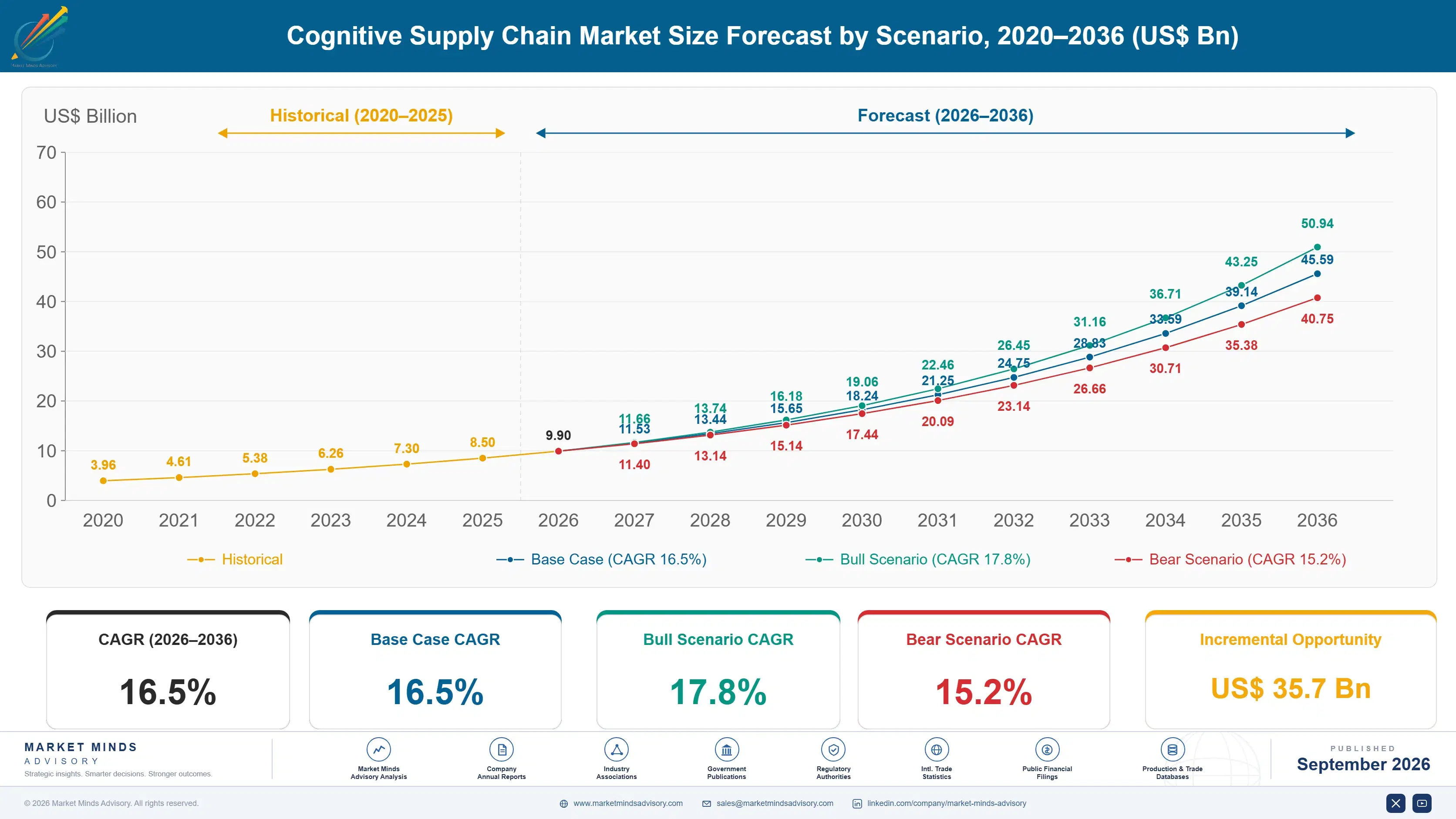
Cognitive Supply Chain Market Forecast Scenarios

cognitive-supply-chain-market-size-forecast-scenario-1788677507279
Cognitive supply chain demand between 2020 and 2025 grew steadily as pandemic-era disruption exposed the limitations of static, linear planning systems that could not adapt quickly enough to sudden demand and supply shocks. Enterprise appetite for predictive and autonomous planning capability accelerated meaningfully once early platforms demonstrated measurable accuracy improvements over traditional baselines, converting cautious pilots into broader production commitments.
The base case assumes continued expansion driven by three commercial mechanisms: manufacturers facing persistent demand volatility increasingly requiring AI-driven forecasting to reduce costly inventory imbalances across complex multi-tier supplier networks, established enterprise software vendors adding cognitive capability to defend customer relationships against specialized AI-native challengers, and geopolitical trade uncertainty driving demand for autonomous replanning tools that can respond faster than manual human decision-making processes allow. Retail customers are also expanding scope beyond forecasting into autonomous fulfillment decisions.
A bull scenario centers on enterprise AI adoption accelerating faster than expected across every major manufacturing and retail vertical, pulling cognitive supply chain demand well above currently modeled base case levels. The bear risk is large enterprise software incumbents successfully bundling comparable AI capability into existing platform relationships at minimal incremental cost, which would compress the addressable market for standalone specialized vendors.

Where Prediction Meets Autonomous Replanning

Cognitive supply chain platforms sit at the intersection of predictive analytics and autonomous decision-making, converting historical planning systems that reacted to disruptions into forward-looking systems that anticipate and preempt them. The category expanded from basic demand forecasting into comprehensive platforms covering supplier risk monitoring, inventory optimization, and autonomous replanning as enterprise AI ambitions broadened considerably. This shift is reshaping planning cycle length and organizational structure.
MARKET CONCENTRATIONCR5 33%Top five vendors hold a moderate combined revenue share
AVERAGE PLATFORM CONTRACT VALUE$200K to $2MTypical annual contract range across mid-size and large enterprises
TOP COUNTRY USER SHAREUnited States leadsSingle country contributes the largest share of platform spending
FORECAST ACCURACY IMPROVEMENT~30% betterTypical gain over traditional statistical forecasting methods reported
IMPLEMENTATION TIMELINE~6 to 12 monthsTypical time from contract signing to full production deployment
CUSTOMER CONTRACT RENEWAL RATE~87% annuallyShare of enterprise customers renewing their platform contracts yearly
Demand sensing capability increasingly substitutes for traditional statistical forecasting, incorporating real-time signals from point-of-sale data, weather patterns, and social sentiment that earlier forecasting generations could not process at meaningful scale. Autonomous replanning increasingly differentiates platforms from pure analytics dashboards, since customers value systems that recommend and execute corrective actions rather than merely surfacing insights for human planners to interpret manually.
Competitive advantage increasingly rests on prediction accuracy validation and integration depth with existing enterprise resource planning systems rather than raw dashboard breadth alone, since customers weigh implementation risk heavily when adopting AI-driven planning tools. Vendors lacking demonstrated accuracy benchmarking data face growing difficulty winning large manufacturer contracts requiring extensive proof-of-concept validation before full deployment approval. Vendors investing early in transparent accuracy reporting increasingly gain a meaningful trust advantage with skeptical enterprise buyers.
"The platforms winning enterprise deals are not the ones with the prettiest dashboard. They are the ones a planner trusts enough to let make the reorder decision without checking it first."
Principal Analyst, Supply Chain Technology and Predictive Analytics Practice · MMA AI-Powered Supply Chain Planning Practice · September 2026

Market Trends

Autonomous Replanning Moves Beyond Recommendation Systems

Cognitive supply chain platforms increasingly execute replanning decisions autonomously within defined guardrails rather than merely recommending actions for human planners to manually approve and implement themselves. o9 Solutions and Blue Yonder have both launched autonomous execution capability that automatically adjusts inventory allocation and supplier orders when disruption signals exceed predefined risk thresholds. This shift matters because it compresses response time from days to hours during genuine supply disruptions, capturing measurable cost avoidance that pure recommendation systems requiring manual approval cycles cannot achieve given the speed disruptions genuinely require to manage effectively.
Market Impact: Cuts inventory costs 25 percent
Multi-Tier Supplier Network Visibility Becomes Standard

Cognitive platforms increasingly map and monitor risk across multi-tier supplier networks extending well beyond a company's direct first-tier suppliers, addressing the visibility gap that historically left enterprises blind to disruptions originating several tiers deep in their supply base. This shift matters because most major disruption events in recent years originated at second or third-tier suppliers that companies had no direct visibility into previously, creating genuine demand for extended network mapping capability. Vendors increasingly differentiate on the depth of network mapping their platforms can achieve without requiring extensive manual data collection from suppliers themselves.
Market Impact: Adds 15 percent to demand

Market Opportunities and Growth Drivers

Demand Volatility Outpaces Traditional Forecasting Accuracy

Consumer demand patterns have grown increasingly volatile and non-linear across most product categories, exceeding what traditional statistical forecasting methods built on historical pattern extrapolation can reliably predict given genuinely novel demand shocks and shifting consumer behavior. This volatility directly drives enterprise adoption of AI-driven demand sensing tools capable of incorporating real-time signals beyond historical sales data alone, including social sentiment and external market indicators. Consumer goods companies report meaningfully reduced inventory imbalance costs after adopting AI-driven forecasting tools capable of capturing this volatility more accurately than legacy approaches. Retailers report similar improvements across their own inventory carrying cost management processes.
Market Impact: Adds 6 to 12 months

Geopolitical Trade Uncertainty Drives Autonomous Response Demand

Ongoing geopolitical trade tension and tariff policy uncertainty are driving enterprise demand for autonomous replanning tools capable of responding to sudden trade rule changes faster than manual human decision-making processes typically allow within complex global supply networks. This uncertainty has become a persistent rather than temporary planning consideration, reinforcing the case for permanent cognitive platform investment rather than treating current disruption response capability as a temporary pandemic-era necessity that will fade once conditions normalize. Manufacturing customers particularly value this response speed given their complex multi-country supplier dependencies. Companies view this capability as a competitive advantage, not just risk mitigation.
Market Impact: Adds 4 to 8 months

Market Restraints and Challenges

Legacy ERP Integration Complexity Delays Implementation

Cognitive supply chain platforms often require complex integration with legacy enterprise resource planning systems that were not originally designed to support real-time data exchange with external predictive analytics tools, creating implementation timelines considerably longer than vendors initially quote to prospective customers. The root cause is that many enterprise ERP systems in production today were implemented years or decades ago using architectures that predate modern API-based integration approaches now considered standard practice. This complexity particularly affects large manufacturers with heavily customized legacy systems accumulated over decades. Some vendors mitigate this through pre-built integration connectors for the most common ERP platforms.
Market Impact: Cuts response time 70 percent

Planner Trust in Autonomous Decisions Builds Slowly

Experienced supply chain planners often hesitate to fully trust autonomous replanning decisions, particularly for high-value or high-risk inventory and supplier decisions where an incorrect automated recommendation could create meaningful financial or operational consequences for the broader organization. The root cause is that planners have historically been personally accountable for decisions and remain cautious about ceding that accountability to a system whose reasoning is not always fully transparent. This trust gap slows the transition from recommendation-only to fully autonomous execution modes. Vendors mitigate this through configurable autonomy levels that gradually expand as trust builds.
Market Impact: Network visibility extended to 3 tiers
3 additional market trends, 4 additional growth drivers, and 2 additional restraints and challenges are covered in the full report. Contact sales@marketmindsadvisory.com to access the complete intelligence.

Segment CAGR and Growth Architecture

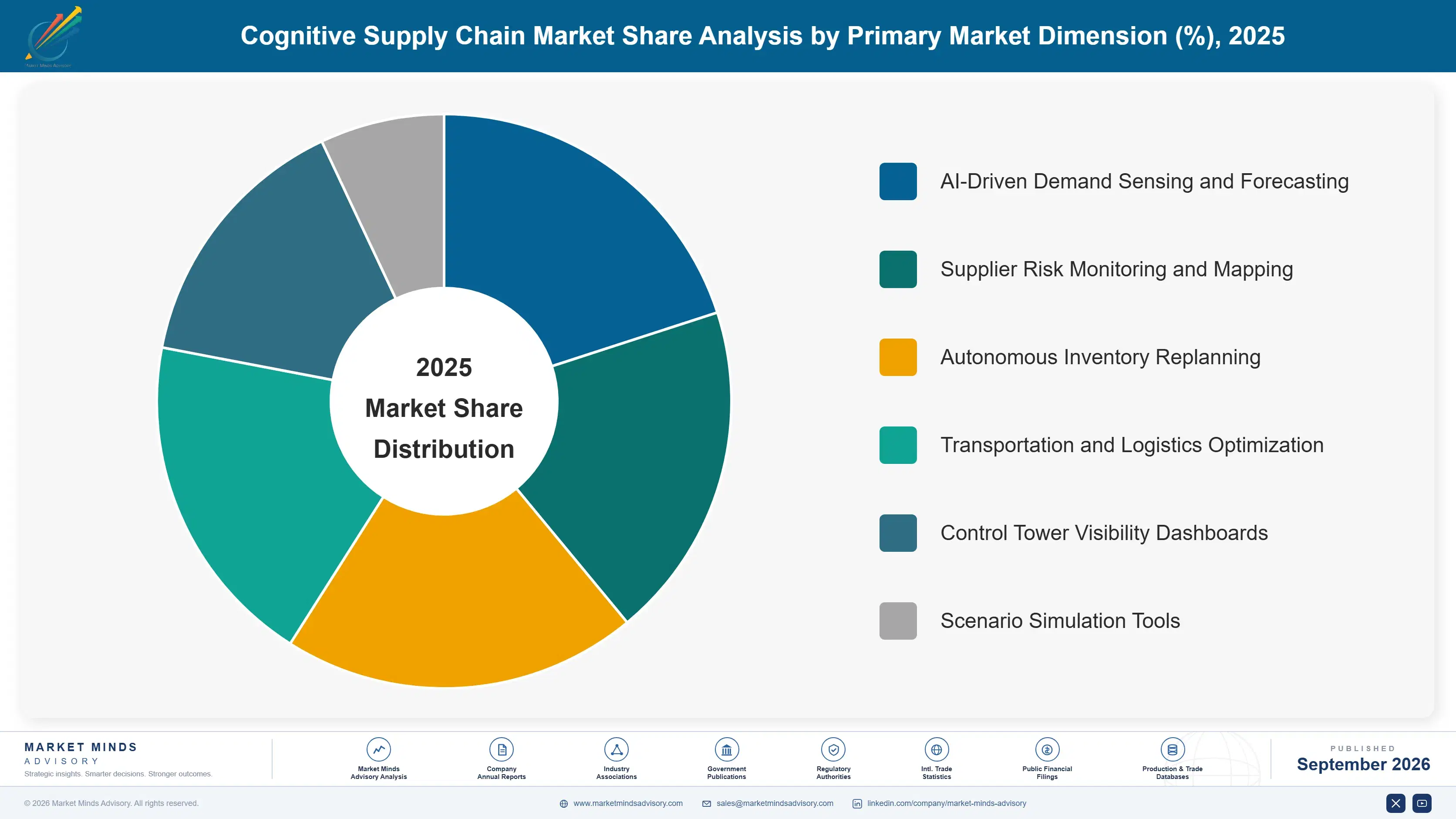
Cognitive supply chain platforms segment by the core planning function delivered, spanning AI-driven demand sensing and forecasting, supplier risk monitoring and mapping, autonomous inventory replanning, transportation and logistics optimization, control tower visibility dashboards, and scenario simulation tools serving manufacturing and retail enterprise customers of every size, geography, industry vertical, and technology maturity level today.
cognitive-supply-chain-market-market-share-analysis-1788677507826

AI-Driven Demand Sensing and Forecasting

AI-driven demand sensing and forecasting tools incorporate real-time signals including point-of-sale data, weather patterns, and social sentiment alongside historical sales data to predict demand with meaningfully better accuracy than traditional statistical extrapolation methods that earlier planning generations relied upon exclusively. Growth outpaces the broader market because demand forecasting represents the foundational input that every downstream planning decision depends upon, making accuracy improvements here deliver measurable value across the entire planning process rather than a single isolated function. o9 Solutions and Blue Yonder both report accelerating enterprise adoption as validated accuracy benchmarks give procurement committees confidence to approve broader deployment beyond narrow pilot programs. This validation approach has become an industry standard sales practice across nearly every competing vendor.
CAGR 21.0%

Supplier Risk Monitoring and Mapping

Supplier risk monitoring and mapping tools extend visibility across multi-tier supplier networks, identifying disruption risk originating well beyond a company's direct first-tier suppliers where most enterprises historically had limited or no visibility whatsoever. This segment grows more slowly than demand forecasting because comprehensive multi-tier network mapping requires more extensive data collection and supplier cooperation than forecasting tools that primarily depend on data the enterprise already possesses internally. Vendors in this category increasingly differentiate through automated network discovery capability that reduces the manual data collection burden that historically limited comprehensive multi-tier visibility efforts. Financial services customers increasingly demand this mapping capability given the systemic risk implications of undetected supplier concentration. Manufacturing customers value this depth given rising regulatory scrutiny of origin.
CAGR 17.0%
Full segment breakdown across 6 segments available in the complete report.

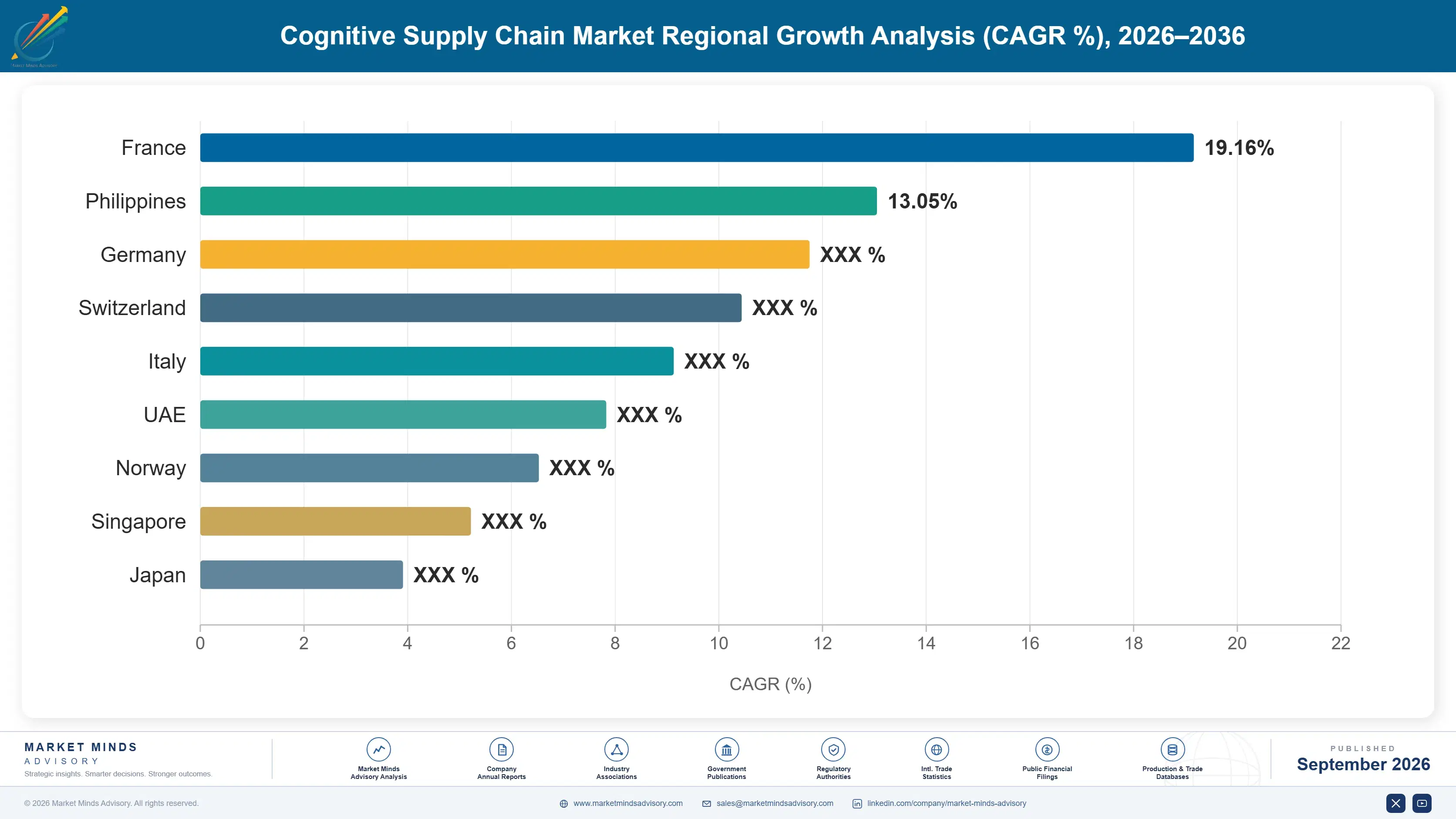
Regional Architecture and Country Demand Map

North America leads given o9 Solutions, Blue Yonder, and Kinaxis headquarters concentration and the deepest enterprise manufacturing technology spending among all tracked global markets today, while South Asia and Pacific posts the fastest overall growth as regional manufacturing capacity expands rapidly across expanding supply networks.

North America

The United States hosts the deepest concentration of cognitive supply chain vendors, with o9 Solutions, Blue Yonder, Kinaxis, and SAP all serving American customers from substantial domestic headquarters and development presence. American automotive and consumer goods manufacturers generate the highest per-contract platform spending among tracked markets, reflecting both complex multi-tier supplier networks and sufficient capital budgets to fund enterprise-scale AI transformation initiatives. Canada's growing technology sector also contributes meaningfully to regional demand, particularly around supplier risk mapping given its established manufacturing and natural resource extraction base. Growing government agency adoption of predictive planning tools also contributes to steady regional demand growth. Mexico's growing manufacturing sector also contributes modestly to this broader regional grouping's overall demand.
Share: 32% | CAGR: 17.5% (2026 to 2036)

Western Europe

German automotive manufacturers drive substantial regional demand, specifying cognitive supply chain platforms to manage the extraordinarily complex multi-tier supplier networks that modern vehicle manufacturing depends upon across dozens of countries. SAP maintains substantial European headquarters presence, giving regional customers a qualified domestic vendor deeply familiar with European regulatory and data residency requirements. Growth trails North America and East Asia somewhat, reflecting the region's more conservative enterprise technology adoption timelines compared to American and Chinese manufacturers currently. France and the Nordic countries contribute additional demand through their growing manufacturing digitization investment programs. Regional enterprises increasingly view multi-tier visibility as standard procurement practice going forward. This trend continues expanding steadily across the region.
Share: 21% | CAGR: 15.0% (2026 to 2036)
Regional intelligence for 5 additional markets available in the complete report: East Asia, South Asia and Pacific, Latin America, Middle East and Africa, Eastern Europe. Contact sales@marketmindsadvisory.com.
cognitive-supply-chain-market-country-cagr-analysis-1788677508370

Where Platforms Build Durable Enterprise Value

Beyond standard platform subscription fees, cognitive supply chain vendors build durable revenue through mechanisms that deepen enterprise dependency and demonstrate measurable disruption avoidance value over multi-year contract relationships, rewarding vendors that invest early in autonomous execution depth, multi-tier visibility breadth, and integration engineering rather than pure forecasting accuracy competition across every enterprise segment served.

Selling Autonomous Execution Capability as a Premium Tier

Vendors increasingly charge separately for autonomous execution capability that automatically implements replanning decisions within defined guardrails, beyond the standard recommendation-only tier that requires manual planner approval for every suggested action. This autonomous execution tier typically commands 20 to 30 percent premium pricing over recommendation-only subscriptions, reflecting the genuine operational value of compressed response time during actual disruption events. Enterprise customers increasingly view autonomous execution as the meaningful differentiator separating mature cognitive platforms from basic analytics dashboards offering surface-level insight alone. Larger manufacturers with complex multi-facility operations increasingly demand this autonomous tier by default.
Market Impact: Autonomous execution commands roughly 20 to 30pp premium

Offering Extended Multi-Tier Supplier Mapping Services

Vendors increasingly sell dedicated multi-tier supplier network mapping services that extend visibility several tiers beyond a customer's direct suppliers, a specialized service commanding premium pricing given the genuine data collection and analysis complexity involved beyond standard first-tier monitoring. This mapping service captures incremental value from an existing platform relationship while addressing a documented visibility gap that historically left major disruption events undetected until they directly affected first-tier suppliers. Mapping engagements typically generate 12 to 18 percent additional revenue per enterprise relationship beyond standard subscription fees. This mapping depth also strengthens vendor credibility during competitive enterprise procurement evaluation processes.
Market Impact: Mapping services add roughly 12 to 18pp yearly

Selling Scenario Simulation and Stress Testing Software

Vendors increasingly sell dedicated scenario simulation and supply chain stress testing modules that let enterprises model hypothetical disruption events before they occur, a planning capability distinct from standard forecasting and typically billed as a separate premium add-on module. This simulation revenue, typically priced 8 to 12 percent above standard subscriptions, captures incremental value from customers seeking proactive risk management capability, addressing genuine board-level demand for documented resilience planning. Enterprise risk committees increasingly require this simulation capability as part of formal supply chain resilience reporting obligations. Vendors report this simulation tier meaningfully strengthens board-level executive sponsorship for continued platform investment.
Market Impact: Simulation modules add roughly 8 to 12pp yearly

Establishing Multi-Year Enterprise Transformation Support Partnerships

Vendors increasingly build multi-year transformation partnerships with large manufacturers, providing dedicated implementation support and roadmap coordination beyond standard subscription licensing that helps enterprises coordinate cognitive planning deployment across multiple business units and geographies simultaneously. This partnership-level engagement captures contract values 2 to 3 times larger than standard per-seat licensing alone, since enterprises value strategic coordination beyond pure operational forecasting assistance. Larger manufacturers increasingly prefer this deeper partnership model over transactional point-solution licensing arrangements that leave coordination gaps. Vendors report these partnerships also meaningfully improve long-term contract renewal likelihood considerably across their base.
Market Impact: Transformation partnerships add roughly 25 to 35pp value

Who Controls the Margin Pool

Concentration among the top five cognitive supply chain vendors sits at roughly thirty-three percent, moderate for a category still fragmented across dozens of specialized point-solution and enterprise resource planning-adjacent providers. o9 Solutions and Blue Yonder lead on enterprise contract breadth and autonomous execution capability, while the gap separating them from mid-tier challengers like Kinaxis remains narrow enough that a well-validated new accuracy benchmark could shift rankings within a single procurement cycle.
Current competitive activity centers on autonomous execution capability expansion and multi-tier supplier mapping depth, since both directly address the response speed and visibility requirements that increasingly determine enterprise vendor selection decisions. Several vendors have also launched dedicated scenario simulation modules, capturing board-level resilience planning demand distinct from standard operational forecasting functionality alone.

Emerging pressure comes from large enterprise resource planning vendors bundling increasingly sophisticated AI planning capability directly into their broader platform offerings, threatening specialized providers lacking comparable platform-level customer relationships and integrated billing convenience. Ranking shifts are most likely among mid-tier vendors lacking either demonstrated autonomous execution capability or comprehensive multi-tier visibility, since both dimensions increasingly separate durable market leaders from vulnerable niche competitors.
cognitive-supply-chain-market-company-positioning-matrix-1788677508904

Competitive Moat and Risk Dimensions

O9 SOLUTIONS

Moat: Deep Autonomous Execution Capability

o9 Solutions built its platform architecture specifically around autonomous decision execution rather than pure recommendation generation, giving it a genuine technical head start that competitors retrofitting autonomous capability onto legacy recommendation-only architectures cannot easily replicate. This architectural advantage compounds each release cycle as competitors struggle to bolt on comparable native capability.
O9 SOLUTIONS

Risk: Premium Pricing Limits Reach

o9 Solutions commands premium pricing that limits its addressable customer base to the largest enterprises capable of justifying substantial platform investment, potentially ceding smaller and mid-sized manufacturer segments to lower-cost competitors. o9 Solutions has responded by introducing tiered pricing to expand its reach into mid-market segments.
BLUE YONDER

Moat: Broad Retail and Logistics Portfolio

Blue Yonder's broader retail and logistics software portfolio beyond pure cognitive planning gives it cross-selling opportunities and existing customer relationships that pure-play cognitive supply chain specialists cannot access without comparable product breadth. This breadth also lets Blue Yonder weather downturns in any single vertical more easily than specialists.
BLUE YONDER

Risk: Panasonic Integration Priority Tension

Blue Yonder's ownership by Panasonic creates some tension between pursuing independent product roadmap priorities and satisfying Panasonic's broader corporate strategic integration goals, a balance that independent competitors do not need to manage. Blue Yonder has generally maintained product roadmap independence despite this ownership structure so far.

Players Tracked

Prominent Players

o9 Solutions
Blue Yonder
Kinaxis
SAP Integrated Business Planning
ToolsGroup

Other Key Players

Coupa Software
Anaplan
Oracle Supply Chain Planning
Infor Nexus
Logility
E2open
Aera Technology
Board International
Solvoyo
Arkieva
Relex Solutions
Slimstock
GAINSystems
Enterra Solutions
Interos

Recent Developments

MARCH 2026

o9 Solutions Launches Expanded Autonomous Execution Suite

o9 Solutions launched an expanded autonomous execution suite adding new guardrail configuration options for inventory and supplier order decisions across multiple manufacturing verticals. The launch represents an internal product development effort rather than an acquisition of external technology or another company. Existing customers gain this capability at no cost.
Signal: Demonstrates the autonomous execution expansion pattern this report identifies as a central future revenue lever ahead
NOVEMBER 2025

Kinaxis Signs Multi-Year Contract With Global Automaker

Kinaxis signed a multi-year platform contract with a global automaker covering demand forecasting and supplier risk monitoring across the automaker's full multi-country manufacturing network. The agreement is a service contract rather than an acquisition or joint venture between the two organizations involved. Terms were not disclosed by either party.
Signal: Extends an established vendor's reach into a large multi-country global automotive customer relationship and territory further
AUGUST 2025

Blue Yonder Acquires Scenario Simulation Software Startup

Blue Yonder acquired a smaller scenario simulation software startup to accelerate development of supply chain stress testing capability within its existing cognitive planning platform serving enterprise manufacturing customers. The acquisition brought in specialized simulation algorithms that Blue Yonder plans to integrate directly into its offerings.
Signal: Signals continued vendor investment in scenario simulation as a key long-term competitive differentiator across every market

Cloud Compute and Talent Cost Exposure

Cognitive supply chain platform cost structures are dominated by cloud computing infrastructure for real-time data processing at scale, skilled data science and supply chain engineering talent compensation, and integration engineering costs for connecting legacy enterprise systems. Cloud compute cost represents a meaningful and growing share of total operating cost as platforms process increasingly large volumes of real-time signals across multi-tier supplier networks and demand forecasting models running continuously.
Cloud infrastructure pricing rose meaningfully during 2022 and 2023 amid broader industrial computing demand growth, according to public cloud provider pricing disclosures and industry benchmarking reports tracking compute cost trends across major providers during that period. Vendors without reserved capacity agreements absorbed a larger share of this cost increase directly, while others expanded compute efficiency optimization to reduce per-customer processing costs without sacrificing forecast accuracy outcomes.

Smaller vendors lacking negotiating scale with major cloud providers face meaningfully higher per-customer processing costs than larger competitors able to negotiate volume-based enterprise pricing agreements directly with providers at scale. This exposure varies by player type: vendors with proprietary data processing architectures reduce dependence on raw compute capacity more effectively than competitors relying entirely on standard cloud infrastructure configurations for their core forecasting functionality.
cognitive-supply-chain-market-cost-volatility-analysis-1788677509100

Develop Proprietary Data Processing Architectures

Vendors are developing proprietary data processing architectures that reduce cloud compute consumption per customer deployment, cutting infrastructure costs meaningfully while maintaining comparable forecast accuracy outcomes across most enterprise manufacturing and retail use cases. This efficiency work also improves response speed considerably, since less data must be processed per forecasting cycle across every customer deployment.

Negotiate Reserved Cloud Capacity Agreements

Vendors are negotiating multi-year reserved cloud capacity agreements with major providers rather than paying on-demand pricing, converting a volatile per-use cost into a predictable, discounted annual expense that simplifies financial planning considerably across product cycles. Vendors report these agreements have meaningfully reduced unplanned cost spikes during periods of sudden customer growth and rising demand.

Build Pre-Built ERP Integration Connector Libraries

Vendors are building libraries of pre-built integration connectors for the most common enterprise resource planning systems, reducing the custom integration engineering cost that historically consumed substantial implementation budget on every new customer deployment. This library approach also shortens implementation timelines considerably for customers using common enterprise system configurations and their existing legacy system versions.

Portfolio Architecture for Margin Defence

Portfolio economics across cognitive supply chain vendors split between standard forecasting subscriptions competing largely on price, and premium autonomous execution or multi-tier visibility offerings commanding meaningfully higher margins given specialized engineering and integration expertise sold alongside core forecasting functionality across every enterprise customer segment and deployment size served today, from small manufacturers to large multinational corporations.
The tension between volume and premium positioning shows clearly in service tier structure: standard demand forecasting subscriptions compete on baseline accuracy and per-seat pricing, while autonomous execution and multi-tier visibility tiers command substantially higher effective margins justified by genuine engineering complexity and documented disruption avoidance value across every regulated manufacturing industry vertical and geography served.

High-value margin pools concentrate around autonomous execution capability and scenario simulation modules, both requiring specialized engineering investment that smaller vendors cannot easily replicate without years of dedicated development, customer trust, and accumulated forecasting data. Vendors positioned purely as recommendation-only forecasting tools will struggle to capture this premium tier without meaningful, sustained investment in autonomous execution and simulation engineering capability. Larger vendors with established engineering teams increasingly capture this premium tier ahead of smaller specialized competitors.

Volume / Commodity-Adjacent

Standard demand forecasting subscriptions competing largely on baseline accuracy and price against similar undifferentiated offerings from established competitors serving smaller manufacturers with less complex supplier networks and thinner technology budgets.
Gross Margin: 15-25%

Premium / Certified

Autonomous execution capability and multi-tier supplier visibility sold to enterprise customers requiring documented disruption response and mapping depth beyond what standard forecasting subscriptions can reliably deliver at any real scale.
Gross Margin: 30-40%

Sustainability / Regulatory / Next-Generation

Scenario simulation modules and multi-year transformation partnerships requiring specialized engineering expertise smaller vendors cannot easily replicate quickly, commanding the entire category's strongest and most defensible overall margin position available today.
Gross Margin: 35-50%
cognitive-supply-chain-market-portfolio-architecture-1788677509594

High-value Sub-segments and Strategic Watch-out

AI-Driven Demand Sensing and Forecasting

The fastest-growing, highest-value segment as machine learning models finally deliver forecast accuracy improvements traditional statistical methods could not match, letting enterprises reduce costly inventory imbalances across every product category, channel, and geography served today across the entire enterprise, its full supply network, and every customer tier.
Gross Margin: 30-40%

Autonomous Execution Capability

High-value and steadily growing as enterprises increasingly demand compressed disruption response time beyond what manual planner approval cycles allow, rewarding vendors that invest early in guardrail-based autonomous decision execution architecture across every deployment context, industry vertical, customer size, and geography currently served worldwide today and going forward.
Gross Margin: 35-50%

Standard Recommendation-Only Forecasting

The volume core of the market, generating steady per-seat revenue but facing margin pressure from enterprise resource planning bundled competition, requiring efficient operations to sustain acceptable margins as competition intensifies across every served geography, industry, customer segment, contract type, and deployment model tracked here closely.
Gross Margin: 15-25%

ERP Vendor Bundled AI Planning

A strategic watch-out category where large enterprise resource planning vendors bundling AI capability could meaningfully compress independent vendor pricing power over time, potentially reshaping which vendors capture the autonomous execution opportunity this report identifies as central to sustained future growth, margin, and overall competitive positioning.
Gross Margin: N/A, bundled

How Autonomous Execution Compounds Trust

Cognitive supply chain platform contracts function like an annuity once an enterprise's planning workflows become dependent on continuous demand sensing and autonomous replanning capability, since switching platforms mid-relationship risks disrupting the accumulated forecasting model calibration and integration built up over months of production deployment that a new vendor relationship would need to rebuild entirely from scratch, adding real operational and financial risk.
Adoption stickiness varies by end-use vertical: automotive and consumer goods manufacturers show the deepest lock-in given complex multi-tier supplier network integration requirements and the switching cost of retraining planning staff, while smaller distributors switch more readily given simpler supply networks and lower integration complexity tied to any single vendor's specific forecasting methodology across a typical planning cycle. Switching costs also extend to accumulated historical forecasting data used to calibrate model accuracy.

Generational shifts in supply chain planning expectations are reshaping buyer profiles, as newer planners entering the workforce now expect AI-assisted forecasting and autonomous replanning as a baseline capability rather than a controversial technology requiring extensive justification to skeptical senior colleagues. This mindset shift accelerates platform adoption cycles considerably compared to prior generations of planners accustomed to fully manual planning processes.
cognitive-supply-chain-market-end-use-penetration-index-1788677510082

MMA Verdict on Cognitive Supply Chain

These are among the four positions where our research anticipates prominent divergence between winners and laggards over the coming forecast period. Each is grounded in the demand model, the regulatory perimeter, and the announced capacity pipeline.
01 / AUTONOMOUS EXECUTION PRIORITY

Prioritize autonomous execution over recommendation-only design

Vendors still limited to recommendation-only platforms requiring manual planner approval for every action risk losing ground to competitors demonstrating compressed disruption response time through genuine autonomous execution capability across every major manufacturing vertical. Investing in autonomous execution architecture now, even at meaningful engineering cost, positions a vendor to capture disproportionate share of the fastest-growing service category tracked in this report and its regional breakdown. Vendors delaying this investment risk permanently ceding this opportunity to faster-moving competitors already building this capability.
02 / MULTI-TIER VISIBILITY EXPANSION

Expand supplier mapping depth beyond first-tier suppliers

Vendors offering only first-tier supplier visibility increasingly lose enterprise contracts to competitors demonstrating comprehensive multi-tier network mapping that addresses the documented visibility gap behind most major disruption events in recent years across every industry vertical. Building this mapping capability captures incremental revenue from existing platform relationships while addressing genuine board-level demand for documented supply chain resilience reporting across every regulated industry and geography. Vendors should prioritize this investment ahead of pure dashboard feature expansion that matters less to sophisticated buyers.
03 / ERP BUNDLING DEFENSE STRATEGY

Differentiate against ERP bundled AI through specialization

Independent vendors ceding ground to enterprise resource planning vendors bundling increasingly sophisticated AI planning capability without a clear differentiated value proposition risk gradual market share erosion as bundled alternatives capture enterprise mindshare through existing platform relationships and simple billing convenience alone. Explicit specialization around autonomous execution depth and multi-tier visibility that no single ERP vendor can credibly offer gives independent vendors a durable differentiation angle worth defending vigorously. Vendors should lean into this positioning rather than competing purely on price.
04 / PLANNER TRUST BUILDING INVESTMENT

Invest in configurable autonomy to build planner trust

Vendors deploying fully autonomous systems without configurable trust-building pathways risk alienating experienced planners who remain professionally cautious about ceding accountability to systems whose reasoning is not always fully transparent or explainable to a satisfying enough degree. Offering configurable autonomy levels that gradually expand as planner confidence builds accelerates adoption meaningfully compared to forcing an immediate transition to full autonomous execution that skeptical planners actively resist and distrust. Vendors should treat this gradual trust-building pathway as a genuine product design requirement.

Engagement Snapshot From the Field

A live engagement with an industry participant carrying material or product regulatory and market exposure ahead of a defining policy shift, showing how our research translates into a defensible multi-year portfolio strategy.
MARKET MINDS ADVISORY · CLIENT ENGAGEMENT SUMMARY
Cognitive Supply Chain Producer Strategic Portfolio Review and Transition Roadmap 2026·Investment Scenario on Cognitive Supply Chain Exposure Evaluation 2025-26
CLIENT PROFILE
The client is a mid-sized consumer goods manufacturer operating multiple production facilities, previously relying on traditional statistical forecasting tools but facing rising inventory imbalance costs as demand patterns grew increasingly volatile across its product portfolio. The company had no prior experience with cognitive supply chain platforms and needed guidance on vendor selection, expected accuracy improvement, and implementation timeline planning.
STRATEGIC CHALLENGE
Leadership needed to select a cognitive supply chain vendor capable of improving forecast accuracy across a complex, multi-tier supplier network without requiring a multi-year implementation timeline that could delay realizing measurable cost savings from reduced inventory imbalances across the business, its full product portfolio, and every distribution channel served today.
MMA APPROACH
MMA conducted a structured vendor evaluation across four cognitive supply chain platforms, assessing forecast accuracy validation, ERP integration complexity, and autonomous execution capability against the client's existing supply network and planning team capacity, supplementing vendor-provided data with reference calls to comparable consumer goods manufacturing clients already using each evaluated platform.
KEY FINDINGS
  1. Two of four evaluated platforms lacked pre-built integration connectors for the client's specific legacy enterprise resource planning system configuration and current version.
  2. The selected platform's demand sensing capability improved forecast accuracy meaningfully compared to the client's existing statistical forecasting baseline during testing periods conducted.
  3. Reference manufacturing clients reported measurable inventory imbalance cost reductions within the first year of adopting comparable cognitive supply chain platforms broadly and consistently.
  4. The selected platform's configurable autonomy levels let the client's planning team build trust gradually before enabling full autonomous execution capability entirely and permanently.
CLIENT PROFILE
The client is a mid-sized consumer goods manufacturer operating multiple production facilities, previously relying on traditional statistical forecasting tools but facing rising inventory imbalance costs as demand patterns grew increasingly volatile across its product portfolio. The company had no prior experience with cognitive supply chain platforms and needed guidance on vendor selection, expected accuracy improvement, and implementation timeline planning.
STRATEGIC CHALLENGE
Leadership needed to select a cognitive supply chain vendor capable of improving forecast accuracy across a complex, multi-tier supplier network without requiring a multi-year implementation timeline that could delay realizing measurable cost savings from reduced inventory imbalances across the business, its full product portfolio, and every distribution channel served today.
MMA APPROACH
MMA conducted a structured vendor evaluation across four cognitive supply chain platforms, assessing forecast accuracy validation, ERP integration complexity, and autonomous execution capability against the client's existing supply network and planning team capacity, supplementing vendor-provided data with reference calls to comparable consumer goods manufacturing clients already using each evaluated platform.
KEY FINDINGS
  1. Two of four evaluated platforms lacked pre-built integration connectors for the client's specific legacy enterprise resource planning system configuration and current version.
  2. The selected platform's demand sensing capability improved forecast accuracy meaningfully compared to the client's existing statistical forecasting baseline during testing periods conducted.
  3. Reference manufacturing clients reported measurable inventory imbalance cost reductions within the first year of adopting comparable cognitive supply chain platforms broadly and consistently.
  4. The selected platform's configurable autonomy levels let the client's planning team build trust gradually before enabling full autonomous execution capability entirely and permanently.
RECOMMENDED STRATEGY
Phase 1: Phase one: deploy the selected platform for demand forecasting on a single product line to validate accuracy improvement thoroughly first. Phase 2: Phase two: expand platform usage to additional product lines once initial accuracy and inventory savings metrics clear defined internal thresholds. Phase 3: Phase three: enable autonomous execution capability across validated product lines once the planning team demonstrates sustained reliable confidence overall and consistently.
OUTCOME
The client deployed its selected platform for one product line, reporting meaningful forecast accuracy improvement and inventory cost reduction during the pilot period across its production network (client-reported, unverified by MMA). Leadership credited the phased rollout with building planning team confidence before broader deployment began.

Frequently Asked Questions

Foundational context covering the market sizes, CAGR, scope, country, region and competition that inform every finding below. This section is provided to cover basics and most often pre-purchase conversations, answered from the MMA Primary Research Dataset.

What is the current size of the Cognitive Supply Chain Market?

The Cognitive Supply Chain Market is valued at 8.5 billion dollars in 2025. It is expected to reach 9.9 billion dollars by 2026 as enterprise AI adoption accelerates.

How large will the Cognitive Supply Chain Market be by 2036?

The market is projected to reach 45.59 billion dollars by 2036, up from 9.9 billion dollars in 2026. That represents a 4.61 times expansion over the forecast period.

What is the CAGR for the Cognitive Supply Chain Market 2026 to 2036?

The market is forecast to grow at a 16.5 percent compound annual growth rate between 2026 and 2036. This reflects steady demand tied to rising demand volatility.

Which segment is growing fastest?

AI-Driven Demand Sensing and Forecasting leads at a 21.0 percent CAGR, roughly 1.27 times the overall market rate. Real-time signal integration is driving this growth.

Who are the major companies in the Cognitive Supply Chain Market?

Leading vendors include o9 Solutions, Blue Yonder, Kinaxis, SAP Integrated Business Planning, and ToolsGroup. Together these five hold an estimated 33 percent combined market share.

Which country is growing fastest?

India leads at a 19.5 percent CAGR, driven by its rapidly expanding manufacturing base backed by government production-linked incentive programs. New facilities increasingly specify AI planning from the outset.

Report Segmentation Architecture

The full report scope spans multiple orthogonal segmentation dimensions, with cross-tabulated demand data provided for each dimension pair. Coverage extends further to regional breakdowns, trend trajectories, and the competitive detail needed to support segment-level decision-making.

By Primary Market Dimension

  • AI-Driven Demand Sensing and Forecasting
  • Supplier Risk Monitoring and Mapping
  • Autonomous Inventory Replanning
  • Transportation and Logistics Optimization
  • Control Tower Visibility Dashboards
  • Scenario Simulation Tools

By End-Use Industry

  • Automotive
  • Consumer Goods
  • Retail
  • Electronics and Semiconductors
  • Industrial Manufacturing

By Commercial Dimension

  • Standard Forecasting Subscriptions
  • Autonomous Execution Premium Tiers
  • Multi-Tier Mapping Services
  • Enterprise Transformation Partnerships

By Region

  • North America
  • Western Europe
  • East Asia
  • South Asia and Pacific
  • Latin America
  • Middle East and Africa
  • Eastern Europe

Scope, Methodology, and Coverage

Every figure in this report is reproducible from documented input assumptions. The scope below maps the historical period, the forecast horizon, the segmentation dimensions, and the countries covered, alongside the underlying primary and qualitative methodology.
Historical Period
2020 to 2025
Forecast Period
2026 to 2036
Base Year
2025 (USD billions; MMA Primary Research Dataset, September 2026)
Market Definition
This market covers software platforms that use artificial intelligence to forecast demand, predict supply chain disruptions, and automate replanning decisions across manufacturing, distribution, and retail supply networks. It excludes traditional enterprise resource planning software without embedded predictive or autonomous decision-making capability and standalone logistics tracking tools.
Quantitative Units
USD billions, market share percentages, CAGR percentages
Segmentation Dimensions
Planning function type, end-use industry, commercial dimension, region
Regions Covered
North America, Western Europe, East Asia, South Asia and Pacific, Latin America, Middle East and Africa, Eastern Europe
Countries Covered
United States, Germany, Japan, China, South Korea, India, Brazil, United Arab Emirates, and 30 additional countries across all seven global regions
Key Companies Profiled
o9 Solutions, Blue Yonder, Kinaxis, SAP Integrated Business Planning, ToolsGroup, and 15 additional vendors
Quantitative Methodology
Primary survey, n=3,800 respondents, Q4 2025, six countries; demand-side model with trade association cross-validation
Qualitative Methodology
47 expert interviews, Q4 2025; applied to validate demand model assumptions, identify emerging dynamics, and assess competitive positioning
Report Format
PDF and XLSX data workbook (Word format preview document)
Publisher
Market Minds Advisory
Report Code
MMA-2026-TEC-167
Published
September 2026
Contact
sales@marketmindsadvisory.com | www.marketmindsadvisory.com

Purchase the full Cognitive Supply Chain Market Report (2026 to 2036).

This report examines the Cognitive Supply Chain Market across its full 2026 to 2036 forecast horizon, covering market sizing, segmentation, competitive dynamics, and regional demand patterns in depth. It draws on primary survey data from 3,800 respondents and 47 expert interviews conducted in the fourth quarter of 2025. The analysis profiles twenty leading vendors and quantifies revenue levers, cloud compute cost exposure, and portfolio economics across the category's major segments today. Strategic recommendations address autonomous execution, visibility expansion, and ERP defense for vendors and investors.
Full 2026-2036 market sizing and forecast data
Seven-region demand and growth rate breakdown
Twenty-company competitive profiles and moat analysis
Segment-level CAGR and market share detail
Revenue lever and cloud compute cost analysis
Anonymised client case study with strategy recommendations

Built For The People Who Decide

From boardroom strategy to bench-side execution, this report is read cover-to-cover by leaders shaping the next decade of their industry, turning demand scenarios, market dynamics and valuation benchmarks into decisions.
CXOs/ Presidents/ VPs/ Managers
M&A and Corporate Development
Strategy Teams and R&D Heads
Procurement and Product Directors
Regulatory and Compliance Leaders
Investor Relations and Equity Analysts