Market Minds Advisory
Cognitive Assessment and Training Market

Cognitive Assessment and Training Market: Cognitive Assessment and Training Market. Aging Populations Push Screening From Clinical Episode to Continuous Digital Practice

Aging populations and rising dementia diagnosis rates are pushing health systems to fund continuous digital cognitive screening and training programs rather than relying on episodic in-clinic assessments administered only when decline is already suspected.

Lead Analyst

Published

September 2026

Make Smarter Decisions with Customized Research Insights

Request a free sample report and evaluate market opportunities, growth trends, and competitive dynamics relevant to your business needs.

2025 MARKET VALUE$8.9BMarket Size 2025
2036 FORECAST VALUE$26.9BBase Case , 2026 to 2036
CAGR 2026 TO 203610.6 %Bull 11.9% / Bear 9.4%
INCREMENTAL OPPORTUNITY$17.1BNet 10- year value creation
EXPANSION MULTIPLE2.74x2036 value over 2026 base
Strategic Levers
M&A Pipeline
Regional Outlook
Country Rankings
Competitive Intelligence
Segmental Deep-dive
Call-Us : 91 93563 13602

Executive Snapshot and Market Trajectory.

Health systems facing rising dementia diagnosis rates are shifting cognitive screening from a rare, episodic clinical event triggered by suspected decline toward continuous digital assessment integrated into routine primary care visits and at-home practice, fundamentally changing when and how impairment gets caught across most patient populations.
Clinic-based standardized assessment tools remain the largest deployed category by installed base, since regulatory and reimbursement frameworks still anchor around formally administered testing, but at-home digital cognitive training platforms are capturing the fastest-growing share of new spending as continuous engagement proves more predictive of decline than a single annual test. Primary care physicians, increasingly required to screen for cognitive impairment during Medicare annual wellness visits, are driving the bulk of new clinical tool adoption.
Cognivue and Linus Health hold the clearest early technology lead in point-of-care digital assessment devices, but consumer-facing platforms including BrainHQ are winning share in the training and engagement layer where clinical device vendors move more slowly. Reimbursement clarity has become the decisive purchasing criterion, since providers remain hesitant to integrate any tool into clinical workflow without a clear billing code path that justifies the added administrative burden.
Market Definition
The cognitive assessment and training market covers software and connected devices used to screen for cognitive impairment and deliver structured cognitive training exercises, in both clinical and consumer settings. It excludes pharmaceutical dementia treatments, general brain health supplements without a software or device component, and neuroimaging equipment used for diagnostic purposes beyond cognitive screening.
Base Year Value
$8.9B in 2025 (MMA Primary Research Dataset, September 2026)
Forecast Period
2026 to 2036, eleven discrete annual values
CAGR
10.6% base case. Bull 11.9%. Bear 9.4%.
Fastest Growth Segment
At-Home Digital Cognitive Training Platforms: 15.2% CAGR
Fastest Growth Country
Japan: 13.4% CAGR
Fastest Growth Region
South Asia and Pacific: 12.7% CAGR
Largest Region
North America: 30% of 2025 global value
Market Leaders
Cognivue, Linus Health, BrainHQ, Cambridge Cognition, and Cogstate lead the competitive landscape.
Primary Survey
n=3,800 procurement and R&D decision-makers, Q4 2025, six countries
Methodology
Demand-side build-up, cross-validated against public data, 47 expert interviews

Cognitive Assessment and Training Market Forecast Scenarios

cognitive-assessment-and-training-market-size-forecast-scenario-1790007304082
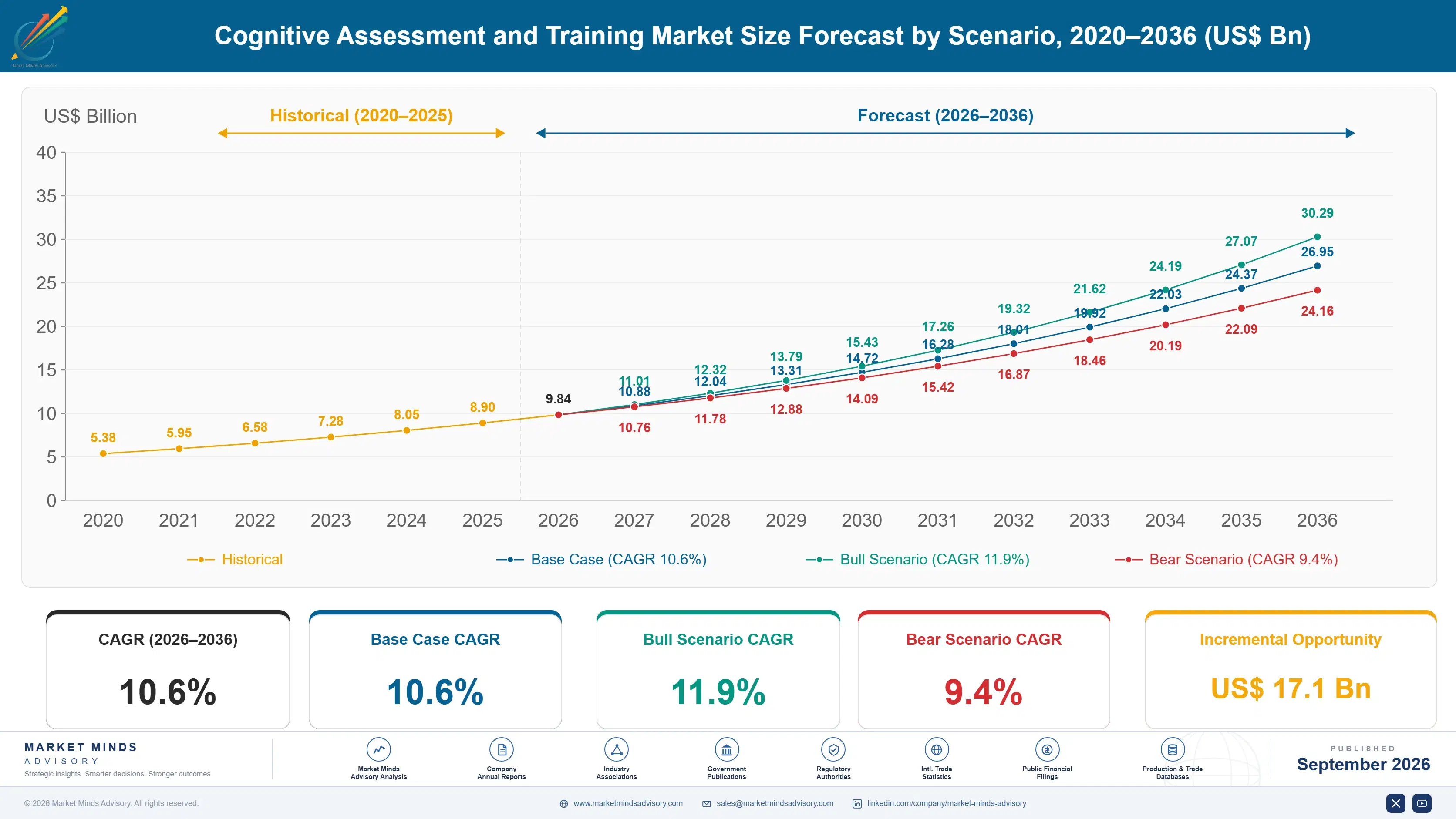
The cognitive assessment and training market compounded at roughly 9.6 percent between 2020 and 2025, a period shaped by pandemic-driven telehealth cognitive screening adoption followed by a steadier build-out of Medicare-mandated wellness visit screening infrastructure across primary care practices nationwide and internationally, particularly across rapidly aging developed economies in both Western Europe and East Asia.
MMA's base case assumes 10.6 percent annual growth through 2036, anchored by three commercial mechanisms: aging population demographics expanding the addressable screening population faster than most other healthcare technology categories, Medicare and payer reimbursement frameworks increasingly covering structured cognitive screening as a standard primary care service, and consumer-facing digital brain training platforms converting casual engagement into sustained, revenue-generating subscription relationships as broader awareness of cognitive health continues growing steadily worldwide.
The bull case centers on reimbursement expansion accelerating faster than current adoption timelines assume, pulling forward primary care screening tool procurement across most major health systems and payer networks. The bear case is emerging pharmaceutical dementia treatments reducing the perceived urgency of early digital screening if disease-modifying drugs shift clinical focus toward biomarker testing rather than functional cognitive assessment tools entirely.

Reimbursement Clarity Now Decides Screening Tool Adoption

Cognitive assessment has spent decades as a rare clinical event, administered only after a patient or family member already suspected something was wrong, which means most tools were built to confirm a diagnosis rather than catch decline early on. That design legacy is now the industry's single biggest constraint as demand shifts toward continuous, proactive screening across most care settings.
MARKET CONCENTRATIONCR5 43%top five vendors hold well under half of category revenue
AVERAGE ASSESSMENT COST$62 per testtypical reimbursed rate for a standardized cognitive screening administration
WELLNESS VISIT SCREENING RATE38%of eligible Medicare visits now include documented cognitive assessment
CONSUMER SUBSCRIPTION RENEWAL RATE54%of digital brain training subscribers renew past the initial term
DETECTION SENSITIVITY87%of mild cognitive impairment cases correctly flagged by leading tools
CLINICAL VALIDATION COST SHARE29% of COGSregulatory and clinical trial expense remains a large cost line
Clinic-based standardized tests remain the reimbursement-anchored default, since Medicare wellness visit requirements and existing billing codes were built around formal, point-in-time administration rather than continuous digital monitoring. Consumer-facing brain training platforms are growing faster by sidestepping this reimbursement dependency entirely, building direct subscription relationships with health-conscious consumers who never enter the clinical billing system at all in the first place.
Vendors that can document detection sensitivity comparable to gold-standard clinical assessment are winning provider trust away from tools whose accuracy claims lack comparable peer-reviewed validation. Cognivue and Linus Health both lean on published clinical validation studies to reassure physicians, while consumer platforms like BrainHQ compete on engagement and renewal data that clinical device vendors have historically deprioritized in favor of pure diagnostic accuracy claims alone.
"Cognitive testing used to happen once, usually too late. Now it's something a patient does between visits, the same way they'd track steps or sleep."
Senior Analyst, Digital Health and Neurotechnology Practice · MMA Healthcare Practice · September 2026

Market Trends

Continuous Digital Screening Replaces Episodic Clinical Testing

Cognitive assessment is shifting from a rare, episodic clinical event administered only after decline is already suspected toward continuous digital monitoring integrated into routine primary care visits and daily at-home practice, a fundamentally different detection model than the industry has operated under for many long decades. This shift matters commercially because continuous engagement data proves more predictive of genuine decline than a single annual test, giving vendors with longitudinal data collection a real accuracy advantage over point-in-time tools. Vendors with continuous monitoring capability are winning accounts at a surprising pace.
Market Impact: Covers 64 million Medicare beneficiaries
AI-Driven Speech and Behavioral Analysis Expands Screening Reach

Vendors are increasingly building passive cognitive screening capability that analyzes speech patterns, typing behavior, and daily digital activity for early impairment signals rather than relying exclusively on active, deliberate testing that requires patient effort and cooperation. This approach matters commercially because passive screening reaches populations who would never proactively seek out or complete a formal cognitive test, expanding the addressable screening population well beyond patients already engaged with the healthcare system. Several vendors have launched dedicated speech analysis products within the past eighteen months specifically targeting this passive detection opportunity.
Market Impact: Adds 12 million new screening candidates

Market Opportunities and Growth Drivers

Medicare Wellness Visit Mandates Guarantee Baseline Demand

Medicare's annual wellness visit requirements, which mandate cognitive impairment detection as part of routine primary care, guarantee a baseline level of screening tool demand regardless of how quickly broader awareness of cognitive health continues to grow among the general population. This regulatory requirement has converted cognitive screening from a discretionary clinical judgment call into a documented compliance obligation that primary care practices cannot simply skip without risking reimbursement consequences during a Medicare audit. Vendors with documented compliance-ready workflow integration are winning primary care accounts faster than competitors requiring extensive custom implementation work.
Market Impact: Adds 6 to 9 months

Aging Population Demographics Expand Addressable Screening Base

Rapidly aging populations across most developed economies are expanding the addressable cognitive screening population faster than most other healthcare technology categories, since dementia and mild cognitive impairment risk rises sharply with age and the absolute number of adults over 65 continues climbing steadily worldwide. This demographic tailwind provides a durable, multi-decade demand floor that is largely independent of any single reimbursement policy change or clinical practice trend that might otherwise introduce volatility into vendor revenue projections. Vendors are increasingly building product roadmaps around this demographic certainty rather than shorter-term regulatory cycles.
Market Impact: Cuts conversion 18 percent

Market Restraints and Challenges

Fragmented Reimbursement Pathways Slow Clinical Adoption

Cognitive screening billing codes and coverage policies vary significantly across payers and jurisdictions, and the root cause is that no single standardized reimbursement framework yet governs digital cognitive assessment the way established frameworks cover more mature diagnostic categories like imaging or laboratory testing. This forces vendors to navigate payer-by-payer contract negotiation and certification, adding real administrative cost and slowing rollout timelines industry-wide even when clinical evidence for a given tool is genuinely strong. Some vendors are mitigating this by building dedicated reimbursement support teams that help provider clients navigate billing complexity directly.
Market Impact: Detects decline 14 months earlier

Consumer Skepticism Toward Unvalidated Brain Training Claims

Years of overstated marketing claims from early brain training products, several of which faced formal regulatory action for unsubstantiated cognitive improvement claims, have left lasting consumer skepticism that legitimate, clinically validated platforms must now actively overcome during ordinary marketing and sales conversations across this entire category today. The commercial impact shows up as longer consumer trust-building periods and lower initial conversion rates than comparable digital health categories without this reputational baggage. Vendors are mitigating this by prominently featuring peer-reviewed clinical validation data rather than relying on generic marketing claims alone.
Market Impact: Reaches 40 percent more undiagnosed patients
4 additional market trends, 3 additional growth drivers, and 2 additional restraints and challenges are covered in the full report. Contact sales@marketmindsadvisory.com to access the complete intelligence.

Segment CAGR and Growth Architecture

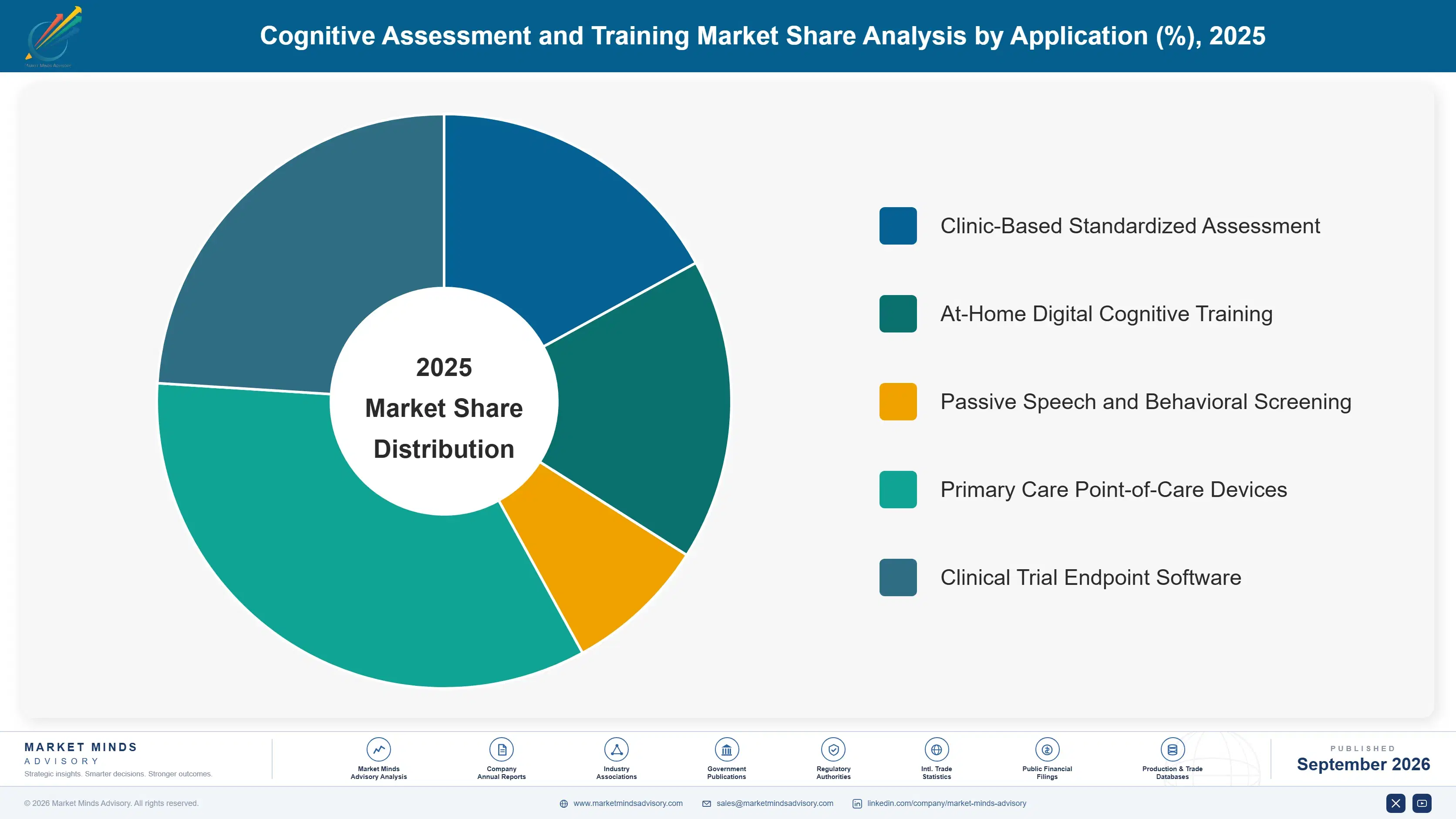
Five application categories cover the market: clinic-based standardized assessment tools, at-home digital cognitive training platforms, passive speech and behavioral screening, primary care point-of-care devices, and clinical trial cognitive endpoint software. Classification follows deployment setting and function alone, not disease stage, payer type, or age cohort, keeping the hierarchy consistent throughout this report and its appendices.
cognitive-assessment-and-training-market-market-share-analysis-1790007304616

At-Home Digital Cognitive Training Platforms

At-home digital cognitive training platforms are the fastest-growing application category, at a 15.2 percent CAGR against a base rate of 10.6 percent, pulled forward by consumer-facing brain training subscriptions that convert casual engagement into sustained, revenue-generating relationships as broader awareness of cognitive health continues growing steadily among aging, health-conscious populations worldwide today. These platforms sidestep the reimbursement dependency that constrains clinical tool adoption, building direct-to-consumer subscription relationships with users who never enter the clinical billing system. BrainHQ and several well-funded consumer health startups have all expanded dedicated cognitive training product lines within the past eighteen months, competing on engagement data and renewal rates rather than pure diagnostic accuracy claims alone.
CAGR 15.2%

Passive Speech and Behavioral Screening

Passive speech and behavioral screening carries the second-fastest growth rate, at 13.8 percent, as vendors build cognitive detection capability that analyzes speech patterns, typing behavior, and daily digital activity for early impairment signals rather than relying exclusively on active, deliberate testing requiring patient effort and cooperation. This capability matters commercially because passive screening reaches populations who would never proactively seek out or complete a formal cognitive test, expanding the addressable screening population well beyond patients already engaged with the healthcare system. Linus Health and several newer entrants have prioritized this category specifically because passive data collection creates a stickier, more continuous customer relationship than periodic active testing alone ever could.
CAGR 13.8%
Full segment breakdown across 5 segments available in the complete report.

Regional Architecture and Country Demand Map

North America leads cognitive assessment and training demand by a clear and quite consistent margin, anchored by Medicare's wellness visit screening mandates and mature reimbursement infrastructure, narrowly ahead of an East Asian base scaling fast on rapidly aging populations across most major economies worldwide today.

North America

Medicare's annual wellness visit requirement, mandating cognitive impairment screening as part of routine primary care, anchors this region's demand through a guaranteed compliance obligation few other markets can match in regulatory clarity. The United States hosts most major clinical device vendors, including Cognivue and Linus Health, giving the region a concentration of research and development investment that reinforces its market leadership position further. Canada's smaller but growing aging population adds incremental volume through parallel provincial healthcare screening initiatives. Growth here trails the fastest-growing regions as this market's overall reimbursement maturity means incremental gains increasingly come from deepening existing screening programs rather than first-time adoption. Financial services and insurance companies also increasingly bundle cognitive screening into wellness benefit programs nationwide.
Share: 30% | CAGR: 10.8% (2026 to 2036)

East Asia

Japan's rapidly aging population, among the oldest in the world, has made cognitive screening a genuine national health priority backed by government-funded dementia prevention initiatives spanning most major municipalities. China's expanding elder care infrastructure is driving substantial cognitive assessment procurement as the country confronts a demographic transition arriving faster than most developed economies experienced historically. South Korea's advanced healthcare technology sector has produced several domestic cognitive screening vendors competing directly with Western entrants for regional market share. Growth here outpaces the global base rate as demographic aging across the region continues compounding faster than in most other markets tracked. Taiwan's healthcare technology sector adds further cognitive screening adoption volume regionally.
Share: 24% | CAGR: 11.4% (2026 to 2036)
Regional intelligence for 5 additional markets available in the complete report: Western Europe, South Asia and Pacific, Latin America, Middle East and Africa, Eastern Europe. Contact sales@marketmindsadvisory.com.
cognitive-assessment-and-training-market-country-cagr-analysis-1790007305148

Where Cognitive Assessment Margin Actually Sits

Test administration fees alone no longer sustain vendor economics in this category anymore at all, not even remotely close to what they once did. Margin concentrates in documented clinical validation depth, continuous engagement data, and reimbursement navigation support, capabilities that vendors still selling one-time assessment tools cannot easily replicate without sustained, ongoing clinical research investment over many years.

Clinical Validation Depth Commands Premium Reimbursement

Vendors that can document detection sensitivity comparable to gold-standard clinical assessment through peer-reviewed validation studies are securing higher reimbursement rates than competitors lacking comparable published evidence in the broader medical literature currently available today. Cognivue and Linus Health both report reimbursement rates commanding 25 to 35 percent meaningfully higher pricing when backed by extensive clinical validation data, since payers increasingly require quantified sensitivity and specificity evidence before approving coverage expansion. This mechanism rewards vendors who invested early in expensive clinical trial infrastructure rather than newer entrants still building their case.
Market Impact: Commands a 25 to 35 percent price premium

Reimbursement Navigation Support Accelerates Provider Adoption

Vendors that provide dedicated billing code guidance and payer contract navigation support are closing provider deals notably more meaningfully faster than competitors leaving reimbursement complexity entirely to the practice's own administrative staff to figure out independently without any outside expert help whatsoever. This support shortens provider procurement evaluation cycles by 2 to 4 months on average, a genuine competitive advantage given how heavily primary care practices weight administrative simplicity when adopting any new clinical workflow tool. Vendors without this capability are increasingly losing accounts to better-prepared competitors regardless of accuracy.
Market Impact: Cuts adoption cycle length by 3 full months

Continuous Engagement Data Increases Subscription Lifetime Value

Consumer platforms that convert casual initial engagement into sustained daily or weekly practice habits are capturing meaningfully and measurably higher lifetime subscription value than competitors experiencing steep early churn after an initial trial period ends abruptly for most enrolled users nationwide. Vendors with documented renewal rates above 50 percent command subscription pricing 20 to 30 percent higher than competitors with lower retention, since continuous engagement data itself becomes a valuable predictive asset payers and researchers increasingly want access to. This mechanism rewards vendors who invest heavily in behavioral engagement design.
Market Impact: Lifts subscription value by 20 to 30 percent

Clinical Trial Endpoint Licensing Beyond Core Assessment

Vendors are increasingly licensing their validated cognitive assessment tools as standardized endpoints for pharmaceutical clinical trials, converting a one-time clinical sale into a genuinely recurring, high-margin licensing relationship with drug developers running multi-year dementia treatment trials across several different continents worldwide. This licensing category now accounts for roughly 8 to 12 percent of total vendor revenue among the largest clinical validation-focused providers, a share growing steadily as pharmaceutical dementia pipeline investment continues steadily expanding across the entire industry. This mirrors a broader digital health trend toward clinical trial infrastructure monetization.
Market Impact: Adds 8 to 12 percent recurring revenue share

Who Controls the Margin Pool

At 43 percent, CR5 concentration leaves a genuinely fragmented tail of specialty and regional vendors beneath the top five. Cognivue holds the clearest early lead in point-of-care clinical devices, but Linus Health and BrainHQ both hold comparably strong positions in adjacent categories, narrowing what would otherwise be a much larger gap to the leader.
Current competitive activity centers on documented clinical validation depth, reimbursement navigation support, and continuous engagement data rather than raw feature breadth. Vendors are racing to publish peer-reviewed detection sensitivity studies since payers increasingly demand quantified proof before approving coverage expansion. Several vendors have also begun bundling reimbursement support services into standard contracts, folding a separate consulting engagement into a single procurement decision.

The next competitive shift is coming from passive speech and behavioral screening vendors entering from the artificial intelligence side rather than traditional clinical device manufacturing, a threat that could compress standalone clinical vendor margins on active testing functionality. That threat remains contained to early screening for now, since formal diagnostic confirmation still requires clinically validated active assessment these newer entrants generally lack. Smaller specialty vendors focused on clinical trial endpoints are proving harder for large platforms to displace quickly.
cognitive-assessment-and-training-market-company-positioning-matrix-1790007305681

Competitive Moat and Risk Dimensions

COGNIVUE

Moat: Point-of-care device installed base

Cognivue's established presence in primary care point-of-care devices gives it a distribution advantage through existing clinical workflows already integrated into physician practices nationwide. That installed base also generates ongoing consumable and software subscription revenue that newer, software-only competitors cannot match at comparable scale or clinical credibility.
COGNIVUE

Risk: Hardware-dependent revenue exposure

Cognivue's revenue still concentrates heavily in device hardware sales rather than the higher-margin data and software layer where competitive differentiation increasingly happens. Competitors building software-only or passive screening platforms independent of dedicated hardware are capturing share Cognivue's more hardware-anchored business model is much slower to pursue.
LINUS HEALTH

Moat: Digital biomarker research depth

Linus Health has invested heavily in digital biomarker research, producing clinical validation evidence and speech analysis capability that positions it ahead of competitors on passive screening accuracy. This research depth gives Linus Health credibility with academic medical centers and pharmaceutical trial sponsors specifically evaluating vendors on scientific rigor.
LINUS HEALTH

Risk: Narrower primary care distribution reach

Linus Health's research-focused positioning has not translated into comparable primary care distribution reach relative to more established device vendors with existing physician relationships built over many years. Building broader primary care sales infrastructure requires investment that competes internally with Linus Health's research and development priorities.

Players Tracked

Prominent Players

Cognivue Inc
Linus Health Inc
Posit Science Corporation
Cambridge Cognition Holdings plc
Cogstate Ltd

Other Key Players

MedRhythms Inc
Neurotrack Technologies Inc
Constant Therapy Health Inc
Ceretype Neuromedicine Inc
Altoida Inc
SBT Retail Diagnostics Inc
Winterlight Labs Inc
Kernel Neuroscience Inc
Savonix Inc
Neumora Therapeutics Inc
Aptima Inc
Quest Diagnostics Incorporated
Labcorp Holdings Inc
Aural Analytics Inc
Boston Cognitive Assessment LLC

Recent Developments

FEBRUARY 2026

Cognivue Launches Expanded Passive Screening Product Line

Cognivue introduced a new passive cognitive screening product line that analyzes speech and behavioral patterns for early impairment signals, extending its existing point-of-care device portfolio into a category where digital-first competitors had previously held an early lead. The launch targets primary care practices seeking broader screening reach.
Signal: Passive screening capability is fast becoming a standard vendor product line requirement across the whole industry
SEPTEMBER 2025

Linus Health Acquires Reimbursement Consulting Startup

Linus Health completed the acquisition of a smaller reimbursement consulting startup to strengthen its payer navigation support capability ahead of expanding coverage requirements across major health systems. The deal brings billing code expertise that Linus Health had previously developed more slowly through internal resources alone.
Signal: Reimbursement navigation capability is increasingly acquired rather than built organically by competing vendors across the sector
APRIL 2026

BrainHQ Signs Major Health Plan Wellness Benefit Agreement

BrainHQ signed a multi-year agreement with a major national health plan to include its cognitive training subscription as a covered wellness benefit for eligible plan members nationwide. The agreement extends BrainHQ's existing payer strategy and provides a reference deployment other health plans are likely to evaluate closely.
Signal: Health plan wellness benefit inclusion is becoming a preferred consumer distribution channel across the entire industry

Clinical Validation and Research Cost Exposure

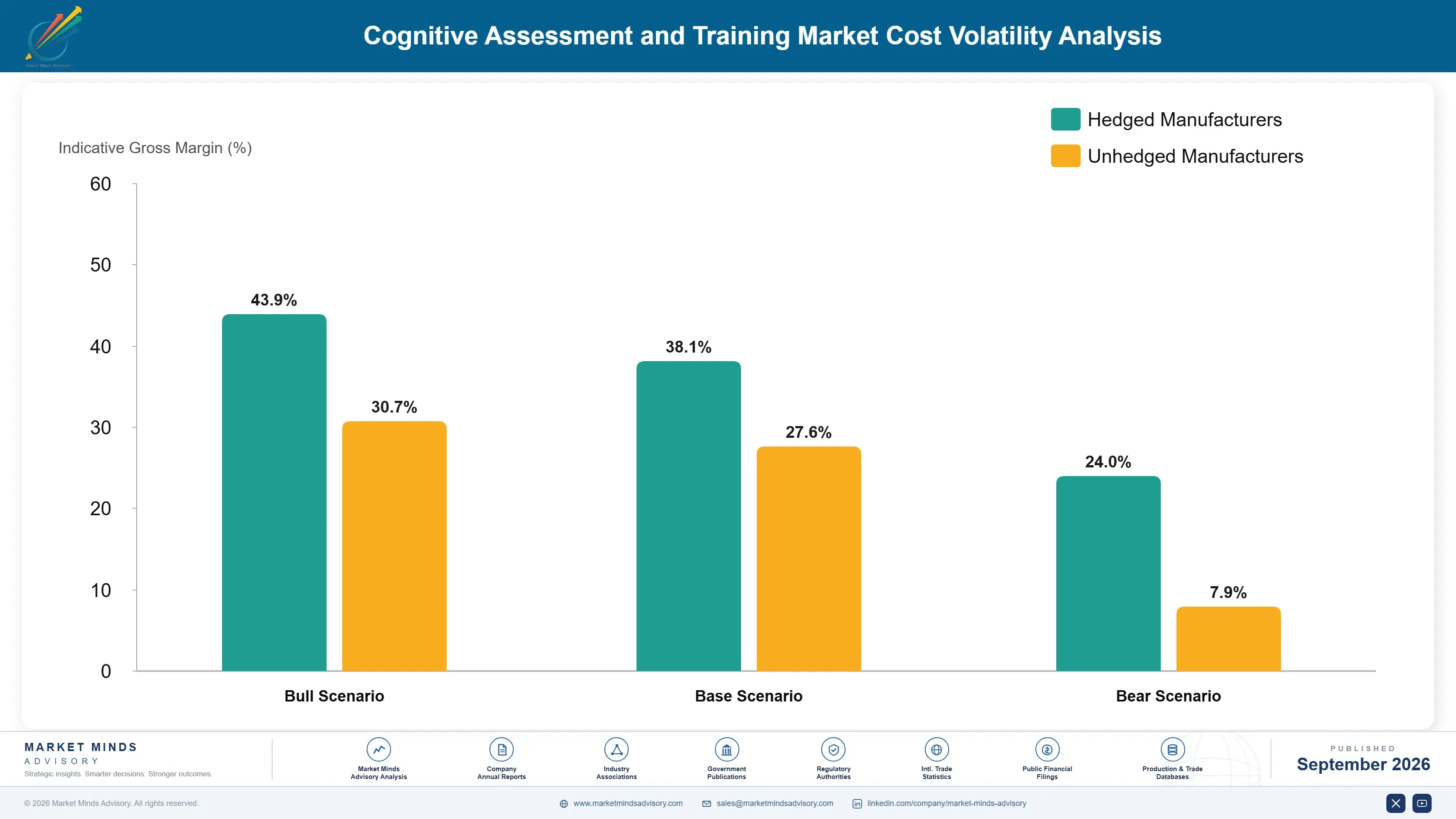
Clinical validation, including peer-reviewed research studies and regulatory submission preparation, accounts for roughly 29 percent of cognitive assessment vendor cost of goods sold, concentrated in academic medical center research partnerships across the United States, United Kingdom, and Australia specifically today. Cloud hosting and speech analysis compute costs add a further 12 to 16 percent overall.
Clinical trial cost volatility hit particularly hard starting in 2023, when broader demand for dementia-related clinical research surged alongside expanding pharmaceutical pipeline investment, pulling qualified research staff away from smaller assessment vendors toward better-funded pharmaceutical trial sponsors. Academic medical center partnership costs, documented in industry research funding surveys, cited intensified competition for clinical trial site capacity, and several assessment vendors disclosed validation cost increases as a margin pressure point through 2024 and 2025.

Larger, better-funded vendors with established academic research partnerships absorbed this cost pressure with far less disruption than smaller vendors competing purely on newer, less established relationships, a resilience gap that persists today across the competitive set. Exposure also varies by validation depth: vendors pursuing extensive multi-site clinical validation face materially higher research cost sensitivity than those relying on smaller, single-site studies with narrower regulatory and payer credibility.
cognitive-assessment-and-training-market-cost-volatility-analysis-1790007305879

Multi-Site Academic Partnership Cost Sharing

Larger vendors are structuring multi-site academic research partnerships that share validation study costs across multiple different institutions simultaneously in parallel across several countries and continents worldwide even today, reducing per-site expense while broadening the geographic diversity of evidence generated for regulatory and payer credibility purposes across the wider global market and its many jurisdictions.

Phased Validation Investment by Product Priority

Vendors are increasingly sequencing which products receive extensive multi-site validation first based on projected revenue return over a multi-year time horizon and strategic priority level for the business, deferring lower-priority product lines until validation costs decline or reimbursement pathways clarify further, preserving scarce research capital for the highest-return submissions currently available across the entire product portfolio.

Pharmaceutical Trial Sponsor Co-Funding Arrangements

Vendors are increasingly structuring co-funded research arrangements with pharmaceutical trial sponsors interested in using validated assessment tools as standardized clinical trial endpoints across multiple concurrent studies and ongoing programs, sharing validation costs with parties who benefit directly from the resulting clinical evidence generated for regulatory submissions and eventual market approvals across multiple therapeutic areas.

Portfolio Architecture for Margin Defence

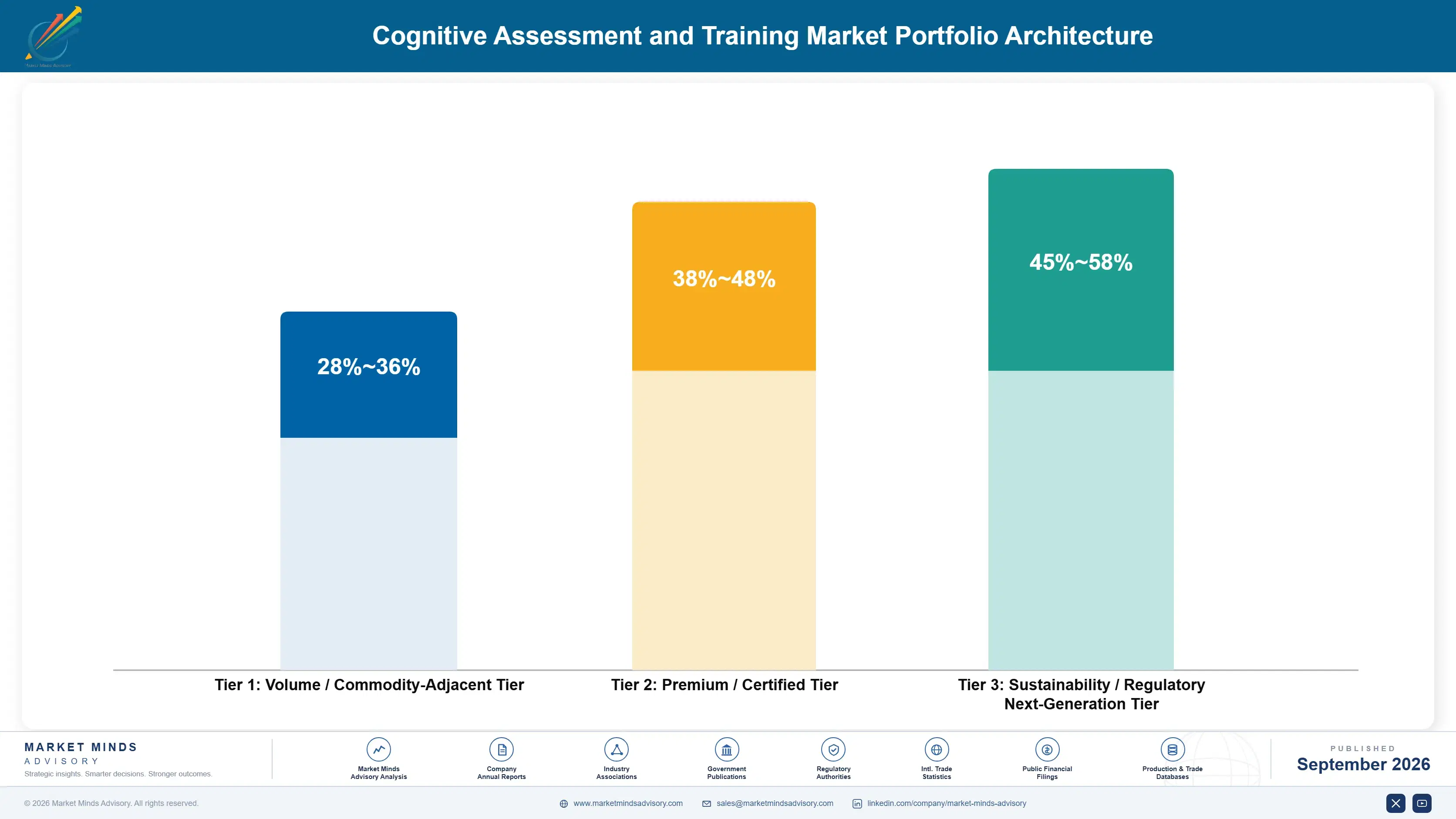
Margin architecture in cognitive assessment splits sharply along clinical validation depth. Basic screening questionnaires and unvalidated consumer tools hold gross margins around 28 to 36 percent as commodity competition keeps pricing tight. Clinically validated diagnostic devices and passive screening platforms hold materially higher margins, since documented sensitivity data and reimbursement credibility create real switching costs providers and payers cannot easily walk away from once integrated.
The volume versus premium tension runs through the entire vendor base: consumer-facing brain training apps scale on subscriber count but face relentless competition from free or low-cost alternatives, while clinically validated device vendors grow more slowly in account count but capture disproportionate revenue per provider relationship. High-value margin pools concentrate almost entirely in clinical validation and passive screening categories rather than basic consumer engagement tools, and that concentration is where the strongest vendors now direct new research investment.

Reimbursement-driven demand, particularly Medicare wellness visit mandates requiring documented cognitive screening, is opening a genuinely durable premium tier that smaller unvalidated vendors struggle to enter quickly, since building clinical validation credibility takes years of accumulated peer-reviewed evidence. Vendors positioned early in this category are compounding an advantage that slower-moving competitors will find increasingly hard to close.

Volume / Commodity-Adjacent Tier

Basic screening questionnaires and unvalidated consumer brain training apps competing on price and subscriber count against free digital alternatives, with limited differentiation and thin pricing power against commodity engagement tools.
Gross Margin: 28-36%

Premium / Certified Tier

Clinic-based standardized assessment tools carrying documented detection sensitivity evidence, where measurement credibility and reimbursement pathway clarity give established vendors durable pricing power over newer, unproven market entrants still building references.
Gross Margin: 38-48%

Sustainability / Regulatory / Next-Generation Tier

Passive speech and behavioral screening platforms tied to continuous digital monitoring and clinical trial endpoint licensing, the fastest-compounding and highest-margin tier as reimbursement frameworks continue expanding coverage steadily each year.
Gross Margin: 45-58%
cognitive-assessment-and-training-market-portfolio-architecture-1790007306386

High-value Sub-segments and Strategic Watch-out

At-Home Digital Cognitive Training Platforms

The highest-value, fastest-growing pool in the market, converting casual consumer engagement into sustained subscription relationships as broader awareness of cognitive health continues growing steadily among aging, health-conscious populations across most major markets this fairly comprehensive report tracks closely and covers in genuinely significant detail throughout.
Gross Margin: 45-58%

Passive Speech and Behavioral Screening

High-value and growing steadily as vendors expand screening reach beyond patients already engaged with the healthcare system, though building the clinical validation credibility required to compete takes real meaningful time for newer entrants to establish with increasingly skeptical clinical providers carefully evaluating all their options.
Gross Margin: 45-58%

Clinic-Based Standardized Assessment Tools

The volume core of the market, generating the bulk of reimbursed clinical deployments as the single most widely adopted category available today across the industry, but facing steady margin normalization as commodity competition intensifies across most primary care accounts renewing contracts each passing year nationwide.
Gross Margin: 38-48%

Pharmaceutical Biomarker Diagnostic Entrants

The clearest strategic watch-out for functional assessment vendors, as pharmaceutical companies developing disease-modifying dementia treatments increasingly favor biomarker-based diagnostic tools over functional cognitive assessment, narrowing the case for standalone assessment platforms in clinical trial contexts going forward over the coming several years ahead for most vendors.
Gross Margin: n/a

Why Cognitive Assessment Revenue Compounds

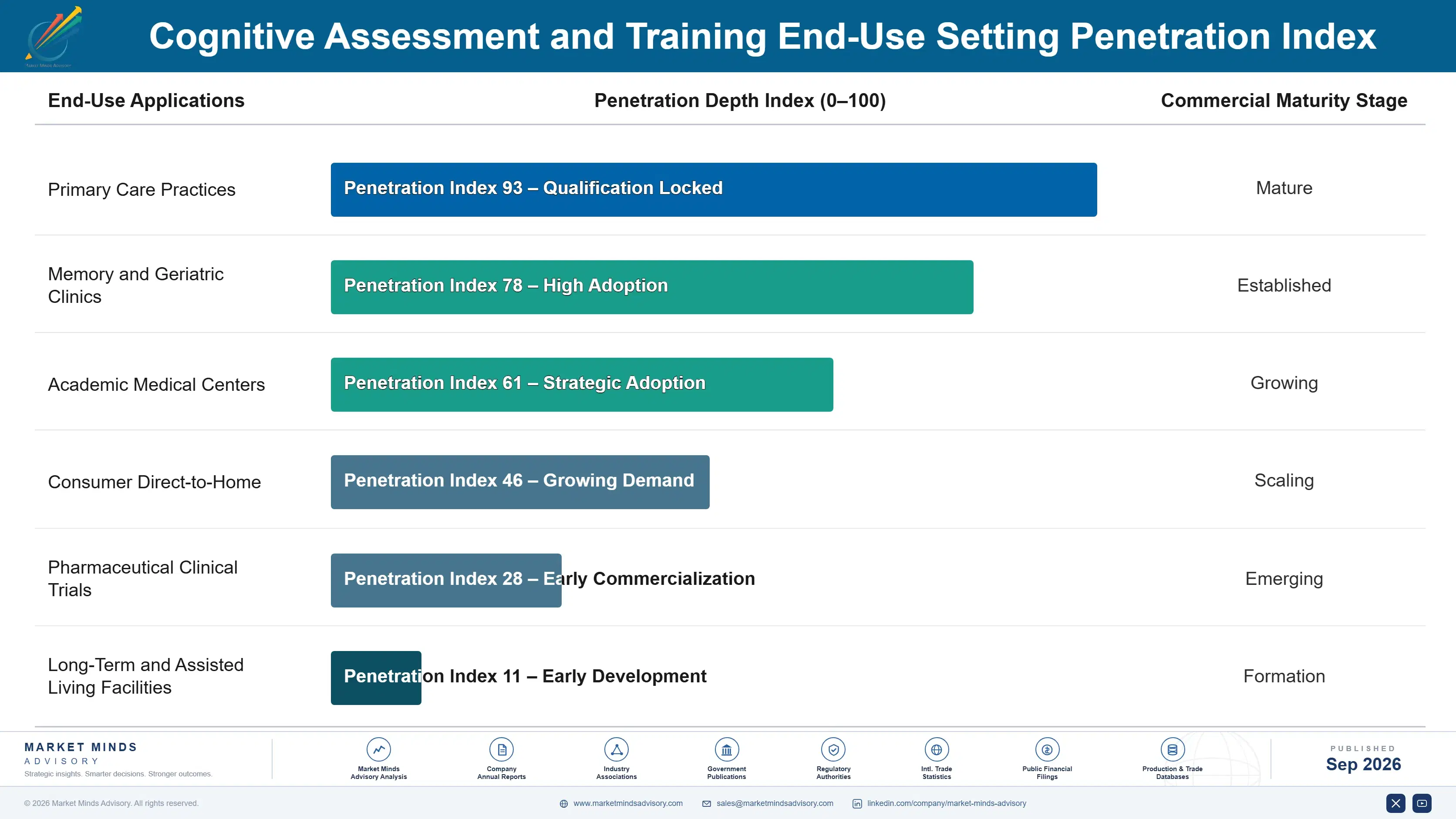
Cognitive assessment revenue increasingly behaves like an annuity business in its reimbursed clinical segments rather than a one-time screening event. Once a health system embeds a screening tool into Medicare wellness visit workflow and billing infrastructure, switching costs rise sharply, and renewal rates for enterprise clinical contracts now commonly exceed 80 percent, turning what used to be episodic testing into a durable, multi-year relationship.
Adoption depth varies significantly by end-use setting. Primary care practices show the deepest stickiness, since Medicare compliance documentation rarely gets redesigned once approved through internal workflow review. Pharmaceutical clinical trials run nearly as sticky, tied to standardized endpoint protocols locked in for a trial's full duration, while direct consumer subscribers remain more transactional and show comparatively less loyalty to any single brand.

Buyer profiles are shifting generationally as well. Younger physicians entering practice now expect digital cognitive screening as a baseline expectation rather than a novel feature, while procurement has moved from pure clinical judgment toward compliance and population health teams, who evaluate vendors on documented sensitivity rather than convenience alone. This buyer shift is steadily raising the evidentiary bar every vendor must clear.
cognitive-assessment-and-training-market-end-use-penetration-index-1790007306883

Where Cognitive Assessment Value Concentrates

These are among the four positions where our research anticipates prominent divergence between winners and laggards over the coming forecast period. Each is grounded in the demand model, the regulatory perimeter, and the announced capacity pipeline.
01 / CLINICAL VALIDATION INVESTMENT

Build peer-reviewed validation evidence before payers demand it universally

Payers increasingly require documented detection sensitivity data before approving coverage expansion, and vendors without this evidence are losing reimbursement negotiations to competitors who can show quantified proof rather than unverified accuracy claims in vendor presentations. Building credible clinical validation takes years of accumulated peer-reviewed research across multiple sites, meaning vendors that invest now hold a genuine head start over slower-moving competitors still relying on marketing claims alone. This capability is becoming the clearest differentiator separating premium vendors from unvalidated consumer tools.
02 / REIMBURSEMENT SUPPORT PRIORITY

Build reimbursement navigation capability ahead of provider expectations

Fragmented reimbursement pathways across payers and jurisdictions are extending provider procurement timelines considerably across most regulated markets, and vendors offering dedicated billing code guidance are closing deals meaningfully faster than competitors leaving this complexity entirely to the buyer's own administrative staff. This capability is becoming a genuine procurement expectation rather than a nice-to-have feature, meaning vendors without it risk losing accounts regardless of underlying clinical accuracy or detection sensitivity. Building this now, ahead of tightening payer requirements, positions vendors well ahead of slower competitors.
03 / PASSIVE SCREENING EXPANSION

Invest in passive screening capability to reach undiagnosed populations

Passive speech and behavioral screening reaches populations who would never proactively seek out or complete a formal cognitive test, expanding the addressable population well beyond patients already engaged with the healthcare system through traditional clinical channels. Vendors building this capability now are positioned to capture the fastest-growing segment of the market before competitors close the gap, since passive data collection also creates a stickier, more continuous customer relationship than periodic active testing alone. This capability is becoming a genuine competitive necessity rather than an optional enhancement.
04 / PHARMACEUTICAL PARTNERSHIP DEFENSE

Build clinical trial endpoint credibility before biomarker tools dominate

Pharmaceutical companies developing disease-modifying dementia treatments increasingly favor biomarker-based diagnostic tools over functional cognitive assessment, a genuine threat to standalone assessment vendors whose core value proposition depends on remaining relevant to clinical trial sponsors and drug developers. Vendors that establish themselves as standardized clinical trial endpoints now, while functional assessment still carries genuine scientific credibility, are best positioned to maintain pharmaceutical industry relevance as the diagnostic landscape continues evolving. Building this credibility early remains the clearest defense against biomarker displacement.

Engagement Snapshot From the Field

A live engagement with an industry participant carrying material or product regulatory and market exposure ahead of a defining policy shift, showing how our research translates into a defensible multi-year portfolio strategy.
MARKET MINDS ADVISORY · CLIENT ENGAGEMENT SUMMARY
Cognitive Assessment and Training Producer Strategic Portfolio Review and Transition Roadmap 2026·Investment Scenario on Cognitive Assessment and Training Exposure Evaluation 2025-26
CLIENT PROFILE
A regional primary care network operating 32 clinics across a multi-state territory engaged MMA to evaluate cognitive assessment vendors ahead of a system-wide Medicare wellness visit screening compliance initiative. The client had relied on inconsistent, clinic-specific screening practices and sought a standardized vendor solution to ensure documented compliance across its entire network of primary care facilities.
STRATEGIC CHALLENGE
Leadership needed to standardize cognitive screening across 32 clinics without disrupting existing primary care workflows already strained by administrative burden and limited appointment time available for each patient visit. A recent internal audit had flagged inconsistent wellness visit documentation as a genuine compliance risk requiring prompt remediation across the network.
MMA APPROACH
MMA benchmarked five candidate cognitive assessment vendors against a weighted scorecard covering documented detection sensitivity, reimbursement navigation support, clinical workflow integration time, and total cost of ownership over a five-year deployment horizon. The team conducted structured interviews with each vendor's clinical implementation staff and cross-referenced disclosed client references against MMA's primary survey dataset covering comparable primary care network deployments.
KEY FINDINGS
  1. The vendor offering the fastest test administration time ranked last once documented detection sensitivity and reimbursement support were fully factored into the final scoring methodology.
  2. Vendors with dedicated reimbursement navigation support cut projected compliance documentation errors by roughly forty percent compared with vendors offering no comparable support.
  3. Clinical workflow integration time varied significantly across candidate vendors, directly affecting physician acceptance and consistent usage across the network's 32 clinics nationwide.
  4. Vendors with passive screening capability proved more valuable for identifying patients who would not proactively report cognitive concerns during routine office visits.
CLIENT PROFILE
A regional primary care network operating 32 clinics across a multi-state territory engaged MMA to evaluate cognitive assessment vendors ahead of a system-wide Medicare wellness visit screening compliance initiative. The client had relied on inconsistent, clinic-specific screening practices and sought a standardized vendor solution to ensure documented compliance across its entire network of primary care facilities.
STRATEGIC CHALLENGE
Leadership needed to standardize cognitive screening across 32 clinics without disrupting existing primary care workflows already strained by administrative burden and limited appointment time available for each patient visit. A recent internal audit had flagged inconsistent wellness visit documentation as a genuine compliance risk requiring prompt remediation across the network.
MMA APPROACH
MMA benchmarked five candidate cognitive assessment vendors against a weighted scorecard covering documented detection sensitivity, reimbursement navigation support, clinical workflow integration time, and total cost of ownership over a five-year deployment horizon. The team conducted structured interviews with each vendor's clinical implementation staff and cross-referenced disclosed client references against MMA's primary survey dataset covering comparable primary care network deployments.
KEY FINDINGS
  1. The vendor offering the fastest test administration time ranked last once documented detection sensitivity and reimbursement support were fully factored into the final scoring methodology.
  2. Vendors with dedicated reimbursement navigation support cut projected compliance documentation errors by roughly forty percent compared with vendors offering no comparable support.
  3. Clinical workflow integration time varied significantly across candidate vendors, directly affecting physician acceptance and consistent usage across the network's 32 clinics nationwide.
  4. Vendors with passive screening capability proved more valuable for identifying patients who would not proactively report cognitive concerns during routine office visits.
RECOMMENDED STRATEGY
Phase 1: Phase one deployed the selected vendor's assessment tool across the ten highest-volume clinics and trained clinical staff within the first ninety days. Phase 2: Phase two extended deployment to the remaining twenty-two clinics over a five-month rollout window with dedicated vendor implementation support and training. Phase 3: Phase three completed compliance documentation standardization network-wide and established an ongoing quarterly screening rate performance review process for network leadership.
OUTCOME
The network reported a 34 percent increase in documented wellness visit screening compliance within the first year following deployment, alongside a 22 percent increase in early-stage cognitive impairment detection across enrolled patients (client-reported, unverified by MMA). Physician satisfaction with the standardized workflow improved measurably following the rollout.

Frequently Asked Questions

Foundational context covering the market sizes, CAGR, scope, country, region and competition that inform every finding below. This section is provided to cover basics and most often pre-purchase conversations, answered from the MMA Primary Research Dataset.

What is the current size of the Cognitive Assessment and Training Market?

The global cognitive assessment and training market reached 8.9 billion dollars in 2025. Growth is concentrated in at-home digital training rather than basic clinical questionnaires.

How large will the Cognitive Assessment and Training Market be by 2036?

MMA projects the market will reach 26.95 billion dollars by 2036, up from 9.84 billion dollars in 2026. That represents a 2.74 times expansion over the ten-year forecast window.

What is the CAGR for the Cognitive Assessment and Training Market 2026 to 2036?

The base case compound annual growth rate is 10.6 percent. MMA's bull scenario projects 11.9 percent, while the bear scenario projects 9.4 percent over the same forecast period.

Which segment is growing fastest?

At-Home Digital Cognitive Training Platforms is the fastest-growing segment at a 15.2 percent CAGR, roughly 1.43 times the overall market rate, driven by consumer subscription growth.

Who are the major companies in the Cognitive Assessment and Training Market?

Cognivue, Linus Health, Posit Science, Cambridge Cognition, and Cogstate lead the competitive landscape. The top five hold roughly 43 percent of global category revenue combined.

Which country is growing fastest?

Japan leads country-level growth at a 13.4 percent CAGR, helped by government-funded dementia prevention initiatives spanning most major municipalities and prefectures nationwide across the country.

Report Segmentation Architecture

The full report scope spans multiple orthogonal segmentation dimensions, with cross-tabulated demand data provided for each dimension pair. Coverage extends further to regional breakdowns, trend trajectories, and the competitive detail needed to support segment-level decision-making.

By Application

  • Clinic-Based Standardized Assessment
  • At-Home Digital Cognitive Training
  • Passive Speech and Behavioral Screening
  • Primary Care Point-of-Care Devices
  • Clinical Trial Endpoint Software

By End-Use Setting

  • Primary Care Practices
  • Memory and Geriatric Clinics
  • Academic Medical Centers
  • Consumer Direct-to-Home
  • Pharmaceutical Clinical Trials
  • Long-Term and Assisted Living Facilities

By Commercial Dimension

  • Reimbursed Clinical Billing
  • Direct Consumer Subscription
  • Health Plan Wellness Benefit
  • Pharmaceutical Licensing Agreement
  • Enterprise Health System Contract

By Region

  • North America
  • East Asia
  • Western Europe
  • South Asia and Pacific
  • Latin America
  • Middle East and Africa
  • Eastern Europe

Scope, Methodology, and Coverage

Every figure in this report is reproducible from documented input assumptions. The scope below maps the historical period, the forecast horizon, the segmentation dimensions, and the countries covered, alongside the underlying primary and qualitative methodology.
Historical Period
2020 to 2025
Forecast Period
2026 to 2036
Base Year
2025 (USD billions; MMA Primary Research Dataset, September 2026)
Market Definition
The cognitive assessment and training market covers software and connected devices used to screen for cognitive impairment and deliver structured cognitive training exercises, in both clinical and consumer settings. It excludes pharmaceutical dementia treatments, general brain health supplements without a software or device component, and neuroimaging equipment used for diagnostic purposes beyond cognitive screening.
Quantitative Units
USD Billion
Segmentation Dimensions
By Application, By End-Use Setting, By Commercial Dimension, By Region
Regions Covered
North America, East Asia, Western Europe, South Asia and Pacific, Latin America, Middle East and Africa, Eastern Europe
Countries Covered
United States, China, Japan, Germany, United Kingdom, India, South Korea, Brazil, Australia, Saudi Arabia
Key Companies Profiled
Cognivue Inc, Linus Health Inc, Posit Science Corporation, Cambridge Cognition Holdings plc, Cogstate Ltd, MedRhythms Inc, Neurotrack Technologies Inc, Constant Therapy Health Inc, Ceretype Neuromedicine Inc, Altoida Inc, SBT Retail Diagnostics Inc, Winterlight Labs Inc, Kernel Neuroscience Inc, Savonix Inc, Neumora Therapeutics Inc, Aptima Inc, Quest Diagnostics Incorporated, Labcorp Holdings Inc, Aural Analytics Inc, Boston Cognitive Assessment LLC
Quantitative Methodology
Primary survey, n=3,800 respondents, Q4 2025, six countries; demand-side model with trade association cross-validation
Qualitative Methodology
47 expert interviews, Q4 2025; applied to validate demand model assumptions, identify emerging dynamics, and assess competitive positioning
Report Format
PDF and XLSX data workbook (Word format preview document)
Publisher
Market Minds Advisory
Report Code
MMA-2026-HLT-812
Published
September 2026
Contact
sales@marketmindsadvisory.com | www.marketmindsadvisory.com

Purchase the full Cognitive Assessment and Training Market Report (2026 to 2036).

This report provides a comprehensive analysis of the global cognitive assessment and training market, covering historical performance from 2020 to 2025 and a detailed forecast through 2036. It examines segmentation by application, end-use setting, and commercial model, alongside regional demand dynamics across all seven MMA-tracked geographies. The analysis includes competitive benchmarking of twenty leading vendors, input cost exposure, portfolio margin architecture, and strategic recommendations grounded in primary survey data. Findings draw on MMA's proprietary quantitative survey and expert interview programs conducted in the fourth quarter of 2025.
Segment-level revenue forecasts through the year 2036
Competitive benchmarking of twenty leading market vendors
Regional demand analysis across all seven geographies
Input cost exposure and mitigation strategy review
Portfolio margin architecture and pricing tier analysis
Strategic verdict with actionable commercial recommendations included

Built For The People Who Decide

From boardroom strategy to bench-side execution, this report is read cover-to-cover by leaders shaping the next decade of their industry, turning demand scenarios, market dynamics and valuation benchmarks into decisions.
CXOs/ Presidents/ VPs/ Managers
M&A and Corporate Development
Strategy Teams and R&D Heads
Procurement and Product Directors
Regulatory and Compliance Leaders
Investor Relations and Equity Analysts