Market Minds Advisory
Coffee Brewers Market

Coffee Brewers Market: Coffee Brewers Market. Automation Redefines the Home Coffee Ritual

Bean-to-cup automation and cold brew specialization push coffee brewers past simple drip functionality, while smart connectivity and subscription capsule programs reshape how manufacturers capture recurring revenue long after the original appliance sale.

Lead Analyst

Published

September 2026

Make Smarter Decisions with Customized Research Insights

Request a free sample report and evaluate market opportunities, growth trends, and competitive dynamics relevant to your business needs.

2025 MARKET VALUE$12.4BMarket Size 2025
2036 FORECAST VALUE$24.0BBase Case , 2026 to 2036
CAGR 2026 TO 20366.2 %Bull 7.5% / Bear 4.9%
INCREMENTAL OPPORTUNITY$10.9BNet 10- year value creation
EXPANSION MULTIPLE1.82x2036 value over 2026 base
Strategic Levers
M&A Pipeline
Regional Outlook
Country Rankings
Competitive Intelligence
Segmental Deep-dive
Call-Us : 91 93563 13602

Executive Snapshot and Market Trajectory.

Home coffee brewing has moved decisively toward automation, as bean-to-cup machines and connected brewing systems increasingly replace manual pour-over and basic drip routines across most developed markets tracked closely worldwide, reshaping how households approach their daily coffee ritual and shaping purchase decisions across every major retail channel today.
Bean-to-cup and cold brew formats are pulling share away from traditional drip and pod machines, since buyers increasingly want cafe-quality output at home without daily manual grinding or disposable capsule waste piling up in landfills across most households. Growth concentrates most heavily in Western Europe and East Asia, where established espresso culture and premium appliance adoption reward automation over basic functionality sold cheaply at mass retail.
Competition remains concentrated among a handful of established appliance conglomerates that also control lucrative capsule and pod subscription revenue, giving incumbents a durable recurring income stream competitors cannot easily replicate at comparable scale or speed today across most regions. Sustainability pressure around single-use pod waste is reshaping product design toward reusable and recyclable capsule formats across nearly every major brand competing in the category currently and going forward. Retailers now merchandise premium lines separately.
Market Definition
The coffee brewers market covers drip, single-serve pod, espresso, bean-to-cup, and cold brew machines designed for home and light commercial use. It excludes commercial-grade cafe equipment sold exclusively to foodservice operators and standalone coffee grinders sold independent of a brewing system.
Base Year Value
$12.4B in 2025 (MMA Primary Research Dataset, September 2026)
Forecast Period
2026 to 2036, eleven discrete annual values
CAGR
6.2% base case. Bull 7.5%. Bear 4.9%.
Fastest Growth Segment
Automatic Bean-to-Cup Machines: 9.4% CAGR
Fastest Growth Country
Italy: 6.9% CAGR
Fastest Growth Region
South Asia and Pacific: 8.3% CAGR
Largest Region
Western Europe: 28% of 2025 global value
Market Leaders
De'Longhi, Nespresso (Nestle), Keurig Dr Pepper, Breville, Jura. Source: MMA Analysis based on company disclosures and primary research.
Primary Survey
n=3,800 procurement and R&D decision-makers, Q4 2025, six countries
Methodology
Demand-side build-up, cross-validated against public data, 47 expert interviews

Coffee Brewers Market Forecast Scenarios

coffee-brewers-market-size-forecast-scenario-1790024804302
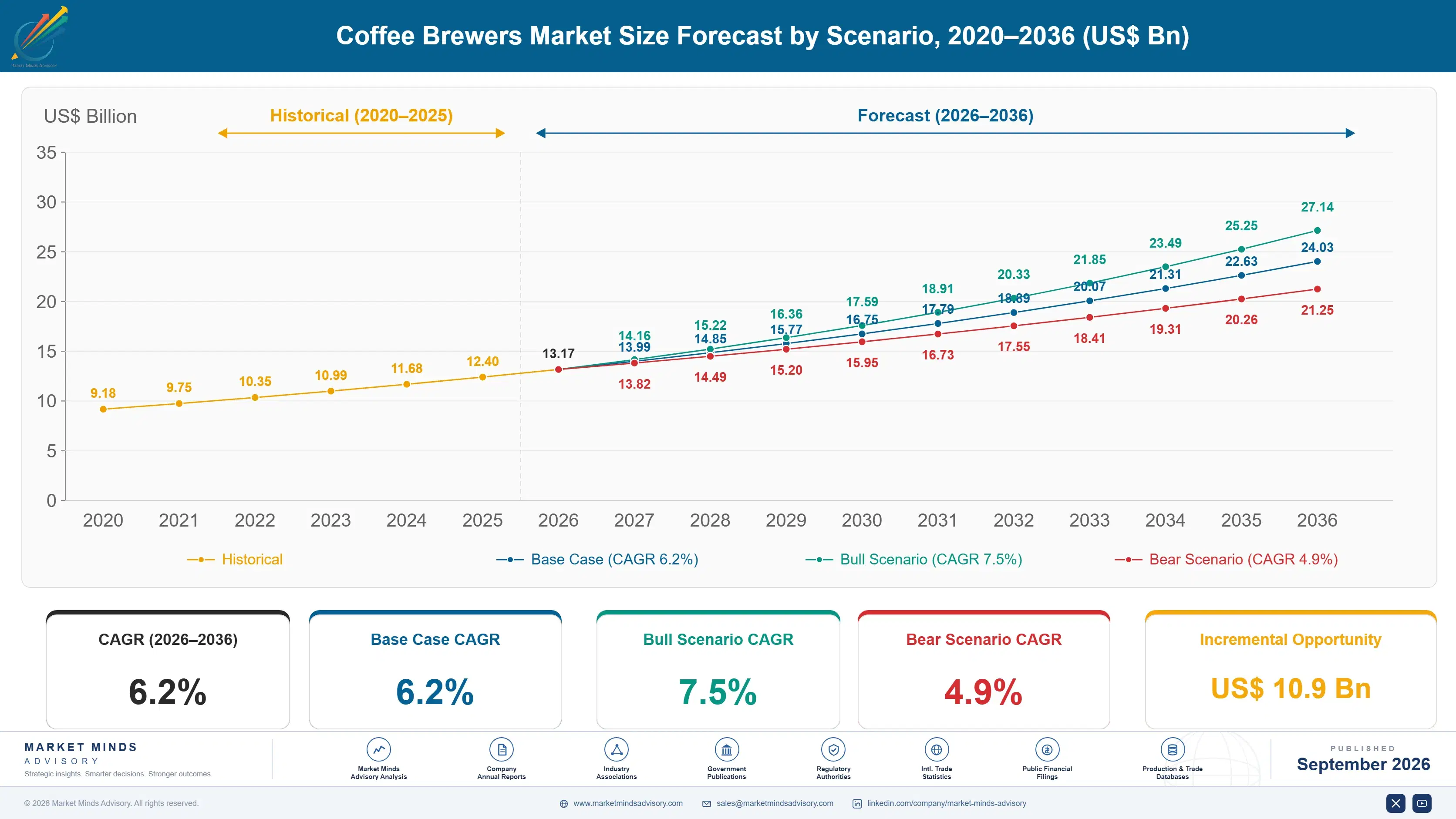
Between 2020 and 2025 the market grew steadily as pandemic-driven home coffee consumption accelerated purchases of premium machines, with bean-to-cup and pod brewer sales both outpacing prior trend for two consecutive years across most tracked markets. Growth cooled somewhat as cafe visits resumed post-pandemic, though it never fell back to pre-2020 levels across most developed economies.
The base case assumes continued premiumization toward bean-to-cup and connected machines, expanding cold brew and specialty format adoption among younger buyers entering the category for the first time, and sustained capsule subscription revenue that keeps incumbents invested in proprietary format development and continuous machine improvement. These three mechanisms together sustain growth even as basic drip machine penetration approaches saturation across most developed markets where households already own some brewing appliance purchased years earlier.
A stronger bull case hinges on smart home integration accelerating connected brewer adoption considerably faster than premiumization alone would justify across most developed markets. The bear risk is a capsule format backlash driven by sustainability regulation, which would force costly reusable pod redesign and disrupt the subscription revenue model incumbents depend on most heavily for long-run profitability.

Automation Turns the Machine Into the Product

Coffee brewing sits at the intersection of appliance manufacturing and recurring consumable revenue, an arrangement that rewards manufacturers who control proprietary capsule formats far more than those competing purely on machine hardware specifications alone. Buyers now treat brewer selection partly as a long-term commitment to a capsule format, reshaping how retailers merchandise the category and how manufacturers price the initial machine sale itself relative to future consumable revenue.
MARKET CONCENTRATIONCR5 42%reflects consolidated ownership across capsule and machine formats
AVERAGE SELLING PRICE$118blends entry drip units with premium bean-to-cup systems
TOP PRODUCING COUNTRY SHAREChina 46%captures the dominant manufacturing base for global brewers
CAPACITY UTILIZATION78%indicates limited headroom across contract manufacturing facilities today
CAPSULE ATTACH REVENUE SHARE34%shows how much category revenue comes from recurring pods
REPLACEMENT CYCLE LENGTH5 yearscaptures how long buyers typically keep a brewer before replacing
Manufacturing remains heavily concentrated in China for entry and mid-tier machines, while premium bean-to-cup and built-in systems retain meaningful production in Italy, Switzerland, and Germany, where precision engineering commands a premium that buyers are willing to pay for durability and consistent output. Capsule production has increasingly localized closer to end markets to reduce shipping costs on high-volume, low-margin consumable goods sold at scale.
Replacement demand now rivals first-time purchase as a growth driver, since buyers who bought a basic drip machine years ago increasingly upgrade to bean-to-cup or connected alternatives during kitchen refreshes and broader home renovation projects. This replacement cycle gives established brands a second monetization opportunity per household well beyond the initial appliance purchase or move-in decision made years earlier after settling into a new home.
"The machine is basically a customer acquisition device for capsule revenue now. Whoever controls the pod format controls the household for the next five years, not whoever sells the cheapest brewer."
Senior Analyst, Consumer Appliances Practice · MMA Consumer Products Practice · September 2026

Market Trends

Bean-to-Cup Automation Becomes the New Premium Standard

Buyers increasingly reject manual dosing and separate grinders in favor of integrated bean-to-cup machines that grind, tamp, and brew in a single automated sequence, eliminating the daily friction that kept many households defaulting to capsules or drip machines instead. Manufacturers report bean-to-cup models now command meaningfully higher average selling prices than five years ago, as precision grinding and milk frothing automation move from a professional cafe feature into a mainstream home appliance expectation. This shift is pulling premium share away from basic drip machines and pod systems, forcing legacy manufacturers to accelerate roadmaps or risk losing share.
Market Impact: cafe substitution drives 39% share

Reusable Capsule Formats Respond to Sustainability Regulation

Regulatory pressure and consumer sentiment around single-use pod waste have pushed manufacturers to introduce reusable and recyclable capsule formats, reversing a design trend that prioritized convenience over material efficiency for over a decade. Several major capsule brands have launched aluminum recycling programs and compostable pod lines within the past two years specifically to counter regulatory scrutiny in the European Union, where extended producer responsibility rules increasingly apply to packaging waste generated by household appliances. This shift is reshaping capsule manufacturing economics considerably, since recyclable materials often cost more per unit than the plastic and aluminum blends they replace.
Market Impact: lifts connected brewer demand by 24%

Market Opportunities and Growth Drivers

Home Coffee Culture Sustains Premium Machine Upgrade Demand

Households that grew accustomed to daily home coffee brewing during recent years continue investing in better equipment even as cafe visits have partially recovered, since the habit of brewing at home has become embedded in daily routines for a meaningful share of the population overall. Buyers increasingly view a premium brewer as a reasonable substitute for regular cafe spending, justifying the higher upfront cost against years of avoided daily purchases. This behavioral shift has proven durable rather than temporary, sustaining premium machine demand well beyond the initial pandemic-driven purchasing surge seen earlier.
Market Impact: compatibility complaints affect 17% of buyers

Smart Home Integration Rewards Connected Brewing Systems

Buyers furnishing smart-home-enabled kitchens increasingly expect their coffee brewer to integrate with voice assistants and scheduling apps, treating connectivity as a baseline expectation for premium appliances rather than a novelty feature reserved for early adopters. Manufacturers offering app-controlled brewing and consumption tracking report stronger customer retention and higher replacement part attach rates than manufacturers selling standalone, non-connected machines at comparable price points. This trend particularly benefits established appliance brands with existing smart home platform relationships over smaller specialty brewer makers lacking comparable software investment and engineering resources. These capabilities also generate valuable usage data for manufacturers.
Market Impact: hard-water service calls run 31% higher

Market Restraints and Challenges

Capsule Format Lock-In Draws Regulatory and Consumer Backlash

Proprietary capsule formats that force buyers into a single manufacturer's pod format increasingly draw regulatory scrutiny and consumer resentment, particularly as sustainability expectations rise around single-use packaging waste generated by billions of pods annually. The root cause is a business model built around recurring consumable margin that depends on limiting third-party compatibility, which buyers increasingly recognize as working against their own interests once cheaper compatible pods become unavailable. Manufacturers are countering with limited compatibility licensing programs and recyclable capsule redesigns that preserve some consumable margin while reducing regulatory and reputational exposure.
Market Impact: bean-to-cup ASPs up 28%

Water Quality Variation Complicates Consistent Brew Performance

Regional water hardness and mineral content vary considerably, meaning a machine calibrated for one market's water profile can underperform or scale up faster in another, undermining the consistent cafe-quality output premium brewers promise buyers. This friction particularly affects bean-to-cup machines with fine internal components sensitive to mineral buildup, generating higher service costs and buyer dissatisfaction in hard-water regions. Manufacturers are responding with built-in water filtration systems and descaling reminders calibrated to regional water profiles, reducing service calls considerably in markets with historically poor machine longevity. Warranty claims cluster heavily in regions with limestone-heavy municipal supply.
Market Impact: recyclable pods now 22% of volume
3 additional market trends, 4 additional growth drivers, and 2 additional restraints and challenges are covered in the full report. Contact sales@marketmindsadvisory.com to access the complete intelligence.

Segment CAGR and Growth Architecture

The market segments by brewing technology rather than by price tier or brand, since how a machine extracts coffee from grounds determines its capsule dependency, service requirements, and target buyer entirely. Six brewing technologies together capture the full addressable scope of home coffee brewing sold globally across every major region and income tier today.
coffee-brewers-market-market-share-analysis-1790024804897

Automatic Bean-to-Cup Machines

Automatic bean-to-cup machines integrate grinding, dosing, tamping, and brewing into a single automated sequence, eliminating the manual steps that previously separated home brewing from cafe-quality output entirely for most households across income levels. This segment is growing fastest as buyers increasingly value the convenience of fresh-ground coffee without daily manual effort, particularly among households that previously relied on capsule machines for convenience alone rather than flavor or freshness. Premium manufacturers have led this segment's expansion, integrating milk frothing and recipe customization that let buyers replicate specialty cafe drinks at home, a capability basic drip and pod machines cannot match at any comparable price point. Retailers increasingly stock these machines near premium appliance displays to reinforce positioning.
CAGR 9.4%

Cold Brew and Specialty Brewers

Cold brew and specialty brewers serve buyers seeking iced and cold coffee formats that traditional hot-brew machines cannot replicate properly, appealing strongly to younger buyers whose coffee consumption skews increasingly toward cold formats year-round rather than seasonally as it once did decades ago. This segment benefits from broader ready-to-drink cold coffee trends that have normalized cold coffee consumption well beyond summer months into a daily habit for many households across multiple regions and income levels. Growth concentrates among younger urban buyers in North America and East Asia, where cold coffee culture has become considerably more mainstream than in traditional hot-coffee-dominant European markets. Retail merchandising increasingly separates cold brew systems from traditional hot brewing equipment.
CAGR 8.6%
Full segment breakdown across 6 segments available in the complete report.

Regional Architecture and Country Demand Map

Western Europe leads on the strength of deep-rooted espresso culture and premium built-in machine manufacturing heritage, narrowly ahead of East Asia, while South Asia and Pacific posts the fastest regional growth from a smaller base as urban cafe-substitution habits expand across major cities nationwide today.

North America

North America holds the second largest regional share, driven by strong cafe-substitution habits and the deepest capsule subscription penetration anywhere in the world, led by established brands with decades of retail distribution across the United States and Canada. American buyers show particularly strong appetite for connected and app-controlled machines, since smart home adoption runs considerably higher here than in most other regions tracked. Canadian demand mirrors the United States closely, tracking similar premiumization trends, retail distribution patterns, and capsule subscription behavior across comparable household income levels. Direct-to-consumer capsule subscription programs continue expanding across both markets steadily each year. Retailers across the region continue expanding premium appliance shelf space and capsule subscription bundling to reflect this sustained demand shift toward automation.
Share: 26% | CAGR: 6.7% (2026 to 2036)

Western Europe

Western Europe holds the largest regional share, anchored by deep-rooted espresso culture in Italy and premium built-in machine manufacturing heritage concentrated in Switzerland and Germany, where Jura and Miele lead global engineering standards. Italian buyers treat a quality espresso machine as an essential household appliance rather than an optional luxury, sustaining strong per-capita ownership across generations and household types. German and Swiss buyers favor precision-engineered bean-to-cup systems reflecting cultural values around durable, long-lasting appliances built to last decades. French demand tracks closely behind, reflecting comparable espresso culture and premium retail infrastructure. Share here exceeds the standard band since Italian, Swiss, and German premium manufacturing heritage concentrates outsized global category value.
Share: 28% | CAGR: 4.9% (2026 to 2036)
Regional intelligence for 5 additional markets available in the complete report: East Asia, South Asia and Pacific, Latin America, Middle East and Africa, Eastern Europe. Contact sales@marketmindsadvisory.com.
coffee-brewers-market-country-cagr-analysis-1790024805441

Where Recurring Capsule Revenue Concentrates

Capsule and pod subscription margins differ sharply from machine hardware margins, which face constant price pressure from private-label and generic alternatives. Manufacturers capture disproportionate returns from proprietary capsule formats, direct subscription channels, and premium bean-to-cup positioning rather than from the initial machine sale, which increasingly functions as an entry point into a longer consumable relationship.

Proprietary Capsule Format Subscription Programs Overall

Manufacturers controlling a proprietary capsule format capture recurring revenue that dwarfs the initial machine sale over a typical five-year ownership period, since buyers locked into a specific format cannot easily switch brands without discarding a functioning machine. Brands with formal subscription programs report subscriber lifetime capsule spend 47% higher than non-subscriber buyers purchasing pods ad hoc through retail, since automatic replenishment removes the friction of running out and switching to a competitor's format out of convenience. This recurring revenue stream justifies selling machines near cost to maximize capsule format adoption.
Market Impact: lifts subscriber lifetime capsule spend by 47% overall

Direct-to-Consumer Capsule Replenishment Sales Channel Program

Capsule replenishment sold through owned e-commerce and app-based reordering carries considerably higher margin than the same capsules sold through retail channels that demand meaningful listing fees and shelf placement discounts from suppliers. Brands operating direct replenishment programs report gross margins near 61% on capsule sales, well above the blended margin achieved through big-box retail distribution agreements negotiated annually. This channel also generates valuable consumption data that manufacturers use to time targeted upsell offers for premium capsule variants and adjacent flavor lines. Loyal subscribers rarely churn once automated reordering is configured correctly.
Market Impact: captures gross margins near 61% via direct sales

Premium Bean-to-Cup Tier With Service Contracts

Premium bean-to-cup machines bundled with extended service and descaling contracts command meaningfully higher average order value than machines sold standalone, since buyers value the assurance that a considerably more mechanically complex appliance will be maintained professionally over its lifetime. This bundled configuration lifts average order value by 36% compared to an unbundled machine sale, while also creating a recurring service revenue stream beyond the initial purchase. Retailers favor these bundles too, since they reduce warranty claim volume and improve customer satisfaction scores considerably. This service revenue stream also improves customer lifetime value considerably.
Market Impact: lifts average order value by 36% for bundles

Smart Connectivity Upsell for Consumption Insights

App-connected machines that track brewing habits and consumable usage create a natural upsell opportunity for manufacturers to recommend premium capsule variants and flavor lines based on observed consumption patterns, deepening the commercial relationship well beyond the initial purchase decision. Brands with connected consumption tracking report 31% higher premium variant attach rates than brands without app-based recommendation capability, since personalized suggestions convert considerably better than generic marketing. This capability also improves customer retention, since buyers who engage with the app rarely switch brands entirely. Manufacturers view this data asset as increasingly strategic over time.
Market Impact: lifts premium variant attach rates by 31% total

Who Controls the Margin Pool

Ranked by global unit shipments including both machines and capsule volume, the market shows meaningful concentration with a CR5 near 42%. De'Longhi holds a clear lead built on broad distribution across drip, pod, and bean-to-cup categories that few competitors match in breadth. Nespresso trails closely given its dominant capsule subscription business, while the gap to Keurig Dr Pepper and Breville stays narrow enough that rank changes look plausible.
Current competitive activity centers on bean-to-cup automation and connected brewing features rather than basic drip functionality, since most established brands already offer comparable entry-tier machines at similar price points. Several manufacturers have launched reusable and recyclable capsule formats within the past two years specifically to counter sustainability regulation and consumer sentiment, while others pursue app-based subscription platforms to deepen recurring capsule revenue relationships.

Emerging pressure comes from smaller specialty roasters and cold brew equipment makers that skip legacy capsule dependency entirely, designing narrower but more differentiated product lines around specific brewing methods. These challengers cannot match incumbent capsule subscription economics, but they are shifting where mid-tier rankings sit within five years, particularly as younger buyers increasingly favor brewing methods perceived as more sustainable than proprietary pod formats.
coffee-brewers-market-company-positioning-matrix-1790024805954

Competitive Moat and Risk Dimensions

DE'LONGHI

Moat: Broad Category Portfolio Coverage

De'Longhi's presence across drip, pod, espresso, and bean-to-cup categories gives it shelf presence and consumer trust that specialist competitors focused on a single format struggle to match quickly. Its ownership of the Braun household appliance license further extends reach into budget-conscious buyers, creating a portfolio breadth few competitors can replicate across the full price spectrum.
DE'LONGHI

Risk: Limited Proprietary Capsule Format

Unlike Nespresso or Keurig, De'Longhi lacks a dominant proprietary capsule format generating comparable recurring subscription revenue, leaving it more dependent on machine hardware margin alone. Building a comparable capsule subscription business from its current position would require years of format adoption that established capsule leaders have already secured across most developed markets.
NESPRESSO (NESTLE)

Moat: Dominant Capsule Subscription Economics

Nespresso's proprietary capsule format and boutique retail experience generate recurring subscription revenue that dwarfs its machine hardware sales, creating a durable income stream competitors without comparable format lock-in cannot replicate. Its boutique retail concept also reinforces premium brand positioning that pure appliance manufacturers struggle to match through conventional retail channels alone.
NESPRESSO (NESTLE)

Risk: Rising Reusable Capsule Substitution Risk

Third-party reusable capsule inserts compatible with Nespresso machines increasingly erode proprietary capsule volume, particularly among sustainability-conscious buyers seeking to reduce single-use pod waste without abandoning their existing machine. This substitution risk directly threatens the recurring subscription economics that justify Nespresso's premium machine pricing strategy in the first place.

Players Tracked

Prominent Players

De'Longhi
Nespresso (Nestle)
Keurig Dr Pepper
Breville
Jura

Other Key Players

Philips (Versuni)
Melitta
Miele
Cuisinart (Conair)
Hamilton Beach
Mr. Coffee (Newell Brands)
Technivorm (Moccamaster)
Bunn
Smeg
Panasonic
Xiaomi
Bialetti
Krups (Groupe SEB)
Ninja (SharkNinja)
Zojirushi

Recent Developments

MAY 2025

De'Longhi Launches Reusable Capsule Compatibility Line

De'Longhi launched a reusable capsule line compatible across its pod machine range, directly responding to sustainability regulation and consumer sentiment against single-use pod waste generated annually. The launch included recycling collection partnerships and marketing content aimed at converting existing single-use capsule buyers toward the reusable alternative.
Signal: Shows a legacy incumbent fast-following sustainability pressure that regulators and consumer sentiment are driving across the industry.
NOVEMBER 2024

Nespresso Opens Expanded Subscription Loyalty Program

Nespresso expanded its subscription loyalty program across key markets, offering tiered rewards and personalized capsule recommendations based on consumption data collected through its app and boutique retail visits. The program aims to deepen recurring revenue per subscriber while reducing churn to third-party compatible capsule sellers undercutting official pricing.
Signal: Signals capsule subscription loyalty programs becoming a standard retention strategy across leading proprietary format manufacturers today.
MARCH 2026

Breville Enters Cold Brew Component Supply Agreement

Breville entered a supply agreement with a specialty cold brew component manufacturer to accelerate development of its cold brew and specialty product line, aiming to capture share in the fastest-growing segment of the broader category. The agreement covers component sourcing rather than equity investment, limiting balance sheet exposure considerably.
Signal: Indicates mid-tier challengers pursuing cold brew differentiation through outside supplier partnership rather than costly in-house development.

Steel, Aluminum, and Capsule Cost Exposure

Stainless steel boilers and aluminum capsule stock together make up the largest cost category, typically 31% to 35% of cost of goods sold, sourced from European and Asian metal fabrication suppliers depending on machine tier. Electronic components for connected machines add a growing cost share as smart features expand across mid-tier lines. Plastic housings draw on polymer resin pricing tied to petrochemical benchmarks.
Aluminum prices rose considerably during 2024 amid supply tightness reported by the IEA's critical minerals market review, pushing capsule production costs up for manufacturers without hedged long-term aluminum contracts. Nestle's annual report cited elevated packaging input costs as a factor affecting beverage systems segment margins during the period, forcing several capsule producers to pass part of the increase through to retail pricing later that year.

Smaller manufacturers without scale purchasing agreements face a distinct competitive disadvantage here, since they cannot lock in multi-year aluminum and steel contracts the way large diversified appliance conglomerates can through broader purchasing volume. This exposure compounds regionally too, since capsule producers sourcing aluminum in Europe face different currency dynamics than those relying on Asian fabrication, widening the cost gap between scaled and boutique competitors.
coffee-brewers-market-cost-volatility-analysis-1790024806150

Multi-Year Aluminum Supply Contracts

Larger manufacturers increasingly lock in multi-year aluminum supply contracts with fixed or collared pricing, insulating capsule production margins from short-term commodity price spikes that smaller competitors must absorb directly into retail pricing decisions each cycle. This approach requires meaningful working capital commitment upfront but protects pricing stability across successive planning cycles and budget periods.

Regional Capsule Manufacturing Localization

Manufacturers are localizing capsule production closer to end markets across North America and East Asia, reducing shipping costs and the single-region tariff exposure that has hurt margins across recent years of trade disruption and shipping volatility. This localization adds upfront facility investment cost but shortens recovery time considerably following any single-region supply disruption or shipping delay.

Portfolio Architecture for Margin Defence

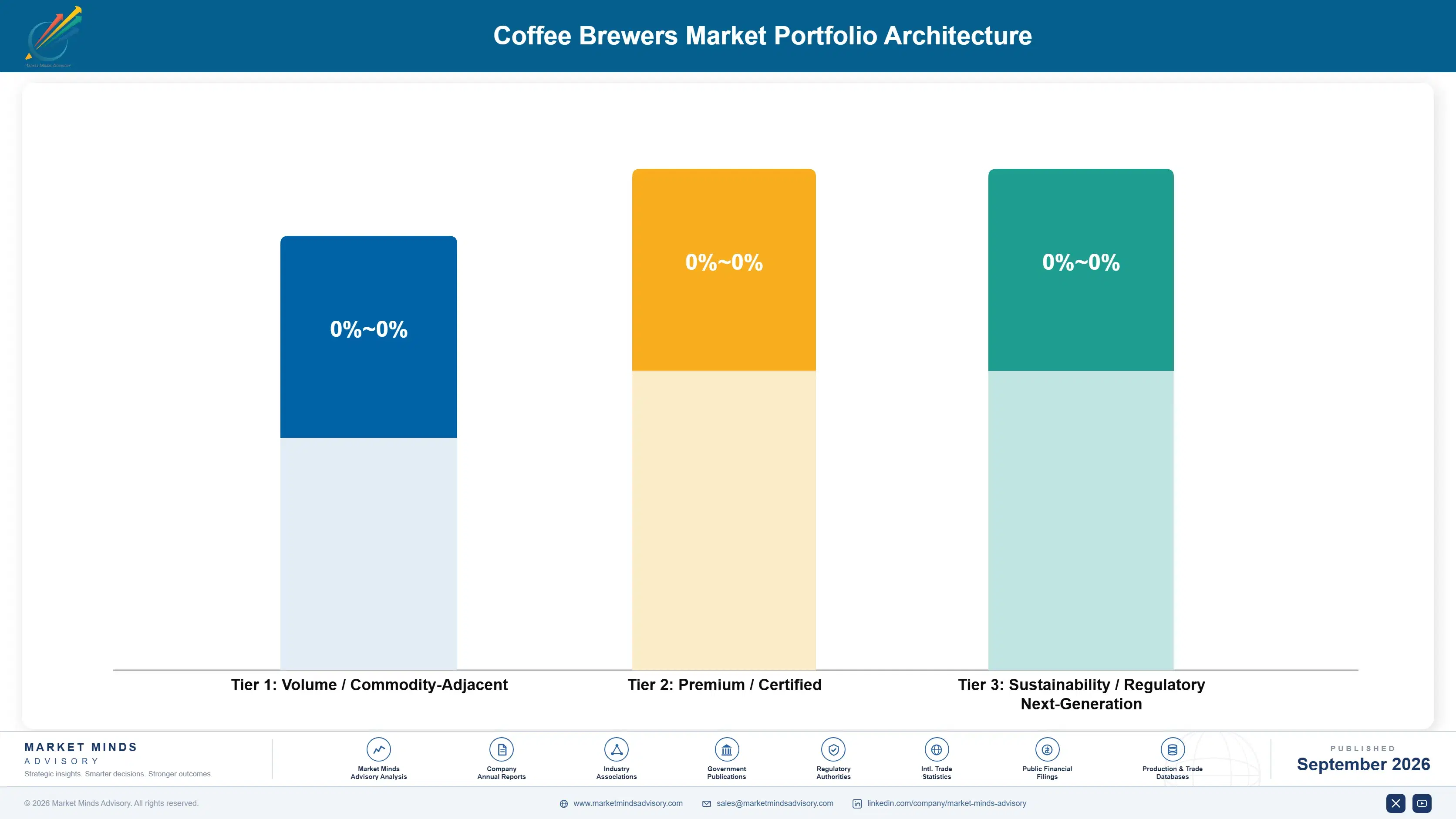
Gross margin architecture splits sharply by tier, with volume-tier drip and pod machines carrying thin margin after mass retail promotion, while premium bean-to-cup systems and proprietary capsule subscriptions carry considerably richer economics that manufacturers increasingly prioritize. This gap drives most manufacturer strategy today, since the entry-level machine increasingly functions as a capsule format acquisition vehicle rather than a meaningful profit center in itself.
The tension between volume and premium tiers plays out most visibly in retail promotional calendars, where basic pod machines get discounted heavily or given away entirely to lock buyers into a proprietary capsule format that recurring subscription revenue later monetizes. Manufacturers accept near-zero or negative machine margin deliberately, treating it as a customer acquisition cost against years of capsule revenue that follows.

High-value margin pools concentrate overwhelmingly in proprietary capsules, service contracts, and direct-to-consumer subscription channels that bypass retail intermediary fees entirely, capturing a larger share of each dollar spent. Sustainability positioning around reusable capsules and recycled materials remains a smaller but growing pool, as buyers increasingly weight environmental claims when choosing between otherwise similar premium brewer lines. Direct-to-consumer subscription programs increasingly anchor long-term brand loyalty across every tier.

Volume / Commodity-Adjacent

Entry-level drip and pod machines sold through mass retail channels nationwide and through big-box chains with minimal automation, competing primarily on price rather than capsule format or brewing precision differentiation from competing brands.
Gross Margin: 12% to 20%

Premium / Certified

Established brands offering bean-to-cup automation, connected app control, and recognized brand heritage built over decades that supports higher retail pricing and recurring capsule subscription revenue over time and across product generations.
Gross Margin: 38% to 48%

Sustainability / Regulatory / Next-Generation

Reusable and recyclable capsule formats paired with energy-efficient brewing technology and recyclable housing materials, appealing to buyers who weight environmental claims heavily alongside traditional automation and everyday convenience considerations carefully.
Gross Margin: 35% to 45%
coffee-brewers-market-portfolio-architecture-1790024806656

High-value Sub-segments and Strategic Watch-out

Automatic Bean-to-Cup Machines

The fastest-growing and highest-value segment, driven by cafe-substitution habits and rising automation demand among design-conscious urban buyers furnishing new kitchens for the first time. Manufacturers are racing to expand grinding precision and milk frothing capability to sustain adoption momentum. Retailers stock these machines near premium displays.
Gross Margin: MMA Estimate, July 2026.

Cold Brew and Specialty Brewers

A high-value category with strong growth among younger buyers favoring cold coffee formats year-round rather than seasonally as before, reflecting shifting consumption habits across generations. Ready-to-drink cold coffee trends influence broader home brewing purchase decisions across most regions. Retail merchandising separates cold brew from hot equipment.
Gross Margin: MMA Estimate, July 2026.

Single-Serve Pod and Capsule Brewers

The volume core of the market, generating steady replacement and recurring capsule revenue as machines wear out or buyers upgrade within the same proprietary format over successive purchase cycles and years of household ownership, brewing habits, and use. Retailers rarely promote this segment heavily since margins run considerably thinner.
Gross Margin: MMA Estimate, July 2026.

Third-Party Compatible Capsule Manufacturers

A strategic watch-out as third-party manufacturers produce cheaper compatible capsules for proprietary formats at considerably lower prices nationwide, threatening the recurring subscription margin incumbent brands depend on most heavily for sustained long-term growth. Incumbents are exploring encrypted capsule authentication chips to slow this ongoing substitution trend.
Gross Margin: MMA Estimate, July 2026.

Why Capsule Buyers Rarely Switch

Coffee brewer purchases function as an annuity for manufacturers controlling a proprietary capsule format, since a household that adopts a specific machine statistically continues purchasing that brand's capsules for years, generating recurring revenue that dwarfs the initial machine sale. This pattern makes the machine sale the start of a long-term revenue relationship rather than a single transaction, fundamentally changing how manufacturers should value each new household acquired at the point of purchase.
Adoption stickiness varies meaningfully by end-use vertical. Serious home coffee enthusiasts who invested in a bean-to-cup system show the deepest engagement, often purchasing specialty beans and maintenance accessories for years after the initial purchase. Casual buyers who bought a basic pod machine mainly for convenience show shallower engagement, frequently switching brands entirely once a competitor offers cheaper compatible capsules or a discounted new machine.

Generational buyer shifts are reshaping the category too. Younger buyers discover specialty brewing content through short-form video before they even own a machine, often building brand preference around sustainability credentials rather than pure convenience or price. This rewards brands with strong social media content and transparent capsule sourcing over legacy manufacturers relying solely on in-store retail merchandising and price promotion.
coffee-brewers-market-end-use-penetration-index-1790024807146

The MMA Strategic Read

These are among the four positions where our research anticipates prominent divergence between winners and laggards over the coming forecast period. Each is grounded in the demand model, the regulatory perimeter, and the announced capacity pipeline.
01 / BEAN-TO-CUP INVESTMENT PRIORITY

Prioritize bean-to-cup automation over incremental pod format defense

Manufacturers still investing primarily in pod format defense are fighting to protect a segment growing meaningfully slower than bean-to-cup automation, which increasingly defines premium purchase decisions across most developed markets worldwide today. Bean-to-cup machines command considerably higher average selling prices and generate service revenue that pod machines rarely capture at comparable scale or consistency over a typical ownership period. Brands that redirect meaningful R&D spend from pod format iteration toward bean-to-cup precision engineering should capture disproportionate premium share over the next decade.
02 / SUBSCRIPTION CHANNEL BUILD

Build direct subscription channels before third-party capsules erode margin

Third-party compatible capsules increasingly erode proprietary format volume, particularly among sustainability-conscious buyers seeking cheaper or reusable alternatives to official pods sold through conventional retail channels nationwide and increasingly online too. Brands still relying on retail capsule sales without a direct subscription channel are more exposed to this substitution than brands with strong app-based reordering relationships already in place today. The window to build defensible subscription loyalty before third-party sellers capture considerably more share is narrowing steadily across most developed markets worldwide.
03 / ALUMINUM SOURCING STRATEGY

Diversify aluminum sourcing before the next commodity price spike

Aluminum cost exposure hits smaller capsule producers considerably harder than scaled incumbents with existing multi-year purchasing agreements already locked in at favorable negotiated rates well ahead of any price spikes each purchasing cycle. Waiting for the next spike to begin supplier diversification guarantees margin compression precisely when competitors with hedged contracts gain relative pricing room to invest in capsule format defense instead of expansion. Acting now, while sourcing conditions remain relatively stable, costs considerably less than acting reactively once prices move again.
04 / SUSTAINABILITY POSITIONING SHIFT

Redirect capsule design investment toward reusable and recyclable formats

Regulatory pressure and consumer sentiment around single-use pod waste are moving faster than many manufacturers have adjusted their capsule design roadmaps, creating meaningful reputational exposure for brands still reliant entirely on non-recyclable formats sold at considerable scale nationwide. Brands that redirect capsule design investment toward reusable and recyclable formats now can capture sustainability-conscious buyers before competitors close the credibility gap already opening in the market today. Delaying this shift risks ceding an increasingly vocal buyer segment entirely to smaller, purpose-built challengers.

Engagement Snapshot From the Field

A live engagement with an industry participant carrying material or product regulatory and market exposure ahead of a defining policy shift, showing how our research translates into a defensible multi-year portfolio strategy.
MARKET MINDS ADVISORY · CLIENT ENGAGEMENT SUMMARY
Coffee Brewers Producer Strategic Portfolio Review and Transition Roadmap 2026·Investment Scenario on Coffee Brewers Exposure Evaluation 2025-26
CLIENT PROFILE
The client is a mid-tier coffee appliance manufacturer with established retail distribution across North America, competing against larger incumbents with dominant proprietary capsule subscription businesses. The company had built solid brand recognition around drip and basic pod machines but lacked a bean-to-cup product line, limiting its ability to capture the premium revenue that leading competitors monetized effectively across their growing installed customer base.
STRATEGIC CHALLENGE
Leadership needed to decide whether to develop an in-house bean-to-cup platform or acquire existing grinding and brewing technology, while competitors continued expanding premium catalog depth faster than the client could match internally. The board questioned whether bean-to-cup expansion or capsule subscription entry would generate stronger near-term returns given comparable capital investment.
MMA APPROACH
MMA conducted primary research across the client's existing customer base alongside competitor bean-to-cup benchmarking, quantifying premium price willingness and service contract attach rates by product category. The engagement combined survey data with expert interviews among appliance retail buyers to identify which premium categories carried the strongest combination of growth and defensible differentiation.
KEY FINDINGS
  1. Buyers who tried a competitor's bean-to-cup machine reported meaningfully higher satisfaction than those using basic drip or pod machines every single day.
  2. Service contract attach rates for bean-to-cup machines ran considerably higher than for basic drip machines across every benchmarked competitor examined (client-reported, unverified by MMA).
  3. Capsule subscription entry carried a considerably longer payback period than bean-to-cup expansion given the client's limited existing proprietary format infrastructure and expertise.
  4. International market entry showed considerably longer payback periods than domestic bean-to-cup expansion given the client's existing brand recognition and distribution investment already in place.
CLIENT PROFILE
The client is a mid-tier coffee appliance manufacturer with established retail distribution across North America, competing against larger incumbents with dominant proprietary capsule subscription businesses. The company had built solid brand recognition around drip and basic pod machines but lacked a bean-to-cup product line, limiting its ability to capture the premium revenue that leading competitors monetized effectively across their growing installed customer base.
STRATEGIC CHALLENGE
Leadership needed to decide whether to develop an in-house bean-to-cup platform or acquire existing grinding and brewing technology, while competitors continued expanding premium catalog depth faster than the client could match internally. The board questioned whether bean-to-cup expansion or capsule subscription entry would generate stronger near-term returns given comparable capital investment.
MMA APPROACH
MMA conducted primary research across the client's existing customer base alongside competitor bean-to-cup benchmarking, quantifying premium price willingness and service contract attach rates by product category. The engagement combined survey data with expert interviews among appliance retail buyers to identify which premium categories carried the strongest combination of growth and defensible differentiation.
KEY FINDINGS
  1. Buyers who tried a competitor's bean-to-cup machine reported meaningfully higher satisfaction than those using basic drip or pod machines every single day.
  2. Service contract attach rates for bean-to-cup machines ran considerably higher than for basic drip machines across every benchmarked competitor examined (client-reported, unverified by MMA).
  3. Capsule subscription entry carried a considerably longer payback period than bean-to-cup expansion given the client's limited existing proprietary format infrastructure and expertise.
  4. International market entry showed considerably longer payback periods than domestic bean-to-cup expansion given the client's existing brand recognition and distribution investment already in place.
RECOMMENDED STRATEGY
Phase 1: Phase one developed an in-house bean-to-cup platform, targeting a launch within fourteen months to capture near-term premium customer demand quickly. Phase 2: Phase two built a formal service contract program bundled with every new bean-to-cup machine, generating recurring maintenance revenue almost immediately. Phase 3: Phase three expanded grinding and milk frothing precision once initial bean-to-cup adoption proved its expected return on the investment made.
OUTCOME
Within eighteen months of the bean-to-cup launch, the client reported a 34% increase in average selling price and meaningfully improved customer satisfaction scores across its core North American market (client-reported, unverified by MMA). The service contract program captured a growing share of recurring maintenance revenue previously ceded entirely to third-party repair providers.

Frequently Asked Questions

Foundational context covering the market sizes, CAGR, scope, country, region and competition that inform every finding below. This section is provided to cover basics and most often pre-purchase conversations, answered from the MMA Primary Research Dataset.

What is the current size of the Coffee Brewers Market?

The global coffee brewers market reached approximately 12.4 billion dollars in 2025. Growth is driven by rising bean-to-cup automation and sustained cafe-substitution habits among households.

How large will the Coffee Brewers Market be by 2036?

The market is projected to reach approximately 24.03 billion dollars by 2036. This reflects sustained bean-to-cup automation and steady capsule subscription revenue across established regional markets.

What is the CAGR for the Coffee Brewers Market 2026 to 2036?

The market is forecast to grow at a 6.2% compound annual growth rate between 2026 and 2036. Automatic bean-to-cup machines are expected to grow considerably faster than this average.

Which segment is growing fastest?

Automatic bean-to-cup machines are the fastest-growing segment, expanding at roughly 9.4% annually. That is well above the overall market's projected growth rate through the 2036 forecast horizon.

Who are the major companies in the Coffee Brewers Market?

Leading companies in this market include De'Longhi, Nespresso, owned by Nestle, and Keurig Dr Pepper, alongside Breville and Jura. These five brands together hold a CR5 near 42%.

Which country is growing fastest?

Italy is the fastest-growing major national market, expanding at approximately 6.9% annually. Deep-rooted espresso culture and premium machine manufacturing heritage continue driving strong domestic adoption nationwide.

Report Segmentation Architecture

The full report scope spans multiple orthogonal segmentation dimensions, with cross-tabulated demand data provided for each dimension pair. Coverage extends further to regional breakdowns, trend trajectories, and the competitive detail needed to support segment-level decision-making.

By Brewing Technology

  • Automatic Bean-to-Cup Machines
  • Cold Brew and Specialty Brewers
  • Single-Serve Pod and Capsule Brewers
  • Espresso and Semi-Automatic Machines
  • Drip and Filter Coffee Makers
  • Percolators and Stovetop Brewers

By End-Use Setting

  • Residential Home Kitchens
  • Office and Workplace Break Rooms
  • Hospitality and Foodservice Operators
  • Rental and Multi-Family Housing
  • Small-Batch Cafe and Specialty Outlets

By Commercial Dimension

  • Retail Channel Sales
  • Direct-to-Consumer E-Commerce
  • Capsule Subscription Programs
  • Private-Label Retail Sales

By Region

  • North America
  • Western Europe
  • East Asia
  • South Asia and Pacific
  • Latin America
  • Middle East and Africa
  • Eastern Europe

Scope, Methodology, and Coverage

Every figure in this report is reproducible from documented input assumptions. The scope below maps the historical period, the forecast horizon, the segmentation dimensions, and the countries covered, alongside the underlying primary and qualitative methodology.
Historical Period
2020 to 2025
Forecast Period
2026 to 2036
Base Year
2025 (USD billions; MMA Primary Research Dataset, September 2026)
Market Definition
The coffee brewers market covers drip, single-serve pod, espresso, bean-to-cup, and cold brew machines designed for home and light commercial use. It excludes commercial-grade cafe equipment sold exclusively to foodservice operators and standalone coffee grinders sold independent of a brewing system.
Quantitative Units
USD billions (current prices); unit shipment volume where applicable
Segmentation Dimensions
By Brewing Technology; By End-Use Setting; By Commercial Dimension; By Region
Regions Covered
North America, Western Europe, East Asia, South Asia and Pacific, Latin America, Middle East and Africa, Eastern Europe
Countries Covered
USA, China, Germany, France, UK, Japan, South Korea, India, Australia, Canada, Brazil, Mexico, Indonesia, Vietnam, Thailand, Malaysia, UAE, Saudi Arabia, South Africa, Nigeria, Turkey, Poland, Netherlands, Italy, Spain, Sweden, Switzerland, Argentina, Colombia, Singapore, and additional markets relevant to this sector
Key Companies Profiled
De'Longhi, Nespresso (Nestle), Keurig Dr Pepper, Breville, Jura, Philips (Versuni), Melitta, Miele, Cuisinart (Conair), Hamilton Beach, Mr. Coffee (Newell Brands), Technivorm (Moccamaster), Bunn, Smeg, Panasonic, Xiaomi, Bialetti, Krups (Groupe SEB), Ninja (SharkNinja), Zojirushi
Quantitative Methodology
Primary survey, n=3,800 respondents, Q4 2025, six countries; demand-side model with trade association cross-validation
Qualitative Methodology
47 expert interviews, Q4 2025; applied to validate demand model assumptions, identify emerging dynamics, and assess competitive positioning
Report Format
PDF and XLSX data workbook (Word format preview document)
Publisher
Market Minds Advisory
Report Code
MMA-2026-CON-117
Published
September 2026
Contact
sales@marketmindsadvisory.com | www.marketmindsadvisory.com

Purchase the full Coffee Brewers Market Report (2026 to 2036).

This report delivers a complete quantitative and qualitative assessment of the global coffee brewers market through 2036, built on primary survey and expert interview data. It covers segmentation by brewing technology, end-use setting, and commercial dimension, alongside detailed regional analysis across all seven world regions. Competitive profiling covers twenty companies spanning established appliance conglomerates and emerging specialty brewer challengers competing for capsule format leadership. The report also includes base, bull, and bear forecast scenarios, input cost exposure analysis, and strategic recommendations for portfolio tier positioning and revenue lever prioritization.
Ten-year market sizing and forecast to 2036
Six-category brewing technology and format segmentation
Full seven-region demand and growth breakdown
Twenty-company competitive profiling and market positioning
Input cost exposure and mitigation strategy review
Strategic revenue lever and portfolio tier analysis

Built For The People Who Decide

From boardroom strategy to bench-side execution, this report is read cover-to-cover by leaders shaping the next decade of their industry, turning demand scenarios, market dynamics and valuation benchmarks into decisions.
CXOs/ Presidents/ VPs/ Managers
M&A and Corporate Development
Strategy Teams and R&D Heads
Procurement and Product Directors
Regulatory and Compliance Leaders
Investor Relations and Equity Analysts