Market Minds Advisory
Codeless Payment Platform Market

Codeless Payment Platform Market: Codeless Payment Platform Market. No-Code Checkout Tools Expand Merchant Access

Small and mid-market merchants lacking dedicated engineering teams are adopting drag-and-drop payment integration platforms that embed checkout capability into websites and apps without writing custom code, expanding digital commerce access nationwide.

Lead Analyst

Published

September 2026

Make Smarter Decisions with Customized Research Insights

Request a free sample report and evaluate market opportunities, growth trends, and competitive dynamics relevant to your business needs.

2025 MARKET VALUE$1.6BMarket Size 2025
2036 FORECAST VALUE$9.4BBase Case , 2026 to 2036
CAGR 2026 TO 203617.5 %Bull 18.8% / Bear 16.2%
INCREMENTAL OPPORTUNITY$7.5BNet 10- year value creation
EXPANSION MULTIPLE5.02x2036 value over 2026 base
Strategic Levers
M&A Pipeline
Regional Outlook
Country Rankings
Competitive Intelligence
Segmental Deep-dive
Call-Us : 91 93563 13602

Executive Snapshot and Market Trajectory.

Small merchants without dedicated engineering resources are adopting drag-and-drop payment platforms that embed checkout capability into websites and apps without requiring custom development work across every sales channel and customer touchpoint they operate nationwide, abroad, and increasingly across mobile commerce, social selling, and every relevant marketplace channel used daily.
Embedded payment widgets for e-commerce are growing fastest as small business owners demand plug-and-play checkout components comparable to what larger competitors build with dedicated engineering teams and technical staff resources of their own accord entirely, reliably, consistently, and predictably across the board. Subscription commerce and marketplace platforms drive the largest share of current adoption given their recurring billing complexity and need for flexible payment method support without ongoing developer maintenance costs or investment.
Competitive intensity is rising as established payment processors compete against no-code platform specialists offering simpler integration than traditional API-based payment gateways require of merchant technical teams and available resources internally today across many firms and industries. Regulatory compliance requirements around payment card data security are shaping which platforms can credibly serve merchants lacking dedicated security and compliance staff internally across their organization and vendor relationships.
Market Definition
This market covers no-code and low-code software platforms that let merchants integrate payment processing capability into websites and applications without custom development work. It excludes traditional API-based payment gateways requiring developer implementation and point-of-sale hardware terminals sold without embedded software integration tools.
Base Year Value
$1.6B in 2025 (MMA Primary Research Dataset, September 2026)
Forecast Period
2026 to 2036, eleven discrete annual values
CAGR
17.5% base case. Bull 18.8%. Bear 16.2%.
Fastest Growth Segment
Embedded Payment Widgets for E-Commerce: 23.0% CAGR
Fastest Growth Country
India: 21.5% CAGR
Fastest Growth Region
South Asia and Pacific: 19.5% CAGR
Largest Region
North America: 32% of 2025 global value
Market Leaders
Stripe, PayPal, Square, Wix Payments, Shopify Payments
Primary Survey
n=3,800 procurement and R&D decision-makers, Q4 2025, six countries
Methodology
Demand-side build-up, cross-validated against public data, 47 expert interviews

Codeless Payment Platform Market Forecast Scenarios

codeless-payment-platform-market-size-forecast-scenario-1788502869995
Between 2020 and 2025 codeless payment platforms grew rapidly as small business e-commerce adoption accelerated and merchants sought checkout solutions without hiring dedicated development staff across every sales channel and market, with embedded widget adoption accelerating meaningfully after 2023 as platform reliability matured enough to handle production payment volume across every merchant category and sales channel nationwide.
The base case assumes continued small business e-commerce adoption driving demand for no-code checkout solutions across every merchant size, industry vertical, and every geographic market, sustained subscription commerce and marketplace platform growth requiring flexible recurring billing capability, and expanding merchant demand for compliance-ready payment integration without dedicated technical staff, three commercial mechanisms reinforcing rapid growth across the entire forecast window through 2036 across every major merchant category and sales channel.
The bull case centers on generative AI dramatically simplifying payment integration configuration, accelerating adoption faster than currently modeled across the smallest merchant segments nationwide and even abroad. The bear risk is established payment processors bundling basic no-code capability into core platform offerings, undercutting standalone vendor pricing power and delaying the premium tier revenue growth vendors have already forecasted internally.

No-Code Checkout Expands Merchant Digital Access

Codeless payment platforms are democratizing digital commerce access for small merchants who previously could not afford custom development work to accept online payments reliably across every sales channel, geography, customer segment, price tier, and industry. Drag-and-drop integration tools now let a merchant launch checkout capability within hours rather than the weeks traditional API integration historically required, expanding the addressable merchant base considerably nationwide.
AVERAGE SETUP TIME2.5 hoursTypical time to launch checkout capability from initial signup
EMBEDDED WIDGET REVENUE SHARE44%Portion of total revenue drawn from embedded checkout widgets
SMALL MERCHANT ADOPTION RATE58%Share of small business merchants using no-code payment tools
AVERAGE TRANSACTION FEE2.9%Typical blended processing fee charged across leading platform vendors
SUBSCRIPTION COMMERCE REVENUE SHARE34%Portion of category revenue drawn from recurring billing merchants
PLATFORM RENEWAL RATE82%Annual merchant subscription renewal rate averaged across the industry
Subscription commerce and marketplace platforms drive disproportionate demand given their recurring billing complexity and need for flexible payment method support that basic one-time checkout tools cannot handle reliably at meaningful scale, volume, velocity, or complexity. These merchants increasingly evaluate platforms on billing flexibility rather than raw transaction processing speed alone, reshaping vendor competitive positioning across the entire category and buyer segment.
Regulatory compliance requirements around payment card data security remain a persistent barrier for smaller platform vendors lacking dedicated compliance resources, pushing merchants toward established providers with proven security track records built over many years, budgets, and multiple audits. This compliance burden increasingly separates credible platform vendors from smaller competitors facing genuine security certification challenges and ongoing maintenance costs across their operations.
"A small business owner should never need to hire an engineer just to accept a credit card online. That barrier is basically gone now, and the merchants who figured that out first are the ones growing fastest."
Head of Payments Technology Practice · MMA No-Code Payment Integration and Checkout Software Practice · September 2026

Market Trends

Embedded Checkout Widgets Displace Custom Integration

Merchants are increasingly abandoning custom-coded payment integration in favor of pre-built embedded checkout widgets that can be added to any website or app through simple drag-and-drop configuration rather than developer implementation. This shift reflects genuine merchant frustration with the cost and delay of custom development work that historically required weeks of specialized engineering effort. Embedded widgets now represent roughly 44 percent of total category revenue, up considerably from a much smaller share just a few years earlier as platform reliability matured enough to handle production payment volume across every merchant category and sales channel nationwide.
Market Impact: Reaches 34% subscription commerce revenue share
Small Business Adoption Accelerates Beyond Early Adopters

Small business adoption of no-code payment tools has moved beyond early technology-forward adopters into mainstream small business usage as platform reliability and merchant support quality have matured considerably over recent years. This broadening adoption base reflects genuine confidence that no-code platforms can handle production payment volume reliably without the technical expertise custom integration historically demanded from merchants. Roughly 58 percent of small business merchants now use no-code payment tools for at least one sales channel, a figure that has climbed steadily as platform capability expanded to cover increasingly sophisticated merchant use cases spanning subscription billing and marketplace payment splitting.
Market Impact: Cuts setup time to 2.5 hours

Market Opportunities and Growth Drivers

Subscription Commerce Growth Demands Flexible Billing

Subscription commerce and marketplace platforms increasingly demand payment infrastructure capable of handling recurring billing cycles, split payments, and flexible payment method support that basic one-time checkout tools cannot deliver reliably at scale. This complexity gap has pushed subscription-focused merchants toward specialized no-code platforms built specifically for recurring revenue business models rather than generic payment processing. Subscription commerce merchants now account for roughly 34 percent of total category revenue, reflecting genuine demand for billing flexibility that generic payment gateways struggle to match without significant custom development investment from merchants lacking dedicated engineering resources.
Market Impact: Adds 25% compliance cost overall

Rapid Deployment Speed Drives Merchant Preference

Merchants increasingly prioritize deployment speed when selecting payment integration solutions, given competitive pressure to launch new sales channels and product lines quickly without waiting for lengthy custom development cycles that traditional integration historically required. This speed advantage has become a genuine competitive differentiator among no-code platforms competing for the same small business merchant accounts across every industry vertical. Average setup time for launching checkout capability now stands at roughly 2.5 hours from initial signup, a dramatic improvement over the weeks traditional API integration required before platforms matured enough to support rapid, reliable deployment.
Market Impact: Limits margin growth to 3 points

Market Restraints and Challenges

Compliance Certification Costs Constrain Smaller Vendors

Payment card industry data security standard certification requires substantial ongoing compliance investment that smaller platform vendors struggle to fund while remaining price-competitive against established providers with dedicated compliance departments. The root cause traces to the genuinely complex, continuously evolving nature of payment security standards that require specialized expertise to maintain compliant infrastructure over time. Commercial impact shows up as roughly 25 percent higher operating costs for smaller vendors pursuing certification independently rather than through third-party compliance partnerships. Vendors mitigate this by partnering with established payment processors handling compliance infrastructure on their behalf.
Market Impact: Reaches 44% embedded widget revenue share

Transaction Fee Pressure Squeezes Vendor Margins

Intense price competition among no-code payment platforms has compressed average transaction fees to roughly 2.9 percent, limiting vendor margin expansion despite genuine feature differentiation across competing platforms serving comparable merchant segments. The root cause is commodity perception among price-sensitive small merchants who struggle to distinguish meaningful feature differences between competing platform offerings during initial vendor evaluation. Commercial impact limits vendor gross margin expansion to roughly 3 percentage points annually across the category broadly. Vendors mitigate this by introducing tiered pricing structures charging premium rates for advanced features beyond basic checkout functionality.
Market Impact: Reaches 58% small merchant adoption rate
3 additional market trends, 4 additional growth drivers, and 3 additional restraints and challenges are covered in the full report. Contact sales@marketmindsadvisory.com to access the complete intelligence.

Segment CAGR and Growth Architecture

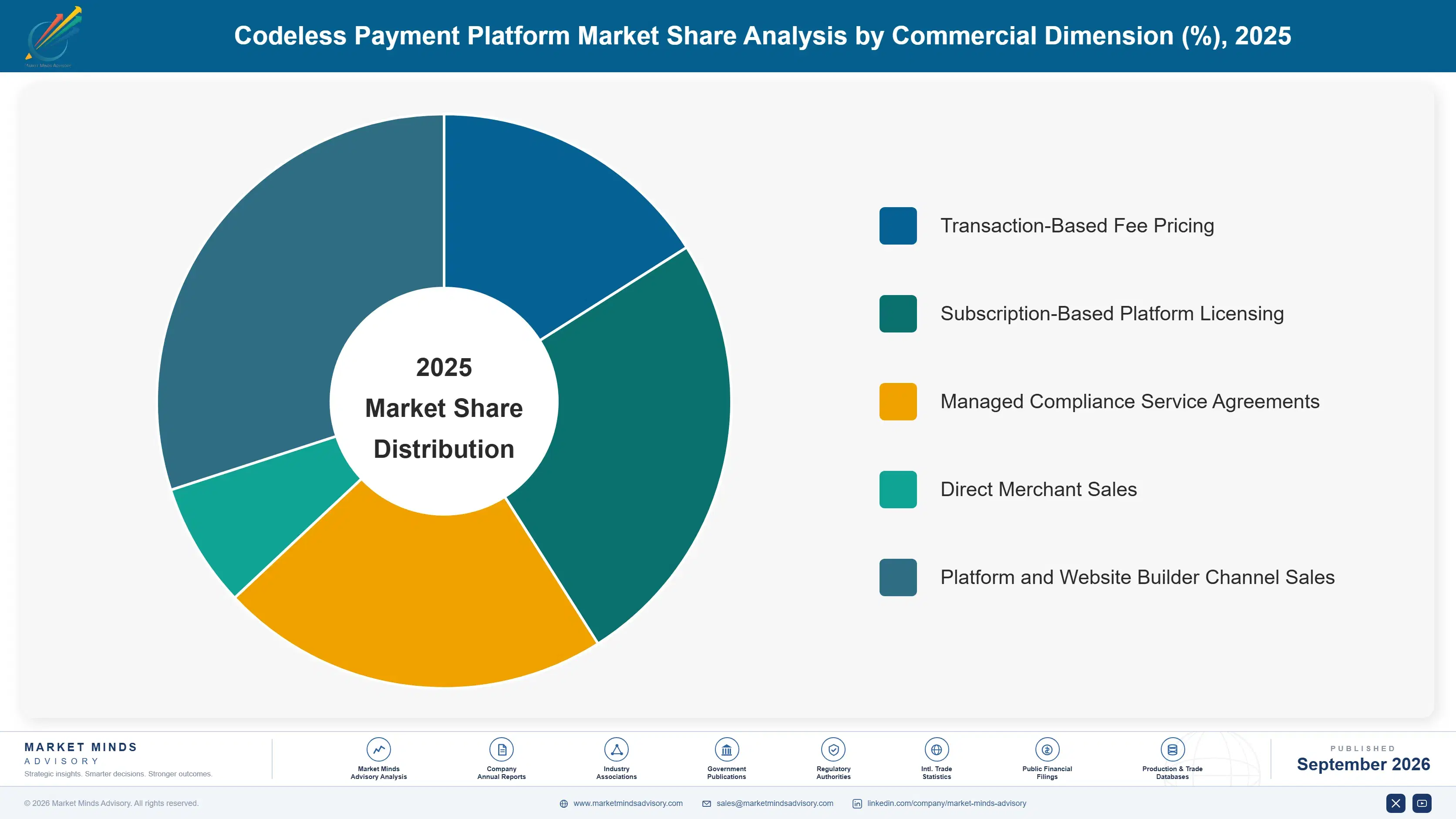
The market breaks into six product-type categories spanning embedded payment widgets, payment link and invoice tools, subscription and recurring billing platforms, marketplace payment splitting software, point-of-sale integration modules, and fraud detection and compliance tools across every merchant category. Each category increasingly integrates AI-driven fraud detection rather than static rule-based screening, with adoption depth varying by merchant sophistication.
codeless-payment-platform-market-market-share-analysis-1788502870582

Embedded Payment Widgets for E-Commerce

This segment covers pre-built checkout components that merchants embed directly into websites and applications through drag-and-drop configuration rather than custom development work requiring dedicated engineering resources and technical staff of their own accord and budget entirely for every deployment. Adoption is accelerating as platform reliability matures enough to handle production payment volume across every merchant category and sales channel nationwide without requiring specialized technical expertise or ongoing maintenance. Growth here outpaces every other segment as small merchants increasingly refuse to hire developers for basic payment functionality, and as vendors race to expand widget customization options before losing accounts to competitors offering more flexible, better-designed checkout experiences at comparable integration simplicity.
CAGR 23.0%

Subscription and Recurring Billing Platforms

Subscription and recurring billing platforms cover payment infrastructure specifically designed for businesses charging customers on a recurring basis, including flexible billing cycles, dunning management, and payment method update capability across every industry vertical, business model, company size, geography, pricing structure, market, and vendor relationship served. This segment benefits from the broader shift toward subscription business models across software, media, and consumer goods categories requiring specialized recurring payment infrastructure. Enterprise buyers increasingly evaluate vendors on billing flexibility and failed payment recovery capability rather than raw processing speed alone, pushing vendors to invest in dunning management technology that reduces involuntary customer churn across every subscription business model and billing cycle configuration encountered.
CAGR 19.5%
Full segment breakdown across 6 segments available in the complete report.

Regional Architecture and Country Demand Map

North America leads given Stripe, PayPal, and Square headquarters concentration and the region's deepest small business e-commerce adoption driving demand directly across every merchant category, while South Asia and Pacific post the fastest regional growth as smartphone-driven digital commerce and expanding merchant populations accelerate rapidly nationwide.

North America

US small businesses drive the region's dominant share, with Stripe, PayPal, Square, and Shopify Payments all headquartered here alongside the deepest concentration of small business e-commerce adoption and startup-friendly payment infrastructure investment in the world. This concentration of both vendor headquarters and sophisticated small merchant demand makes North America the largest justified share, reflecting real market structure rather than a reflexive default assumption applied without evidence. Domestic vendors continue expanding internationally from this strong home market base. Venture capital funding concentrated here continues fueling new payment technology startups at a pace unmatched anywhere else globally. This funding advantage compounds over time, letting domestic vendors out-innovate competitors elsewhere on core product capability.
Share: 32% | CAGR: 17.5% (2026 to 2036)

Western Europe

European merchants pursue no-code payment adoption steadily, shaped by strict PSD2 and open banking regulations that create genuine demand for compliant payment integration beyond simple checkout functionality. Wix Payments maintains meaningful European operations serving regional small business and website builder clients directly. Growth trails North America's pace given somewhat slower small business digitization timelines across member states compared to US e-commerce adoption, though merchant demand for compliant payment tools continues expanding steadily. This regulatory environment is shaping product roadmaps across every vendor serving the continent's compliance-conscious small business market. Merchants here increasingly favor vendors with proven regulatory compliance track records over pure feature breadth alone. Nordic merchants lead this compliance-focused adoption pattern across the continent.
Share: 20% | CAGR: 16.0% (2026 to 2036)
Regional intelligence for 5 additional markets available in the complete report: East Asia, South Asia and Pacific, Latin America, Middle East and Africa, Eastern Europe. Contact sales@marketmindsadvisory.com.
codeless-payment-platform-market-country-cagr-analysis-1788502871150

Where Payment Platforms Capture Margin

Vendors expand margin by moving well beyond commodity transaction processing into subscription billing tools, fraud detection services, and managed compliance packaging, each capturing budget that a basic checkout offering otherwise leaves entirely for a competitor to claim across that same long-term merchant relationship over its full multi-year platform lifecycle and its complete operating history.

Offer Advanced Recurring Billing And Dunning Management

Vendors offering advanced recurring billing and dunning management tools alongside core checkout capability capture roughly 26 percent higher average revenue per merchant than vendors selling basic one-time payment processing alone across every account tier, business size, and industry vertical. Subscription commerce merchants increasingly refuse to piece together billing infrastructure from multiple vendors when a single platform can handle both checkout and recurring billing complexity together. Building this billing capability requires sustained engineering investment that smaller vendors struggle to fund without dedicated development teams working across multiple product releases and years.
Market Impact: Adds a 26% recurring billing revenue premium overall

Offer AI-Driven Fraud Detection Support Services

Vendors offering AI-driven fraud detection and chargeback prevention services capture a premium of roughly 22 percent over comparable platforms lacking dedicated fraud screening capability charged to comparable merchant accounts across every industry vertical, price segment, business size, geography, sales format, vendor relationship, and platform generation encountered. Merchants value this service since it effectively outsources specialized fraud analytics expertise they would otherwise need to develop internally with dedicated risk management staff. This lever requires vendors to build genuine fraud detection expertise that takes years to develop credibly and sustain over time.
Market Impact: Adds a 22% fraud detection service premium now

Provide Managed Compliance Certification Support Services

Vendors offering managed compliance certification support, handling payment card industry data security standard requirements on behalf of merchants, command a service revenue premium of roughly 18 percent on top of standard processing fees charged to merchants lacking internal compliance resources across every business size, industry, price tier, geography, sales channel, platform type, vendor relationship, and market. Merchants value this support since it effectively outsources a specialized compliance function they cannot justify building internally at their current operating scale. Roughly 37 percent of small merchants now pay for managed compliance support.
Market Impact: Reaches a 37% managed compliance attach rate now

Expand Wallet Share Through Multi-Channel Bundling

Vendors that successfully bundle payment acceptance across web, mobile, and in-person point-of-sale channels capture meaningfully more revenue per merchant than vendors serving clients through a single sales channel alone across every business size, industry, price tier, geography, sales format, platform type, vendor relationship, market segment, and every contract structure. This bundling motion works particularly well among growing small merchants expanding beyond their original single sales channel into multiple concurrent formats and platforms. Roughly 44 percent of merchants now process payments across two or more channels through a single vendor relationship.
Market Impact: Reaches a 44% multi-channel bundling rate right now

Who Controls the Margin Pool

The codeless payment platform market carries moderate concentration, with a CR5 near 39 percent reflecting a mix of established payment processors and specialized no-code checkout vendors. Stripe and PayPal lead through broad platform reach and brand recognition among small merchants, while a gap separates them from mid-tier challengers still building comparable feature depth. Revenue basis: global merchant processing and subscription contracted revenue, per company disclosures.
Current activity centers on subscription billing capability and AI-driven fraud detection development, since merchants increasingly evaluate vendors on feature breadth rather than raw transaction fee pricing alone. Vendors are racing to expand widget customization options while building managed compliance services to capture recurring revenue beyond transaction processing. Partnership activity between payment platforms and e-commerce website builders has intensified as vendors seek deeper embedded distribution.

Rankings shift meaningfully wherever a vendor proves superior checkout conversion rates through demonstrated merchant results rather than marketing claims alone. Platform-embedded vendors integrated into popular website builders retain durable advantage given built-in distribution, though standalone payment specialists compete aggressively on feature breadth and international payment method support. Expect consolidation pressure to intensify as smaller vendors lacking scale struggle to fund compliance and fraud engineering investment leading players now treat as baseline.
codeless-payment-platform-market-company-positioning-matrix-1788502871777

Competitive Moat and Risk Dimensions

STRIPE

Moat: Broad Developer And Platform Reach

Stripe's extensive developer documentation and broad platform integration reach give it default consideration among merchants and platform builders seeking reliable payment infrastructure across every business model and industry. This reach makes it a common default choice for platforms building embedded payment capability into their own products.
STRIPE

Risk: Premium Pricing Limits Smallest Merchants

Stripe's transaction fee structure puts it at a disadvantage for the smallest, most price-sensitive merchants operating on razor-thin margins compared to lower-cost regional competitors serving comparable segments. This leaves an opening for budget-focused vendors to win the smallest merchant segment despite Stripe's broader feature and reliability advantages.
PAYPAL

Moat: Massive Existing Consumer Trust Base

PayPal benefits from decades of consumer trust and brand recognition that gives merchants confidence customers will complete checkout rather than abandoning carts at an unfamiliar payment brand. This trust advantage translates into measurably higher checkout conversion rates for merchants using PayPal alongside other payment options.
PAYPAL

Risk: Slower No-Code Feature Innovation Pace

PayPal's legacy platform architecture has meant a slower pace of no-code feature innovation relative to newer, technology-native competitors built specifically around embedded checkout experiences from inception and design. This leaves an opening for faster-moving vendors to win merchants prioritizing modern checkout design over brand recognition alone.

Players Tracked

Prominent Players

Stripe
PayPal
Square
Wix Payments
Shopify Payments

Other Key Players

Adyen
Braintree
Checkout.com
GoCardless
Recurly
Chargebee
Paddle
Razorpay
Payoneer
Authorize.net
Worldpay
Fiserv
Global Payments
BigCommerce Payments
Squarespace Payments

Recent Developments

MARCH 2026

Stripe Launches Advanced Dunning Management Suite

Stripe launched an advanced dunning management suite helping subscription merchants recover failed payments automatically through intelligent retry timing and customer communication sequences tailored by payment failure reason and history. The launch targets subscription commerce merchants seeking to reduce involuntary customer churn from failed payment attempts.
Signal: Signals accelerating vendor investment in subscription billing recovery capability across the entire global payment industry landscape.
NOVEMBER 2025

PayPal Expands Embedded Checkout Widget Customization

PayPal announced expanded embedded checkout widget customization options letting merchants match checkout appearance more closely to their brand identity without any custom development work involved. The expansion targets merchants seeking greater design control over the checkout experience within existing no-code integration simplicity and reliability standards.
Signal: Confirms widget customization is becoming a genuine competitive differentiator among vendors across the entire global industry.
JUNE 2026

Square Partners With Managed Compliance Service Provider

Square entered a partnership with a managed compliance service provider to offer merchants outsourced payment card industry data security standard certification support without requiring internal compliance expertise or staff. The partnership targets small merchants lacking dedicated staff to manage ongoing compliance certification requirements independently and reliably.
Signal: Reflects growing vendor investment in compliance service partnerships for smaller merchant accounts across every global market.

Interchange Fee and Fraud Loss Cost Exposure

Card network interchange fees and processing costs represent roughly 45 to 55 percent of vendor cost of goods sold, sourced primarily through card network fee schedules set by Visa, Mastercard, and other major payment networks. Fraud loss reserves and chargeback handling, needed to protect against payment fraud, contribute a further 12 percent, drawn from a mix of proprietary risk models and third-party fraud detection services.
Interchange fee schedules rose meaningfully in 2025 as card networks adjusted pricing structures across several transaction categories, a dynamic documented in payment industry trade association reporting on network fee changes affecting merchant processing costs broadly across the sector. Vendors absorbing these increases without repricing merchant contracts saw margin compression across their processing revenue lines, particularly smaller vendors lacking scale to negotiate favorable network pricing tiers directly.

Vendors without significant transaction volume or direct network relationships face a genuine competitive disadvantage against scale players able to negotiate better interchange pricing tiers, since rising fee costs erode already thin processing margins faster for smaller competitors. Exposure varies by merchant category too, since vendors serving high-fraud-risk categories face additional chargeback and fraud loss exposure that vendors serving lower-risk categories avoid.
codeless-payment-platform-market-cost-volatility-analysis-1788502871977

Negotiate Volume-Based Interchange Pricing Tiers

Vendors are increasingly negotiating volume-based interchange pricing tiers directly with card networks, securing discounted processing rates well below standard published rates in exchange for guaranteed minimum transaction volume commitments spanning multiple years across their full merchant portfolio and every transaction category processed nationwide, abroad, and across every price tier, industry, platform, geography, and channel.

Deploy AI-Driven Fraud Prevention Models

Some vendors now deploy proprietary AI-driven fraud detection models that reduce chargeback rates meaningfully compared to generic rule-based screening approaches used previously across the industry and every merchant category served today. This approach lowers fraud loss reserve requirements while maintaining acceptable transaction approval rates across every merchant category and risk profile encountered daily and consistently.

Diversify Merchant Portfolio Risk Exposure

Vendors are diversifying their merchant portfolio composition across multiple industry categories rather than concentrating in any single high-risk vertical, reducing aggregate fraud and chargeback exposure meaningfully over time and across every price tier and category. This diversification also helps maintain the transaction volume scale needed to negotiate favorable network pricing terms across every processed category.

Portfolio Architecture for Margin Defence

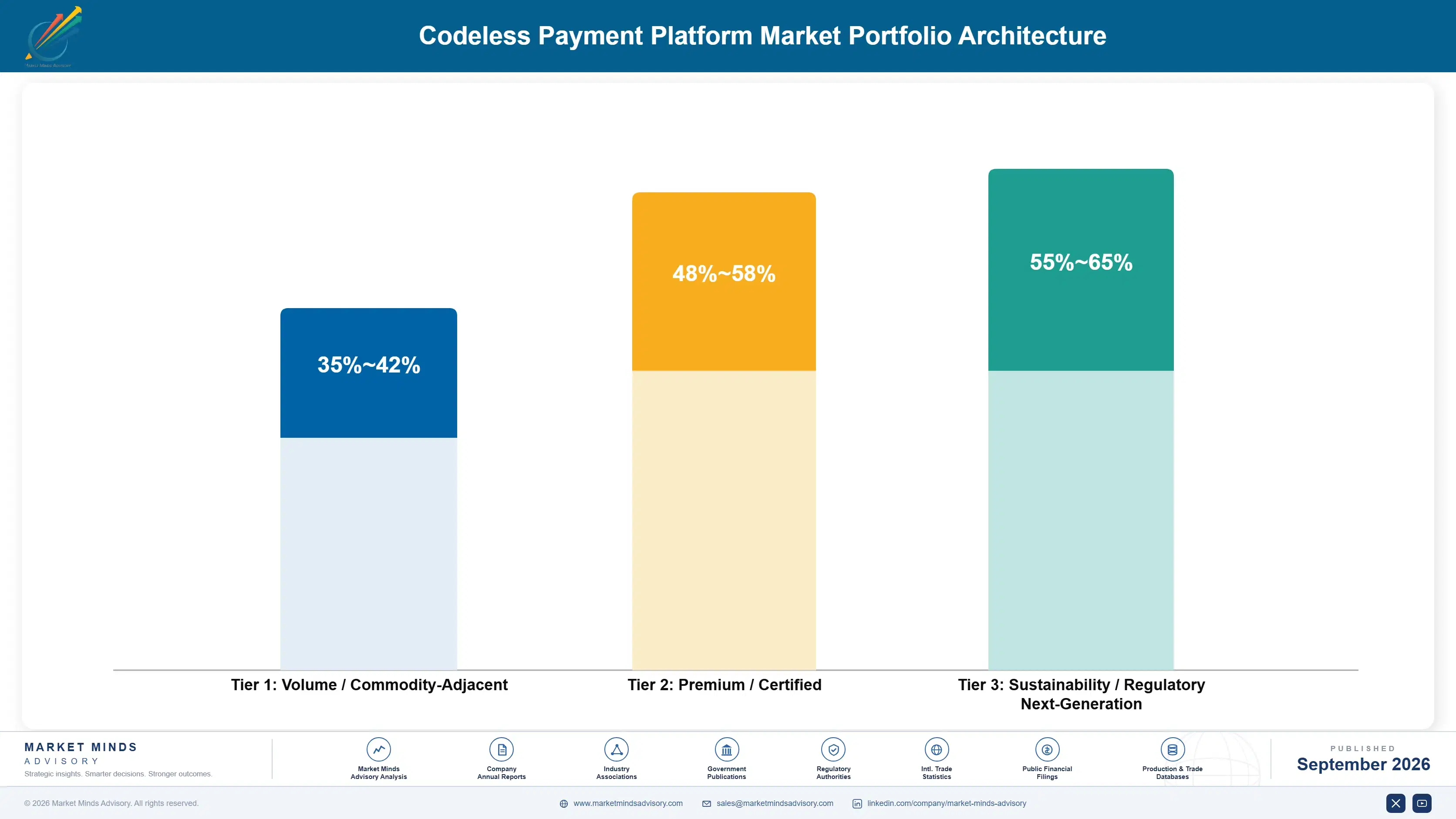
The codeless payment platform market splits into three commercial tiers separated by feature sophistication and merchant support depth rather than by transaction fee pricing alone. Commodity-adjacent basic checkout tools compete on price against tightly integrated mid-tier subscription billing offerings, while forward-looking enterprise accounts pay a substantial premium for AI-driven fraud detection platforms carrying managed compliance support built directly into the merchant relationship.
Volume tier gross margins run meaningfully below premium tier margins, since commodity checkout tools face intense price competition from numerous vendors offering broadly comparable transaction processing capability at similar fee structures. Vendors chasing volume through aggressive fee discounting increasingly find that strategy erodes the very margin needed to fund the fraud engineering investment that separates premium platforms from basic checkout in the eyes of growing merchant accounts.

High-value margin pools concentrate overwhelmingly in subscription billing and fraud detection deployments carrying managed compliance depth, where switching costs run moderately high once a merchant commits its checkout infrastructure to a given platform. Vendors positioned in this tier capture disproportionate lifetime revenue relative to their merchant count, since growing merchant accounts rarely churn and consistently expand their transaction volume over successive business growth cycles.

Volume / Commodity-Adjacent

Basic embedded checkout widgets for smaller merchants without heavy compliance or fraud requirements, competing primarily on price against numerous vendors offering broadly comparable functionality, integration simplicity, reliability, and support quality.
Gross Margin: 35-42%

Premium / Certified

Subscription billing and dunning management platforms carrying flexible recurring payment capability, commanding a durable premium over basic checkout through demonstrated billing recovery results and consistent renewal rates among merchant clients.
Gross Margin: 48-58%

Sustainability / Regulatory / Next-Generation

AI-driven fraud detection and managed compliance services commanding the platform's highest margin among forward-looking enterprise customers pursuing genuine competitive differentiation beyond basic transaction processing and standard checkout capability entirely and consistently.
Gross Margin: 55-65%
codeless-payment-platform-market-portfolio-architecture-1788502872472

High-value Sub-segments and Strategic Watch-out

Embedded Payment Widgets for E-Commerce

The fastest-growing, highest-value segment as merchants demand plug-and-play checkout components, commanding premium pricing while expanding rapidly across every merchant category nationwide over the coming decade as adoption accelerates further among competing vendors racing hard for lasting share, trust, recognition, loyalty, referrals, repeat orders, and reviews.
Gross Margin: 58-68%

AI-Driven Fraud Detection Services

A high-value segment growing at a more moderate pace as fraud sophistication increases across every industry and company size nationwide and abroad consistently, reliably, steadily, predictably, and sustainably, still commanding strong margin from merchants requiring reliable chargeback prevention built into their contracted platform delivery terms.
Gross Margin: 50-60%

Standard Checkout Processing Tools

The volume core of the market, generationally mature and highly price competitive, providing steady recurring revenue without the margin upside that newer AI-driven services increasingly command instead across the industry and every merchant segment served nationwide today and well into the very distant future ahead.
Gross Margin: 35-42%

Legacy API-Based Payment Gateways

A strategic watch-out category as no-code platforms displace traditional API-based payment gateways entirely, pressuring vendors reliant on developer-dependent integration for a meaningful share of total contracted revenue going forward across every merchant type, industry, geography, price tier, channel, format, use case, relationship, contract, and market.
Gross Margin: 28-36%

Recurring Transaction Revenue and Deep Lock-In

Codeless payment platforms run almost entirely on annuity economics, since checkout infrastructure integrated into a merchant's website or app cannot be swapped out without rebuilding integration and disrupting live payment processing at considerable risk. Transaction fee revenue dominates vendor income statements, with expanded feature adoption inside existing merchant accounts contributing more incremental revenue than net-new merchant acquisition across most established vendor portfolios operating in this market today.
Adoption stickiness varies meaningfully by end-use vertical. Subscription commerce and marketplace merchants exhibit the deepest lock-in, since payment platform switching requires rebuilding complex recurring billing logic and reconciling customer payment method data. Simple one-time checkout merchants switch more readily, lacking equivalent integration depth, which explains why leading vendors increasingly prioritize subscription account depth over volume expansion into less sticky merchant segments.

Buyer profiles are shifting generationally as small business owners who came up managing manual invoicing and basic checkout give way gradually to a cohort fluent in evaluating platform fraud detection accuracy and billing flexibility rather than accepting whatever checkout tool a website builder happens to bundle. This generational transition is accelerating vendor selection cycles and rewarding platforms built for measurable conversion improvement over legacy vendors coasting on installed base alone.
codeless-payment-platform-market-end-use-penetration-index-1788502872975

Where Vendors Should Focus Next

These are among the four positions where our research anticipates prominent divergence between winners and laggards over the coming forecast period. Each is grounded in the demand model, the regulatory perimeter, and the announced capacity pipeline.
01 / SUBSCRIPTION BILLING INVESTMENT

Build recurring billing depth before subscription demand peaks

Subscription commerce merchants increasingly refuse to piece together billing infrastructure from multiple vendors when a single platform can handle both checkout and recurring billing complexity together reliably and cost-effectively. Vendors lacking dunning management and flexible billing capability will lose subscription accounts to competitors offering demonstrably better payment recovery outcomes across every merchant category. Building this capability takes years of sustained investment, so vendors should commit budget now rather than waiting for subscription commerce growth to fully mature across every account.
02 / FRAUD DETECTION ENHANCEMENT

Invest in AI fraud detection before chargebacks intensify

Merchants increasingly demand AI-driven fraud detection capability that reduces chargeback losses beyond what generic rule-based screening approaches can reliably deliver across diverse merchant categories and varying risk profiles served today across every relevant market. Vendors without genuine fraud detection depth risk losing the most valuable, highest-volume merchant accounts to competitors demonstrating measurably lower fraud loss rates consistently across every account tier. Vendors should invest now in fraud detection capability rather than waiting until chargeback rates become an unavoidable competitive disadvantage.
03 / COMPLIANCE SERVICE EXPANSION

Expand managed compliance services before requirements tighten

Small merchants lacking dedicated compliance resources increasingly value managed certification support that outsources specialized payment security expertise they cannot justify building internally on their own without significant investment, dedicated staff, ongoing training, infrastructure, and continuous maintenance. Vendors without this service depth risk losing the smallest merchant segment to competitors already capturing compliance service revenue alongside standard transaction processing fees across every account tier. Vendors should prioritize this expansion now rather than ceding the opportunity entirely to specialized third-party compliance providers.
04 / MULTI-CHANNEL BUNDLING STRATEGY

Bundle payment channels before merchants seek separate vendors

Growing merchants increasingly expect a single vendor to handle payment acceptance across web, mobile, and in-person channels rather than managing separate vendor relationships for each individual sales format they operate across every business, geography, and account size. Vendors without genuine multi-channel bundling capability risk losing expanding merchant accounts to competitors offering unified payment infrastructure across every channel a merchant operates today. Vendors should invest now in cross-channel integration rather than continuing to compete purely on single-channel transaction fee pricing alone.

Engagement Snapshot From the Field

A live engagement with an industry participant carrying material or product regulatory and market exposure ahead of a defining policy shift, showing how our research translates into a defensible multi-year portfolio strategy.
MARKET MINDS ADVISORY · CLIENT ENGAGEMENT SUMMARY
Codeless Payment Platform Producer Strategic Portfolio Review and Transition Roadmap 2026·Investment Scenario on Codeless Payment Platform Exposure Evaluation 2025-26
CLIENT PROFILE
The client is a small US e-commerce retailer selling home goods products, previously relying on a custom-coded payment integration built years earlier by a contractor who was no longer available for maintenance. Annual revenue sits in the low single-digit millions of dollars range (client-reported, unverified by MMA), with the aging custom integration increasingly prone to bugs during peak seasonal traffic periods.
STRATEGIC CHALLENGE
The retailer faced recurring checkout failures during high-traffic sales events, causing measurable lost revenue and customer frustration with no internal engineering resources available to diagnose or fix the underlying custom code issues. Leadership needed a payment platform migration strategy that eliminated ongoing maintenance burden while preserving existing checkout conversion performance during the transition.
MMA APPROACH
MMA conducted a structured assessment of the retailer's existing checkout failure patterns, mapping which specific integration points caused the most frequent and costly disruptions during peak traffic periods. The engagement team then built a vendor evaluation framework weighting reliability track record and embedded widget flexibility above raw transaction fee pricing, given the retailer's stated reliability concerns.
KEY FINDINGS
  1. Checkout failures during peak traffic periods cost the retailer an estimated 12 percent of potential sales revenue during affected sales events (client-reported, unverified by MMA), exceeding initial leadership estimates.
  2. The retailer's custom integration had not received a security update in over two years due to contractor unavailability (client-reported, unverified by MMA), representing meaningful compliance risk exposure.
  3. Migration to a no-code embedded widget platform required no custom development work and completed within days rather than the originally anticipated weeks (client-reported, unverified by MMA) of planning.
  4. Post-migration checkout conversion rates improved measurably compared to the retailer's historical baseline performance during comparable sales periods (client-reported, unverified by MMA) tracked internally.
CLIENT PROFILE
The client is a small US e-commerce retailer selling home goods products, previously relying on a custom-coded payment integration built years earlier by a contractor who was no longer available for maintenance. Annual revenue sits in the low single-digit millions of dollars range (client-reported, unverified by MMA), with the aging custom integration increasingly prone to bugs during peak seasonal traffic periods.
STRATEGIC CHALLENGE
The retailer faced recurring checkout failures during high-traffic sales events, causing measurable lost revenue and customer frustration with no internal engineering resources available to diagnose or fix the underlying custom code issues. Leadership needed a payment platform migration strategy that eliminated ongoing maintenance burden while preserving existing checkout conversion performance during the transition.
MMA APPROACH
MMA conducted a structured assessment of the retailer's existing checkout failure patterns, mapping which specific integration points caused the most frequent and costly disruptions during peak traffic periods. The engagement team then built a vendor evaluation framework weighting reliability track record and embedded widget flexibility above raw transaction fee pricing, given the retailer's stated reliability concerns.
KEY FINDINGS
  1. Checkout failures during peak traffic periods cost the retailer an estimated 12 percent of potential sales revenue during affected sales events (client-reported, unverified by MMA), exceeding initial leadership estimates.
  2. The retailer's custom integration had not received a security update in over two years due to contractor unavailability (client-reported, unverified by MMA), representing meaningful compliance risk exposure.
  3. Migration to a no-code embedded widget platform required no custom development work and completed within days rather than the originally anticipated weeks (client-reported, unverified by MMA) of planning.
  4. Post-migration checkout conversion rates improved measurably compared to the retailer's historical baseline performance during comparable sales periods (client-reported, unverified by MMA) tracked internally.
RECOMMENDED STRATEGY
Phase 1: Phase one migrates core checkout functionality to an embedded no-code widget platform, prioritizing reliability during upcoming seasonal sales events entirely. Phase 2: Phase two adds AI-driven fraud detection capability to address compliance gaps identified during the initial migration assessment process conducted thoroughly. Phase 3: Phase three evaluates subscription billing capability for potential future recurring revenue product lines currently under active internal consideration by leadership.
OUTCOME
The retailer completed the checkout migration ahead of its next major seasonal sales event, experiencing zero checkout failures during the subsequent high-traffic period compared to previous years (client-reported, unverified by MMA). Leadership subsequently approved the fraud detection upgrade, citing the successful migration as justification for continued platform investment.

Frequently Asked Questions

Foundational context covering the market sizes, CAGR, scope, country, region and competition that inform every finding below. This section is provided to cover basics and most often pre-purchase conversations, answered from the MMA Primary Research Dataset.

What is the current size of the Codeless Payment Platform Market?

The market is valued at $1.6 billion in 2025, reflecting growing small merchant adoption of no-code checkout tools. This figure captures embedded widgets and subscription billing platforms sold across every merchant category worldwide.

How large will the Codeless Payment Platform Market be by 2036?

The market is projected to reach $9.43 billion by 2036. That represents a 5.02-fold expansion from its 2026 base value over the ten-year forecast window.

What is the CAGR for the Codeless Payment Platform Market 2026 to 2036?

The market grows at a compound annual rate of 17.5 percent across the forecast period. Bull and bear scenarios range from 16.2 to 18.8 percent depending on adoption pace.

Which segment is growing fastest?

Embedded Payment Widgets for E-Commerce lead at 23.0 percent CAGR, roughly 1.31 times the overall market rate. Small merchant demand for plug-and-play checkout drives this acceleration.

Who are the major companies in the Codeless Payment Platform Market?

Stripe, PayPal, Square, Wix Payments, and Shopify Payments lead the market. Each competes primarily on feature breadth and merchant support depth rather than price alone.

Which country is growing fastest?

India leads at 21.5 percent CAGR, driven by its massive expanding small business population and rapidly growing digital commerce adoption. This outpaces the region's own broader growth rate considerably.

Report Segmentation Architecture

The full report scope spans multiple orthogonal segmentation dimensions, with cross-tabulated demand data provided for each dimension pair. Coverage extends further to regional breakdowns, trend trajectories, and the competitive detail needed to support segment-level decision-making.

By Primary Market Dimension

  • Embedded Payment Widgets
  • Payment Link and Invoice Tools
  • Subscription and Recurring Billing Platforms
  • Marketplace Payment Splitting Software
  • Point-of-Sale Integration Modules
  • Fraud Detection and Compliance Tools

By End-Use Industry

  • E-Commerce and Retail
  • Software and SaaS
  • Professional Services
  • Nonprofit and Fundraising
  • Hospitality and Food Service
  • Education

By Commercial Dimension

  • Transaction-Based Fee Pricing
  • Subscription-Based Platform Licensing
  • Managed Compliance Service Agreements
  • Direct Merchant Sales
  • Platform and Website Builder Channel Sales

By Region

  • North America
  • Western Europe
  • East Asia
  • South Asia and Pacific
  • Latin America
  • Middle East and Africa
  • Eastern Europe

Scope, Methodology, and Coverage

Every figure in this report is reproducible from documented input assumptions. The scope below maps the historical period, the forecast horizon, the segmentation dimensions, and the countries covered, alongside the underlying primary and qualitative methodology.
Historical Period
2020 to 2025
Forecast Period
2026 to 2036
Base Year
2025 (USD billions; MMA Primary Research Dataset, September 2026)
Market Definition
This report defines the codeless payment platform market as no-code and low-code software platforms that let merchants integrate payment processing capability into websites and applications without custom development work. It excludes traditional API-based payment gateways requiring developer implementation and point-of-sale hardware terminals sold without embedded software integration tools.
Quantitative Units
USD billions, percentage CAGR, percentage market share
Segmentation Dimensions
Product/technology type, end-use industry, commercial/pricing model
Regions Covered
North America, Western Europe, East Asia, South Asia and Pacific, Latin America, Middle East and Africa, Eastern Europe
Countries Covered
United States, India, Germany, China, United Kingdom, Brazil
Key Companies Profiled
Stripe, PayPal, Square, Wix Payments, Shopify Payments, and 15 additional participants
Quantitative Methodology
Primary survey, n=3,800 respondents, Q4 2025, six countries; demand-side model with trade association cross-validation
Qualitative Methodology
47 expert interviews, Q4 2025; applied to validate demand model assumptions, identify emerging dynamics, and assess competitive positioning
Report Format
PDF and XLSX data workbook (Word format preview document)
Publisher
Market Minds Advisory
Report Code
MMA-2026-TEC-157
Published
September 2026
Contact
sales@marketmindsadvisory.com | www.marketmindsadvisory.com

Purchase the full Codeless Payment Platform Market Report (2026 to 2036).

This report delivers a complete assessment of the codeless payment platform market, covering sizing, segmentation, competitive dynamics, and cost forces through 2036. It examines how no-code checkout tools are expanding digital commerce access for small merchants across every major global market. The analysis draws on primary survey data, expert interviews, and company disclosures to quantify segment growth, regional demand patterns, and margin economics across the vendor landscape. It further evaluates subscription billing adoption, fraud detection investment, and interchange fee cost exposure shaping vendor strategy going forward.
Full 2026 to 2036 market sizing and forecast
Segment-level growth and gross margin analysis
Regional demand mapping across seven world regions
Competitive landscape and vendor market positioning
Interchange fee and fraud loss cost exposure
Anonymized client engagement strategy case study

Built For The People Who Decide

From boardroom strategy to bench-side execution, this report is read cover-to-cover by leaders shaping the next decade of their industry, turning demand scenarios, market dynamics and valuation benchmarks into decisions.
CXOs/ Presidents/ VPs/ Managers
M&A and Corporate Development
Strategy Teams and R&D Heads
Procurement and Product Directors
Regulatory and Compliance Leaders
Investor Relations and Equity Analysts