Market Minds Advisory
Cocoa-Based Polyphenols Market

Cocoa-Based Polyphenols Market: Flavanol Science Meets Functional Food Demand

Cardiovascular health claims backed by clinical flavanol research, functional food reformulation, and cocoa byproduct valorization are pulling polyphenol extraction into cocoa processing, forcing grinders to decide whether extraction is a business or a side stream.

Lead Analyst

Bilal Shaikh

Published

September 2026

Make Smarter Decisions with Customized Research Insights

Request a free sample report and evaluate market opportunities, growth trends, and competitive dynamics relevant to your business needs.

2025 MARKET VALUE$0.7BMarket Size 2025
2036 FORECAST VALUE$1.7BBase Case , 2026 to 2036
CAGR 2026 TO 20368.9 %Bull 10.1% / Bear 7.7%
INCREMENTAL OPPORTUNITY$1.0BNet 10- year value creation
EXPANSION MULTIPLE2.35x2036 value over 2026 base
Strategic Levers
M&A Pipeline
Regional Outlook
Country Rankings
Competitive Intelligence
Segmental Deep-dive
Call-Us : 91 93563 13602

Executive Snapshot and Market Trajectory

Cocoa polyphenols are moving from a cocoa processing byproduct into a standalone nutraceutical ingredient category, as clinical research linking cocoa flavanols to cardiovascular benefit gives supplement and functional food brands a defensible health claim. Standardization and clinical documentation now separate leaders from commodity sellers.
Commercial demand splits between dietary supplement brands paying a premium for standardized high-flavanol extracts and functional food manufacturers seeking lower-cost polyphenol fractions for fortification. Western Europe accounts for close to a third of global capacity, anchored by the Netherlands and Belgium's position as the world's cocoa grinding and processing center. Growing Asian functional food demand is narrowing that lead each year. North America's dietary supplement industry adds the world's second-largest demand base by far.
Competition remains fragmented relative to mature nutraceutical ingredient categories, with the top five holding under half of global capacity. Barry Callebaut and Cargill hold the deepest integrated cocoa processing positions, while specialty extractors compete on flavanol standardization and clinical documentation rather than raw material cost, and cocoa husk valorization is opening a genuinely new lower-cost supply channel. Extractors without integrated processing access increasingly struggle to match this cost structure.
Market Definition
This market covers polyphenol compounds extracted from cocoa beans, husks, and shells, including flavanols, procyanidins, and standardized polyphenol powders, used in dietary supplements, functional foods, and cosmetic formulations. It excludes cocoa butter, cocoa powder sold for confectionery use, and finished chocolate products.
Base Year Value
$0.7B in 2025 (MMA Primary Research Dataset, August 2026)
Forecast Period
2026 to 2036, eleven discrete annual values
CAGR
8.9% base case. Bull 10.1%. Bear 7.7%.
Fastest Growth Segment
High-Flavanol Cocoa Extracts: 12.8% CAGR
Fastest Growth Country
India: 11.3% CAGR
Fastest Growth Region
South Asia and Pacific: 11.0% CAGR
Largest Region
North America: 25% of 2025 global value
Market Leaders
Barry Callebaut AG, Cargill Incorporated, Naturex, DSM-Firmenich, Sensient Technologies Corporation. Source: MMA Analysis based on company annual reports.
Primary Survey
n=3,800 procurement and R&D decision-makers, Q4 2025, six countries
Methodology
Demand-side build-up, cross-validated against public data, 47 expert interviews

Cocoa-Based Polyphenols Market Forecast Scenarios

cocoa-based-polyphenols-market-trends-size-forecast-scenario-1787310747235
Cocoa polyphenol demand grew steadily through 2020 to 2025 as clinical research on flavanol cardiovascular benefit accumulated and supplement brands began building products around it. The market grew at an estimated 8.0% historical CAGR across the period, accelerating meaningfully after 2022 as major supplement brands launched standardized flavanol products. Functional food fortification volume grew more gradually, tracking broader consumer interest in functional ingredients.
The base case assumes 8.9% CAGR through 2036, driven by three mechanisms operating together. First, continued clinical research supporting cocoa flavanol cardiovascular benefit keeps expanding the supplement category's credibility and shelf presence. Second, functional food manufacturers increasingly fortify beverages and snack products with lower-cost polyphenol fractions as consumer interest in functional ingredients broadens beyond dedicated supplements. Third, cocoa husk and shell valorization technology is opening a lower-cost supply stream that widens the addressable market for cost-sensitive applications.
The bull case (10.1% CAGR) assumes broader regulatory recognition of cocoa flavanol health claims across additional major markets pulls functional food adoption forward faster than currently expected. The bear case (7.7% CAGR) reflects the risk that cocoa bean price volatility, driven by West African supply constraints, raises extraction feedstock costs enough to slow lower-margin functional food fortification adoption.

Byproduct Valorization Meets Clinical Health Claims

Cocoa polyphenol economics diverge sharply depending on whether extraction targets beans or husks. Bean-derived high-flavanol extracts command premium pricing tied to clinical documentation and cardiovascular health claims, while husk-derived extracts compete on cost as a byproduct valorization play that turns cocoa processing waste into a marketable ingredient stream. Producers that can serve both economics well remain relatively rare across the current landscape.
CR5 CONCENTRATION44%share held by the top five global producers
AVERAGE SELLING PRICE$85-420/kgrange spanning functional food grade to premium supplement extracts
TOP PRODUCING COUNTRY SHARENetherlands, 22%share of global cocoa polyphenol extraction capacity today
CAPACITY UTILIZATION68%average operating rate across dedicated polyphenol extraction facilities
TRADE INTENSITY46%of finished extract volume crossing borders before formulation
FEEDSTOCK COST SHARE38% of COGSraw cocoa bean and husk material inputs combined together
Supplement brands and functional food manufacturers behave very differently as buyers. Supplement brands pay for standardized flavanol content and clinical substantiation, running lengthy formulation and claims-testing cycles before launch, while functional food manufacturers move faster and prioritize cost-effective polyphenol fractions that blend into existing product formulations without major reformulation cost. This divergence in buying behavior means producers need distinctly different commercial approaches for each customer type.
Over the next decade, two forces will determine winners. Continued clinical research expanding cocoa flavanol health claim recognition will keep growing the premium supplement segment, while husk and shell valorization technology adds a second, cost-driven growth vector that rewards producers investing early in byproduct extraction capability. Producers investing successfully in both vectors simultaneously stand to capture the broadest share of future growth.
"Every cocoa grinder has been throwing husks away for a century while sitting on a polyphenol-rich material that supplement brands now pay real money for. The producers getting this right are the ones treating extraction as a second product line, not a sustainability footnote."
Director, Functional Ingredients and Nutraceuticals Practice · MMA Chemicals and

Market Trends

Cocoa Husk Valorization Opens Lower-Cost Polyphenol Supply

Cocoa processors, including Barry Callebaut and Cargill, have begun commercializing husk and shell extraction technology that recovers polyphenol content from material historically discarded or sold as low-value animal feed and composting input. This valorization pathway produces polyphenol extracts at meaningfully lower cost than bean-derived flavanol extraction, since husks and shells were previously a disposal cost rather than a purchased feedstock, giving producers a genuine margin advantage on the resulting extract. Several producers now market husk-derived extracts for functional food fortification, where cost sensitivity limits demand for premium bean-derived extracts. This lower-cost tier has expanded the category's addressable customer base meaningfully.
Market Impact: Adds 1.4 million kg supplement dema
Clinical Research Expands Cardiovascular Health Claim Recognition

Accumulating clinical trial evidence linking standardized cocoa flavanol intake to measurable cardiovascular biomarker improvement has supported expanded health claim recognition in several major supplement markets, giving brands a more defensible marketing position than earlier generic antioxidant claims allowed. Mars-funded flavanol research, alongside independent academic studies, has built a substantiation base that major supplement brands increasingly cite directly in product marketing and label claims. This research base continues expanding, with several large-scale trials still underway that could further strengthen the category's clinical credibility and regulatory standing across additional markets over the coming years.
Market Impact: Adds 8% functional food segment vol

Market Opportunities and Growth Drivers

Cardiovascular Supplement Category Growth Accelerates Sharply

Major supplement brands have expanded standardized cocoa flavanol product lines targeting cardiovascular health, supported by growing consumer awareness of clinical research linking flavanol intake to blood pressure and vascular function improvement. This category growth has made dietary supplements the single largest end-use driver of high-flavanol cocoa extract demand, commanding meaningfully higher pricing than functional food applications given the clinical documentation and standardization required. Extract producers that secure early supply relationships with major supplement brands gain multi-year revenue visibility tied to product reformulation cycles, and brands increasingly favor suppliers with proven clinical-grade standardization capability over newer entrants lacking established documentation.
Market Impact: Adds 25 percent extraction feedstoc

Functional Food Fortification Broadens Addressable Market

Beverage and snack manufacturers have increasingly fortified products with cocoa polyphenol extracts as consumer interest in functional ingredients broadens beyond dedicated supplements into everyday food and beverage categories. This demand has proven more resilient than some analysts expected given cost sensitivity in food formulation, since husk-derived lower-cost extracts have made fortification economically viable for a broader range of mainstream products than premium bean-derived extracts alone could support. Producers serving this demand typically maintain closer collaboration with food formulation teams than with the clinical and regulatory teams that dominate supplement industry relationships.
Market Impact: Adds 15% validation cost

Market Restraints and Challenges

Cocoa Bean Price Volatility Raises Feedstock Cost

Cocoa bean prices have experienced substantial volatility in recent years, driven by West African supply constraints tied to weather conditions, aging tree stock, and crop disease pressure across Ivory Coast and Ghana, the two countries supplying the large majority of global cocoa. This volatility directly raises the cost of bean-derived flavanol extraction, since beans represent a meaningful share of production cost for premium supplement-grade extracts, squeezing margins during periods of elevated pricing that extractors cannot always pass through to supplement brand customers quickly. Producers are addressing this through increased husk-derived extraction, which insulates output from bean price volatility.
Market Impact: Adds 9% husk-derived segment volume

Standardization Complexity Limits Smaller Producer Entry

Achieving consistent, clinically documented flavanol content across production batches requires sophisticated analytical testing and process control capability that smaller cocoa processors often lack, limiting how many producers can credibly serve the premium supplement segment regardless of raw material access. This standardization barrier has kept the supplement-grade segment more concentrated than the broader functional food polyphenol market, where specification requirements are less demanding. Smaller producers are addressing this through technical partnerships with contract testing laboratories, though this approach adds cost and complexity compared to in-house standardization capability that larger competitors maintain directly.
Market Impact: Adds 7% supplement segment volume
3 additional market trends, 4 additional growth drivers, and 3 additional restraints and challenges are covered in the full report. Contact sales@marketmindsadvisory.com to access the complete intelligence.

Segment CAGR and Growth Architecture

MMA segments this market by extraction source and standardization level, the classification supplement and food manufacturers use when specifying polyphenol material. This lens separates high-flavanol bean extracts, procyanidin-standardized extracts, general polyphenol powders, husk and shell-derived extracts, and specialty fractions by underlying material source rather than end application alone. Regional origin is treated as a separate dimension entirely.
cocoa-based-polyphenols-market-trends-market-share-analysis-1787310747764

High-Flavanol Cocoa Extracts

High-flavanol cocoa extracts are the fastest-growing segment by a wide margin, expanding directly alongside dietary supplement category growth as brands specify this material for standardized cardiovascular health products. These extracts require sophisticated processing to preserve flavanol content through the extraction process, since standard cocoa processing methods degrade much of the naturally occurring flavanol content during roasting and alkalization. Barry Callebaut and Cargill hold the deepest technical positions in this segment, having invested years in low-temperature extraction process refinement to preserve flavanol content at commercial scale. Specialty extractors including Naturex compete on clinical documentation depth and standardization consistency rather than price alone, since supplement brands prioritize substantiation quality over raw cost in this premium segment.
CAGR 12.8%

Cocoa Husk and Shell-Derived Polyphenol Extracts

Cocoa husk and shell-derived polyphenol extract demand is expanding faster than the broader market base, driven by both cost-effective functional food fortification demand and sustainability positioning that turns processing waste into a marketable ingredient stream. This segment commands meaningfully lower pricing than bean-derived flavanol extracts, but producers benefit from near-zero feedstock cost since husks were previously a disposal expense rather than a purchased input. Major cocoa processors including Cargill and Olam maintain strong positions given their existing access to husk material as a byproduct of core grinding operations. Growth here remains largely insulated from cocoa bean price volatility, giving producers serving this segment a more stable cost structure than bean-derived extract producers face.
CAGR 10.5%
Full segment breakdown across 6 segments available in the complete report.

Regional Architecture and Country Demand Map

Western Europe leads cocoa polyphenol production given the Netherlands and Belgium's position as the world's cocoa grinding center, though North America's supplement industry and East Asia's functional food demand are both narrowing that lead steadily. South Asia posts the fastest regional growth given its expanding nutraceutical manufacturing base.

North America

The United States dietary supplement industry, the largest globally by revenue, anchors North American cocoa polyphenol demand, with major brands including several building standardized cocoa flavanol product lines around published cardiovascular research. Sensient Technologies maintains significant domestic extraction and standardization capacity serving this supplement demand base directly. Functional food and beverage manufacturers add a meaningful secondary demand pool, fortifying products with lower-cost husk-derived extracts as functional ingredient trends broaden beyond dedicated supplements. Canada contributes through smaller specialty supplement manufacturing rather than large-scale extraction capacity of its own. Growth trails Western Europe's cocoa processing concentration but benefits from the world's largest and most sophisticated dietary supplement retail and e-commerce distribution infrastructure.
Share: 25% | CAGR: 9.0% (2026 to 2036)

Western Europe

The Netherlands and Belgium host the world's largest cocoa grinding and processing complexes, giving Western Europe a durable processing-capacity advantage in polyphenol extraction given direct access to bean and husk material at the point of primary processing. Barry Callebaut and Cargill both operate major integrated processing and extraction facilities across the region, capturing polyphenol value that would otherwise require separate bean sourcing elsewhere. Germany and France host a substantial functional food and nutraceutical manufacturing base that draws directly on this regional extraction capacity. European Union novel food regulation has created a more defined regulatory pathway for polyphenol ingredients than exists in some other markets, supporting continued product launches. Growth trails faster-growing Asian markets given the region's already mature processing base.
Share: 24% | CAGR: 7.3% (2026 to 2036)
Regional intelligence for 5 additional markets available in the complete report: East Asia, South Asia and Pacific, Latin America, Middle East and Africa, Eastern Europe. Contact sales@marketmindsadvisory.com.
cocoa-based-polyphenols-market-trends-country-cagr-analysis-1787310748273

Where Polyphenol Producers Can Expand Margins

Producers create outsized value not from standard extract tonnage but from clinical documentation depth, husk valorization economics, and long-term supplement brand relationships. The levers below identify where margin expands fastest, moving beyond commodity extract sales toward standardized flavanol supply, byproduct valorization, and application-specific technical support. This favors producers investing ahead of visible demand signals.

Clinical Documentation Depth Commands Premium Pricing

Producers that invest in clinical trial substantiation and standardized flavanol content documentation capture meaningfully higher realized pricing than commodity polyphenol powders, often 3 to 5 times the price per kilogram for equivalent material, because supplement brands pay for defensible marketing claims as much as the ingredient itself. This documentation requires sustained research investment and years of accumulated clinical evidence, but producers that achieve it gain access to the highest-margin segment of the entire market well ahead of competitors still selling on generic antioxidant positioning alone. Several producers have built entire brand partnerships around this documentation depth.
Market Impact: Adds 300 to 500 basis points gross

Husk Valorization Captures Near-Zero-Cost Feedstock Value

Producers that build husk and shell extraction capability convert a historically discarded processing byproduct into a marketable ingredient stream at near-zero incremental feedstock cost, since husks were previously a disposal expense rather than a purchased input. This capability requires investment in extraction process development but delivers meaningfully lower production cost than bean-derived extraction, typically 30 to 40% lower per kilogram of extracted polyphenol, insulating a growing share of output from cocoa bean price volatility entirely. This economics has made husk extraction the fastest-payback capacity investment available to integrated cocoa processors today.
Market Impact: Cuts production cost by 30 to 40 pe

Functional Food Formulation Technical Support Programs

Producers that embed food application scientists to help beverage and snack manufacturers integrate polyphenol extracts without compromising taste, color, or shelf stability capture value beyond raw ingredient sales, since formulation challenges represent a genuine barrier that generic ingredient suppliers cannot solve for customers. This technical support typically deepens customer relationships significantly, and producers offering it report measurably higher customer retention across reformulation cycles than commodity extract sellers competing purely on price. Producers offering this support report retention rates 20 to 30% higher than commodity sellers competing purely on price alone.
Market Impact: Adds 15 to 20 percent in customer r

Long-Term Supplement Brand Supply Partnership Agreements

Producers that establish multi-year supply agreements with major supplement brands, tied to specific product formulations already through clinical substantiation and regulatory review, secure durable revenue relationships that persist for the commercial life of the product line. Requalifying an alternative polyphenol supplier requires the brand to repeat costly clinical documentation and label claim substantiation work, a barrier that keeps switching rare once a supply relationship is established and formulation-locked into an approved product. These agreements typically extend across 3 to 5 years, giving producers revenue visibility that spot sales cannot provide.
Market Impact: Secures 3 to 5 years of forward vol

Who Controls the Margin Pool

CR5 stands at 44%, reflecting a market still fragmented relative to more mature nutraceutical ingredient categories, though the top five hold meaningful share given their integrated cocoa processing positions. The gap between these five leaders and smaller specialty extractors is widest in clinical documentation depth, where established players have accumulated years of substantiation data. This gap has persisted given the cost of building clinical evidence.
Competition currently plays out across three dimensions: clinical research investment supporting expanded health claim recognition among premium extract producers, husk valorization capacity buildout among integrated cocoa processors seeking to monetize byproduct streams, and functional food formulation technical support among a smaller group of application-focused specialists. Integrated processors compete primarily on cost-advantaged husk-derived volume, where standardization barriers remain lower than in premium bean-derived flavanol extracts.

Emerging pressure comes from two directions. Smaller specialty extractors are closing the clinical documentation gap with established leaders by partnering with contract research organizations rather than building in-house capability from scratch. West African value-added processing initiatives could also reorder regional supply relationships if Ivory Coast and Ghana succeed in capturing more extraction value domestically rather than exporting raw beans. Neither is likely to reorder the top five within a few years.
cocoa-based-polyphenols-market-trends-company-positioning-matrix-1787310748796

Competitive Moat and Risk Dimensions

BARRY CALLEBAUT AG

Moat: Integrated Processing and Extraction Scale

Barry Callebaut operates the industry's largest integrated cocoa processing base, giving it direct access to both bean and husk material at the point of primary grinding without separate sourcing cost. This integration, built over decades of processing infrastructure investment, gives Barry Callebaut a durable cost advantage in husk-derived extraction that standalone extractors cannot easily replicate.
BARRY CALLEBAUT AG

Risk: Extraction Remains a Secondary Business

Barry Callebaut's core business remains commodity cocoa processing and chocolate ingredients, meaning polyphenol extraction competes internally for capital and management attention against its much larger primary business lines. This positioning risks ceding technical leadership in premium flavanol extraction to specialty producers more singularly focused on the nutraceutical opportunity.
CARGILL INCORPORATED

Moat: Diversified Global Processing Footprint

Cargill operates cocoa processing facilities across multiple continents, giving it geographically diversified access to bean and husk feedstock that reduces exposure to any single origin country's supply disruption. This diversification, built through sustained global infrastructure investment, provides more supply resilience than smaller regionally concentrated competitors can match.
CARGILL INCORPORATED

Risk: Limited Standalone Nutraceutical Brand Presence

Cargill sells primarily as a bulk ingredient supplier rather than building consumer-facing nutraceutical brand presence, limiting its ability to capture the full margin available further downstream in finished supplement products. This positioning leaves more value on the table for supplement brands and specialty formulators than a more vertically integrated competitor might capture.

Players Tracked

Prominent Players

Barry Callebaut AG
Cargill Incorporated
Naturex
DSM-Firmenich
Sensient Technologies Corporation

Other Key Players

Nexira SAS
Archer-Daniels-Midland Company
Olam International
Cocoatree SA
Blue California
Indena S.p.A.
Kerry Group plc
Ingredion Incorporated
Fuji Chemical Industries Co. Ltd.
Synthite Industries Ltd.
Martin Bauer Group
Euromed S.A.
Symrise AG
Bioriginal Food & Science Corp.
JB Cocoa Sdn Bhd

Recent Developments

APRIL 2025

Cargill Commissions Husk Valorization Facility in Ivory Coast

Cargill announced commissioning of a pilot-scale cocoa husk valorization facility in Ivory Coast, targeting polyphenol extraction from processing byproduct historically discarded or sold as low-value feed material. The facility tests extraction economics ahead of anticipated larger commercial-scale deployment across additional processing sites. Results will inform broader rollout decisions.
Signal: Confirms major processors are investing in
SEPTEMBER 2025

Barry Callebaut Expands Flavanol Extraction Capacity in the Netherlands

Barry Callebaut announced completion of a capacity expansion at its Netherlands processing complex, adding qualified high-flavanol extraction capacity to serve growing supplement industry demand. The expansion follows several years of low-temperature extraction process refinement to preserve flavanol content at commercial scale. Analysts view this as evidence of accelerating premium investment.
Signal: Signals integrated processors are scaling
DECEMBER 2025

Sensient Technologies and a Major Supplement Brand Sign Supply Agreement

Sensient Technologies signed a multi-year supply agreement with a major dietary supplement brand covering standardized high-flavanol cocoa extract for cardiovascular health products. The agreement secures forward volume for Sensient at negotiated pricing ahead of the brand's planned product line expansion. The agreement reflects growing demand for clinically substantiated cardiovascular ingredients.
Signal: Signals supplement brands are increasingly

Cocoa Bean and Husk Feedstock Exposure

Raw cocoa bean and husk material together account for roughly 38% of cost of goods sold across cocoa polyphenol extraction, with bean pricing tied directly to global cocoa exchange markets while husk material carries minimal direct cost as a processing byproduct. Producers relying primarily on bean-derived extraction face far greater feedstock cost exposure than husk-focused producers.
Cocoa bean prices rose sharply during 2023 and 2024, documented in company annual reports across the sector, as West African supply constraints tied to weather conditions and crop disease pressure pulled global cocoa markets tighter than in decades. Several extractors reported compressed margins during this period on bean-derived products, since customer pricing on longer-term supplement contracts could not be renegotiated quickly enough to reflect rising bean cost, illustrating how directly feedstock volatility can affect near-term profitability.

This exposure disadvantages bean-focused extractors relative to husk-focused competitors with access to near-zero-cost byproduct feedstock, widening margin gaps during volatile pricing periods that are difficult to close through efficiency gains alone. Producers without diversified feedstock sourcing absorb volatility directly in margin, while larger integrated players like Barry Callebaut hedge exposure through diversified sourcing and captive husk material access.
cocoa-based-polyphenols-market-trends-cost-volatility-analysis-1787310748991

Husk and Shell Feedstock Diversification

Producers are shifting a growing share of extraction capacity toward husk and shell material, which carries minimal direct feedstock cost as a processing byproduct rather than a purchased commodity. This approach has become more common since 2023 as bean price volatility made husk-derived extraction meaningfully more attractive on a relative cost basis. Producers report improved margin stability after this shift.

Long-Term Cocoa Bean Supply Contracts

Larger extractors are locking in multi-year bean supply contracts directly with West African cooperatives and exporters, reducing exposure to spot cocoa market volatility. This approach requires established origin-country relationships but provides more predictable feedstock costs than spot market purchasing. These relationships also support origin-country sustainability positioning that supplement brands increasingly value in sourcing decisions.

Flexible Extraction Formulation Blending

Some producers blend bean-derived and husk-derived material in finished extract formulations, adjusting the ratio based on relative feedstock cost while maintaining consistent polyphenol content specifications. This approach provides flexibility to manage cost without fully committing to either feedstock source exclusively. This flexibility has become more valuable as bean price swings have grown larger in recent years.

Portfolio Architecture for Margin Defence

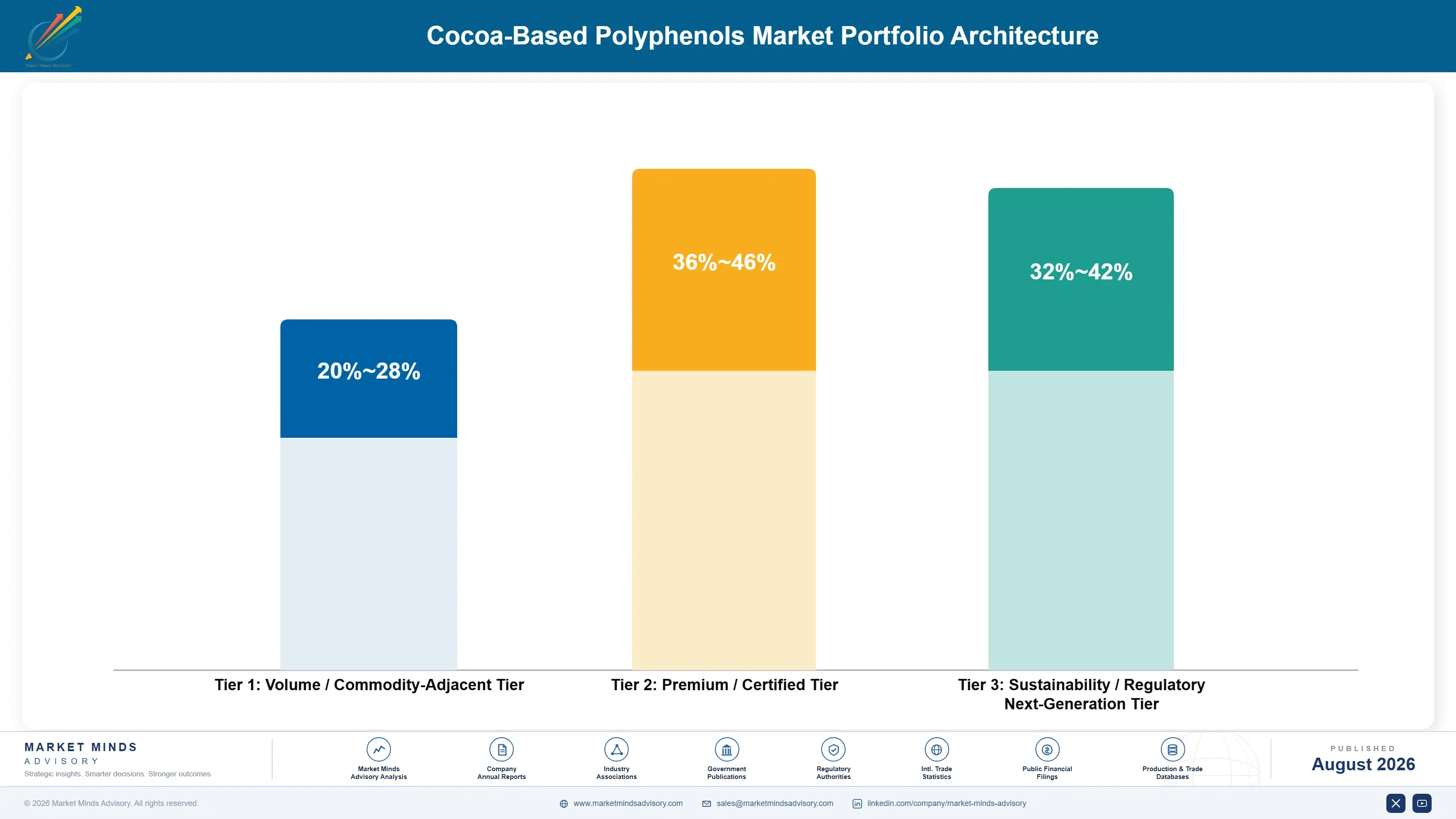
MMA organizes this market into three tiers by extraction source and margin profile. The volume tier covers husk and shell-derived polyphenol extracts sold into cost-sensitive functional food fortification, competing primarily on price given near-zero feedstock cost. The premium tier covers standardized high-flavanol bean extracts commanding higher margins through clinical documentation and supplement brand relationships. The sustainability tier captures next-generation extraction technology and
Volume tier producers compete on price and husk feedstock access with moderate margins, while premium tier suppliers protect pricing power through clinical documentation barriers that keep new entrants out for years. This creates real tension inside integrated cocoa processors, since capital allocated to sustaining husk-derived volume competes directly with capital needed to fund premium flavanol extraction development, and most large processors now favor building both capabilities in parallel.

The highest-value pools concentrate in clinically documented high-flavanol extracts for cardiovascular supplement applications, where substantiation barriers and durable supplement brand relationships combine to support the strongest pricing power in the entire market. Cosmetic-grade antioxidant polyphenol fractions are emerging as a further high-value pool as skincare formulators seek natural ingredient positioning.

Volume / Commodity-Adjacent Tier

Husk and shell-derived polyphenol extracts sold into cost-sensitive functional food fortification, competing primarily on price given near-zero byproduct feedstock cost and limited standardization requirements. Feedstock access and cost dominate competitiveness in this tier.
Gross Margin: 20-28%

Premium / Certified Tier

Standardized high-flavanol bean extracts qualified for dietary supplement applications, commanding higher margins through clinical documentation barriers and long-term supplement brand supply relationships. Suppliers here typically hold multi-year supplement brand relationships.
Gross Margin: 36-46%

Sustainability / Regulatory / Next-Generation Tier

Novel extraction technology and specialty polyphenol fractions positioned ahead of expanding functional food and cosmetic demand, commanding premium pricing from technically demanding early-adopter customers. Scale remains modest today but growth here outpaces the rest of the market by a wide margin.
Gross Margin: 32-42%
cocoa-based-polyphenols-market-trends-portfolio-architecture-1787310749485

High-value Sub-segments and Strategic Watch-out

Clinically Documented High-Flavanol Extracts

This segment combines the highest substantiation barriers in the market with the fastest unit growth, as supplement brands specify clinically documented material for cardiovascular health products. Producers with established clinical evidence hold a durable advantage. New entrants face years of clinical trial investment before reaching comparable substantiation.
Gross Margin: 38-48%

Cosmetic-Grade Antioxidant Polyphenol Fractions

Skincare formulator demand for natural antioxidant ingredients supports strong pricing power and steady growth largely independent of dietary supplement demand cycles that historically dominated cocoa polyphenol consumption. Established formulator relationships provide meaningful protection against new entrants lacking equivalent technical depth. This demand grows independent of dietary supplement category cycles.
Gross Margin: 34-44%

Husk-Derived Functional Food Extracts

The largest volume base by tonnage, this segment covers husk-derived extracts sold into functional food fortification, where competition is driven mostly by price and feedstock access rather than deep technical differentiation. Integrated processors with strong feedstock access consistently outcompete smaller sellers lacking husk material scale.
Gross Margin: 18-26%

West African Value-Added Processing Buildout

Ivory Coast and Ghana are investing in domestic extraction capacity to capture more processing value, a trajectory worth monitoring closely by established European and North American extractors over the coming several years. Established European and North American extractors are watching this trajectory closely as domestic processing capability matures.
Gross Margin: 16-24%

Formulation Lock-In and Buyer Depth

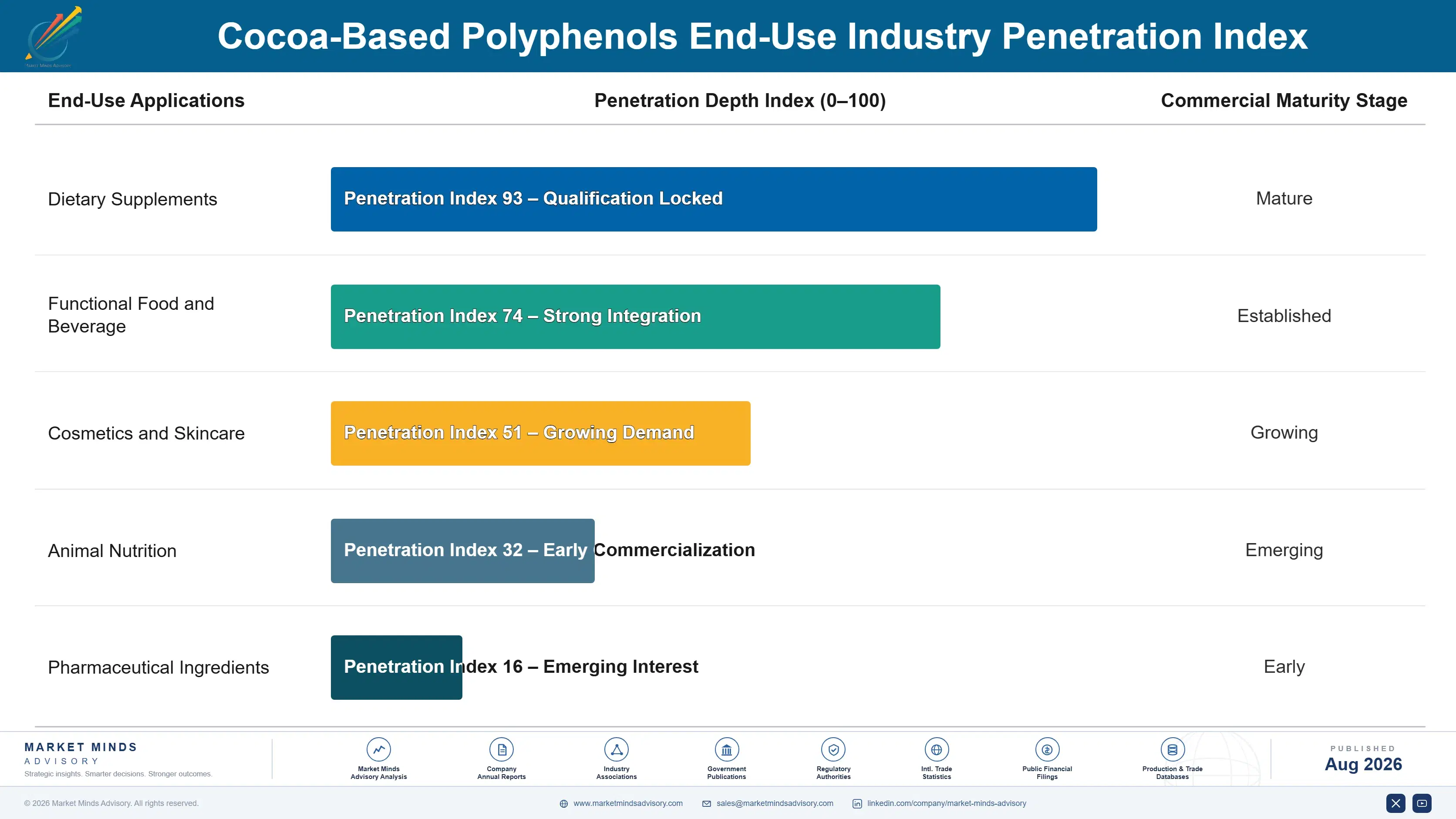
Once a polyphenol extract is formulated into a supplement product that has completed clinical substantiation and label claim review, that relationship typically persists for the full commercial life of the product line, since switching suppliers requires repeating costly documentation and substantiation work that most brands avoid absorbing without strong cause. This creates durable, low-churn revenue characteristics once formulation lock-in is achieved, distinct from the more competitive initia
Adoption depth varies sharply by vertical. Supplement brands show the deepest stickiness once formulation is locked in, since reformulation requires extensive clinical and regulatory rework that most brands avoid mid-product-life. Cosmetic formulators show moderate stickiness tied to product reformulation cycles. Functional food manufacturers show the least stickiness of the three, since product reformulations occur more frequently and reopen sourcing decisions more often than long-lived supplement products ever do.

Buyer profiles are shifting generationally as supplement brands increasingly weigh sustainability and traceability credentials, not just clinical substantiation, as explicit sourcing criteria. Younger brand management teams increasingly favor suppliers with credible byproduct valorization and ethical sourcing positioning, a consideration barely present in sourcing decisions before recent consumer sustainability awareness increased significantly.
cocoa-based-polyphenols-market-trends-end-use-penetration-index-1787310749978

Where MMA Sees the Opportunity

These are among the four positions where our research anticipates prominent divergence between winners and laggards over the coming forecast period. Each is grounded in the demand model, the regulatory perimeter, and the announced capacity pipeline.
01 / HUSK VALORIZATION INVESTMENT

Build Husk and Shell Extraction Capability Now

Husk valorization converts a historically discarded processing byproduct into a marketable ingredient stream at near-zero incremental feedstock cost, delivering meaningfully lower production cost than bean-derived extraction. Integrated cocoa processors that build this capability now capture value from material they already handle as part of core grinding operations, requiring far less new capital investment than building bean-derived flavanol extraction from scratch. This positions early movers to serve cost-sensitive functional food fortification demand that premium bean-derived extracts cannot economically address, capturing volume competitors focused only on flavanol extraction overlook entirely.
02 / CLINICAL DOCUMENTATION INVESTMENT

Invest in Clinical Substantiation Ahead of Category Growth

Clinical documentation depth is the single largest driver of pricing power in the premium supplement segment, and producers that invest in substantiation now position themselves ahead of continued cardiovascular supplement category growth through 2036. This investment requires sustained research funding and years of accumulated clinical evidence, but producers that achieve credible documentation gain access to the highest-margin segment of the entire market. Waiting until the category is obviously large risks ceding this documentation advantage to competitors who invested earlier and built substantiation depth first.
03 / WEST AFRICAN PROCESSING PARTNERSHIP

Partner With West African Producers on Value-Added Processing

Ivory Coast and Ghana are actively pursuing policy support for domestic value-added cocoa processing, creating an opportunity for extractors to establish early partnerships rather than competing against eventual domestic processing capacity later. Producers that build processing relationships with West African cooperatives and exporters now secure preferential feedstock access while supporting the origin-country value capture that increasingly matters to sustainability-conscious supplement brands. This positioning also reduces exposure to future export restrictions that origin countries could impose to encourage domestic processing, a policy direction both governments have signaled interest in pursuing.
04 / FUNCTIONAL FOOD TECHNICAL SUPPORT

Build Formulation Technical Support Capability for Food Manufacturers

Functional food manufacturers face genuine formulation challenges integrating polyphenol extracts without compromising taste, color, or shelf stability, a barrier that generic ingredient suppliers competing purely on price cannot solve for customers. Producers that embed food application scientists to support customer formulation work deepen relationships and improve retention meaningfully compared to commodity extract sellers. This capability requires technical staff investment but is considerably less capital-intensive than building new extraction capacity, making it accessible even to mid-scale producers with constrained capital budgets.

Engagement Snapshot From the Field

A live engagement with an industry participant carrying material or product regulatory and market exposure ahead of a defining policy shift, showing how our research translates into a defensible multi-year portfolio strategy.
MARKET MINDS ADVISORY · CLIENT ENGAGEMENT SUMMARY
Cocoa-Based Polyphenols Producer Strategic Portfolio Review and Transition Roadmap 2026·Investment Scenario on Cocoa-Based Polyphenols Exposure Evaluation 2025-26
CLIENT PROFILE
The client is a mid-sized United States dietary supplement brand generating approximately $180 million in annual revenue (client-reported, unverified by MMA) from a cardiovascular health product line built around standardized cocoa flavanol extract. The brand sourced extract from a single European supplier and was evaluating whether to diversify sourcing amid growing concerns about cocoa bean price volatility.
STRATEGIC CHALLENGE
The client needed to decide whether to qualify a second, husk-derived extract supplier offering approximately 20% (client-reported, unverified by MMA) lower cost, or maintain its existing single-source bean-derived extract relationship that carried the specific clinical substantiation data underlying its current product label claims and marketing. The brand needed clarity before committing to either path.
MMA APPROACH
MMA's advisory team analyzed whether husk-derived extract could support equivalent label claims given existing clinical evidence, and interviewed regulatory affairs specialists about the substantiation requirements for introducing a blended or alternative extract source without requiring entirely new clinical trials. The analysis weighed cost savings against regulatory and reformulation risk. The recommendation prioritized regulatory certainty alongside meaningful cost savings.
KEY FINDINGS
  1. Regulatory analysis indicated that existing clinical substantiation applied specifically to the bean-derived extract's flavanol profile, meaning a full husk-derived substitution would likely require new supporting clinical data before label claims could transfer.
  2. A blended formulation using husk-derived extract for a portion of total flavanol content, while maintaining bean-derived extract for the clinically documented core dosage, could reduce cost without triggering new substantiation requirements.
  3. Comparable brands that attempted full source substitution without updated clinical data faced regulatory scrutiny and delayed product relaunches averaging four to six months.
  4. The blended approach could reduce overall extract cost by approximately 8%, a smaller but achievable saving that avoided the regulatory risk of full substitution.
CLIENT PROFILE
The client is a mid-sized United States dietary supplement brand generating approximately $180 million in annual revenue (client-reported, unverified by MMA) from a cardiovascular health product line built around standardized cocoa flavanol extract. The brand sourced extract from a single European supplier and was evaluating whether to diversify sourcing amid growing concerns about cocoa bean price volatility.
STRATEGIC CHALLENGE
The client needed to decide whether to qualify a second, husk-derived extract supplier offering approximately 20% (client-reported, unverified by MMA) lower cost, or maintain its existing single-source bean-derived extract relationship that carried the specific clinical substantiation data underlying its current product label claims and marketing. The brand needed clarity before committing to either path.
MMA APPROACH
MMA's advisory team analyzed whether husk-derived extract could support equivalent label claims given existing clinical evidence, and interviewed regulatory affairs specialists about the substantiation requirements for introducing a blended or alternative extract source without requiring entirely new clinical trials. The analysis weighed cost savings against regulatory and reformulation risk. The recommendation prioritized regulatory certainty alongside meaningful cost savings.
KEY FINDINGS
  1. Regulatory analysis indicated that existing clinical substantiation applied specifically to the bean-derived extract's flavanol profile, meaning a full husk-derived substitution would likely require new supporting clinical data before label claims could transfer.
  2. A blended formulation using husk-derived extract for a portion of total flavanol content, while maintaining bean-derived extract for the clinically documented core dosage, could reduce cost without triggering new substantiation requirements.
  3. Comparable brands that attempted full source substitution without updated clinical data faced regulatory scrutiny and delayed product relaunches averaging four to six months.
  4. The blended approach could reduce overall extract cost by approximately 8%, a smaller but achievable saving that avoided the regulatory risk of full substitution.
RECOMMENDED STRATEGY
Phase 1: Phase 1 (Months 1-3): Confirm blended formulation ratios with the regulatory affairs team to ensure existing clinical substantiation remains applicable to labeling claims. Phase 2: Phase 2 (Months 4-7): Qualify the husk-derived supplier for the blended formulation portion while maintaining the existing bean-derived supply relationship for core dosage material. Phase 3: Phase 3 (Months 8-12): Transition production to the blended formulation and monitor consumer feedback and quality metrics before considering further sourcing adjustments.
OUTCOME
The client implemented the blended sourcing strategy without requiring new clinical trials, achieving an estimated 7 percentage points (client-reported, unverified by MMA) of cost savings while preserving its existing label claims and marketing substantiation. The diversified sourcing also reduced the brand's exposure to any single supplier's capacity or pricing disruption.

Frequently Asked Questions

Foundational context covering the market sizes, CAGR, scope, country, region and competition that inform every finding below. This section is provided to cover basics and most often pre-purchase conversations, answered from the MMA Primary Research Dataset.

What is the current size of the Cocoa-Based Polyphenols Market?

The Cocoa-Based Polyphenols Market was valued at $0.68 billion in 2025. MMA projects it will reach $0.74 billion in 2026 as supplement and functional food demand both continue expanding.

How large will the Cocoa-Based Polyphenols Market be by 2036?

MMA forecasts the market will reach $1.74 billion by 2036, up from $0.74 billion in 2026. That represents a 2.35 times expansion over the ten-year forecast window.

What is the CAGR for the Cocoa-Based Polyphenols Market 2026 to 2036?

The market is projected to grow at an 8.9% CAGR between 2026 and 2036. MMA's bull and bear scenarios range from 10.1% to 7.7% depending on cocoa bean price and health claim recognition.

Which segment is growing fastest?

High-Flavanol Cocoa Extracts is the fastest-growing segment, expanding at a 12.8% CAGR, roughly 1.44 times the overall market rate as dietary supplement demand for cardiovascular health products accelerates.

Who are the major companies in the Cocoa-Based Polyphenols Market?

Barry Callebaut, Cargill, Naturex, DSM-Firmenich, and Sensient Technologies lead the market, together holding an estimated 44% of global production capacity. This concentration reflects the market's still-fragmented competitive structure.

Which country is growing fastest?

India is the fastest-growing country market, expanding at an estimated 11.3% CAGR as domestic supplement and nutraceutical manufacturing capacity continues rapid expansion. Rising consumer health awareness continues to support this growth trajectory.

Report Segmentation Architecture

The full report scope spans multiple orthogonal segmentation dimensions, with cross-tabulated demand data provided for each dimension pair. Coverage extends further to regional breakdowns, trend trajectories, and the competitive detail needed to support segment-level decision-making.

By Primary Market Dimension

  • High-Flavanol Cocoa Extracts
  • Cocoa Procyanidin-Standardized Extracts
  • Cocoa Polyphenol Powders
  • Cocoa Husk and Shell-Derived Polyphenol Extracts
  • Cocoa Butter-Derived Polyphenol Fractions
  • Fermentation-Optimized Cocoa Polyphenol Extracts

By End-Use Industry

  • Dietary Supplements
  • Functional Food and Beverage
  • Cosmetics and Skincare
  • Animal Nutrition
  • Pharmaceutical Ingredients

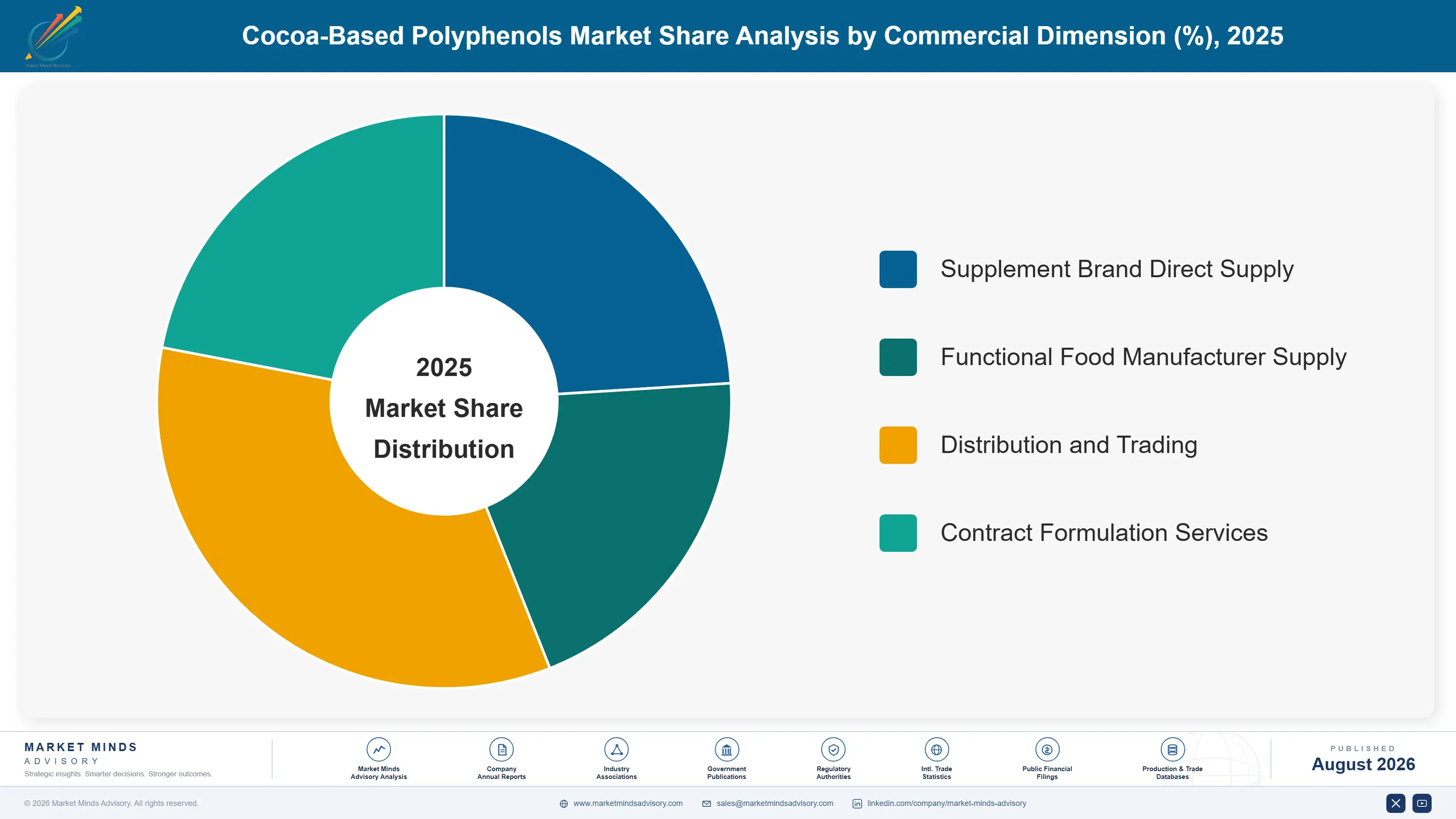
By Commercial Dimension

  • Supplement Brand Direct Supply
  • Functional Food Manufacturer Supply
  • Distribution and Trading
  • Contract Formulation Services

By Region

  • North America
  • Western Europe
  • East Asia
  • South Asia and Pacific
  • Latin America
  • Middle East and Africa
  • Eastern Europe

Scope, Methodology, and Coverage

Every figure in this report is reproducible from documented input assumptions. The scope below maps the historical period, the forecast horizon, the segmentation dimensions, and the countries covered, alongside the underlying primary and qualitative methodology.
Historical Period
2020 to 2025
Forecast Period
2026 to 2036
Base Year
2025 (USD billions; MMA Primary Research Dataset, August 2026)
Market Definition
This report covers polyphenol compounds extracted from cocoa beans, husks, and shells, including flavanols, procyanidins, and standardized polyphenol powders, used in dietary supplements, functional foods, and cosmetic formulations. It excludes cocoa butter, cocoa powder sold for confectionery use, and finished chocolate products.
Quantitative Units
USD billions (current prices); metric tons of extracted polyphenol material where applicable
Segmentation Dimensions
By Extraction Source and Standardization Level; By End-Use Industry; By Commercial Dimension; By Region
Regions Covered
North America, Western Europe, East Asia, South Asia and Pacific, Latin America, Middle East and Africa, Eastern Europe
Countries Covered
USA, China, Germany, France, UK, Japan, South Korea, India, Australia, Canada, Brazil, Mexico, Indonesia, Vietnam, Thailand, Malaysia, UAE, Saudi Arabia, South Africa, Nigeria, Turkey, Poland, Netherlands, Italy, Spain, Sweden, Switzerland, Argentina, Colombia, Singapore, and additional markets relevant to this sector
Key Companies Profiled
Barry Callebaut AG, Cargill Incorporated, Naturex, DSM-Firmenich, Sensient Technologies Corporation, Nexira SAS, Archer-Daniels-Midland Company, Olam International, Cocoatree SA, Blue California, Indena S.p.A., Kerry Group plc, Ingredion Incorporated, Fuji Chemical Industries Co. Ltd., Synthite Industries Ltd., Martin Bauer Group, Euromed S.A., Symrise AG, Bioriginal Food & Science Corp., JB Cocoa Sdn Bhd
Quantitative Methodology
Primary survey, n=3,800 respondents, Q4 2025, six countries; demand-side model with trade association cross-validation
Qualitative Methodology
47 expert interviews, Q4 2025; applied to validate demand model assumptions, identify emerging dynamics, and assess competitive positioning
Report Format
PDF and XLSX data workbook (Word format preview document)
Publisher
Market Minds Advisory
Report Code
MMA-2026-CHM-106
Published
August 2026
Contact
sales@marketmindsadvisory.com | www.marketmindsadvisory.com

Purchase the full Cocoa-Based Polyphenols Market Report (2026 to 2036).

The full Cocoa-Based Polyphenols Market report delivers ten-year forecasts across all seven regions, six product segments, and the full competitive landscape of twenty profiled producers. It includes detailed analysis of clinical documentation economics, husk valorization technology, and demand drivers spanning dietary supplements, functional foods, and cosmetics. Buyers receive segment-level margin benchmarking across the volume, premium, and sustainability tiers identified in this summary. The report also includes primary survey data from 3,800 respondents and 47 expert interviews conducted in the fourth quarter of 2025, supporting every demand and pricing assumption in the forecast.
Ten-year regional and segment-level forecast models
Competitive profiles covering twenty ingredient producers
Clinical documentation and health claim economics analysis
Husk valorization and feedstock cost risk modeling
Portfolio margin benchmarking across three commercial tiers
Primary survey and expert interview data appendix

Built For The People Who Decide

From boardroom strategy to bench-side execution, this report is read cover-to-cover by leaders shaping the next decade of their industry, turning demand scenarios, market dynamics and valuation benchmarks into decisions.
CXOs/ Presidents/ VPs/ Managers
M&A and Corporate Development
Strategy Teams and R&D Heads
Procurement and Product Directors
Regulatory and Compliance Leaders
Investor Relations and Equity Analysts