Market Minds Advisory
Cocktail Shakers Market

Cocktail Shakers Market: Cocktail Shakers Market: The Best-Selling Design Is The One Professionals Rejected, And A Gifting Category Wearing Housewares Clothes, 2026 to 2036

Around 89% of working bartenders use the two-piece Boston and consumers overwhelmingly buy the three-piece cobbler, which seizes when properly chilled. About 61% of units are bought by somebody other than the user.

Lead Analyst

Published

September 2026

Make Smarter Decisions with Customized Research Insights

Request a free sample report and evaluate market opportunities, growth trends, and competitive dynamics relevant to your business needs.

2025 MARKET VALUE$0.7BMarket Size 2025
2036 FORECAST VALUE$1.2BBase Case , 2026 to 2036
CAGR 2026 TO 20365.8 %Bull 7.0% / Bear 4.6%
INCREMENTAL OPPORTUNITY$0.5BNet 10- year value creation
EXPANSION MULTIPLE1.71x2036 value over 2026 base
Strategic Levers
M&A Pipeline
Regional Outlook
Country Rankings
Competitive Intelligence
Segmental Deep-dive
Call-Us : 91 93563 13602

Executive Snapshot and Market Trajectory.

Roughly 89% of working bartenders use a two-piece Boston shaker. Consumers overwhelmingly buy the three-piece cobbler, which seizes when the drink is properly chilled because the metal contracts. The design professionals rejected is the design that sells. It sells because it looks like one and includes a strainer.
Insulated and vacuum shakers grow at 8.7%, half again the market rate of 5.8%, on a genuine functional argument about dilution control rather than on appearance alone. Boston two-piece shakers follow at 7.4% as home enthusiasts move toward professional technique. Cobbler shakers grow slowest of the six designs at 4.6%, and still hold the largest share of units. It still holds the largest share of units by a wide margin.
About 61% of units are bought by somebody other than the eventual user and 47% of annual volume moves in the final calendar quarter, which makes this a gifting business wearing housewares clothes. East Asia holds 29% of demand. Median household use runs about six occasions a year, so replacement demand barely exists at all. Volume follows household formation and gifting occasions rather than anything wearing out, which is unusual for a metal kitchen product.
Market Definition
This market covers cocktail shakers and integrated shaking vessels for beverage preparation, including Boston two-piece shakers, cobbler three-piece shakers, French Parisian shakers, insulated and vacuum shakers, powered and electric shaking devices, and single-serve and portable shakers. It excludes mixing glasses and stirring vessels, separately sold jiggers, strainers and muddlers, blenders and food processors, and multi-item barware gift sets where the shaker is not the primary article.
Base Year Value
$0.7B in 2025 (MMA Primary Research Dataset, September 2026)
Forecast Period
2026 to 2036, eleven discrete annual values
CAGR
5.8% base case. Bull 7.0%. Bear 4.6%.
Fastest Growth Segment
Insulated And Vacuum Shakers: 8.7% CAGR
Fastest Growth Country
China: 9.6% CAGR
Fastest Growth Region
South Asia and Pacific: 7.8% CAGR
Largest Region
East Asia: 29% of 2025 global value
Market Leaders
Zwilling J.A. Henckels, Groupe SEB, Lifetime Brands, Helen of Troy, and Yukiwa Seiko lead the field. Source: MMA Primary Research Dataset, July 2026.
Primary Survey
n=3,800 procurement and R&D decision-makers, Q4 2025, six countries
Methodology
Demand-side build-up, cross-validated against public data, 47 expert interviews

Cocktail Shakers Market Forecast Scenarios

cocktail-shakers-market-size-forecast-scenario-1790017875829
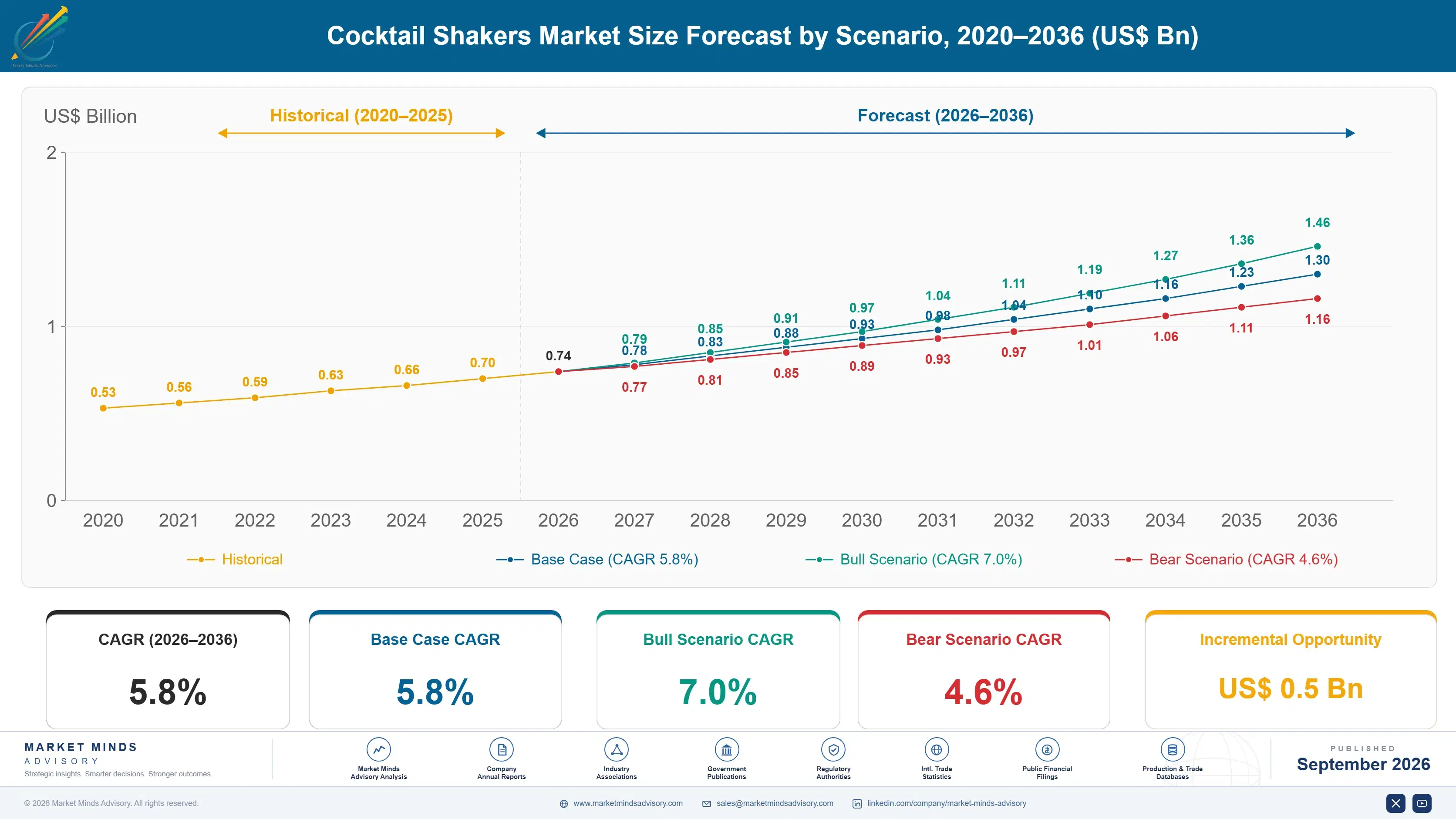
Growth from 2020 to 2025 ran at 4.8% and came almost entirely from home consumption during and after the period when bars were closed. Households that had never owned barware bought it, and a meaningful share of that equipment has been used a handful of times since. Professional and on-trade demand recovered slowly and remains small in units while setting the design language consumers copy.
The base case at 5.8% rests on three mechanisms. Home enthusiast demand keeps migrating toward professional formats, which lifts Boston and French designs against cobblers. Asian at-home cocktail consumption expands quickly from a low base, with Chinese growth at 9.6% leading every country covered. And insulated formats grow on a dilution control argument that is technically sound rather than decorative. None of the three assumes retail merchandising changes at all.
The bull case at 7.0% depends on the enthusiast segment broadening enough that performance features start deciding purchases rather than presentation, which would reprice the whole category upward. The bear case at 4.6% is gifting exposure: about 61% of units are bought as gifts and 47% of volume moves in one quarter, so a weak holiday season removes a year of growth.

The Design Professionals Rejected

A cobbler shaker is three pieces: tin, built-in strainer, and cap. Chill it properly and the metal contracts at different rates, the strainer seats hard into the tin, and it jams. Around 34% of cobbler owners report exactly that. Professionals worked this out decades ago and about 89% now use a two-piece Boston, which separates with a palm strike because there is nothing to seize. Consumers buy the cobbler anyway.
TOP FIVE CONCENTRATION22%Share of category revenue held by the leading manufacturers
FOURTH QUARTER VOLUME SHARE47%Annual unit volume moving in the final calendar quarter
GIFT PURCHASE SHARE61%Units bought by somebody other than the eventual user
COBBLER SEIZURE COMPLAINTS34%Cobbler owners reporting the vessel jamming when properly chilled
MEDIAN ANNUAL USE6 timesOccasions a household shaker is used in a year
PROFESSIONAL BOSTON PREFERENCE89%Working bartenders choosing the two-piece design over alternatives
They buy it because it looks like a cocktail shaker, includes a strainer, and photographs well in a gift box. That last point matters more than the first two. Around 61% of units are purchased by somebody other than the person who will use them, and 47% of annual volume moves in the final quarter. The buyer is not the user and cannot know which design works.
Then there is what happens after the box is opened. Median household use is about six occasions a year, which means these products do not wear out and replacement demand is close to nonexistent. Category volume depends on household formation, gifting occasions, and enthusiasts trading up. It does not depend on anything breaking, which is unusual for a metal kitchen product.
"The category's best seller is a design working bartenders abandoned because it jams when you use it properly. It survives because the person buying it is not the person using it, and a three-piece set looks more like a present than two plain tins do."
Practice Director, Housewares and Foodservice Equipment · MMA Consumer Housewares and Foodservice Equipment Practice · September 2026

Market Trends

Enthusiasts Migrate Toward Professional Formats Steadily

Boston two-piece shakers grow at 7.4% against cobblers at 4.6%, as home enthusiasts who actually make drinks discover why bars use them. The migration follows video instruction rather than retail merchandising, since almost every bartending channel demonstrates on a Boston and never explains why. That leaves a growing group of buyers who want the professional format and a retail shelf still organised around gift presentation. Brands serving the enthusiast directly through their own channels capture that shift; those relying on department store shelves largely do not. The mix shift is mildly dilutive, since a Boston costs less to make.
Market Impact: Country grows at 9.6%

Insulation Brings A Real Functional Argument Back

Insulated and vacuum shakers grow at 8.7%, fastest of the six designs, on dilution control rather than appearance. A single-wall tin frosts and pulls heat from the room, so extended shaking over-dilutes; a vacuum wall holds the temperature and lets the bartender shake to texture rather than to a clock. This is the first genuinely functional argument the category has had in years, and it is one consumers can be shown rather than told. Premium pricing holds considerably better here than anywhere else covered. Manufacturing is considerably harder, because a double wall must survive repeated thermal shock without seal failure.
Market Impact: Gifts are 61% of units

Market Opportunities and Growth Drivers

Asian At-Home Cocktail Culture Builds Quickly

China grows at 9.6%, faster than any country covered, as at-home cocktail preparation moves from a novelty into an established leisure activity among urban households. East Asia holds 29% of world demand, helped considerably by Japan, where bartending is treated as a craft discipline and shaker manufacture is a specialist trade rather than a housewares line. Korean demand follows a similar enthusiast pattern. Regional production capacity also sits here, which keeps unit costs low across every price tier. Japanese craft manufacture supports price points no housewares brand anywhere else has been able to reach or defend.
Market Impact: Covers 61% of purchases

Gifting Occasions Rather Than Wear Drive Volume

Around 61% of units are bought as gifts and 47% of annual volume moves in the final calendar quarter, which means demand follows occasions rather than product life. Median household use is roughly six times a year, so nothing wears out and nothing needs replacing. That makes new household formation, holiday gifting, and wedding registries the actual volume drivers. It also explains why presentation, packaging, and perceived completeness of a set outsell any performance feature at retail. It also explains why a weak holiday quarter removes an entire year of growth rather than deferring it into the next one.
Market Impact: Median 6 uses per year

Market Restraints and Challenges

The Buyer Cannot Judge What They Are Buying

About 61% of units are purchased by somebody other than the eventual user, and the root cause is that this is a gifting category rather than a considered housewares purchase. Commercially it means performance features do not sell, because the buyer has never used a shaker and cannot evaluate a seal, a seizure risk, or a steel grade. Manufacturers respond with presentation-led packaging that also communicates function, with recipe inclusion, and with direct enthusiast channels bypassing the gift shelf. None of that reaches a buyer standing in front of a shelf of boxed sets in December.
Market Impact: Boston grows at 7.4%

Nothing Wears Out So Nothing Gets Replaced

Median household use runs about six occasions a year, and the root cause is that a shaker is bought for an intention rather than a habit. Commercially this removes replacement demand almost entirely and ties the category to household formation and gifting occasions instead. Manufacturers respond by building enthusiast communities that raise use frequency, by selling consumable adjacents alongside the hardware, and by targeting the on-trade where equipment genuinely does wear out. On-trade equipment is the exception and wears out on a cycle measured in months rather than decades. That is a completely different business inside the same category.
Market Impact: Segment grows at 8.7%
4 additional market trends, 3 additional growth drivers, and 2 additional restraints and challenges are covered in the full report. Contact sales@marketmindsadvisory.com to access the complete intelligence.

Segment CAGR and Growth Architecture

Segmentation follows shaker design and construction type across six categories: Boston two-piece shakers, cobbler three-piece shakers, French Parisian shakers, insulated and vacuum shakers, powered and electric shaking devices, and single-serve and portable shakers. Material grade, price tier, and channel are treated as separate dimensions rather than folded into this hierarchy. Separately sold strainers, jiggers, and muddlers fall outside the scope.
cocktail-shakers-market-market-share-analysis-1790017876388

Insulated And Vacuum Shakers

Insulated and vacuum shakers grow at 8.7%, half again the market rate of 5.8%, on the only genuinely functional argument this category has produced in years. A single-wall tin frosts within seconds and draws heat from the room and the hand, so a longer shake over-dilutes the drink; a vacuum wall holds temperature and lets the shake run to texture instead. That is demonstrable rather than assertable, which matters enormously in a category where most claims are decorative. Premium pricing holds better here than anywhere else covered. Manufacturing is considerably harder, since a double wall must survive repeated thermal shock without seal failure. Seal failure after repeated thermal cycling is the defect that separates competent manufacture from the rest.
CAGR 8.7%

Boston Two-Piece Shakers

Boston shakers grow at 7.4% as home enthusiasts follow professional practice, where around 89% of working bartenders use them. Two tins, or a tin and a glass, seal on impact and separate with a palm strike, and there is no third component to seize when the metal contracts. The design is also cheaper to manufacture than a cobbler and sells for less, which makes the mix shift mildly dilutive to category value even as it improves what people own. Retail merchandising still favours cobblers because two plain tins do not look like a gift. Enthusiast direct channels carry most of this growth. Two plain tins do not photograph like a present.
CAGR 7.4%
Full segment breakdown across 6 segments available in the complete report.

Regional Architecture and Country Demand Map

Regional shares reflect where cocktail shakers are purchased rather than where they are manufactured. All seven regions sit inside the standard bands, and the drivers behind each are named in the paragraphs below. Gifting concentration and enthusiast penetration vary considerably, and each paragraph names the mechanism.

East Asia

Japan treats bartending as a craft discipline with its own technique vocabulary, and Japanese shaker manufacture is a specialist metalworking trade rather than a housewares line, which supports price points no other region sustains. Growth of 6.8% runs above the world rate. Chinese growth of 9.6% leads every country covered as at-home cocktail preparation becomes an established urban leisure activity. Korean enthusiast demand follows a similar pattern from a smaller base. Most of the world's volume manufacturing also sits in the region, which keeps costs low across every tier. Gifting behaviour is strong but concentrated around different calendar occasions. Enthusiast penetration is rising faster than gift purchasing across the region.
Share: 29% | CAGR: 6.8% (2026 to 2036)

North America

Home bar culture is more established here than anywhere outside Japan, and the enthusiast segment that follows professional technique is the largest of any region. Growth of 5.2% runs a little under the world rate. Gifting concentration is extreme, with holiday and wedding registry purchasing accounting for the majority of annual units. Direct enthusiast channels and specialist barware retailers have grown considerably faster than department store distribution. On-trade demand is meaningful and sets the technique that home buyers imitate. Cobbler share remains high at mass retail despite the enthusiast shift running the other way. That divergence between what enthusiasts buy and what mass retail stocks is wider here than in any other region.
Share: 27% | CAGR: 5.2% (2026 to 2036)
Regional intelligence for 5 additional markets available in the complete report: Western Europe, South Asia and Pacific, Latin America, Middle East and Africa, Eastern Europe. Contact sales@marketmindsadvisory.com.
cocktail-shakers-market-country-cagr-analysis-1790017876917

Where Shaker Brands Actually Earn

Four commercial moves matter in a category where the buyer is usually not the user, the best seller is the worst design, and nothing ever wears out. Each works around one of those facts rather than pretending it away, which is what most of the field currently does at retail. Each also costs less than defending shelf space.

Build Direct Enthusiast Channels Around Technique

Boston shakers grow at 7.4% against cobblers at 4.6% because enthusiasts follow video instruction rather than retail merchandising. Brands selling direct with technique content attached report gross margin 2.3 times better than department store distribution of the same product. The enthusiast knows what they want and is buying for themselves rather than for somebody else, which removes the presentation constraint that shapes everything on a gift shelf. That channel is also considerably cheaper to serve. Technique content costs little to produce and doubles as the acquisition mechanism, which makes the channel unusually efficient to build from a standing start.
Market Impact: Raises gross margin to 2.3 times better overall

Make Function Visible Inside Gift Packaging

Around 61% of units go to somebody other than the user, and the buyer cannot evaluate a seal or a seizure risk. Brands packaging function as a visible claim, showing why a two-piece separates and a three-piece jams, report unit prices 1.7 times higher than presentation-only equivalents. The constraint is that the box must still look like a present. Solving both at once is a packaging design problem rather than a product one, and almost nobody has attempted it. A simple diagram of why a three-piece jams does more work than copy about steel grade.
Market Impact: Raises achieved unit prices to 1.7 times higher

Sell Dilution Control Where It Can Be Demonstrated

Insulated shakers grow at 8.7% on a temperature argument that can be shown rather than asserted, which is rare in a category dominated by decorative claims. Brands leading with demonstrable dilution control report premium tier conversion 2.6 times higher than those leading on finish or materials. A frosted single-wall tin drawing heat from the room is visible in a ten second demonstration. Almost every competing claim in this market requires the buyer to take somebody's word for it. The demonstration also travels through video without modification, which is where enthusiast demand now forms.
Market Impact: Raises premium tier conversion to 2.6 times higher

Pursue On-Trade Where Equipment Genuinely Wears

Household shakers are used a median of six times a year and never wear out, while a working bar shakes hundreds of drinks a night and replaces tins regularly. Brands building on-trade supply positions report revenue per account 4.2 times higher than household retail equivalents over a five-year period. On-trade units are small in absolute terms and they repeat, which is the opposite of the consumer business. The technique credibility also feeds back into enthusiast demand. Working bartenders also become the source of the technique instruction that enthusiast buyers follow, so the position pays twice over a full cycle.
Market Impact: Raises revenue per account to 4.2 times higher

Who Controls the Margin Pool

Concentration is extremely low. Five manufacturers hold 22% of category revenue, measured consistently on that basis across all participants, and the remainder spreads across housewares groups, specialist barware brands, foodservice equipment suppliers, Japanese craft metalworkers, and a very large Chinese production base supplying private label. Barriers to entry are close to nonexistent for basic stainless formats. Fragmentation at this level is unusual even among housewares categories.
Competition currently turns on three dimensions: channel position, since direct enthusiast selling and gift retail reward completely different products; manufacturing capability in insulated formats, where thermal shock and seal durability are genuinely difficult; and technique credibility with the on-trade, which feeds enthusiast demand rather than generating volume itself. Price decides almost entirely at gift retail, which still accounts for the majority of units moved across every region covered here.

Pressure builds from two directions at once. Chinese private label production supplies gift retail at costs no branded manufacturer can approach. Enthusiast demand is migrating to direct channels and to formats that photograph badly. Rankings will shift toward brands holding insulated manufacturing capability and direct enthusiast reach rather than shelf space. Brands holding only boxed gift set volume are most exposed.
cocktail-shakers-market-company-positioning-matrix-1790017877440

Competitive Moat and Risk Dimensions

ZWILLING J.A. HENCKELS

Moat: Premium Brand And Retail Reach

A kitchenware brand that consumers already associate with quality metal carries a shaker onto premium retail shelves and into gift purchasing without needing to explain anything about barware. In a category where 61% of buyers are choosing for somebody else, brand recognition substitutes almost entirely for product judgement.
ZWILLING J.A. HENCKELS

Risk: Weak Enthusiast Channel Presence

The fastest growing part of this market buys direct, follows video technique instruction, and prefers formats that look like tools rather than gifts. Premium kitchenware brand equity carries little weight with a buyer who is choosing between two plain tins on the basis of how they seal.
YUKIWA SEIKO

Moat: Craft Manufacture And Technique Authority

Specialist Japanese shaker manufacture with a genuine following among working bartenders supports price points no housewares brand can reach, and the authority is earned through professional use rather than marketing. That credibility compounds slowly and cannot be bought by a competitor at any price. Working bartenders are also where enthusiast buyers learn technique.
YUKIWA SEIKO

Risk: Very Narrow Volume Base

Craft manufacture at premium price points serves a small enthusiast and professional population, which leaves the business exposed to a niche rather than to a market. Scaling without diluting the authority that justifies the price is a problem this position has never really had to solve before.

Players Tracked

Prominent Players

Zwilling J.A. Henckels
Groupe SEB
Lifetime Brands
Helen of Troy
Yukiwa Seiko

Other Key Players

Cocktail Kingdom
Mercer Culinary
True Brands
Libbey
Alessi
WMF Group
Vollrath Company
Winco Industries
Browne Foodservice
Metrokane
Uber Bar Tools
Tiger Corporation
Hario
Kai Corporation
Tramontina

Recent Developments

MARCH 2026

Cocktail Kingdom Expands Direct Enthusiast Channel And Technique Programme

Cocktail Kingdom expanded its direct sales operation alongside a structured technique instruction programme, targeting home enthusiasts migrating from cobbler to Boston formats. The approach bypasses gift retail entirely and sells to the eventual user. Professional format sales through the channel grew considerably faster than gift retail equivalents.
Signal: Selling to the user rather than the gift buyer changes which designs win. They want different products.
OCTOBER 2025

Zwilling Expands Vacuum Insulated Barware Production Capacity

Zwilling J.A. Henckels completed an organic expansion of vacuum insulated barware manufacturing, funded internally with no partner involved. Management cited dilution control demand from enthusiast buyers rather than any shortage in conventional single-wall formats. Seal durability under repeated thermal cycling was the stated engineering focus of the expansion.
Signal: Insulated manufacture is where the category's only demonstrable claim now sits. Demonstrable claims are worth more than decorative ones here.
JUNE 2025

Lifetime Brands Acquires Specialist Barware Tool Business

Lifetime Brands completed an acquisition of a specialist barware tool business with established on-trade distribution. The transaction was an outright acquisition rather than a joint venture or minority stake, with professional channel access cited as the rationale. Existing professional distribution relationships transferred with the business under agreed terms.
Signal: On-trade credibility is being bought because it cannot be manufactured or advertised. It cannot be advertised.

What A Shaker Costs

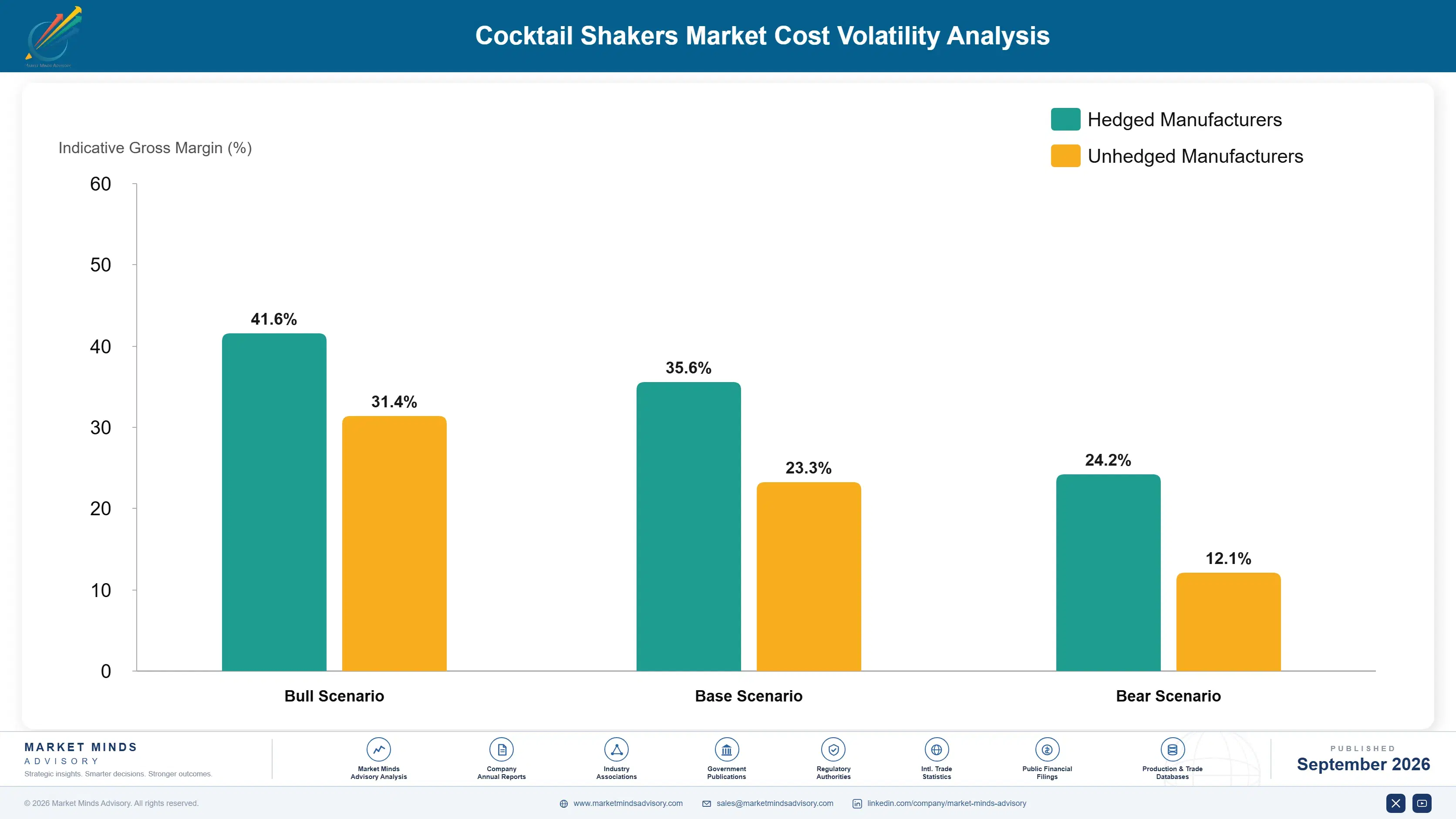
Three cost groups dominate. Stainless steel runs 30% to 38% of cost of goods sold, and the range separates austenitic grades from cheaper ferritic substitutes. Forming, polishing, and finishing take 26% to 34%, rising sharply for mirror polish and coated finishes. Packaging and gift presentation account for 20% to 28%, extraordinary for a metal product.
Nickel and chromium pricing moved through 2024 and 2025 on mine supply and stainless demand together, and United States Geological Survey mineral commodity summaries documented the underlying movements across the period. Several housewares manufacturers described the resulting margin pressure in their annual reports. Packaging board costs followed pulp and freight cycles that had no relationship to metal pricing at any point in the window at all.

The competitive disadvantage mechanism runs through packaging and channel rather than through metal cost. A brand selling into gift retail carries presentation cost as a large share of a modest unit price and cannot recover it, while a direct enthusiast seller ships in plain packaging at a higher price. Exposure therefore varies by channel rather than by scale, and mid-sized brands committed to department store distribution are the most squeezed.
cocktail-shakers-market-cost-volatility-analysis-1790017877637

Shift Channel Mix Toward Direct Enthusiast Selling

Gift retail forces presentation cost onto a modest unit price and rewards designs that photograph well rather than work well. Direct selling to the eventual user removes the packaging burden and the design constraint together, which is the only channel change that materially alters both the cost structure and the product mix at once.

Contract Stainless Against Mine Supply Rather Than Season

Nickel and chromium pricing follows mine supply and industrial stainless demand at volumes housewares manufacture cannot influence in any direction. Contracting against those cycles rather than against the fourth quarter production peak removes most of the exposure and secures allocation when larger consumers compete for the same output. Fourth quarter production peaks and mine supply cycles have never aligned.

Standardise Packaging Architecture Across The Range

Presentation runs close to a quarter of goods sold and rises fastest at entry price points where it can least be absorbed. A shared packaging architecture across a range converts a per-product tooling and inventory problem into a volume position, which is the only lever that moves this line for a brand committed to gift retail.

Portfolio Architecture for Margin Defence

Margin follows channel and manufacturing difficulty rather than design. Entry stainless cobblers compete close to commodity terms against Chinese private label. Branded gift sets earn modestly on presentation and recognition. Craft manufactured professional shakers earn well on authority that cannot be advertised into existence, and vacuum insulated formats earn most, because thermal shock and seal durability are genuinely hard to manufacture.
The tension between volume and premium runs through who is buying. A gift purchaser choosing among boxed sets is deciding on appearance, completeness, and price, and no performance argument reaches them at the point of sale. An enthusiast buying direct after watching a technique video is deciding on seal, weight, balance, and separation, and will pay several times the gift price for a product that photographs badly.

High-value pools concentrate in vacuum insulated formats, in craft manufactured professional shakers, and in on-trade supply where equipment genuinely wears out and repeats. Where the product is an entry stainless cobbler in a boxed set for the fourth quarter, Chinese private label production holds cost and tooling proximity together and there is very little left for anybody else.

Volume / Commodity-Adjacent

Entry stainless cobblers, basic Boston tins, and boxed gift sets sold through mass and department store retail. The ten-point range reflects packaging cost and sourcing position rather than any capability a buyer would pay a premium to obtain.
Gross Margin: 26% to 36%

Premium / Certified

Branded premium shakers with verified austenitic steel grades, mirror or specialist finishes, and design-led presentation. The twelve-point range separates genuine finish and material quality from products claiming grades that laboratory testing would not support.
Gross Margin: 42% to 54%

Sustainability / Regulatory / Next-Generation

Vacuum insulated shakers and craft manufactured professional formats sold direct to enthusiasts and the on-trade. The fourteen-point range reflects manufacturing difficulty and channel position, neither of which a private label producer can replicate quickly.
Gross Margin: 58% to 72%
cocktail-shakers-market-portfolio-architecture-1790017878141

High-value Sub-segments and Strategic Watch-out

Vacuum Insulated Shaker Formats

Highest value in the category and the only design carrying a demonstrable functional claim rather than a decorative one. The fourteen-point range reflects manufacturing capability, since a double wall must survive repeated thermal shock without any seal failure. Very few manufacturers get that consistently right at volume.
Gross Margin: 60% to 74%

Craft Professional Shakers

High value on authority earned through working bartender use rather than through any marketing spend. The twelve-point range reflects manufacturing precision and finish, which is what justifies price points no housewares brand can reach. Scaling without diluting the authority is the unsolved problem. Nobody has managed it yet.
Gross Margin: 52% to 64%

Direct Enthusiast Boston Formats

Volume core growing at 7.4% as home users follow professional technique they learned from video rather than retail. The twelve-point range reflects channel position, since the same tin earns very differently direct than it does on a shelf. Technique content doubles as the acquisition mechanism here.
Gross Margin: 44% to 56%

Boxed Gift Cobbler Sets

The strategic watch-out. Slowest growing design, a seizure complaint rate near 34%, and Chinese private label holding cost and tooling together. The ten-point range reflects packaging and sourcing position, with nothing else defending it. Returns and negative reviews cluster on the seizure complaint. That is expensive.
Gross Margin: 24% to 34%

How This Demand Repeats

Household demand barely repeats at all. A shaker is used a median of six times a year, survives indefinitely at that rate, and is replaced only when a household forms, moves, or receives another one as a gift. That ties consumer volume to occasions rather than to product life, which is why the fourth quarter carries 47% of units and a weak holiday season removes a year of growth.
On-trade demand behaves in the opposite direction entirely. A working bar shakes hundreds of drinks a night, tins deform, seals wear, and replacement runs on a cycle measured in months rather than decades. Unit volumes are small against the consumer market but they repeat reliably, and the technique credibility earned there feeds back into enthusiast demand that no advertising budget can substitute for.

The enthusiast buyer sits between the two and is where the category's growth actually lives. They buy for themselves rather than as a gift, they follow professional technique learned from video, and they replace equipment as their practice develops rather than when it fails. That behaviour resembles a hobby purchase far more than a housewares one, and brands organised around gift retail reach almost none of them.
cocktail-shakers-market-end-use-penetration-index-1790017878635

Where This Market Rewards

These are among the four positions where our research anticipates prominent divergence between winners and laggards over the coming forecast period. Each is grounded in the demand model, the regulatory perimeter, and the announced capacity pipeline.
01 / DIRECT ENTHUSIAST CHANNEL

Sell to the user not the giver

Boston shakers grow at 7.4% against cobblers at 4.6% because enthusiasts follow video technique instruction rather than anything a retail shelf communicates to them at the point of sale. Brands selling direct with technique content attached report gross margin 2.3 times better than department store distribution of identical product. The enthusiast is buying for themselves, which removes the presentation constraint that shapes every decision on a gift shelf, and technique content costs little to produce while doubling as the acquisition mechanism itself.
02 / FUNCTION VISIBLE PACKAGING

The buyer cannot judge the product

Around 61% of units go to somebody other than the eventual user, and that buyer has never used a shaker and cannot evaluate a seal, a seizure risk, or a steel grade. Brands packaging function as a visible claim, showing why a two-piece separates while a three-piece jams, report unit prices 1.7 times higher than presentation-only equivalents. The box must still look like a present, which makes this a packaging design problem rather than a product one, and a simple diagram does more work than any copy about steel grade.
03 / DEMONSTRABLE DILUTION CONTROL

Show it rather than claim it

Insulated shakers grow at 8.7% on a temperature argument that can be demonstrated in ten seconds, which is genuinely rare in a category where nearly every competing claim is decorative and unverifiable. Brands leading with dilution control report premium tier conversion 2.6 times higher than those leading on finish or materials. A frosted single-wall tin visibly drawing heat from the room does more selling than any description of steel grade ever manages, and the demonstration travels through video without modification, which is where enthusiast demand now forms.
04 / ON-TRADE SUPPLY POSITION

Only bars wear equipment out

Household shakers are used a median of six times a year and effectively never wear out, while a working bar shakes hundreds of drinks nightly and replaces tins on a cycle measured in months. Brands building on-trade supply positions report revenue per account 4.2 times higher than household retail over five years. The technique credibility earned in professional use also feeds enthusiast demand in a way advertising has never managed to replicate, and working bartenders are also where those enthusiast buyers learn their technique in the first place.

Engagement Snapshot From the Field

A live engagement with an industry participant carrying material or product regulatory and market exposure ahead of a defining policy shift, showing how our research translates into a defensible multi-year portfolio strategy.
MARKET MINDS ADVISORY · CLIENT ENGAGEMENT SUMMARY
Cocktail Shakers Producer Strategic Portfolio Review and Transition Roadmap 2026·Investment Scenario on Cocktail Shakers Exposure Evaluation 2025-26
CLIENT PROFILE
A housewares group with barware revenue near USD 46 million (client-reported, unverified by MMA) across North America and Western Europe. The range was built around boxed cobbler gift sets, fourth quarter concentration had risen for four consecutive years, and returns and negative reviews had climbed alongside without anybody establishing why. Nobody had read the reviews in any structured way.
STRATEGIC CHALLENGE
The commercial team read rising seasonality as evidence the gift positioning was working and had proposed expanding the boxed set range further. Nobody had read the negative reviews in any structured way, and the group had no visibility at all of what happened to the product after it left the shelf.
MMA APPROACH
MMA coded three years of product reviews and return reasons, surveyed both gift purchasers and eventual recipients separately, tested seizure behaviour across the range at genuine chilled working temperatures, and modelled channel economics for direct enthusiast selling against the incumbent retail structure. Purchasers and recipients were surveyed as separate populations rather than treated as one customer.
KEY FINDINGS
  1. A clear majority of negative reviews described the shaker jamming shut, and bench testing confirmed the cobbler design seized reliably once chilled to proper working temperature.
  2. Gift purchasers and recipients described completely different priorities, with buyers citing appearance and completeness while recipients cited leaking, jamming, and difficulty separating.
  3. Recipients reported using the product a median of five times in the first year, and roughly a third had stopped using it entirely after the jamming issue.
  4. Direct channel modelling showed margin on an unboxed two-piece Boston exceeding the boxed cobbler set despite a considerably lower retail price point.
CLIENT PROFILE
A housewares group with barware revenue near USD 46 million (client-reported, unverified by MMA) across North America and Western Europe. The range was built around boxed cobbler gift sets, fourth quarter concentration had risen for four consecutive years, and returns and negative reviews had climbed alongside without anybody establishing why. Nobody had read the reviews in any structured way.
STRATEGIC CHALLENGE
The commercial team read rising seasonality as evidence the gift positioning was working and had proposed expanding the boxed set range further. Nobody had read the negative reviews in any structured way, and the group had no visibility at all of what happened to the product after it left the shelf.
MMA APPROACH
MMA coded three years of product reviews and return reasons, surveyed both gift purchasers and eventual recipients separately, tested seizure behaviour across the range at genuine chilled working temperatures, and modelled channel economics for direct enthusiast selling against the incumbent retail structure. Purchasers and recipients were surveyed as separate populations rather than treated as one customer.
KEY FINDINGS
  1. A clear majority of negative reviews described the shaker jamming shut, and bench testing confirmed the cobbler design seized reliably once chilled to proper working temperature.
  2. Gift purchasers and recipients described completely different priorities, with buyers citing appearance and completeness while recipients cited leaking, jamming, and difficulty separating.
  3. Recipients reported using the product a median of five times in the first year, and roughly a third had stopped using it entirely after the jamming issue.
  4. Direct channel modelling showed margin on an unboxed two-piece Boston exceeding the boxed cobbler set despite a considerably lower retail price point.
RECOMMENDED STRATEGY
Phase 1: Phase one: halt the boxed set range expansion and redesign the cobbler seal geometry to address the seizure that is driving returns. Phase 2: Phase two: launch a direct enthusiast channel selling professional formats unboxed, with technique instruction attached to the product pages. Price it against margin rather than against shelf equivalents. Phase 3: Phase three: measure recipient satisfaction separately from purchaser satisfaction, since the two groups want different things entirely. Report both measures to the commercial team quarterly.
OUTCOME
Return rates on the redesigned cobbler fell by roughly half within three quarters (client-reported, unverified by MMA). The direct channel reached profitability inside its first year. Recipient satisfaction is now tracked separately from purchaser satisfaction across the whole barware range. Fourth quarter concentration fell for the first time in five years.

Frequently Asked Questions

Foundational context covering the market sizes, CAGR, scope, country, region and competition that inform every finding below. This section is provided to cover basics and most often pre-purchase conversations, answered from the MMA Primary Research Dataset.

What is the current size of the Cocktail Shakers Market?

The market was worth USD 0.7 billion in 2025 and stands at USD 0.7 billion in 2026. Value covers cocktail shakers and integrated shaking vessels at manufacturer selling price.

How large will the Cocktail Shakers Market be by 2036?

MMA forecasts USD 1.2 billion by 2036, an increase of USD 0.5 billion across the forecast period. That represents 1.71 times the 2026 base of USD 0.7 billion.

What is the CAGR for the Cocktail Shakers Market 2026 to 2036?

The base case compound annual growth rate is 5.8%, with a bull case at 7.0% and a bear case at 4.6%. Historical growth from 2020 to 2025 ran at 4.8%.

Which segment is growing fastest?

Insulated and vacuum shakers grow at 8.7%, half again the market rate of 5.8%. They carry the only demonstrable functional claim in a category otherwise full of decorative ones.

Who are the major companies in the Cocktail Shakers Market?

Zwilling JA Henckels, Groupe SEB, Lifetime Brands, Helen of Troy and Yukiwa Seiko lead the field. Together they hold only 22% of category revenue, which makes this among the most fragmented markets covered.

Which country is growing fastest?

China grows at 9.6%, as at-home cocktail preparation moves from novelty to established urban leisure activity. Most of the world's shaker manufacturing capacity also sits there.

Report Segmentation Architecture

The full report scope spans multiple orthogonal segmentation dimensions, with cross-tabulated demand data provided for each dimension pair. Coverage extends further to regional breakdowns, trend trajectories, and the competitive detail needed to support segment-level decision-making.

By Shaker Design Type

  • Boston Two-Piece Shakers
  • Cobbler Three-Piece Shakers
  • French Parisian Shakers
  • Insulated and Vacuum Shakers
  • Powered and Electric Shaking Devices
  • Single-Serve and Portable Shakers

By End-Use Industry

  • Household Home Bar Use
  • Bars and Cocktail Lounges
  • Hotels and Hospitality
  • Restaurants and Casual Dining
  • Events and Mobile Bar Services
  • Corporate and Promotional Gifting

By Commercial Dimension

  • Department Store and Mass Retail
  • Specialist Barware Retail
  • Direct to Consumer Online
  • Foodservice Equipment Distribution
  • Wedding and Gift Registry Channels
  • Private Label and Contract Supply

By Region

  • East Asia
  • North America
  • Western Europe
  • South Asia and Pacific
  • Latin America
  • Middle East and Africa
  • Eastern Europe

Scope, Methodology, and Coverage

Every figure in this report is reproducible from documented input assumptions. The scope below maps the historical period, the forecast horizon, the segmentation dimensions, and the countries covered, alongside the underlying primary and qualitative methodology.
Historical Period
2020 to 2025
Forecast Period
2026 to 2036
Base Year
2025 (USD billions; MMA Primary Research Dataset, September 2026)
Market Definition
This market covers cocktail shakers and integrated shaking vessels for beverage preparation, across Boston two-piece shakers, cobbler three-piece shakers, French Parisian shakers, insulated and vacuum shakers, powered and electric shaking devices, and single-serve and portable shakers. It excludes mixing glasses and stirring vessels, separately sold jiggers, strainers and muddlers, blenders and food processors, and multi-item barware gift sets where the shaker is not the primary article.
Quantitative Units
USD billions, revenue at manufacturer selling price
Segmentation Dimensions
Shaker design type, end-use setting, commercial dimension, region
Regions Covered
East Asia, North America, Western Europe, South Asia and Pacific, Latin America, Middle East and Africa, Eastern Europe
Countries Covered
Japan, China, South Korea, Taiwan, United States, Canada, Mexico, Germany, France, United Kingdom, Italy, Spain, Netherlands, Sweden, Switzerland, Poland, Czechia, India, Indonesia, Thailand, Vietnam, Singapore, Australia, Brazil, Argentina, Colombia, Chile, United Arab Emirates, Turkey, South Africa
Key Companies Profiled
Zwilling J.A. Henckels, Groupe SEB, Lifetime Brands, Helen of Troy, Yukiwa Seiko, Cocktail Kingdom, Mercer Culinary, True Brands, Libbey, Alessi, WMF Group, Vollrath Company, Winco Industries, Browne Foodservice, Metrokane, Uber Bar Tools, Tiger Corporation, Hario, Kai Corporation, Tramontina
Quantitative Methodology
Primary survey, n=3,800 respondents, Q4 2025, six countries; demand-side model with trade association cross-validation
Qualitative Methodology
47 expert interviews, Q4 2025; applied to validate demand model assumptions, identify emerging dynamics, and assess competitive positioning
Report Format
PDF and XLSX data workbook (Word format preview document)
Publisher
Market Minds Advisory
Report Code
MMA-2026-CON-531
Published
September 2026
Contact
sales@marketmindsadvisory.com | www.marketmindsadvisory.com

Purchase the full Cocktail Shakers Market Report (2026 to 2036).

The full report sizes the cocktail shakers market across six design types, seven regions, and thirty countries, with forecasts to 2036 under base, bull, and bear cases. It separates gift purchasing from user purchasing, quantifies seasonal concentration and household use frequency, and measures the gap between professional and consumer design preference. Competitive analysis covers twenty participants evaluated consistently on category revenue, with detailed treatment of channel position and insulated manufacturing capability. Cost structure by channel and packaging burden is analysed throughout, alongside on-trade replacement economics. Primary research includes 3,800 survey responses and 47 expert interviews.
Six shaker design types sized and forecast separately
Twenty participants evaluated on category revenue consistently
Gift purchasing separated from user purchasing throughout
Household use frequency and replacement behaviour quantified
Professional and consumer design preference measured against each other
On-trade replacement economics compared with household retail

Built For The People Who Decide

From boardroom strategy to bench-side execution, this report is read cover-to-cover by leaders shaping the next decade of their industry, turning demand scenarios, market dynamics and valuation benchmarks into decisions.
CXOs/ Presidents/ VPs/ Managers
M&A and Corporate Development
Strategy Teams and R&D Heads
Procurement and Product Directors
Regulatory and Compliance Leaders
Investor Relations and Equity Analysts