Market Minds Advisory
Coaxial Splitters Market

Coaxial Splitters Market: Coaxial Splitters Market. Trends and Forecast 2026 to 2036

DOCSIS 4.0 network upgrades and rising home broadband speed requirements are pushing cable operators toward higher-frequency splitter replacement cycles, forcing legacy component suppliers to defend distribution contracts against faster-certifying rivals.

Lead Analyst

Published

September 2026

Make Smarter Decisions with Customized Research Insights

Request a free sample report and evaluate market opportunities, growth trends, and competitive dynamics relevant to your business needs.

2025 MARKET VALUE$1.1BMarket Size 2025
2036 FORECAST VALUE$1.9BBase Case , 2026 to 2036
CAGR 2026 TO 20364.5 %Bull 5.7% / Bear 3.3%
INCREMENTAL OPPORTUNITY$0.7BNet 10- year value creation
EXPANSION MULTIPLE1.55x2036 value over 2026 base
Strategic Levers
M&A Pipeline
Regional Outlook
Country Rankings
Competitive Intelligence
Segmental Deep-dive
Call-Us : 91 93563 13602

Executive Snapshot and Market Trajectory.

Coaxial splitter demand remains steady as cable broadband infrastructure continues serving hybrid fiber-coaxial networks worldwide, even as DOCSIS 4.0 upgrade cycles push operators toward higher-frequency components. Suppliers report steady replacement demand across most established cable operator networks. Suppliers report this pattern holding across most major regional markets.
Demand concentrates around multi-port residential splitters and higher-frequency commercial-grade units, where cable operators value signal loss minimization and DOCSIS compliance over unit cost entirely. High-frequency DOCSIS 4.0 compatible splitters are emerging as the fastest growing category, since network operators need components rated for the extended frequency range next-generation broadband requires. Geographic concentration remains heaviest across North America's mature cable infrastructure base, though India's expanding broadband penetration is driving accelerated component demand.
Competitive intensity concentrates among five suppliers holding a combined 58% revenue share, reflecting genuine manufacturing scale advantages and established cable operator relationships that few smaller entrants can replicate quickly. DOCSIS 4.0 certification requirements are reshaping supplier roadmaps, as operators increasingly specify components rated for extended frequency ranges rather than legacy specifications sufficient for older network generations. Suppliers lacking certification depth lose contracts to better-positioned rivals. This gap is reshaping competitive positioning across the supplier landscape.
Market Definition
This report covers passive coaxial splitter devices used to divide cable television and broadband internet signals across multiple outlets within residential, commercial, and cable network infrastructure applications. It excludes active signal amplifiers, complete set-top box hardware, and fiber optic splitters used in non-coaxial network segments.
Base Year Value
$1.1B in 2025 (MMA Primary Research Dataset, September 2026)
Forecast Period
2026 to 2036, eleven discrete annual values
CAGR
4.5% base case. Bull 5.7%. Bear 3.3%.
Fastest Growth Segment
High-Frequency DOCSIS 4.0 Compatible Splitters: 8.0% CAGR
Fastest Growth Country
India: 6.5% CAGR
Fastest Growth Region
South Asia and Pacific: 6.5% CAGR
Largest Region
North America: 30% of 2025 global value
Market Leaders
Leading participants include CommScope, PPC Broadband, Holland Electronics, Antronix, and Extreme Broadband Engineering. Source: MMA Primary Research Dataset, July 2026.
Primary Survey
n=3,800 procurement and R&D decision-makers, Q4 2025, six countries
Methodology
Demand-side build-up, cross-validated against public data, 47 expert interviews

Coaxial Splitters Market Forecast Scenarios

coaxial-splitters-market-size-forecast-scenario-1789981328104
Coaxial splitter demand grew at roughly 4.2% between 2020 and 2025, as pandemic-driven home internet upgrade demand accelerated cable network capacity investment before growth normalized to more modest replacement-driven levels across mature cable markets. Suppliers report demand stabilizing as network capacity investment resumed once operators completed the earlier infrastructure spending surge. Suppliers report demand stabilizing at this pace.
The base case assumes 4.5% growth through 2036, anchored by three commercial mechanisms. First, DOCSIS 4.0 upgrades are driving replacement of legacy splitters with higher-frequency components across established cable infrastructure. Second, multi-gigabit broadband adoption requires components rated for extended frequency ranges legacy splitters cannot support. Third, expanding cable broadband penetration in emerging markets is creating demand beyond mature market replacement cycles. These mechanisms compound as operators increasingly standardize on components qualified for both current and next-generation network specifications.
The bull case centers on DOCSIS 4.0 rollout spreading faster than scheduled across additional networks responding to competitive fiber pressure. The bear case centers on continued fiber-to-the-home deployment displacing coaxial infrastructure in some markets, limiting splitter demand growth to markets where hybrid fiber-coaxial architecture remains dominant. Both scenarios hinge on fiber deployment pace and DOCSIS certification timelines across the largest cable markets MMA tracks.

Where Frequency Rating Determines Design Wins

Coaxial splitter suppliers compete on signal loss minimization and frequency range certification rather than price, since cable operators pay a considerable premium for components that maintain signal quality across extended distribution networks. Suppliers that cannot demonstrate this certification lose distribution contracts entirely regardless of manufacturing cost advantages. This barrier sustains higher margins over generic uncertified components, since operators rarely switch suppliers once a component proves consistent across signal quality testing.
MARKET CONCENTRATIONCR5 58%Five suppliers hold nearly two-thirds of total revenue
AVERAGE SELLING PRICE$2.50 per unitMulti-port commercial units command a considerable additional premium
TOP PRODUCING COUNTRY SHAREChina 34%Largest single national contributor to global manufacturing output
INSERTION LOSS REQUIREMENTUnder 3.5 dB targetCable operators increasingly specify strict signal quality thresholds
DOCSIS 4.0 REVENUE SHARE18% of totalHigher-frequency components command a growing share of spending
FIBER DISPLACEMENT RISKRising across all segmentsOperators increasingly evaluate fiber alternatives in dense markets
DOCSIS 4.0 compatible splitters are displacing legacy lower-frequency components across new network deployments, since multi-gigabit broadband service requires signal quality that older component specifications cannot reliably support. This shift favors suppliers with strong frequency range certification capability over those optimized purely for legacy specification manufacturing. Suppliers investing early in extended frequency range manufacturing are capturing design wins ahead of rivals optimized purely for legacy specification production.
Fiber-to-the-home competition represents an emerging commercial pressure beyond traditional replacement demand cycles, as some operators evaluate migrating dense urban markets away from hybrid fiber-coaxial architecture. This dynamic is creating uncertainty for suppliers dependent on sustained coaxial infrastructure investment in the most competitive broadband markets. Suppliers with diversified portfolios spanning coaxial and fiber-adjacent components are best positioned, while coaxial-only manufacturers face genuine long-term demand uncertainty.
"A splitter is the most boring component in the network until it fails during a storm and half the neighborhood loses internet. Reliability is the entire business."
Senior Analyst, Broadband Infrastructure and Network Components Practice · MMA Technology Practice · September 2026

Market Trends

DOCSIS 4.0 Rollout Drives Component Replacement

Cable operators are deploying DOCSIS 4.0 network upgrades that require splitters certified for extended frequency ranges beyond what legacy component specifications support, driving replacement demand across established network infrastructure. This transition is happening faster than most suppliers' product roadmaps anticipated, since competitive pressure from fiber-to-the-home providers pushed cable operators to accelerate multi-gigabit broadband capability rollout timelines. Suppliers with mature high-frequency manufacturing capability are winning new distribution contracts across major cable operators, while suppliers optimized purely for legacy specification production are being excluded from these upgrade cycles entirely. This transition is accelerating across every major cable operator network refresh cycle.
Market Impact: Broadband upgrades drove demand growth 24%
Fiber Competition Pressures Coaxial Infrastructure Investment

Cable operators face intensifying competitive pressure from fiber-to-the-home providers offering symmetric multi-gigabit speeds, forcing difficult infrastructure investment decisions between upgrading existing coaxial networks versus migrating toward fiber architecture entirely in the most competitive markets. This competitive dynamic is large enough that several suppliers are now developing dual coaxial and fiber-adjacent component lines specifically to hedge against uncertain long-term infrastructure investment direction. Suppliers able to demonstrate flexibility across both architectures are better positioned than suppliers dependent entirely on sustained coaxial infrastructure investment continuing. This dedicated focus is proving more profitable than treating architecture flexibility as an afterthought.
Market Impact: Emerging market demand grew 20%

Market Opportunities and Growth Drivers

Rising Home Broadband Speed Requirements Drive Upgrades

Consumer demand for multi-gigabit residential broadband speeds is pushing cable operators to upgrade network components including splitters to specifications capable of supporting these higher data rates without signal degradation. This demand carries genuine commercial urgency since consumer speed expectations continue rising as streaming, gaming, and remote work applications require greater bandwidth than previous generations of household internet usage patterns demanded. Suppliers with the broadest certified high-frequency product portfolio enjoy meaningfully stronger operator retention than newer entrants, since network reliability concerns make operators reluctant to introduce unproven components into critical infrastructure.
Market Impact: Fiber conversion eliminates 100% of demand

Emerging Market Broadband Expansion Fuels New Demand

Rapidly expanding cable broadband infrastructure across India and Southeast Asia is creating substantial new component demand as operators build out network capacity to serve growing numbers of first-time broadband subscribers in these developing markets. This growth is concentrated among suppliers with strong regional distribution and manufacturing cost competitiveness specific to price-sensitive emerging market procurement requirements. Suppliers able to offer cost-competitive components meeting basic certification standards are capturing a disproportionate share of this emerging market growth ahead of premium-focused competitors. This trend is only accelerating further across most emerging broadband markets tracked.
Market Impact: Commodity pricing compressed margins by 15%

Market Restraints and Challenges

Fiber-to-the-Home Deployment Threatens Long-Term Coaxial Demand

Cable operators in competitive urban markets are increasingly deploying fiber-to-the-home infrastructure that eliminates coaxial cable entirely, replacing splitters and related components with fundamentally different network architecture that generates no coaxial component demand. The root cause is fiber's superior symmetric bandwidth capability, which some operators view as necessary to remain competitive against fiber-native providers entering their traditional service territories. The commercial impact is permanent demand loss in markets where fiber conversion completes, not merely deferred replacement timing. Suppliers are mitigating this risk by diversifying into fiber-adjacent component manufacturing and pursuing hybrid network service contracts that extend equipment relationships beyond coaxial infrastructure.
Market Impact: DOCSIS 4.0 demand grew 22%

Commodity Pricing Pressure Compresses Manufacturer Margins

Basic coaxial splitters have become largely commoditized products with limited technical differentiation among competing manufacturers, creating intense price-based competition that compresses margins across the volume segment of this market. The root cause is the mature, well-understood manufacturing technology underlying basic splitter production, which many manufacturers globally can replicate without significant technical barriers. This pricing pressure concentrates among suppliers competing primarily in the commodity residential segment lacking premium certification differentiation. Suppliers are mitigating this pressure by shifting production mix toward higher-frequency certified components commanding meaningfully better margins and by consolidating manufacturing footprints to lower per-unit overhead costs.
Market Impact: Fiber pressure grew 19%
3 additional market trends, 4 additional growth drivers, and 2 additional restraints and challenges are covered in the full report. Contact sales@marketmindsadvisory.com to access the complete intelligence.

Segment CAGR and Growth Architecture

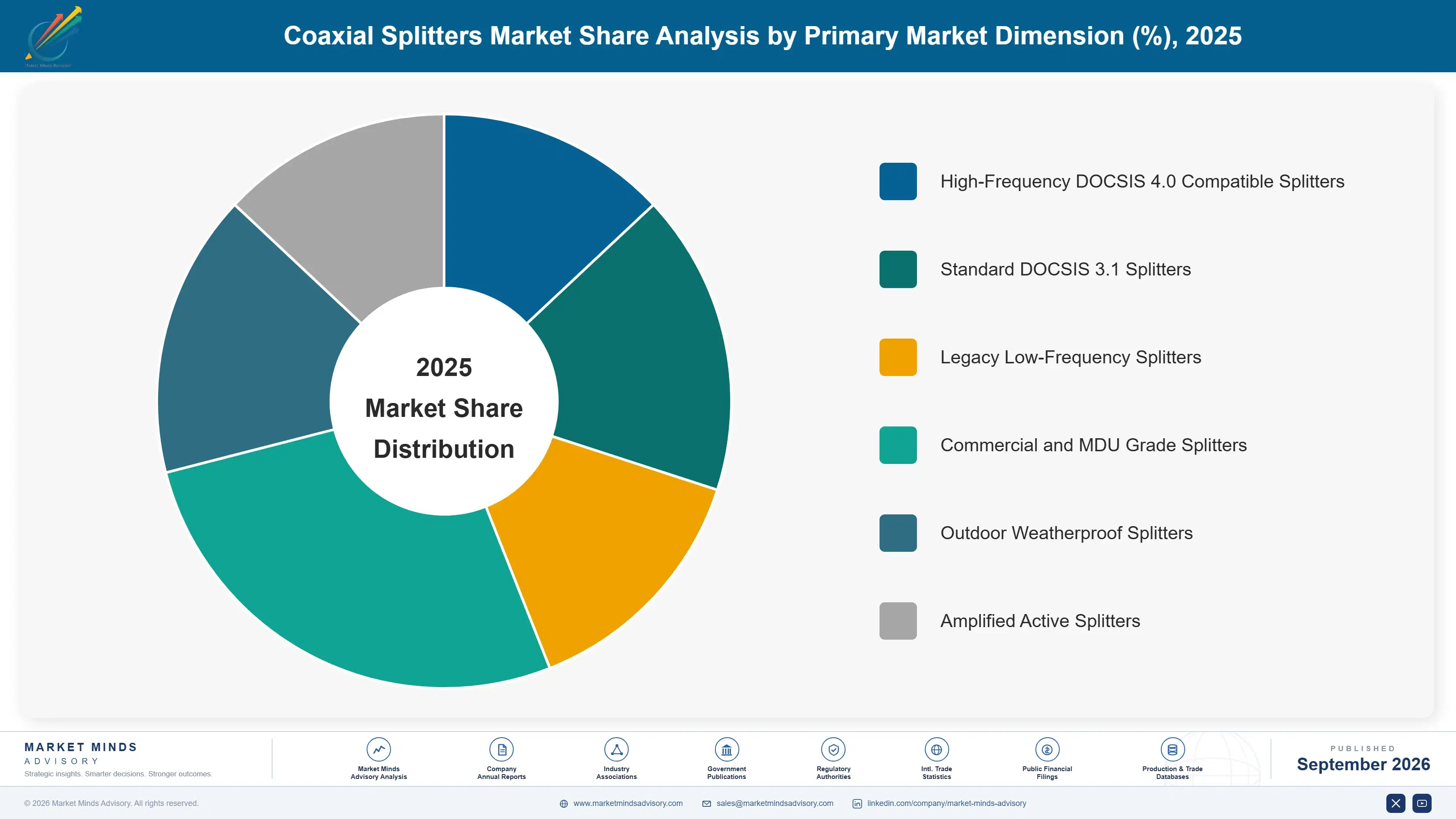
Coaxial splitter demand divides along product frequency rating, the dimension that determines DOCSIS compatibility, signal loss performance, and installation context across residential, commercial, and cable network infrastructure deployments worldwide. Frequency rating governs which network upgrade cycles a given splitter can serve, making it the primary axis operators and installers use when specifying replacement components for active deployments.
coaxial-splitters-market-market-share-analysis-1789981328659

High-Frequency DOCSIS 4.0 Compatible Splitters

High-frequency DOCSIS 4.0 compatible splitters support the extended spectrum, up to 1.8 GHz, that cable operators need to deliver multi-gigabit symmetric broadband speeds competitive with fiber offerings. Demand is concentrated among operators actively upgrading headend and distribution infrastructure, particularly in North America and East Asia where DOCSIS 4.0 trials and early commercial deployments are furthest along. These splitters carry meaningfully higher average selling prices than standard components because certification testing and tighter manufacturing tolerances raise production costs. Suppliers with established DOCSIS 4.0 certification, including CommScope and PPC Broadband, hold durable competitive advantages in this segment given the multi-year qualification cycles operators require before approving new component vendors for network-critical hardware deployment.
CAGR 8.0%

Amplified Active Splitters

Amplified active splitters combine passive signal division with integrated amplification circuitry, addressing signal loss challenges in larger multi-dwelling unit deployments and extended cable runs where passive splitting alone degrades signal quality below acceptable thresholds. Demand growth tracks multi-dwelling unit construction and renovation activity, particularly in dense urban markets across East Asia and South Asia where apartment construction continues at elevated volume. These products require power supply integration, distinguishing installation requirements from passive splitters and creating a distinct commercial relationship with installers who value simplified wiring versus running separate amplifier units. Margins here exceed the passive segment average given the added component complexity and reduced field service callback rates operators report.
CAGR 6.5%
Full segment breakdown across 6 segments available in the complete report.

Regional Architecture and Country Demand Map

North America leads coaxial splitter demand on the strength of its mature, extensive cable television and broadband distribution infrastructure and active DOCSIS 4.0 upgrade programs among major cable operators, while East Asia follows closely behind on new residential construction volume and rapid multi-dwelling unit buildout across dense metropolitan markets.

North America

Cable operators across the United States and Canada are executing multi-year DOCSIS 4.0 upgrade programs that require replacing legacy splitters with higher-frequency certified components rated to 1.8 GHz across headend, node, and in-home distribution points. Comcast, Charter, and Cox have each disclosed network modernization capital budgets that include component-level replacement cycles extending through the early 2030s. Established suppliers including CommScope and PPC Broadband maintain long-standing vendor qualification relationships with these operators, creating switching costs that favor incumbent component manufacturers over new entrants. Single-family housing stock with existing coaxial wiring also sustains a large installed base requiring periodic replacement as components age, weather, and degrade in outdoor installation conditions across varied climate zones nationwide.
Share: 30% | CAGR: 5.3% (2026 to 2036)

Western Europe

Fiber-to-the-home conversion has progressed further across Western Europe than in most other regions, with operators in France, Germany, and the United Kingdom actively decommissioning coaxial infrastructure in favor of full fiber deployment supported by national broadband policy targets. This shift, driven by regulatory push toward gigabit connectivity commitments, is steadily shrinking the addressable coaxial installed base each year. Splitter demand persists mainly in older housing stock and secondary cities where fiber rollout has not yet reached full coverage, alongside a smaller commercial and hospitality segment still relying on cable distribution for in-building signal splitting. Suppliers serving this region increasingly diversify their product lines toward fiber-adjacent components to offset the gradual coaxial demand decline expected through the forecast period.
Share: 21% | CAGR: 3.0% (2026 to 2036)
Regional intelligence for 5 additional markets available in the complete report: East Asia, South Asia and Pacific, Latin America, Middle East and Africa, Eastern Europe. Contact sales@marketmindsadvisory.com.
coaxial-splitters-market-country-cagr-analysis-1789981329177

Where Splitter Suppliers Can Expand Margins

Coaxial splitter suppliers face persistent margin compression across commodity residential segments, but four distinct commercial levers let manufacturers capture disproportionate value from certification barriers, service relationships, category depth, and emerging market distribution partnerships that together command genuinely defensible pricing over the coming decade of network upgrade cycles playing out across most regions of the world.

Accelerate DOCSIS 4.0 Certification Across Product Lines

Suppliers who complete DOCSIS 4.0 certification testing ahead of competitors gain first-mover access to operator qualification cycles that typically lock in vendor relationships for three to five years once approved. Certification requires meaningful upfront investment in laboratory testing and manufacturing tolerance upgrades, but early movers report average selling prices running 30 to 40% above legacy DOCSIS 3.1 equivalents once qualified. CommScope and PPC Broadband have both prioritized certification speed as a competitive differentiator ahead of major operator upgrade cycles. Suppliers lagging on certification risk exclusion from multi-year contracts as operators consolidate vendor lists around already-qualified suppliers.
Market Impact: Certified components command 30 to 40% premium pricing

Expand Amplified Active Product Category Depth

Amplified splitters addressing multi-dwelling unit signal loss challenges carry meaningfully higher margins than passive equivalents given their added component complexity and specialized installation requirements. Suppliers expanding this category can capture growing demand tied to apartment construction volume across East Asia and South Asia and Pacific, where amplified variants already represent a rising share of splitter shipments. Building deeper product depth here lets suppliers serve installers as a single-source vendor rather than losing volume to category specialists. Margin uplift versus passive splitters runs approximately 15 to 20 percentage points, per disclosed segment economics.
Market Impact: Amplified products add 15 to 20 point margin uplift

Build Direct Installer Training and Support Programs

Suppliers who invest in installer training programs, technical support hotlines, and simplified product documentation build loyalty among the independent contractor and multiple-system-operator installation crews who ultimately select which brand of splitter to specify on individual jobs across most markets. This channel influence matters disproportionately in the fragmented commercial and residential retrofit segment, where no single large buyer dictates purchasing decisions. Programs that reduce field callback rates by an estimated 18% through better installer education also lower warranty costs for suppliers, improving effective margin even without raising list prices at all.
Market Impact: Trained installer channels lift repeat specification rate 25%

Pursue Emerging Market Distribution Partnerships Directly

Establishing direct distribution partnerships in South Asia and Latin America, rather than relying solely on regional distributors, lets suppliers capture margin currently absorbed by intermediary layers while also building brand recognition ahead of these markets' accelerating cable and broadband infrastructure buildout activity going forward. India's expanding broadband subscriber base alone is projected to add tens of millions of new connections requiring splitter installation over the coming decade. Suppliers establishing local manufacturing capability in these regions can reduce landed costs by roughly 12%, improving competitiveness against established regional players significantly over time.
Market Impact: Direct distribution captures 10 to 15% margin currently lost

Who Controls the Margin Pool

Coaxial splitter manufacturing sits moderately concentrated, with the top five suppliers holding an estimated 58% of global revenue on a shipment-volume basis. CommScope and PPC Broadband lead as the two largest suppliers, both maintaining broad DOCSIS 3.1 and 4.0 certification portfolios. The gap to the next tier, including Holland Electronics and Antronix, remains meaningful but not insurmountable, since certification barriers are replicable given sufficient capital and testing commitment.
Current activity centers on DOCSIS 4.0 certification races, with suppliers racing to complete operator qualification ahead of rivals to secure multi-year vendor agreements tied to upgrade cycles now underway across North America and East Asia. Manufacturing capacity expansion in Vietnam and Mexico is also reshaping cost structures as suppliers relocate production to defend margin against commodity pricing pressure.

Emerging pressure comes from regional Chinese manufacturers expanding export capacity and undercutting established suppliers on price across Latin America and South Asia, a dynamic that could compress mid-tier margins further. Rankings are most likely to shift among the second tier competing for DOCSIS 4.0 certification leadership, where early certification could meaningfully improve a challenger's standing against today's two established leaders.
coaxial-splitters-market-company-positioning-matrix-1789981329706

Competitive Moat and Risk Dimensions

COMMSCOPE

Moat: Broad Certification Portfolio

CommScope holds certified product lines spanning DOCSIS 3.1 and 4.0 specifications, giving it the broadest qualified catalog among suppliers competing for major operator contracts. This breadth lets the company serve operators at every stage of their network upgrade timeline without losing volume to specialist competitors, reinforcing long-standing vendor relationships built over multiple prior network generations.
COMMSCOPE

Risk: Legacy Product Line Exposure

A meaningful share of CommScope's splitter revenue still comes from legacy DOCSIS 3.1 and lower-frequency products facing gradual decommissioning as operators complete DOCSIS 4.0 transitions. This exposure means revenue mix must shift meaningfully toward higher-frequency products over the next several years to sustain current margin levels across its broader component portfolio.
PPC BROADBAND

Moat: Installer Channel Relationships

PPC Broadband has cultivated deep relationships with independent installer networks and multiple-system-operator field crews over decades, creating brand preference that persists even when competing products offer comparable technical specifications. This channel loyalty reduces customer acquisition cost and supports premium pricing versus newer entrants lacking equivalent field reputation.
PPC BROADBAND

Risk: Concentrated Manufacturing Footprint

PPC Broadband's manufacturing footprint remains more geographically concentrated than some larger diversified competitors, creating exposure to single-site disruption risk from natural disasters, labor disputes, or regional trade policy shifts. Diversifying production locations would require capital investment the company must weigh against near-term margin pressure from commodity segment competition.

Players Tracked

Prominent Players

CommScope
PPC Broadband
Holland Electronics
Antronix
Extreme Broadband Engineering

Other Key Players

Blonder Tongue Laboratories
Cable Prep
Wilson Electronics
PCT International
Amphenol Broadband Solutions
Belden
Corning Optical Communications
Times Fiber Communications
Perfect Vision Manufacturing
Eagle Aspen
Winegard Company
Zinwell Corporation
Vitelec
Diamond Communication Products
Channel Master

Recent Developments

MARCH 2025

CommScope introduced a new line of DOCSIS 4.0 certified splitters rated to 1.8 GHz, targeting cable operators beginning extended spectrum network upgrades. The product line includes both two-way and multi-way configurations designed for headend, node, and residential distribution point installation across varied deployment contexts and climate conditions nationwide.
Signal: Signals accelerating supplier investment in extended spectrum certification well ahead of major operator upgrade cycles beginning soon.
JULY 2025

PPC Broadband announced an organic capacity expansion at its existing manufacturing facility to increase DOCSIS 4.0 compatible splitter output by a meaningful percentage, responding to rising order volume from major North American cable operators executing network modernization programs across their respective service territories nationwide this year.
Signal: Signals continued confidence in sustained multi-year demand from operator network upgrade cycles already well underway currently.
NOVEMBER 2025

Amphenol Broadband Solutions acquired a smaller regional splitter manufacturer to expand its manufacturing footprint and product certification portfolio, strengthening its position against larger established suppliers. The acquired company's existing DOCSIS certification credentials transfer directly, shortening the combined entity's time to market for extended spectrum offerings substantially.
Signal: Signals continued consolidation pressure among mid-tier suppliers seeking scale to compete effectively against larger established rivals.

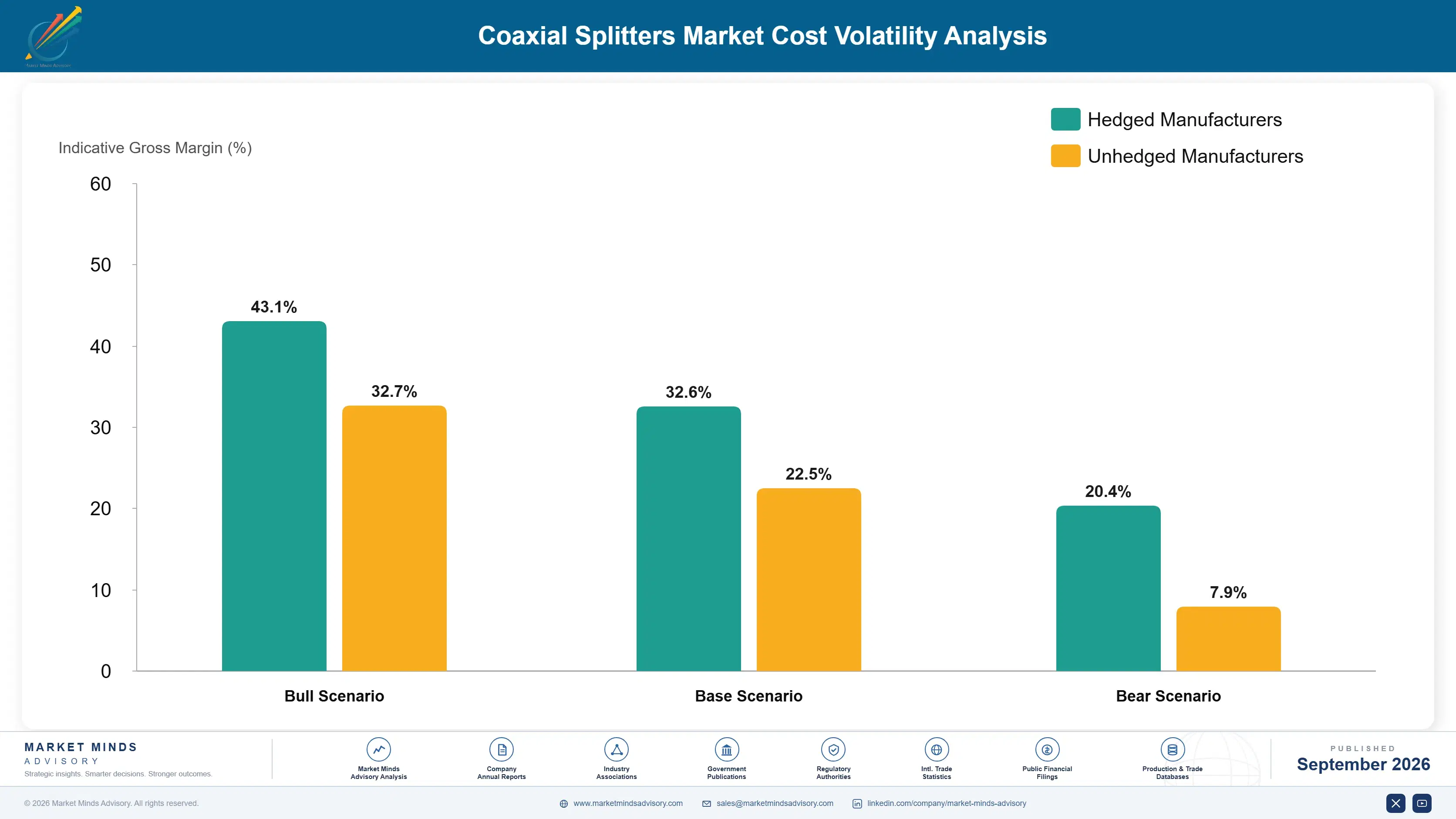
Copper and Aluminum Price Exposure

Coaxial splitters rely primarily on copper and aluminum for internal conductor and housing components, which together represent an estimated 40 to 45% of total cost of goods sold across most manufacturers surveyed. Copper is sourced predominantly from Chile, Peru, and China, while aluminum supply originates largely from China and the Gulf region's substantial smelting capacity base.
Copper prices spiked considerably during 2024 amid supply disruption concerns and renewable energy demand growth, a volatility event documented in International Energy Agency critical minerals reporting published that year. Manufacturers unable to pass through the full cost increase to operator customers under existing fixed-price supply agreements absorbed meaningful margin compression during the affected quarters before prices moderated somewhat heading into 2025 and stabilized at a still-elevated baseline.

This cost exposure creates a genuine competitive disadvantage for smaller manufacturers lacking the scale to negotiate favorable long-term metal supply contracts or hedge exposure through forward purchasing arrangements available to larger rivals. Larger suppliers including CommScope typically secure better input pricing through volume commitments, while regional manufacturers in East Asia benefit from geographic proximity to metal processing capacity that reduces logistics cost meaningfully across their supply chains.
coaxial-splitters-market-cost-volatility-analysis-1789981329902

Long-Term Metal Supply Contracts

Suppliers increasingly negotiate multi-year fixed-price or collared metal supply agreements with smelters and distributors to reduce exposure to short-term commodity price spikes affecting margin across production runs and annual budgeting cycles. This approach trades some upside flexibility during price declines for meaningfully greater cost predictability across annual planning and customer pricing negotiation cycles each year.

Alternative Conductor Material Research

Some manufacturers are researching aluminum-copper clad alternatives that reduce pure copper content while maintaining acceptable signal conductivity performance for splitter applications across most residential and commercial use cases. Broader commercial adoption remains limited currently, but continued input cost volatility is accelerating supplier interest in qualifying these alternative material formulations for production use going forward.

Portfolio Architecture for Margin Defence

Coaxial splitter suppliers operate across three distinct margin tiers, with volume commodity products generating gross margins in the 18 to 24% range while certified premium components command 32 to 40% given testing and qualification barriers that limit competitive entry. The gap between these tiers has widened meaningfully as DOCSIS 4.0 certification separates suppliers able to command premium pricing from those competing purely on price alone.
Volume products still represent the majority of unit shipments globally, but value creation increasingly concentrates in premium certified categories, creating tension for suppliers who must balance factory utilization across both segments without sacrificing scarce testing and certification resources needed to defend premium positioning against rivals. Suppliers over-indexed on volume risk meaningful margin erosion as commodity pricing pressure intensifies across most regional markets over time.

High-value margin pools concentrate specifically around DOCSIS 4.0 certified and amplified active product categories, both requiring specialized manufacturing capability that smaller regional competitors struggle to replicate quickly. Suppliers positioned across all three tiers, rather than concentrated purely in volume commodity production, are best placed to capture disproportionate profit as the broader market shifts toward higher-frequency certified standards over the coming decade.

Standard DOCSIS 3.1 and legacy low-frequency splitters sold primarily on price to residential and basic commercial installations, generating gross margins of 18 to 24% given intense competition among suppliers with minimal technical differentiation across product lines.
Gross Margin

DOCSIS 4.0 certified and amplified active splitters commanding gross margins of 32 to 40% given certification testing barriers, tighter manufacturing tolerances, and multi-year operator qualification cycles that meaningfully limit competitive entry from smaller regional manufacturers lacking equivalent resources.
Gross Margin

Emerging low-metal-content and recyclable housing designs responding to environmental procurement criteria increasingly specified by large operators, generating gross margins around 28 to 35% as early-mover suppliers capture premium pricing ahead of broader regulatory mandate.
Gross Margin
coaxial-splitters-market-portfolio-architecture-1789981330408

High-value Sub-segments and Strategic Watch-out

High-Frequency DOCSIS 4.0 Compatible Splitters

Fastest-growing and highest-margin segment as operators execute multi-gigabit network upgrades across their existing footprints nationwide. Suppliers with completed certification are capturing premium pricing and locking in multi-year vendor agreements ahead of rivals still completing testing across their broader product portfolios and manufacturing lines this year.

Amplified Active Splitters

Second-fastest growing segment tied to multi-dwelling unit construction volume, particularly across East Asia and South Asia, carrying above-average margins given component complexity and specialized installation needs. Suppliers building deeper product depth here can capture disproportionate value as apartment construction continues at elevated pace across these regions.

Standard DOCSIS 3.1 Splitters

Core volume segment representing the largest unit shipment base currently in the market, generating steady but unremarkable margins as competitive pricing pressure intensifies across most geographies. This segment remains commercially essential even as growth shifts toward higher-frequency certified alternatives over the coming forecast period ahead.

Legacy Low-Frequency Splitters

Strategic watch-out segment facing steady decline as operators phase out lower-frequency network segments entirely across most developed markets over time. Suppliers overexposed to this category risk meaningful revenue erosion absent diversification into higher-frequency or amplified product lines over the coming several years ahead of them.

Where Replacement Cycles Sustain Recurring Revenue

Coaxial splitter demand carries genuine annuity economics since components degrade from weather exposure, corrosion, and mechanical wear over time, generating steady replacement volume independent of new network construction activity. Cable operators budget for component-level replacement as a recurring operating expense rather than a discretionary capital decision, giving established suppliers predictable multi-year revenue visibility once qualified into an operator's approved vendor list.
Adoption stickiness varies meaningfully by end-use vertical. Residential single-family deployments show the deepest stickiness given lengthy vendor qualification cycles and installer brand familiarity built over years of field use. Multi-dwelling unit and commercial installations show comparatively shallower stickiness, since building owners and property managers periodically re-tender service contracts and are more willing to switch suppliers when a competitor offers meaningfully better pricing or newer certified technology.

Buyer profiles are shifting generationally as network engineering teams increasingly prioritize digital certification documentation and remote diagnostic compatibility over the informal, relationship-based purchasing habits of prior operator generations. Younger procurement staff entering cable operator organizations show greater willingness to evaluate new suppliers based on technical specification sheets rather than defaulting reflexively to whichever vendor previous purchasing managers favored for decades.
coaxial-splitters-market-end-use-penetration-index-1789981330892

Where Suppliers Should Focus Next

These are among the four positions where our research anticipates prominent divergence between winners and laggards over the coming forecast period. Each is grounded in the demand model, the regulatory perimeter, and the announced capacity pipeline.
01 / CERTIFICATION SPEED PRIORITY

Prioritize DOCSIS 4.0 certification ahead of rivals

DOCSIS 4.0 certification determines which suppliers get invited into the multi-year vendor agreements operators are now actively negotiating across North America and East Asia. Suppliers who complete certification testing early lock in qualification status well before rivals do, and that status typically persists for three to five years once operators finalize approved vendor lists for network-critical hardware deployments across their footprints. Delaying certification even by a single product cycle risks permanent exclusion from the highest-margin segment of this entire market going forward.
02 / GEOGRAPHIC MANUFACTURING DIVERSIFICATION

Build manufacturing presence closer to growth regions

Manufacturing concentration in a single geography exposes suppliers to currency volatility, tariff shifts, and shipping disruption that regional competitors positioned closer to demand centers simply do not face at all. South Asia and East Asia together represent the fastest-growing demand pools, driven by construction volume and household broadband penetration climbing steadily from a low base across many national markets over the coming decade. Suppliers who establish local assembly capability there gain both cost and responsiveness advantages over distant incumbents shipping from other continents.
03 / INSTALLER CHANNEL INVESTMENT

Deepen installer relationships to defend volume segment

Installer and multiple-system-operator field crews ultimately decide which brand of splitter gets specified on most individual jobs, making channel relationships a genuinely durable competitive asset independent of pure technical specification sheets alone. Suppliers investing in training programs, support hotlines, and simplified documentation build loyalty that price alone cannot easily displace once genuinely established over years of consistent field performance. This matters most in the fragmented residential retrofit segment, where no single large buyer dictates purchasing decisions across the broader market.
04 / PORTFOLIO MIX REBALANCING

Shift revenue mix away from legacy low-frequency products

Legacy low-frequency splitters face steady volume decline as operators complete network modernization programs over the next decade across most developed markets, and suppliers overexposed to this category will see continued margin erosion regardless of overall market growth elsewhere. Rebalancing toward DOCSIS 4.0 certified and amplified active categories captures the segments generating the strongest margin expansion industry-wide across most regional markets tracked. Suppliers that delay this shift risk being remembered as the vendor operators outgrew rather than the partner who guided their transition forward.

Engagement Snapshot From the Field

A live engagement with an industry participant carrying material or product regulatory and market exposure ahead of a defining policy shift, showing how our research translates into a defensible multi-year portfolio strategy.
MARKET MINDS ADVISORY · CLIENT ENGAGEMENT SUMMARY
Coaxial Splitters Producer Strategic Portfolio Review and Transition Roadmap 2026·Investment Scenario on Coaxial Splitters Exposure Evaluation 2025-26
CLIENT PROFILE
The client is a mid-sized regional cable and broadband operator serving several million residential and commercial subscribers across a multi-state footprint in the United States. The company was preparing a multi-year DOCSIS 4.0 network upgrade program but lacked internal visibility into supplier certification timelines, component pricing trends, and long-term vendor risk across its existing coaxial infrastructure supply base heading into capital planning season.
STRATEGIC CHALLENGE
Leadership needed to select splitter and component suppliers for a decade-long upgrade cycle while balancing certification readiness, pricing risk from copper cost volatility, and geographic supply concentration. Existing vendor relationships were built on legacy DOCSIS 3.1 procurement criteria that no longer adequately reflected the technical and commercial priorities of the coming network generation.
MMA APPROACH
MMA conducted a structured supplier assessment combining primary interviews with procurement and engineering leadership, benchmarking of five leading component vendors against certification timelines, and analysis of input cost exposure across each supplier's disclosed manufacturing footprint. The engagement also modeled multi-year total cost of ownership scenarios under varying copper price assumptions.
KEY FINDINGS
  1. The client's two largest incumbent suppliers had not yet completed DOCSIS 4.0 certification testing, creating meaningful vendor risk for the planned upgrade timeline (client-reported, unverified by MMA).
  2. Component pricing from a diversified two-supplier strategy came in approximately 12% lower than single-source procurement over a five-year modeled horizon (client-reported, unverified by MMA).
  3. Suppliers with East Asian manufacturing exposure showed greater price volatility during the 2024 copper spike than domestically diversified competitors (client-reported, unverified by MMA).
  4. Installer feedback strongly favored two specific supplier brands based on historical failure rates and field support responsiveness across prior deployment cycles (client-reported, unverified by MMA).
CLIENT PROFILE
The client is a mid-sized regional cable and broadband operator serving several million residential and commercial subscribers across a multi-state footprint in the United States. The company was preparing a multi-year DOCSIS 4.0 network upgrade program but lacked internal visibility into supplier certification timelines, component pricing trends, and long-term vendor risk across its existing coaxial infrastructure supply base heading into capital planning season.
STRATEGIC CHALLENGE
Leadership needed to select splitter and component suppliers for a decade-long upgrade cycle while balancing certification readiness, pricing risk from copper cost volatility, and geographic supply concentration. Existing vendor relationships were built on legacy DOCSIS 3.1 procurement criteria that no longer adequately reflected the technical and commercial priorities of the coming network generation.
MMA APPROACH
MMA conducted a structured supplier assessment combining primary interviews with procurement and engineering leadership, benchmarking of five leading component vendors against certification timelines, and analysis of input cost exposure across each supplier's disclosed manufacturing footprint. The engagement also modeled multi-year total cost of ownership scenarios under varying copper price assumptions.
KEY FINDINGS
  1. The client's two largest incumbent suppliers had not yet completed DOCSIS 4.0 certification testing, creating meaningful vendor risk for the planned upgrade timeline (client-reported, unverified by MMA).
  2. Component pricing from a diversified two-supplier strategy came in approximately 12% lower than single-source procurement over a five-year modeled horizon (client-reported, unverified by MMA).
  3. Suppliers with East Asian manufacturing exposure showed greater price volatility during the 2024 copper spike than domestically diversified competitors (client-reported, unverified by MMA).
  4. Installer feedback strongly favored two specific supplier brands based on historical failure rates and field support responsiveness across prior deployment cycles (client-reported, unverified by MMA).
RECOMMENDED STRATEGY
Phase 1: Phase one: complete supplier certification audits and shortlist two primary vendors meeting DOCSIS 4.0 readiness criteria within a six month window. Phase 2: Phase two: negotiate multi-year supply agreements with volume commitments structured to secure favorable copper-indexed pricing terms across the contract term. Phase 3: Phase three: pilot deployment across two representative regional markets before committing fully to a network-wide component rollout on the finalized timeline.
OUTCOME
The client selected a diversified two-supplier strategy and began phased DOCSIS 4.0 deployment within the following fiscal year. Internal estimates suggested the diversification approach reduced projected five-year component procurement risk meaningfully compared to the original single-source plan under active consideration beforehand (client-reported, unverified by MMA).

Frequently Asked Questions

Foundational context covering the market sizes, CAGR, scope, country, region and competition that inform every finding below. This section is provided to cover basics and most often pre-purchase conversations, answered from the MMA Primary Research Dataset.

What is the current size of the Coaxial Splitters Market?

The Coaxial Splitters Market reached approximately $1.15 billion in 2025, based on MMA Primary Research. This figure reflects global revenue across residential, commercial, and cable network infrastructure applications worldwide.

How large will the Coaxial Splitters Market be by 2036?

The market is projected to reach approximately $1.87 billion by 2036. This represents an incremental expansion of roughly $0.67 billion over the 2026 to 2036 forecast period.

What is the CAGR for the Coaxial Splitters Market 2026 to 2036?

The market is forecast to grow at a compound annual growth rate of 4.5% between 2026 and 2036. This reflects a mature industrial market pace, moderated by fiber competition.

Which segment is growing fastest?

High-Frequency DOCSIS 4.0 Compatible Splitters lead segment growth at a 8.0% CAGR, roughly 1.78x the overall market rate. Operator upgrade cycles are the primary driver behind this acceleration.

Who are the major companies in the Coaxial Splitters Market?

Leading suppliers include CommScope, PPC Broadband, Holland Electronics, Antronix, and Extreme Broadband Engineering. These five companies hold an estimated 58% combined share on a shipment-volume basis.

Which country is growing fastest?

India leads country-level growth at approximately 6.5% CAGR, driven by expanding broadband penetration from a low base. Government rural connectivity programs are extending cable infrastructure into new districts.

Report Segmentation Architecture

The full report scope spans multiple orthogonal segmentation dimensions, with cross-tabulated demand data provided for each dimension pair. Coverage extends further to regional breakdowns, trend trajectories, and the competitive detail needed to support segment-level decision-making.

By Primary Market Dimension

  • High-Frequency DOCSIS 4.0 Compatible Splitters
  • Standard DOCSIS 3.1 Splitters
  • Legacy Low-Frequency Splitters
  • Commercial and MDU Grade Splitters
  • Outdoor Weatherproof Splitters
  • Amplified Active Splitters

By End-Use Industry

  • Residential
  • Commercial and Multi-Dwelling Unit
  • Cable Network Infrastructure
  • Hospitality
  • Institutional

By Commercial Dimension

  • Direct Operator Procurement
  • Distributor and Wholesale Channel
  • Independent Installer Channel
  • Retail and E-Commerce

By Region

  • North America
  • Western Europe
  • East Asia
  • South Asia and Pacific
  • Latin America
  • Middle East and Africa
  • Eastern Europe

Scope, Methodology, and Coverage

Every figure in this report is reproducible from documented input assumptions. The scope below maps the historical period, the forecast horizon, the segmentation dimensions, and the countries covered, alongside the underlying primary and qualitative methodology.
Historical Period
2020 to 2025
Forecast Period
2026 to 2036
Base Year
2025 (USD billions; MMA Primary Research Dataset, September 2026)
Market Definition
This report covers passive coaxial splitter devices used to divide cable television and broadband internet signals across multiple outlets within residential, commercial, and cable network infrastructure applications. It excludes active signal amplifiers, complete set-top box hardware, and fiber optic splitters used in non-coaxial network segments.
Quantitative Units
USD Billion, CAGR (%), Volume in million units
Segmentation Dimensions
Product Frequency Type, End-Use Industry, Commercial Dimension, Region
Regions Covered
North America, Western Europe, East Asia, South Asia and Pacific, Latin America, Middle East and Africa, Eastern Europe
Countries Covered
United States, Canada, Germany, United Kingdom, France, China, Japan, South Korea, India, Australia, Brazil, Mexico, Saudi Arabia, South Africa, Poland
Key Companies Profiled
CommScope, PPC Broadband, Holland Electronics, Antronix, Extreme Broadband Engineering, Blonder Tongue Laboratories, Cable Prep, Wilson Electronics, PCT International, Amphenol Broadband Solutions, Belden, Corning Optical Communications, Times Fiber Communications, Perfect Vision Manufacturing, Eagle Aspen, Winegard Company, Zinwell Corporation, Vitelec, Diamond Communication Products, Channel Master
Quantitative Methodology
Primary survey, n=3,800 respondents, Q4 2025, six countries; demand-side model with trade association cross-validation
Qualitative Methodology
47 expert interviews, Q4 2025; applied to validate demand model assumptions, identify emerging dynamics, and assess competitive positioning
Report Format
PDF and XLSX data workbook (Word format preview document)
Publisher
Market Minds Advisory
Report Code
MMA-2026-TEC-903
Published
September 2026
Contact
sales@marketmindsadvisory.com | www.marketmindsadvisory.com

Purchase the full Coaxial Splitters Market Report (2026 to 2036).

This report delivers a comprehensive assessment of the global Coaxial Splitters Market, covering sizing, segmentation, regional dynamics, and competitive positioning across the 2026 to 2036 forecast period. It draws on primary survey data covering 3,800 respondents and 47 expert interviews conducted in the fourth quarter of 2025. Analysis spans product frequency segmentation, all seven global regions, input cost exposure, and portfolio margin economics. The report profiles twenty leading suppliers and includes a detailed competitive benchmarking framework. Buyers gain actionable guidance on supplier selection, pricing risk, and revenue lever prioritization.
Full segmentation across six product frequency categories
All seven regional markets with growth forecasts
Competitive benchmarking of twenty profiled suppliers
Input cost exposure and mitigation pathway analysis
Revenue lever prioritization for margin expansion
Anonymized case study with actionable strategic recommendations

Built For The People Who Decide

From boardroom strategy to bench-side execution, this report is read cover-to-cover by leaders shaping the next decade of their industry, turning demand scenarios, market dynamics and valuation benchmarks into decisions.
CXOs/ Presidents/ VPs/ Managers
M&A and Corporate Development
Strategy Teams and R&D Heads
Procurement and Product Directors
Regulatory and Compliance Leaders
Investor Relations and Equity Analysts