

Market Minds Advisory
Coal Tar Pitch Market

Coal Tar Pitch Market: Aluminum Anode Binders, Graphite Electrode Feedstock, and Needle Coke Demand

Aluminum smelters and graphite electrode makers are locking in longer-term pitch supply contracts as needle coke and EV battery anode demand pulls specialty high-softening-point grades away from standard binder volume, tightening a quiet commodity market.

Lead Analyst

Bilal Shaikh

Published

September 2026

Make Smarter Decisions with Customized Research Insights

Request a free sample report and evaluate market opportunities, growth trends, and competitive dynamics relevant to your business needs.

2025 MARKET VALUE$3.2BMarket Size 2025
2036 FORECAST VALUE$5.0BBase Case , 2026 to 2036
CAGR 2026 TO 20364.2 %Bull 5.4% / Bear 3.0%
INCREMENTAL OPPORTUNITY$1.7BNet 10- year value creation
EXPANSION MULTIPLE1.52x2036 value over 2026 base
Strategic Levers
M&A Pipeline
Regional Outlook
Country Rankings
Competitive Intelligence
Segmental Deep-dive
Call-Us : 91 93563 13602

Executive Snapshot and Market Trajectory

Coal tar pitch remains an unglamorous but essential feedstock, binding carbon anodes for aluminum smelting and graphite electrodes for steelmaking, even as specialty high-softening-point grades destined for needle coke and EV battery anode production pull the industry toward a more technically demanding product mix. worldwide. today. entirely.
China's enormous coking and steel industry base absorbs the largest share of global pitch supply and production, with domestic integrated producers increasingly exporting surplus volume into Southeast Asian and Indian aluminum smelting capacity as those regions expand. Standard binder pitch volume continues growing in line with aluminum output, while specialty grades tied to lithium-ion battery anode material command a widening price premium over commodity binder pitch across nearly every major market.
No single producer commands outright pricing power despite meaningful regional concentration, because aluminum and steel customers dual-source aggressively and coking byproduct supply ties pitch production directly to steel industry coke oven operating rates rather than independent capacity decisions. Environmental regulation on polycyclic aromatic hydrocarbon emissions is reshaping which producers can continue operating older coking facilities profitably. Compliance costs are rising across the industry. Investors are watching closely.
Market Definition
The coal tar pitch market covers the production and supply of coal tar pitch derived from the distillation of coal tar, used primarily as a binder for carbon anodes in aluminum smelting and graphite electrodes in steelmaking. It excludes petroleum-derived pitch and raw coal tar sold without further distillation processing.
Base Year Value
$3.2B in 2025 (MMA Primary Research Dataset, August 2026)
Forecast Period
2026 to 2036, eleven discrete annual values
CAGR
4.2% base case. Bull 5.4%. Bear 3.0%.
Fastest Growth Segment
High Softening Point Special Pitch: 6.5% CAGR
Fastest Growth Country
China: 5.5% CAGR
Fastest Growth Region
South Asia and Pacific: 6.2% CAGR
Largest Region
East Asia: 43% of 2025 global value
Market Leaders
Rain Carbon Inc., Himadri Speciality Chemical Ltd., Koppers Holdings Inc., Mitsubishi Chemical Corporation, JFE Chemical Corporation. Source: MMA Analysis based on company annual reports.
Primary Survey
n=3,800 procurement and R&D decision-makers, Q4 2025, six countries
Methodology
Demand-side build-up, cross-validated against public data, 47 expert interviews

Coal Tar Pitch Market Forecast Scenarios

coal-tar-pitch-market-trends-size-forecast-scenario-1787465213037
Between 2020 and 2025 coal tar pitch demand tracked global aluminum and steel production through a volatile stretch of energy price swings and shifting coking capacity, with the sharpest supply disruptions concentrated in Europe as several older coking facilities closed under tightening emissions regulation and rising compliance costs across the wider region during that period.
The base case assumes three commercial mechanisms drive growth beyond aluminum production volume alone: steady standard binder pitch demand tracking global aluminum smelting capacity additions, rising needle coke and EV battery anode material demand pulling specialty high-softening-point pitch volume higher, and continued Chinese coking capacity consolidation concentrating supply among larger, more efficient producers. Together these forces keep the market growing modestly faster than aluminum output alone would suggest. Producers unable to keep pace risk losing share to faster-moving competitors.
The bull case rests on EV battery anode material demand accelerating faster than currently forecast, pulling specialty pitch volume and pricing meaningfully higher across the decade. The bear case centers on aluminum smelting capacity growth slowing in China specifically, the region that anchors the largest share of global binder pitch consumption today. Producers positioned for both scenarios simultaneously hold the strongest long-term outlook.

Byproduct Economics Tied to Coking and Aluminum Cycles

Coal tar pitch economics are fundamentally tied to coking byproduct availability rather than independent capacity decisions, since pitch producers depend on raw coal tar generated by steel industry coke ovens as their primary feedstock, linking pitch supply directly to steel production rates rather than aluminum demand alone. This dependency means pitch supply can tighten even when aluminum demand alone would suggest ample availability. Producers with diversified feedstock sourcing manage this cyclicality better than smaller single-facility operations.
TOP PRODUCER SHAREChina, 52%Share of global coal tar pitch supply concentrated domestically
MARKET CONCENTRATIONCR5 35%Combined share held by the five largest global producers
AVERAGE SELLING PRICE$480-950 per tonneTypical price range across standard and specialty grades
SOFTENING POINT RANGE85-160°CTypical range specified across binder and specialty grades
COAL TAR FEEDSTOCK SHARE61% of COGSRaw coal tar share of total pitch production cost
CAPACITY UTILIZATION72%Average utilization rate across major global distillation facilities
The commercial character of the market splits between standard binder pitch, which competes largely on cost and consistent supply for aluminum anode production, and specialty high-softening-point grades, where needle coke and EV battery anode material producers negotiate directly on technical specification and long-term supply security. Producers straddling both tiers run distinctly different sales and quality assurance organizations.
Over the next decade, EV battery anode material demand, Chinese coking capacity consolidation, and tightening emissions regulation on legacy coking facilities will decide which producers retain their current supply positions and which lose ground as older, less compliant facilities close permanently. The pace of facility closures is accelerating each successive year across the wider industry. Compliance investment increasingly separates survivors from exits across the industry.
"Nobody gets into coal tar pitch because it is exciting. They get into it because someone has to bind the anode, and right now the specialty grades are quietly the best margin in the whole coking chain."
Director, Industrial Chemicals and Carbon Materials Practice · MMA Industrial Chemicals and Carbon Materials Practice · August 2026

Market Trends

Needle Coke and EV Battery Anode Demand Pulling Specialty Grades

High-softening-point pitch, the specialty feedstock used to produce needle coke for both graphite electrodes and lithium-ion battery anode material, is capturing a widening share of pitch producer revenue as EV battery manufacturers scale synthetic graphite anode production well ahead of most forecasts issued just a few years ago. Producers with established high-softening-point distillation capability are winning long-term supply contracts with battery material makers, while standard binder-grade producers remain confined to lower-margin aluminum anode volume. The technical qualification process for battery-grade needle coke feedstock is considerably more demanding than aluminum anode binder specifications, favoring producers with specialty distillation infrastructure.
Market Impact: Adds 400K tonnes demand by 2030
Emissions Regulation Closing Older Coking Facilities

Tightening polycyclic aromatic hydrocarbon and particulate emissions regulation across Europe and increasingly China is forcing older coking facilities to either invest heavily in emissions control equipment or close permanently, directly constraining the raw coal tar feedstock supply that pitch producers depend on. Several European coking facilities have already announced permanent closure rather than fund the capital investment required to meet new emissions standards, tightening regional pitch feedstock availability meaningfully. Producers with newer, already-compliant facilities are capturing disproportionate share of remaining regional demand as older competitors exit the market entirely. Investors are watching closely.
Market Impact: Adds 3.1 points to electrode demand

Market Opportunities and Growth Drivers

Global Aluminum Smelting Capacity Expansion Continues

New aluminum smelting capacity continues coming online across China, India, and the Middle East, each new smelter requiring substantial binder pitch volume for carbon anode production over its entire multi-decade operating life, creating durable long-term demand that tracks aluminum industry investment cycles rather than short-term price swings. Gulf state smelters in particular are securing long-term pitch supply agreements years before commissioning, reflecting how critical reliable binder pitch supply is to smelter economics given the absence of viable substitute binders at comparable cost. Producers with established Middle East distribution relationships are capturing disproportionate share of this expansion-driven demand.
Market Impact: Adds $15-25 per tonne compliance cost

Graphite Electrode Demand from Steel Recycling

Electric arc furnace steelmaking, which relies on graphite electrodes manufactured using impregnating pitch, continues gaining share over traditional blast furnace production as steel producers pursue lower emissions and greater feedstock flexibility through scrap-based recycling. This multi-decade shift toward electric arc furnace capacity directly supports pitch demand growth independent of overall steel production volume, since electric arc furnaces consume considerably more graphite electrode material per tonne of steel than traditional production methods require. Producers supplying impregnating-grade pitch to electrode manufacturers are benefiting from this multi-decade transition in steelmaking technology. Momentum keeps building.
Market Impact: Caps supply growth at 2-3% yearly

Market Restraints and Challenges

Emissions Compliance Cost Pressure on Older Facilities

Polycyclic aromatic hydrocarbon and particulate emissions regulation is forcing pitch producers operating older distillation facilities to choose between substantial capital investment in emissions control equipment or permanent closure, a decision several European producers have already resolved by exiting the market entirely. The root cause is that coal tar distillation inherently generates regulated emissions that grow more expensive to control as standards tighten across successive regulatory cycles. Producers are mitigating the impact by consolidating production into fewer, newer, already-compliant facilities and by lobbying for phased compliance timelines that avoid immediate closure decisions.
Market Impact: Adds $80-140 per tonne premium

Feedstock Availability Tied to Steel Coking Rates

Coal tar pitch production depends entirely on raw coal tar generated as a byproduct of steel industry coke ovens, meaning pitch supply cannot expand independently of steel coking operating rates regardless of how strong aluminum or graphite electrode demand becomes. The root cause is the byproduct nature of coal tar generation, which ties pitch feedstock availability to steel industry capacity decisions made for entirely different commercial reasons. Producers are mitigating the constraint by securing long-term coal tar supply agreements directly with integrated steel producers and by investing in petroleum-derived pitch alternatives where technically feasible.
Market Impact: Cuts European capacity 8-12% by 2030
3 additional market trends, 4 additional growth drivers, and 3 additional restraints and challenges are covered in the full report. Contact sales@marketmindsadvisory.com to access the complete intelligence.

Segment CAGR and Growth Architecture

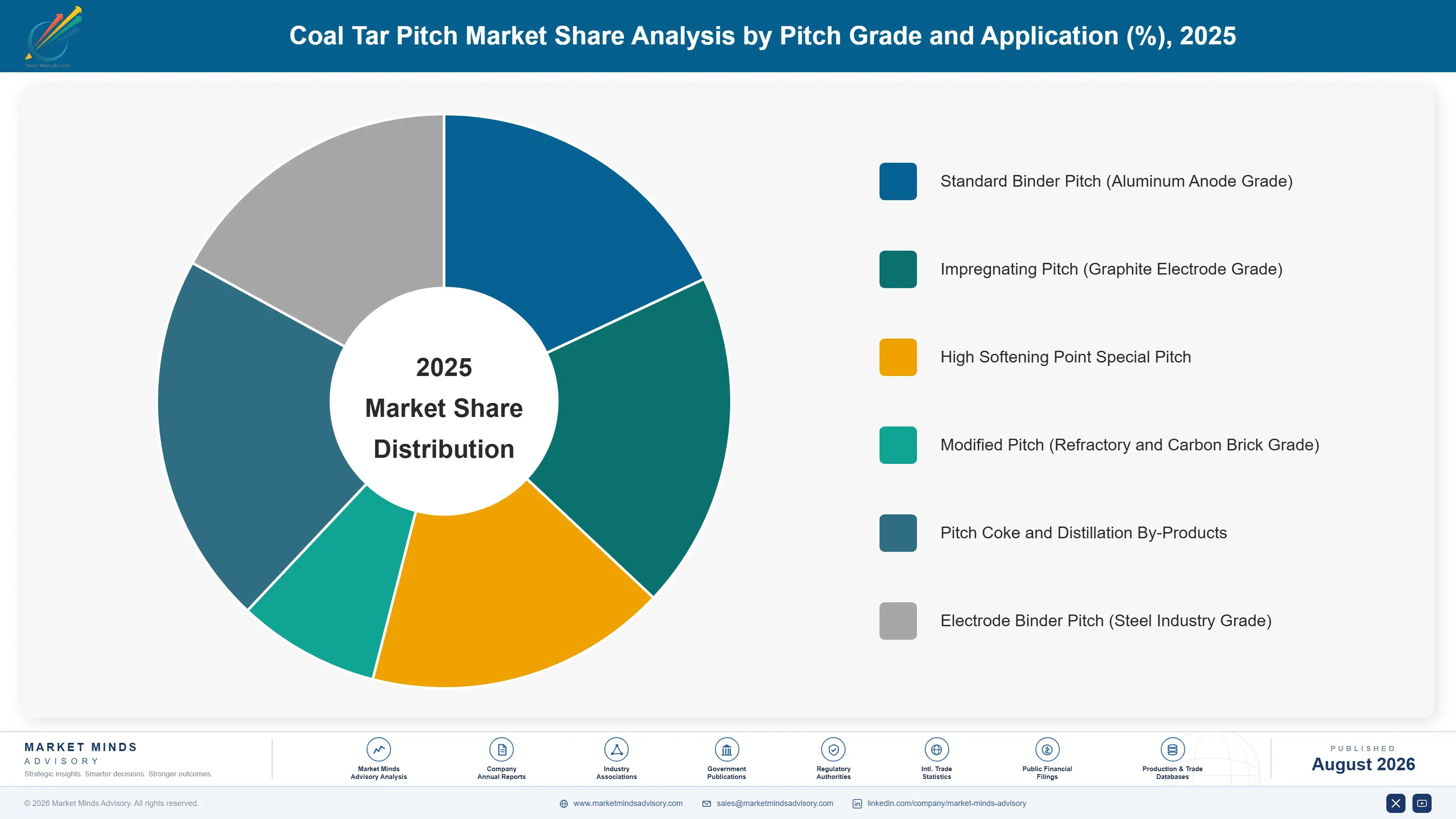
Segmentation follows pitch grade and end-use application, the dimension aluminum smelters and electrode makers specify against in procurement contracts, rather than by distribution channel or customer size, both of which sit outside this defined market scope and belong instead to adjacent commercial and channel-level analysis kept entirely separate from this specific market research report.
coal-tar-pitch-market-trends-market-share-analysis-1787465213597

High Softening Point Special Pitch

High softening point special pitch, typically specified above 150 degrees Celsius softening point, serves as the critical feedstock for needle coke production used in both graphite electrodes and increasingly lithium-ion battery anode material for electric vehicles. EV battery manufacturers are qualifying needle coke suppliers years ahead of anode material production ramp-up, pulling specialty pitch demand forward considerably faster than standard binder pitch growth tracking aluminum output alone. Producers need specialized fractional distillation capability and consistent quality control that few facilities currently maintain at scale. Pricing commands a substantial premium over standard binder pitch, and the segment is pulling capital investment toward specialty distillation upgrades across nearly every major producer's expansion roadmap this decade.
CAGR 6.5%

Electrode Binder Pitch (Steel Industry Grade)

Electrode binder pitch serves graphite electrode manufacturers supplying the growing electric arc furnace steelmaking segment, which continues gaining share over traditional blast furnace production as steel producers pursue scrap-based recycling and lower emissions manufacturing routes. This multi-decade shift toward electric arc furnace capacity supports pitch demand growth independent of overall steel production volume, since these furnaces consume considerably more graphite electrode material per tonne than blast furnace alternatives require. Producers need consistent impregnation-grade quality and reliable supply continuity that electrode manufacturers demand given the capital intensity of their own production processes. Gross margin on this segment remains attractive as electric arc furnace capacity additions continue across multiple major steel-producing regions worldwide.
CAGR 5.0%
Full segment breakdown across 6 segments available in the complete report.

Regional Architecture and Country Demand Map

East Asia massive coking and aluminum smelting base, anchored overwhelmingly by China, accounts for the majority of global pitch supply and consumption, while North America and Western Europe carry the richest specialty high-softening-point demand tied to graphite electrode and battery material production capacity. overall. now.

North America

US and Canadian pitch demand is anchored by established graphite electrode manufacturers and aluminum smelters, with electric arc furnace steelmaking expansion supporting steady growth in impregnating-grade pitch consumption even as overall regional aluminum smelting capacity remains roughly flat. Rain Carbon's substantial North American coal tar distillation footprint gives the region genuine domestic supply capability rather than full dependence on imports. EV battery anode material production ramping up across several new US gigafactories is creating fresh specialty pitch demand that did not exist meaningfully five years ago. Growth trails East Asia given the region's already mature aluminum smelting base and limited new capacity additions. Canadian coking operations supply a modest but steady share of regional feedstock, supplementing domestic distillation capacity.
Share: 22% | CAGR: 2.9% (2026 to 2036)

Western Europe

Germany and Spain anchor regional pitch demand through established graphite electrode and aluminum anode production, though several older coking facilities have closed permanently under tightening emissions regulation, constraining domestic feedstock availability considerably. Bilbaína de Alquitranes and DEZA represent the region's most established specialty pitch producers, both increasingly focused on higher-margin specialty grades as commodity binder pitch volume faces sustained pressure from smelter closures across the region. Regional aluminum smelting capacity has declined somewhat as energy costs pushed several smelters toward permanent curtailment. Growth trails most other regions given this ongoing capacity pressure. Italy also maintains modest specialty pitch production capacity serving regional graphite electrode manufacturers directly. Producer margins remain under pressure.
Share: 18% | CAGR: 2.7% (2026 to 2036)
Regional intelligence for 5 additional markets available in the complete report: East Asia, South Asia and Pacific, Latin America, Middle East and Africa, Eastern Europe. Contact sales@marketmindsadvisory.com.
coal-tar-pitch-market-trends-country-cagr-analysis-1787465214119

Where Pitch Producers Can Defend Margin

Producers facing persistent feedstock constraints and rising compliance costs have four realistic paths to defend and expand margin without waiting for aluminum and steel demand alone to drive growth across every region they currently serve, plan to enter, or hope eventually to win business in over the coming years. ahead of competitors moving more slowly.

Investing Early in Specialty High-Softening-Point Capacity

Producers that invest in specialty distillation capability for high-softening-point pitch can capture $80-140 per tonne premium pricing from needle coke and EV battery anode material customers, well above standard binder pitch margins. The capability requires meaningful upfront capital investment and specialized quality control infrastructure, but producers who move early are securing long-term supply contracts with battery material makers before competition for these relationships intensifies further. Sponsors increasingly treat this qualification as a genuine competitive necessity. EV battery anode material demand continues scaling faster than most producers originally expected. Momentum keeps building steadily.
Market Impact: Adds $80-140 per tonne in premium pricing today

Investing Early in Emissions Compliance Infrastructure

Investing proactively in emissions control equipment ahead of tightening regulatory deadlines positions producers to retain operating licenses and capture market share from competitors forced into permanent closure, absorbing the $15-25 per tonne compliance cost while smaller operators cannot. This investment requires substantial capital commitment, but producers with compliant facilities are winning long-term contracts that customers increasingly restrict to environmentally compliant suppliers specifically. Producers that delay this investment risk losing operating licenses entirely as regulatory deadlines approach across successive compliance cycles in major producing jurisdictions. Regulatory deadlines are approaching faster than many mid-tier producers have prepared for across major jurisdictions.
Market Impact: Secures long-term contracts worth $15-25 per tonne yearly

Long-Term Coal Tar Feedstock Supply Agreements

Securing multi-year coal tar supply agreements directly with integrated steel producers, rather than relying on spot-market feedstock purchases, protects pitch producers from the supply volatility inherent in steel coking byproduct generation. These agreements typically cost more upfront than spot purchasing but eliminate the risk of production curtailment during periods of tight feedstock availability, a risk that increasingly determines which producers can maintain reliable customer supply commitments. Producers securing 3-5 year agreements report meaningfully fewer supply disruptions. Larger buyers increasingly favor suppliers demonstrating this security. Suppliers without comparable agreements struggle to compete for the largest smelter accounts.
Market Impact: Protects against roughly 2-3% yearly volatility risk overall

Middle East and Southeast Asia Distribution Expansion

Establishing direct distribution relationships with Gulf state and Southeast Asian aluminum smelters, where regional demand is growing at roughly 6% annually but domestic pitch production remains essentially nonexistent, gives producers access to some of the fastest-growing binder pitch demand globally. These smelters secure supply contracts years before commissioning, rewarding producers who establish relationships early with multi-decade customer commitments that provide exceptional revenue visibility. Producers succeeding here are capturing outsized share of the industry fastest-growing regional demand pool. These relationships typically require years of relationship building well before formal supply contracts are finalized.
Market Impact: Captures share of a 6% Gulf demand pool

Who Controls the Margin Pool

The five largest global pitch producers hold roughly one-third of production volume on a capacity basis, a moderate concentration that leaves meaningful room for regional producers, particularly across China, to compete on proximity to feedstock and customers rather than scale alone. The gap between leading specialty producers and commodity binder pitch competitors is widening as EV battery demand rewards technical sophistication.
Current competitive activity centers on three dimensions: specialty high-softening-point capacity investment that determines EV battery material readiness, emissions compliance infrastructure that determines which facilities can continue operating, and long-term feedstock and distribution agreements that secure reliable supply chains. Producers investing across all three simultaneously are pulling ahead of narrowly focused competitors. Companies betting on just one of these dimensions increasingly find themselves outpaced by more diversified rivals across the industry.

Emerging pressure is coming from Indian producers, led by Himadri's dominant domestic position, expanding capacity to serve both growing local demand and export markets across Southeast Asia and the Middle East. Rankings are most likely to shift among mid-tier European producers lacking either emissions compliance investment or specialty grade capability, both of which are becoming necessary rather than optional for long-term survival.
coal-tar-pitch-market-trends-company-positioning-matrix-1787465214662

Competitive Moat and Risk Dimensions

RAIN CARBON INC.

Moat: Broadest Global Distillation Footprint

Rain Carbon's coal tar processing capacity spanning North America and Europe gives it the broadest geographic footprint of any global producer, letting it serve multinational aluminum and steel customers from multiple qualified production sites rather than a single regional facility. Few competitors can match this operational breadth today.
RAIN CARBON INC.

Risk: European Emissions Compliance Exposure

Rain Carbon's substantial European operations mean it faces some of the earliest and most extensive emissions compliance costs under tightening regulation, a burden competitors with smaller European footprints face on a comparatively smaller scale relative to overall capacity. Rain Carbon continues investing meaningfully to manage this exposure over time.
HIMADRI SPECIALITY CHEMICAL LTD.

Moat: Dominant Indian Market Incumbency

Himadri's over seventy percent domestic market share and established relationships with India's growing aluminum smelting sector give it a scale advantage in one of the world's fastest-growing pitch markets that global competitors are still working to replicate through their own local investment. Investors particularly value this durable, defensible market position.
HIMADRI SPECIALITY CHEMICAL LTD.

Risk: Geographic Concentration Exposure

Himadri's revenue base skews heavily toward India relative to global peers, leaving it more exposed than diversified competitors to any slowdown in Indian aluminum smelting investment or a shift in domestic sourcing preference toward international suppliers. Diversifying internationally remains an ongoing strategic priority for leadership.

Players Tracked

Prominent Players

Rain Carbon Inc.
Himadri Speciality Chemical Ltd.
Koppers Holdings Inc.
Mitsubishi Chemical Corporation
JFE Chemical Corporation

Other Key Players

Shanxi Coking Co. Ltd.
Baosteel Chemical Co. Ltd.
Shandong Gude Chemical Co. Ltd.
Bilbaína de Alquitranes S.A.
DEZA a.s.
RÜTGERS Group
Nippon Steel Corporation
Sumitomo Corporation
Hengshui Zehao Chemicals Co. Ltd.
Jining Carbon Co. Ltd.
Konark Tar Products Private Limited
Hebei Yukuang New Materials Co. Ltd.
Angang Steel Company Limited
SunCoke Energy Inc.
Puyang Fuxin Chemical Co. Ltd.

Recent Developments

MAY 2025

Himadri Expands Specialty Pitch Production Capacity

Himadri Speciality Chemical commissioned new specialty high-softening-point pitch production capacity at its Indian facility, targeting supply agreements with EV battery anode material makers expanding across the region growing lithium-ion battery manufacturing sector. The expansion reflects growing confidence in India long-term battery material demand trajectory ahead.
Signal: Confirms specialty pitch capacity investment is accelerating well ahead of confirmed battery material demand across the industry.
SEPTEMBER 2025

Rain Carbon Signs Long-Term Feedstock Agreement

Rain Carbon signed a multi-year coal tar supply agreement with a major integrated steel producer, securing feedstock availability for its North American distillation operations amid tightening regional coking capacity. The agreement reflects growing industry-wide preference for long-term feedstock security over spot purchasing across the wider region.
Signal: Shows established producers are increasingly locking in feedstock security years ahead of anticipated regional supply tightening.
JANUARY 2026

European Coking Facility Announces Permanent Closure

A major European coking facility announced permanent closure rather than fund emissions control equipment upgrades required under new regulatory standards, removing meaningful regional pitch feedstock capacity from the market entirely. The closure reflects broader consolidation pressure facing smaller, less compliant European operations today across the wider industry.
Signal: Indicates emissions compliance costs are now directly forcing capacity exits across the wider European market clearly.

Coal Tar Feedstock and Coking Rate Dependency

Raw coal tar, a byproduct of steel industry coke ovens, accounts for roughly sixty-one percent of pitch production cost, with supply availability tied directly to steel coking operating rates rather than independent market pricing, leaving pitch producers exposed to steel industry capacity decisions made for entirely different commercial reasons. This dependency means pitch supply can tighten even when aluminum demand alone would suggest ample availability across major producing regions.
Coal tar availability tightened meaningfully during the 2021 to 2022 energy price disruption tracked by the International Energy Agency, as several steel producers curtailed coking operations amid soaring energy costs, directly constraining pitch feedstock supply and forcing several producers to ration allocation across customer contracts during the tightest supply months. The shortage reshaped how producers now negotiate feedstock contracts, with multi-year commitments increasingly replacing spot purchasing arrangements common in earlier years.

Larger producers with direct long-term coal tar supply agreements with integrated steel producers absorb feedstock volatility far better than smaller regional producers dependent on spot-market purchases, a gap in supply chain sophistication that is slowly reshaping which producers can maintain reliable customer supply commitments during periods of tight availability. Regional variation in exposure is widening as a result.
coal-tar-pitch-market-trends-cost-volatility-analysis-1787465214861

Long-Term Steel Producer Supply Agreements

Negotiating multi-year coal tar supply agreements directly with integrated steel producers lets larger pitch producers guarantee feedstock allocation during periods of tight coking capacity, a structure smaller regional producers struggle to replicate without comparable purchasing volume and established relationships. Larger producers increasingly pursue this path given their negotiating leverage with major steel accounts today.

Diversified Steel Producer Sourcing Relationships

Qualifying coal tar feedstock relationships across multiple steel producers and geographic regions reduces exposure to any single coking facility disruption or regional production curtailment, giving procurement teams alternative sourcing options during periods of tight regional availability. Smaller producers without comparable relationships struggle to secure similar diversification. Smaller producers without comparable relationships struggle to secure similar diversification terms.

Petroleum-Derived Pitch Substitution Capability

Building technical capability to substitute petroleum-derived pitch for coal tar pitch in certain applications offers producers a partial hedge against coal tar feedstock volatility, though performance differences limit substitution to specific lower-specification applications rather than full replacement. Producers investing in this capability gain meaningful flexibility during periods of coal tar scarcity. further. each cycle.

Portfolio Architecture for Margin Defence

Coal tar pitch producers organize their portfolios across three tiers separated primarily by softening point specification and technical qualification requirements rather than by customer size alone, with gross margin climbing sharply from standard binder pitch toward specialty high-softening-point grades commanding genuine technical differentiation. The gap between the lowest and highest tier has widened considerably as EV battery material qualification becomes a genuine competitive requirement rather than an optional upgrade.
The volume-versus-premium tension is intensifying as aluminum smelters demand consistent commodity pricing on standard binder pitch while battery material makers pay considerably more for specialty grades, forcing producers to run fundamentally different sales and quality assurance organizations under a single corporate roof. Producers that fail to separate these two operating models organizationally often see margin erosion bleed from the commodity tier into programs that should command premium pricing.

High-value margin pools concentrate overwhelmingly in specialty high-softening-point and impregnating grades, both of which command qualification barriers that standard binder producers cannot easily cross without meaningful capital investment and multi-year distillation capability development. Producers building both established and specialty capabilities simultaneously are positioning themselves to capture a disproportionate share of the industry's fastest-growing margin pool.

Volume / Commodity-Adjacent Tier

Standard binder pitch sold primarily on cost and consistent supply for aluminum anode production across mainstream commodity aluminum smelting programs. Margins remain thin and continue narrowing further each year across most producing regions.
Gross Margin: 8-14%

Premium / Certified Tier

Impregnating pitch for graphite electrode manufacturing with proven quality certification, commanding higher pricing on electric arc furnace steelmaking demand. Programs here run at meaningful and growing commercial scale worldwide. Pricing stays firm.
Gross Margin: 16-24%

Sustainability / Regulatory / Next-Generation Tier

High-softening-point specialty pitch for needle coke and EV battery anode material production, commanding the steepest qualification barriers and richest margin pools available. Demand for this tier keeps rising steadily each successive quarter.
Gross Margin: 26-36%
coal-tar-pitch-market-trends-portfolio-architecture-1787465215384

High-value Sub-segments and Strategic Watch-out

High-Softening-Point Specialty Pitch

Highest-value, fastest-growing segment as EV battery anode material demand pulls capital investment away from commodity binder pitch across nearly every major producer's expansion roadmap this decade. Investment keeps accelerating across nearly every major producer platform available today. Suppliers ignoring this shift risk losing relevance across the industry.
Gross Margin: 28-36%

Electrode Binder Pitch for Steel Recycling

High-value, moderate-growth segment expanding steadily as electric arc furnace steelmaking gains share, offering producers a durable margin premium tied to technical qualification rather than volume scale. Momentum is building steadily across most major steel-producing markets each year. Suppliers here enjoy meaningful and growing pricing power.
Gross Margin: 18-24%

Standard Aluminum Anode Binder Pitch

The volume core of the market, carrying thin but stable margin across the largest share of global aluminum smelting demand, essential to producer fixed-cost absorption even as growth concentrates elsewhere. Producers rely on it for baseline fixed-cost coverage across their broader portfolios. Volume here remains substantial for years to come.
Gross Margin: 8-14%

Emissions Compliance Capacity Attrition

Strategic watch-out segment where tightening emissions regulation forces older, less compliant facilities toward permanent closure, pressuring regional supply availability broadly across Europe specifically. Producers exposed here face the sharpest long-term multi-year capacity decline overall. Diversification into specialty grades offers the clearest available hedge. now. today.
Gross Margin: 4-10%

Smelter Cycles and Grade Depth

Coal tar pitch demand behaves like an annuity anchored to aluminum smelter and graphite electrode facility operating lifecycles rather than one-off transactions: once a producer wins design-in as a qualified supplier to a given smelter, it typically holds that relationship for the facility's entire multi-decade operating life, giving qualified producers exceptionally predictable revenue visibility across many years. Winning that initial qualification is therefore disproportionately valuable relative to its upfront bidding cost.
Adoption depth varies sharply by end-use vertical. EV battery anode material and needle coke customers specify the deepest technical qualification requirements, including extensive fatigue and performance testing, while standard aluminum anode production relies on established commodity specifications largely unchanged for decades. Graphite electrode customers sit in between, requiring consistent impregnation-grade quality without the extensive qualification battery material customers demand.

A generational shift in customer profile is underway as EV battery material makers, an entirely new customer category that barely existed a decade ago, increasingly drive specialty pitch demand and technical specification requirements that traditional aluminum and steel customers never needed. Established aluminum smelting customers continue operating under long-standing supply relationships largely unchanged across multiple decades of production history.
coal-tar-pitch-market-trends-end-use-penetration-index-1787465215873

Where Pitch Producers Should Invest Next

These are among the four positions where our research anticipates prominent divergence between winners and laggards over the coming forecast period. Each is grounded in the demand model, the regulatory perimeter, and the announced capacity pipeline.
01 / SPECIALTY GRADE INVESTMENT

Build high-softening-point capacity before EV battery demand accelerates further

Producers lacking specialty high-softening-point distillation capability are ceding the fastest-growing, highest-margin segment of the market to better-equipped competitors across nearly every needle coke and EV battery anode material program advancing today. Specialty capability raises unit pricing meaningfully above standard binder pitch, giving early movers a durable revenue advantage over slower-moving rivals confined to commodity volume and outsized share of the industry fastest-growing demand pool. Waiting for battery material makers to specify this capacity unprompted means missing qualification windows on the programs defining the industry remaining growth.
02 / EMISSIONS COMPLIANCE INFRASTRUCTURE

Invest in emissions control before regulatory deadlines force closure decisions

Emissions regulation is tightening faster than many mid-tier producers have prepared for, and producers without compliant infrastructure risk losing operating licenses entirely as deadlines approach across successive regulatory cycles in major producing jurisdictions, with each passing cycle raising closure risk further. Producers that invest proactively are winning long-term contracts that customers increasingly restrict to environmentally compliant suppliers specifically, while laggards face permanent closure. Early investment here protects both operating continuity and long-term customer relationships across the industry, positioning compliant producers to absorb share as competitors exit.
03 / FEEDSTOCK SECURITY STRATEGY

Secure long-term coal tar agreements before supply tightens further

Coal tar feedstock availability remains tied entirely to steel coking operating rates, and producers without long-term supply agreements risk production curtailment during periods of tight availability regardless of how strong downstream demand becomes across major producing regions. Producers securing multi-year agreements directly with integrated steel producers are protecting delivery reliability that customers increasingly demand as a baseline qualification requirement across nearly every major account. Suppliers without this security risk losing major accounts to more reliable competitors holding stronger feedstock relationships.
04 / GULF AND ASIA EXPANSION

Build Middle East and Southeast Asia distribution before competition intensifies

Gulf state and Southeast Asian aluminum smelting capacity is expanding faster than any other major market, and producers relying solely on established regional distribution networks are missing the fastest-growing binder pitch demand available globally today. These smelters secure supply contracts years before commissioning, rewarding producers who establish relationships early with exceptional revenue visibility as new smelter commissioning accelerates across multiple fast-growing regional markets simultaneously. Producers succeeding here capture a disproportionate share of the industry best remaining growth opportunity over the coming decade.

Engagement Snapshot From the Field

A live engagement with an industry participant carrying material or product regulatory and market exposure ahead of a defining policy shift, showing how our research translates into a defensible multi-year portfolio strategy.
MARKET MINDS ADVISORY · CLIENT ENGAGEMENT SUMMARY
Coal Tar Pitch Producer Strategic Portfolio Review and Transition Roadmap 2026·Investment Scenario on Coal Tar Pitch Exposure Evaluation 2025-26
CLIENT PROFILE
The client is a regional coal tar pitch producer with distillation facilities across two countries, serving established aluminum smelter and graphite electrode customers with standard binder and impregnating pitch, reporting annual revenue in the low hundreds of millions and a workforce spanning production, quality assurance, and commercial functions (client-reported, unverified by MMA). across its established markets.
STRATEGIC CHALLENGE
The client was losing long-term supply contracts to competitors offering specialty high-softening-point pitch for EV battery anode material customers, capability it had not yet developed, while simultaneously facing margin pressure on its standard binder pitch business from lower-cost Asian producers undercutting aggressively on price. Both dynamics threatened the client longer-term competitive position considerably.
MMA APPROACH
MMA conducted a facility-by-facility competitive benchmarking exercise across the client's active and prospective customer relationships, combined with primary interviews among procurement decision-makers at aluminum and battery material customers, to identify which specific capability gaps were costing contracts and quantify the investment case for closing them. before finalizing recommendations for the leadership team.
KEY FINDINGS
  1. Roughly fifty percent of lost contract bids over the prior two years traced directly to missing specialty distillation capability rather than price alone.
  2. Battery material procurement teams ranked long-term supply security as a rising qualification criterion, moving from optional to expected within roughly two years.
  3. Asian competitors had captured meaningful share of new standard binder pitch contracts the client had not successfully defended. across two major regional markets specifically.
  4. EV battery anode material customers represented a growing share of new contract volume the client had been systematically excluded from. pressuring long-term commercial growth prospects.
CLIENT PROFILE
The client is a regional coal tar pitch producer with distillation facilities across two countries, serving established aluminum smelter and graphite electrode customers with standard binder and impregnating pitch, reporting annual revenue in the low hundreds of millions and a workforce spanning production, quality assurance, and commercial functions (client-reported, unverified by MMA). across its established markets.
STRATEGIC CHALLENGE
The client was losing long-term supply contracts to competitors offering specialty high-softening-point pitch for EV battery anode material customers, capability it had not yet developed, while simultaneously facing margin pressure on its standard binder pitch business from lower-cost Asian producers undercutting aggressively on price. Both dynamics threatened the client longer-term competitive position considerably.
MMA APPROACH
MMA conducted a facility-by-facility competitive benchmarking exercise across the client's active and prospective customer relationships, combined with primary interviews among procurement decision-makers at aluminum and battery material customers, to identify which specific capability gaps were costing contracts and quantify the investment case for closing them. before finalizing recommendations for the leadership team.
KEY FINDINGS
  1. Roughly fifty percent of lost contract bids over the prior two years traced directly to missing specialty distillation capability rather than price alone.
  2. Battery material procurement teams ranked long-term supply security as a rising qualification criterion, moving from optional to expected within roughly two years.
  3. Asian competitors had captured meaningful share of new standard binder pitch contracts the client had not successfully defended. across two major regional markets specifically.
  4. EV battery anode material customers represented a growing share of new contract volume the client had been systematically excluded from. pressuring long-term commercial growth prospects.
RECOMMENDED STRATEGY
Phase 1: Phase 1 (Months 1-6): Build specialty distillation capability and pilot a high-softening-point pitch grade for one qualifying customer. battery material customer directly. Phase 2: Phase 2 (Months 6-14): Secure long-term coal tar feedstock agreements with integrated steel producers to ensure supply reliability. across its two operating facilities. Phase 3: Phase 3 (Months 14-24): Launch an emissions compliance investment program to protect operating licenses ahead of regulatory deadlines. across its European operations.
OUTCOME
Within eighteen months of implementation, the client reported winning qualification on two additional specialty pitch supply contracts with battery material customers, alongside a measurable improvement in bid win rate on emissions-compliance-scored sourcing evaluations across its European customer base and several new prospective accounts (client-reported, unverified by MMA).

Frequently Asked Questions

Foundational context covering the market sizes, CAGR, scope, country, region and competition that inform every finding below. This section is provided to cover basics and most often pre-purchase conversations, answered from the MMA Primary Research Dataset.

What is the current size of the Coal Tar Pitch Market?

The global coal tar pitch market is valued at approximately $3.2 billion in 2025. Growth is concentrated in specialty high-softening-point grades and China's dominant aluminum and steel industry base.

How large will the Coal Tar Pitch Market be by 2036?

The market is projected to reach approximately $5.0 billion by 2036 under the base case scenario. This reflects roughly 1.52 times expansion from 2026 levels.

What is the CAGR for the Coal Tar Pitch Market 2026 to 2036?

The base case CAGR is 4.2% over the forecast period. Bull and bear scenarios range from 5.4% down to 3.0% depending on EV battery anode material demand.

Which segment is growing fastest?

High Softening Point Special Pitch is the fastest-growing segment at a 6.5% CAGR, roughly 1.55 times the overall market rate. Electrode Binder Pitch for steel industry applications follows closely at 5.0%.

Who are the major companies in the Coal Tar Pitch Market?

Leading producers include Rain Carbon Inc., Himadri Speciality Chemical Ltd., Koppers Holdings Inc., Mitsubishi Chemical Corporation, and JFE Chemical Corporation. Together they hold roughly one-third of global production volume.

Which country is growing fastest?

China leads global growth at a 5.5% CAGR, driven by its dominant coking and aluminum smelting industry base. Domestic producers are increasingly exporting surplus volume into expanding Southeast Asian capacity.

Report Segmentation Architecture

The full report scope spans multiple orthogonal segmentation dimensions, with cross-tabulated demand data provided for each dimension pair. Coverage extends further to regional breakdowns, trend trajectories, and the competitive detail needed to support segment-level decision-making.

By Pitch Grade and Application

  • Standard Binder Pitch (Aluminum Anode Grade)
  • Impregnating Pitch (Graphite Electrode Grade)
  • High Softening Point Special Pitch
  • Modified Pitch (Refractory and Carbon Brick Grade)
  • Pitch Coke and Distillation By-Products
  • Electrode Binder Pitch (Steel Industry Grade)

By End-Use Industry

  • Aluminum Smelting
  • Steel and Graphite Electrode Manufacturing
  • EV Battery Anode Material Production
  • Refractory and Construction Materials
  • Carbon and Graphite Products

By Commercial Sourcing Dimension

  • Direct Smelter Supply Contracts
  • Electrode Manufacturer Agreements
  • Battery Material Long-Term Contracts
  • Spot Market Distribution

By Region

  • North America
  • Western Europe
  • East Asia
  • South Asia and Pacific
  • Latin America
  • Middle East and Africa
  • Eastern Europe

Scope, Methodology, and Coverage

Every figure in this report is reproducible from documented input assumptions. The scope below maps the historical period, the forecast horizon, the segmentation dimensions, and the countries covered, alongside the underlying primary and qualitative methodology.
Historical Period
2020 to 2025
Forecast Period
2026 to 2036
Base Year
2025 (USD billions; MMA Primary Research Dataset, August 2026)
Market Definition
The coal tar pitch market covers the production and supply of coal tar pitch derived from the distillation of coal tar, used primarily as a binder for carbon anodes in aluminum smelting and graphite electrodes in steelmaking. It excludes petroleum-derived pitch and raw coal tar sold without further distillation processing.
Quantitative Units
USD billions (current prices); production volume in million tonnes where applicable
Segmentation Dimensions
By Pitch Grade and Application; By End-Use Industry; By Commercial Sourcing Dimension; By Region
Regions Covered
North America, Western Europe, East Asia, South Asia and Pacific, Latin America, Middle East and Africa, Eastern Europe
Countries Covered
USA, China, Germany, France, UK, Japan, South Korea, India, Australia, Canada, Brazil, Mexico, Indonesia, Vietnam, Thailand, Malaysia, UAE, Saudi Arabia, South Africa, Nigeria, Turkey, Poland, Netherlands, Italy, Spain, Sweden, Switzerland, Argentina, Colombia, Singapore, and additional markets relevant to this sector
Key Companies Profiled
Rain Carbon Inc., Himadri Speciality Chemical Ltd., Koppers Holdings Inc., Mitsubishi Chemical Corporation, JFE Chemical Corporation, Shanxi Coking Co. Ltd., Baosteel Chemical Co. Ltd., Shandong Gude Chemical Co. Ltd., Bilbaína de Alquitranes S.A., DEZA a.s., RÜTGERS Group, Nippon Steel Corporation, Sumitomo Corporation, Hengshui Zehao Chemicals Co. Ltd., Jining Carbon Co. Ltd., Konark Tar Products Private Limited, Hebei Yukuang New Materials Co. Ltd., Angang Steel Company Limited, SunCoke Energy Inc., Puyang Fuxin Chemical Co. Ltd.
Quantitative Methodology
Primary survey, n=3,800 respondents, Q4 2025, six countries; demand-side model with trade association cross-validation
Qualitative Methodology
47 expert interviews, Q4 2025; applied to validate demand model assumptions, identify emerging dynamics, and assess competitive positioning
Report Format
PDF and XLSX data workbook (Word format preview document)
Publisher
Market Minds Advisory
Report Code
MMA-2026-CHM-117
Published
August 2026
Contact
sales@marketmindsadvisory.com | www.marketmindsadvisory.com

Purchase the full Coal Tar Pitch Market Report (2026 to 2036).

The full report delivers a comprehensive analysis of the global coal tar pitch market, including detailed segmentation by pitch grade and application, regional demand forecasts across all seven MMA-tracked geographies, and competitive benchmarking of the twenty leading producers profiled. It includes primary survey data from three thousand eight hundred respondents and forty-seven expert interviews conducted in the fourth quarter of 2025. Buyers receive producer capability matrices, feedstock cost sensitivity models, and smelter sourcing cycle analysis. The full ten-year forecast spans 2026 through 2036 across every major regional market.
Ten-year quantitative forecast model spanning 2026-2036
Seven-region demand breakdown with growth drivers
Twenty-company competitive benchmarking profiles included in full
Primary survey and expert interview data
Coal tar feedstock cost sensitivity analysis
Smelter and electrode sourcing cycle mapping

Built For The People Who Decide

From boardroom strategy to bench-side execution, this report is read cover-to-cover by leaders shaping the next decade of their industry, turning demand scenarios, market dynamics and valuation benchmarks into decisions.
CXOs/ Presidents/ VPs/ Managers
M&A and Corporate Development
Strategy Teams and R&D Heads
Procurement and Product Directors
Regulatory and Compliance Leaders
Investor Relations and Equity Analysts