Market Minds Advisory
Carbon Dioxide Lasers Market

Carbon Dioxide Lasers Market: Carbon Dioxide Lasers Market. Trends and Forecast 2026 to 2036

Fiber lasers keep taking metal cutting share from carbon dioxide systems, yet non-metal processing sustains steady replacement demand, forcing legacy manufacturers to defend niches where CO2 wavelength properties still beat solid-state alternatives on cost.

Lead Analyst

Published

September 2026

Make Smarter Decisions with Customized Research Insights

Request a free sample report and evaluate market opportunities, growth trends, and competitive dynamics relevant to your business needs.

2025 MARKET VALUE$1.9BMarket Size 2025
2036 FORECAST VALUE$3.0BBase Case , 2026 to 2036
CAGR 2026 TO 20364.2 %Bull 5.5% / Bear 2.9%
INCREMENTAL OPPORTUNITY$1.0BNet 10- year value creation
EXPANSION MULTIPLE1.51x2036 value over 2026 base
Strategic Levers
M&A Pipeline
Regional Outlook
Country Rankings
Competitive Intelligence
Segmental Deep-dive
Call-Us : 91 93563 13602

Executive Snapshot and Market Trajectory.

Fiber laser substitution continues eroding CO2 laser share in metal cutting applications across most heavy industrial manufacturing segments worldwide, but non-metal processing, textile work, and medical procedures still favor the ten-micron wavelength, keeping replacement demand steady across large established installed bases inside factories, hospitals, and workshops worldwide today.
Commercial activity concentrates around RF-excited sealed systems replacing older gas-flow designs, as buyers prioritize longer service intervals and lower ongoing maintenance costs across facilities. Textile cutting, acrylic engraving, and medical procedure applications drive the fastest incremental unit demand, with China's manufacturing base absorbing a disproportionate share of new installations given its dominant non-metal fabrication, packaging, and garment industries expanding output steadily each year.
Competitive intensity sits moderately concentrated among five major suppliers controlling roughly two-fifths of global revenue, while dozens of regional Chinese manufacturers compete aggressively on price for lower-power sealed tube systems sold into small workshops, schools, and hobbyist studios across many provinces. Regulatory pressure around laser safety certification and rising demand for compact waveguide designs are reshaping which suppliers win specification battles in medical and marking equipment contracts over the coming decade ahead of most competitors.
Market Definition
The Carbon Dioxide Lasers Market covers gas-discharge laser systems generating coherent infrared light near ten point six microns, sold as sealed tubes, RF-excited modules, waveguide units, slab resonators, fast-axial-flow systems, and TEA configurations for cutting, marking, welding, and medical use. It excludes fiber, diode, and solid-state laser systems sold as separate product categories.
Base Year Value
$1.9B in 2025 (MMA Primary Research Dataset, September 2026)
Forecast Period
2026 to 2036, eleven discrete annual values
CAGR
4.2% base case. Bull 5.5%. Bear 2.9%.
Fastest Growth Segment
RF-Excited CO2 Lasers: 6.8% CAGR
Fastest Growth Country
China: 6.0% CAGR
Fastest Growth Region
South Asia and Pacific: 6.2% CAGR
Largest Region
East Asia: 29% of 2025 global value
Market Leaders
Leading participants include Coherent, Trumpf, Han's Laser, Access Laser, and Synrad. Source: MMA Analysis based on company annual reports.
Primary Survey
n=3,800 procurement and R&D decision-makers, Q4 2025, six countries
Methodology
Demand-side build-up, cross-validated against public data, 47 expert interviews

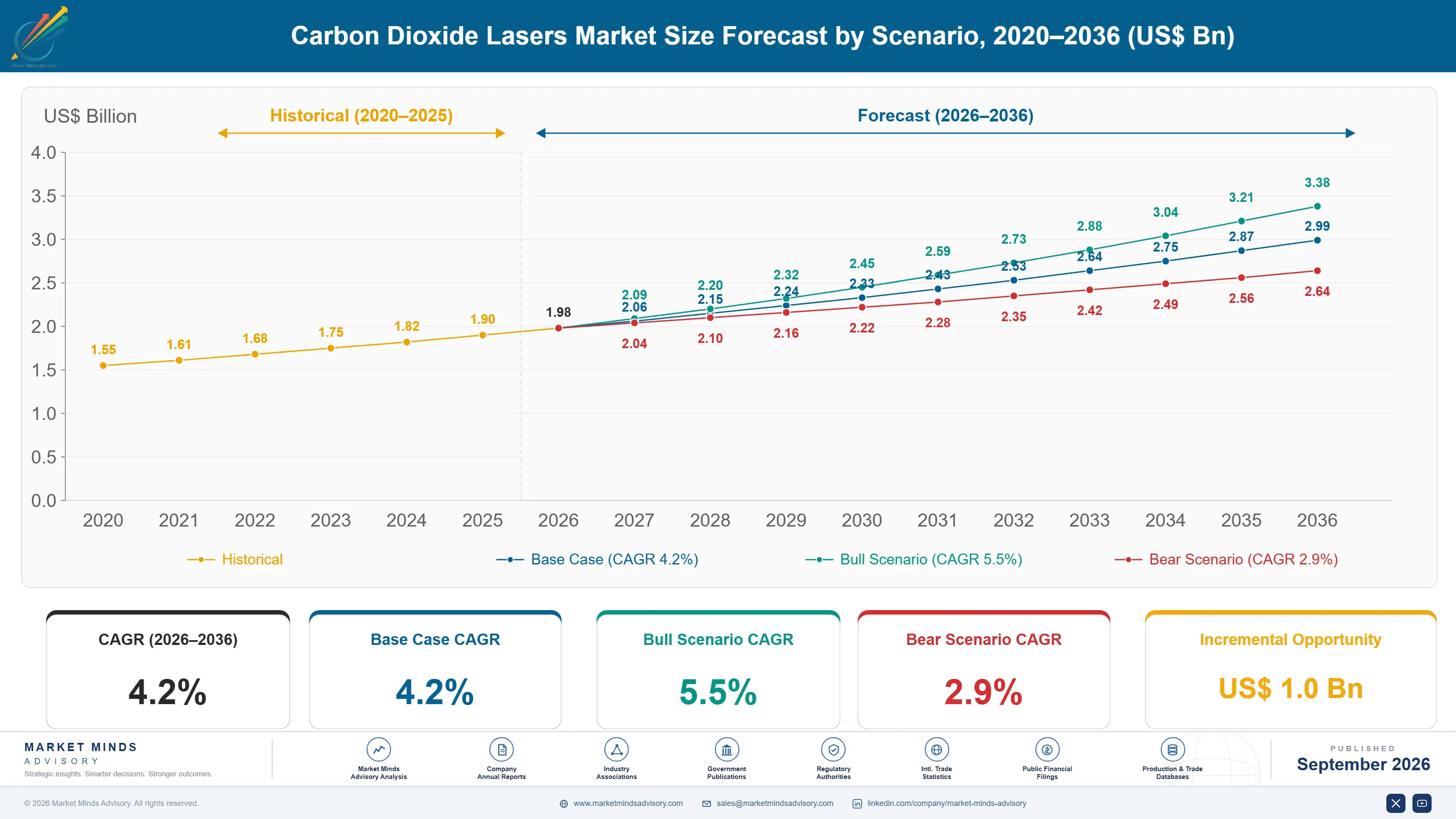
Carbon Dioxide Lasers Market Forecast Scenarios

co2-laser-market-size-forecast-scenario-1789986667822
Between 2020 and 2025 the market grew at a milder 3.5% historical rate as fiber laser adoption steadily displaced CO2 systems in metal cutting shops across North America and Europe, even as non-metal processing, textile, and medical procedure volumes held their installed base largely intact through the period despite competitive pricing pressure from newer entrants.
The base case assumes 4.2% annual growth through 2036, driven by three mechanisms: continued RF-excited sealed system replacement of older gas-flow designs reducing ongoing maintenance costs meaningfully across established production lines, expanding non-metal processing volume across textile, leather, and packaging manufacturing in China and South Asia, and steady medical procedure equipment upgrades as hospitals replace aging dermatology and surgical laser systems nearing end of service life across most developed and emerging regions worldwide.
A bull scenario near 5.5% growth would require accelerated adoption of compact waveguide systems in emerging medical diagnostics applications alongside sustained Chinese textile export demand. A bear case near 2.9% reflects faster than expected fiber laser substitution in remaining metal marking applications, compressing unit volumes across legacy sealed tube product lines still held by smaller regional manufacturers.

Where CO2 Lasers Still Beat Fiber on Cost

Carbon dioxide lasers persist commercially because their infrared wavelength couples efficiently into organic materials like wood, acrylic, textile, and leather, something fiber lasers handle poorly regardless of applied power. This physical advantage anchors durable demand in non-metal cutting, engraving, and marking applications even as fiber systems dominate metal fabrication almost entirely across most industrial segments today, leaving CO2 systems a defensible commercial territory.
MARKET CONCENTRATIONCR5 42%Share held by five largest global suppliers combined
AVERAGE SELLING PRICE$8,400 per unitBlended price across sealed tube and RF-excited systems
TOP PRODUCING COUNTRYChina, 46% shareShare of global unit production concentrated domestically there
CAPACITY UTILISATION71%Average factory utilisation across major manufacturing facilities worldwide today
REPLACEMENT CYCLE6 to 8 yearsTypical service life before sealed tube systems need replacement
TRADE INTENSITY38% export sharePortion of finished units shipped across international borders annually
Commercial character has shifted decisively toward RF-excited sealed architecture, which eliminates the gas replenishment and electrode maintenance that plagued older fast-axial-flow designs sold a decade ago. Buyers now weigh total cost of ownership over multi-year service contracts rather than upfront purchase price alone, favoring suppliers offering predictable maintenance schedules and documented mean-time-between-failure data across comparable competing product lines and service networks.
Over the next decade, medical procedure applications and compact waveguide designs will likely determine which suppliers gain share, as dermatology and surgical equipment manufacturers increasingly specify smaller, more reliable CO2 modules for crowded procedure rooms. Manufacturers unable to certify systems for medical-grade reliability standards risk losing specification battles to competitors already established in regulated healthcare procurement channels across most major developed markets.
"CO2 lasers won't disappear, they will retreat into the applications where their wavelength physics genuinely wins, and manufacturers who accept that retreat gracefully will outearn those still chasing metal cutting share."
Director, Industrial Laser Systems and Photonics Practice · MMA Construction and Industrial Equipment Practice · September 2026

Market Trends

RF-Excited Sealed Systems Replace Legacy Gas-Flow Designs

Manufacturers are transitioning production lines toward RF-excited sealed tube architecture, which extends service life to roughly six to eight years compared with the eighteen to twenty-four month intervals typical of older fast-axial-flow designs requiring frequent gas replenishment and electrode servicing across most maintenance schedules. Coherent, Synrad, and Access Laser have all launched sealed RF product families since 2023 targeting the marking and engraving segment specifically, where buyers increasingly evaluate suppliers on documented mean-time-between-failure figures rather than upfront unit price alone across most procurement decisions made by industrial buyers today across facilities.
Market Impact: China textile demand exceeds 300 billion
Medical Procedure Demand Drives Compact Waveguide Adoption

Dermatology clinics and surgical equipment manufacturers are specifying smaller waveguide CO2 modules delivering under thirty watts for procedures like skin resurfacing and minor tissue ablation, replacing bulkier legacy systems that occupied significant procedure room floor space in busy urban clinics, dermatology suites, and hospital wings nationwide today. Hospital procurement cycles for laser-based dermatology equipment in the United States alone are expected to add roughly 4,200 new installed units through 2030 as older systems reach end of certified service life across major regional health networks and private practices this coming decade.
Market Impact: Hospitals allocated 1.8 billion in 2025

Market Opportunities and Growth Drivers

China's Textile Export Growth Sustains Non-Metal Demand

China's textile and garment export sector, which shipped goods worth over 300 billion dollars in 2025, relies heavily on CO2 laser cutting and engraving equipment for pattern work, denim finishing, and leather goods production across thousands of small and mid-sized manufacturing facilities concentrated in Guangdong and Zhejiang provinces and neighboring industrial clusters nationwide today. Domestic laser equipment producers like Han's Laser and Bodor have expanded sealed tube production capacity specifically to serve this steady, price-sensitive replacement demand from garment factories nationwide over the past several years of sustained export growth.
Market Impact: Metal segment shrinks 5% yearly

Hospital Equipment Modernization Expands Medical Segment Demand

Aging dermatology and surgical laser installations across United States and European hospital networks, many originally installed between 2005 and 2012, are reaching end of certified service life and require replacement under updated medical device safety regulations across most jurisdictions and healthcare systems today. Hospital capital equipment budgets allocated roughly 1.8 billion dollars toward laser-based dermatology and surgical systems in 2025 alone, with compact waveguide CO2 modules increasingly specified over older bulkier designs given their smaller procedure room footprint and lower ongoing maintenance requirements across most facilities, hospitals, and clinics nationwide.
Market Impact: Gas input costs rose 40%

Market Restraints and Challenges

Fiber Laser Substitution Continues Squeezing Remaining Metal Applications

Fiber lasers have already captured over 80% of new metal cutting installations globally, and the remaining CO2 metal marking niche keeps shrinking as fiber system prices fall below 15,000 dollars for entry-level units sold to small fabrication shops and hobbyist workshops nationwide. The root cause is fiber's superior electrical efficiency and near-zero consumable maintenance, which CO2 sealed tube designs cannot match despite recent RF-excited improvements to service intervals. Manufacturers are mitigating this by pivoting product roadmaps entirely toward non-metal and medical applications where fiber cannot compete on wavelength physics alone.
Market Impact: Sealed RF systems reach 55% share

Rare Gas Supply Costs Pressure Sealed Tube Margins

Sealed CO2 laser tubes require helium and carbon dioxide gas mixtures whose prices rose nearly 40% between 2022 and 2025 amid tightening global helium supply constraints affecting multiple manufacturing industries simultaneously and quite unpredictably across most producing and consuming regions worldwide today. The root cause traces to concentrated helium production in just a small handful of countries, leaving manufacturers exposed to supply disruptions beyond their direct control. Some producers are mitigating exposure by qualifying alternative gas suppliers and redesigning resonators to reduce total gas volume required per unit produced annually.
Market Impact: Medical segment adds 4,200 units
3 additional market trends, 4 additional growth drivers, and 2 additional restraints and challenges are covered in the full report. Contact sales@marketmindsadvisory.com to access the complete intelligence.

Segment CAGR and Growth Architecture

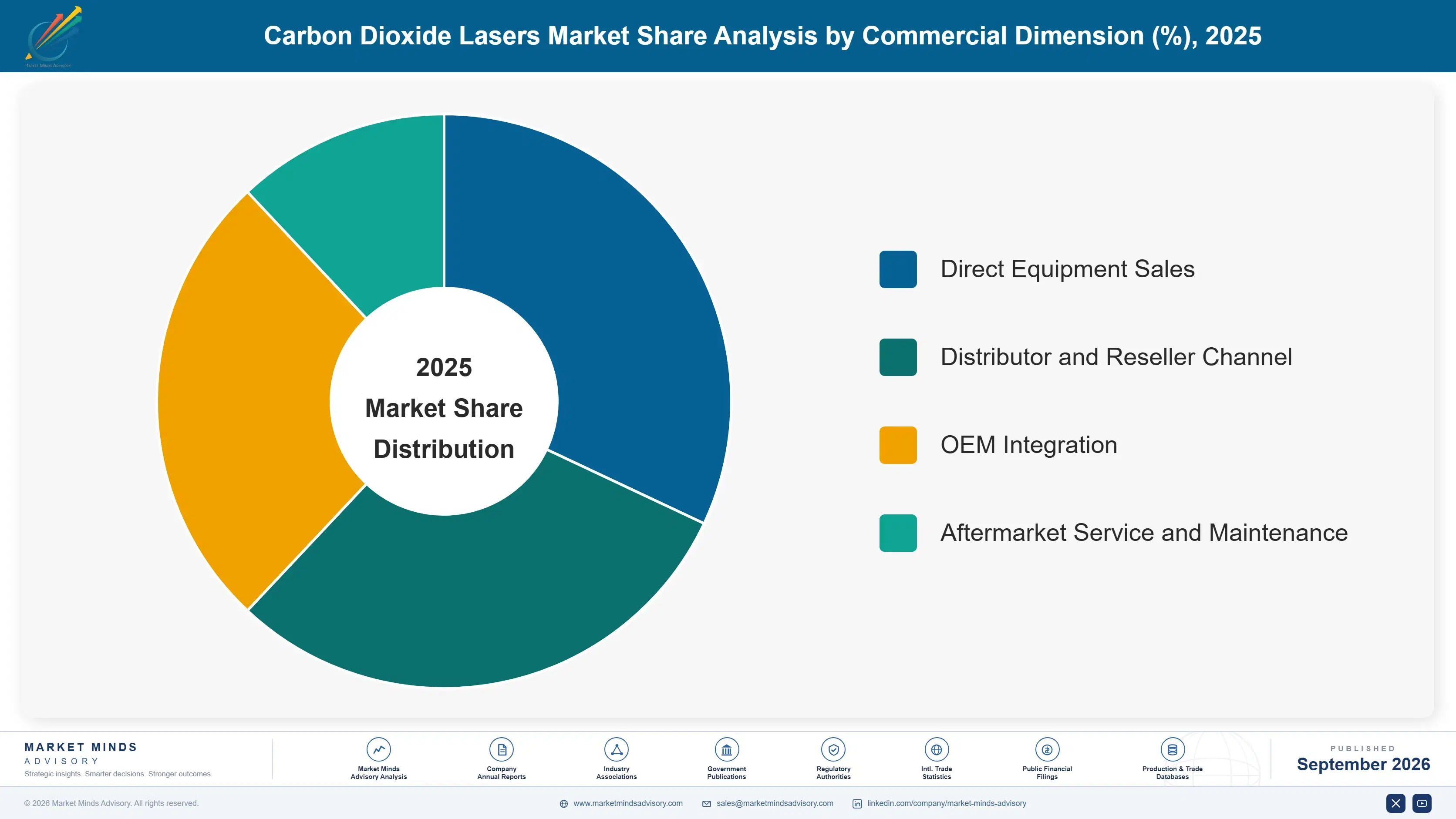
This report segments the Carbon Dioxide Lasers Market by resonator and excitation technology, the classification buyers actually use when specifying equipment for cutting, marking, welding, or medical procedures across distinct industrial and clinical applications requiring different power output, physical footprint, service intervals, and long-term reliability characteristics suited to their specific production environment and budget constraints.
co2-laser-market-market-share-analysis-1789986668816

RF-Excited CO2 Lasers

RF-excited sealed CO2 lasers are the fastest-growing product category, expanding at 6.8% annually as manufacturers replace older gas-flow designs across marking, engraving, and light industrial cutting applications worldwide. Their sealed architecture eliminates the electrode wear and gas replenishment that shortened service life in legacy fast-axial-flow systems, cutting maintenance costs meaningfully for buyers operating multiple units across busy production facilities and small independent workshops on tight budgets. Coherent, Synrad, and Access Laser all lead this category with sealed RF product families launched since 2023, and Chinese manufacturers including Han's Laser are following closely with competitively priced domestic alternatives targeting cost-sensitive small workshop buyers across most emerging regions and provincial industrial clusters.
CAGR 6.8%

Waveguide CO2 Lasers

Waveguide CO2 lasers, the second-fastest-growing category at 6.0% annually, benefit from compact form factors under thirty watts that suit dermatology, surgical, and precision marking applications where floor space and portability matter considerably to procurement decision makers across busy clinics and outpatient surgical centers nationwide today. Hospital procurement teams increasingly specify waveguide modules over bulkier fast-axial-flow alternatives given their notably lower maintenance burden and quieter operation in busy clinical settings. Manufacturers including Access Laser and several specialized Japanese producers are expanding waveguide product lines specifically to capture growing medical device demand as older installed dermatology equipment reaches end of certified service life across major hospital networks nationwide and throughout Western Europe.
CAGR 6.0%
Full segment breakdown across 6 segments available in the complete report.

Regional Architecture and Country Demand Map

Demand concentrates in East Asia given China's dominant non-metal fabrication and textile export base, with North America and Western Europe holding meaningful share through established medical and industrial marking installations rather than new capacity growth, while South Asia and Pacific gains ground fastest as apparel manufacturing shifts regionally.

North America

United States hospital networks and industrial marking equipment buyers sustain the region's installed base, replacing aging dermatology and surgical laser systems as they reach end of certified service life under updated medical device regulations enforced across most states nationwide. Domestic demand centers on RF-excited sealed systems favored for lower maintenance overhead across dispersed clinic and workshop locations spanning most metropolitan regions nationwide today. Canada contributes modest additional volume through woodworking and signage engraving applications concentrated in Ontario and Quebec, while Mexican maquiladora operations increasingly specify CO2 units for textile finishing tied to broader nearshoring investment trends across the border manufacturing corridor and supply chain networks. Certified service network coverage weighs heavily on supplier selection given production downtime costs.
Share: 24% | CAGR: 4.0% (2026 to 2036)

Western Europe

Germany anchors regional demand through Trumpf's engineering-focused customer base and a dense population of precision manufacturing workshops using CO2 systems for non-metal cutting and marking applications across the country's industrial heartland and export-oriented supply chains. Growth trails the global average as fiber laser substitution proceeds faster here than in less mature markets, compressing legacy metal marking volumes considerably each year across most manufacturing segments. France and Italy contribute meaningful demand through leather goods and fashion accessory production tied to established luxury manufacturing clusters, while the United Kingdom's medical device sector sustains steady dermatology equipment replacement across regional hospital networks and private clinics nationwide. Scandinavian countries add incremental demand through furniture and design-focused manufacturing applications favoring precision engraving equipment.
Share: 21% | CAGR: 2.7% (2026 to 2036)
Regional intelligence for 5 additional markets available in the complete report: East Asia, South Asia and Pacific, Latin America, Middle East and Africa, Eastern Europe. Contact sales@marketmindsadvisory.com.
co2-laser-market-country-cagr-analysis-1789986669736

Where Suppliers Can Defend Margin From Fiber

As fiber lasers keep taking metal cutting share, CO2 laser suppliers must find margin in adjacent commercial territory: medical device certification, multi-year service contract revenue, regional distribution partnerships, and compact designs that fiber systems cannot easily replicate given fundamental wavelength physics constraints affecting most competing product architectures and their installed customer bases worldwide today.

Medical-Grade Certification Program for Waveguide Modules

Suppliers investing in medical device certification for compact waveguide modules can access dermatology and surgical procurement channels commanding meaningfully higher margins than industrial marking equipment, where price competition from Chinese manufacturers compresses returns considerably across most product categories. Certified medical units typically sell at prices 60% above equivalent industrial-grade systems given the regulatory compliance burden and reliability testing required for hospital procurement approval. Access Laser and several specialized producers have already captured disproportionate share in this segment by moving early on certification investment across multiple jurisdictions. Buyers in this segment also value documented reliability data over pure price comparisons.
Market Impact: Certified medical units command 60% premium pricing today

Bundling Multi-Year Service Contract Revenue Streams

Suppliers bundling multi-year maintenance and gas replenishment contracts with equipment sales capture recurring revenue that partially offsets declining unit sales in the shrinking metal marking segment facing continued fiber substitution pressure. Service contracts typically generate margins exceeding 45% compared with roughly 20% on hardware sales alone, since maintenance work requires specialized technician visits rather than commodity components sold at thin margins. Coherent and Trumpf both report growing service revenue as a share of total CO2 laser segment income across their installed customer base worldwide. Buyers increasingly prefer bundled contracts over standalone hardware purchases.
Market Impact: Service margins exceed 45% versus hardware sales alone

Textile Export Cluster Distribution Partnership Building

Building dedicated distribution and technical support partnerships across China's Guangdong and Zhejiang textile manufacturing clusters captures disproportionate volume from the fastest-growing demand pool globally, where thousands of small garment factories require reliable local service networks close to their facilities. Manufacturers with established regional partnerships report unit volumes roughly 35% higher than competitors relying solely on export sales without meaningful local technical presence or support infrastructure. Han's Laser and Bodor already dominate this channel through decades of accumulated local relationships and service infrastructure across most provinces. Local presence also shortens delivery times considerably for repeat buyers.
Market Impact: Regional partnerships lift unit volume by 35% overall

Helium Supply Hedging and Alternative Gas Qualification

Suppliers qualifying alternative gas mixtures and locking in multi-year helium supply contracts protect margin against the roughly 40% input cost inflation that squeezed sealed tube manufacturers between 2022 and 2025 amid tight global supply. Redesigning resonators to reduce gas volume requirements per unit can cut input costs by an estimated 15% without sacrificing performance or service life expectations. Manufacturers moving early on gas supply diversification are already reporting more stable gross margins than competitors still exposed to spot market pricing volatility across most quarters. Locking in supply early also reduces exposure to future price spikes.
Market Impact: Gas hedging offsets roughly 40% cost inflation risk

Who Controls the Margin Pool

Concentration sits moderate, with a CR5 near 42% on a revenue basis and a meaningful gap separating Coherent and Trumpf from mid-tier challengers like Han's Laser and Access Laser, who compete on price and service reach rather than technology breadth. Below these five, dozens of smaller Chinese manufacturers compete almost entirely on price, serving cost-sensitive workshop buyers across garment and leather goods clusters where brand loyalty matters far less than price.
Current competitive activity centers on three dimensions: sealed RF product launches replacing older gas-flow architecture, medical device certification opening higher-margin dermatology procurement channels, and aggressive Chinese domestic pricing pressuring lower-power sealed tube segments where differentiation remains thin and buyers switch suppliers readily based on delivered cost alone. Service bundling has also become a meaningful lever among established Western suppliers.

Emerging pressure comes from fiber laser makers extending downward into remaining CO2 niches and from Chinese manufacturers scaling waveguide production, both of which could compress mid-tier rankings over the coming years. Suppliers slow to certify medical-grade systems or diversify beyond metal-adjacent applications risk falling further behind competitors established in regulated healthcare channels, while distribution partnerships in fast-growing textile export clusters increasingly determine which challengers gain share against incumbent leaders.
co2-laser-market-company-positioning-matrix-1789986670601

Competitive Moat and Risk Dimensions

COHERENT

Moat: Certified Reliability Data

Coherent's decades of documented mean-time-between-failure performance across large installed medical and industrial customer bases give buyers real confidence that newer entrants cannot match without years of accumulated field service history and reliability testing across diverse operating environments, duty cycles, and climate conditions found worldwide today.
COHERENT

Risk: Metal Segment Revenue Exposure

A meaningful share of Coherent's legacy CO2 revenue still comes from metal marking applications facing continued fiber laser substitution, forcing the company to actively manage declining volume while investing elsewhere in medical and non-metal growth areas that require sustained capital allocation over multiple years and careful portfolio rebalancing.
TRUMPF

Moat: Precision Engineering Brand Trust

Trumpf's reputation for engineering-grade reliability across German and broader European industrial customers commands premium pricing power that price-focused Chinese competitors cannot replicate given decades of accumulated trust built through direct customer relationships and documented field performance across demanding industrial applications and precision manufacturing environments nationwide.
TRUMPF

Risk: European Market Growth Ceiling

Trumpf's revenue concentration in a slower-growing Western European region, where fiber substitution runs ahead of the global average, limits organic growth unless the company expands more aggressively into faster-growing Asian and medical procurement channels currently underpenetrated relative to its established domestic customer base and legacy sales infrastructure.

Players Tracked

Prominent Players

Coherent
Trumpf
Han's Laser
Access Laser
Synrad

Other Key Players

Bodor
II-VI Incorporated
Universal Laser Systems
Amada
Mitsubishi Electric
Epilog Laser
GCC Laser
SPI Lasers
Cincinnati Incorporated
Laser Photonics
Kern Laser Systems
Full Spectrum Laser
Boss Laser
GravoTech
Rofin-Sinar

Recent Developments

MARCH 2025

Coherent Launches Sealed RF Waveguide Module Family

Coherent introduced a new sealed RF-excited waveguide module family targeting dermatology and precision marking applications, offering service life extending to eight years without gas replenishment. The launch specifically targets hospital procurement teams replacing aging fast-axial-flow systems nearing end of certified service life across major regional health networks.
Signal: Signals Coherent's strategic pivot toward medical-grade certified equipment and away from declining metal marking revenue streams entirely.
JULY 2025

Han's Laser Expands Guangdong Sealed Tube Capacity

Han's Laser announced expanded sealed tube manufacturing capacity at its Guangdong facility, targeting rising domestic textile export demand from garment factories across the province. The expansion adds roughly 20% more annual production capacity, reinforcing the company's price leadership position against smaller regional Chinese competitors and imported alternatives.
Signal: Signals continued Chinese domestic consolidation around scale-driven price competition in sealed tube systems across most provinces nationwide.
NOVEMBER 2025

Trumpf Announces Multi-Year Helium Supply Agreement

Trumpf signed a multi-year supply agreement with a European industrial gas producer to lock in helium and carbon dioxide gas mixture pricing through 2029, protecting margin against continued input cost volatility. The agreement also includes provisions for alternative gas formulation research aimed at reducing consumption per unit produced.
Signal: Signals suppliers proactively hedging against input cost inflation rather than passively absorbing spot market pricing volatility going forward.

Helium Cost Exposure and Gas Supply Concentration

Helium and carbon dioxide gas mixtures represent roughly 12 to 16% of total component cost of goods sold for sealed CO2 laser systems, with the remainder split across optics, resonator housings, and RF excitation electronics sourced primarily from Germany, Japan, and domestic Chinese suppliers depending on product tier, power output, and overall design complexity across manufacturers.
Helium prices rose nearly 40% between 2022 and 2025 amid tightening global supply, according to the IEA Critical Minerals and Semiconductor Supply Chain Review 2025, which flagged helium as increasingly strategically constrained given concentrated production in just a handful of countries including the United States, Qatar, and Russia facing export disruption risk from geopolitical tension, aging extraction infrastructure, and periodic maintenance shutdowns affecting global output volumes considerably.

This exposure disadvantages smaller Chinese sealed tube manufacturers lacking long-term supply contracts, forcing them to absorb spot market price spikes that larger Western suppliers with hedged multi-year agreements can avoid. Vertically integrated players able to redesign resonators for lower gas consumption per unit gain a meaningful and durable cost advantage over competitors still reliant on legacy architecture requiring frequent gas replenishment cycles.
co2-laser-market-cost-volatility-analysis-1789986670926

Multi-Year Fixed-Price Helium Supply Contracts

Manufacturers increasingly negotiate multi-year fixed-price or collared supply agreements with industrial gas producers across multiple countries and regions worldwide to reduce exposure to short-term helium price spikes affecting production costs and delivery schedules considerably. This accepts somewhat reduced flexibility during price declines for meaningfully greater cost predictability across annual planning cycles and budgeting decisions.

Resonator Redesign to Cut Gas Volume Requirements

Several manufacturers are redesigning resonator geometry to reduce total gas volume required per sealed unit, targeting reductions of roughly 15% without sacrificing output power or service life expectations. This gradually lowers exposure to helium price volatility while improving unit economics across most product tiers and price points over successive design generations and product refresh cycles.

Alternative Gas Mixture Qualification Programs

Some producers are researching alternative gas mixture formulations that reduce dependency on helium specifically, testing nitrogen and other blend ratios that maintain acceptable beam quality for lower-power industrial applications across most facilities. This diversification reduces single-source supply risk considerably while preserving performance across most non-precision cutting and marking use cases over the coming several years.

Portfolio Architecture for Margin Defence

Suppliers operate across three margin tiers: volume sealed tube systems for basic marking and engraving generate gross margins around 20 to 28%, while certified medical-grade waveguide modules command 40 to 50% given regulatory barriers competitors cannot quickly replicate without years of testing. The gap between these tiers has widened considerably as fiber substitution compresses returns in commodity metal marking applications globally.
Volume sealed tube systems still represent the majority of unit shipments, particularly across Chinese textile manufacturing clusters serving garment export demand, but the highest value creation now concentrates in medical certification and RF-excited sealed architecture where buyers pay meaningfully for documented reliability and lower maintenance burden. Suppliers must balance capacity between shrinking legacy segments and growing premium niches without starving either of needed investment.

High-value margin pools concentrate specifically around medical device certification and compact waveguide designs, both requiring capital investment and regulatory expertise that smaller regional competitors struggle to replicate quickly at comparable quality. Suppliers positioned across all three tiers, rather than concentrated purely in commodity metal marking, are best placed to capture disproportionate profit as the broader market keeps shifting toward non-metal and medical applications over the coming decade.

Sealed tube systems for basic metal and light non-metal marking sold primarily on price to cost-conscious Chinese textile and workshop buyers, generating gross margins of 20 to 28% amid intense competition and thin differentiation between suppliers.
Gross Margin

RF-excited sealed systems and medical-grade waveguide modules commanding gross margins of 40 to 50% given regulatory certification barriers, documented reliability data, and longer service intervals that meaningfully limit competitive entry from smaller regional manufacturers.
Gross Margin

Low-gas-consumption resonator redesigns and alternative gas mixture systems responding to helium supply constraints and rising input costs, generating gross margins around 32 to 40% as early-mover manufacturers capture premium efficiency-conscious industrial contracts.
Gross Margin
co2-laser-market-portfolio-architecture-1789986671764

High-value Sub-segments and Strategic Watch-out

RF-Excited CO2 Lasers

Fastest-growing and highest-margin segment as buyers replace older gas-flow designs with sealed architecture offering longer service intervals and lower maintenance burden across most facilities today. Manufacturers with established sealed RF product lines are capturing premium positioning ahead of competitors still reliant on legacy systems requiring frequent servicing and gas replenishment.

Waveguide CO2 Lasers

Second-fastest growing segment tied to medical device certification expansion, carrying above-average margins given regulatory compliance requirements across dermatology and surgical applications tracked across most developed healthcare markets. Manufacturers building deeper certification credentials here can capture disproportionate value as hospital procurement cycles accelerate replacement of aging installed equipment nationwide.

Sealed CO2 Laser Tubes

Core revenue segment representing steady replacement demand across most active Chinese textile and workshop deployments currently tracked across major manufacturing provinces, generating stable margins as competitive pricing pressure persists moderately. This segment remains commercially essential even as growth shifts toward RF-excited alternatives over the coming forecast period.

Fast-Axial-Flow CO2 Lasers

Strategic watch-out segment facing steady displacement as sealed RF architecture becomes the preferred choice across nearly all competing manufacturers and buyer segments. Manufacturers overexposed to this legacy category risk meaningful margin erosion absent diversification into sealed or medical-certified product lines over the coming several years.

Where CO2 Laser Loyalty Comes From

Revenue durability comes less from subscription models than from service contract renewal and gas replenishment consumables, since sealed CO2 systems still require periodic technician visits and component replacement over their six to eight year service life across most industrial and clinical deployments worldwide. Suppliers bundling maintenance into multi-year contracts capture recurring income even as new unit sales growth slows considerably.
Adoption depth varies meaningfully by vertical: medical procedure buyers show the strongest stickiness, rarely switching suppliers once regulatory certification and clinical training investments are made across their entire procurement organization, while textile workshop buyers treat sealed tube systems as replaceable commodities chosen mainly on delivered price and availability across regional distribution networks serving garment manufacturing clusters nationwide.

Younger procurement managers entering hospital and manufacturing purchasing roles increasingly expect documented reliability data and predictable service contracts as standard practice, rather than negotiating maintenance terms separately after purchase completion each time. This generational shift pressures suppliers still selling equipment without bundled service commitments to restructure their offerings meaningfully or risk losing valuable renewal business to more service-oriented competitors already established across most regions and market segments today.
co2-laser-market-end-use-penetration-index-1789986672601

Retreat Deliberately Into Defensible Territory

These are among the four positions where our research anticipates prominent divergence between winners and laggards over the coming forecast period. Each is grounded in the demand model, the regulatory perimeter, and the announced capacity pipeline.
01 / MEDICAL CERTIFICATION INVESTMENT

Prioritize dermatology and surgical certification over metal marking defense

Manufacturers still chasing shrinking metal marking share face inevitable margin compression as fiber substitution accelerates across most industrial segments and buyer categories worldwide, leaving little room for meaningful price competition. Investing in medical device certification for compact waveguide modules opens dermatology and surgical procurement channels commanding roughly 60% price premiums over industrial-grade equivalents currently sold across most regions. Competitors delaying this pivot risk permanently ceding the fastest-growing, highest-margin segment to already-certified rivals with established hospital procurement relationships and clinical training programs.
02 / SERVICE CONTRACT BUNDLING

Convert equipment sales into recurring multi-year service revenue

Hardware-only sales models leave manufacturers exposed to declining unit volumes as fiber laser substitution proceeds across most metal-adjacent applications and buyer segments worldwide, compressing gross margins steadily each fiscal year. Bundling multi-year maintenance and gas replenishment contracts generates margins exceeding 45%, compared with roughly 20% on standalone hardware transactions typically negotiated once and rarely renewed thereafter without dedicated follow-up. Manufacturers building dedicated service organizations now will capture disproportionate recurring revenue as their installed base continues aging steadily across most regional markets and buyer segments.
03 / HELIUM SUPPLY HEDGING

Lock in multi-year gas contracts before further price escalation

Helium input costs rose nearly 40% between 2022 and 2025, squeezing margins hardest for smaller manufacturers lacking long-term supply agreements or hedging capability across their procurement organization and finance function entirely. Locking in multi-year fixed-price contracts now, before further escalation, protects margin predictability while competitors exposed to spot pricing absorb continued volatility across successive fiscal quarters and budget cycles ahead. Redesigning resonators to reduce gas volume requirements compounds this advantage considerably over successive product generations and design refreshes each year.
04 / CHINESE DISTRIBUTION PARTNERSHIPS

Build direct technical support presence across textile export clusters

The fastest-growing demand pool globally sits within China's Guangdong and Zhejiang textile manufacturing clusters, where thousands of small garment factories require reliable local technical support and service networks located nearby their facilities. Manufacturers building dedicated regional partnerships report unit volumes roughly 35% higher than competitors relying solely on export sales without meaningful local presence established across the region. Suppliers absent from this channel risk ceding the market's single largest growth pool to entrenched domestic Chinese rivals with decades of accumulated relationships.

Engagement Snapshot From the Field

A live engagement with an industry participant carrying material or product regulatory and market exposure ahead of a defining policy shift, showing how our research translates into a defensible multi-year portfolio strategy.
MARKET MINDS ADVISORY · CLIENT ENGAGEMENT SUMMARY
Carbon Dioxide Lasers Producer Strategic Portfolio Review and Transition Roadmap 2026·Investment Scenario on Carbon Dioxide Lasers Exposure Evaluation 2025-26
CLIENT PROFILE
The client is a mid-sized North American manufacturer of sealed CO2 laser systems supplying industrial marking and light cutting equipment to distributors across the United States and Canada. The company reported (client-reported, unverified by MMA) annual segment revenue of approximately $180 million and had historically concentrated on metal-adjacent marking applications facing accelerating fiber laser substitution.
STRATEGIC CHALLENGE
The manufacturer faced steadily eroding unit volumes as fiber laser competitors captured metal marking specification wins across its core distributor channel, while leadership lacked clear visibility into which adjacent applications offered genuine defensible margin. The board needed an independent assessment before committing capital to medical certification or textile-focused product development ahead of the next budget cycle.
MMA APPROACH
MMA conducted segment-level margin and growth analysis across the client's product portfolio, benchmarking against primary survey data covering medical procurement, textile export demand, and competitive positioning. The engagement combined expert interviews with the client's product and sales leadership alongside MMA's regional demand data to identify the highest-return certification and partnership investments available given the company's existing engineering capabilities.
KEY FINDINGS
  1. Medical-grade waveguide certification could access a segment where equivalent products carried a 60% price premium over the client's existing industrial line (client-reported, unverified by MMA).
  2. The client's metal marking revenue had declined at a mid-single-digit annual rate for three consecutive years as fiber laser competitors expanded specification wins.
  3. Service contract attach rates lagged industry benchmarks considerably, with fewer than a third of equipment sales including bundled multi-year maintenance and gas replenishment agreements.
  4. Chinese textile export clusters represented the single largest underserved growth pool globally, offering volume the client's current distribution network could not reach.
CLIENT PROFILE
The client is a mid-sized North American manufacturer of sealed CO2 laser systems supplying industrial marking and light cutting equipment to distributors across the United States and Canada. The company reported (client-reported, unverified by MMA) annual segment revenue of approximately $180 million and had historically concentrated on metal-adjacent marking applications facing accelerating fiber laser substitution.
STRATEGIC CHALLENGE
The manufacturer faced steadily eroding unit volumes as fiber laser competitors captured metal marking specification wins across its core distributor channel, while leadership lacked clear visibility into which adjacent applications offered genuine defensible margin. The board needed an independent assessment before committing capital to medical certification or textile-focused product development ahead of the next budget cycle.
MMA APPROACH
MMA conducted segment-level margin and growth analysis across the client's product portfolio, benchmarking against primary survey data covering medical procurement, textile export demand, and competitive positioning. The engagement combined expert interviews with the client's product and sales leadership alongside MMA's regional demand data to identify the highest-return certification and partnership investments available given the company's existing engineering capabilities.
KEY FINDINGS
  1. Medical-grade waveguide certification could access a segment where equivalent products carried a 60% price premium over the client's existing industrial line (client-reported, unverified by MMA).
  2. The client's metal marking revenue had declined at a mid-single-digit annual rate for three consecutive years as fiber laser competitors expanded specification wins.
  3. Service contract attach rates lagged industry benchmarks considerably, with fewer than a third of equipment sales including bundled multi-year maintenance and gas replenishment agreements.
  4. Chinese textile export clusters represented the single largest underserved growth pool globally, offering volume the client's current distribution network could not reach.
RECOMMENDED STRATEGY
Phase 1: Phase one: pursue medical device certification for a compact waveguide module within an eighteen-month development and regulatory testing window ahead of launch. Phase 2: Phase two: restructure sales contracts to bundle multi-year maintenance agreements with all new equipment purchases made across the entire distributor network. Phase 3: Phase three: evaluate a distribution partnership or licensing arrangement to access Chinese textile export manufacturing clusters directly rather than through intermediaries.
OUTCOME
Within two years of certification approval, the client reported (client-reported, unverified by MMA) medical segment revenue reaching roughly $22 million, alongside a 4 percentage point improvement in blended gross margin. Service contract attach rates more than doubled following the sales restructuring, providing meaningfully more predictable recurring revenue heading into subsequent budget cycles.

Frequently Asked Questions

Foundational context covering the market sizes, CAGR, scope, country, region and competition that inform every finding below. This section is provided to cover basics and most often pre-purchase conversations, answered from the MMA Primary Research Dataset.

What is the current size of the Carbon Dioxide Lasers Market?

The Carbon Dioxide Lasers Market is valued at $1.9 billion in 2025. This reflects global sales of sealed, RF-excited, waveguide, and other CO2 laser systems across industrial and medical applications.

How large will the Carbon Dioxide Lasers Market be by 2036?

The market is projected to reach $2.99 billion by 2036. Growth is anchored by non-metal processing, medical procedure applications, and RF-excited sealed system replacement demand.

What is the CAGR for the Carbon Dioxide Lasers Market 2026 to 2036?

The market is forecast to grow at a 4.2% compound annual growth rate between 2026 and 2036. This reflects steady replacement demand offsetting continued fiber laser substitution in metal applications.

Which segment is growing fastest?

RF-Excited CO2 Lasers is the fastest-growing segment at a 6.8% CAGR, roughly 1.62x the overall market rate. Longer service life and lower maintenance costs are driving this transition.

Who are the major companies in the Carbon Dioxide Lasers Market?

Leading companies include Coherent, Trumpf, Han's Laser, Access Laser, and Synrad. These five firms compete on reliability data, service networks, and medical device certification breadth across most regions.

Which country is growing fastest?

China is the fastest-growing country at a 6.0% CAGR. Its dominant textile export manufacturing base drives outsized demand for non-metal cutting and finishing equipment nationwide.

Report Segmentation Architecture

The full report scope spans multiple orthogonal segmentation dimensions, with cross-tabulated demand data provided for each dimension pair. Coverage extends further to regional breakdowns, trend trajectories, and the competitive detail needed to support segment-level decision-making.

By Primary Market Dimension

  • RF-Excited CO2 Lasers
  • Waveguide CO2 Lasers
  • Sealed CO2 Laser Tubes
  • Fast-Axial-Flow CO2 Lasers
  • Slab CO2 Lasers
  • TEA CO2 Lasers

By End-Use Industry

  • Industrial Manufacturing
  • Textile and Garment
  • Medical and Healthcare
  • Electronics and Semiconductor
  • Signage and Woodworking

By Commercial Dimension

  • Direct Equipment Sales
  • Distributor and Reseller Channel
  • OEM Integration
  • Aftermarket Service and Maintenance

By Region

  • North America
  • Western Europe
  • East Asia
  • South Asia and Pacific
  • Latin America
  • Middle East and Africa
  • Eastern Europe

Scope, Methodology, and Coverage

Every figure in this report is reproducible from documented input assumptions. The scope below maps the historical period, the forecast horizon, the segmentation dimensions, and the countries covered, alongside the underlying primary and qualitative methodology.
Historical Period
2020 to 2025
Forecast Period
2026 to 2036
Base Year
2025 (USD billions; MMA Primary Research Dataset, September 2026)
Market Definition
The Carbon Dioxide Lasers Market covers gas-discharge laser systems generating coherent infrared light near ten point six microns, sold as sealed tubes, RF-excited modules, waveguide units, slab resonators, fast-axial-flow systems, and TEA configurations for cutting, marking, welding, and medical use. It excludes fiber, diode, and solid-state laser systems sold as separate product categories.
Quantitative Units
Value in USD Billion, Volume in Thousand Units
Segmentation Dimensions
By Resonator and Excitation Technology, By End-Use Industry, By Commercial Dimension, By Region
Regions Covered
North America, Western Europe, East Asia, South Asia and Pacific, Latin America, Middle East and Africa, Eastern Europe
Countries Covered
United States, Canada, Mexico, Germany, United Kingdom, France, Italy, China, Japan, South Korea, India, Vietnam, Australia, Brazil, Saudi Arabia, United Arab Emirates, South Africa, Poland
Key Companies Profiled
Coherent, Trumpf, Han's Laser, Access Laser, Synrad, Bodor, II-VI Incorporated, Universal Laser Systems, Amada, Mitsubishi Electric, Epilog Laser, GCC Laser, SPI Lasers, Cincinnati Incorporated, Laser Photonics, Kern Laser Systems, Full Spectrum Laser, Boss Laser, GravoTech, Rofin-Sinar
Quantitative Methodology
Primary survey, n=3,800 respondents, Q4 2025, six countries; demand-side model with trade association cross-validation
Qualitative Methodology
47 expert interviews, Q4 2025; applied to validate demand model assumptions, identify emerging dynamics, and assess competitive positioning
Report Format
PDF and XLSX data workbook (Word format preview document)
Publisher
Market Minds Advisory
Report Code
MMA-2026-CON-201
Published
September 2026
Contact
sales@marketmindsadvisory.com | www.marketmindsadvisory.com

Purchase the full Carbon Dioxide Lasers Market Report (2026 to 2036).

This report provides a comprehensive assessment of the global Carbon Dioxide Lasers Market, covering market sizing, segmentation, and regional dynamics through 2036. It examines competitive positioning among leading laser manufacturers, margin pressure from continued fiber laser substitution, and revenue opportunities within medical certification and service contract bundling. The analysis draws on primary survey data, expert interviews, and company disclosures to quantify demand shifts across industrial, textile, and medical procurement channels. Readers gain a data-grounded view of where certification investment and distribution strategy decisions carry the greatest commercial return.
Ten-year market sizing and forecast model
Six-segment resonator technology segmentation with growth rates
Seven-region demand and competitive share breakdown
Twenty-company competitive landscape and moat assessment
Helium supply cost and volatility risk analysis
Portfolio margin and revenue lever guidance

Built For The People Who Decide

From boardroom strategy to bench-side execution, this report is read cover-to-cover by leaders shaping the next decade of their industry, turning demand scenarios, market dynamics and valuation benchmarks into decisions.
CXOs/ Presidents/ VPs/ Managers
M&A and Corporate Development
Strategy Teams and R&D Heads
Procurement and Product Directors
Regulatory and Compliance Leaders
Investor Relations and Equity Analysts