Market Minds Advisory
CO2 Enhanced Oil Recovery (EOR) Market

CO2 Enhanced Oil Recovery (EOR) Market: The 45Q Tax Credit and Carbon Capture Buildout Are Reviving a Decades-Old Recovery Technique

Expanded 45Q tax credit incentives and a wave of new carbon capture facilities are pushing CO2 supply into a decades-old recovery technique faster than pipeline infrastructure across most producing basins can absorb it.

Lead Analyst

David Horsley

Published

September 2026

Make Smarter Decisions with Customized Research Insights

Request a free sample report and evaluate market opportunities, growth trends, and competitive dynamics relevant to your business needs.

2025 MARKET VALUE$8.9BMarket Size 2025
2036 FORECAST VALUE$17.2BBase Case , 2026 to 2036
CAGR 2026 TO 20366.2 %Bull 7.4% / Bear 5.0%
INCREMENTAL OPPORTUNITY$7.8BNet 10- year value creation
EXPANSION MULTIPLE1.82x2036 value over 2026 base
Strategic Levers
M&A Pipeline
Regional Outlook
Country Rankings
Competitive Intelligence
Segmental Deep-dive
Call-Us : 91 93563 13602

Executive Snapshot and Market Trajectory

CO2 enhanced oil recovery is shifting from a niche Permian Basin technique into a genuine carbon management revenue stream as expanded 45Q tax credit values pull new anthropogenic CO2 supply into fields that have relied on natural CO2 sources for decades.
CO2 capture and supply services are pulling capital investment fastest as industrial emitters and ethanol producers monetize captured CO2 through offtake agreements with oilfield operators rather than natural CO2 dome extraction alone. Monitoring, measurement, and verification services follow closely, driven directly by regulatory requirements attached to 45Q credit claims. North America commands the overwhelming majority of global commercial activity, anchored by the Permian Basin's mature CO2 pipeline network and decades of accumulated injection expertise.
Five operators hold roughly 45 percent of category revenue on a production basis, leaving considerable share open to smaller independent operators across legacy fields. A technology transition toward anthropogenic CO2 sourcing, combined with expanding pipeline infrastructure connecting new capture facilities to injection sites, is reshaping which operators and service providers win the largest long-term offtake contracts over the coming decade.
Market Definition
The market comprises CO2 capture and supply, transportation, injection, field operations, and monitoring services associated with injecting carbon dioxide into mature oil reservoirs to increase recoverable output, including both anthropogenic and naturally sourced CO2 streams. It excludes carbon capture and storage projects that do not involve oil recovery and excludes broader carbon credit trading activity conducted independently of an EOR project.
Base Year Value
$8.9B in 2025 (MMA Primary Research Dataset, August 2026)
Forecast Period
2026 to 2036, eleven discrete annual values
CAGR
6.2% base case. Bull 7.4%. Bear 5.0%.
Fastest Growth Segment
CO2 Capture and Supply Services: 9.5% CAGR
Fastest Growth Country
China: 9.6% CAGR
Fastest Growth Region
South Asia and Pacific: 8.2% CAGR
Largest Region
North America: 40% of 2025 global value
Market Leaders
Occidental Petroleum Corporation, ExxonMobil, Kinder Morgan, Inc., Chevron Corporation, Cenovus Energy Inc. Source: MMA Analysis based on company annual reports.
Primary Survey
n=3,800 procurement and R&D decision-makers, Q4 2025, six countries
Methodology
Demand-side build-up, cross-validated against public data, 47 expert interviews

CO2 Enhanced Oil Recovery (EOR) Market Forecast Scenarios

co2-enhanced-oil-recovery-eor-market-size-forecast-scenario-1787301529737
Between 2020 and 2025 the market grew at a historical pace of 5.2 percent as early anthropogenic CO2 offtake agreements and expanded federal tax credit values built a foundation for the faster growth phase now underway across most major producing basins in North America, a transition that has since broadened beyond its original Permian Basin origins into new basins nationwide.
The base case rests on three commercial mechanisms holding together over the decade: expanded 45Q tax credit values that improve project economics for anthropogenic CO2 capture facilities, new pipeline infrastructure connecting industrial emitters to legacy oilfields previously reliant on naturally sourced CO2 alone, and operators extending field life at mature basins that would otherwise face terminal decline without additional injection across most producing regions.
A bull scenario hinges on additional pipeline capacity being permitted and constructed faster than current developer timelines suggest, pulling forward anthropogenic CO2 offtake volume considerably. The bear case centers on permitting delays and local opposition to new CO2 pipeline routes that would slow capture facility connections and defer the offtake volume tied directly to those specific projects.

A Legacy Technique Meets a New Carbon Credit Economy

Three forces are converging on this legacy technique at once: a large base of mature fields still relying on decades-old natural CO2 dome sources, a fast-scaling anthropogenic supply segment paying meaningfully more per ton given its tax credit eligibility, and expanding pipeline infrastructure connecting new capture facilities to injection sites that did not previously have commercial access to purchased CO2.
MARKET CONCENTRATIONCR5 45%top five operators hold nearly half of category production revenue
INCREMENTAL RECOVERY RATE8 to 15% OOIPadditional oil recovered as a share of oil in place
LEADING PRODUCING BASINPermian Basin, 48% sharelargest single-basin share of global commercial output today
ANTHROPOGENIC CO2 SHARE34% of injected volumeproportion of injected carbon dioxide sourced from industrial capture sites
PROJECT FIELD LIFE EXTENSION15 to 25 yearstypical additional productive years gained from flooding operations
CO2 PURCHASE COST SHARE30% of COGSpurchased and transported carbon dioxide share of operating cost
Commercially, the market increasingly splits along CO2 source rather than pure operator scale. Large integrated operators with proprietary pipeline networks evaluate anthropogenic offtake agreements on tax credit stacking and long-term supply certainty, while smaller independent operators still rely primarily on legacy natural CO2 contracts and spot market purchases across a much thinner margin structure overall.
Over the next decade, pipeline connectivity and 45Q credit qualification expertise will matter as much as raw reservoir engineering skill. Operators who move fastest to secure long-term anthropogenic offtake agreements and build the monitoring infrastructure credit qualification requires will capture a disproportionate share of the newest capture-to-injection contracts before smaller independents can close that structural gap.
"CO2-EOR spent forty years as a niche Permian technique nobody outside West Texas thought about twice. Now it's the cheapest way for an ethanol plant to monetize a carbon capture unit, and that has changed who shows up at the negotiating table."
Director, Carbon Management Practice · MMA Carbon Capture and Oilfield Services

Market Trends

Expanded 45Q Tax Credit Values Reshape Project Economics

Federal tax credit values for captured CO2 used in enhanced oil recovery have increased substantially in recent years, materially improving the economics of anthropogenic capture projects that previously struggled to compete with cheaper naturally sourced CO2 from geologic domes. Several industrial emitters and ethanol producers have announced new capture facilities specifically citing improved credit economics as the deciding investment factor, a shift that did not exist at comparable scale before the expansion took effect. This has pulled an entirely new category of CO2 supplier, namely industrial and biofuel emitters, into commercial relationships with oilfield operators that previously sourced CO2 exclusively from natural domes and dedicated wells alone.
Market Impact: Adds 4,000 miles of pipeline

Anthropogenic CO2 Supply Diversifies the Sourcing Base

Ethanol plants, fertilizer facilities, and natural gas processing plants are increasingly capturing and selling CO2 to oilfield operators under long-term offtake agreements, diversifying a sourcing base that has relied overwhelmingly on natural CO2 domes in Colorado and New Mexico for decades of continuous production. Several operators have disclosed that anthropogenic sources now represent roughly a third of total injected volume across their portfolios, up meaningfully from a small fraction only five years earlier. This diversification reduces operators' exposure to natural dome depletion risk while simultaneously creating a new commercial relationship between industrial emitters and the oil and gas sector.
Market Impact: Extends life 15-25 years

Market Opportunities and Growth Drivers

Pipeline Infrastructure Expansion Connects New Supply

Several major CO2 pipeline projects are under construction or in advanced permitting across the central United States, designed specifically to connect new industrial capture facilities to oilfields and dedicated storage sites that previously lacked commercial CO2 delivery infrastructure entirely. Developers have disclosed combined planned pipeline capacity representing a meaningful expansion of total national CO2 transportation infrastructure relative to the currently operating network built up over the past four decades. This infrastructure buildout directly enables the anthropogenic supply diversification reshaping the broader market, since capture facilities without pipeline access cannot economically deliver CO2 to injection sites at commercial scale.
Market Impact: Adds 2-4 years to timelines

Mature Field Decline Sustains Recovery Technique Demand

A substantial share of legacy conventional oilfields across North America have reached a production decline stage where primary and secondary recovery methods alone can no longer sustain economic output, creating durable demand for CO2 flooding as a proven tertiary recovery technique with decades of operating history behind it. Operators have disclosed that CO2-EOR projects can extend commercially productive field life by fifteen to twenty five years beyond what conventional secondary recovery alone would support at comparable cost. This demand base provides a stable revenue floor for the industry even as the newer anthropogenic supply segment continues scaling alongside it.
Market Impact: Ties 30% of cost to CO2

Market Restraints and Challenges

Pipeline Permitting Delays Slow Capacity Expansion

New CO2 pipeline projects face extended permitting timelines and, in several documented cases, local opposition tied to route selection and eminent domain concerns, slowing the infrastructure buildout that anthropogenic CO2 supply growth depends on directly. The root cause is that CO2 pipeline permitting in the United States remains fragmented across state-level regulatory processes lacking the unified federal framework that governs comparable interstate natural gas pipeline infrastructure. The commercial impact falls hardest on capture facility developers who have already committed capital to projects awaiting pipeline connection at multiple sites. Developers are mitigating this through phased project development that sequences capture facility commissioning to align more closely with realistic pipeline completion timelines.
Market Impact: Lifts credit to $60 per ton

CO2 Purchase Cost Volatility Compresses Operator Margin

Purchased and transported CO2 represents roughly 30 percent of total operating cost for EOR projects reliant on external supply, leaving operators directly exposed to CO2 pricing negotiated under long-term offtake agreements that do not always track oil price movements in the same direction or timing. The root cause is that CO2 supply contracts are typically negotiated separately from crude oil sales agreements, creating a timing mismatch between input cost and revenue that operators cannot fully hedge away across their contracts. The commercial impact concentrates among smaller independent operators lacking proprietary CO2 supply or pipeline assets. Operators are mitigating this through vertically integrated capture-to-injection ownership structures that internalize the CO2 supply chain.
Market Impact: Raises share to 34% today
4 additional market trends, 3 additional growth drivers, and 3 additional restraints and challenges are covered in the full report. Contact sales@marketmindsadvisory.com to access the complete intelligence.

Segment CAGR and Growth Architecture

Segmentation follows service and technology type across the CO2-EOR value chain, the dimension operators use to structure capture-to-injection commercial relationships. CO2 capture and supply services are treated as a distinct category given their fundamentally different commercial and regulatory position relative to downstream field operations sold separately, since buyers evaluate each on genuinely different criteria.
co2-enhanced-oil-recovery-eor-market-market-share-analysis-1787301530602

CO2 Capture and Supply Services

CO2 capture and supply services are the fastest-growing category, encompassing the capture, compression, and sale of CO2 from industrial emitters, ethanol plants, and natural gas processing facilities to oilfield operators under long-term offtake agreements. Demand concentrates among industrial emitters seeking to monetize captured CO2 through expanded 45Q tax credit values that materially improve project economics relative to just a few years earlier. Production capacity for this specialized service remains constrained by the engineering and regulatory expertise required to design capture systems that meet credit qualification requirements, a barrier that differs from conventional oilfield service experience most established operators already possess. Suppliers with proven capture reliability and credit qualification track records are winning a disproportionate share of new long-term offtake agreements, since operators increasingly evaluate supply certainty as heavily as delivered price.
CAGR 9.5%

Monitoring, Measurement, and Verification Services

Monitoring, measurement, and verification services, which track injected CO2 volumes and confirm sequestration for tax credit compliance purposes, form the second-fastest-growing category as expanded 45Q credit claims require increasingly rigorous documentation to satisfy federal verification standards. Demand concentrates among operators pursuing anthropogenic offtake agreements, where credit eligibility depends directly on demonstrable monitoring rigor that natural CO2 source projects historically did not require to the same degree. Growth tracks the broader anthropogenic supply buildout closely, since every new capture-to-injection agreement requires a corresponding monitoring program before credits can be claimed. Suppliers with proven regulatory compliance track records hold a meaningful advantage over general oilfield service providers attempting to extend into this more specialized and closely scrutinized segment.
CAGR 8.0%
Full segment breakdown across 6 segments available in the complete report.

Regional Architecture and Country Demand Map

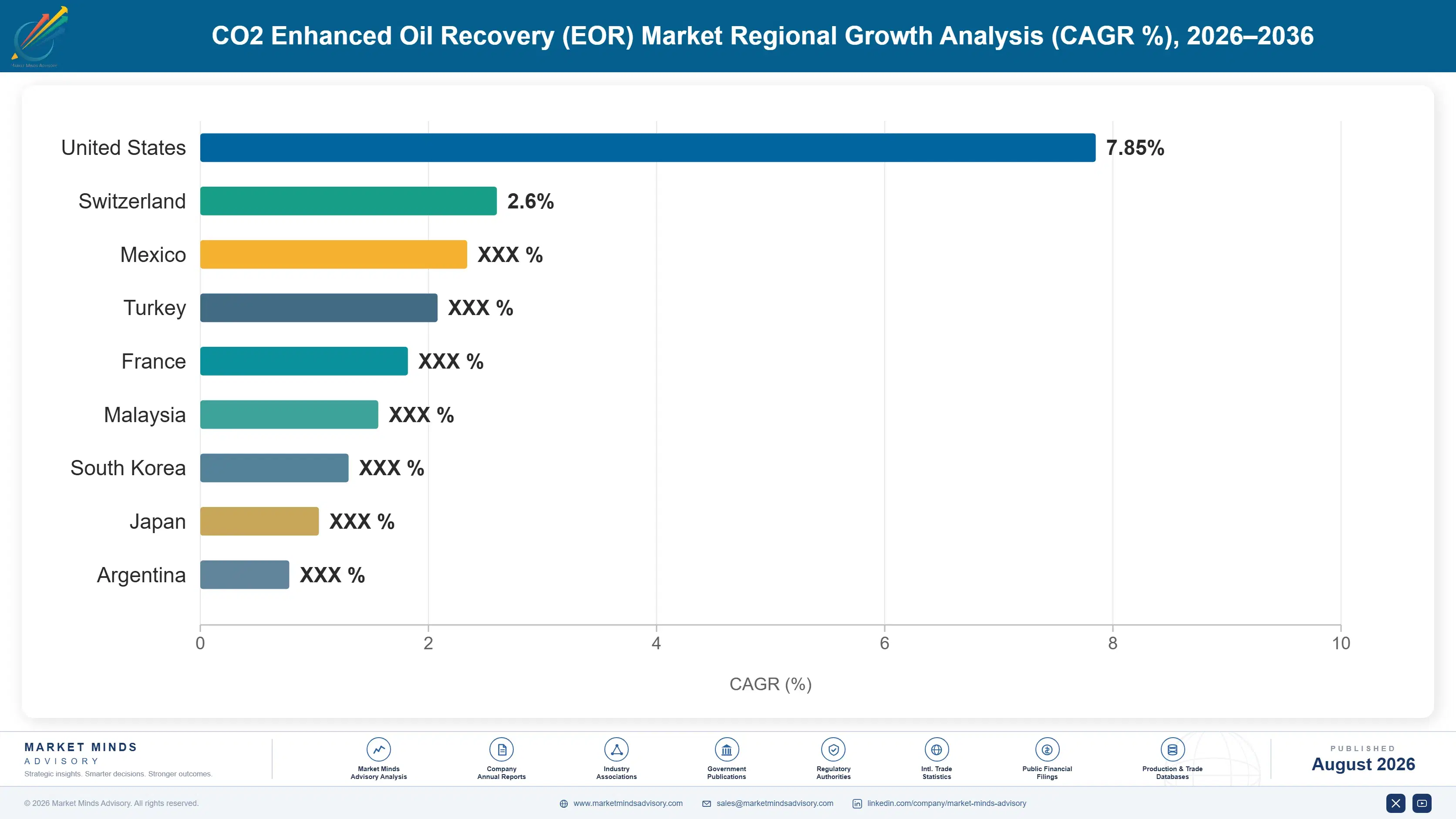
North America commands an outsized majority of global commercial activity given the Permian Basin's decades of accumulated CO2 pipeline infrastructure, a genuine structural concentration this report notes explicitly, while South Asia and Pacific shows the fastest regional growth on new pilot project development and policy support.

North America

Out-of-band note: North America's 40 percent share exceeds the standard 22 to 32 percent band because the Permian Basin and Gulf Coast together host the overwhelming majority of global commercial CO2-EOR production, a genuine concentration built over four decades of pipeline investment no other region has matched. The United States anchors the region overwhelmingly, home to Occidental Petroleum and the Permian Basin's mature CO2 pipeline network connecting natural domes and anthropogenic capture facilities to hundreds of active injection projects. Kinder Morgan's proprietary pipeline assets give it an outsized transportation role. Canada's Weyburn field, sourced partly via cross-border pipeline, remains one of the world's longest-running commercial CO2-EOR projects. Mexico's state oil company has expressed early pilot interest, though deployment remains limited relative to its northern neighbors.
Share: 40% | CAGR: 6.8% (2026 to 2036)

Western Europe

Out-of-band note: Western Europe's 14 percent share falls below the standard 18 to 26 percent band because the region's carbon capture investment has prioritized dedicated geologic storage over enhanced oil recovery, leaving commercial CO2-EOR activity genuinely underdeveloped relative to North America and East Asia. Norway's North Sea carbon capture projects focus primarily on saline aquifer storage rather than oil recovery, a policy preference shaping the broader regional approach. The United Kingdom's declining North Sea production has generated periodic pilot interest, though no commercial-scale project has advanced past feasibility. The Netherlands hosts growing capture capacity tied to decarbonization targets, though volumes flow predominantly to storage. Regional demand remains constrained by limited conventional production and a storage-favoring policy environment.
Share: 14% | CAGR: 4.6% (2026 to 2036)
Regional intelligence for 5 additional markets available in the complete report: East Asia, South Asia and Pacific, Latin America, Middle East and Africa, Eastern Europe. Contact sales@marketmindsadvisory.com.
co2-enhanced-oil-recovery-eor-market-country-cagr-analysis-1787301531446

Where Operators Can Defend Category Margin

As natural CO2 dome supply matures and anthropogenic sourcing scales, operators are shifting commercial strategy toward long-term offtake agreements, pipeline ownership, and monitoring infrastructure investment to defend margin across the fastest-growing supply categories over the coming decade and beyond, a shift that rewards operators who move first across every basin they operate in.

Secure Long-Term Anthropogenic CO2 Offtake Agreements

Operators who secure long-term offtake agreements directly with industrial emitters and ethanol producers are locking in CO2 supply at negotiated prices ahead of broader market competition for the same capture facilities, since credit-eligible anthropogenic CO2 increasingly commands a premium over natural dome sourcing as tax credit values continue expanding. Operators with established multi-year offtake agreements report supply cost predictability meaningfully higher than competitors relying on spot market anthropogenic purchases without long-term contracts. This lever requires sustained relationship investment but converts into a durable, multi-year cost advantage that later entrants cannot easily replicate.
Market Impact: Locks in supply cost for 10-plus ye

Build Proprietary CO2 Pipeline Infrastructure Early

Operators who invest in proprietary CO2 pipeline infrastructure connecting capture facilities directly to injection sites are capturing transportation margin that would otherwise flow to third-party pipeline owners, while simultaneously securing preferential capacity access ahead of competitors relying entirely on common-carrier pipeline systems across the basin. Operators with proprietary pipeline assets report project economics meaningfully stronger than competitors dependent on third-party transportation capacity subject to allocation constraints and delays. This lever requires substantial upfront infrastructure investment but converts into a durable, multi-decade cost and access advantage.
Market Impact: Cuts transport cost by roughly 20%

Develop Deep Credit Qualification and MMV Expertise

Operators who develop specialized 45Q credit qualification and monitoring, measurement, and verification expertise ahead of broader industry adoption are winning a disproportionate share of anthropogenic offtake agreements, since industrial emitters strongly prefer operators with demonstrated regulatory compliance track records over unproven counterparties lacking comparable documentation depth. Operators with proven credit qualification expertise report new-agreement win rates roughly 2x higher than competitors offering only conventional injection services without comparable compliance depth. This lever requires meaningful upfront regulatory investment but converts into a durable, multi-year revenue relationship worth defending.
Market Impact: Doubles new-agreement win rate to r

Establish Vertically Integrated Capture Models

Operators who establish vertically integrated capture-to-injection ownership structures, rather than relying entirely on third-party CO2 purchase agreements, are internalizing the full value chain margin from capture through enhanced recovery rather than sharing it across multiple independent counterparties along the chain and its intermediaries. Operators with vertically integrated models report project-level margin roughly 25 percent higher than comparable projects reliant on external CO2 purchase agreements for similar total injection volume. This lever requires substantial capital commitment but delivers outsized margin predictability once established across the operator's portfolio.
Market Impact: Lifts project margin roughly 25% ov

Who Controls the Margin Pool

The top five operators hold roughly 45 percent of production revenue on a company-revenue basis, a moderately concentrated structure reflecting how legacy natural CO2 dome fields remain accessible to numerous independent operators even as anthropogenic supply and pipeline infrastructure concentrate among a narrower set of integrated players. The gap between Occidental Petroleum and ExxonMobil, the two largest operators, and the broader independent field remains meaningful given their proprietary
Current competitive activity centers on three fronts: anthropogenic offtake agreement races to secure new capture facility supply ahead of competitors, pipeline infrastructure investment designed to capture transportation margin and secure capacity access, and monitoring and verification capability investment intended to win the largest credit-eligible contracts across multiple basins.

Pressure is building from industrial gas companies and dedicated carbon management specialists, who are moving into CO2 supply and pipeline development roles that traditional oilfield operators previously controlled entirely on their own. Several have already signed reference offtake agreements with major operators, evidence that could reshape value chain economics faster than established incumbents currently expect across the broader industry.
co2-enhanced-oil-recovery-eor-market-company-positioning-matrix-1787301532304

Competitive Moat and Risk Dimensions

OCCIDENTAL PETROLEUM CORPORATION

Moat: Deepest CO2-EOR Operating Expertise

Occidental Petroleum has operated CO2-EOR projects in the Permian Basin for decades longer than most competitors, giving it reservoir engineering and injection optimization expertise that newer entrants cannot replicate without comparable years of accumulated field operating history and data behind them.
OCCIDENTAL PETROLEUM CORPORATION

Risk: Concentrated Permian Basin Exposure

Occidental Petroleum's revenue concentration in Permian Basin CO2-EOR operations leaves it more exposed than geographically diversified competitors to regional pipeline capacity constraints and localized permitting delays that can defer or limit specific project expansion plans across its portfolio.
EXXONMOBIL

Moat: Broadest Integrated Pipeline Network

ExxonMobil's acquisition of Denbury's proprietary CO2 pipeline network gives it one of the industry's broadest integrated capture-to-injection infrastructure positions, a scale advantage that smaller independent operators reliant on third-party pipeline capacity cannot easily match at comparable cost or speed.
EXXONMOBIL

Risk: Integration Complexity Across Legacy Assets

ExxonMobil's integration of a large acquired pipeline and field asset base carries execution risk tied to reconciling legacy operating standards and contracts across multiple prior ownership structures, a complexity smaller, more homogeneous competitors generally do not face at comparable scale today.

Players Tracked

Prominent Players

Occidental Petroleum Corporation
ExxonMobil
Kinder Morgan, Inc.
Chevron Corporation
Cenovus Energy Inc.

Other Key Players

Chord Energy Corporation
Core Energy LLC
Merit Energy Company
Trinity CO2 Investments LLC
Bluesource LLC
Air Products and Chemicals, Inc.
Linde plc
SLB
Halliburton Company
Baker Hughes Company
Summit Carbon Solutions
Navigator CO2 Ventures LLC
Ring Energy, Inc.
Abu Dhabi National Oil Company
PetroChina Company Limited

Recent Developments

SEPTEMBER 2023

ExxonMobil Completes Acquisition of Denbury's CO2 Pipeline Network

ExxonMobil completed its acquisition of Denbury, gaining Denbury's proprietary CO2 pipeline network and associated EOR field assets in the Gulf Coast and Rocky Mountain regions, a full corporate acquisition rather than a joint venture or minority equity stake in the underlying assets and infrastructure.
Signal: Major integrated operators are acquiring d
APRIL 2025

Occidental Petroleum Signs Long-Term Offtake Agreement With Industrial Emitter

Occidental Petroleum signed a multi-year CO2 offtake agreement, not an acquisition or joint venture, with a major industrial emitter to purchase captured CO2 for injection across its Permian Basin operations, securing predictable anthropogenic supply tied directly to that facility's disclosed capture capacity.
Signal: Operators are increasingly securing long-t
JANUARY 2026

Kinder Morgan Announces Pipeline Capacity Expansion Serving New Capture Facilities

Kinder Morgan announced an organic capacity expansion of its existing CO2 pipeline network, not an acquisition, designed to connect several newly commissioned industrial capture facilities to established injection sites across its Gulf Coast and Permian Basin transportation corridors and connecting laterals.
Signal: Pipeline operators are expanding organic c

Purchased CO2 Supply Cost Exposure

Purchased and transported CO2 accounts for roughly 30 percent of cost of goods sold across operators reliant on external supply, with well operations, workover, and monitoring costs making up most of the remainder of total project operating cost. CO2 supply concentrates among a relatively small number of natural dome operators and a growing but still limited pool of anthropogenic capture facilities.
CO2 supply costs tightened meaningfully during 2022, when several operators disclosed in annual reports that natural dome production constraints and rising pipeline transportation costs pushed delivered CO2 prices higher across multiple major basins simultaneously that year. Several smaller independent operators disclosed project economics compression during this period as CO2 cost increases outpaced the oil price gains that would normally offset higher input costs across their portfolios and operating budgets.

Exposure varies by operator scale and vertical integration. Larger integrated operators with proprietary CO2 sources or pipeline assets absorbed the volatility with comparatively limited disruption, while smaller independent operators reliant entirely on third-party CO2 purchase agreements faced sharper cost swings that occasionally opened share for better-integrated competitors during the tightest supply quarters of the cycle.
co2-enhanced-oil-recovery-eor-market-cost-volatility-analysis-1787301532598

Secure Long-Term Fixed-Volume CO2 Supply Contracts

Leading operators are increasingly securing multi-year fixed-volume agreements directly with anthropogenic capture facilities, trading some pricing flexibility for meaningfully greater supply certainty during periods of tight natural dome CO2 availability across the broader basin, particularly during the sharpest phases of past cycles.

Diversify Between Natural and Anthropogenic CO2 Sources

Operators are qualifying both natural dome and anthropogenic CO2 supply relationships simultaneously rather than relying on a single source type, reducing exposure to disruptions affecting either the natural production or industrial capture segment of the supply base overall.

Invest In Proprietary Pipeline and Capture Assets

Several of the largest operators have built or acquired proprietary CO2 pipeline and, in some cases, capture facility assets, insulating a meaningful share of production from third-party supply pricing pressure and allowing faster expansion into new injection sites across their broader footprint.

Portfolio Architecture for Margin Defence

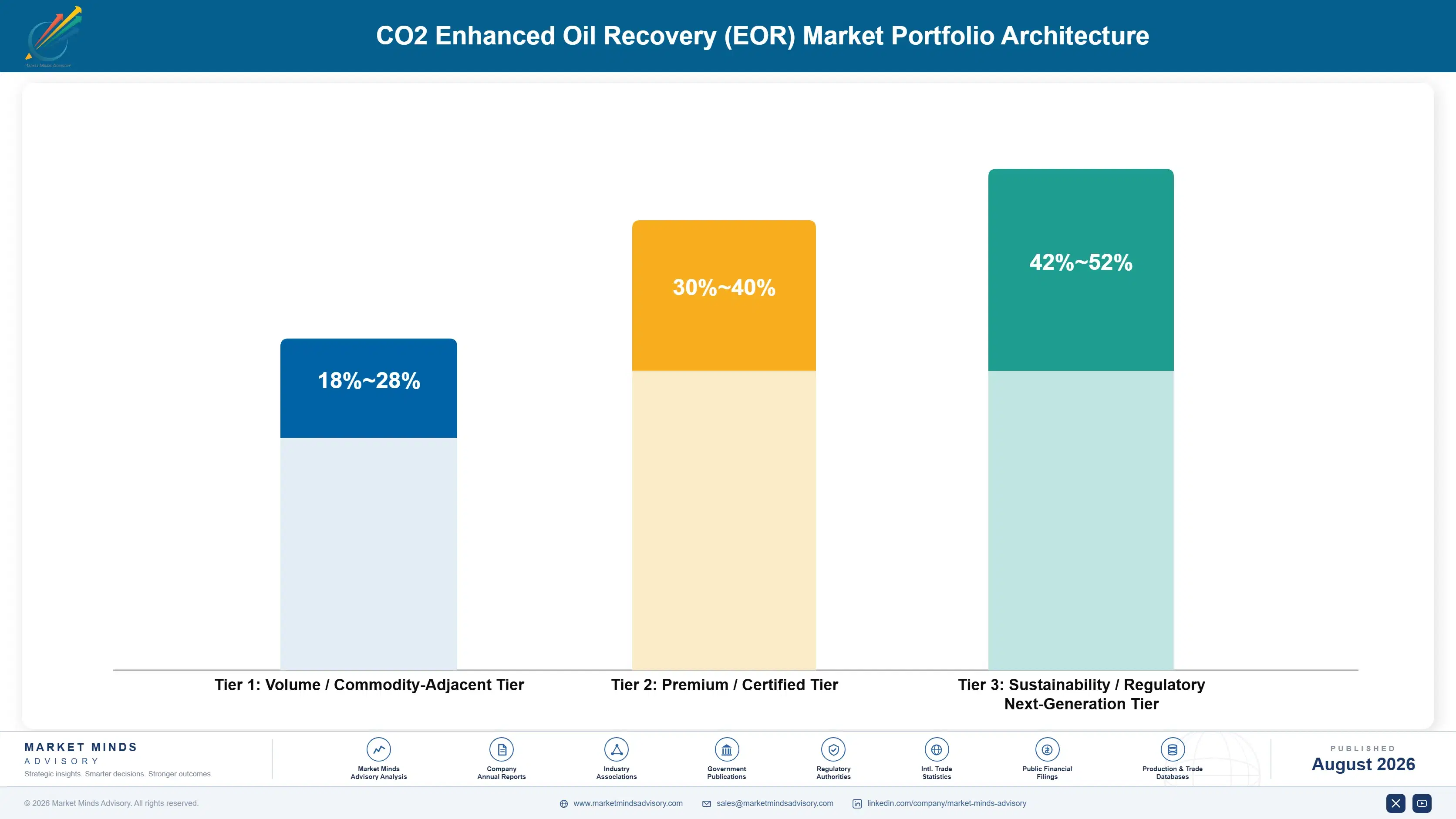
The market splits into three commercial tiers with distinct margin economics. Legacy natural dome CO2-EOR projects compete largely on established reservoir performance and proven low-cost natural CO2 sourcing, anthropogenic-supplied projects carry meaningfully higher margin tied to tax credit stacking, and vertically integrated capture-to-injection projects command the highest margin given their full value chain ownership and constrained competitive set across the industry.
The tension between legacy and premium positioning shapes how operators allocate capital: natural dome projects still represent meaningful production volume across established Permian Basin fields, but nearly all incremental profit growth over the forecast period concentrates in anthropogenic and vertically integrated projects, where leading operators increasingly direct pipeline and monitoring infrastructure investment across their broader portfolios.

High-value margin pools concentrate specifically in vertically integrated capture-to-injection projects capturing full value chain margin and in anthropogenic offtake agreements structured around the strongest tax credit stacking terms. Both pools reward operators who invest ahead of demand in pipeline access and monitoring infrastructure rather than those who compete purely on legacy natural dome sourcing across the broader replacement channel.

Volume / Commodity-Adjacent Tier

Legacy natural dome CO2-EOR projects competing largely on established reservoir performance and proven low-cost natural CO2 sourcing across mature Permian Basin and Gulf Coast fields nationwide and abroad.
Gross Margin: 18-28%

Premium / Certified Tier

Anthropogenic-supplied projects with credit-eligible monitoring infrastructure, commanding meaningful premiums tied directly to tax credit stacking and demonstrated compliance documentation across audited sites.
Gross Margin: 30-40%

Sustainability / Regulatory / Next-Generation Tier

Vertically integrated capture-to-injection projects, carrying the category's highest margins given full value chain ownership and a constrained pool of operators able to deliver them at scale today.
Gross Margin: 42-52%
co2-enhanced-oil-recovery-eor-market-portfolio-architecture-1787301533409

Field Life Economics Meet Multi-Decade Contracts

CO2-EOR projects behave as a genuine long-cycle capital commitment, generating steady production revenue across fifteen to twenty five years of extended field life rather than a short-cycle drilling relationship, reflecting the category's exceptionally long project economics across most basin types and operator segments worldwide.
Adoption depth varies sharply by operator type across the market. Integrated majors show the fastest anthropogenic-driven expansion given proprietary pipeline access, smaller independent operators remain the slowest-cycling segment given their reliance on legacy natural dome contracts, and mid-sized operators sit between the two, tied more closely to available third-party pipeline capacity than to pure reservoir potential or engineering capability alone.

A generational shift in buyer profile is underway as operator capital planning teams increasingly include dedicated carbon credit and monitoring compliance specialists rather than pure reservoir engineers trained under an older natural-CO2-only project model. Industrial emitter procurement teams are also reshaping how operators must present injection site suitability and long-term offtake terms earlier in the capture facility investment decision process.
co2-enhanced-oil-recovery-eor-market-end-use-penetration-index-1787301533898

Where This Market Goes Next

These are among the four positions where our research anticipates prominent divergence between winners and laggards over the coming forecast period. Each is grounded in the demand model, the regulatory perimeter, and the announced capacity pipeline.
01 / ANTHROPOGENIC OFFTAKE STRATEGY

Long-term supply agreements will decide who captures growth

Industrial emitters and ethanol producers reward operators who secure long-term offtake agreements first, because capture facility developers need supply certainty before committing capital to a new project alongside a specific oilfield partner. Operators who built anthropogenic supply relationships early are already winning a disproportionate share of new capture facility offtake agreements across major producing basins. This gap should widen rather than narrow as leading operators accumulate reference relationships that later entrants cannot replicate quickly regardless of how much capital they eventually commit to catching up.
02 / MONITORING AND VERIFICATION DEPTH

Credit qualification expertise is winning the fastest-growing agreements

Industrial emitters increasingly weigh monitoring and verification compliance expertise as heavily as core injection capability when selecting oilfield partners, rewarding operators who invest in credit qualification systems ahead of formal offtake negotiations across multiple capture facilities. Operators with proven compliance track records are already reporting meaningfully higher agreement win rates than competitors still building monitoring capability. Operators who underinvest in verification infrastructure risk losing agreements to better-positioned competitors regardless of underlying reservoir quality differences across their broader project portfolios and basins.
03 / PIPELINE INFRASTRUCTURE OWNERSHIP

Proprietary transportation assets are opening a defensible position

Capture facilities with genuine CO2 supply but limited pipeline access represent an underserved segment that operators investing early in proprietary transportation infrastructure are increasingly capturing away from third-party-dependent competitors across the industry and multiple producing basins. Operators with proprietary pipeline assets report meaningfully stronger project economics than competitors lacking comparable transportation infrastructure ownership across their basins. This lever requires sustained capital investment but expands the addressable market beyond the category's traditional reliance on common-carrier pipeline capacity alone.
04 / VERTICAL INTEGRATION STRATEGY

Full value chain ownership is reshaping margin distribution

Operators increasingly prefer consolidating capture-to-injection ownership under a single integrated structure rather than sharing value chain margin across multiple independent counterparties along the supply chain separately and across intermediaries. Operators with vertically integrated models report project-level margin and cost predictability meaningfully higher than competitors relying on external CO2 purchase agreements for comparable injection volume today. This consolidation trend should continue as more operators pursue acquisitions of pipeline and capture assets rather than isolated CO2 purchase agreements going forward across the industry.

Engagement Snapshot From the Field

A live engagement with an industry participant carrying material or product regulatory and market exposure ahead of a defining policy shift, showing how our research translates into a defensible multi-year portfolio strategy.
MARKET MINDS ADVISORY · CLIENT ENGAGEMENT SUMMARY
CO2 Enhanced Oil Recovery (EOR) Producer Strategic Portfolio Review and Transition Roadmap 2026·Investment Scenario on CO2 Enhanced Oil Recovery (EOR) Exposure Evaluation 2025-26
CLIENT PROFILE
The client is a regional independent oilfield operator managing several mature Permian Basin fields, historically reliant on natural dome CO2 sourcing under contracts nearing expiration and representing substantial annual production volume across its operated fields (client-reported, unverified by MMA). The company needed to secure alternative long-term CO2 supply to sustain continued injection operations across its full field portfolio.
STRATEGIC CHALLENGE
Leadership needed to evaluate anthropogenic CO2 offtake opportunities capable of replacing declining natural dome supply while completing supplier selection within a compressed timeline set by existing contract expiration deadlines across multiple operated fields and injection sites nearing capacity limits.
MMA APPROACH
MMA benchmarked candidate anthropogenic CO2 suppliers against delivered cost, pipeline connectivity, and credit qualification documentation quality, modeled expected project economics under three distinct supply scenarios, and recommended a supplier selection and phased contract transition sequence prioritized by expiration deadline and available capital budget.
KEY FINDINGS
  1. Only three of eight candidate anthropogenic CO2 suppliers evaluated offered pipeline connectivity meeting the client's delivery requirements without additional infrastructure investment needed.
  2. Delivered CO2 cost varied by roughly 15 percent across candidate suppliers, a meaningful factor given the client's thin project-level margin structure already in place.
  3. Credit qualification documentation quality varied significantly across candidate suppliers, materially affecting which suppliers could realistically support the client's ongoing 45Q credit claims.
  4. Modeled project economics differences across candidate suppliers translated into a meaningful revenue impact over the remaining field life (client-reported, unverified by MMA).
CLIENT PROFILE
The client is a regional independent oilfield operator managing several mature Permian Basin fields, historically reliant on natural dome CO2 sourcing under contracts nearing expiration and representing substantial annual production volume across its operated fields (client-reported, unverified by MMA). The company needed to secure alternative long-term CO2 supply to sustain continued injection operations across its full field portfolio.
STRATEGIC CHALLENGE
Leadership needed to evaluate anthropogenic CO2 offtake opportunities capable of replacing declining natural dome supply while completing supplier selection within a compressed timeline set by existing contract expiration deadlines across multiple operated fields and injection sites nearing capacity limits.
MMA APPROACH
MMA benchmarked candidate anthropogenic CO2 suppliers against delivered cost, pipeline connectivity, and credit qualification documentation quality, modeled expected project economics under three distinct supply scenarios, and recommended a supplier selection and phased contract transition sequence prioritized by expiration deadline and available capital budget.
KEY FINDINGS
  1. Only three of eight candidate anthropogenic CO2 suppliers evaluated offered pipeline connectivity meeting the client's delivery requirements without additional infrastructure investment needed.
  2. Delivered CO2 cost varied by roughly 15 percent across candidate suppliers, a meaningful factor given the client's thin project-level margin structure already in place.
  3. Credit qualification documentation quality varied significantly across candidate suppliers, materially affecting which suppliers could realistically support the client's ongoing 45Q credit claims.
  4. Modeled project economics differences across candidate suppliers translated into a meaningful revenue impact over the remaining field life (client-reported, unverified by MMA).
RECOMMENDED STRATEGY
Phase 1: Phase 1 (Months 1-3): Complete supplier evaluation and finalize anthropogenic CO2 supply selection based on cost and connectivity fit overall. Phase 2: Phase 2 (Months 4-9): Execute contract transition and pipeline connection commissioning across the client's priority fields identified in phase one. Phase 3: Phase 3 (Months 10-14): Complete remaining field transitions and establish ongoing credit qualification monitoring across the full field portfolio.
OUTCOME
Fourteen months into the engagement, the client reported successful transition to anthropogenic CO2 supply across its full field portfolio with delivered cost and credit qualification performance matching modeled projections across every transitioned field (client-reported, unverified by MMA), validating MMA's supplier selection recommendation and phased transition sequence fully.

Frequently Asked Questions

Foundational context covering the market sizes, CAGR, scope, country, region and competition that inform every finding below. This section is provided to cover basics and most often pre-purchase conversations, answered from the MMA Primary Research Dataset.

What is the current size of the CO2 Enhanced Oil Recovery (EOR) Market?

The market is valued at approximately 8.9 billion dollars in 2025, expanding to roughly 9.45 billion dollars in 2026 as expanded tax credit values continue driving anthropogenic CO2 supply growth.

How large will the CO2 Enhanced Oil Recovery (EOR) Market be by 2036?

MMA forecasts the market reaching approximately 17.25 billion dollars by 2036, roughly 1.82 times its 2026 value, driven primarily by expanded 45Q credits and pipeline infrastructure buildout.

What is the CAGR for the CO2 Enhanced Oil Recovery (EOR) Market 2026 to 2036?

The base-case compound annual growth rate is 6.2 percent, with a bull scenario of 7.4 percent and a bear scenario of 5.0 percent depending on pipeline permitting pace and credit stability.

Which segment is growing fastest?

CO2 capture and supply services are growing fastest at a 9.5 percent CAGR, roughly 1.53 times the overall market rate, driven by expanded tax credit values improving capture project economics.

Who are the major companies in the CO2 Enhanced Oil Recovery (EOR) Market?

Occidental Petroleum Corporation, ExxonMobil, Kinder Morgan, Inc., Chevron Corporation, and Cenovus Energy Inc. lead the market, together holding roughly 45 percent of revenue on a company-revenue basis.

Which country is growing fastest?

China is the fastest-growing country at a 9.6 percent CAGR, driven by expanding CCUS-EOR pilot projects in the Songliao and Ordos basins backed by national policy objectives.

Report Segmentation Architecture

The full report scope spans multiple orthogonal segmentation dimensions, with cross-tabulated demand data provided for each dimension pair. Coverage extends further to regional breakdowns, trend trajectories, and the competitive detail needed to support segment-level decision-making.

By Service and Technology Type

  • CO2 Capture and Supply Services
  • CO2 Injection and Well Services
  • CO2-EOR Field Operations and Production
  • Monitoring, Measurement, and Verification Services
  • CO2 Transportation and Pipeline Infrastructure
  • Enhanced Recovery Chemicals and Additives

By End-Use Industry

  • Legacy Conventional Oilfield Operations
  • Industrial CO2 Capture and Emitters
  • Ethanol and Biofuel Production
  • Natural Gas Processing

By Commercial Dimension

  • Direct Operator Offtake Agreements
  • Third-Party Pipeline Transportation Contracts
  • Vertically Integrated Ownership Structures
  • Spot Market CO2 Purchases

By Region

  • North America
  • Western Europe
  • East Asia
  • South Asia and Pacific
  • Latin America
  • Middle East and Africa
  • Eastern Europe

Scope, Methodology, and Coverage

Every figure in this report is reproducible from documented input assumptions. The scope below maps the historical period, the forecast horizon, the segmentation dimensions, and the countries covered, alongside the underlying primary and qualitative methodology.
Historical Period
2020 to 2025
Forecast Period
2026 to 2036
Base Year
2025 (USD billions; MMA Primary Research Dataset, August 2026)
Market Definition
The market covers CO2 capture and supply, transportation, injection, field operations, and monitoring services associated with injecting carbon dioxide into mature oil reservoirs to increase recoverable output, spanning both anthropogenic and naturally sourced CO2 streams. Carbon capture and storage projects without oil recovery, and carbon credit trading conducted independently of an EOR project, are excluded.
Quantitative Units
USD billions (current prices); incremental barrels of oil recovered where cited
Segmentation Dimensions
By Service and Technology Type; By End-Use Industry; By Commercial Dimension; By Region
Regions Covered
North America, Western Europe, East Asia, South Asia and Pacific, Latin America, Middle East and Africa, Eastern Europe
Countries Covered
USA, Canada, Mexico, China, Japan, India, Australia, Brazil, Colombia, Argentina, UAE, Oman, Saudi Arabia, Norway, UK, Netherlands, Poland, Romania, Hungary, Czech Republic, Malaysia, Indonesia, and additional markets relevant to this sector
Key Companies Profiled
Occidental Petroleum Corporation, ExxonMobil, Kinder Morgan, Inc., Chevron Corporation, Cenovus Energy Inc., Chord Energy Corporation, Core Energy LLC, Merit Energy Company, Trinity CO2 Investments LLC, Bluesource LLC, Air Products and Chemicals, Inc., Linde plc, SLB, Halliburton Company, Baker Hughes Company, Summit Carbon Solutions, Navigator CO2 Ventures LLC, Ring Energy, Inc., Abu Dhabi National Oil Company, PetroChina Company Limited
Quantitative Methodology
Primary survey, n=3,800 respondents, Q4 2025, six countries; demand-side model with trade association cross-validation
Qualitative Methodology
47 expert interviews, Q4 2025; applied to validate demand model assumptions, identify emerging dynamics, and assess competitive positioning
Report Format
PDF and XLSX data workbook (Word format preview document)
Publisher
Market Minds Advisory
Report Code
MMA-2026-ENE-638
Published
August 2026
Contact
sales@marketmindsadvisory.com | www.marketmindsadvisory.com

Purchase the full CO2 Enhanced Oil Recovery (EOR) Market Report (2026 to 2036).

The full report delivers a complete quantitative and strategic assessment of the CO2 enhanced oil recovery market across all seven regions and more than twenty countries covered in this study. It includes detailed segment-level forecasts through 2036, competitive benchmarking across twenty profiled companies, and primary research drawn from 3,800 survey respondents and 47 expert interviews conducted in Q4 2025. Buyers receive editable data tables and full regional narrative detail beyond the two regions previewed in this summary document. A dedicated appendix covers 45Q credit qualification requirements and pipeline infrastructure economics by basin.
Fully editable Excel data tables and models
All seven full regional narratives fully included
Twenty full company competitive profiles included
45Q credit qualification appendix provided in full
Segment-level 2026-2036 detailed annual forecasts
Full primary survey and expert interview data included fully

Built For The People Who Decide

From boardroom strategy to bench-side execution, this report is read cover-to-cover by leaders shaping the next decade of their industry, turning demand scenarios, market dynamics and valuation benchmarks into decisions.
CXOs/ Presidents/ VPs/ Managers
M&A and Corporate Development
Strategy Teams and R&D Heads
Procurement and Product Directors
Regulatory and Compliance Leaders
Investor Relations and Equity Analysts