Market Minds Advisory
Co-Emulsifiers Market

Co-Emulsifiers Market: Co-Emulsifiers Market. Bio-Fermentation Technology, Natural-Origin Formulation, and Stability Substantiation Through 2036

Formulators are shifting toward bio-fermented and sugar-based co-emulsifiers as regulatory pressure on silicone and synthetic actives grows, forcing legacy suppliers to reformulate quickly while natural-origin grades capture margin from commodity incumbents.

Lead Analyst

Published

September 2026

Make Smarter Decisions with Customized Research Insights

Request a free sample report and evaluate market opportunities, growth trends, and competitive dynamics relevant to your business needs.

2025 MARKET VALUE$1.9BMarket Size 2025
2036 FORECAST VALUE$3.8BBase Case , 2026 to 2036
CAGR 2026 TO 20366.4 %Bull 7.5% / Bear 5.3%
INCREMENTAL OPPORTUNITY$1.7BNet 10- year value creation
EXPANSION MULTIPLE1.86x2036 value over 2026 base
Strategic Levers
M&A Pipeline
Regional Outlook
Country Rankings
Competitive Intelligence
Segmental Deep-dive
Call-Us : 91 93563 13602

Executive Snapshot and Market Trajectory.

Bio-fermentation technology is displacing conventional synthetic chemistry as the preferred manufacturing route for co-emulsifiers, with natural-origin and sugar-based grades moving from prestige cosmetic formulation houses into mainstream personal care manufacturing faster than prior emulsifier innovation cycles, reshaping supplier roadmaps across nearly every major producer.
Commercial momentum concentrates around bio-fermented natural-origin co-emulsifiers and sugar-based alkyl polyglucoside grades, the two fastest-growing product categories tracked this cycle, as Western European producers lead sustainability innovation while East Asian manufacturers increasingly export fermentation component technology to meet rising brand demand for clean-label formulation claims across mass and prestige personal care manufacturing channels, particularly among formulators targeting sensitive-skin and clean-beauty product lines. Formulation partnerships across the region are deepening as licensing demand grows steadily.
Competitive intensity is rising as diversified specialty chemical conglomerates acquire smaller bio-fermentation and natural-origin startups rather than build biotechnology capability internally, while tightening purity and sustainability substantiation requirements push credibility standards up across the category, separating suppliers that can prove stability and clean-formulation outcomes from those still relying on commodity silicone-based grades alone, leaving smaller regional producers increasingly exposed on both fronts. That gap is widening quickly.
Market Definition
The co-emulsifiers market covers secondary stabilizing agents used alongside primary emulsifiers in cosmetic, personal care, and food formulations to improve emulsion stability and sensory texture. It excludes primary emulsifier systems sold as standalone products and finished cosmetic or food products containing co-emulsifiers.
Base Year Value
$1.9B in 2025 (MMA Primary Research Dataset, September 2026)
Forecast Period
2026 to 2036, eleven discrete annual values
CAGR
6.4% base case. Bull 7.5%. Bear 5.3%.
Fastest Growth Segment
Bio-Fermented and Natural-Origin Co-Emulsifiers: 11.6% CAGR
Fastest Growth Country
India: 9.1% CAGR
Fastest Growth Region
South Asia and Pacific: 8.3% CAGR
Largest Region
Western Europe: 26% of 2025 global value
Market Leaders
BASF, Croda International, Evonik, Clariant, and Lubrizol lead the category. Source: MMA Primary Research Dataset, July 2026.
Primary Survey
n=3,800 procurement and R&D decision-makers, Q4 2025, six countries
Methodology
Demand-side build-up, cross-validated against public data, 47 expert interviews

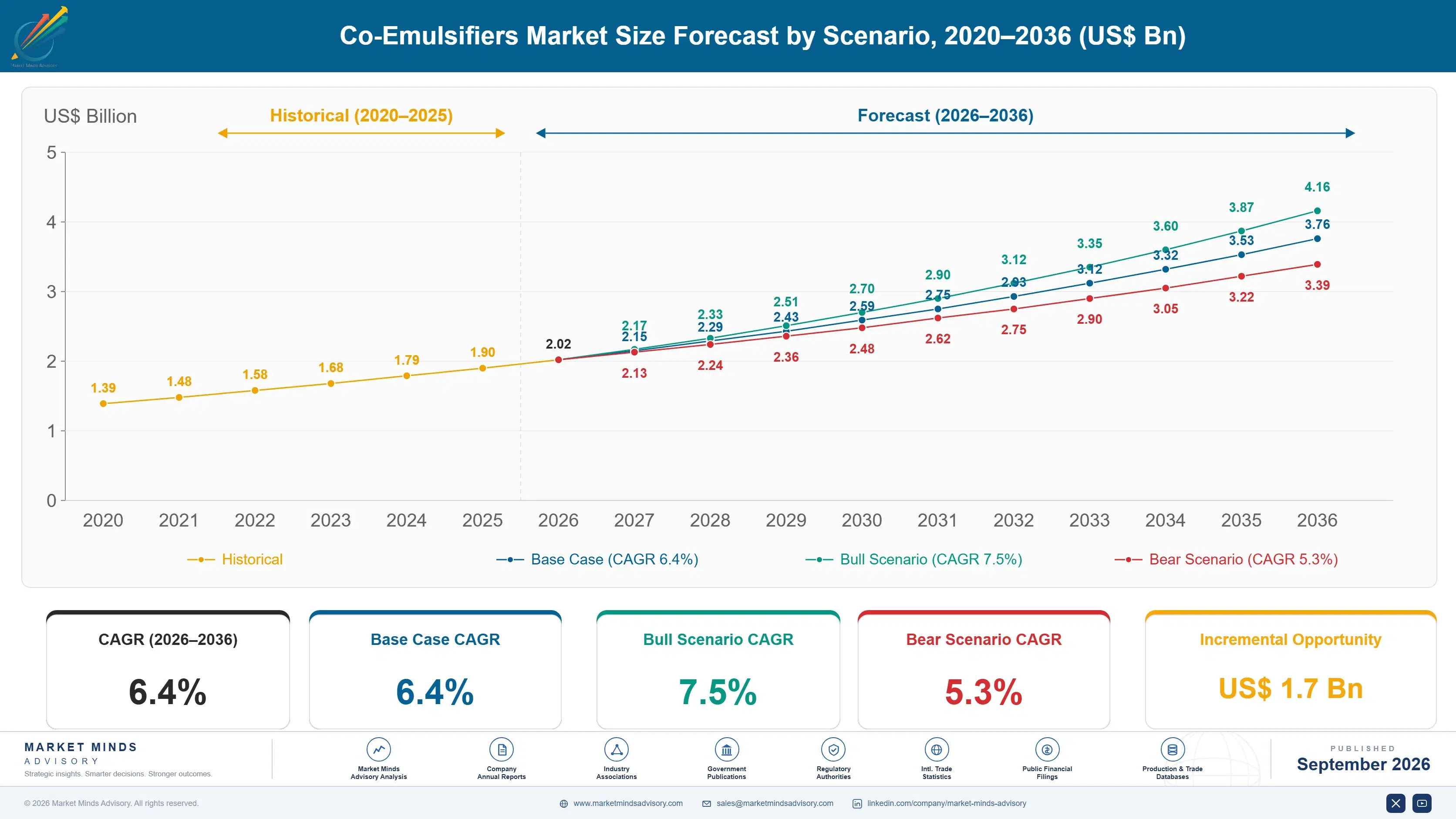
Co-Emulsifiers Market Forecast Scenarios

co-emulsifiers-market-size-forecast-scenario-1790016375639
Between 2020 and 2025 the category grew steadily as clean-label formulation demand expanded across mass and prestige personal care and bio-fermentation research matured, with the historical growth rate of 5.7% reflecting that gradual mainstreaming rather than a single catalytic regulatory action or product launch. Formulator trust in bio-fermented co-emulsifier quality built gradually across that entire five-year window nationwide, supporting steady adoption.
The base case assumes continued bio-fermentation and natural-origin technology cost reduction expanding mass-market formulation access, growing brand demand for clean-label and sustainability-substantiated claims, and expanding cosmetic manufacturer adoption of sugar-based alkyl polyglucoside grades, three mechanisms reinforcing each other as bio-fermented and natural-origin co-emulsifiers move from prestige formulation houses into mainstream mass personal care manufacturing across most major production channels through the forecast window, with private label entry adding volume once component costs fall enough.
A bull case turns on regulatory bodies formalizing sustainability and purity testing standards that accelerate premium positioning industry-wide well ahead of schedule, while the bear risk is inconsistent quality across unregulated synthetic suppliers eroding brand trust faster than established producers can differentiate their clinically validated formulations during early market expansion. That risk grows sharper wherever independent producers lack the testing budgets to substantiate their claims.

Bio-Fermentation Meets Formulation Cost Discipline

Formulation cost in this category increasingly depends on sugar and fermentation feedstock sourcing rather than basic synthetic chemistry, since bio-fermented and natural-origin claims require ingredient concentrations that cost considerably more than conventional silicone-based blends, and every additional sustainability certification a supplier pursues adds testing expense that smaller regional producers often cannot absorb as easily as diversified specialty chemical conglomerates with broader research budgets.
MARKET CONCENTRATIONCR5 42%Moderately consolidated field led by specialty chemical majors
AVERAGE SELLING PRICE$12 per kilogramBio-fermented grades command a meaningful premium generally overall
TOP PRODUCING COUNTRY SHAREGermany 21%Reflects deep specialty ingredient manufacturing base established there
CAPACITY UTILISATION75%Fermentation production lines run below synthetic plant rates
TRADE INTENSITY38% cross-borderSpecialty grades ship globally more than commodity synthetic peers
FEEDSTOCK COST SHARE24%Sugar and fermentation feedstock dominates total production cost
Cosmetic formulators and brand buyers have both become gatekeepers of category growth, allocating formulation contracts and shelf space to suppliers that can substantiate clean-label and stability claims through genuine third-party testing rather than marketing language alone, a filtering process that increasingly favors well-capitalized challengers over small regional producers lacking testing budgets. Suppliers lacking that documentation face a genuinely uphill battle for formulation contracts.
Capacity utilisation running below synthetic manufacturing reflects the category's specialty nature: bio-fermentation and natural-origin production lines still run smaller, more technically demanding batches to accommodate feedstock sourcing variability, though several producers are investing in dedicated production capacity that should lift utilisation meaningfully as demand scales toward mainstream personal care manufacturing broadly. That investment cycle should shorten considerably as feedstock sourcing partnerships mature further.
"Clean-label substantiation has quietly become the real differentiator in this category, not emulsion chemistry. Suppliers that treat sustainability testing as a compliance afterthought will keep losing formulation contracts to challengers who built the science in from the start."
Senior Analyst, Chemicals and Materials Practice · MMA Chemicals and Materials Practice · September 2026

Market Trends

Bio-Fermentation Technology Significantly Improves Sustainability Credentials

Advances in bio-fermentation and purification technology are letting producers achieve sustainability credentials that synthetic chemical synthesis alone cannot replicate credibly, cutting a meaningful share of downstream refinement cost while improving measured biodegradability in formulation testing. Suppliers that solved fermentation scale-up challenges are now able to guarantee clean-label claims backed by clinical validation studies, something earlier synthetic-only producers struggled to promise consistently. Major producers have responded by reformulating flagship production lines around bio-fermentation, positioning themselves ahead of competitors still relying solely on synthetic chemistry. Retailers increasingly favor suppliers with demonstrated sustainability reliability across multiple product tiers.
Market Impact: Expands addressable formulation demand by 24%
Sugar-Based Grades Expand Clean-Label Formulation Adoption

Sugar-based alkyl polyglucoside co-emulsifiers are expanding clean-label formulation adoption considerably beyond what silicone-based grades could achieve, addressing a longstanding consumer skepticism problem that limited silicone acceptance in premium formulations. Cosmetic formulators increasingly specify sugar-based grades for premium product lines, since clean-label claims support pricing that offsets the added manufacturing complexity. Suppliers and formulators have responded by highlighting sugar-based grades prominently in ingredient documentation, pushing producers still offering only silicone-based grades to accelerate reformulation timelines. Feature adoption is becoming increasingly common across most major premium formulation channels, and producers still offering only silicone-based grades risk losing formulation contracts to better-equipped rivals.
Market Impact: Lifts natural-origin specification rates by 27%

Market Opportunities and Growth Drivers

Rising Clean-Label Demand Expands Core Formulator Base

Rising brand demand for clean-label and sustainability-substantiated formulations across major markets is expanding the core addressable population for co-emulsifiers well beyond traditional prestige cosmetic buyers alone. Brand buyers increasingly specify bio-fermented and natural-origin co-emulsifiers as a preferred alternative to silicone-based grades facing growing consumer scrutiny, giving the category a genuine sustainability tailwind that legacy synthetic actives cannot claim as easily. That sustainability support is translating into formulation investment alongside traditional retail partnerships, expanding distribution reach considerably. Several suppliers now co-develop features directly with brand partners to accelerate adoption nationwide. That trend keeps accelerating.
Market Impact: Adds 20% to production cost

Silicone Scrutiny Accelerates Alternative Ingredient Adoption

Growing consumer and regulatory scrutiny of silicone-based ingredients across several major markets is accelerating adoption of co-emulsifiers as the preferred cleaner alternative, since bio-fermented and sugar-based grades offer comparable stability without the environmental concerns driving silicone scrutiny. Brand buyers increasingly specify natural-origin co-emulsifiers explicitly in formulation briefs, giving suppliers a genuine sustainability tailwind that competing actives cannot claim as easily. That shift is translating into long-term supply contracts as brands lock in reliable sourcing ahead of further regulatory tightening. Competitors relying purely on price competition face a steadily rising cost of customer acquisition.
Market Impact: Excludes suppliers lacking 2 clinical studies

Market Restraints and Challenges

Feedstock Sourcing Volatility Compresses Formulation Margin

Sugar and fermentation feedstock costs remain exposed to sourcing volatility tied to limited agricultural and fermentation production capacity relative to surging formulation demand across the category. The root cause is that specialty feedstock production cannot scale as quickly as conventional chemical synthesis, creating periodic supply tightness that pushes input costs up sharply during peak demand periods. The commercial impact shows up directly in production margin, where suppliers using higher-purity feedstock absorb cost spikes more severely than those using conventional synthetic inputs. Several producers are exploring fermentation-scale production as a mitigation pathway to decouple supply.
Market Impact: Improves biodegradability scores by 28%

Clinical Substantiation Costs Exclude Smaller Producers

Rising brand and formulator demand for clinical substantiation has created a cost barrier that smaller regional producers struggle to clear without outside funding or contract testing partnerships. The root cause is that stability and purity testing protocols have grown considerably more rigorous as brand scrutiny of clean-label claims increases industry-wide. The commercial impact is exclusion from premium formulation contracts and brand specification lists, since both increasingly require published substantiation before considering a new supplier at all. Several smaller producers are pursuing shared testing consortiums as a mitigation pathway to spread costs.
Market Impact: Lifts sugar-based grade adoption by 34%
4 additional market trends, 4 additional growth drivers, and 3 additional restraints and challenges are covered in the full report. Contact sales@marketmindsadvisory.com to access the complete intelligence.

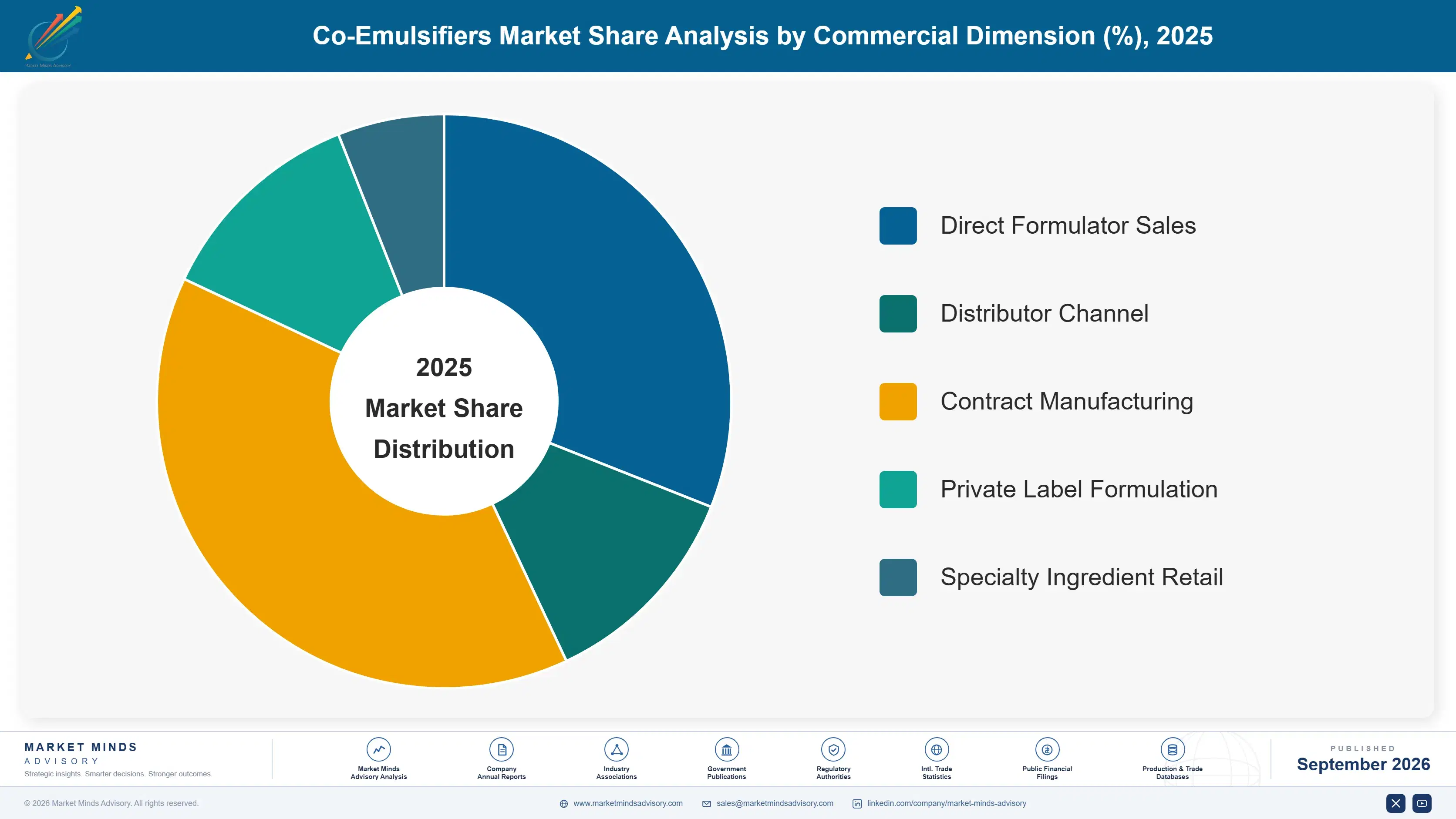
Segment CAGR and Growth Architecture

The category splits into six product-type segments defined by chemistry and manufacturing method rather than end-use or channel, since a single co-emulsifier function can serve cosmetic, personal care, or food formulation applications interchangeably depending on purity grade and sourcing chosen at manufacturing, keeping the classification logic consistent throughout. No other classification dimension captures this variety as cleanly.
co-emulsifiers-market-market-share-analysis-1790016376174

Bio-Fermented and Natural-Origin Co-Emulsifiers

Bio-fermented and natural-origin co-emulsifiers use microbial fermentation rather than chemical synthesis to produce the active molecule, appealing to clean-formulation brands seeking natural-origin ingredient claims. The segment started as a premium novelty for prestige personal care brands but has moved into mainstream manufacturing as fermentation scale-up technology matured enough to support commercially viable production costs. Formulator endorsement accelerated adoption considerably, since bio-fermented grades offer a genuinely testable sustainability claim that synthetic-only competitors cannot match credibly. Manufacturing capacity for stabilized fermentation lines remains the binding constraint currently. Several major suppliers have already reformulated flagship lines around bio-fermentation, positioning themselves ahead of competitors still relying on synthetic chemistry across most formulation channels. Demand keeps outpacing that manufacturing build-out considerably each year.
CAGR 11.6%

Sugar-Based and Alkyl Polyglucoside Co-Emulsifiers

Sugar-based and alkyl polyglucoside co-emulsifiers derive from renewable plant sugars rather than petrochemical feedstock, appealing to clean-label brands seeking to avoid silicone and synthetic actives facing growing consumer scrutiny. The segment has grown quickly as manufacturing technology matured enough to support commercially viable production costs at scale, creating a receptive customer base already familiar with sugar-derived surfactants from other personal care categories. Brands have responded by highlighting sugar-based sourcing prominently in ingredient marketing rather than treating it as a niche claim. Production cost remains meaningfully higher than conventional silicone-based grades currently, though that gap is narrowing as manufacturing scales. Several producers are now investing directly in dedicated sugar-based production capacity.
CAGR 8.9%
Full segment breakdown across 6 segments available in the complete report.

Regional Architecture and Country Demand Map

Western Europe leads on specialty ingredient manufacturing density and regulatory-driven natural-emulsifier reformulation, while South Asia and Pacific posts the fastest regional growth as rising cosmetic manufacturing volume accelerates adoption among formulators this cycle. Retail media budgets are increasingly steering toward this category as well. Retail budgets are steering there increasingly.

North America

Cosmetic manufacturers across the United States and Canada have expanded dedicated bio-fermented and sugar-based ingredient sourcing faster than most other regions, and prestige formulation houses built their earliest scale here before expanding internationally into adjacent markets. Brand demand for natural-origin co-emulsifiers as a silicone alternative is rising quickly among formulators managing consumer scrutiny, a population increasingly directed toward substantiated clean-label actives. Prestige beauty manufacturers are simultaneously carving out clinical formulation sections, pushing conventional synthetic-only suppliers to reformulate or lose contracts to better-substantiated competitors nationwide, a dynamic reshaping supplier strategy considerably. Regulatory coverage discussions for ingredient safety are also expanding steadily. Retail media programs are now steering promotional budgets toward substantiated brands specifically.
Share: 24% | CAGR: 6.8% (2026 to 2036)

Western Europe

Germany and France carry the deepest cosmetic ingredient regulatory infrastructure in the world, giving co-emulsifier suppliers a distribution pathway that combines regulatory credibility with mass manufacturing reach unavailable in most other regions. European Union cosmetic ingredient regulation has pushed suppliers toward well-substantiated claims earlier than most other markets, giving regional producers meaningful export credibility when entering certification-conscious markets elsewhere. Nordic countries show particularly high adoption of bio-fermented grades tied to strong consumer trust in clinically validated cosmetic ingredients. Export volume into North America continues rising steadily. That regulatory head start compounds as reformulation costs fall with scale across the manufacturing base. Export volume into North America and Asia continues rising as that credibility compounds.
Share: 26% | CAGR: 4.7% (2026 to 2036)
Regional intelligence for 5 additional markets available in the complete report: East Asia, South Asia and Pacific, Latin America, Middle East and Africa, Eastern Europe. Contact sales@marketmindsadvisory.com.
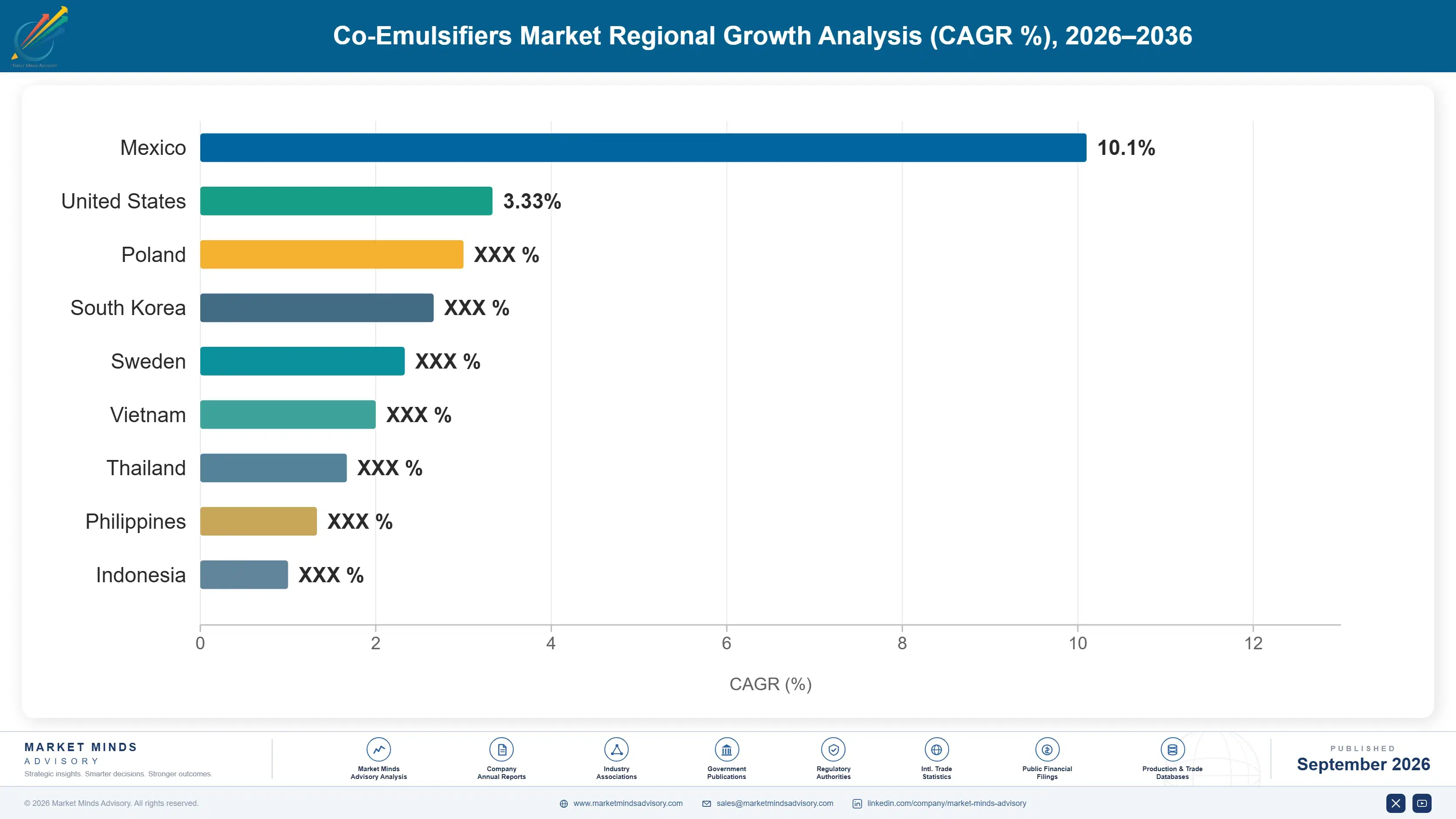
co-emulsifiers-market-country-cagr-analysis-1790016376695

Where Sustainability Proof Turns Into Margin

Margin capture in this category depends less on synthesis cost than on how well a supplier converts sustainability substantiation into brand endorsement and defensible formulation position, since clean-label claims alone rarely justify premium pricing without credible third-party backing behind them, and the three levers below capture where that conversion happens. Suppliers ignoring this pattern keep losing ground to better-prepared competitors.

Secure Brand Endorsement Before Contract Renewal

Suppliers that secure genuine brand endorsement before a formal contract renewal consistently outperform competitors relying solely on price competition, since cosmetic manufacturers increasingly research sustainability backing before renewing sourcing agreements. Endorsement partnerships also open premium formulation channel distribution that commodity competitors cannot access as easily, expanding total addressable market considerably. Several suppliers report contract renewal rates running 23 to 33% higher through endorsed channels than through price competition alone. That advantage typically persists for twelve to eighteen months before rivals catch up. Formulators increasingly favor suppliers who can promise firm technical backing.
Market Impact: Lifts contract renewal rates by 23 to 33%

Invest in Bio-Fermentation Stabilization Technology Early

Producers that invest early in bio-fermentation stabilization and concentration technology capture meaningfully lower production costs than competitors still using earlier-generation synthesis approaches. That cost advantage compounds as production scales, letting early movers underprice competitors while maintaining comparable margin. Formulators increasingly favor suppliers who can demonstrate stable, long-shelf-life formulations, since product returns tied to instability damage brand trust considerably. Several producers pursuing this strategy have cut production costs by roughly 15 to 20% within two years. Formulators reward that stability with faster contract renewal cycles overall, and manufacturers ignoring this pattern fall behind quickly.
Market Impact: Cuts production cost by 15 to 20% annually

Build Direct Formulator Relationships Beyond Distribution

Suppliers that build genuine direct formulator relationships alongside traditional distribution channels capture a meaningfully larger addressable market than those confined to distributor sales alone, since formulators increasingly recommend suppliers who provide technical support as a first-line sourcing preference. Direct relationships also carry implicit technical credibility that distribution alone cannot replicate, supporting premium pricing that price-sensitive commodity buyers might otherwise resist. Several suppliers expanding into direct relationships have grown unit volume by roughly 21 to 31% within eighteen months. That distribution advantage tends to compound as formulator relationships deepen over time.
Market Impact: Grows unit volume by 21 to 31% yearly

Who Controls the Margin Pool

Market concentration sits at a CR5 of 42%, moderate for a category with dozens of regional and specialty entrants competing for formulation contracts, and the gap between the top five players and the broader field is widening as diversified specialty chemical conglomerates acquire smaller bio-fermentation and natural-origin specialists to fill capability gaps rather than build internally, evaluated on a revenue-share basis across major cosmetic manufacturing channels. Growth remains available to any supplier that can prove sustainability and stability outcomes credibly at scale.
Current competitive activity centers on sustainability substantiation racing and brand partnership building rather than price competition directly, as suppliers invest in bio-fermentation stabilization technology, direct formulator relationships, and natural-origin partnerships simultaneously to defend contract position against private-label entrants gaining ground quickly across commodity distribution channels alike.

Rankings are most likely to shift where diversified conglomerates scale their own bio-fermented mass production, since that move threatens founder-led regional producers lacking manufacturing scale far more than it threatens legacy players that already run diversified ingredient portfolios across multiple purity tiers and distribution channels, and several major conglomerates are already piloting exactly that strategy this year. That single move could reorder category rankings within one or two contract cycles.
co-emulsifiers-market-company-positioning-matrix-1790016377220

Competitive Moat and Risk Dimensions

BASF

Moat: Vertically integrated synthesis scale

BASF's decades of vertically integrated chemical synthesis and broad emulsifier portfolio give it cost and quality control that fragmented regional competitors cannot replicate easily, letting it price competitively across commodity and premium tiers simultaneously ahead of rivals still outsourcing production. That reach lets it capture volume other specialty ingredient suppliers still struggle to access broadly.
BASF

Risk: Slower bio-fermentation niche reaction

Operating a broad large-scale synthetic chemistry portfolio slows bio-fermentation reformulation decisions considerably compared to specialty fermentation-focused producers that can pivot production resources within a single product cycle. That lag is becoming a real liability as natural-origin trends and brand scrutiny both shift faster than large-company approval processes typically move.
CRODA INTERNATIONAL

Moat: Natural-origin sustainability heritage

Croda's decades of natural-origin ingredient heritage and sustainability positioning give it credibility that commodity synthetic competitors cannot match easily, securing formulation contracts across certification-strict prestige personal care channels regardless of testing backlog pressure affecting smaller rivals. That heritage advantage is durable across nearly every prestige personal care channel globally.
CRODA INTERNATIONAL

Risk: Higher cost commodity presence

Croda's natural-origin manufacturing cost structure remains meaningfully higher than commodity synthetic competitors, leaving it exposed if mass-market price competition intensifies faster than premium sustainability positioning can differentiate. Croda has been comparatively slower to build cost-competitive mass commodity presence meaningfully. Croda has been comparatively slower to build that commodity presence meaningfully at scale.

Players Tracked

Prominent Players

BASF
Croda International
Evonik
Clariant
Lubrizol

Other Key Players

Ashland
Symrise
DSM-Firmenich
Seppic
Vantage Specialty Ingredients
Stepan Company
Innospec
Solvay
Kao Corporation
Gattefossé
Corbion
Cargill
AAK
Wacker Chemie
Momentive Performance Materials

Recent Developments

SEPTEMBER 2025

BASF Launches Bio-Fermented Natural-Origin Co-Emulsifier

BASF launched a new bio-fermented natural-origin co-emulsifier line incorporating updated fermentation technology developed through internal research partnerships with cosmetic formulation houses. The launch targets manufacturers seeking clean-label credentials, positioning the ingredient against specialty competitors already established in fermentation technology. Early market feedback has been positive.
Signal: Signals continued investment in fermentation as a core differentiator against silicone-based competitors nationwide broadly overall and expand
DECEMBER 2025

Croda Acquires Sugar-Based Co-Emulsifier Producer

Croda International acquired a smaller sugar-based alkyl polyglucoside co-emulsifier producer known for renewable feedstock formulations, adding dedicated sugar-based product lines to its existing ingredient portfolio. The acquisition gives Croda additional prestige-tier formulation relationships in markets it had not previously penetrated as deeply. Early industry feedback has been favorable.
Signal: Signals a consolidation trend as larger ingredient suppliers acquire specialized sugar-based producers broadly across North American and European markets
FEBRUARY 2026

Evonik Signs Supply Agreement for Lecithin Feedstock

Evonik signed a multi-year supply agreement with a natural feedstock supplier to secure access to stabilized lecithin compounds ahead of anticipated demand growth. The agreement locks in pricing terms that partially insulate Evonik from feedstock volatility affecting smaller competitors. Early supplier feedback has been favorable overall.
Signal: Signals proactive supply chain security ahead of anticipated lecithin feedstock demand growth broadly across every major cosmetic channel

Sugar and Fermentation Sourcing Exposure

Sugar and fermentation feedstock account for roughly 24% of total production cost, sourced primarily from a mix of agricultural and biotechnology producers concentrated in Germany, France, and a handful of American specialty chemical firms with limited alternative supply. Conventional silicone-based inputs remain considerably more commoditized by comparison across most legacy manufacturing processes today. Several brands have since begun diversifying supplier relationships to reduce exposure.
Sugar feedstock prices spiked sharply in 2024 following weather-related harvest disruption across major growing regions and fermentation capacity constraints among leading European biotechnology suppliers, a volatility event echoed in several specialty chemical conglomerates' annual report disclosures citing higher input costs that year across multiple reporting quarters. Manufacturers without diversified sourcing agreements absorbed the increase directly into compressed margins rather than passing it through to pricing immediately.

The competitive disadvantage falls hardest on smaller founder-led regional producers that lack the purchasing leverage to negotiate long-term supply contracts at favorable pricing, forcing them to buy on shorter-term terms exposed to spot market volatility. Larger conglomerate-owned brands and manufacturers with vertically integrated sourcing weather these swings far more comfortably, widening the cost gap between scaled players and independents each reporting cycle.
co-emulsifiers-market-cost-volatility-analysis-1790016377418

Diversify Feedstock Sourcing Across Multiple Regions

Manufacturers are increasingly sourcing sugar and fermentation feedstock from multiple growing regions and biotechnology suppliers rather than concentrating purchases with a single partner, spreading capacity risk across a wider supplier base. This diversification adds procurement complexity but meaningfully reduces exposure to any single regional disruption event. Several manufacturers now maintain dual-region sourcing contracts specifically for that purpose.

Invest in Fermentation-Scale Production Capability

Several manufacturers are funding direct investment in fermentation-scale production to reduce dependence on external biotechnology suppliers and agricultural feedstock entirely. Early pilot volumes remain small relative to total category demand, but the technology could reshape sourcing economics meaningfully within the next several years as production scales commercially. Several major manufacturers have already committed initial funding toward this direction.

Portfolio Architecture for Margin Defence

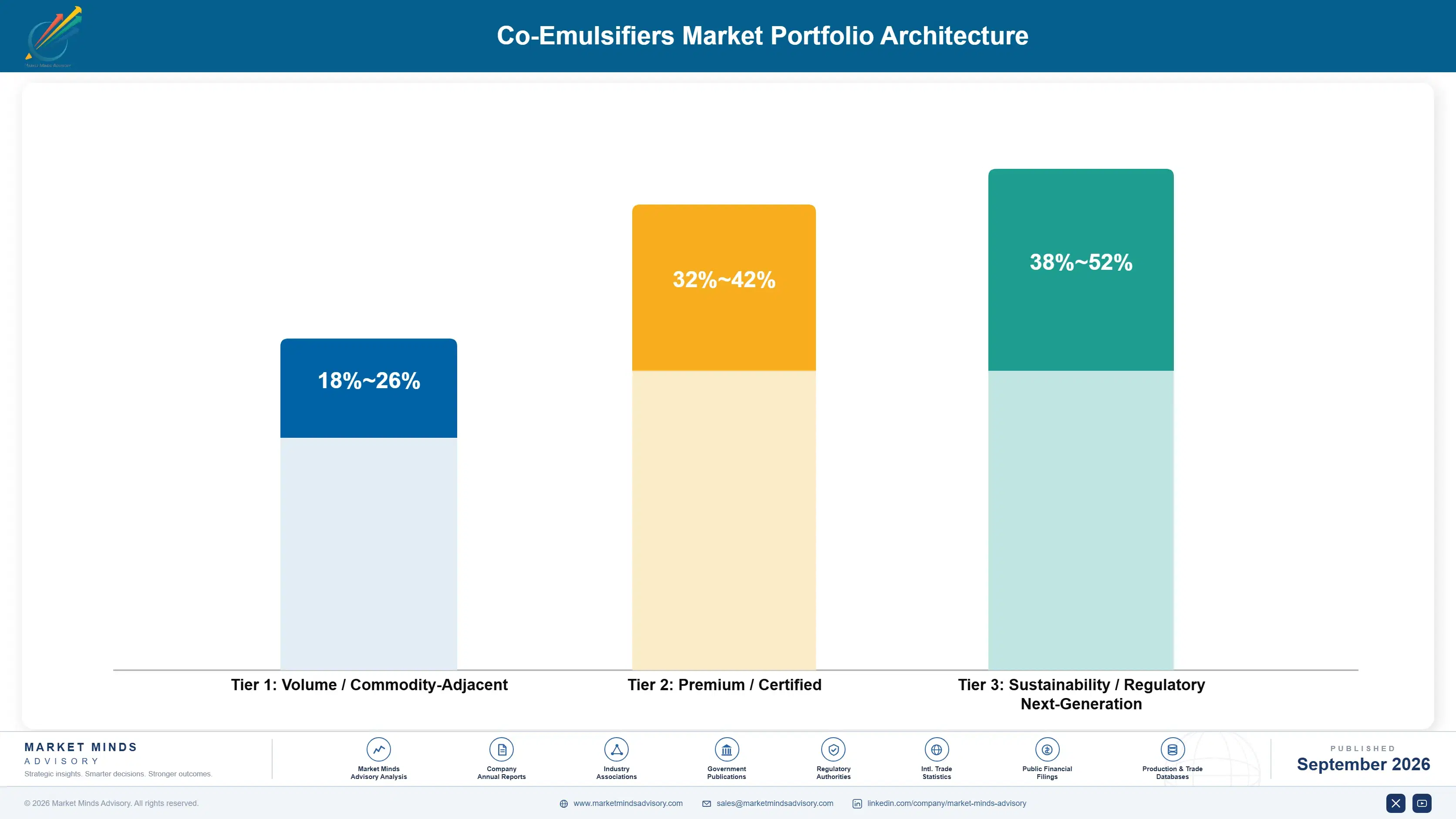
Portfolio architecture in this category runs across three tiers separated mainly by manufacturing method and sustainability substantiation depth, with gross margin ranging from thin on volume-adjacent commodity silicone-based grades to considerably richer on certified bio-fermented and sugar-based grades that carry genuine third-party sustainability backing rather than marketing claims alone, a distinction brand buyers increasingly enforce at the contract-renewal stage. Utilisation across those tiers also differs meaningfully by manufacturing scale.
The tension between volume and premium plays out most visibly in formulation contract allocation, where certified bio-fermented grades earn disproportionate margin per unit but occupy less contract volume than volume-adjacent formulations that formulators still need to source for price-sensitive mass products unwilling to pay a sustainability premium, forcing category managers to balance margin ambition against formulation budget realities. That balance is harder to strike as substantiation costs climb.

High-value margin pools concentrate in bio-fermented and sugar-based grades, where suppliers capture recurring formulation contract revenue and premium pricing simultaneously, while the next-generation biotech tier remains the space most likely to reshape category economics as fermentation-scale production matures over the next several years. Manufacturers that invested early in sustainability research are best positioned to capture that shift.

Volume / Commodity-Adjacent

Commodity silicone-based and synthetic grades with minimal sustainability substantiation, competing mainly on price and volume against legacy suppliers rather than differentiated natural-origin positioning. This tier remains the largest by unit volume despite slower relative growth.
Gross Margin: 18-26%

Premium / Certified

Third-party certified sugar-based and natural-origin grades carrying genuine sustainability substantiation, commanding meaningful price premiums while requiring sustained testing investment to maintain credibility. Formulators increasingly treat this tier as the entry price for meaningful contract inclusion.
Gross Margin: 32-42%

Sustainability / Regulatory / Next-Generation

Bio-fermented and next-generation biotech formulations positioned ahead of tightening substantiation requirements, commanding the richest margins currently but still limited by manufacturing scale and production capacity. Growth here is expected to accelerate as pilot volumes reach commercial production scale.
Gross Margin: 38-52%
co-emulsifiers-market-portfolio-architecture-1790016377918

High-value Sub-segments and Strategic Watch-out

Certified Bio-Fermented Co-Emulsifiers

High-value, high-growth segment combining sustainability credibility with premium pricing power, currently expanding fastest among formulators seeking clean-label credentials nationwide. Brands now compete directly for exclusive supply rights on the fastest-scaling certified producers. Insurance and formulation partnerships are further widening this segment's addressable market. Growth accelerates.
Gross Margin: 42-52%

Sugar-Based Alkyl Polyglucoside Grades

High-value, moderate-growth segment built on renewable feedstock sourcing that commands premium pricing through natural-origin positioning, growing steadily as manufacturers refine production cost structures further. Clean-label certification bodies are beginning to endorse several leading producers in this space, and adoption keeps rising steadily. Momentum builds. nationwide.
Gross Margin: 36-46%

Conventional Silicone-Based Co-Emulsifiers

Volume core segment still carrying the bulk of category unit volume despite slower growth, remaining commercially essential for formulators serving price-sensitive mass products unwilling to pay a premium. Retailers keep this tier stocked broadly to avoid losing budget-conscious formulators entirely. Private label growth concentrates here across most major markets.
Gross Margin: 16-24%

Private-Label Bio-Fermented Formulation Entrants

Strategic watch-out segment where brands scaling their own bio-fermented sourcing could undercut founder-led producers on price while matching sustainability credentials, a genuine threat to premium positioning industry-wide. Founder-led producers are responding by deepening direct formulator loyalty programs considerably. Shelf-reset outcomes next year will reveal how fast this threat materializes.
Gross Margin: 26-36%

Formulation Loyalty and Substantiation Economics

Co-emulsifier supply behaves like an annuity business once a cosmetic manufacturer commits, because requalifying a new stabilizing agent means re-running formulation stability studies entirely, and most brands would rather retain a proven ingredient supplier than restart testing and regulatory approval from scratch. That effect compounds the longer a manufacturer stays with a given ingredient supplier. Subscription-style long-term contracts are reinforcing that loyalty further each renewal cycle.
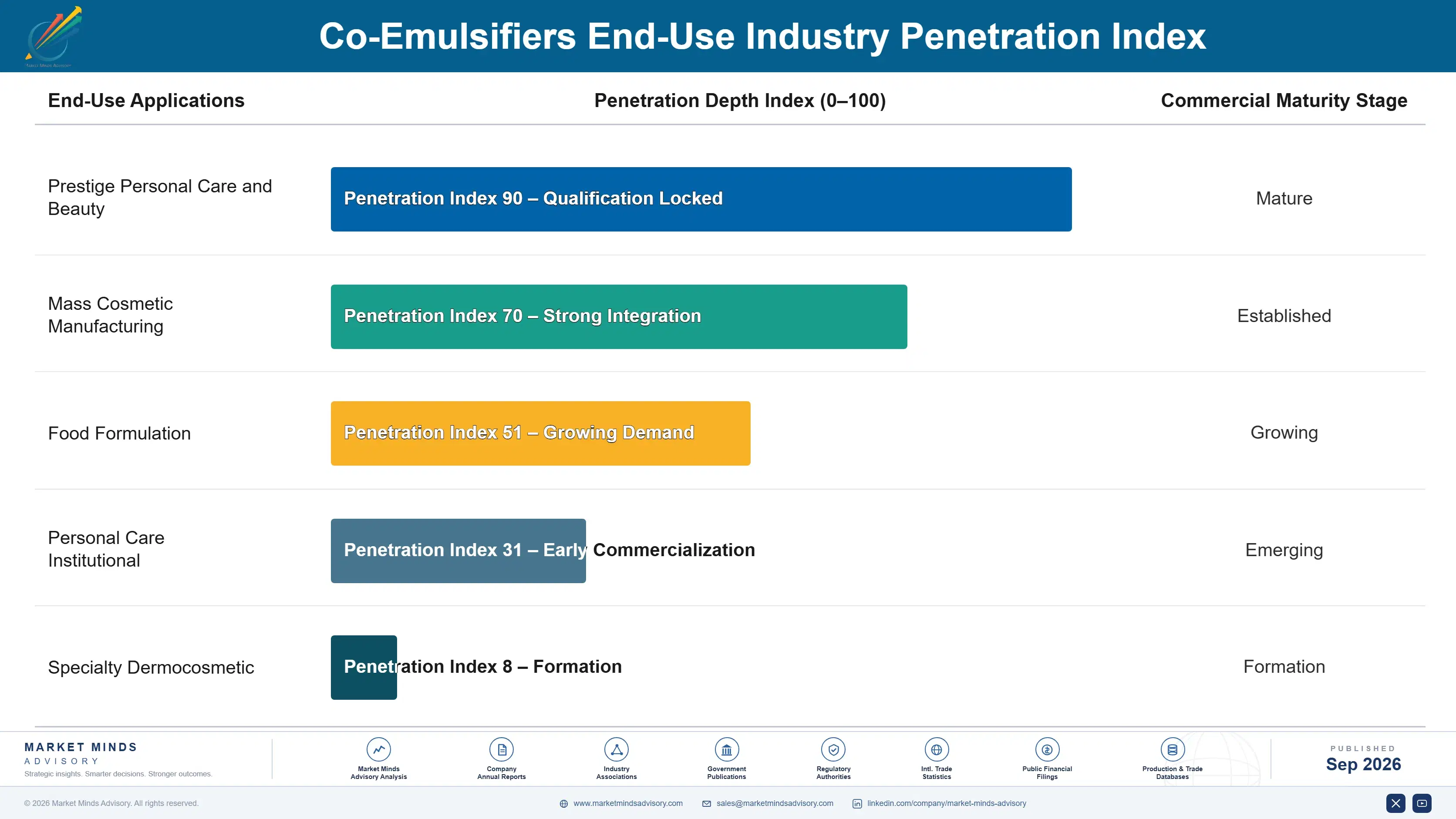
Adoption depth varies sharply by end-use vertical: prestige personal care brands invest heavily in bio-fermented and natural-origin grades to differentiate against mass-market competitors, while mass-market formulators adopt more slowly, waiting for ingredient costs to fall and substantiation data to become widely available before committing formulation resources. Regulatory bodies increasingly influence which suppliers earn that loyalty first.

Generational turnover is reshaping the buyer profile meaningfully: younger formulation chemists researching fermentation and sustainability science before sourcing decisions are replacing older buyers who chose primarily on price and supplier familiarity, and that shift is pulling category growth toward transparent, clinically substantiated suppliers even where price per kilogram runs measurably higher than legacy silicone-based co-emulsifiers. That pattern is one brand buyers now factor directly into sourcing decisions.
co-emulsifiers-market-end-use-penetration-index-1790016378635

Where Sustainability Discipline Wins Category Share

These are among the four positions where our research anticipates prominent divergence between winners and laggards over the coming forecast period. Each is grounded in the demand model, the regulatory perimeter, and the announced capacity pipeline.
01 / BRAND PARTNERSHIP TIMING

Secure endorsement early or lose ground to faster movers

Suppliers that secure genuine brand endorsement before a formal contract renewal consistently outperform competitors relying solely on price competition, since cosmetic manufacturers increasingly research sustainability backing before renewing sourcing agreements across mass and prestige formulation channels alike. Brands and formulators increasingly treat endorsement as a baseline requirement rather than a differentiator, meaning late movers do not make the shortlist regardless of purity quality. The window for building these relationships cheaply is closing fast as competition for brand attention intensifies industry-wide.
02 / FERMENTATION STABILIZATION INVESTMENT

Early stabilization technology investment compounds cost advantage

Producers that invest early in bio-fermentation stabilization and concentration technology capture meaningfully lower production costs than competitors still using earlier-generation synthesis approaches across the category broadly. Suppliers lacking this capability depend entirely on premium pricing that private-label competitors increasingly threaten as brands expand their own bio-fermented sourcing nationwide. Building stabilization expertise early, before ingredient costs rise further industry-wide, remains one of the more durable margin advantages available in this category today across nearly every regional market, and that head start compounds each additional cycle.
03 / DIRECT FORMULATOR EXPANSION

Direct relationships build credibility distribution alone cannot match

Suppliers that build genuine direct formulator relationships alongside traditional distribution channels capture a meaningfully larger addressable market than those confined to distributor sales alone, since formulators increasingly recommend suppliers who provide technical support as a first-line sourcing preference across most major regulated markets. That credibility supports premium pricing that price-sensitive commodity buyers might otherwise resist entirely, and those formulator relationships compound in value over future contract cycles that grow more valuable each year. Waiting to build this channel will leave considerably less room to capture that advantage.
04 / PRIVATE-LABEL DEFENSE STRATEGY

Regional producers must deepen brand ties before conglomerates scale in-house

Diversified conglomerates scaling their own bio-fermented mass production pose the single largest threat to founder-led regional producers lacking manufacturing scale to match private-label pricing across most major formulation channels currently expanding certified capacity rapidly. Deepening direct formulator partnerships and building distinctive sustainability credentials before that scaling accelerates further gives independent producers a defensible position worth pursuing immediately, since the window is narrowing. Waiting until private-label entrants mature fully will leave less room to build the switching costs that protect market position long term.

Engagement Snapshot From the Field

A live engagement with an industry participant carrying material or product regulatory and market exposure ahead of a defining policy shift, showing how our research translates into a defensible multi-year portfolio strategy.
MARKET MINDS ADVISORY · CLIENT ENGAGEMENT SUMMARY
Co-Emulsifiers Producer Strategic Portfolio Review and Transition Roadmap 2026·Investment Scenario on Co-Emulsifiers Exposure Evaluation 2025-26
CLIENT PROFILE
The client is a founder-led bio-fermented co-emulsifier producer operating primarily through distributor channels in Western Europe, generating client-reported annual revenue of approximately $11 million (client-reported, unverified by MMA). The producer built early traction through fermentation-derived ingredient formats before seeking direct formulator relationships to accelerate brand penetration meaningfully across additional metro markets over the following year.
STRATEGIC CHALLENGE
The client needed to secure direct formulator relationships and negotiate technical support terms simultaneously while protecting the distributor margin structure that had funded its early growth trajectory. Leadership worried that direct expansion would cannibalize distributor relationships without meaningfully growing total brand reach. That tension shaped every strategic decision the engagement addressed carefully.
MMA APPROACH
MMA conducted primary interviews with formulation category buyers and distributor partners to map realistic relationship timelines, then modeled distributor cannibalization risk against incremental direct brand reach using the client's existing customer data alongside primary survey benchmarks drawn from comparable ingredient producer expansions. That comparison grounded the recommendation in observed behavior rather than assumption alone entirely.
KEY FINDINGS
  1. Direct formulator relationships reached brands the distributor channel could not access economically, particularly technically sophisticated buyers. That reach expanded the producer's total addressable market meaningfully beyond its original distributor base.
  2. Cannibalization risk was lower than leadership feared, since direct-relationship brands and distributor-sourced brands showed meaningfully different demographic profiles overall. Leadership had overestimated the overlap between the two customer groups at the outset.
  3. Technical support timelines ran longer than initially planned, requiring the client to sequence direct launch markets around onboarding dates. Building buffer time into the launch schedule prevented costly last-minute negotiation delays.
  4. Private-label competition was already emerging in the client's target formulation categories, narrowing the strategic window for premium positioning. Moving quickly on relationships became essential to preserve any meaningful first-mover advantage.
CLIENT PROFILE
The client is a founder-led bio-fermented co-emulsifier producer operating primarily through distributor channels in Western Europe, generating client-reported annual revenue of approximately $11 million (client-reported, unverified by MMA). The producer built early traction through fermentation-derived ingredient formats before seeking direct formulator relationships to accelerate brand penetration meaningfully across additional metro markets over the following year.
STRATEGIC CHALLENGE
The client needed to secure direct formulator relationships and negotiate technical support terms simultaneously while protecting the distributor margin structure that had funded its early growth trajectory. Leadership worried that direct expansion would cannibalize distributor relationships without meaningfully growing total brand reach. That tension shaped every strategic decision the engagement addressed carefully.
MMA APPROACH
MMA conducted primary interviews with formulation category buyers and distributor partners to map realistic relationship timelines, then modeled distributor cannibalization risk against incremental direct brand reach using the client's existing customer data alongside primary survey benchmarks drawn from comparable ingredient producer expansions. That comparison grounded the recommendation in observed behavior rather than assumption alone entirely.
KEY FINDINGS
  1. Direct formulator relationships reached brands the distributor channel could not access economically, particularly technically sophisticated buyers. That reach expanded the producer's total addressable market meaningfully beyond its original distributor base.
  2. Cannibalization risk was lower than leadership feared, since direct-relationship brands and distributor-sourced brands showed meaningfully different demographic profiles overall. Leadership had overestimated the overlap between the two customer groups at the outset.
  3. Technical support timelines ran longer than initially planned, requiring the client to sequence direct launch markets around onboarding dates. Building buffer time into the launch schedule prevented costly last-minute negotiation delays.
  4. Private-label competition was already emerging in the client's target formulation categories, narrowing the strategic window for premium positioning. Moving quickly on relationships became essential to preserve any meaningful first-mover advantage.
RECOMMENDED STRATEGY
Phase 1: Phase one: complete technical support infrastructure for core product lines before approaching direct formulator buyers. This sequencing avoided presenting incomplete technical documentation during sensitive negotiations. Phase 2: Phase two: launch direct relationships in two priority regions, preserving distributor pricing and messaging discipline throughout. Limiting initial scope let the team refine messaging before a full global rollout. Phase 3: Phase three: expand direct footprint globally while building loyalty programs that bridge distributor and direct purchase behavior. Loyalty programs helped retain distributor revenue throughout expansion.
OUTCOME
Within twelve months of relationship completion, the client secured direct partnerships with two major regional formulation houses while distributor revenue grew rather than declined, as direct visibility drove new distributor-channel sign-ups among brands first discovering the producer through technical referrals (client-reported, unverified by MMA). Leadership now views the two channels as complementary rather than competing.

Frequently Asked Questions

Foundational context covering the market sizes, CAGR, scope, country, region and competition that inform every finding below. This section is provided to cover basics and most often pre-purchase conversations, answered from the MMA Primary Research Dataset.

What is the current size of the Co-Emulsifiers Market?

The co-emulsifiers market reached $1.9 billion globally in 2025. That figure covers fatty alcohol, polyglycerol ester, sugar-based, and bio-fermented co-emulsifier grades sold worldwide as raw ingredients to personal care and cosmetic manufacturers.

How large will the Co-Emulsifiers Market be by 2036?

The market is projected to reach $3.76 billion by 2036, up from its 2026 value of $2.02 billion. That growth reflects roughly 1.86 times expansion over the ten-year forecast window across every major region tracked.

What is the CAGR for the Co-Emulsifiers Market 2026 to 2036?

The market is forecast to grow at a compound annual growth rate of 6.4% between 2026 and 2036. Bull and bear scenarios range from 7.5% to 5.3%, depending on regulatory and formulation adoption pace nationwide.

Which segment is growing fastest?

Bio-Fermented and Natural-Origin Co-Emulsifiers is the fastest-growing segment at an 11.6% CAGR, roughly 1.81 times the overall market rate. Sugar-Based and Alkyl Polyglucoside Co-Emulsifiers follows closely as the second-fastest format.

Who are the major companies in the Co-Emulsifiers Market?

Leading companies include BASF, Croda International, Evonik, Clariant, and Lubrizol. Together these five players hold an estimated CR5 of 42% measured on a revenue basis across major channels.

Which country is growing fastest?

India is the fastest-growing country at an estimated 9.1% CAGR, driven by rapidly expanding cosmetic manufacturing volume. That pace outstrips the global average by a considerable margin through the forecast window.

Report Segmentation Architecture

The full report scope spans multiple orthogonal segmentation dimensions, with cross-tabulated demand data provided for each dimension pair. Coverage extends further to regional breakdowns, trend trajectories, and the competitive detail needed to support segment-level decision-making.

By Primary Market Dimension

  • Fatty Alcohol-Based Co-Emulsifiers
  • Polyglycerol Ester Co-Emulsifiers
  • Lecithin and Phospholipid Co-Emulsifiers
  • Sugar-Based and Alkyl Polyglucoside Co-Emulsifiers
  • Silicone-Based Co-Emulsifiers
  • Bio-Fermented and Natural-Origin Co-Emulsifiers

By End-Use Industry

  • Prestige Personal Care and Beauty
  • Mass Cosmetic Manufacturing
  • Food Formulation
  • Personal Care Institutional
  • Specialty Dermocosmetic

By Commercial Dimension

  • Direct Formulator Sales
  • Distributor Channel
  • Contract Manufacturing
  • Private Label Formulation
  • Specialty Ingredient Retail

By Region

  • North America
  • Western Europe
  • East Asia
  • South Asia and Pacific
  • Latin America
  • Middle East and Africa
  • Eastern Europe

Scope, Methodology, and Coverage

Every figure in this report is reproducible from documented input assumptions. The scope below maps the historical period, the forecast horizon, the segmentation dimensions, and the countries covered, alongside the underlying primary and qualitative methodology.
Historical Period
2020 to 2025
Forecast Period
2026 to 2036
Base Year
2025 (USD billions; MMA Primary Research Dataset, September 2026)
Market Definition
The co-emulsifiers market covers secondary stabilizing agents used alongside primary emulsifiers in cosmetic, personal care, and food formulations to improve emulsion stability and sensory texture. It excludes primary emulsifier systems sold as standalone products and finished cosmetic or food products containing co-emulsifiers.
Quantitative Units
USD Billion; unit volume in metric tons where category-relevant
Segmentation Dimensions
Product and manufacturing method type, end-use industry, commercial channel, region
Regions Covered
North America, Western Europe, East Asia, South Asia and Pacific, Latin America, Middle East and Africa, Eastern Europe
Countries Covered
35+ countries across seven regions
Key Companies Profiled
20 companies profiled, including 5 key players and 15 additional participants
Quantitative Methodology
Primary survey, n=3,800 respondents, Q4 2025, six countries; demand-side model with trade association cross-validation
Qualitative Methodology
47 expert interviews, Q4 2025; applied to validate demand model assumptions, identify emerging dynamics, and assess competitive positioning
Report Format
PDF and XLSX data workbook (Word format preview document)
Publisher
Market Minds Advisory
Report Code
MMA-2026-CHM-273
Published
September 2026
Contact
sales@marketmindsadvisory.com | www.marketmindsadvisory.com

Purchase the full Co-Emulsifiers Market Report (2026 to 2036).

This report delivers a complete quantitative and qualitative assessment of the co-emulsifiers market through 2036, covering base year sizing, forecast scenarios, segmentation, and regional dynamics across all seven regions tracked. It draws on primary survey research spanning 3,800 respondents across six countries alongside 47 expert interviews conducted in the fourth quarter of 2025. Readers get detailed competitive profiling, input cost analysis, and portfolio guidance built for commercial decision-making. The report closes with a strategic verdict identifying where category leadership gets decided over the coming decade.
Full ten-year market sizing and forecast scenarios
Complete seven-region demand and growth analysis
Detailed competitive profiling of twenty companies
Segmentation across six manufacturing and delivery types
Input cost exposure and mitigation strategy analysis
Strategic verdict and revenue lever guidance

Built For The People Who Decide

From boardroom strategy to bench-side execution, this report is read cover-to-cover by leaders shaping the next decade of their industry, turning demand scenarios, market dynamics and valuation benchmarks into decisions.
CXOs/ Presidents/ VPs/ Managers
M&A and Corporate Development
Strategy Teams and R&D Heads
Procurement and Product Directors
Regulatory and Compliance Leaders
Investor Relations and Equity Analysts