Market Minds Advisory
Cloud Seeding System Market

Cloud Seeding System Market: Cloud Seeding System Market: System Classes, Attribution Evidence and Programme Funding 2026 to 2036

You cannot know what a cloud would have done if you had left it alone. Every argument in this market, scientific and commercial, comes back to that one unresolved problem.

Lead Analyst

Published

September 2026

Make Smarter Decisions with Customized Research Insights

Request a free sample report and evaluate market opportunities, growth trends, and competitive dynamics relevant to your business needs.

2025 MARKET VALUE$0.4BMarket Size 2025
2036 FORECAST VALUE$1.4BBase Case , 2026 to 2036
CAGR 2026 TO 203612.8 %Bull 14.0% / Bear 11.6%
INCREMENTAL OPPORTUNITY$1.0BNet 10- year value creation
EXPANSION MULTIPLE3.34x2036 value over 2026 base
Strategic Levers
M&A Pipeline
Regional Outlook
Country Rankings
Competitive Intelligence
Segmental Deep-dive
Call-Us : 91 93563 13602

Executive Snapshot and Market Trajectory.

Cloud seeding has an attribution problem that no amount of engineering solves. Establishing a credible effect takes something like 12 years of randomised operations, and no water authority under drought will fund a decade-long experiment before acting. Governments buy on precaution instead, and that is the entire market.
The market reaches USD 0.41 billion in 2026 and USD 1.37 billion by 2036, a 3.34 times expansion at 12.8%. Unmanned aerial seeding platforms grow at 19.2%, half again the market rate of 12.8%, because a drone can place material where the physics wants it rather than where an aircraft may safely fly. East Asia holds 38% of spending, since China operates a national programme larger than everybody else combined. It is not close.
Five suppliers hold 44% of programme equipment and operations revenue, concentrated because operating an instrumented aircraft fleet and manufacturing pyrotechnic flares are both specialist businesses with very few entrants. Weather Modification Inc and North American Weather Consultants run operations. Ice Crystal Engineering makes the flares almost everybody uses. Chinese state institutes serve the largest programme entirely outside commercial supply. Nobody outside China competes for that volume.
Market Definition
This report covers systems, consumables and operations used to modify precipitation from clouds: unmanned aerial seeding platforms, radar, measurement and decision systems, ground-based generator networks, seeding agents and flare consumables, manned aircraft seeding operations, and programme design and verification services. It excludes general meteorological forecasting services, fog dispersal at airports, hail suppression netting and physical crop protection, atmospheric carbon removal, and the water infrastructure these programmes are intended to supply.
Base Year Value
$0.4B in 2025 (MMA Primary Research Dataset, September 2026)
Forecast Period
2026 to 2036, eleven discrete annual values
CAGR
12.8% base case. Bull 14.0%. Bear 11.6%.
Fastest Growth Segment
Unmanned Aerial Seeding Platforms: 19.2% CAGR
Fastest Growth Country
United Arab Emirates: 18.6% CAGR
Fastest Growth Region
South Asia and Pacific: 14.8% CAGR
Largest Region
East Asia: 38% of 2025 global value
Market Leaders
Weather Modification Inc, North American Weather Consultants, Ice Crystal Engineering, Cloud Seeding Technologies and Rainmaker Technology lead on programme equipment and operations revenue. Source: MMA Analysis.
Primary Survey
n=3,800 procurement and R&D decision-makers, Q4 2025, six countries
Methodology
Demand-side build-up, cross-validated against public data, 47 expert interviews

Cloud Seeding System Market Forecast Scenarios

cloud-seeding-system-market-size-forecast-scenario-1789986940487
Between 2020 and 2025 the category compounded at 11.4% and drought did the selling. Western American basins, Australian catchments and Gulf states all expanded programmes during years when reservoirs fell and every other option was slower or more expensive. Scientific criticism continued throughout and changed almost nothing, because a water authority facing an empty reservoir is not waiting for a randomised trial to conclude.
The base case holds 12.8% on three mechanisms. Unmanned platforms are replacing manned aircraft on economics and on access, since a drone flies into conditions no pilot should and costs a fraction per seeding hour. Measurement and verification systems are growing faster than the seeding itself, because every programme now has to produce defensible evidence for an auditor rather than an anecdote. And Gulf water scarcity funds programmes on national security grounds that no cost benefit analysis constrains.
The bull case at 14.0% assumes a large randomised programme finally produces a result strong enough to end the argument, which would move procurement from precaution to policy across dozens of basins. The bear case at 11.6% is the opposite finding, or an environmental challenge to silver iodide release that a court upholds somewhere consequential.

The Counterfactual Nobody Can Measure

The problem with cloud seeding is not the chemistry, it is the control. Silver iodide provides ice nuclei and clouds sometimes produce more precipitation afterwards, which nobody seriously disputes. What cannot be established from any single operation is what that cloud would have produced if left alone, and the natural variability of precipitation is large enough to swamp the effect being claimed.
TOP FIVE CONCENTRATION44%Concentrated by aircraft fleet and specialist flare manufacturing
ATTRIBUTABLE PRECIPITATION INCREASE9%Additional rainfall credibly attributed under controlled evaluation conditions
PROGRAMME COST PER HECTAREUSD 3.40Annual operating outlay across a typical basin programme
RANDOMISED TRIAL DURATION12 yearsStatistical evidence period needed to establish a credible effect
GROUND GENERATOR COVERAGE800 metresVertical reach before released material stops seeding effectively
SEEDING SEASON WINDOW140 daysAnnual days offering suitable cloud conditions in temperate basins
Getting past that takes randomisation over many seasons. The programmes that produced credible numbers ran something like 12 years of alternating seeded and unseeded operations, and the effect they measured came out around 9%. That is small as a percentage and considerable as a volume across a large basin, particularly at a programme cost of a few dollars per hectare annually. But 12 years is not a timescale any water authority in a drought accepts.
So the market runs on precaution rather than proof, and that shapes everything about it. Governments fund programmes because the downside of not trying looks worse than the cost of trying, which is a political calculation rather than a scientific one. China removed the argument entirely by treating weather modification as national infrastructure. Nobody else has that option and everybody else is arguing.
"Nobody in this business will tell you seeding definitely works, and nobody will tell you it definitely does not. What they will tell you is that a few dollars per hectare is cheap against the alternative, and that argument has funded every programme running today."
Director, Water Resources and Atmospheric Systems Practice · MMA Agriculture Practice · September 2026

Market Trends

Drones Reach Cloud Conditions No Pilot Should Fly

Seeding works best in supercooled conditions inside developing cloud, which is precisely where icing makes manned flight dangerous and where a pilot is correctly instructed not to go. An unmanned platform has no such constraint, costs a fraction per seeding hour and can loiter where the physics says material should be released rather than where an aircraft can safely position. That changes both the economics and the placement accuracy at once. Unmanned aerial seeding platforms compound at 19.2% against 12.8% for the market, and the operational programmes adopting them are not going back.
Market Impact: Costs USD 3.40 per hectare

Every Programme Now Needs Defensible Evidence For Auditors

A decade ago a seeding programme reported flight hours and rainfall totals and nobody asked hard questions. Public spending scrutiny and environmental challenge have both tightened, and programme managers now need an evidence framework that survives an auditor, a court or a journalist rather than a briefing note. That means radar, gauge networks, tracer studies and statistical design bought alongside the seeding rather than instead of it. Radar, measurement and decision systems compound at 16.0%, faster than the operations they verify, which tells you where the anxiety sits. Nobody wants to be the programme that could not explain itself.
Market Impact: Covers over 5 million square kilometres

Market Opportunities and Growth Drivers

Water Scarcity Makes Precaution Cheaper Than Certainty

A basin programme runs at a few dollars per hectare a year against desalination, interbasin transfer or demand restriction that each cost orders of magnitude more and take years to deliver. Even at the modest 9% effect that credible evaluation supports, the arithmetic works if the effect is real and the loss is small if it is not. That is a precautionary purchase and water authorities make it consciously, which is why the scientific argument has almost no influence on procurement. The decision is about asymmetry rather than about evidence. Very few vendors explain it that way.
Market Impact: Requires 12 years of trials

Chinese State Programme Operates At Uncontested Scale

China runs weather modification as national infrastructure rather than as a contested intervention, covering an area measured in millions of square kilometres with tens of thousands of personnel and a permanent institutional structure. The programme is funded on agricultural output, hydropower yield and drought mitigation grounds, and Western scientific debate has no bearing on it whatever. Domestic institutes and manufacturers supply almost all of the equipment and the operations. Nothing about that volume is addressable by a commercial vendor from outside, which distorts every global market comparison anybody publishes. The scale is genuinely difficult to overstate.
Market Impact: Bans enacted in 3 states

Market Restraints and Challenges

Attribution Requires More Time Than Anybody Has

Establishing a statistically credible seeding effect requires something like 12 years of randomised operations, alternating seeded and unseeded periods across the same basin under comparable conditions. The root cause is natural precipitation variability, which is large enough to hide an effect of around 9% inside ordinary year-to-year noise. Commercially this means no programme can prove its own value on its own timescale, and every renewal argument rests on evidence generated somewhere else. Mitigation runs through tracer chemistry and radar signatures that show material reaching target cloud, which is physical evidence rather than statistical proof.
Market Impact: Platforms compound at 19.2% annually

Silver Iodide Release Attracts Environmental Challenge

Deliberately dispersing a metal compound into the atmosphere over populated catchments invites legal and political objection regardless of the measured toxicology, which is generally reassuring at the concentrations involved. The root cause is that the intervention is visible, deliberate and hard to explain, and downstream communities frequently believe a programme upstream is taking rain that would otherwise have fallen on them. Commercially this produces litigation risk, permitting delay and occasional legislative bans at state level. Mitigation runs through hygroscopic alternatives and through transparency programmes that publish operations in advance, which several operators now do routinely.
Market Impact: Measurement compounds at 16.0% yearly
3 additional market trends, 4 additional growth drivers, and 2 additional restraints and challenges are covered in the full report. Contact sales@marketmindsadvisory.com to access the complete intelligence.

Segment CAGR and Growth Architecture

Segmentation follows system class, since what a programme buys depends on whether it is delivering material, measuring the result or designing the intervention. Six classes cover the market: unmanned seeding platforms, radar and measurement systems, programme design and verification services, seeding agents and flare consumables, ground-based generator networks, and manned aircraft operations. Application purpose and funding source are separate dimensions.
cloud-seeding-system-market-market-share-analysis-1789986941029

Unmanned Aerial Seeding Platforms

Unmanned platforms grow at 19.2%, half again the market rate of 12.8%, and the argument is physical rather than economic, though the economics help. Seeding works best inside supercooled developing cloud, which is exactly where icing makes manned flight dangerous and where a pilot is correctly told not to go. A drone has no such constraint, so material can be released where the physics says it should be rather than where an aircraft can safely position. Cost per seeding hour falls sharply at the same time. The obstacle is airspace authorisation rather than the aircraft, and it varies enormously between jurisdictions with no technical logic behind the variation at all. That inconsistency frustrates every operator working across borders.
CAGR 19.2%

Radar, Measurement and Decision Systems

Measurement and decision systems grow at 16.0%, faster than the seeding operations they exist to verify, which tells you exactly where programme anxiety now sits. A decade ago an operator reported flight hours and rainfall totals and that was accepted. Public spending scrutiny, environmental challenge and downstream community objection have all tightened, and a programme manager now needs an evidence framework that survives an auditor, a court or a journalist. Radar signatures showing material reaching target cloud, tracer chemistry, dense gauge networks and proper statistical design are bought alongside the seeding rather than instead of it. Nobody wants to be the programme that could not explain itself afterwards, and that fear is doing most of the selling here.
CAGR 16.0%
Full segment breakdown across 6 segments available in the complete report.

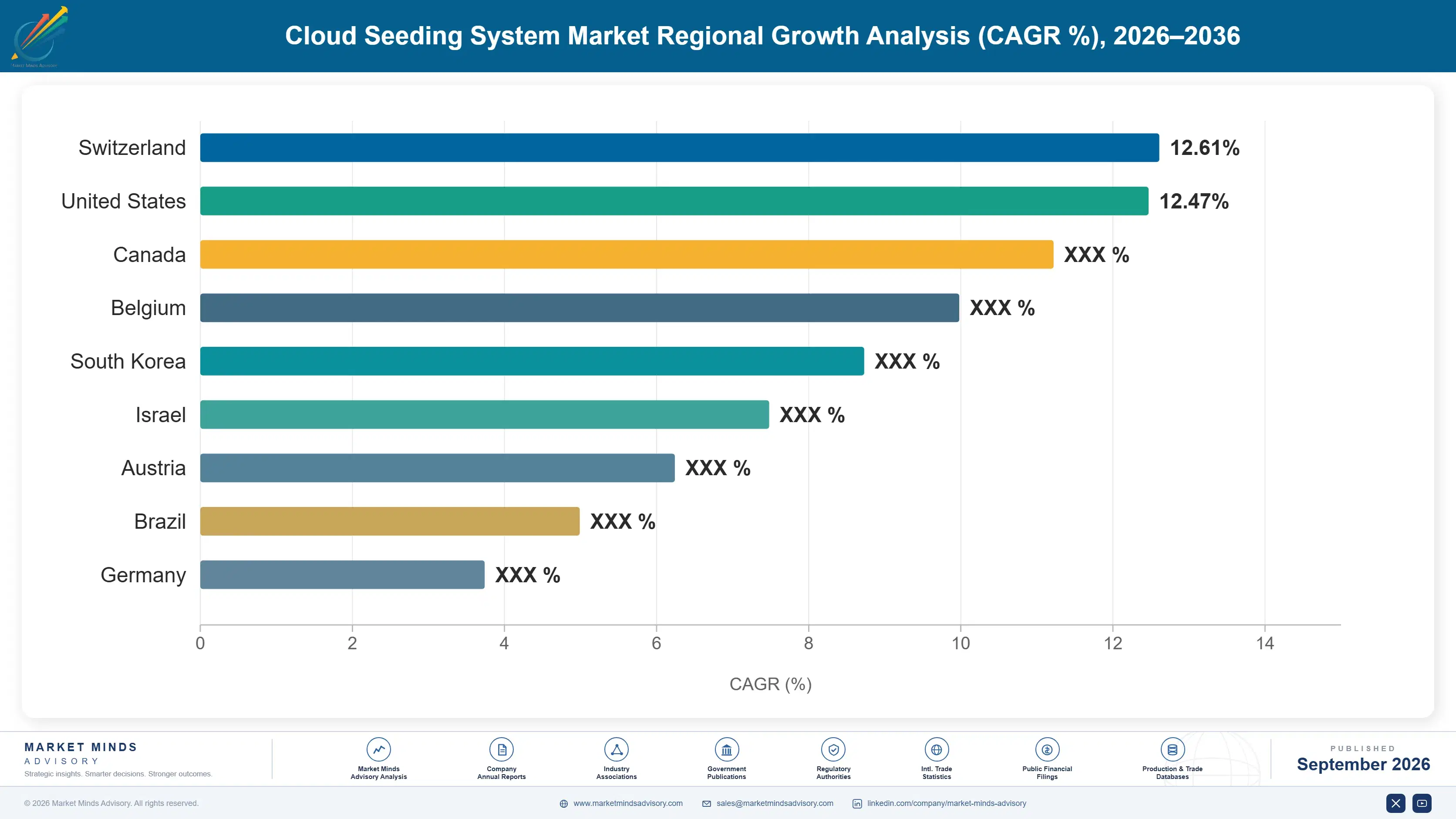
Regional Architecture and Country Demand Map

East Asia leads at 38%, far above the standard band, because China operates weather modification as national infrastructure at a scale exceeding everybody else combined. Middle East and Africa sits at double its band on Gulf water scarcity. Western Europe falls well below on scientific scepticism.

East Asia

East Asia holds 38% of spending, far above the 30% band ceiling, and one national programme explains almost all of it. China operates weather modification as infrastructure rather than as a contested intervention, across an area measured in millions of square kilometres, with tens of thousands of personnel and a permanent institutional structure at provincial level. Funding rests on agricultural output, hydropower yield and drought mitigation, and Western scientific argument has no bearing on any of it. Domestic institutes and manufacturers supply essentially all the equipment and operations, which makes that volume unaddressable by commercial vendors from outside. Japanese and Korean activity is research scale by comparison. The comparison is not really meaningful.
Share: 38% | CAGR: 14.0% (2026 to 2036)

Middle East and Africa

At 16% Middle East and Africa sits at more than double the 6% band ceiling, and Gulf water scarcity is the reason. The United Arab Emirates funds one of the most active operational and research programmes anywhere and grows at 18.6%, faster than any other country in this market, with a research grant scheme that funds international science directly. Saudi Arabia operates a national programme across several regions. The reasoning is water security rather than agricultural economics, which removes the cost benefit constraint that limits programmes elsewhere. Moroccan and Ethiopian programmes run on agricultural grounds at much smaller scale. Nowhere else funds this on sovereign necessity, and that changes what gets approved.
Share: 16% | CAGR: 13.2% (2026 to 2036)
Regional intelligence for 5 additional markets available in the complete report: North America, Western Europe, South Asia and Pacific, Latin America, Eastern Europe. Contact sales@marketmindsadvisory.com.
cloud-seeding-system-market-country-cagr-analysis-1789986941575

How To Sell Without Proof

Nobody in this market can prove their product works on the timescale a customer decides in, and pretending otherwise damages credibility that takes years to rebuild. What actually sells is asymmetry arithmetic, physical evidence of material reaching cloud, and access to funders whose reasoning is sovereign rather than economic. The four levers below cover those.

Sell The Asymmetry, Not The Effect Size

A basin programme costs a few dollars per hectare a year against desalination or interbasin transfer at orders of magnitude more, so the argument that closes is about downside rather than about the 9% effect credible evaluation supports. If the effect is real the arithmetic is overwhelming; if it is not, the loss is trivially small against a water budget. Water authorities understand asymmetry perfectly well and are used to making decisions under uncertainty. Vendors who lead with contested effect sizes invite the scientific argument instead of the commercial one, and lose it.
Market Impact: USD 3.40 per hectare against far costlier alternatives

Sell Physical Evidence Rather Than Statistical Proof

Nobody can produce statistical proof inside a procurement cycle, since that takes something like 12 years of randomised operation. What can be produced immediately is physical evidence: radar signatures showing seeded material reaching target cloud, tracer chemistry recovered in precipitation on the ground, and aircraft or drone telemetry confirming placement. That does not prove the rainfall increased and it does prove the intervention happened where it was meant to, which is what an auditor actually asks. Measurement and decision systems compound at 16.0% because programme managers worked this out before their vendors did.
Market Impact: Measurement systems compound at 16.0% on evidence demand

Move Delivery From Aircraft To Unmanned Platforms

Seeding works best inside supercooled developing cloud, which is where icing makes manned flight dangerous and where a pilot is correctly instructed not to fly. An unmanned platform has no such limit, so material goes where the physics says rather than where an aircraft can safely position, and the cost per seeding hour falls sharply as well. Unmanned platforms compound at 19.2% against 12.8% for the market. The remaining obstacle is airspace authorisation, which varies between jurisdictions for reasons that have nothing to do with the technology involved. Working through that is a compliance job.
Market Impact: Unmanned platforms compound at 19.2% against 12.8% overall

Follow The Sovereign Water Security Funding

A Gulf water authority does not run a cost benefit analysis on rainfall enhancement, because the reasoning is water security rather than agricultural economics and the alternative is desalination at enormous energy cost. The United Arab Emirates compounds at 18.6%, faster than any other country here, and funds international atmospheric research directly through a grant programme. Saudi Arabia operates nationally across several regions. That funding is patient, technically serious and entirely insulated from the cost benefit constraint that limits programmes everywhere else. Reaching it requires regional presence and sovereign procurement patience.
Market Impact: The Emirates compounds at 18.6% on sovereign funding

Who Controls the Margin Pool

Five suppliers hold 44% of programme equipment and operations revenue, concentrated because operating an instrumented aircraft fleet and manufacturing pyrotechnic flares are both specialist businesses that very few firms enter. Weather Modification Inc and North American Weather Consultants run operational programmes across American basins. Ice Crystal Engineering supplies flares almost everybody uses. Cloud Seeding Technologies serves European and Gulf programmes. All participants are assessed on programme equipment and operations revenue.
Competition runs on operational credibility and evaluation record rather than on technology, which is unusual and reflects an unresolved scientific position. A programme manager selecting an operator is choosing whose evidence will survive an audit and whose incident record is clean, because the technology itself is broadly comparable across suppliers. Long-running programmes with published evaluation are worth more commercially than any equipment advantage.

Rankings shift with unmanned platforms and with politics. Drone operators are entering a field previously defined by aircraft fleet ownership, which was the main barrier to entry and is becoming less so. The other variable is entirely outside anybody's control: a state legislature enacting a ban removes a programme and its supplier together, and several have done exactly that.
cloud-seeding-system-market-company-positioning-matrix-1789986942099

Competitive Moat and Risk Dimensions

WEATHER MODIFICATION INC

Moat: Instrumented Fleet And Record

Weather Modification Inc operates a fleet of research-instrumented aircraft accumulated over decades, which is expensive capital, difficult to insure and impossible to assemble quickly. Alongside it sits an operational record across dozens of programmes that a water authority selecting an operator weighs above any technical claim. Both take years and neither is available for purchase.
WEATHER MODIFICATION INC

Risk: Aircraft Fleet Obsolescence

The fleet that constitutes the company's main barrier to entry is also the asset unmanned platforms are displacing, and drone operators compound at 19.2% while manned operations grow at 8.2%. Capital tied up in aircraft is capital not deployed into the technology that replaces them. A moat built on an obsolescing asset erodes without anybody attacking it.
ICE CRYSTAL ENGINEERING

Moat: Pyrotechnic Manufacturing Position

Ice Crystal Engineering manufactures the silver iodide flares that most Western programmes burn, a business requiring explosives licensing, specialist handling and a formulation record regulators accept. Almost nobody enters a market this small that carries this much regulatory overhead, which leaves a supplier position considerably stronger than the revenue would suggest. Programmes standardise on a flare and rarely change.
ICE CRYSTAL ENGINEERING

Risk: Silver Iodide Substitution Risk

The whole position rests on one compound that attracts environmental objection and occasional legislative attention, and hygroscopic alternatives exist for warm cloud seeding already. A programme that switches formulation on political grounds rather than technical ones takes the supplier position with it. Being the specialist in a contested material is a strong place until the material becomes the argument.

Players Tracked

Prominent Players

Weather Modification Inc
North American Weather Consultants
Ice Crystal Engineering
Cloud Seeding Technologies
Rainmaker Technology

Other Key Players

Seeding Operations and Atmospheric Research
Desert Research Institute
Snowy Hydro
Vaisala
Enterprise Electronics Corporation
Leonardo
Metek
Kipp and Zonen
Textron Aviation
Pilatus Aircraft
Droplet Measurement Technologies
Hydro Tasmania
Meteo France International
Anhui Sun Create Electronics
Beijing Metstar Radar

Recent Developments

FEBRUARY 2025

Rainmaker Technology Expands Unmanned Seeding Operations In Western Basins

Rainmaker Technology expanded unmanned aerial seeding operations across western American basins, an organic operational expansion rather than an acquisition. Unmanned platforms reach supercooled conditions inside developing cloud that manned aircraft are correctly instructed to avoid, which improves placement accuracy while cutting cost per seeding hour substantially.
Signal: The aircraft fleet that was once the barrier to entry is quietly becoming the liability instead.
SEPTEMBER 2024

United Arab Emirates Extends Rain Enhancement Research Funding

The United Arab Emirates extended its rain enhancement research grant programme to additional international teams, a funding commitment rather than a commercial transaction. The scheme funds atmospheric science directly rather than procuring operations, which is unusual and reflects a water security reasoning that no cost benefit analysis constrains.
Signal: Sovereign water security funding behaves nothing like the commercial procurement everywhere else in this particular market.
MAY 2025

Vaisala Extends Radar Product Range For Seeding Verification

Vaisala extended its weather radar and measurement product range with configurations aimed at seeding programme verification, an organic product development rather than a transaction. The work targets programme managers who need evidence surviving an auditor or a court, which has become a requirement rather than an optional addition.
Signal: Measurement is now bought because programmes must defend themselves rather than because anybody wants better science.

What A Programme Costs Annually

Aircraft operation, including fuel, maintenance, insurance and flight crew, accounts for roughly 42% of an operational programme's cost, which is why unmanned platforms change the arithmetic so sharply. Seeding agents and pyrotechnic flares add about 14% from a very narrow manufacturing base. Radar, gauge networks and evaluation carry around 24%, and programme management the balance.
Vaisala Annual Report 2024 records instrument manufacturing and component availability as recurring cost variables across its weather and environmental businesses. Textron Aviation disclosures describe rising operating and maintenance costs across turboprop platforms of the type seeding operators fly. Aviation insurance for weather modification work rose materially through 2023 and 2024 as underwriters reassessed intentional flight into icing conditions, and several operators absorbed those increases inside multi-year programme contracts they could not reprice.

The competitive disadvantage mechanism is aviation exposure rather than any material price. An operator flying manned aircraft into icing conditions carries insurance, maintenance and crew cost that scales with hours and rises whenever underwriters reassess the risk. An unmanned operator carries none of it. That difference is invisible in a technical comparison and decisive in a competitive tender, which is why fleet ownership is shifting from advantage to burden.
cloud-seeding-system-market-cost-volatility-analysis-1789986942297

Transition Fleet Capacity Toward Unmanned Platforms Deliberately

Aircraft operation runs about 42% of programme cost and carries insurance exposure that underwriters have been repricing since 2023. Unmanned platforms remove most of that line and reach conditions manned flight cannot enter safely. The transition costs capital an operator has already tied up in aircraft, which is exactly why most of them keep deferring it.

Write Insurance Escalation Into Multi-Year Programme Contracts

Aviation insurance for intentional flight into icing conditions rose materially through 2023 and 2024 as underwriters reassessed the risk, and operators on multi-year programme contracts absorbed the whole increase. Negotiating an insurance escalation provision at contract award is straightforward, since the customer is a public authority familiar with indexed contracts. Almost nobody in this industry has attempted it.

Qualify A Second Flare Manufacturer Before Needing One

Seeding agents and pyrotechnic flares run about 14% of programme cost from a manufacturing base narrow enough to count on one hand, because explosives licensing and formulation approval deter almost every potential entrant. Qualifying a second source takes regulatory approval and burn testing measured in seasons rather than weeks. The cost is duplicated qualification against volume that may never move.

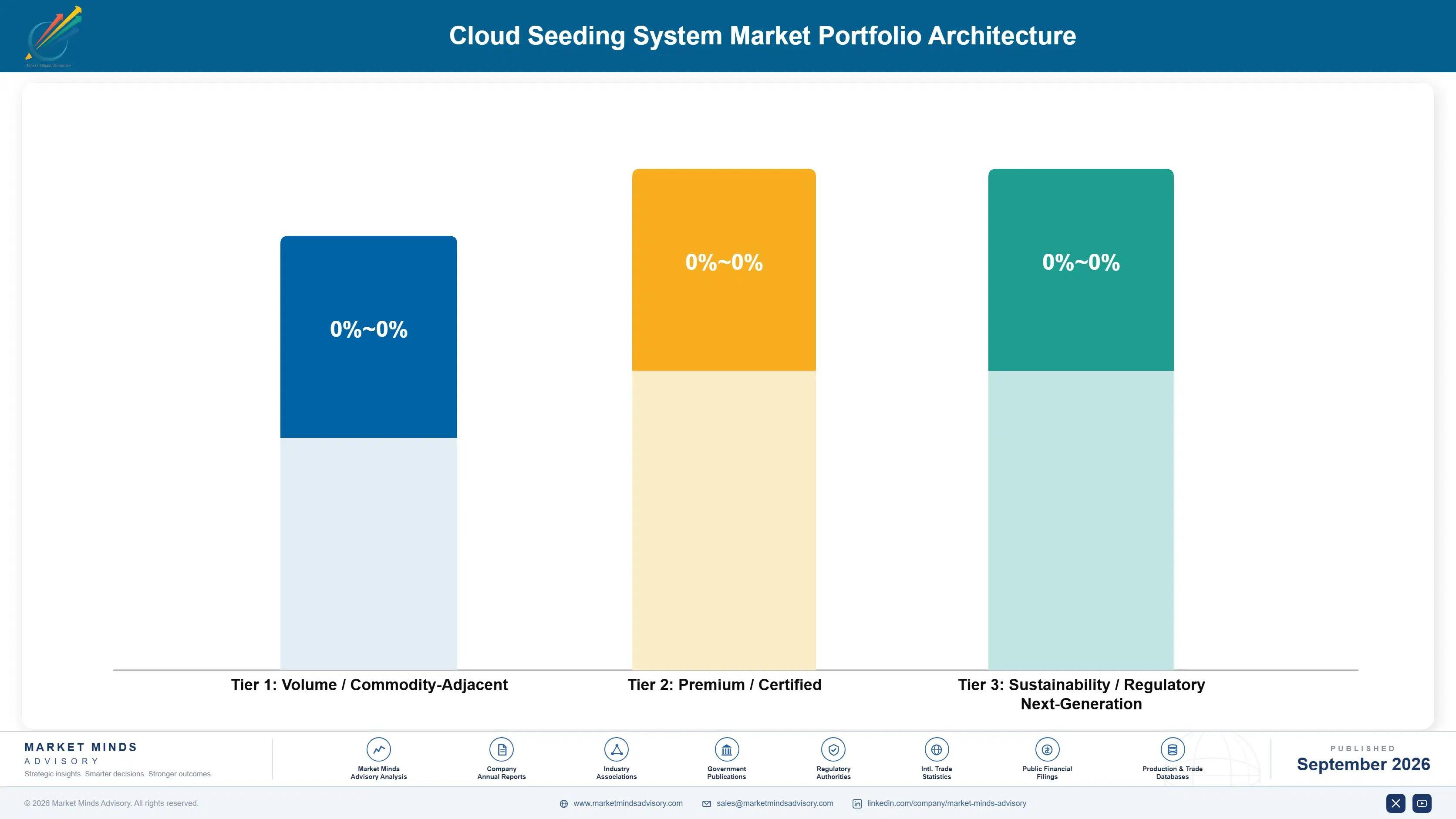
Portfolio Architecture for Margin Defence

Margin architecture separates on how contestable the work is. Manned aircraft operations earn least, competed on flight hours against operators with comparable fleets and rising insurance nobody can pass on. Ground generator networks and consumables sit in the middle. Radar and measurement systems, verification services and unmanned platforms earn most, because each addresses the evidence problem or the aviation cost problem that defines this whole category.
The volume versus premium tension is a capital allocation problem with a clock on it. An operator's aircraft fleet is its barrier to entry and its largest cost line simultaneously, and every year of continued fleet investment is a year not spent building unmanned capability. Manned operations grow at 8.2% and unmanned at 19.2%, which makes the direction obvious and the transition expensive for anybody already committed to the old asset.

High-value pools sit in measurement and verification and in unmanned delivery, and neither is where the operating companies built their positions. Measurement rewards instrument engineering and statistical credibility. Unmanned rewards airspace authorisation and a cost base without aviation insurance in it. The established operators hold aircraft fleets and evaluation records, which are the assets of the previous decade.

Volume / Commodity-Adjacent

Manned aircraft seeding operations competed on flight hours against operators with comparable fleets, carrying insurance that underwriters keep repricing. The eight point spread separates operators with owned depreciated fleets from those leasing capacity at market rates.
Gross Margin: 14% to 22%

Premium / Certified

Ground generator networks and seeding agent consumables sold against regulatory approval and formulation records that deter almost every potential entrant. The ten point spread tracks manufacturing scale in a market small enough that scale barely exists.
Gross Margin: 28% to 38%

Sustainability / Regulatory / Next-Generation

Radar and measurement systems, programme verification services and unmanned seeding platforms, each addressing the evidence or aviation cost problems that define this category. The twelve point spread reflects how far each supplier has moved off manned aircraft economics.
Gross Margin: 46% to 58%
cloud-seeding-system-market-portfolio-architecture-1789986942798

High-value Sub-segments and Strategic Watch-out

Unmanned Aerial Seeding Platforms

Grows at 19.2% because a drone reaches supercooled conditions inside developing cloud that manned aircraft are correctly told to avoid, at far lower cost per hour. The twelve point spread reflects airspace authorisation position. Fleet ownership is turning from a barrier into a liability quite quickly.
Gross Margin: 46% to 58%

Radar, Measurement And Decision Systems

Grows at 16.0%, faster than the seeding it verifies, because every programme now needs evidence that survives an auditor, a court or a journalist. The twelve point spread reflects instrument engineering depth. Physical evidence is buyable immediately while statistical proof takes 12 years or longer.
Gross Margin: 46% to 58%

Ground-Based Generator Networks

Grows at 10.4% and carries steady volume across established programmes, though released material reaches only around 800 metres before it stops seeding effectively. The ten point spread reflects manufacturing scale. Terrain determines where these work, which limits the addressable basins considerably in most countries around the world.
Gross Margin: 28% to 38%

Manned Aircraft Seeding Operations

Grows at 8.2%, by far the slowest here, because unmanned platforms reach better conditions at lower cost and without the aviation insurance exposure. The eight point spread reflects fleet depreciation status. Operators keep flying because the capital is already committed to the aircraft and nothing else.
Gross Margin: 14% to 22%

How Programmes Get Funded Annually

The annuity is the programme rather than any contract. A basin authority that funds seeding renews annually, usually for decades, because stopping is a decision somebody has to defend if the following year is dry. That gives an incumbent remarkable stability and makes displacement almost impossible outside a scandal or a political change. The renewal argument rests on evidence generated elsewhere, since 12 years is longer than any programme review cycle.
Adoption depth varies by what the programme is protecting. Hydropower and municipal water authorities adopt deeply and permanently because the asset value is enormous and the programme cost is trivial against it. Agricultural hail suppression adopts on an insurance logic and renews with crop prices. Sovereign water security programmes adopt without any cost benefit constraint whatever. Recreational snowpack augmentation adopts and stops with the ski season economics.

The deciding buyer moved from a hydrologist to a public accountability function, which changed the whole conversation. A hydrologist assessed physical plausibility and mostly accepted it. A programme accountability officer asks whether the spending survives an audit and whether a court challenge would embarrass anybody. That shift explains why measurement grows faster than seeding, and why every operator now employs communications staff.
cloud-seeding-system-market-end-use-penetration-index-1789986943291

How To Compete Without Certainty

These are among the four positions where our research anticipates prominent divergence between winners and laggards over the coming forecast period. Each is grounded in the demand model, the regulatory perimeter, and the announced capacity pipeline.
01 / ASYMMETRY ARGUMENT DISCIPLINE

Sell The Downside, Not The Effect

A basin programme costs a few dollars per hectare a year against desalination or interbasin transfer at orders of magnitude more, which makes the commercial argument about downside rather than about effect size. If the effect is real the arithmetic is overwhelming, and if it is not the loss is trivially small against any water budget, which is a calculation water authorities are entirely comfortable making. Vendors who lead with the contested 9% figure invite a scientific argument they cannot win inside a procurement cycle, when the commercial one existed.
02 / PHYSICAL EVIDENCE INVESTMENT

Prove Placement, Since Proof Takes Twelve Years

Establishing a statistically credible seeding effect takes something like 12 years of randomised operation, which is longer than any procurement cycle or programme review will ever wait. What is available immediately is physical evidence: radar signatures showing material reaching target cloud, tracer chemistry recovered in precipitation, and telemetry confirming the release happened where it was intended to. That does not prove rainfall increased and it does prove the intervention occurred as designed, which is what an auditor actually asks, and it is why measurement compounds at 16.0% regardless.
03 / UNMANNED TRANSITION TIMING

Move Off Aircraft Before The Insurance Does

Seeding works best inside supercooled developing cloud, which is precisely where icing makes manned flight dangerous and where a pilot is correctly instructed not to fly at all. Aircraft operation runs about 42% of programme cost and carries insurance that underwriters have been repricing upward since 2023, while an unmanned operator carries none of that exposure. Unmanned platforms compound at 19.2% against manned operations at 8.2%, so a fleet that was the main barrier to entry is turning into the largest liability on the balance sheet.
04 / SOVEREIGN FUNDING ACCESS

Follow Water Security, Not Water Economics

A Gulf water authority does not run a cost benefit analysis on rainfall enhancement, because the reasoning is water security and the alternative is desalination at enormous energy cost. The United Arab Emirates compounds at 18.6%, faster than any other country here, and funds international atmospheric research directly through a grant scheme rather than only procuring operations. That funding is patient, technically serious and entirely insulated from the cost benefit constraint that limits programmes everywhere else, and reaching it requires regional presence and sovereign patience rather than product.

Engagement Snapshot From the Field

A live engagement with an industry participant carrying material or product regulatory and market exposure ahead of a defining policy shift, showing how our research translates into a defensible multi-year portfolio strategy.
MARKET MINDS ADVISORY · CLIENT ENGAGEMENT SUMMARY
Cloud Seeding System Producer Strategic Portfolio Review and Transition Roadmap 2026·Investment Scenario on Cloud Seeding System Exposure Evaluation 2025-26
CLIENT PROFILE
A western American water district operating a snowpack augmentation programme across a mountain basin for eleven consecutive seasons, funded annually by member irrigation and municipal users. Two downstream districts had begun questioning whether the programme was diverting precipitation that would otherwise have reached them, and a state legislator had proposed restricting the practice. The renewal vote was four months away.
STRATEGIC CHALLENGE
The district could show eleven years of operations and no evaluation an outside statistician would accept, which is normal in this field and indefensible in a hearing. Management wanted to commission a randomised study and the timescale made that useless for the renewal vote. Nobody had assembled the physical evidence the programme had generated all along. It existed and had never been organised.
MMA APPROACH
MMA reconstructed eleven seasons of radar records, generator logs, tracer sampling and downstream gauge data into a single physical evidence file showing where material went and where it did not. We modelled the downstream districts' precipitation record against the programme calendar to test the diversion claim directly, and drew on 47 expert interviews conducted in Q4 2025 with operators, atmospheric scientists and water authority managers.
KEY FINDINGS
  1. Downstream precipitation showed no relationship with the programme calendar across 11 seasons, which addressed the diversion claim more directly than any effect estimate would have.
  2. Radar and tracer records existed for 9 of the 11 seasons and had never been compiled, which meant the physical evidence was already paid for (client-reported, unverified by MMA).
  3. Generator placement in 2 of the sub-basins put material below the altitude where it could seed effectively, which was an operational finding nobody had looked for.
  4. A randomised evaluation would have taken longer than the programme had existed, which made it the wrong instrument for the question the hearing was actually asking.
CLIENT PROFILE
A western American water district operating a snowpack augmentation programme across a mountain basin for eleven consecutive seasons, funded annually by member irrigation and municipal users. Two downstream districts had begun questioning whether the programme was diverting precipitation that would otherwise have reached them, and a state legislator had proposed restricting the practice. The renewal vote was four months away.
STRATEGIC CHALLENGE
The district could show eleven years of operations and no evaluation an outside statistician would accept, which is normal in this field and indefensible in a hearing. Management wanted to commission a randomised study and the timescale made that useless for the renewal vote. Nobody had assembled the physical evidence the programme had generated all along. It existed and had never been organised.
MMA APPROACH
MMA reconstructed eleven seasons of radar records, generator logs, tracer sampling and downstream gauge data into a single physical evidence file showing where material went and where it did not. We modelled the downstream districts' precipitation record against the programme calendar to test the diversion claim directly, and drew on 47 expert interviews conducted in Q4 2025 with operators, atmospheric scientists and water authority managers.
KEY FINDINGS
  1. Downstream precipitation showed no relationship with the programme calendar across 11 seasons, which addressed the diversion claim more directly than any effect estimate would have.
  2. Radar and tracer records existed for 9 of the 11 seasons and had never been compiled, which meant the physical evidence was already paid for (client-reported, unverified by MMA).
  3. Generator placement in 2 of the sub-basins put material below the altitude where it could seed effectively, which was an operational finding nobody had looked for.
  4. A randomised evaluation would have taken longer than the programme had existed, which made it the wrong instrument for the question the hearing was actually asking.
RECOMMENDED STRATEGY
Phase 1: Phase one: compile the existing physical evidence into a public file rather than commissioning a randomised study that cannot report before the vote. Phase 2: Phase two: publish downstream precipitation analysis alongside the operations calendar, since that answers the objection actually being made by the neighbouring districts. Phase 3: Phase three: relocate the two misplaced generator sites and report placement altitude in every seasonal operations summary from now on.
OUTCOME
The district published the physical evidence file and the downstream analysis before the renewal vote, and the programme was renewed (client-reported, unverified by MMA). The proposed state restriction did not advance. Two generator sites were relocated, and placement altitude now appears in every seasonal summary the district publishes.

Frequently Asked Questions

Foundational context covering the market sizes, CAGR, scope, country, region and competition that inform every finding below. This section is provided to cover basics and most often pre-purchase conversations, answered from the MMA Primary Research Dataset.

What is the current size of the Cloud Seeding System Market?

Global value reaches USD 0.41 billion in 2026, measured as programme equipment and operations contract revenue across all system classes. The 2025 base is USD 0.36 billion.

How large will the Cloud Seeding System Market be by 2036?

Programme equipment and operations revenue reaches USD 1.37 billion by 2036, an increase of USD 0.96 billion over the forecast period. That represents 3.34 times expansion from 2026.

What is the CAGR for the Cloud Seeding System Market 2026 to 2036?

The base case runs at 12.8% annually, with a bull case at 14.0% if a large randomised programme settles the scientific argument and a bear case at 11.6% if environmental challenge succeeds.

Which segment is growing fastest?

Unmanned aerial seeding platforms grow at 19.2%, half again the market rate of 12.8%. A drone reaches supercooled conditions inside developing cloud that manned aircraft are correctly instructed to avoid.

Who are the major companies in the Cloud Seeding System Market?

Weather Modification Inc, North American Weather Consultants, Ice Crystal Engineering, Cloud Seeding Technologies and Rainmaker Technology lead on programme equipment and operations revenue, together holding 44%.

Which country is growing fastest?

The United Arab Emirates leads at 18.6%, funding one of the most active operational and research programmes anywhere on water security grounds. Saudi Arabia and China follow behind.

Report Segmentation Architecture

The full report scope spans multiple orthogonal segmentation dimensions, with cross-tabulated demand data provided for each dimension pair. Coverage extends further to regional breakdowns, trend trajectories, and the competitive detail needed to support segment-level decision-making.

By System Class

  • Unmanned Aerial Seeding Platforms
  • Radar, Measurement And Decision Systems
  • Programme Design And Verification Services
  • Seeding Agents And Flare Consumables
  • Ground-Based Generator Networks
  • Manned Aircraft Seeding Operations

By End-Use Industry

  • Municipal Water Supply
  • Hydropower Generation
  • Irrigated Agriculture
  • Hail Damage Protection
  • Wildfire And Haze Suppression
  • Winter Sports And Recreation

By Commercial Dimension

  • Public Authority Operations Contracts
  • Sovereign Programme Procurement
  • Agricultural Cooperative Funding
  • Equipment Direct Supply
  • Research Grant Funded Work
  • Consumable Supply Agreements

By Region

  • North America
  • Western Europe
  • East Asia
  • South Asia and Pacific
  • Latin America
  • Middle East and Africa
  • Eastern Europe

Scope, Methodology, and Coverage

Every figure in this report is reproducible from documented input assumptions. The scope below maps the historical period, the forecast horizon, the segmentation dimensions, and the countries covered, alongside the underlying primary and qualitative methodology.
Historical Period
2020 to 2025
Forecast Period
2026 to 2036
Base Year
2025 (USD billions; MMA Primary Research Dataset, September 2026)
Market Definition
This report covers systems, consumables and operations used to modify precipitation from clouds: unmanned aerial seeding platforms, radar, measurement and decision systems, ground-based generator networks, seeding agents and flare consumables, manned aircraft seeding operations, and programme design and verification services. It excludes general meteorological forecasting services, fog dispersal at airports, hail suppression netting and physical crop protection, atmospheric carbon removal, and the water infrastructure these programmes are intended to supply.
Quantitative Units
USD millions, programme equipment and operations contract revenue basis; seeding flight and generator hours; attributable precipitation increase as a percentage; programme cost per hectare in USD; randomised evaluation duration in years.
Segmentation Dimensions
System class; end-use application; commercial funding model; geography across seven regions.
Regions Covered
North America, Western Europe, East Asia, South Asia and Pacific, Latin America, Middle East and Africa, Eastern Europe
Countries Covered
China, Japan, India, Indonesia, Thailand, Australia, United States, Canada, Mexico, Brazil, Argentina, Chile, Spain, France, Italy, Bulgaria, Serbia, United Arab Emirates, Saudi Arabia, Morocco.
Key Companies Profiled
Weather Modification Inc, North American Weather Consultants, Ice Crystal Engineering, Cloud Seeding Technologies, Rainmaker Technology, Seeding Operations and Atmospheric Research, Desert Research Institute, Snowy Hydro, Vaisala, Enterprise Electronics Corporation, Leonardo, Metek, Textron Aviation, Droplet Measurement Technologies, Beijing Metstar Radar.
Quantitative Methodology
Primary survey, n=3,800 respondents, Q4 2025, six countries; demand-side model with trade association cross-validation
Qualitative Methodology
47 expert interviews, Q4 2025; applied to validate demand model assumptions, identify emerging dynamics, and assess competitive positioning
Report Format
PDF and XLSX data workbook (Word format preview document)
Publisher
Market Minds Advisory
Report Code
MMA-2026-AGR-111
Published
September 2026
Contact
sales@marketmindsadvisory.com | www.marketmindsadvisory.com

Purchase the full Cloud Seeding System Market Report (2026 to 2036).

This report sizes the global cloud seeding systems market from 2026 to 2036 across six system classes, six end-use applications and seven regions. It sets out the attribution problem honestly, explaining why credible statistical evidence takes about 12 years and what programmes buy instead. Cost composition is sourced to company annual reports, with aircraft operation at 42% of programme cost. Regional analysis explains why East Asia leads at 38% on a national programme larger than everybody else combined. Competitive assessment covers 20 named suppliers with four revenue lever analyses and an anonymised water district engagement.
Attribution problem examined honestly rather than avoided
Six system classes sized through to 2036
Aircraft and consumable cost composition from filings
Twenty named suppliers assessed on programme revenue
Four revenue levers with quantified commercial impact
Anonymised water district renewal engagement included in full

Built For The People Who Decide

From boardroom strategy to bench-side execution, this report is read cover-to-cover by leaders shaping the next decade of their industry, turning demand scenarios, market dynamics and valuation benchmarks into decisions.
CXOs/ Presidents/ VPs/ Managers
M&A and Corporate Development
Strategy Teams and R&D Heads
Procurement and Product Directors
Regulatory and Compliance Leaders
Investor Relations and Equity Analysts