

Market Minds Advisory
Cloud Professional Services Market

Cloud Professional Services Market: Cloud Professional Services Market. FinOps Discipline Redefines Migration Contracts

Enterprises are demanding measurable cost optimization alongside cloud migration as early lift-and-shift projects produced runaway bills, pushing consultancies to bundle FinOps discipline directly into every implementation engagement they now sell.

Lead Analyst

Published

September 2026

Make Smarter Decisions with Customized Research Insights

Request a free sample report and evaluate market opportunities, growth trends, and competitive dynamics relevant to your business needs.

2025 MARKET VALUE$68.5BMarket Size 2025
2036 FORECAST VALUE$215.9BBase Case , 2026 to 2036
CAGR 2026 TO 203611.0 %Bull 12.2% / Bear 9.8%
INCREMENTAL OPPORTUNITY$139.9BNet 10- year value creation
EXPANSION MULTIPLE2.84x2036 value over 2026 base
Strategic Levers
M&A Pipeline
Regional Outlook
Country Rankings
Competitive Intelligence
Segmental Deep-dive
Call-Us : 91 93563 13602

Executive Snapshot and Market Trajectory.

Enterprises are demanding measurable cost optimization discipline alongside cloud migration work as early lift-and-shift projects produced runaway monthly bills that finance departments could no longer approve without a credible cost governance plan attached to every single new engagement they fund.
Application modernization and cost optimization consulting drive fastest adoption, since enterprises that migrated workloads years ago now need help refactoring monolithic applications into cloud-native architecture while simultaneously controlling spend that grew unchecked during the initial rush to migrate workloads quickly. North America leads deployment given concentrated enterprise cloud spend and consulting firm headquarters, while managed cloud operations increasingly extend beyond migration projects into ongoing operational responsibility that internal teams historically struggled to staff and retain.
A moderately fragmented vendor base spans global systems integrators and specialized boutique cloud consultancies, with FinOps and cost governance expertise increasingly separating winners from firms still selling migration as a one-time project rather than an ongoing optimization discipline requiring continuous attention. Multi-cloud and hybrid infrastructure complexity across enterprise environments continues to reshape which firms can deliver consistent outcomes across genuinely heterogeneous technology estates without extensive custom engagement scoping and pricing work.
Market Definition
The cloud professional services market covers consulting, migration, implementation, and managed services that help enterprises plan, migrate, and optimize workloads across public, private, and hybrid cloud infrastructure. It excludes the underlying cloud infrastructure and software products themselves, focusing purely on the advisory and implementation services layer.
Base Year Value
$68.5B in 2025 (MMA Primary Research Dataset, September 2026)
Forecast Period
2026 to 2036, eleven discrete annual values
CAGR
11.0% base case. Bull 12.2%. Bear 9.8%.
Fastest Growth Segment
Cloud Cost Optimization (FinOps) Consulting Services: 16.5% CAGR
Fastest Growth Country
India: 15.0% CAGR
Fastest Growth Region
South Asia and Pacific: 13.5% CAGR
Largest Region
North America: 30% of 2025 global value
Market Leaders
Accenture, Deloitte, IBM Consulting, Capgemini, Tata Consultancy Services
Primary Survey
n=3,800 procurement and R&D decision-makers, Q4 2025, six countries
Methodology
Demand-side build-up, cross-validated against public data, 47 expert interviews

Cloud Professional Services Market Forecast Scenarios

cloud-professional-services-market-size-forecast-scenario-1789986194509
Cloud professional services grew steadily through 2020 to 2023 as pandemic-driven remote work accelerated enterprise cloud migration timelines that many organizations had previously deferred for years, then continued expanding from 2024 as cost optimization and application modernization work replaced pure migration as the primary engagement type, lifting the historical growth rate to roughly 10.0 percent annually across the category.
Base case growth to 2036 rests on three commercial mechanisms: enterprises extending FinOps discipline from pilot programs to organization-wide cost governance practices covering their entire cloud estate, application modernization backlogs building as more workloads become candidates for cloud-native refactoring following initial migration, and managed cloud operations contracts expanding as enterprises struggle to retain specialized internal cloud talent amid persistent skills shortages. These mechanisms reinforce each other across different service categories, sustaining above-average growth without depending on any single dominant catalyst.
A bull scenario centers on a major economic downturn forcing enterprises to prioritize cloud cost optimization engagements urgently, which would compress consulting sales cycles within a single budget cycle. The bear risk is enterprises building sufficient internal cloud expertise to reduce reliance on external consultants, which has historically slowed managed services contract renewals by a year or more at maturing companies.

Where FinOps Discipline Determines Contract Renewal

FinOps and cost governance credibility has become the primary purchasing criterion, since enterprises burned by runaway cloud bills from early lift-and-shift migrations demand documented cost control before signing new modernization contracts with any vendor. Firms that once competed narrowly on migration speed now compete on ongoing cost optimization discipline, which shifts engagement structure toward managed retainers rather than one-time project fees alone.
MARKET CONCENTRATIONCR5 35%a fragmented base of global integrators and boutique consultancies
AVERAGE ENGAGEMENT VALUE$2.8M per migration projecttypical enterprise cloud migration and modernization program size overall
TOP DELIVERY COUNTRY SHAREIndia 34%concentrated IT services delivery capacity supporting global cloud engagements
FINOPS ADOPTION RATE46% of large enterpriseslarge enterprises now running formal cloud cost governance programs
COST OVERRUN REDUCTION38% lower with FinOpscloud spend variance versus organizations without formal cost governance
TALENT COST SHARE58% of total delivery costskilled cloud engineering talent versus tools and overhead expenses
Skilled cloud engineering talent remains a significant bottleneck across the industry, with demand for certified multi-cloud architects running well ahead of available supply and driving billing rates sharply higher for specialists holding top-tier vendor certifications across major platforms. Application modernization backlogs remain substantial, since many enterprises migrated workloads years ago without genuinely refactoring monolithic applications for cloud-native architecture, leaving considerable unrealized value still on the table.
Managed cloud operations contracts are becoming a baseline expectation rather than a project add-on, concentrating advantage among firms who can demonstrate reliable ongoing operational support beyond the initial migration engagement itself. Meanwhile several firms are extending FinOps capability into automated cost anomaly detection, which could meaningfully expand the addressable managed services opportunity within the next several contract renewal cycles.
"Every consultancy pitches a cloud migration roadmap; fewer than half include a credible plan for what the customer's bill looks like eighteen months later. The firms winning renewals are the ones who show up to that conversation with data, not excuses."
Director, Cloud Advisory and Technology Consulting Practice · MMA Cloud Migration Practice · September 2026

Market Trends

FinOps Discipline Becomes Standard Contract Requirement

Enterprises are increasingly requiring formal FinOps and cost governance capability as a baseline requirement in consulting engagements, rather than treating cost optimization as an optional add-on service purchased separately after migration completes and bills start arriving high. This shift has pushed cloud spend variance down by roughly 38 percent among enterprises running formal cost governance programs compared to those without any structured discipline in place, a figure vendors now cite prominently in competitive proposals. Roughly 46 percent of large enterprises now run formal FinOps programs, up sharply from a much smaller share just three years earlier.
Market Impact: 65% report unfilled positions 6+ months

Application Modernization Backlogs Drive Refactoring Demand

Many enterprises that migrated applications years ago using a simple lift-and-shift approach never followed through with genuine cloud-native refactoring, leaving substantial technical debt and unrealized cost savings sitting in production environments that finance departments are now pressuring technology teams to address directly. This backlog represents a substantial addressable opportunity for consultancies offering application modernization services, since these engagements typically command higher margins than routine migration work given the specialized architectural expertise required. Modernization-focused engagement value now represents roughly 34 percent of total consulting revenue at leading firms, up meaningfully from a much smaller share several years earlier.
Market Impact: 72% now run three-plus cloud providers

Market Opportunities and Growth Drivers

Persistent Cloud Skills Shortage Drives Outsourcing

Enterprises across most industries continue struggling to hire and retain skilled cloud engineers internally, since demand for certified multi-cloud architects and platform engineers consistently outpaces the supply of qualified candidates entering the workforce each year. This shortage is pushing organizations that once planned to build internal cloud teams toward long-term managed services contracts instead, treating external expertise as a more reliable and cost-predictable alternative to competing for scarce internal talent in a tight labor market. Roughly 65 percent of enterprises report unfilled cloud engineering positions lasting six months or longer, reinforcing sustained demand for external consulting capacity.
Market Impact: Renewal rates decline 15-20% after maturity

Multi-Cloud Complexity Requires Deep Specialized Expertise

Enterprises increasingly operate across multiple cloud providers simultaneously, whether by deliberate strategy to avoid vendor lock-in or through accumulated technical debt from acquisitions and decentralized departmental purchasing decisions made over many years without central technology governance. This multi-cloud reality requires specialized integration and management expertise that few internal teams possess across every provider's distinct services and pricing models simultaneously, creating durable demand for external consulting support. Roughly 72 percent of large enterprises now operate workloads across three or more cloud providers, up meaningfully from a much smaller share just several years earlier.
Market Impact: Billing rates rose 20-25% since 2022

Market Restraints and Challenges

Client Insourcing Threatens Long-Term Contract Renewal

Many enterprises that initially outsourced cloud migration and operations work eventually build sufficient internal expertise to bring routine operational tasks back in-house, reducing the scope and value of ongoing consulting relationships once the initial knowledge transfer period concludes. The root cause is that consulting engagements inherently transfer institutional knowledge to client teams as a natural byproduct of delivery, gradually reducing the client's dependence on external expertise over time. The commercial impact is declining managed services renewal rates as clients mature past their initial skills gap. Leading firms now mitigate this by continuously introducing new service lines requiring fresh specialized expertise.
Market Impact: 38% lower cloud spend variance

Billing Rate Inflation Strains Client Budgets

Persistent demand for scarce certified cloud talent has pushed consulting billing rates meaningfully higher across the industry, straining client budgets already stretched by rising cloud infrastructure costs themselves and creating growing price resistance among cost-conscious enterprise buyers. The root cause is that talent supply has not scaled proportionally with surging demand for multi-cloud expertise across every major industry vertical simultaneously. This has caused several enterprises to delay planned modernization engagements or scale back project scope considerably to fit constrained budgets. Vendors are mitigating this by offering fixed-price outcome-based contracts rather than pure time-and-materials billing structures.
Market Impact: 34% of revenue now from modernization
3 additional market trends, 4 additional growth drivers, and 3 additional restraints and challenges are covered in the full report. Contact sales@marketmindsadvisory.com to access the complete intelligence.

Segment CAGR and Growth Architecture

Segmentation follows service function within the cloud adoption lifecycle, spanning cost optimization consulting, application modernization services, migration and workload assessment, managed cloud operations, and security and compliance consulting, each addressing a genuinely distinct engagement type rather than overlapping customer size, industry vertical, or pricing model categories within this entire broader global enterprise services market.
cloud-professional-services-market-market-share-analysis-1789986195054

Cloud Cost Optimization (FinOps) Consulting Services

Cloud cost optimization consulting leads growth as enterprises finally treat FinOps as an ongoing operational discipline rather than a one-time audit exercise, extending cost governance practices from isolated pilot programs to organization-wide policy covering the entire cloud estate. These engagements combine spend analytics tooling implementation with organizational process design, since sustainable cost discipline requires both visibility into spending patterns and the governance structures that translate insight into actual behavioral change among engineering teams. Financial services and retail companies are adopting this segment fastest, since their high transaction volume and thin margins make cloud cost discipline commercially essential rather than a nice-to-have optimization exercise. Firms combining deep analytics with change management win disproportionate share.
CAGR 16.5%

Cloud-Native Application Modernization Services

Application modernization services are the second-fastest growing segment, driven by enterprises finally addressing the substantial backlog of applications migrated years ago through simple lift-and-shift approaches that never received genuine cloud-native refactoring. These engagements involve breaking monolithic applications into microservices, adopting containerization and serverless architecture patterns, and rebuilding data pipelines to take full advantage of cloud-native scalability rather than simply hosting legacy architecture on rented infrastructure. Technology and media companies are adopting this segment fastest, since their competitive pressure to ship features rapidly makes legacy architecture constraints considerably more costly than for enterprises operating in slower-moving industries with less frequent release cycles. Firms with genuine cloud-native architecture expertise are capturing share fastest from generic migration specialists.
CAGR 15.0%
Full segment breakdown across 5 segments available in the complete report.

Regional Architecture and Country Demand Map

North America leads on concentrated enterprise cloud spend and consulting firm headquarters, while East Asia follows closely behind on rapid enterprise digitization, and South Asia and Pacific posts the fastest overall regional growth on expanding IT services delivery capacity across every major economic sector worldwide.

North America

US enterprises maintain the world's largest cloud spend of any market, giving domestic consultancies including Accenture and Deloitte the deepest bench of large-scale migration and modernization project experience of any regional competitor. Regulatory scrutiny from financial and healthcare sector regulators has pushed compliance-conscious industries to adopt structured cloud governance frameworks earlier than less regulated sectors elsewhere. Canadian enterprises are following a similar adoption trajectory under comparable regulatory guidance and shared vendor relationships across the border. Large technology and financial services companies headquartered domestically continue driving a substantial share of near-term FinOps and modernization consulting demand as they scale cloud footprints considerably. Mexican cross-border enterprises are following a comparable adoption curve closely behind.
Share: 30% | CAGR: 11.5% (2026 to 2036)

East Asia

China's rapidly expanding technology sector and massive domestic cloud providers are driving substantial consulting demand as companies navigate a fragmented multi-provider landscape spanning both domestic and international cloud platforms simultaneously. Japan and South Korea are extending cloud adoption into traditionally conservative enterprise sectors including banking and manufacturing, responding to competitive pressure from more digitally mature international competitors entering their markets. Both countries increasingly favor consultancies offering deep local language support and regulatory expertise given the region's distinct compliance requirements across financial services. Taiwan's technology manufacturing sector has separately driven meaningful cloud consulting demand given tight software-hardware integration requirements across its semiconductor industry. Southeast Asian technology hubs are following a similar trajectory as adoption expands further.
Share: 24% | CAGR: 12.0% (2026 to 2036)
Regional intelligence for 5 additional markets available in the complete report: Western Europe, South Asia and Pacific, Latin America, Middle East and Africa, Eastern Europe. Contact sales@marketmindsadvisory.com.
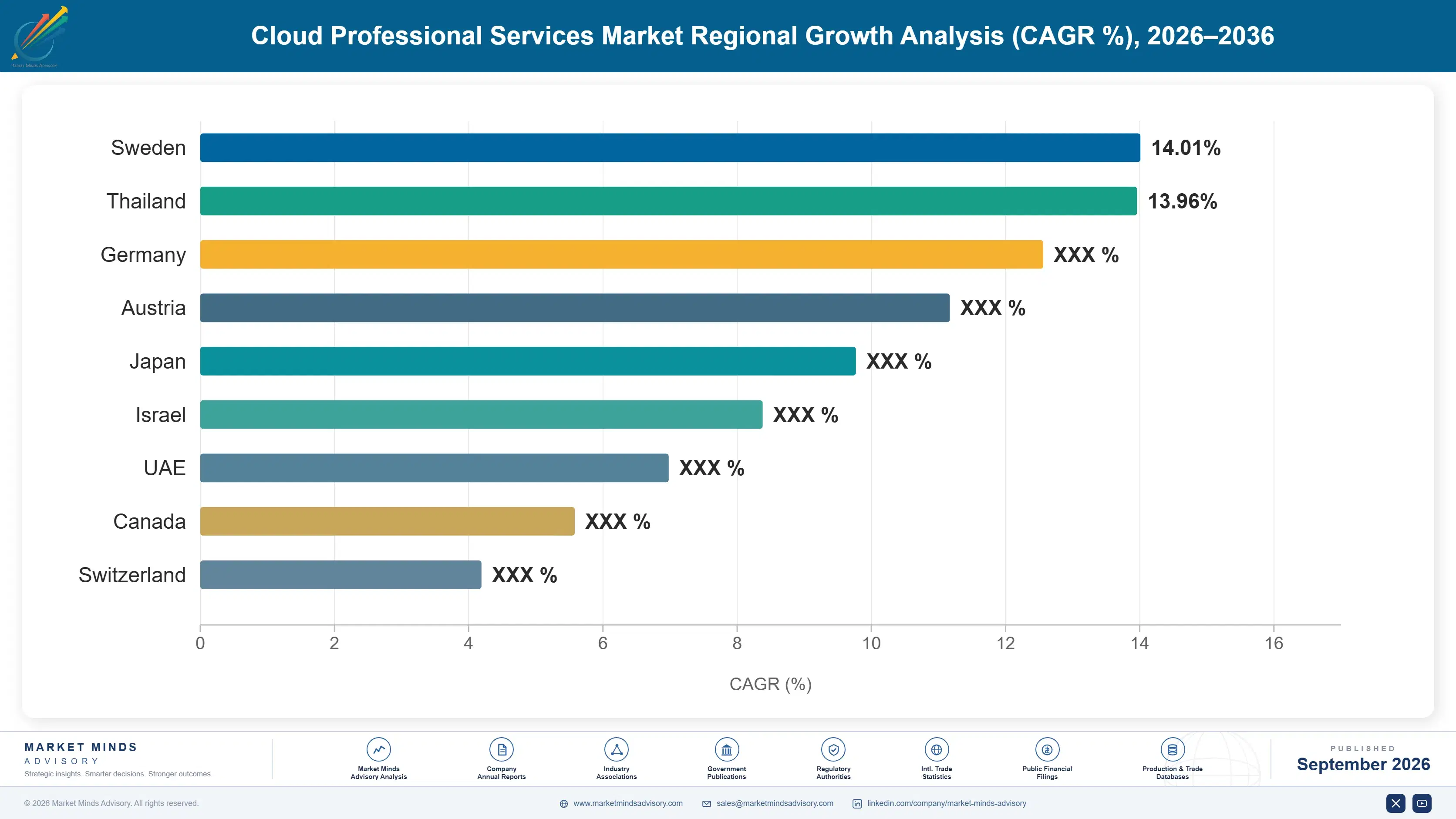
cloud-professional-services-market-country-cagr-analysis-1789986195588

Where Cloud Consultancies Should Expand Revenue

Beyond core migration and implementation fees, firms are building adjacent commercial layers around managed FinOps retainers, application modernization packages, outcome-based pricing structures, and proprietary tooling licensing, each extending overall contract value well past the initial engagement into sustained multi-year client relationships spanning large and mid-sized enterprise customers everywhere across the entire global economy today.

Managed FinOps Retainer Relationship Service Programs

Firms are converting one-time FinOps assessments into ongoing managed retainer relationships, since cost governance requires continuous monitoring and policy enforcement rather than a single point-in-time audit that becomes stale as cloud usage patterns evolve across the organization. These managed retainers now generate roughly 24 percent of total engagement revenue at several leading consultancies, well above the negligible share retainer-based FinOps represented when the category was dominated by one-time assessment projects. Clients value the sustained cost discipline enough to accept ongoing fees, and firms report meaningfully higher client retention when FinOps is delivered as a continuous service rather than a project.
Market Impact: 24% of revenue now from FinOps retainer relationships

Application Modernization Bundled Package Offerings Overall

Application modernization packages bundling architecture assessment, refactoring, and cloud-native rebuild work are commanding substantial project value beyond routine migration engagements, since enterprises increasingly recognize that lift-and-shift alone leaves considerable cost and performance value unrealized on the table. These packages now represent roughly 32 percent of total consulting revenue at leading firms, reflecting genuine willingness to pay for the specialized architectural expertise modernization requires beyond basic infrastructure migration. Firms offering this service report meaningfully higher project margins than those still selling migration as a standalone, lower-complexity offering to cost-conscious clients. Firms with genuine architectural depth are winning the largest modernization mandates.
Market Impact: 32% of revenue now from modernization packages today

Outcome-Based Pricing Structure Contract Terms Now

Outcome-based pricing structures tied to measured cost savings or performance improvements are replacing pure time-and-materials billing that dominated the category for years, giving clients confidence that consultant incentives align directly with delivering measurable business value rather than simply maximizing billable hours worked. Roughly 28 percent of new enterprise engagements now include some outcome-based pricing component, up sharply from a negligible share when time-and-materials billing was the near-universal default practice across the industry. This shift has strengthened client trust and improved win rates against firms still offering only traditional hourly billing arrangements.
Market Impact: 28% of new engagements now include outcome pricing

Proprietary Cost Analytics Tooling Licensing Programs

Proprietary tooling licensing for cost analytics dashboards and migration automation platforms built internally by consultancies are opening a new recurring software revenue stream distinct from traditional labor-based consulting fees entirely and independently of billable hours. These tooling licenses have expanded average account value by roughly 18 percent for firms pursuing this model, without requiring proportional growth in billable consulting headcount to deliver the additional value. Firms lacking proprietary tooling increasingly struggle to differentiate on pure methodology alone against competitors offering software-augmented delivery capability already proven across their existing large enterprise client base.
Market Impact: 18% larger accounts via proprietary tooling licensing deals

Who Controls the Margin Pool

Cloud professional services remains fragmented, with the top five vendors holding an estimated 35 percent of the market on an engagement-revenue basis. Accenture and Deloitte lead on breadth across enterprise transformation programs, while a meaningful gap separates them from smaller specialist challengers who compete mainly on niche technical depth and vertical industry expertise rather than global delivery scale.
Current competitive activity centers on three fronts: firms racing to build proprietary FinOps tooling to differentiate from methodology-only competitors, larger integrators acquiring specialized cloud boutiques to close application modernization capability gaps rather than building comparable expertise internally, and several firms expanding offshore delivery capacity to manage rising billing rate pressure from scarce cloud talent. Pricing pressure has intensified modestly among mid-tier firms competing for mid-market accounts larger integrators consider too small to prioritize.

Emerging pressure comes from hyperscaler-native professional services divisions entering the market directly rather than relying entirely on partner networks, betting that platform-level expertise can substitute for independent consultancy relationships built over years of client trust. Rankings could shift meaningfully if a major cloud provider bundles competitive migration services at heavily subsidized pricing, since that would compress the addressable market for standalone specialist consultancies currently commanding premium engagement fees.
cloud-professional-services-market-company-positioning-matrix-1789986196136

Competitive Moat and Risk Dimensions

ACCENTURE

Moat: Broadest global delivery scale

Accenture's massive global delivery network spanning dozens of countries gives it the ability to staff large, complex multi-region cloud transformation programs that smaller boutique consultancies simply cannot match in scale, letting it win the largest enterprise transformation mandates consistently across every major industry vertical and geography worldwide.
ACCENTURE

Risk: Higher cost than boutique rivals

Accenture's premium billing rates and large account team structures can make it meaningfully more expensive than specialized boutique consultancies for narrowly scoped engagements, risking share loss among mid-market clients prioritizing cost efficiency over the comprehensive breadth that only a global systems integrator can realistically provide.
DELOITTE

Moat: Strong regulated industry relationships

Deloitte's deep existing relationships across financial services and healthcare, built through decades of audit and advisory work, give its cloud consulting practice privileged access to compliance-sensitive transformation programs that newer entrants struggle to win without comparable regulatory relationship history, trust, and institutional credibility built over many years.
DELOITTE

Risk: Perceived weaker technical depth

Some technically sophisticated buyers perceive Deloitte's cloud practice as stronger on strategy and governance than on hands-on technical implementation depth, a perception that can cost the firm complex modernization engagements to more technically specialized competitors with deeper hands-on engineering credibility built over many years of focused practice.

Players Tracked

Prominent Players

Accenture
Deloitte
IBM Consulting
Capgemini
Tata Consultancy Services

Other Key Players

Cognizant
Infosys
Wipro
HCLTech
DXC Technology
Rackspace Technology
Slalom Consulting
Perficient
EPAM Systems
Publicis Sapient
NTT Data
Atos
Kyndryl
ThoughtWorks
Endava

Recent Developments

MARCH 2026

Accenture Acquires FinOps Analytics Startup

Accenture acquired a small FinOps analytics startup specializing in automated cloud spend anomaly detection, folding the technology directly into its cost optimization consulting practice rather than continuing to rely on third-party tooling partners for spend analytics capability across its large global enterprise engagement portfolio and pipeline.
Signal: Large consultancies are increasingly building proprietary FinOps tooling through acquisition rather than through external partnership deals.
NOVEMBER 2025

Deloitte Signs Modernization Delivery Partnership

Deloitte signed a multi-year delivery partnership with a specialized application modernization boutique to expand its refactoring and containerization capability, replacing an earlier arrangement that relied primarily on generalist consulting staff for highly technical cloud-native architecture rebuild work across its large enterprise client engagement portfolio globally.
Signal: Large integrators are increasingly partnering with technical specialists to close modernization capability gaps quickly and directly.
JUNE 2025

IBM Consulting Expands Offshore Delivery Capacity

IBM Consulting announced expanded offshore delivery capacity dedicated to cloud migration and managed operations work, aimed at managing rising billing rate pressure from scarce onshore cloud talent while maintaining competitive pricing for cost-conscious mid-market enterprise clients across multiple global industries, regions, and growing market segments.
Signal: Vendors are increasingly expanding offshore delivery capacity to manage persistent cloud talent cost pressure directly and consistently.

Skilled Talent Costs Drive Delivery Margins

Skilled cloud engineering talent compensation and offshore delivery infrastructure together represent roughly 58 percent of cost of goods sold for cloud professional services firms, notably higher than traditional generalist IT consulting categories. Talent compensation alone accounts for close to 42 percent, reflecting the significant billing rate premium required to attract and retain certified multi-cloud architects.
Certified cloud architect compensation rose sharply during 2022 and 2023, following surging enterprise demand for cloud migration and modernization talent across all industries simultaneously, as documented in major staffing industry salary surveys published during that period. Firms serving high-demand enterprise clients absorbed meaningfully higher talent costs for several quarters before adjusting billing rates to reflect the new competitive labor market reality facing the entire consulting industry.

Smaller boutique firms lacking scale to retain large benches of certified cloud talent face a real cost disadvantage against larger integrators like Accenture, who can spread talent costs across a broader project portfolio and rotate staff between engagements as client demand fluctuates. This dynamic increasingly pushes smaller specialists toward niche technical subcontracting roles where larger integrators see insufficient contract value to compete aggressively for scarce talent.
cloud-professional-services-market-cost-volatility-analysis-1789986196333

Offshore Delivery Model Expansion

Firms are expanding delivery capacity in India and Eastern Europe, where certified cloud talent costs meaningfully less than in North America or Western Europe, while still meeting the technical bar required for complex enterprise transformation engagements and client-facing delivery quality standards expected by demanding customers across every industry vertical, geography, and account size served.

Internal Certification Training Investment

Larger firms are investing in internal cloud certification training programs to develop talent from adjacent technical backgrounds rather than competing exclusively for the limited pool of already-certified professionals, expanding their addressable hiring pool considerably beyond the constrained external labor market for scarce specialists holding top-tier vendor certifications across every major cloud platform available today.

Cross-Engagement Staff Utilization Models

Larger firms are rotating certified cloud talent across multiple client engagements based on fluctuating project demand rather than dedicating staff permanently to a single account, meaningfully improving billable utilization and reducing the idle capacity cost that smaller firms serving fewer concurrent engagements simply cannot avoid or easily absorb over time and across budget cycles.

Portfolio Architecture for Margin Defence

Cloud professional services spans three commercial tiers: basic migration and lift-and-shift execution at the volume end, certified modernization and refactoring engagements meeting architectural benchmarks in the middle, and integrated FinOps and managed operations retainers at the premium top, with gross margins expanding meaningfully from the commodity tier through to next-generation engagements that command significantly higher recurring revenue per client relationship.
Volume-tier migration execution faces persistent price pressure from clients treating lift-and-shift as commoditized project work, while premium FinOps and managed retainers increasingly capture disproportionate margin as clients pay for ongoing optimization discipline rather than one-time project delivery alone. Firms straddling both tiers face internal tension allocating scarce cloud talent between defending existing migration accounts and building the next-generation advisory capability premium clients now demand.

High-value margin pools concentrate heavily around FinOps retainers and application modernization work, where large enterprises pay meaningfully more for measurable reductions in cloud spend variance and legacy architecture technical debt. Smaller firms without deep architectural expertise remain confined to lower-margin migration execution work, ceding the fastest-growing and most profitable segment entirely to larger, better-capitalized competitors with deeper talent benches and proprietary tooling budgets.

Volume / Commodity-Adjacent Tier

Basic migration and lift-and-shift execution services serving cost-sensitive clients with minimal architectural transformation beyond simple infrastructure relocation and basic configuration matching original on-premise environments exactly as they existed before migration.
Gross Margin: 18-26%

Premium / Certified Tier

Certified modernization and refactoring engagements meeting architectural benchmarks, offering genuine cloud-native transformation that meaningfully reduces the technical debt legacy lift-and-shift approaches otherwise leave unaddressed across an enterprise's entire application estate.
Gross Margin: 32-40%

Sustainability / Regulatory / Next-Generation Tier

Integrated FinOps and managed operations retainers combining cost governance, ongoing optimization, and operational support, commanding the highest recurring revenue per client among large enterprise accounts operating complex multi-cloud environments today.
Gross Margin: 44-54%
cloud-professional-services-market-portfolio-architecture-1789986196842

High-value Sub-segments and Strategic Watch-out

Cloud Cost Optimization (FinOps) Consulting Services

This segment combines the fastest unit growth in the market with the highest recurring revenue potential, as clients pay premium rates for ongoing cost governance that eliminates runaway cloud spend, making it the clearest priority for firm investment over the next several years across accounts.
Gross Margin: 48-58%

Cloud-Native Application Modernization Services

Growing quickly on enterprises addressing accumulated lift-and-shift technical debt, this segment carries strong margins though slightly below the FinOps leader, as firms increasingly bundle modernization work with cost optimization to justify premium pricing over standalone migration work sold entirely alone today, quite reliably and consistently.
Gross Margin: 38-46%

Cloud Migration and Workload Assessment Services

A large installed-base segment growing at a moderate pace, this migration category remains the anchor service most enterprises purchase first before considering broader modernization investment, anchoring overall category volume even as growth increasingly shifts toward higher-value engagement types each and every single passing year consistently.
Gross Margin: 22-30%

Managed Cloud Operations Services

Growth here trails the fastest segments, and firms risk this category commoditizing further as basic operational support becomes a standard feature bundled into broader retainer packages rather than sold separately as a distinct standalone service offering for most enterprise clients today and further going forward.
Gross Margin: 28-36%

Why Consulting Contracts Compound Over Years

Cloud professional services engagements increasingly function as annuity products rather than one-time project fees, since FinOps retainers, managed operations contracts, and proprietary tooling licensing attach to the initial migration engagement and recur across a client's typical five to seven year vendor relationship. Firms capturing this attached recurring revenue build client lifetime value multiples well above the original migration project price.
Adoption depth varies meaningfully by client maturity: smaller enterprises adopt shallowly, engaging consultancies primarily for one-time migration projects without deep ongoing advisory integration, while large enterprises integrate consulting relationships deeply into cost governance, architecture review, and modernization roadmap planning, creating switching costs that keep those clients within a single firm's advisory relationship across multiple years and successive technology refresh cycles.

Buyer profiles are shifting generationally as enterprises increasingly include dedicated cloud center of excellence leaders who evaluate vendor selection through outcome measurement and proprietary tooling criteria rather than pure billing rate comparisons alone. Younger technology leaders entering these roles expect measurable proof of cost savings and modernization impact before renewal, favoring firms who can demonstrate quantified outcomes over long-standing incumbent relationships built on legacy tenure.
cloud-professional-services-market-end-use-penetration-index-1789986197342

Priorities for Cloud Consultancies Now

These are among the four positions where our research anticipates prominent divergence between winners and laggards over the coming forecast period. Each is grounded in the demand model, the regulatory perimeter, and the announced capacity pipeline.
01 / FINOPS RETAINER DEVELOPMENT

Convert Assessments Into Ongoing Retainers

Enterprises burned by runaway cloud bills from early lift-and-shift migrations increasingly demand documented, ongoing cost control rather than a single point-in-time audit that becomes stale as usage patterns evolve across the organization and its expanding cloud footprint over successive budget cycles. Firms that convert one-time FinOps assessments into managed retainer relationships capture meaningfully higher client lifetime value and materially better retention than those still selling cost optimization as a project. Ongoing discipline, not a one-time audit, wins renewal decisions today.
02 / APPLICATION MODERNIZATION INVESTMENT

Address the Lift-and-Shift Technical Debt Backlog

Many enterprises that migrated applications years ago through simple lift-and-shift approaches never followed through with genuine cloud-native refactoring, leaving substantial technical debt and unrealized cost savings sitting in production environments that finance departments are now pressuring technology teams to finally address directly, comprehensively, and without further delay across the entire portfolio. Firms building deep modernization expertise are winning larger, higher-margin engagements than competitors offering only routine migration execution work. Modernization capability is becoming as commercially valuable as migration expertise itself.
03 / PROPRIETARY TOOLING DEVELOPMENT

Build Software Assets, Not Just Methodology

Firms relying purely on methodology and human expertise face increasing commoditization pressure as competitors build proprietary cost analytics and migration automation tooling that differentiates delivery quality beyond what generic consulting frameworks alone can credibly provide to increasingly sophisticated enterprise buyers evaluating multiple competing proposals side by side. Vendors with genuine proprietary software assets are expanding account value and margins meaningfully faster than those competing purely on billable headcount and hourly rates. Software-augmented delivery is becoming a genuine competitive moat in this category.
04 / OFFSHORE DELIVERY SCALING

Expand Offshore Capacity Ahead of Rate Pressure

Persistent demand for scarce certified cloud talent continues pushing billing rates higher across the industry, and firms lacking scaled offshore delivery capacity will increasingly lose price-sensitive mid-market accounts to competitors who can offer comparable quality at meaningfully lower cost through distributed global delivery models built over many years of investment. Building this capability now positions firms ahead of continued talent scarcity that shows no signs of easing given rising enterprise cloud adoption. Delivery model flexibility is becoming a genuine competitive advantage.

Engagement Snapshot From the Field

A live engagement with an industry participant carrying material or product regulatory and market exposure ahead of a defining policy shift, showing how our research translates into a defensible multi-year portfolio strategy.
MARKET MINDS ADVISORY · CLIENT ENGAGEMENT SUMMARY
Cloud Professional Services Producer Strategic Portfolio Review and Transition Roadmap 2026·Investment Scenario on Cloud Professional Services Exposure Evaluation 2025-26
CLIENT PROFILE
The client is a mid-size retail enterprise operating roughly 400 e-commerce and internal applications across a fragmented multi-cloud environment inherited through years of decentralized departmental purchasing decisions made entirely without central oversight. Annual cloud infrastructure spend exceeded $24 million (client-reported, unverified by MMA), with finance leadership unable to explain year-over-year cost growth to executive leadership.
STRATEGIC CHALLENGE
The client's decentralized cloud purchasing had produced significant spend growth without corresponding business value justification, and no single team held accountability for overall cost governance across the fragmented multi-cloud environment. Leadership needed a FinOps implementation strategy that would establish sustainable cost discipline without disrupting the development velocity that decentralized purchasing had originally been intended to support.
MMA APPROACH
MMA conducted a comprehensive spend analysis across the client's full cloud estate to identify the largest cost drivers and unused or underutilized resources accumulated over several years of decentralized decision-making. The engagement combined spend analytics tooling implementation with organizational governance design, establishing clear accountability structures that balanced central cost oversight against continued team-level purchasing autonomy.
KEY FINDINGS
  1. A significant share of provisioned cloud resources sat unused or severely underutilized, representing immediately actionable cost reduction opportunity across the entire cloud estate.
  2. Departmental teams lacked visibility into their own cloud spend relative to peer teams, removing a natural behavioral incentive for maintaining cost discipline over time.
  3. Reserved instance and committed-use discount programs were significantly underutilized despite the client's substantial and highly predictable baseline compute usage patterns each month.
  4. Establishing team-level spend accountability dashboards produced measurable behavioral change within just a few weeks, before any technical cost optimization work even began.
CLIENT PROFILE
The client is a mid-size retail enterprise operating roughly 400 e-commerce and internal applications across a fragmented multi-cloud environment inherited through years of decentralized departmental purchasing decisions made entirely without central oversight. Annual cloud infrastructure spend exceeded $24 million (client-reported, unverified by MMA), with finance leadership unable to explain year-over-year cost growth to executive leadership.
STRATEGIC CHALLENGE
The client's decentralized cloud purchasing had produced significant spend growth without corresponding business value justification, and no single team held accountability for overall cost governance across the fragmented multi-cloud environment. Leadership needed a FinOps implementation strategy that would establish sustainable cost discipline without disrupting the development velocity that decentralized purchasing had originally been intended to support.
MMA APPROACH
MMA conducted a comprehensive spend analysis across the client's full cloud estate to identify the largest cost drivers and unused or underutilized resources accumulated over several years of decentralized decision-making. The engagement combined spend analytics tooling implementation with organizational governance design, establishing clear accountability structures that balanced central cost oversight against continued team-level purchasing autonomy.
KEY FINDINGS
  1. A significant share of provisioned cloud resources sat unused or severely underutilized, representing immediately actionable cost reduction opportunity across the entire cloud estate.
  2. Departmental teams lacked visibility into their own cloud spend relative to peer teams, removing a natural behavioral incentive for maintaining cost discipline over time.
  3. Reserved instance and committed-use discount programs were significantly underutilized despite the client's substantial and highly predictable baseline compute usage patterns each month.
  4. Establishing team-level spend accountability dashboards produced measurable behavioral change within just a few weeks, before any technical cost optimization work even began.
RECOMMENDED STRATEGY
Phase 1: Phase 1 (Months 1-2): Conduct a comprehensive spend audit and implement real-time cost visibility dashboards across every single business department. Phase 2: Phase 2 (Months 3-5): Establish team-level cost accountability structures and negotiate expanded reserved capacity commitments across all major cloud providers. Phase 3: Phase 3 (Months 6-9): Transition to an ongoing managed FinOps retainer with continuous optimization work and regular quarterly governance reviews.
OUTCOME
Within nine months of completing the FinOps implementation, the client reported cloud spend declining by roughly 31 percent (client-reported, unverified by MMA) relative to the prior baseline, alongside annual cost avoidance of approximately $7.4 million (client-reported, unverified by MMA) from resource right-sizing and reserved capacity.

Frequently Asked Questions

Foundational context covering the market sizes, CAGR, scope, country, region and competition that inform every finding below. This section is provided to cover basics and most often pre-purchase conversations, answered from the MMA Primary Research Dataset.

What is the current size of the Cloud Professional Services Market?

The cloud professional services market was valued at $68.5 billion in 2025. It is projected to reach $76.04 billion in 2026 as FinOps adoption accelerates.

How large will the Cloud Professional Services Market be by 2036?

The market is projected to reach $215.91 billion by 2036, up from $76.04 billion in 2026. That represents a 2.84 times expansion over the forecast decade.

What is the CAGR for the Cloud Professional Services Market 2026 to 2036?

The market is projected to grow at an 11.0 percent CAGR between 2026 and 2036. This is up from a historical CAGR of roughly 10.0 percent between 2020 and 2025.

Which segment is growing fastest?

Cloud cost optimization (FinOps) consulting services lead growth at a 16.5 percent CAGR, roughly 1.5 times the overall market rate. Enterprises finally treat cost governance as an ongoing discipline rather than a one-time audit.

Who are the major companies in the Cloud Professional Services Market?

Accenture, Deloitte, IBM Consulting, Capgemini, and Tata Consultancy Services are the five largest participants by engagement revenue. Together they hold an estimated 35 percent of the global market.

Which country is growing fastest?

India is the fastest-growing country at a 15.0 percent CAGR, driven by the country's massive IT services delivery sector. Rapid enterprise digitization across domestic industries reinforces this trajectory further.

Report Segmentation Architecture

The full report scope spans multiple orthogonal segmentation dimensions, with cross-tabulated demand data provided for each dimension pair. Coverage extends further to regional breakdowns, trend trajectories, and the competitive detail needed to support segment-level decision-making.

By Service Function Type

  • Cloud Cost Optimization (FinOps) Consulting
  • Cloud-Native Application Modernization Services
  • Cloud Migration and Workload Assessment
  • Managed Cloud Operations Services
  • Cloud Security and Compliance Consulting
  • Cloud Architecture and Strategy Advisory

By End-Use Industry

  • Financial Services and Insurance
  • Retail and E-Commerce
  • Technology and Media
  • Healthcare and Life Sciences
  • Manufacturing and Industrial

By Commercial Dimension

  • Fixed-Fee Project Engagements
  • Time-and-Materials Billing
  • Outcome-Based Pricing Contracts
  • Managed Retainer Agreements

By Region

  • North America
  • Western Europe
  • East Asia
  • South Asia and Pacific
  • Latin America
  • Middle East and Africa
  • Eastern Europe

Scope, Methodology, and Coverage

Every figure in this report is reproducible from documented input assumptions. The scope below maps the historical period, the forecast horizon, the segmentation dimensions, and the countries covered, alongside the underlying primary and qualitative methodology.
Historical Period
2020 to 2025
Forecast Period
2026 to 2036
Base Year
2025 (USD billions; MMA Primary Research Dataset, September 2026)
Market Definition
The cloud professional services market covers consulting, migration, implementation, and managed services that help enterprises plan, migrate, and optimize workloads across public, private, and hybrid cloud infrastructure. It excludes the underlying cloud infrastructure and software products themselves, focusing purely on the advisory and implementation services layer.
Quantitative Units
USD billions (current prices); billable consultant headcount where applicable
Segmentation Dimensions
By Service Function Type; By End-Use Industry; By Commercial Dimension; By Region
Regions Covered
North America, Western Europe, East Asia, South Asia and Pacific, Latin America, Middle East and Africa, Eastern Europe
Countries Covered
USA, China, Germany, France, UK, Japan, South Korea, India, Australia, Canada, Brazil, Mexico, Indonesia, Vietnam, Thailand, Malaysia, UAE, Saudi Arabia, South Africa, Nigeria, Turkey, Poland, Netherlands, Italy, Spain, Sweden, Switzerland, Argentina, Colombia, Singapore, and additional markets relevant to this sector
Key Companies Profiled
Accenture, Deloitte, IBM Consulting, Capgemini, Tata Consultancy Services, Cognizant, Infosys, Wipro, HCLTech, DXC Technology, Rackspace Technology, Slalom Consulting, Perficient, EPAM Systems, Publicis Sapient, NTT Data, Atos, Kyndryl, ThoughtWorks, Endava
Quantitative Methodology
Primary survey, n=3,800 respondents, Q4 2025, six countries; demand-side model with trade association cross-validation
Qualitative Methodology
47 expert interviews, Q4 2025; applied to validate demand model assumptions, identify emerging dynamics, and assess competitive positioning
Report Format
PDF and XLSX data workbook (Word format preview document)
Publisher
Market Minds Advisory
Report Code
MMA-2026-TEC-190
Published
September 2026
Contact
sales@marketmindsadvisory.com | www.marketmindsadvisory.com

Purchase the full Cloud Professional Services Market Report (2026 to 2036).

This report delivers a comprehensive analysis of the global cloud professional services market, spanning service function segmentation, regional demand dynamics, and competitive positioning across twenty profiled companies worldwide. It includes ten-year forecasts through 2036, detailed input cost and margin analysis across three commercial tiers, and revenue diversification strategies for firms navigating the shift toward managed FinOps retainers. The analysis draws on primary survey data, expert interviews, and company disclosures to support procurement, investment, and product strategy decisions. It closes with an anonymized client engagement case study illustrating measured cost and governance outcomes.
Service function segmentation with detailed growth forecasts
Seven-region demand analysis through the 2036 forecast
Competitive benchmarking of twenty profiled global vendors
Input cost and gross margin tier breakdown analysis
Revenue diversification and recurring pricing lever analysis
Anonymized client engagement case study with outcomes

Built For The People Who Decide

From boardroom strategy to bench-side execution, this report is read cover-to-cover by leaders shaping the next decade of their industry, turning demand scenarios, market dynamics and valuation benchmarks into decisions.
CXOs/ Presidents/ VPs/ Managers
M&A and Corporate Development
Strategy Teams and R&D Heads
Procurement and Product Directors
Regulatory and Compliance Leaders
Investor Relations and Equity Analysts