Market Minds Advisory
Cloud Printing Services Market

Cloud Printing Services Market: Cloud Printing Services Market: Service Classes, Server Removal Economics and Secure Release Adoption 2026 to 2036

Nobody buys cloud printing to save money on printing. They buy it to delete the print servers, which run with high privileges and sit on every network segment in the building.

Lead Analyst

Published

September 2026

Make Smarter Decisions with Customized Research Insights

Request a free sample report and evaluate market opportunities, growth trends, and competitive dynamics relevant to your business needs.

2025 MARKET VALUE$2.9BMarket Size 2025
2036 FORECAST VALUE$8.1BBase Case , 2026 to 2036
CAGR 2026 TO 20369.8 %Bull 11.0% / Bear 8.5%
INCREMENTAL OPPORTUNITY$4.9BNet 10- year value creation
EXPANSION MULTIPLE2.55x2036 value over 2026 base
Strategic Levers
M&A Pipeline
Regional Outlook
Country Rankings
Competitive Intelligence
Segmental Deep-dive
Call-Us : 91 93563 13602

Executive Snapshot and Market Trajectory.

Enterprise print volumes fall about 4% a year and this market grows at 9.8%. Both are true, because spend is migrating from consumables and devices to software and security on a shrinking page base. The purchase is infrastructure removal and attack surface reduction, not anything about printing at all.
The market reaches USD 3.18 billion in 2026 and USD 8.10 billion by 2036, a 2.55 times expansion at 9.8%. Serverless print infrastructure grows at 14.7%, half again the market rate of 9.8%, because organisations migrating away from on-premises print servers remove around 84% of that infrastructure entirely. Western Europe holds 30% of software and service revenue, and India grows fastest at 14.2%. European privacy rules explain that lead precisely. That is not a coincidence.
Five vendors hold 38% of software and service revenue, which is unusually fragmented for enterprise software. PaperCut and Vasion built specialist platforms and sell through resellers. Canon, Ricoh and Kofax reached the same customers from device and document management positions. Microsoft's inclusion of basic cloud print in its enterprise licensing sits underneath all of them as a permanent pricing constraint. Everybody prices against it.
Market Definition
This report covers cloud-delivered software and managed services that route, secure, meter and administer enterprise printing: serverless print infrastructure, secure release and pull printing, cloud managed print services, mobile and guest printing, output management and document workflow, and print cost recovery and chargeback. It excludes printing hardware, consumables and paper, on-premises print server software, document storage and content management platforms, and commercial print production services.
Base Year Value
$2.9B in 2025 (MMA Primary Research Dataset, September 2026)
Forecast Period
2026 to 2036, eleven discrete annual values
CAGR
9.8% base case. Bull 11.0%. Bear 8.5%.
Fastest Growth Segment
Serverless Print Infrastructure: 14.7% CAGR
Fastest Growth Country
India: 14.2% CAGR
Fastest Growth Region
South Asia and Pacific: 12.0% CAGR
Largest Region
Western Europe: 30% of 2025 global value
Market Leaders
PaperCut Software, Vasion, Canon, Kofax and Ricoh lead on cloud print software and managed service revenue. Source: MMA Analysis.
Primary Survey
n=3,800 procurement and R&D decision-makers, Q4 2025, six countries
Methodology
Demand-side build-up, cross-validated against public data, 47 expert interviews

Cloud Printing Services Market Forecast Scenarios

cloud-printing-services-market-size-forecast-scenario-1789988791337
Between 2020 and 2025 the category compounded at 8.6%, and a security disclosure did more for it than any sales campaign. Print spooler vulnerabilities published in 2021 forced organisations to look at infrastructure they had ignored for twenty years, and what they found was a privileged service running on every network segment. Migration budgets appeared quickly after that.
The base case holds 9.8% on three mechanisms. Windows Server estate consolidation continues to remove print servers as a matter of routine infrastructure hygiene, and each removal requires a replacement. European privacy enforcement treats an uncollected document in an output tray as a reportable exposure, which makes secure release a compliance purchase rather than a convenience. And hybrid working left organisations with users who print from home, from client sites and from personal devices that no domain controller has ever seen.
The bull case at 11.0% assumes page volume decline slows as regulated industries hit a floor of documents that must exist on paper. The bear case at 8.5% is Microsoft extending Universal Print capability far enough that the specialist platforms lose their differentiation, which would compress pricing across a category already selling at around USD 14 per user annually.

Deleting Servers, Not Saving Paper

The business case for cloud printing has almost nothing to do with printing. A print server runs with elevated privileges, holds queues for every department and sits inside every network segment an organisation operates, which made it invisible for twenty years and then made it a liability. Migration removes around 84% of that infrastructure, and the saving is measured in servers rather than in pages.
TOP FIVE CONCENTRATION38%Fragmented across software specialists and device manufacturer platforms
PRINT SERVERS REMOVED84%Share of on-premises print infrastructure eliminated after full migration
UNCOLLECTED DOCUMENT RATE21%Jobs sent but never retrieved from the output tray
ANNUAL PAGE VOLUME DECLINE4%Rate at which enterprise printed pages continue falling annually
TYPICAL DEPLOYMENT PERIOD9 weeksMigration from print servers to cloud infrastructure end to end
SEAT LICENCE PRICEUSD 14Annual per user list pricing across mainstream platforms
Print volumes are falling and this market is growing, which sounds contradictory until you look at where the money goes. Enterprise pages decline around 4% annually. Spend is transferring from consumables and hardware, where it always sat, toward software licences at roughly USD 14 per user per year and the security controls attached to them. A shrinking activity can support a growing software category for years.
European privacy enforcement supplied the other half of the argument. Around 21% of print jobs are sent and never collected, which means a document containing personal data sits in an open output tray until somebody removes it. Regulators treat that as an exposure rather than as an inconvenience. Secure release, where the job waits until the user authenticates at the device, converts a reportable problem into a solved one.
"The print management category spent two decades selling cost recovery to finance directors who did not care. Then somebody published a vulnerability in the print spooler and the same product became a security purchase. Nothing about the software actually changed."
Principal, Enterprise Output and Workplace Infrastructure Practice · MMA Technology Practice · September 2026

Market Trends

A Security Disclosure Rebuilt The Entire Business Case

For two decades print management was sold to finance departments on cost recovery, and finance departments were reliably unmoved. Print spooler vulnerabilities published in 2021 changed the buyer entirely. A print server runs with elevated privileges on every network segment, which nobody had examined closely because printing seemed uninteresting. Security teams examined it, did not like what they saw, and migration budgets appeared within quarters rather than years. The software being sold did not change at all. The department signing for it did, and that department has considerably more money.
Market Impact: Secure release addresses 21% exposure

Hybrid Work Broke The Domain Joined Assumption

Traditional print infrastructure assumes the user sits on a corporate network, on a managed device, with a domain controller able to authenticate them. Hybrid working removed all three assumptions at once, leaving organisations with people printing from home networks, client sites and personal hardware that no directory has ever seen. Cloud print services solve that by treating identity rather than network location as the control point. Mobile and guest printing services compound at 11.1% on this alone, and the demand came from an office change nobody planned for. Identity became the control point instead of the network.
Market Impact: Servers fall 84% after migration

Market Opportunities and Growth Drivers

European Privacy Rules Made Secure Release Compulsory

Around 21% of print jobs are sent and never collected, which leaves documents containing personal data sitting in an open output tray until somebody picks them up or throws them away. European supervisory authorities treat that as a reportable exposure rather than as untidiness, and several have issued findings on exactly this. Secure release holds the job until the user authenticates at the device, which removes the exposure entirely. That converted an optional efficiency feature into a compliance requirement, and it explains why European adoption ran ahead of everywhere else.
Market Impact: Pricing capped near USD 14

Windows Server Consolidation Removes Print Infrastructure By Default

Organisations reducing their Windows Server estate treat print servers as obvious candidates, since each one serves a narrow function and carries full operating system licensing, patching and maintenance overhead. A migration removes around 84% of that infrastructure and the replacement is a cloud service costing roughly USD 14 per user annually. The decision usually gets made inside an infrastructure consolidation programme rather than as a print purchase, which is why print management vendors selling to facilities teams keep missing it. Serverless print infrastructure compounds at 14.7% on this. Most print vendors are calling on the wrong department entirely.
Market Impact: Pages decline about 4% annually

Market Restraints and Challenges

Microsoft Bundling Caps What Anybody Can Charge

Microsoft includes basic cloud print capability inside enterprise licensing that most large organisations already hold, which means every specialist vendor competes against something the customer believes is free. The root cause is that basic print routing is a commodity function and Microsoft has every reason to include it. Commercially this holds list pricing near USD 14 per user annually and forces vendors to justify a premium on secure release, analytics and device breadth. Mitigation runs through capabilities the bundled option genuinely lacks, rather than through arguing about the ones it has.
Market Impact: Migration removes 84% of servers

Page Volumes Keep Falling Underneath Everything

Enterprise printed pages decline around 4% a year and there is no scenario in which that reverses, which means this software category sits on a shrinking activity base. The root cause is document digitisation that has run for thirty years and continues, accelerated by hybrid working and electronic signature adoption. Commercially this caps the long-run size of the category regardless of how well anybody executes. Mitigation runs through per-user rather than per-page pricing, and through extending into output management and document workflow where the volume trend is different. Neither route reverses the underlying decline in any way.
Market Impact: Guest printing compounds at 11.1%
3 additional market trends, 4 additional growth drivers, and 2 additional restraints and challenges are covered in the full report. Contact sales@marketmindsadvisory.com to access the complete intelligence.

Segment CAGR and Growth Architecture

Segmentation follows cloud print service class, since what an organisation contracts for determines who signs and what it replaces. Six classes cover the market: serverless print infrastructure, secure release and pull printing, mobile and guest printing, output management and document workflow, cloud managed print services, and print cost recovery and chargeback. Customer industry and channel are separate dimensions.
cloud-printing-services-market-market-share-analysis-1789988791949

Serverless Print Infrastructure

Serverless print infrastructure grows at 14.7%, half again the market rate of 9.8%, and the buyer is an infrastructure team rather than anybody responsible for printing. Removing print servers eliminates around 84% of the on-premises footprint along with the operating system licensing, patching burden and privilege exposure attached to each one. The replacement costs roughly USD 14 per user annually and deploys in about nine weeks. The decision almost always sits inside a wider Windows Server consolidation programme, which is why vendors calling on facilities managers keep arriving after the budget has already been allocated somewhere else entirely. Reaching that buyer earlier is worth more than any product improvement available.
CAGR 14.7%

Secure Release And Pull Printing Services

Secure release and pull printing compounds at 12.4% on a compliance argument rather than a convenience one. Around 21% of jobs are sent and never collected, leaving documents with personal data in an open tray, and European supervisory authorities treat that as a reportable exposure rather than as an untidy office. Holding the job until the user authenticates at the device removes the problem completely. The secondary benefit is that uncollected jobs never print at all, which cuts consumable spend by a visible margin, but nobody signs the contract for that reason. Regulatory exposure is what moves this purchase forward. Efficiency arguments never moved this purchase in twenty years of trying.
CAGR 12.4%
Full segment breakdown across 6 segments available in the complete report.

Regional Architecture and Country Demand Map

Western Europe leads at 30% of software and service revenue, above the standard band, because privacy enforcement turned secure release from a convenience into a compliance requirement and the specialist vendor base is largely European. North America follows at 28% on infrastructure consolidation rather than on privacy.

Western Europe

Western Europe holds 30% of software and service revenue, above the 26% band ceiling, because privacy enforcement made secure release a compliance purchase here before it was anything anywhere else. Supervisory authorities across Germany, the Netherlands and France have treated uncollected documents in output trays as reportable exposures, and 21% of jobs go uncollected. The specialist vendor base is also European, with MyQ and Y Soft in Czechia, Printix originating in Denmark and Ringdale operating across the region. German and Dutch public sector procurement writes secure release into tender requirements as standard. Growth at 8.6% is the slowest anywhere because adoption started earliest. Depth of adoption here is considerably ahead of anywhere else in the world.
Share: 30% | CAGR: 8.6% (2026 to 2036)

North America

At 28% North America is the second largest market, and the buying motivation differs completely from Europe's. Infrastructure consolidation drives it: organisations reducing Windows Server estates treat print servers as obvious removals, and the decision sits with infrastructure teams rather than with compliance. Vasion and Pharos Systems compete against Canon and Ricoh platforms sold through the device channel. Healthcare and legal sectors buy secure release for their own regulatory reasons, though the framing is confidentiality rather than data protection law. Growth at 9.4% sits below the global rate on a large installed base that adopted early. The buyer here is IT infrastructure throughout. Compliance signs occasionally, but infrastructure controls the money in this region.
Share: 28% | CAGR: 9.4% (2026 to 2036)
Regional intelligence for 5 additional markets available in the complete report: East Asia, South Asia and Pacific, Latin America, Middle East and Africa, Eastern Europe. Contact sales@marketmindsadvisory.com.
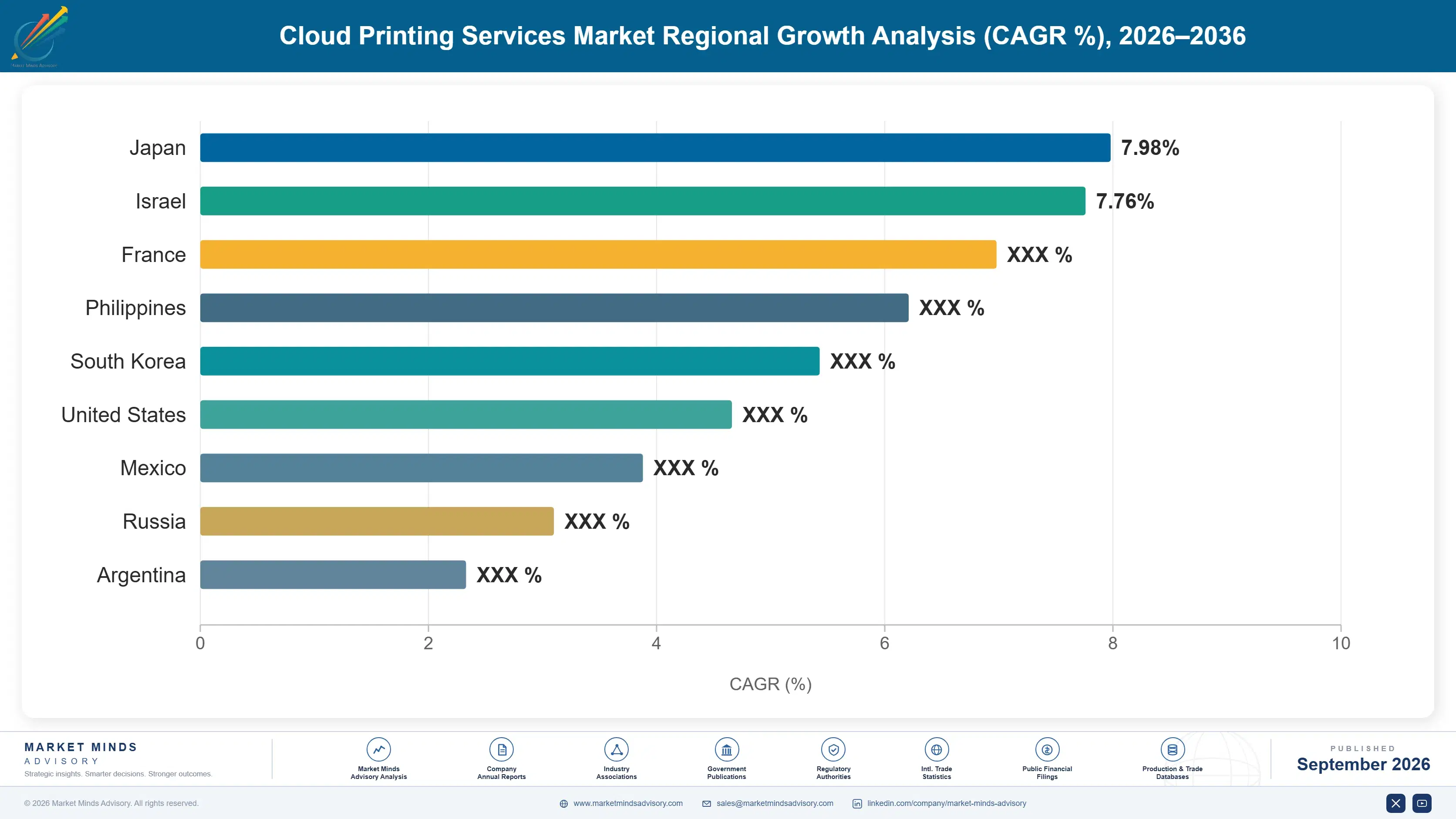
cloud-printing-services-market-country-cagr-analysis-1789988792497

Where This Category Earns Margin

The bundled alternative is free and already licensed, page volumes fall every year, and the buyer sits in a department most vendors do not call on at all. Every lever below works around one of those three facts. None of them involves arguing that printing matters more than the customer already thinks it does.

Sell To Infrastructure, Not To Facilities

The decision to remove print servers gets made inside a Windows Server consolidation programme, by infrastructure architects who measure success in servers eliminated rather than in pages printed. Migration removes around 84% of that footprint. Vendors organised around facilities managers and print procurement keep arriving after the budget has been allocated to somebody else, which is a coverage problem rather than a product one. Reframing the pitch around operating system licensing, patch burden and privilege exposure reaches the person who actually signs, and it reaches them earlier. Coverage is the problem, and coverage is fixable.
Market Impact: Migration eliminates fully 84% of all print servers

Lead With Compliance Where Regulators Have Ruled

Around 21% of print jobs are never collected, and European supervisory authorities have treated documents left in output trays as reportable exposures rather than as untidiness. That turns secure release from an efficiency feature into a control a data protection officer needs to evidence. The compliance conversation carries a different budget and a different urgency from the cost recovery conversation this industry spent twenty years having. Markets following European privacy structure, including Brazil and South Africa, take the same argument without modification and very few vendors make it there. Very few vendors make it there at all.
Market Impact: A 21% uncollected rate now justifies the purchase

Price Per User Rather Than Per Page

Enterprise printed pages decline around 4% annually with no prospect of reversal, so any pricing tied to volume shrinks with the customer's activity by design. Per-user pricing at roughly USD 14 annually holds revenue flat as pages fall and grows it as headcount grows, which inverts the exposure entirely. Vendors still carrying page-based contracts from the managed print era are watching their own base erode on schedule. Converting those contracts at renewal is unglamorous commercial work that most organisations defer for years. Converting a page-based book at renewal is the single highest return commercial project available in this category.
Market Impact: Per-user pricing survives the steady 4% page decline

Build What The Bundled Option Genuinely Lacks

Microsoft includes basic cloud print in enterprise licensing that most large customers already hold, which caps pricing near USD 14 per user and makes any argument about routing pointless. What the bundled option does not do well is device breadth across mixed fleets, secure release with card authentication, granular chargeback and support for the older hardware most organisations actually operate. Building deliberately in those gaps is the only defensible position available. Competing on the features the bundle already covers is a contest nobody in this category wins. That contest has no winner among specialists.
Market Impact: Bundling caps list price near USD 14 annually

Who Controls the Margin Pool

Five vendors hold 38% of cloud print software and managed service revenue, unusually fragmented for enterprise software of this maturity. PaperCut Software and Vasion built specialist platforms sold almost entirely through reseller channels. Canon, Ricoh and Kofax reached the same customers from device and document management positions. The gap between the leaders and the field is channel reach rather than product capability. All participants are assessed on cloud print software and managed service revenue.
Competition runs on device compatibility more than on anything a datasheet emphasises. A customer with a mixed fleet of printers accumulated over fifteen years needs a platform that supports all of it, and the vendor whose driver and firmware coverage is broadest wins regardless of interface quality. Device manufacturers hold a natural advantage on their own hardware and a natural disadvantage everywhere else, which is why the independents survive.

Rankings shift on how far Microsoft extends Universal Print, since every vendor here competes against something customers already own. The other pressure runs the opposite way: device manufacturers face declining hardware revenue and are pushing software harder to compensate, which brings capable competitors into a category that specialists had largely to themselves.
cloud-printing-services-market-company-positioning-matrix-1789988793025

Competitive Moat and Risk Dimensions

PAPERCUT SOFTWARE

Moat: Channel Depth And Device Breadth

PaperCut sells through a reseller network built over two decades and supports a device range wider than any manufacturer platform covers, which matters enormously to customers running mixed fleets accumulated over fifteen years. Assembling comparable driver and firmware coverage requires relationships with every hardware vendor simultaneously. The channel and the compatibility reinforce each other in a way capital cannot shortcut.
PAPERCUT SOFTWARE

Risk: Bundled Alternative Pressure

Microsoft includes basic cloud print in enterprise licensing most customers already hold, which caps list pricing near USD 14 per user and forces every conversation onto features rather than function. A specialist with no adjacent product to cross-subsidise has nowhere to absorb that pressure. Each capability Microsoft adds narrows the defensible gap a little further.
CANON

Moat: Installed Device Estate Access

Canon reaches a very large installed base of its own multifunction devices with software preloaded and a service relationship already in place, which removes the acquisition cost independent vendors carry on every deal. The uniFLOW platform has been developed over many years and is genuinely capable rather than a hardware accessory. That combination is difficult to answer from outside.
CANON

Risk: Mixed Fleet Coverage Gap

Most organisations run devices from several manufacturers, and a platform strongest on its own hardware is always disadvantaged on everybody else's. Improving competitor device support undercuts the hardware business it exists to serve, which is an uncomfortable position to hold. Independent vendors face no such conflict and customers with mixed fleets notice the difference quickly.

Players Tracked

Prominent Players

PaperCut Software
Vasion
Canon
Kofax
Ricoh

Other Key Players

Y Soft
MyQ
Pharos Systems
Celiveo
Ringdale
Microsoft
Xerox
HP Inc.
Konica Minolta
Sharp
Lexmark
Toshiba Tec
Brother Industries
Epson
ThinPrint

Recent Developments

FEBRUARY 2025

Vasion Expands Serverless Print Platform For Enterprise Migration

Vasion expanded its serverless print infrastructure platform with additional migration tooling aimed at organisations removing Windows print servers, an organic product development rather than any acquisition. The tooling targets infrastructure consolidation programmes directly rather than print procurement, which is where the budget for these projects actually sits.
Signal: The vendors reaching infrastructure architects are finding budget that print procurement never controlled at any point.
SEPTEMBER 2024

PaperCut Extends Secure Release Support Across Wider Device Range

PaperCut Software extended secure release and card authentication support across additional third-party device families, an organic engineering expansion rather than a partnership or merger. Device breadth decides mixed fleet deals more than interface quality does, and most organisations run hardware from several manufacturers accumulated across many years.
Signal: Compatibility with hardware nobody wants to replace remains the quietly decisive factor in this whole category.
JUNE 2025

Canon Broadens uniFLOW Cloud Deployment Options For Regulated Sectors

Canon broadened deployment options for its uniFLOW cloud platform to accommodate data residency requirements in regulated sectors, an organic product change rather than any transaction or partnership. European and Brazilian privacy frameworks both require processing location control, and output management touches personal data by definition.
Signal: Data residency requirements are reshaping print software architecture in ways nobody anticipated even a decade ago.

What Cloud Print Software Costs

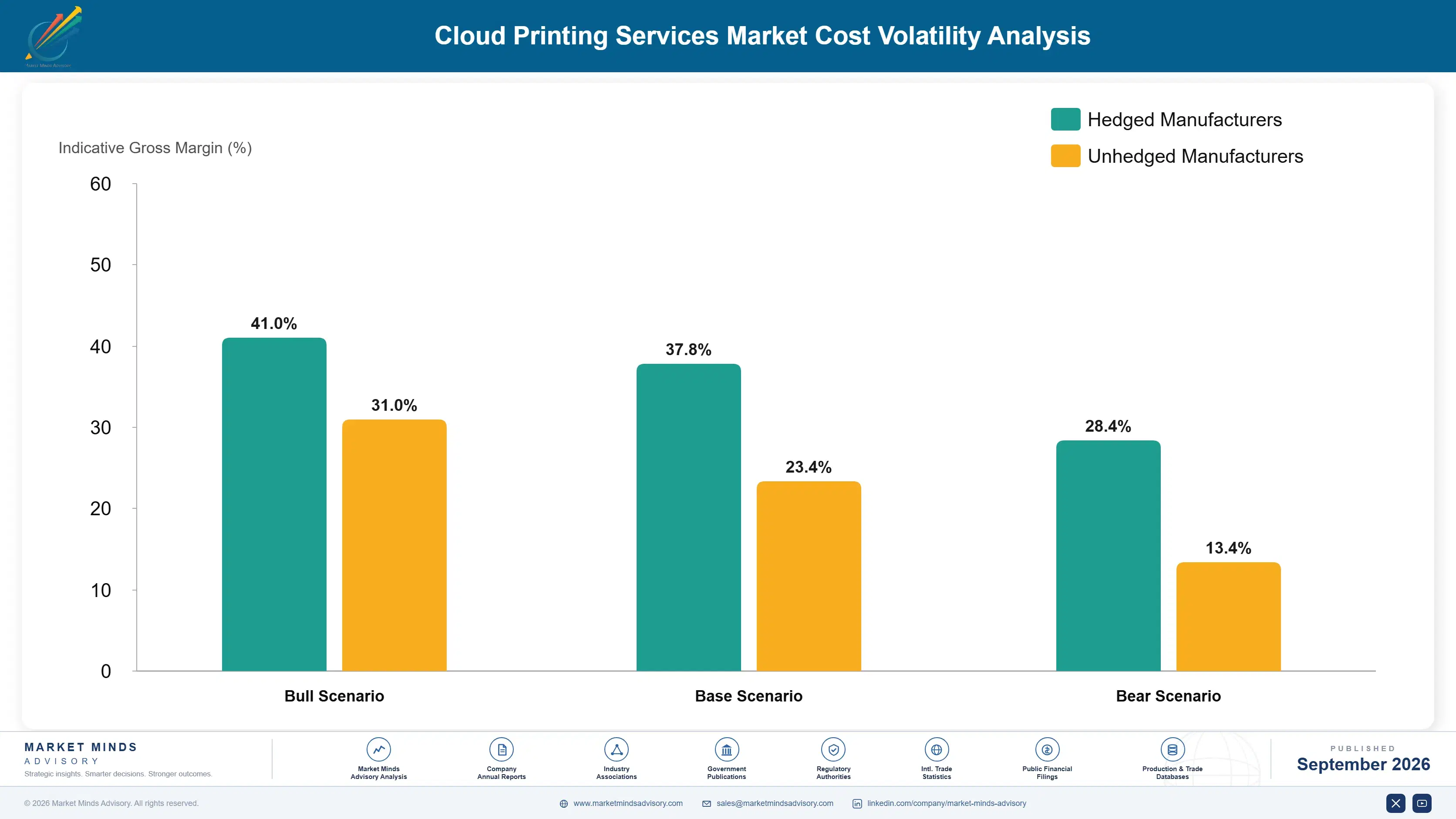
Engineering salaries account for roughly 46% of platform cost, weighted heavily toward device compatibility work that never finishes because manufacturers keep shipping new firmware. Cloud hosting carries around 16%, modest because print job payloads are small and traffic is bursty. Channel margin paid to resellers runs about 22% of list price, and support and certification absorb most of the balance.
Ricoh Annual Report 2024 and Canon Annual Report 2024 both record software and solutions revenue growing while hardware declines, and both describe engineering investment shifting accordingly. Cloud infrastructure pricing rose across major providers through 2023 and 2024, which affected this category less than most because per-user data volumes are small. The persistent cost is device compatibility engineering, and it scales with fleet diversity rather than with customer count.

The competitive disadvantage mechanism is channel cost rather than engineering. An independent vendor pays roughly 22% of list price to a reseller for every deal, while a device manufacturer reaches the same customer through a service relationship it already funds for hardware reasons. That difference is built into the business model and cannot be engineered away. It explains why independents defend on device breadth, the one thing manufacturers cannot match.
cloud-printing-services-market-cost-volatility-analysis-1789988793222

Automate Device Certification Testing End To End

Device compatibility engineering is the largest single cost in this category and it never completes, because manufacturers ship firmware continuously across hundreds of active models. Automated certification harnesses that test new firmware against the platform without manual intervention convert an expanding headcount problem into a fixed infrastructure one. The build cost is significant and the saving compounds every year afterwards.

Shift Channel Mix Toward Direct Enterprise Renewals

Reseller margin runs about 22% of list price, which is reasonable compensation for winning a new customer and poor value for processing a renewal the vendor would keep anyway. Renegotiating channel agreements so that new business carries full margin and renewals carry less aligns payment with work performed. Partners resist this and the ones delivering genuine new business accept it.

Size Cloud Capacity Against Bursty Print Traffic

Print traffic is extremely uneven, concentrating into short peaks at the start of the working day and around month end reporting cycles. Provisioning steady capacity against that profile wastes most of it, since hosting already runs around 16% of platform cost. Autoscaling configured against observed daily and monthly patterns cuts that materially with no service impact anybody notices.

Portfolio Architecture for Margin Defence

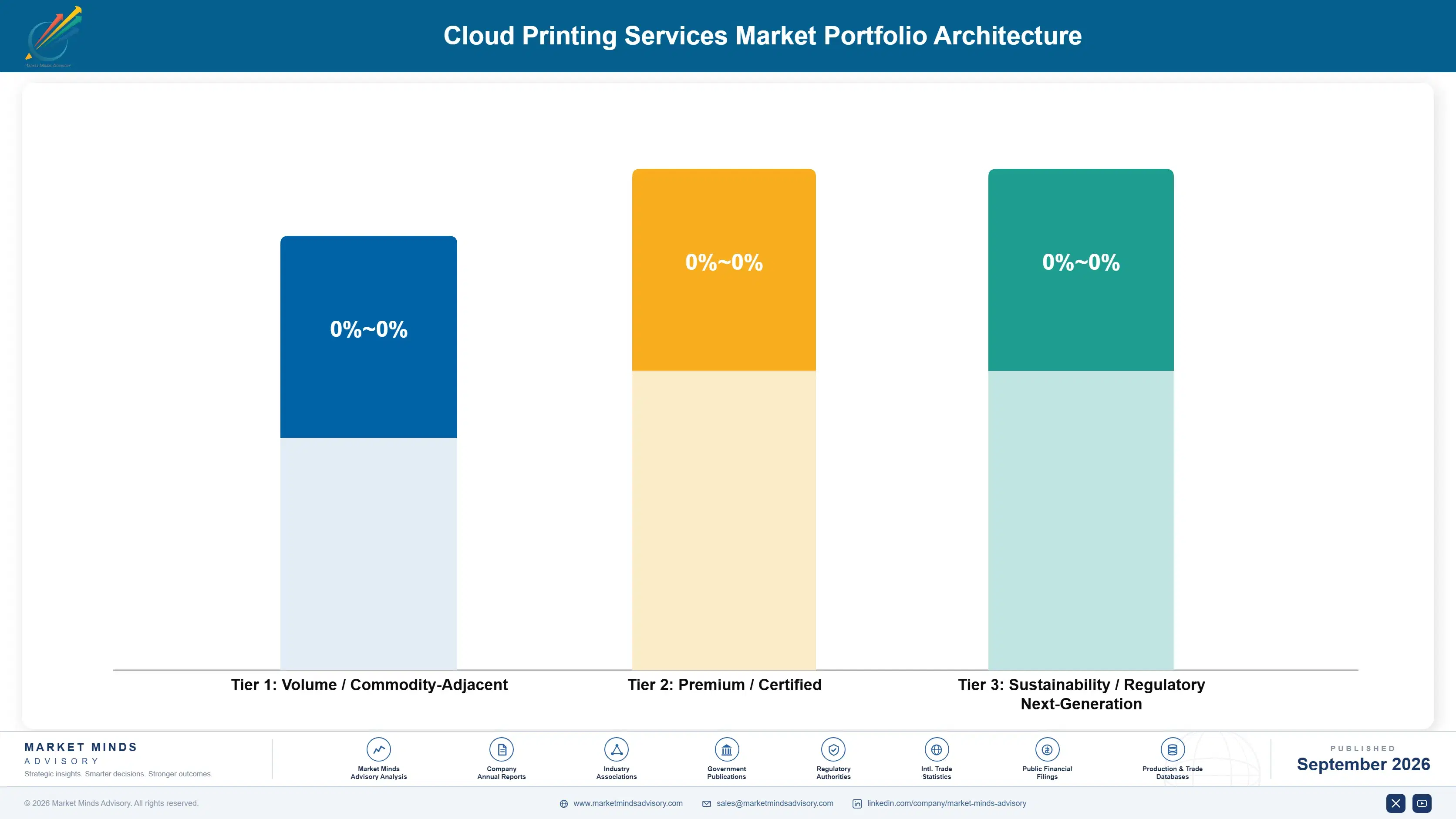
Margin architecture separates on who the buyer is and what they are avoiding. Cloud managed print services earn least, because they compete against incumbent managed print contracts on price and carry service delivery cost. Output management and cost recovery sit in the middle. Serverless infrastructure and secure release earn most, since one is bought by infrastructure teams removing risk and the other by compliance officers evidencing a control.
The volume versus premium tension is a routing question rather than a product one. Basic print routing is bundled free inside enterprise licensing most customers already own, so any vendor competing there is arguing about something the buyer believes they have. Secure release, mixed fleet device support and granular chargeback are not bundled and probably will not be. Vendors who keep defending the routing layer are defending the only ground they cannot hold.

High-value pools concentrate in secure release and in serverless infrastructure, and neither is reached by improving the print experience. Secure release requires card authentication hardware integration, device firmware work and a compliance argument most sales organisations cannot make. Serverless infrastructure requires reaching infrastructure architects who have never taken a call about printing. Both are organisational capabilities rather than features.

Volume / Commodity-Adjacent

Cloud managed print services and basic print routing, competing against bundled enterprise licensing and incumbent managed print contracts on price. The ten point spread separates vendors delivering service directly from those passing delivery to channel partners at lower margin.
Gross Margin: 42% to 52%

Premium / Certified

Output management, document workflow and cost recovery platforms sold on capability the bundled alternative does not offer. The ten point spread tracks how much of a vendor's book sits in multi-year enterprise agreements rather than in annually renegotiated departmental deals.
Gross Margin: 58% to 68%

Sustainability / Regulatory / Next-Generation

Serverless print infrastructure and secure release, bought by infrastructure and compliance functions rather than by print procurement. The twelve point spread reflects device certification breadth, which determines how many mixed fleet deals a vendor can actually serve.
Gross Margin: 72% to 84%
cloud-printing-services-market-portfolio-architecture-1789988793730

High-value Sub-segments and Strategic Watch-out

Serverless Print Infrastructure

Grows at 14.7% because migration removes around 84% of on-premises print infrastructure along with its licensing and privilege exposure. The twelve point spread reflects certification breadth. The buyer is an infrastructure architect who has never taken a call about printing before. That is the coverage problem in one sentence.
Gross Margin: 72% to 84%

Secure Release And Pull Printing

Grows at 12.4% because 21% of jobs go uncollected and European regulators treat trays full of personal data as reportable exposures. The twelve point spread reflects device integration depth. Compliance officers sign this, and they carry a different budget entirely. Efficiency never sold this to anybody at all.
Gross Margin: 72% to 84%

Mobile And Guest Printing Services

Grows at 11.1% because hybrid work left people printing from home networks and personal devices no domain controller has ever authenticated. The ten point spread reflects identity integration quality. Demand arrived from an office change that nobody in this industry planned for. Nobody forecast that particular demand source.
Gross Margin: 58% to 68%

Print Cost Recovery And Chargeback

Grows at 4.3%, slowest of the six classes, on a page base declining around 4% annually and a value proposition finance departments have ignored for twenty years. The ten point spread reflects contract structure. Education and legal customers still buy it reliably every year. Volume decline caps it permanently.
Gross Margin: 58% to 68%

How These Contracts Actually Persist

The annuity is the migration itself. Once an organisation has removed 84% of its print servers and rebuilt queues, workflows and authentication against a cloud platform, going back means reinstating infrastructure the infrastructure team spent nine weeks deleting. Switching between cloud platforms is easier but still means recertifying every device in a mixed fleet, which is why renewal rates run well above what per-user pricing would normally support.
Depth varies by what the platform is holding. A customer using secure release with card authentication has physical hardware, badge systems and a compliance record tied to the vendor, and moving means touching all of them. A customer using cost recovery for legal billing has it embedded in how they invoice. A customer using basic routing has nothing invested and moves for a point on price.

The buyer changed twice in five years and most sales organisations noticed neither move. It was a facilities manager buying cost control, then a security team buying attack surface reduction, and now an infrastructure architect buying server elimination. Each carries a larger budget and less patience for print. Vendors still leading with pages per month are talking to somebody who left the decision years ago.
cloud-printing-services-market-end-use-penetration-index-1789988794225

Where This Category Actually Wins

These are among the four positions where our research anticipates prominent divergence between winners and laggards over the coming forecast period. Each is grounded in the demand model, the regulatory perimeter, and the announced capacity pipeline.
01 / INFRASTRUCTURE BUYER COVERAGE

Call On The People Deleting Servers

The decision to remove print servers is taken inside a Windows Server consolidation programme by architects who measure success in servers eliminated, and migration removes around 84% of that footprint. Vendors organised around facilities managers and print procurement keep arriving after the budget has gone elsewhere, which is a coverage failure rather than a product one. Reframing around operating system licensing, patching burden and privilege exposure reaches the person who signs, and reaches them considerably earlier in the buying cycle than before.
02 / COMPLIANCE ARGUMENT LEADERSHIP

Sell The Control, Not The Convenience

Around 21% of print jobs are never collected, and European supervisory authorities treat documents left in output trays as reportable exposures rather than as untidiness in the office. That converts secure release from an efficiency feature into a control a data protection officer must be able to evidence, which carries a different budget and a very different urgency. Markets following European privacy structure, including Brazil and South Africa, accept the identical argument, and remarkably few vendors bother making it there.
03 / PRICING MODEL CONVERSION

Charge For Users, Never For Pages

Enterprise printed pages decline around 4% every single year, with no realistic prospect of any reversal at all, so pricing tied to volume shrinks alongside the customer's activity by design rather than by accident. Per-user pricing at roughly USD 14 annually holds revenue steady as pages fall and grows it as headcount grows, which inverts the exposure completely. Vendors still carrying page-based contracts inherited from the managed print era are watching their own revenue base erode exactly on schedule, quarter after quarter.
04 / BUNDLE GAP ENGINEERING

Build Only What Microsoft Does Not

Microsoft includes basic cloud print inside enterprise licensing most large customers already hold, which caps list pricing near USD 14 per user and makes any argument about routing quality essentially pointless. What the bundled option handles poorly is device breadth across mixed fleets, secure release with card authentication, granular chargeback and support for older hardware organisations still operate. Building deliberately into those gaps is the only defensible position, and competing on the features the bundle already covers is simply unwinnable.

Engagement Snapshot From the Field

A live engagement with an industry participant carrying material or product regulatory and market exposure ahead of a defining policy shift, showing how our research translates into a defensible multi-year portfolio strategy.
MARKET MINDS ADVISORY · CLIENT ENGAGEMENT SUMMARY
Cloud Printing Services Producer Strategic Portfolio Review and Transition Roadmap 2026·Investment Scenario on Cloud Printing Services Exposure Evaluation 2025-26
CLIENT PROFILE
A European professional services firm with 14,000 staff across eleven countries, running 38 print servers and a device fleet accumulated from four manufacturers over fifteen years. A data protection review had flagged uncollected documents in output trays as an unresolved exposure. Separately, the infrastructure team wanted the print servers gone as part of a wider consolidation. Neither group knew about the other.
STRATEGIC CHALLENGE
The compliance function wanted secure release deployed quickly and had a modest budget for it. Infrastructure wanted print servers eliminated within a consolidation programme funded far more generously. Procurement was evaluating three vendors against a requirement written entirely around cost recovery, which was the concern of neither group and had been copied from a previous tender.
MMA APPROACH
MMA mapped the device fleet by manufacturer and firmware level against each candidate platform's certified support, since mixed fleet coverage decides these deals more than interface quality does. We modelled the infrastructure saving from server removal against the compliance value of secure release, and priced both under per-user and per-page structures, drawing on 47 expert interviews conducted in Q4 2025.
KEY FINDINGS
  1. Only 2 of the 3 shortlisted platforms certified support for the full device fleet, and the requirement document had not asked the question at all.
  2. Server removal eliminated 32 of the 38 print servers, an 84% reduction, with the infrastructure saving alone exceeding the total platform cost (client-reported, unverified by MMA).
  3. Uncollected jobs ran at 23% of volume, slightly above the 21% typical rate, and eliminating them cut consumable spend by a visible amount.
  4. The per-page pricing option on offer would have reduced vendor revenue by roughly 4% annually as volumes fell, which the vendor had not disclosed.
CLIENT PROFILE
A European professional services firm with 14,000 staff across eleven countries, running 38 print servers and a device fleet accumulated from four manufacturers over fifteen years. A data protection review had flagged uncollected documents in output trays as an unresolved exposure. Separately, the infrastructure team wanted the print servers gone as part of a wider consolidation. Neither group knew about the other.
STRATEGIC CHALLENGE
The compliance function wanted secure release deployed quickly and had a modest budget for it. Infrastructure wanted print servers eliminated within a consolidation programme funded far more generously. Procurement was evaluating three vendors against a requirement written entirely around cost recovery, which was the concern of neither group and had been copied from a previous tender.
MMA APPROACH
MMA mapped the device fleet by manufacturer and firmware level against each candidate platform's certified support, since mixed fleet coverage decides these deals more than interface quality does. We modelled the infrastructure saving from server removal against the compliance value of secure release, and priced both under per-user and per-page structures, drawing on 47 expert interviews conducted in Q4 2025.
KEY FINDINGS
  1. Only 2 of the 3 shortlisted platforms certified support for the full device fleet, and the requirement document had not asked the question at all.
  2. Server removal eliminated 32 of the 38 print servers, an 84% reduction, with the infrastructure saving alone exceeding the total platform cost (client-reported, unverified by MMA).
  3. Uncollected jobs ran at 23% of volume, slightly above the 21% typical rate, and eliminating them cut consumable spend by a visible amount.
  4. The per-page pricing option on offer would have reduced vendor revenue by roughly 4% annually as volumes fell, which the vendor had not disclosed.
RECOMMENDED STRATEGY
Phase 1: Phase one: rewrite the requirement around server elimination and secure release, and drop the inherited cost recovery language from it entirely. Phase 2: Phase two: shortlist only platforms certifying the full mixed device fleet, since partial coverage means keeping servers for the remainder. Phase 3: Phase three: fund the project from the infrastructure consolidation budget rather than from the compliance budget, which was far too small.
OUTCOME
The firm removed 32 print servers and deployed secure release across the full fleet in about nine weeks (client-reported, unverified by MMA). The data protection finding closed and the infrastructure saving covered platform cost within the first year. Requirements are now written by the function that will fund the purchase, which outlasted the engagement.

Frequently Asked Questions

Foundational context covering the market sizes, CAGR, scope, country, region and competition that inform every finding below. This section is provided to cover basics and most often pre-purchase conversations, answered from the MMA Primary Research Dataset.

What is the current size of the Cloud Printing Services Market?

Global value reaches USD 3.18 billion in 2026, measured as cloud print software and managed service revenue across all six service classes. The 2025 base is USD 2.9 billion.

How large will the Cloud Printing Services Market be by 2036?

Software and service revenue reaches USD 8.10 billion by 2036, an increase of USD 4.92 billion over the forecast period. That represents 2.55 times expansion from the 2026 base.

What is the CAGR for the Cloud Printing Services Market 2026 to 2036?

The base case runs at 9.8% annually, with a bull case at 11.0% if page volume decline slows and a bear case at 8.5% if bundled cloud print capability closes the differentiation gap.

Which segment is growing fastest?

Serverless print infrastructure grows at 14.7%, half again the market rate of 9.8%. Migration removes around 84% of on-premises print infrastructure along with its licensing and privilege exposure.

Who are the major companies in the Cloud Printing Services Market?

PaperCut Software, Vasion, Canon, Kofax and Ricoh lead on software and service revenue, together holding 38%. Y Soft, MyQ and Pharos Systems hold smaller positions.

Which country is growing fastest?

India leads at 14.2%, on very large user populations at technology services firms and captive centres with modern identity infrastructure already deployed. Brazil and Poland follow.

Report Segmentation Architecture

The full report scope spans multiple orthogonal segmentation dimensions, with cross-tabulated demand data provided for each dimension pair. Coverage extends further to regional breakdowns, trend trajectories, and the competitive detail needed to support segment-level decision-making.

By Cloud Print Service Class

  • Serverless Print Infrastructure
  • Secure Release And Pull Printing Services
  • Mobile And Guest Printing Services
  • Output Management And Document Workflow
  • Cloud Managed Print Services
  • Print Cost Recovery And Chargeback

By End-Use Industry

  • Professional And Financial Services
  • Government And Public Administration
  • Healthcare Providers
  • Education And Universities
  • Manufacturing And Logistics
  • Retail And Hospitality

By Commercial Dimension

  • Reseller And Channel Partner Sales
  • Direct Enterprise Licensing
  • Device Manufacturer Bundled Supply
  • Managed Service Provider Delivery
  • Public Sector Framework Procurement
  • Marketplace And Subscription Sales

By Region

  • North America
  • Western Europe
  • East Asia
  • South Asia and Pacific
  • Latin America
  • Middle East and Africa
  • Eastern Europe

Scope, Methodology, and Coverage

Every figure in this report is reproducible from documented input assumptions. The scope below maps the historical period, the forecast horizon, the segmentation dimensions, and the countries covered, alongside the underlying primary and qualitative methodology.
Historical Period
2020 to 2025
Forecast Period
2026 to 2036
Base Year
2025 (USD billions; MMA Primary Research Dataset, September 2026)
Market Definition
This report covers cloud-delivered software and managed services that route, secure, meter and administer enterprise printing: serverless print infrastructure, secure release and pull printing, cloud managed print services, mobile and guest printing, output management and document workflow, and print cost recovery and chargeback. It excludes printing hardware, consumables and paper, on-premises print server software, document storage and content management platforms, and commercial print production services.
Quantitative Units
USD millions, cloud print software and managed service revenue basis; licensed users; annual printed page volume; uncollected job rate as a percentage; per user annual list price in USD.
Segmentation Dimensions
Cloud print service class; customer industry; commercial distribution channel; geography across seven regions.
Regions Covered
North America, Western Europe, East Asia, South Asia and Pacific, Latin America, Middle East and Africa, Eastern Europe
Countries Covered
Germany, Netherlands, France, United Kingdom, Sweden, Czechia, Poland, Romania, United States, Canada, Mexico, Brazil, Chile, Japan, South Korea, China, India, Australia, Singapore, South Africa.
Key Companies Profiled
PaperCut Software, Vasion, Canon, Kofax, Ricoh, Y Soft, MyQ, Pharos Systems, Celiveo, Ringdale, Microsoft, Xerox, HP Inc., Konica Minolta, ThinPrint.
Quantitative Methodology
Primary survey, n=3,800 respondents, Q4 2025, six countries; demand-side model with trade association cross-validation
Qualitative Methodology
47 expert interviews, Q4 2025; applied to validate demand model assumptions, identify emerging dynamics, and assess competitive positioning
Report Format
PDF and XLSX data workbook (Word format preview document)
Publisher
Market Minds Advisory
Report Code
MMA-2026-TEC-461
Published
September 2026
Contact
sales@marketmindsadvisory.com | www.marketmindsadvisory.com

Purchase the full Cloud Printing Services Market Report (2026 to 2036).

This report sizes the global cloud printing services market from 2026 to 2036 across six service classes, six customer industries and seven regions. It explains why organisations buy this software to delete print servers rather than to manage printing, how a 21% uncollected job rate turned secure release into a compliance control, and why a category can grow at 9.8% on a page base falling 4% annually. Cost composition is sourced to company annual reports, with device certification engineering analysed as the persistent constraint. Regional analysis explains why Western Europe leads at 30% of revenue. Competitive assessment covers 20 named vendors with four revenue lever analyses.
Six cloud print service classes sized to 2036
Server removal economics modelled as the decisive argument
Device certification cost analysed from company filings
Twenty named vendors assessed on service revenue
Four revenue levers with quantified commercial impact
Anonymised European professional services migration engagement included

Built For The People Who Decide

From boardroom strategy to bench-side execution, this report is read cover-to-cover by leaders shaping the next decade of their industry, turning demand scenarios, market dynamics and valuation benchmarks into decisions.
CXOs/ Presidents/ VPs/ Managers
M&A and Corporate Development
Strategy Teams and R&D Heads
Procurement and Product Directors
Regulatory and Compliance Leaders
Investor Relations and Equity Analysts