Market Minds Advisory
Cloud ERP Industry Analysis in Latin America

Cloud ERP Industry Analysis in Latin America: Cloud ERP Industry Analysis in Latin America. Trends and Forecast 2026 to 2036

Legacy on-premises finance systems are giving way to cloud-native platforms as tax digitalization mandates across Brazil, Mexico, and Colombia force enterprises to modernize reporting infrastructure or face compliance penalties and audit exposure.

Lead Analyst

Published

September 2026

Make Smarter Decisions with Customized Research Insights

Request a free sample report and evaluate market opportunities, growth trends, and competitive dynamics relevant to your business needs.

2025 MARKET VALUE$58.0BMarket Size 2025
2036 FORECAST VALUE$182.8BBase Case , 2026 to 2036
CAGR 2026 TO 203611.0 %Bull 12.2% / Bear 9.8%
INCREMENTAL OPPORTUNITY$118.4BNet 10- year value creation
EXPANSION MULTIPLE2.84x2036 value over 2026 base
Strategic Levers
M&A Pipeline
Regional Outlook
Country Rankings
Competitive Intelligence
Segmental Deep-dive
Call-Us : 91 93563 13602

Executive Snapshot and Market Trajectory.

Cloud ERP adoption is accelerating fastest where governments mandate digital tax reporting, and nowhere is that pressure sharper right now than across Brazil's electronic invoicing regime, which is forcing finance leaders across the region to modernize legacy systems well ahead of their originally planned replacement cycles.
Vendor competition is intensifying around AI-embedded financial planning modules, the fastest growing category as enterprises demand forecasting accuracy alongside core transaction processing. Mid-market adoption is outpacing large enterprise renewal cycles, since smaller firms face fewer legacy migration constraints. Geographic concentration remains heaviest across North America and Western Europe, though Brazil and Mexico are closing the gap through mandate-driven modernization. Vendors report shorter sales cycles wherever regulatory deadlines are firm rather than voluntary.
Competitive intensity centers on five global platforms holding a combined 46% revenue share, while Totvs defends home-market share through localized tax compliance depth rivals cannot copy. Regulatory tightening around e-invoicing and real-time reporting across multiple Latin American jurisdictions is compressing implementation timelines and forcing vendors to prioritize compliance modules over broader feature roadmaps. This pressure is reshaping vendor investment roadmaps across the broader region today. Timelines are tightening.
Market Definition
This report covers cloud-based enterprise resource planning software delivered via subscription across finance, supply chain, human capital, and operations modules for organizations operating in or serving Latin American markets. It excludes on-premises perpetual license ERP deployments and standalone point solutions such as isolated accounting or payroll software not integrated within a broader ERP suite.
Base Year Value
$58.0B in 2025 (MMA Primary Research Dataset, September 2026)
Forecast Period
2026 to 2036, eleven discrete annual values
CAGR
11.0% base case. Bull 12.2%. Bear 9.8%.
Fastest Growth Segment
AI-Embedded Financial Planning and Analytics Modules: 16.5% CAGR
Fastest Growth Country
Brazil: 15.5% CAGR
Fastest Growth Region
South Asia and Pacific: 13.0% CAGR
Largest Region
North America: 30% of 2025 global value
Market Leaders
Leading participants include SAP, Oracle, Microsoft, Totvs, and Workday. Source: MMA Primary Research Dataset, July 2026.
Primary Survey
n=3,800 procurement and R&D decision-makers, Q4 2025, six countries
Methodology
Demand-side build-up, cross-validated against public data, 47 expert interviews

Cloud ERP Industry Analysis in Latin America Market Forecast Scenarios

cloud-erp-industry-analysis-in-latin-america-size-forecast-scenario-1788503569182
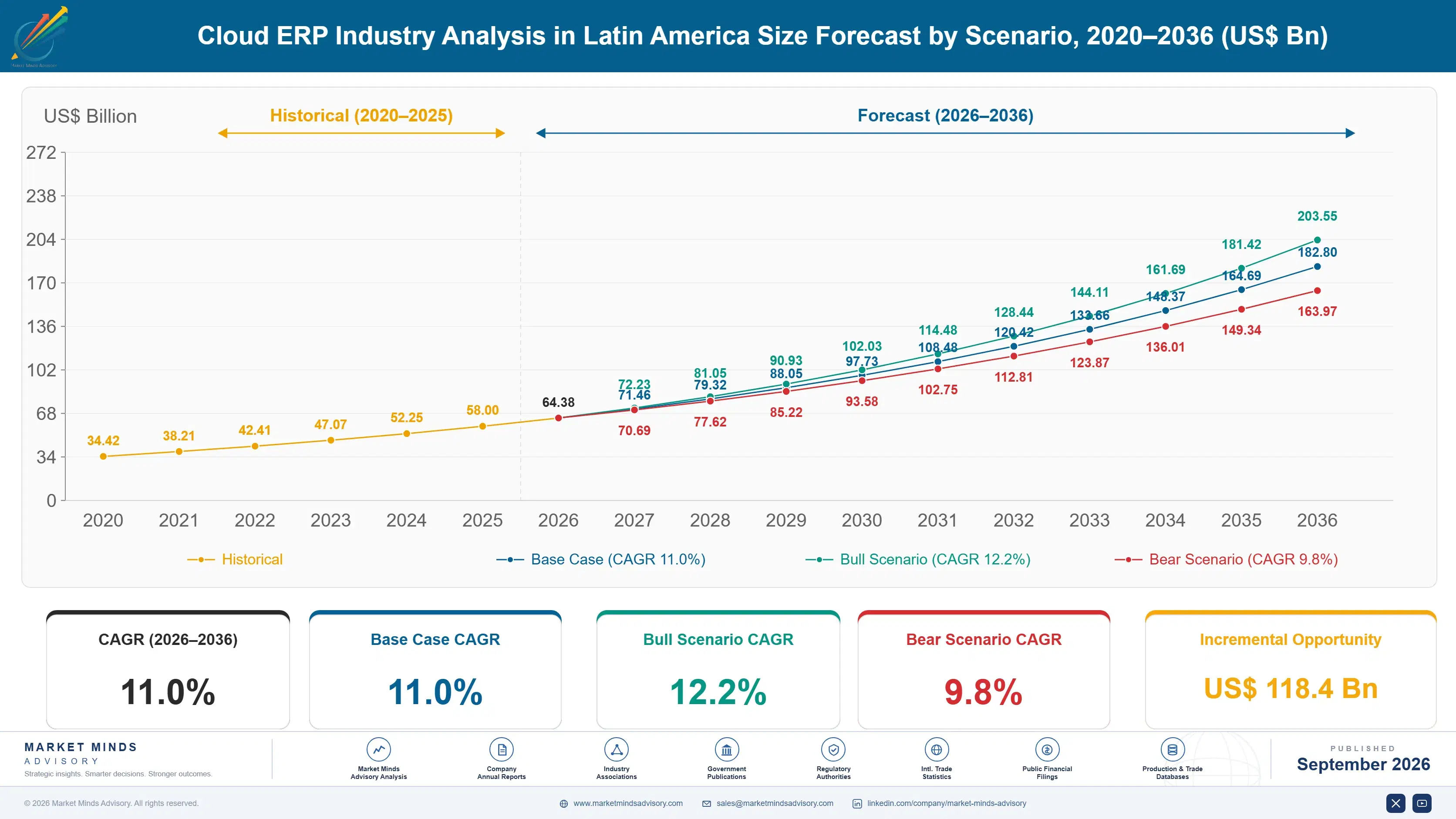
Global cloud ERP adoption grew steadily between 2020 and 2025 at roughly 10.0%, as the pandemic accelerated remote finance operations and pushed enterprises toward subscription-based platforms over capital-intensive on-premises deployments. Latin American adoption lagged the global average through most of this period, constrained by fragmented regional tax regimes. Vendors reported longer sales cycles amid currency risk concerns.
The base case assumes continued 11.0% annual growth through 2036, driven by three commercial mechanisms. First, mandatory e-invoicing rollouts across Brazil, Mexico, and Colombia force finance system modernization on fixed regulatory timelines. Second, mid-market enterprises increasingly bypass on-premises deployment entirely, adopting cloud-native platforms as their first ERP investment. Third, vendors are bundling AI-driven forecasting modules into core contracts, lifting average contract value across the installed base. These mechanisms reinforce each other as regulatory pressure creates the initial sales trigger vendors expand through.
The bull case centers on accelerated public sector digitalization mandates spreading faster than currently scheduled across additional Latin American jurisdictions beyond Brazil and Mexico. The bear case centers on prolonged currency volatility across the region discouraging multi-year subscription commitments, particularly among mid-market enterprises sensitive to dollar-denominated contract pricing. Both scenarios hinge on macroeconomic conditions across the region's three largest economies.

Where Compliance Mandates Force Platform Modernization

Cloud ERP vendors serving Latin America compete on compliance depth as much as core functionality, since tax authorities across the region continually update mandatory reporting formats. Vendors that cannot update compliance modules within regulatory grace periods lose renewal leverage almost immediately. Several vendors now maintain dedicated regional compliance engineering teams to track tax authority rule changes, a cost structure smaller entrants struggle to replicate.
MARKET CONCENTRATIONCR5 46%Top five vendors hold under half the total revenue
AVERAGE CONTRACT VALUE$185K annualMid-market deals rising faster than large enterprise renewals
TOP PRODUCING COUNTRY SHAREBrazil 34%Largest single national contributor within the regional total
CLOUD MIGRATION PENETRATION58% of installed baseMajority of enterprises have not yet fully migrated
IMPLEMENTATION CYCLE LENGTH9 months averageMid-market deployments complete considerably faster than enterprise projects
RENEWAL RETENTION RATE88% annualMost customers renew despite ongoing local competitor pressure
Mid-market adoption is outpacing large enterprise renewal cycles across the region, as smaller firms bypass on-premises deployment entirely rather than migrating from legacy systems. This dynamic favors vendors with rapid implementation methodologies over those built for lengthy enterprise rollouts. Implementation partners specializing in mid-market deployments have become critical distribution channels across the region's more fragmented secondary markets.
Currency volatility complicates multi-year contract negotiation, pushing some vendors toward local-currency pricing arrangements. Totvs defends its Brazilian home-market position through deep localization while global vendors compete primarily on breadth of module integration and multinational deployment consistency across borders. Multinational enterprises operating across several Latin American countries increasingly demand a single vendor relationship spanning all subsidiaries, favoring platforms that can demonstrate consistent compliance coverage across every jurisdiction where the customer operates.
"An ERP vendor's roadmap does not matter here if it cannot ship a tax table update before the government's deadline. The winner in Brazil is the one with the fastest compliance patch, not the prettiest dashboard."
Senior Analyst, Enterprise Software and Cloud Platforms Practice · MMA Technology Practice · September 2026

Market Trends

Mandatory E-Invoicing Rewrites Vendor Compliance Roadmaps

Brazil's continuous electronic invoicing regime and comparable programs spreading across Mexico and Colombia require ERP vendors to update tax reporting logic on government timelines rather than their own release schedules. Vendors that fall behind these mandated updates face customer churn almost immediately, since noncompliance exposes buyers to real audit penalties. This dynamic has restructured vendor engineering priorities, pulling compliance work ahead of feature development across nearly every roadmap serving the region and forcing smaller entrants to partner with local compliance specialists rather than build the capability internally from scratch. Regional teams now anchor most vendor roadmaps.
Market Impact: Deadlines cut decisions by 35%
AI-Embedded Forecasting Modules Displace Standalone Analytics Tools

Enterprises are increasingly demanding financial planning and forecasting capability embedded directly within core ERP modules rather than purchased as separate analytics software. This shift is consolidating spend that previously went to standalone business intelligence vendors into the core ERP contract itself, lifting average deal size meaningfully. Vendors without native AI-driven forecasting capability are losing competitive evaluations to platforms that can demonstrate integrated planning functionality during the sales cycle, particularly among mid-market buyers replacing spreadsheet-based forecasting processes for the first time this decade. Spreadsheet replacement is driving most of this early demand across smaller accounts.
Market Impact: First-time adoption grew 41%

Market Opportunities and Growth Drivers

Regional Tax Digitalization Programs Force System Upgrades

Government mandates requiring real-time electronic invoicing and standardized digital tax reporting are forcing enterprises across Brazil, Mexico, and Chile to replace legacy finance systems that cannot generate compliant reporting formats. Unlike discretionary software upgrades, these mandates carry fixed compliance deadlines and real financial penalties for noncompliance, which shortens enterprise decision cycles considerably. Finance leaders report that regulatory deadlines, not budget cycles, now determine ERP replacement timing across most large accounts evaluated by MMA's primary survey respondents this year. Vendors that misjudge these timelines lose deals to faster-moving competitors already certified against the new reporting formats.
Market Impact: Currency risk cut renewals 18%

Mid-Market Cloud-First Adoption Bypasses Legacy Infrastructure Entirely

A growing share of mid-market enterprises across the region are adopting cloud ERP as their first formal system, skipping on-premises deployment entirely rather than migrating from an existing legacy platform. This greenfield adoption pattern removes the data migration complexity that slows large enterprise projects, allowing mid-market implementations to complete considerably faster. Vendors with implementation methodologies purpose-built for first-time adopters are capturing disproportionate share of this segment relative to vendors optimized for complex enterprise migrations. Channel partners report this pattern accelerating quickly across secondary cities beyond the largest three metropolitan markets.
Market Impact: Multi-country rollouts take 45% longer

Market Restraints and Challenges

Currency Volatility Discourages Multi-Year Subscription Commitments

Sharp currency fluctuations across Argentina and, to a lesser extent, Brazil and Mexico make dollar-denominated multi-year ERP subscriptions unpredictable for finance leaders budgeting in local currency. The root cause is a fixed mismatch between vendor pricing, typically set in dollars, and customer revenue, earned locally. This mismatch pushes some enterprises toward shorter contract terms or local vendors like Totvs offering local-currency pricing. Global vendors are exploring hedged pricing arrangements and regional billing entities to mitigate this friction and preserve multi-year commitment rates among currency-sensitive accounts. Finance teams cite this mismatch as a recurring objection during renewal negotiations across the region.
Market Impact: Compliance work absorbs 28% of capacity

Fragmented Regional Tax Regimes Complicate Multinational Rollouts

Enterprises operating across several Latin American countries face genuinely different tax reporting requirements in each jurisdiction, unlike the more harmonized regulatory environment across Western Europe. This fragmentation is rooted in each country's independent tax administration modernization timeline, with no regional coordination mechanism forcing alignment. The commercial impact is longer, costlier multinational implementations requiring separate compliance configuration per country. Vendors are mitigating this friction by building modular, country-specific compliance packs that can be assembled without full platform reconfiguration for each new jurisdiction added. Larger vendors with dedicated regional delivery teams absorb this cost more easily than smaller challengers entering new countries.
Market Impact: Forecasting modules lift deal size 22%
3 additional market trends, 4 additional growth drivers, and 2 additional restraints and challenges are covered in the full report. Contact sales@marketmindsadvisory.com to access the complete intelligence.

Segment CAGR and Growth Architecture

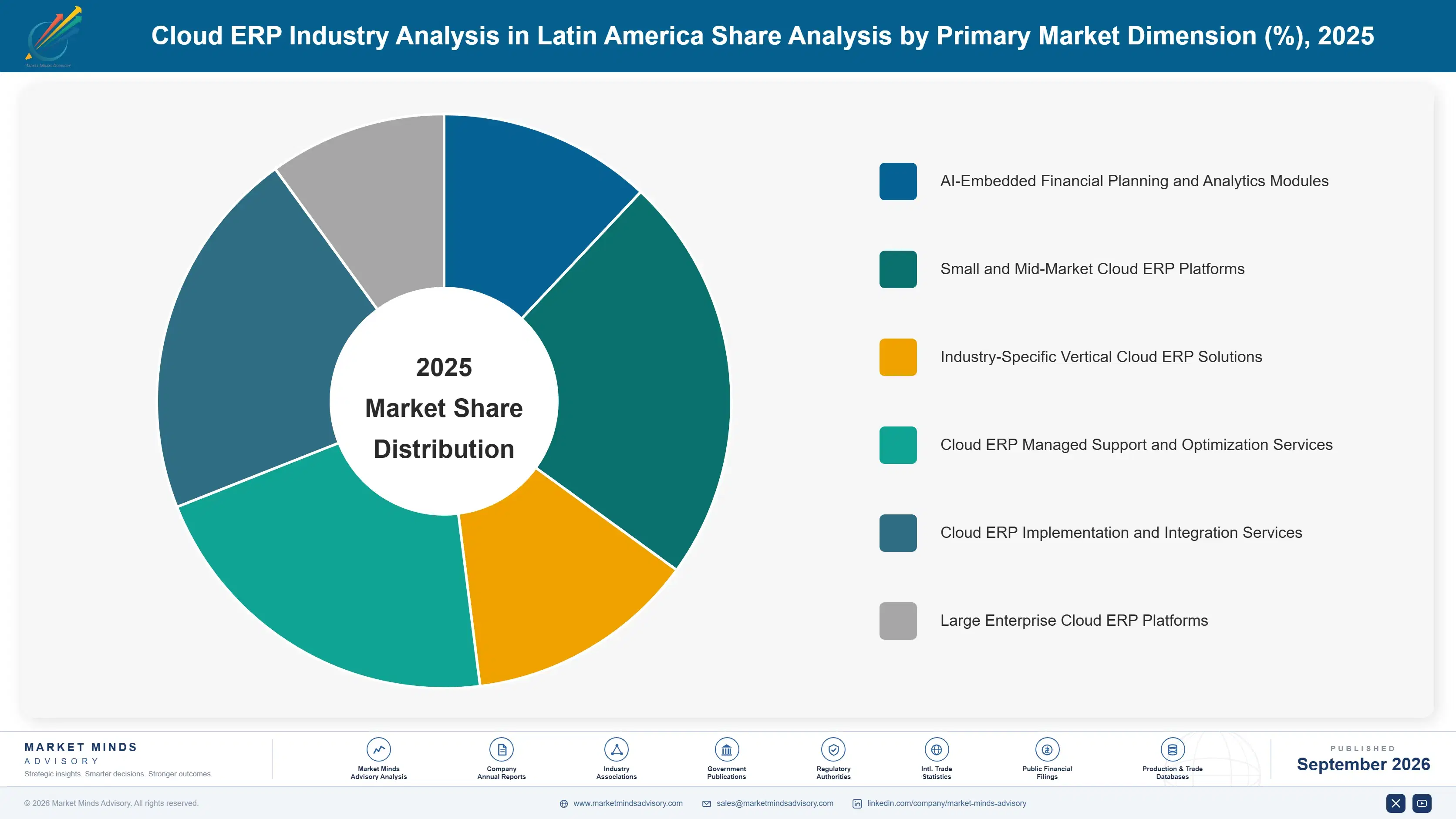
Cloud ERP demand splits across six segments by product and service type, reflecting how enterprises consume finance, planning, and operational functionality. Compliance-driven modernization is pulling budget toward AI-embedded planning modules and mid-market platforms fastest. Large enterprise platforms and implementation services remain the largest revenue pools today, but growth is shifting decisively toward smaller, faster-deploying categories.
cloud-erp-industry-analysis-in-latin-america-market-share-analysis-1788503569725

AI-Embedded Financial Planning and Analytics Modules

This segment embeds machine learning-driven forecasting, scenario modeling, and anomaly detection directly into core financial planning workflows, replacing standalone business intelligence tools enterprises previously purchased separately. Demand is concentrated among finance teams seeking faster, more accurate rolling forecasts without exporting data into external spreadsheet models. Vendors are pricing these modules at a premium over base ERP licensing, reflecting genuine differentiation buyers report during competitive evaluations. Adoption is accelerating fastest among enterprises that already completed core ERP migration and are now layering advanced planning capability on top of stable transaction processing infrastructure across finance departments today. MMA's primary survey indicates this segment will command an increasing share of total contract value as more enterprises complete core migration.
CAGR 16.5%

Small and Mid-Market Cloud ERP Platforms

Small and mid-market enterprises increasingly adopt cloud ERP as their first formal system rather than migrating from legacy on-premises software, removing the data migration complexity that slows large enterprise projects considerably. Implementation timelines for this segment run considerably shorter than enterprise deployments, allowing vendors to serve higher deal volume with smaller specialized delivery teams. Growth here outpaces the large enterprise segment because the total addressable population of mid-market firms without any ERP system remains substantial across secondary cities and industries beyond the largest metropolitan corporate centers throughout the region. Vendors with local implementation partner networks are capturing disproportionate share of this segment relative to those relying solely on direct enterprise sales teams.
CAGR 13.0%
Full segment breakdown across 6 segments available in the complete report.

Regional Architecture and Country Demand Map

Regional demand splits along regulatory maturity as much as economic scale. North America and Western Europe retain the largest installed bases, but Latin America is profiled here given its growth trajectory relative to its current share, driven largely by compliance mandates outpacing the broader global average.

North America

SAP, Oracle, Microsoft, and Workday all maintain their largest revenue base and product development headquarters across the United States, concentrating both installed base and go-to-market investment in this region. Enterprises here lead global adoption of AI-embedded planning modules, since finance teams have the largest existing budget for premium add-on functionality. Renewal cycles are also longest here, as large enterprises negotiate multi-year agreements bundling several modules simultaneously rather than purchasing incrementally the way mid-market buyers across other regions typically do. Implementation partners in this region also report the deepest bench of certified consultants, shortening rollout timelines for enterprises willing to pay premium services rates. Renewal negotiations here increasingly bundle AI planning modules from the outset rather than as later upsells.
Share: 30% | CAGR: 12.0% (2026 to 2036)

Western Europe

Enterprises across Germany, France, and the United Kingdom favor established vendors with strong data residency guarantees, reflecting stricter regional privacy expectations than most other markets. Growth here trails the global average since a larger share of the installed base already completed cloud migration during the prior decade, leaving less greenfield opportunity remaining. Vendors compete primarily on regulatory certification depth and integration with regional banking infrastructure rather than aggressive new-customer pricing strategies common elsewhere in the world. Several vendors are now investing in localized AI forecasting modules trained on regional accounting standards to reignite growth among enterprises otherwise satisfied with existing platforms. Early results from these pilots remain modest but closely watched by vendor product teams.
Share: 22% | CAGR: 9.5% (2026 to 2036)
Regional intelligence for 5 additional markets available in the complete report: East Asia, South Asia and Pacific, Latin America, Middle East and Africa, Eastern Europe. Contact sales@marketmindsadvisory.com.
cloud-erp-industry-analysis-in-latin-america-country-cagr-analysis-1788503570246

How Vendors Expand Regional Contract Value

Vendors serving Latin America are shifting revenue strategy beyond initial license and implementation fees toward recurring compliance, planning, and localization services that deepen customer dependency and lift retained annual contract value considerably over time. Compliance depth, localization quality, and cross-sell discipline now separate the vendors expanding wallet share from those merely defending existing installed base contracts.

Bundle Compliance Updates Into Core Subscription Pricing

Vendors are folding mandatory tax and regulatory update maintenance directly into base subscription pricing rather than billing separately, removing a recurring negotiation point that previously created renewal friction. This bundling raises perceived value without requiring a separate sales conversation, since customers view compliance currency as a baseline expectation rather than a premium add-on. Vendors report this approach lifts average contract value by roughly 15% compared to itemized compliance billing while also reducing customer churn risk during the tax authority's periodic mandatory update cycles. Several vendors now market this bundling explicitly as a compliance guarantee to strengthen renewal conversations.
Market Impact: Bundled compliance pricing lifts contract value about 15%

Expand Local-Language Implementation and Training Services

Vendors are building dedicated Portuguese and Spanish language implementation and training practices rather than relying on translated documentation and English-speaking consultants. This localization investment shortens implementation timelines and improves user adoption rates within customer organizations, directly reducing the support costs vendors otherwise absorb during rollout. Vendors with mature local-language practices report implementation services revenue growing roughly 28% faster than vendors relying primarily on centralized delivery teams serving the region remotely from outside its borders. Regional systems integrators increasingly prefer partnering with vendors offering native local-language delivery capability over centralized alternatives.
Market Impact: Local-language services grow revenue about 28% faster overall

Cross-Sell AI Planning Modules Into Existing Accounts

Vendors are running structured upsell campaigns targeting existing ERP customers who have not yet adopted AI-embedded planning and forecasting modules, rather than treating these modules as a feature reserved for new customer acquisition alone. This approach converts an already-committed customer base into incremental revenue without the acquisition cost of a competitive sales cycle. Vendors executing disciplined cross-sell programs report planning module attach rates reaching roughly 34% of the installed base within eighteen months of launch. Vendors with dedicated customer success teams report meaningfully higher attach rates than those relying on account managers alone.
Market Impact: Cross-sell campaigns reach roughly 34% of installed accounts

Offer Local-Currency Pricing to Reduce Churn Risk

Vendors are introducing local-currency billing arrangements for customers in Brazil, Mexico, and Colombia, removing the exchange rate volatility that previously discouraged multi-year contract commitments among currency-sensitive mid-market accounts. This pricing flexibility trades some margin certainty for improved contract duration and reduced renewal risk, a trade vendors increasingly view as favorable given rising customer acquisition costs. Early adopters of local-currency pricing report multi-year contract attach rates roughly 20% higher than vendors maintaining dollar-only pricing across these specific accounts. Finance leaders across the region cite currency flexibility as a deciding factor during competitive vendor evaluations.
Market Impact: Local-currency pricing lifts multi-year attach rates by 20%

Who Controls the Margin Pool

Five vendors hold a combined 46% revenue share, a moderate concentration reflecting genuine local competition rather than global oligopoly. SAP and Oracle lead as the two largest platforms serving multinational enterprises, while Totvs defends a distinct home-market position across Brazil that global vendors have struggled to erode despite years of direct competitive effort. The gap between the leading two platforms and the third-ranked challenger remains meaningful.
Activity centers on compliance module depth and AI-embedded planning capability rather than core transaction processing, since most platforms already handle standard finance and operations functionality adequately. Vendors are racing to certify against the latest tax authority reporting formats before competitors, since certification timing directly influences competitive evaluations during active sales cycles across the region. Several vendors have partnered with regional accounting firms to accelerate certification work internally.

Emerging pressure is coming from mid-market specialists offering faster implementation timelines than the large global platforms optimized for enterprise complexity. Rankings could shift meaningfully if a mid-market specialist achieves compliance certification breadth comparable to the incumbents, since implementation speed increasingly matters more than feature completeness for the region's fastest-growing buyer segment. Vendors that fail to close this gap risk losing ground even where functionality remains competitive.
cloud-erp-industry-analysis-in-latin-america-company-positioning-matrix-1788503570772

Competitive Moat and Risk Dimensions

SAP

Moat: Enterprise Installed Base Depth

SAP's decades-long presence among the largest multinational enterprises operating in Latin America gives it an installed base competitors cannot easily displace. Switching costs are substantial once finance operations run on SAP's core modules across multiple subsidiaries. This depth is difficult for newer entrants to replicate given the long sales cycles and switching costs already sunk by existing customers.
SAP

Risk: Slower Mid-Market Product Fit

SAP's enterprise-oriented product architecture and implementation cost structure make it less competitive for mid-market accounts, ceding this faster-growing segment to specialized regional and cloud-native challengers. Mid-market specialists with faster implementation timelines increasingly win these deals before SAP's enterprise sales process can complete a full evaluation cycle.
ORACLE

Moat: Integrated Cloud Infrastructure Stack

Oracle bundles ERP with its own cloud infrastructure and database licensing, creating a technically integrated offering that is difficult for competitors reliant on third-party cloud hosting to replicate at comparable performance and cost. This integration advantage strengthens with each additional workload customers migrate onto Oracle's combined infrastructure and application stack over successive contract renewal cycles.
ORACLE

Risk: Perceived Higher Total Cost

Oracle's pricing structure is frequently cited by mid-market buyers as a barrier to adoption relative to more narrowly scoped regional alternatives offering comparable core functionality at meaningfully lower total contract cost. This dynamic is especially pronounced among currency-sensitive mid-market accounts weighing multi-year commitments against smaller, more narrowly focused alternatives.

Players Tracked

Prominent Players

SAP
Oracle
Microsoft
Totvs
Workday

Other Key Players

Infor
NetSuite
Sage
Epicor
IFS
Acumatica
Unit4
Deltek
Syspro
Priority Software
Odoo
Rootstock Cloud ERP
Plex Systems
Ramco Systems
QAD Inc.

Recent Developments

SEPTEMBER 2025

Totvs acquired a Brazilian fintech-focused financial planning software firm in September 2025 to strengthen its embedded analytics capability and defend its home-market position against global vendors adding comparable AI-driven forecasting modules to their own regional platforms. The deal closed within the quarter and integration began immediately across existing accounts.
Signal: Signals regional vendors defending home turf through targeted acquisition of complementary planning capability ahead of expected competitive moves
DECEMBER 2025

SAP entered a partnership with a leading Mexican systems integrator in December 2025 to accelerate mid-market implementation capacity ahead of Mexico's expanding digital tax reporting mandate, addressing a segment where SAP has historically lagged smaller regional specialists. The partnership includes joint training for integration consultants across the partner's office network.
Signal: Signals global vendors partnering locally to close mid-market implementation capacity gaps quickly within the broader mid-market segment
MARCH 2026

Microsoft launched an expanded Spanish and Portuguese-language version of its cloud ERP planning module in March 2026, targeting mid-market enterprises across Brazil, Mexico, and Colombia that previously relied on English-language interfaces and translated documentation. The launch followed eighteen months of localization work led by a dedicated regional product team.
Signal: Signals localization becoming a competitive requirement rather than an optional differentiator regionally across every major regional market

Compliance Engineering Costs Pressure Regional Margins

Compliance engineering and local certification work account for roughly 22 to 28% of vendor cost of goods sold for platforms serving Latin America, a meaningfully higher share than in more regulatory-stable markets. This talent is sourced primarily from regional development centers in Brazil, Mexico, and Argentina, supplemented by specialist consulting firms tracking tax authority rule changes.
SAP's fiscal year 2025 annual report noted rising investment in localization engineering to support accelerating regulatory change across emerging markets, without breaking out Latin America specifically. Industry-wide, vendors report compliance-related engineering headcount serving the region grew roughly 30% between 2024 and 2025 as Brazil, Mexico, and Colombia each advanced digital tax reporting mandates on overlapping but distinct implementation timelines. Vendors without a formal Latin America product roadmap increasingly struggle to keep pace with this accelerating regulatory cadence.

Vendors without dedicated regional compliance engineering face a genuine competitive disadvantage, since generic global platforms updated on a slower centralized release cycle cannot match the update speed of vendors like Totvs with localized development teams. This exposure is sharpest among smaller global entrants attempting to serve the region without local engineering presence, while larger vendors absorb the cost through scale across their broader global compliance function.
cloud-erp-industry-analysis-in-latin-america-cost-volatility-analysis-1788503570969

Establish Dedicated Regional Compliance Engineering Teams

Vendors are building dedicated Latin America compliance engineering teams rather than routing regional certification work through centralized global product teams already managing competing release priorities. This regional dedication shortens the time between a regulatory announcement and a certified platform update, directly protecting renewal rates among customers. Several vendors report meaningfully faster certification turnaround after establishing this dedicated capability locally.

Partner With Regional Tax Compliance Specialists

Vendors lacking scale to justify dedicated regional engineering teams are partnering with third-party tax compliance specialist firms that track regulatory changes across multiple countries simultaneously. This partnership model spreads compliance monitoring cost across several vendor clients, making certification speed achievable without proportional headcount investment. Several vendors report this approach delivers comparable certification speed at a fraction of the internal cost.

Portfolio Architecture for Margin Defence

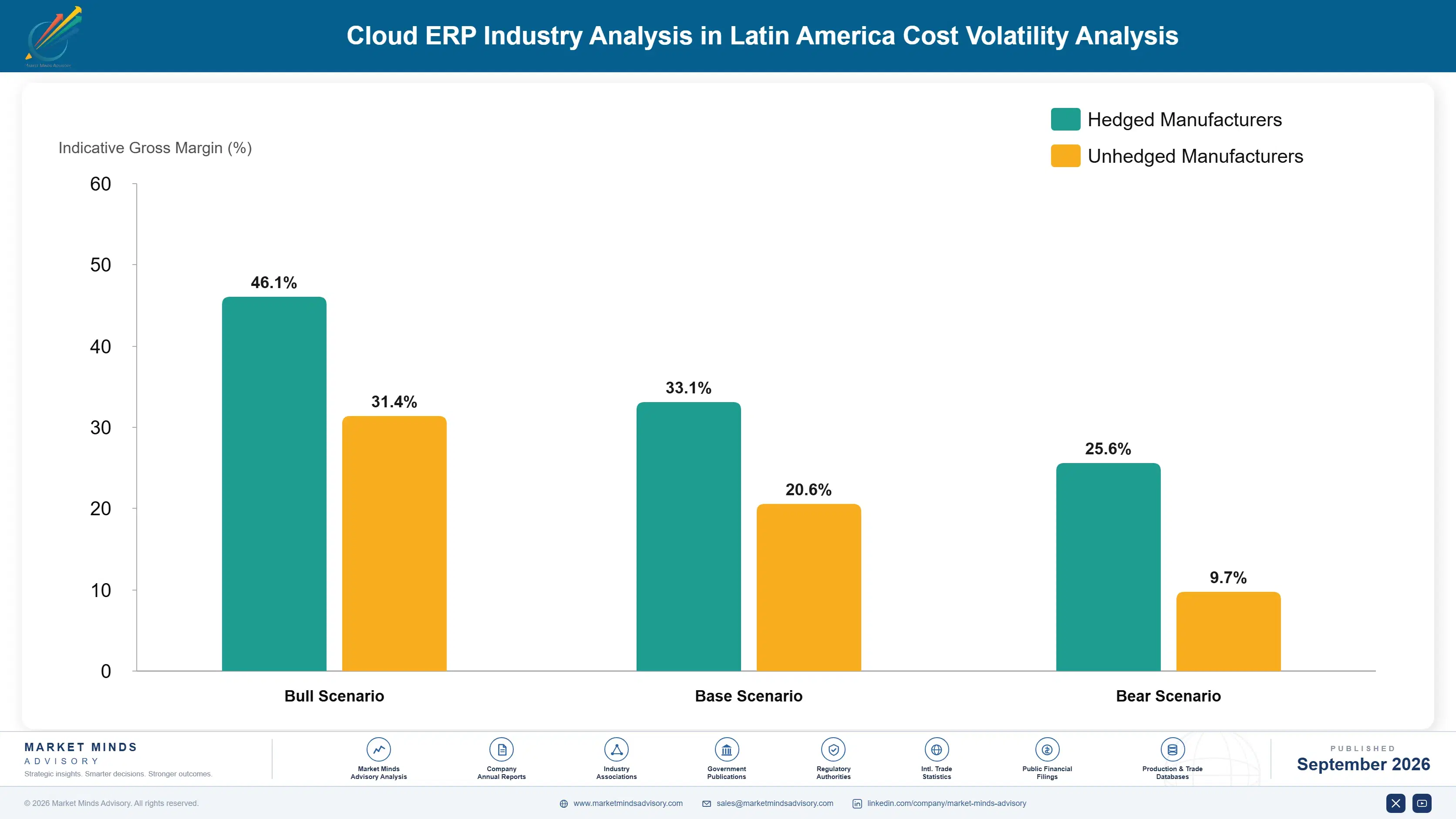
Vendor economics in this market split along three tiers. Commodity-adjacent implementation and support services compete on price and delivery volume, generating gross margins in the 45 to 55% range on thin, competitive service contracts. Certified compliance-attested platforms command 62 to 70% gross margins, reflecting genuine switching costs once compliance workflows are embedded within a customer's finance operations. Contract renewal cycles run twelve to eighteen months, and buyers often multi-source to preserve negotiating leverage.
AI-embedded planning modules occupy the premium tier, with margins reaching 75 to 82% where vendors demonstrate genuine forecasting differentiation over generic spreadsheet replacement tools. Volume implementation contracts remain necessary to build reference customers and regional market presence, but the highest-value pools concentrate where vendors sell verified compliance and forecasting outcomes rather than raw transaction processing capability. Enterprises at this tier consolidate point tools into one contract for measurable forecast accuracy improvement.

This tension between volume services and premium software licensing defines vendor strategy today across the region. Vendors increasingly bundle implementation, compliance maintenance, and AI planning into unified contracts, pushing value capture toward platforms proving measurable forecasting accuracy rather than feature breadth alone. Vendors failing to demonstrate forecasting improvement risk displacement even where core technology remains competitive.

Basic implementation and support services sold on time-and-materials or fixed-fee contracts with thin differentiation, competing primarily on price and delivery speed across the region's mid-market segment. Renewal cycles run twelve to eighteen months, and buyers frequently multi-source to preserve negotiating leverage at each contract cycle.
Gross Margin

Compliance-attested platforms embedded in tax reporting and regulatory workflows, commanding higher retention once finance teams standardize processes around a single certified vendor relationship across their organization. Expansion revenue accrues as compliance obligations widen across additional subsidiaries and business units over successive contract renewal years.
Gross Margin

AI-embedded financial planning and forecasting modules addressing emerging regulatory disclosure requirements and rising enterprise demand for predictive, not merely historical, financial reporting capability across the region. Pricing power remains strongest among vendors demonstrating measurable forecasting accuracy improvement rather than feature breadth alone across accounts.
Gross Margin
cloud-erp-industry-analysis-in-latin-america-portfolio-architecture-1788503571502

High-value Sub-segments and Strategic Watch-out

AI-Embedded Financial Planning and Analytics Modules

Highest growth and highest value pool as enterprises shift spend toward predictive forecasting capability, commanding premium pricing and the strongest retention across the region's competitive vendor set today. Vendors here increasingly price on outcome guarantees, and enterprise buyers report willingness to pay a premium for verified forecast accuracy.

Small and Mid-Market Cloud ERP Platforms

Strong growth and healthy margins as first-time cloud adopters bypass legacy on-premises systems entirely, though implementation partner competition is intensifying quickly as more specialists enter this segment. Vendors with strong local implementation partner networks retain pricing power even as more competitors enter this fast-growing segment nationwide.

Large Enterprise Cloud ERP Platforms

The volume core generating the bulk of installed base revenue, characterized by long renewal cycles, thinner incremental growth, and intense competition among a small field of established global vendors. Consolidation among smaller regional implementation partners is likely as larger platforms absorb delivery capability into broader bundled service contracts.

Cloud ERP Implementation and Integration Services

A strategic watch-out segment where margin compression from local competition could accelerate as more regional systems integrators enter, potentially reshaping vendor delivery economics within the coming several years. Vendors positioned early around modular compliance delivery could capture disproportionate share if regional competition intensifies faster than currently anticipated.

Compliance Creates Sticky Recurring Contracts

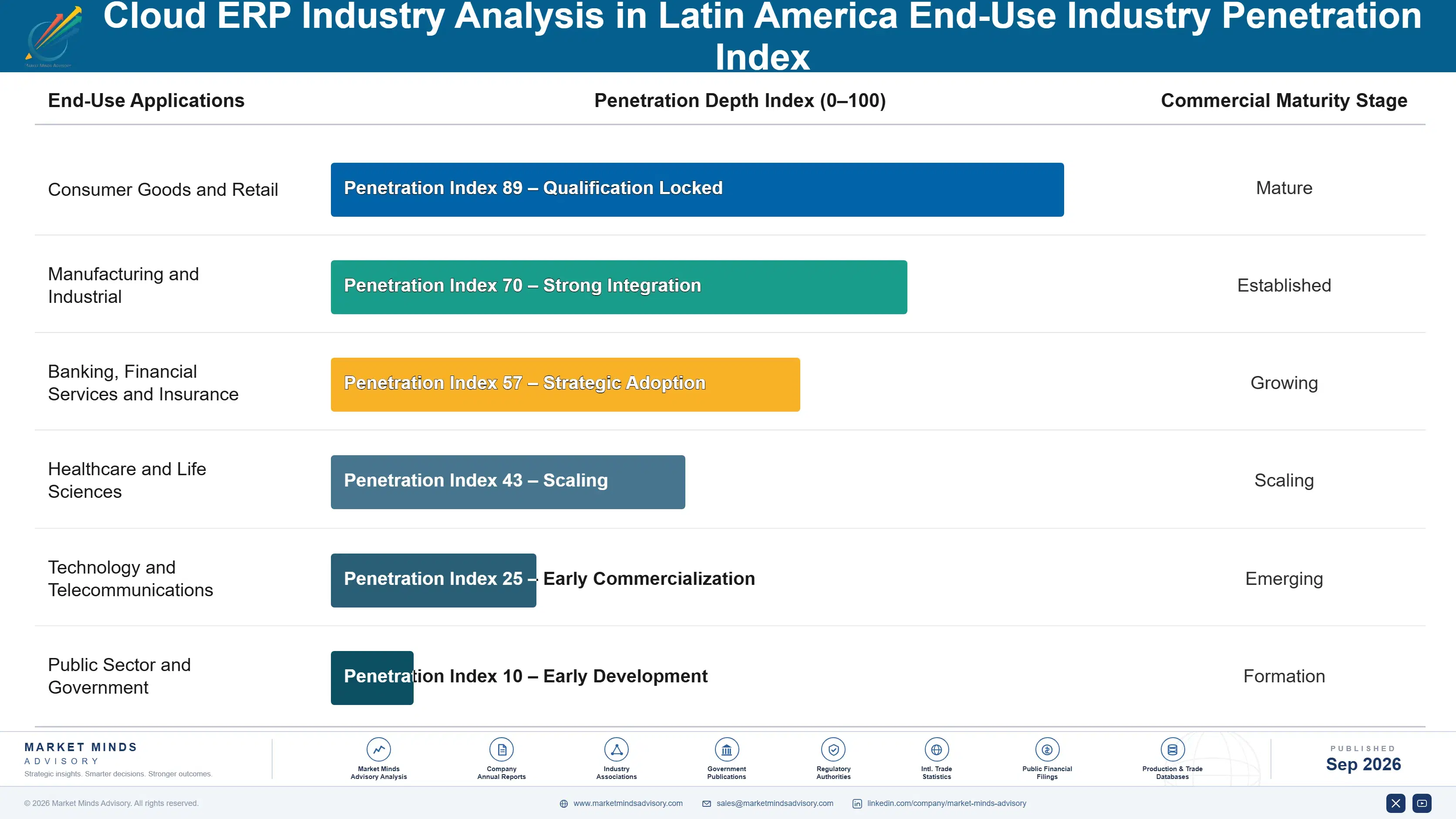
Cloud ERP in Latin America runs almost entirely on annual subscription contracts, giving vendors predictable recurring revenue once a platform is embedded in a customer's finance operations across every subsidiary and business unit. Net revenue retention above 110% is common among the leading vendors, driven primarily by module attachment and seat expansion as customers grow their regional footprint over successive contract years.
Adoption depth varies sharply by end-use vertical across the region. Financial services and large manufacturing enterprises embed these platforms deeply into compliance and tax reporting workflows, producing switching costs that keep churn below 6% annually among these accounts. Retail and smaller professional services buyers adopt more selectively, often running point solutions for specific functions rather than full platform standardization, which keeps their churn meaningfully higher across the board.

Buyer profiles are shifting generationally as regional finance leaders increasingly prioritize compliance automation and forecasting accuracy over feature checklists common in prior procurement cycles. Younger finance leaders entering the role since 2023 favor vendors offering local-currency pricing and native-language support over the centralized, English-language-first vendor relationships their predecessors accepted throughout the prior decade of regional enterprise software adoption.
cloud-erp-industry-analysis-in-latin-america-end-use-penetration-index-1788503572012

Where MMA Sees the Advantage

These are among the four positions where our research anticipates prominent divergence between winners and laggards over the coming forecast period. Each is grounded in the demand model, the regulatory perimeter, and the announced capacity pipeline.
01 / COMPLIANCE SPEED INVESTMENT

Build dedicated regional compliance engineering ahead of competitors

Regulatory deadlines, not budget cycles, now determine ERP replacement timing across most large accounts in this region, and the vendors that certify against new reporting formats fastest win the resulting evaluation. A centralized global product team update cycle is too slow for this market, since Brazil, Mexico, and Colombia advance on independent, overlapping schedules. Vendors investing in dedicated regional compliance engineering now will keep winning these deadline-driven replacement cycles for years to come, well beyond the current forecast horizon MMA has modeled here.
02 / MID-MARKET LOCALIZATION STRATEGY

Prioritize local-language and local-currency capability for mid-market accounts

Mid-market enterprises adopting cloud ERP for the first time are the fastest-growing buyer segment, and they consistently favor vendors offering native Portuguese and Spanish support over centralized English-language delivery. Local-currency pricing further reduces the currency risk that discourages multi-year commitments among this same segment. Vendors treating localization as a checkbox rather than a genuine investment will keep losing competitive evaluations to Totvs and other regional specialists whose entire product roadmap and go-to-market model is built specifically around this exact regional capability from the start.
03 / AI PLANNING CROSS-SELL

Cross-sell AI forecasting modules into the existing installed base first

AI-embedded financial planning modules are growing far faster than core ERP licensing, and the existing installed base represents the lowest-cost path to capturing this growth without a competitive acquisition sales cycle. Vendors running structured cross-sell campaigns are already reaching meaningful attach rates within eighteen months of module launch. Competitors treating these modules as new-customer features exclusively are leaving substantial expansion revenue on the table within their own existing accounts and long-tenured customer relationships already paying for core platform access today.
04 / CURRENCY RISK MANAGEMENT

Offer local-currency pricing to protect multi-year contract commitments

Currency volatility remains the single most cited objection during renewal negotiations across the region, and vendors maintaining dollar-only pricing are losing multi-year commitments to competitors offering local-currency alternatives. This flexibility trades some margin certainty for materially better contract duration and reduced churn risk, a trade increasingly favorable given rising customer acquisition costs across the region. Vendors slow to adopt this pricing flexibility risk ceding ground to more adaptable regional and global rivals already moving decisively in this direction across every major account segment MMA tracks.

Engagement Snapshot From the Field

A live engagement with an industry participant carrying material or product regulatory and market exposure ahead of a defining policy shift, showing how our research translates into a defensible multi-year portfolio strategy.
MARKET MINDS ADVISORY · CLIENT ENGAGEMENT SUMMARY
Cloud ERP Industry Analysis in Latin America Producer Strategic Portfolio Review and Transition Roadmap 2026·Investment Scenario on Cloud ERP Industry Analysis in Latin America Exposure Evaluation 2025-26
CLIENT PROFILE
The client is a mid-sized consumer goods manufacturer operating across Brazil, Mexico, and Colombia with several hundred million dollars in annual revenue and a finance function still running fragmented, largely spreadsheet-based reporting processes across its three national subsidiaries. The company had never operated a unified enterprise resource planning platform across all three markets simultaneously. No prior vendor relationship existed.
STRATEGIC CHALLENGE
The client needed to select a single cloud ERP platform capable of meeting Brazil's continuous electronic invoicing mandate while also supporting Mexico's and Colombia's distinct digital tax reporting requirements on comparable but non-identical timelines. Leadership lacked internal expertise to evaluate vendor compliance certification claims independently. Prior vendor sales presentations offered conflicting compliance claims MMA needed to independently verify.
MMA APPROACH
MMA benchmarked four leading cloud ERP platforms against the client's specific three-country compliance requirements, combining primary survey data with direct vendor reference calls across comparable manufacturing customers. The engagement produced a weighted scoring framework prioritizing certification speed and local-language implementation capability over generic feature comparison. Reference calls focused specifically on multi-country deployment experience rather than single-market implementations.
KEY FINDINGS
  1. Two of the four vendors evaluated lacked current certification against Colombia's newest digital reporting format, disqualifying them from consideration entirely. This gap surprised the client's procurement team.
  2. The selected platform's local-language implementation team completed rollout across all three countries approximately 35% faster than the client's original internal timeline estimate (client-reported, unverified by MMA).
  3. Annual licensing cost for the selected platform came in roughly $410,000 below the client's next-preferred alternative once implementation services were included (client-reported, unverified by MMA).
  4. Fragmented internal spreadsheet reporting, not technology limitation, was the primary root cause of the client's inability to consolidate financial results across its three subsidiaries.
CLIENT PROFILE
The client is a mid-sized consumer goods manufacturer operating across Brazil, Mexico, and Colombia with several hundred million dollars in annual revenue and a finance function still running fragmented, largely spreadsheet-based reporting processes across its three national subsidiaries. The company had never operated a unified enterprise resource planning platform across all three markets simultaneously. No prior vendor relationship existed.
STRATEGIC CHALLENGE
The client needed to select a single cloud ERP platform capable of meeting Brazil's continuous electronic invoicing mandate while also supporting Mexico's and Colombia's distinct digital tax reporting requirements on comparable but non-identical timelines. Leadership lacked internal expertise to evaluate vendor compliance certification claims independently. Prior vendor sales presentations offered conflicting compliance claims MMA needed to independently verify.
MMA APPROACH
MMA benchmarked four leading cloud ERP platforms against the client's specific three-country compliance requirements, combining primary survey data with direct vendor reference calls across comparable manufacturing customers. The engagement produced a weighted scoring framework prioritizing certification speed and local-language implementation capability over generic feature comparison. Reference calls focused specifically on multi-country deployment experience rather than single-market implementations.
KEY FINDINGS
  1. Two of the four vendors evaluated lacked current certification against Colombia's newest digital reporting format, disqualifying them from consideration entirely. This gap surprised the client's procurement team.
  2. The selected platform's local-language implementation team completed rollout across all three countries approximately 35% faster than the client's original internal timeline estimate (client-reported, unverified by MMA).
  3. Annual licensing cost for the selected platform came in roughly $410,000 below the client's next-preferred alternative once implementation services were included (client-reported, unverified by MMA).
  4. Fragmented internal spreadsheet reporting, not technology limitation, was the primary root cause of the client's inability to consolidate financial results across its three subsidiaries.
RECOMMENDED STRATEGY
Phase 1: Phase one: deploy the platform's compliance modules in Brazil first, given the most immediate regulatory deadline pressure. This sequencing matched the client's most urgent compliance exposure. Phase 2: Phase two: extend deployment to Mexico and Colombia over the following nine months, sequencing by each country's own mandate timeline. Phase 3: Phase three: consolidate financial reporting across all three subsidiaries into a single quarterly board reporting package. This consolidated view had never previously existed within the organization.
OUTCOME
The client selected the platform and completed its Brazil deployment ahead of the mandatory compliance deadline, with Mexico and Colombia following on the planned nine-month sequence. Consolidated quarterly reporting across all three subsidiaries became possible for the first time in company history, meaningfully improving board-level visibility into regional performance (client-reported, unverified by MMA).

Frequently Asked Questions

Foundational context covering the market sizes, CAGR, scope, country, region and competition that inform every finding below. This section is provided to cover basics and most often pre-purchase conversations, answered from the MMA Primary Research Dataset.

What is the current size of the Cloud ERP Industry Analysis in Latin America?

The global Cloud ERP market was valued at approximately $58.0 billion in 2025. Latin America contributes a growing share driven by mandatory tax digitalization programs.

How large will the Cloud ERP Industry Analysis in Latin America be by 2036?

MMA projects the global market will reach approximately $182.8 billion by 2036. Latin America's share is expected to expand faster than the global average over this period.

What is the CAGR for the Cloud ERP Industry Analysis in Latin America 2026 to 2036?

The global market is projected to grow at a compound annual growth rate of 11.0% between 2026 and 2036. Compliance-driven demand keeps Latin America's growth above this global rate.

Which segment is growing fastest?

AI-Embedded Financial Planning and Analytics Modules is the fastest growing segment, expanding at 16.5% annually, roughly 1.5x the overall market rate. Enterprise demand for embedded forecasting is driving this acceleration.

Who are the major companies in the Cloud ERP Industry Analysis in Latin America?

Leading companies include SAP, Oracle, Microsoft, Totvs, and Workday. Totvs holds a distinct home-market position across Brazil that global vendors have struggled to erode over several years of direct competition.

Which country is growing fastest?

Brazil is the fastest growing country market, expanding at approximately 15.5% annually. Continuous electronic invoicing mandates are the primary driver behind this acceleration across the country's enterprise sector.

Report Segmentation Architecture

The full report scope spans multiple orthogonal segmentation dimensions, with cross-tabulated demand data provided for each dimension pair. Coverage extends further to regional breakdowns, trend trajectories, and the competitive detail needed to support segment-level decision-making.

By Primary Market Dimension

  • AI-Embedded Financial Planning and Analytics Modules
  • Small and Mid-Market Cloud ERP Platforms
  • Industry-Specific Vertical Cloud ERP Solutions
  • Cloud ERP Managed Support and Optimization Services
  • Cloud ERP Implementation and Integration Services
  • Large Enterprise Cloud ERP Platforms

By End-Use Industry

  • Consumer Goods and Retail
  • Manufacturing and Industrial
  • Banking, Financial Services and Insurance
  • Healthcare and Life Sciences
  • Technology and Telecommunications
  • Public Sector and Government

By Commercial Dimension

  • Large Enterprise
  • Small and Mid-Market Business
  • Direct Sales
  • Channel Partner and Reseller
  • Managed Services

By Region

  • North America
  • Western Europe
  • East Asia
  • South Asia and Pacific
  • Latin America
  • Middle East and Africa
  • Eastern Europe

Scope, Methodology, and Coverage

Every figure in this report is reproducible from documented input assumptions. The scope below maps the historical period, the forecast horizon, the segmentation dimensions, and the countries covered, alongside the underlying primary and qualitative methodology.
Historical Period
2020 to 2025
Forecast Period
2026 to 2036
Base Year
2025 (USD billions; MMA Primary Research Dataset, September 2026)
Market Definition
This report covers cloud-based enterprise resource planning software delivered via subscription across finance, supply chain, human capital, and operations modules for organizations operating in or serving Latin American markets. It excludes on-premises perpetual license ERP deployments and standalone point solutions such as isolated accounting or payroll software not integrated within a broader ERP suite.
Quantitative Units
USD Billion, CAGR (%), 2020-2036
Segmentation Dimensions
By Primary Market Dimension, By End-Use Industry, By Commercial Dimension, By Region
Regions Covered
North America, Western Europe, East Asia, South Asia and Pacific, Latin America, Middle East and Africa, Eastern Europe
Countries Covered
United States, Canada, Germany, United Kingdom, France, China, Japan, South Korea, India, Australia, Brazil, Mexico, Colombia, Argentina, Chile, Saudi Arabia, UAE, South Africa, Poland
Key Companies Profiled
SAP, Oracle, Microsoft, Totvs, Workday, Infor, NetSuite, Sage, Epicor, IFS, Acumatica, Unit4, Deltek, Syspro, Priority Software, Odoo, Rootstock Cloud ERP, Plex Systems, Ramco Systems, QAD Inc.
Quantitative Methodology
Primary survey, n=3,800 respondents, Q4 2025, six countries; demand-side model with trade association cross-validation
Qualitative Methodology
47 expert interviews, Q4 2025; applied to validate demand model assumptions, identify emerging dynamics, and assess competitive positioning
Report Format
PDF and XLSX data workbook (Word format preview document)
Publisher
Market Minds Advisory
Report Code
MMA-2026-TEC-706
Published
September 2026
Contact
sales@marketmindsadvisory.com | www.marketmindsadvisory.com

Purchase the full Cloud ERP Industry Analysis in Latin America Report (2026 to 2036).

This report provides a comprehensive assessment of the global Cloud ERP market with particular depth on Latin America, covering historical performance from 2020 to 2025 and a forecast through 2036. It examines segmentation across primary product types, end-use industries, and commercial models, alongside regional demand dynamics across all seven world regions. The competitive landscape section profiles twenty companies and benchmarks the five leading vendors on a revenue basis. Analysis includes input cost exposure, portfolio margin economics, and strategic recommendations for market participants. The report also includes an anonymized client case study demonstrating practical vendor selection in a real three-country deployment.
Ten-year market sizing and forecast model
Six-segment MECE market segmentation framework analysis
All seven world regional markets profiled fully
Twenty-company competitive benchmarking dataset included here
Detailed Latin America compliance and localization analysis
Anonymized client case study with strategy

Built For The People Who Decide

From boardroom strategy to bench-side execution, this report is read cover-to-cover by leaders shaping the next decade of their industry, turning demand scenarios, market dynamics and valuation benchmarks into decisions.
CXOs/ Presidents/ VPs/ Managers
M&A and Corporate Development
Strategy Teams and R&D Heads
Procurement and Product Directors
Regulatory and Compliance Leaders
Investor Relations and Equity Analysts