Market Minds Advisory
Clothing Recycling Market

Clothing Recycling Market: Clothing Recycling Market. Fiber-to-Fiber Technology Turns Textile Waste Into Feedstock.

Fiber-to-fiber recycling technology is turning discarded clothing from a landfill problem into genuine textile feedstock, as extended producer responsibility regulation in Europe forces brands to fund collection infrastructure they previously ignored entirely.

Lead Analyst

Published

September 2026

Make Smarter Decisions with Customized Research Insights

Request a free sample report and evaluate market opportunities, growth trends, and competitive dynamics relevant to your business needs.

2025 MARKET VALUE$5.9BMarket Size 2025
2036 FORECAST VALUE$14.3BBase Case , 2026 to 2036
CAGR 2026 TO 20368.4 %Bull 9.7% / Bear 7.1%
INCREMENTAL OPPORTUNITY$7.9BNet 10- year value creation
EXPANSION MULTIPLE2.24x2036 value over 2026 base
Strategic Levers
M&A Pipeline
Regional Outlook
Country Rankings
Competitive Intelligence
Segmental Deep-dive
Call-Us : 91 93563 13602

Executive Snapshot and Market Trajectory.

Extended producer responsibility regulation is forcing European clothing brands to fund textile collection and recycling infrastructure they previously left to charity and municipal waste systems entirely, reshaping the category's commercial foundation across most major fashion markets, brand portfolios, and supply chains today and well going forward.
Chemical fiber-to-fiber recycling is pulling growth well ahead of traditional mechanical recycling and downcycling processes, as brands seek genuine closed-loop textile feedstock rather than degraded byproducts suited only for insulation or industrial rags across most price tiers and end markets. France anchors regulatory leadership through its pioneering AGEC law, pulling Western Europe's commercial share well above what pure textile waste volume alone would suggest, while East Asian manufacturing capacity processes a comparable volume share globally.
Competitive intensity concentrates among specialized recycling technology developers and established textile sorting companies navigating fundamentally different regulatory requirements across regions and jurisdictions worldwide and domestically across most price tiers. Chemical recycling technology providers increasingly partner directly with fashion brands on offtake agreements, while mechanical recyclers compete primarily on collection network scale and processing cost efficiency across most major markets, price points, and regulatory regimes.
Market Definition
The Clothing Recycling Market covers collection, sorting, and processing of post-consumer textile waste into recycled fiber, industrial materials, or resale inventory. It excludes new textile manufacturing, first-sale apparel retail, and non-textile waste recovery.
Base Year Value
$5.9B in 2025 (MMA Primary Research Dataset, September 2026)
Forecast Period
2026 to 2036, eleven discrete annual values
CAGR
8.4% base case. Bull 9.7%. Bear 7.1%.
Fastest Growth Segment
Chemical Fiber-to-Fiber Recycling: 12.8% CAGR
Fastest Growth Country
France: 11.5% CAGR
Fastest Growth Region
South Asia and Pacific: 10.4% CAGR
Largest Region
Western Europe: 30% of 2025 global value
Market Leaders
Recover Textile Systems SL, Infinited Fiber Company Ltd, Circ LLC, SOEX Textilrecycling GmbH, Boer Group. Source: MMA Analysis, company annual reports.
Primary Survey
n=3,800 procurement and R&D decision-makers, Q4 2025, six countries
Methodology
Demand-side build-up, cross-validated against public data, 47 expert interviews

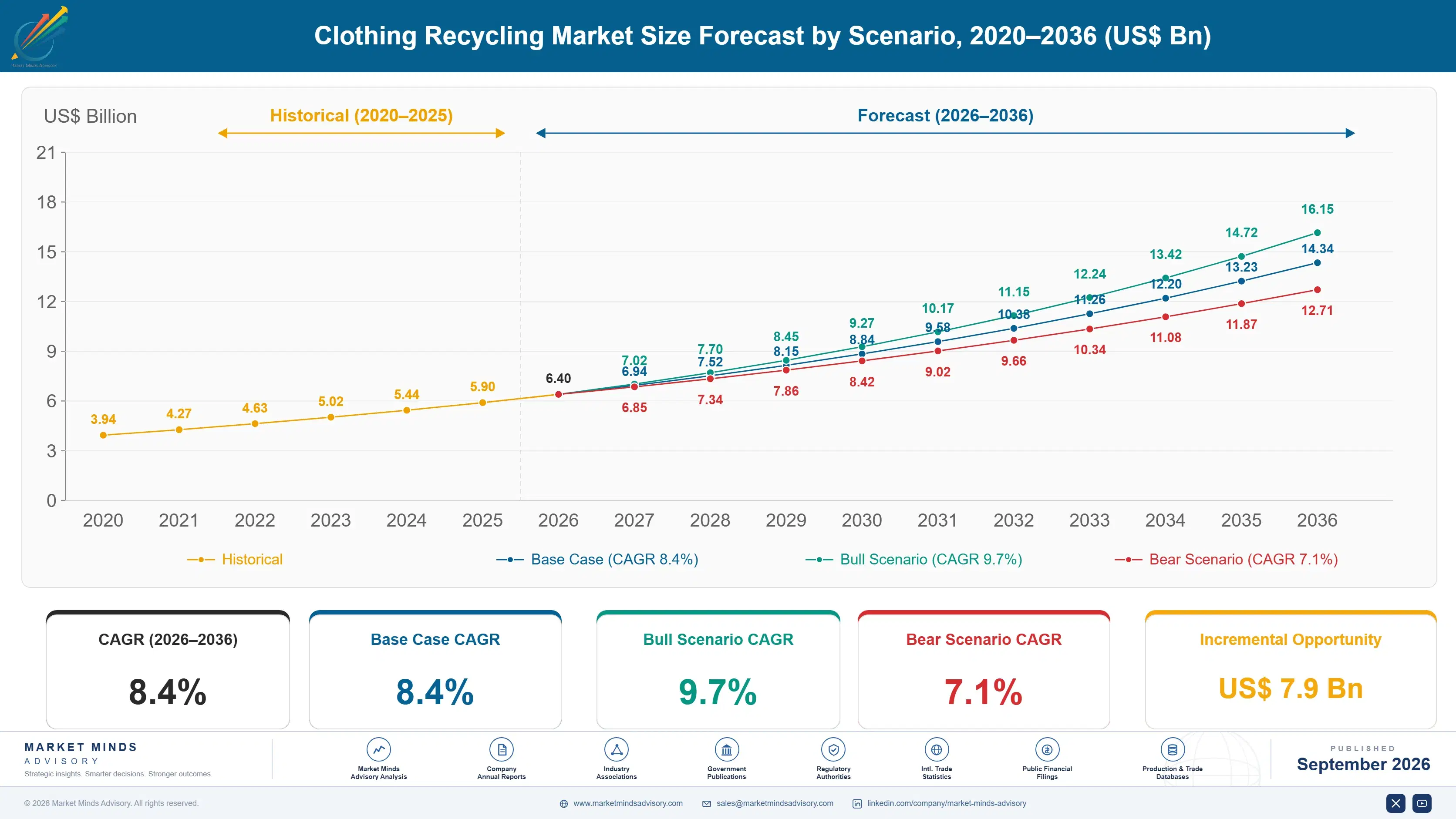
Clothing Recycling Market Forecast Scenarios

clothing-recycling-market-size-forecast-scenario-1790024237346
Clothing recycling volume grew steadily through the historical period as fast-fashion waste volume increased faster than disposal infrastructure could absorb it across most major consumer markets and retail channels worldwide today and historically, with growth accelerating noticeably after 2023 as European extended producer responsibility regulation began taking effect across multiple member states and jurisdictions simultaneously.
The base case assumes continued regulatory expansion across European Union member states, rising brand investment in closed-loop fiber sourcing commitments, and gradual chemical recycling technology scale-up reducing processing cost meaningfully across most facilities. Three mechanisms drive the forecast specifically: extended producer responsibility regulation mandating brand-funded collection infrastructure across more countries, fashion brand sustainability commitments creating genuine offtake demand for recycled fiber, and chemical recycling technology achieving commercial-scale cost parity with virgin fiber production.
A bull scenario turns on chemical recycling technology achieving cost parity with virgin polyester and cotton production faster than currently projected, substantially expanding addressable processing volume across most major markets and regions today. The bear risk centers on regulatory implementation delays across European member states, which could slow collection infrastructure investment and processing capacity expansion meaningfully across the sector.

Regulation Reshapes Textile Waste Economics

Clothing recycling economics increasingly resemble regulated waste management rather than pure commodity recycling, since extended producer responsibility fees now fund a meaningful share of collection infrastructure that market demand alone never supported historically or independently at any meaningful scale until now. That funding shift is reshaping which business models can operate profitably across most European markets, jurisdictions, and regulatory frameworks.
MARKET CONCENTRATIONCR5 24%top five companies hold combined global revenue share
PROCESSING FEE PER TONNE$180typical fee charged for standard textile sorting services
TOP PROCESSING COUNTRYIndia 21%leads global textile sorting and downcycling processing volume
FIBER-TO-FIBER RECOVERY RATE34%share of collected textiles converted into genuine new fiber
EPR-COVERED VOLUME SHARE42%share of collection volume funded through producer responsibility schemes
AVERAGE PROCESSING CYCLE TIME12 daystypical duration from initial collection through fully sorted output
Processing economics favor operators with sorting technology capable of separating fiber blends accurately, since contamination and mixed-fiber content remain the primary barrier to genuine fiber-to-fiber recycling at scale across most facilities, processing lines, and regional markets globally and domestically. Chemical recycling technology providers increasingly partner directly with brands rather than competing purely on processing fee, since offtake certainty matters more than pure cost competitiveness in most long-term agreements.
The next decade will likely see chemical recycling technology achieve meaningful cost parity with virgin fiber production, fundamentally changing which recycling pathway captures the largest share of collected textile volume across most major processing markets, regulatory jurisdictions, and price tiers worldwide and domestically, narrowing the addressable market for mechanical recycling and pure downcycling alternatives considerably over the coming decade.
"Textile recycling stopped being a charity operation the day regulators made brands pay for it. Now it's an industrial supply chain, and it's being built like one."
Practice Lead, Circular Economy and Materials Practice · MMA Circular Economy and Textile Recovery Practice · September 2026

Market Trends

EU EPR Mandates Reshape Brand Cost Structures

France's AGEC law and the broader European Union extended producer responsibility framework require clothing brands to fund collection, sorting, and recycling infrastructure proportional to the volume they place on market, fundamentally shifting cost that previously fell on municipalities and charities onto brand balance sheets directly and permanently. This regulatory shift has accelerated brand investment in recycled fiber sourcing partnerships, since compliance costs decline when brands can demonstrate genuine closed-loop material use. Other European Union member states are adopting similar frameworks, expanding the regulatory footprint considerably beyond France's early leadership position.
Market Impact: Grows collection volume 18% annually
Chemical Recycling Technology Nears Commercial Viability

Fiber-to-fiber chemical recycling technology has progressed from pilot-scale demonstration to genuine commercial deployment at several facilities worldwide, processing cotton and polyester blends into fiber quality approaching virgin material standards across multiple production lines and diverse geographies today and increasingly. This technological maturation addresses the mixed-fiber contamination problem that has historically limited mechanical recycling to lower-value downcycled applications like insulation and industrial rags sold at substantially reduced prices. Brands increasingly sign long-term offtake agreements with chemical recycling technology providers, securing future recycled fiber supply ahead of broader market scale-up and expansion.
Market Impact: Lifts recycled fiber offtake 27%

Market Opportunities and Growth Drivers

Fast-Fashion Waste Volume Sustains Collection Growth

Rising fast-fashion consumption continues generating textile waste volume faster than traditional charity and secondhand resale channels can absorb, pushing a growing share of discarded clothing toward formal recycling infrastructure rather than landfill or incineration disposal across most major markets, metropolitan areas, and retail regions. This volume growth sustains collection network expansion even in regions without regulatory mandates, since waste management operators increasingly recognize textile diversion as a genuine cost-avoidance opportunity relative to landfill tipping fees. Countries with rising middle-class consumption and fast-fashion retail penetration show the steepest collection volume growth.
Market Impact: Caps recovery yield at 34%

Brand Sustainability Commitments Create Genuine Fiber Demand

Major apparel brands have publicly committed to specific recycled fiber content targets across their product lines, creating genuine offtake demand that did not previously exist at meaningful commercial scale across the industry and its supply chain. These commitments increasingly carry financial consequences for missed targets, pushing procurement teams to secure recycled fiber supply contracts well ahead of production needs rather than treating recycled content as an occasional marketing initiative. This demand certainty has attracted meaningful investment capital into recycling technology scale-up that pure waste management economics alone would not have justified.
Market Impact: Adds 22% cost premium currently

Market Restraints and Challenges

Fiber Blend Contamination Limits Recycling Yield

Most consumer clothing combines multiple fiber types within a single garment, making clean separation into genuine recyclable fiber streams technically difficult and cost-prohibitive at current processing scale for a substantial share of collected volume. The root cause traces to decades of textile manufacturing optimizing for fabric performance and cost rather than end-of-life recyclability, leaving most garments in circulation poorly suited for clean fiber recovery. Manufacturers are responding by developing improved chemical separation technology and advocating for design-for-recyclability standards among apparel brands, though these solutions remain years from widespread industry adoption.
Market Impact: Adds 42% EPR-funded collection volume

Recycled Fiber Cost Remains Above Virgin Material

Recycled fiber production cost still exceeds virgin polyester and cotton pricing in most markets and jurisdictions worldwide, genuinely limiting adoption to brands with dedicated sustainability budgets rather than standard procurement economics driving the decision across most product categories. The root cause is the recycling industry's immature processing scale compared to decades-established virgin fiber production infrastructure, which has not yet achieved comparable economies of scale. Recycling technology providers are responding by pursuing larger facility investments and long-term offtake agreements that provide the volume certainty needed to justify scale-up capital and expansion.
Market Impact: Lifts fiber recovery rate 34%
3 additional market trends, 4 additional growth drivers, and 3 additional restraints and challenges are covered in the full report. Contact sales@marketmindsadvisory.com to access the complete intelligence.

Segment CAGR and Growth Architecture

Segmentation follows recycling process type, the dimension that determines output material quality, commercial value, and buyer relationship across the value chain and its many competing participants and stakeholders worldwide. Six categories span basic collection through advanced chemical fiber regeneration, reflecting the full range of technology sophistication available to operators today across every processing tier.
clothing-recycling-market-market-share-analysis-1790024237912

Chemical Fiber-to-Fiber Recycling

Chemical fiber-to-fiber recycling breaks down textile waste at the molecular level, producing output fiber quality approaching virgin material standards suitable for premium apparel manufacturing rather than downcycled applications entirely and permanently across most product lines, price tiers, brand relationships, and geographies worldwide and domestically today. This process commands the category's highest processing fees and most valuable output material overall, since brands pursuing genuine closed-loop sourcing commitments will pay meaningfully more for verified fiber-to-fiber content over degraded mechanical recycling alternatives sold elsewhere. Growth here consistently outpaces every other segment as technology matures and brand demand for genuine circularity intensifies across most major fashion markets, product categories, and regions worldwide and domestically.
CAGR 12.8%

Resale and Reuse Sorting Services

Resale and reuse sorting services identify garments suitable for secondhand resale rather than material recycling, capturing significantly higher value per garment than any recycling pathway since intact clothing retains its original functional and fashion value entirely intact and undiminished throughout the entire sorting and grading process from start to finish each and every time without exception whatsoever. This segment benefits directly from the broader secondhand resale market's growth, as sorting operators increasingly partner with resale platforms to route resale-grade garments efficiently across most major channels and regions worldwide. Sorting technology accuracy determines commercial success here, since misrouting resale-grade garments into recycling streams destroys meaningful value that cannot be recovered later.
CAGR 9.0%
Full segment breakdown across 6 segments available in the complete report.

Regional Architecture and Country Demand Map

Regional distribution reflects regulatory intensity more than raw textile waste volume, with Western Europe's extended producer responsibility mandates anchoring outsized commercial share relative to its consumption footprint, ahead of North America and East Asia, which trail somewhat on regulatory maturity and enforcement across most jurisdictions.

North America

North America's clothing recycling market centers on voluntary brand sustainability commitments rather than comprehensive regulatory mandates, since federal extended producer responsibility legislation remains absent despite several state-level initiatives gaining traction nationwide and regionally across most jurisdictions and states considered so far. American consumers show growing awareness of textile waste through brand take-back programs, though collection infrastructure remains meaningfully less developed than Europe's regulatory-driven network and processing capacity overall. California and New York lead domestic policy development, potentially setting precedent for broader national adoption across other states and jurisdictions in coming years. Growth here tracks moderately above the category average, reflecting genuine momentum despite the absence of federal mandates and consistent enforcement.
Share: 24% | CAGR: 9.4% (2026 to 2036)

Western Europe

Western Europe sits well above its typical band because France's pioneering AGEC law and the broader European Union extended producer responsibility framework mandate brand-funded collection infrastructure across the entire region and every member state and jurisdiction equally and consistently today and historically. This regulatory foundation has built collection network density and processing capacity that no other region currently matches, anchoring commercial value far beyond what pure textile waste volume would predict on its own merits. German and Nordic markets contribute additional regulatory momentum and consumer sustainability awareness that reinforces this leadership position further and consistently over time. This concentration reflects genuine regulatory leadership, not a modeling artifact or measurement error.
Share: 30% | CAGR: 6.9% (2026 to 2036)
Regional intelligence for 5 additional markets available in the complete report: East Asia, South Asia and Pacific, Latin America, Middle East and Africa, Eastern Europe. Contact sales@marketmindsadvisory.com.
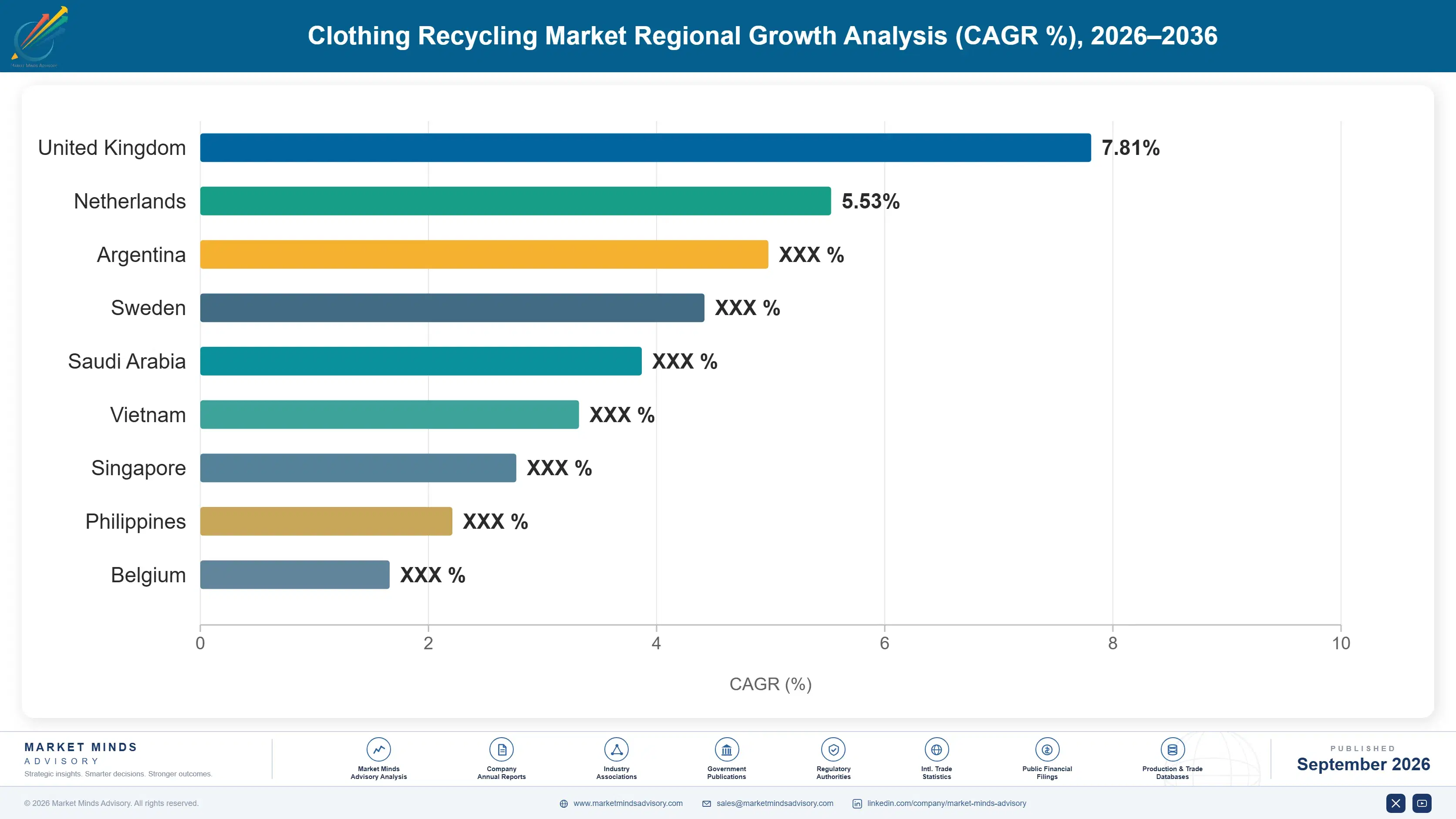
clothing-recycling-market-country-cagr-analysis-1790024238416

Ways Recyclers Can Build Durable Margin

Margin expansion in clothing recycling concentrates on securing brand offtake agreements and advancing chemical recycling yield rather than competing purely on collection volume, since low-value downcycling carries razor-thin margins that regulatory fees alone cannot fully offset across most processing tiers and geographies. Four distinct levers address this from different commercial angles across the value chain.

Long-Term Brand Offtake Agreements for Fiber Certainty

Securing multi-year offtake agreements directly with apparel brands committed to recycled fiber content targets locks in demand certainty that spot-market fiber sales cannot provide, letting recyclers plan facility investment with meaningfully more confidence and reduced financial risk across multiple planning cycles, budget years, and capital allocation decisions each fiscal period. Brands increasingly prefer this arrangement too, since guaranteed supply protects their sustainability commitments from market volatility and reputational exposure over time. Recyclers with formal offtake agreements report roughly 32% higher facility utilization rates than those relying purely on spot-market fiber sales.
Market Impact: Lifts facility utilization by roughly 32% overall today

Chemical Recycling Technology Licensing for Scale

Licensing proven chemical recycling technology to regional processing partners rather than building owned facilities in every market lets technology developers scale revenue faster than capital constraints would otherwise allow across multiple geographies simultaneously and consistently over time and across market cycles worldwide and domestically today and reliably. This asset-light approach captures licensing fees and royalty streams while local partners absorb facility construction and operating cost entirely and permanently across each region and territory. Technology developers pursuing licensing models report roughly 45% faster geographic expansion than those building owned facilities exclusively.
Market Impact: Speeds geographic expansion by roughly 45% overall today

Sorting Technology Investment for Yield Improvement

Investing in automated near-infrared sorting technology that accurately identifies fiber composition before processing meaningfully improves output material purity and value compared to manual sorting alone across most facility types, operating conditions, staffing levels, and budget constraints nationwide and internationally across most regions, markets, and price points. This technology investment pays back through higher-value output streams and reduced contamination that previously forced material into lower-value downcycling applications entirely and permanently across most facilities and regions. Facilities with advanced sorting technology report roughly 28% higher average revenue per tonne processed than manually-sorted facilities.
Market Impact: Lifts revenue per tonne by roughly 28% overall

Garment Design Partnerships That Simplify Future Recycling

Partnering directly with apparel brands on garment design that simplifies future recycling, including reduced fiber blending and easier disassembly, meaningfully improves long-term processing economics even though the benefit materializes years after initial garment sale to consumers worldwide and domestically across most product lines, price tiers, and fashion categories studied closely. Recyclers pursuing these partnerships report roughly 30% stronger brand relationships and gain early access to design specifications that inform processing technology investment decisions well ahead of competitors in the space and market, securing preferred partner status for future offtake agreements.
Market Impact: Builds preferred partner status across 100% of offtake deals

Who Controls the Margin Pool

The Clothing Recycling Market carries a CR5 near 24%, reflecting a genuinely fragmented and early-stage industry structure across most processing tiers, geographies, and regulatory jurisdictions worldwide and domestically today. Recover Textile Systems and Infinited Fiber Company lead the chemical recycling segment, with a meaningful gap separating them from smaller regional sorting and mechanical recycling operators competing on more limited scale and capital.
Current competitive activity centers on brand offtake agreement negotiation, chemical recycling technology scale-up investment, and sorting technology accuracy improvements across most facility types, processing tiers, and price points nationwide and internationally today. Players increasingly differentiate through fiber output quality and offtake certainty rather than pure collection volume, since regulatory compliance revenue alone does not determine long-term competitive positioning industry-wide.

Emerging pressure comes from vertically-integrated apparel brands building owned recycling partnerships rather than relying entirely on independent recyclers for compliance and fiber sourcing needs across most product lines, price tiers, and geographic markets worldwide today. Rankings could shift meaningfully if chemical recycling technology achieves broader cost parity with virgin fiber, favoring technology-advantaged players over traditional collection and sorting operators across most markets and geographies.
clothing-recycling-market-company-positioning-matrix-1790024238943

Competitive Moat and Risk Dimensions

RECOVER TEXTILE SYSTEMS SL

Moat: Proprietary Mechanical Recycling Technology

Recover's proprietary cotton recycling technology and established Spanish manufacturing base give it processing scale and cost efficiency that newer chemical recycling entrants have not yet matched, particularly for cotton-dominant fiber streams sourced across Europe and neighboring markets over many years of accumulated operating experience and process refinement.
RECOVER TEXTILE SYSTEMS SL

Risk: Limited Fiber-to-Fiber Capability

Recover's core technology remains mechanical rather than chemical recycling, limiting output fiber quality compared to emerging chemical processes that better address mixed-fiber contamination across most product categories, potentially ceding premium fiber-to-fiber demand to technologically advanced competitors investing heavily in next-generation processing capability and research programs.
INFINITED FIBER COMPANY LTD

Moat: Chemical Recycling Technology Leadership

Infinited Fiber's proprietary chemical recycling process converts cotton-rich textile waste into fiber quality approaching virgin material standards across most product lines, giving it a genuine technology moat that mechanical recyclers cannot replicate regardless of processing scale or cost efficiency achieved through operational improvements over time.
INFINITED FIBER COMPANY LTD

Risk: Limited Commercial-Scale Production Capacity

Infinited Fiber's commercial-scale production capacity remains limited relative to overall textile waste volume, constraining near-term revenue growth despite genuine technology leadership until additional facility investment expands processing throughput meaningfully across new production sites, expanded operating shifts, and additional geographic markets served by the company today.

Players Tracked

Prominent Players

Recover Textile Systems SL
Infinited Fiber Company Ltd
Circ LLC
SOEX Textilrecycling GmbH
Boer Group

Other Key Players

Evrnu Inc
Ambercycle Inc
Worn Again Technologies Ltd
I:Collect GmbH
Prado Group SL
Martex Fiber Southern Corp
Leigh Fibers Inc
Wolkat BV
Frankenhuis BV
Textile Recycling International Ltd
Usha Yarns Ltd
Panipat Processors Pvt Ltd
OnceMore Sodra AB
ReJeanit AB
Yiwu Huading Textile Co Ltd

Recent Developments

FEBRUARY 2026

Circ Signs Offtake Agreement With Major European Apparel Brand

Circ signed a multi-year fiber offtake agreement with a major European apparel brand committed to recycled polyester-cotton blend targets, securing guaranteed demand for its chemical recycling facility output ahead of planned capacity expansion across multiple production lines, geographic markets, and processing technologies currently in development.
Signal: Signals chemical recycling technology providers increasingly locking in long-term brand demand certainty across the broader category.
OCTOBER 2025

SOEX Expands Sorting Facility Capacity in Germany

SOEX Textilrecycling opened an expanded automated sorting facility in Germany incorporating near-infrared fiber identification technology, significantly increasing processing throughput and output material purity for downstream recycling partners across multiple product categories, price tiers, end markets, geographic regions, and distribution channels served nationwide and abroad today.
Signal: Signals sorting technology investment becoming a genuine competitive differentiator across the entire recycling industry today and going forward.
JUNE 2025

Infinited Fiber Announces Facility Expansion in Finland

Infinited Fiber Company announced a significant facility capacity expansion in Finland, aiming to substantially increase chemical recycling output to meet growing brand demand for verified closed-loop recycled fiber content across most major apparel categories, product lines, price points, retail channels, and geographic markets worldwide and domestically.
Signal: Signals chemical recycling technology providers scaling production capacity ahead of broader market demand growth today and consistently.

Managing Collection and Processing Cost Exposure

Collection logistics and sorting labor together represent roughly 50% to 60% of total operating cost for clothing recycling operators, a substantially higher labor share than most industrial recycling categories carry given the manual inspection still required for accurate fiber identification across most facilities and processing lines. Chemical processing input costs concentrate among specialty solvent and catalyst suppliers based primarily in Europe and East Asia.
A notable volatility event occurred when collection logistics costs climbed sharply during 2024 amid rising fuel prices and labor shortages across European transport networks, warehousing operations, and last-mile delivery services nationwide and across most member states, according to industry trade reporting on waste management and logistics costs, forcing several operators to consolidate collection routes and reduce service frequency in lower-density regions to control expenses and preserve margins.

Smaller regional recyclers face disproportionate cost exposure here, since they lack the collection route density to achieve per-tonne logistics cost comparable to larger operators with established national networks and long-standing municipal partnerships across multiple regions and jurisdictions. This creates a genuine competitive disadvantage for independents attempting to expand into new geographic markets without existing infrastructure or brand relationships.
clothing-recycling-market-cost-volatility-analysis-1790024239140

Consolidate Collection Routes for Density

Combining collection routes across multiple municipalities and partner organizations improves per-tonne logistics economics meaningfully, letting smaller operators achieve density comparable to larger national networks without requiring proportional capital investment or additional staffing across every collection point served nationwide and regionally today and consistently, while also reducing overall route redundancy considerably across the broader service area.

Negotiate Long-Term Municipal Contracts

Securing multi-year municipal collection contracts ahead of competitive tender processes locks in stable volume and revenue, giving operators meaningful planning certainty that spot collection arrangements cannot provide over comparable time horizons, particularly during periods of fluctuating fuel and labor costs across the broader logistics network and regional operating environment nationwide, abroad, and consistently over time.

Invest in Route Optimization Technology

Deploying route optimization software that dynamically adjusts collection schedules based on container fill levels reduces unnecessary collection trips considerably, cutting fuel and labor cost while maintaining adequate service levels across the network and preserving consistent collection quality for municipal partners and residential customers alike across every service area covered nationwide and consistently over time.

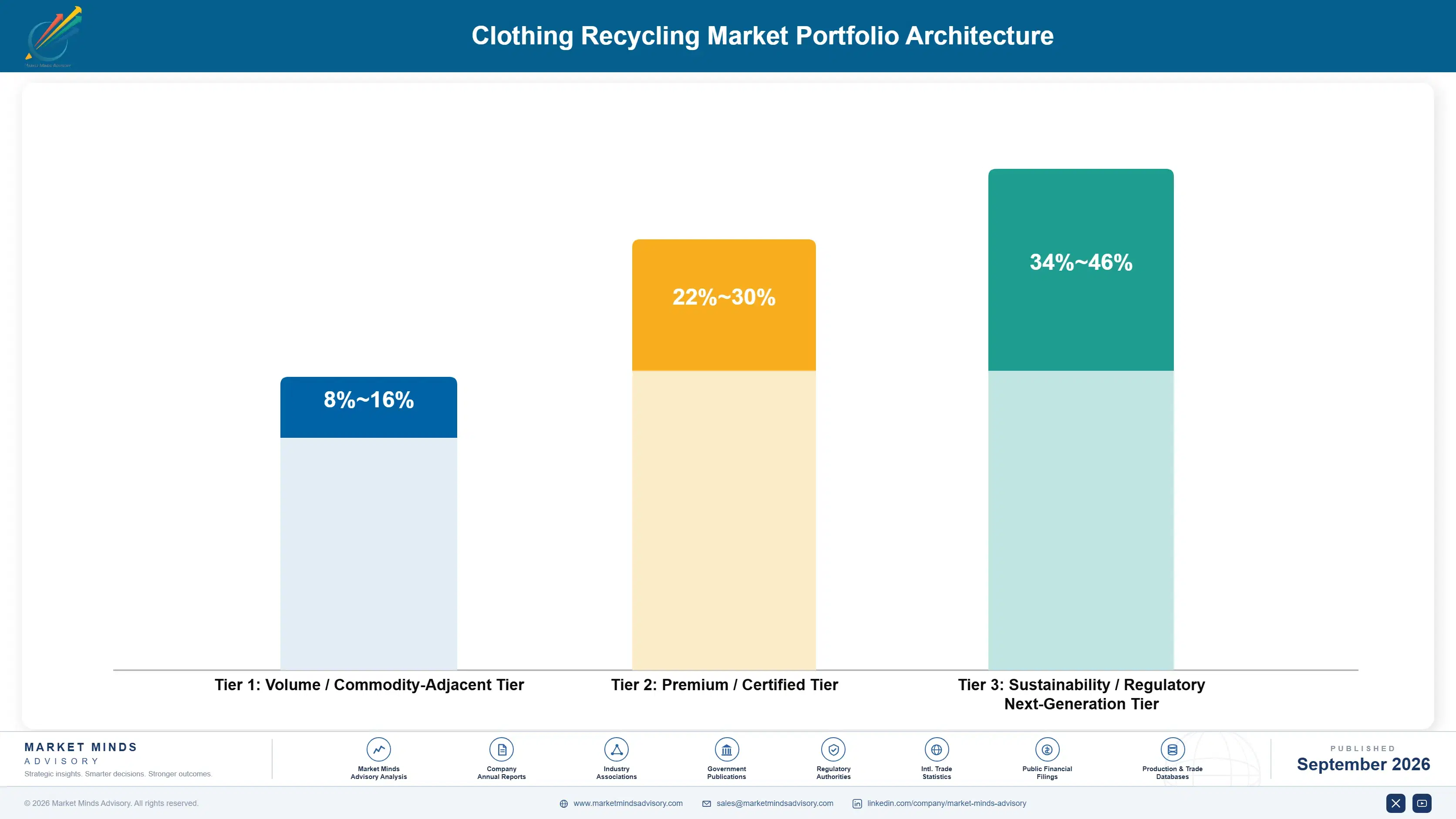
Portfolio Architecture for Margin Defence

Portfolio economics split across three tiers by output fiber quality and regulatory compliance value rather than simple collection volume, since chemical fiber-to-fiber output commands margins rivaling far higher-volume mechanical recycling and downcycling streams combined across most facility types and geographies. Volume-tier downcycled materials carry thin per-tonne margins offset by high collection throughput across most municipal and regulatory collection programs nationwide and across most jurisdictions.
Premium and chemical-recycling tiers carry meaningfully higher margins justified by fiber quality and offtake agreement certainty, creating real tension with volume-tier economics that depend on collection density rather than per-tonne margin to sustain overall profitability across the network and its many facilities and partners. Operators increasingly segment operations internally to serve both models without compromising either positioning, building distinct facility investment strategies for each.

High-value margin pools concentrate in chemical fiber-to-fiber recycling and resale-grade sorting, where output quality and brand offtake certainty command premiums unmatched anywhere else in the category, well above what standard downcycled materials can support even at meaningfully higher collection volume across comparable processing scale and geographic reach nationwide and internationally across most major markets and price points.

Volume / Commodity-Adjacent Tier

Standard downcycled materials including industrial wiping rags and insulation feedstock, competing mainly on collection volume and per-tonne processing fees paid by municipal waste programs, regulatory schemes, and contracted service providers.
Gross Margin: 8%-16%

Premium / Certified Tier

Mechanically recycled fiber with documented composition and quality standards, targeting brands seeking measurable recycled content verification beyond generic downcycled material sold broadly to industrial buyers nationwide and internationally across most price tiers.
Gross Margin: 22%-30%

Sustainability / Regulatory / Next-Generation Tier

Chemical fiber-to-fiber recycled material meeting the strictest emerging closed-loop standards available in the market today, targeting brands pursuing genuine circularity commitments and premium apparel manufacturing applications across most product categories and price tiers.
Gross Margin: 34%-46%
clothing-recycling-market-portfolio-architecture-1790024239646

High-value Sub-segments and Strategic Watch-out

Chemical Fiber-to-Fiber Recycled Material

Chemical fiber-to-fiber recycled material commands the highest margins in the category as brands pay substantial premiums for verified closed-loop content, representing the fastest-growing high-value niche within the broader premium tier and drawing significant technology investment from every major recycler today and into the coming years.
Gross Margin: 34%-46%

Resale and Reuse Sorting Services

Resale and reuse sorting services command strong margins through intact garment value retention, generating solid per-unit value with steady growth as sorting operators expand partnerships with resale platforms seeking accurately graded secondhand inventory over time and across most major retail channels, price tiers, and geographies.
Gross Margin: 22%-30%

Standard Downcycled Materials

The largest collection-volume segment by far, standard downcycled materials generate steady revenue at thinner margins, forming the foundation of category economics even as growth concentrates in higher-margin chemical recycling and resale sorting tiers positioned well above this core segment across nearly every major market and geography.
Gross Margin: 8%-14%

Collection Logistics Cost Volatility

Rising collection logistics cost volatility represents a genuine strategic watch-out, since sustained fuel and labor cost spikes could compress operator margins meaningfully if smaller regional recyclers cannot secure the route density that larger, better-capitalized competitors maintain consistently across every major market, region, and service area.
Gross Margin: N/A

Recurring Collection Economics Across Regulatory Regimes

Clothing recycling carries a genuine recurring revenue annuity through ongoing collection contracts and processing fee agreements, distinct from one-time equipment sales that anchor most industrial recycling categories across most facility types and geographies worldwide today. This recurring collection relationship generates steadier revenue than transaction-based recycling models common in other materials categories and industries entirely.
Adoption depth varies sharply by end-use vertical: brands operating under mandatory extended producer responsibility regulation engage most deeply, since compliance requirements create ongoing collection and processing obligations regardless of market conditions or economic cycles affecting broader retail spending and consumer confidence. Brands in unregulated markets participate more voluntarily and inconsistently, often scaling sustainability spending up or down based on broader budget conditions rather than fixed compliance requirements mandated by law.

Generational shifts favor younger consumers increasingly expecting brands to offer take-back programs as standard practice rather than a differentiator worth marketing separately or prominently, contrasting with older buyer segments who show less awareness of or interest in textile recycling participation broadly and consistently. This split is gradually reshaping how brands design collection point accessibility and consumer-facing recycling infrastructure nationwide and internationally.
clothing-recycling-market-end-use-penetration-index-1790024240140

Where Recyclers Should Focus Next

These are among the four positions where our research anticipates prominent divergence between winners and laggards over the coming forecast period. Each is grounded in the demand model, the regulatory perimeter, and the announced capacity pipeline.
01 / CHEMICAL RECYCLING INVESTMENT

Invest in chemical recycling technology before cost parity arrives

Chemical fiber-to-fiber recycling is becoming the category's defining technology differentiator, and operators that build genuine processing capability now will hold a meaningful advantage as brand demand for verified closed-loop fiber continues intensifying across most major fashion markets and product categories worldwide. Waiting until cost parity with virgin fiber arrives naturally costs considerably more in lost early positioning than proactive investment does today. Smaller recyclers should seriously consider technology licensing arrangements rather than developing proprietary chemical processes entirely alone and unassisted.
02 / BRAND OFFTAKE PRIORITY

Secure long-term brand offtake agreements to lock in demand certainty

Recyclers that establish formal multi-year offtake agreements with apparel brands gain demand certainty that spot-market fiber sales cannot provide, letting them plan facility investment with meaningfully more confidence and reduced financial risk across multiple planning cycles and budget years ahead. This positioning also reduces exposure to regulatory compliance revenue alone, which fluctuates with policy implementation timing rather than genuine market demand across most jurisdictions. Recyclers without such agreements risk losing preferred partner status to competitors already building these relationships deliberately.
03 / ROUTE DENSITY INVESTMENT

Consolidate collection routes to improve logistics economics

Collection logistics cost remains the single largest operating expense for most recyclers, and operators that achieve genuine route density through consolidation or municipal partnership expansion will hold a meaningful cost advantage over fragmented regional competitors across most geographic markets, jurisdictions, and price tiers nationwide and abroad. This advantage compounds as fuel and labor costs continue rising across most major markets and price points nationwide. Smaller recyclers lacking route density should seriously consider shared collection infrastructure arrangements with regional peers and partners.
04 / EUROPEAN REGULATORY FOCUS

Prioritize Western European markets given regulatory maturity

Western Europe's extended producer responsibility framework provides the most mature and predictable regulatory foundation in the category, offering genuine revenue certainty that less regulated markets cannot currently match at comparable scale or speed today. Operators expanding into this region access brand-funded collection infrastructure investment that market demand alone would not otherwise support at comparable scale or speed at all. Early movers in emerging European regulatory markets will likely capture durable share advantages as similar frameworks expand regionally across additional member states.

Engagement Snapshot From the Field

A live engagement with an industry participant carrying material or product regulatory and market exposure ahead of a defining policy shift, showing how our research translates into a defensible multi-year portfolio strategy.
MARKET MINDS ADVISORY · CLIENT ENGAGEMENT SUMMARY
Clothing Recycling Producer Strategic Portfolio Review and Transition Roadmap 2026·Investment Scenario on Clothing Recycling Exposure Evaluation 2025-26
CLIENT PROFILE
The client is a mid-sized independent textile recycler with an established mechanical recycling operation but limited chemical recycling capability across most product lines. Revenue growth had plateaued as brand customers increasingly requested verified fiber-to-fiber content that mechanical recycling could not deliver, prompting leadership to seek an outside assessment of technology investment options before committing significant capital.
STRATEGIC CHALLENGE
Leadership needed to decide whether to invest in proprietary chemical recycling technology development or pursue a licensing partnership with an established technology provider, without clear visibility into which approach would generate stronger returns given the company's limited capital budget for the coming three fiscal years and available organizational capacity and staffing.
MMA APPROACH
MMA combined primary survey data across apparel brand procurement teams with a competitive benchmarking exercise against five comparable recyclers that had pursued different technology strategies over recent years. The team modeled both proprietary development and licensing partnership paths against projected capital requirements and brand offtake revenue potential over a five-year horizon.
KEY FINDINGS
  1. Brand demand for verified chemical recycled fiber content grew 55% over eighteen months, outpacing mechanical recycled fiber demand growth substantially across most product categories.
  2. Licensing partnership paths showed 40% faster time-to-market than proprietary technology development given the client's current engineering capacity, available capital budget, and staffing.
  3. Proprietary technology development carried an estimated payback period nearly twice as long as licensing given current facility utilization rates and market conditions.
  4. Comparable recyclers with chemical recycling capability captured 30% higher average brand offtake pricing than mechanical-only competitors studied closely across the comparable set.
CLIENT PROFILE
The client is a mid-sized independent textile recycler with an established mechanical recycling operation but limited chemical recycling capability across most product lines. Revenue growth had plateaued as brand customers increasingly requested verified fiber-to-fiber content that mechanical recycling could not deliver, prompting leadership to seek an outside assessment of technology investment options before committing significant capital.
STRATEGIC CHALLENGE
Leadership needed to decide whether to invest in proprietary chemical recycling technology development or pursue a licensing partnership with an established technology provider, without clear visibility into which approach would generate stronger returns given the company's limited capital budget for the coming three fiscal years and available organizational capacity and staffing.
MMA APPROACH
MMA combined primary survey data across apparel brand procurement teams with a competitive benchmarking exercise against five comparable recyclers that had pursued different technology strategies over recent years. The team modeled both proprietary development and licensing partnership paths against projected capital requirements and brand offtake revenue potential over a five-year horizon.
KEY FINDINGS
  1. Brand demand for verified chemical recycled fiber content grew 55% over eighteen months, outpacing mechanical recycled fiber demand growth substantially across most product categories.
  2. Licensing partnership paths showed 40% faster time-to-market than proprietary technology development given the client's current engineering capacity, available capital budget, and staffing.
  3. Proprietary technology development carried an estimated payback period nearly twice as long as licensing given current facility utilization rates and market conditions.
  4. Comparable recyclers with chemical recycling capability captured 30% higher average brand offtake pricing than mechanical-only competitors studied closely across the comparable set.
RECOMMENDED STRATEGY
Phase 1: Phase one: pursue a licensing partnership with an established chemical recycling technology provider first before expanding into new geographic markets. Phase 2: Phase two: pilot chemical recycling processing alongside existing mechanical operations at limited initial scale and capacity levels nationwide and consistently. Phase 3: Phase three: expand chemical recycling capacity based on brand offtake demand and proven facility economics over time and consistently going forward.
OUTCOME
Within eighteen months of the licensing partnership launch, the client reported (client-reported, unverified by MMA) a 35% increase in brand offtake revenue and secured two new multi-year fiber supply agreements. The client subsequently began evaluating proprietary technology development for a second facility given the pilot's demonstrated commercial success.

Frequently Asked Questions

Foundational context covering the market sizes, CAGR, scope, country, region and competition that inform every finding below. This section is provided to cover basics and most often pre-purchase conversations, answered from the MMA Primary Research Dataset.

What is the current size of the Clothing Recycling Market?

The Clothing Recycling Market was valued at 5.9 billion dollars in 2025. This figure reflects global collection, sorting, and processing revenue across all recycling pathways.

How large will the Clothing Recycling Market be by 2036?

The market is projected to reach 14.3 billion dollars by 2036. This represents roughly a 2.24 times expansion from 2026 value over the ten-year forecast period.

What is the CAGR for the Clothing Recycling Market 2026 to 2036?

The market is forecast to grow at an 8.4% compound annual rate between 2026 and 2036. Growth is faster in chemical fiber-to-fiber recycling than in traditional downcycling pathways.

Which segment is growing fastest?

Chemical Fiber-to-Fiber Recycling is growing fastest, at a 12.8% CAGR. That is roughly 1.5 times the overall market growth rate through the full 2036 forecast horizon.

Who are the major companies in the Clothing Recycling Market?

Major companies include Recover Textile Systems SL, Infinited Fiber Company Ltd, Circ LLC, SOEX Textilrecycling GmbH, and Boer Group, together holding a modest combined revenue share.

Which country is growing fastest?

France is the fastest-growing country market, expanding at an 11.5% CAGR. Its pioneering AGEC extended producer responsibility law is the primary driver behind this growth.

Report Segmentation Architecture

The full report scope spans multiple orthogonal segmentation dimensions, with cross-tabulated demand data provided for each dimension pair. Coverage extends further to regional breakdowns, trend trajectories, and the competitive detail needed to support segment-level decision-making.

By Primary Market Dimension

  • Chemical Fiber-to-Fiber Recycling
  • Mechanical Fiber Recycling
  • Downcycling to Industrial Wiping Rags
  • Downcycling to Insulation and Nonwoven Materials
  • Resale and Reuse Sorting Services
  • Collection and Logistics Services

By End-Use Industry

  • Apparel and Fashion Brands
  • Industrial and Automotive Materials
  • Home Textile and Insulation
  • Secondhand Retail and Resale

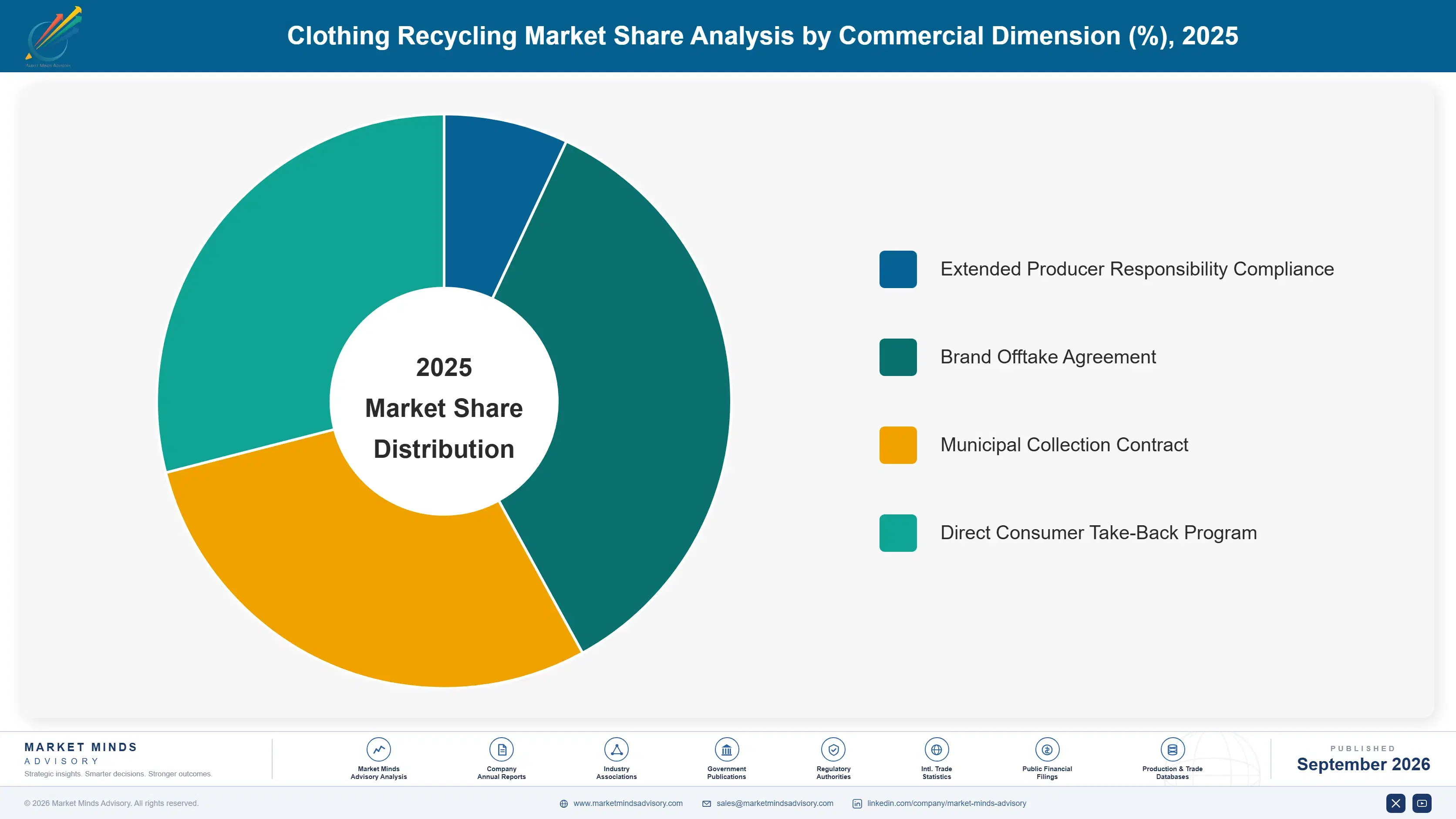
By Commercial Dimension

  • Extended Producer Responsibility Compliance
  • Brand Offtake Agreement
  • Municipal Collection Contract
  • Direct Consumer Take-Back Program

By Region

  • North America
  • Western Europe
  • East Asia
  • South Asia and Pacific
  • Latin America
  • Middle East and Africa
  • Eastern Europe

Scope, Methodology, and Coverage

Every figure in this report is reproducible from documented input assumptions. The scope below maps the historical period, the forecast horizon, the segmentation dimensions, and the countries covered, alongside the underlying primary and qualitative methodology.
Historical Period
2020 to 2025
Forecast Period
2026 to 2036
Base Year
2025 (USD billions; MMA Primary Research Dataset, September 2026)
Market Definition
The Clothing Recycling Market covers collection, sorting, and processing of post-consumer textile waste into recycled fiber, industrial materials, or resale inventory. It excludes new textile manufacturing, first-sale apparel retail, and non-textile waste recovery.
Quantitative Units
USD billions (current prices); processed volume in metric tonnes where applicable
Segmentation Dimensions
By Recycling Process Type; By End-Use Industry; By Commercial Dimension; By Region
Regions Covered
North America, Western Europe, East Asia, South Asia and Pacific, Latin America, Middle East and Africa, Eastern Europe
Countries Covered
USA, China, Germany, France, UK, Japan, South Korea, India, Australia, Canada, Brazil, Mexico, Indonesia, Vietnam, Thailand, Malaysia, UAE, Saudi Arabia, South Africa, Nigeria, Turkey, Poland, Netherlands, Italy, Spain, Sweden, Switzerland, Argentina, Colombia, Singapore, and additional markets relevant to this sector
Key Companies Profiled
Recover Textile Systems SL, Infinited Fiber Company Ltd, Circ LLC, SOEX Textilrecycling GmbH, Boer Group, Evrnu Inc, Ambercycle Inc, Worn Again Technologies Ltd, I:Collect GmbH, Prado Group SL, Martex Fiber Southern Corp, Leigh Fibers Inc, Wolkat BV, Frankenhuis BV, Textile Recycling International Ltd, Usha Yarns Ltd, Panipat Processors Pvt Ltd, OnceMore Sodra AB, ReJeanit AB, Yiwu Huading Textile Co Ltd
Quantitative Methodology
Primary survey, n=3,800 respondents, Q4 2025, six countries; demand-side model with trade association cross-validation
Qualitative Methodology
47 expert interviews, Q4 2025; applied to validate demand model assumptions, identify emerging dynamics, and assess competitive positioning
Report Format
PDF and XLSX data workbook (Word format preview document)
Publisher
Market Minds Advisory
Report Code
MMA-2026-TEC-209
Published
September 2026
Contact
sales@marketmindsadvisory.com | www.marketmindsadvisory.com

Purchase the full Clothing Recycling Market Report (2026 to 2036).

This report provides a comprehensive assessment of the global Clothing Recycling Market, covering market sizing, segmentation, regional dynamics, and competitive positioning through 2036. It draws on primary survey data across 3,800 respondents in six countries and 47 expert interviews conducted in Q4 2025, combined with company disclosures and MMA proprietary analysis across every major processing pathway. The report is designed to support strategic decisions on technology investment, regulatory positioning, and competitive strategy across the forecast period. Readers gain a clear view of where margin pools concentrate and how regulatory economics are likely to shift.
Detailed segmentation by recycling process type
Seven-region market sizing with growth forecasts
Competitive benchmarking of twenty leading companies
Collection cost and logistics risk analysis
Revenue lever and margin expansion strategies
Anonymized client case study with outcomes

Built For The People Who Decide

From boardroom strategy to bench-side execution, this report is read cover-to-cover by leaders shaping the next decade of their industry, turning demand scenarios, market dynamics and valuation benchmarks into decisions.
CXOs/ Presidents/ VPs/ Managers
M&A and Corporate Development
Strategy Teams and R&D Heads
Procurement and Product Directors
Regulatory and Compliance Leaders
Investor Relations and Equity Analysts