Market Minds Advisory
Closed System Transfer Devices (CSTDs) Market

Closed System Transfer Devices (CSTDs) Market: Occupational Benefit, Pharmacy Budgets, and Surrogate Evidence

This is a device that protects the pharmacist rather than the patient, which means the people who benefit from it do not control the budget that has to pay for it.

Lead Analyst

Alice Ballenger

Published

September 2026

Make Smarter Decisions with Customized Research Insights

Request a free sample report and evaluate market opportunities, growth trends, and competitive dynamics relevant to your business needs.

2025 MARKET VALUE$1.3BMarket Size 2025
2036 FORECAST VALUE$3.5BBase Case , 2026 to 2036
CAGR 2026 TO 20369.4 %Bull 10.6% / Bear 8.2%
INCREMENTAL OPPORTUNITY$2.1BNet 10- year value creation
EXPANSION MULTIPLE2.46x2036 value over 2026 base
Strategic Levers
M&A Pipeline
Regional Outlook
Country Rankings
Competitive Intelligence
Segmental Deep-dive
Call-Us : 91 93563 13602

Executive Snapshot and Market Trajectory

The beneficiary here is the pharmacist and the nurse, not the patient receiving the drug. That single fact separates who champions these devices from who pays for them, and it explains why adoption tracks safety culture rather than clinical evidence. Very few medical devices work this way at all.
Compounding workstation interfaces compound at 14.1%, a full 1.50x the market rate, because robotic compounding requires closed connections manual devices were never engineered to provide. North America holds the largest share at 35%, above the standard band, because a United States pharmacy compounding standard created a containment requirement no other jurisdiction has matched in scope or in enforcement expectation, and device pricing there runs above every other region.
Concentration is high at 79%, and contracts run hospital-wide across roughly 4 year cycles because switching means retraining every technician and nurse who handles a hazardous dose. Devices cut measured surface contamination by around 92%, which remains a surrogate marker rather than any demonstrated health outcome in exposed staff. Adoption has not slowed, since occupational safety rarely waits for outcome data. Conversions are rare, large and fiercely contested when they finally arrive.
Market Definition
This market covers closed system transfer devices and their components used to contain hazardous drug vapour, aerosol and liquid during compounding, transfer and administration, spanning vial access devices, syringe adaptors, infusion bag and line connectors, administration set spikes and adaptors, and compounding workstation interfaces, measured at manufacturer revenue. Compounding isolators and biological safety cabinets, personal protective equipment, robotic compounding systems themselves, standard needle-free connectors without hazardous drug containment claims, and surface contamination testing services are excluded.
Base Year Value
$1.3B in 2025 (MMA Primary Research Dataset, August 2026)
Forecast Period
2026 to 2036, eleven discrete annual values
CAGR
9.4% base case. Bull 10.6%. Bear 8.2%.
Fastest Growth Segment
Compounding Workstation Interfaces: 14.1% CAGR
Fastest Growth Country
China: 15.4% CAGR
Fastest Growth Region
South Asia and Pacific: 11.4% CAGR
Largest Region
North America: 35% of 2025 global value
Market Leaders
Becton Dickinson, Equashield, ICU Medical, Simplivia Healthcare, and B. Braun. Source: MMA Primary Research Dataset, July 2026.
Primary Survey
n=3,800 procurement and R&D decision-makers, Q4 2025, six countries
Methodology
Demand-side build-up, cross-validated against public data, 47 expert interviews

Closed System Transfer Devices (CSTDs) Market Forecast Scenarios

closed-system-transfer-devices-market-size-forecast-scenario-1787304883197
Growth ran near 8.2% from 2020 to 2025 as compliance expectation rather than clinical evidence drove adoption. A United States pharmacy compounding standard for hazardous drugs moved through a contested revision, ending widely followed while formal enforceability stayed ambiguous. Hospitals adopted regardless, because occupational safety officers and nursing organisations pressed the case considerably harder than pharmacy budgets resisted it.
Base case growth of 9.4% rests on three mechanisms. The hazardous drug list keeps expanding beyond oncology into antivirals, immunosuppressants and hormonal agents, adding doses to the addressable base without any new device. Automated and robotic compounding requires dedicated closed interfaces. And adoption outside North America continues rising from a low base as European and Asian health systems formalise their own handling requirements. None of the three requires the others.
The bull case at 10.6% assumes European and Asian regulators adopt binding containment requirements, converting a safety culture argument into a compliance obligation across most of the world's hazardous drug volume. The bear case at 8.2% is evidence pressure: the absence of demonstrated health outcomes in exposed workers invites budget challenge in systems where pharmacy consumables face genuine scrutiny.

Transfer Devices: Staff Safety, Budgets and Evidence

Almost every medical device is justified by what it does for a patient. This one is not. A closed system transfer device does nothing for the person receiving chemotherapy; it protects the technician compounding the dose and the nurse administering it from vapour, aerosol and liquid escape. That inversion determines how the category behaves commercially, because the people who benefit from it are not the people who approve the spending.
TOP FIVE CONCENTRATION79%Highly concentrated across established manufacturers holding hospital-wide contracts
DEVICE COST PER DOSEUSD 14Blended consumable cost for containing one hazardous drug preparation
HOSPITAL ADOPTION RATE68%Institutions handling hazardous drugs using containment devices routinely
SURFACE CONTAMINATION REDUCTION92%Measured decrease in detectable drug residue on pharmacy work surfaces
ANNUAL HAZARDOUS DOSES320 millionHazardous drug preparations compounded and administered worldwide each year
CONTRACT CONVERSION CYCLE4 yearsTypical interval between hospital-wide device contract reviews and conversions
The evidence position is more delicate than most marketing acknowledges. Measured surface contamination in pharmacy preparation areas falls by roughly 92% where these devices are used, and that reduction is well documented across many published studies. Nobody has demonstrated a corresponding improvement in health outcomes among exposed staff, because effect size is small and latency long. The value case therefore rests entirely on a surrogate marker.
That has not slowed adoption, because occupational safety rarely waits for outcome data. Roughly 68% of institutions handling hazardous drugs now use containment devices routinely, driven by pharmacy compounding standards, nursing organisation advocacy and institutional risk management rather than by any clinical trial. Positions are then unusually durable, since contracts run hospital-wide on four year cycles and switching means retraining everyone involved.
"Nobody has shown that these devices make pharmacists healthier, and everybody buys them anyway. That is not a criticism. It is what occupational safety looks like when the harm takes twenty years to appear and no institution wants to be the one that waited for proof."
Principal Analyst, Hospital Pharmacy and Infusion Systems Practice · MMA Medical

Market Trends

Automated compounding requires purpose-built closed interfaces

Robotic and semi-automated compounding systems handle hazardous preparations without a technician in the enclosure, and they need connections designed for mechanical manipulation rather than for a gloved hand. Devices engineered for manual workflow frequently cannot be operated reliably by a robot at all. The segment compounds at 14.1% as centralised compounding units adopt automation for both containment and accuracy reasons, and interface compatibility increasingly determines which containment brand a pharmacy can select. Suppliers incompatible with the leading platforms lose accounts entirely when a pharmacy automates, regardless of how long the existing relationship has run or how well the devices performed.
Market Impact: Adoption reaching 68% of institutio

Hazardous drug lists expand well beyond oncology agents

Occupational hazard classifications now cover antiviral agents, immunosuppressants, hormonal therapies and several biologics alongside cytotoxic chemotherapy, and each addition brings more preparations into the containment requirement without any new device being developed. Roughly 320 million hazardous preparations are compounded worldwide annually and that denominator keeps growing through classification rather than through prescribing. Pharmacies frequently discover the obligation applies to agents they had never considered hazardous at all. Community hospitals in particular apply containment to cytotoxic agents while frequently omitting newly classified drugs, which leaves a compliance gap that accreditation assessors have begun examining directly during inspections.
Market Impact: China compounding at 15.4% annually

Market Opportunities and Growth Drivers

Pharmacy compounding standards create a containment expectation

A United States pharmacy compounding standard covering hazardous drugs established containment expectations that accreditation bodies, state boards and institutional risk managers all treat as authoritative, whatever the formal enforceability position happens to be. Adoption reached roughly 68% of handling institutions on that basis. European and several Asian health systems have followed with their own handling guidance, generally less prescriptive but pointing the same direction, and hospital accreditation increasingly examines the practice directly. Formal enforceability has remained ambiguous throughout, and institutions have adopted regardless because nobody wants to defend the alternative position afterwards.
Market Impact: Exactly 0 outcome studies published

Centralised compounding units concentrate hazardous preparation volume

Health systems are consolidating hazardous drug preparation into dedicated centralised units rather than compounding at ward level, both for containment and for accuracy. China compounds at 15.4% substantially on that shift, as hospital pharmacy intravenous admixture services expand across provincial institutions. Centralisation raises per-site volume enough to justify automation and standardised containment, and it makes the purchasing decision institutional rather than departmental, which favours suppliers holding system-wide agreements. Ward-level compounding is correspondingly declining, which removes the settings where containment was hardest to implement and to verify. Auditability improves alongside the containment itself.
Market Impact: Residual waste exceeding USD 14

Market Restraints and Challenges

No study has demonstrated improved health outcomes in exposed staff

Surface contamination falls by roughly 92% where these devices are used, and that is the entire published evidence base. The root cause is methodological: occupational harm from chronic low-level hazardous drug exposure has long latency, small effect size and heavy confounding, so no realistic study could detect the difference. Commercial impact is a value case resting on a surrogate marker, which invites budget challenge. Participants respond with contamination monitoring programmes, exposure modelling and institutional risk framing. None of those responses produces the outcome data that would settle the argument. The argument recurs at every budget review.
Market Impact: Compounding at 14.1% each year

Added dead space wastes expensive drug on every preparation

Every containment device introduces residual volume that remains in the system after transfer, and with biologics and high-cost oncology agents that waste can exceed the roughly USD 14 device cost several times over. The root cause is straightforward engineering: containment requires enclosed pathways and enclosed pathways hold liquid. Commercial impact is a counter-argument that pharmacy directors raise and manufacturers rarely address. Low residual volume designs and vial-sharing protocols are the mitigations participants are pursuing. Vial-sharing protocols help where drug stability permits, and frequently it does not. Manufacturers rarely publish comparative waste data at all.
Market Impact: Covering 320 million annual doses
3 additional market trends, 4 additional growth drivers, and 2 additional restraints and challenges are covered in the full report. Contact sales@marketmindsadvisory.com to access the complete intelligence.

Segment CAGR and Growth Architecture

Segmentation follows position in the hazardous drug handling workflow, because position determines the containment engineering required, the user performing the step, the volume of devices consumed and the price each component commands. Five workflow positions cover containment device supply without overlap. Drug class and care setting cut across every position and are treated here as use attributes.
closed-system-transfer-devices-market-market-share-analysis-1787304883730

Compounding Workstation Interfaces

Growing at 14.1%, a full 1.50x the market rate, workstation interfaces connect containment systems to robotic and semi-automated compounding equipment that handles hazardous preparations without a technician inside the enclosure. Devices engineered for a gloved hand frequently cannot be manipulated reliably by a robotic arm, so purpose-built interfaces are a genuine engineering requirement rather than a packaging variation. Centralised compounding units adopting automation for accuracy and containment together drive the segment, and interface compatibility increasingly determines which containment brand a pharmacy is able to select at all. Suppliers incompatible with dominant platforms lose accounts outright at the equipment purchase, which happens before any containment evaluation takes place. Pharmacy operations makes that call.
CAGR 14.1%

Infusion Bag and Line Connectors

Bag and line connectors grow at 11.2%, covering the transfer from prepared syringe into an infusion container and the connection to an administration set at the bedside. This is where nursing exposure occurs rather than pharmacy exposure, and nursing organisations have advocated for containment at this step more forcefully than at any other. Consumption per treated patient is high because each infusion requires its own connectors. Compatibility with existing infusion sets and pumps constrains design freedom considerably, which is why incumbents with established hospital relationships defend this position well. Residual volume matters most in this position too, since bag transfers involve the largest liquid volumes and the greatest opportunity for expensive drug to remain trapped in the system.
CAGR 11.2%
Full segment breakdown across 5 segments available in the complete report.

Regional Architecture and Country Demand Map

Regional shares here follow regulatory expectation and occupational safety culture rather than the volume of hazardous drugs actually prepared, and those two things diverge more sharply than in most device categories. Reading hazardous preparation volumes alone would place this market somewhere entirely different from where its revenue actually sits.

North America

North America holds 35% of value. Note: this sits above the standard regional band because a United States pharmacy compounding standard established containment expectations that accreditation bodies and state boards treat as authoritative, creating adoption pressure no other jurisdiction matches. Device pricing here also runs above other regions for comparable products. Hospital-wide contracts across integrated delivery networks and group purchasing organisations make conversions large, infrequent and fiercely contested. Nursing advocacy has driven adoption more than any pharmacy budget argument. Group purchasing organisations negotiate terms that individual institutions then adopt. Device pricing sustained here supports development that price-driven markets elsewhere never could, which is why most product innovation in the category originates from suppliers anchored in this region.
Share: 35% | CAGR: 8.6% (2026 to 2036)

Western Europe

Twenty-two per cent of value, growing at 8.0%, the slowest of the seven regions. Occupational health frameworks address hazardous drug handling through workplace exposure regulation rather than through pharmacy compounding standards, which produces guidance that is less prescriptive about devices specifically. Adoption is nonetheless high in Nordic countries and Germany where occupational safety culture is strong, and considerably lower across southern Europe. Public procurement compresses device pricing through tendering, and several health systems have questioned the value case given the surrogate evidence position directly. Adoption within Nordic and German institutions nonetheless approaches North American levels, which suggests that occupational safety culture rather than regulatory text is what actually determines practice across the region.
Share: 22% | CAGR: 8.0% (2026 to 2036)
Regional intelligence for 5 additional markets available in the complete report: East Asia, South Asia and Pacific, Latin America, Middle East and Africa, Eastern Europe. Contact sales@marketmindsadvisory.com.
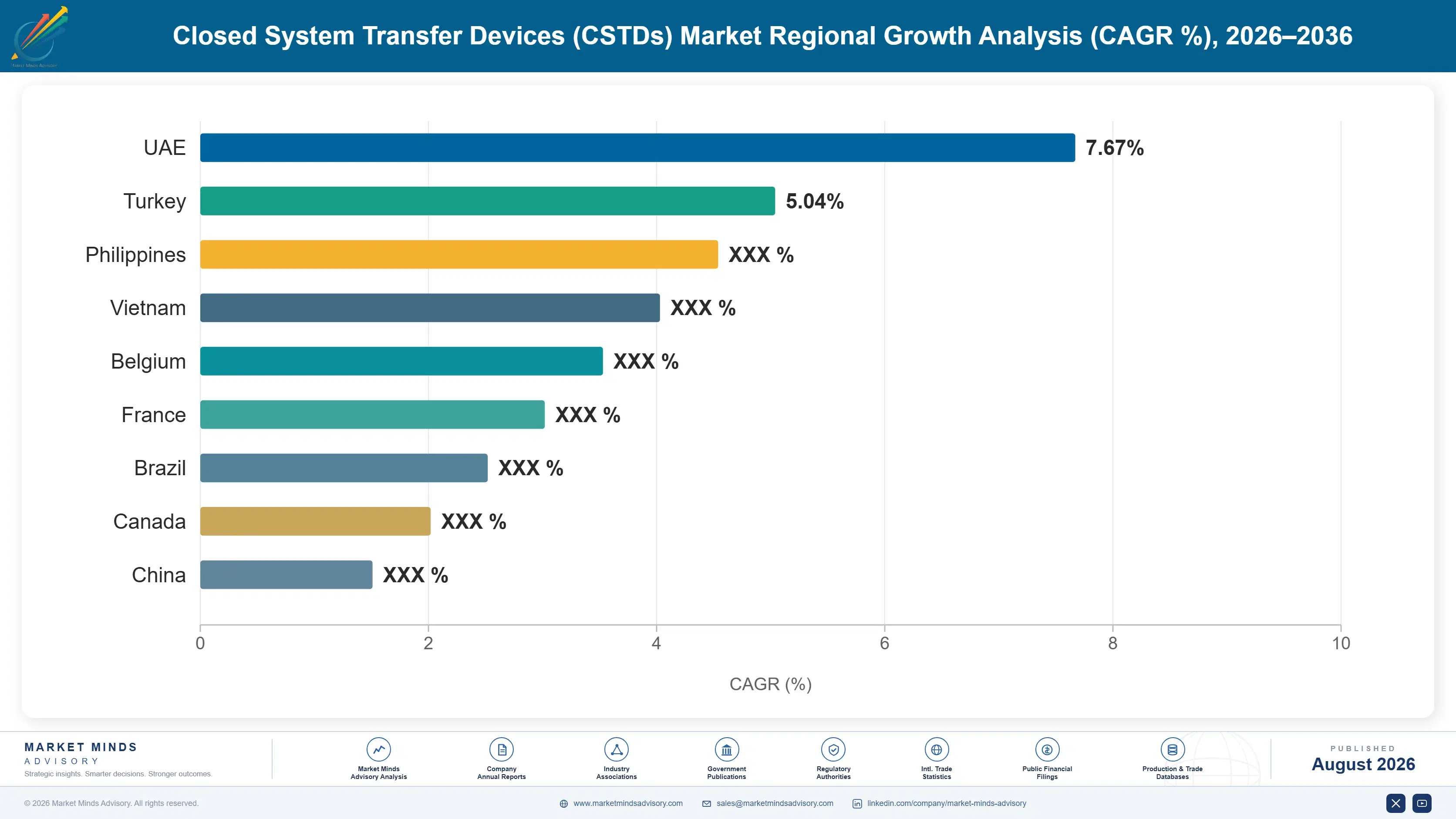
closed-system-transfer-devices-market-country-cagr-analysis-1787304884247

Where Containment Device Positions Are Won

Nobody has proved these devices make staff healthier, contracts convert about every four years, and the budget paying for them belongs to a department that gains nothing clinically. Value therefore accrues to whoever wins the institutional conversion, and to whoever the automation interface locks in. Product performance alone has rarely decided an account here.

Win the institutional conversion, then hold it

Contracts run hospital-wide on roughly 4 year cycles, and switching means retraining every pharmacy technician and nurse who handles a hazardous dose, revalidating compounding procedures and reprinting protocols. That makes conversions rare, large and extremely defensible once won. Commercial effort concentrated on the handful of institutions actually reviewing in any given year returns far more than broad promotional activity across a customer base that is not in a position to change anything. Identifying which institutions are actually in a review window is therefore worth more than any promotional reach across the wider base.
Market Impact: Contracts locked for roughly 4 year

Design for the robot before the pharmacy buys one

Automated compounding compounds at 14.1% and devices engineered for a gloved hand frequently cannot be manipulated by a robotic arm at all, which means interface compatibility now determines which containment brand a pharmacy can select. Suppliers whose devices work with the leading automation platforms are chosen by the equipment decision rather than by their own selling. Those who are not compatible lose the account entirely when the pharmacy automates, regardless of any existing relationship. That decision is made by pharmacy operations rather than by anyone the containment sales organisation normally calls upon.
Market Impact: Automation segment is growing at 14

Address residual drug waste before a pharmacy director does

Containment requires enclosed pathways and enclosed pathways hold liquid, so every device wastes residual drug that with high-cost biologics can exceed the roughly USD 14 device cost several times over. Pharmacy directors raise this and manufacturers rarely answer it, which cedes the argument. Low residual volume design and documented waste comparisons convert a persistent objection into a differentiator, and they matter more in oncology pharmacy economics than any containment performance claim does. Vial-sharing protocols help only where drug stability permits, which is frequently not the case. Comparative waste data is currently absent from the category entirely.
Market Impact: Waste exceeding the USD 14 device c

Sell to occupational safety, not to pharmacy procurement

The benefit accrues to technicians and nurses while the cost lands in a pharmacy consumables budget that gains nothing, which is a classic misalignment that pricing alone never resolves. Roughly 68% of handling institutions have adopted, and in almost every case an occupational safety officer, nursing organisation or risk manager drove it rather than pharmacy. Commercial organisations calling exclusively on pharmacy directors are addressing the payer and ignoring the advocate. Institutional risk framing has repeatedly proved more persuasive than any containment performance data. Pharmacy directors have opposed or delayed adoption on budget grounds in most surveyed markets.
Market Impact: Adoption already reaching 68% of th

Who Controls the Margin Pool

Concentration is high at 79% across the top five, measured on annual revenue from closed system transfer devices and their dedicated components, the single basis applied throughout this analysis. Becton Dickinson and Equashield lead through quite different routes, the first on installed base and hospital-wide contracting reach, the second on a fully enclosed syringe design that performed strongly in independent containment testing and took genuine share.
Competition runs on three dimensions that resolve at different moments. Containment performance competition happens during evaluation, when institutions compare independent testing data and run their own surface sampling. Contract competition happens roughly every four years and is decided as much by conversion cost and training burden as by product merit. Automation interface competition happens when a pharmacy buys compounding equipment, and it can override both of the others.

Pressure builds from two directions. Chinese and Indian manufacturers compete on price in markets where accreditation rather than regulation drives adoption, and their share is rising in Asia and Latin America. Separately, the surrogate evidence position invites budget challenge wherever pharmacy consumables face genuine scrutiny. Rankings shift most where a supplier secures compatibility with dominant compounding automation, which selects the containment brand for years.
closed-system-transfer-devices-market-company-positioning-matrix-1787304884767

Competitive Moat and Risk Dimensions

BECTON DICKINSON

Moat: Installed base and contracting reach

A large installed base across integrated delivery networks and group purchasing organisations, combined with the breadth to negotiate hazardous drug containment alongside wider infusion and medication management supply, gives Becton Dickinson contracting reach that focused competitors cannot match. Four year conversion cycles and staff retraining requirements then protect each position won for a considerable period.
BECTON DICKINSON

Risk: Containment performance comparison

Independent containment testing has at times favoured fully enclosed competitor designs, and institutions running their own surface sampling occasionally reach conclusions that contracting relationships cannot override. Automation interface compatibility increasingly decides accounts at the equipment purchase rather than the contract review. Price competition from Asian manufacturers is advancing in accreditation-driven markets.
EQUASHIELD

Moat: Fully enclosed syringe design

A design integrating the syringe barrel into the closed system, rather than adapting a standard syringe, performed strongly in independent containment testing and gave Equashield a technical argument that converted institutional evaluations against far larger incumbents. Investment in compounding automation compatible with its own containment architecture extends that position into the fastest-growing part of the category.
EQUASHIELD

Risk: Narrow portfolio contracting exposure

Competing against suppliers who can bundle containment with infusion sets, pumps and wider medication management leaves a focused manufacturer negotiating on a single line item where others negotiate across a portfolio. Group purchasing agreements frequently favour breadth. Manufacturing scale and geographic coverage remain smaller than the largest competitors can deploy.

Players Tracked

Prominent Players

Becton Dickinson
Equashield
ICU Medical
Simplivia Healthcare
B. Braun

Other Key Players

Corvida Medical
Yukon Medical
Codan Medizinische Gerate
Baxter
Nipro
JMS
Vygon
Fresenius Kabi
Amsino International
Shandong Weigao Group
Zhejiang Kindly Medical
Terumo
Cardinal Health
Grifols
Elite Medical

Recent Developments

FEBRUARY 2025

Compounding automation compatibility begins deciding containment brand selection

Centralised hospital pharmacy units adopting robotic compounding found that containment devices designed for manual handling could not be manipulated reliably by automated systems, an organic technical constraint that made interface compatibility the effective selection criterion. Existing supplier relationships rarely survived the equipment decision. Containment evaluation followed the decision.
Signal: The compounding equipment purchase now sel
JULY 2025

Hazardous drug classifications extend further beyond cytotoxic agents

Occupational hazard classifications continued extending across antiviral agents, immunosuppressants and hormonal therapies, an organic regulatory review process that brought additional preparations into containment expectations without any device development being required. Pharmacies frequently discovered the obligation applied to agents they had never previously considered hazardous at all.
Signal: Classification rather than any prescribing
NOVEMBER 2025

Chinese admixture service expansion drives domestic device competition

Chinese hospital pharmacy intravenous admixture services expanded across provincial institutions, an organic health system development that concentrated hazardous preparation into auditable units while domestic manufacturers competed aggressively on device pricing. Ward-level preparation declined correspondingly and domestic manufacturers gained share against international suppliers. Auditability improved alongside containment.
Signal: Centralisation makes containment practical

Polymer, Elastomer and Sterilisation Costs

These are precision moulded plastic assemblies and their economics reflect that. Medical grade polymers including polycarbonate, polypropylene and specialist elastomeric septa account for roughly 43% of cost of goods, sourced from a concentrated group of resin producers in Western Europe, the United States and increasingly Asia. Injection moulding tooling carries substantial upfront cost amortised across long production runs, and sterilisation plus packaging make up most of the remainder.
Medical grade resin supply tightened materially through 2021 and 2022 as several producers withdrew from medical applications, citing liability exposure disproportionate to the volumes involved, and device manufacturers found themselves requalifying materials under time pressure. Manufacturer annual reports across the period documented both the disruption and the inventory positions subsequently built. Ethylene oxide sterilisation capacity also came under regulatory pressure in the United States, constraining availability for several categories.

Exposure varies most by design specificity rather than by scale. Manufacturers using widely available resin grades can substitute with qualification work, while those depending on specialist elastomeric formulations for septum performance face far narrower alternatives. Geography compounds it: Chinese manufacturers with domestic resin, tooling and sterilisation capacity operate at cost structures Western competitors cannot approach in tender markets.
closed-system-transfer-devices-market-cost-volatility-analysis-1787304884966

Qualify alternate medical resin grades before producers withdraw

Several resin producers exited medical applications entirely because liability exposure outweighed modest volumes, and manufacturers discovered the dependency only when supply stopped arriving. Qualifying alternate grades during ordinary conditions costs validation and regulatory filing effort rather than capital investment. The exposure is easy to overlook precisely because these materials had been reliably cheap and available for decades.

Diversify sterilisation modality and geographic capacity

Ethylene oxide sterilisation capacity faced regulatory restriction in several United States locations, and manufacturers dependent on single facilities lost availability with little warning. Qualifying radiation alternatives or additional geographic sites costs validation and materials compatibility testing, which is cheaper undertaken in advance than negotiated during an interruption. Single-facility dependence is the exposure worth removing first.

Design septum formulations around available elastomer chemistry

Septum performance under repeated needle penetration depends on elastomeric formulations available from relatively few suppliers, and substitution alters resealing behaviour in ways that require full containment revalidation. Designing toward broadly available chemistry at development stage preserves sourcing flexibility that a specialist formulation permanently removes. The performance difference is usually smaller than the supply risk it creates.

Portfolio Architecture for Margin Defence

Margin architecture separates on contracting position rather than on containment technology. Standard vial access devices and syringe adaptors sold into price-driven tenders earn modestly, particularly where Asian manufacturers compete directly and accreditation rather than regulation drives the purchase. Devices embedded in hospital-wide agreements earn considerably better, protected by four year cycles and retraining costs. Automation interfaces earn best, because compatibility rather than pri
The volume against premium tension runs along regulatory geography. North American institutions pay above other regions for comparable devices and convert on hospital-wide agreements that are large and infrequent. Asian and Latin American volumes are growing faster at prices that international manufacturers frequently cannot meet profitably, and domestic suppliers take that work. Serving both requires either two cost structures or a deliberate decision to concede the price-driven markets entirely.

High-value pools concentrate around lock-in and compatibility. Automation workstation interfaces, hospital-wide contracts across integrated networks, and low residual volume designs for high-cost biologic preparation all command pricing that commodity components do not. Standard vial access devices, whatever their containment performance, compete in tenders against manufacturers with cost structures that Western producers have no realistic route to matching.

Volume / Commodity-Adjacent Tier

Standard vial access devices and syringe adaptors sold through tenders in accreditation-driven markets, competing directly against Asian manufacturers whose resin, tooling and sterilisation costs Western producers cannot approach. Price rather than performance decides these awards.
Gross Margin: 38-50%

Premium / Certified Tier

Containment portfolios embedded in hospital-wide agreements across integrated delivery networks, protected by four year conversion cycles and by the retraining every technician and nurse would otherwise require. Conversions are rare and fiercely contested when they arrive.
Gross Margin: 58-70%

Sustainability / Regulatory / Next-Generation Tier

Compounding automation interfaces and low residual volume designs for high-cost biologics, commanding premium because compatibility and drug waste rather than device price determine the selection outright. Compatibility decides the account before any evaluation begins.
Gross Margin: 68-80%
closed-system-transfer-devices-market-portfolio-architecture-1787304885462

Per-Dose Consumption and Contract Cycles

Revenue here is about as recurring as medical devices get. Every hazardous preparation consumes devices that are discarded afterwards, so consumption tracks oncology and hazardous drug volume directly rather than any capital or replacement cycle. Roughly 320 million hazardous preparations are compounded worldwide each year, and each one is a transaction. Volume follows the institution's own clinical activity rather than any purchasing decision made after the contract is signed.
Adoption depth varies sharply by institution type rather than by geography. Academic cancer centres and integrated delivery networks use containment across every hazardous preparation and have written it into procedure. Community hospitals with lower oncology volumes adopt selectively, frequently applying containment to cytotoxic agents while omitting newly classified hazardous drugs. Ambulatory infusion centres and physician offices sit furthest behind, and they represent a meaningful share of hazardous administration.

Decision profiles are unusually distributed for a device this cheap. Pharmacy directors control the consumables budget and gain no clinical benefit. Occupational safety officers, nursing organisations and institutional risk managers advocate without holding the budget. Group purchasing organisations negotiate the actual terms. And compounding automation purchases effectively select the containment brand without anyone in that list being consulted.
closed-system-transfer-devices-market-end-use-penetration-index-1787304885952

Where Containment Device Strategy Lands

These are among the four positions where our research anticipates prominent divergence between winners and laggards over the coming forecast period. Each is grounded in the demand model, the regulatory perimeter, and the announced capacity pipeline.
01 / ADVOCATE VERSUS PAYER

The people who benefit control none of the budget

A closed system transfer device does nothing at all for the patient receiving the drug and everything for the technician compounding it and the nurse administering it, while the cost lands squarely in a pharmacy consumables budget that gains no clinical benefit whatsoever. Roughly 68% of handling institutions have adopted, and an occupational safety officer, nursing organisation or risk manager drove that decision in almost every case. Commercial organisations calling exclusively on pharmacy directors are addressing the payer while ignoring the advocate entirely.
02 / CONVERSION WINDOW FOCUS

Only a handful of accounts can change in any year

Hospital-wide contracts run on roughly four year cycles and switching means retraining every pharmacy technician and nurse who handles a hazardous dose, revalidating compounding procedures and reissuing every protocol document affected. Conversions are therefore rare, very large and extremely defensible once they have actually been won by a particular supplier. Commercial effort concentrated on the small number of institutions genuinely reviewing in any given year returns considerably more than broad promotional activity aimed at customers who simply cannot change anything.
03 / AUTOMATION COMPATIBILITY GATE

The robot purchase now picks the containment brand

Automated and robotic compounding compounds at 14.1% and devices engineered for manipulation by a gloved human hand frequently cannot be operated reliably by a mechanical arm at all in practice. Interface compatibility therefore determines which containment brand a pharmacy is even able to select at all once it automates its central preparation unit. Suppliers incompatible with the leading automation platforms lose those accounts entirely at the equipment decision itself, regardless of how long the existing supply relationship has been running.
04 / DRUG WASTE ANSWER

Residual volume is the objection nobody answers

Containment requires enclosed fluid pathways and enclosed pathways inevitably retain residual drug, which with high-cost biologics and modern oncology agents can exceed the roughly USD 14 device cost several times over per preparation. Pharmacy directors raise this objection consistently and manufacturers rarely address it directly, which cedes an argument that matters more in oncology pharmacy economics than any containment performance claim does. Low residual volume design converts what is currently a persistent commercial weakness into a genuine and defensible differentiator.

Engagement Snapshot From the Field

A live engagement with an industry participant carrying material or product regulatory and market exposure ahead of a defining policy shift, showing how our research translates into a defensible multi-year portfolio strategy.
MARKET MINDS ADVISORY · CLIENT ENGAGEMENT SUMMARY
Closed System Transfer Devices (CSTDs) Producer Strategic Portfolio Review and Transition Roadmap 2026·Investment Scenario on Closed System Transfer Devices (CSTDs) Exposure Evaluation 2025-26
CLIENT PROFILE
A containment device manufacturer with a full vial access, syringe and connector portfolio, hospital positions across several European markets and no compounding automation compatibility. Annual revenue was approximately USD 96 million (client-reported, unverified by MMA), weighted toward tender-based sales in markets where accreditation rather than binding regulation drove adoption decisions. Several accounts had already been lost at automation purchase.
STRATEGIC CHALLENGE
Tender pricing had eroded steadily against Chinese and Indian manufacturers, while several existing accounts had been lost when hospitals adopted robotic compounding incompatible with the client's devices. The board needed to decide whether to compete on manufacturing cost, invest in automation interface development, or restructure commercial effort around the institutions actually reviewing contracts.
MMA APPROACH
MMA conducted 47 expert interviews spanning hospital pharmacy directors, oncology pharmacists, occupational safety officers, nursing leaders, compounding automation vendors, group purchasing negotiators and accreditation assessors across six countries. A quantitative survey of 3,800 respondents established adoption drivers, conversion behaviour, residual waste concerns and evidence perceptions. We then modelled revenue outcomes under cost competition, automation investment and commercial restructuring strategies.
KEY FINDINGS
  1. Occupational safety officers and nursing leaders had initiated adoption in five of six markets surveyed, while pharmacy directors had opposed or delayed it on budget grounds in most of them.
  2. Institutions that had adopted compounding automation reported that containment brand selection had followed the equipment decision, and none had evaluated devices independently afterwards.
  3. Pharmacy directors raised residual drug waste unprompted in most interviews, and none reported that any supplier had provided comparative waste data addressing it.
  4. Conversion reviews had occurred in a small minority of surveyed institutions in the preceding year, and commercial coverage had not been concentrated on those accounts at all.
CLIENT PROFILE
A containment device manufacturer with a full vial access, syringe and connector portfolio, hospital positions across several European markets and no compounding automation compatibility. Annual revenue was approximately USD 96 million (client-reported, unverified by MMA), weighted toward tender-based sales in markets where accreditation rather than binding regulation drove adoption decisions. Several accounts had already been lost at automation purchase.
STRATEGIC CHALLENGE
Tender pricing had eroded steadily against Chinese and Indian manufacturers, while several existing accounts had been lost when hospitals adopted robotic compounding incompatible with the client's devices. The board needed to decide whether to compete on manufacturing cost, invest in automation interface development, or restructure commercial effort around the institutions actually reviewing contracts.
MMA APPROACH
MMA conducted 47 expert interviews spanning hospital pharmacy directors, oncology pharmacists, occupational safety officers, nursing leaders, compounding automation vendors, group purchasing negotiators and accreditation assessors across six countries. A quantitative survey of 3,800 respondents established adoption drivers, conversion behaviour, residual waste concerns and evidence perceptions. We then modelled revenue outcomes under cost competition, automation investment and commercial restructuring strategies.
KEY FINDINGS
  1. Occupational safety officers and nursing leaders had initiated adoption in five of six markets surveyed, while pharmacy directors had opposed or delayed it on budget grounds in most of them.
  2. Institutions that had adopted compounding automation reported that containment brand selection had followed the equipment decision, and none had evaluated devices independently afterwards.
  3. Pharmacy directors raised residual drug waste unprompted in most interviews, and none reported that any supplier had provided comparative waste data addressing it.
  4. Conversion reviews had occurred in a small minority of surveyed institutions in the preceding year, and commercial coverage had not been concentrated on those accounts at all.
RECOMMENDED STRATEGY
Phase 1: Phase one: redirect commercial coverage toward institutions with contracts approaching review, and toward occupational safety and nursing leaders rather than pharmacy procurement. Phase 2: Phase two: develop automation interface compatibility with the leading compounding platforms, since that decision now selects the containment brand outright. Phase 3: Phase three: generate comparative residual waste data and use it as a differentiator rather than conceding an objection nobody in the category currently answers.
OUTCOME
The client restructured commercial coverage around conversion windows and safety advocates, invested roughly USD 14 million in automation interface development (client-reported, unverified by MMA), and published comparative residual volume data. Win rates in contested conversions improved measurably within a year, and two accounts previously lost to automation incompatibility returned at their next review.

Frequently Asked Questions

Foundational context covering the market sizes, CAGR, scope, country, region and competition that inform every finding below. This section is provided to cover basics and most often pre-purchase conversations, answered from the MMA Primary Research Dataset.

What is the current size of the Closed System Transfer Devices (CSTDs) Market?

The global CSTD market was valued at USD 1.3 billion in 2025, spanning vial access devices, syringe adaptors, bag and line connectors, administration spikes and automation interfaces. Roughly 320 million hazardous preparations are compounded worldwide annually.

How large will the Closed System Transfer Devices (CSTDs) Market be by 2036?

MMA forecasts the market at USD 3.49 billion by 2036, expanding 2.46 times from the 2026 base of USD 1.42 billion. That represents roughly USD 2.07 billion of incremental value across the forecast decade.

What is the CAGR for the Closed System Transfer Devices (CSTDs) Market 2026 to 2036?

The base case compound annual growth rate is 9.4%, with a bull case of 10.6% and a bear case of 8.2%. The bull case assumes European and Asian regulators adopt binding containment requirements.

Which segment is growing fastest?

Compounding workstation interfaces grow at 14.1%, a full 1.50x the overall market rate. Devices designed for a gloved hand frequently cannot be manipulated reliably by a robotic compounding arm.

Who are the major companies in the Closed System Transfer Devices (CSTDs) Market?

Becton Dickinson, Equashield, ICU Medical, Simplivia Healthcare and B. Braun together hold 79% of revenue, having arrived by different routes, one through contracting reach and another through enclosed design performance.

Which country is growing fastest?

China grows fastest at 15.4%, as hospital pharmacy intravenous admixture services expand across provincial institutions. North America remains the largest region at 35% of value on compounding standard expectations.

Report Segmentation Architecture

The full report scope spans multiple orthogonal segmentation dimensions, with cross-tabulated demand data provided for each dimension pair. Coverage extends further to regional breakdowns, trend trajectories, and the competitive detail needed to support segment-level decision-making.

By Workflow Position

  • Vial Access Devices
  • Syringe Adaptors and Closed Syringes
  • Infusion Bag and Line Connectors
  • Administration Set Spikes and Adaptors
  • Compounding Workstation Interfaces

By End-Use Industry

  • Academic and Tertiary Cancer Centres
  • Community Hospital Pharmacies
  • Centralised Compounding Units
  • Ambulatory Infusion Centres
  • Physician Office Oncology Practices
  • Compounding Pharmacies and Outsourcing Facilities

By Commercial Dimension

  • Hospital-Wide Supply Agreements
  • Group Purchasing Organisation Contracts
  • Public Tender Procurement
  • Distributor and Wholesaler Channel
  • Automation Vendor Bundled Supply
  • Training and Implementation Services

By Region

  • North America
  • Western Europe
  • East Asia
  • South Asia and Pacific
  • Latin America
  • Middle East and Africa
  • Eastern Europe

Scope, Methodology, and Coverage

Every figure in this report is reproducible from documented input assumptions. The scope below maps the historical period, the forecast horizon, the segmentation dimensions, and the countries covered, alongside the underlying primary and qualitative methodology.
Historical Period
2020 to 2025
Forecast Period
2026 to 2036
Base Year
2025 (USD billions; MMA Primary Research Dataset, August 2026)
Market Definition
This market comprises closed system transfer devices and their dedicated components used to contain hazardous drug vapour, aerosol and liquid during compounding, transfer and administration, measured at manufacturer revenue across hospital-wide supply agreements, group purchasing contracts, public tender procurement, distributor channels, automation vendor bundled supply and training services. Coverage spans vial access devices using physical barrier and air-filtration containment approaches, syringe adaptors and integrated closed syringes, infusion bag and administration line connectors, administration set spikes and adaptors, and interfaces connecting containment systems to robotic and semi-automated compounding equipment. Compounding isolators, biological safety cabinets and containment enclosures, personal protective equipment including gowns and gloves, robotic compounding systems themselves, standard needle-free connectors without hazardous drug containment claims, surface contamination monitoring and testing services, and hazardous drug waste disposal fall outside scope.
Quantitative Units
USD millions (current prices); devices consumed by workflow position; hazardous preparations compounded; cost per preparation; institutional adoption rate; contract conversion cycle length
Segmentation Dimensions
By Workflow Position; By End-Use Industry; By Commercial Dimension; By Region
Regions Covered
North America, Western Europe, East Asia, South Asia and Pacific, Latin America, Middle East and Africa, Eastern Europe
Countries Covered
United States, Canada, Mexico, Germany, France, United Kingdom, Italy, Spain, Netherlands, Sweden, Denmark, Switzerland, China, Japan, South Korea, Taiwan, India, Australia, Thailand, Indonesia, Singapore, Brazil, Argentina, Colombia, Chile, Saudi Arabia, United Arab Emirates, Israel, South Africa, Poland, Czechia, Hungary, and additional markets relevant to hazardous drug handling analysis
Key Companies Profiled
Becton Dickinson, Equashield, ICU Medical, Simplivia Healthcare, B. Braun, Corvida Medical, Yukon Medical, Codan Medizinische Gerate, Baxter, Nipro, JMS, Vygon, Fresenius Kabi, Amsino International, Shandong Weigao Group, Zhejiang Kindly Medical, Terumo, Cardinal Health, Grifols, Elite Medical
Quantitative Methodology
Primary survey, n=3,800 respondents, Q4 2025, six countries; demand-side model with trade association cross-validation
Qualitative Methodology
47 expert interviews, Q4 2025; applied to validate demand model assumptions, identify emerging dynamics, and assess competitive positioning
Report Format
PDF and XLSX data workbook (Word format preview document)
Publisher
Market Minds Advisory
Report Code
MMA-2026-MED-325
Published
August 2026
Contact
sales@marketmindsadvisory.com | www.marketmindsadvisory.com

Purchase the full Closed System Transfer Devices (CSTDs) Market Report (2026 to 2036).

The full MMA report treats the split between who benefits and who pays as the fact that governs this category, quantifying how adoption follows occupational safety advocacy rather than clinical evidence. It sizes five workflow positions and seven regions to 2036, modelling devices consumed per preparation, hazardous drug volumes, adoption rates, pricing and contract conversion cycles separately. Competitive assessment covers twenty manufacturers on one consistent revenue basis. Cost exposure is traced through polymer, elastomer and sterilisation inputs. Four commercial levers and a strategic verdict close the report, grounded in 47 expert interviews and a 3,800-respondent survey.
Five workflow positions sized separately through 2036
Adoption modelled against regulatory expectation by jurisdiction
Contract conversion cycles mapped across institution types
Twenty manufacturers assessed on one consistent revenue basis
Automation interface compatibility quantified against brand selection outcomes
Anonymised client engagement with tested strategic recommendations

Built For The People Who Decide

From boardroom strategy to bench-side execution, this report is read cover-to-cover by leaders shaping the next decade of their industry, turning demand scenarios, market dynamics and valuation benchmarks into decisions.
CXOs/ Presidents/ VPs/ Managers
M&A and Corporate Development
Strategy Teams and R&D Heads
Procurement and Product Directors
Regulatory and Compliance Leaders
Investor Relations and Equity Analysts