Market Minds Advisory
Clinical Documentation Improvement (CDI) Market

Clinical Documentation Improvement (CDI) Market: AI-Powered NLP, Computer-Assisted Coding, and Outsourced Review Demand Through 2036

A missed comorbidity documented in a physician's note can shift a hospital's reimbursement by thousands of dollars per case, and AI is now catching those gaps faster than any human reviewer team.

Lead Analyst

Alice Ballenger

Published

September 2026

Make Smarter Decisions with Customized Research Insights

Request a free sample report and evaluate market opportunities, growth trends, and competitive dynamics relevant to your business needs.

2025 MARKET VALUE$4.6BMarket Size 2025
2036 FORECAST VALUE$13.7BBase Case , 2026 to 2036
CAGR 2026 TO 203610.4 %Bull 11.7% / Bear 9.1%
INCREMENTAL OPPORTUNITY$8.6BNet 10- year value creation
EXPANSION MULTIPLE2.69x2036 value over 2026 base
Strategic Levers
M&A Pipeline
Regional Outlook
Country Rankings
Competitive Intelligence
Segmental Deep-dive
Call-Us : 91 93563 13602

Executive Snapshot and Market Trajectory

Clinical documentation improvement has moved from a retrospective coding audit function into a real-time, AI-assisted workflow embedded directly inside physician charting systems across hospitals and health systems, reshaping how revenue cycle leaders think about reimbursement accuracy and compliance risk simultaneously, across nearly every hospital service line.
AI-powered natural language processing CDI platforms are now the fastest-growing segment, expanding near 16.8% annually as hospitals replace manual concurrent review with automated documentation gap detection, well over 60% faster than the wider market's pace. North America anchors more than two fifths of global value through the United States' uniquely reimbursement-driven documentation requirements, while India's expanding medical coding and CDI outsourcing capacity pulls South Asian demand higher each year.
Competitive intensity concentrates around five established health information technology majors that hold decades of coding software expertise and hospital system sourcing relationships, even as specialized AI-native vendors compete on natural language processing accuracy. Computer-assisted coding integration and demonstrated reimbursement accuracy improvement increasingly determine which vendors capture premium enterprise health system contracts beyond standalone query volume, particularly as guaranteed staffing coverage becomes a differentiator reshaping vendor rankings across nearly every major hospital system tier nationwide.
Market Definition
The clinical documentation improvement market covers commercial licensing and sale of AI-powered natural language processing CDI platforms, computer-assisted coding integration software, concurrent documentation review services, retrospective audit and query services, CDI specialist staffing and outsourcing, and physician query and clinical decision support tools used by hospitals and health systems. It excludes general electronic health record platforms and standalone medical billing software, which the industry classifies as separate health information technology categories.
Base Year Value
$4.6B in 2025 (MMA Primary Research Dataset, August 2026)
Forecast Period
2026 to 2036, eleven discrete annual values
CAGR
10.4% base case. Bull 11.7%. Bear 9.1%.
Fastest Growth Segment
AI-Powered Natural Language Processing CDI Platforms: 16.8% CAGR
Fastest Growth Country
India: 14.5% CAGR
Fastest Growth Region
South Asia and Pacific: 12.5% CAGR
Largest Region
North America: 41% of 2025 global value
Market Leaders
3M Health Information Systems, Optum360, Nuance Communications Inc, Iodine Software, Dolbey Systems Inc. Source: MMA Analysis based on company annual reports.
Primary Survey
n=3,800 procurement and R&D decision-makers, Q4 2025, six countries
Methodology
Demand-side build-up, cross-validated against public data, 47 expert interviews

Clinical Documentation Improvement (CDI) Market Forecast Scenarios

clinical-documentation-improvement-cdi-market-size-forecast-scenario-1787465663753
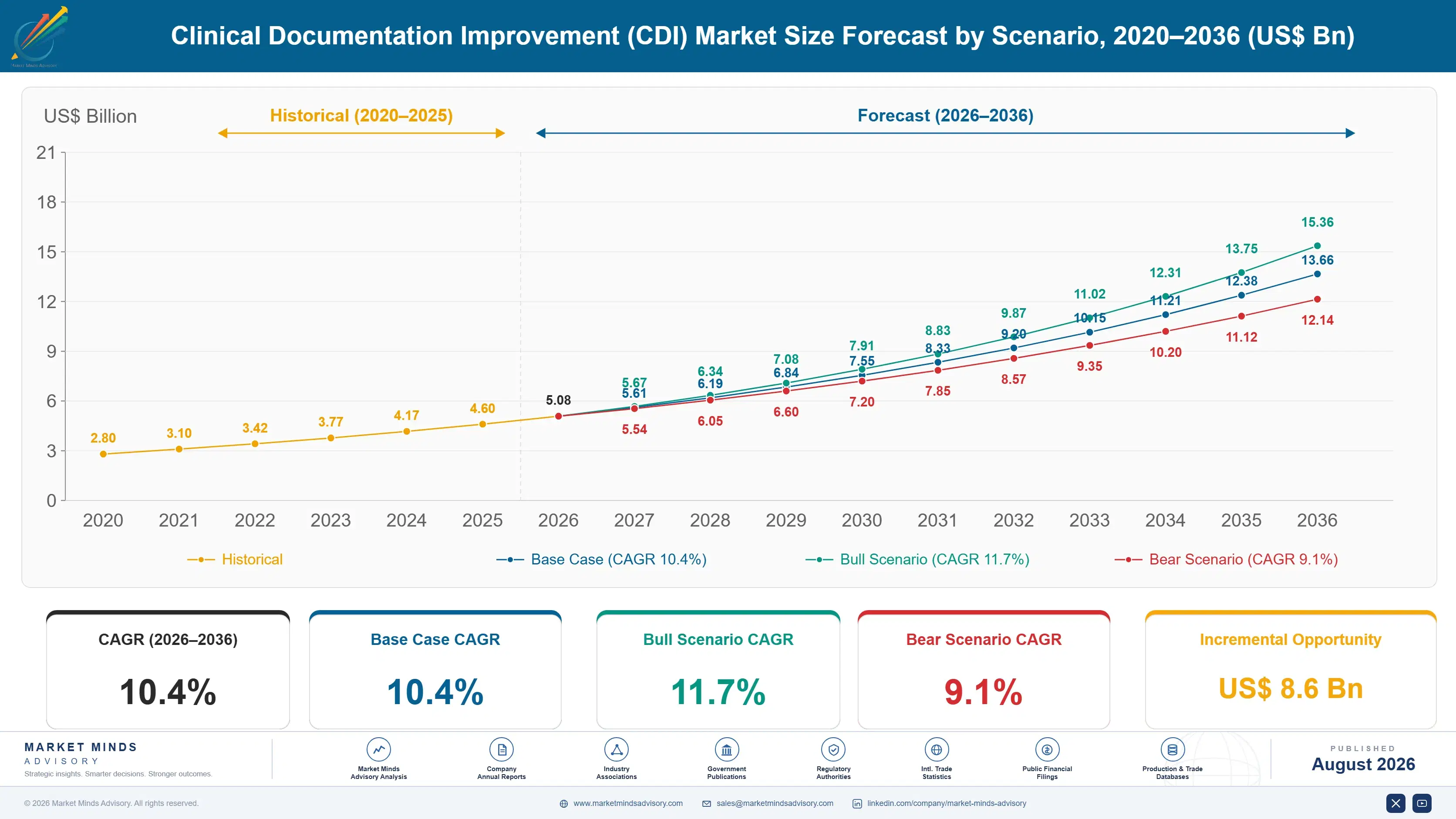
CDI demand grew unevenly from 2020 to 2025, as pandemic-era hospital staffing disruption briefly slowed concurrent review capacity before AI-assisted documentation platforms accelerated growth from 2023 onward. United States hospital system technology investment expanded steadily across the period. The market grew at a 9.4% historical CAGR, slower than the forecast pace as AI-driven demand only scaled meaningfully in the final two years.
The base case carries CDI to a 10.4% CAGR through 2036 on three mechanisms. First, hospitals keep replacing manual concurrent review with AI-powered natural language processing that flags documentation gaps in real time. Second, value-based reimbursement models keep expanding the financial stakes tied to accurate risk-adjustment and severity documentation across payer contracts. Third, medical coding and CDI outsourcing keeps growing as hospitals seek specialized expertise without expanding permanent staff headcount.
The bull case, 11.7%, assumes AI-powered CDI and outsourcing adoption accelerates faster than currently projected as more mid-sized hospital systems specify the technology across a broader range of service lines. The bear case, 9.1%, assumes hospital capital budget constraints and staffing cost pressure cap premium platform specification, keeping growth concentrated in standard retrospective audit formats tied to compliance minimum requirements alone.

Documentation Review Moves From Retrospective to Real-Time

CDI now splits along a technology-sophistication and service-integration line rather than a purely commodity one. Standard retrospective audit and query services, the volume backbone of the category, support baseline compliance requirements at pricing closer to traditional coding software. AI-native, real-time platforms instead serve as a strategic reimbursement optimization tool, commanding meaningfully higher pricing for documented natural language processing accuracy and workflow integration engineering.
MARKET CONCENTRATIONCR5: 44%Top five vendors hold under half of global sales
AVERAGE CONTRACT VALUEUSD 340,000 per hospital system annuallyPricing varies sharply between standard and AI-native platforms
TOP ADOPTING COUNTRYUnited States: 41% of global revenueDominant reimbursement-driven documentation requirements anchor demand strongly nationwide
OUTSOURCING PENETRATION38% of hospitals use external CDI servicesPenetration rate shapes recurring staffing and service revenue timing
IMPLEMENTATION COST SHARE28% to 40% of total contract valueIntegration and training costs drive significant deployment expense
DOCUMENTATION QUERY RESPONSE RATE72% average physician response rateResponse rate shapes measurable reimbursement accuracy outcomes directly
Buyers split sharply by hospital system size and sourcing sophistication. Large enterprise health systems specify AI-powered platforms integrated directly into physician charting workflows to capture measurable reimbursement accuracy gains, requiring natural language processing and clinical workflow integration expertise that standard coding vendors struggle to match consistently. Smaller hospitals instead rely on outsourced CDI staffing and services, competing largely on cost per case rather than deep technology integration.
Over the next decade, AI-native platforms and computer-assisted coding integration should keep pulling value toward higher-margin premium tiers, while United States hospital system investment keeps driving the largest underlying volume base for standard review formats. Value-based reimbursement expansion, not documentation compliance requirements alone, increasingly looks like the most durable driver of category-wide platform upgrades across hospital system tiers.
"A CDI specialist used to read a chart line by line looking for gaps. Now the software finds the gap before the specialist even opens the file, and that changes what the job actually is."
Director, Healthcare Information Technology Practice · MMA Healthcare Technology Practice · August 2026

Market Trends

Hospitals Standardize Real-Time AI Documentation Review Now

Hospital systems have increasingly specified AI-powered natural language processing platforms embedded directly into physician charting workflows as standard documentation infrastructure, treating real-time gap detection as a defining reimbursement safeguard rather than a retrospective compliance exercise handled after discharge. Several major health systems now require concurrent, in-workflow query generation rather than accepting generic post-discharge audit processes common across earlier CDI programs. Vendors including Iodine Software and Nuance have invested in dedicated clinical natural language processing development teams, recognizing that enterprise contracts increasingly hinge on demonstrated accuracy improvement data rather than traditional query volume metrics, across nearly every major hospital service line.
Market Impact: Risk-adjustment expansion adds 1,400 hospital contracts

Computer-Assisted Coding Expands Beyond Inpatient Settings

Computer-assisted coding integration, once concentrated almost entirely in inpatient hospital settings, has expanded meaningfully into outpatient and ambulatory care documentation, since falling implementation costs and improved specialty-specific natural language processing accuracy have made the technology commercially viable across a considerably broader range of care settings than earlier generations supported. Several vendors have already launched ambulatory-focused coding platforms priced within reach of mid-sized physician group practices, reflecting genuine technology diffusion rather than incremental feature addition. Vendors with established outpatient workflow integration capability are capturing these contracts well ahead of competitors still building comparable specialty-specific expertise.
Market Impact: Outsourcing demand grows 12.6% annually

Market Opportunities and Growth Drivers

Value-Based Reimbursement Expansion Raises Documentation Stakes

Payers across major markets continue expanding value-based and risk-adjusted reimbursement models, forcing hospitals to document severity and comorbidity status accurately across their full patient population rather than treating detailed documentation as relevant only to a subset of complex cases. Several major payers have signaled further risk-adjustment model expansion through the current forecast period specifically, giving CDI vendors a durable, quantified demand timeline that shapes multi-year platform investment rather than one-off compliance response. That reimbursement durability distinguishes CDI demand from more discretionary quality-improvement purchasing elsewhere in the hospital technology stack, across nearly every major payer contract type.
Market Impact: Alert fatigue caps rates at 72%

Clinical Staffing Shortages Lift Outsourcing Demand

Persistent hospital difficulty recruiting and retaining qualified CDI specialists continues lifting demand for outsourced staffing and managed CDI services marketed explicitly on guaranteed coverage and measurable query response rates, a purchase driver largely absent from earlier in-house-only CDI program design. Hospitals have responded by shifting budget allocation directly toward outsourced service contracts, a practice that barely existed at current scale before 2022 and now shapes procurement decisions among mid-sized hospital systems specifically. Several vendors have expanded outsourced staffing capacity to meet this coverage-conscious demand segment, particularly across mid-sized systems without dedicated in-house recruiting infrastructure.
Market Impact: Integration complexity adds 22% to costs

Market Restraints and Challenges

Physician Alert Fatigue Limits Query Response Rates

AI-generated documentation queries carry meaningful physician workflow burden, and many clinicians, particularly in high-volume specialties, continue deprioritizing or ignoring queries despite documented reimbursement benefits that timely responses provide to the hospital's overall accuracy performance. The underlying cause is that physicians already manage substantial electronic health record alert volume unrelated to CDI, giving individual documentation queries limited attention relative to competing clinical priorities. That fatigue limits how quickly query response rates can improve in high-volume hospital settings. Vendors are responding by developing more targeted, lower-volume query algorithms that prioritize only high-value cases.
Market Impact: AI documentation demand grows 16.8% annually

Integration Complexity Raises Implementation Cost Significantly

Integrating AI-powered CDI platforms with existing electronic health record systems requires extensive workflow customization and interoperability testing that raises implementation cost compared with standalone standard coding software, and many smaller hospitals lack the technical infrastructure to complete integration without significant vendor support. The underlying cause is that electronic health record systems vary across hospital vendors, requiring CDI platforms to support multiple distinct integration pathways rather than a single standardized interface. That integration burden concentrates premium implementations among vendors with established interoperability engineering capability. Smaller vendors are responding by partnering with EHR-specific integration specialists rather than building internal capability alone.
Market Impact: Ambulatory coding demand grows 13.5% yearly
3 additional market trends, 4 additional growth drivers, and 3 additional restraints and challenges are covered in the full report. Contact sales@marketmindsadvisory.com to access the complete intelligence.

Segment CAGR and Growth Architecture

Segmentation follows technology and service function, a single classification logic separating CDI offerings by the documentation task they perform. AI-powered NLP, computer-assisted coding, concurrent review, retrospective audit, staffing outsourcing, and physician query formats each carry distinct engineering requirements and buyer occasions, keeping upstream platform technology and downstream service delivery from blurring together across hospital system tiers.
clinical-documentation-improvement-cdi-market-market-share-analysis-1787465664354

AI-Powered Natural Language Processing CDI Platforms

AI-powered natural language processing CDI platforms are growing at 16.8% annually, well over 60% faster than the wider market's 10.4% pace, as hospitals replace manual concurrent review with automated documentation gap detection embedded directly inside physician charting workflows. This format requires clinical natural language processing expertise distinct from conventional coding software development, since accuracy across highly variable physician writing styles and specialty-specific terminology exceeds standard rule-based system capability. Retail and enterprise pricing for AI-native platforms runs well above standard review formats, reflecting both natural language processing investment and hospital willingness to pay for documented reimbursement accuracy improvement. Iodine Software and Nuance have both prioritized capital investment in dedicated AI platform development, positioning the segment to capture continuing real-time documentation growth.
CAGR 16.8%

Computer-Assisted Coding Integration Software

Computer-assisted coding integration software grows at 13.5% annually, driven by hospitals and physician practices seeking automated code suggestion and validation that reduces manual coder workload while improving documentation-to-code accuracy across increasingly complex reimbursement rule sets. This segment commands meaningful premium pricing over standard formats, reflecting both integration complexity and the genuine accuracy validation involved in matching code suggestions to documented clinical specificity across diverse care settings. Several vendors have expanded computer-assisted coding specification across broader ambulatory and outpatient programs, extending a technology once reserved for inpatient hospital settings into mainstream physician practice management. Capacity expansion has proceeded among established coding software suppliers, though specialty-specific accuracy expertise limits how quickly new entrants can credibly compete in this demanding segment.
CAGR 13.5%
Full segment breakdown across 6 segments available in the complete report.

Regional Architecture and Country Demand Map

CDI production and consumption concentrate overwhelmingly in North America, anchored by the United States' uniquely reimbursement-driven documentation requirements. India carries the fastest country-level growth, as its expanding medical coding and CDI outsourcing capacity pulls South Asian demand higher. Established United States reimbursement infrastructure continues reinforcing this outsized concentration considerably.

North America

United States demand overwhelmingly dominates the CDI category, a concentration this report notes explicitly because CDI as a commercial discipline exists almost entirely as a response to the country's diagnosis-related-group and risk-adjustment reimbursement architecture, which has no direct international equivalent at comparable scale. Optum360 and 3M Health Information Systems maintain substantial domestic platform and staffing capacity serving hospital systems of every size across the country. Canada follows a considerably smaller consumption pattern, since its single-payer reimbursement structure carries far less documentation-driven financial stakes than the American system. Growth here tracks close to the global average despite the region's outsized share, reflecting a mature, saturated buyer base where incremental AI adoption drives growth more than new hospital system entry.
Share: 41% | CAGR: 9.5% (2026 to 2036)

Western Europe

Western Europe's CDI demand centers on Germany, France, and the United Kingdom, where national health systems have begun adopting documentation improvement practices tied to activity-based hospital funding models resembling a lighter-weight version of the American DRG structure. Nuance and Craneware maintain regional platform presence built around adapting American CDI methodology to European coding and reimbursement frameworks. Italy and Spain contribute additional demand tied to expanding hospital digitization investment across southern European health systems specifically. Growth trails East Asia and South Asia and Pacific as the region's hospital technology adoption remains more gradual, with incremental documentation improvement representing a smaller share of overall health IT spending than in the United States.
Share: 20% | CAGR: 8.8% (2026 to 2036)
Regional intelligence for 5 additional markets available in the complete report: East Asia, South Asia and Pacific, Latin America, Middle East and Africa, Eastern Europe. Contact sales@marketmindsadvisory.com.
clinical-documentation-improvement-cdi-market-country-cagr-analysis-1787465664877

Where CDI Vendors Can Capture Margin

Margin defense in CDI increasingly depends on moving beyond standard compliance-audit pricing toward positioning that lets a vendor charge for documented AI accuracy, workflow integration, or guaranteed staffing coverage. The four moves below target the fastest-growing buyer segments most willing to pay well above standard pricing for genuine differentiation across enterprise and mid-market channels.

Build Clinical NLP Accuracy Engineering Capability Now

AI-powered platforms engineered for real-time documentation gap detection command retail and enterprise pricing running well above standard review software, and demand from hospital systems has grown faster than the industry's dedicated clinical natural language processing capability currently available across major health IT vendors. Vendors that invest in specialty-specific accuracy engineering now capture premium enterprise contracts before competitors establish comparable technical capability, since hospitals increasingly specify AI-native platforms as a baseline requirement. The engineering investment requires meaningful research capacity, but the roughly 30% margin uplift over standard formats justifies the cost for most established health IT vendors.
Market Impact: NLP engineering typically commands roughly a 30% premium

Expand EHR-Specific Integration Partnerships Broadly Now

Deeply integrated CDI platforms command meaningful premium pricing over standalone software, and demand from hospitals seeking continuous charting workflow embedding has grown faster than the industry's dedicated EHR integration capability currently available across established vendors. Vendors that secure integration partnerships with major EHR platforms now capture premium contracts before competitors establish comparable interoperability expertise, since hospitals increasingly favor documented integration depth in supplier qualification criteria. The integration investment requires meaningful engineering development, but the roughly 24% pricing premium and reduced deployment friction it provides justifies the cost for vendors pursuing enterprise-linked growth.
Market Impact: Integration partnerships typically command roughly a 24% premium

Develop Guaranteed Outsourced Staffing Coverage Models

Vendors offering guaranteed CDI staffing coverage command substantial premium pricing over competitors lacking documented service-level commitments, and demand from hospitals navigating persistent staffing shortages has grown faster than the industry's dedicated coverage capacity currently available across established vendors. Vendors that invest in staffing pipeline development now capture contracts from hospitals specifying guaranteed coverage as standard procurement practice across expanding mid-sized health system programs. The staffing investment requires meaningful recruiting and specialized training infrastructure, but the roughly 26% margin premium this segment commands justifies the cost for vendors serving coverage-sensitive markets well ahead of broader category adoption.
Market Impact: Coverage guarantees typically add roughly a 26% premium

Secure Long-Term Enterprise Health System Contracts

Hospital systems increasingly prefer multi-year CDI platform commitments over annual renewal purchasing across enterprise-wide deployments, since implementation disruption during platform transition carries workflow continuity risk that hospitals cannot easily absorb given coordinated clinical and revenue cycle scheduling. Vendors that secure these contracts now lock in demand and pricing before competitors capture the same health system accounts, since hospitals rarely switch CDI vendors once a platform has been integrated into clinical workflow. The contracting investment requires meaningful implementation capacity, but the multi-year revenue visibility, typically locking in roughly 21% more contracted volume than annual sourcing, justifies the cost for established vendors.
Market Impact: Long-term contracts typically lock in 21% more volume

Who Controls the Margin Pool

Competitive concentration sits at a moderate CR5 of 44%, reflecting a market split between established health information technology majors competing on integration depth and hospital system sourcing relationships, and specialized AI-native vendors competing on natural language processing accuracy. The gap between category leaders and mid-tier challengers remains built on decades of coding software expertise and enterprise health system relationships.
Competitive activity currently runs along three lines. Established health IT majors compete on EHR integration depth and enterprise program breadth, applying engineering expertise smaller competitors cannot easily replicate. Specialized AI-native vendors compete on natural language processing accuracy and demonstrated reimbursement improvement outcomes. Outsourced staffing specialists compete on guaranteed coverage and query response rate performance, since access to documented staffing reliability increasingly determines who wins mid-sized hospital contracts.

Pressure is building from two directions. Specialized AI-native vendors are moving upmarket into enterprise health system contracts, challenging established majors on territory once defensible through integration investment alone. Guaranteed staffing coverage is becoming a differentiator, rewarding vendors willing to fund recruiting infrastructure over those competing on generic software pricing. Rankings over the next five years will favor whoever combines natural language processing accuracy with credible staffing reliability.
clinical-documentation-improvement-cdi-market-company-positioning-matrix-1787465665397

Competitive Moat and Risk Dimensions

3M HEALTH INFORMATION SYSTEMS

Moat: Deep coding software engineering scale

3M holds decades of coding classification and grouping software research and hospital system sourcing relationships across the majority of large United States health systems that newer entrants, domestic or international, cannot replicate on any reasonable timeline, giving it program access and coding credibility that smaller specialized competitors genuinely struggle to match across enterprise and mid-market segments alike.
3M HEALTH INFORMATION SYSTEMS

Risk: Exposed to legacy platform disruption

3M's substantial standard coding software revenue base remains exposed to continuing disruption from AI-native competitors offering faster accuracy improvement, and the company must increasingly rely on natural language processing platform investment to offset that persistent competitive headwind facing its largest historical revenue category over the next several years.
IODINE SOFTWARE

Moat: Purpose-built AI accuracy engineering

Iodine Software maintains substantial clinical natural language processing and machine learning expertise built specifically for CDI applications, giving it accuracy credibility and enterprise program access that legacy coding vendors lacking comparable AI-native architecture cannot easily replicate across similarly demanding hospital deployment programs spanning multiple health system sizes and specialties.
IODINE SOFTWARE

Risk: Smaller staffing services scale

Iodine's more specialized focus on AI platform technology relative to full-service staffing vendors limits how quickly it can capture bundled outsourcing contracts, potentially constraining its ability to capture the full coverage-driven growth surge without additional staffing partnership or acquisition investment across multiple health system segments.

Players Tracked

Prominent Players

3M Health Information Systems
Optum360
Nuance Communications Inc
Iodine Software
Dolbey Systems Inc

Other Key Players

nThrive Inc
R1 RCM Inc
Change Healthcare Inc
Craneware plc
Vizient Inc
Streamline Health Solutions Inc
ChartWise Medical Systems Inc
Enjoin LLC
ClinIntell Inc
TruCode LLC
HealthStream Inc
Wolters Kluwer Health
Cerner Corporation
Epic Systems Corporation
Huron Consulting Group Inc

Recent Developments

MARCH 2024

Iodine Software launches next-generation clinical NLP platform

Iodine Software launched a new natural language processing platform engineered specifically for real-time documentation gap detection, integrating specialty-specific accuracy models with expanded electronic health record workflow embedding for enterprise health system programs. The launch was an organic product introduction, not a joint venture or acquisition of any competing vendor.
Signal: Signals established AI-native vendors investing directly in specialty-specific clinical accuracy ahead of confirmed hospital specification requirements.
AUGUST 2024

Nuance expands ambulatory coding platform capacity

Nuance announced expanded ambulatory-focused computer-assisted coding capacity at its domestic development facilities, responding directly to growing physician group demand for outpatient documentation accuracy ahead of continued outpatient adoption growth. The expansion was an organic capacity investment, not a joint venture or acquisition of any regional vendor.
Signal: Signals established coding vendors scaling ambulatory-specific software capability well ahead of continued outpatient adoption demand growth.
JANUARY 2025

Optum360 acquires minority stake in offshore coding venture

Optum360 acquired a minority equity stake in an offshore medical coding and CDI staffing venture to strengthen its direct outsourcing capacity presence across South Asia ahead of anticipated staffing shortage demand growth. The transaction was a minority equity investment, not a full acquisition, merger, or joint venture arrangement.
Signal: Signals established health IT majors building dedicated offshore staffing capability rather than relying entirely on third-party outsourcing partners alone.

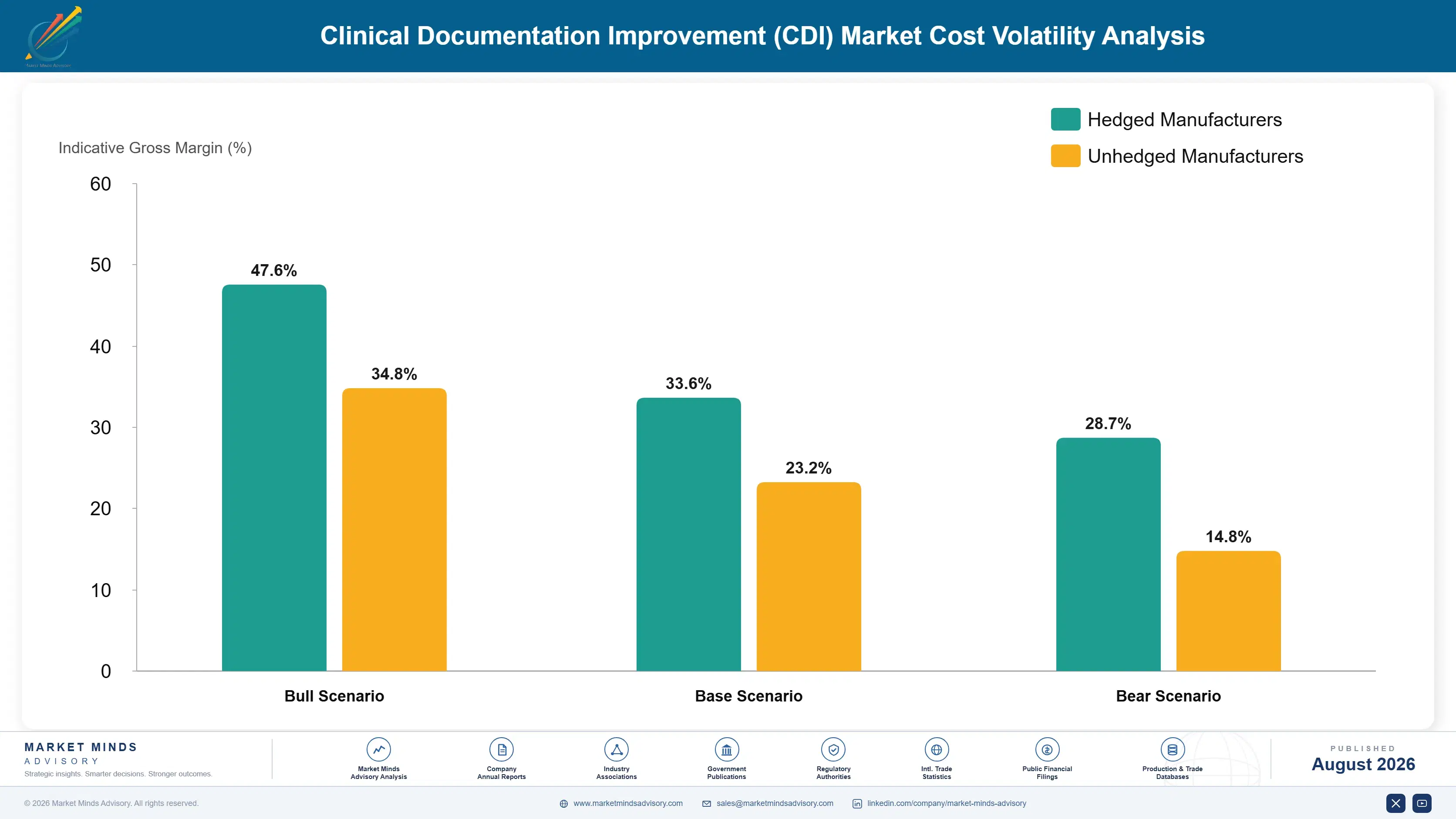
Clinical Data and Talent Set The Floor

Clinical natural language processing training data licensing and CDI staffing talent account for 32% to 44% of production cost for CDI platforms and services, sourced from healthcare data licensing markets and a limited pool of documentation specialists whose availability tracks healthcare labor markets rather than CDI-specific demand. AI-native platform development carries a higher data licensing cost share than standard formats, reflecting the clinical annotation needed for training accuracy.
The 2022 healthcare staffing shortage illustrated input cost exposure directly. Industry association data recorded qualified CDI specialist vacancy rates reaching multi-year highs through 2022 as healthcare labor market tightness and pandemic-era clinical staffing disruption constrained talent availability. Vendors without established recruiting pipelines absorbed cost increases in staffing and retention, passing some of that cost through to hospital customers who had few alternative sourcing options at the time.

Exposure falls hardest on smaller regional vendors without long-term staffing pipeline relationships or diversified sourcing across offshore markets, who must compete for scarce domestic CDI talent closer to spot labor market pricing and absorb whatever margin compression results from healthcare staffing volatility. Larger diversified health IT majors with established offshore staffing partnerships smooth that volatility better than smaller, capitalized competitors exposed to labor market swings.
clinical-documentation-improvement-cdi-market-cost-volatility-analysis-1787465665594

Build Long-Term Offshore Staffing Pipelines

Vendors developing multi-year offshore staffing pipeline relationships convert volatile domestic labor market exposure into a planned talent cost, protecting downstream hospital pricing that resists frequent adjustments across long enterprise contract cycles. This favors larger established vendors with existing offshore relationships, but smaller vendors can access similar terms through staffing consortia rather than negotiating individually across multiple recruiting markets.

Diversify Talent Sourcing Across Regions

Vendors reduce single-source labor market exposure by sourcing CDI talent across multiple regional markets rather than depending entirely on any single geography for the majority of staffing volume. That diversification smooths talent availability across different regional healthcare labor cycles, though it adds training and quality assurance complexity across each additional sourcing relationship incorporated into the network over time.

Invest in AI-Assisted Staff Productivity Tools

Vendors reduce talent dependence by investing in AI-assisted productivity tools that let existing CDI specialists handle higher case volume, capturing labor efficiency that headcount expansion cannot achieve at comparable cost. This productivity strategy suits larger vendors with technology development budgets best, but delivers durable cost stability that persists regardless of healthcare labor market volatility across multiple service segments.

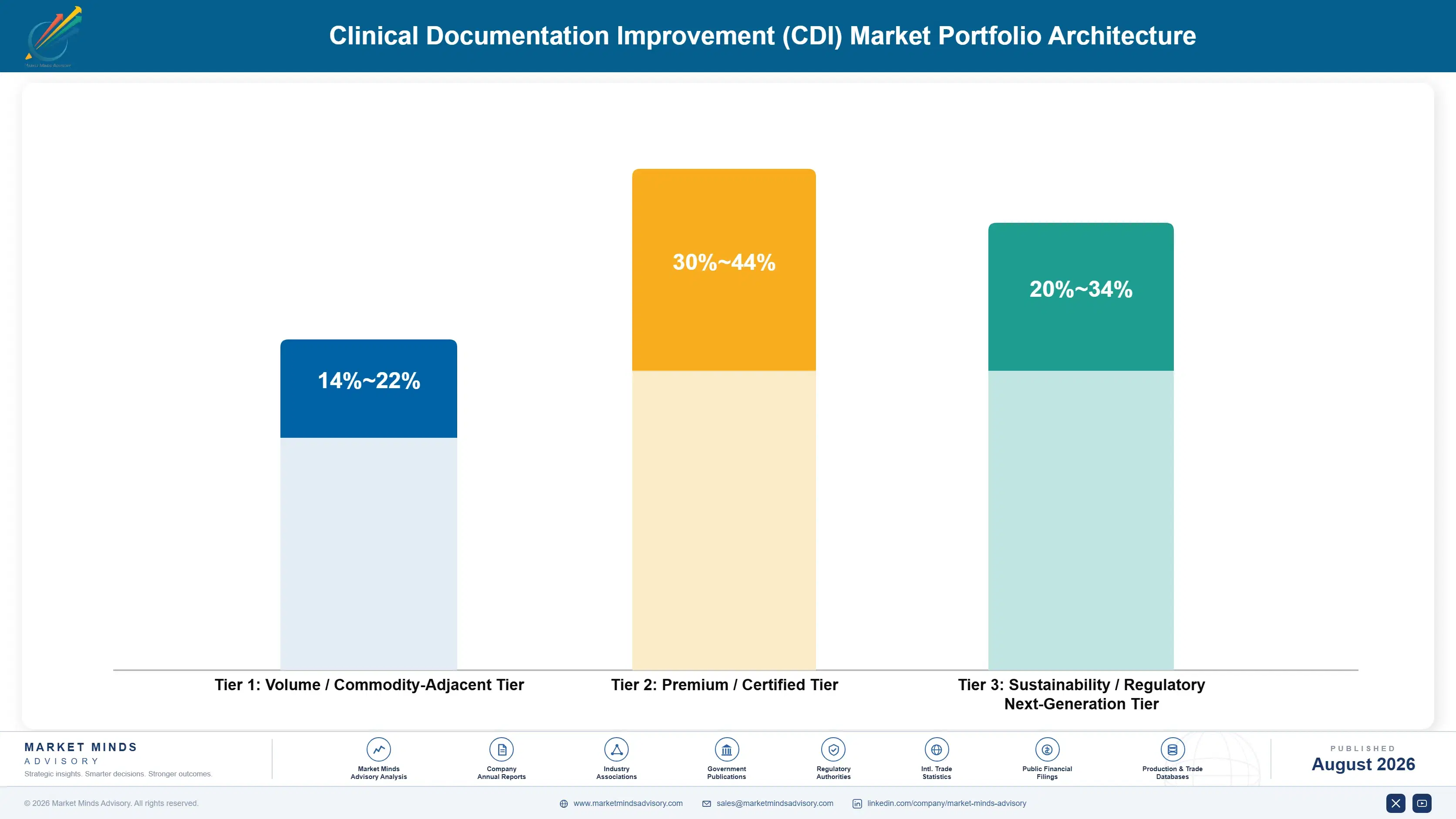
Portfolio Architecture for Margin Defence

CDI's portfolio splits into three tiers with meaningfully different margin economics. Volume standard retrospective audit and query services, sold through established compliance-focused channels on price and delivered coverage, compete on cost and earn steady but thin margins. AI-native and deeply integrated premium platforms earn substantially more, since documented accuracy improvement and workflow integration create switching costs standard vendors cannot replicate quickly.
The tension for CDI vendors is capital allocation between two economics. Volume standard service delivery generates dependable cash flow that funds operations and platform research, while AI-native and integration capacity requires meaningful engineering and specialized talent investment before generating comparable returns at much higher margin. Vendors leaning entirely on standard volume risk losing share to faster-growing differentiated competitors, while those chasing premium investment too aggressively risk underutilized capacity if enterprise adoption proves slower than currently projected.

High-value margin pools concentrate in AI-native and deeply integrated platforms carrying genuine accuracy or integration differentiation that standard formats cannot match. Frontier opportunity sits in combining verified natural language processing accuracy with credible guaranteed staffing coverage, letting vendors capture premium pricing from both enterprise and mid-market channels while retaining steady standard service revenue simultaneously.

Volume / Commodity-Adjacent Tier

Standard retrospective audit and query services sold through established compliance-focused channels on price and delivered coverage, priced close to comparable coding software with minimal differentiation between competing regional vendors nationwide.
Gross Margin: 14-22%

Premium / Certified Tier

AI-native and deeply integrated platforms carrying documented natural language processing accuracy and workflow integration that commands sustained premiums, running well above standard formats, across enterprise health systems and coverage-conscious buyers worldwide, reflecting genuine engineering differentiation.
Gross Margin: 30-44%

Sustainability / Regulatory / Next-Generation Tier

Emerging predictive documentation and next-generation ambient clinical intelligence formats designed to serve increasingly demanding real-time accuracy requirements ahead of continued value-based reimbursement expansion, though scale-up economics remain largely unproven at full commercial volume today.
Gross Margin: 20-34%
clinical-documentation-improvement-cdi-market-portfolio-architecture-1787465666093

High-value Sub-segments and Strategic Watch-out

AI-Powered Natural Language Processing CDI Platforms

AI-native demand grows fastest at 16.8% annually and already commands pricing well above conventional review formats. Established majors investing in accuracy engineering and hospitals expanding real-time adoption both continue growing, and rising reimbursement stakes should keep margin strong through the forecast period ahead, across nearly every regional market currently tracked.
Gross Margin: 30-44%

Computer-Assisted Coding Integration Software

Computer-assisted coding demand grows at a healthy 13.5% annually, driven by ambulatory expansion and outpatient specification, though specialty-specific accuracy expertise limits how quickly new entrants can compete in this technically demanding and quality-critical segment commanding strong margins near the upper end of the category's premium range.
Gross Margin: 24-36%

Retrospective Audit and Query Services

Retrospective audit services remain the largest format by volume, anchored by decades of established compliance specification across mainstream hospital operations globally. Margins stay steady but modest, competing on price and delivered coverage rather than differentiation, but the segment anchors baseline category revenue across nearly every hospital system worldwide.
Gross Margin: 14-22%

CDI Specialist Staffing and Outsourcing Services

Staffing and outsourcing demand faces gradual competitive pressure as AI-native platforms increasingly automate work previously requiring dedicated specialist headcount, narrowing the addressable market for pure staffing-based service delivery. Producers concentrated purely in this segment risk volume erosion absent diversification, across nearly every hospital segment currently tracked.
Gross Margin: 16-24%

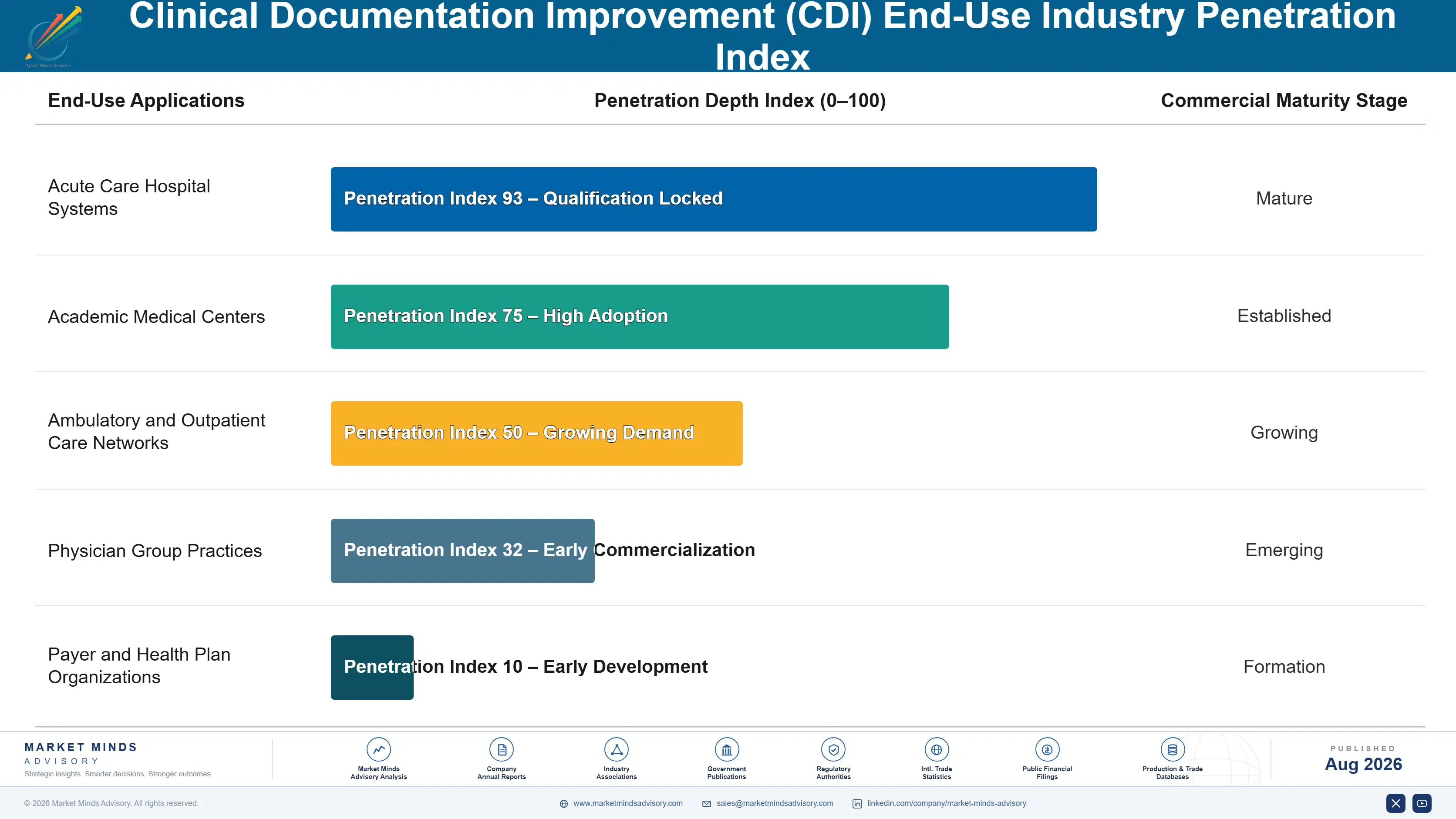
Why Health System Contracts Run Long

CDI demand behaves like an annuity within enterprise health system relationships, since hospitals validate a platform through extended clinical workflow integration and staff training and then source against that qualified platform for the multi-year contract lifecycle rather than re-tendering routinely, given the workflow disruption and retraining risk of switching mid-contract. Mid-market and smaller hospital buyers behave considerably less predictably, since purchasing decisions follow individual budget cycles and staffing needs rather than long-term enterprise commitment.
Stickiness varies sharply by buyer type and health system size. Enterprise health systems rarely switch CDI vendors once a platform has launched, given the workflow retraining and clinical adoption exposure involved in switching mid-contract across a multi-year cycle. Mid-market buyers show less loyalty, comparing compatible services on price and coverage guarantee for each contract renewal decision. Academic medical center programs sit in between, valuing accuracy expertise without the single-contract commitment mid-market procurement lacks.

Buyer profiles are shifting generationally within both enterprise and mid-market channels specifically. Hospital revenue cycle leaders increasingly treat AI-native documentation accuracy as a core financial performance criterion rather than a routine compliance decision, a shift that favors vendors offering documented accuracy and staffing differentiation over those competing purely on generic price compliance alone.
clinical-documentation-improvement-cdi-market-end-use-penetration-index-1787465666582

Where CDI Vendors Should Bet

These are among the four positions where our research anticipates prominent divergence between winners and laggards over the coming forecast period. Each is grounded in the demand model, the regulatory perimeter, and the announced capacity pipeline.
01 / CLINICAL NLP ACCURACY PRIORITY

Build natural language processing capability before AI demand outpaces supply

AI-native demand is growing well over 60% faster than the wider market's pace, and real-time platforms already command meaningful pricing above standard review services, yet most vendors still lack dedicated clinical natural language processing capability at meaningful commercial scale. Vendors that invest now in specialty-specific accuracy engineering position ahead of continuing AI-driven documentation growth across every major hospital system. Waiting risks ceding the category's fastest-growing enterprise segment permanently to competitors currently building that engineering capability well ahead of broader industry adoption.
02 / EHR INTEGRATION PRIORITY

Secure integration partnerships before enterprise demand accelerates further

Deeply integrated platforms command meaningful premium pricing, and demand from hospitals seeking continuous workflow embedding has grown considerably faster than the industry's dedicated EHR integration capability currently available across established vendors. Vendors that secure integration partnerships now capture premium contracts before competitors establish comparable interoperability expertise, since hospitals increasingly favor documented integration depth in supplier qualification. Every vendor without an integration strategy today risks losing this genuine differentiation opportunity to competitors already locking in EHR partnerships, leaving significant contract volume and customer trust on the table.
03 / STAFFING COVERAGE DEVELOPMENT

Build guaranteed coverage models before staffing shortages accelerate further

Vendors offering guaranteed staffing coverage command substantial premium pricing, and demand from hospitals navigating persistent CDI staffing shortages has grown considerably faster than the industry's dedicated coverage capacity currently available across established vendors. Vendors that invest now in recruiting infrastructure capture contracts from hospitals before competitors establish comparable staffing capability. Every vendor relying purely on ad hoc staffing models risks missing this fast-growing, technically differentiated revenue opportunity entirely, ceding ground to competitors already scaling coverage capacity across multiple hospital segments.
04 / LONG-TERM PROGRAM CONTRACTS

Lock hospitals into multi-year enterprise agreements now

Hospital systems increasingly prefer multi-year CDI platform commitments over annual renewal purchasing across enterprise-wide deployment programs, since implementation disruption during platform transition carries genuine workflow continuity risk that hospitals cannot comfortably absorb given tightly coordinated clinical and revenue cycle scheduling. Vendors that secure these contracts now lock in demand and pricing before competitors capture the same health system accounts, since hospitals rarely switch CDI vendors once a platform has been integrated. Every vendor relying purely on annual sales risks missing the category's most durable and valuable revenue opportunity entirely.

Engagement Snapshot From the Field

A live engagement with an industry participant carrying material or product regulatory and market exposure ahead of a defining policy shift, showing how our research translates into a defensible multi-year portfolio strategy.
MARKET MINDS ADVISORY · CLIENT ENGAGEMENT SUMMARY
Clinical Documentation Improvement (CDI) Producer Strategic Portfolio Review and Transition Roadmap 2026·Investment Scenario on Clinical Documentation Improvement (CDI) Exposure Evaluation 2025-26
CLIENT PROFILE
A mid-sized North American hospital system operating six acute care facilities approached MMA while evaluating whether to transition from its legacy retrospective CDI program toward a real-time, AI-powered documentation platform. The client reported annual CDI program spending near USD 8.5 million, with retrospective manual review representing roughly 80% of current activity and facing documented reimbursement accuracy gaps (client-reported, unverified by MMA).
STRATEGIC CHALLENGE
Management faced a strategic decision between investing in a platform transition across all six facilities or piloting the technology at a single facility to validate accuracy improvement before broader rollout. The revenue cycle team worried a transition would strain implementation resources and disrupt physician workflow relationships, while the finance team worried a phased approach would delay capturing reimbursement accuracy gains the organization needed.
MMA APPROACH
MMA benchmarked AI platform transition timelines and documented accuracy improvement outcomes across comparable hospital systems that had completed similar transitions, assessed the client's current documentation gap patterns relative to platform capability, and evaluated which vendor relationships offered the most commercially attractive terms given the client's facility count and implementation timeline requirements.
KEY FINDINGS
  1. Comparable hospital systems that piloted AI platforms at a single facility before broader rollout achieved smoother physician adoption than systems that transitioned all facilities simultaneously.
  2. Platform investment costs, while substantial, were largely justified by documented reimbursement accuracy improvement that exceeded the client's internal cost projections within the first year of full deployment.
  3. The client's existing documentation gap patterns aligned closely with cases where AI platforms had demonstrated the strongest accuracy improvement in comparable hospital system deployments.
  4. A phased rollout approach starting with the highest-volume facility allowed validation of the accuracy improvement model before committing to full six-facility deployment.
CLIENT PROFILE
A mid-sized North American hospital system operating six acute care facilities approached MMA while evaluating whether to transition from its legacy retrospective CDI program toward a real-time, AI-powered documentation platform. The client reported annual CDI program spending near USD 8.5 million, with retrospective manual review representing roughly 80% of current activity and facing documented reimbursement accuracy gaps (client-reported, unverified by MMA).
STRATEGIC CHALLENGE
Management faced a strategic decision between investing in a platform transition across all six facilities or piloting the technology at a single facility to validate accuracy improvement before broader rollout. The revenue cycle team worried a transition would strain implementation resources and disrupt physician workflow relationships, while the finance team worried a phased approach would delay capturing reimbursement accuracy gains the organization needed.
MMA APPROACH
MMA benchmarked AI platform transition timelines and documented accuracy improvement outcomes across comparable hospital systems that had completed similar transitions, assessed the client's current documentation gap patterns relative to platform capability, and evaluated which vendor relationships offered the most commercially attractive terms given the client's facility count and implementation timeline requirements.
KEY FINDINGS
  1. Comparable hospital systems that piloted AI platforms at a single facility before broader rollout achieved smoother physician adoption than systems that transitioned all facilities simultaneously.
  2. Platform investment costs, while substantial, were largely justified by documented reimbursement accuracy improvement that exceeded the client's internal cost projections within the first year of full deployment.
  3. The client's existing documentation gap patterns aligned closely with cases where AI platforms had demonstrated the strongest accuracy improvement in comparable hospital system deployments.
  4. A phased rollout approach starting with the highest-volume facility allowed validation of the accuracy improvement model before committing to full six-facility deployment.
RECOMMENDED STRATEGY
Phase 1: Phase 1 (0 to 6 months): Pilot the AI platform at the highest-volume facility to validate accuracy improvement and physician adoption assumptions. Phase 2: Phase 2 (6 to 15 months): Expand deployment to three additional facilities based on validated accuracy and adoption performance from the pilot. Phase 3: Phase 3 (15 to 30 months): Complete full six-facility rollout and formalize long-term vendor contract terms based on documented system-wide performance.
OUTCOME
The client completed its pilot deployment and reported meaningfully improved documentation accuracy and physician query response rates within the first six months. Revenue cycle leadership specifically credited the platform for measurable reimbursement gains during that period. The client is now expanding deployment across additional facilities based on the pilot's documented performance (client-reported, unverified by MMA).

Frequently Asked Questions

Foundational context covering the market sizes, CAGR, scope, country, region and competition that inform every finding below. This section is provided to cover basics and most often pre-purchase conversations, answered from the MMA Primary Research Dataset.

What is the current size of the Clinical Documentation Improvement (CDI) Market?

The global CDI market reached USD 5.08 billion in 2026, based on MMA Primary Research Dataset findings. Growth increasingly reflects AI-native platform demand rather than standard retrospective audit volume alone.

How large will the Clinical Documentation Improvement (CDI) Market be by 2036?

MMA's base case projects the market reaching USD 13.66 billion by 2036, an incremental opportunity of roughly USD 8.58 billion over the 2026 to 2036 forecast period.

What is the CAGR for the Clinical Documentation Improvement (CDI) Market 2026 to 2036?

The base case CAGR is 10.4%, with a bull case of 11.7% and a bear case of 9.1% depending on AI adoption pace and hospital capital budget conditions.

Which segment is growing fastest?

AI-powered natural language processing CDI platforms lead at a 16.8% CAGR, well over 60% faster than the overall market rate, as hospitals replace manual review with automated detection.

Who are the major companies in the Clinical Documentation Improvement (CDI) Market?

Leading participants include 3M Health Information Systems, Optum360, Nuance Communications, Iodine Software, and Dolbey Systems, assessed on integration and engineering program breadth across enterprise and mid-market hospital system deployments worldwide.

Which country is growing fastest?

India leads country-level growth at 14.5% annually, driven by its rapidly expanding medical coding and CDI outsourcing capacity, ahead of every other emerging coding outsourcing hub.

Report Segmentation Architecture

The full report scope spans multiple orthogonal segmentation dimensions, with cross-tabulated demand data provided for each dimension pair. Coverage extends further to regional breakdowns, trend trajectories, and the competitive detail needed to support segment-level decision-making.

By Technology and Service Function

  • AI-Powered Natural Language Processing CDI Platforms
  • Computer-Assisted Coding Integration Software
  • Concurrent Clinical Documentation Review Services
  • Retrospective Audit and Query Services
  • CDI Specialist Staffing and Outsourcing Services
  • Physician Query and Clinical Decision Support Tools

By End-Use Industry

  • Acute Care Hospital Systems
  • Academic Medical Centers
  • Ambulatory and Outpatient Care Networks
  • Physician Group Practices
  • Payer and Health Plan Organizations

By Commercial Dimension

  • Enterprise Platform Licensing
  • Outsourced Staffing Service Contracts
  • EHR Integration Partnership Services
  • Consulting and Implementation Services

By Region

  • North America
  • Western Europe
  • East Asia
  • South Asia and Pacific
  • Latin America
  • Middle East and Africa
  • Eastern Europe

Scope, Methodology, and Coverage

Every figure in this report is reproducible from documented input assumptions. The scope below maps the historical period, the forecast horizon, the segmentation dimensions, and the countries covered, alongside the underlying primary and qualitative methodology.
Historical Period
2020 to 2025
Forecast Period
2026 to 2036
Base Year
2025 (USD billions; MMA Primary Research Dataset, August 2026)
Market Definition
The clinical documentation improvement market covers commercial licensing and sale of AI-powered natural language processing CDI platforms, computer-assisted coding integration software, concurrent documentation review services, retrospective audit and query services, CDI specialist staffing and outsourcing, and physician query and clinical decision support tools used by hospitals and health systems. It excludes general electronic health record platforms and standalone medical billing software, which the industry classifies as separate health information technology categories.
Quantitative Units
USD billions (current prices); number of hospital system contracts where applicable
Segmentation Dimensions
By Technology and Service Function; By End-Use Industry; By Commercial Dimension; By Region
Regions Covered
North America, Western Europe, East Asia, South Asia and Pacific, Latin America, Middle East and Africa, Eastern Europe
Countries Covered
USA, Canada, Germany, France, UK, Italy, Spain, China, Japan, South Korea, India, Australia, Philippines, Indonesia, Brazil, Mexico, Argentina, UAE, Saudi Arabia, South Africa, Nigeria, Egypt, Poland, Czech Republic, Hungary, Slovakia, Russia, Netherlands, Sweden, Switzerland, and additional markets relevant to this sector
Key Companies Profiled
3M Health Information Systems, Optum360, Nuance Communications Inc, Iodine Software, Dolbey Systems Inc, nThrive Inc, R1 RCM Inc, Change Healthcare Inc, Craneware plc, Vizient Inc, Streamline Health Solutions Inc, ChartWise Medical Systems Inc, Enjoin LLC, ClinIntell Inc, TruCode LLC, HealthStream Inc, Wolters Kluwer Health, Cerner Corporation, Epic Systems Corporation, Huron Consulting Group Inc
Quantitative Methodology
Primary survey, n=3,800 respondents, Q4 2025, six countries; demand-side model with trade association cross-validation
Qualitative Methodology
47 expert interviews, Q4 2025; applied to validate demand model assumptions, identify emerging dynamics, and assess competitive positioning
Report Format
PDF and XLSX data workbook (Word format preview document)
Publisher
Market Minds Advisory
Report Code
MMA-2026-HLT-101
Published
August 2026
Contact
sales@marketmindsadvisory.com | www.marketmindsadvisory.com

Purchase the full Clinical Documentation Improvement (CDI) Market Report (2026 to 2036).

The full MMA Clinical Documentation Improvement report sizes the market across six technology and service function segments, five end-use industries, four commercial supply models, and seven regions through 2036. It profiles twenty participants on a consistent basis of integration and engineering program breadth across standard, AI-native, and staffing formats, scoring each on natural language processing investment, EHR integration depth, and staffing coverage readiness. Scenario models quantify how AI adoption, value-based reimbursement expansion, and staffing shortage conditions move both category volume and pricing. The report includes talent cost modeling, a clinical NLP accuracy benchmark, and staffing coverage pathway assessment built for healthcare and investment strategy teams.
Six-function demand model with accuracy-adjusted pricing
Clinical data and staffing cost volatility modeling
Clinical NLP accuracy pathway benchmarking model
Twenty-company competitive profiling on consistent program basis
Seven-region demand map with country-level growth detail
EHR integration and staffing coverage assessment

Built For The People Who Decide

From boardroom strategy to bench-side execution, this report is read cover-to-cover by leaders shaping the next decade of their industry, turning demand scenarios, market dynamics and valuation benchmarks into decisions.
CXOs/ Presidents/ VPs/ Managers
M&A and Corporate Development
Strategy Teams and R&D Heads
Procurement and Product Directors
Regulatory and Compliance Leaders
Investor Relations and Equity Analysts