Market Minds Advisory
Clinical Decision Support App Market

Clinical Decision Support App Market: Clinical Decision Support App Market. Generative AI Diagnostic Assistance Reshapes Point-of-Care Software Purchasing

Generative AI diagnostic suggestion engines are pushing hospitals to replace static rule-based alert systems with adaptive clinical decision support apps that learn from institution-specific outcomes data rather than generic published guidelines alone.

Lead Analyst

Published

September 2026

Make Smarter Decisions with Customized Research Insights

Request a free sample report and evaluate market opportunities, growth trends, and competitive dynamics relevant to your business needs.

2025 MARKET VALUE$6.4BMarket Size 2025
2036 FORECAST VALUE$21.8BBase Case , 2026 to 2036
CAGR 2026 TO 203611.8 %Bull 13.1% / Bear 10.6%
INCREMENTAL OPPORTUNITY$14.7BNet 10- year value creation
EXPANSION MULTIPLE3.05x2036 value over 2026 base
Strategic Levers
M&A Pipeline
Regional Outlook
Country Rankings
Competitive Intelligence
Segmental Deep-dive
Call-Us : 91 93563 13602

Executive Snapshot and Market Trajectory.

Hospitals are under real pressure to replace static rule-based alert systems that clinicians have learned to ignore with adaptive apps that surface fewer, more clinically relevant warnings drawn from institution-specific outcomes data rather than generic published guidelines alone across every department and specialty.
Generative AI diagnostic suggestion engines, embedded directly into electronic health record workflows, are the clearest growth driver, since they can synthesize a patient's full chart into a differential diagnosis suggestion faster than a clinician manually reviewing scattered notes and lab results. Sepsis and deterioration prediction apps remain the largest deployed category by installed hospital count, even as generative diagnostic tools capture a growing share of new purchasing budget across most large health systems nationwide.
Epic's own embedded clinical decision support tools hold the deepest installed base through EHR bundling, but standalone vendors including Aidoc and Cleerly are winning share in imaging-specific diagnostic support where deeper specialty expertise matters more than platform breadth. Regulatory clearance pathways through the FDA are tightening for generative AI tools, favoring vendors with mature clinical validation infrastructure over newer entrants still building the evidence base regulators increasingly demand.
Market Definition
The clinical decision support app market covers software applications that analyze patient data at the point of care to generate diagnostic, treatment, or risk alerts for clinicians. It excludes general electronic health record systems sold without an embedded decision support module, medical devices with onboard software, and population health analytics platforms not used at the point of individual patient care.
Base Year Value
$6.4B in 2025 (MMA Primary Research Dataset, September 2026)
Forecast Period
2026 to 2036, eleven discrete annual values
CAGR
11.8% base case. Bull 13.1%. Bear 10.6%.
Fastest Growth Segment
Generative AI Diagnostic Suggestion Tools: 17.6% CAGR
Fastest Growth Country
India: 14.2% CAGR
Fastest Growth Region
South Asia and Pacific: 14.2% CAGR
Largest Region
North America: 31% of 2025 global value
Market Leaders
Epic Systems, Cerner Oracle Health, IBM Watson Health successor, Aidoc, and Cleerly lead the competitive landscape.
Primary Survey
n=3,800 procurement and R&D decision-makers, Q4 2025, six countries
Methodology
Demand-side build-up, cross-validated against public data, 47 expert interviews

Clinical Decision Support App Market Forecast Scenarios

clinical-decision-support-app-market-size-forecast-scenario-1790007285300
The clinical decision support app market compounded at roughly 10.8 percent between 2020 and 2025, a period shaped by pandemic-driven demand for rapid triage and deterioration prediction tools followed by a broader push toward generative AI diagnostic assistance as large language models matured enough for regulated clinical use across many major health systems nationwide and abroad.
MMA's base case assumes 11.8 percent annual growth through 2036, anchored by three commercial mechanisms: generative AI diagnostic tools maturing from pilot programs into standard clinical workflow, FDA clearance pathways stabilizing enough to give hospital buyers genuine purchasing confidence, and EHR vendors bundling decision support modules directly into existing platform contracts rather than requiring separate procurement, which lowers the adoption barrier for smaller hospital systems with limited technology budgets and staff.
The bull case centers on faster-than-expected FDA clearance throughput for generative diagnostic tools, pulling forward adoption timelines that currently assume a more cautious multi-year regulatory pace. The bear case is a high-profile diagnostic error attributed to an AI decision support tool, which could trigger a regulatory and liability backlash that slows adoption industry-wide regardless of the underlying technology's actual accuracy record.

Alert Fatigue Is Reshaping Clinical Decision Support Purchasing

Clinical decision support apps face a credibility problem that most enterprise software categories never encounter: clinicians have spent years learning to dismiss alerts reflexively, and nearly half of all alerts still get overridden without meaningful review at the point of care. That override rate is now the single most scrutinized metric in vendor evaluation across most large health systems.
MARKET CONCENTRATIONCR5 44%top five vendors hold under half of app revenue
AVERAGE CONTRACT VALUE$186,000typical annual enterprise subscription across mid-size hospital systems today
ALERT OVERRIDE RATE49%of clinical alerts still get dismissed without meaningful clinician review
FDA CLEARANCE BACKLOG14 monthsaverage wait time for generative diagnostic tool clearance currently
RENEWAL RATE84%of enterprise contracts renew once initial deployment stabilizes fully
CLOUD HOSTING COST SHARE22% of COGScompliant cloud infrastructure remains a large recurring cost line
Generative AI diagnostic tools promise to cut alert volume by surfacing only genuinely relevant suggestions rather than every rule-based trigger a patient's chart satisfies, but hospital buyers remain cautious about clinical liability exposure until FDA clearance pathways mature further. Sepsis and deterioration prediction remains the largest deployed category by installed base, even as newer generative tools capture a growing share of new purchasing budget across most large systems nationwide.
Vendors that can document a meaningful reduction in override rate alongside improved diagnostic accuracy are winning budget away from legacy rule-based competitors, since hospital quality committees increasingly demand this evidence before approving procurement decisions. Epic's EHR-bundled decision support tools benefit from default installation, but standalone specialists like Aidoc are winning share in imaging where deeper diagnostic expertise outweighs the convenience of platform bundling alone.
"A clinical alert that gets dismissed nine times out of ten isn't decision support. It's noise the hospital happens to be paying a subscription for."
Senior Analyst, Digital Health and Clinical AI Practice · MMA Healthcare Practice · September 2026

Market Trends

Generative AI Diagnostic Assistants Move Into Regulated Clinical Use

Large language model based diagnostic suggestion tools have moved from experimental pilot programs into FDA-cleared clinical deployment at a small but growing number of academic medical centers, marking a genuine inflection point for the category. These tools synthesize a patient's full chart, including notes, labs, and imaging reports, into a ranked differential diagnosis suggestion within seconds, a task that previously required a clinician to manually review scattered documentation across multiple screens. Early deployments concentrate in emergency departments and intensive care units, where diagnostic speed carries the highest clinical stakes and the clearest measurable return on investment.
Market Impact: Cuts procurement cycles by 6 months
Alert Fatigue Metrics Become a Formal Procurement Requirement

Hospital quality committees are increasingly requiring vendors to disclose documented alert override rates as a formal procurement criterion, a shift from the previous generation of purchasing decisions that focused almost entirely on rule coverage breadth rather than clinician acceptance. This has forced legacy rule-based vendors to invest heavily in alert tuning and machine learning based suppression of low-value warnings that clinicians reliably ignore, since a high override rate now actively damages competitive positioning during vendor evaluation. Several major health systems have begun publishing internal alert fatigue benchmarks that they now share directly with prospective vendors during the procurement process.
Market Impact: Cuts unnecessary procedures by 15 percent

Market Opportunities and Growth Drivers

EHR Bundling Lowers Adoption Barrier for Smaller Hospitals

Epic and Oracle Health are both increasingly bundling decision support modules directly into existing EHR platform contracts rather than requiring hospitals to negotiate and procure separate standalone software, a shift that dramatically lowers the adoption barrier for smaller hospital systems with limited technology budgets and thin IT staffing. This bundling strategy is squeezing standalone vendors out of the general rule-based alert category, pushing them to specialize in narrower, higher-value applications like imaging-specific diagnostic support where deeper clinical expertise still commands a premium that platform bundling alone cannot replicate. Smaller EHR vendors are responding with bundled partnerships of their own.
Market Impact: Adds 4 to 6 months

Value-Based Care Contracts Reward Documented Diagnostic Accuracy

Health systems increasingly operating under value-based and risk-sharing payer contracts have a direct financial incentive to reduce diagnostic errors and unnecessary procedures, and decision support apps that can document measurable accuracy improvement are capturing budget tied directly to these value-based contract performance metrics. This financial alignment is accelerating adoption beyond what pure clinical quality improvement goals alone would achieve, since hospital finance leadership now actively champions decision support procurement rather than treating it as a purely clinical department request. Vendors are increasingly building outcomes reporting dashboards specifically designed to support these value-based contract renewal conversations with payers.
Market Impact: Adds 30 to 50 percent

Market Restraints and Challenges

Clinical Liability Uncertainty Slows Generative AI Adoption

Hospital legal and risk management teams remain genuinely uncertain about liability exposure when a generative AI diagnostic suggestion contributes to a clinical decision that later proves incorrect, and the root cause is that malpractice law in most jurisdictions has not yet caught up with AI-assisted clinical decision-making precedent. The commercial impact shows up as extended procurement timelines, since risk committees now routinely add several additional review cycles specifically for generative AI tools that legacy rule-based systems never faced. Some vendors are mitigating this by offering contractual liability sharing arrangements that shift some risk exposure away from the purchasing hospital.
Market Impact: Cuts review time 40 percent

EHR Integration Complexity Raises Total Implementation Cost

Many hospitals run heavily customized, decades-old EHR configurations that were never designed to exchange real-time data with modern cloud-based decision support applications, and the root cause traces back to years of institution-specific customization that makes each hospital's integration project genuinely unique rather than a repeatable, templated deployment. Integration costs frequently exceed the software licensing cost itself within the first implementation year, discouraging some smaller hospitals despite genuine interest in the underlying clinical capability. Vendors are mitigating this by building pre-configured connectors for the most common EHR platform versions still in wide clinical use.
Market Impact: Requires under 30 percent override threshold
3 additional market trends, 4 additional growth drivers, and 2 additional restraints and challenges are covered in the full report. Contact sales@marketmindsadvisory.com to access the complete intelligence.

Segment CAGR and Growth Architecture

Six application categories cover the market: diagnostic suggestion tools, drug interaction and dosing alerts, sepsis and deterioration prediction, imaging-specific diagnostic support, care pathway and order set guidance, and population risk stratification tools. Classification follows clinical function alone, not care setting, department, or vendor type, keeping the hierarchy consistent throughout this report and its appendices.
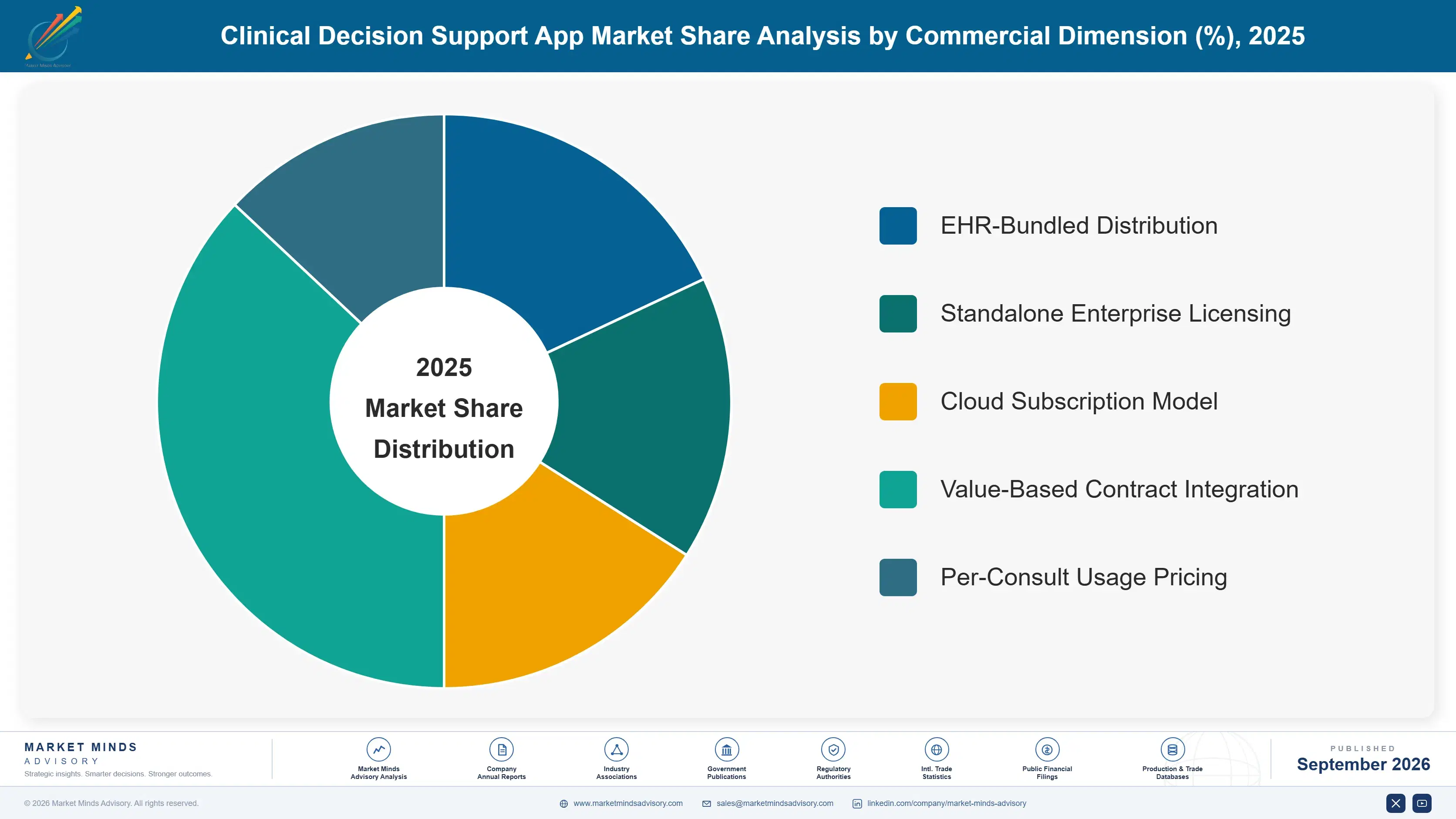
clinical-decision-support-app-market-market-share-analysis-1790007285836

Generative AI Diagnostic Suggestion Tools

Generative AI diagnostic suggestion tools are the fastest-growing application category, at a 17.6 percent CAGR against a base rate of 11.8 percent, pulled forward by large language models finally maturing enough for regulated clinical use after years of experimental pilot programs that never reached production deployment at scale. These tools synthesize a patient's entire chart into a ranked differential diagnosis suggestion, a capability that legacy rule-based systems could never approximate since they can only trigger on predefined conditions rather than reasoning across unstructured clinical narrative text. Epic, Aidoc, and several well-funded startups have all launched dedicated generative diagnostic products within the past eighteen months, and FDA clearance activity in this specific category has accelerated sharply.
CAGR 17.6%

Imaging-Specific Diagnostic Support

Imaging-specific diagnostic support carries the second-fastest growth rate, at 14.9 percent, as radiology and cardiology departments face growing case volume without proportional growth in specialist staffing, creating real pressure to triage and prioritize imaging studies using automated diagnostic support tools across most large hospital systems. Aidoc and Cleerly have both built deep clinical validation evidence specifically within narrow imaging subspecialties, a strategy that has proven more defensible than broader, shallower platform coverage against well-capitalized EHR incumbents entering the category. Hospitals increasingly view imaging-specific diagnostic support as essential infrastructure for managing radiologist workload rather than an optional productivity enhancement, a shift pulling budget away from broader, less differentiated decision support categories entirely.
CAGR 14.9%
Full segment breakdown across 6 segments available in the complete report.

Regional Architecture and Country Demand Map

North America leads clinical decision support app demand by a clear margin, anchored by the FDA's maturing generative AI clearance pathway and Epic's EHR-bundled distribution reach, narrowly ahead of an East Asian base scaling fast off strong hospital IT investment across most major regional markets.

North America

Epic's EHR platform, installed across the majority of large United States health systems, gives decision support modules a distribution advantage no standalone vendor can match, since bundled features arrive already installed rather than requiring separate procurement. The FDA's clearance pathway for generative AI diagnostic tools, while still maturing, is further along than comparable regulatory frameworks in most other regions, giving American hospitals earlier access to newer diagnostic categories than competitors elsewhere. Canada's smaller but growing hospital digitization push adds incremental volume through provincial health system modernization programs currently underway. Growth trails the fastest-growing regions as this market's overall maturity means incremental gains increasingly come from upgrading existing deployments rather than first-time adoption.
Share: 31% | CAGR: 12.3% (2026 to 2036)

East Asia

China's rapid hospital digitization push, backed by national health informatization policy targets, is scaling decision support adoption quickly across large tertiary hospitals in major metropolitan areas nationwide and beyond. Japan's aging population and persistent physician shortage are driving strong demand for diagnostic support tools that can extend limited specialist capacity across a stretched healthcare workforce facing real strain. South Korea's advanced hospital IT infrastructure and strong domestic AI research base have produced several locally developed decision support platforms competing directly with Western vendors for share and budget. Growth here outpaces the global base rate as hospital technology investment across the region continues compounding faster than in more mature Western markets.
Share: 23% | CAGR: 12.6% (2026 to 2036)
Regional intelligence for 5 additional markets available in the complete report: Western Europe, South Asia and Pacific, Latin America, Middle East and Africa, Eastern Europe. Contact sales@marketmindsadvisory.com.
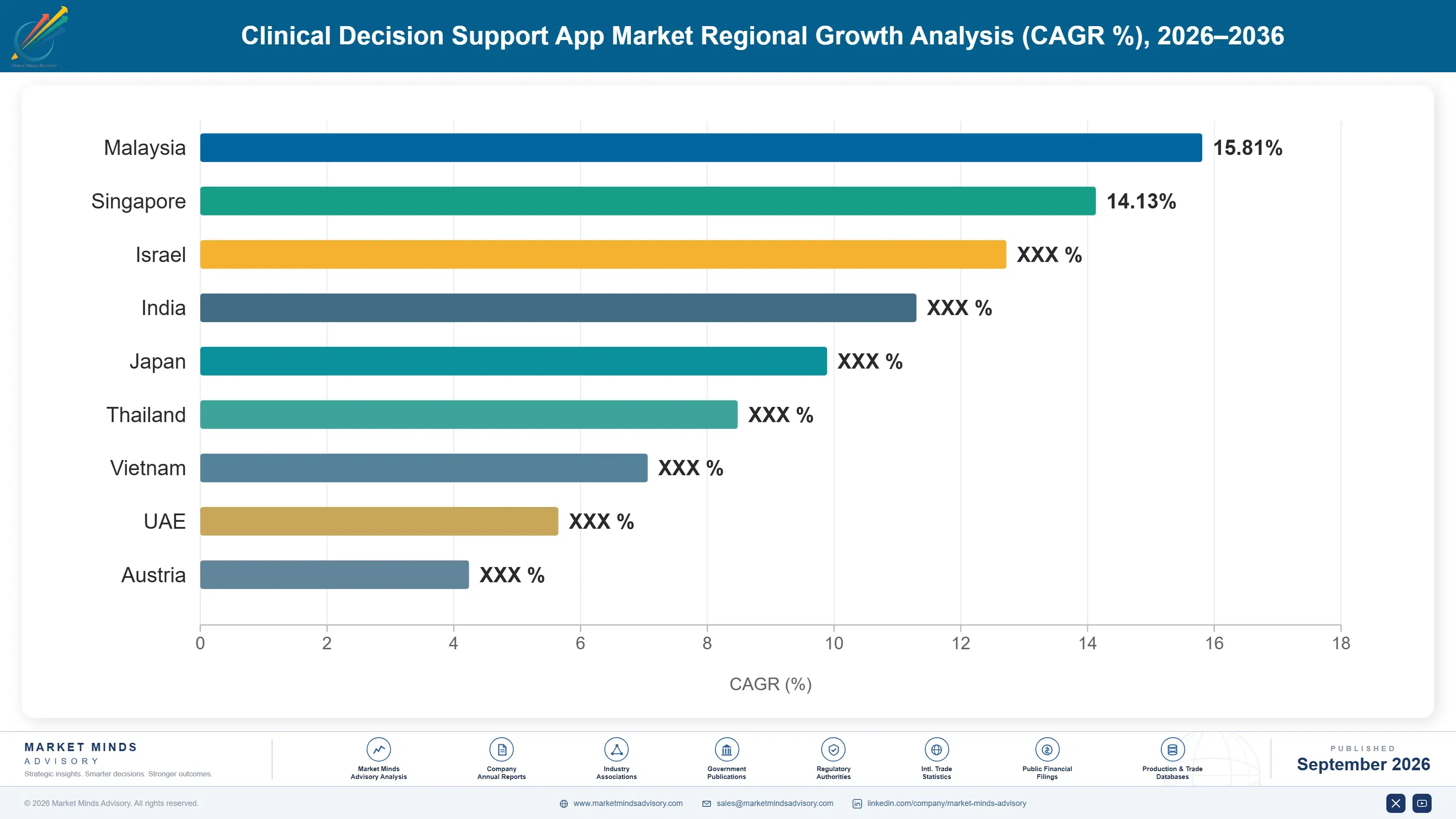
clinical-decision-support-app-market-country-cagr-analysis-1790007286374

Where Clinical Decision Support Margin Concentrates

Alert volume no longer predicts vendor success in this fast-moving category anymore at all, not even remotely close to it. Margin concentrates in documented accuracy improvement, low override rates, and specialty-specific clinical depth, capabilities that generic rule-based competitors cannot easily replicate without years of accumulated validation evidence and hard-won clinical trust among practicing physicians.

Outcomes Documentation Drives Premium Pricing Power

Vendors that can document a measurable reduction in diagnostic error rate or alert override percentage are converting that evidence directly into premium pricing over legacy rule-based competitors in the broader market today. Published data showing generative diagnostic tools reducing missed sepsis diagnoses by 20 to 25 percent is giving vendors with this evidence a real basis for enterprise contract renewal at higher rates than competitors relying purely on feature comparison alone in sales conversations. Hospital quality committees increasingly require this documentation before approving multi-year contract renewals at any price point whatsoever.
Market Impact: Supports a 20 to 25 percent price premium

Specialty-Specific Clinical Depth Beats Platform Breadth

Vendors focused narrowly on a single clinical subspecialty, such as imaging or sepsis prediction, are commanding per-seat pricing 25 to 35 percent higher than broad-platform competitors, since hospital department heads increasingly value deep validation evidence within their specific specialty over generalized coverage across many conditions and clinical use cases nationwide today. Aidoc's imaging-focused pricing runs meaningfully above generalist EHR-bundled decision support modules on a per-radiologist basis, reflecting genuine willingness to pay for specialty depth. This dynamic is pushing several broader platform vendors to build dedicated specialty modules of their own.
Market Impact: Commands pricing 25 to 35 percent above generalist tools

Outcomes Reporting Subscription Beyond Core Software License

Vendors are increasingly separating outcomes reporting and value-based contract analytics into standalone recurring add-on subscriptions rather than bundling this capability into the base software license, converting a one-time feature into genuinely ongoing recurring revenue. This add-on module now accounts for roughly 10 to 14 percent of total vendor revenue among the largest decision support providers, a share growing steadily as more hospitals operate under value-based payer contracts requiring documented outcomes reporting to payers. This mirrors a broader healthcare software trend toward analytics-layer monetization beyond the core clinical workflow tool itself.
Market Impact: Adds 10 to 14 percent recurring subscription revenue

Liability Sharing Arrangements Accelerate Enterprise Sales

Vendors offering contractual liability sharing arrangements, where the vendor assumes a portion of clinical risk exposure for AI-assisted diagnostic suggestions, are closing enterprise deals meaningfully faster than competitors leaving all liability with the purchasing hospital's own risk committee. These arrangements shorten legal and risk committee review cycles by roughly 3 months on average, a genuine competitive advantage during the extended procurement timelines this category typically involves for every prospective buyer. Larger, better-capitalized vendors can absorb this liability exposure more comfortably than smaller competitors, creating a real barrier for newer entrants.
Market Impact: Cuts procurement review time by 3 months typically

Who Controls the Margin Pool

At 44 percent, CR5 concentration leaves a genuinely fragmented tail of specialty and regional vendors beneath the top five. Epic leads through EHR-bundled distribution reach that no standalone vendor can match, but Aidoc and Cleerly have both carved durable positions in imaging-specific diagnostic support, narrowing the gap between the platform leader and its closest specialty challengers.
Current competitive activity centers on generative AI diagnostic capability, documented outcomes evidence, and specialty-specific clinical depth rather than broad rule coverage. Vendors are racing to publish clinical validation studies since hospital quality committees increasingly demand measurement rigor before approving procurement. Several vendors have also begun offering liability sharing arrangements to accelerate enterprise sales cycles that generative AI's regulatory novelty has otherwise extended considerably.

The next competitive shift is coming from EHR incumbents building native generative AI diagnostic modules rather than relying on standalone specialty vendors, a threat that could compress independent platform margins within a few years. That threat remains contained to broader diagnostic categories for now, since narrow imaging and cardiology specialty tools still require deeper clinical validation than incumbents have built. Smaller specialty vendors focused on a single condition are proving harder for large platforms to displace quickly.
clinical-decision-support-app-market-company-positioning-matrix-1790007286901

Competitive Moat and Risk Dimensions

EPIC SYSTEMS

Moat: EHR-bundled distribution reach

Epic's installed base across the majority of large United States health systems gives its bundled decision support modules default distribution that no standalone vendor can match without separate, often lengthy procurement processes. Hospitals rarely rip out an existing EHR relationship over a decision support feature gap, which insulates Epic's modules from the competitive pressure standalone vendors face constantly.
EPIC SYSTEMS

Risk: Shallower specialty clinical depth

Epic's decision support modules cover broad clinical categories but generally lack the deep, subspecialty-specific validation evidence that focused vendors like Aidoc have built within narrow domains such as imaging. Hospital department heads increasingly prefer specialty depth over platform convenience for high-stakes diagnostic categories, a gap Epic's broader development priorities are slower to close than a narrowly focused competitor.
AIDOC

Moat: Imaging-specific validation evidence

Aidoc has built deep clinical validation evidence specifically within radiology and cardiology imaging, a subspecialty focus that has produced published outcomes data broader platform vendors have not matched in comparable depth. This validation depth gives Aidoc a durable position with radiology department heads who prioritize documented diagnostic accuracy over broader platform convenience when evaluating imaging-specific tools.
AIDOC

Risk: Narrow single-specialty revenue base

Aidoc's revenue concentrates heavily in imaging applications, leaving it more exposed than diversified competitors if imaging-specific procurement budgets tighten or if EHR incumbents eventually close the validation gap in this specific subspecialty. Expanding into adjacent clinical categories requires building comparable validation evidence from scratch, a multi-year undertaking competitors with broader existing platforms do not face.

Players Tracked

Prominent Players

Epic Systems Corporation
Oracle Health Corporation
Aidoc Medical Ltd
Cleerly Inc
athenahealth Inc

Other Key Players

IBM Corporation
Nuance Communications Inc
Wolters Kluwer NV
Elsevier BV
Zebra Medical Vision Ltd
Viz.ai Inc
PathAI Inc
Tempus AI Inc
Butterfly Network Inc
Qure.ai Technologies Pvt Ltd
Arterys Inc
Regard Inc
Ambience Healthcare Inc
Suki AI Inc
Abridge AI Inc

Recent Developments

FEBRUARY 2026

Epic Launches Native Generative AI Diagnostic Module

Epic Systems introduced a native generative AI diagnostic suggestion module built directly into its EHR platform, targeting health systems seeking integrated decision support without separate vendor procurement. The launch extends Epic's existing decision support portfolio into generative diagnostic territory where standalone vendors had previously held an early lead.
Signal: EHR incumbents building native generative diagnostic tools now directly threaten standalone specialty vendors across the industry
SEPTEMBER 2025

Aidoc Acquires Cardiology-Focused Diagnostic Startup

Aidoc completed the acquisition of a smaller cardiology-focused diagnostic imaging startup to expand its clinical validation evidence beyond its existing radiology-centered product line. The deal brings specialized cardiology algorithms that Aidoc had previously developed more slowly through internal engineering resources alone, compressing its roadmap by roughly a year.
Signal: Specialty clinical depth is increasingly acquired rather than built organically by competing imaging vendors nationwide today
APRIL 2026

Cleerly Signs Major Health System Enterprise Agreement

Cleerly signed a multi-year enterprise agreement with a major academic health system to deploy its cardiac imaging diagnostic support platform across all affiliated hospital facilities network-wide. The agreement extends Cleerly's existing enterprise strategy and provides a reference deployment other large health systems are likely to evaluate closely.
Signal: Enterprise-wide deployment agreements are becoming the preferred path to scale for specialty software vendors more broadly

Cloud Infrastructure and Clinical Validation Cost Exposure

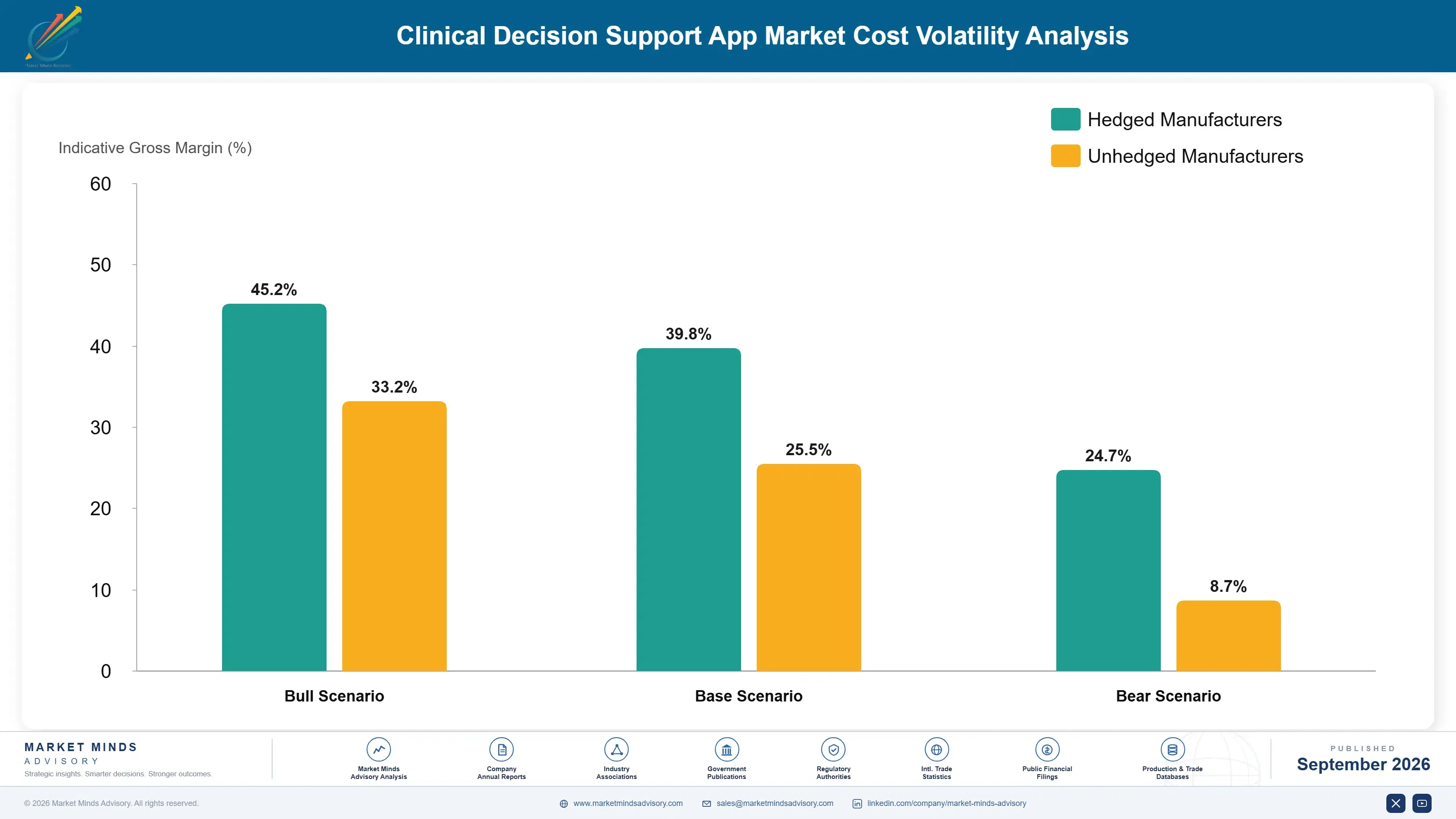
HIPAA-compliant cloud hosting and compute infrastructure account for roughly 22 percent of vendor cost of goods sold, sourced predominantly from AWS, Azure, and Google Cloud data centers configured for healthcare-grade data residency and security requirements nationwide today across most large deployments. Clinical validation study costs add a further 15 to 20 percent for vendors pursuing FDA clearance.
Cloud pricing volatility hit healthcare software vendors particularly hard starting in 2023, when major cloud providers raised enterprise compute pricing following surging generative AI workload demand that consumed capacity vendors had previously counted on at stable rates. Microsoft's fiscal year 2024 annual report cited data center capacity constraints tied to generative AI demand as a driver of tighter pricing negotiations, and several vendors disclosed rising hosting costs as a margin pressure point through 2024 and 2025.

Larger vendors with committed-use cloud contracts and dedicated clinical validation teams absorbed this cost pressure with far less disruption than smaller vendors reliant on spot-market pricing and outsourced validation consulting, a resilience gap that persists. Exposure also varies by regulatory pathway: vendors pursuing generative AI clearance face materially higher validation costs than those maintaining legacy rule-based products, since FDA scrutiny of AI-specific clinical claims has intensified considerably.
clinical-decision-support-app-market-cost-volatility-analysis-1790007287099

Multi-Year Committed-Use Cloud Contracts

Larger vendors are locking in multi-year committed-use agreements with major cloud providers that fix compute pricing well below list rates, trading some flexibility for meaningful, durable cost predictability that smaller competitors without comparable negotiating scale generally cannot access at any comparable price point at all, today or at any point in the entire future.

Shared Clinical Validation Consortium Participation

Smaller vendors are pooling resources through industry consortium clinical validation programs to amortize regulatory submission costs across multiple participating members, a cost-sharing approach that individual smaller firms could rarely justify pursuing entirely alone given the considerable expense genuinely involved in the overall regulatory clearance process for any given product line or clinical category today.

Regulatory Pathway Prioritization by Product Line

Vendors are increasingly sequencing which products pursue FDA clearance first based on projected revenue return, deferring lower-priority generative AI features until validation costs decline or reimbursement pathways clarify further, preserving scarce capital for the submissions carrying the single highest expected commercial return over the long run ahead of every direct competitor in the field.

Portfolio Architecture for Margin Defence

Margin architecture in clinical decision support splits sharply along clinical validation depth. Basic rule-based alert tools hold gross margins around 28 to 36 percent as EHR bundling compresses standalone pricing. Generative AI and specialty imaging tools hold materially higher margins, since documented outcomes evidence and regulatory clearance create real switching costs hospitals cannot easily walk away from once integrated.
The volume versus premium tension runs through the entire vendor base: EHR-bundled generalist tools scale on installed base but face constant margin pressure from bundling economics, while specialty and generative vendors grow more slowly in account count but capture disproportionate revenue per contract. High-value margin pools concentrate almost entirely in generative diagnostic and imaging specialty categories rather than basic rule-based alerts, and that concentration is where the strongest vendors now direct new investment.

Regulatory-driven demand, particularly FDA clearance pathways stabilizing for generative AI tools, is opening a genuinely new premium tier that smaller commodity-focused vendors struggle to enter quickly, since building documented clinical validation credibility takes years of accumulated evidence. Vendors positioned early in this category are compounding an advantage that slower-moving competitors will find increasingly hard to close.

Volume / Commodity-Adjacent Tier

Basic rule-based alert and drug interaction checking tools bundled into EHR platforms, competing on installed base rather than differentiated clinical capability, with limited standalone pricing power against bundled incumbents and their default distribution advantage.
Gross Margin: 28-36%

Premium / Certified Tier

FDA-cleared sepsis and deterioration prediction tools carrying documented clinical outcomes evidence, where validation credibility and regulatory clearance give established vendors durable pricing power over newer, unproven entrants still building evidence.
Gross Margin: 42-52%

Sustainability / Regulatory / Next-Generation Tier

Generative AI diagnostic suggestion tools and specialty imaging support tied to evolving FDA clearance pathways, the fastest-compounding and highest-margin tier as clinical validation evidence and hospital trust continue building steadily.
Gross Margin: 50-62%
clinical-decision-support-app-market-portfolio-architecture-1790007287601

High-value Sub-segments and Strategic Watch-out

Generative AI Diagnostic Suggestion Tools

The highest-value, fastest-growing pool in the market, converting a static alert system into an adaptive diagnostic partner as large language models finally mature enough for regulated clinical deployment across most large academic health systems this report tracks closely, a trend MMA analysts expect to keep accelerating.
Gross Margin: 50-62%

Imaging-Specific Diagnostic Support

High-value and growing steadily as radiology and cardiology departments face rising case volume without proportional specialist staffing growth nationwide, though deep clinical validation requirements slow the pace of new competitive entry into this profitable, defensible category over the near term ahead for most vendors currently.
Gross Margin: 42-52%

Sepsis and Deterioration Prediction

The volume core of the market, generating the bulk of installed deployments but facing steady margin compression as EHR bundling economics push pricing down across most large hospital system contract renewals negotiated each year across the wider industry today and increasingly going forward as well.
Gross Margin: 28-36%

EHR-Native Generative Diagnostic Modules

The clearest strategic watch-out for standalone specialty vendors, as Epic and Oracle Health build generative diagnostic functionality directly into incumbent record systems hospitals already operate and budget for, narrowing the case for separate vendor contracts going forward over the coming several years ahead for most buyers.
Gross Margin: n/a

Why Decision Support Revenue Compounds

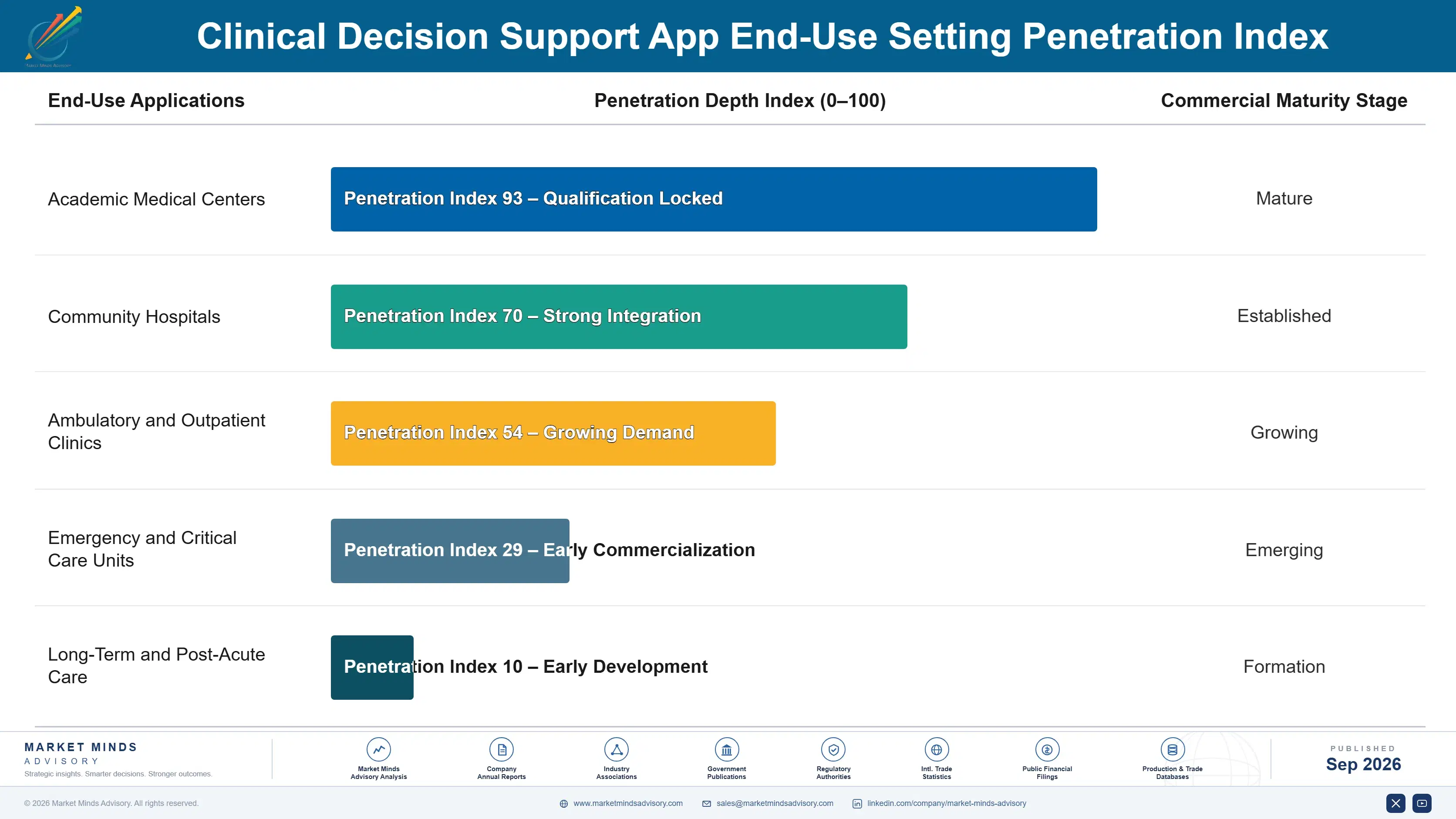
Clinical decision support revenue increasingly behaves like an annuity business in its premium segments rather than a one-time software sale. Once a hospital embeds a tool into clinical workflow and validates it through internal quality review, switching costs rise sharply, and renewal rates for enterprise decision support contracts now commonly exceed 84 percent, turning what used to be a project-based purchase into a durable, multi-year relationship.
Adoption depth varies significantly by end-use vertical. Emergency and critical care units show the deepest stickiness, since clinicians there rely on continuous, real-time deterioration alerts that become embedded in moment-to-moment clinical judgment. Imaging-specific support runs nearly as sticky, tied to radiologist workflow habits rarely redesigned, while general ambulatory clinics remain more transactional and show comparatively less loyalty to any single decision support vendor.

Buyer profiles are shifting generationally as well. Younger physicians entering practice now expect AI-assisted diagnostic suggestions as a baseline expectation rather than a novel feature, while procurement has moved from pure IT departments toward clinical quality and risk management teams, who evaluate vendors on documented outcomes rather than technical specifications alone. This buyer shift is steadily raising the evidentiary bar every vendor must clear.
clinical-decision-support-app-market-end-use-penetration-index-1790007288117

Where Decision Support Value Concentrates

These are among the four positions where our research anticipates prominent divergence between winners and laggards over the coming forecast period. Each is grounded in the demand model, the regulatory perimeter, and the announced capacity pipeline.
01 / OUTCOMES EVIDENCE BUILDING

Build documented accuracy evidence before quality committees demand it universally

Hospital quality committees increasingly require documented reduction in diagnostic error rate or alert override percentage before approving procurement, and vendors without this evidence are losing budget to competitors who can show the number directly rather than merely asserting it. Building credible clinical validation evidence takes years of accumulated outcomes data, meaning vendors that start now hold a genuine head start over slower-moving competitors still relying on qualitative feature claims alone. This capability is becoming the clearest differentiator separating premium vendors from commodity, rule-based ones industry-wide.
02 / SPECIALTY DEPTH INVESTMENT

Invest in narrow specialty depth rather than broad generalist coverage

Aidoc and Cleerly's success in imaging demonstrates that hospital department heads increasingly value deep validation evidence within their specific specialty over generalized platform coverage across many conditions and use cases. Vendors spreading investment thin across many clinical categories risk losing specialty accounts to narrower, better-validated competitors who can demonstrate superior accuracy within a single high-stakes domain that hospitals care most about. Building genuine specialty depth now, before EHR incumbents close the validation gap, is the clearer path to durable, defensible share.
03 / REGULATORY PATHWAY NAVIGATION

Build FDA clearance infrastructure ahead of generative AI scrutiny intensifying

FDA scrutiny of AI-specific clinical claims has intensified considerably relative to traditional software submissions, and vendors without mature clinical validation infrastructure are facing longer, costlier clearance timelines than established competitors already positioned ahead of them. Vendors that invested early in regulatory affairs capability are now clearing generative AI products faster than newer entrants still building this infrastructure from scratch under tightening scrutiny from regulators. Building this capability now, before regulatory requirements tighten further, costs meaningfully less than catching up later under real pressure.
04 / LIABILITY RISK MANAGEMENT

Offer liability sharing arrangements to accelerate cautious enterprise sales cycles

Hospital legal and risk management teams remain genuinely uncertain about liability exposure when AI-assisted diagnostic suggestions contribute to an incorrect clinical decision, and this genuine uncertainty is extending procurement timelines considerably across the entire category today. Vendors offering contractual liability sharing arrangements are closing enterprise deals meaningfully faster than competitors leaving all risk with the purchasing hospital's own committee to bear alone. Building this capability now positions vendors well ahead of competitors still negotiating deal terms the old, slower way.

Engagement Snapshot From the Field

A live engagement with an industry participant carrying material or product regulatory and market exposure ahead of a defining policy shift, showing how our research translates into a defensible multi-year portfolio strategy.
MARKET MINDS ADVISORY · CLIENT ENGAGEMENT SUMMARY
Clinical Decision Support App Producer Strategic Portfolio Review and Transition Roadmap 2026·Investment Scenario on Clinical Decision Support App Exposure Evaluation 2025-26
CLIENT PROFILE
A regional academic health system operating eight hospitals and a large ambulatory network engaged MMA to evaluate clinical decision support vendors ahead of a system-wide generative AI diagnostic tool procurement. The client had piloted two vendors independently in separate departments and sought a single enterprise framework to standardize deployment, clinical validation requirements, and liability terms across the system.
STRATEGIC CHALLENGE
Leadership needed to select a single generative AI diagnostic vendor without disrupting active rule-based alert systems serving critical care and emergency department workflows across all eight facilities. Legal and risk management teams raised significant liability concerns about AI-assisted diagnostic suggestions, while clinical leadership pushed for faster adoption to address documented alert fatigue among frontline physicians.
MMA APPROACH
MMA benchmarked four candidate vendors against a weighted scorecard covering documented clinical validation evidence, FDA clearance status, liability sharing terms, and EHR integration depth with the client's existing Epic deployment. The team conducted structured interviews with each vendor's clinical validation team and cross-referenced disclosed outcomes data against MMA's primary survey dataset covering comparable academic health system deployments.
KEY FINDINGS
  1. The vendor with the broadest feature set ranked last once clinical validation depth and liability sharing terms were fully factored into the final scoring methodology.
  2. Vendors offering contractual liability sharing arrangements cut projected legal and risk committee review time by nearly three months compared with vendors offering none.
  3. Documented alert override rate reduction varied significantly across candidate vendors, directly affecting projected clinician adoption and long-term satisfaction with the selected platform.
  4. EHR integration depth with the client's existing Epic deployment proved more predictive of successful rollout than any standalone clinical accuracy benchmark alone.
CLIENT PROFILE
A regional academic health system operating eight hospitals and a large ambulatory network engaged MMA to evaluate clinical decision support vendors ahead of a system-wide generative AI diagnostic tool procurement. The client had piloted two vendors independently in separate departments and sought a single enterprise framework to standardize deployment, clinical validation requirements, and liability terms across the system.
STRATEGIC CHALLENGE
Leadership needed to select a single generative AI diagnostic vendor without disrupting active rule-based alert systems serving critical care and emergency department workflows across all eight facilities. Legal and risk management teams raised significant liability concerns about AI-assisted diagnostic suggestions, while clinical leadership pushed for faster adoption to address documented alert fatigue among frontline physicians.
MMA APPROACH
MMA benchmarked four candidate vendors against a weighted scorecard covering documented clinical validation evidence, FDA clearance status, liability sharing terms, and EHR integration depth with the client's existing Epic deployment. The team conducted structured interviews with each vendor's clinical validation team and cross-referenced disclosed outcomes data against MMA's primary survey dataset covering comparable academic health system deployments.
KEY FINDINGS
  1. The vendor with the broadest feature set ranked last once clinical validation depth and liability sharing terms were fully factored into the final scoring methodology.
  2. Vendors offering contractual liability sharing arrangements cut projected legal and risk committee review time by nearly three months compared with vendors offering none.
  3. Documented alert override rate reduction varied significantly across candidate vendors, directly affecting projected clinician adoption and long-term satisfaction with the selected platform.
  4. EHR integration depth with the client's existing Epic deployment proved more predictive of successful rollout than any standalone clinical accuracy benchmark alone.
RECOMMENDED STRATEGY
Phase 1: Phase one deployed the selected vendor's generative diagnostic tool in the emergency department across all eight facilities within the first four months. Phase 2: Phase two extended deployment to critical care units over a six-month rollout window with dedicated clinical validation support from the vendor. Phase 3: Phase three expanded deployment to general medicine wards and began evaluating imaging-specific tools for the radiology department separately in parallel.
OUTCOME
The health system reported a 26 percent reduction in alert override rate within the first year of deployment, alongside a 31 percent improvement in early sepsis detection across enrolled emergency department patients (client-reported, unverified by MMA). Clinician satisfaction with decision support tools improved measurably following the rollout.

Frequently Asked Questions

Foundational context covering the market sizes, CAGR, scope, country, region and competition that inform every finding below. This section is provided to cover basics and most often pre-purchase conversations, answered from the MMA Primary Research Dataset.

What is the current size of the Clinical Decision Support App Market?

The global clinical decision support app market reached 6.4 billion dollars in 2025. Growth is concentrated in generative AI diagnostic tools rather than legacy rule-based alert systems.

How large will the Clinical Decision Support App Market be by 2036?

MMA projects the market will reach 21.84 billion dollars by 2036, up from 7.16 billion dollars in 2026. That represents a 3.05 times expansion over the ten-year forecast window.

What is the CAGR for the Clinical Decision Support App Market 2026 to 2036?

The base case compound annual growth rate is 11.8 percent. MMA's bull scenario projects 13.1 percent, while the bear scenario projects 10.6 percent over the same forecast period.

Which segment is growing fastest?

Generative AI Diagnostic Suggestion Tools are the fastest-growing segment at a 17.6 percent CAGR, roughly 1.49 times the overall market rate, driven by maturing large language models.

Who are the major companies in the Clinical Decision Support App Market?

Epic Systems, Oracle Health, Aidoc, Cleerly, and athenahealth lead the competitive landscape. The top five hold roughly 44 percent of global category revenue combined across all deployed applications.

Which country is growing fastest?

India leads country-level growth at a 14.2 percent CAGR, helped by an expanding private hospital sector that is adding capacity rapidly across most major metropolitan areas nationwide.

Report Segmentation Architecture

The full report scope spans multiple orthogonal segmentation dimensions, with cross-tabulated demand data provided for each dimension pair. Coverage extends further to regional breakdowns, trend trajectories, and the competitive detail needed to support segment-level decision-making.

By Clinical Function

  • Diagnostic Suggestion Tools
  • Drug Interaction and Dosing Alerts
  • Sepsis and Deterioration Prediction
  • Imaging-Specific Diagnostic Support
  • Care Pathway and Order Set Guidance
  • Population Risk Stratification

By End-Use Setting

  • Academic Medical Centers
  • Community Hospitals
  • Ambulatory and Outpatient Clinics
  • Emergency and Critical Care Units
  • Long-Term and Post-Acute Care

By Commercial Dimension

  • EHR-Bundled Distribution
  • Standalone Enterprise Licensing
  • Cloud Subscription Model
  • Value-Based Contract Integration
  • Per-Consult Usage Pricing

By Region

  • North America
  • Western Europe
  • East Asia
  • South Asia and Pacific
  • Latin America
  • Middle East and Africa
  • Eastern Europe

Scope, Methodology, and Coverage

Every figure in this report is reproducible from documented input assumptions. The scope below maps the historical period, the forecast horizon, the segmentation dimensions, and the countries covered, alongside the underlying primary and qualitative methodology.
Historical Period
2020 to 2025
Forecast Period
2026 to 2036
Base Year
2025 (USD billions; MMA Primary Research Dataset, September 2026)
Market Definition
The clinical decision support app market covers software applications that analyze patient data at the point of care to generate diagnostic, treatment, or risk alerts for clinicians. It excludes general electronic health record systems sold without an embedded decision support module, medical devices with onboard software, and population health analytics platforms not used at the point of individual patient care.
Quantitative Units
USD Billion
Segmentation Dimensions
By Clinical Function, By End-Use Setting, By Commercial Dimension, By Region
Regions Covered
North America, Western Europe, East Asia, South Asia and Pacific, Latin America, Middle East and Africa, Eastern Europe
Countries Covered
United States, China, Germany, United Kingdom, Japan, India, Brazil, France, Australia, Saudi Arabia
Key Companies Profiled
Epic Systems Corporation, Oracle Health Corporation, Aidoc Medical Ltd, Cleerly Inc, athenahealth Inc, IBM Corporation, Nuance Communications Inc, Wolters Kluwer NV, Elsevier BV, Zebra Medical Vision Ltd, Viz.ai Inc, PathAI Inc, Tempus AI Inc, Butterfly Network Inc, Qure.ai Technologies Pvt Ltd, Arterys Inc, Regard Inc, Ambience Healthcare Inc, Suki AI Inc, Abridge AI Inc
Quantitative Methodology
Primary survey, n=3,800 respondents, Q4 2025, six countries; demand-side model with trade association cross-validation
Qualitative Methodology
47 expert interviews, Q4 2025; applied to validate demand model assumptions, identify emerging dynamics, and assess competitive positioning
Report Format
PDF and XLSX data workbook (Word format preview document)
Publisher
Market Minds Advisory
Report Code
MMA-2026-HLT-208
Published
September 2026
Contact
sales@marketmindsadvisory.com | www.marketmindsadvisory.com

Purchase the full Clinical Decision Support App Market Report (2026 to 2036).

This report provides a comprehensive analysis of the global clinical decision support app market, covering historical performance from 2020 to 2025 and a detailed forecast through 2036. It examines segmentation by clinical function, end-use setting, and commercial model, alongside regional demand dynamics across all seven MMA-tracked geographies. The analysis includes competitive benchmarking of twenty leading vendors, input cost exposure, portfolio margin architecture, and strategic recommendations grounded in primary survey data. Findings draw on MMA's proprietary quantitative survey and expert interview programs conducted in the fourth quarter of 2025.
Segment-level revenue forecasts through the year 2036
Competitive benchmarking of twenty leading market vendors
Regional demand analysis across all seven geographies
Input cost exposure and mitigation strategy review
Portfolio margin architecture and pricing tier analysis
Strategic verdict with actionable commercial recommendations included

Built For The People Who Decide

From boardroom strategy to bench-side execution, this report is read cover-to-cover by leaders shaping the next decade of their industry, turning demand scenarios, market dynamics and valuation benchmarks into decisions.
CXOs/ Presidents/ VPs/ Managers
M&A and Corporate Development
Strategy Teams and R&D Heads
Procurement and Product Directors
Regulatory and Compliance Leaders
Investor Relations and Equity Analysts