Market Minds Advisory
Clinical Chemistry Enzymes Market

Clinical Chemistry Enzymes Market: Recurring Reagent Revenue Meets Platform Lock-In

Rising chronic disease testing volume across aging populations and expanding diagnostic laboratory infrastructure in emerging markets is driving steady enzyme reagent demand, while automated analyzer platform lock-in determines which reagent manufacturers capture recurring consumable revenue.

Lead Analyst

Alice Ballenger

Published

September 2026

Make Smarter Decisions with Customized Research Insights

Request a free sample report and evaluate market opportunities, growth trends, and competitive dynamics relevant to your business needs.

2025 MARKET VALUE$0.8BMarket Size 2025
2036 FORECAST VALUE$1.6BBase Case , 2026 to 2036
CAGR 2026 TO 20366.2 %Bull 7.4% / Bear 5.0%
INCREMENTAL OPPORTUNITY$0.7BNet 10- year value creation
EXPANSION MULTIPLE1.82x2036 value over 2026 base
Strategic Levers
M&A Pipeline
Regional Outlook
Country Rankings
Competitive Intelligence
Segmental Deep-dive
Call-Us : 91 93563 13602

Executive Snapshot and Market Trajectory

Clinical chemistry enzyme reagents remain one of diagnostic laboratory testing's most reliable recurring revenue categories, as liver, cardiac, and renal function panels stay embedded in routine clinical protocols regardless of broader healthcare capital spending cycles that more strongly affect discretionary diagnostic technology purchases.
Demand concentrates in North America and East Asia, where high test volumes across large hospital laboratory networks and rapidly expanding diagnostic infrastructure respectively drive the largest reagent consumption. Cardiac and muscle enzyme panels are growing fastest as cardiovascular disease testing volume rises globally, while liver function panels remain the largest application by volume given their routine inclusion in standard metabolic panels. Analyzer manufacturers increasingly bundle reagent supply with instrument placement agreements.
Competition centers on analyzer platform lock-in and reagent supply reliability rather than raw enzymatic performance differences, since core assay chemistry has matured considerably across established manufacturers. Roche, Siemens, Abbott, and Beckman Coulter each sell proprietary reagent formulations calibrated specifically to their own analyzer platforms, creating meaningful switching costs for laboratories once a platform is installed. Independent reagent manufacturers compete primarily on open-platform compatibility and price for laboratories running third-party analyzer systems rather than proprietary combinations.
Market Definition
The Clinical Chemistry Enzymes Market covers enzyme-based reagents, assay kits, calibrators, and controls used in automated clinical chemistry analyzers to measure liver, cardiac, renal, pancreatic, and metabolic enzyme activity for diagnostic purposes. It excludes molecular diagnostics reagents, immunoassay reagents not enzyme-based, and the analyzer instrumentation itself.
Base Year Value
$0.8B in 2025 (MMA Primary Research Dataset, August 2026)
Forecast Period
2026 to 2036, eleven discrete annual values
CAGR
6.2% base case. Bull 7.4%. Bear 5.0%.
Fastest Growth Segment
Cardiac and Muscle Enzyme Panels: 9.8% CAGR
Fastest Growth Country
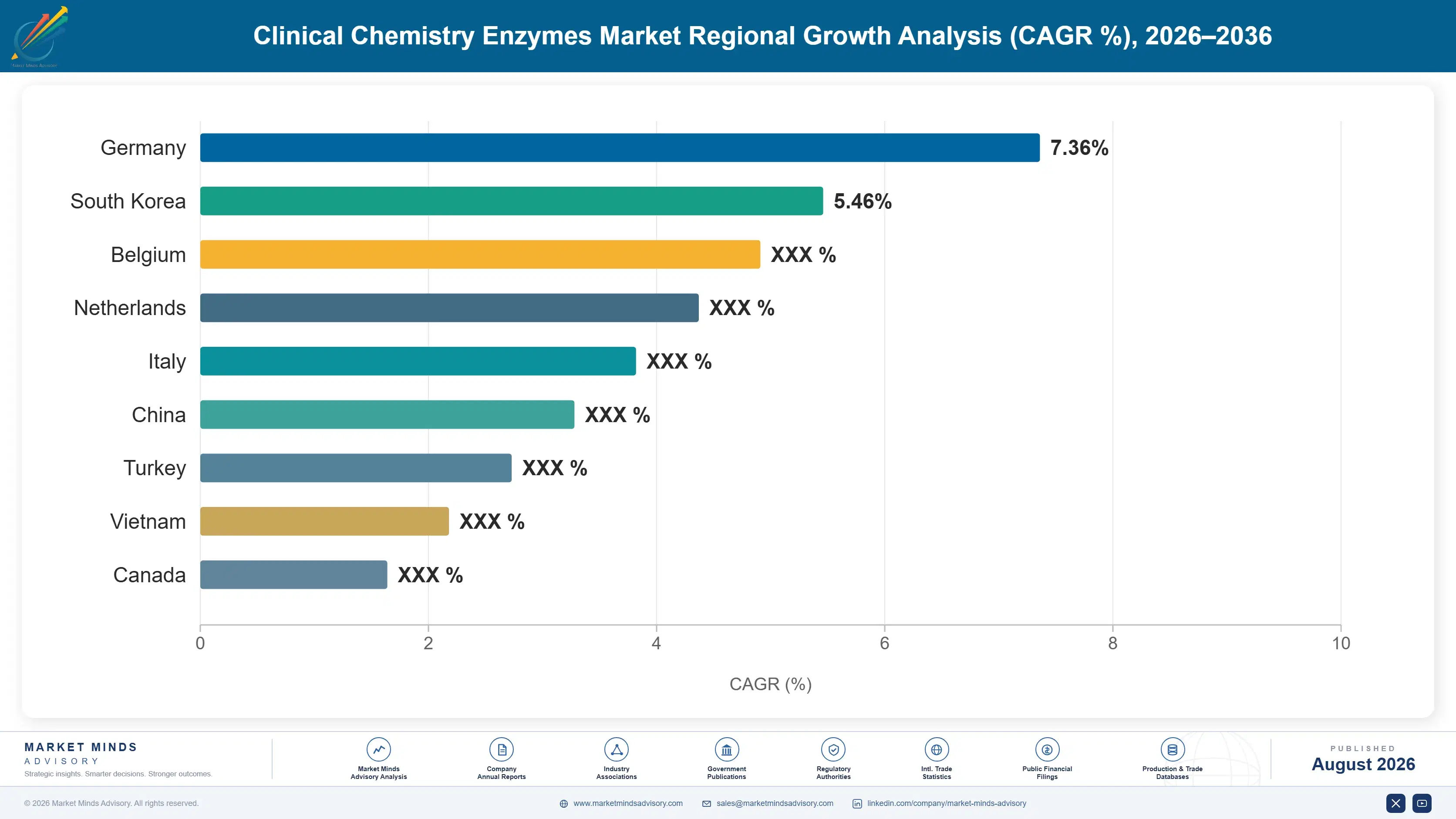
India: 10.4% CAGR
Fastest Growth Region
South Asia and Pacific: 8.3% CAGR
Largest Region
North America: 29% of 2025 global value
Market Leaders
F. Hoffmann-La Roche Ltd, Siemens Healthineers AG, Abbott Laboratories, Beckman Coulter Inc. (Danaher), and Randox Laboratories Ltd. Source: MMA Analysis based on company annual reports.
Primary Survey
n=3,800 procurement and R&D decision-makers, Q4 2025, six countries
Methodology
Demand-side build-up, cross-validated against public data, 47 expert interviews

Clinical Chemistry Enzymes Market Forecast Scenarios

clinical-chemistry-enzymes-market-size-forecast-scenario-1787304650072
Enzyme reagent demand grew steadily between 2020 and 2025 at roughly 5.4 percent annually, as pandemic-related elective testing disruption in 2020 gave way to recovering routine diagnostic testing volume and expanding laboratory infrastructure investment across emerging markets from 2021 onward. Chronic disease testing volume growth sustained steady reagent consumption through 2024 and 2025 across most developed and emerging healthcare systems.
The base case assumes 6.2 percent annual growth through 2036, anchored on three mechanisms: rising chronic disease prevalence driving routine liver, cardiac, and renal panel testing volume, continued diagnostic laboratory infrastructure expansion across South Asia and East Asia, and growing analyzer platform installed base creating predictable recurring reagent consumption independent of new instrument sales. Laboratory networks are also consolidating reagent purchasing onto fewer preferred manufacturers to simplify procurement and secure volume-based pricing agreements across their full testing menu.
A bull scenario, at 7.4 percent, assumes faster-than-expected diagnostic laboratory infrastructure expansion across emerging markets accelerates reagent consumption beyond current projections. A bear scenario, at 5.0 percent, assumes point-of-care testing substitution for select enzyme panels slows centralized laboratory reagent volume growth in developed markets. Automation-driven testing efficiency gains could also moderate per-test reagent consumption modestly over time.

Recurring Reagent Revenue Meets Platform Lock-In

Clinical chemistry enzyme reagents sit at the intersection of chronic disease testing volume growth, diagnostic laboratory infrastructure expansion, and analyzer platform economics that lock laboratories into specific reagent supply relationships for years at a time. This combination gives the category unusually durable recurring demand relative to many other diagnostic segments tied more closely to discretionary capital equipment purchasing cycles and hospital budget approval timelines.
MARKET CONCENTRATION (CR5)44%Four major analyzer makers hold substantial combined category leadership
AVERAGE REAGENT KIT COST$210Enzyme assay kits carry modest recurring per-test consumable cost
TOP TESTING COUNTRY SHARE24%The United States dominates global reagent consumption and revenue
OPEN-PLATFORM COMPATIBILITY SHARE31%Most laboratories still run proprietary closed analyzer reagent systems
AVERAGE ASSAY TURNAROUND TIME8 minAutomated enzymatic assays deliver rapid results supporting high throughput
REAGENT SHELF LIFE18 moExtended stability reduces waste and supports efficient inventory management
Commercially, the market splits between a handful of full-line analyzer and reagent manufacturers selling proprietary closed-platform systems to large hospital and reference laboratory networks, and a fragmented tier of independent reagent manufacturers competing on price and open-platform compatibility for smaller laboratories running third-party analyzer systems. Distribution runs through both direct manufacturer sales for major laboratory networks and distributor channels for smaller independent laboratories.
Analyzer platform lock-in and reagent supply reliability will define competitive position over the next decade more than incremental assay chemistry improvements, which have converged considerably across established manufacturers. Vendors able to expand platform installed base and secure long-term reagent supply contracts are positioned to capture disproportionate share of laboratory testing budgets industry-wide over time.
"The real product here isn't the enzyme reagent. It's the multi-year contract that comes with whichever analyzer a lab bought five years ago."
Director, In Vitro Diagnostics Practice · MMA In Vitro Diagnostics Reagents Prac

Market Trends

Point-of-Care Enzyme Testing Expands Slowly

Point-of-care enzyme testing platforms, capable of delivering cardiac and liver function results outside centralized laboratory settings, are gradually expanding into emergency department and urgent care settings where rapid turnaround meaningfully improves clinical decision-making speed. Abbott and Siemens Healthineers have both expanded point-of-care enzyme panel offerings since 2023, targeting emergency medicine and cardiology practices seeking faster cardiac marker results than centralized laboratory processing typically delivers. Centralized laboratories still handle the substantial majority of enzyme testing volume given cost efficiency at scale, limiting how quickly point-of-care substitution can meaningfully affect overall reagent consumption patterns. Point-of-care testing captured an estimated 14 percent of cardiac enzyme testing volume in 2025.
Market Impact: Expands routine panel volume 18% ye
Automated Analyzer Consolidation Drives Reagent Standardization

Hospital and reference laboratory networks are increasingly consolidating testing volume onto fewer, higher-throughput automated analyzer platforms, standardizing reagent purchasing across previously fragmented multi-vendor laboratory networks in the process. This consolidation trend favors analyzer manufacturers with the broadest test menu and highest throughput capability, since laboratories increasingly prefer a single platform capable of running liver, cardiac, renal, and metabolic panels together rather than maintaining multiple specialized systems. Roche and Siemens Healthineers have both expanded analyzer throughput capacity specifically to capture this consolidation-driven demand from large reference laboratory networks. Consolidated laboratory networks now represent an estimated 52 percent of total reagent purchasing volume.
Market Impact: Drives capacity growth across 40-pl

Market Opportunities and Growth Drivers

Rising Chronic Disease Testing Volume Growth

Aging populations and rising chronic disease prevalence, including cardiovascular disease, diabetes, and chronic kidney disease, are driving steady growth in routine liver, cardiac, and renal function panel testing volume across most developed and emerging healthcare systems. Broader chronic disease screening directly increases routine enzyme panel testing frequency, creating demand growth independent of any underlying change in analyzer platform installed base or new laboratory formation. Health systems managing large chronic disease patient populations report particularly strong routine monitoring panel volume growth, reflecting both clinical guideline requirements and value-based care reimbursement incentives tied to preventive monitoring. This dynamic is expected to sustain steady reagent volume growth even as testing efficiency improves through automation.
Market Impact: Locks laboratories into 7-plus year

Diagnostic Laboratory Infrastructure Expansion Continues

Government and private investment in diagnostic laboratory infrastructure across South Asia, East Asia, and parts of Latin America is expanding testing capacity and reagent consumption in markets historically underserved by centralized laboratory networks. India's expanding network of accredited diagnostic laboratories, supported by both government health infrastructure investment and private laboratory chain expansion, has meaningfully increased enzyme panel testing volume over the past several years. China's continued healthcare infrastructure investment similarly supports rapidly expanding laboratory testing capacity across both major metropolitan and increasingly smaller regional hospital systems. This infrastructure expansion is expected to continue driving reagent volume growth meaningfully faster than in mature developed markets throughout the forecast period.
Market Impact: Shifts 14% of cardiac testing volum

Market Restraints and Challenges

Analyzer Platform Lock-In Limits Reagent Choice

Proprietary closed-platform analyzer systems require laboratories to purchase reagents formulated specifically for that platform, limiting laboratory choice and creating meaningful switching costs whenever a laboratory wants to change reagent suppliers without also replacing expensive capital analyzer equipment. The root cause is that major analyzer manufacturers deliberately design reagent chemistry and packaging to be platform-specific, protecting recurring reagent revenue from open-market competition once an analyzer sale is completed. This dynamic frustrates laboratory procurement teams seeking competitive reagent pricing, since switching suppliers effectively requires replacing the underlying analyzer investment entirely. Independent reagent manufacturers are mitigating the barrier by developing validated open-platform reagent alternatives compatible with major proprietary analyzer systems.
Market Impact: Captures 14% of cardiac enzyme volu

Point-Of-Care Substitution Pressures Volume Growth

Point-of-care enzyme testing platforms, while still representing a modest share of total testing volume, are gradually substituting for centralized laboratory testing in select emergency and urgent care settings where rapid turnaround matters more than cost efficiency at scale. The root cause is that point-of-care platforms increasingly deliver clinically acceptable accuracy for time-sensitive applications like cardiac marker testing, reducing the volume advantage centralized laboratories have historically relied on to justify their cost structure for urgent testing needs. This substitution pressure remains modest today but could meaningfully affect centralized laboratory reagent volume growth if point-of-care accuracy and cost continue improving. Manufacturers are mitigating exposure by developing point-of-care platforms themselves rather than ceding the segment to specialized competitors.
Market Impact: Represents 52% of reagent purchasin
3 additional market trends, 2 additional growth drivers, and 4 additional restraints and challenges are covered in the full report. Contact sales@marketmindsadvisory.com to access the complete intelligence.

Segment CAGR and Growth Architecture

Segmentation follows enzyme panel type and clinical application, the classification laboratories and analyzer manufacturers use when organizing reagent menus and test ordering protocols. Six segments span the full application range from established liver function panels through emerging cardiac and renal enzyme panels, keeping each category mutually exclusive by underlying organ system and diagnostic purpose targeted.
clinical-chemistry-enzymes-market-market-share-analysis-1787304650606

Cardiac and Muscle Enzyme Panels

Cardiac and muscle enzyme panels, including creatine kinase, creatine kinase-MB, and lactate dehydrogenase assays, support diagnosis and monitoring of cardiac and skeletal muscle injury, playing a central role in emergency department chest pain evaluation protocols worldwide. Growth is accelerating fastest of any segment as rising cardiovascular disease prevalence and expanding emergency department testing volume drive steady demand for both centralized laboratory and point-of-care cardiac panel testing. Abbott and Siemens Healthineers dominate this segment given their established cardiac marker testing expertise and broad emergency medicine customer relationships built over many years. Adoption remains strongest in developed healthcare markets with well-established emergency medicine infrastructure, though emerging market cardiac testing volume is expanding rapidly as cardiovascular disease prevalence rises alongside changing lifestyle and dietary patterns.
CAGR 9.8%

Renal and Metabolic Enzyme Panels

Renal and metabolic enzyme panels, including amylase, lipase, and various kidney function-related enzyme assays, support diagnosis and monitoring of pancreatic and renal disease alongside broader metabolic health assessment across routine and specialized clinical testing protocols. Growth is accelerating as rising diabetes and chronic kidney disease prevalence drives expanded routine monitoring panel testing, particularly among aging populations and patients managing multiple chronic conditions simultaneously. Roche and Beckman Coulter lead this segment given their established renal panel testing menus and broad relationships with nephrology and endocrinology specialty practices worldwide. This segment benefits from strong recurring testing demand tied to chronic disease management protocols requiring regular monitoring intervals rather than one-time diagnostic testing alone.
CAGR 8.6%
Full segment breakdown across 6 segments available in the complete report.

Regional Architecture and Country Demand Map

Clinical chemistry enzyme reagent demand concentrates where diagnostic laboratory infrastructure and chronic disease testing volume run highest. North America's dense laboratory network, East Asia's expanding testing infrastructure, and Western Europe's established healthcare systems together account for the large majority of global reagent revenue worldwide today.

North America

The United States accounts for the large majority of North American demand, reflecting its dense network of hospital and reference laboratory systems performing exceptionally high testing volumes across routine liver, cardiac, and renal panels for a large and aging patient population. Large reference laboratory networks including major national chains consolidate substantial reagent purchasing volume, giving them meaningful negotiating leverage with analyzer and reagent manufacturers competing for their business. Canada's smaller but steady demand tracks similar chronic disease testing patterns, though provincial healthcare budget structures keep per-capita testing volume somewhat below United States levels. Point-of-care testing adoption for cardiac panels has proceeded faster in the region than elsewhere, reflecting well-developed emergency medicine infrastructure and reimbursement pathways supporting rapid testing technology adoption.
Share: 29% | CAGR: 6.5% (2026 to 2036)

Western Europe

Germany, France, and the United Kingdom drive most Western European demand, each maintaining well-developed national health system laboratory networks with established reagent procurement processes favoring long-term supply contracts over spot purchasing. Roche and Siemens Healthineers maintain particularly strong domestic market positions given their European manufacturing base and long-standing relationships with national health system laboratory networks built over decades of operation. Public healthcare system procurement processes across the region favor established manufacturers with proven reliability and comprehensive test menus over newer entrants offering narrower reagent portfolios. Currency and national tender pricing pressure periodically constrain reagent pricing flexibility across smaller public hospital laboratory systems within the region.
Share: 24% | CAGR: 4.7% (2026 to 2036)
Regional intelligence for 5 additional markets available in the complete report: East Asia, South Asia and Pacific, Latin America, Middle East and Africa, Eastern Europe. Contact sales@marketmindsadvisory.com.
clinical-chemistry-enzymes-market-country-cagr-analysis-1787304651135

Where Reagent Makers Can Defend Margin

Manufacturers face a market where analyzer platform lock-in increasingly determines competitive position as much as reagent chemistry quality, making installed base expansion and long-term supply contracts central to sustained revenue. Four levers stand out: analyzer platform installed base expansion, long-term laboratory network supply agreements, point-of-care platform development, and open-platform reagent compatibility for third-party analyzer systems.

Expand Analyzer Platform Installed Base Aggressively

Manufacturers prioritizing analyzer placement, even at reduced upfront instrument margin, are securing multi-year recurring reagent revenue streams that substantially exceed the value of the initial instrument sale itself over the platform's typical service life. This razor-and-blade economic model rewards manufacturers willing to compete aggressively on instrument pricing or financing terms to win platform placements, since reagent revenue per installed analyzer typically runs several times the instrument's own sale price across a multi-year contract period. Roche and Siemens Healthineers have both expanded flexible analyzer financing and placement programs specifically to accelerate installed base growth among mid-sized laboratory networks. Installed base expansion now drives an estimated 68 percent of total category revenue through recurring reagent sales.
Market Impact: Drives 68% of revenue through recur

Secure Long-Term Laboratory Network Supply Agreements

Manufacturers securing multi-year exclusive or preferred supply agreements with large reference laboratory networks are converting variable per-order reagent revenue into predictable, contractually secured recurring revenue streams that simplify capacity planning and production forecasting. These agreements typically bundle volume-based pricing discounts with guaranteed supply reliability commitments, addressing laboratory concerns about reagent shortages disrupting testing operations that directly affect patient care and clinical decision-making. Large reference laboratory networks increasingly favor manufacturers capable of guaranteeing supply continuity across their full test menu rather than negotiating separately with multiple specialized reagent vendors for different panel types. Long-term supply agreements now cover an estimated 55 percent of total reference laboratory reagent purchasing volume.
Market Impact: Covers roughly 55% of reference lab

Develop Point-Of-Care Enzyme Testing Platforms

Manufacturers developing point-of-care enzyme testing platforms for emergency department and urgent care settings are capturing a growing testing segment before specialized point-of-care competitors establish dominant market position in this comparatively newer application area. Abbott's early investment in point-of-care cardiac marker testing has built meaningful clinical evidence and physician familiarity that newer entrants must now compete against when seeking adoption in time-sensitive emergency medicine applications. This capability also provides a defensive hedge against centralized laboratory testing volume erosion, since manufacturers offering both centralized and point-of-care platforms can capture testing volume regardless of where it migrates. Point-of-care platform revenue has grown an estimated 22 percent annually since 2023.
Market Impact: Grows point-of-care revenue roughly

Offer Open-Platform Reagent Compatibility Options

Independent reagent manufacturers developing validated open-platform reagent alternatives compatible with major proprietary analyzer systems are capturing laboratory customers seeking competitive pricing without replacing existing capital analyzer equipment they have already invested in. This approach directly addresses laboratory frustration with proprietary platform lock-in, offering a genuine alternative to laboratories unwilling to accept the reagent pricing power that closed-platform analyzer manufacturers otherwise hold over their captive installed base. Independent manufacturers pursuing this strategy typically compete on price rather than brand recognition, appealing particularly to smaller laboratories and cost-constrained healthcare systems in emerging markets. Open-platform reagent revenue has grown an estimated 16 percent annually as laboratories seek pricing alternatives.
Market Impact: Grows open-platform reagent revenue

Who Controls the Margin Pool

Four companies, Roche, Siemens Healthineers, Abbott, and Beckman Coulter, hold an estimated 44 percent of global revenue on a company-revenue basis, reflecting a moderately concentrated market anchored by proprietary closed-platform analyzer and reagent systems. Roche leads by a meaningful margin over the next closest challenger, reflecting its broad global analyzer installed base and comprehensive enzyme panel test menu across most clinical applications.
Current competitive activity centers on three dimensions: analyzer platform installed base expansion through competitive placement financing, long-term laboratory network supply contract negotiation, and point-of-care platform development aimed at capturing testing volume migrating outside centralized laboratories. Established manufacturers are also defending reagent margin through comprehensive test menu breadth that discourages laboratories from maintaining multiple vendor relationships.

Emerging pressure comes primarily from independent open-platform reagent manufacturers and Chinese domestic manufacturers expanding production capacity to serve fast-growing regional demand, competing increasingly on price against established multinational manufacturers. If independent and regional manufacturers continue improving open-platform compatibility and certification credibility, competitive rankings in price-sensitive emerging markets could shift faster than in developed markets where proprietary platform lock-in remains more durable.
clinical-chemistry-enzymes-market-company-positioning-matrix-1787304651684

Competitive Moat and Risk Dimensions

F. HOFFMANN-LA ROCHE LTD

Moat: Broadest Global Analyzer Installed Base

Roche benefits from the industry's broadest global analyzer installed base and most comprehensive enzyme panel test menu, giving it a scale advantage that smaller competitors cannot easily replicate without comparable decades of accumulated laboratory relationships and manufacturing infrastructure investment across multiple continents and healthcare systems.
F. HOFFMANN-LA ROCHE LTD

Risk: Open-Platform Competition Pressures Margin

Roche's premium closed-platform reagent pricing faces growing pressure from independent open-platform manufacturers offering comparable core enzymatic performance at meaningfully lower cost, particularly in cost-sensitive emerging market segments where laboratory budget constraints outweigh brand loyalty considerations that matter more in developed healthcare markets.
SIEMENS HEALTHINEERS AG

Moat: Deep Hospital System Relationships

Siemens Healthineers benefits from long-standing relationships with major hospital systems built through its broader diagnostic imaging and laboratory automation portfolio, giving it privileged access to laboratory purchasing committees evaluating enzyme reagent supply alongside broader capital equipment and automation decisions made at the same facilities.
SIEMENS HEALTHINEERS AG

Risk: Narrower Point-Of-Care Presence Currently

Siemens Healthineers has moved somewhat more slowly than Abbott to build out point-of-care enzyme testing capability, potentially ceding early-mover advantage in the fastest-growing segment of the market to competitors who prioritized that technology earlier in their broader product development roadmaps.

Players Tracked

Prominent Players

F. Hoffmann-La Roche Ltd
Siemens Healthineers AG
Abbott Laboratories
Beckman Coulter Inc. (Danaher)
Randox Laboratories Ltd

Other Key Players

Sekisui Diagnostics LLC
DiaSys Diagnostic Systems GmbH
Erba Mannheim GmbH
Biosystems S.A.
Spinreact S.A.U.
Human Gesellschaft für Biochemica und Diagnostica mbH
Audit Diagnostics
Cypress Diagnostics
Elabscience Biotechnology Inc.
BioSino Bio-Technology and Science Inc.
Mindray Medical International Limited
Getein Biotech Inc.
Fujifilm Wako Pure Chemical Corporation
Merck KGaA
Zhejiang Orient Gene Biotech Co Ltd

Recent Developments

MAY 2025

Roche Expands Analyzer Placement Financing Program

Roche launched an expanded flexible analyzer placement financing program, an organic commercial initiative rather than an acquisition, designed to accelerate installed base growth among mid-sized laboratory networks by reducing upfront capital investment required to adopt its enzyme panel testing platforms broadly.
Signal: Leading manufacturers are competing on fle
OCTOBER 2024

Abbott Acquires Point-Of-Care Cardiac Marker Technology Developer

Abbott completed the acquisition of a specialty point-of-care cardiac marker technology developer, adding proprietary rapid testing capability rather than continuing to rely solely on internal research and development for its point-of-care enzyme testing product lines going forward across its facilities.
Signal: Established manufacturers are acquiring po
JANUARY 2025

Beckman Coulter Signs Reference Laboratory Network Supply Agreement

Beckman Coulter signed a multi-year exclusive reagent supply agreement, not an acquisition or joint venture, with a large multi-state reference laboratory network to provide enzyme panel reagents under a standardized volume-based pricing structure covering the network's full testing menu.
Signal: Manufacturers are increasingly formalizing

Biological Raw Material Cost Exposure

Purified enzymes, antibodies, and specialized biological raw materials together represent roughly 39 percent of cost of goods sold for a typical enzyme reagent product line, with the remainder split across packaging, quality control, and cold chain logistics. Most purified enzyme raw materials originate from specialized biotechnology suppliers in the United States, Germany, and Japan, concentrating supply risk among a comparatively small number of qualified producers.
The 2021 biological raw material supply disruption, driven by broader biotechnology manufacturing capacity constraints during the pandemic recovery period, delayed enzyme reagent shipments industry-wide, with several manufacturers reporting extended lead times through much of 2022. Roche's 2022 annual report cited raw material and biological component availability as a specific factor affecting diagnostics segment shipment timing that year, a constraint that eased gradually through 2023 as broader biotechnology manufacturing capacity normalized across the industry.

Established manufacturers with long-standing biological raw material supplier relationships and larger purchase volumes secured priority allocation more easily than smaller specialty reagent makers during the shortage period, widening the delivery reliability gap between established and emerging manufacturers. Manufacturers without long-term supply agreements, concentrated among smaller independent reagent makers, faced longer shipment delays and lost some competitive momentum during the broader market recovery period.
clinical-chemistry-enzymes-market-cost-volatility-analysis-1787304651887

Diversify Biological Raw Material Supplier Qualification

Manufacturers are qualifying multiple purified enzyme and biological raw material suppliers across the United States, Germany, and Japan, reducing dependency on any single source following the 2021 shortage experience. Dual-sourcing adds modest qualification cost but has proven worthwhile given the shipment delays single-source manufacturers experienced when raw material availability tightened unexpectedly across the broader biotechnology supply chain.

Build Strategic Raw Material Inventory Buffers

Several manufacturers have increased safety stock of critical purified enzyme and biological raw materials beyond historical norms, accepting higher working capital cost in exchange for shipment reliability during future supply disruptions across their production networks. This buffer strategy proved valuable during the most recent shortage cycle and is now standard practice among the largest reagent manufacturers globally.

Pursue Backward Integration Into Enzyme Production

The largest manufacturers are acquiring or building captive enzyme production and purification capacity, insulating their highest-margin reagent product lines from third-party raw material pricing and availability pressure entirely across their supply chains. This approach requires significant capital investment but has delivered meaningfully more predictable shipment schedules for companies that have pursued it consistently over time.

Portfolio Architecture for Margin Defence

The market organizes into three margin tiers running from standard open-platform reagent kits through certified proprietary closed-platform enzyme panels to next-generation point-of-care testing platforms bundled with analyzer placement and service support. Gross margins widen substantially moving up this ladder, reflecting both platform engineering complexity and the recurring revenue premium analyzer manufacturers capture at the top tier consistently across most developed healthcare markets an
Volume sits meaningfully in the mid-tier proprietary closed-platform reagent segment by test count, but profitability concentrates in premium point-of-care platforms and next-generation testing systems where laboratories pay meaningfully more for testing speed and clinical workflow integration. This volume-versus-margin tension shapes product development priorities across nearly every major manufacturer's roadmap and capital allocation decisions for the years immediately ahead.

High-value pools concentrate specifically around point-of-care cardiac testing platforms and long-term reference laboratory supply contracts, both growing considerably faster than the broader enzyme reagent category overall. Manufacturers positioned early in these pools are capturing disproportionate profit growth relative to their unit shipment share of the overall market today, a gap likely to widen further as chronic disease testing volume continues expanding steadily.

Volume / Commodity-Adjacent Tier

Standard open-platform enzyme reagent kits sold largely on price and broad analyzer compatibility across independent laboratories and smaller regional distributor networks worldwide, with modest brand loyalty or platform-specific lock-in.
Gross Margin: 22-30%

Premium / Certified Tier

Proprietary closed-platform enzyme reagent lines with established analyzer integration and comprehensive test menu breadth, commanding meaningful premiums tied to platform lock-in and clinical workflow reliability across hospital laboratory customers.
Gross Margin: 36-46%

Sustainability / Regulatory / Next-Generation Tier

Point-of-care testing platforms bundled with rapid turnaround capability and clinical workflow integration support, carrying the category's highest margins given engineering complexity and the testing speed advantage delivered to clinicians.
Gross Margin: 46-56%
clinical-chemistry-enzymes-market-portfolio-architecture-1787304652401

Platform-Driven Recurring Testing Economics

Clinical chemistry enzyme reagent demand functions less like a discretionary diagnostic technology purchase and more like an annuity tied to analyzer platform installed base, since laboratories cannot avoid ongoing reagent purchasing once a proprietary platform has been installed and integrated into routine clinical workflows. This dynamic insulates a meaningful share of reagent revenue from broader laboratory capital budget cycles affecting other diagnostic equipment categories across the indus
Adoption depth varies considerably by laboratory type: large hospital and reference laboratory networks have adopted comprehensive proprietary closed-platform testing menus almost universally, while smaller independent laboratories and clinics still rely on a mix of open-platform reagents and outsourced specialized testing for lower-volume panels. Reimbursement-rich developed markets sit well ahead of cost-constrained systems in overall platform sophistication and testing breadth.

A generational shift in laboratory management buyer profiles is underway as younger laboratory directors, trained during the era of consolidated automated platforms rather than manual bench testing, increasingly expect comprehensive single-platform test menus as a standard operating expectation rather than a premium capability. This expectation is accelerating platform consolidation even in laboratory segments not yet facing direct competitive pressure to change.
clinical-chemistry-enzymes-market-end-use-penetration-index-1787304652907

Where MMA Sees The Opportunity

These are among the four positions where our research anticipates prominent divergence between winners and laggards over the coming forecast period. Each is grounded in the demand model, the regulatory perimeter, and the announced capacity pipeline.
01 / INSTALLED BASE STRATEGY

Prioritize analyzer placement over near-term instrument sale margin

Manufacturers optimizing for near-term instrument sale margin rather than aggressive placement are leaving meaningful recurring reagent revenue on the table, since reagent revenue per installed analyzer typically runs several times the instrument's own sale price across a multi-year contract period. Those instead prioritizing installed base growth through competitive financing and placement terms are converting near-term margin sacrifice into substantially larger long-term recurring revenue streams that compound across the platform's full service life. MMA views installed base growth rate as the single clearest predictor of which manufacturers sustain durable reagent revenue growth over the next decade of category evolution.
02 / POINT-OF-CARE EXPANSION

Build point-of-care testing capability before specialists establish dominant position

Point-of-care enzyme testing remains a comparatively small share of total testing volume today, but manufacturers underinvesting in this capability risk ceding an increasingly important growth segment to specialized point-of-care competitors gaining clinical evidence and physician familiarity ahead of established laboratory reagent manufacturers. Vendors building point-of-care capability now are positioning themselves to capture testing volume regardless of whether it remains centralized or migrates toward faster point-of-care alternatives over the coming years. MMA expects point-of-care capability to become an increasingly important competitive requirement, rewarding manufacturers who invest early rather than treating it as a peripheral product line.
03 / REFERENCE LABORATORY CONTRACTS

Secure exclusive supply agreements before reference laboratories consolidate further

Reference laboratory networks are increasingly consolidating reagent purchasing onto fewer preferred manufacturers capable of guaranteeing supply continuity and comprehensive test menu coverage across their full testing operation. Manufacturers securing exclusive or preferred supply agreements now are capturing disproportionate share of this consolidating purchasing volume before remaining reference laboratory networks finalize their own preferred vendor decisions in the coming contract cycles. MMA views exclusive supply agreement capture as a durable strategic opening for manufacturers with strong existing reference laboratory relationships and comprehensive test menu breadth already in place.
04 / EMERGING MARKET EXPANSION

Expand reagent manufacturing capacity to serve fast-growing Asian markets

Diagnostic laboratory infrastructure expansion across India and China is creating substantial new reagent demand that established multinational manufacturers have not yet fully captured, leaving meaningful market share available to competitors willing to invest in regional manufacturing and distribution capability. Manufacturers establishing local production and distribution infrastructure now are positioned to capture disproportionate share of this expanding demand before domestic regional manufacturers scale their own competitive capability further. MMA expects emerging market reagent demand growth to outpace developed market growth meaningfully throughout the current ten-year forecast period, rewarding early regional investment.

Engagement Snapshot From the Field

A live engagement with an industry participant carrying material or product regulatory and market exposure ahead of a defining policy shift, showing how our research translates into a defensible multi-year portfolio strategy.
MARKET MINDS ADVISORY · CLIENT ENGAGEMENT SUMMARY
Clinical Chemistry Enzymes Producer Strategic Portfolio Review and Transition Roadmap 2026·Investment Scenario on Clinical Chemistry Enzymes Exposure Evaluation 2025-26
CLIENT PROFILE
The client is a regional reference laboratory network operating multiple testing facilities across several states, historically running a mixed fleet of analyzer platforms from different manufacturers accumulated through years of facility acquisitions and ad hoc equipment purchases (client-reported, unverified by MMA). Leadership sought to consolidate onto a single preferred analyzer and reagent platform to simplify procurement and reduce operating costs.
STRATEGIC CHALLENGE
Leadership needed to select a single analyzer and reagent platform capable of supporting the network's full enzyme panel test menu across all facilities within a compressed consolidation timeline, while minimizing testing disruption during the transition and controlling capital expenditure across a facility network operating on tight daily testing volume commitments.
MMA APPROACH
MMA benchmarked candidate analyzer and reagent platforms against test menu breadth, supply reliability at scale, and total cost of ownership including reagent pricing under volume-based contracts, modeled expected consolidation timeline under three distinct vendor scenarios, and recommended a vendor selection and phased facility-by-facility consolidation sequence.
KEY FINDINGS
  1. Roughly 55 percent of the network's existing analyzer fleet used incompatible proprietary reagent systems, representing the single largest consolidation complexity identified across the facility network overall.
  2. Vendors offering comprehensive test menu breadth reduced estimated outsourced specialized testing volume by an estimated 30 percent compared to vendors requiring supplemental third-party testing.
  3. Volume-based pricing contracts varied meaningfully between vendors, with the most competitive vendor offering reagent pricing roughly 20 percent below the highest-priced candidate.
  4. Phased facility-by-facility consolidation, rather than simultaneous network-wide transition, reduced testing disruption risk while still meeting the network's cost reduction targets.
CLIENT PROFILE
The client is a regional reference laboratory network operating multiple testing facilities across several states, historically running a mixed fleet of analyzer platforms from different manufacturers accumulated through years of facility acquisitions and ad hoc equipment purchases (client-reported, unverified by MMA). Leadership sought to consolidate onto a single preferred analyzer and reagent platform to simplify procurement and reduce operating costs.
STRATEGIC CHALLENGE
Leadership needed to select a single analyzer and reagent platform capable of supporting the network's full enzyme panel test menu across all facilities within a compressed consolidation timeline, while minimizing testing disruption during the transition and controlling capital expenditure across a facility network operating on tight daily testing volume commitments.
MMA APPROACH
MMA benchmarked candidate analyzer and reagent platforms against test menu breadth, supply reliability at scale, and total cost of ownership including reagent pricing under volume-based contracts, modeled expected consolidation timeline under three distinct vendor scenarios, and recommended a vendor selection and phased facility-by-facility consolidation sequence.
KEY FINDINGS
  1. Roughly 55 percent of the network's existing analyzer fleet used incompatible proprietary reagent systems, representing the single largest consolidation complexity identified across the facility network overall.
  2. Vendors offering comprehensive test menu breadth reduced estimated outsourced specialized testing volume by an estimated 30 percent compared to vendors requiring supplemental third-party testing.
  3. Volume-based pricing contracts varied meaningfully between vendors, with the most competitive vendor offering reagent pricing roughly 20 percent below the highest-priced candidate.
  4. Phased facility-by-facility consolidation, rather than simultaneous network-wide transition, reduced testing disruption risk while still meeting the network's cost reduction targets.
RECOMMENDED STRATEGY
Phase 1: Phase 1 (Months 1-3): Complete vendor evaluation and finalize selection based on test menu breadth and pricing terms. Phase 2: Phase 2 (Months 4-10): Consolidate highest-volume facilities first, prioritizing sites with the greatest platform incompatibility issues. Phase 3: Phase 3 (Months 11-16): Complete remaining facility consolidation and establish ongoing supply chain performance monitoring network-wide.
OUTCOME
Sixteen months into the engagement, the network reported successful platform consolidation across all facilities, achieving meaningful cost reduction and testing menu standardization (client-reported, unverified by MMA), validating MMA's vendor selection and phased consolidation recommendation fully across the network.

Frequently Asked Questions

Foundational context covering the market sizes, CAGR, scope, country, region and competition that inform every finding below. This section is provided to cover basics and most often pre-purchase conversations, answered from the MMA Primary Research Dataset.

What is the current size of the Clinical Chemistry Enzymes Market?

The global Clinical Chemistry Enzymes Market was valued at approximately $0.85 billion in 2025. Growth is driven by rising chronic disease testing volume and laboratory infrastructure expansion.

How large will the Clinical Chemistry Enzymes Market be by 2036?

The market is projected to reach approximately $1.64 billion by 2036, roughly 1.82 times its 2026 value. Growth is led by cardiac and renal panel testing expansion.

What is the CAGR for the Clinical Chemistry Enzymes Market 2026 to 2036?

The market is forecast to grow at a 6.2 percent CAGR between 2026 and 2036. Bull and bear scenarios range from 7.4 percent to 5.0 percent.

Which segment is growing fastest?

Cardiac and muscle enzyme panels are growing fastest at a 9.8 percent CAGR, roughly 1.58 times the overall market rate, driven by rising cardiovascular disease testing volume.

Who are the major companies in the Clinical Chemistry Enzymes Market?

Roche, Siemens Healthineers, Abbott, Beckman Coulter, and Randox lead the market, together holding roughly 44 percent of category revenue on a company-revenue basis.

Which country is growing fastest?

India is growing fastest among major markets at an estimated 10.4 percent CAGR, driven by rapidly expanding diagnostic laboratory infrastructure investment.

Report Segmentation Architecture

The full report scope spans multiple orthogonal segmentation dimensions, with cross-tabulated demand data provided for each dimension pair. Coverage extends further to regional breakdowns, trend trajectories, and the competitive detail needed to support segment-level decision-making.

By Enzyme Panel Type and Application

  • Liver Function Enzymes
  • Cardiac and Muscle Enzymes
  • Lipid Metabolism Enzymes
  • Renal and Metabolic Enzymes
  • Coupled Enzyme Assay Kits
  • Enzyme Calibrators and Controls

By End-Use Setting

  • Hospital Laboratories
  • Reference Laboratories
  • Point-of-Care Testing Sites
  • Physician Office Laboratories

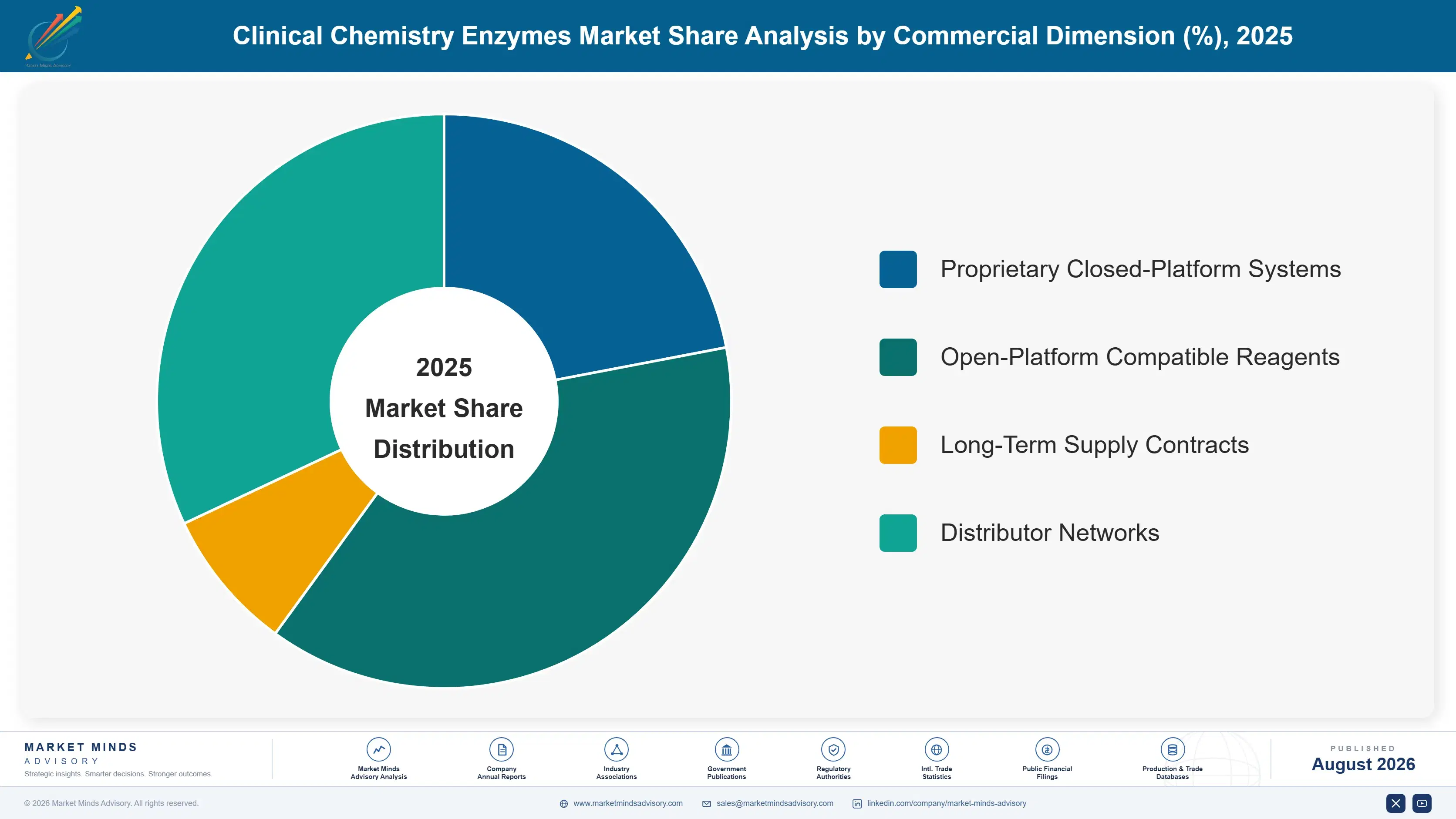
By Commercial Dimension

  • Proprietary Closed-Platform Systems
  • Open-Platform Compatible Reagents
  • Long-Term Supply Contracts
  • Distributor Networks

By Region

  • North America
  • Western Europe
  • East Asia
  • South Asia and Pacific
  • Latin America
  • Middle East and Africa
  • Eastern Europe

Scope, Methodology, and Coverage

Every figure in this report is reproducible from documented input assumptions. The scope below maps the historical period, the forecast horizon, the segmentation dimensions, and the countries covered, alongside the underlying primary and qualitative methodology.
Historical Period
2020 to 2025
Forecast Period
2026 to 2036
Base Year
2025 (USD billions; MMA Primary Research Dataset, August 2026)
Market Definition
The Clinical Chemistry Enzymes Market covers enzyme-based reagents, assay kits, calibrators, and controls used in automated clinical chemistry analyzers to measure liver, cardiac, renal, pancreatic, and metabolic enzyme activity for diagnostic purposes. It excludes molecular diagnostics reagents, immunoassay reagents not enzyme-based, and the analyzer instrumentation itself.
Quantitative Units
USD billions (current prices); test volume where applicable
Segmentation Dimensions
By Enzyme Panel Type and Application; By End-Use Setting; By Commercial Dimension; By Region
Regions Covered
North America, Western Europe, East Asia, South Asia and Pacific, Latin America, Middle East and Africa, Eastern Europe
Countries Covered
USA, China, Germany, France, UK, Japan, South Korea, India, Australia, Canada, Brazil, Mexico, Indonesia, Vietnam, Thailand, Malaysia, UAE, Saudi Arabia, South Africa, Nigeria, Turkey, Poland, Netherlands, Italy, Spain, Sweden, Switzerland, Argentina, Colombia, Singapore, and additional markets relevant to this sector
Key Companies Profiled
F. Hoffmann-La Roche Ltd, Siemens Healthineers AG, Abbott Laboratories, Beckman Coulter Inc. (Danaher), Randox Laboratories Ltd, Sekisui Diagnostics LLC, DiaSys Diagnostic Systems GmbH, Erba Mannheim GmbH, Biosystems S.A., Spinreact S.A.U., Human Gesellschaft für Biochemica und Diagnostica mbH, Audit Diagnostics, Cypress Diagnostics, Elabscience Biotechnology Inc., BioSino Bio-Technology and Science Inc., Mindray Medical International Limited, Getein Biotech Inc., Fujifilm Wako Pure Chemical Corporation, Merck KGaA, Zhejiang Orient Gene Biotech Co Ltd
Quantitative Methodology
Primary survey, n=3,800 respondents, Q4 2025, six countries; demand-side model with trade association cross-validation
Qualitative Methodology
47 expert interviews, Q4 2025; applied to validate demand model assumptions, identify emerging dynamics, and assess competitive positioning
Report Format
PDF and XLSX data workbook (Word format preview document)
Publisher
Market Minds Advisory
Report Code
MMA-2026-MED-120
Published
August 2026
Contact
sales@marketmindsadvisory.com | www.marketmindsadvisory.com

Purchase the full Clinical Chemistry Enzymes Market Report (2026 to 2036).

The full Clinical Chemistry Enzymes Market report provides detailed 2026 to 2036 forecasts across all six enzyme panel segments and seven global regions, alongside company-level competitive profiles for the twenty manufacturers covered in this summary. It includes primary survey data from 3,800 laboratory procurement and clinical chemistry respondents across six countries, supplemented by 47 expert interviews with manufacturers, laboratory directors, and clinical chemistry specialists. The report addresses analyzer platform economics, point-of-care testing trends, and reference laboratory consolidation patterns in depth. Segment-level margin analysis and vendor selection frameworks support procurement and laboratory strategy decisions across the value chain.
Segment-level 2026-2036 forecasts across all six panel types
Full competitive profiles for twenty manufacturers profiled
Regional deep-dive analysis across all seven regions covered
Primary survey data from 3,800 laboratory procurement respondents
47 expert interviews with manufacturers and laboratory directors
Vendor selection and total cost of ownership frameworks included

Built For The People Who Decide

From boardroom strategy to bench-side execution, this report is read cover-to-cover by leaders shaping the next decade of their industry, turning demand scenarios, market dynamics and valuation benchmarks into decisions.
CXOs/ Presidents/ VPs/ Managers
M&A and Corporate Development
Strategy Teams and R&D Heads
Procurement and Product Directors
Regulatory and Compliance Leaders
Investor Relations and Equity Analysts