Market Minds Advisory
Clinical Alarm Management Market

Clinical Alarm Management Market: From Notification Volume to Actionable Alerting

Clinical alarm management is shifting from basic notification routing toward AI-driven alarm fatigue reduction, as Joint Commission patient safety mandates and nurse staffing shortages force hospitals to prioritize actionable alerting over volume.

Lead Analyst

Alice Ballenger

Published

August 2026

Make Smarter Decisions with Customized Research Insights

Request a free sample report and evaluate market opportunities, growth trends, and competitive dynamics relevant to your business needs.

2025 MARKET VALUE$1.8BMarket Size 2025
2036 FORECAST VALUE$4.9BBase Case , 2026 to 2036
CAGR 2026 TO 20369.5 %Bull 10.8% / Bear 8.2%
INCREMENTAL OPPORTUNITY$2.9BNet 10- year value creation
EXPANSION MULTIPLE2.48x2036 value over 2026 base
Strategic Levers
M&A Pipeline
Regional Outlook
Country Rankings
Competitive Intelligence
Segmental Deep-dive
Call-Us : 91 93563 13602

Executive Snapshot and Market Trajectory

Clinical alarm management sits at the center of hospital patient safety strategy, where reducing false and non-actionable alerts matters as much to nursing staff retention as to direct patient outcomes measured across most accredited acute care facilities operating today throughout the country, region, and beyond current expectations.
Joint Commission National Patient Safety Goal enforcement, chronic nurse staffing shortages pushing hospitals toward mobile secondary notification, and rapid growth in AI-based alarm fatigue analytics software are together concentrating demand upside in two clear directions: North American acute care hospitals facing direct accreditation pressure, and East Asian markets building new hospital IT infrastructure from a comparatively blank slate without legacy system constraints holding back adoption across most major metropolitan hospital networks currently expanding rapidly.
Vocera Communications, Ascom Holding, and Spok Holdings lead a moderately concentrated competitive field where analytics-driven alarm prioritization capability is becoming as commercially decisive as core middleware integration breadth, while device majors including GE HealthCare and Philips Healthcare bundle alarm management into broader patient monitoring platform sales, pressuring pure-play vendors to demonstrate clearer clinical outcome evidence to defend standalone purchasing decisions across most hospital accounts.
Market Definition
The clinical alarm management market covers middleware software, secondary notification devices, and analytics platforms that route, prioritize, and reduce non-actionable physiological monitor and nurse call alerts within hospital settings. Standalone patient monitoring hardware and general hospital communication platforms without alarm-specific functionality are excluded.
Base Year Value
$1.8B in 2025 (MMA Primary Research Dataset, August 2026)
Forecast Period
2026 to 2036, eleven discrete annual values
CAGR
9.5% base case. Bull 10.8%. Bear 8.2%.
Fastest Growth Segment
Analytics and Alarm Fatigue Reduction Software: 14.5% CAGR
Fastest Growth Country
India: 12.0% CAGR
Fastest Growth Region
South Asia and Pacific: 11.5% CAGR
Largest Region
North America: 31% of 2025 global value
Market Leaders
Vocera Communications, Ascom Holding, Spok Holdings, GE HealthCare, Philips Healthcare. Source: MMA Analysis, July 2026.
Primary Survey
n=3,800 procurement and R&D decision-makers, Q4 2025, six countries
Methodology
Demand-side build-up, cross-validated against public data, 47 expert interviews

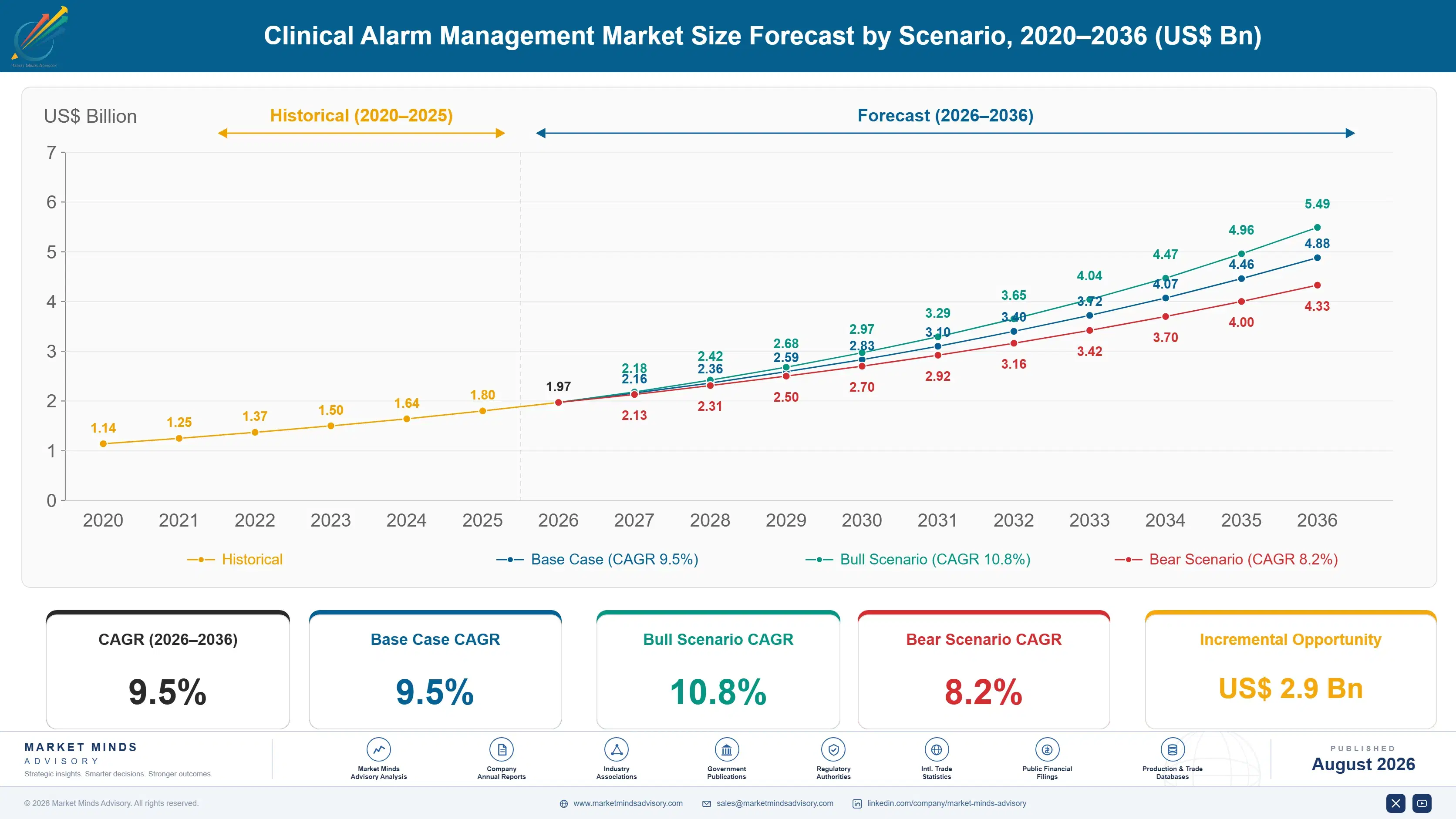
Clinical Alarm Management Market Forecast Scenarios

clinical-alarm-management-market-size-forecast-scenario-1787304955531
Clinical alarm management demand grew steadily between 2020 and 2025, with pandemic-driven nurse staffing pressure accelerating hospital interest in secondary notification systems that route alerts directly to mobile devices rather than relying solely on bedside monitor audio. Joint Commission enforcement activity intensified through the back half of the historical period, pushing adoption beyond early-adopter academic medical centers into broader community hospital networks nationwide.
The base case assumes 9.5 percent annual growth through 2036, anchored on three commercial mechanisms: continued Joint Commission National Patient Safety Goal enforcement pushing hospitals toward documented alarm reduction programs, chronic nurse staffing shortages sustaining demand for mobile secondary alerting that extends limited nursing coverage more efficiently, and rapid growth in AI-based alarm prioritization analytics that promise measurable reductions in non-actionable alert volume across acute care and intensive care settings alike.
The bull case centers on faster-than-expected AI analytics adoption demonstrating clear nurse workload reduction, prompting accelerated hospital system-wide rollout beyond initial pilot units. The bear case flags hospital capital budget constraints and integration complexity with legacy nurse call and monitoring infrastructure, which could slow full-facility deployment and leave many hospitals running partial alarm management coverage for longer than currently planned.

From Alert Volume to Alert Relevance

Clinical alarm management occupies a category defined less by hardware innovation than by workflow and analytics maturity, where hospitals increasingly judge vendors on demonstrated alarm volume reduction rather than notification speed alone. Basic middleware integration between physiological monitors and nurse mobile devices has become table stakes, pushing genuine competitive differentiation toward AI-based alert prioritization and clinical outcome evidence gathered across live hospital deploy
MARKET CONCENTRATIONCR5 48%Top five vendors control roughly half of installed base
AVERAGE SELLING PRICEUSD 1,850/bedBlended average price per licensed hospital bed annually
TOP PRODUCING COUNTRY SHARE31%Share of installed hospital base in leading producing country
ACCREDITATION PROGRAM COVERAGE68%Portion of accredited hospitals with formal alarm reduction programs
NURSE RESPONSE IMPROVEMENT22%Average nurse response time improvement after system deployment
INPUT COST SHARE52%Software licensing costs as share of total system cost
Regulatory pressure remains the primary demand catalyst in North America, where Joint Commission accreditation standards require documented alarm safety improvement programs at every accredited hospital. Adoption elsewhere follows a different pattern: East Asian and European hospitals often approach alarm management as part of broader digital hospital modernization initiatives rather than as a standalone compliance requirement, resulting in different purchasing timelines and vendor evaluation criteria across regions.
Nurse staffing shortages are reshaping vendor value propositions industry-wide, with secondary notification and analytics vendors increasingly marketing measurable nursing workload reduction rather than pure patient safety benefit alone. Integration complexity with legacy nurse call and physiological monitoring infrastructure remains the most common deployment obstacle, often extending implementation timelines well beyond initial hospital procurement expectations across multi-facility health system rollouts.
"Hospitals stopped asking which system sounds an alarm fastest years ago. Now they ask which one has the discipline to stay quiet when nothing is actually wrong."
Director, Healthcare IT and Patient Safety Practice · MMA Medical Devices / Clin

Market Trends

Joint Commission Alarm Safety Goal Drives Compliance Spending

The Joint Commission National Patient Safety Goal on clinical alarm safety, requiring accredited hospitals to establish alarm system policies and monitor effectiveness, has moved from a general expectation to a specific audited requirement with documented improvement targets set annually. Hospitals failing to demonstrate measurable alarm reduction risk accreditation findings that carry real reputational and reimbursement consequences. This has pushed alarm management software purchasing decisions higher up hospital capital priority lists, with several health systems now tracking alarm reduction metrics at the board level alongside other core patient safety indicators reported quarterly.
Market Impact: Nursing vacancy rates exceed 10 per
AI Analytics Enable Predictive Alarm Prioritization

Machine learning models trained on physiological monitor waveform data are increasingly able to distinguish clinically significant deterioration from routine artifact-driven false alarms before they ever reach nursing staff at all in most deployments. Several vendors have published clinical validation studies showing meaningful reductions in non-actionable alert volume following AI prioritization deployment, giving hospital purchasing committees concrete evidence to justify capital investment. This capability is quickly becoming a baseline expectation in new vendor evaluations rather than a premium differentiator, compressing the technology adoption timeline across most mid-size and large hospital systems.
Market Impact: Over 500 new hospitals opening annu

Market Opportunities and Growth Drivers

Nurse Staffing Shortages Drive Mobile Notification Adoption

Persistent nurse staffing shortages across most developed healthcare systems are pushing hospitals toward secondary alerting technology that extends limited nursing coverage more efficiently across larger patient assignments than staffing ratios would otherwise support today. Mobile notification systems routing prioritized alerts directly to nurse smartphones reduce time spent physically checking bedside monitors, freeing capacity for direct patient care tasks. Hospital administrators increasingly frame alarm management investment as a staffing efficiency tool rather than solely a compliance expenditure, broadening budget sponsorship beyond biomedical engineering and patient safety departments into nursing operations leadership.
Market Impact: Deployments run 6 to 12 months

Hospital Digital Modernization Bundles Alarm Management Investment

Hospitals undertaking broader electronic health record and digital infrastructure modernization projects increasingly bundle alarm management system upgrades into the same capital planning cycle rather than treating them as a separate standalone purchase decision entirely across most facility types. This bundling is particularly pronounced in East Asian and Middle Eastern markets building new hospital facilities, where alarm management integration is specified from initial facility design rather than retrofitted onto legacy nurse call infrastructure. Vendors with strong systems integration partnerships are capturing disproportionate share of these greenfield hospital projects across multiple regions simultaneously.
Market Impact: Rural rollout delays exceed 12 mont

Market Restraints and Challenges

Legacy Infrastructure Integration Complexity Slows Deployment

Many hospitals operate physiological monitors, nurse call systems, and electronic health record platforms from different vendors purchased across multiple procurement cycles spanning decades, a fragmentation rooted in historically siloed hospital IT purchasing without centralized platform standards. This complexity extends implementation timelines well beyond initial vendor estimates, often requiring custom interface development for each facility rather than standardized deployment. Vendors are mitigating this friction through pre-built integration libraries covering major monitor and nurse call brands, though full compatibility across all legacy combinations remains an unresolved challenge for many hospital IT departments.
Market Impact: Applies to over 4,000 accredited ho

Hospital Capital Budget Constraints Limit Full Rollout

Many hospitals, particularly smaller community and rural facilities, face genuine capital budget constraints rooted in thin operating margins and competing infrastructure priorities beyond alarm management alone across most current facility types. This restraint keeps some accredited hospitals running partial or manual alarm reduction programs well past their intended full-deployment timeline, creating compliance risk during accreditation surveys. Vendors are mitigating this barrier through subscription-based pricing models and phased deployment options that spread capital outlay over multiple budget cycles rather than requiring full upfront system investment across an entire facility at once.
Market Impact: Studies show 30 to 50% reduction
4 additional market trends, 4 additional growth drivers, and 4 additional restraints and challenges are covered in the full report. Contact sales@marketmindsadvisory.com to access the complete intelligence.

Segment CAGR and Growth Architecture

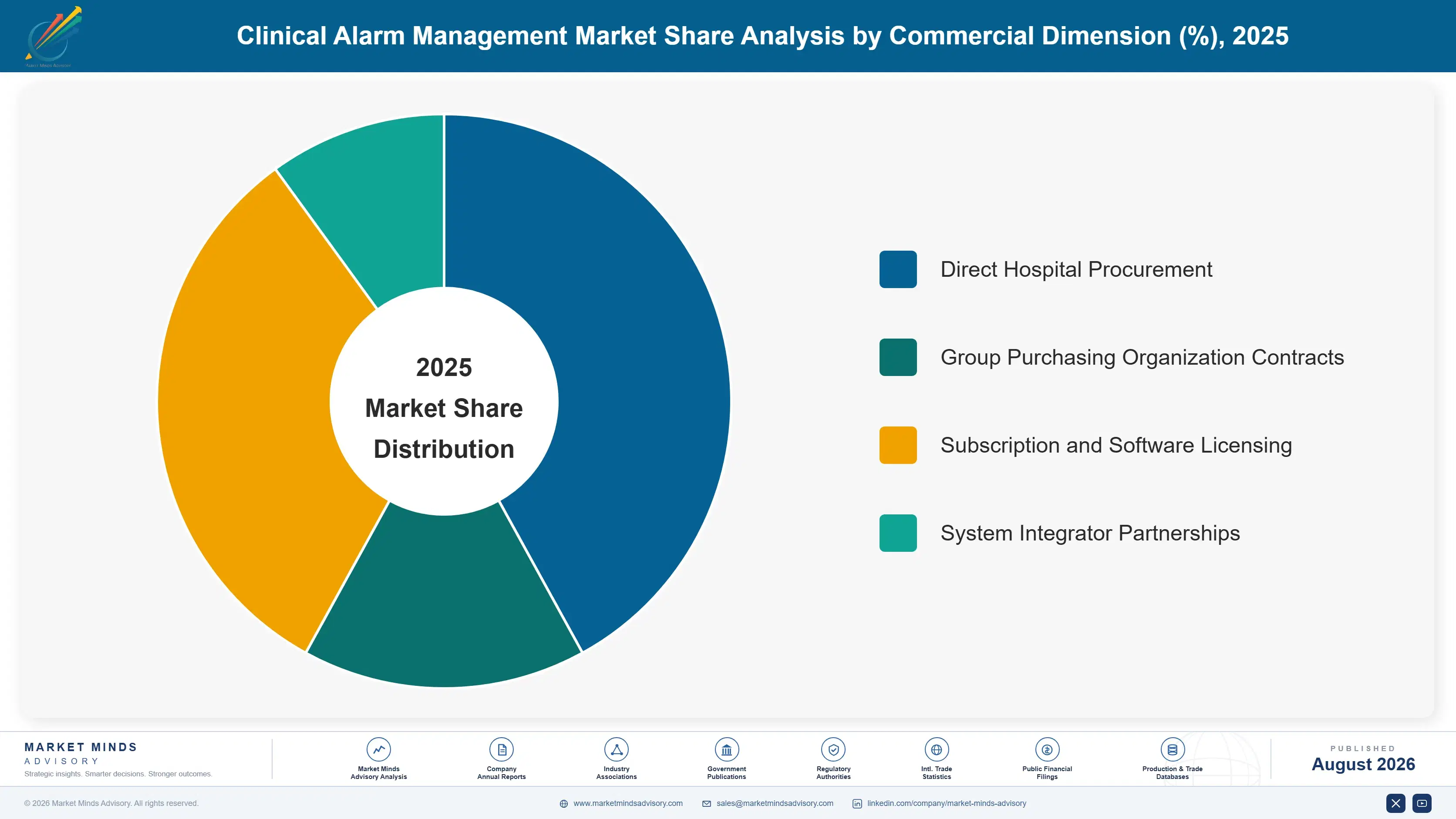
Clinical alarm management segments by product and technology type across six categories spanning software, hardware, and services used across most hospitals. Analytics and alarm fatigue reduction software and secondary alerting and mobile notification devices are the two fastest-growing categories tracked, both expanding well ahead of the broader market as hospitals prioritize actionable alerting over notification volume alone.
clinical-alarm-management-market-market-share-analysis-1787304956106

Analytics and Alarm Fatigue Reduction Software

Analytics and alarm fatigue reduction software, which applies machine learning to physiological monitor waveform data to distinguish clinically significant events from routine artifact-driven false alarms, is converting the fastest share of new hospital purchasing budgets as accreditation bodies demand documented alarm reduction outcomes across nearly every accredited facility. Vendors publishing peer-reviewed clinical validation studies showing measurable non-actionable alert reduction are winning disproportionate share of new contracts against competitors relying on notification speed alone. This category increasingly determines vendor selection even when hospitals are technically purchasing broader middleware platforms, since analytics capability has become the primary differentiator hospital purchasing committees evaluate during vendor selection processes across most major health systems today.
CAGR 14.5%

Secondary Alerting and Mobile Notification Devices

Secondary alerting and mobile notification devices, which route prioritized physiological monitor and nurse call alerts directly to nurse smartphones and dedicated pagers, are expanding rapidly as hospitals address chronic nurse staffing shortages by extending limited coverage more efficiently across larger patient assignments and busier shifts throughout the week. Growth here tracks nurse mobile device adoption broadly, with hospitals increasingly standardizing on smartphone-based secondary alerting rather than legacy dedicated pager hardware that requires separate procurement and maintenance contracts. This category benefits directly from consumer smartphone technology maturation, lowering hardware cost while improving notification reliability and giving hospital IT departments a simpler device management model across their entire nursing workforce and shift schedule.
CAGR 12.0%
Full segment breakdown across 6 segments available in the complete report.

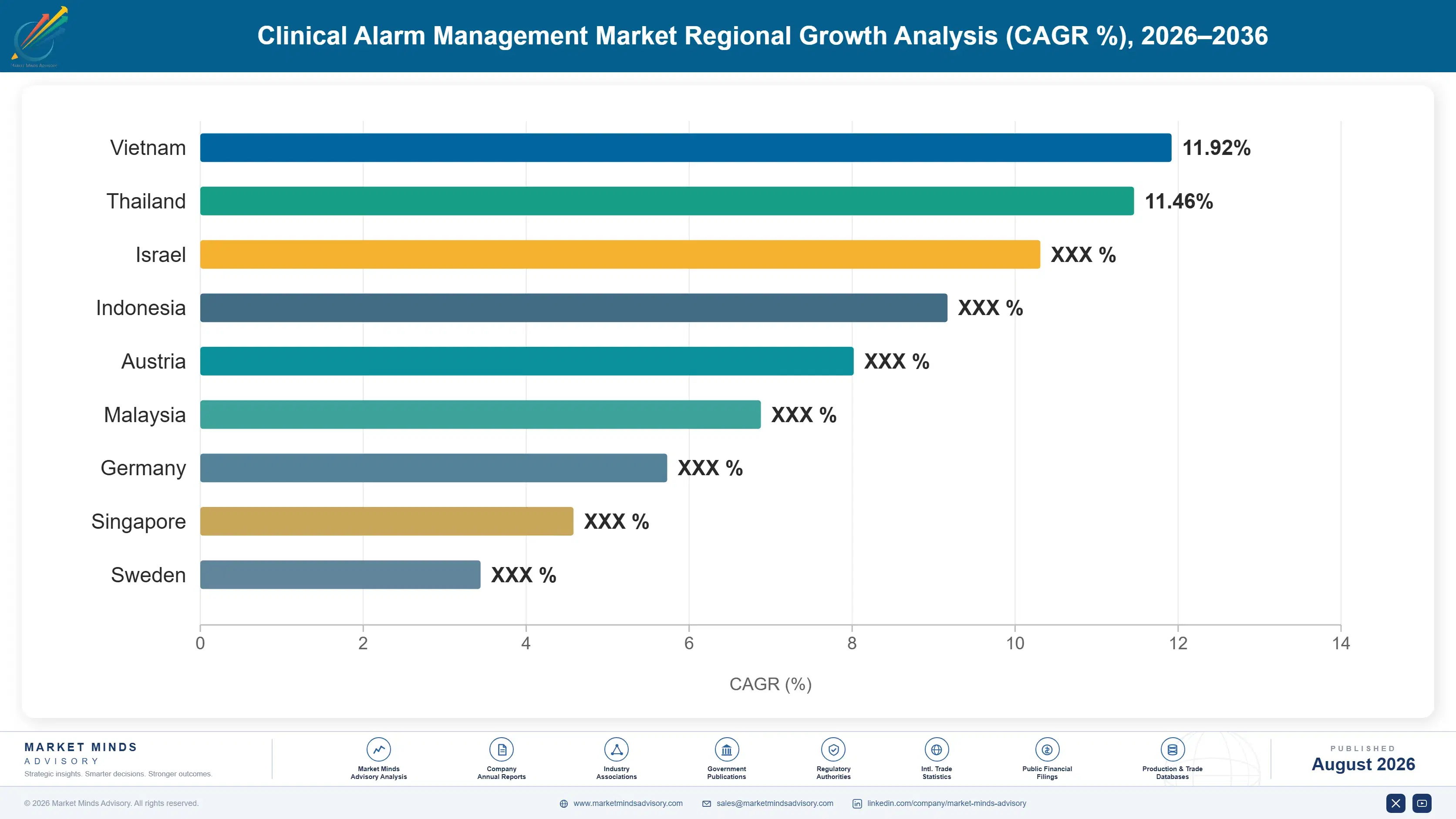
Regional Architecture and Country Demand Map

Clinical alarm management demand concentrates most heavily in North America, where Joint Commission accreditation requirements create direct regulatory pressure absent elsewhere. East Asia follows closely as new hospital construction bundles alarm management from design, while South Asia and Pacific markets post the fastest regional growth off a smaller installed base.

North America

North America holds the largest share of global clinical alarm management revenue, a position justified directly by Joint Commission accreditation requirements that apply specifically to United States hospitals seeking continued certification and reimbursement eligibility across their operations. The United States accounts for the overwhelming majority of regional volume, with virtually every accredited acute care hospital operating some form of alarm management system by regulatory necessity rather than pure preference. Canada contributes a smaller share, driven by comparable but less formalized provincial patient safety initiatives. Vendor competition here centers heavily on demonstrated compliance outcomes and clinical evidence, since purchasing committees must document alarm reduction results to accreditation surveyors during periodic review.
Share: 31% | CAGR: 10.7% (2026 to 2036)

Western Europe

Western Europe follows North America in absolute value, though adoption here stems more from broader hospital digital modernization initiatives than from a single unified regulatory mandate comparable to Joint Commission requirements found in the United States and its territories. Germany, France, and the United Kingdom together account for the majority of regional volume, with national health system procurement cycles shaping purchasing timelines more than individual hospital budget decisions. Nurse staffing shortages are a meaningful secondary driver across the region, similar to North America. Growth trails East Asia and South Asia as the market matures, though public health system modernization investment sustains steady demand across most participating countries and health authorities.
Share: 22% | CAGR: 8.0% (2026 to 2036)
Regional intelligence for 5 additional markets available in the complete report: East Asia, South Asia and Pacific, Latin America, Middle East and Africa, Eastern Europe. Contact sales@marketmindsadvisory.com.
clinical-alarm-management-market-country-cagr-analysis-1787304956616

Analytics Attach and Compliance Service Growth

Clinical alarm management vendors are pursuing several distinct paths to grow revenue beyond initial middleware installation as hospitals demand demonstrated compliance and workflow outcomes rather than notification infrastructure alone. Four levers stand out as commercially significant across the forecast period, spanning analytics software attach, compliance reporting services, greenfield hospital partnerships, and subscription-based deployment financing structures.

Analytics Software Subscription Attach Growth Strategy

Vendors are increasingly bundling AI-based alarm prioritization analytics as a subscription layer on top of core middleware licensing, converting a historically one-time infrastructure sale into a recurring revenue relationship across most new hospital contracts. Hospitals adopting analytics report attach rates approaching 45 percent on new middleware contracts, a figure vendors expect to climb as accreditation bodies increasingly expect documented alarm reduction evidence during periodic review. This shift improves vendor gross margin quality meaningfully and gives vendors far greater visibility into customer retention and future expansion opportunities across their installed hospital base.
Market Impact: Analytics software subscription att

Compliance Reporting and Audit Support Services

Vendors offering dedicated compliance reporting services, generating documentation hospitals submit directly to accreditation surveyors, are capturing meaningful service revenue beyond core software licensing across most contract renewals and expansions today. These services typically carry gross margin well above hardware and middleware sales, since delivery requires clinical expertise rather than additional infrastructure cost. Leading vendors now attach compliance reporting service contracts to more than 50 percent of North American hospital accounts, reflecting how central accreditation documentation has become to overall hospital purchasing decisions and vendor selection processes across most accredited facilities.
Market Impact: Compliance reporting services now a

Greenfield Hospital Construction Partnership Development Program

Establishing partnerships with hospital architecture and construction firms to specify alarm management systems during initial facility design, rather than competing for retrofit contracts later, is opening a growing volume channel across East Asian and Middle Eastern greenfield hospital projects nationwide and internationally each year. Vendors with established design-stage partnerships report win rates roughly 30 percent higher on new hospital construction bids compared to vendors competing only after facility completion. This approach requires sustained relationship investment with architecture firms, but positions vendors advantageously in markets adding substantial new hospital capacity annually.
Market Impact: Design-stage partnerships show 30 p

Subscription-Based Deployment Financing for Smaller Hospitals

Vendors offering subscription and phased deployment financing structures are opening purchasing decisions to smaller community and rural hospitals that lack capital budget for upfront system-wide installation across their entire facilities and departments today. Vendors offering per-bed subscription pricing report win rates meaningfully higher among facilities under 200 beds compared to standard upfront capital sale terms. This lever matters most in price-sensitive segments including rural and critical access hospitals, where operating budget flexibility often exceeds available capital budget, making financing structure a deciding factor in many smaller facility purchasing decisions nationwide.
Market Impact: Win rates rise most for hospitals u

Who Controls the Margin Pool

Clinical alarm management carries a CR5 near forty-eight percent, concentrated among five vendors spanning pure-play communication specialists and device majors that bundle alarm functionality into broader monitoring platforms across most acute care settings. The gap between leaders and the challenger tier is meaningful, since regulatory-driven purchasing rewards vendors with strongest clinical evidence and compliance documentation track records.
Current competitive activity plays out across three dimensions: analytics capability races among pure-play vendors seeking to match device major bundling advantages, design-stage partnerships with hospital architecture firms targeting greenfield East Asian and Middle Eastern construction, and consolidation among smaller regional integrators lacking capital to fund AI analytics research and development independently. Larger vendors are also pursuing selective acquisitions of clinical validation and analytics specialist firms.

Emerging pressure comes from device majors increasingly bundling alarm management directly into physiological monitoring platform sales at effectively zero incremental cost, undercutting pure-play vendor standalone pricing models. Rankings could shift meaningfully if regulatory-driven analytics adoption speed diverges significantly between leaders, particularly as hospital purchasing committees increasingly favor vendors demonstrating the clearest documented nurse workload reduction alongside core alarm safety compliance across their entire deployment footprint.
clinical-alarm-management-market-company-positioning-matrix-1787304957134

Competitive Moat and Risk Dimensions

VOCERA COMMUNICATIONS

Moat: Clinical Evidence and Analytics Depth

Vocera Communications has built the deepest library of published clinical validation studies among pure-play alarm management vendors, giving it a genuine advantage in accreditation-driven purchasing decisions where hospitals must demonstrate documented outcomes. This evidence base compounds over time, since each new deployment generates additional clinical data that strengthens future sales conversations with skeptical purchasing committees.
VOCERA COMMUNICATIONS

Risk: Device Major Bundling Pressure

Vocera faces mounting pressure from physiological monitoring device majors that increasingly bundle basic alarm management functionality directly into monitor sales at minimal incremental cost, threatening to commoditize the middleware layer Vocera has traditionally competed on. Slower differentiation beyond core notification into deeper analytics could leave Vocera vulnerable to being squeezed out of bundled hospital procurement decisions.
ASCOM HOLDING

Moat: Global Systems Integration Breadth

Ascom Holding maintains particularly broad integration compatibility across legacy nurse call and physiological monitoring brands, a capability built over years of European hospital deployment experience that reduces implementation complexity for hospitals running fragmented multi-vendor infrastructure. This integration depth is difficult for newer entrants to replicate quickly without comparable field deployment history.
ASCOM HOLDING

Risk: Slower North American Market Penetration

Ascom has historically concentrated deployment strength in Europe, leaving it with comparatively thinner presence in the North American market where Joint Commission accreditation pressure drives the largest share of global demand. Building North American sales and clinical evidence infrastructure from a smaller base could limit near-term share gains against domestically established competitors.

Players Tracked

Prominent Players

Vocera Communications
Ascom Holding
Spok Holdings
GE HealthCare
Philips Healthcare

Other Key Players

Connexall
Rauland-Borg
Hillrom
CenTrak
Extension Healthcare
Mobile Heartbeat
PatientSafe Solutions
TigerConnect
Bernoulli Health
iMDsoft
Capsule Technologies
Masimo
Dragerwerk
Nihon Kohden
Oracle Health

Recent Developments

APRIL 2025

Vocera Communications Launches AI Alarm Prioritization Analytics Module

Vocera Communications launched a new AI-based alarm prioritization analytics module trained on physiological monitor waveform data, designed to distinguish clinically significant deterioration from routine artifact-driven false alarms. The module integrates directly into existing Vocera middleware deployments, allowing current customers to add analytics capability without full platform replacement.
Signal: Signals accelerating vendor investment in
OCTOBER 2024

Ascom Holding Signs Multi-Facility Supply Agreement With European Hospital Group

Ascom Holding signed a multi-facility supply agreement with a major European hospital group to deploy alarm management middleware across eighteen facilities, replacing fragmented legacy nurse call systems with a standardized platform. The agreement includes phased rollout through 2027 and ongoing analytics subscription licensing across all participating hospital sites.
Signal: Signals growing hospital preference for st
JANUARY 2025

Spok Holdings Acquires Clinical Validation Analytics Firm

Spok Holdings completed the acquisition of a clinical validation analytics firm specializing in alarm reduction outcome measurement, adding published research capability that strengthens Spok evidence base for accreditation-focused hospital sales conversations. The acquisition accelerates Spok internal analytics roadmap, reducing dependence on third-party clinical research partnerships for compliance documentation.
Signal: Signals continued industry consolidation a

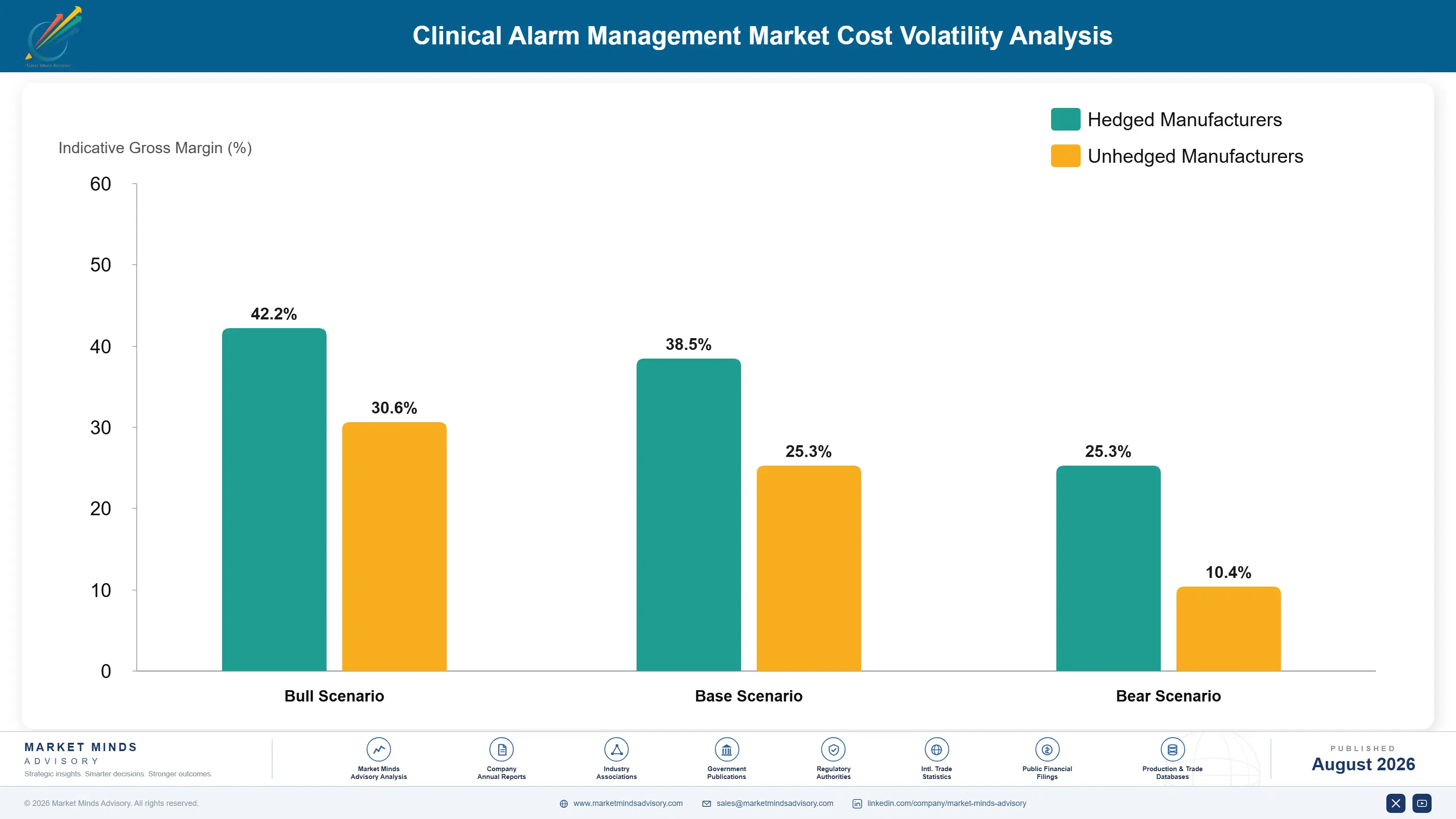
Software Engineering and Integration Labor Cost

Software engineering and clinical integration labor together represent roughly fifty to fifty-five percent of clinical alarm management system cost of goods sold, reflecting the category nature as a software and services business rather than a hardware manufacturing one. Skilled clinical informatics engineers capable of interfacing with diverse hospital IT systems remain in short supply, concentrated primarily in North America and Western Europe.
Specialized clinical informatics engineering wages rose meaningfully during 2022 and 2023 amid broader healthcare IT labor market tightness following pandemic-driven digital health hiring surges across the industry. Several vendors disclosed in annual reports that engineering labor cost inflation compressed implementation service margin during this period, pushing some vendors toward offshore development and integration support to manage cost growth without sacrificing project delivery timelines to hospital customers.

Cost exposure varies by vendor business model and geography. Vendors with mature pre-built integration libraries covering major monitor and nurse call brands absorb labor cost pressure more easily than smaller competitors requiring custom interface development for every deployment. Geographic exposure also differs: vendors relying primarily on North American and Western European engineering talent face higher labor cost than those with established offshore development centers in lower-cost regions.
clinical-alarm-management-market-cost-volatility-analysis-1787304957328

Pre-Built Integration Library Expansion

Vendors are expanding libraries of pre-built integration connectors covering major physiological monitor and nurse call brands, reducing the need for custom engineering on each new hospital deployment. This shortens implementation timelines and reduces labor cost per project meaningfully, giving vendors better margin visibility and faster time to revenue recognition across new hospital contracts signed each quarter.

Offshore Development Center Expansion

Several major vendors have expanded offshore software development and clinical integration engineering centers to manage labor cost growth without sacrificing delivery capacity or clinical support quality. This shift requires investment in training and quality control processes but reduces overall project cost meaningfully over time, particularly for standardized integration work that does not require on-site clinical presence.

Standardized Deployment Methodology Adoption

Vendors are adopting standardized deployment methodologies and project management frameworks across hospital implementations, reducing the customization burden that has historically driven labor cost overruns on individual projects. This standardization also improves project timeline predictability for hospital customers, strengthening vendor reputation and reducing the risk of costly implementation delays that damage customer relationships over time.

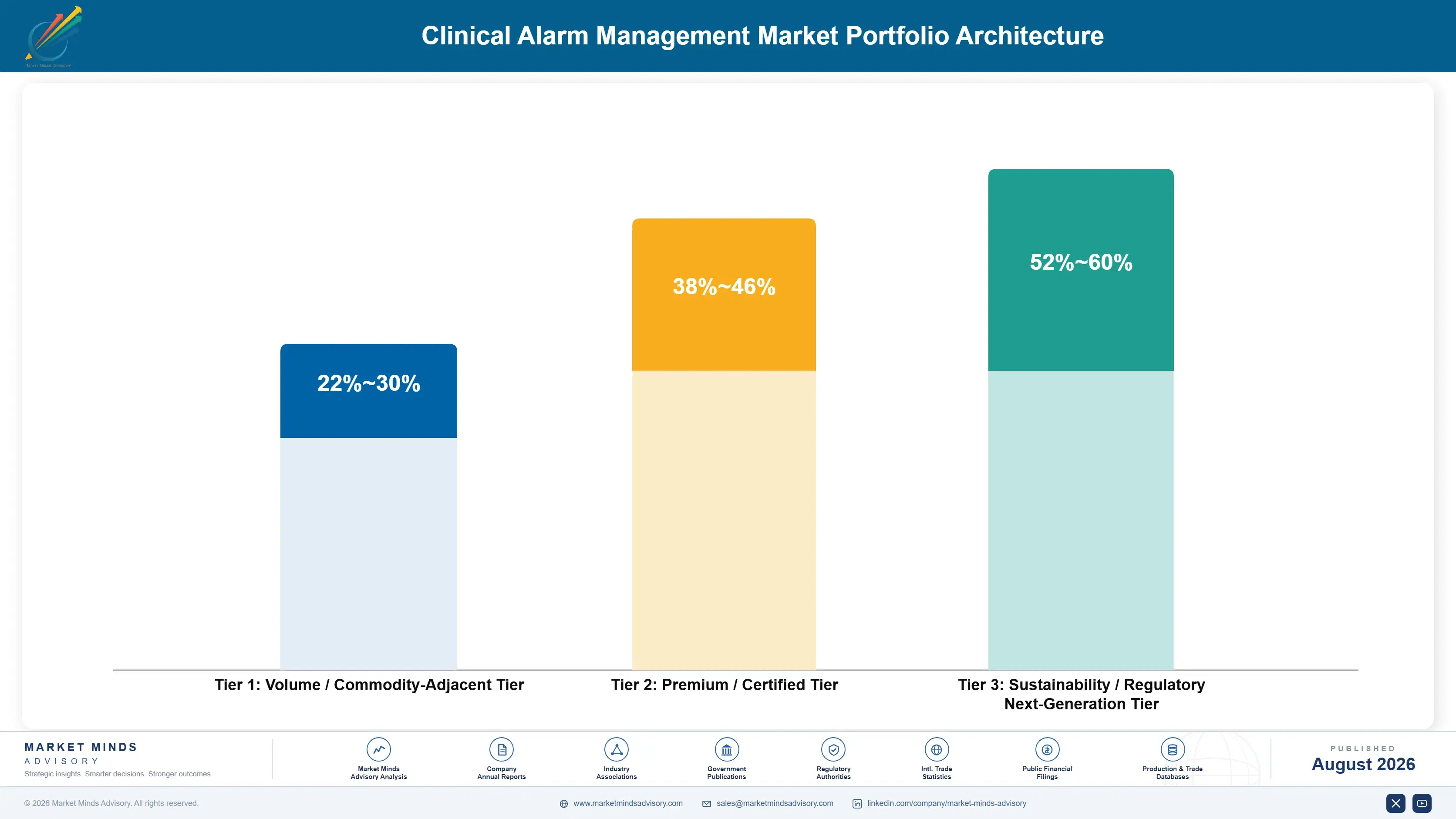
Portfolio Architecture for Margin Defence

Clinical alarm management portfolios span three margin tiers running from commodity-adjacent basic middleware through certified analytics-enabled platforms to sustainability-linked next-generation AI prioritization and predictive deterioration systems built for advanced clinical use. Gross margin widens considerably moving up the tier structure, driven primarily by analytics subscription attach and clinical evidence depth rather than notification infrastructure differences alone across most vend
Volume tier competition centers on price and basic notification reliability for cost-constrained community hospitals, where core middleware functionality and integration breadth determine competitiveness more than analytics sophistication or clinical research depth. Premium tier competition instead centers on published clinical validation, analytics accuracy, and compliance documentation depth, an entirely different buying calculus that rewards vendors with dedicated clinical research capability built over many years of sustained investment and hospital partnership.

High-value margin pools concentrate overwhelmingly in the premium and next-generation tiers, where analytics subscription and compliance reporting services generate recurring revenue well above any one-time middleware installation transaction alone. Vendors increasingly steer product development and sales incentive structures toward this upper tier as volume-tier margin continues compressing under sustained device major bundling pressure and intensifying price competition from lower-cost regional integrators and new entrants.

Volume / Commodity-Adjacent Tier

Basic middleware routing physiological monitor and nurse call alerts to mobile devices, targeting price-sensitive community and rural hospitals where core notification reliability matters more than advanced analytics or predictive prioritization capability.
Gross Margin: 22%-30%

Premium / Certified Tier

Analytics-enabled middleware platforms with documented clinical validation, typically sold with compliance reporting services to accredited hospitals across mid-size and large health systems seeking demonstrated alarm reduction outcomes for accreditation surveys.
Gross Margin: 38%-46%

Sustainability / Regulatory / Next-Generation Tier

AI-driven predictive deterioration and alarm prioritization systems targeting leading academic medical centers and health systems piloting next-generation clinical decision support ahead of broader accreditation requirements and industry standard adoption timelines currently underway.
Gross Margin: 52%-60%
clinical-alarm-management-market-portfolio-architecture-1787304957824

Compliance Cycles and Vendor Trust

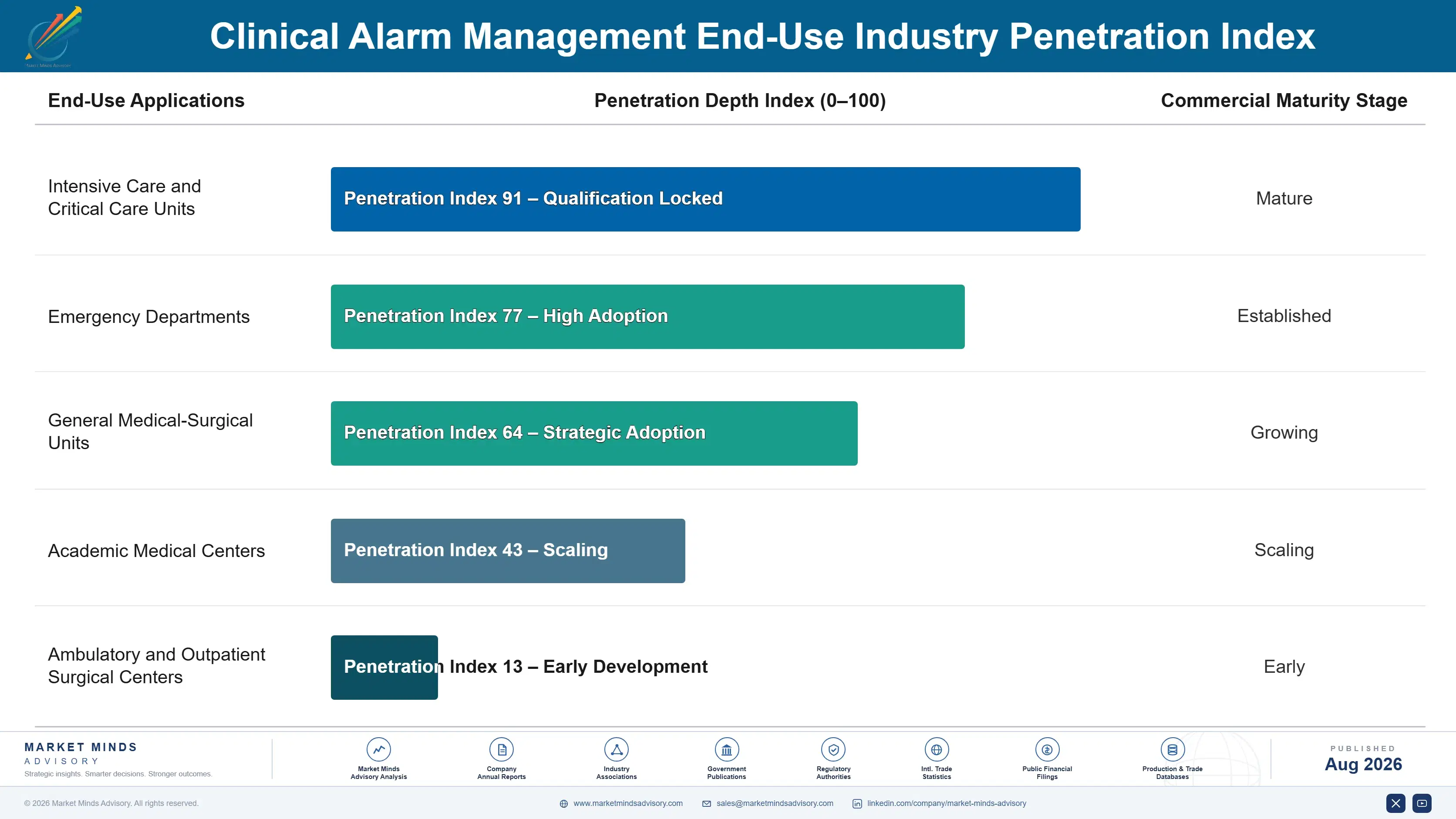
Clinical alarm management demand carries genuine annuity characteristics through multi-year middleware contracts anchored by ongoing accreditation compliance cycles, since hospitals rarely switch vendors mid-certification given the documentation continuity accreditation surveyors expect to see across successive review periods. Vendors increasingly value long-term compliance partnership over pure initial installation revenue, restructuring sales models to prioritize retention and analytics attach
Adoption depth varies sharply by end-use vertical. Intensive care and emergency departments show the deepest, most sustained engagement, layering analytics across nearly their entire monitored bed base given the highest acuity and alarm volume. General medical-surgical units adopt more gradually, with software attach still catching up as hospitals prioritize highest-risk units first before expanding coverage across lower-acuity floors and departments.

A generational shift in buyer profile is underway as younger nursing informatics leaders trained on data-driven workflow optimization reach purchasing influence roles within hospital IT and clinical operations departments. This cohort expects analytics-driven prioritization as a baseline feature rather than a premium add-on, reshaping procurement criteria toward demonstrated outcome evidence and away from notification speed specifications that dominated purchasing decisions a decade ago.
clinical-alarm-management-market-end-use-penetration-index-1787304958311

Where Clinical Alarm Management Value Concentrates

These are among the four positions where our research anticipates prominent divergence between winners and laggards over the coming forecast period. Each is grounded in the demand model, the regulatory perimeter, and the announced capacity pipeline.
01 / ANALYTICS EVIDENCE INVESTMENT

Prioritize Published Clinical Validation Over Notification Speed Alone

Vendors that invest in published clinical validation studies demonstrating measurable alarm reduction are capturing disproportionate share of accreditation-driven hospital purchasing decisions across most major health systems today and beyond current expectations. Purchasing committees increasingly weigh documented outcome evidence alongside core notification reliability, a shift that rewards sustained clinical research investment over incremental infrastructure refinement alone. Vendors slow to build genuine evidence depth risk losing accreditation-focused accounts within three to five years as this evaluation criterion becomes the clear industry default.
02 / GREENFIELD HOSPITAL PARTNERSHIPS

Build Architecture Firm Relationships Ahead of Construction Booms

East Asian and Middle Eastern markets are adding new hospital capacity faster than most vendors currently have design-stage partnership relationships to capture profitably at meaningful scale across most affected regions, countries, and rapidly growing metropolitan areas today. Establishing architecture and construction firm partnerships ahead of project bidding requires patient multi-year relationship investment with limited near-term payback for most vendors entering these markets. Vendors that build this presence early are positioned to capture disproportionate share as regional hospital construction continues accelerating steadily.
03 / DEVICE BUNDLING COMPETITIVE RESPONSE

Differentiate on Analytics Depth to Counter Device Major Bundling

Physiological monitoring device majors bundling basic alarm functionality into monitor sales at minimal incremental cost threaten to commoditize pure-play vendor middleware offerings across most standard hospital procurement decisions and budget cycles nationwide and internationally each year. Pure-play vendors need genuine analytics depth and clinical evidence that bundled device offerings cannot easily replicate without dedicated research investment of their own. Vendors failing to differentiate meaningfully beyond basic notification risk being squeezed out of bundled hospital procurement entirely within the next several years.
04 / SMALLER HOSPITAL FINANCING ACCESS

Expand Subscription Financing to Capture Rural Hospital Segment

Smaller community and rural hospitals represent a meaningfully underserved segment where capital budget constraints, rather than lack of clinical need, limit alarm management adoption across most facility types in this category and region today. Vendors offering subscription and phased deployment financing structures are winning disproportionate share among facilities that traditional upfront capital sale models effectively price out of the market entirely. This segment carries lower average contract value but offers meaningful volume growth as accreditation pressure extends to smaller facilities.

Engagement Snapshot From the Field

A live engagement with an industry participant carrying material or product regulatory and market exposure ahead of a defining policy shift, showing how our research translates into a defensible multi-year portfolio strategy.
MARKET MINDS ADVISORY · CLIENT ENGAGEMENT SUMMARY
Clinical Alarm Management Producer Strategic Portfolio Review and Transition Roadmap 2026·Investment Scenario on Clinical Alarm Management Exposure Evaluation 2025-26
CLIENT PROFILE
The client is a regional health system operating eight acute care hospitals across the midwestern United States, serving a mixed urban and rural patient population with a combined intensive care and medical-surgical bed count exceeding twelve hundred. The health system faced growing scrutiny from Joint Commission surveyors regarding undocumented alarm reduction progress across several facilities, alongside persistent nurse turnover partly attributed to alarm fatigue in high-acuity units.
STRATEGIC CHALLENGE
Leadership needed to evaluate whether a system-wide analytics platform could meaningfully reduce non-actionable alert volume without requiring full replacement of existing middleware infrastructure across all eight facilities simultaneously. The health system also needed documented evidence suitable for presentation to Joint Commission surveyors ahead of an upcoming accreditation survey cycle, creating real time pressure around vendor selection and deployment.
MMA APPROACH
MMA conducted an independent vendor capability assessment across four analytics platform candidates, benchmarking alarm reduction evidence, integration compatibility with existing middleware, and implementation timeline feasibility ahead of the accreditation survey deadline. The engagement combined primary interviews with nursing and biomedical engineering leadership at three pilot facilities, competitive benchmarking against peer health systems, and phased deployment planning sequencing rollout by facility survey timing.
KEY FINDINGS
  1. Pilot deployment at three facilities reduced non-actionable alert volume by an estimated thirty-eight percent within four months (client-reported, unverified by MMA), based on internal monitoring system logs.
  2. Nursing staff surveyed at pilot facilities reported meaningfully reduced perceived alarm fatigue, though the health system noted survey response rates varied considerably across the three participating units.
  3. Integration with existing middleware infrastructure took approximately ten weeks per facility, faster than initial vendor estimates of sixteen weeks, aided by pre-built connectors for the incumbent monitoring platform.
  4. The selected vendor documentation package was accepted by Joint Commission surveyors during the subsequent accreditation review without requiring supplemental evidence or follow-up documentation requests from the health system.
CLIENT PROFILE
The client is a regional health system operating eight acute care hospitals across the midwestern United States, serving a mixed urban and rural patient population with a combined intensive care and medical-surgical bed count exceeding twelve hundred. The health system faced growing scrutiny from Joint Commission surveyors regarding undocumented alarm reduction progress across several facilities, alongside persistent nurse turnover partly attributed to alarm fatigue in high-acuity units.
STRATEGIC CHALLENGE
Leadership needed to evaluate whether a system-wide analytics platform could meaningfully reduce non-actionable alert volume without requiring full replacement of existing middleware infrastructure across all eight facilities simultaneously. The health system also needed documented evidence suitable for presentation to Joint Commission surveyors ahead of an upcoming accreditation survey cycle, creating real time pressure around vendor selection and deployment.
MMA APPROACH
MMA conducted an independent vendor capability assessment across four analytics platform candidates, benchmarking alarm reduction evidence, integration compatibility with existing middleware, and implementation timeline feasibility ahead of the accreditation survey deadline. The engagement combined primary interviews with nursing and biomedical engineering leadership at three pilot facilities, competitive benchmarking against peer health systems, and phased deployment planning sequencing rollout by facility survey timing.
KEY FINDINGS
  1. Pilot deployment at three facilities reduced non-actionable alert volume by an estimated thirty-eight percent within four months (client-reported, unverified by MMA), based on internal monitoring system logs.
  2. Nursing staff surveyed at pilot facilities reported meaningfully reduced perceived alarm fatigue, though the health system noted survey response rates varied considerably across the three participating units.
  3. Integration with existing middleware infrastructure took approximately ten weeks per facility, faster than initial vendor estimates of sixteen weeks, aided by pre-built connectors for the incumbent monitoring platform.
  4. The selected vendor documentation package was accepted by Joint Commission surveyors during the subsequent accreditation review without requiring supplemental evidence or follow-up documentation requests from the health system.
RECOMMENDED STRATEGY
Phase 1: Phase 1 (Months 1 to 2): Complete vendor capability assessment and pilot facility selection, prioritizing units with highest documented alarm fatigue and nurse turnover. Phase 2: Phase 2 (Months 3 to 6): Deploy analytics platform at three pilot facilities, tracking alert volume reduction and nursing staff feedback against baseline metrics. Phase 3: Phase 3 (Months 7 to 12): Roll out validated platform across remaining five facilities, sequencing deployment ahead of each facility upcoming accreditation survey date.
OUTCOME
Within twelve months, the health system completed system-wide analytics deployment across all eight facilities, reduced non-actionable alert volume meaningfully across pilot and rollout sites, and passed its Joint Commission survey without alarm-related findings (client-reported, unverified by MMA). Nurse turnover in high-acuity units declined modestly following deployment, though the health system noted other concurrent staffing initiatives also contributed.

Frequently Asked Questions

Foundational context covering the market sizes, CAGR, scope, country, region and competition that inform every finding below. This section is provided to cover basics and most often pre-purchase conversations, answered from the MMA Primary Research Dataset.

What is the current size of the Clinical Alarm Management Market?

The global clinical alarm management market was valued at 1.8 billion dollars in 2025. This figure covers middleware software, secondary notification devices, and analytics platforms used across hospital settings.

How large will the Clinical Alarm Management Market be by 2036?

MMA forecasts the market will reach 4.88 billion dollars by 2036, more than doubling in value. This growth is driven primarily by accreditation-driven analytics adoption and nurse staffing pressure.

What is the CAGR for the Clinical Alarm Management Market 2026 to 2036?

The base case CAGR is 9.5 percent annually across the forecast period. Bull and bear scenarios range from 10.8 percent to 8.2 percent depending on hospital capital budget conditions.

Which segment is growing fastest?

Analytics and alarm fatigue reduction software is the fastest-growing segment, expanding at approximately 14.5 percent annually. This is roughly 1.5 times the overall market growth rate, driven by accreditation demand.

Who are the major companies in the Clinical Alarm Management Market?

Leading companies include Vocera Communications, Ascom Holding, Spok Holdings, GE HealthCare, and Philips Healthcare. These five vendors hold a combined CR5 near forty-eight percent of the global market.

Which country is growing fastest?

India is the fastest-growing national market, expanding at approximately 12.0 percent annually. This reflects rapid new hospital construction and rising alarm management specification at the design stage.

Report Segmentation Architecture

The full report scope spans multiple orthogonal segmentation dimensions, with cross-tabulated demand data provided for each dimension pair. Coverage extends further to regional breakdowns, trend trajectories, and the competitive detail needed to support segment-level decision-making.

By Product and Technology Type

  • Analytics and Alarm Fatigue Reduction Software
  • Secondary Alerting and Mobile Notification Devices
  • Alarm Notification Middleware Software
  • Physiological Monitor Integration Systems
  • Nurse Call Integration Services
  • Professional Services and System Integration

By End-Use Industry

  • Intensive Care and Critical Care Units
  • Emergency Departments
  • General Medical-Surgical Units
  • Academic Medical Centers
  • Ambulatory and Outpatient Surgical Centers

By Commercial Dimension

  • Direct Hospital Procurement
  • Group Purchasing Organization Contracts
  • Subscription and Software Licensing
  • System Integrator Partnerships

By Region

  • North America
  • Western Europe
  • East Asia
  • South Asia and Pacific
  • Latin America
  • Middle East and Africa
  • Eastern Europe

Scope, Methodology, and Coverage

Every figure in this report is reproducible from documented input assumptions. The scope below maps the historical period, the forecast horizon, the segmentation dimensions, and the countries covered, alongside the underlying primary and qualitative methodology.
Historical Period
2020 to 2025
Forecast Period
2026 to 2036
Base Year
2025 (USD billions; MMA Primary Research Dataset, August 2026)
Market Definition
The clinical alarm management market covers middleware software, secondary notification devices, and analytics platforms that route, prioritize, and reduce non-actionable physiological monitor and nurse call alerts within hospital settings. Standalone patient monitoring hardware and general hospital communication platforms without alarm-specific functionality are excluded.
Quantitative Units
USD billions (current prices); licensed hospital beds where applicable
Segmentation Dimensions
By Product and Technology Type; By End-Use Industry; By Commercial Dimension; By Region
Regions Covered
North America, Western Europe, East Asia, South Asia and Pacific, Latin America, Middle East and Africa, Eastern Europe
Countries Covered
USA, China, Germany, France, UK, Japan, South Korea, India, Australia, Canada, Brazil, Mexico, Indonesia, Vietnam, Thailand, Malaysia, UAE, Saudi Arabia, South Africa, Nigeria, Turkey, Poland, Netherlands, Italy, Spain, Sweden, Switzerland, Argentina, Colombia, Singapore, and additional markets relevant to this sector
Key Companies Profiled
Vocera Communications, Ascom Holding, Spok Holdings, GE HealthCare, Philips Healthcare, Connexall, Rauland-Borg, Hillrom, CenTrak, Extension Healthcare, Mobile Heartbeat, PatientSafe Solutions, TigerConnect, Bernoulli Health, iMDsoft, Capsule Technologies, Masimo, Dragerwerk, Nihon Kohden, Oracle Health
Quantitative Methodology
Primary survey, n=3,800 respondents, Q4 2025, six countries; demand-side model with trade association cross-validation
Qualitative Methodology
47 expert interviews, Q4 2025; applied to validate demand model assumptions, identify emerging dynamics, and assess competitive positioning
Report Format
PDF and XLSX data workbook (Word format preview document)
Publisher
Market Minds Advisory
Report Code
MMA-2026-MED-521
Published
August 2026
Contact
sales@marketmindsadvisory.com | www.marketmindsadvisory.com

Purchase the full Clinical Alarm Management Market Report (2026 to 2036).

The full report delivers detailed segment-level revenue forecasts across all six product categories through 2036. It includes country-level breakdowns for the fourteen markets carrying the deepest primary research coverage, alongside a complete competitive benchmarking module covering all twenty profiled companies. Proprietary MMA survey data drawn from 3,800 respondents across six countries supports the demand analysis, complemented by expert interview findings from 47 industry specialists gathered during the fourth quarter of 2025. Buyers also receive editable data tables and a quarterly market monitor update subscription for twelve months following purchase.
Segment-level revenue forecasts across six product categories
Country-level breakdowns for fourteen deeply researched markets
Competitive benchmarking module covering twenty profiled companies
Proprietary survey data from 3,800 respondents worldwide
Expert interview findings from 47 industry specialists
Twelve months of quarterly market monitor updates

Built For The People Who Decide

From boardroom strategy to bench-side execution, this report is read cover-to-cover by leaders shaping the next decade of their industry, turning demand scenarios, market dynamics and valuation benchmarks into decisions.
CXOs/ Presidents/ VPs/ Managers
M&A and Corporate Development
Strategy Teams and R&D Heads
Procurement and Product Directors
Regulatory and Compliance Leaders
Investor Relations and Equity Analysts