Market Minds Advisory
Cling Film Market

Cling Film Market: The One That Works Best Is The One Being Restricted

Polyethylene has spent twenty years trying to cling the way PVC does, and professional kitchens keep voting for the material that regulators and retailers are steadily taking away from them.

Lead Analyst

Bilal Shaikh

Published

September 2026

Make Smarter Decisions with Customized Research Insights

Request a free sample report and evaluate market opportunities, growth trends, and competitive dynamics relevant to your business needs.

2025 MARKET VALUE$2.6BMarket Size 2025
2036 FORECAST VALUE$4.1BBase Case , 2026 to 2036
CAGR 2026 TO 20364.2 %Bull 5.4% / Bear 3.0%
INCREMENTAL OPPORTUNITY$1.4BNet 10- year value creation
EXPANSION MULTIPLE1.51x2036 value over 2026 base
Strategic Levers
M&A Pipeline
Regional Outlook
Country Rankings
Competitive Intelligence
Segmental Deep-dive
Call-Us : 91 93563 13602

Executive Snapshot and Market Trajectory

Cling is not a property of the plastic. It comes from an additive that makes up around 4% of the film and attracts essentially all of the regulatory attention, which is why the material that clings best is the one being removed from professional kitchens.
Growth runs at 4.2% and compostable films lead it. Bio-based cling grows at 6.3%, exactly 1.50 times the market rate, from a base small enough that retailer commitments rather than consumer demand move it. East Asia holds 32%, above band, because food delivery volumes and foodservice packaging demand both concentrate there. Multilayer coextrusion is where PVC conversions actually land in practice. That additive is the whole commercial story here.
Concentration is very low at 23% across the top five measured on cling film tonnage supplied, and thin film converting being widely held explains it. A roll of nine micron film is mostly air by volume, which caps a practical freight radius near 600 kilometres and keeps supply regional everywhere. Recovery runs at roughly 2% because the film is thin and food-contaminated. That leaves the product with no technical defence against packaging waste rules.
Market Definition
This market covers thin cling and wrap films supplied for food contact use in foodservice, retail, and consumer applications, spanning PVC cling films, polyethylene cling films, polyolefin multilayer cling films, barrier and specialty cling films, and compostable and bio-based cling films. Pallet stretch wrap and industrial unitising film, rigid and semi-rigid food containers, vacuum and skin packaging films, laminated pouch structures, and cling film dispensers and cutting equipment fall outside scope.
Base Year Value
$2.6B in 2025 (MMA Primary Research Dataset, August 2026)
Forecast Period
2026 to 2036, eleven discrete annual values
CAGR
4.2% base case. Bull 5.4%. Bear 3.0%.
Fastest Growth Segment
Compostable and Bio-Based Cling Films: 6.3% CAGR
Fastest Growth Country
India: 7.0% CAGR
Fastest Growth Region
South Asia and Pacific: 6.2% CAGR
Largest Region
East Asia: 32% of 2025 global value
Market Leaders
Berry Global, Amcor, Sealed Air, Reynolds Consumer Products, Coveris. Source: MMA Analysis based on company annual reports.
Primary Survey
n=3,800 procurement and R&D decision-makers, Q4 2025, six countries
Methodology
Demand-side build-up, cross-validated against public data, 47 expert interviews

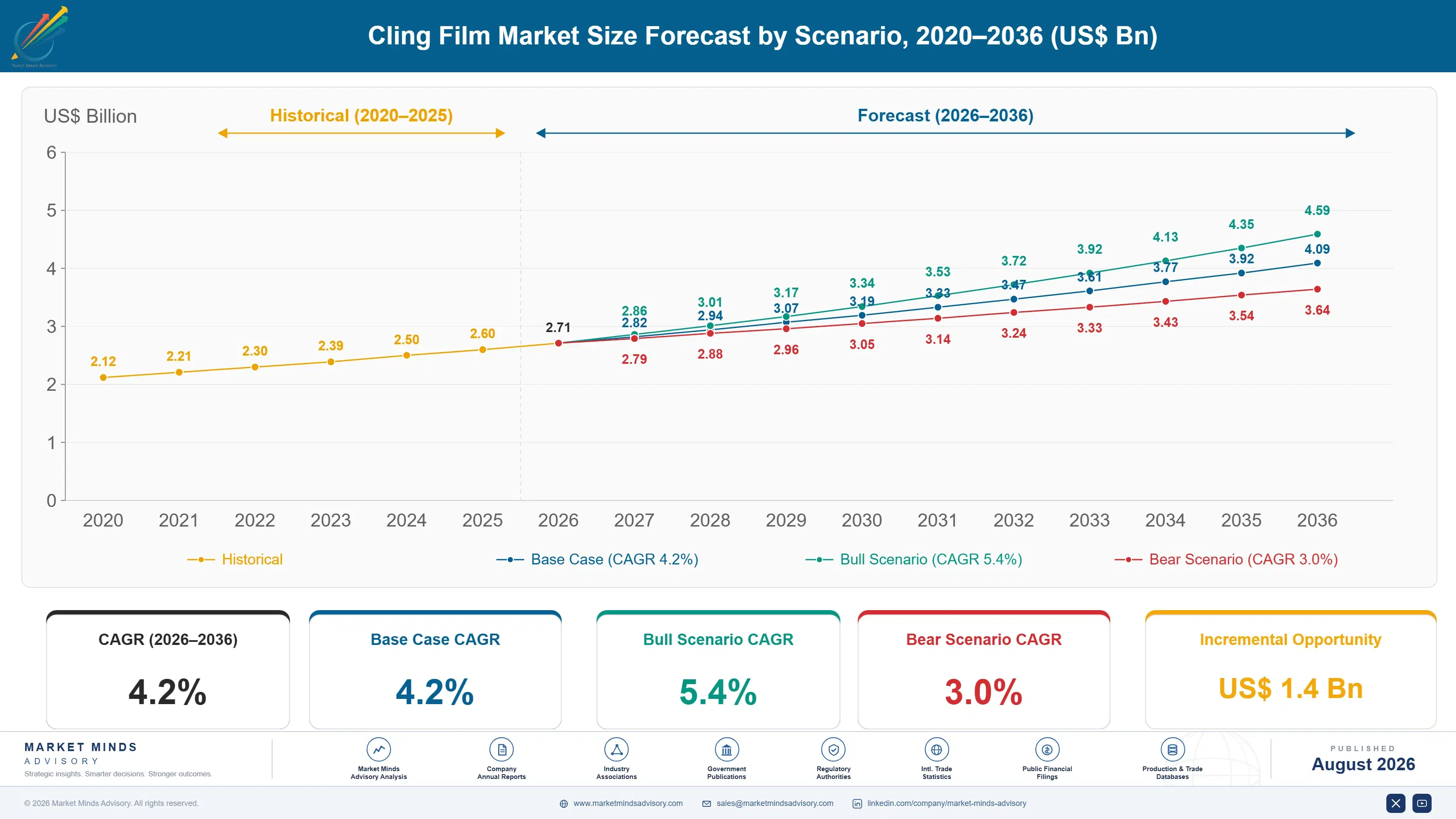
Cling Film Market Forecast Scenarios

cling-film-market-size-forecast-scenario-1787303451970
The 2020 to 2025 period ran at 3.4% and foodservice explained most of the movement. Professional kitchen demand collapsed in 2020 as restaurants closed, then recovered strongly on food delivery volumes that never fully receded afterwards. Retail consumer rolls moved the other way, spiking during home cooking in 2020 and settling back below trend as eating out resumed across most markets.
Three mechanisms carry the 4.2% base case. Prepared and delivered food volume is the largest, since every delivered dish arrives wrapped or sealed and that habit has proved durable. Foodservice hygiene practice is the second, where covering and dating prepared items is procedure rather than preference. And retail fresh counter operations are the third, growing with in-store food preparation. Food manufacturing and processing demand sits beneath all three at steadier rates.
The 5.4% bull case rests on compostable film performance improving enough for retailers to convert consumer ranges outright, which would reprice a large part of the volume rather than merely shifting it. The 3.0% bear case is packaging waste regulation restricting thin unrecyclable film in general, since cling recovers at roughly 2% and has no obvious defence on that basis.

Tack Comes From The Additive

Everything commercially interesting about this product sits in a few percent of its weight. Polyethylene does not cling on its own, so tackifier is added at around 4% of film weight to make it stick, and PVC clings because the plasticiser softening it also makes it tacky. The polymer is the cheap part and the additive is where all the regulatory attention lands.
TOP FIVE CONCENTRATION23%Very fragmented, since thin film converting is very widely held
PVC SHARE OF FOODSERVICE38%Of professional kitchen use, down from very nearly total
TACKIFIER SHARE OF FILM4%Of film weight, and all of the regulatory attention
THINNEST COMMERCIAL GAUGE9 micronsAt which retail and foodservice specifications are routinely supplied
RECYCLING RATE ACHIEVED2%Of used cling film recovered, given the food contamination
FREIGHT RADIUS LIMIT600 kmBeyond which a low density roll defeats delivered economics
That has split the market between what works and what is permitted. PVC still holds around 38% of professional kitchen use because it clings to a cold wet surface in a way polyethylene has never quite matched, while plasticiser migration into fatty foods has driven restriction and retailer bans across a growing list of jurisdictions. Chefs are not being persuaded by performance arguments.
The waste question has no comfortable answer. Cling film is thin, food-contaminated, and recovered at roughly 2%, which places it directly in the path of packaging waste regulation with no substitute that performs the same function. Concentration at 23% means the industry has no obvious voice to make that argument with either. Roll density is now the only route left where downgauging has stopped.
"We have watched polyethylene cling improve for twenty years. It is genuinely much better than it was. Ask a chef wrapping a cold tray of fish and they will still tell you exactly which roll they want."
Director, Flexible Packaging and Food Contact Materials Practice · MMA Packaging

Market Trends

Retailer Policy Moves Faster Than Any Regulation

Supermarket groups have removed PVC cling from own-label ranges and from in-store food preparation ahead of any legal requirement, acting on plasticiser migration concerns and reputational exposure rather than on a ban. That policy route moves considerably faster than legislation and reaches whole product ranges at once. PVC still holds around 38% of professional kitchen use, which is where retailer influence does not reach. Converters watching legislation are watching the slower signal by a considerable margin. Retailer commitments give roughly two years of warning. Very few track them systematically. Most watch the legislation.
Market Impact: Film supplied at 9 microns
Compostable Films Grow On Commitment Not Performance

Bio-based and compostable cling grows at 6.3% against 4.2% for the market, pulled by retailer packaging commitments rather than by any performance advantage or consumer demand. Cling on these films remains weaker than polyethylene and considerably weaker than PVC, and shelf life under refrigeration is shorter. The base is small enough that a single large retailer conversion moves the segment materially in either direction. Whether composting infrastructure exists to receive the film after use remains genuinely unresolved. Most markets buying it have none. Nobody in the chain raises that. Nobody asks the question.
Market Impact: Tackifier is 4% of film weight

Market Opportunities and Growth Drivers

Delivered Food Volume Sustains Foodservice Demand

Every delivered dish arrives covered, sealed, or wrapped, and that habit proved durable well beyond the period that created it. Foodservice cling consumption follows delivery order volume rather than restaurant covers, which decoupled it from dining room traffic entirely. Kitchens also cover and date prepared items as documented hygiene procedure rather than as preference, which makes a large share of consumption effectively non-discretionary. Foodservice consumption therefore decoupled from dining room covers entirely after 2021. Delivery order volume is the number that matters now. Very few forecasts separate the two. Covers served decide nothing now.
Market Impact: Recovery runs at only 2%

Thin Gauge Reduction Has Reached Its Practical Limit

Commercial films now run to around nine microns, and further downgauging costs cling performance and tear resistance faster than it saves resin. That limit matters because gauge reduction absorbed material cost increases for two decades and can no longer do so. Converters facing resin cost movement now have to pass it through or accept it, which has changed pricing behaviour across the industry noticeably. Converters facing resin movement now have to pass it through or absorb it themselves. That has changed pricing behaviour across the industry noticeably. Nobody has anywhere left to hide.
Market Impact: Freight radius caps near 600 km

Market Restraints and Challenges

Recyclability Offers No Defence Against Waste Rules

Cling film recovers at roughly 2% because it is thin, food-contaminated, and worth almost nothing as a recyclate, and the root cause is that the properties making it useful are exactly those making it unrecoverable. Commercial impact is that packaging waste regulation reaches this product with no technical answer available. Mitigation runs through compostable alternatives, reusable covering systems in foodservice, and honest engagement rather than recyclability claims nobody can substantiate. Converters making recyclability claims are inviting scrutiny they cannot survive when anybody checks. The recovery data is public. It has not improved in a decade.
Market Impact: PVC holds 38% of foodservice

Freight Economics Confine Converters To A Radius

A roll of nine micron film is mostly air by volume and the root cause is simply that thin film occupies far more space than its weight suggests, so trucks fill before they load out. Commercial impact is a practical radius near 600 kilometres and concentration at just 23%. Mitigation runs through regional converting sites, higher core and roll density formats, and prioritising specialty grades where value per pallet is considerably higher. Gauge reduction absorbed cost pressure for two decades and has reached its practical limit. Nine microns is already at the performance edge.
Market Impact: Compostable films grow at 6.3%
3 additional market trends, 4 additional growth drivers, and 2 additional restraints and challenges are covered in the full report. Contact sales@marketmindsadvisory.com to access the complete intelligence.

Segment CAGR and Growth Architecture

Segmentation follows film chemistry and construction, because those determine cling mechanism, food contact status, gauge achievable, and which additive attracts regulatory attention. Sales channel and end use both cut across every chemistry rather than separating them cleanly, which makes either weaker as a primary dimension for this market. Chemistry decides which regulator takes an interest.
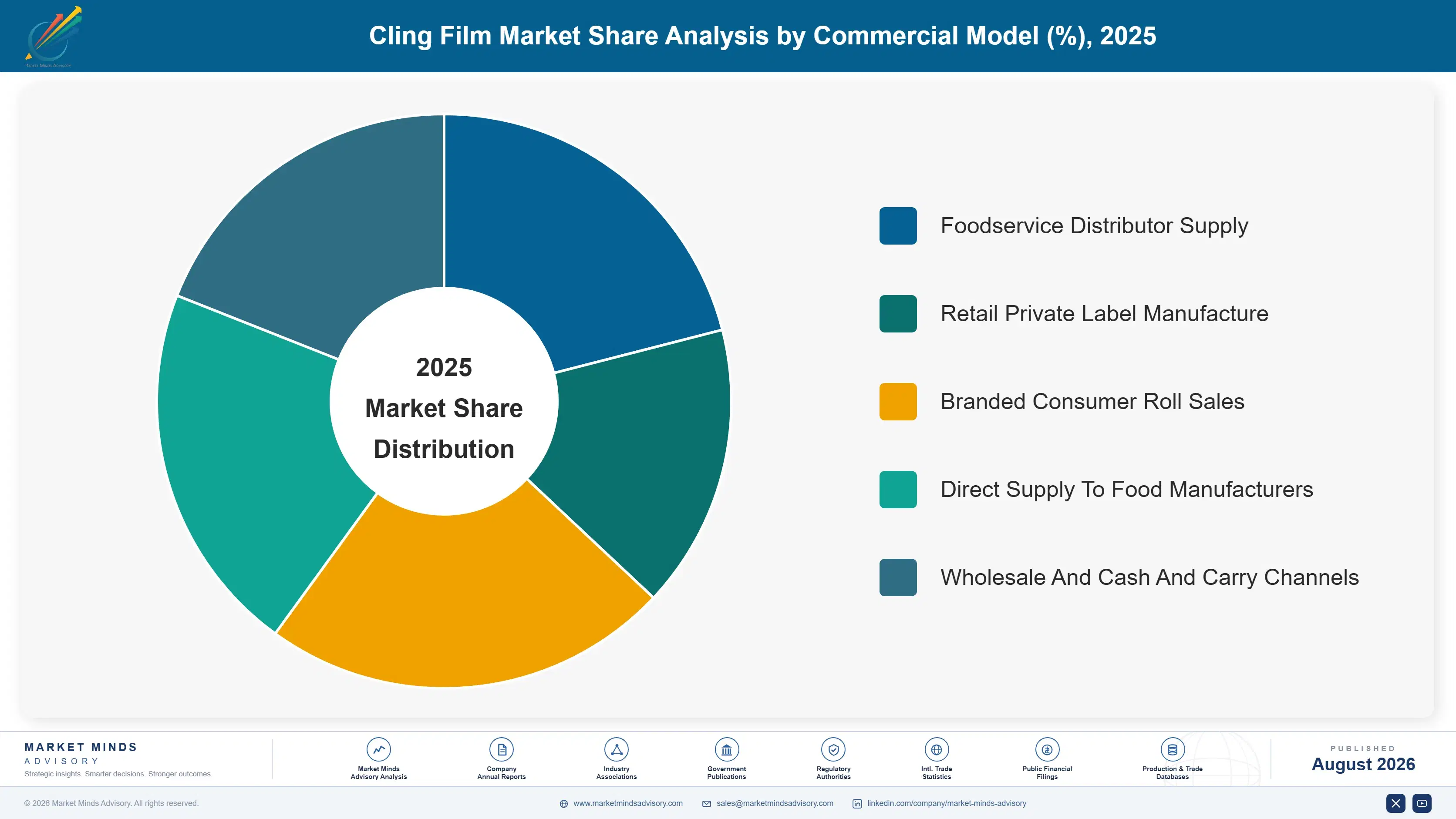
cling-film-market-market-share-analysis-1787303452545

Compostable And Bio-Based Cling Films

The fastest chemistry at 6.3%, exactly 1.50 times the market rate, using polylactic acid and cellulose-based structures certified for industrial or home composting. Growth comes from retailer packaging commitments rather than from any performance advantage, since cling is weaker than polyethylene and refrigerated shelf life is shorter. The base is small enough that a single retailer conversion moves it materially. Whether composting infrastructure exists to receive the film after use remains a genuinely unresolved question in most of the markets buying it. Retailer commitments rather than performance are creating this demand, which makes the trajectory dependent on decisions nobody in the supply chain controls. A single conversion moves the segment.
CAGR 6.3%

Polyolefin Multilayer Cling Films

Second fastest at 5.1%, coextruded structures that place cling additive in one layer and strength in another, which recovers part of the performance gap against PVC without the plasticiser. These films cling better than monolayer polyethylene and cost more to make, since coextrusion adds line complexity and scrap. Foodservice buyers converting away from PVC generally land here rather than on simple polyethylene, and the performance difference is genuinely noticeable on a cold wet surface. Foodservice buyers converting away from PVC generally land here rather than on simple monolayer polyethylene. The performance difference on a cold wet surface is genuinely noticeable. Kitchens decide it on the counter. Arguments never reach them at all.
CAGR 5.1%
Full segment breakdown across 5 segments available in the complete report.

Regional Architecture and Country Demand Map

East Asia leads at 32%, above band, because food delivery volumes and foodservice packaging demand both concentrate there. Western Europe and North America follow on per capita use. India grows fastest. Two regional shares sit outside their framework bands. Food handling volume rather than population explains both.

East Asia

Thirty-two percent, above the framework band, and justified because Chinese, Japanese, and Korean food delivery volumes are the largest anywhere while foodservice packaging demand has grown alongside them at rates no other region matches. PVC cling remains widely used across the region, since retailer policy pressure has been far weaker than in Europe and regulatory restriction has been slower. Domestic converters supply nearly all of it within freight radius. Growth at 5.1% runs above the market rate on delivery volume. Freight economics keep converting regional here as everywhere, since a roll of thin film occupies far more volume than its weight. Trucks cube out long before loading out. Domestic converters supply it.
Share: 32% | CAGR: 5.1% (2026 to 2036)

Western Europe

Twenty-two percent, and per capita cling consumption here is among the highest anywhere while PVC has been retreating faster than in any other region. Supermarket groups removed it from own-label and in-store preparation ahead of any legal requirement, which moved the market far more quickly than legislation would have. Packaging waste regulation is also strictest here and cling has no recyclability defence. Growth at 2.6% is the slowest of any region, reflecting both pressures together. Compostable conversion has progressed further here than anywhere, driven by the same retailer commitments that removed the PVC. Composting infrastructure has not kept pace. Very few raise that publicly. Waste regulation is strictest here and cling has no answer to it.
Share: 22% | CAGR: 2.6% (2026 to 2036)
Regional intelligence for 5 additional markets available in the complete report: North America, South Asia and Pacific, Latin America, Middle East and Africa, Eastern Europe. Contact sales@marketmindsadvisory.com.
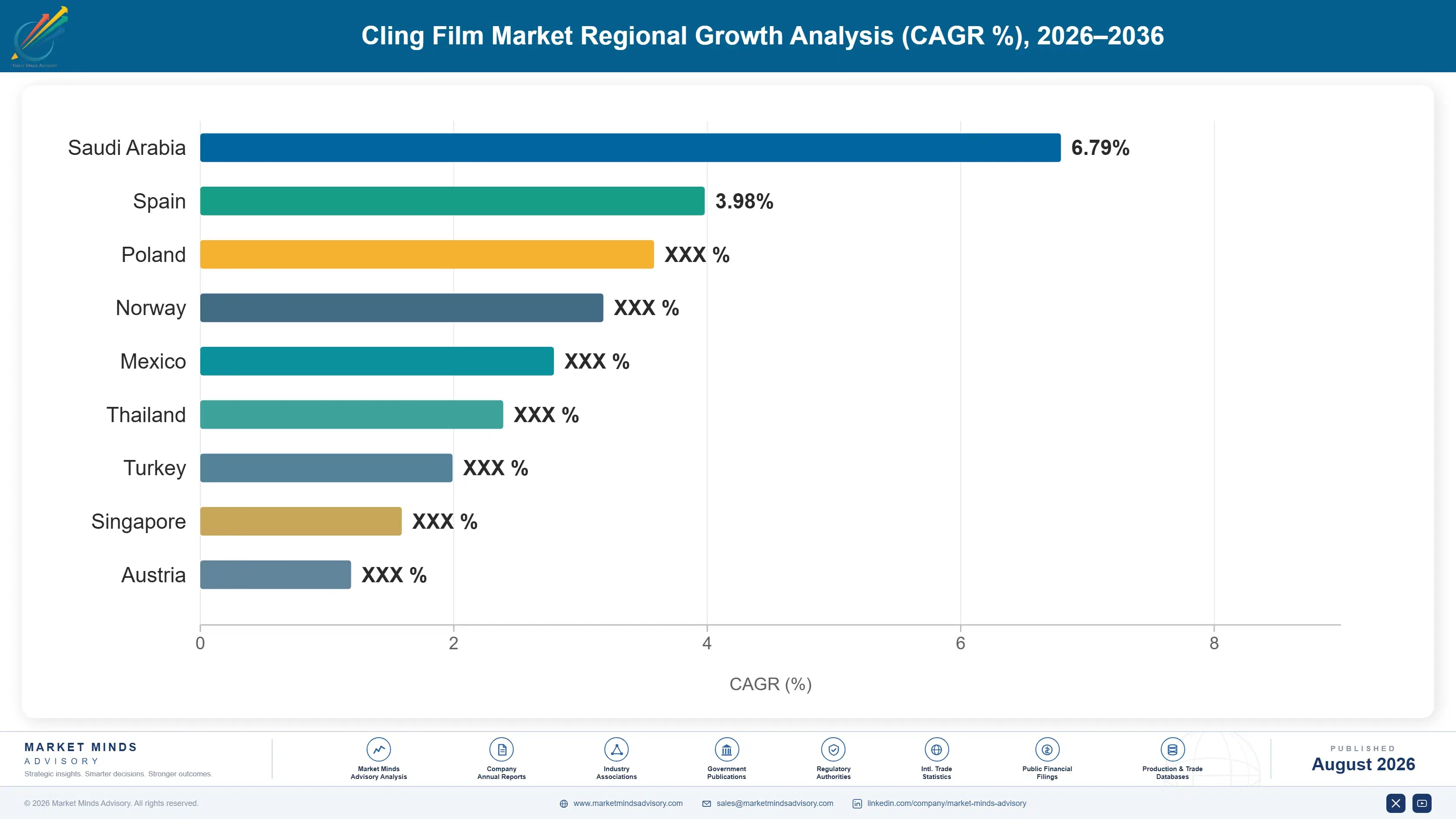
cling-film-market-country-cagr-analysis-1787303453061

Additives, Radius And Retailer Policy

Tackifier is 4% of film weight, PVC still holds 38% of foodservice, recovery runs at 2%, and compostable grades grow at 6.3%. Value comes from cling performance in the alternatives, from regional converting position, and from anticipating retailer policy rather than regulation. Sustainability arguments decide remarkably little of it. Counter performance decides it. Nothing else does.

Close The Cling Gap Rather Than Arguing About It

PVC holds around 38% of professional kitchen use because it clings to a cold wet surface in a way polyethylene has never matched, and chefs are not persuaded by technical comparisons. Multilayer coextrusion placing tackifier in one layer recovers part of that gap and costs more to make. Converters who solved the performance problem take conversions that competitors keep trying to win with sustainability arguments instead. Kitchens reject an inadequate film on the counter within a shift, and no argument reaches them afterwards. Three trials failing is enough to end a conversion.
Market Impact: PVC still holds fully 38% of all fo

Track Retailer Policy Ahead Of Any Regulation

Supermarket groups removed PVC from own-label ranges and in-store preparation well ahead of any legal requirement, and that route reaches whole product ranges at once rather than product by product. Converters watching legislation are watching the slower signal. Those tracking retailer packaging commitments have roughly two years of warning on conversions that regulation would not have given them at all. Retailer commitments reach whole product ranges simultaneously rather than product by product. Roughly two years of warning is available to anybody watching. Legislation offers none of that. Roughly 38% of foodservice volume sits behind that timing question.
Market Impact: Tackifier is just 4% of the film we

Site Converting Inside The Freight Radius

A roll of nine micron film is mostly air, so trucks fill by volume long before they load out by weight, and delivered economics fail beyond roughly 600 kilometres. Concentration at 23% follows directly from that. A converter serving distant customers is competing against cubic capacity rather than against competitors, and regional sites are the only structure that reaches demand outside the radius economically. Roll density, smaller cores, and tighter winding all put more film on a pallet without touching gauge. That route remains available where downgauging does not. Nine microns is already the limit.
Market Impact: Freight radius caps out near 600 km

Stop Making Recyclability Claims Nobody Believes

Cling film recovers at roughly 2% because it is thin, food-contaminated, and worth almost nothing as recyclate, and no technical development changes that meaningfully. Converters making recyclability claims are inviting scrutiny they cannot survive. Compostable alternatives, reusable foodservice covering systems, and honest engagement about what the product is do considerably more for a customer relationship than an unsupportable claim does. Recovery has not improved in a decade and the data is public to anybody who checks it. Honest engagement serves a customer relationship considerably better. Very few converters try that.
Market Impact: Recovery still sits at only 2% of v

Who Controls the Margin Pool

Concentration is very low at 23% across the top five measured on cling film tonnage supplied, and two things explain it together. Thin film converting is widely held capability requiring no unusual technology, and a roll of nine micron film is mostly air, so freight economics cap a practical radius near 600 kilometres. The leader to challenger gap is meaningful only in branded retail ranges and multilayer foodservice grades.
Competitive activity runs on three fronts. Cling performance in non-PVC films is the first, since that is what actually decides foodservice conversions rather than any sustainability argument. Regional converting footprint is the second, because reach is physical. And retailer relationship depth is the third, where packaging policy decisions reach whole ranges at once and years before regulation would.

Pressure arrives from two directions. Private label has taken retail shelf share from branded consumer rolls steadily. And packaging waste regulation is reaching thin unrecyclable film with no technical defence available. Rankings shift on retailer conversions rather than on product launches. Neither pressure reaches multilayer foodservice grades, where coextrusion capability and demonstrated cling performance both restrict who can credibly compete. That tier is contested by very few.
cling-film-market-company-positioning-matrix-1787303453580

Competitive Moat and Risk Dimensions

BERRY GLOBAL

Moat: Converting footprint and film breadth

Converting capacity across many regions reaches demand that a 600 kilometre freight radius otherwise excludes, which is the only practical way to serve a national or multinational customer in this product. Breadth across PVC, polyethylene, multilayer, and compostable films lets one supplier follow a customer through a conversion rather than losing it. Both positions took years and capital to assemble.
BERRY GLOBAL

Risk: Retailer policy removing PVC volume

Supermarket groups keep removing PVC cling from own-label and in-store preparation ahead of regulation, and that policy route reaches whole ranges simultaneously rather than gradually. PVC volume converts to alternatives at lower realised value in most cases. Breadth mitigates the loss and does not prevent the repricing that comes with it.
AMCOR

Moat: Food contact compliance depth

Regulatory and food contact expertise across many jurisdictions matters unusually here, since the additive carrying the cling is exactly what regulators scrutinise and requirements differ by market and by food type. That capability lets a supplier answer a retailer's questions before the retailer has finished asking them. Very few converters carry that depth at all.
AMCOR

Risk: Limited exposure to foodservice volume

Foodservice carries substantial and less discretionary volume than retail consumer rolls, and a position weighted toward retail participates less in the delivery-driven growth sustaining this market. Foodservice buyers also decide on cling performance rather than on compliance depth. Building that position means competing on a dimension where the existing advantage contributes very little.

Players Tracked

Prominent Players

Berry Global
Amcor
Sealed Air
Reynolds Consumer Products
Coveris

Other Key Players

Intertape Polymer Group
Anchor Packaging
Novolex
Wrap Film Systems
Sigma Plastics Group
Inteplast Group
Manuli Stretch
Trioplast
Paragon Films
Mitsubishi Chemical
Okura Industrial
Shanghai Zijiang Enterprise
Fuji Seal International
Kureha
Klockner Pentaplast

Recent Developments

JANUARY 2025

Supermarket group removes PVC cling from own-label range

A European supermarket group withdrew PVC cling film from its own-label products and in-store food preparation, citing plasticiser migration concerns rather than responding to any legal requirement or enforcement action. The decision was a retailer packaging policy change rather than any regulatory or supplier development.
Signal: Retailer policy reaches whole ranges at on
APRIL 2025

Foodservice group rejects polyethylene conversion on performance

A catering group ended a trial converting from PVC to polyethylene cling after kitchen staff reported inadequate adhesion on chilled and wet surfaces, reverting to the original specification. The decision was an operational assessment rather than any commercial dispute or supply problem with the alternative film.
Signal: Chefs decide these conversions on the coun
AUGUST 2025

Converter commissions multilayer line for foodservice grades

A film converter installed coextrusion capacity for multilayer cling structures placing tackifier in a single layer, targeting foodservice customers converting away from PVC who had found monolayer polyethylene inadequate. The investment was organic capacity construction rather than any acquisition or partnership arrangement. Monolayer film had already failed trials.
Signal: Multilayer is where PVC conversions actual

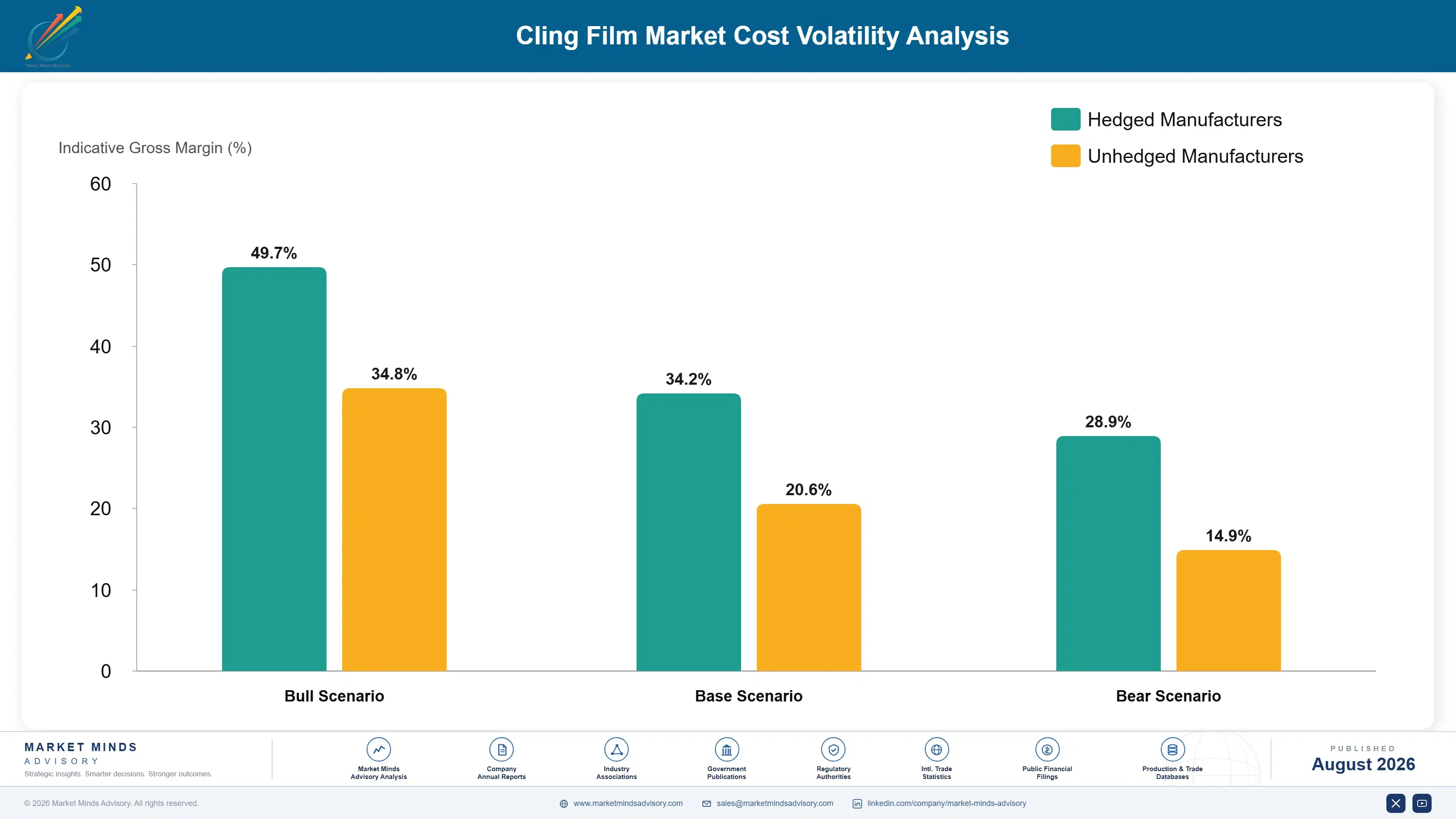
Resin, Tackifier and Cube

Converted film cost divides between base resin at roughly 51%, tackifier and additive packages near 11%, extrusion and winding energy around 12%, cores, packaging, and outbound freight about 17%, and quality control, labour, and overhead the balance. Freight is unusually high for a converted product because thin film occupies far more truck volume than its weight suggests, and trucks cube out long before they weigh out.
Polyethylene and PVC resin pricing both moved sharply through 2022 as European energy costs pushed cracker economics, and several flexible packaging converters disclosed resin cost pass-through difficulty in filings covering that year. Polyisobutylene tackifier moved separately and further, being a far smaller volume speciality. Pass-through was slow, since retail and foodservice contracts typically run annually against agreed pricing. Gauge reduction can no longer absorb any of it either.

The competitive disadvantage mechanism runs through freight cube rather than through resin purchasing. Resin costs broadly the same for converters of reasonable scale, while delivered cost per roll rises steeply with distance because the load is volume-limited. A converter without regional sites near its customers carries a delivered cost penalty that no extrusion efficiency closes, and gauge reduction can no longer offset it either.
cling-film-market-cost-volatility-analysis-1787303453775

Index annual contracts to published resin movement

Base resin carries roughly 51% of converted film cost and moves on petrochemical cycles no converter influences, while retail and foodservice contracts typically fix pricing annually. Indexation clauses referenced to published resin data shift that exposure to customers better able to absorb it. Gauge reduction absorbed these movements for two decades and has now reached its practical limit.

Improve roll density rather than pursuing thinner gauge

Cores, packaging, and outbound freight carry about 17% of converted cost because trucks cube out before they weigh out on thin film. Higher roll density, smaller cores, and tighter winding all put more film on each pallet without touching the gauge. That route is available where downgauging is not, since nine microns is already at the practical performance limit.

Qualify alternate tackifier grades during formulation work

Tackifier and additives carry around 11% of cost and the cling additive is a specialty product from a narrow supply base, so a formulation locked to one grade has no response when that supplier reprices. Qualifying alternates during development costs testing time and food contact review. Doing it under supply pressure later means requalifying a food contact material

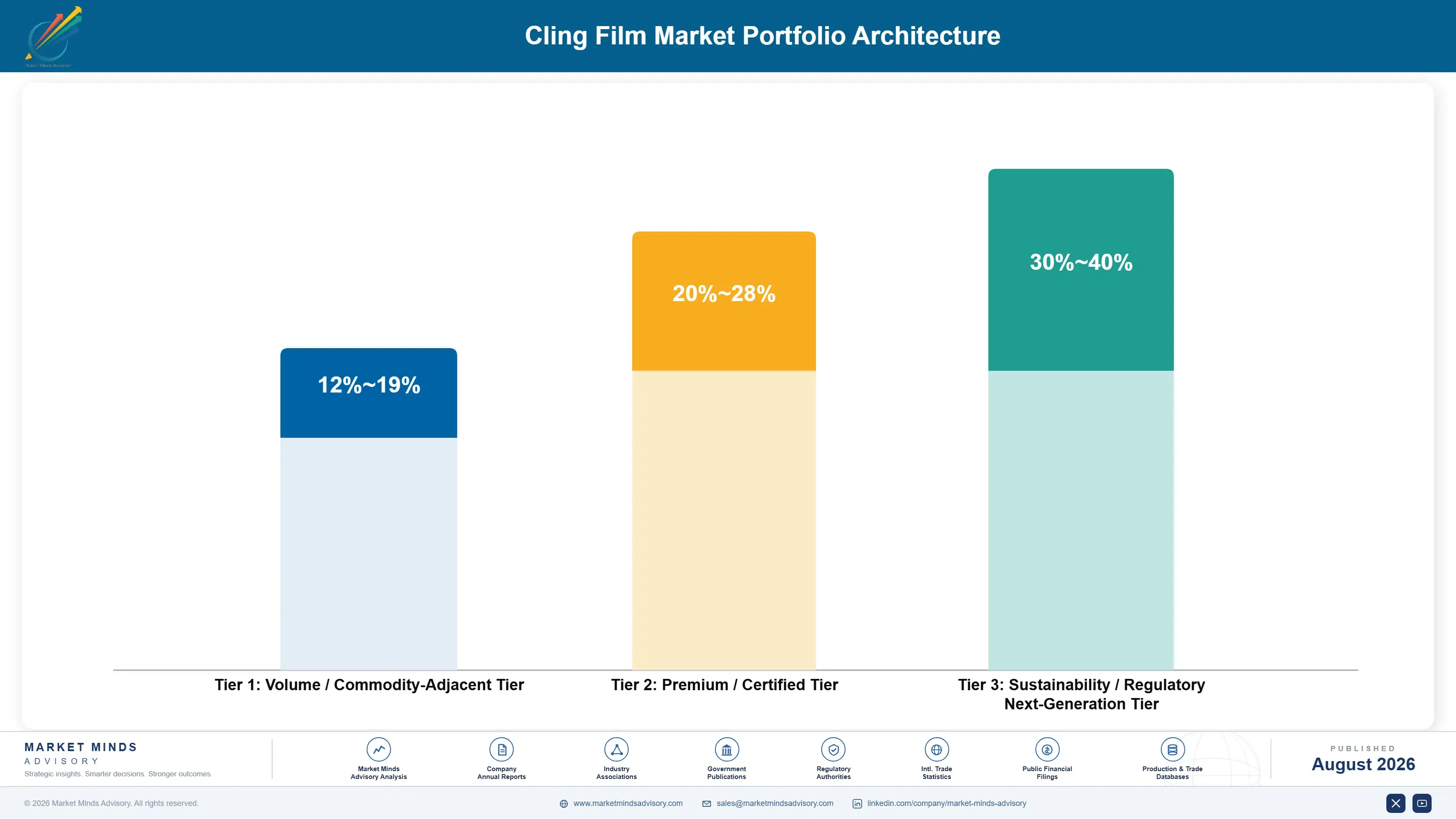
Portfolio Architecture for Margin Defence

Three tiers describe this business and the spread follows performance and compliance rather than volume. Commodity polyethylene cling sits at the bottom, where any converter can make it and delivered price inside a radius decides orders. Retail branded rolls and standard PVC occupy the middle. Multilayer foodservice grades, barrier films, and certified compostable structures sit at the top, where performance or certification restrict who can
The tension is that PVC still carries substantial foodservice volume at reasonable margin while being removed range by range through retailer policy rather than regulation, which makes the timing unpredictable. A converter weighted there is earning well from a position it will lose on somebody else's schedule. One weighted toward compostable holds a certified position on volumes that retailer commitments rather than performance are creating.

High-value pools concentrate where the film has to work rather than merely comply. Multilayer foodservice grades are the clearest case, since a kitchen rejecting a film on the counter ends a conversion regardless of what any sustainability argument said, and coextrusion capability is not widely held. Certified compostable grades are the second such pool, protected by certification rather than by any performance advantage. Neither pool is decided on delivered price.

Volume / Commodity-Adjacent Tier

Commodity monolayer polyethylene cling where any converter can produce it and delivered price inside a freight radius decides orders. Cling performance is adequate rather than good on cold surfaces. Any converter can produce it.
Gross Margin: 12-19%

Premium / Certified Tier

Branded retail consumer rolls and standard PVC foodservice film where shelf presence or cling performance genuinely differentiates. PVC earns well while retailer policy removes it range by range. Timing sits entirely with somebody else.
Gross Margin: 20-28%

Sustainability / Regulatory / Next-Generation Tier

Multilayer foodservice structures, barrier films, and certified compostable grades where coextrusion capability or certification restricts supply. Best margin available and the least contested work here. Coextrusion capability is genuinely not widely held.
Gross Margin: 30-40%
cling-film-market-portfolio-architecture-1787303454272

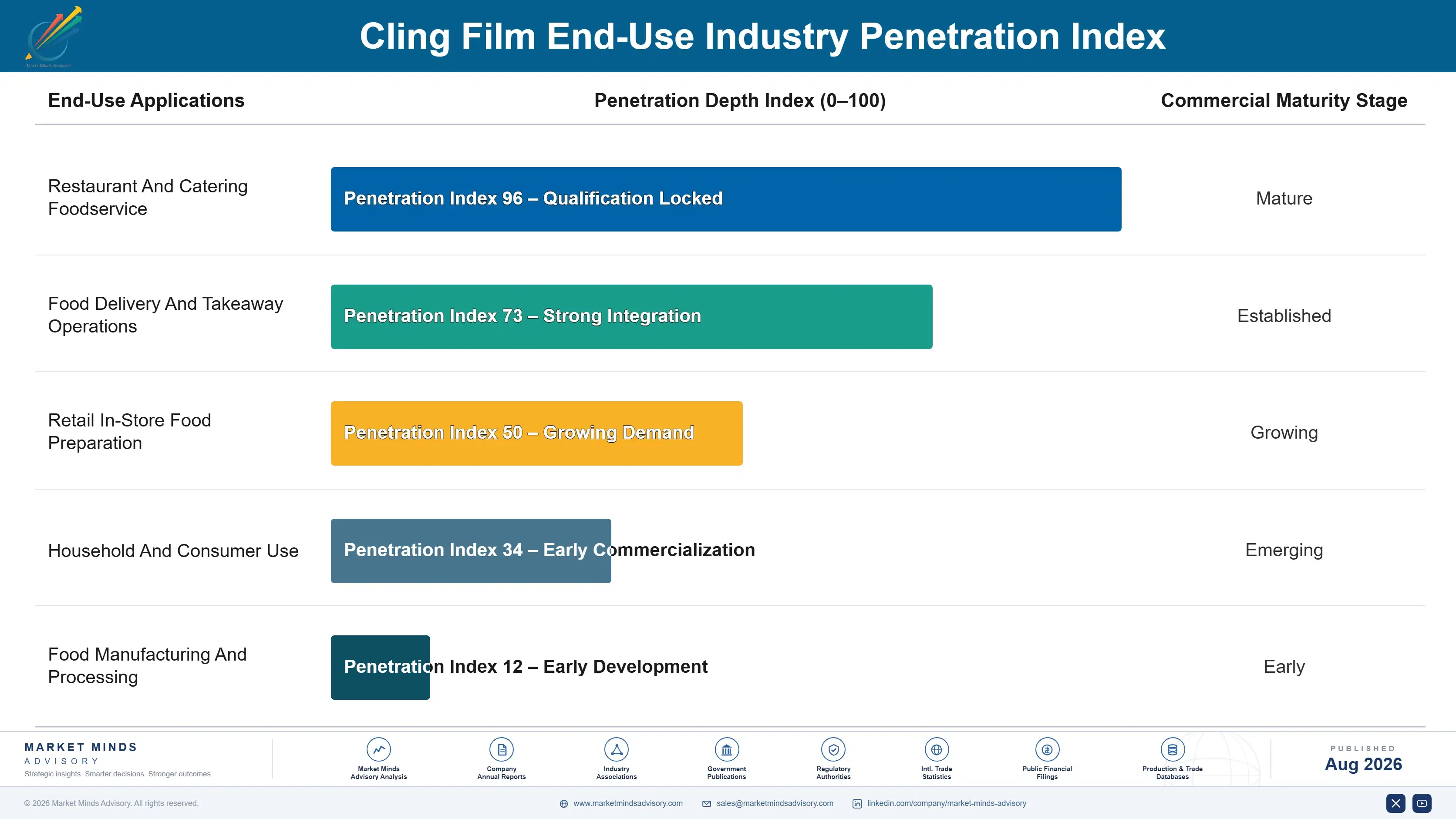
Kitchens, Ranges and Policies

Demand behaves as continuous consumption tied to food volume handled rather than to any purchasing cycle, which makes it unusually predictable once a customer is supplied. A kitchen consumes film against covers served and items prepared, and a retailer against packs sold, with commercial activity confined to contract renewal. That predictability is the compensation for a market where freight caps reach and margins are thin.
Stickiness runs through operational habit and dispenser fit rather than through any contract. A kitchen that has standardised on a film width, core, and dispenser does not change without a reason, and staff resistance to a worse-performing alternative is immediate and vocal. Branded retail rolls stick through shelf position rather than preference. Commodity polyethylene supply sticks least and moves on delivered price.

Buyer profiles shifted as retailer policy became the deciding force. The earlier buyer was a foodservice purchasing manager or a retail category buyer comparing film on price and performance. The current conversation increasingly involves a retailer packaging or sustainability function making a range-wide material decision that no individual kitchen or category buyer will be consulted about at all.
cling-film-market-end-use-penetration-index-1787303454762

What We Would Tell a Board

These are among the four positions where our research anticipates prominent divergence between winners and laggards over the coming forecast period. Each is grounded in the demand model, the regulatory perimeter, and the announced capacity pipeline.
01 / CLING PERFORMANCE INVESTMENT

Solve the counter test, not the argument

PVC still holds around 38% of professional kitchen use because it clings to a cold wet surface in a way monolayer polyethylene has genuinely never matched, and chefs are simply not persuaded by technical comparisons or by any sustainability argument. Multilayer coextrusion placing the tackifier in a dedicated layer recovers a genuinely real part of that performance gap. Converters who solved the performance problem win conversions that competitors keep losing while making a sustainability case nobody in the kitchen is listening to.
02 / RETAILER POLICY TRACKING

Watch the buyers, not the legislators

Supermarket groups removed PVC cling from their own-label ranges and in-store food preparation well ahead of any legal requirement, acting on plasticiser migration concerns and their own reputational exposure rather than on any ban existing anywhere. That policy route reaches whole product ranges simultaneously and moves considerably faster than any legislative process ever manages to. Converters tracking retailer packaging commitments get roughly two years of warning on conversions, which watching the legislation alone would never have provided them at all.
03 / FREIGHT CUBE DISCIPLINE

You are shipping air, not film

A roll of nine micron cling film is mostly air by volume, so trucks fill their cubic capacity long before they approach any weight limit at all, and delivered economics fail beyond roughly 600 kilometres from the converting site. Concentration at just 23% across the top five follows directly from that physical constraint rather than from any lack of capability. Roll density improvement remains available where further downgauging does not, since nine microns already sits at the practical performance limit.
04 / WASTE POSITION HONESTY

Do not make claims this product cannot support

Household cling film is recovered at roughly 2% of the volume placed on the market because it is thin, food-contaminated, and worth almost nothing as a recyclate, and no plausible technical development alters that arithmetic meaningfully at all. Converters making recyclability claims are inviting scrutiny they simply cannot survive the moment somebody actually checks the published recovery data. Compostable alternatives, reusable foodservice covering systems, and honest engagement about what the product is all serve a customer relationship far better than any unsupportable claim ever does.

Engagement Snapshot From the Field

A live engagement with an industry participant carrying material or product regulatory and market exposure ahead of a defining policy shift, showing how our research translates into a defensible multi-year portfolio strategy.
MARKET MINDS ADVISORY · CLIENT ENGAGEMENT SUMMARY
Cling Film Producer Strategic Portfolio Review and Transition Roadmap 2026·Investment Scenario on Cling Film Exposure Evaluation 2025-26
CLIENT PROFILE
A flexible film converter with approximately 180 million dollars in annual revenue (client-reported, unverified by MMA), producing PVC and monolayer polyethylene cling from two sites for foodservice distributors and retail private label. PVC carried a substantial share of foodservice volume, no multilayer capability existed, and two retail customers had announced packaging policy changes. Neither policy had been assessed internally.
STRATEGIC CHALLENGE
The board wanted to understand how quickly PVC volume would disappear, whether monolayer polyethylene would retain the customers converting away from it, and what the announced retailer policies actually meant for the next three years of volume. Nobody had assessed customer exposure to retailer policy rather than to regulation. It had been assumed.
MMA APPROACH
We assessed each foodservice customer's exposure to retailer policy rather than to regulation. Conversion trial outcomes were reviewed where the client's polyethylene film had been tested against PVC. Multilayer coextrusion investment was costed against the volume genuinely at risk, and delivered cost was mapped by customer distance. Conversion timing was then mapped by retailer commitment.
KEY FINDINGS
  1. Retailer policy rather than regulation would remove roughly half the client's PVC foodservice volume within four years, on timing the client had no influence over whatever it did.
  2. Monolayer polyethylene had failed kitchen trials at three customers on adhesion to chilled surfaces, and each of those had reverted to PVC rather than accepting the alternative.
  3. Multilayer coextrusion investment was affordable against the volume at risk and would take roughly two years to commission and qualify with foodservice customers.
  4. Delivered cost to a quarter of the customer base was worse than assumed, because freight had been calculated on weight rather than on the cubic capacity actually consumed.
CLIENT PROFILE
A flexible film converter with approximately 180 million dollars in annual revenue (client-reported, unverified by MMA), producing PVC and monolayer polyethylene cling from two sites for foodservice distributors and retail private label. PVC carried a substantial share of foodservice volume, no multilayer capability existed, and two retail customers had announced packaging policy changes. Neither policy had been assessed internally.
STRATEGIC CHALLENGE
The board wanted to understand how quickly PVC volume would disappear, whether monolayer polyethylene would retain the customers converting away from it, and what the announced retailer policies actually meant for the next three years of volume. Nobody had assessed customer exposure to retailer policy rather than to regulation. It had been assumed.
MMA APPROACH
We assessed each foodservice customer's exposure to retailer policy rather than to regulation. Conversion trial outcomes were reviewed where the client's polyethylene film had been tested against PVC. Multilayer coextrusion investment was costed against the volume genuinely at risk, and delivered cost was mapped by customer distance. Conversion timing was then mapped by retailer commitment.
KEY FINDINGS
  1. Retailer policy rather than regulation would remove roughly half the client's PVC foodservice volume within four years, on timing the client had no influence over whatever it did.
  2. Monolayer polyethylene had failed kitchen trials at three customers on adhesion to chilled surfaces, and each of those had reverted to PVC rather than accepting the alternative.
  3. Multilayer coextrusion investment was affordable against the volume at risk and would take roughly two years to commission and qualify with foodservice customers.
  4. Delivered cost to a quarter of the customer base was worse than assumed, because freight had been calculated on weight rather than on the cubic capacity actually consumed.
RECOMMENDED STRATEGY
Phase 1: Phase 1 (months one to twelve): commit to multilayer coextrusion capacity ahead of the retailer policy timelines rather than after them. Phase 2: Phase 2 (months twelve to thirty): requalify foodservice customers on multilayer film before their retailer conversion deadlines arrive. Qualify ahead of the deadline. Phase 3: Phase 3 (months thirty to forty-eight): reprice or exit customers where delivered cube economics never worked in the first place.
OUTCOME
Multilayer capacity was approved within two quarters and commissioned ahead of the announced retailer deadlines. Two foodservice customers qualified the new film before their conversion dates, and freight was recalculated on cubic capacity across the whole customer base (client-reported, unverified by MMA). Retailer policy tracking became a standing commercial input.

Frequently Asked Questions

Foundational context covering the market sizes, CAGR, scope, country, region and competition that inform every finding below. This section is provided to cover basics and most often pre-purchase conversations, answered from the MMA Primary Research Dataset.

What is the current size of the Cling Film Market?

The market is valued at USD 2.6 billion in 2025, rising to USD 2.71 billion in 2026. Scope covers thin food contact cling and wrap films, not pallet stretch wrap, rigid containers, or vacuum packaging films.

How large will the Cling Film Market be by 2036?

MMA forecasts USD 4.09 billion by 2036, an increase of USD 1.38 billion over the 2026 base. That represents an expansion multiple of 1.51 times across the forecast period.

What is the CAGR for the Cling Film Market 2026 to 2036?

The base case CAGR is 4.2%, with a bull case of 5.4% and a bear case of 3.0%. The historical rate from 2020 to 2025 was 3.4%, disrupted by foodservice closure and recovery.

Which segment is growing fastest?

Compostable and bio-based cling films at 6.3%, exactly 1.50 times the market rate. Growth comes from retailer packaging commitments rather than from any performance advantage over conventional film.

Who are the major companies in the Cling Film Market?

Berry Global, Amcor, Sealed Air, Reynolds Consumer Products, and Coveris lead on cling film tonnage supplied. The top five hold only 23%, since thin film converting is widely held.

Which country is growing fastest?

India at 7.0%, where food delivery expansion and organised retail are replacing informal food handling with wrapped and dated product. Per capita consumption remains far below developed markets.

Report Segmentation Architecture

The full report scope spans multiple orthogonal segmentation dimensions, with cross-tabulated demand data provided for each dimension pair. Coverage extends further to regional breakdowns, trend trajectories, and the competitive detail needed to support segment-level decision-making.

By Film Chemistry And Construction

  • PVC Cling Films
  • Polyethylene Cling Films
  • Polyolefin Multilayer Cling Films
  • Barrier And Specialty Cling Films
  • Compostable And Bio-Based Cling Films

By End-Use Industry

  • Restaurant And Catering Foodservice
  • Food Delivery And Takeaway Operations
  • Retail In-Store Food Preparation
  • Household And Consumer Use
  • Food Manufacturing And Processing

By Commercial Model

  • Foodservice Distributor Supply
  • Retail Private Label Manufacture
  • Branded Consumer Roll Sales
  • Direct Supply To Food Manufacturers
  • Wholesale And Cash And Carry Channels

By Region

  • East Asia
  • Western Europe
  • North America
  • South Asia and Pacific
  • Latin America
  • Middle East and Africa
  • Eastern Europe

Scope, Methodology, and Coverage

Every figure in this report is reproducible from documented input assumptions. The scope below maps the historical period, the forecast horizon, the segmentation dimensions, and the countries covered, alongside the underlying primary and qualitative methodology.
Historical Period
2020 to 2025
Forecast Period
2026 to 2036
Base Year
2025 (USD billions; MMA Primary Research Dataset, August 2026)
Market Definition
This market comprises thin cling and wrap films manufactured for food contact use across foodservice, retail, and household applications, measured at converter revenue across foodservice distribution, private label, branded retail, direct manufacturer, and wholesale channels. Coverage spans PVC cling films, monolayer polyethylene cling films incorporating tackifier additives, coextruded polyolefin multilayer cling films, barrier and specialty cling structures containing polyvinylidene chloride or ethylene vinyl alcohol, and certified compostable and bio-based cling films. Pallet stretch wrap and industrial unitising film, rigid and semi-rigid food trays and containers, vacuum, skin and thermoform packaging films, laminated pouch and sachet structures, aluminium foil and paper wraps, and cling film dispensers, cutter boxes and application equipment fall outside scope.
Quantitative Units
USD billions (current prices); film tonnage supplied by chemistry; price per tonne by grade; film gauge in microns
Segmentation Dimensions
By Film Chemistry And Construction; By End-Use Industry; By Commercial Model; By Region
Regions Covered
East Asia, Western Europe, North America, South Asia and Pacific, Latin America, Middle East and Africa, Eastern Europe
Countries Covered
China, Japan, South Korea, Taiwan, India, Indonesia, Vietnam, Thailand, Australia, United States, Canada, Mexico, United Kingdom, Germany, France, Italy, Spain, Netherlands, Brazil, Argentina, Colombia, Saudi Arabia, United Arab Emirates, Egypt, South Africa, Poland, Czechia, Romania, and additional markets relevant to this sector
Key Companies Profiled
Berry Global, Amcor, Sealed Air, Reynolds Consumer Products, Coveris, Intertape Polymer Group, Anchor Packaging, Novolex, Wrap Film Systems, Sigma Plastics Group, Inteplast Group, Manuli Stretch, Trioplast, Paragon Films, Mitsubishi Chemical, Okura Industrial, Shanghai Zijiang Enterprise, Fuji Seal International, Kureha, Klockner Pentaplast
Quantitative Methodology
Primary survey, n=3,800 respondents, Q4 2025, six countries; demand-side model with trade association cross-validation
Qualitative Methodology
47 expert interviews, Q4 2025; applied to validate demand model assumptions, identify emerging dynamics, and assess competitive positioning
Report Format
PDF and XLSX data workbook (Word format preview document)
Publisher
Market Minds Advisory
Report Code
MMA-2026-PAC-952
Published
August 2026
Contact
sales@marketmindsadvisory.com | www.marketmindsadvisory.com

Purchase the full Cling Film Market Report (2026 to 2036).

The full report sizes cling film across five film chemistries, five end-use industries, five commercial models, and seven regions, with retailer packaging policy tracked separately from regulation because it moves faster and reaches further. PVC conversion exposure is quantified customer by customer against announced policy timelines. Freight cube economics are modelled on volume rather than weight. Competitive profiling covers twenty converters on film tonnage supplied, and multilayer coextrusion capability is assessed separately from monolayer capacity. Regional demand is built from food handling volume rather than from any population measure.
Retailer packaging policy tracked separately from formal regulation
PVC conversion exposure quantified against announced retailer policy timelines
Freight cube economics modelled on truck volume rather than weight
Multilayer coextrusion capability assessed separately from monolayer converting capacity
Kitchen trial outcomes reviewed for cling performance against PVC
Compostable certification and infrastructure availability assessed by market

Built For The People Who Decide

From boardroom strategy to bench-side execution, this report is read cover-to-cover by leaders shaping the next decade of their industry, turning demand scenarios, market dynamics and valuation benchmarks into decisions.
CXOs/ Presidents/ VPs/ Managers
M&A and Corporate Development
Strategy Teams and R&D Heads
Procurement and Product Directors
Regulatory and Compliance Leaders
Investor Relations and Equity Analysts