

Market Minds Advisory
Cleaning and Hygiene Product Market

Cleaning and Hygiene Product Market: Cleaning and Hygiene Product Market: Shipping Water, Disinfection Theatre and What Contact Time Actually Requires

A trigger spray is roughly 95% water shipped in a plastic bottle right across an ocean, and this industry has spent forty years optimising everything except for that one fact.

Lead Analyst

Published

September 2026

Make Smarter Decisions with Customized Research Insights

Request a free sample report and evaluate market opportunities, growth trends, and competitive dynamics relevant to your business needs.

2025 MARKET VALUE$78.0BMarket Size 2025
2036 FORECAST VALUE$136.3BBase Case , 2026 to 2036
CAGR 2026 TO 20365.2 %Bull 6.4% / Bear 4.0%
INCREMENTAL OPPORTUNITY$54.2BNet 10- year value creation
EXPANSION MULTIPLE1.66x2036 value over 2026 base
Strategic Levers
M&A Pipeline
Regional Outlook
Country Rankings
Competitive Intelligence
Segmental Deep-dive
Call-Us : 91 93563 13602

Executive Snapshot and Market Trajectory.

Most of what this industry ships is water. A trigger spray runs about 95% water in a plastic bottle moved thousands of miles, which means the freight, the packaging and much of the carbon are all spent on something available from a tap at the destination. Concentrates hold about 7%.
Concentrate and refill systems grow at 7.8%, half again the market rate of 5.2%, because removing the water removes the bottle, the freight and the shelf space in one decision. Professional and institutional cleaners follow at 6.4%. Traditional ready-to-use sprays grow slowest at 2.9%, still holding the overwhelming majority of household volume. Retailers are pushing the shift considerably harder than consumers themselves are anywhere.
Disinfection is where the claims outrun the practice. Every registered disinfectant requires a contact time, frequently several minutes, and a surface wiped dry in fifteen seconds has not been disinfected at all. Concentration is moderate at 41% held by the top five, and India grows fastest of any country covered at 9.6%. Institutional buyers observe dwell time because auditors check for it; households have simply never been told that it matters at all.
Market Definition
This market covers chemical cleaning and hygiene products for household and institutional use, spanning surface cleaners and disinfectants, laundry detergents and additives, dishwashing products, concentrate and refill systems, professional and institutional cleaners, and specialty and washroom hygiene products. Sizing is at manufacturer net revenue. Cleaning equipment and machinery, personal care and soap for body use, contract cleaning services, and industrial process chemicals are excluded.
Base Year Value
$78.0B in 2025 (MMA Primary Research Dataset, September 2026)
Forecast Period
2026 to 2036, eleven discrete annual values
CAGR
5.2% base case. Bull 6.4%. Bear 4.0%.
Fastest Growth Segment
Concentrate And Refill Systems: 7.8% CAGR
Fastest Growth Country
India: 9.6% CAGR
Fastest Growth Region
South Asia and Pacific: 7.5% CAGR
Largest Region
East Asia: 28% of 2025 global value
Market Leaders
Procter and Gamble, Unilever, Reckitt Benckiser, Henkel, Ecolab. Source: MMA Primary Research Dataset, July 2026.
Primary Survey
n=3,800 procurement and R&D decision-makers, Q4 2025, six countries
Methodology
Demand-side build-up, cross-validated against public data, 47 expert interviews

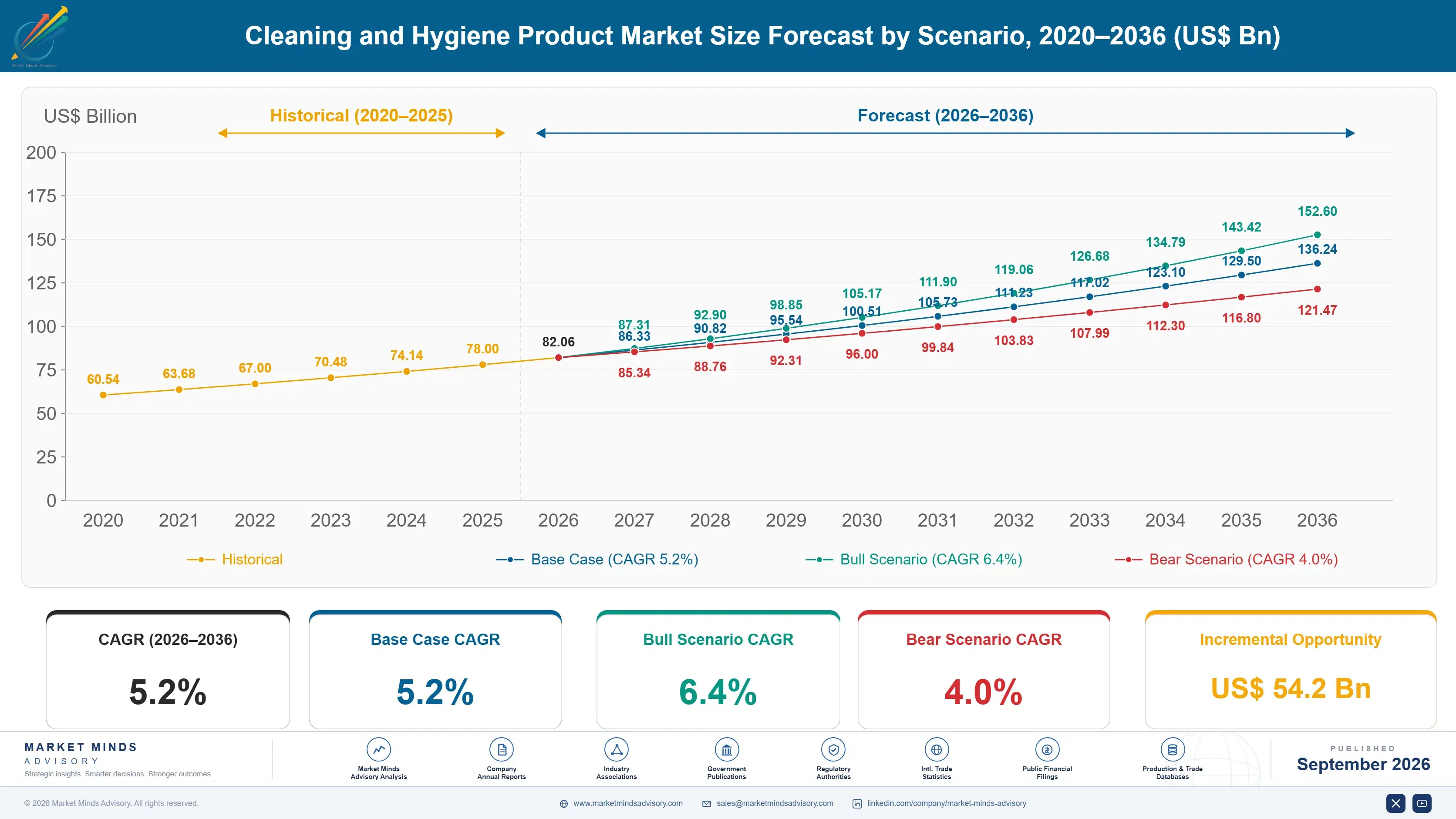
Cleaning and Hygiene Product Market Forecast Scenarios

cleaning-and-hygiene-product-market-size-forecast-scenario-1790024444821
Growth of 4.0% between 2020 and 2025 contains a disinfection spike and a long normalisation. Surface disinfectant demand rose to levels no supply chain could serve through 2020, capacity was added, and demand fell back sharply from 2022 leaving considerable overcapacity. Laundry and dishwashing behaved normally throughout, which is why the headline looks calmer than the period was.
Three mechanisms carry the base case. Concentrates grow at 7.8% as retailers allocate fixture space to formats that reduce their own freight and handling cost. Indian demand expands at 9.6% on household formalisation, with sachet and small-format purchasing converting informal cleaning practice into branded product. Institutional demand is growing faster than household as hygiene protocols adopted during the pandemic period persisted in healthcare, food service and education. All three are visible in shipment and listing data already.
The bull case is retailer mandates on packaging. Several major grocers have set plastic reduction targets that concentrates satisfy directly, and a mandate rather than an option would move the segment far faster than consumer preference will. The bear case is a concentrate dosing failure. Consumer misuse producing ineffective dilution would damage a format whose argument rests on performing identically to what it replaces.

What Is Actually In The Bottle

The economics of this category are shaped by an ingredient that costs nothing. A ready-to-use trigger spray is roughly 95% water, and that water is packaged in plastic, palletised, shipped, warehoused and put on a shelf, all at costs that have nothing to do with the cleaning chemistry inside. Concentrates remove every one of those costs and hold about 7% of household volume, which is the gap between what makes sense and what people buy. Nothing about the chemistry requires that water to travel.
TOP FIVE CONCENTRATION41%Combined net revenue share held by the five largest participants
WATER CONTENT SHARE95%Typical water proportion in a ready-to-use trigger spray
REQUIRED CONTACT TIME4 minutesMedian dwell period for registered disinfectant claims to hold
CONCENTRATE FORMAT SHARE7%Portion of household cleaning volume sold in concentrated form
PRIVATE LABEL SHARE28%Share of household volume under retailer rather than manufacturer brands
INSTITUTIONAL REVENUE SHARE34%Portion of category revenue from professional rather than household buyers
Disinfection claims rest on a number almost nobody observes. Registered disinfectants specify a contact time, commonly around four minutes, during which the surface must stay visibly wet for the label claim to hold. A household spraying and wiping within fifteen seconds has cleaned rather than disinfected. Institutional protocols enforce dwell time because auditors check it; domestic use does not, and the label rarely explains why it matters.
Institutional buyers supply about 34% of revenue and behave nothing like households. They specify contact time, dilution ratio and cost per litre of diluted product, and they audit compliance. Nothing about a household purchase is tested that way.
"This industry ships water across oceans and sells disinfectants that are wiped away before they work. Both problems have been understood for decades and neither is difficult; they persist because the formats that fix them are less convenient to buy and less profitable to sell."
Director, Household and Institutional Chemicals Practice · MMA Chemicals and Household Products Practice · September 2026

Market Trends

Retailers Push Concentrates To Cut Their Own Costs

Concentrate and refill systems grow at 7.8% against 5.2% for the market, and the pressure is coming from retailers rather than from consumers. A concentrate reduces pallet count, warehouse space, shelf facings and delivery frequency, all of which are retailer costs rather than manufacturer ones, and several major grocers have set plastic reduction targets that the format satisfies directly. Consumer preference has moved far more slowly, with concentrates at around 7% of household volume, but fixture allocation is not a consumer decision. Fixture allocation is decided centrally and moves faster than habit does.
Market Impact: India grows at 9.6% annually

Institutional Protocols Persist After The Emergency Ended

Hygiene procedures adopted across healthcare, food service and education during the pandemic period largely remained in place after the emergency justification disappeared, because auditors now check them and reversing a documented protocol requires a decision nobody wants to sign. That has left institutional demand growing faster than household demand, at around 34% of category revenue. These buyers specify dilution ratios and contact times precisely, which makes them a genuinely different customer from a household reaching for a spray. They also test what they buy, which makes performance claims verifiable in a way domestic marketing never has to be.
Market Impact: Targets cover 100% of listings

Market Opportunities and Growth Drivers

Indian Household Formalisation Converts Informal Cleaning Practice

India grows fastest of any country covered at 9.6%, driven by households moving from improvised cleaning methods to branded product as incomes rise and organised retail extends beyond the largest cities. Sachet and small-format packaging priced against weekly cash budgets is what makes that conversion possible, since a full bottle is unaffordable where a single-use sachet is not. Domestic manufacturers built around that format from the outset rather than adapting Western pack sizes downward. Nigerian, Kenyan and Egyptian households are converting on the same economics at smaller scale, and the format rather than the formulation is what makes it possible.
Market Impact: Concentrates reach only 7% share

Retailer Plastic Targets Create A Format Mandate

Several major grocery groups have committed to packaging reduction targets that ready-to-use formats cannot satisfy and concentrates answer directly, and fixture allocation follows those commitments rather than consumer demand. A manufacturer whose range is entirely ready-to-use faces a listing conversation it cannot win on sustainability grounds. That converts an environmental commitment into a commercial requirement, and it moves considerably faster than consumer preference does because a buyer decides it centrally. A supplier arriving at a listing review without a concentrate range has nothing to offer on the dimension the buyer must prioritise. That is a condition rather than a preference.
Market Impact: Requires 4 minutes of dwell

Market Restraints and Challenges

Consumers Buy Convenience Rather Than Concentration

Concentrates hold only about 7% of household volume despite removing freight, packaging and shelf cost, because a consumer wants to spray a surface rather than measure, dilute and mix anything first. The root cause is that the benefit accrues to the retailer and the planet while the inconvenience lands entirely on the buyer. Commercially it leaves the format dependent on fixture allocation rather than on demand. Participants addressing it design dosing that removes the measuring step completely. Single-dose cartridges and automatic dosing on refill are where the adoption is actually happening.
Market Impact: Concentrates hold 7% of volume

Contact Time Makes Most Domestic Disinfection Ineffective

Registered disinfectants require a dwell period commonly around four minutes with the surface staying visibly wet, and domestic use typically wipes within fifteen seconds, which means the claim on the bottle did not happen. The root cause is that the instruction sits in small print because stating it prominently makes the product sound inconvenient. Commercially it exposes the category to a credibility problem. Mitigation runs to faster-acting chemistries, foaming formats that stay wet and clearer labelling. Chemistries reaching registered kill claims inside 60 seconds exist and cost more per litre to make.
Market Impact: Institutional supplies 34% of revenue
3 additional market trends, 4 additional growth drivers, and 2 additional restraints and challenges are covered in the full report. Contact sales@marketmindsadvisory.com to access the complete intelligence.

Segment CAGR and Growth Architecture

Segmentation follows product category, the dimension on which formulation, regulatory treatment, buyer type and packaging format all divide together. Six categories are assessed at manufacturer net revenue. Cleaning equipment and machinery, personal care and body soap, contract cleaning services, and industrial process chemicals sit outside the defined scope throughout this report. Packaging format separates their economics more than chemistry does.
cleaning-and-hygiene-product-market-market-share-analysis-1790024445430

Concentrate And Refill Systems

Concentrate and refill systems grow at 7.8%, half again the market rate of 5.2%, and the growth is driven by retailers rather than by households. Removing water removes the bottle, the pallet, the freight and the shelf facing, and every one of those is a retailer cost, which is why fixture allocation is moving ahead of consumer preference. Concentrates hold around 7% of household volume, so the runway is long. The constraint is that measuring and diluting is genuine inconvenience, and the participants gaining fastest are those designing dosing that removes the step rather than explaining why it is worth doing. Japanese refill pouch penetration shows the format works when retail commits.
CAGR 7.8%

Professional And Institutional Cleaners

Professional and institutional cleaners grow at 6.4% and supply about 34% of category revenue from buyers who behave nothing like households. A facilities manager specifies dilution ratio, contact time and cost per litre of diluted solution, and auditors verify compliance, which makes performance claims testable in a way domestic marketing never is. Hygiene protocols adopted during the pandemic period largely persisted because reversing a documented procedure requires somebody to sign for it. This segment already buys concentrated almost universally, since the dilution step is a trained task rather than an inconvenience. Installed dispensing equipment on site raises switching cost well beyond anything a product comparison would suggest, which is why these accounts are the most durable in the whole category.
CAGR 6.4%
Full segment breakdown across 6 segments available in the complete report.

Regional Architecture and Country Demand Map

Shares record where products are sold rather than where surfactants are manufactured. East Asia sits at the top of its standard band on population and manufacturing together, and Eastern Europe below on price sensitivity that keeps measured revenue low relative to volume. Each deviation carries a stated reason.

East Asia

At 28% this sits at the top of its standard band, carried by Chinese household demand and by surfactant manufacturing that supplies much of the world. Chinese consumers have premiumised quickly across household cleaning, with specialty and fragrance-led products taking share from basic formulations. Japanese demand is distinctive in its acceptance of refill pouches, which reach penetration levels no Western market approaches and demonstrate that the format works when retail commits to it. Growth of 6.3% reflects premiumisation and format change together rather than volume expansion. Japanese refill pouch penetration is the clearest demonstration anywhere that concentrated and refill formats work at household scale when retailers commit fixture space to them rather than treating them as an experiment.
Share: 28% | CAGR: 6.3% (2026 to 2036)

North America

The 25% position sits inside the standard band and this is where the disinfection spike and subsequent overcapacity were sharpest. Surface disinfectant demand rose to unservable levels through 2020 and fell back hard from 2022, leaving capacity that has not been absorbed. Private label holds a substantial share of household volume, helped by large-format retail. Institutional demand across healthcare, food service and education is strong and audited. Growth of 4.3% reflects a mature household base alongside institutional demand that continues expanding. Retailer packaging commitments are beginning to reach listing reviews here, which will move concentrate fixture allocation ahead of consumer preference. Canadian demand behaves identically at smaller scale across every format covered.
Share: 25% | CAGR: 4.3% (2026 to 2036)
Regional intelligence for 5 additional markets available in the complete report: Western Europe, South Asia and Pacific, Latin America, Middle East and Africa, Eastern Europe. Contact sales@marketmindsadvisory.com.
cleaning-and-hygiene-product-market-country-cagr-analysis-1790024445965

Four Moves Worth Making Now

These four address a category that ships water across oceans, makes disinfection claims that domestic use does not achieve, and depends on a format shift where the benefit and the inconvenience fall on different parties. Each has been executed by at least one participant. Two of the four are packaging decisions rather than chemistry ones.

Design Dosing That Removes The Measuring Step

Concentrates hold about 7% of household volume because measuring and diluting is genuine inconvenience, not because consumers dispute the argument. Single-dose cartridges, pre-metered pods and bottles that dose automatically on refill remove the step entirely at a packaging cost near USD 0.20 per unit. Participants who designed the step out report concentrate repeat purchase rising roughly 2.9 times against measured-dilution formats, because the format stops asking anything of the buyer. Several previous attempts failed by explaining the benefit instead of removing the inconvenience. Consumers were never actually disputing the argument itself.
Market Impact: Concentrate repeat purchase rises roughly 2.9 times higher

Reformulate Disinfectants For Shorter Contact Times

Registered disinfectants commonly require around four minutes of visible wetness and domestic users wipe within fifteen seconds, which means the label claim did not happen in most households. Chemistries achieving registered kill claims within 60 seconds exist and cost more per litre. Participants who reformulated and stated the shorter time prominently report price realisation around 1.4 times conventional equivalents, because a claim a buyer can actually satisfy is worth paying for. It also removes a credibility exposure that the category has carried quietly for years. A claim nobody can satisfy is a claim waiting to be tested publicly.
Market Impact: Price realisation reaches roughly 1.4 times conventional equivalents

Lead Retailer Packaging Conversations With Concentrates

Grocery groups have committed to packaging reduction targets that ready-to-use formats cannot meet, and a supplier arriving without a concentrate range enters that listing review with nothing to offer. Leading with format rather than defending volume changes the conversation entirely. Participants who did report securing fixture allocation roughly 2.2 times their prior facings for concentrate lines, because the retailer needed the commitment more than the supplier needed the listing. Defending ready-to-use facings on price is a conversation that cannot be won once a packaging commitment is in place. The format is the only currency in that room.
Market Impact: Concentrate fixture allocation rises roughly 2.2 times higher

Build Sachet Economics For Emerging Household Conversion

Indian growth at 9.6% and comparable African expansion rest on packaging priced against a weekly cash budget rather than a monthly one, and a full bottle is simply unaffordable where a sachet is not. Retooling for single-use formats costs filling line investment rather than reformulation. Participants who built sachet capability report new household acquisition rising roughly 3.6 times against equivalent promotional spending on standard pack sizes. Domestic manufacturers in both regions built around the format from the outset rather than scaling Western pack sizes downward, which is why they hold the positions they do. Filling capability is the barrier.
Market Impact: New household acquisition rises roughly 3.6 times higher

Who Controls the Margin Pool

Concentration is moderate at 41% held by the top five, measured consistently on manufacturer net revenue rather than unit volume, which would heavily overweight low-priced private label and sachet product sold in enormous quantities. The leader to challenger gap rests on retailer relationships and registration capability rather than on formulation, since surfactant chemistry is mature and contract manufacturing is widely available to anybody.
Competition runs on three dimensions currently. Retailer listings decide household volume, and in a weekly repeat purchase fixture position carries the decision almost entirely. Registration capability decides disinfectant participation, since biocidal approval is expensive and slow and favours participants with regulatory departments. Specification performance decides institutional supply, where buyers test dilution ratios and contact times rather than responding to branding.

Pressure is building from two directions and positions will shift on both. Retailer packaging commitments are becoming listing conditions rather than preferences, which disadvantages any supplier without a concentrate range regardless of brand strength. Meanwhile Indian and Chinese manufacturers built around sachet and small-format economics are reaching African and Southeast Asian households that Western participants have never served profitably at those price points.
cleaning-and-hygiene-product-market-company-positioning-matrix-1790024446486

Competitive Moat and Risk Dimensions

PROCTER AND GAMBLE

Moat: Retail Distribution And Scale

Listings across grocery, mass and drug retail in essentially every market place product in front of buyers making a habitual weekly purchase, and manufacturing scale produces unit costs that regional competitors cannot approach on comparable formulations at comparable quality. Habit does the rest once a household has chosen.
PROCTER AND GAMBLE

Risk: Ready-To-Use Format Weighting

A portfolio weighted toward ready-to-use formats faces retailer packaging commitments that concentrates satisfy and bottles cannot, which turns an environmental preference into a listing condition. Converting volume ranges to concentrate requires filling investment and a consumer conversation the company has avoided for years. Volume ranges move slowest.
ECOLAB

Moat: Institutional Specification And Service

Selling to facilities managers on audited dilution ratios, contact times and cost per litre of diluted solution creates a technical relationship that survives procurement reviews, and dispensing equipment installed on site raises switching cost well beyond what a product comparison would suggest. Auditors accept what is already documented.
ECOLAB

Risk: Limited Household Channel Presence

Institutional strength provides no position in household retail, which remains about two thirds of category revenue and grows on entirely different terms. Entering grocery would require brand investment and listing negotiations against incumbents whose relationships took decades to build. That is a decades-long undertaking rather than a campaign.

Players Tracked

Prominent Players

Procter and Gamble
Unilever
Reckitt Benckiser
Henkel
Ecolab

Other Key Players

SC Johnson
Church and Dwight
Colgate-Palmolive
Clorox
Kao Corporation
Lion Corporation
Diversey
Werner and Mertz
McBride
Bombril
Hindustan Unilever
Nice Group
Blue Moon Group
Jyothy Labs
Dabur India

Recent Developments

MARCH 2025

Reckitt Benckiser launches automatic dosing refill system

The company introduced a household concentrate format that doses automatically on refill, removing the measuring step that has limited consumer adoption of concentrated cleaning products. This was organic product development funded internally, with no acquisition, licensing arrangement or joint venture behind it. Existing ready-to-use ranges continued on shelf unchanged.
Signal: Removing the measuring step matters more than explaining the benefit. Previous attempts failed by explaining rather than removing it.
NOVEMBER 2024

Henkel expands sachet filling capacity across African markets

The company added single-use sachet filling lines serving West and East African household demand from regional rather than imported supply. This was organic capital investment funded internally, with no joint venture, acquisition or contract manufacturing partner involved anywhere. Existing bottle formats continue where household budgets support them.
Signal: Weekly cash budgets rather than product preference decide these markets. Filling capability rather than formulation is the actual barrier.
JUNE 2025

Ecolab acquires institutional hygiene specialist in Asia

The company completed the acquisition of a regional institutional hygiene supplier with healthcare and food service accounts across Southeast Asia. This was a completed acquisition rather than a merger or joint venture, with service contracts transferring under existing terms. Dispensing equipment installed at customer sites transferred with the accounts.
Signal: Institutional accounts are being bought where protocol adoption already happened. Installed dispensing makes these accounts unusually difficult to displace.

What The Formula Costs

Surfactants and packaging dominate and water contributes nothing but weight. Surfactants run roughly 29% of manufacturing cost, other actives and fragrance about 14%, and packaging a further 26% on ready-to-use formats where the bottle is most of what is being paid for. Freight takes around 12% because the product is heavy and mostly water. Concentrates reduce packaging and freight together rather than separately.
Surfactant feedstock prices rose sharply through 2021 and 2022 on petrochemical and palm oil kernel costs together, a movement the EIA documents for petrochemical feedstocks and the USDA for vegetable oils across the same period. Resin costs for packaging climbed alongside. Procter and Gamble and Reckitt Benckiser reporting for that year both identify commodity inflation across household products as requiring pricing action. Both feedstock movements landed inside a single year.

Exposure divides by format rather than by company size. Ready-to-use participants carry packaging and freight exposure on a product that is overwhelmingly water, which makes them unusually sensitive to resin and fuel pricing for a chemical business. Concentrate participants carry proportionally more surfactant exposure and far less of everything else. Manufacturers producing regionally avoid the freight layer that dominates landed cost on a dense liquid.
cleaning-and-hygiene-product-market-cost-volatility-analysis-1790024446681

Shift portfolio weight toward concentrated formats

Packaging and freight together approach two fifths of ready-to-use manufacturing cost and almost all of it is spent moving water. Concentrates cut both at once while raising surfactant share of a much smaller total. The obstacle is consumer adoption, which requires dosing design rather than persuasion and has defeated several attempts already. Dosing design is the answer.

Dual source surfactants across petrochemical and oleochemical

Surfactants derive from petrochemical and palm kernel feedstocks that price on unrelated cycles, one following crude and the other agricultural conditions. Qualifying formulations that run on either gives genuine substitution capability when one moves. Qualification takes development time and duplicated documentation across markets. Few participants hold genuine dual capability, which leaves most of the industry exposed to whichever moves first.

Manufacture regionally for dense liquid products

Freight is roughly an eighth of cost on a product that is mostly water and ships by weight, which makes long routes economically indefensible. Regional filling close to demand removes it almost entirely. The constraint is that filling lines need volume to justify installation, which limits the approach to markets of genuine scale. Smaller markets cannot justify it.

Portfolio Architecture for Margin Defence

Margin architecture divides by format and by buyer type rather than by chemistry, which a formulation sheet would not predict. Ready-to-use household surface cleaners and basic detergents run at gross margins in the high twenties to high thirties, competing directly against private label produced by contract manufacturers using essentially the same surfactant packages. Nothing a shopper sees distinguishes the branded product from the retailer one.
Specialty household products, fragranced ranges and dishwashing systems hold gross margins in the low forties to low fifties. The spread reflects how differently branded and private label products carry marketing and distribution cost. Fragrance and format variety support premium positioning here in a way that cleaning performance alone never does, particularly across Latin America and East Asia.

The highest-value pool is institutional supply and concentrate systems, at margins in the low fifties to low sixties. Institutional buyers pay for audited specification and installed dispensing; concentrates earn margin by removing the packaging and freight that consume ready-to-use economics. Household ready-to-use carries the volume and the fixture space. It defends nothing against a retailer brand. Habit and fixture space are the argument for keeping it.

Volume / Commodity-Adjacent

Ready-to-use household surface cleaners and basic detergents, competing against private label using essentially the same surfactant packages. The ten point range reflects how differently scale positions absorb packaging cost. Retailer packaging commitments are moving against it.
Gross Margin: 28 to 38%

Premium / Certified

Specialty household products, fragranced ranges and dishwashing systems. Fragrance and format variety support premium positioning here in a way that cleaning performance alone has never managed to. Latin American and East Asian demand supports it particularly strongly.
Gross Margin: 41 to 51%

Sustainability / Regulatory / Next-Generation

Institutional supply and concentrate systems. Institutional buyers pay for audited specification and installed dispensing, while concentrates earn margin by removing packaging and freight entirely. Both earn margin from something other than the chemistry itself.
Gross Margin: 51 to 62%
cleaning-and-hygiene-product-market-portfolio-architecture-1790024447183

High-value Sub-segments and Strategic Watch-out

Concentrate And Refill Systems

High value and fastest growth at 7.8%, driven by retailer packaging commitments rather than consumer demand. Dosing design rather than persuasion is what converts households, and several attempts have already failed on that point. Japanese refill penetration shows what a real retail commitment achieves in practice.
Gross Margin: 52 to 61%

Professional And Institutional Cleaners

High value and strong growth at 6.4%, supplying about 34% of revenue from buyers who audit dilution ratios and contact times. Installed dispensing equipment raises switching cost well beyond product comparison. Protocols adopted during the pandemic period largely persisted afterwards because auditors now check them.
Gross Margin: 50 to 59%

Ready-To-Use Household Cleaners

Volume core and the format retailer packaging commitments are moving against directly. It holds the fixture space and the household habit, but it ships water and defends nothing against private label. Habit rather than performance keeps households buying the same thing for years without ever reconsidering.
Gross Margin: 28 to 36%

Surface Disinfectant Products

Strategic watch-out. Overcapacity from the 2020 spike persists and domestic use rarely achieves the required contact time. The eighteen point range reflects how differently registered and general-purpose products price. Faster-acting chemistries are the available answer to that exposure. Registration cost also favours the larger participants.
Gross Margin: 30 to 48%

How Habit Actually Forms

Household demand here is habitual to a degree few categories match, which cuts both ways commercially. A household buys the same surface cleaner for years without reconsidering, because the product works adequately and the decision is not worth revisiting for the money involved. That makes acquisition extremely valuable and switching extremely hard, and it is why fixture position rather than product performance decides most household volume.
Stickiness varies sharply by buyer type and by installed equipment. Institutional accounts with dispensing equipment on site are the most durable in the category, since switching means removing hardware and requalifying protocols that auditors have already accepted. Household concentrate users who adopted a refill system are unusually sticky too, because the vessel stays and the refill has to match it. Ready-to-use household buyers switch on promotion without noticing.

Buyer profiles have shifted toward format sensitivity rather than brand sensitivity. Households increasingly notice packaging volume and are more receptive to refill systems than they were, though the inconvenience of dilution still defeats most of that receptiveness. Institutional buyers have become considerably more technical since the pandemic period, specifying contact times and dilution ratios where they previously bought on price and relationship alone.
cleaning-and-hygiene-product-market-end-use-penetration-index-1790024447674

Where Format Decides Value

These are among the four positions where our research anticipates prominent divergence between winners and laggards over the coming forecast period. Each is grounded in the demand model, the regulatory perimeter, and the announced capacity pipeline.
01 / DOSING DESIGN CAPABILITY

Remove the step, not the objection

Concentrates hold only about 7% of household volume because measuring and diluting is genuine inconvenience rather than because consumers dispute the environmental or cost argument behind them. Single-dose cartridges and bottles that dose automatically on refill remove that step entirely at a packaging cost near twenty cents per unit. Participants who designed the step out report concentrate repeat purchase rising roughly 2.9 times against measured-dilution formats, because the format stops asking anything of the buyer, and several previous attempts failed by explaining rather than removing.
02 / CONTACT TIME REFORMULATION

Sell a claim people can actually meet

Registered disinfectants commonly require around four minutes of visible surface wetness and domestic users wipe within fifteen seconds, which means the label claim simply did not happen in most households. Chemistries achieving registered kill claims within sixty seconds exist and cost more per litre to formulate. Participants who reformulated and stated the shorter contact time prominently report price realisation around 1.4 times conventional equivalents in the same retail fixture, and it removes a credibility exposure the category has carried quietly.
03 / RETAILER FORMAT LEADERSHIP

Arrive at the listing with concentrates

Grocery groups have committed to packaging reduction targets that ready-to-use formats cannot satisfy and concentrates answer directly, which turns an environmental preference into a listing condition that suppliers must actually meet. A manufacturer arriving without a concentrate range enters that review with nothing at all to offer. Participants leading with format report securing fixture allocation roughly 2.2 times their prior facings, because the retailer needed the commitment more than the supplier did, and defending ready-to-use facings on price cannot be won there.
04 / SACHET FORMAT CAPABILITY

Price against the week, not the month

Indian growth at 9.6% and comparable African expansion rest on packaging priced against a weekly cash budget rather than a monthly shop, since a full bottle is unaffordable in households where a single sachet is not. Retooling for single-use formats costs filling line investment rather than any reformulation work at all. Participants who built sachet capability report new household acquisition rising roughly 3.6 times against equivalent promotional spending on standard pack sizes, because domestic manufacturers built around the format from the outset.

Engagement Snapshot From the Field

A live engagement with an industry participant carrying material or product regulatory and market exposure ahead of a defining policy shift, showing how our research translates into a defensible multi-year portfolio strategy.
MARKET MINDS ADVISORY · CLIENT ENGAGEMENT SUMMARY
Cleaning and Hygiene Product Producer Strategic Portfolio Review and Transition Roadmap 2026·Investment Scenario on Cleaning and Hygiene Product Exposure Evaluation 2025-26
CLIENT PROFILE
A household chemicals manufacturer with net revenue near USD 620 million (client-reported, unverified by MMA), weighted approximately 79% to ready-to-use household formats, 14% to institutional supply and 7% to concentrates. Sachet capability was absent entirely. Two major grocery customers had raised packaging reduction commitments during the previous listing review. Concentrate sales had never been analysed against dosing design.
STRATEGIC CHALLENGE
Household volume had declined for two consecutive years while management attributed the fall to private label pricing. A promotional programme across the ready-to-use range had been approved. Nobody had examined what the grocery packaging commitments would mean for listings, or why the existing concentrate line sold so poorly. Neither question had been examined internally.
MMA APPROACH
MMA reviewed grocery packaging commitments against the client's range composition line by line. Concentrate purchase behaviour was tested against three dosing designs with matched consumer panels. Landed cost was decomposed by format across surfactant, packaging and freight, and institutional specification requirements were collected from twelve facilities buyers. Findings were reconciled against listing review records.
KEY FINDINGS
  1. Both grocery customers had packaging commitments the ready-to-use range could not satisfy, and one had already signalled reduced facings at the next review regardless of price.
  2. Panel testing showed automatic dosing lifted concentrate repeat purchase by 214% against the measured-dilution format the client already sold, at almost identical unit cost.
  3. Packaging and freight together represented 39% of ready-to-use landed cost against 14% for the concentrate equivalent delivering the same diluted volume. to an end customer.
  4. All twelve institutional buyers specified contact time and dilution ratio, and the client's technical documentation did not state contact time on four of six relevant products.
CLIENT PROFILE
A household chemicals manufacturer with net revenue near USD 620 million (client-reported, unverified by MMA), weighted approximately 79% to ready-to-use household formats, 14% to institutional supply and 7% to concentrates. Sachet capability was absent entirely. Two major grocery customers had raised packaging reduction commitments during the previous listing review. Concentrate sales had never been analysed against dosing design.
STRATEGIC CHALLENGE
Household volume had declined for two consecutive years while management attributed the fall to private label pricing. A promotional programme across the ready-to-use range had been approved. Nobody had examined what the grocery packaging commitments would mean for listings, or why the existing concentrate line sold so poorly. Neither question had been examined internally.
MMA APPROACH
MMA reviewed grocery packaging commitments against the client's range composition line by line. Concentrate purchase behaviour was tested against three dosing designs with matched consumer panels. Landed cost was decomposed by format across surfactant, packaging and freight, and institutional specification requirements were collected from twelve facilities buyers. Findings were reconciled against listing review records.
KEY FINDINGS
  1. Both grocery customers had packaging commitments the ready-to-use range could not satisfy, and one had already signalled reduced facings at the next review regardless of price.
  2. Panel testing showed automatic dosing lifted concentrate repeat purchase by 214% against the measured-dilution format the client already sold, at almost identical unit cost.
  3. Packaging and freight together represented 39% of ready-to-use landed cost against 14% for the concentrate equivalent delivering the same diluted volume. to an end customer.
  4. All twelve institutional buyers specified contact time and dilution ratio, and the client's technical documentation did not state contact time on four of six relevant products.
RECOMMENDED STRATEGY
Phase 1: Phase one: cancel the promotional programme and commit capital to automatic dosing concentrate development immediately. Private label pricing was never the actual problem. Phase 2: Phase two: lead both grocery listing reviews with the concentrate range rather than defending ready-to-use facings. Ready-to-use stays listed alongside it. Phase 3: Phase three: complete institutional technical documentation and install sachet filling for emerging market entry. Contact time was missing on four products.
OUTCOME
Gross margin improved by five points across four quarters as concentrate mix rose (client-reported, unverified by MMA). Both grocery customers increased total facings rather than reducing them, and the automatic dosing format reached 19% of household volume within its first full year on shelf. Institutional documentation gaps were closed within two quarters.

Frequently Asked Questions

Foundational context covering the market sizes, CAGR, scope, country, region and competition that inform every finding below. This section is provided to cover basics and most often pre-purchase conversations, answered from the MMA Primary Research Dataset.

What is the current size of the Cleaning and Hygiene Product Market?

The market was valued at USD 78.0 billion in 2025, rising to USD 82.1 billion in 2026. Sizing is at manufacturer net revenue across six product categories.

How large will the Cleaning and Hygiene Product Market be by 2036?

MMA forecasts USD 136.3 billion by 2036, an increase of USD 54.2 billion over the 2026 base. That represents expansion of 1.66 times across the forecast period.

What is the CAGR for the Cleaning and Hygiene Product Market 2026 to 2036?

The base case CAGR is 5.2%, with a bull case of 6.4% and a bear case of 4.0%. Historical growth between 2020 and 2025 ran at 4.0%.

Which segment is growing fastest?

Concentrate and refill systems grow at 7.8%, half again the market rate, driven by retailer packaging commitments. Professional and institutional cleaners follow at 6.4%, and ready-to-use sprays grow slowest at 2.9%.

Who are the major companies in the Cleaning and Hygiene Product Market?

Procter and Gamble, Unilever, Reckitt Benckiser, Henkel and Ecolab lead on manufacturer net revenue, holding a combined 41%. Retailer relationships and registration capability separate them.

Which country is growing fastest?

India grows fastest at 9.6%, as households convert from improvised cleaning to branded product through sachet packaging priced against weekly rather than monthly budgets. Domestic manufacturers built around that format first.

Report Segmentation Architecture

The full report scope spans multiple orthogonal segmentation dimensions, with cross-tabulated demand data provided for each dimension pair. Coverage extends further to regional breakdowns, trend trajectories, and the competitive detail needed to support segment-level decision-making.

By Product Category

  • Surface Cleaners and Disinfectants
  • Laundry Detergents and Additives
  • Dishwashing Products
  • Concentrate and Refill Systems
  • Professional and Institutional Cleaners
  • Specialty and Washroom Hygiene

By End-Use Industry

  • Household and Domestic Use
  • Healthcare and Clinical Settings
  • Food Service and Hospitality
  • Education and Public Buildings
  • Commercial Offices and Retail
  • Food Processing and Manufacturing

By Commercial Dimension

  • Grocery and Supermarket Retail
  • Discount and Value Retail
  • Marketplace and E-Commerce
  • Janitorial and Sanitation Distribution
  • Direct Institutional Contract
  • Wholesale and Cash and Carry

By Region

  • East Asia
  • North America
  • Western Europe
  • South Asia and Pacific
  • Latin America
  • Middle East and Africa
  • Eastern Europe

Scope, Methodology, and Coverage

Every figure in this report is reproducible from documented input assumptions. The scope below maps the historical period, the forecast horizon, the segmentation dimensions, and the countries covered, alongside the underlying primary and qualitative methodology.
Historical Period
2020 to 2025
Forecast Period
2026 to 2036
Base Year
2025 (USD billions; MMA Primary Research Dataset, September 2026)
Market Definition
This market covers chemical cleaning and hygiene products for household and institutional use, spanning surface cleaners and disinfectants, laundry detergents and additives, dishwashing products, concentrate and refill systems, professional and institutional cleaners, and specialty and washroom hygiene products. Sizing is at manufacturer net revenue across grocery, discount, marketplace, janitorial distribution, direct institutional and wholesale channels. Cleaning equipment and machinery, personal care and body soap, contract cleaning services, and industrial process chemicals are excluded throughout this report.
Quantitative Units
USD billions at manufacturer net revenue; volume in millions of litres of diluted product; contact time in minutes to registered claim.
Segmentation Dimensions
Product category, end-use industry, commercial dimension, and geographic region.
Regions Covered
East Asia, North America, Western Europe, South Asia and Pacific, Latin America, Middle East and Africa, Eastern Europe
Countries Covered
China, United States, India, Germany, Brazil, Nigeria
Key Companies Profiled
Procter and Gamble, Unilever, Reckitt Benckiser, Henkel, Ecolab, SC Johnson, Church and Dwight, Colgate-Palmolive, Clorox, Kao Corporation, Lion Corporation, Diversey, Werner and Mertz, McBride, Bombril, Hindustan Unilever, Nice Group, Blue Moon Group, Jyothy Labs, Dabur India
Quantitative Methodology
Primary survey, n=3,800 respondents, Q4 2025, six countries; demand-side model with trade association cross-validation
Qualitative Methodology
47 expert interviews, Q4 2025; applied to validate demand model assumptions, identify emerging dynamics, and assess competitive positioning
Report Format
PDF and XLSX data workbook (Word format preview document)
Publisher
Market Minds Advisory
Report Code
MMA-2026-CHM-807
Published
September 2026
Contact
sales@marketmindsadvisory.com | www.marketmindsadvisory.com

Purchase the full Cleaning and Hygiene Product Market Report (2026 to 2036).

The full report sizes the cleaning and hygiene product market across six product categories, six end-use industries and six commercial dimensions for all seven global regions through 2036. It decomposes landed cost by format across surfactant, packaging and freight, quantifying exactly what shipping water costs a ready-to-use range. Concentrate purchase behaviour is tested against alternative dosing designs through matched consumer panels. Grocery packaging commitments are reviewed against supplier range composition line by line. Competitive assessment covers 20 participants on a consistent manufacturer net revenue basis.
Landed cost decomposed by format across surfactant and freight
Concentrate behaviour tested against alternative dosing designs
Grocery packaging commitments reviewed against range composition
Institutional specification requirements collected from facilities buyers
Six product categories sized through 2036
Twenty participants assessed on manufacturer net revenue

Built For The People Who Decide

From boardroom strategy to bench-side execution, this report is read cover-to-cover by leaders shaping the next decade of their industry, turning demand scenarios, market dynamics and valuation benchmarks into decisions.
CXOs/ Presidents/ VPs/ Managers
M&A and Corporate Development
Strategy Teams and R&D Heads
Procurement and Product Directors
Regulatory and Compliance Leaders
Investor Relations and Equity Analysts