Market Minds Advisory
Clad Pipe Market

Clad Pipe Market: Corrosion Resistance At A Fraction Of The Alloy

Sour, high-chloride, and CO2-rich reservoirs need alloy that costs many times carbon steel. Clad pipe puts the alloy only where the fluid touches it, and the bond line is where projects fail.

Lead Analyst

David Horsley

Published

September 2026

Make Smarter Decisions with Customized Research Insights

Request a free sample report and evaluate market opportunities, growth trends, and competitive dynamics relevant to your business needs.

2025 MARKET VALUE$3.4BMarket Size 2025
2036 FORECAST VALUE$6.8BBase Case , 2026 to 2036
CAGR 2026 TO 20366.5 %Bull 7.8% / Bear 5.3%
INCREMENTAL OPPORTUNITY$3.2BNet 10- year value creation
EXPANSION MULTIPLE1.88x2036 value over 2026 base
Strategic Levers
M&A Pipeline
Regional Outlook
Country Rankings
Competitive Intelligence
Segmental Deep-dive
Call-Us : 91 93563 13602

Executive Snapshot and Market Trajectory

Reservoirs are getting sourer and more corrosive as the easy fields deplete, and solid corrosion-resistant alloy pipe costs five to eight times what carbon steel does. Clad pipe puts the alloy only on the wetted surface. That arbitrage is the whole market, worth USD 3.4 billion in 2025.
Metallurgically bonded clad pipe grows fastest at 8.4%, roughly 1.29 times the market rate, because welded and hot-rolled bonds hold up under the thermal cycling and bending that mechanically lined pipe struggles with. Middle East and Africa takes 27% of value, well above the band this framework applies, because the sour gas developments driving demand sit overwhelmingly in Saudi Arabia, Qatar, and Abu Dhabi. East Asia follows at 24% of value.
Concentration reaches 44% across the top five, high for a pipe product, because cladding capacity is capital-intensive and qualification with any given operator takes years to obtain. Competition turns on bond integrity records and on whether a mill holds the specific approvals an operator will accept. Virtually every failure in service traces back to the bond line or the girth weld rather than to the alloy.
Market Definition
The clad pipe market covers line pipe and process piping in which a corrosion-resistant alloy layer is bonded to a carbon or low-alloy steel backing, spanning metallurgically bonded, mechanically lined, weld overlay, explosion bonded, and centrifugally cast product. Solid corrosion-resistant alloy pipe, internally coated carbon steel, non-metallic and composite pipe, clad plate and vessels, and subsea flexible pipe are excluded.
Base Year Value
$3.4B in 2025 (MMA Primary Research Dataset, August 2026)
Forecast Period
2026 to 2036, eleven discrete annual values
CAGR
6.5% base case. Bull 7.8%. Bear 5.3%.
Fastest Growth Segment
Metallurgically Bonded Clad Pipe: 8.4% CAGR
Fastest Growth Country
Saudi Arabia: 9.1% CAGR
Fastest Growth Region
South Asia and Pacific: 8.2% CAGR
Largest Region
Middle East and Africa: 27% of 2025 global value
Market Leaders
Butting, Cladtek, EEW Group, JFE Steel, Nippon Steel. Source: MMA Primary Research Dataset, July 2026.
Primary Survey
n=3,800 procurement and R&D decision-makers, Q4 2025, six countries
Methodology
Demand-side build-up, cross-validated against public data, 47 expert interviews

Clad Pipe Market Forecast Scenarios

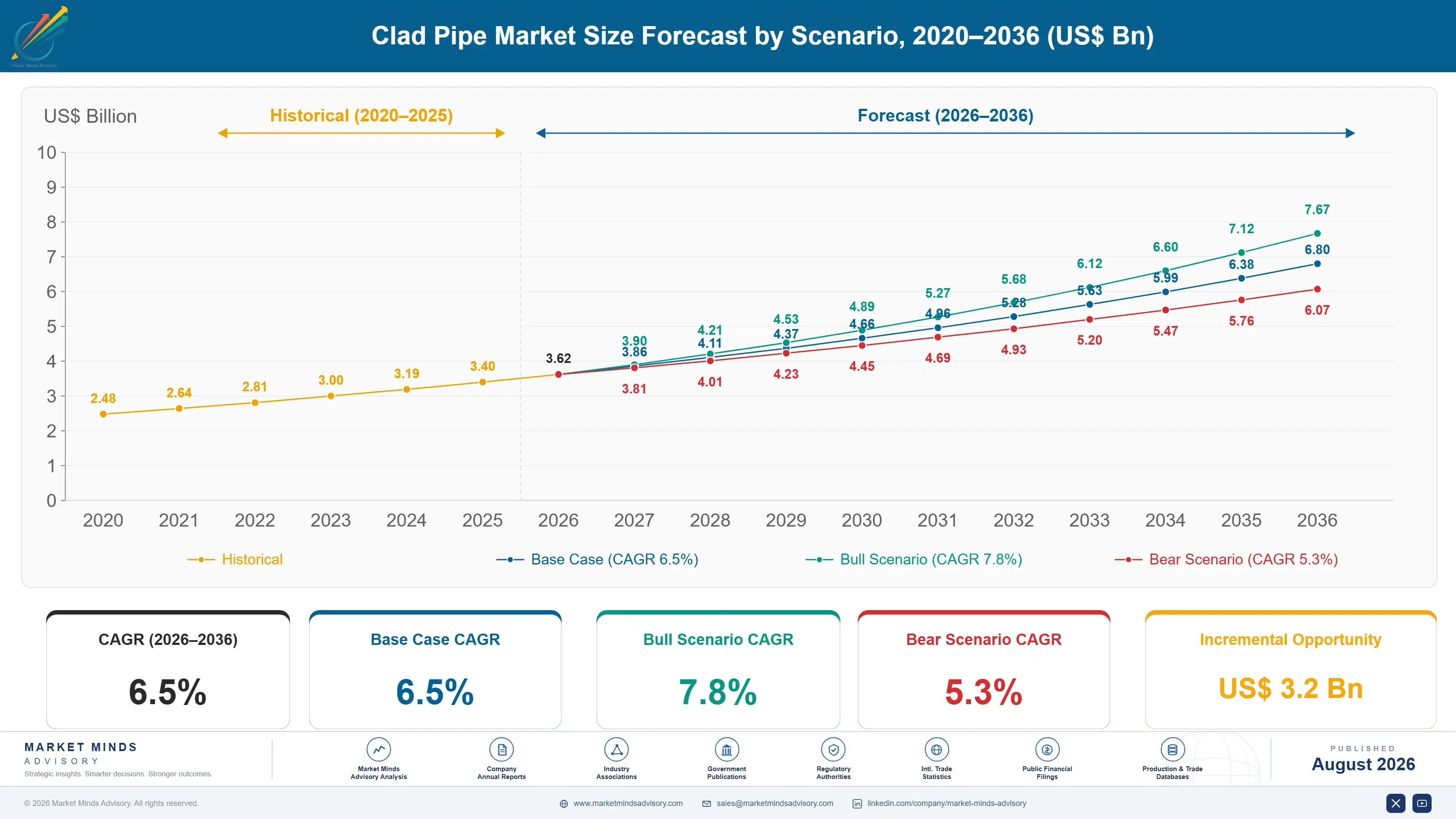
clad-pipe-market-size-forecast-scenario-1787333654474
Between 2020 and 2025 the market survived a collapse and then a boom. Oil and gas capital spending fell hard in 2020 and clad pipe orders, sitting on the long-lead critical path of any development, fell with it. Recovery from 2022 was rapid as Middle East sour gas and Brazilian pre-salt moved to award. A 5.4% historical CAGR conceals two flat years followed by mills at capacity.
Three mechanisms carry the 6.5% base case. Reservoir souring is the largest, since CO2 and hydrogen sulphide content rises as fields mature and existing carbon steel infrastructure stops being fit for the fluid it carries. Alloy price differentials are the second, because nickel and molybdenum costs make solid corrosion-resistant alloy prohibitive on any long line. And Middle East gas expansion, particularly Jafurah and North Field, is committing sour service pipe volumes through the decade.
The 7.8% bull case turns on carbon dioxide transport infrastructure, where wet CO2 streams are aggressive enough to require alloy and the pipeline lengths involved are considerable. The 5.3% bear case is oil and gas capital discipline, since clad pipe demand derives entirely from upstream sanction decisions that operators can defer for two or three years without much consequence.

Alloy Only Where The Fluid Touches It

The commercial logic of clad pipe is arithmetic. A sour, high-chloride, CO2-bearing well stream will destroy carbon steel in a few years, and solid alloy pipe that resists it costs five to eight times as much. Bonding three millimetres of alloy to a carbon steel wall gives the same corrosion performance at a fraction of the alloy content, and on a hundred-kilometre line that difference decides whether the field gets developed.
TOP FIVE CONCENTRATION44%Capital intensity and qualification cycles keep the supplier field narrow
ALLOY COST PREMIUM5 to 8 timesSolid corrosion-resistant alloy against equivalent carbon steel line pipe
TYPICAL CLAD THICKNESS3 millimetresAlloy layer bonded to the carbon steel backing wall
QUALIFICATION LEAD TIME18 to 36 monthsMill approval before an operator will accept project supply
NICKEL SHARE OF COST31%Alloy element pricing flowing directly into finished pipe cost
DESIGN SERVICE LIFE25 to 30 yearsExpected operating years for sour service pipeline installations
What the arithmetic hides is risk. The alloy performs exactly as specified; the bond and the girth weld are where things actually go wrong. Disbonding under thermal cycling, hydrogen-induced separation, and dilution of the alloy layer during field welding have all caused failures, and an operator that has seen one will specify against the responsible process for a decade afterwards.
That memory explains the concentration. Forty-four percent across five suppliers is high for a pipe product, and it persists because qualification takes eighteen to thirty-six months and no operator wants to run that exercise twice. A mill without the right project approvals simply cannot bid, regardless of what its delivered price would have been.
"Nobody buys clad pipe because they want two metals bonded together. They buy it because solid alloy would kill the project economics, and they spend the whole procurement worrying about the interface they created to save the money."
Principal, Energy Materials Practice · MMA Energy Practice ·

Market Trends

Reservoir Souring Pushes Alloy Into Existing Fields

Producing fields grow sourer as they age, with CO2 and hydrogen sulphide fractions rising through water injection, gas reinjection, and simple depletion. Carbon steel flowlines specified against original reservoir fluid stop being fit for what they now carry, and operators face either chemical inhibition programmes running indefinitely or replacement in corrosion-resistant material. Clad pipe wins that comparison on any line long enough for solid alloy to be unaffordable. The effect is a brownfield replacement stream that grows independently of new field sanctions, which is unusual in a business almost entirely tied to upstream capital cycles.
Market Impact: Jafurah targets 2 billion cubic fee

Carbon Dioxide Transport Creates A New Application

Captured CO2 is only benign when it is dry. Any water content forms carbonic acid aggressive enough to attack carbon steel, and dehydration to specification across a pipeline network with multiple injection points is harder to guarantee than single-source designs assume. Several European and North American CO2 transport projects have specified clad or lined pipe for that reason, on line lengths that make solid alloy impossible. Volumes remain small against oil and gas, but the pipeline distances involved are substantial and the specification precedent set by early projects will be difficult for later ones to argue away.
Market Impact: Nickel reached 100,000 per tonne

Market Opportunities and Growth Drivers

Middle East Sour Gas Developments Commit Long-Term Volume

Saudi Arabia's Jafurah development and Qatar's North Field expansion both involve gas with hydrogen sulphide and CO2 content requiring corrosion-resistant material across gathering and transmission networks, and both of them run through the end of the decade. Aramco has stated Jafurah will reach substantial sustained gas production, and the associated pipe volumes are committed years ahead through framework agreements rather than tendered project by project. Abu Dhabi's sour gas programme adds further volume on similar terms. These developments give mills order visibility that almost nothing else in this market provides.
Market Impact: Requalification takes 18 to 36 mont

Nickel And Molybdenum Pricing Makes Solid Alloy Unaffordable

Corrosion-resistant alloys derive their performance from nickel, chromium, and molybdenum, and those elements price at multiples of iron. A solid alloy line pipe carries that cost through its full wall thickness while a clad pipe carries it across three millimetres, which is the entire commercial argument for the product. Whenever nickel prices rise, and the 2022 spike was extreme by any measure, the clad option becomes more attractive rather than less, because the saving scales with the alloy price. That partially hedges this market against the input cost hurting its competitors most.
Market Impact: Weld inspection adds 8% to installa

Market Restraints and Challenges

Bond Line Failures Damage Confidence For Years

Disbonding between the alloy layer and the carbon steel backing has caused pipeline failures serious enough to change operator specifications permanently. The root cause is usually hydrogen accumulating at the interface or thermal cycling that the bond was never qualified against, and it is invisible until the line is in service. Commercially this makes operators conservative, slows adoption of newer bonding routes, and locks incumbent suppliers into position. Participants are mitigating through improved ultrasonic bond inspection, hydrogen-tolerant interlayer designs, and full-scale qualification testing that replicates actual thermal cycles rather than laboratory conditions.
Market Impact: Souring affects 40% of mature field

Girth Welding In The Field Remains The Weak Point

A clad pipe joint requires welding two dissimilar material systems in field conditions, and dilution of the alloy layer by the carbon steel backing during welding can leave a corrosion-vulnerable band at every single joint. The root cause is that field welding cannot replicate mill conditions and welder skill varies considerably. Commercially it slows installation, raises inspection cost, and creates a failure mode nobody can attribute cleanly between pipe supplier and contractor. Mitigation is running toward pre-qualified welding procedures, automated orbital welding, and mill-applied weld overlay on pipe ends before shipment.
Market Impact: CO2 projects specify 2,000 kilometr
2 additional market trends, 3 additional growth drivers, and 4 additional restraints and challenges are covered in the full report. Contact sales@marketmindsadvisory.com to access the complete intelligence.

Segment CAGR and Growth Architecture

Segmentation follows bonding method, meaning how the corrosion-resistant layer is joined to the carbon steel backing, because that single choice determines bond integrity under service conditions, achievable diameter and length, cost per metre, and which operators will accept the product at all. Diameter, service duty, and end-use are handled in the framework rather than here.
clad-pipe-market-market-share-analysis-1787333655019

Metallurgically Bonded Clad Pipe

Metallurgically bonded pipe grows fastest at 8.4%, about 1.29 times the market rate, because a true diffusion bond formed by hot rolling or hot isostatic pressing behaves as one material under thermal cycling and bending. That matters on flowlines seeing production temperature swings and on reeled installation where a mechanical fit would separate. Operators who have experienced disbonding on lined pipe specify metallurgical bond by default afterwards, and that preference is proving remarkably sticky. The penalty is cost and lead time, since the process is capital-intensive and the mills capable of running it properly are few. Sour gas gathering systems across the Middle East account for most of the current growth.
CAGR 8.4%

Weld Overlay Clad Pipe

Weld overlay grows at 7.6%, depositing alloy onto the carbon steel bore by automated welding rather than bonding a separate layer to it. It handles the smaller diameters, the complex geometries, and the pipe ends where a rolled clad product cannot physically reach, which makes it the standard route for fittings, spools, and the transition pieces that every clad pipeline eventually needs somewhere. Deposition rate limits the economics on long straight runs, so overlay rarely competes head-on against rolled line pipe. Its growth comes from the same projects driving metallurgical bond, since every kilometre of clad line pipe requires overlay-clad fittings and pre-overlaid ends to make field welding practical at all.
CAGR 7.6%
Full segment breakdown across 7 segments available in the complete report.

Regional Architecture and Country Demand Map

Regional shares here follow reservoir chemistry rather than economic size, because clad pipe gets bought only where the produced fluids are sour or CO2-rich enough to destroy carbon steel outright. That concentrates demand into a small handful of gas provinces and a few deepwater offshore basins.

Middle East and Africa

Middle East and Africa takes 27% of value against a 6% ceiling in this framework, and sour gas geology explains the entire breach. Saudi Arabian, Qatari, and Emirati gas developments carry hydrogen sulphide and CO2 concentrations that make corrosion-resistant material mandatory rather than optional, and the pipeline lengths involved rule out solid alloy on cost. Jafurah and the North Field expansion alone commit clad volumes through the end of the decade. Local content requirements have pulled cladding capacity into the region, with Saudi and Emirati facilities now supplying projects that once imported everything. North and West African offshore work adds a smaller stream. Growth at 7.0% sits above the global rate on committed project pipelines.
Share: 27% | CAGR: 7.0% (2026 to 2036)

East Asia

East Asia records 24% of value, split between manufacturing and consumption in a way no other region shares. Japanese mills hold the strongest technical position in metallurgically bonded product and export heavily into Middle East projects, while Chinese producers have built substantial capacity serving domestic offshore developments in the South China Sea and Bohai Bay alongside growing export volumes. Chinese sour gas fields in Sichuan carry high hydrogen sulphide content and require clad gathering systems. Korean fabricators consume clad pipe through offshore module and topside construction for projects located elsewhere entirely. Growth at 7.2% exceeds the global rate on domestic offshore activity and on export share gains against European mills.
Share: 24% | CAGR: 7.2% (2026 to 2036)
Regional intelligence for 5 additional markets available in the complete report: North America, Western Europe, South Asia and Pacific, Latin America, Eastern Europe. Contact sales@marketmindsadvisory.com.
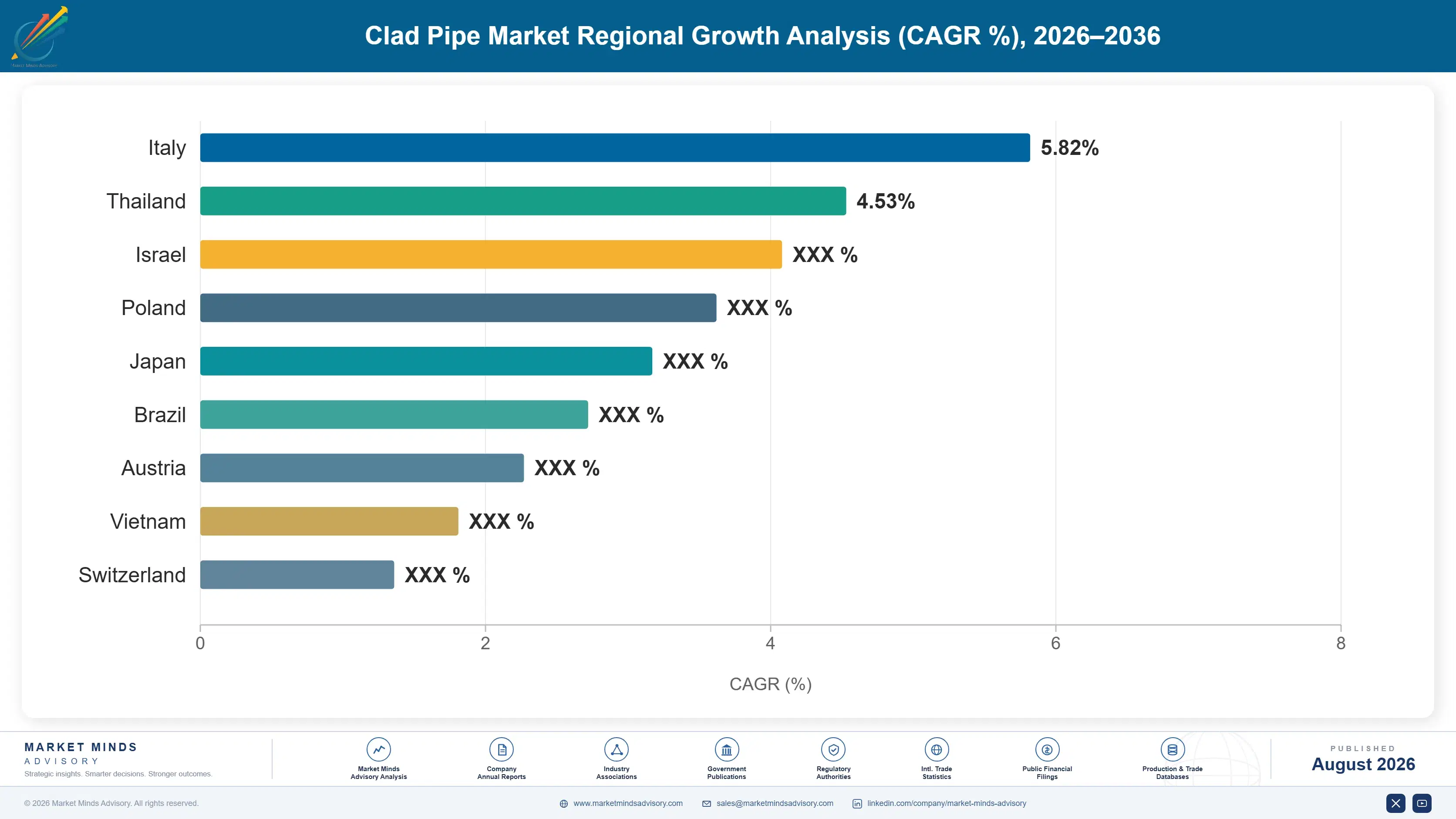
clad-pipe-market-country-cagr-analysis-1787333655531

Where Clad Pipe Margin Actually Sits

Margin in clad pipe does not come from the pipe itself. It comes from holding qualifications that competitors cannot obtain quickly, from supplying the fittings and pre-clad ends that make a pipeline installable in the first place, and from taking responsibility for bond integrity rather than leaving the operator to worry about it alone.

Sell The Complete Clad Package Including Fittings

A clad pipeline needs overlay-clad fittings, spools, transition pieces, and pre-overlaid pipe ends, and those items carry margins two to three times the line pipe they connect. Suppliers who bid line pipe alone hand that content to fabricators and lose the higher-value half of the scope. Bundling raises contract value 25% to 40% and gives the buyer one party accountable for material compatibility across every joint. It also creates a technical dependency, since matching overlay chemistry to the parent clad layer is easier when one supplier controls both specifications from the start.
Market Impact: Bundling raises contract value 25 t

Convert Qualification Into Framework Agreement Position

Operator qualification takes eighteen to thirty-six months and costs real money in test programmes, and once granted it should not be treated as a per-project asset. Converting it into multi-year framework agreements with committed volumes locks out competitors who would need the same qualification cycle to bid, and framework pricing typically runs 8% to 15% above spot tender levels because the operator is buying supply certainty. Middle East national oil companies increasingly prefer this model. The mills that pushed hardest for framework terms after qualifying now carry order books competitors cannot approach.
Market Impact: Framework pricing runs 8 to 15 perc

Underwrite Bond Integrity Through Extended Testing

Operators buying clad pipe are buying against a failure mode they have seen or heard about, and most suppliers respond with standard specification compliance. Full-scale qualification testing that replicates actual thermal cycling, reeling, and sour exposure costs USD 300,000 to USD 800,000 per programme and converts a technical argument into evidence. Suppliers offering it reach specifications written to exclude the alternatives, and they defend price against lower-cost mills that cannot produce equivalent data. The testing also generates the design basis an operator needs to justify clad over solid alloy internally.
Market Impact: Testing programmes cost 300,000 to

Who Controls the Margin Pool

Concentration reaches 44% across the top five measured on clad pipe revenue, which is high for a pipe product and reflects how much capital and qualification history the business requires. Butting and Cladtek lead, the first on metallurgically bonded and mechanically lined product from German operations, the second on weld overlay with capacity positioned inside the Middle East. EEW, JFE, and Nippon Steel follow closely. The gap to the next tier is qualification breadth rather than capacity.
Competition currently turns on which project approvals a mill actually holds, since an unqualified supplier cannot bid whatever its price. Delivery against long-lead critical path schedules matters nearly as much, because clad pipe gates pipeline construction. Technical support during welding procedure qualification is the third dimension, and it separates suppliers who sell material from those who sell an installable system.

Pressure is building from Chinese and Middle Eastern producers who have added capacity and are working through operator qualifications now. Their cost position is materially better and the technical gap is narrowing on the simpler bonding routes. Rankings will shift where operators accept new suppliers, which is happening fastest on mechanically lined product and slowest on metallurgically bonded sour service pipe.
clad-pipe-market-company-positioning-matrix-1787333656062

Competitive Moat and Risk Dimensions

BUTTING

Moat: Deepest qualification and reference record

Butting holds project qualifications across a very wide operator base built over decades of supply into North Sea, Middle East, and Brazilian developments. That record is the barrier itself, because an operator can name Butting without further justification while any alternative must be argued through a technical review nobody has time for on a critical path item.
BUTTING

Risk: German cost base under pressure

Manufacturing in Germany carries energy and labour costs that Chinese and Middle Eastern competitors do not, and the differential has widened since 2022. On projects where qualification is not the binding constraint, particularly mechanically lined pipe for moderate service, that gap is increasingly decisive and it is not something process improvement can close on its own.
CLADTEK

Moat: Capacity positioned inside demand

Cladtek built weld overlay and lined pipe capacity in Indonesia, Brazil, and the Middle East rather than exporting from a single home plant, which satisfies local content requirements that increasingly decide Middle East and Brazilian awards. That positioning is expensive to replicate and it converts a policy requirement into a commercial advantage on exactly the projects growing fastest.
CLADTEK

Risk: Limited metallurgical bond capability

The strength is in weld overlay and mechanical lining rather than in metallurgically bonded product, which is the fastest-growing route and the one specified for the most demanding sour service. As operators harden specifications toward true metallurgical bond after disbonding experience, that gap risks excluding Cladtek from the highest-value scope on the projects it is otherwise well placed to win.

Players Tracked

Prominent Players

Butting
Cladtek
EEW Group
JFE Steel
Nippon Steel

Other Key Players

Proclad Group
Inox Tech
Eisenbau Kramer
Canadoil Group
NobelClad
Zhejiang Jiuli Hi-Tech Metals
Baoji Petroleum Steel Pipe
Tenaris
Vallourec
Tubacex
Salzgitter Mannesmann
Welspun Corp
Jindal SAW
Kobe Steel
Alleima

Recent Developments

APRIL 2025

Saudi cladding capacity expanded under local content requirements

A clad pipe producer expanded weld overlay and lining capacity inside Saudi Arabia to serve sour gas gathering requirements. The investment responds to in-kingdom content rules that increasingly determine award outcomes on Aramco projects, regardless of what imported material would have cost delivered to site.
Signal: Local content policy now decides awards mo
NOVEMBER 2024

Japanese mill qualified metallurgical clad for reeled installation

A Japanese pipe producer completed full-scale qualification of metallurgically bonded clad line pipe for reeled subsea installation. The programme ran the bend cycle testing that mechanically lined product has historically struggled to pass without separation developing between the liner and the carbon steel backing wall.
Signal: Reeling qualification opens up subsea inst
FEBRUARY 2025

European mill won CO2 transport pipeline clad supply award

A European clad pipe supplier was awarded the material supply package for a North Sea carbon dioxide transport line. Corrosion-resistant material was specified because water content in the captured stream could not be guaranteed low enough for plain carbon steel across all of the injection points.
Signal: Wet CO2 uncertainty is converting into all

Nickel, Chromium, And Carbon Steel

Alloy elements dominate the cost structure. Nickel carries roughly 31% of cost of goods and molybdenum and chromium a further 18% to 24%, sourced through alloy producers drawing on Indonesian, Russian, Chilean, and South African mining output. Carbon steel backing plate or pipe accounts for 20% to 26% and comes from regional mills. Energy for hot rolling, heat treatment, and welding makes up most of the balance.
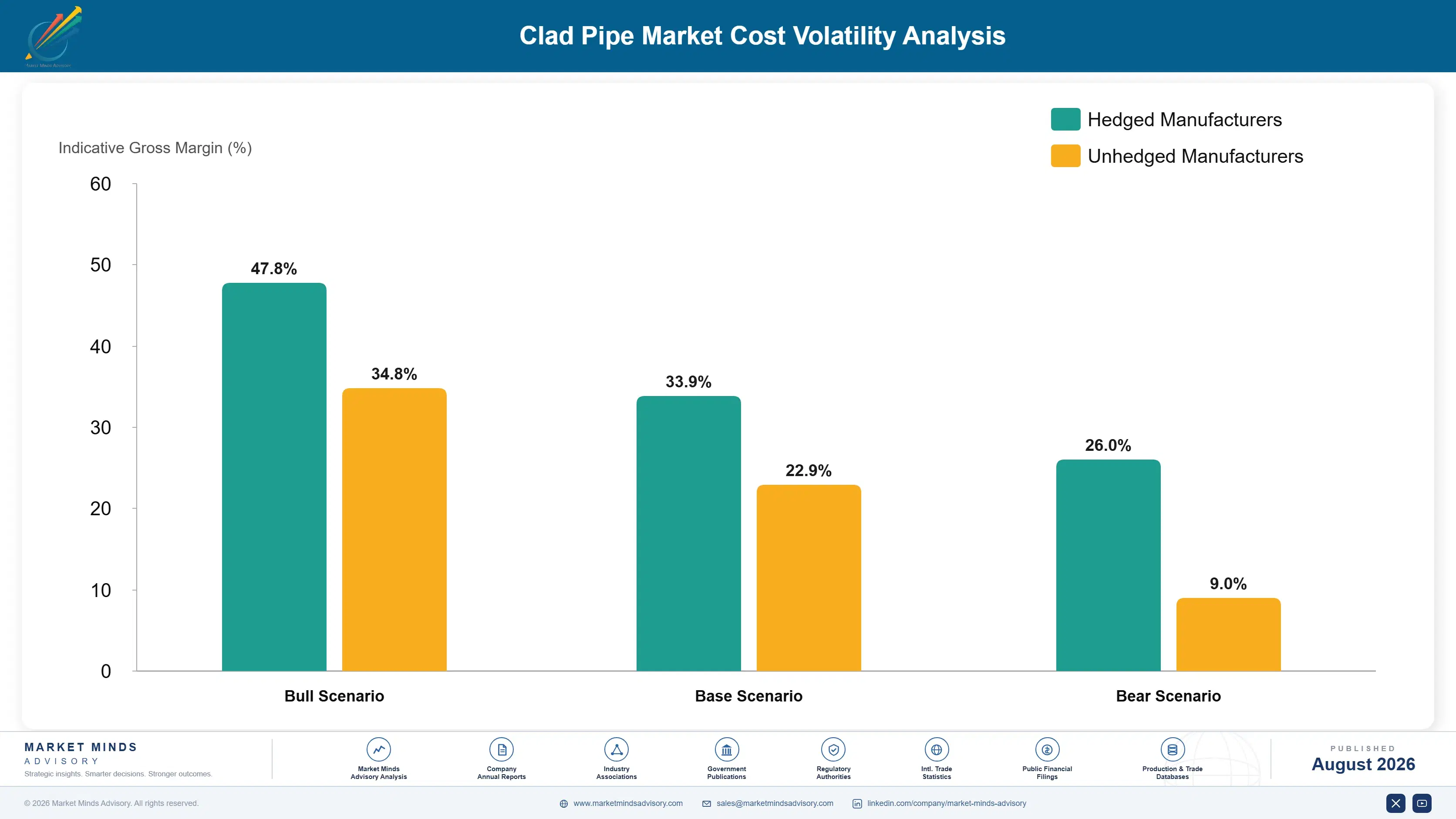
Nickel prices moved violently in March 2022 when the London Metal Exchange suspended and then cancelled trades, with quoted prices reaching around USD 100,000 per tonne intraday. Alleima and Tubacex both recorded alloy surcharge effects through that period. Clad producers holding fixed-price project contracts carried the exposure directly, because a pipeline award signed months earlier cannot be repriced against a metal spike that nobody forecast.

Exposure divides by contract structure rather than by geography. Mills selling into distribution and general industrial work apply alloy surcharges that pass movement through within weeks. Those bidding long-lead project supply on fixed prices absorb it across delivery schedules running two years or more. Smaller producers without hedging desks or long-term alloy supply agreements sit worst, since they buy alloy at spot when a project draws down.
clad-pipe-market-cost-volatility-analysis-1787333656258

Attach alloy surcharge clauses to project contracts

Indexing the alloy element portion of a project price to published metal benchmarks transfers volatility back to the buyer over delivery schedules that can run two years. Operators resist it initially and accept it once the alternative risk premium is quantified for them. The mechanism is standard in stainless distribution and translates directly into project supply with little modification.

Hedge nickel exposure against confirmed order backlog

Once a project award is firm the alloy requirement is known precisely, which makes it hedgeable in a way general production is not. Forward purchases or exchange positions matched to backlog remove the gap between contract price and metal cost. The constraint is treasury capability, which larger producers have and smaller regional mills generally do not.

Shift scope toward overlay and fittings content

Weld overlay fittings and pre-clad ends carry far less alloy per unit of revenue than line pipe does while commanding better margins, which lowers overall metal exposure without reducing turnover at all. Growing that share changes the cost base rather than requiring any change in purchasing behaviour. It also improves resilience through project cycles.

Portfolio Architecture for Margin Defence

Margin here tracks qualification scarcity rather than product complexity. Mechanically lined pipe for moderate service is approaching commodity status as Chinese and Middle Eastern capacity qualifies, and the pricing shows it clearly. Metallurgically bonded pipe for sour service sits behind a qualification barrier that few mills clear, and it prices accordingly because the operator has perhaps four acceptable suppliers rather than fifteen.
The volume tension is between filling capacity and defending price. Clad mills are capital-intensive and utilisation drives fixed cost recovery, which pushes commercial teams toward the lined pipe volume that every competitor is also chasing. Holding out for qualified sour service scope means accepting lower utilisation, and mills that get this balance wrong in either direction lose money in different ways.

High-value pools sit in three places. Metallurgically bonded pipe for sour gas gathering, overlay-clad fittings and transition pieces where the alloy content is small relative to the engineering, and CO2 transport applications where specification precedent is still being written. All three are decided by technical qualification rather than by price, which is exactly why they hold margin while the rest of the market compresses.

Volume / Commodity-Adjacent Tier

Mechanically lined pipe and simple overlay for moderate service, sold into projects with multiple qualified bidders. The range reflects how differently Chinese and European cost bases carry the same product specification.
Gross Margin: 12-20%

Premium / Certified Tier

Metallurgically bonded line pipe qualified for sour service, and overlay-clad fittings and spools. Qualification scarcity rather than manufacturing difficulty supports the margin, since operators typically have very few acceptable suppliers.
Gross Margin: 24-33%

Sustainability / Regulatory / Next-Generation Tier

Clad pipe for carbon dioxide transport, reeled subsea installation, and hydrogen service where specification precedent is unsettled. The wide range reflects genuine pricing uncertainty in applications that have very little procurement history behind them.
Gross Margin: 30-42%
clad-pipe-market-portfolio-architecture-1787333656762

High-value Sub-segments and Strategic Watch-out

Metallurgically Bonded Sour Service Pipe

Growing at 8.4% and carrying the strongest margins in the whole market, because operators who have already experienced disbonding will not accept the alternatives at any price. Qualification takes eighteen to thirty-six months, which keeps the qualified supplier field very small and pricing correspondingly firm.
Gross Margin: 26-36%

Overlay-Clad Fittings and Transition Pieces

Growing at 7.6% with margins well above line pipe, because alloy content is low relative to the engineering and welding involved in making them. Every clad pipeline needs them, and suppliers bidding line pipe alone hand this scope straight to fabricators for nothing in return.
Gross Margin: 32-44%

Mechanically Lined Pipe

The volume base of the market, increasingly contested as Chinese and Middle Eastern capacity clears operator qualification on moderate service duty. It funds mill utilisation and remains properly defensible only where reeling or thermal cycling exposes the weakness of a purely mechanical fit between layers.
Gross Margin: 12-20%

Carbon Dioxide Transport Pipe

Small today and growing quickly, with the specification precedent still being written by the early European and Gulf Coast projects. The watch-out is that dehydration standards could tighten enough to make plain carbon steel acceptable again, which would remove the application from this market entirely.
Gross Margin: 28-40%

What Follows The First Award

Clad pipe generates less annuity income than most industrial products, and suppliers who understand that build the position differently. Pipe is installed once and expected to last twenty-five to thirty years, so there is no replacement stream worth planning around. The recurring revenue is qualification itself, since an approved mill sits on a framework that produces orders across successive project phases without competitive tender each time.
Stickiness varies sharply by operator type. National oil companies qualify slowly, then buy through frameworks for years and rarely requalify, which makes them the most valuable relationships available. International majors maintain broader approved vendor lists and tender competitively within them, so approval guarantees a seat rather than an order. Engineering contractors buying on behalf of operators are the least sticky, since their obligation is to the lowest compliant bid.

Buyer profiles have shifted toward materials engineering and away from procurement. Failures traced to bond lines and girth welds moved the deciding voice to corrosion specialists who read qualification data rather than price schedules. Suppliers still selling on delivered cost per tonne are pitching to a function that no longer decides, which is why documentation quality now predicts win rate better than pricing does.
clad-pipe-market-end-use-penetration-index-1787333657256

Where To Compete Here

These are among the four positions where our research anticipates prominent divergence between winners and laggards over the coming forecast period. Each is grounded in the demand model, the regulatory perimeter, and the announced capacity pipeline.
01 / QUALIFICATION PORTFOLIO DEPTH

Qualification is the product, not the pipe

An unqualified mill cannot bid regardless of its price, and getting qualified takes eighteen to thirty-six months of test programmes costing real money long before a single order ever arrives. That barrier is what holds concentration at 44% in a product that is otherwise not especially difficult for a competent mill to manufacture. Treating qualification as a capital investment with a portfolio to be managed, rather than as a project cost, separates the mills that compound position from those that merely chase tenders.
02 / FITTINGS SCOPE CAPTURE

Bid the whole clad scope, not line pipe

Overlay-clad fittings, spools, and transition pieces carry margins two to three times the line pipe they connect, and suppliers bidding pipe alone hand that content straight to the fabricators for nothing. Bundling the whole scope raises contract value by a quarter to two-fifths and makes one single party accountable for material compatibility at every joint in the system. Operators come to prefer that accountability once somebody explains clearly what the alternative costs them on the day a girth weld fails.
03 / LOCAL CAPACITY POSITIONING

Build where the sour gas actually is

In-kingdom and in-country content requirements now decide Middle East and Brazilian awards far more reliably than delivered cost does, and exporting from a single home plant cannot satisfy them at any price at all. Cladtek has already proved that local capacity converts a policy requirement into a durable commercial advantage on exactly the projects that happen to be growing fastest. Competitors treating regional plants as a cost of doing business rather than as a defensible position have the logic backwards.
04 / BOND INTEGRITY EVIDENCE

Sell test data, not specification compliance

Every operator buying clad pipe is buying against a failure mode they have either seen themselves or been warned about at some length, and standard specification compliance does nothing at all to address that fear. Full-scale testing replicating actual thermal cycling, reeling, and sour exposure costs several hundred thousand dollars and produces the kind of evidence that competing mills simply cannot match. It reaches specifications written to exclude the alternatives, which is worth considerably more than the testing ever costs.

Engagement Snapshot From the Field

A live engagement with an industry participant carrying material or product regulatory and market exposure ahead of a defining policy shift, showing how our research translates into a defensible multi-year portfolio strategy.
MARKET MINDS ADVISORY · CLIENT ENGAGEMENT SUMMARY
Clad Pipe Producer Strategic Portfolio Review and Transition Roadmap 2026·Investment Scenario on Clad Pipe Exposure Evaluation 2025-26
CLIENT PROFILE
A Middle East national oil company developing a sour gas field with hydrogen sulphide and carbon dioxide content requiring corrosion-resistant material across roughly 600 kilometres of gathering and trunk line. Project capital exceeded USD 4 billion (client-reported, unverified by MMA), with pipe material representing a substantial share and sitting on the critical path for first gas.
STRATEGIC CHALLENGE
The materials specification had defaulted to metallurgically bonded clad across the full network, which only three qualified mills could supply within the schedule. Procurement was concerned that the resulting competitive position would be poor, while the corrosion group would not accept alternatives without evidence they would survive the service conditions.
MMA APPROACH
MMA segmented the network by actual fluid conditions rather than by a single worst-case specification, establishing where thermal cycling and hydrogen partial pressure genuinely required a metallurgical bond and where mechanically lined pipe would perform. Qualified supplier capacity was mapped against the project schedule, and in-kingdom capacity additions were assessed for realistic availability.
KEY FINDINGS
  1. Roughly 40% of the network carried service conditions that mechanically lined pipe would meet, widening the qualified bidder field from three suppliers to nine on that portion.
  2. Applying a single worst-case specification across the whole network added an estimated USD 190 million to material cost (client-reported, unverified by MMA) with no corresponding integrity benefit.
  3. Two of the three qualified metallurgical bond suppliers had committed capacity to other regional projects overlapping the client's delivery window, creating genuine schedule risk.
  4. In-kingdom cladding capacity under construction would qualify too late for the trunk line but comfortably in time for the later gathering phases.
CLIENT PROFILE
A Middle East national oil company developing a sour gas field with hydrogen sulphide and carbon dioxide content requiring corrosion-resistant material across roughly 600 kilometres of gathering and trunk line. Project capital exceeded USD 4 billion (client-reported, unverified by MMA), with pipe material representing a substantial share and sitting on the critical path for first gas.
STRATEGIC CHALLENGE
The materials specification had defaulted to metallurgically bonded clad across the full network, which only three qualified mills could supply within the schedule. Procurement was concerned that the resulting competitive position would be poor, while the corrosion group would not accept alternatives without evidence they would survive the service conditions.
MMA APPROACH
MMA segmented the network by actual fluid conditions rather than by a single worst-case specification, establishing where thermal cycling and hydrogen partial pressure genuinely required a metallurgical bond and where mechanically lined pipe would perform. Qualified supplier capacity was mapped against the project schedule, and in-kingdom capacity additions were assessed for realistic availability.
KEY FINDINGS
  1. Roughly 40% of the network carried service conditions that mechanically lined pipe would meet, widening the qualified bidder field from three suppliers to nine on that portion.
  2. Applying a single worst-case specification across the whole network added an estimated USD 190 million to material cost (client-reported, unverified by MMA) with no corresponding integrity benefit.
  3. Two of the three qualified metallurgical bond suppliers had committed capacity to other regional projects overlapping the client's delivery window, creating genuine schedule risk.
  4. In-kingdom cladding capacity under construction would qualify too late for the trunk line but comfortably in time for the later gathering phases.
RECOMMENDED STRATEGY
Phase 1: Phase one: split the specification by measured service condition, reserving metallurgical bond for the high hydrogen sulphide gathering sections only. Phase 2: Phase two: secure trunk line supply through framework agreement with the uncommitted qualified mill rather than through open tender against constrained capacity. Phase 3: Phase three: sponsor in-kingdom supplier qualification during phase one delivery so that later gathering scope has domestic options available to it.
OUTCOME
The client issued a differentiated specification and reported material cost savings of approximately USD 165 million against the original single-specification estimate (client-reported, unverified by MMA). Trunk line supply was secured under framework terms ahead of two competing regional projects, and in-kingdom qualification began during the first delivery phase.

Frequently Asked Questions

Foundational context covering the market sizes, CAGR, scope, country, region and competition that inform every finding below. This section is provided to cover basics and most often pre-purchase conversations, answered from the MMA Primary Research Dataset.

What is the current size of the Clad Pipe Market?

The market reached USD 3.4 billion in 2025 and is forecast at USD 3.62 billion for 2026. Demand follows sour and CO2-rich reservoir development rather than general oil and gas activity.

How large will the Clad Pipe Market be by 2036?

MMA forecasts USD 6.80 billion by 2036, an increase of USD 3.18 billion over 2026. That represents an expansion multiple of 1.88 times across the forecast period.

What is the CAGR for the Clad Pipe Market 2026 to 2036?

The base case CAGR is 6.5%, with a bull case at 7.8% and a bear case at 5.3%. The bull case depends largely on carbon dioxide transport pipelines specifying corrosion-resistant material.

Which segment is growing fastest?

Metallurgically bonded clad pipe grows fastest at 8.4%, about 1.29 times the market rate. It holds up under thermal cycling and reeling where mechanically lined product can separate.

Who are the major companies in the Clad Pipe Market?

Butting, Cladtek, EEW Group, JFE Steel, and Nippon Steel lead the market. The top five hold roughly 44% of clad pipe revenue, high for a pipe product and sustained by qualification barriers.

Which country is growing fastest?

Saudi Arabia grows fastest at 9.1%, driven by Jafurah and associated sour gas gathering requiring corrosion-resistant material across long gathering networks. In-kingdom content rules are pulling cladding capacity into the country.

Report Segmentation Architecture

The full report scope spans multiple orthogonal segmentation dimensions, with cross-tabulated demand data provided for each dimension pair. Coverage extends further to regional breakdowns, trend trajectories, and the competitive detail needed to support segment-level decision-making.

By Bonding Method

  • Metallurgically Bonded Clad Pipe
  • Weld Overlay Clad Pipe
  • Mechanically Lined Pipe
  • Explosion Bonded Clad Pipe
  • Centrifugally Cast Clad Pipe

By End-Use Industry

  • Upstream Oil and Gas Production
  • Gas Processing and LNG
  • Refining and Petrochemicals
  • Carbon Dioxide Transport and Storage
  • Power Generation and Desalination

By Commercial Dimension

  • Direct Project Supply
  • Framework and Long-Term Agreements
  • Engineering Contractor Procurement
  • Distributor and Stockist Channel
  • Fabricator and Spool Shop Supply

By Region

  • Middle East and Africa
  • East Asia
  • North America
  • Western Europe
  • South Asia and Pacific
  • Latin America
  • Eastern Europe

Scope, Methodology, and Coverage

Every figure in this report is reproducible from documented input assumptions. The scope below maps the historical period, the forecast horizon, the segmentation dimensions, and the countries covered, alongside the underlying primary and qualitative methodology.
Historical Period
2020 to 2025
Forecast Period
2026 to 2036
Base Year
2025 (USD billions; MMA Primary Research Dataset, August 2026)
Market Definition
The clad pipe market comprises line pipe and process piping in which a corrosion-resistant alloy layer is bonded to a carbon or low-alloy steel backing, valued at mill selling prices to operators, engineering contractors, fabricators, and distributors. It spans metallurgically bonded product formed by hot rolling or hot isostatic pressing, weld overlay clad pipe, mechanically lined pipe, explosion bonded pipe, and centrifugally cast clad product, together with overlay-clad fittings, spools, and transition pieces supplied as part of clad pipeline scope. Solid corrosion-resistant alloy pipe, internally coated or lined carbon steel using non-metallic materials, composite and thermoplastic pipe, clad plate and pressure vessels, and subsea flexible and umbilical products are excluded.
Quantitative Units
USD billions (current prices); volume in thousands of tonnes shipped
Segmentation Dimensions
By Bonding Method; By End-Use Industry; By Commercial Dimension; By Region
Regions Covered
Middle East and Africa, East Asia, North America, Western Europe, South Asia and Pacific, Latin America, Eastern Europe
Countries Covered
Saudi Arabia, United Arab Emirates, Qatar, Kuwait, Oman, Egypt, Nigeria, Angola, South Africa, China, Japan, South Korea, Taiwan, India, Australia, Indonesia, Malaysia, Thailand, Vietnam, USA, Canada, Mexico, Brazil, Guyana, Argentina, Colombia, Germany, Italy, Norway, UK, Netherlands, France, Spain, Poland, Romania, Hungary, Czechia, and additional markets relevant to this sector
Key Companies Profiled
Butting, Cladtek, EEW Group, JFE Steel, Nippon Steel, Proclad Group, Inox Tech, Eisenbau Kramer, Canadoil Group, NobelClad, Zhejiang Jiuli Hi-Tech Metals, Baoji Petroleum Steel Pipe, Tenaris, Vallourec, Tubacex, Salzgitter Mannesmann, Welspun Corp, Jindal SAW, Kobe Steel, Alleima
Quantitative Methodology
Primary survey, n=3,800 respondents, Q4 2025, six countries; demand-side model with trade association cross-validation
Qualitative Methodology
47 expert interviews, Q4 2025; applied to validate demand model assumptions, identify emerging dynamics, and assess competitive positioning
Report Format
PDF and XLSX data workbook (Word format preview document)
Publisher
Market Minds Advisory
Report Code
MMA-2026-ENE-568
Published
August 2026
Contact
sales@marketmindsadvisory.com | www.marketmindsadvisory.com

Purchase the full Clad Pipe Market Report (2026 to 2036).

The full report examines clad pipe demand across seven regions and five bonding methods, with particular attention to how operator qualification rather than price determines which mills can bid on any given project. It quantifies the cost arbitrage against solid corrosion-resistant alloy and traces where reservoir souring is converting brownfield carbon steel networks into replacement demand. Competitive analysis covers twenty participants assessed on clad pipe revenue, including how quickly Chinese and Middle Eastern capacity is clearing qualification barriers. Regional chapters map project pipelines against qualified supplier capacity through the forecast period.
Seven-region demand and project pipeline analysis
Five bonding method segmentation with growth rates
Twenty participant competitive assessment and qualification mapping
Cost arbitrage modelling against solid alloy pipe
Carbon dioxide transport application sizing and specification precedent
Framework agreement pricing benchmarks by operator type

Built For The People Who Decide

From boardroom strategy to bench-side execution, this report is read cover-to-cover by leaders shaping the next decade of their industry, turning demand scenarios, market dynamics and valuation benchmarks into decisions.
CXOs/ Presidents/ VPs/ Managers
M&A and Corporate Development
Strategy Teams and R&D Heads
Procurement and Product Directors
Regulatory and Compliance Leaders
Investor Relations and Equity Analysts