Market Minds Advisory
Citizen Service AI Market

Citizen Service AI Market: Citizen Service AI Market: Government Service Delivery, Application Processing and Eligibility Systems, 2026 to 2036

Deflection figures quoted by agencies mostly measure abandonment rather than resolution, and almost nobody separates the two. The durable value sits upstream, where processing reduces a backlog instead of a queue.

Lead Analyst

Published

September 2026

Make Smarter Decisions with Customized Research Insights

Request a free sample report and evaluate market opportunities, growth trends, and competitive dynamics relevant to your business needs.

2025 MARKET VALUE$3.2BMarket Size 2025
2036 FORECAST VALUE$16.9BBase Case , 2026 to 2036
CAGR 2026 TO 203616.4 %Bull 17.7% / Bear 15.1%
INCREMENTAL OPPORTUNITY$13.2BNet 10- year value creation
EXPANSION MULTIPLE4.57x2036 value over 2026 base
Strategic Levers
M&A Pipeline
Regional Outlook
Country Rankings
Competitive Intelligence
Segmental Deep-dive
Call-Us : 91 93563 13602

Executive Snapshot and Market Trajectory.

Agencies report deflecting 34% of enquiries away from human caseworkers. What they rarely report is that 41% of those deflected citizens then filed nothing at all. A contact that disappears counts as a success and a service failure at the same time, and very few agencies measure which one happened.
The value that survives scrutiny sits earlier in the process. Document processing and application intake grows at 24.6%, half again the market rate of 16.4%, because extracting fields from submitted forms reduces a backlog rather than a queue, and the result is inspectable in a way a conversation is not. East Asia holds 28% of contracted value, carried by provincial service platforms operating at population scale.
The supplier field is unusually open, with the top five holding only 29% between them and systems integrators, hyperscale platform providers, and specialist vendors all competing for the same awards. What is consolidating is not market share but the assurance requirement. Agencies that cannot inspect a model are writing accuracy thresholds into contracts instead, which rewards suppliers able to evidence performance rather than describe it. Assurance capability is the real differentiator now.
Market Definition
The citizen service AI market covers software and delivered services applying machine learning to government-to-citizen service interactions, including conversational assistants and contact deflection, document processing and application intake, eligibility screening and benefit determination, translation and accessibility services, case triage and workload routing, and identity verification and fraud detection. It excludes defence and intelligence applications, internal government productivity software, tax collection systems, and law enforcement analytics.
Base Year Value
$3.2B in 2025 (MMA Primary Research Dataset, September 2026)
Forecast Period
2026 to 2036, eleven discrete annual values
CAGR
16.4% base case. Bull 17.7%. Bear 15.1%.
Fastest Growth Segment
Document Processing And Application Intake: 24.6% CAGR
Fastest Growth Country
India: 22.4% CAGR
Fastest Growth Region
South Asia and Pacific: 18.6% CAGR
Largest Region
East Asia: 28% of 2025 global value
Market Leaders
Accenture, Microsoft, Salesforce, ServiceNow, and Deloitte lead the field. Source: MMA Primary Research Dataset, July 2026.
Primary Survey
n=3,800 procurement and R&D decision-makers, Q4 2025, six countries
Methodology
Demand-side build-up, cross-validated against public data, 47 expert interviews

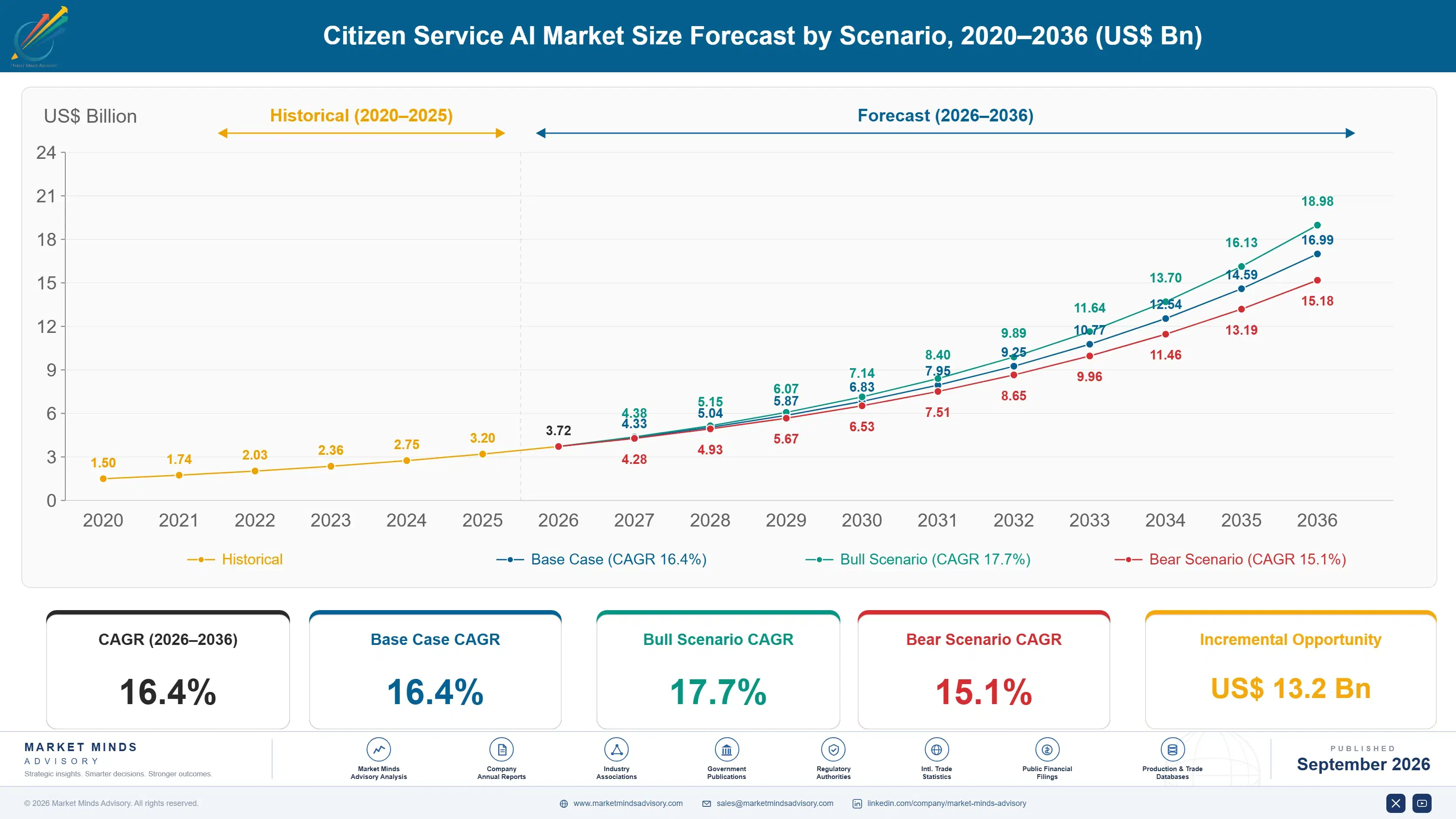
Citizen Service AI Market Forecast Scenarios

citizen-service-ai-market-size-forecast-scenario-1790005516550
Growth between 2020 and 2025 followed crisis rather than strategy. Pandemic benefit programmes overwhelmed agencies whose intake ran on paper, and emergency procurement bought conversational assistants at speed with little evaluation attached. Historical growth of 14.9% reflects that surge and the subsequent reassessment, as agencies discovered that deflection figures looked impressive while backlogs had not moved and complaint volumes had risen.
The base case at 16.4% rests on three mechanisms. Application intake volumes continue rising while caseworker headcount does not, which forces processing automation regardless of political appetite. Language obligations, particularly in multilingual jurisdictions, cannot be met with human translation capacity at the required response times. And assurance frameworks now emerging in several jurisdictions establish accuracy and appeal requirements that agencies must satisfy through documented systems rather than through informal deployment.
The bull case at 17.7% turns on eligibility determination becoming automatable within a formal appeal framework, which would move the largest single cost in benefit administration. The bear case at 15.1% is a public trust event: a widely reported wrongful determination affecting vulnerable claimants would slow procurement across every jurisdiction watching, and this category has less political tolerance for error than almost any other software market.

Deflection Is Not The Same As Resolution

The headline metric in this market is misleading and everybody uses it anyway. A deflection rate of 34% counts every enquiry that did not reach a caseworker, which includes the citizen who found an answer and the citizen who gave up. Roughly 41% of deflected contacts filed nothing afterward, and for a benefits agency that is not a saving. It is a person who went away.
TOP FIVE CONCENTRATION29%Share of contracted value held by the leading suppliers
CONTACT DEFLECTION RATE34%Enquiries resolved without ever reaching a human caseworker
ABANDONMENT WITHIN DEFLECTION41%Deflected contacts where the citizen filed nothing afterward
DOCUMENT PROCESSING ACCURACY94%Field level extraction accuracy accepted in agency contracts
MEDIAN CONTRACT VALUEUSD 1.4 millionAnnual value of a typical national agency implementation
PROCUREMENT DURATION14 monthsMedian period from published notice to contract award
Processing work behaves differently because it is inspectable. When a system extracts fields from a submitted document at 94% accuracy, the errors are countable, correctable, and attributable, and an agency can write that threshold into a contract. Nobody has found a comparable way to specify what a conversational assistant should achieve, which is why procurement has drifted upstream. Contracts now specify what nobody can otherwise verify.
Assurance is becoming the real product. Agencies cannot inspect a model and increasingly do not try, so they contract against measured outcomes, appeal rates, and documented error handling instead. Suppliers able to evidence performance under audit are winning awards against competitors with better demonstrations, and that shift has done more to reshape the competitive field than any technical advance. Demonstrations decide very little now.
"Every agency we interviewed could quote a deflection rate. Almost none could tell us what happened to the people who were deflected. That gap is where the next round of public criticism is going to come from, and the suppliers who measure it now will be the ones still selling afterward."
Practice Director, Public Sector Technology and Service Delivery · MMA Technology Practice · September 2026

Market Trends

Procurement Shifts Upstream Toward Inspectable Processing Work

Conversational deployments produced impressive dashboards and disappointing outcomes, and agencies noticed. Document processing and application intake grows at 24.6% because the work is measurable: extraction accuracy at field level can be sampled, audited, and written into a contract as a threshold with consequences attached. Around 47% of new citizen service awards now cover processing rather than interaction, reversing the balance of five years ago. The commercial consequence is that suppliers whose capability rests on conversational design are competing for a shrinking share of a growing market, and several have repositioned accordingly.
Market Impact: Addresses 47% award share

Assurance Frameworks Convert Model Quality Into Contract Terms

Agencies cannot inspect a model in any meaningful way, and most have stopped pretending otherwise. Instead they contract against measured accuracy, documented error handling, appeal pathways, and periodic independent sampling, which turns the purchasing question from technical assessment into evidence assessment. Roughly 38% of published procurements now include an accuracy threshold with financial consequence attached, up sharply from a marginal share three years ago. Suppliers who can evidence performance under audit win against competitors with better demonstrations, and the gap widens as frameworks mature across jurisdictions. Evidence assessment has replaced technical assessment entirely.
Market Impact: Serves 22 official languages

Market Opportunities and Growth Drivers

Application Volumes Rise While Caseworker Headcount Does Not

Benefit, permit, and licence application volumes have grown steadily across most jurisdictions while administrative headcount has been flat or falling under fiscal constraint. That arithmetic forces processing automation whether or not anybody wanted it, because backlogs become politically visible long before budgets recover. Agencies facing published waiting time targets buy against those targets directly. The commercial character is defensive rather than ambitious: the buyer is managing a queue that is already embarrassing, which shortens evaluation and makes demonstrated throughput a more persuasive argument than any capability demonstration. Published waiting times drive the timetable directly.
Market Impact: Abandons 41% of deflected contacts

Multilingual Obligations Exceed Available Human Translation Capacity

Jurisdictions with many official or widely spoken languages cannot meet service response obligations through human translation at the volumes involved. India's growth of 22.4% leads every country covered, driven by service delivery across 22 official languages where the alternative to machine translation is no service at all. European jurisdictions face a smaller version of the same problem, and Gulf states a third. The obligation is legal rather than aspirational in most of these cases, which makes the purchase difficult to defer and largely insulates it from general spending restraint. Legal obligation resists spending restraint.
Market Impact: Delays award by 14 months

Market Restraints and Challenges

Deflection Metrics Conceal Abandoned Citizen Interactions

About 41% of deflected contacts result in no subsequent filing, and the root cause is measurement design: deflection counts contacts that did not reach a caseworker, without distinguishing resolution from abandonment. Agencies procured against that metric for years. Commercially the reckoning is arriving as evaluations catch up, and suppliers whose case studies rest on deflection numbers are facing questions they cannot answer. Participants are responding by instrumenting downstream outcomes, reporting completed applications rather than avoided contacts, and by moving toward processing work where the result is directly observable. Downstream instrumentation is the honest answer.
Market Impact: Covers 47% of new awards

Public Procurement Runs Fourteen Months To Award

Median elapsed time from published notice to contract award is 14 months, and the cause is procedural rather than technical: public procurement law requires transparency steps that cannot be compressed, and challenge periods extend timelines further. For suppliers this means long unfunded pursuit costs, revenue that arrives in unpredictable clusters, and technology that has moved on before the contract is signed. Workarounds include framework agreements and pre-qualified supplier arrangements that allow call-off without full competition, innovation pilot funding outside main procurement, and consortium bidding with established prime contractors. Consortium bidding also shortens the route considerably.
Market Impact: Appears in 38% of procurements
4 additional market trends, 3 additional growth drivers, and 2 additional restraints and challenges are covered in the full report. Contact sales@marketmindsadvisory.com to access the complete intelligence.

Segment CAGR and Growth Architecture

Segmentation follows service function. Six functional segments cover the field: conversational assistants and contact deflection, document processing and application intake, eligibility screening and benefit determination, translation and accessibility services, case triage and workload routing, and identity verification and fraud detection. Most agencies now buy processing before interaction. Interaction work follows once processing is working properly.
citizen-service-ai-market-market-share-analysis-1790005517087

Document Processing And Application Intake

Processing grows at 24.6%, half again the market rate of 16.4%, and inspectability is the whole reason. Field level extraction accuracy can be sampled independently, written into a contract at 94% with consequences attached, and audited afterward by somebody who was not involved in building it. Nothing comparable exists for conversational quality, which is why 47% of new awards now cover processing rather than interaction. The buyer is usually managing a visible backlog rather than pursuing an efficiency ambition, so demonstrated throughput on real submitted documents persuades far more effectively than any capability demonstration on curated examples ever does. Independent sampling has become a standard contract term rather than an unusual one.
CAGR 24.6%

Eligibility Screening And Benefit Determination

Eligibility work grows at 20.1% and carries both the largest prize and the largest risk in the category. Determination is the single biggest cost in benefit administration, so automating even part of it moves real money. It is also where a wrongful outcome affects a vulnerable claimant directly, which is why almost every deployment operates as a recommendation to a caseworker rather than as a decision. Formal appeal frameworks are the gating condition: jurisdictions that have built them procure confidently, and those that have not restrict systems to screening and triage regardless of what the technology can demonstrably do. Policy readiness, rather than model capability, sets the pace of adoption here.
CAGR 20.1%
Full segment breakdown across 6 segments available in the complete report.

Regional Architecture and Country Demand Map

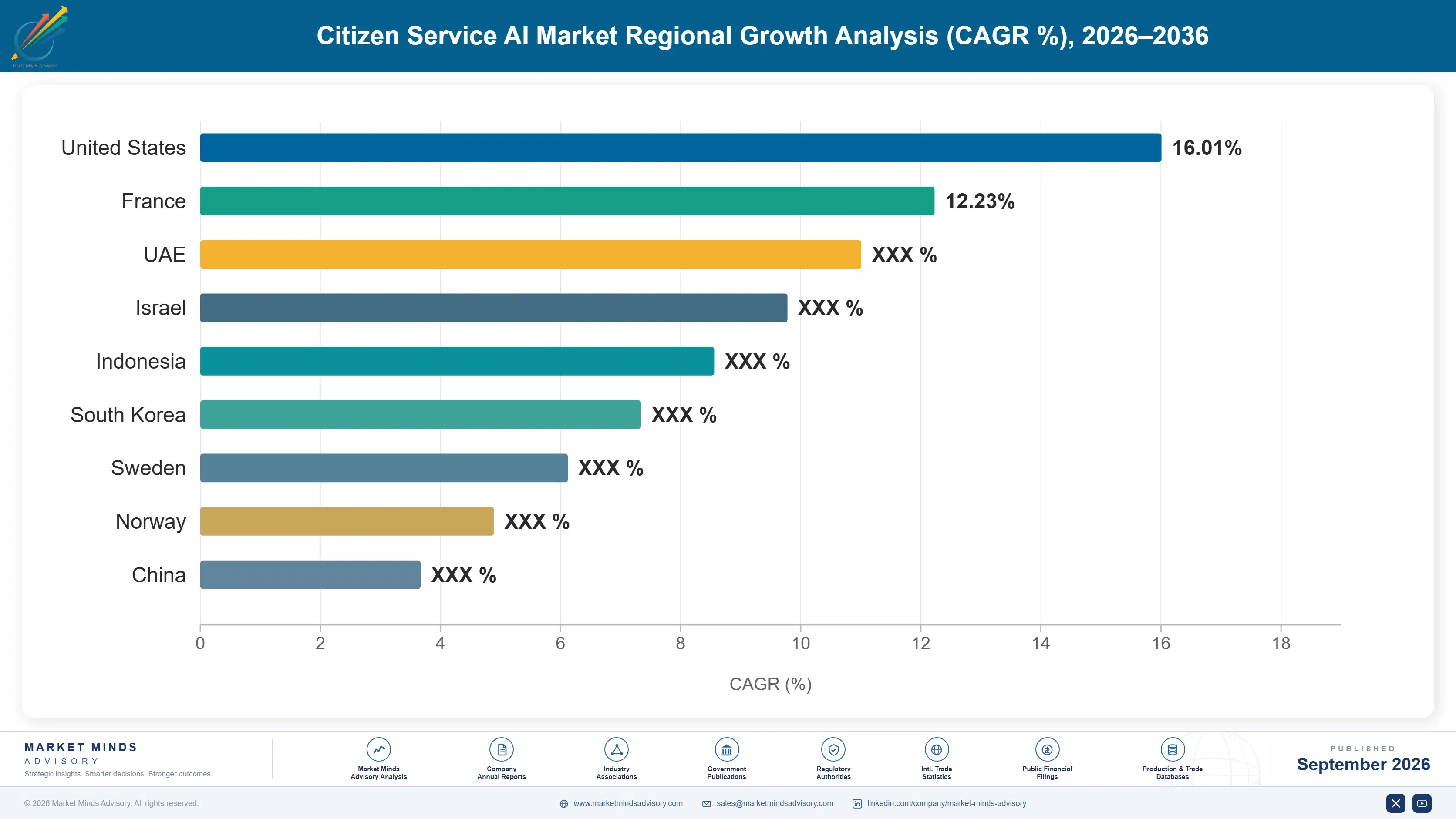
Regional shares track contracted value with government buyers, which follows administrative volume and procurement capability rather than population or economic size. Jurisdictions with centralised service platforms concentrate spending in ways that federal structures deliberately avoid, and both patterns appear here. Contract values vary enormously between the seven.

East Asia

Provincial and municipal service platforms in China operate at a population scale nothing else in this market approaches, consolidating hundreds of administrative services into single access points where processing automation delivers measurable throughput gains. Japan's digital agency has driven national standardisation across local government systems, which creates procurement at a level individual municipalities could never fund. Korean administrative modernisation adds a third, smaller stream. Growth of 17.4% runs above the world rate because centralised platform architecture lets a single procurement reach an entire population, and because processing volumes here make the throughput argument straightforward rather than speculative. One procurement can reach an entire provincial population at once. Throughput arguments are straightforward here.
Share: 28% | CAGR: 17.4% (2026 to 2036)

North America

Federal and state agencies buy separately, which fragments procurement but multiplies the number of buyers. State unemployment and benefits system modernisation, much of it triggered by pandemic-era failures that remain politically live, supplies the largest single demand stream. Federal agencies procure through established framework vehicles that shorten award timelines considerably against the category median. Growth of 15.4% is moderate, held back by procurement duration and by an unusually cautious posture toward automated determination following several publicised eligibility disputes. Assurance requirements here are among the most developed anywhere, which favours suppliers who can evidence performance under independent audit. Framework vehicles shorten award timelines against the category median considerably. Assurance requirements are among the world's most developed.
Share: 26% | CAGR: 15.4% (2026 to 2036)
Regional intelligence for 5 additional markets available in the complete report: Western Europe, South Asia and Pacific, Latin America, Middle East and Africa, Eastern Europe. Contact sales@marketmindsadvisory.com.
citizen-service-ai-market-country-cagr-analysis-1790005517613

Where Suppliers Win Government Work

Four commercial moves separate suppliers winning durable government work from those pursuing long procurements they lose. Each responds to the same reality: agencies cannot inspect a model, they are increasingly unwilling to buy on demonstration, and they will contract against evidence they can audit afterward. Demonstration quality decides almost nothing in a modern evaluation.

Contract Against Measured Accuracy With Consequences Attached

Offering an accuracy threshold with financial consequence converts an unverifiable claim into a commitment an agency can defend to its own oversight. Roughly 38% of published procurements now require this, and suppliers who propose it before being asked win at materially higher rates because they have removed the buyer's largest anxiety. Doing it credibly requires measurement infrastructure most suppliers do not have. The commitment is genuinely risky only for suppliers whose performance they cannot themselves predict, which is precisely the useful signal it sends. Proposing it early removes the buyer's largest anxiety immediately.
Market Impact: Now required in 38% of all published procurements

Report Completed Outcomes Instead Of Avoided Contacts

Deflection rates are becoming a liability as evaluations discover that 41% of deflected citizens filed nothing. Suppliers who instrument downstream completion, reporting applications finished rather than contacts avoided, arrive at evaluation with the number the agency now wants and competitors cannot produce retrospectively. Early movers report win rates roughly 2.3 times higher in re-procurements of existing conversational deployments. The instrumentation work is modest, and it also protects the supplier when the inevitable critical review of deflection metrics arrives in a given jurisdiction. Competitors cannot produce the number retrospectively at all.
Market Impact: Raises re-procurement win rate by about 2.3 times

Enter Through Framework And Pre-Qualified Vehicles

A 14 month median procurement makes direct competition expensive and slow, while framework agreements and pre-qualified supplier arrangements permit call-off in weeks. Suppliers listed on the major vehicles in their target jurisdictions close roughly 3.1 times as many public sector engagements annually as those bidding open competitions alone. Listing costs administrative effort and some pricing transparency, and it is worth both, particularly for suppliers without an established prime contractor relationship to ride into an agency on somebody else's paper. Pursuit cost falls by an order of magnitude, and so does the wait.
Market Impact: Closes 3.1 times more public engagements every year

Build Appeal Pathway Design Into The Offer

Eligibility work carries the largest prize in this market and is gated by whether a jurisdiction has a formal appeal framework, not by technical capability. Suppliers who help design that pathway, working alongside legal and policy staff, shape the specification that follows and are rarely displaced from it afterward. Engagements entered this way carry contract values roughly 60% to 90% above comparable processing-only work. The consulting effort is unbillable at first and it buys a position that competitors cannot bid against later. Policy readiness is the gate, not technical capability.
Market Impact: Lifts contract value by roughly 60% to 90%

Who Controls the Margin Pool

This is an open field by public sector standards. The top five hold 29% of contracted value, measured consistently on that basis across all participants, and three distinct groups compete for the same awards: systems integrators with government delivery history, hyperscale platform providers, and specialist vendors built for particular service functions. The gap between the leader and the fifth is narrow enough that a single national programme reorders positions.
Competition currently turns on three things: ability to commit to measured accuracy with consequences, presence on framework and pre-qualified vehicles, and evidence of delivered outcomes rather than demonstrated capability. Technical differentiation matters less than suppliers believe, because agencies cannot assess it directly and have largely stopped trying. Price competition is moderate, constrained more by delivery capacity than by margin discipline.

Pressure is building from two directions. Specialists with strong processing evidence are taking work from integrators whose credentials are general rather than specific. Meanwhile domestic suppliers in several jurisdictions are winning on data residency and language coverage that international competitors cannot match. Rankings will shift toward whoever holds eligibility determination positions, where contract values run well above the category.
citizen-service-ai-market-company-positioning-matrix-1790005518137

Competitive Moat and Risk Dimensions

ACCENTURE

Moat: Government Delivery Track Record

Decades of large public programme delivery produce reference evidence that new entrants cannot assemble, and agencies procuring at national scale weight delivery risk heavily because a failed programme becomes a political event. That record wins awards where the buyer's dominant concern is whether the work will actually complete rather than how capable the technology is.
ACCENTURE

Risk: General Rather Than Specific Evidence

Assurance frameworks increasingly demand measured accuracy on the specific service function being procured, not general delivery credentials. Specialist competitors with narrow processing evidence answer that question directly, and evaluation panels weighting it heavily are the ones where broad integrator credentials count for considerably less than they used to.
MICROSOFT

Moat: Accreditation And Residency Coverage

Government cloud accreditation across many jurisdictions, with data residency arrangements already in place, removes a barrier that takes competitors years and substantial expense to clear. For agencies under sovereignty requirements this frequently narrows the credible field before any functional evaluation begins, which is a powerful position to hold quietly.
MICROSOFT

Risk: Domestic Preference In Jurisdictions

Several governments now weight domestic supply explicitly in procurement, on sovereignty and language coverage grounds that an international provider cannot satisfy through accreditation alone. That exposure concentrates in exactly the fastest growing markets, where national digital programmes are largest and political attention to supplier origin is highest.

Players Tracked

Prominent Players

Accenture
Microsoft
Salesforce
ServiceNow
Deloitte

Other Key Players

IBM
Google
Amazon Web Services
Infosys
Tata Consultancy Services
Capgemini
Atos
NEC
Fujitsu
Hitachi
Wipro
Genesys
NICE
Pegasystems
Verint

Recent Developments

APRIL 2026

ServiceNow Awarded Application Processing Contract By National Agency

ServiceNow was selected to deliver document processing and intake automation for a national benefits agency, with the award specifying a field level extraction accuracy threshold and independent periodic sampling rather than relying on supplier reported performance figures. Sampling is conducted by a party unconnected to the delivery team.
Signal: Accuracy thresholds with independent sampling are becoming standard rather than exceptional in published government procurements now.
DECEMBER 2025

Salesforce Releases Eligibility Screening Module With Appeal Support

Salesforce released an eligibility screening capability designed to operate as a caseworker recommendation rather than an automated determination, with documented reasoning output built specifically to support the appeal pathways that administrative law requires in most jurisdictions. Reasoning output is retained for the statutory record and made available on request.
Signal: Eligibility products are being designed around appeal frameworks because determination without one remains commercially unsellable anywhere.
AUGUST 2025

NEC Signs Supply Agreement With Japanese Local Government Consortium

NEC entered a supply agreement covering standardised citizen service processing across a consortium of Japanese municipalities, following national standardisation work that allows shared procurement at a scale individual local authorities could not fund alone. Standardised processing replaces separately commissioned systems across dozens of participating authorities.
Signal: Centralised platform architecture lets a single procurement reach whole populations that fragmented federal buying never assembles.

What Delivery Costs Suppliers

Three inputs dominate. Model inference compute runs 24% to 31% of cost of goods sold, implementation and integration staff take 30% to 38%, and security accreditation with ongoing assurance obligations adds a further 9% to 14%. Inference capacity is procured from a small number of providers, several of which also compete for the same government awards, which is an uncomfortable dependency that suppliers discuss privately and rarely disclose.
Inference pricing moved substantially through 2024 and 2025 in both directions as model efficiency improved while demand rose, and several suppliers described the resulting margin volatility in their annual reports for those years. Fixed-price government contracts signed before the movement carried the exposure entirely, since public procurement rarely permits mid-term repricing. Escalation and technology refresh clauses have since become common in multi-year agreements. Mid-term repricing remains rare.

The competitive disadvantage mechanism runs through implementation rather than compute. A supplier rebuilding integration into legacy agency systems for each engagement carries service cost that a supplier with reusable connectors does not, and cannot price against it in a competitive tender. Exposure varies by player type. Large integrators amortise accreditation and connectors widely. Specialists carry both against fewer contracts and are being priced out.
citizen-service-ai-market-cost-volatility-analysis-1790005518333

Build Reusable Connectors For Common Agency Systems

A relatively small number of case management and benefit administration platforms account for most agency deployments in any given jurisdiction, so building certified connectors once removes the largest recurring implementation cost. Suppliers with complete coverage report integration effort falling by roughly 40%, which converts directly into competitiveness on fixed-price tenders. Fixed-price tenders reward that discipline directly.

Negotiate Committed Inference Capacity At Fixed Rates

Multi-year committed volume with an inference provider converts spot pricing exposure into planned cost, which matters because government contracts are themselves fixed price and rarely repriceable. The trade is flexibility for predictability, and it suits suppliers whose contracted pipeline already fixes volumes well ahead of delivery. Government contracts fix volumes well ahead of delivery, which makes commitment straightforward.

Amortise Accreditation Across Multiple Jurisdictions

Government security accreditation is expensive to obtain and considerably cheaper to extend into adjacent jurisdictions with comparable frameworks. Suppliers sequencing entry to reuse accreditation evidence spread that cost across a wider revenue base, which is a genuine reason smaller specialists retreat from multi-country public sector work. Sequencing entry deliberately is worth real money over several years.

Portfolio Architecture for Margin Defence

Margin follows how directly performance can be evidenced. Conversational deployment is drifting toward commodity, since the outcome cannot be specified credibly and buyers have grown sceptical of the metric that sold it. Processing work earns considerably more because accuracy is contractible. Eligibility and appeal-supported determination earns most of all, since the prize is large and very few suppliers can operate credibly inside an administrative law framework.
The tension between volume and premium runs through implementation cost. High-volume conversational work carries integration effort that fixed-price tenders barely cover, and suppliers without reusable connectors lose money on every engagement. Premium eligibility work carries far better economics but scales only with the number of jurisdictions that have built formal appeal pathways, which is a policy variable no supplier controls.

High-value pools concentrate where administrative cost is largest and the framework permits automation: eligibility determination in jurisdictions with appeal structures, national platform processing at population scale, and Gulf programmes with mandated deployment targets. What these share is a buyer who has already decided to proceed and needs a supplier who can survive the assurance requirement. Elsewhere, procurement compares day rates.

Volume / Commodity-Adjacent

Conversational assistant deployment, contact deflection, and basic translation services. Outcomes are difficult to specify credibly and buyers have grown sceptical of deflection metrics. The nine-point range reflects wide variation in whether suppliers reuse integration connectors across engagements.
Gross Margin: 31% to 40%

Premium / Certified

Document processing and application intake contracted against measured field level accuracy with independent sampling. Evidence requirements narrow the credible field considerably before evaluation. The nine-point range separates suppliers with measurement infrastructure from those committing to thresholds they cannot reliably predict.
Gross Margin: 47% to 56%

Sustainability / Regulatory / Next-Generation

Eligibility screening and determination operating inside formal appeal frameworks, plus identity verification at national scale. Very few suppliers can work credibly within administrative law constraints. The ten-point range reflects how differently jurisdictions structure appeal and assurance obligations.
Gross Margin: 58% to 68%
citizen-service-ai-market-portfolio-architecture-1790005518832

High-value Sub-segments and Strategic Watch-out

Eligibility Determination With Appeal Support

Highest value and strong growth at 20.1%, addressing the largest single cost in benefit administration. Deployment is gated by whether a jurisdiction has built a formal appeal framework rather than by technical capability. The ten-point range reflects differing assurance obligations across administrative law traditions. Policy readiness gates entry.
Gross Margin: 60% to 70%

National Platform Document Processing

High value with the fastest growth at 24.6%, driven by inspectable accuracy that agencies can contract against and audit. Centralised platforms let one procurement reach an entire population. The eight-point range separates suppliers with reusable connectors from those rebuilding integration each time. Accuracy is genuinely contractible.
Gross Margin: 52% to 60%

Identity Verification And Fraud Detection

The steady core of premium work, funded by benefit integrity programmes whose business case survives changes of government unusually well. Growth tracks the market rate. Procurement is slower than elsewhere because error consequences are severe and evaluation panels weigh false positive rates heavily. False positives decide awards.
Gross Margin: 48% to 57%

Conversational Deflection Deployment

The strategic watch-out. Deflection metrics are becoming a liability as evaluations discover that many deflected citizens filed nothing, and outcomes remain difficult to specify credibly. The fourteen-point range reflects the gap between suppliers reusing connectors and those absorbing bespoke integration on fixed-price terms. Renewals are quietly disappearing.
Gross Margin: 28% to 42%

Why Government Contracts Persist

Revenue here is contractual and long, which produces stability that looks better than the underlying commercial position frequently is. Government agreements commonly run three to five years with extension options, and re-procurement demands effort that constrained administrative teams avoid unless something has failed publicly. Expansion comes through added service functions within an existing contract rather than through growth in usage of what was originally bought.
Stickiness varies sharply by function. Processing and identity verification embed deeply, because the system becomes the intake path and removing it means rebuilding an operational process that auditors have already examined. Eligibility deployments are stickier still, since appeal pathways are documented around the specific system. Conversational deployments are the least durable, and several have been quietly discontinued at renewal without any replacement procurement following.

The buyer profile has shifted decisively. Digital transformation teams drove early purchasing and bought on demonstrated capability and user experience. Programme assurance officers, legal counsel, and operational directors now shape most significant awards, and they ask about measured accuracy, appeal handling, error attribution, and audit evidence. Suppliers still leading with demonstrations are addressing an audience that stopped deciding these procurements some years ago.
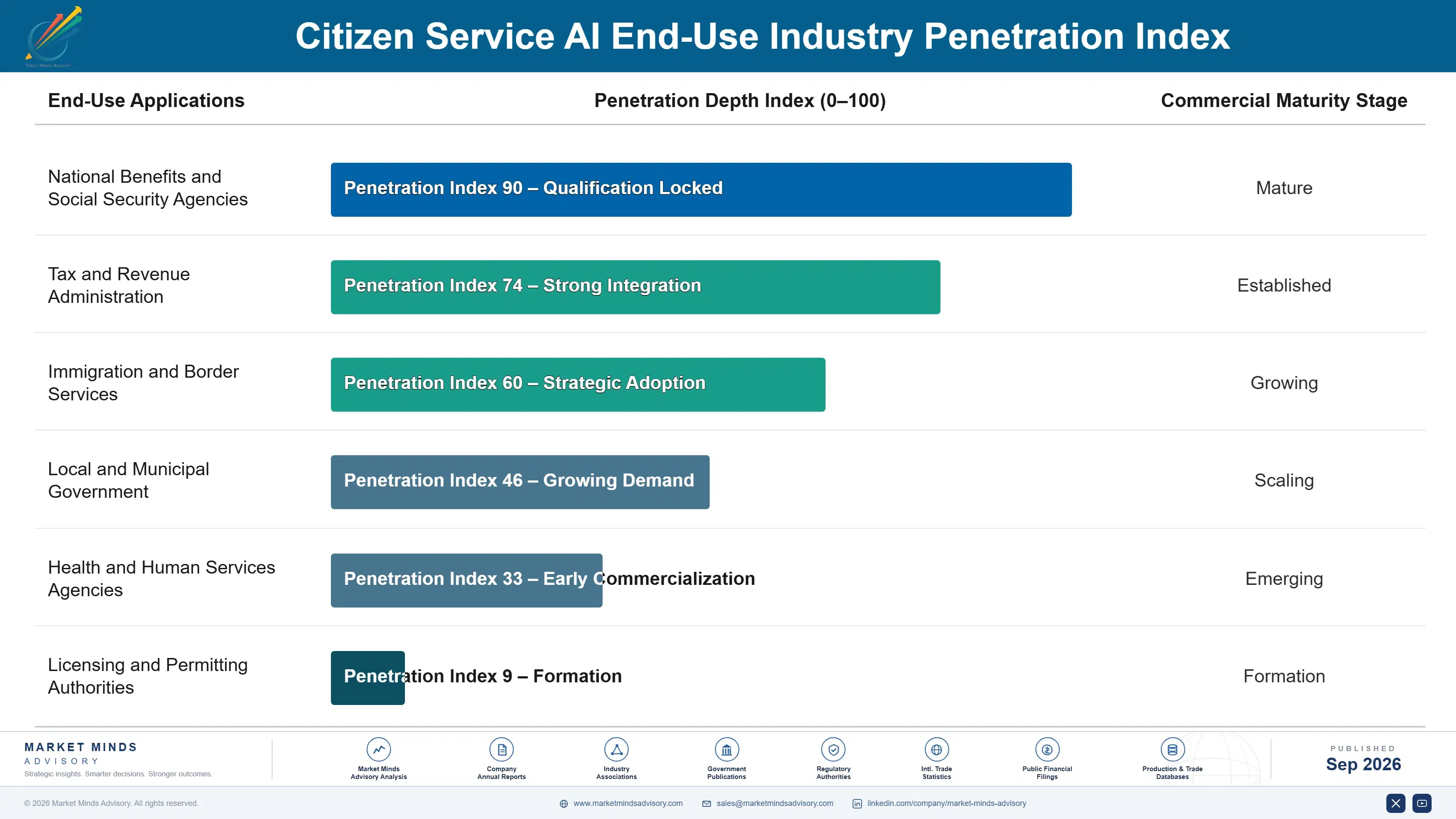
citizen-service-ai-market-end-use-penetration-index-1790005519325

Where This Market Rewards

These are among the four positions where our research anticipates prominent divergence between winners and laggards over the coming forecast period. Each is grounded in the demand model, the regulatory perimeter, and the announced capacity pipeline.
01 / OUTCOME MEASUREMENT HONESTY

Deflection was never the number that mattered

Agencies report deflecting 34% of enquiries while roughly 41% of those citizens filed nothing afterward, which means the headline metric counts service failure and service success identically. Evaluations are catching up, and suppliers whose case studies rest on deflection are facing questions they cannot answer retrospectively. Instrumenting completed applications instead raises win rates about 2.3 times in re-procurements, and it protects the supplier when critical reviews eventually arrive in a given jurisdiction, as they eventually will in that market, as they eventually will.
02 / CONTRACTIBLE ACCURACY COMMITMENT

Evidence beats demonstration in every assurance framework

Agencies cannot inspect a model and have largely stopped trying, so they contract against measured accuracy with consequences attached, which now appears in roughly 38% of published procurements. Suppliers proposing a threshold before being asked remove the buyer's largest anxiety and win at materially higher rates than competitors with better demonstrations. The commitment is only risky for suppliers who cannot predict their own performance, which is exactly the signal it sends, and evaluation panels have learned to read it that way.
03 / PROCUREMENT ROUTE SELECTION

Fourteen months of open competition is avoidable

Median time from published notice to award runs 14 months, which makes open competition expensive to pursue and slow to convert for any supplier without deep reserves. Framework agreements and pre-qualified vehicles allow call-off in weeks, and suppliers listed on the major ones close roughly 3.1 times as many public engagements annually. Listing costs administrative effort and some pricing transparency, and both are trivial against the timeline saved, particularly for a challenger without an incumbent position anywhere to fall back on.
04 / APPEAL FRAMEWORK POSITIONING

Eligibility work is gated by policy, not technology

Determination is the largest cost in benefit administration and the largest prize in this market, yet deployment depends entirely on whether a jurisdiction has built a formal appeal pathway rather than on capability. Suppliers who help design that pathway alongside legal and policy staff shape the specification that follows and carry contract values roughly 60% to 90% above processing-only work. The early consulting is unbillable and buys an unassailable position that competitors cannot later bid against once the pathway exists.

Engagement Snapshot From the Field

A live engagement with an industry participant carrying material or product regulatory and market exposure ahead of a defining policy shift, showing how our research translates into a defensible multi-year portfolio strategy.
MARKET MINDS ADVISORY · CLIENT ENGAGEMENT SUMMARY
Citizen Service AI Producer Strategic Portfolio Review and Transition Roadmap 2026·Investment Scenario on Citizen Service AI Exposure Evaluation 2025-26
CLIENT PROFILE
A national benefits agency processing approximately 4.1 million applications annually across income support, disability, and housing programmes, with administrative expenditure above USD 890 million (client-reported, unverified by MMA). The agency had deployed a conversational assistant three years earlier and was preparing to procure the next phase of its automation programme with a substantially larger budget.
STRATEGIC CHALLENGE
The conversational deployment reported a 31% deflection rate, which leadership had cited publicly, but application backlogs had grown and complaint volumes had risen over the same period. Nobody could reconcile the figures. The agency needed to decide whether to expand the existing approach, redirect toward processing, or attempt eligibility automation.
MMA APPROACH
MMA matched deflected contact records against subsequent filing activity to establish what actually happened to those citizens, benchmarked processing accuracy achievable on the agency's own document mix, and assessed the jurisdiction's appeal framework against requirements for automated determination. Supplier capability was evaluated on evidenced delivery rather than on demonstration performance.
KEY FINDINGS
  1. Of contacts recorded as deflected, 44% produced no subsequent application within ninety days, and complaint rates among that group ran roughly triple the agency average.
  2. Field level extraction accuracy of 94% was achievable on the agency's actual document mix, sufficient to remove an estimated 38% of manual intake handling entirely.
  3. The existing appeal framework did not support automated determination, and amending it was assessed as a two year legislative and procedural exercise rather than a technical one.
  4. Only four of the eleven candidate suppliers were willing to commit to a measured accuracy threshold carrying financial consequence during structured procurement discussions.
CLIENT PROFILE
A national benefits agency processing approximately 4.1 million applications annually across income support, disability, and housing programmes, with administrative expenditure above USD 890 million (client-reported, unverified by MMA). The agency had deployed a conversational assistant three years earlier and was preparing to procure the next phase of its automation programme with a substantially larger budget.
STRATEGIC CHALLENGE
The conversational deployment reported a 31% deflection rate, which leadership had cited publicly, but application backlogs had grown and complaint volumes had risen over the same period. Nobody could reconcile the figures. The agency needed to decide whether to expand the existing approach, redirect toward processing, or attempt eligibility automation.
MMA APPROACH
MMA matched deflected contact records against subsequent filing activity to establish what actually happened to those citizens, benchmarked processing accuracy achievable on the agency's own document mix, and assessed the jurisdiction's appeal framework against requirements for automated determination. Supplier capability was evaluated on evidenced delivery rather than on demonstration performance.
KEY FINDINGS
  1. Of contacts recorded as deflected, 44% produced no subsequent application within ninety days, and complaint rates among that group ran roughly triple the agency average.
  2. Field level extraction accuracy of 94% was achievable on the agency's actual document mix, sufficient to remove an estimated 38% of manual intake handling entirely.
  3. The existing appeal framework did not support automated determination, and amending it was assessed as a two year legislative and procedural exercise rather than a technical one.
  4. Only four of the eleven candidate suppliers were willing to commit to a measured accuracy threshold carrying financial consequence during structured procurement discussions.
RECOMMENDED STRATEGY
Phase 1: Phase one: redirect the automation budget toward document processing and intake, contracted against a measured field level accuracy threshold with independent periodic sampling attached. Phase 2: Phase two: reinstrument the conversational deployment to report completed applications rather than deflected contacts, and reset published performance claims accordingly. Phase 3: Phase three: begin appeal framework development in parallel, positioning eligibility screening procurement for the following cycle once the pathway exists.
OUTCOME
Twelve months after phase one, manual intake handling fell by 34% and the application backlog reduced for the first time in four years (client-reported, unverified by MMA). Republished performance reporting drew criticism initially and removed a standing audit finding. Appeal framework development began on the recommended timetable.

Frequently Asked Questions

Foundational context covering the market sizes, CAGR, scope, country, region and competition that inform every finding below. This section is provided to cover basics and most often pre-purchase conversations, answered from the MMA Primary Research Dataset.

What is the current size of the Citizen Service AI Market?

The market was worth USD 3.2 billion in 2025 and reaches USD 3.7 billion in 2026. Value is measured on contracted value with government buyers.

How large will the Citizen Service AI Market be by 2036?

MMA forecasts USD 16.9 billion by 2036, an increase of USD 13.2 billion across the forecast period. That represents 4.57 times the 2026 base of USD 3.7 billion.

What is the CAGR for the Citizen Service AI Market 2026 to 2036?

The base case compound annual growth rate is 16.4%, with a bull case at 17.7% and a bear case at 15.1%. Historical growth from 2020 to 2025 ran at 14.9%.

Which segment is growing fastest?

Document processing and application intake grows at 24.6%, half again the market rate of 16.4%. Extraction accuracy is inspectable and can be written into a contract.

Who are the major companies in the Citizen Service AI Market?

Accenture, Microsoft, Salesforce, ServiceNow, and Deloitte lead the field, holding 29% of contracted value between them. Domestic suppliers tend to win wherever data residency requirements apply.

Which country is growing fastest?

India grows at 22.4%, driven by service delivery obligations across 22 official languages that human translation capacity cannot meet. Contract values sit below the global median.

Report Segmentation Architecture

The full report scope spans multiple orthogonal segmentation dimensions, with cross-tabulated demand data provided for each dimension pair. Coverage extends further to regional breakdowns, trend trajectories, and the competitive detail needed to support segment-level decision-making.

By Service Function

  • Conversational Assistants and Contact Deflection
  • Document Processing and Application Intake
  • Eligibility Screening and Benefit Determination
  • Translation and Accessibility Services
  • Case Triage and Workload Routing
  • Identity Verification and Fraud Detection

By End-Use Industry

  • National Benefits and Social Security Agencies
  • Tax and Revenue Administration
  • Immigration and Border Services
  • Local and Municipal Government
  • Health and Human Services Agencies
  • Licensing and Permitting Authorities

By Commercial Dimension

  • Direct Agency Procurement
  • Framework Agreement Call-Off
  • Prime Contractor Subcontract
  • Government Cloud Marketplace
  • Development Institution Funded
  • Shared Service Consortium Purchase

By Region

  • East Asia
  • North America
  • Western Europe
  • South Asia and Pacific
  • Latin America
  • Middle East and Africa
  • Eastern Europe

Scope, Methodology, and Coverage

Every figure in this report is reproducible from documented input assumptions. The scope below maps the historical period, the forecast horizon, the segmentation dimensions, and the countries covered, alongside the underlying primary and qualitative methodology.
Historical Period
2020 to 2025
Forecast Period
2026 to 2036
Base Year
2025 (USD billions; MMA Primary Research Dataset, September 2026)
Market Definition
The citizen service AI market covers software and delivered services applying machine learning to government-to-citizen service interactions, including conversational assistants and contact deflection, document processing and application intake, eligibility screening and benefit determination, translation and accessibility services, case triage and workload routing, and identity verification and fraud detection. It excludes defence and intelligence applications, internal government productivity software, tax collection systems, and law enforcement analytics.
Quantitative Units
USD billions, contracted value with government buyers
Segmentation Dimensions
Service function, end-use industry, commercial dimension, region
Regions Covered
East Asia, North America, Western Europe, South Asia and Pacific, Latin America, Middle East and Africa, Eastern Europe
Countries Covered
China, Japan, South Korea, Taiwan, United States, Canada, United Kingdom, Germany, France, Netherlands, Sweden, Denmark, Spain, India, Australia, Singapore, Brazil, Chile, Colombia, Saudi Arabia, United Arab Emirates, South Africa, Kenya, Estonia, Poland, Romania
Key Companies Profiled
Accenture, Microsoft, Salesforce, ServiceNow, Deloitte, IBM, Google, Amazon Web Services, Infosys, Tata Consultancy Services, Capgemini, Atos, NEC, Fujitsu, Hitachi, Wipro, Genesys, NICE, Pegasystems, Verint
Quantitative Methodology
Primary survey, n=3,800 respondents, Q4 2025, six countries; demand-side model with trade association cross-validation
Qualitative Methodology
47 expert interviews, Q4 2025; applied to validate demand model assumptions, identify emerging dynamics, and assess competitive positioning
Report Format
PDF and XLSX data workbook (Word format preview document)
Publisher
Market Minds Advisory
Report Code
MMA-2026-TEC-401
Published
September 2026
Contact
sales@marketmindsadvisory.com | www.marketmindsadvisory.com

Purchase the full Citizen Service AI Market Report (2026 to 2036).

The full report sizes the citizen service AI market across six service functions, seven regions, and twenty-six countries, with forecasts to 2036 under base, bull, and bear cases. It examines why deflection metrics conceal abandonment, how procurement has moved upstream toward inspectable processing work, and what assurance frameworks mean for supplier positioning. Competitive analysis covers twenty participants evaluated consistently on contracted government value, with detailed treatment of procurement duration, framework vehicles, and appeal pathway gating on eligibility work. Cost structure, margin architecture by function, and regional procurement practice are analysed in full. Primary research includes 3,800 survey responses and 47 expert interviews.
Six service functions sized and forecast separately
Twenty participants evaluated on contracted government value
Regional procurement practice across seven geographies assessed
Margin architecture by service function and evidence requirement
Deflection and abandonment analysis with downstream outcome data
Assurance framework and appeal pathway readiness by jurisdiction

Built For The People Who Decide

From boardroom strategy to bench-side execution, this report is read cover-to-cover by leaders shaping the next decade of their industry, turning demand scenarios, market dynamics and valuation benchmarks into decisions.
CXOs/ Presidents/ VPs/ Managers
M&A and Corporate Development
Strategy Teams and R&D Heads
Procurement and Product Directors
Regulatory and Compliance Leaders
Investor Relations and Equity Analysts