Market Minds Advisory
Circuit Monitoring Market

Circuit Monitoring Market: Circuit Monitoring Market. Data Center Density Forces Branch-Level Power Visibility

Rising data center power density is forcing facility operators to monitor electrical load down to the individual branch circuit, pulling budget from panel-level metering toward granular, software-driven visibility across every major facility type today

Lead Analyst

Published

September 2026

Make Smarter Decisions with Customized Research Insights

Request a free sample report and evaluate market opportunities, growth trends, and competitive dynamics relevant to your business needs.

2025 MARKET VALUE$3.4BMarket Size 2025
2036 FORECAST VALUE$9.1BBase Case , 2026 to 2036
CAGR 2026 TO 20369.4 %Bull 10.7% / Bear 8.1%
INCREMENTAL OPPORTUNITY$5.4BNet 10- year value creation
EXPANSION MULTIPLE2.46x2036 value over 2026 base
Strategic Levers
M&A Pipeline
Regional Outlook
Country Rankings
Competitive Intelligence
Segmental Deep-dive
Call-Us : 91 93563 13602

Executive Snapshot and Market Trajectory.

Circuit monitoring has moved from a niche electrical safety compliance tool into a core facility operations discipline, as rising power density makes branch-level visibility essential to preventing costly downtime across nearly every commercial and industrial facility type. Investment committees now treat this visibility as core infrastructure spending.
Data center capacity expansion is the biggest near-term demand driver, forcing facility operators to monitor individual circuit load in real time rather than relying on panel-level aggregate readings that cannot catch an overloaded branch before it trips and takes down critical compute infrastructure. Facility managers that once tolerated panel-level blind spots now treat granular circuit visibility as a genuine competitive advantage during capacity planning.
Competitive intensity is high among hardware manufacturers and software analytics vendors racing to consolidate sensing, communication, and dashboard capability into unified platforms, while legacy panel meter makers face genuine disruption risk from wireless-native challengers built around branch-level granularity from inception. Smaller regional integrators see this consolidation as a threat to their hardware-only service model. Rankings could shift soon. Established hardware vendors are responding by acquiring analytics startups rather than ceding this layer to newer entrants.
Market Definition
The circuit monitoring market comprises hardware sensors, current transformers, and software platforms that measure and report electrical load, power quality, and circuit breaker health at the individual branch circuit level within commercial, industrial, and data center facilities. It excludes utility-scale grid monitoring and residential smart meters billed directly by utilities.
Base Year Value
$3.4B in 2025 (MMA Primary Research Dataset, September 2026)
Forecast Period
2026 to 2036, eleven discrete annual values
CAGR
9.4% base case. Bull 10.7%. Bear 8.1%.
Fastest Growth Segment
Circuit Monitoring Software and Analytics Platforms: 17.0% CAGR
Fastest Growth Country
India: 14.8% CAGR
Fastest Growth Region
South Asia and Pacific: 11.4% CAGR
Largest Region
North America: 30% of 2025 global value
Market Leaders
Schneider Electric, Eaton, Siemens, ABB, and Panduit lead the market. Source: MMA Primary Research Dataset, July 2026.
Primary Survey
n=3,800 procurement and R&D decision-makers, Q4 2025, six countries
Methodology
Demand-side build-up, cross-validated against public data, 47 expert interviews

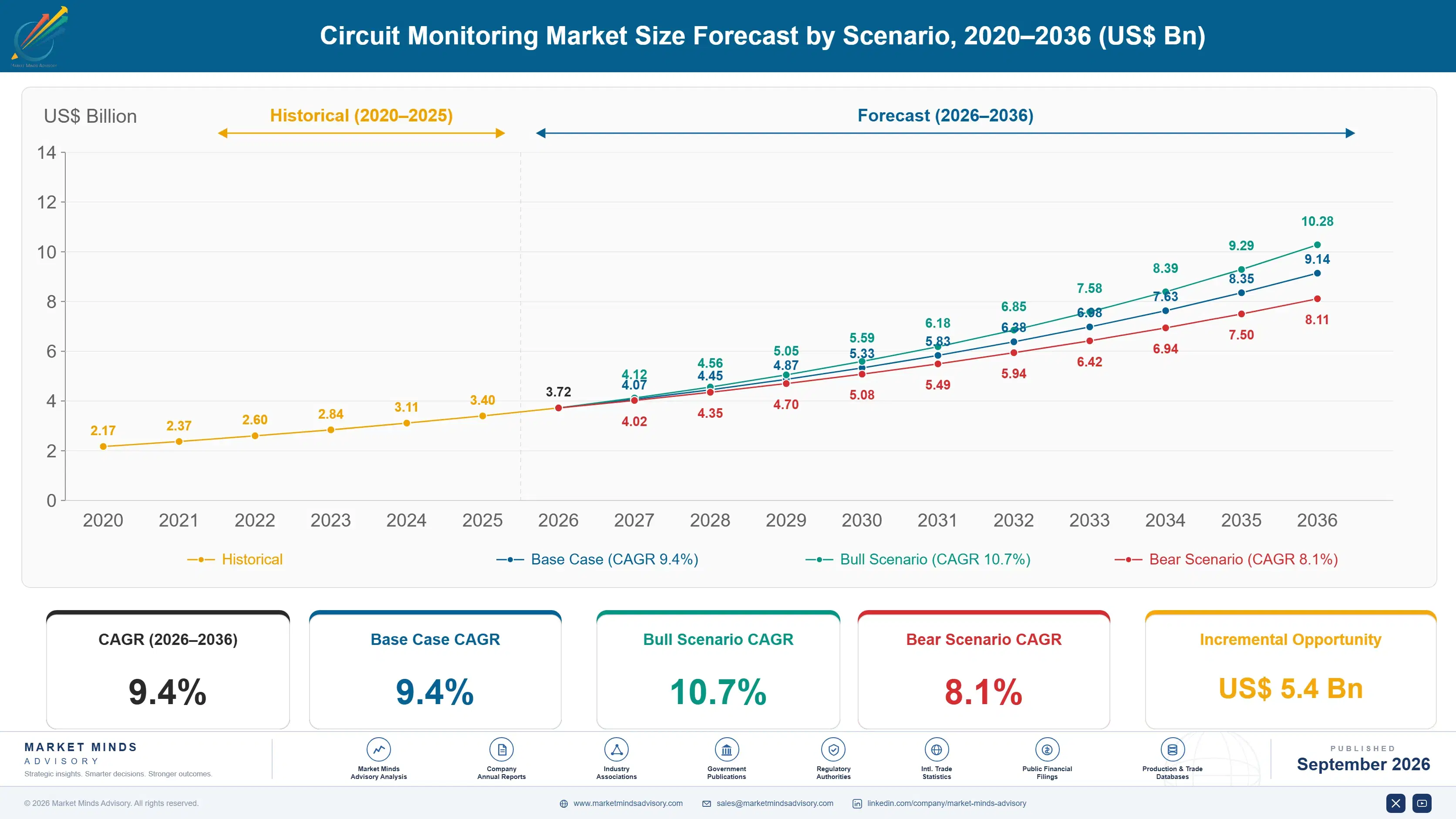
Circuit Monitoring Market Forecast Scenarios

circuit-monitoring-market-size-forecast-scenario-1790008829628
Between 2020 and 2025 the market grew steadily as smart building adoption matured, then accelerated once data center capacity expansion exposed the limits of panel-level monitoring at high power density, a historical CAGR near 8.6% across that period. Early adoption concentrated among large enterprise data center operators. Vendors spent this period proving out sensor accuracy and communication reliability under real high-density conditions.
The base case assumes continued data center capacity expansion, falling wireless sensor costs for smaller commercial buildings, and broader software analytics adoption that converts raw circuit data into actionable capacity planning insight. Together these three mechanisms push adoption beyond large data centers into mainstream commercial and industrial facility procurement across most major economies over the coming decade. Software analytics adoption removes a friction point that has slowed facility manager confidence in raw sensor data for years without proper interpretation tools.
The bull case centers on a named catalyst: expanded fire and electrical safety codes mandating branch-level monitoring in high-density occupancy buildings. The bear case centers on persistent integration complexity with legacy electrical panels that were never designed to accommodate modern sensor retrofits. Vendors addressing integration complexity through retrofit-friendly clamp-on sensors are winning trust among cautious facility operators.

Data Center Density Forces Branch-Level Power Visibility

Circuit monitoring has moved past the panel-level, aggregate-only measurement approach that defined its first decade, when facility operators could see total panel load but had no visibility into which individual branch circuit was actually driving that consumption across the facility. That earlier limitation frustrated both facility managers and capacity planners. Procurement committees today treat branch-level granularity as a baseline requirement rather than a competitive differentiator among vendors.
MARKET CONCENTRATIONCR5 40%Top five vendors hold two fifths of revenue
AVERAGE SELLING PRICE$180 per circuit pointTypical unit cost for a monitored branch circuit point
TOP PRODUCING COUNTRY SHAREChina 26%Share of global sensor manufacturing capacity concentrated there
SENSOR REPLACEMENT CYCLE8 yearsTypical operational lifespan before hardware needs full replacing
WIRELESS ADOPTION RATE44% of new installationsShare of new deployments using wireless rather than wired sensors
COMPONENT COST SHARE37%Share of unit cost from current transformers and semiconductors
Procurement officers now evaluate vendors on branch-level granularity and software analytics depth rather than on sensor price alone, forcing vendors that once competed purely on hardware cost to build genuine data platform and dashboard capability internally or through acquisition. This shift has reshaped which vendors win large enterprise facility contracts. Vendors lacking dedicated analytics dashboards increasingly lose enterprise renewal bids to fuller-service competitors offering complete solutions.
Software analytics providers increasingly outearn pure hardware manufacturers on a per-facility basis, since ongoing subscription revenue from capacity planning and anomaly detection dashboards compounds in ways a one-time sensor sale cannot match across a facility's operational lifespan. Margin pools are shifting decisively toward vendors with genuine software capability. Investors have taken notice, valuing software-heavy vendors at meaningfully higher multiples than commodity sensor manufacturers.
"The vendors winning this transition are not the ones with the cheapest current transformer. They are the ones that can tell a facility manager exactly which circuit will trip next."
Director, Facility Electrical Infrastructure Practice · MMA Construction and Industrial Equipment Practice · September 2026

Market Trends

AI-powered anomaly detection predicts circuit failures early

Vendors are embedding machine learning models directly into circuit monitoring dashboards that identify subtle load pattern changes indicating an aging breaker or failing connection before it actually trips, letting facility teams schedule proactive maintenance rather than responding to unplanned outages after the fact. This capability meaningfully reduces unplanned downtime costs that scale dramatically at high-density data center and industrial facilities where a single tripped circuit can cascade into significant financial loss. Major platform vendors have begun marketing measurable downtime reduction figures directly to prospective enterprise customers evaluating competing systems. Adoption accelerates fastest among facilities with the highest downtime cost exposure.
Market Impact: 58% of centers specify monitoring
Wireless sensor retrofits accelerate legacy building upgrades

Vendors are increasingly offering clamp-on wireless sensors that retrofit onto existing electrical panels without requiring the panel shutdown and rewiring that wired sensor installation traditionally demanded, letting facility owners upgrade monitoring capability without disrupting ongoing operations. This retrofit-friendly approach meaningfully expands the addressable installed base beyond new construction into the vast existing building stock that previously found monitoring upgrades operationally impractical. Major electrical contractors increasingly market wireless retrofit projects as a distinct service line separate from new installation work. Analysts expect retrofit-friendly installation to become the default method across most legacy building upgrade projects within a few years.
Market Impact: 23% average energy cost reduction reported

Market Opportunities and Growth Drivers

Data center power density growth outpaces panel-level visibility

Rising rack power density in modern data centers is pushing individual circuits closer to their rated capacity than facility operators have ever managed before, creating rising procurement volume for branch-level monitoring that can catch an overloaded circuit before it trips and takes down critical compute infrastructure. Data center operators increasingly specify circuit monitoring as a standard design requirement for new facility builds rather than a retrofit consideration, since the financial cost of unplanned downtime at hyperscale facilities dwarfs the monitoring investment required to prevent it. Facility design engineers report this requirement is now standard practice across most new hyperscale projects.
Market Impact: 29% of projects exceed budget

Energy cost pressure drives circuit-level efficiency optimization

Rising commercial electricity costs are pushing facility operators to identify and eliminate circuit-level energy waste that panel-level aggregate monitoring cannot isolate, creating rising procurement volume for granular monitoring that reveals exactly which equipment or circuit is driving excess consumption. This efficiency-driven demand particularly benefits vendors offering analytics that translate raw circuit data into specific, actionable efficiency recommendations rather than raw numbers facility staff must interpret manually themselves. Larger enterprises report meaningful annual energy cost savings from this granular visibility within the first full year of deployment across their facility portfolio.
Market Impact: 36% of sensor data unused

Market Restraints and Challenges

Legacy panel compatibility complicates retrofit installation

Many existing electrical panels, particularly in older commercial buildings, lack the physical space or standardized bus configuration that modern circuit monitoring sensors were designed around, forcing custom integration work that increases installation cost and timeline meaningfully beyond standard project estimates. The root cause is decades of accumulated panel design variation across different manufacturers and building eras that predates any monitoring standardization effort. Commercially this discourages smaller building owners from pursuing retrofit projects given the unpredictable installation cost. Vendors are developing universal mounting adapters as a mitigation pathway to reduce this variability.
Market Impact: 44% reduction in unplanned circuit outages

Data overload without analytics leaves value uncaptured

Many facilities deploy circuit monitoring sensors but lack the analytics capability to translate the resulting flood of raw data into actionable maintenance or efficiency decisions, leaving expensive monitoring infrastructure generating data nobody actually reviews or acts upon. The root cause is procurement budgets that fund sensor hardware readily but treat analytics software and staff training as a discretionary afterthought purchased separately if at all. Commercially this shows up in low customer satisfaction and poor renewal rates for hardware-only vendors. Leading vendors are now bundling mandatory analytics onboarding directly into hardware contracts.
Market Impact: 52% faster installation versus wired sensors
3 additional market trends, 4 additional growth drivers, and 2 additional restraints and challenges are covered in the full report. Contact sales@marketmindsadvisory.com to access the complete intelligence.

Segment CAGR and Growth Architecture

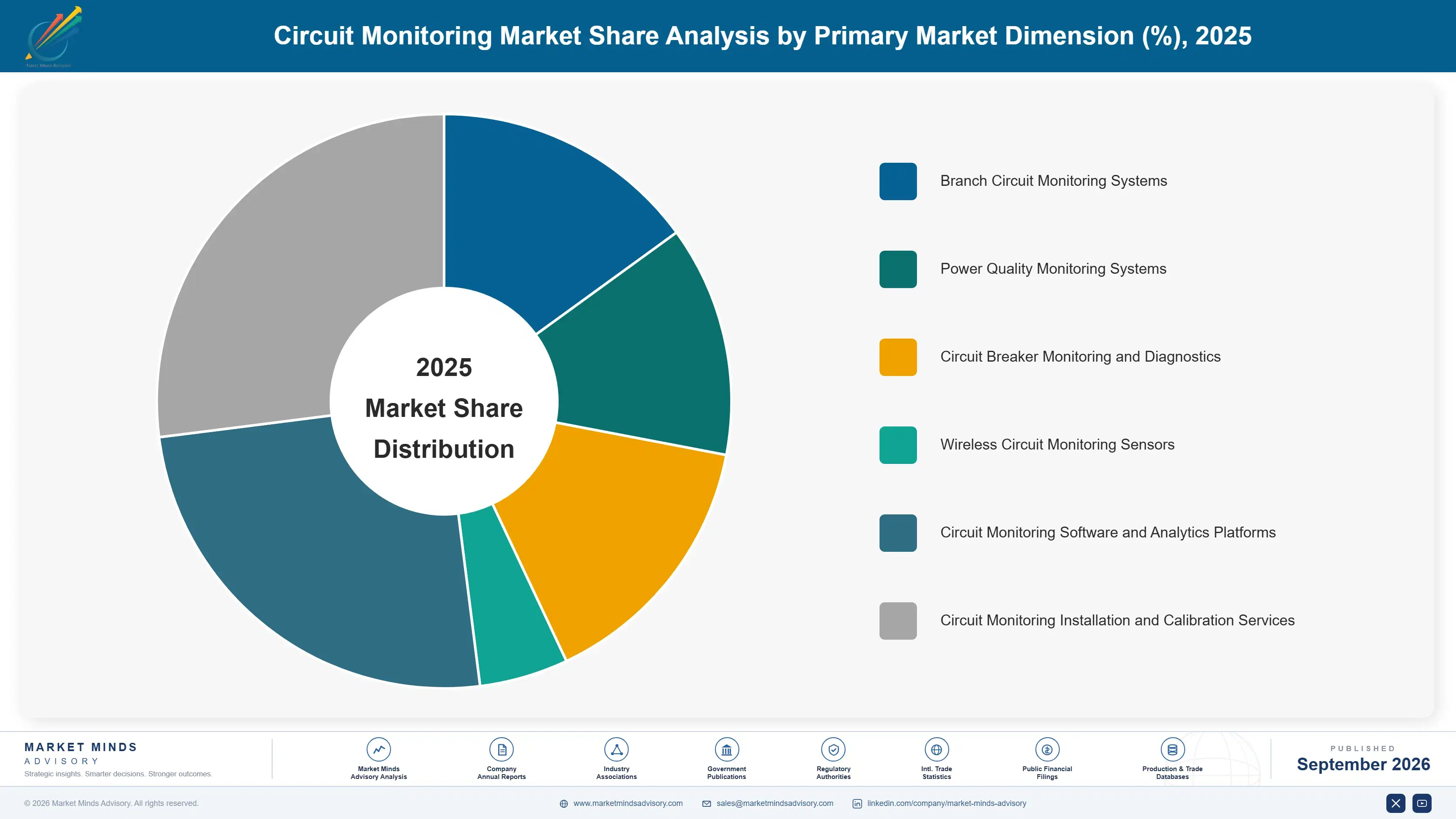
The market divides across six product segments spanning hardware, wireless, and software layers. Circuit monitoring software and analytics platforms, and wireless circuit monitoring sensors, are growing fastest as facilities move past basic panel metering toward granular, actionable branch-level insight. This split increasingly determines where vendors concentrate engineering and product investment budgets. Vendors track this closely today.
circuit-monitoring-market-market-share-analysis-1790008830164

Circuit Monitoring Software and Analytics Platforms

Circuit monitoring software and analytics platforms convert raw sensor readings into actionable capacity planning, anomaly detection, and energy efficiency insight that facility teams can actually use to make maintenance and expansion decisions. This segment is growing fastest because facilities increasingly recognize that hardware alone generates data nobody reviews without a proper interpretation layer, pushing budget toward the software that actually captures monitoring value. Vendors are increasingly building AI-powered predictive maintenance features that identify failing circuits before they trip, adding genuine operational value beyond simple historical reporting dashboards. Analysts expect this lead to widen further as more facilities recognize the value gap between raw sensor data and genuine actionable insight. today
CAGR 17.0%

Wireless Circuit Monitoring Sensors

Wireless circuit monitoring sensors clamp onto existing electrical panels without requiring the panel shutdown and rewiring that wired sensor installation traditionally demanded, letting facility owners retrofit monitoring capability onto existing buildings without disrupting ongoing operations. This segment benefits directly from the vast existing building stock that previously found wired monitoring upgrades operationally impractical given the disruption and cost involved. Electrical contractors increasingly market wireless retrofit projects as a distinct, faster service line separate from traditional new construction installation work. Analysts expect this retrofit-driven growth to keep accelerating as more legacy building owners recognize monitoring's downtime prevention value. Vendors serving this niche report strong margins given limited qualified competition and specialized retrofit expertise required to serve this segment well.
CAGR 15.0%
Full segment breakdown across 7 segments available in the complete report.

Regional Architecture and Country Demand Map

North America leads global demand, anchored by concentrated hyperscale data center capacity and stringent electrical safety code enforcement. East Asia and Western Europe follow, driven by rapid data center buildout and mature industrial facility management practices. Every region shows measurable, if uneven, monitoring adoption growth this year.

North America

The United States anchors regional demand through its concentration of hyperscale data center capacity and enterprise colocation facilities that increasingly specify circuit monitoring as a standard design requirement rather than an optional add-on. Canada contributes steady demand through its own growing data center sector, though at meaningfully smaller absolute scale than its southern neighbor. Electrical safety code enforcement here is more advanced than in most other regions, pushing facility owners toward monitoring adoption ahead of mandatory compliance deadlines. Large enterprise operators headquartered in the region increasingly mandate monitoring platform standardization across their global facility portfolios. Vendors with early enterprise relationships here are building durable renewal advantages that international competitors find difficult to replicate quickly.
Share: 30% | CAGR: 10.2% (2026 to 2036)

East Asia

China's rapid data center and manufacturing facility construction is driving disproportionate regional growth as new builds increasingly specify circuit monitoring from initial design rather than retrofitting it later. South Korea contributes through its advanced semiconductor manufacturing sector, where precise power quality monitoring is essential to protecting sensitive production equipment. Japan's precision manufacturing sector adds steady demand through facilities that value certified reliability over the lowest available unit cost. Regional sensor manufacturers increasingly export domestically built hardware to other markets as they scale beyond their home base. Analysts expect this export trend to accelerate as domestic vendors seek growth beyond an increasingly mature and competitive home market. Regional certification bodies are also streamlining approval processes to support this export growth.
Share: 26% | CAGR: 10.4% (2026 to 2036)
Regional intelligence for 5 additional markets available in the complete report: Western Europe, South Asia and Pacific, Latin America, Middle East and Africa, Eastern Europe. Contact sales@marketmindsadvisory.com.
circuit-monitoring-market-country-cagr-analysis-1790008830682

Building Margin Around Analytics, Not Sensors

Hardware sales alone generate the thinnest margin in this market, so vendors increasingly build recurring revenue through analytics subscriptions, predictive maintenance services, and installation partnerships that facilities renew annually rather than a single sensor purchase. Margin pools are shifting decisively toward vendors that build services and licensing revenue beyond hardware sales alone. today overall

Bundle predictive maintenance analytics with sensor hardware

Vendors increasingly bundle AI-powered predictive maintenance analytics directly into sensor hardware contracts rather than selling raw circuit data alone, locking in recurring revenue that survives beyond the initial hardware purchase cycle. This bundling lifts blended gross margin by an estimated 17 percentage points compared to hardware-only sales, since analytics carries far lower marginal delivery cost once the underlying models are trained. Facilities increasingly view predictive analytics as essential given the financial cost of unplanned downtime at high-density sites. Vendors report this bundled approach is becoming standard practice across most large facility procurement decisions today.
Market Impact: 17 percentage point blended margin lift reported industry-wide

Sell professional installation and calibration services

Vendors are packaging professional installation and calibration services as a paid component of sensor deployment rather than leaving setup to facility electricians, recognizing that proper installation directly predicts sensor accuracy and reduces costly recalibration calls later. Installation services typically carry gross margin above 52% since delivery scales through trained regional technician networks rather than dedicated engineering staff for every project. Facilities increasingly accept this cost given the alternative of unreliable readings from improperly installed sensors. Larger vendors are extending this into ongoing annual recalibration service contracts to keep this revenue stream recurring.
Market Impact: 52% gross margin earned on installation revenue annually

Charge premium fees for expedited retrofit installation

Integrators increasingly charge premium fees for expedited retrofit installation timelines that let facility owners meet tight compliance deadlines without the standard multi-month project queue that ordinary scheduling would otherwise require. This expedited service commands price premiums of 22 to 27% over standard scheduling because it directly answers the urgency facility owners facing enforcement deadlines genuinely feel. Adoption has grown quickly among owners facing imminent code enforcement deadlines with limited remaining compliance runway. Larger integrators are extending this into a standing rapid-response tier for repeat enterprise clients facing recurring compliance pressure.
Market Impact: 24% price premium earned on expedited projects annually

License monitoring software to independent regional integrators

Larger monitoring software platforms increasingly license their infrastructure to smaller regional integrators under white-label arrangements, extending platform reach into markets the original developer lacks direct sales presence to serve efficiently on its own. This licensing model generates high-margin royalty revenue, typically 35 to 40% of licensed revenue, with minimal incremental delivery cost since the underlying platform has already been developed and validated at scale. Smaller integrators benefit by launching multi-rail capability quickly rather than building proprietary routing technology themselves. Larger developers view this as a low-risk way to extend market reach without direct regional sales investment.
Market Impact: 38% royalty margin earned on licensing deals annually

Who Controls the Margin Pool

Market concentration is high, with a CR5 of 40% split across established electrical equipment manufacturers and specialist wireless monitoring vendors rather than concentrated around a single dominant leader. The gap between the top vendor and the fifth-ranked challenger remains narrower than in more mature industrial equipment categories. No single vendor commands more than roughly a tenth of global revenue today, leaving room for smaller specialists to win individual regional and vertical accounts outright.
Current competitive activity centers on software capability: established hardware manufacturers are acquiring or building analytics platforms to offer complete monitoring solutions that facilities increasingly demand, while software-first challengers partner with contract manufacturers to gain hardware credibility without vertical integration. Several mid-tier hardware manufacturers have announced analytics platform acquisitions over the past eighteen months specifically to close this software capability gap quickly.

Emerging pressure comes from wireless-native startups offering retrofit-friendly sensors at meaningfully faster installation speed than legacy wired competitors, appealing to facility owners managing existing building stock. Rankings could shift meaningfully if these startups prove comparable reliability at enterprise scale. Established hardware manufacturers are responding by launching their own wireless product lines rather than ceding retrofit-friendly buyers entirely to newer entrants.
circuit-monitoring-market-company-positioning-matrix-1790008831216

Competitive Moat and Risk Dimensions

SCHNEIDER ELECTRIC

Moat: Broad electrical equipment portfolio

Schneider Electric offers one of the widest ranges of electrical distribution and monitoring products spanning panels, breakers, and software, letting facility owners consolidate purchasing with a single trusted vendor across their entire electrical infrastructure. This breadth gives it design-win advantages that smaller specialist vendors cannot easily match.
SCHNEIDER ELECTRIC

Risk: Slower software-first innovation pace

Schneider Electric's broad hardware portfolio can slow analytics software development pace relative to specialist software vendors that focus exclusively on monitoring platform innovation, leaving room for agile challengers to win deals specifically on newer analytics capability like AI-driven predictive maintenance. Smaller specialists increasingly market faster release cycles as a direct competitive counter to this scale disadvantage.
EATON

Moat: Deep data center customer relationships

Eaton has built exceptionally close relationships with hyperscale data center operators through its power distribution and backup power business, giving it early visibility into future monitoring requirements that smaller competitors only learn about through public specification announcements. This relationship depth lets Eaton shape product roadmaps ahead of competitors.
EATON

Risk: Customer concentration exposure

Eaton's monitoring revenue increasingly concentrates among a small number of very large hyperscale customers, creating meaningful exposure if any single customer shifts toward in-house monitoring development or a competing supplier for even a portion of their facility needs. Eaton is diversifying its customer base to mitigate this risk, but meaningful concentration will likely persist for years.

Players Tracked

Prominent Players

Schneider Electric
Eaton
Siemens
ABB
Panduit

Other Key Players

Legrand
Vertiv
Honeywell
Rockwell Automation
Yokogawa Electric
Fluke Corporation (Fortive)
Veris Industries
NK Technologies
Accuenergy
Enel X
SmartWatt Metering
Powerside
Continental Control Systems
Senva
Verdigris Technologies

Recent Developments

MARCH 2026

Siemens launched an expanded wireless circuit monitoring line with extended battery life and integrated AI-powered anomaly detection, targeting large commercial retrofit projects that previously required separate hardware and software vendors to assemble a complete monitoring solution. across multiple facility types simultaneously and reliably. across every deployment.
Signal: Signals established hardware vendors consolidating sensing and analytics capability into unified product offerings. ahead of tightening buyer expectations.
OCTOBER 2025

ABB acquired a smaller wireless sensor manufacturer specializing in clamp-on retrofit installations, adding fast-deployment hardware capability to its existing monitoring software platform, extending its addressable market among facility owners managing older building stock. Terms of the transaction were not disclosed publicly by either company involved.
Signal: Signals continued consolidation as monitoring platforms race to build comprehensive hardware coverage ahead of rivals. across the retrofit segment specifically.

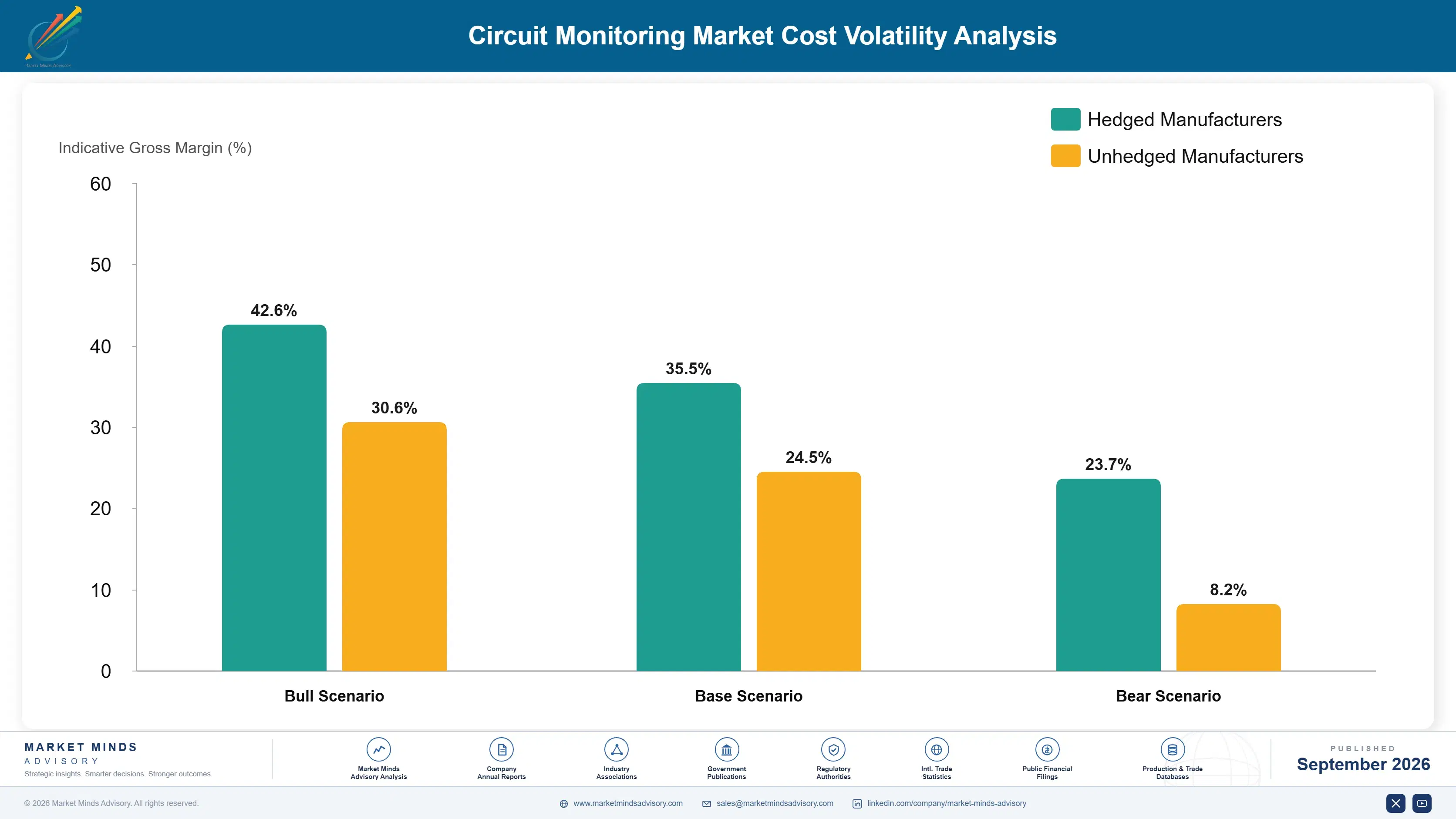
Semiconductor and Copper Cost Exposure

Component bill of materials centers on two primary cost inputs: current transformer copper windings and monitoring semiconductor chipsets, together representing an estimated 40 to 48% of unit manufacturing cost, sourced predominantly from East Asian fabrication facilities and global copper commodity markets. Wireless communication modules represent a further meaningful cost share concentrated among specialized radio chipset suppliers.
Copper commodity pricing spiked roughly 14% during 2025 as global demand from electric vehicle and grid infrastructure investment competed directly with sensor manufacturers for the same constrained refined copper supply, according to company annual report disclosures from major current transformer suppliers. Several manufacturers delayed planned price reductions for a full product cycle as a result, slowing affordability improvements facility buyers had been anticipating. Some manufacturers pushed 2026 price reductions into the following cycle.

Smaller sensor manufacturers carry disproportionate exposure because they lack the purchasing volume that diversified electrical equipment giants use to secure priority allocation and favorable material pricing from suppliers. This asymmetry pushes smaller vendors toward premium positioning that absorbs higher input costs or partnership arrangements with larger manufacturers for shared component sourcing. Larger diversified manufacturers use their broader purchasing power to smooth these cost swings in ways smaller specialists simply cannot.
circuit-monitoring-market-cost-volatility-analysis-1790008831413

Multi-supplier copper sourcing agreements

Manufacturers increasingly qualify copper winding material from two or more suppliers simultaneously rather than relying on a single source, preserving negotiating leverage and reducing exposure to allocation shortages during periods of elevated demand across the broader electronics and automotive supply chain. Several manufacturers report meaningfully improved delivery reliability after adopting dual-sourcing strategies over the past two years.

Alternative conductor material research

Manufacturers are researching aluminum-core and hybrid conductor alternatives that reduce dependence on constrained copper supply chains, aiming to reach commercial viability for lower-current applications within several years and reduce exposure to future material price volatility. Early laboratory results suggest these alternatives could match current performance within the next several years. Adoption remains limited today.

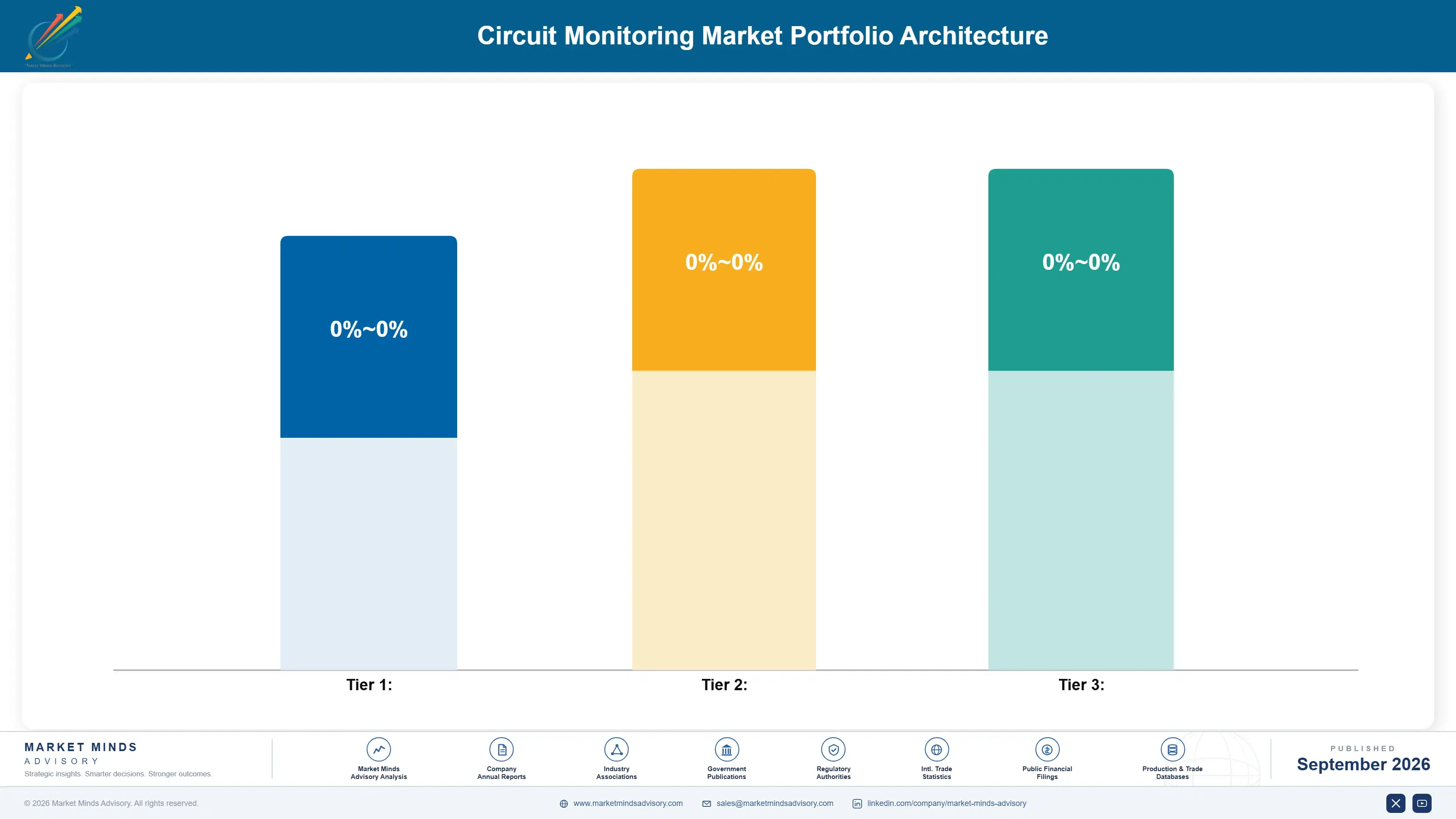
Portfolio Architecture for Margin Defence

Vendor portfolios span a wide margin gradient, from commodity single-circuit sensors sold on thin unit economics to premium certified analytics platforms and predictive maintenance products commanding substantially higher gross margin across most product categories. Vendors that once competed purely on sensor accuracy now differentiate primarily through software depth and installation service quality. Buyers increasingly expect this software depth as a baseline procurement requirement rather than a differentiator.
The volume tier still anchors most vendor unit shipments today, but margin expansion increasingly comes from premium certified analytics bundles and wireless retrofit products that regulated procurement processes increasingly favor. This tension between volume hardware sales and premium software migration shapes how vendors prioritize product roadmaps across their organizations. Vendors that misjudge this balance risk losing share to competitors better aligned with facility operator priorities.

High-value margin pools concentrate specifically around AI-powered predictive maintenance paired with wireless retrofit hardware, where facilities pay a meaningful premium for demonstrated downtime prevention and reduced maintenance labor. Vendors slow to build genuine software capability risk ceding this expanding premium pool to newer, more focused competitors within a few product cycles. This premium pool is expected to expand faster than the overall market over the coming decade.

Standard wired current transformers and basic panel meters sold primarily on unit price to budget-constrained facilities with minimal analytics or wireless requirements across most standard deployment scenarios. Margins here remain the thinnest across the entire vendor product portfolio.
Gross Margin

Certified wireless sensors bundled with installation services sold to facilities requiring documented reliability and ongoing vendor support across multi-year monitoring contracts and warranties. Renewal rates in this tier run notably higher than in the volume tier below it.
Gross Margin

AI-powered predictive maintenance platforms and wireless retrofit hardware positioned for facilities seeking measurable downtime prevention and formal compliance with tightening electrical safety regulation. Vendors here typically enjoy the strongest pricing power in the entire market.
Gross Margin
circuit-monitoring-market-portfolio-architecture-1790008831913

High-value Sub-segments and Strategic Watch-out

AI-Powered Predictive Maintenance Analytics

The fastest-growing, highest-margin pool in the market, translating raw circuit data into actionable maintenance recommendations. Facilities increasingly view this as essential rather than optional, pulling budget away from basic dashboards quickly across most portfolios. This trend should continue through the forecast period. Vendors here command strong pricing power.

Wireless Retrofit Sensors

A high-value, moderate-growth pool where established manufacturers defend share through deep retrofit installation expertise and proven reliability at scale. Growth remains healthy but slower than analytics as the underlying hardware consolidation trend matures further. This trend should continue through the forecast period. Buyers value this reliability.

Standard Wired Current Transformers

The volume core of the market, still generating the largest unit shipment base despite slowing margin growth. Vendors defend this base through bundled pricing and multi-year facility contracts even as buyers gradually shift new spending toward premium alternatives instead. This trend should continue through the forecast period.

Standalone Panel-Level Meters

A strategic watch-out segment facing mounting pressure as branch-level monitoring increasingly becomes standard specification rather than an optional upgrade. Vendors without a credible branch-level roadmap risk losing renewal share to integrated competitors. This trend should continue through the forecast period. Investment here is slowing noticeably.

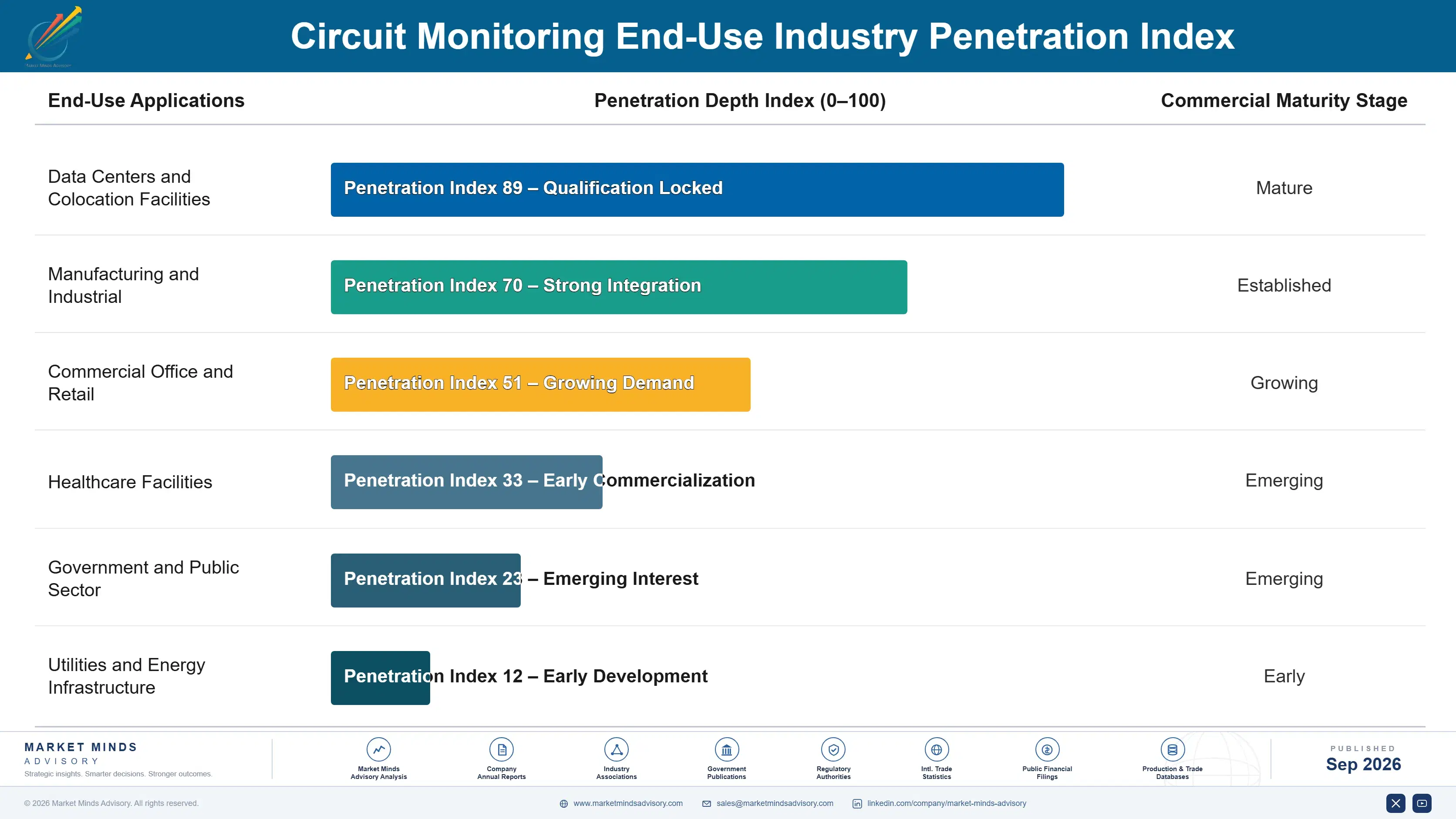
Why Facility Contracts Compound Over Time

Circuit monitoring contracts increasingly resemble annuity revenue rather than one-time hardware purchases, since facilities rarely rip out a working sensor network once operations teams have built maintenance workflows around its predictive alerts. Renewal rates on bundled hardware-plus-analytics contracts run meaningfully higher than hardware-only sales, and expansion revenue from added circuit coverage compounds steadily across multi-year facility relationships.
Adoption stickiness varies meaningfully by end-use vertical: data centers and heavy industrial facilities embed monitoring deeply into safety-critical operations workflows, making displacement costly and rare, while smaller commercial office buildings adopt more selectively around specific energy audit requirements, keeping switching costs comparatively lower and renewal cycles shorter across those less critical accounts. Vendors track this variance closely when deciding where to invest new analytics development budget each year.

Buyer profiles are shifting generationally as facility operations directors, rather than traditional electricians, increasingly own the purchasing decision, prioritizing predictive accuracy and analytics depth over raw hardware specifications. This generational handoff favors vendors that can demonstrate measurable downtime prevention outcomes over incumbents selling primarily on hardware durability alone. Vendors that misjudge this generational shift risk losing the champion inside the facility buying committee entirely.
circuit-monitoring-market-end-use-penetration-index-1790008832405

Where MMA Sees Durable Advantage

These are among the four positions where our research anticipates prominent divergence between winners and laggards over the coming forecast period. Each is grounded in the demand model, the regulatory perimeter, and the announced capacity pipeline.
01 / VENDOR SELECTION DISCIPLINE

Prioritize bundled hardware and analytics over point solutions

Facilities evaluating circuit monitoring vendors should weight bundled hardware-plus-analytics-plus-installation offerings well above point solutions when comparing shortlisted vendors for multi-year procurement decisions across their portfolios. Vendors selling sensor hardware alone without genuine analytics capability routinely underperform bundled competitors on renewal rates and actual downtime reduction within two years of deployment, according to feedback gathered across the primary survey. Facilities that select correctly the first time avoid a costly, disruptive re-procurement process just a few years later, since upfront diligence costs far less than a forced mid-contract switch.
02 / VENDOR CONSOLIDATION TIMING

Expect accelerating acquisition activity among mid-tier specialists

Mid-tier circuit monitoring specialists lacking software capability face mounting cost pressure that larger, better-capitalized competitors do not carry to the same degree across their existing contract base. MMA expects acquisition activity among these specialists to accelerate over the next two to three years as buyers increasingly demand bundled hardware and analytics capability. Facilities should factor this acquisition risk into any multi-year specialist vendor contract they sign, since larger technology providers increasingly view this consolidation as a meaningful new growth opportunity worth pursuing aggressively.
03 / RETROFIT INVESTMENT TIMING

Prioritize wireless retrofit before legacy panel constraints worsen

Facility owners routinely underestimate how quickly legacy panel compatibility issues could complicate future retrofit projects as electrical codes tighten and panel component availability shrinks over time, leaving those without proactive retrofit investment facing costlier upgrades later. This risk compounds for facilities that delay retrofit investment until code enforcement or equipment failure forces the issue. MMA recommends facilities prioritize wireless retrofit investment now rather than waiting for a forced, more expensive response later, since early investment costs meaningfully less than reactive upgrades.
04 / ANALYTICS INVESTMENT TIMING

Fund analytics capability ahead of buyer expectation shifts

Vendors slow to build genuine AI-powered predictive maintenance capability risk ceding the fastest-growing, highest-margin segment of this market to competitors already investing heavily in analytics and machine learning talent. This capability gap compounds as facilities increasingly treat analytics features as essential rather than optional given the financial cost of unplanned downtime at high-density sites. MMA recommends vendors prioritize analytics investment now rather than waiting for category maturity to force a reactive, costlier response later, since early investment builds a durable competitive advantage.

Engagement Snapshot From the Field

A live engagement with an industry participant carrying material or product regulatory and market exposure ahead of a defining policy shift, showing how our research translates into a defensible multi-year portfolio strategy.
MARKET MINDS ADVISORY · CLIENT ENGAGEMENT SUMMARY
Circuit Monitoring Producer Strategic Portfolio Review and Transition Roadmap 2026·Investment Scenario on Circuit Monitoring Exposure Evaluation 2025-26
CLIENT PROFILE
The client is a regional data center operator running eight facilities totaling approximately 120 megawatts of critical IT load, with roughly $850 million in annual colocation revenue (client-reported, unverified by MMA). The operator had relied on panel-level monitoring alone, leaving branch-level power visibility largely absent across its fleet. Individual facility managers had previously handled monitoring decisions independently without company-wide coordination or shared evaluation criteria.
STRATEGIC CHALLENGE
Leadership needed to prevent recurring branch circuit trips that had caused two significant customer-facing outages in the prior year but lacked internal expertise to evaluate competing monitoring vendors and retrofit approaches objectively. The board demanded a solution that would not require extended facility downtime to install. The board explicitly requested independent, vendor-neutral evaluation before approving any fleet-wide budget commitment.
MMA APPROACH
MMA conducted a structured vendor evaluation spanning six monitoring platforms, combining facility electrical assessment with operations staff interviews across the operator's highest-risk facilities. The engagement produced a phased twelve-month rollout plan sequencing the two facilities with the worst outage history ahead of the remaining fleet. Recommendations were validated against each facility's existing electrical infrastructure before finalizing the rollout sequence.
KEY FINDINGS
  1. Three of six evaluated vendors could not demonstrate installation approaches avoiding extended facility downtime during retrofit (client-reported, unverified by MMA). across all evaluated proposals.
  2. Facilities completing wireless retrofit reported 47% faster installation compared to wired alternatives previously considered (client-reported, unverified by MMA). across the completed facilities overall.
  3. Bundled hardware-plus-analytics pricing reduced total monitoring program cost by an estimated 21% compared to separate procurement (client-reported, unverified by MMA). across the full rollout program.
  4. Unplanned circuit-related outages declined measurably across all monitored facilities within the first year of full deployment (client-reported, unverified by MMA). across the entire monitored fleet.
CLIENT PROFILE
The client is a regional data center operator running eight facilities totaling approximately 120 megawatts of critical IT load, with roughly $850 million in annual colocation revenue (client-reported, unverified by MMA). The operator had relied on panel-level monitoring alone, leaving branch-level power visibility largely absent across its fleet. Individual facility managers had previously handled monitoring decisions independently without company-wide coordination or shared evaluation criteria.
STRATEGIC CHALLENGE
Leadership needed to prevent recurring branch circuit trips that had caused two significant customer-facing outages in the prior year but lacked internal expertise to evaluate competing monitoring vendors and retrofit approaches objectively. The board demanded a solution that would not require extended facility downtime to install. The board explicitly requested independent, vendor-neutral evaluation before approving any fleet-wide budget commitment.
MMA APPROACH
MMA conducted a structured vendor evaluation spanning six monitoring platforms, combining facility electrical assessment with operations staff interviews across the operator's highest-risk facilities. The engagement produced a phased twelve-month rollout plan sequencing the two facilities with the worst outage history ahead of the remaining fleet. Recommendations were validated against each facility's existing electrical infrastructure before finalizing the rollout sequence.
KEY FINDINGS
  1. Three of six evaluated vendors could not demonstrate installation approaches avoiding extended facility downtime during retrofit (client-reported, unverified by MMA). across all evaluated proposals.
  2. Facilities completing wireless retrofit reported 47% faster installation compared to wired alternatives previously considered (client-reported, unverified by MMA). across the completed facilities overall.
  3. Bundled hardware-plus-analytics pricing reduced total monitoring program cost by an estimated 21% compared to separate procurement (client-reported, unverified by MMA). across the full rollout program.
  4. Unplanned circuit-related outages declined measurably across all monitored facilities within the first year of full deployment (client-reported, unverified by MMA). across the entire monitored fleet.
RECOMMENDED STRATEGY
Phase 1: Phase one prioritized the two highest-risk facilities before any additional fleet-wide procurement commitment was made. establishing a proven rollout playbook. Phase 2: Phase two expanded deployment to four additional facilities over six months, sequenced by existing electrical infrastructure age. limiting operational disruption throughout. Phase 3: Phase three completed the remaining two facilities over three months, prioritized by upcoming customer contract renewal timing. completing the rollout smoothly.
OUTCOME
Eighteen months post-engagement, the operator reports meaningfully reduced circuit-related outages, improved customer service level agreement compliance, and validated predictive maintenance accuracy across its fleet (client-reported, unverified by MMA). The operator has since made branch-level monitoring a mandatory standard for all future facility acquisitions. Operations staff also reported meaningfully higher confidence in the new monitoring technology after the initial rollout.

Frequently Asked Questions

Foundational context covering the market sizes, CAGR, scope, country, region and competition that inform every finding below. This section is provided to cover basics and most often pre-purchase conversations, answered from the MMA Primary Research Dataset.

What is the current size of the Circuit Monitoring Market?

The global market reached an estimated $3.4 billion in 2025. This figure covers current transformers, wireless sensors, and analytics software sold across data centers and industrial facilities.

How large will the Circuit Monitoring Market be by 2036?

MMA projects the market will reach approximately $9.1 billion by 2036. Growth is driven primarily by data center power density and expanding predictive maintenance adoption.

What is the CAGR for the Circuit Monitoring Market 2026 to 2036?

The market is projected to grow at a 9.4% compound annual growth rate across the forecast period. This reflects accelerating branch-level visibility requirements and rising energy cost pressure.

Which segment is growing fastest?

Circuit Monitoring Software and Analytics Platforms lead growth at a 17.0% CAGR, roughly 1.81 times the overall market rate. Facilities increasingly demand actionable insight, not raw data.

Who are the major companies in the Circuit Monitoring Market?

Schneider Electric, Eaton, Siemens, ABB, and Panduit lead the market today. These vendors combine sensor hardware, wireless connectivity, and increasingly predictive analytics capability at scale.

Which country is growing fastest?

India leads country-level growth at a 14.8% CAGR. Rapidly expanding data center and manufacturing construction increasingly specifies modern circuit monitoring standards from the outset today.

Report Segmentation Architecture

The full report scope spans multiple orthogonal segmentation dimensions, with cross-tabulated demand data provided for each dimension pair. Coverage extends further to regional breakdowns, trend trajectories, and the competitive detail needed to support segment-level decision-making.

By Primary Market Dimension

  • Branch Circuit Monitoring Systems
  • Power Quality Monitoring Systems
  • Circuit Breaker Monitoring and Diagnostics
  • Wireless Circuit Monitoring Sensors
  • Circuit Monitoring Software and Analytics Platforms
  • Circuit Monitoring Installation and Calibration Services

By End-Use Industry

  • Data Centers and Colocation Facilities
  • Manufacturing and Industrial
  • Commercial Office and Retail
  • Healthcare Facilities
  • Government and Public Sector
  • Utilities and Energy Infrastructure

By Commercial Dimension

  • Direct Facility Owner Sales
  • Electrical Contractor Channel
  • Original Equipment Manufacturer Integration
  • Managed Monitoring Service Subscription

By Region

  • North America
  • East Asia
  • Western Europe
  • South Asia and Pacific
  • Latin America
  • Middle East and Africa
  • Eastern Europe

Scope, Methodology, and Coverage

Every figure in this report is reproducible from documented input assumptions. The scope below maps the historical period, the forecast horizon, the segmentation dimensions, and the countries covered, alongside the underlying primary and qualitative methodology.
Historical Period
2020 to 2025
Forecast Period
2026 to 2036
Base Year
2025 (USD billions; MMA Primary Research Dataset, September 2026)
Market Definition
The circuit monitoring market comprises hardware sensors, current transformers, and software platforms that measure and report electrical load, power quality, and circuit breaker health at the individual branch circuit level within commercial, industrial, and data center facilities. It excludes utility-scale grid monitoring and residential smart meters billed directly by utilities.
Quantitative Units
USD billions (current prices); monitored circuit point counts where applicable
Segmentation Dimensions
By Primary Market Dimension; By End-Use Industry; By Commercial Dimension; By Region
Regions Covered
North America, East Asia, Western Europe, South Asia and Pacific, Latin America, Middle East and Africa, Eastern Europe
Countries Covered
USA, China, Germany, France, UK, Japan, South Korea, India, Australia, Canada, Brazil, Mexico, Indonesia, Vietnam, Thailand, Malaysia, UAE, Saudi Arabia, South Africa, Nigeria, Turkey, Poland, Netherlands, Italy, Spain, Sweden, Switzerland, Argentina, Colombia, Singapore, and additional markets relevant to this sector
Key Companies Profiled
Schneider Electric, Eaton, Siemens, ABB, Panduit, Legrand, Vertiv, Honeywell, Rockwell Automation, Yokogawa Electric, Fluke Corporation (Fortive), Veris Industries, NK Technologies, Accuenergy, Enel X, SmartWatt Metering, Powerside, Continental Control Systems, Senva, Verdigris Technologies
Quantitative Methodology
Primary survey, n=3,800 respondents, Q4 2025, six countries; demand-side model with trade association cross-validation
Qualitative Methodology
47 expert interviews, Q4 2025; applied to validate demand model assumptions, identify emerging dynamics, and assess competitive positioning
Report Format
PDF and XLSX data workbook (Word format preview document)
Publisher
Market Minds Advisory
Report Code
MMA-2026-CON-534
Published
September 2026
Contact
sales@marketmindsadvisory.com | www.marketmindsadvisory.com

Purchase the full Circuit Monitoring Market Report (2026 to 2036).

The full report delivers a comprehensive assessment of the global circuit monitoring market across all seven regions, six segmentation categories, and twenty profiled vendors spanning electrical equipment manufacturers and specialist wireless and software providers. It includes detailed forecast modeling through 2036, competitive positioning analysis, input cost exposure, and facility regulation tracking across major jurisdictions. Buyers receive access to the underlying primary survey dataset and expert interview transcripts referenced throughout the analysis. Custom consulting engagements building on this research are available on request. The analysis draws on both quantitative survey and qualitative expert interview methodology, referenced separately throughout the document.
Ten-year quantitative market sizing and forecast model
Vendor competitive benchmarking and positioning matrix
Detailed regional commentary across seven regions
Primary survey dataset access, n equals 3800
Expert interview transcript summaries and analysis
Quarterly market update subscription option available

Built For The People Who Decide

From boardroom strategy to bench-side execution, this report is read cover-to-cover by leaders shaping the next decade of their industry, turning demand scenarios, market dynamics and valuation benchmarks into decisions.
CXOs/ Presidents/ VPs/ Managers
M&A and Corporate Development
Strategy Teams and R&D Heads
Procurement and Product Directors
Regulatory and Compliance Leaders
Investor Relations and Equity Analysts