Market Minds Advisory
Circuit Breaker Market

Circuit Breaker Market: Circuit Breaker Market: Interruption Technologies, Gas Phase-Out Economics and Installed Base Turnover 2026 to 2036

The standard insulating gas in high voltage switchgear warms the atmosphere twenty four thousand times more than carbon dioxide does. Regulators have now set the dates for removing it entirely.

Lead Analyst

Published

September 2026

Make Smarter Decisions with Customized Research Insights

Request a free sample report and evaluate market opportunities, growth trends, and competitive dynamics relevant to your business needs.

2025 MARKET VALUE$21.8BMarket Size 2025
2036 FORECAST VALUE$43.1BBase Case , 2026 to 2036
CAGR 2026 TO 20366.4 %Bull 7.7% / Bear 5.2%
INCREMENTAL OPPORTUNITY$19.9BNet 10- year value creation
EXPANSION MULTIPLE1.86x2036 value over 2026 base
Strategic Levers
M&A Pipeline
Regional Outlook
Country Rankings
Competitive Intelligence
Segmental Deep-dive
Call-Us : 91 93563 13602

Executive Snapshot and Market Trajectory.

Everybody describes this market as booming and it compounds at 6.4%, which looks like a contradiction until you notice the service life. A circuit breaker is designed for forty years and the installed base turns over at about 2.5% annually. Regulation moves more units than electrification does.
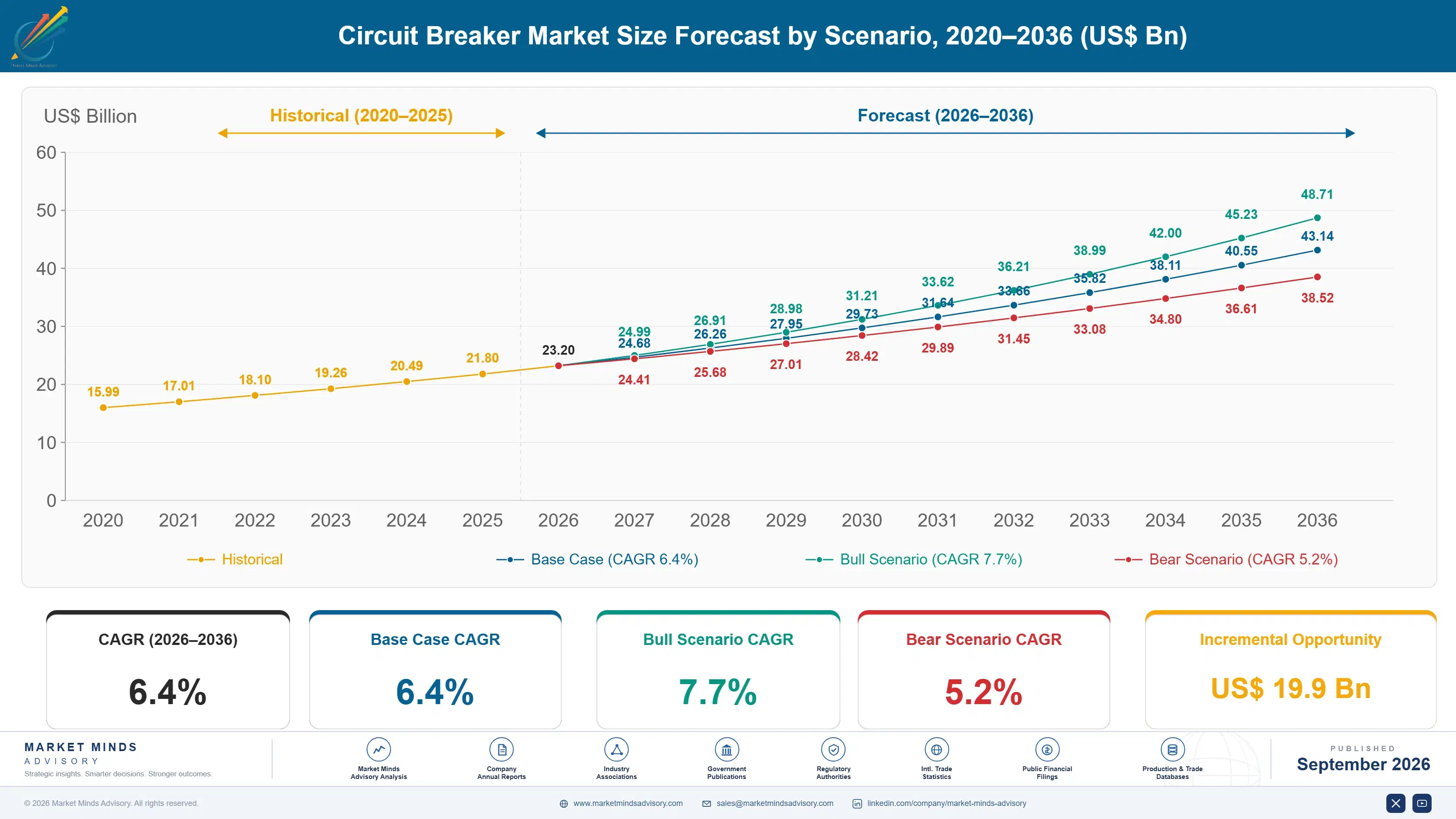
The market reaches USD 23.20 billion in 2026 and USD 43.14 billion by 2036, a 1.86 times expansion at 6.4%. Solid-state and hybrid direct current breakers grow at 9.6%, half again the market rate of 6.4%, because direct current never crosses zero and the arc has to be forced out rather than extinguishing itself. East Asia holds 38% of unit shipment revenue on manufacturing and grid expansion together, and India grows fastest at 11.2%.
Five manufacturers hold 58% of unit shipment revenue, concentrated by type test certification depth rather than by any manufacturing advantage. Schneider Electric, ABB, Siemens, Eaton and Mitsubishi Electric hold approvals across every major standard, accumulated over decades of qualification testing. Chinese manufacturers including Chint Electric and Delixi Electric compete hard in low voltage and are working upward through the voltage classes steadily and deliberately.
Market Definition
This report covers electrical circuit breakers across voltage classes, segmented by interruption and insulation technology: solid-state and hybrid direct current breakers, vacuum interruption medium voltage breakers, alternative gas insulated high voltage breakers, moulded case and miniature breakers, air interruption low voltage breakers, and sulphur hexafluoride gas insulated breakers. It excludes fuses and protection relays, switchgear enclosures sold separately, transformers, contactors and motor starters, and utility network assets beyond the switching equipment itself.
Base Year Value
$21.8B in 2025 (MMA Primary Research Dataset, September 2026)
Forecast Period
2026 to 2036, eleven discrete annual values
CAGR
6.4% base case. Bull 7.7%. Bear 5.2%.
Fastest Growth Segment
Solid-State And Hybrid Direct Current Breakers: 9.6% CAGR
Fastest Growth Country
India: 11.2% CAGR
Fastest Growth Region
South Asia and Pacific: 8.5% CAGR
Largest Region
East Asia: 38% of 2025 global value
Market Leaders
Schneider Electric, ABB, Siemens, Eaton and Mitsubishi Electric lead on circuit breaker unit shipment revenue. Source: MMA Analysis.
Primary Survey
n=3,800 procurement and R&D decision-makers, Q4 2025, six countries
Methodology
Demand-side build-up, cross-validated against public data, 47 expert interviews

Circuit Breaker Market Forecast Scenarios

circuit-breaker-market-size-forecast-scenario-1789990558159
Between 2020 and 2025 the category compounded at 5.1%, tracking construction and grid investment with the lag a forty year product always imposes. Two things then changed the trajectory. European regulators set phase-out dates for sulphur hexafluoride insulation, and grid connection demand from data centres and electrification began exceeding what utilities had planned decades earlier for their networks.
The base case holds 6.4% on three mechanisms. Fluorinated gas phase-out obliges replacement of high voltage switchgear on a regulatory schedule rather than at end of life, which pulls demand forward from a base that would otherwise turn over slowly. Grid reinforcement for renewable connection and electrified transport keeps expanding substation counts. And direct current architectures across transmission, storage and data centres need breakers that alternating current designs cannot provide at all.
The bull case at 7.7% assumes phase-out dates tighten further and extend beyond Europe, which would compress an installed base replacement into a considerably shorter window. The bear case at 5.2% is construction and grid investment slowing together: with installed base turnover near 2.5% annually, replacement alone cannot support growth when new installation demand falls away from the equation.

A Forty Year Product Meets New Rules

Sulphur hexafluoride is the most potent greenhouse gas in industrial use, warming the atmosphere roughly 24,300 times more than carbon dioxide over a century, and it has insulated high voltage switchgear for sixty years because nothing else performed as well. Regulators have now set removal dates. That obliges replacement of an installed base on a legal schedule rather than at end of life, which is not how this equipment was ever intended to turn over at all.
TOP FIVE CONCENTRATION58%Concentrated among global manufacturers holding deep certification portfolios
INSTALLED BASE TURNOVER2.5%Annual replacement rate across equipment designed for decades
DESIGN SERVICE LIFE40 yearsExpected operating life for high voltage switchgear installations generally
SF6 WARMING POTENTIAL24,300 timesRelative to carbon dioxide over a hundred year horizon
ALTERNATIVE GAS ENCLOSURE PENALTY18%Additional volume required by non-fluorinated insulating alternatives today
TYPE TEST QUALIFICATION PERIOD26 monthsFrom design freeze to full certification across required international standards
The alternatives work and they cost something real. Clean air, fluoronitrile mixtures and vacuum interruption at higher voltages all insulate adequately, and each requires around 18% more enclosure volume alongside different operating mechanisms and complete requalification. Type testing runs about 26 months from design freeze. Substations built for compact gas insulated equipment frequently lack room for the replacement.
Direct current is the other technology break and it is a genuine one. Interrupting alternating current is straightforward because the current crosses zero a hundred times a second and the arc extinguishes itself. Direct current never crosses zero, so the interruption has to be forced. As transmission, storage and data centre architectures move to direct current, that becomes a real segment.
"People keep telling me electrification is transforming this industry. A circuit breaker lasts forty years, so the installed base turns over at two and a half percent a year and always will. The gas phase-out will move more units than the energy transition does."
Director, Power Distribution and Switching Equipment Practice · MMA Energy and Electrical Equipment Practice · September 2026

Market Trends

Gas Phase-Out Forces Replacement Regulation Rather Than Failure

Sulphur hexafluoride warms the atmosphere around 24,300 times more than carbon dioxide and European fluorinated gas rules now set dates for removing it from new high voltage equipment and eventually from service. That converts an installed base designed to last forty years into a replacement programme running on a legal timetable instead. Alternative gas insulated breakers compound at 8.4% against 6.4% for the market on that mechanism alone, and the sulphur hexafluoride segment grows at 0.8% as it declines toward eventual withdrawal from every new installation. Nothing about that timetable is negotiable.
Market Impact: India compounds at 11.2% annually
Direct Current Interruption Is A Genuinely Different Problem

Alternating current crosses zero a hundred times each second and an arc extinguishes itself at that moment, which is why breaker design changed relatively little across a century. Direct current never crosses zero, so the interruption must be forced through solid-state devices, commutation circuits or hybrid arrangements that combine both. High voltage transmission links, battery storage installations and increasingly data centre power architectures all run direct current. Solid-state and hybrid breakers compound at 9.6% on a technology that cannot be adapted from existing designs at all. Adaptation is not available as an option here.
Market Impact: Vacuum avoids the 18% penalty

Market Opportunities and Growth Drivers

Grid Reinforcement Adds Substations Faster Than Replacement

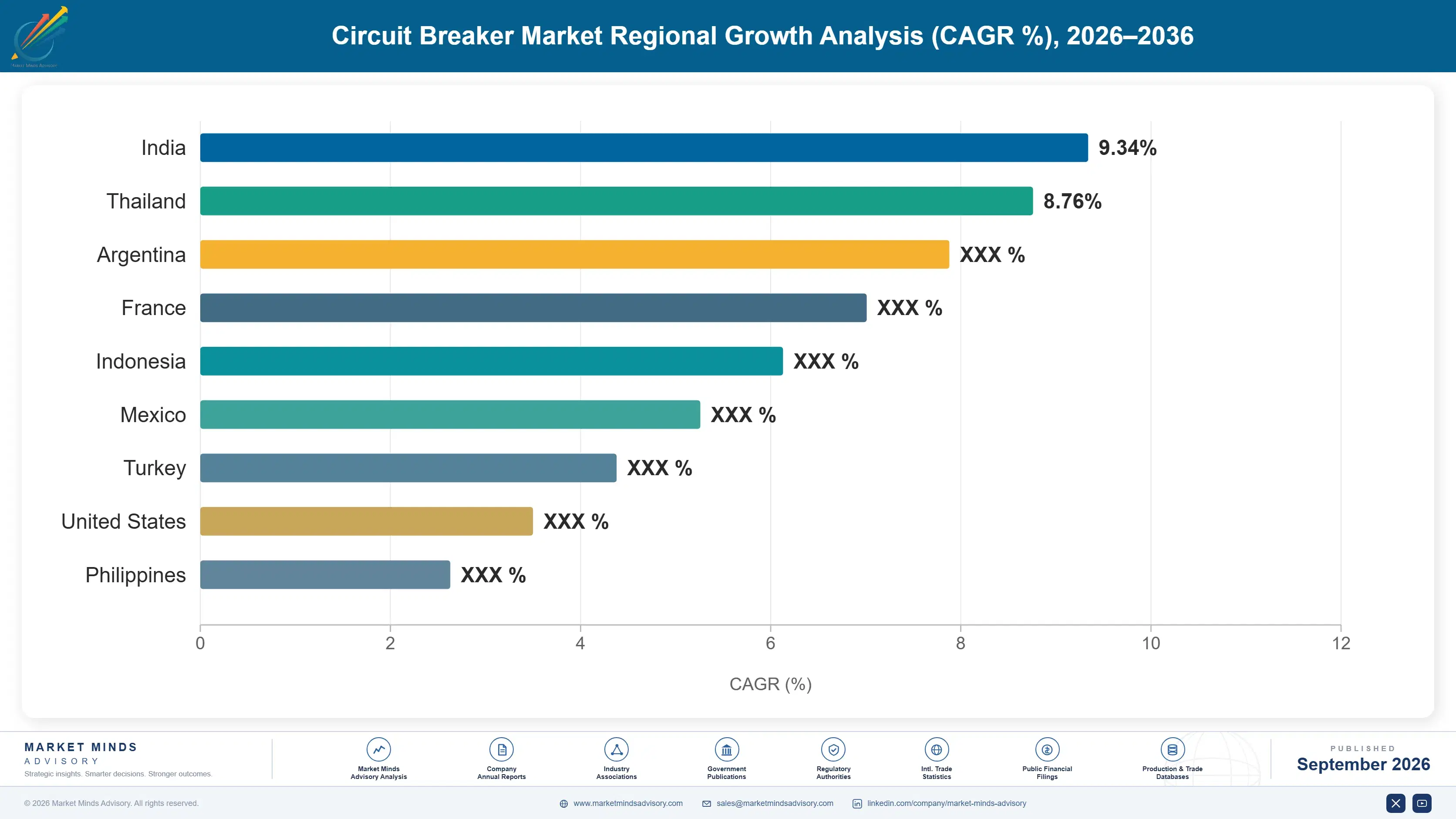
Connecting renewable generation, electrified transport and concentrated data centre load requires substation counts that utilities planned decades ago on assumptions nothing like current demand. Each new substation carries breakers at several voltage levels, which is new installation rather than replacement of anything. India compounds at 11.2%, ahead of any other country, on transmission and distribution investment running at a pace no developed market matches. That new build demand matters commercially because it is not constrained by the 2.5% turnover rate that governs the existing installed base. New build is where growth actually comes from.
Market Impact: Alternatives need 18% more volume

Vacuum Interruption Keeps Moving Up The Voltage Classes

Vacuum interruption dominated medium voltage for decades and was long considered impractical above it, since maintaining vacuum integrity and managing dielectric recovery at transmission voltages defeated earlier designs. Manufacturing and materials improvements have moved the practical ceiling upward steadily, which matters enormously now that the gas alternative is being withdrawn by regulation. Vacuum compounds at 7.1% on that migration. It also avoids the roughly 18% enclosure penalty alternative gases carry, which is a decisive advantage in substations with no room to expand. Substations with no room to expand find that decisive.
Market Impact: Certification takes about 26 months

Market Restraints and Challenges

Alternatives Need Space Existing Substations Do Not Have

Clean air and fluoronitrile insulating alternatives require around 18% more enclosure volume than sulphur hexafluoride at equivalent voltage, because no other medium matches its dielectric strength at comparable pressure. The root cause is physics rather than engineering effort, and no design work removes it entirely. Commercially this means replacing gas insulated equipment in a compact urban substation frequently requires civil works nobody budgeted for. Mitigation runs through vacuum interruption at higher voltages, mixed technology substations and staged replacement timed against building refurbishment cycles. Nobody costed the civil works into the phase-out estimates.
Market Impact: Gas warms 24,300 times more

Type Testing Delays Every New Design By Years

Full type test certification runs around 26 months from design freeze across the short circuit, dielectric, mechanical and temperature rise requirements that international standards impose. The root cause is that testing capacity for high power short circuit work exists at a small number of laboratories worldwide and cannot be expanded quickly or cheaply. Commercially this delays every alternative gas and direct current design reaching market, exactly when demand is arriving. Mitigation runs through booking laboratory slots years ahead and designing platforms that certify once across several product variants. Being late to certification costs a year of market access.
Market Impact: Direct current breakers compound at 9.6%
3 additional market trends, 4 additional growth drivers, and 2 additional restraints and challenges are covered in the full report. Contact sales@marketmindsadvisory.com to access the complete intelligence.

Segment CAGR and Growth Architecture

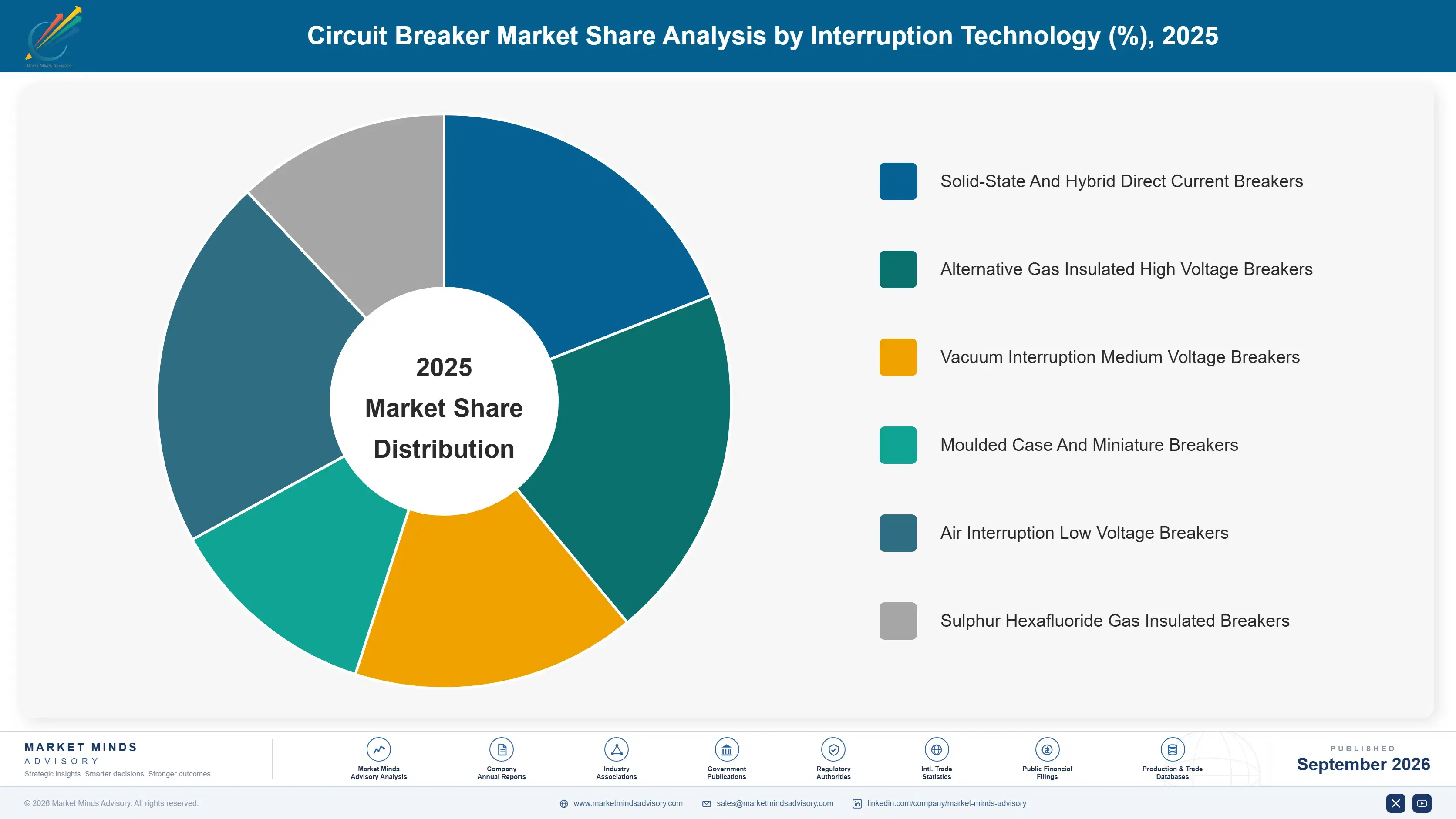
Segmentation follows interruption and insulation technology, since how a breaker extinguishes an arc determines its voltage capability, its enclosure size and its regulatory exposure. Six technologies cover the market: solid-state and hybrid direct current, alternative gas insulated, vacuum interruption, moulded case and miniature, air interruption, and sulphur hexafluoride gas insulated. Application voltage class is a separate dimension entirely.
circuit-breaker-market-market-share-analysis-1789990558703

Solid-State And Hybrid Direct Current Breakers

Solid-state and hybrid direct current breakers grow at 9.6%, half again the market rate of 6.4%, on a problem that alternating current designs cannot solve at all. Alternating current crosses zero a hundred times a second and the arc extinguishes itself, which is why breaker architecture changed so little across a century. Direct current never crosses zero, so interruption has to be forced using semiconductor devices, commutation circuits or hybrid arrangements combining both. High voltage transmission links, grid scale battery installations and data centre power architectures are all moving that way, which converts a specialist product for a handful of projects into a genuine segment with volume behind it. Volume finally justifies the engineering.
CAGR 9.6%

Alternative Gas Insulated High Voltage Breakers

Alternative gas insulated breakers compound at 8.4% because regulators decided the incumbent technology has to go. Sulphur hexafluoride warms the atmosphere roughly 24,300 times more than carbon dioxide and European fluorinated gas rules set removal dates for new high voltage equipment. Clean air and fluoronitrile mixtures both insulate adequately and both need around 18% more enclosure volume, which is physics rather than an engineering shortfall anybody can design away. That penalty matters most in compact urban substations built specifically for the space efficiency gas insulation delivered, where replacement requires civil works nobody included in the original phase-out cost estimates. Physics rather than engineering effort sets that penalty, and no development programme removes it.
CAGR 8.4%
Full segment breakdown across 6 segments available in the complete report.

Regional Architecture and Country Demand Map

East Asia leads at 38% of unit shipment revenue, far above the standard band, because Chinese manufacturing supplies much of the world and Chinese grid expansion consumes an enormous share of what it makes. Western Europe follows at 19% and sets the regulatory agenda everywhere.

East Asia

East Asia holds 38% of unit shipment revenue, far above the 30% band ceiling, on manufacturing and installation together rather than on either alone. Chinese manufacturers including Chint Electric, Delixi Electric and TBEA supply low and medium voltage equipment worldwide at pricing international competitors cannot match, and Chinese grid expansion consumes an enormous share of that output domestically. Japanese and Korean manufacturers including Mitsubishi Electric, Toshiba, Fuji Electric, Hyundai Electric and LS Electric hold high voltage positions built on certification depth. Growth at 7.4% sits above the global rate. Chinese suppliers are working upward through the voltage classes steadily. Certification rather than manufacturing is the barrier they are clearing. Volume and technology sit together here.
Share: 38% | CAGR: 7.4% (2026 to 2036)

Western Europe

Nineteen percent of unit shipment revenue reaches Western Europe, which understates the region enormously because European regulation sets the agenda for the whole industry. Fluorinated gas rules written here determine when sulphur hexafluoride equipment stops being installed worldwide, since manufacturers will not maintain two product lines indefinitely. Schneider Electric, ABB, Siemens and Hitachi Energy all develop and manufacture here and supply globally. Compact urban substations built for gas insulated equipment face the 18% enclosure penalty most acutely. Growth at 5.0% is the slowest of any region on a mature installed base and limited new construction. Rules written here decide when this equipment stops being installed worldwide, since manufacturers will not maintain two product lines indefinitely.
Share: 19% | CAGR: 5.0% (2026 to 2036)
Regional intelligence for 5 additional markets available in the complete report: North America, South Asia and Pacific, Latin America, Middle East and Africa, Eastern Europe. Contact sales@marketmindsadvisory.com.
circuit-breaker-market-country-cagr-analysis-1789990559253

What Moves Volume In This Market

A forty year product turns its installed base over at about 2.5% a year, a regulator has now scheduled the replacement of a technology that dominated for sixty years, and every new design waits roughly two years for certification. Each of the four levers below works with those constraints rather than pretending they can be avoided.

Book Type Test Capacity Years In Advance

Full certification runs around 26 months from design freeze, and high power short circuit testing exists at a small number of laboratories worldwide whose capacity cannot expand quickly. Every manufacturer developing alternative gas and direct current designs is competing for the same slots at the same moment. Booking laboratory time against a development roadmap rather than a finished design brings products to market a year ahead of competitors who waited until they were ready. The booking costs money and it costs considerably less than arriving late does. Arriving late costs a year of market access.
Market Impact: A 26 month certification decides all launch timing

Push Vacuum Interruption Up The Voltage Classes

Alternative insulating gases need around 18% more enclosure volume than sulphur hexafluoride, which is physics and not an engineering shortfall anybody can design away. Vacuum interruption avoids that penalty entirely and has been moving up the voltage classes as materials and manufacturing improve. In compact urban substations built specifically for gas insulated space efficiency, vacuum is frequently the only replacement that physically fits without civil works. Vacuum compounds at 7.1% and the manufacturers extending its practical ceiling are taking positions that will hold for decades. Positions taken now will hold for decades.
Market Impact: Vacuum avoids the entire 18% enclosure volume penalty

Sell Replacement Against The Regulatory Calendar

Installed base turnover runs about 2.5% annually because equipment lasts forty years, and no commercial argument accelerates a utility replacing something that still works. Fluorinated gas phase-out dates change that entirely by making replacement a compliance obligation with a deadline attached. Manufacturers who map the installed sulphur hexafluoride base against those dates know precisely where demand appears and when, several years ahead. Very few sales organisations have built that map, and the dates have been published for some time now. The deadlines have been published for some time and remain freely available to anybody who reads them.
Market Impact: Phase-out beats the slow 2.5% annual turnover rate

Design For Direct Current Before The Volume Arrives

Direct current never crosses zero, so interruption must be forced through semiconductors, commutation circuits or hybrids, and none of that adapts from an alternating current design. Transmission links, grid batteries and data centre architectures are all moving that way, and solid-state breakers compound at 9.6% against 6.4% for the market. The technology takes years to develop and 26 months to certify afterwards, so a manufacturer starting when volume arrives has already missed it. This is a decision about the next decade rather than the next order book. This is a decade decision rather than an order book one.
Market Impact: Direct current breakers compound at 9.6% every year

Who Controls the Margin Pool

Five manufacturers hold 58% of circuit breaker unit shipment revenue, concentrated by type test certification portfolios rather than by any manufacturing advantage. Schneider Electric, ABB, Siemens, Eaton and Mitsubishi Electric hold approvals across every major international standard, accumulated over decades and representing an entry barrier capital alone does not clear. Chinese manufacturers compete hard in low voltage. All participants are assessed on unit shipment revenue.
Competition differs completely by voltage class, which the aggregate figure disguises. Low voltage is a commodity contest on price where Chinese manufacturers have taken substantial share and continue to. High voltage remains a certification and reliability contest where a utility will not accept an unproven supplier at any discount, because a transmission breaker failure is a regional outage rather than a maintenance ticket, and no procurement saving covers that.

Rankings shift on who certifies alternative gas and direct current designs first, since laboratory capacity constrains everybody equally and being early is worth years of advantage. The second pressure is Chinese manufacturers working upward through the voltage classes, which has happened in every adjacent electrical equipment category and shows no sign whatever of stopping here.
circuit-breaker-market-company-positioning-matrix-1789990559774

Competitive Moat and Risk Dimensions

SCHNEIDER ELECTRIC

Moat: Certification Portfolio Breadth

Schneider holds type test approvals across every major international standard and voltage class, each representing months of laboratory time and considerable expense accumulated over decades. A utility or specifier selects from certified equipment, so the portfolio itself is the market access. Assembling comparable breadth requires laboratory capacity that does not exist in sufficient quantity.
SCHNEIDER ELECTRIC

Risk: Low Voltage Price Erosion

Moulded case and miniature breakers are commodity products where Chinese manufacturers compete on price with adequate certification and improving quality. That volume funds the engineering and certification investment the high voltage business depends on. Losing low voltage share erodes the base supporting everything above it, and the erosion has been steady rather than sudden.
MITSUBISHI ELECTRIC

Moat: Vacuum Interruption Technology Depth

Mitsubishi Electric holds vacuum interrupter design and manufacturing capability developed across decades, in the technology best placed to replace fluorinated gas without the enclosure penalty alternatives carry. Vacuum performance depends on materials, contact metallurgy and manufacturing consistency that accumulate through production experience. That knowledge cannot be acquired quickly by anybody entering the segment now.
MITSUBISHI ELECTRIC

Risk: Regional Demand Concentration

A revenue base weighted toward Japanese and East Asian utilities depends on grid investment cycles in markets with mature networks and limited new construction ahead. European fluorinated gas rules are creating replacement demand the company is positioned for and does not sit close to commercially. Reaching that demand means competing in territories where European incumbents hold utility relationships spanning generations.

Players Tracked

Prominent Players

Schneider Electric
ABB
Siemens
Eaton
Mitsubishi Electric

Other Key Players

Hitachi Energy
Legrand
Hyundai Electric
LS Electric
Toshiba
Fuji Electric
Chint Electric
Delixi Electric
TBEA
CG Power and Industrial Solutions
Hyosung Heavy Industries
GE Vernova
Powell Industries
Larsen and Toubro
Rockwell Automation

Recent Developments

MARCH 2025

Siemens Extends Clean Air Insulated Switchgear Across Voltage Classes

Siemens extended its clean air insulated high voltage switchgear range across additional voltage classes, an organic product development rather than an acquisition or joint venture. European fluorinated gas rules set removal dates for sulphur hexafluoride equipment, and alternatives require around 18% more enclosure volume at equivalent voltage ratings.
Signal: Regulators rather than utilities or manufacturers are now setting the replacement schedule for this whole category.
OCTOBER 2024

Hitachi Energy Advances High Voltage Vacuum Interruption Development

Hitachi Energy advanced vacuum interruption capability toward higher voltage classes, an organic engineering programme rather than any transaction. Vacuum avoids the enclosure penalty alternative insulating gases carry, which is decisive in compact urban substations originally built specifically for the space efficiency that gas insulation delivered.
Signal: Whichever technology fits inside the substations that already exist wins replacement work the alternatives cannot reach.
JULY 2025

Chint Electric Expands Medium Voltage Range For Export Markets

Chint Electric expanded its medium voltage breaker range with certification for additional international standards, an organic expansion rather than a partnership or merger. Chinese manufacturers established in low voltage are working upward through the voltage classes, following a pattern visible across every adjacent electrical equipment category.
Signal: Certification rather than manufacturing capability is the barrier that Chinese suppliers are now systematically clearing away.

What Building A Breaker Costs

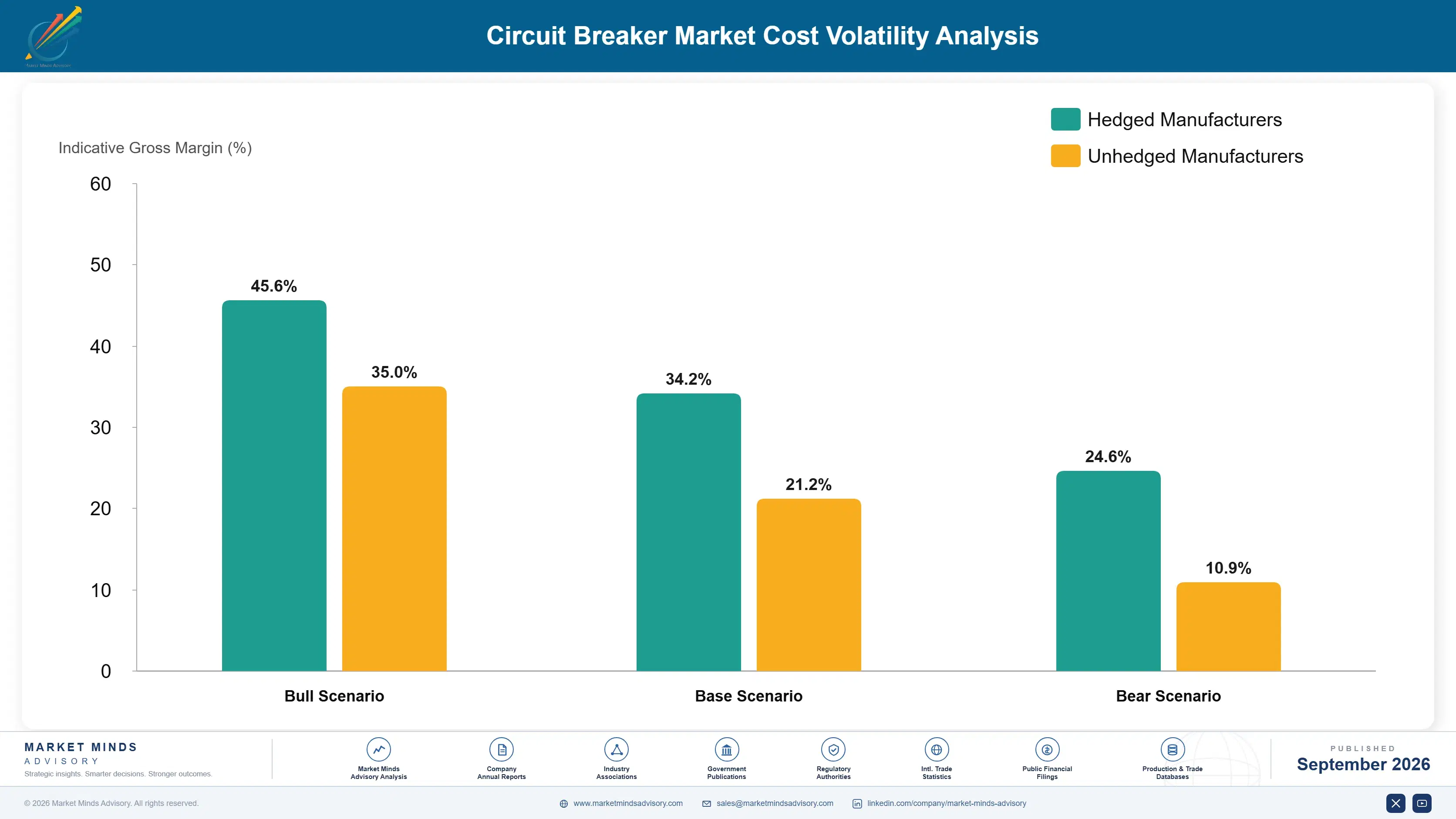
Copper conductor and silver contact material together account for roughly 29% of breaker cost, and neither has a practical substitute at the conductivity and arc erosion resistance required. Steel and aluminium enclosure carries around 17%, rising for alternative gas designs that need more volume. Precision mechanism assembly absorbs about 21%, and type testing amortisation plus insulating medium take most of the remaining balance.
Copper pricing moved considerably through 2023 and 2024, and the IEA has documented how far electrification demand for critical minerals diverged from historical patterns during that period. ABB Annual Report 2024 and Schneider Electric Annual Report 2024 both record raw material cost as a principal operating variable. Manufacturers on long utility framework agreements absorbed those movements directly, since a catalogue price fixed for three years does not adjust.

The competitive disadvantage mechanism is certification amortisation rather than material cost. Type testing runs around 26 months and costs the same whether a manufacturer sells ten thousand units of a design or ten million, so volume determines what that investment costs per breaker. Exposure concentrates among specialists carrying full certification across small ranges, which is why the category keeps consolidating.
circuit-breaker-market-cost-volatility-analysis-1789990559970

Certify Platforms Rather Than Individual Products

Type testing runs around 26 months and costs the same regardless of how many units a design eventually sells. Architecting a platform so one certification campaign covers several voltage ratings and configurations spreads that investment across far more volume than certifying each variant separately does. The discipline is design architecture rather than testing expertise, and teams treat certification downstream.

Hedge Copper And Silver Across Framework Agreements

Copper and silver contact material run around 29% of breaker cost and utility framework agreements frequently fix catalogue pricing for three years with no indexation attached. That leaves the manufacturer absorbing every commodity movement across the term. Matching hedge tenor to agreement tenor removes the exposure at a premium far smaller than the movements themselves have repeatedly proved to be.

Design Alternative Gas Products For Existing Enclosures

Alternative insulating media need around 18% more volume, which means replacement in compact substations frequently requires civil works that stop projects entirely. Designing to fit existing bays even at some performance cost reaches replacement demand that a larger and technically better product simply cannot serve. Manufacturers optimising purely on electrical performance lose tenders on dimensions instead.

Portfolio Architecture for Margin Defence

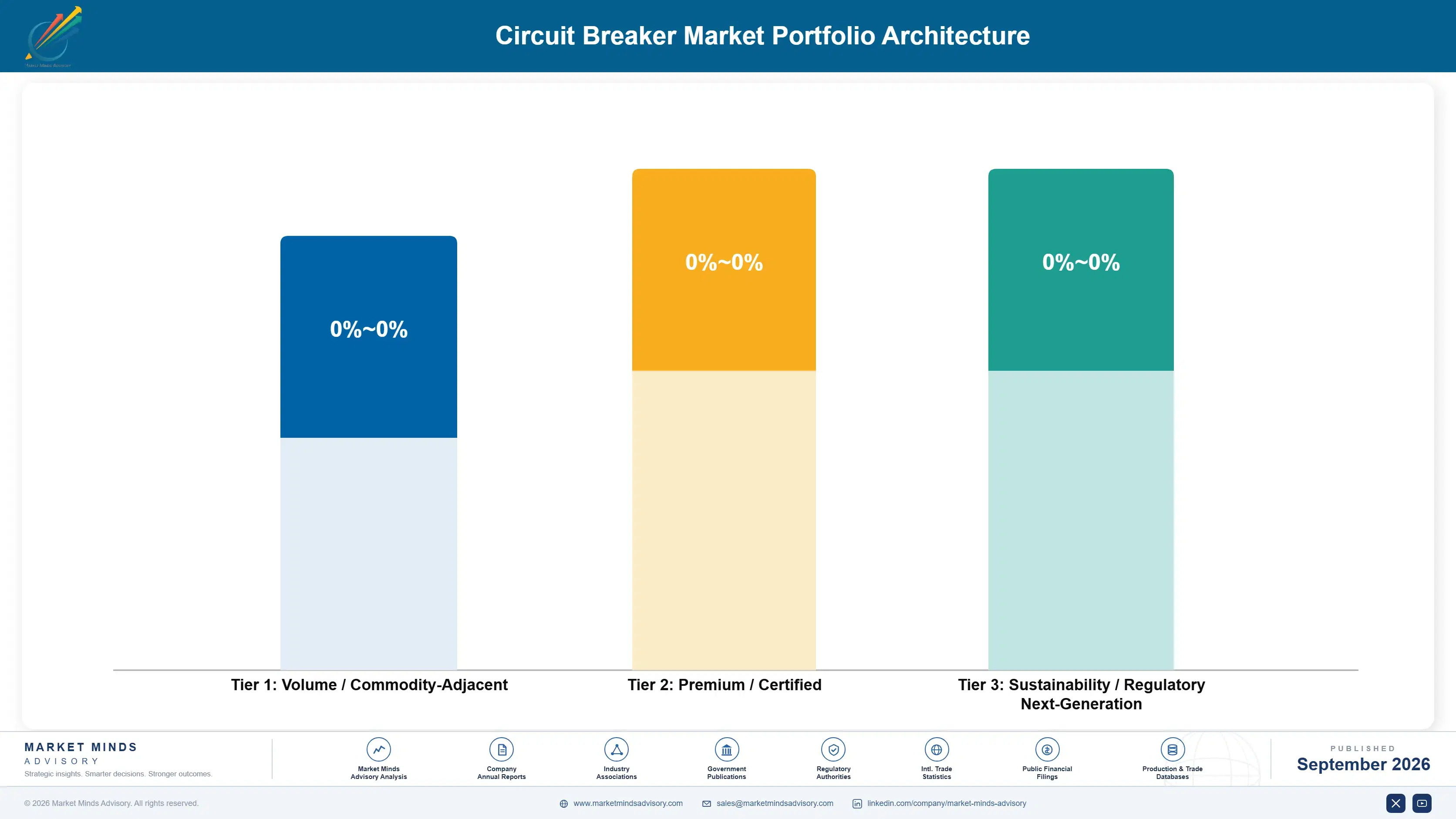
Margin architecture separates on certification depth and on how much a failure costs the customer. Moulded case and miniature breakers earn least, since they are commodity products where Chinese manufacturers compete effectively on price with adequate approvals. Air interruption low voltage sits marginally above. Direct current, alternative gas and vacuum interruption earn most, because each requires certification and engineering that very few manufacturers currently hold.
The volume versus premium tension is a funding relationship rather than a choice. Low voltage volume generates the cash that funds certification campaigns and engineering the high voltage business depends on absolutely. Losing low voltage share to price competition erodes the base supporting everything above it, which is why European manufacturers defend commodity positions that look unattractive on their own margins alone.

High-value pools concentrate in direct current interruption and in high voltage vacuum, and neither is reached by manufacturing investment. Direct current requires semiconductor and commutation engineering that alternating current designers do not possess. High voltage vacuum requires contact metallurgy and manufacturing consistency accumulated through production experience. Both take a decade to develop and 26 months to certify afterwards, which is why so few manufacturers hold either.

Volume / Commodity-Adjacent

Moulded case, miniature and air interruption low voltage breakers, where adequate certification is widely held and Chinese manufacturers compete effectively on price. The eight point spread separates manufacturers with genuine automation scale from those assembling at higher labour content and cost.
Gross Margin: 18% to 26%

Premium / Certified

Vacuum interruption medium voltage and conventional gas insulated high voltage breakers sold on certification depth and demonstrated reliability. The ten point spread tracks how much of a manufacturer's volume sits under utility framework agreements rather than in competitively tendered project supply negotiated individually.
Gross Margin: 30% to 40%

Sustainability / Regulatory / Next-Generation

Solid-state and hybrid direct current breakers and alternative gas insulated high voltage equipment, where certification is scarce and regulation rather than preference drives the purchase. The fourteen point spread reflects how early each manufacturer completed type testing relative to everybody else in the category.
Gross Margin: 42% to 56%
circuit-breaker-market-portfolio-architecture-1789990560485

High-value Sub-segments and Strategic Watch-out

Solid-State And Hybrid Direct Current Breakers

Grows at 9.6% because direct current never crosses zero and interruption has to be forced rather than allowed to extinguish itself. The fourteen point spread reflects certification timing. Nothing here adapts from an alternating current design, which is the whole commercial point. Semiconductors do the work here.
Gross Margin: 42% to 56%

Alternative Gas Insulated High Voltage Breakers

Grows at 8.4% because regulators set removal dates for a gas warming the atmosphere 24,300 times more than carbon dioxide. The fourteen point spread reflects type test progress. An 18% enclosure penalty makes urban substation replacement a civil engineering problem too. Regulation rather than preference drives every purchase.
Gross Margin: 42% to 56%

Vacuum Interruption Medium Voltage Breakers

Grows at 7.1% as materials and manufacturing improvements push the practical voltage ceiling steadily upward year after year. The ten point spread reflects framework agreement coverage. Vacuum avoids the enclosure penalty entirely, which decides replacement work in constrained substations. Materials knowledge takes decades to build.
Gross Margin: 30% to 40%

Sulphur Hexafluoride Gas Insulated Breakers

Grows at 0.8%, slowest of the six technologies, as regulation withdraws it from new installation across an expanding list of jurisdictions. The ten point spread reflects existing framework positions. Service and spares demand persists for decades after new installation stops entirely. Spares demand outlives new installation.
Gross Margin: 30% to 40%

How Utility Positions Endure

The annuity is the framework agreement and the spares obligation behind it. A utility standardising on one manufacturer's breakers stocks those spares, trains those technicians and writes those part numbers into maintenance systems that run for decades. Equipment lasting forty years means the supply relationship outlives most of the people who negotiated it. Displacement happens at framework renewal and almost never in between, which makes those renewals unusually valuable.
Depth varies by voltage class and by consequence of failure. A transmission breaker is type tested, commissioned and integrated into protection schemes coordinated across a whole substation, and nobody substitutes one without revalidating the scheme. Medium voltage sits close behind. Miniature breakers in a distribution board are genuinely interchangeable and get bought on price at every order, which is exactly why that segment behaves like a commodity.

The buyer added a compliance dimension nobody had before. A utility asset manager once compared reliability, price and delivery across suppliers with certification as a threshold requirement. That manager now also holds a fluorinated gas inventory obligation with dates attached to it. Manufacturers mapping a utility's installed gas base against phase-out deadlines answer a question customers now ask.
circuit-breaker-market-end-use-penetration-index-1789990560976

What Decides Position Here

These are among the four positions where our research anticipates prominent divergence between winners and laggards over the coming forecast period. Each is grounded in the demand model, the regulatory perimeter, and the announced capacity pipeline.
01 / CERTIFICATION SLOT BOOKING

Reserve The Laboratory Before The Design

Full type test certification runs around 26 months from design freeze, and high power short circuit testing exists at a small number of laboratories worldwide whose capacity genuinely cannot expand quickly at any price. Every manufacturer developing alternative gas and direct current designs is competing for identical slots at exactly the same moment in time. Booking laboratory capacity against a development roadmap rather than a finished design brings products to market a full year ahead of competitors who waited until their designs were actually finished.
02 / VACUUM CEILING EXTENSION

Fit Inside The Substation That Exists

Alternative insulating gases require around 18% more enclosure volume than sulphur hexafluoride, which is a consequence of physics rather than any engineering shortfall that development effort removes. Vacuum interruption avoids that penalty completely and has been moving up the voltage classes as materials and manufacturing consistency improve steadily. In compact urban substations built specifically for the space efficiency gas insulation delivered, vacuum is frequently the only replacement that physically fits without triggering the civil works that nobody anywhere has actually budgeted for yet.
03 / PHASE-OUT BASE MAPPING

Know Whose Gas Expires And When

Installed base turnover runs around 2.5% each year because this equipment lasts forty years, and no commercial argument persuades a utility to replace something that is still working perfectly well. Fluorinated gas phase-out dates change that completely by turning replacement into a compliance obligation carrying a legal deadline. Manufacturers who map the installed sulphur hexafluoride base against those published dates know exactly where demand appears and when, and remarkably few sales organisations in this industry have actually built that map at all.
04 / DIRECT CURRENT PREPARATION

Build For A Grid Nobody Has Yet

Direct current never crosses zero, so interruption must be forced through semiconductors, commutation circuits or hybrid arrangements, and absolutely none of that adapts from an existing alternating current design. Transmission links, grid scale batteries and data centre architectures are all moving toward direct current, and solid-state breakers compound at 9.6% against 6.4% for the market. The technology takes years to develop and another 26 months to certify, so anybody starting development when the volume arrives has already missed the whole opportunity.

Engagement Snapshot From the Field

A live engagement with an industry participant carrying material or product regulatory and market exposure ahead of a defining policy shift, showing how our research translates into a defensible multi-year portfolio strategy.
MARKET MINDS ADVISORY · CLIENT ENGAGEMENT SUMMARY
Circuit Breaker Producer Strategic Portfolio Review and Transition Roadmap 2026·Investment Scenario on Circuit Breaker Exposure Evaluation 2025-26
CLIENT PROFILE
A European transmission system operator running 340 substations with a significant share of gas insulated switchgear installed between 1990 and 2010. Fluorinated gas phase-out dates were approaching and the asset management team had a replacement plan built on equipment age. Nobody had checked whether the alternative equipment would physically fit into the substations that needed it most urgently.
STRATEGIC CHALLENGE
Asset management wanted replacement sequenced by equipment age, which was defensible engineering practice and had worked for decades. Regulatory compliance wanted it sequenced by gas inventory and deadline exposure. Neither had assessed enclosure dimensions against the roughly 18% additional volume alternatives require, and the capital plan was going to the board within a quarter.
MMA APPROACH
MMA assessed physical bay dimensions across all 340 substations against alternative gas and vacuum equipment envelopes, and identified which sites required civil works. We modelled replacement sequencing against phase-out deadlines, equipment age and civil works lead times together. The work drew on 47 expert interviews conducted in Q4 2025 with manufacturers, operators and substation engineering contractors across the region.
KEY FINDINGS
  1. Roughly 4 in 10 substations could not accommodate alternative gas equipment without civil works, and none of that had appeared in the capital plan.
  2. Vacuum interruption fitted the existing bays at 2 of the 3 relevant voltage classes, which avoided civil works entirely at those particular sites.
  3. Sequencing by equipment age rather than by gas inventory would have missed the phase-out deadline on 27 substations (client-reported, unverified by MMA).
  4. Civil works lead times ran about 3 times the equipment procurement lead time, which reversed the assumed critical path across the whole programme.
CLIENT PROFILE
A European transmission system operator running 340 substations with a significant share of gas insulated switchgear installed between 1990 and 2010. Fluorinated gas phase-out dates were approaching and the asset management team had a replacement plan built on equipment age. Nobody had checked whether the alternative equipment would physically fit into the substations that needed it most urgently.
STRATEGIC CHALLENGE
Asset management wanted replacement sequenced by equipment age, which was defensible engineering practice and had worked for decades. Regulatory compliance wanted it sequenced by gas inventory and deadline exposure. Neither had assessed enclosure dimensions against the roughly 18% additional volume alternatives require, and the capital plan was going to the board within a quarter.
MMA APPROACH
MMA assessed physical bay dimensions across all 340 substations against alternative gas and vacuum equipment envelopes, and identified which sites required civil works. We modelled replacement sequencing against phase-out deadlines, equipment age and civil works lead times together. The work drew on 47 expert interviews conducted in Q4 2025 with manufacturers, operators and substation engineering contractors across the region.
KEY FINDINGS
  1. Roughly 4 in 10 substations could not accommodate alternative gas equipment without civil works, and none of that had appeared in the capital plan.
  2. Vacuum interruption fitted the existing bays at 2 of the 3 relevant voltage classes, which avoided civil works entirely at those particular sites.
  3. Sequencing by equipment age rather than by gas inventory would have missed the phase-out deadline on 27 substations (client-reported, unverified by MMA).
  4. Civil works lead times ran about 3 times the equipment procurement lead time, which reversed the assumed critical path across the whole programme.
RECOMMENDED STRATEGY
Phase 1: Phase one: resequence replacement by gas inventory and deadline exposure rather than by equipment age, which misses the compliance dates entirely. Phase 2: Phase two: specify vacuum interruption wherever the voltage class permits it, avoiding civil works at the four in ten constrained sites. Phase 3: Phase three: start civil works procurement ahead of equipment procurement, since it is the genuine critical path rather than the switchgear.
OUTCOME
The operator resequenced its programme against phase-out deadlines and specified vacuum wherever voltage permitted (client-reported, unverified by MMA). Civil works requirements fell substantially and every compliance date became achievable. Replacement planning now begins with physical dimensions rather than with equipment age, which is the change that outlasted the engagement itself.

Frequently Asked Questions

Foundational context covering the market sizes, CAGR, scope, country, region and competition that inform every finding below. This section is provided to cover basics and most often pre-purchase conversations, answered from the MMA Primary Research Dataset.

What is the current size of the Circuit Breaker Market?

Global value reaches USD 23.20 billion in 2026, measured as circuit breaker unit shipment revenue across all six interruption technologies. The 2025 base is USD 21.8 billion.

How large will the Circuit Breaker Market be by 2036?

Unit shipment revenue reaches USD 43.14 billion by 2036, an increase of USD 19.94 billion over the forecast period. That represents 1.86 times expansion from the 2026 base.

What is the CAGR for the Circuit Breaker Market 2026 to 2036?

The base case runs at 6.4% annually, with a bull case at 7.7% if gas phase-out dates tighten and extend beyond Europe, and a bear case at 5.2% if grid investment slows.

Which segment is growing fastest?

Solid-state and hybrid direct current breakers grow at 9.6%, half again the market rate of 6.4%. Direct current never crosses zero, so interruption must be forced rather than allowed to extinguish itself.

Who are the major companies in the Circuit Breaker Market?

Schneider Electric, ABB, Siemens, Eaton and Mitsubishi Electric lead on unit shipment revenue, together holding 58%. Hitachi Energy, Chint Electric and LS Electric hold smaller positions across voltage classes.

Which country is growing fastest?

India leads at 11.2%, because transmission and distribution investment adds substations and voltage levels at a pace no developed market matches. Saudi Arabia and Brazil follow on transmission expansion.

Report Segmentation Architecture

The full report scope spans multiple orthogonal segmentation dimensions, with cross-tabulated demand data provided for each dimension pair. Coverage extends further to regional breakdowns, trend trajectories, and the competitive detail needed to support segment-level decision-making.

By Interruption Technology

  • Solid-State And Hybrid Direct Current Breakers
  • Alternative Gas Insulated High Voltage Breakers
  • Vacuum Interruption Medium Voltage Breakers
  • Moulded Case And Miniature Breakers
  • Air Interruption Low Voltage Breakers
  • Sulphur Hexafluoride Gas Insulated Breakers

By End-Use Industry

  • Transmission And Distribution Utilities
  • Commercial And Institutional Buildings
  • Industrial Process Plants
  • Data Centres And Digital Infrastructure
  • Renewable Generation And Storage
  • Rail And Transport Electrification

By Commercial Dimension

  • Utility Framework Agreements
  • Engineering And Construction Contractor Supply
  • Electrical Distributor Channel
  • Original Equipment Manufacturer Integration
  • Panel Builder Supply
  • Replacement And Retrofit Contracts

By Region

  • North America
  • Western Europe
  • East Asia
  • South Asia and Pacific
  • Latin America
  • Middle East and Africa
  • Eastern Europe

Scope, Methodology, and Coverage

Every figure in this report is reproducible from documented input assumptions. The scope below maps the historical period, the forecast horizon, the segmentation dimensions, and the countries covered, alongside the underlying primary and qualitative methodology.
Historical Period
2020 to 2025
Forecast Period
2026 to 2036
Base Year
2025 (USD billions; MMA Primary Research Dataset, September 2026)
Market Definition
This report covers electrical circuit breakers across voltage classes, segmented by interruption and insulation technology: solid-state and hybrid direct current breakers, vacuum interruption medium voltage breakers, alternative gas insulated high voltage breakers, moulded case and miniature breakers, air interruption low voltage breakers, and sulphur hexafluoride gas insulated breakers. It excludes fuses and protection relays, switchgear enclosures sold separately, transformers, contactors and motor starters, and utility network assets beyond the switching equipment itself.
Quantitative Units
USD millions, unit shipment revenue basis; installed units by voltage class; installed base turnover as a percentage; enclosure volume penalty as a percentage; type test qualification period in months.
Segmentation Dimensions
Interruption and insulation technology; end-use industry; commercial supply route; geography across seven regions.
Regions Covered
North America, Western Europe, East Asia, South Asia and Pacific, Latin America, Middle East and Africa, Eastern Europe
Countries Covered
China, Japan, South Korea, India, Australia, Indonesia, United States, Canada, Mexico, Brazil, Chile, Germany, France, Italy, Sweden, Switzerland, Poland, Romania, Saudi Arabia, South Africa.
Key Companies Profiled
Schneider Electric, ABB, Siemens, Eaton, Mitsubishi Electric, Hitachi Energy, Legrand, Hyundai Electric, LS Electric, Toshiba, Fuji Electric, Chint Electric, TBEA, CG Power and Industrial Solutions, GE Vernova.
Quantitative Methodology
Primary survey, n=3,800 respondents, Q4 2025, six countries; demand-side model with trade association cross-validation
Qualitative Methodology
47 expert interviews, Q4 2025; applied to validate demand model assumptions, identify emerging dynamics, and assess competitive positioning
Report Format
PDF and XLSX data workbook (Word format preview document)
Publisher
Market Minds Advisory
Report Code
MMA-2026-ENE-141
Published
September 2026
Contact
sales@marketmindsadvisory.com | www.marketmindsadvisory.com

Purchase the full Circuit Breaker Market Report (2026 to 2036).

This report sizes the global circuit breaker market from 2026 to 2036 across six interruption technologies, six end-use industries and seven regions. It explains why a forty year service life holds installed base turnover near 2.5% annually regardless of grid investment, how fluorinated gas phase-out converts replacement into a compliance obligation with legal deadlines, and why alternatives needing 18% more enclosure volume create a civil engineering problem nobody costed. Cost composition is sourced to IEA minerals analysis and company annual reports, with certification amortisation analysed as the concentration driver. Regional analysis explains why East Asia leads at 38% while India grows at 11.2%.
Six interruption technologies sized through to 2036
Gas phase-out economics modelled against the installed base
Certification and material cost composition from company filings
Twenty named manufacturers assessed on shipment revenue
Four revenue levers with quantified commercial impact
Anonymised transmission operator replacement planning engagement included fully

Built For The People Who Decide

From boardroom strategy to bench-side execution, this report is read cover-to-cover by leaders shaping the next decade of their industry, turning demand scenarios, market dynamics and valuation benchmarks into decisions.
CXOs/ Presidents/ VPs/ Managers
M&A and Corporate Development
Strategy Teams and R&D Heads
Procurement and Product Directors
Regulatory and Compliance Leaders
Investor Relations and Equity Analysts