Market Minds Advisory
Chronic Hepatitis B Virus Testing Market

Chronic Hepatitis B Virus Testing Market: 254 Million Infections and a Diagnosis Rate Near One in Seven

Roughly 254 million people live with chronic hepatitis B and about one in seven knows it, which makes this a market limited by who gets tested rather than by any shortage of testing capability.

Lead Analyst

Alice Ballenger

Published

September 2026

Make Smarter Decisions with Customized Research Insights

Request a free sample report and evaluate market opportunities, growth trends, and competitive dynamics relevant to your business needs.

2025 MARKET VALUE$1.9BMarket Size 2025
2036 FORECAST VALUE$4.4BBase Case , 2026 to 2036
CAGR 2026 TO 20368.2 %Bull 9.4% / Bear 7.0%
INCREMENTAL OPPORTUNITY$2.4BNet 10- year value creation
EXPANSION MULTIPLE2.20x2036 value over 2026 base
Strategic Levers
M&A Pipeline
Regional Outlook
Country Rankings
Competitive Intelligence
Segmental Deep-dive
Call-Us : 91 93563 13602

Executive Snapshot and Market Trajectory

This is not a technology problem and it has not been one for twenty years. Roughly 254 million people live with chronic hepatitis B, about one in seven has been diagnosed, and the assays to find the rest have existed and worked reliably the entire time.
Point-of-care and decentralised testing compounds at 12.3%, a full 1.50x the market rate, because a laboratory-based algorithm requiring three visits loses patients at every step. East Asia holds the largest share at 32%, on a chronically infected population larger than any other region's and national screening programmes that actually fund the testing. Roughly 38% of people who screen positive complete confirmation and staging, and every additional visit to a distant facility loses more of them.
Concentration is high at 61%, with the diagnostics majors holding the immunoassay and molecular positions. What separates this from most infectious disease testing is that treatment eligibility requires viral load and often liver assessment, so a positive antigen result begins a cascade rather than concluding anything. Most patients never finish it. Screening tests price near $1.90 in high-burden programmes, so volume rather than value drives participation entirely.
Market Definition
This market covers laboratory and point-of-care testing used to detect, confirm, stage and monitor chronic hepatitis B virus infection, spanning surface antigen screening assays, confirmatory and serological panel testing, viral load quantification, point-of-care and decentralised testing, and drug resistance and genotyping assays. Hepatitis B vaccines, antiviral therapies, liver imaging and elastography, liver biopsy pathology, hepatitis C and other viral hepatitis testing, and blood donor screening performed by transfusion services are excluded.
Base Year Value
$1.9B in 2025 (MMA Primary Research Dataset, August 2026)
Forecast Period
2026 to 2036, eleven discrete annual values
CAGR
8.2% base case. Bull 9.4%. Bear 7.0%.
Fastest Growth Segment
Point-of-Care and Decentralised Testing: 12.3% CAGR
Fastest Growth Country
Nigeria: 12.6% CAGR
Fastest Growth Region
South Asia and Pacific: 10.4% CAGR
Largest Region
East Asia: 32% of 2025 global value
Market Leaders
Roche Diagnostics, Abbott, Siemens Healthineers, Hologic, and QIAGEN. Source: MMA Primary Research Dataset, July 2026.
Primary Survey
n=3,800 procurement and R&D decision-makers, Q4 2025, six countries
Methodology
Demand-side build-up, cross-validated against public data, 47 expert interviews

Chronic Hepatitis B Virus Testing Market Forecast Scenarios

chronic-hepatitis-b-virus-testing-market-size-forecast-scenario-1787306500823
Growth ran near 6.9% from 2020 to 2025 and hepatitis programmes lost ground for much of it. Screening services were suspended or deprioritised across most health systems for roughly two years, and diagnosis rates that had been improving slowly went backwards. Recovery began from 2022 as elimination targets returned to health ministry agendas and molecular capacity built for other purposes was redirected toward viral hepatitis.
Base case growth of 8.2% rests on three mechanisms. Elimination commitments give health ministries a diagnosis target they are formally measured against, which funds screening that clinical demand alone never generated. Molecular testing capacity built during the pandemic exists and is underused in many countries. And simplified treatment guidance is widening eligibility, which makes finding patients worth more than it was when few of them qualified for therapy. None of the three depends on a new assay reaching market.
The bull case at 9.4% assumes decentralised testing reaches primary care and community settings at scale, converting a three-visit laboratory algorithm into a single encounter. The bear case at 7.0% reflects health ministry budgets moving elsewhere, since hepatitis B produces no acute crisis and competes for attention against diseases that generate visible emergencies and political urgency.

Hepatitis B Testing: Diagnosis Gap and Cascade Loss

Around 254 million people live with chronic hepatitis B infection and roughly 14% of them know it. That gap has persisted for decades despite assays that are cheap, accurate and available everywhere, which tells you the constraint has never been diagnostic capability. It is that the infection produces no symptoms for thirty years, so nobody presents for testing and nothing forces a health system to look.
TOP FIVE CONCENTRATION61%Concentrated among diagnostics majors with immunoassay and molecular platforms
GLOBAL DIAGNOSIS RATE14%Share of infected people who know their infection status today
CASCADE COMPLETION RATE38%Screened positives completing confirmation and staging assessment afterward
SCREENING TEST PRICE$1.90Typical cost of a surface antigen screening test in programmes
VIRAL LOAD TEST PRICE$26Typical cost of quantification in high-burden country programmes
TREATMENT ELIGIBILITY SHARE23%Diagnosed patients meeting current criteria for antiviral therapy
The testing itself is also unusually staged. A positive surface antigen result establishes infection but says nothing about whether treatment is warranted, which requires viral load quantification and liver assessment alongside it. Roughly 38% of people who screen positive complete that cascade. Each additional visit loses patients, and in most high-burden settings the confirmatory steps happen at a different facility on a different day.
What has changed recently is why anyone funds this. Elimination commitments gave health ministries a diagnosis target they report against, which turns screening into a measured obligation rather than a clinical choice. Simplified treatment guidance widening eligibility from roughly 23% of diagnosed patients matters too: finding somebody is worth considerably more when there is a reasonable chance you can treat them.
"Every conversation about hepatitis B testing eventually becomes a conversation about the second visit. You can screen a village in an afternoon for two dollars a head. Getting those people back for a viral load six weeks later at a hospital ninety minutes away is where the programme actually fails, and no assay improvement fixes it."
Principal Analyst, Infectious Disease Diagnostics and Public Health Practice · M

Market Trends

Elimination targets convert screening into a measured obligation

Health ministries that have committed to viral hepatitis elimination now report against diagnosis and treatment coverage figures, which turns screening from a clinical option into a programme requirement with a number attached. That distinction matters commercially because clinical demand for asymptomatic infection testing has always been close to zero. Diagnosis sits near 14% globally, and the gap between that and any credible elimination target represents the entire growth opportunity in this market rather than any technology transition. Suppliers engaging at ministry level therefore reach volumes that clinical channel selling never produces.
Market Impact: Eligibility widening beyond 23% cur
Decentralised testing attacks the cascade rather than the assay

Roughly 38% of people who screen positive complete confirmation and staging, because each additional visit to a distant facility loses patients who feel entirely well. Point-of-care platforms performing antigen screening and viral load in a single encounter address that loss directly, and the segment compounds at 12.3% against a market rate of 8.2%. The clinical argument is not accuracy, which laboratory methods win comfortably, but the proportion of diagnosed patients who actually reach a treatment decision at all. Programme funders increasingly evaluate on patients reaching a treatment decision rather than on tests performed, which reverses the conventional diagnostic argument entirely.
Market Impact: Viral load priced near $26 each

Market Opportunities and Growth Drivers

Simplified treatment criteria widen who is worth finding

Treatment eligibility under earlier criteria covered roughly 23% of diagnosed patients, which weakened the argument for screening considerably: finding somebody you cannot treat produces anxiety and follow-up cost without clinical benefit. Simplified guidance widening eligibility changes that calculation directly, since a larger share of diagnosed patients now reach therapy. Health ministries fund screening more readily when the treatment pathway behind it is broader, and that relationship is far more decisive than any assay performance comparison. Ministries understand that arithmetic perfectly well when they set programme scope. Programme scope follows treatment pathway breadth closely.
Market Impact: Diagnosis reaching only 14% globall

Molecular capacity built for other purposes now sits underused

Pandemic response installed nucleic acid testing platforms across countries that previously had almost none, and much of that capacity is now substantially underused. Viral load quantification runs on the same instruments with different reagents, which means hepatitis programmes can expand molecular testing without capital investment that health ministries would struggle to fund. Reagent and training cost rather than instrument availability now limits expansion in most high-burden countries, which is a considerably easier problem. Suppliers offering validated assays for installed competitor platforms therefore reach volume that no instrument placement strategy could deliver, and reagent revenue compounds without a capital cycle.
Market Impact: Screening tests priced near $1.90

Market Restraints and Challenges

The disease produces no symptoms and therefore no demand

Chronic hepatitis B is silent for decades before liver damage becomes apparent, so patients do not present, clinicians do not suspect and no acute crisis forces a health system to respond. The root cause is the natural history of the infection rather than any failure of awareness or access. Commercial impact is that demand exists only where a programme creates it, which makes this market almost entirely dependent on public health funding decisions. Participants respond by supporting programme design, ministry engagement and elimination target reporting. Nothing about the disease itself will change that.
Market Impact: Diagnosis rate standing near 14%

Programme pricing leaves very little margin per test

Screening tests in high-burden country programmes price near $1.90 and viral load near $26, both established through tender and donor-funded procurement mechanisms that treat price as the dominant criterion. The root cause is that these programmes serve populations where any higher price simply means fewer people tested. Commercial impact is that volume rather than value drives participation. Participants respond by pursuing platform placement that generates other test revenue, and by competing on throughput and reagent stability rather than on price. Menu breadth rather than assay price decides viability. Standalone hepatitis participation rarely works commercially.
Market Impact: Cascade completion sitting at 38%
3 additional market trends, 4 additional growth drivers, and 2 additional restraints and challenges are covered in the full report. Contact sales@marketmindsadvisory.com to access the complete intelligence.

Segment CAGR and Growth Architecture

Five test classes divide this market by position in the diagnostic cascade, which determines both pricing and where patients are lost. The division separates the cheap high-volume screening step from the expensive confirmatory work that far fewer patients ever reach, and that gap is the commercial story here. Cascade position rather than assay technology decides value.
chronic-hepatitis-b-virus-testing-market-market-share-analysis-1787306501360

Point-of-Care and Decentralised Testing

Compounding at 12.3%, a full 1.50x the market rate, decentralised platforms perform screening and increasingly viral load quantification in a single patient encounter rather than across three visits to different facilities. The argument is cascade completion rather than analytical performance, which laboratory methods win comfortably. Roughly 38% of screened positives currently complete confirmation and staging, and every visit removed improves that figure directly. Programme funders increasingly evaluate on patients reaching a treatment decision rather than on tests performed, which favours this segment decisively. Cartridge cost per result remains the obstacle, since programmes operating at $26 per viral load will not fund a substantially higher figure at scale without evidence on patients reaching treatment.
CAGR 12.3%

Viral Load Quantification

Growing at 9.8%, quantification determines whether a diagnosed patient meets treatment criteria and then monitors response afterward, which makes it the step where clinical decisions actually happen. Pricing near $26 in high-burden programmes reflects donor-negotiated procurement rather than commercial value. Molecular instrument capacity installed during pandemic response is substantially underused and runs these assays with different reagents, so expansion no longer requires capital investment. Reagent cost, cold chain and trained personnel now constrain growth more than instrument availability does anywhere. Monitoring diagnosed patients on therapy is the one genuinely recurring revenue stream in this market, since those patients are quantified repeatedly over years rather than once. Screening identifies people who mostly never reach any treatment decision at all.
CAGR 9.8%
Full segment breakdown across 5 segments available in the complete report.

Regional Architecture and Country Demand Map

Regional distribution follows infected population and programme funding, and those two rarely coincide. The regions carrying the heaviest disease burden are frequently those with the least funded testing, which is precisely why the global diagnosis rate has stayed where it is. Programme funding rather than burden decides where value sits.

East Asia

Thirty-two per cent of global value, the largest regional position, and disease burden explains it. Note: this exceeds the 22 to 30% band because China alone carries roughly a third of the world's chronic hepatitis B infections and has funded national screening programmes that most high-burden countries have not. Domestic manufacturers supply the majority of Chinese testing volume at prices international participants cannot approach. Japan and South Korea run mature programmes with high diagnosis rates and testing patterns closer to Western practice, focused on monitoring rather than case finding. Chinese programme pricing sits well below every other market covered, so unit volume and value diverge sharply across the region. Domestic manufacturers hold that cost position permanently.
Share: 32% | CAGR: 9.0% (2026 to 2036)

North America

Twenty per cent of value on a comparatively small infected population, which reflects pricing rather than burden. Note: this sits below the 22 to 32% band because chronic hepatitis B prevalence here is low and concentrated in immigrant communities, so screening volumes are modest even where reimbursement is generous. Universal adult screening recommendations have widened testing considerably in recent years. Diagnosis rates are among the highest anywhere, and the commercial value comes from monitoring diagnosed patients rather than from case finding at population scale. Assay pricing here runs many times programme levels elsewhere, which is why a small infected population generates substantial value. Commercial value comes from monitoring diagnosed patients repeatedly rather than from case finding.
Share: 20% | CAGR: 7.6% (2026 to 2036)
Regional intelligence for 5 additional markets available in the complete report: Western Europe, South Asia and Pacific, Latin America, Middle East and Africa, Eastern Europe. Contact sales@marketmindsadvisory.com.
chronic-hepatitis-b-virus-testing-market-country-cagr-analysis-1787306501885

Where Hepatitis B Testing Value Concentrates

Nobody presents for a test for an infection that produces no symptoms, so clinical demand is effectively zero and every test performed exists because a programme decided it should. Value therefore comes from programme design, from cascade completion and from platform positions that survive tender pricing. None of the three is an assay performance question.

Sell to the programme, not to the clinician

Chronic hepatitis B produces no symptoms for decades, so no patient presents and no clinician suspects, which means commercial effort directed at prescribers reaches people who have no reason to order anything. Health ministries reporting against elimination targets are the actual buyers, and they decide on programme cost per patient diagnosed rather than on assay performance. Participants engaging at ministry and programme design level reported securing volumes several times larger than clinical channel selling produced for comparable effort. Diagnosis sits near 14% globally, and closing that gap is the only growth available here.
Market Impact: Diagnosis rate standing near 14% wo

Compete on cascade completion, not assay accuracy

Laboratory methods outperform decentralised platforms analytically and nobody disputes it, yet roughly 38% of screened positives complete confirmation and staging because each visit loses patients who feel entirely well. Programme funders increasingly evaluate on patients reaching a treatment decision rather than on tests performed. A platform that completes the cascade in one encounter beats a more accurate one requiring three visits on the measure that funders actually use, which reverses the conventional diagnostic argument entirely. Most commercial organisations have not adjusted to it. A platform completing the cascade in one encounter beats a more accurate one needing three visits.
Market Impact: Completion improving from a 38% bas

Place platforms that carry other assay revenue

Screening tests price near $1.90 and viral load near $26 in high-burden programmes, which leaves very little margin on hepatitis testing considered alone. An instrument placed for hepatitis programmes runs tuberculosis, human immunodeficiency virus and other assays on the same platform, and the combined menu carries the placement economics that hepatitis alone cannot. Participants treating hepatitis B as a standalone opportunity consistently find the numbers do not work, while those treating it as menu volume find they do. Displacement from a national programme afterward is also considerably harder. Standalone hepatitis participation consistently fails on the numbers.
Market Impact: Screening priced near $1.90 for eve

Use idle molecular capacity rather than selling instruments

Pandemic response installed nucleic acid platforms across countries that previously had almost none, and much of that capacity is now substantially underused. Viral load quantification runs on those instruments with different reagents, so programmes can expand without capital ministries would struggle to approve. Suppliers offering validated assays for installed competitor platforms reach volume that instrument placement cannot, and reagent revenue at $26 per test compounds without any capital cycle to wait through. Capital approvals that ministries would struggle to obtain are avoided entirely. Reagent revenue compounds without any capital cycle to wait through.
Market Impact: Viral load quantification priced ne

Who Controls the Margin Pool

The top five hold 61% of the market measured on revenue from hepatitis B testing products, the basis used throughout this section. Roche and Abbott lead through immunoassay and molecular platform positions that reach laboratories running many other tests, which is how the economics work at these price levels. The gap to specialists is wide in laboratory testing and considerably narrower in decentralised platforms, where different capabilities matter.
Competitive activity runs along three lines. Established participants are placing multi-disease molecular platforms where hepatitis is one assay among several, since no single infectious disease programme justifies an instrument on its own. Several are developing decentralised viral load capability aimed at cascade completion rather than analytical performance. And Chinese and Indian manufacturers supply the majority of screening volume in their domestic programmes at prices nobody else attempts.

Pressure comes from two directions. Programme and donor procurement treats price as the dominant criterion, which compresses margins on every test in high-burden markets. And domestic manufacturers in the countries carrying most of the disease burden hold cost positions international participants cannot match. Rankings shift toward participants whose platforms carry a broad assay menu, because that is what makes these programmes commercially viable at all.
chronic-hepatitis-b-virus-testing-market-company-positioning-matrix-1787306502411

Competitive Moat and Risk Dimensions

ROCHE DIAGNOSTICS

Moat: Platform menu carrying programme economics

Hepatitis assays reach laboratories on instruments already installed for a broad menu of immunoassay and molecular testing, which means the placement economics never depend on hepatitis volume alone. That matters enormously at programme pricing, where a single-disease instrument would never be justified. Programme funders also value a supplier whose platform runs several priority disease assays under one service arrangement.
ROCHE DIAGNOSTICS

Risk: Programme pricing compresses returns

Donor and ministry procurement in the highest-burden markets treats price as the dominant criterion, and screening assays priced near $1.90 leave little margin regardless of platform quality. Volume growth in those geographies therefore contributes far less to value than the test counts suggest, and domestic manufacturers there hold cost positions that no international supplier can approach.
ABBOTT

Moat: Decentralised platform installed base

A substantial installed base of point-of-care and near-patient molecular platforms across high-burden countries positions the company where the cascade completion argument is strongest, and those instruments were frequently placed for other disease programmes entirely. Adding a hepatitis assay to an installed platform reaches volume without any placement contest, which is a considerably cheaper route to programme participation.
ABBOTT

Risk: Cartridge cost limits programme reach

Decentralised molecular testing costs materially more per result than centralised laboratory quantification, and programmes operating at $26 per viral load will not fund a substantially higher figure at scale. The cascade completion argument justifies the difference clinically but requires funders to value patients reaching treatment over tests performed, which not all of them yet do consistently.

Players Tracked

Prominent Players

Roche Diagnostics
Abbott
Siemens Healthineers
Hologic
QIAGEN

Other Key Players

bioMerieux
Bio-Rad Laboratories
Ortho Clinical Diagnostics
DiaSorin
Fujirebio
Cepheid
SD Biosensor
Wantai BioPharm
KHB Shanghai Kehua
Autobio Diagnostics
Mindray
Trinity Biotech
Meril Diagnostics
Molbio Diagnostics
Sysmex

Recent Developments

MARCH 2023

Universal adult screening recommended in the United States

Public health authorities recommended hepatitis B screening for all adults at least once, replacing risk-based testing that had missed a substantial share of infections. The recommendation was a public health guidance change rather than a regulatory approval, and it widened the tested population considerably. Prevalence there remains comparatively low.
Signal: Risk-based screening had been missing most
MARCH 2024

Simplified treatment guidance widens eligibility criteria

Updated international guidance simplified the criteria for initiating antiviral therapy in chronic hepatitis B, expanding the share of diagnosed patients eligible for treatment. This was a clinical guidance revision rather than a product approval, and it strengthened the argument for screening by increasing what a diagnosis actually leads to.
Signal: Finding patients became worth considerably
SEPTEMBER 2024

Donor programmes extend hepatitis testing procurement

International funding mechanisms extended pooled procurement arrangements to cover hepatitis B screening and viral load testing alongside existing disease programmes, applying the price negotiation models developed for other infections. This was a procurement policy extension rather than any commercial transaction between suppliers and funders. Volume and price compression arrived together.
Signal: Pooled procurement brought both volume and

What Actually Costs Money Here

Reagent chemistry is cheap and everything around it is not. Antibodies, enzymes, nucleotides and assay-specific reagents account for roughly 26% of cost of goods, sourced from specialist biological suppliers across Europe, North America and increasingly Asia. Quality release testing, regulatory maintenance across many national registrations, and cold chain distribution absorb around 34%, and none of that falls with volume in the way reagent cost does.
Antibody and enzyme supply tightened materially through 2021 and 2022 as diagnostic demand across every infectious disease competed for the same specialist producers, and diagnostics sector reporting documented extended lead times through that period. Cold chain distribution into high-burden countries also carries costs and losses that temperate-market suppliers systematically underestimate, with excursion wastage a recurring and expensive problem in tropical programmes. Registration maintenance across dozens of national systems adds fixed cost.

Exposure varies most by test class and by manufacturing location. Screening immunoassay producers carry thin margins at $1.90 programme pricing and depend entirely on volume, which favours manufacturers in the countries where that volume sits. Molecular producers carry higher reagent and cold chain cost against $26 pricing that supports it better. Participants without local registration and distribution carry costs that erase any manufacturing advantage.
chronic-hepatitis-b-virus-testing-market-cost-volatility-analysis-1787306502609

Ambient-stable reagent formulation for tropical programmes

Cold chain into high-burden countries costs more than the reagents it protects and loses product to excursions with depressing regularity. Lyophilised and ambient-stable formulations remove that dependency at some development cost, and programme funders increasingly specify them because they have absorbed the wastage themselves for years. Funders increasingly specify ambient stability outright. Wastage has been absorbed for years.

Regional registration and distribution partnerships

Registering across dozens of national regulatory systems and building distribution into each is expensive and slow, and it erases manufacturing cost advantage for participants who attempt it alone. Partnership with established regional distributors converts a fixed cost into a variable one, at the price of margin and of direct customer relationships. Most participants underestimate the cost of doing it alone.

Shared platform menus across disease programmes

No single infectious disease programme justifies instrument placement at these price levels, and hepatitis is smaller than tuberculosis or human immunodeficiency virus programmes in most countries. Building menus that span several priority diseases makes the placement viable, and it also makes a supplier considerably harder to displace from a national programme afterward. Placement decides everything downstream.

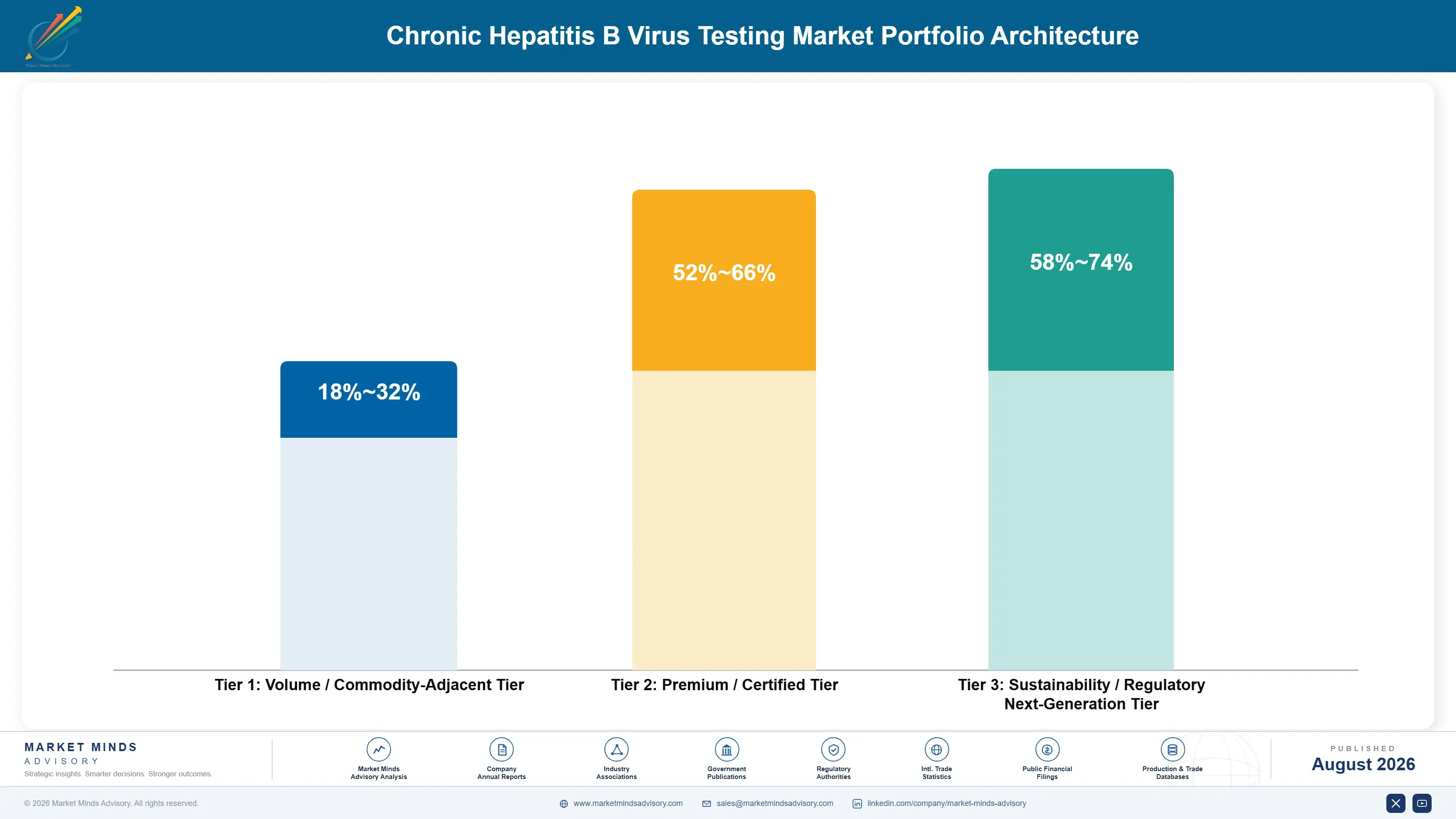
Portfolio Architecture for Margin Defence

Margin architecture separates by where a test sits in the cascade and who pays for it. Screening immunoassays in donor-funded and ministry programmes price near $1.90 and clear gross margins in the twenties, sustained only by volume. Viral load quantification and resistance testing carry molecular complexity and price near $26 or above, and both clear well over fifty per cent even under negotiated programme procurement.
The tension is between burden and value. The regions carrying most of the world's infection are the ones where testing is cheapest and funded through mechanisms designed to compress price. High-income markets generate strong margins on a small infected population. Nobody has built a position that captures volume and value together, and participants weighted toward either extreme have an uncomfortable business.

High-value pools concentrate where a test informs a treatment decision rather than merely establishing infection. Viral load quantification, resistance testing and decentralised platforms that complete the cascade all sit there. Screening assays alone identify people who mostly never reach a treatment decision, which generates test volume without generating the clinical outcome that programme funders are increasingly measuring. That distinction now shapes procurement criteria directly.

Volume / Commodity-Adjacent Tier

Surface antigen screening assays and rapid tests supplied into donor-funded and ministry programmes at negotiated pricing, where volume alone sustains participation and domestic manufacturers hold a permanent cost advantage. Margins here depend entirely on volume.
Gross Margin: 18-32%

Premium / Certified Tier

Viral load quantification and serological confirmation panels running on installed laboratory platforms, protected by instrument compatibility, regulatory registration breadth and the clinical decisions these results actually inform. Clinical decisions happen at this step.
Gross Margin: 52-66%

Sustainability / Regulatory / Next-Generation Tier

Decentralised molecular platforms and resistance genotyping addressing cascade completion and treatment failure, defended by cartridge technology, ambient stability and evidence on patients reaching treatment decisions. Cartridge cost is the remaining obstacle to programme adoption at scale.
Gross Margin: 58-74%
chronic-hepatitis-b-virus-testing-market-portfolio-architecture-1787306503114

High-value Sub-segments and Strategic Watch-out

Point-of-Care and Decentralised Testing

High value and the fastest growth at 12.3%, addressing cascade loss rather than analytical performance. Cartridge cost per result remains the obstacle, and funders must value patients reaching treatment above tests performed. Funders are moving toward that measure steadily. Cartridge cost is the obstacle. Evidence will decide it.
Gross Margin: 58-74%

Viral Load Quantification

High value at 9.8%, determining treatment eligibility and monitoring response afterward. Idle molecular capacity from pandemic response removes the capital barrier, leaving reagent cost and trained personnel as constraints. Recurring monitoring revenue sits entirely here. Trained personnel now limit expansion more than instruments. Capital is no longer needed.
Gross Margin: 52-66%

Surface Antigen Screening Assays

The volume core at 7.4%, carrying nearly all test counts and very little value at programme pricing near $1.90. Domestic manufacturers in high-burden countries hold cost positions nobody else can approach. Volume without value describes this segment precisely. Participation depends purely on volume. Value follows elsewhere entirely.
Gross Margin: 18-32%

Drug Resistance and Genotyping

The strategic watch-out at 8.8%. Clinically valuable where treatment failure occurs, but the tested population is small and most high-burden programmes cannot fund it against competing screening priorities. Screening priorities absorb the available programme funding first. The tested population stays small. Funding goes to screening first.
Gross Margin: 56-70%

Who Funds and What Completes

Revenue here follows programme funding cycles rather than clinical demand, because a disease producing no symptoms generates no patient-initiated testing at all. A national screening campaign creates enormous volume for its duration and very little afterward, which makes demand lumpy and dependent on ministry budget decisions that suppliers cannot influence directly. Monitoring diagnosed patients on therapy is the one genuinely recurring revenue stream in this market.
Cascade completion varies enormously by how testing is organised. Programmes performing screening and confirmation in a single encounter retain most patients, while those requiring return visits to distant facilities lose the majority. Roughly 38% complete the full cascade globally, and the difference between well-designed and poorly designed programmes is far larger than the difference between any two assays a supplier might offer.

The funding decision has also moved. Hepatitis testing was once bought by laboratories deciding which assays to run within their own budgets. It is now increasingly decided by health ministry programme managers and international funding mechanisms evaluating cost per patient diagnosed and treated. Suppliers still selling to laboratory directors are addressing people who no longer control the volume that matters in this market.
chronic-hepatitis-b-virus-testing-market-end-use-penetration-index-1787306503604

Where Value Actually Sits

These are among the four positions where our research anticipates prominent divergence between winners and laggards over the coming forecast period. Each is grounded in the demand model, the regulatory perimeter, and the announced capacity pipeline.
01 / PROGRAMME CHANNEL PRIORITY

No patient will ever ask for this test

Chronic hepatitis B produces no symptoms for decades, so no patient presents and no clinician suspects, which means commercial effort aimed at prescribers reaches people with no reason to order anything at all. Health ministries reporting against elimination targets are the actual buyers here, and they decide on programme cost per patient diagnosed rather than anything else. Participants that engaged at ministry and programme design level secured volumes several times larger than clinical channel selling had ever produced for them at equivalent commercial effort.
02 / CASCADE COMPLETION METRIC

A better assay across three visits still loses

Laboratory methods outperform decentralised platforms analytically and nobody in the field seriously disputes that, yet only around 38% of screened positives complete confirmation and staging because every additional visit loses people who feel entirely well. Programme funders increasingly evaluate suppliers on the number of patients reaching an actual treatment decision rather than on the raw count of tests performed. That reverses the conventional diagnostic argument entirely, and most commercial organisations in this field have not yet adjusted their positioning to it.
03 / MENU PLACEMENT ECONOMICS

Hepatitis alone never justifies the instrument

Screening tests price near $1.90 and viral load near $26 in high-burden programmes, which leaves margin that is far too thin to support any instrument placement on hepatitis volume considered by itself. The same platform running tuberculosis, human immunodeficiency virus and other priority disease assays carries placement economics that hepatitis volume alone could never reach. Participants that treat this as a standalone commercial opportunity consistently find the numbers fail, while those treating it as menu volume find that they work.
04 / INSTALLED CAPACITY EXPLOITATION

The instruments are already there and idle

Pandemic response installed nucleic acid amplification platforms across countries that previously had almost none of them at all, and a substantial share of that capacity now sits considerably underused. Viral load quantification runs on those same instruments using only different reagents, so hepatitis programmes can expand without any capital approvals that health ministries would otherwise struggle to obtain. Suppliers offering validated assays for installed competitor platforms reach volume that any instrument placement strategy of their own simply could not deliver.

Engagement Snapshot From the Field

A live engagement with an industry participant carrying material or product regulatory and market exposure ahead of a defining policy shift, showing how our research translates into a defensible multi-year portfolio strategy.
MARKET MINDS ADVISORY · CLIENT ENGAGEMENT SUMMARY
Chronic Hepatitis B Virus Testing Producer Strategic Portfolio Review and Transition Roadmap 2026·Investment Scenario on Chronic Hepatitis B Virus Testing Exposure Evaluation 2025-26
CLIENT PROFILE
A diagnostics manufacturer with annual revenue near $1.3 billion (client-reported, unverified by MMA), holding immunoassay and molecular platforms sold across Europe, North America and selected emerging markets. Leadership had identified hepatitis B testing in high-burden countries as a growth opportunity and wanted to understand why previous attempts to enter those programmes had generated volume without generating any profit.
STRATEGIC CHALLENGE
Earlier entry attempts had won tender volume at programme pricing and lost money on every shipment once registration, distribution and cold chain costs were properly allocated. Leadership needed to establish whether these markets could be served profitably at all, and whether the company's decentralised platform could compete on cascade completion rather than on price alone.
MMA APPROACH
We rebuilt landed cost by country including registration maintenance, distribution, cold chain and excursion wastage, which the client had been allocating on a global average. Twenty-six programme managers and ministry officials were interviewed on procurement criteria. We modelled standalone hepatitis participation against multi-disease platform placement across eight high-burden markets. Wastage was measured at country level.
KEY FINDINGS
  1. Cold chain and excursion wastage in tropical programmes consumed a larger share of landed cost than reagent manufacture, and the client had never measured it at country level.
  2. Programme managers evaluated on cost per patient diagnosed and increasingly on cost per patient treated, and 19 of 26 said tests performed was no longer their primary reporting metric.
  3. Standalone hepatitis participation was unprofitable in seven of eight markets modelled, while multi-disease platform placement was profitable in five of the same eight.
  4. Idle molecular instrument capacity existed in six markets, and validated assays for competitor platforms reached volume the client's own instruments could not have accessed.
CLIENT PROFILE
A diagnostics manufacturer with annual revenue near $1.3 billion (client-reported, unverified by MMA), holding immunoassay and molecular platforms sold across Europe, North America and selected emerging markets. Leadership had identified hepatitis B testing in high-burden countries as a growth opportunity and wanted to understand why previous attempts to enter those programmes had generated volume without generating any profit.
STRATEGIC CHALLENGE
Earlier entry attempts had won tender volume at programme pricing and lost money on every shipment once registration, distribution and cold chain costs were properly allocated. Leadership needed to establish whether these markets could be served profitably at all, and whether the company's decentralised platform could compete on cascade completion rather than on price alone.
MMA APPROACH
We rebuilt landed cost by country including registration maintenance, distribution, cold chain and excursion wastage, which the client had been allocating on a global average. Twenty-six programme managers and ministry officials were interviewed on procurement criteria. We modelled standalone hepatitis participation against multi-disease platform placement across eight high-burden markets. Wastage was measured at country level.
KEY FINDINGS
  1. Cold chain and excursion wastage in tropical programmes consumed a larger share of landed cost than reagent manufacture, and the client had never measured it at country level.
  2. Programme managers evaluated on cost per patient diagnosed and increasingly on cost per patient treated, and 19 of 26 said tests performed was no longer their primary reporting metric.
  3. Standalone hepatitis participation was unprofitable in seven of eight markets modelled, while multi-disease platform placement was profitable in five of the same eight.
  4. Idle molecular instrument capacity existed in six markets, and validated assays for competitor platforms reached volume the client's own instruments could not have accessed.
RECOMMENDED STRATEGY
Phase 1: Phase one: stop bidding standalone hepatitis tenders and enter only where a multi-disease platform menu carries the placement economics properly. Phase 2: Phase two: develop ambient-stable formulations to remove cold chain dependency, since wastage exceeds reagent cost in tropical programme conditions. Funders now specify it. Phase 3: Phase three: validate assays for installed competitor molecular platforms, reaching capacity the company will never place instruments into. That capacity is already installed and idle.
OUTCOME
Standalone tender participation ceased and the company withdrew from three markets it had been serving at a loss. Multi-disease placement proceeded in four markets and reached profitability within the first year (client-reported, unverified by MMA). Ambient-stable development was funded, and programme managers cited it during two subsequent procurement discussions.

Frequently Asked Questions

Foundational context covering the market sizes, CAGR, scope, country, region and competition that inform every finding below. This section is provided to cover basics and most often pre-purchase conversations, answered from the MMA Primary Research Dataset.

What is the current size of the Chronic Hepatitis B Virus Testing Market?

The global market is valued at $1.85 billion in 2025, rising to $2.00 billion in 2026. East Asia holds the largest share at 32%, reflecting an infected population larger than any other region's.

How large will the Chronic Hepatitis B Virus Testing Market be by 2036?

MMA forecasts $4.40 billion by 2036, an increase of $2.40 billion over the 2026 base and an expansion multiple of 2.20x. Decentralised testing and viral load quantification carry most of that growth.

What is the CAGR for the Chronic Hepatitis B Virus Testing Market 2026 to 2036?

The base case compound annual growth rate is 8.2%, with a bull case at 9.4% and a bear case at 7.0%. Historical growth from 2020 to 2025 ran near 6.9% as screening programmes lost ground.

Which segment is growing fastest?

Point-of-care and decentralised testing compounds at 12.3%, a full 1.50x the market rate. It addresses cascade loss rather than analytical performance, since roughly 38% of screened positives complete confirmation.

Who are the major companies in the Chronic Hepatitis B Virus Testing Market?

Roche Diagnostics, Abbott, Siemens Healthineers, Hologic and QIAGEN together hold 61% of revenue from hepatitis B testing products. All five reach programmes through platforms carrying broad assay menus.

Which country is growing fastest?

Nigeria compounds at 12.6%, faster than any other country covered, as national elimination commitments and donor programmes fund screening at scale for the first time. Diagnosis rates there start from a very low base.

Report Segmentation Architecture

The full report scope spans multiple orthogonal segmentation dimensions, with cross-tabulated demand data provided for each dimension pair. Coverage extends further to regional breakdowns, trend trajectories, and the competitive detail needed to support segment-level decision-making.

By Test Class

  • Surface Antigen Screening Assays
  • Confirmatory and Serological Panel Testing
  • Viral Load Quantification
  • Point-of-Care and Decentralised Testing
  • Drug Resistance and Genotyping Assays

By End-Use Industry

  • National Screening Programmes
  • Hospital and Reference Laboratories
  • Primary Care and Community Clinics
  • Antenatal and Maternal Health Services
  • Hepatology and Liver Disease Centres
  • Non-Governmental and Donor Programmes

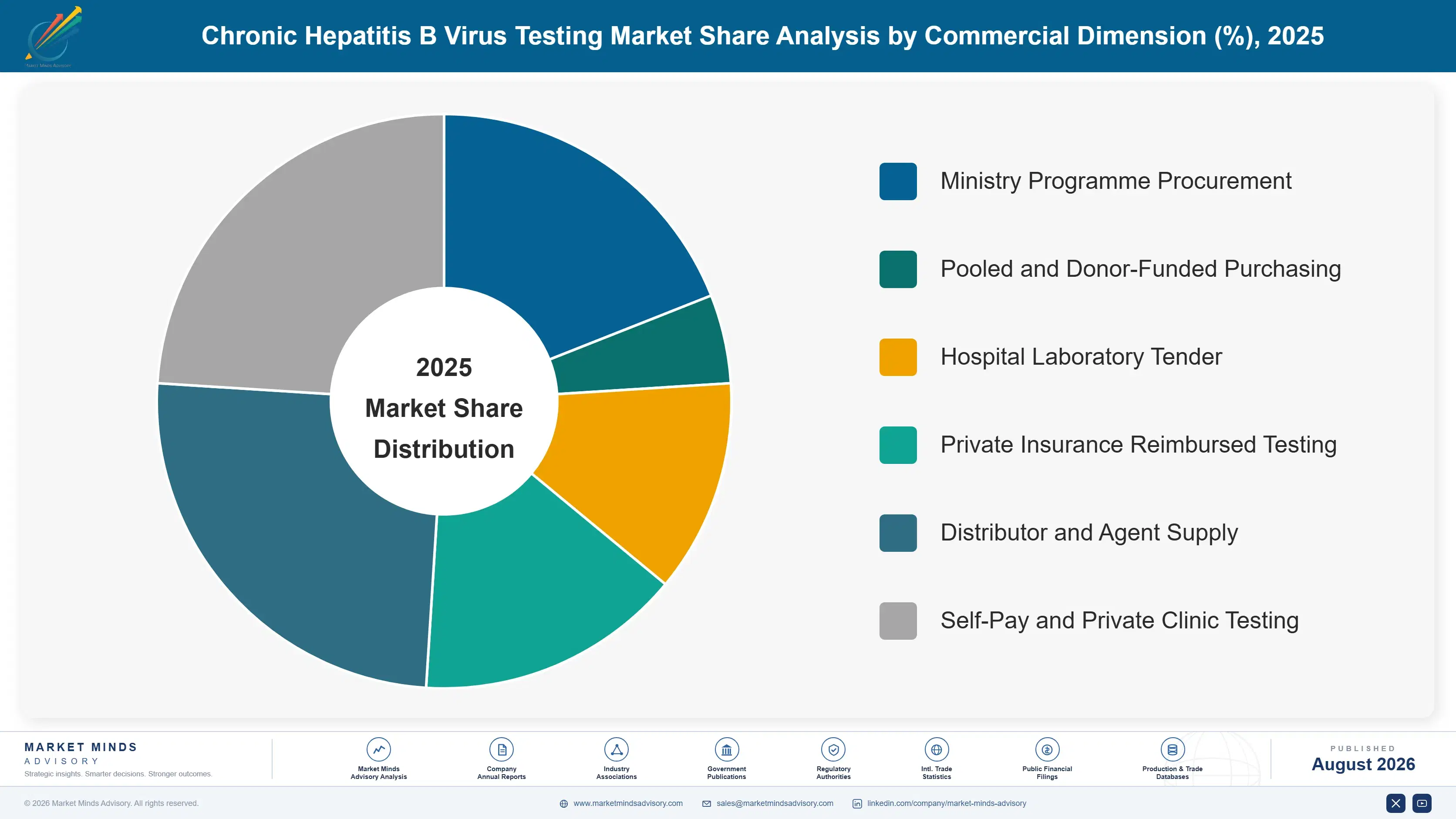
By Commercial Dimension

  • Ministry Programme Procurement
  • Pooled and Donor-Funded Purchasing
  • Hospital Laboratory Tender
  • Private Insurance Reimbursed Testing
  • Distributor and Agent Supply
  • Self-Pay and Private Clinic Testing

By Region

  • East Asia
  • North America
  • Western Europe
  • South Asia and Pacific
  • Latin America
  • Middle East and Africa
  • Eastern Europe

Scope, Methodology, and Coverage

Every figure in this report is reproducible from documented input assumptions. The scope below maps the historical period, the forecast horizon, the segmentation dimensions, and the countries covered, alongside the underlying primary and qualitative methodology.
Historical Period
2020 to 2025
Forecast Period
2026 to 2036
Base Year
2025 (USD billions; MMA Primary Research Dataset, August 2026)
Market Definition
This market comprises laboratory and point-of-care testing used to detect, confirm, stage and monitor chronic hepatitis B virus infection, measured at manufacturer revenue across ministry programme procurement, pooled and donor-funded purchasing, hospital laboratory tender, private insurance reimbursed testing, distributor and agent supply, and self-pay or private clinic testing. Coverage spans surface antigen screening assays including rapid formats and laboratory immunoassays, confirmatory and serological panel testing covering antibody and e-antigen markers, viral load quantification by nucleic acid amplification, point-of-care and decentralised testing performing screening or quantification outside centralised laboratories, and drug resistance and genotyping assays used in treatment failure. Hepatitis B vaccines and immunoglobulin, antiviral therapies of every class, liver imaging including ultrasound and transient elastography, liver biopsy and histopathology services, hepatitis A, C, D and E testing, blood donor screening performed by transfusion services, and instrument hardware sold independently of assays fall outside scope.
Quantitative Units
USD millions (current prices); tests performed by class; people screened; diagnosis rate by market; cascade completion rate; price per test by class; treatment eligible share
Segmentation Dimensions
By Test Class; By End-Use Industry; By Commercial Dimension; By Region
Regions Covered
East Asia, North America, Western Europe, South Asia and Pacific, Latin America, Middle East and Africa, Eastern Europe
Countries Covered
China, Japan, South Korea, Taiwan, Vietnam, United States, Canada, Germany, France, Italy, Spain, United Kingdom, Netherlands, Sweden, Greece, India, Indonesia, Pakistan, Bangladesh, Philippines, Australia, Thailand, Brazil, Colombia, Peru, Argentina, Mexico, Nigeria, Ethiopia, Egypt, South Africa, Ghana, Kenya, Saudi Arabia, Poland, Czechia, Hungary, Romania, Turkey, and additional markets relevant to viral hepatitis analysis
Key Companies Profiled
Roche Diagnostics, Abbott, Siemens Healthineers, Hologic, QIAGEN, bioMerieux, Bio-Rad Laboratories, Ortho Clinical Diagnostics, DiaSorin, Fujirebio, Cepheid, SD Biosensor, Wantai BioPharm, KHB Shanghai Kehua, Autobio Diagnostics, Mindray, Trinity Biotech, Meril Diagnostics, Molbio Diagnostics, Sysmex
Quantitative Methodology
Primary survey, n=3,800 respondents, Q4 2025, six countries; demand-side model with trade association cross-validation
Qualitative Methodology
47 expert interviews, Q4 2025; applied to validate demand model assumptions, identify emerging dynamics, and assess competitive positioning
Report Format
PDF and XLSX data workbook (Word format preview document)
Publisher
Market Minds Advisory
Report Code
MMA-2026-HLT-535
Published
August 2026
Contact
sales@marketmindsadvisory.com | www.marketmindsadvisory.com

Purchase the full Chronic Hepatitis B Virus Testing Market Report (2026 to 2036).

The full MMA report treats the diagnosis gap and the cascade loss as the two facts that define this market, and follows their commercial consequences through pricing, channel and platform strategy. It sizes five test classes and seven regions to 2036, modelling tests performed, people screened, diagnosis rates, cascade completion, pricing by class and treatment eligibility separately. Competitive assessment covers twenty manufacturers on one consistent revenue basis. Cost exposure is traced through reagents, registration and cold chain. Four commercial levers and a strategic verdict close the report, grounded in 47 expert interviews and a 3,800-respondent survey.
Five test classes sized separately through 2036
Diagnosis rates and cascade completion mapped by covered market
Programme procurement pricing benchmarked across donor and ministry channels
Twenty manufacturers assessed on one consistent revenue basis
Landed cost modelled by country including cold chain wastage
Anonymised manufacturer engagement with tested market entry recommendations

Built For The People Who Decide

From boardroom strategy to bench-side execution, this report is read cover-to-cover by leaders shaping the next decade of their industry, turning demand scenarios, market dynamics and valuation benchmarks into decisions.
CXOs/ Presidents/ VPs/ Managers
M&A and Corporate Development
Strategy Teams and R&D Heads
Procurement and Product Directors
Regulatory and Compliance Leaders
Investor Relations and Equity Analysts