Market Minds Advisory
Chronic Disease Management Services Market

Chronic Disease Management Services Market: Predictive Risk Scoring Moves Care Upstream of the Crisis

AI-driven risk stratification is letting health plans and providers identify which chronic disease patients will deteriorate before a costly hospitalization happens, pulling reimbursement dollars toward predictive programs that intervene while a crisis is still preventable.

Lead Analyst

Alice Ballenger

Published

September 2026

Make Smarter Decisions with Customized Research Insights

Request a free sample report and evaluate market opportunities, growth trends, and competitive dynamics relevant to your business needs.

2025 MARKET VALUE$8.6BMarket Size 2025
2036 FORECAST VALUE$25.0BBase Case , 2026 to 2036
CAGR 2026 TO 203610.2 %Bull 11.5% / Bear 8.9%
INCREMENTAL OPPORTUNITY$15.5BNet 10- year value creation
EXPANSION MULTIPLE2.64x2036 value over 2026 base
Strategic Levers
M&A Pipeline
Regional Outlook
Country Rankings
Competitive Intelligence
Segmental Deep-dive
Call-Us : 91 93563 13602

Executive Snapshot and Market Trajectory

Predictive risk stratification is shifting chronic disease management from reacting to hospitalizations toward identifying which patients will deteriorate weeks before a crisis, giving payers and providers a genuinely new intervention window earlier programs never had access to. That earlier window is reshaping how payers structure reimbursement priorities.
Demand concentrates around three service categories: remote patient monitoring, care coordination spanning multiple providers, and disease-specific coaching for diabetes and hypertension. AI-driven predictive risk stratification is growing fastest as payers seek to intervene before expensive acute episodes occur rather than reacting afterward. North America holds the largest share on concentrated digital health reimbursement infrastructure and payer investment. Care coordination increasingly spans behavioral health comorbidities as well.
Competitive intensity concentrates among large digital health platforms with broad chronic condition coverage competing for health plan and employer contracts, while specialized single-condition vendors compete on clinical outcomes depth within narrower therapeutic areas. Consolidation continues reshaping the competitive field, as larger platforms acquire specialized point solutions to build comprehensive, multi-condition offerings that health plans increasingly prefer over managing dozens of separate vendor relationships. That consolidation trend is reshaping which vendors survive independently.
Market Definition
The chronic disease management services market covers services and technology-enabled programs that monitor, coordinate, and support care for patients with chronic conditions outside acute hospital settings, including remote patient monitoring, care coordination, disease-specific coaching, telehealth consultation, medication adherence support, and predictive risk stratification. It excludes acute hospital-based treatment, pharmaceutical products themselves, and general wellness programs not targeted at diagnosed chronic conditions specifically.
Base Year Value
$8.6B in 2025 (MMA Primary Research Dataset, August 2026)
Forecast Period
2026 to 2036, eleven discrete annual values
CAGR
10.2% base case. Bull 11.5%. Bear 8.9%.
Fastest Growth Segment
AI-Driven Predictive Risk Stratification Services: 16.5% CAGR
Fastest Growth Country
India: 16.8% CAGR
Fastest Growth Region
South Asia and Pacific: 12.4% CAGR
Largest Region
North America: 32% of 2025 global value
Market Leaders
Teladoc Health Inc., Omada Health Inc., UnitedHealth Group, CVS Health Corporation, Koninklijke Philips N.V. Source: MMA Analysis based on company annual reports.
Primary Survey
n=3,800 procurement and R&D decision-makers, Q4 2025, six countries
Methodology
Demand-side build-up, cross-validated against public data, 47 expert interviews

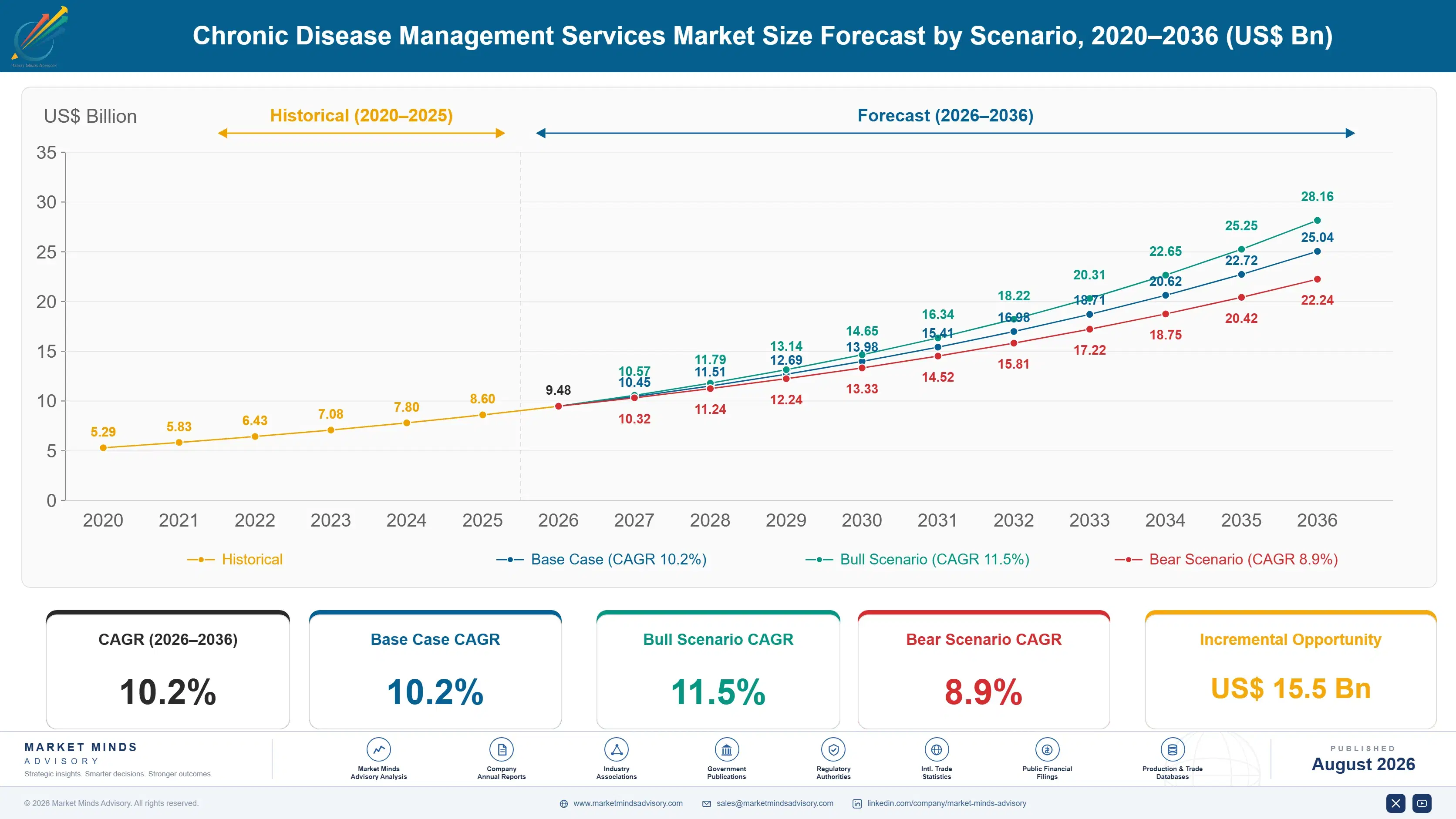
Chronic Disease Management Services Market Forecast Scenarios

chronic-disease-management-services-market-size-forecast-scenario-1787306347098
Between 2020 and 2025 the market grew at roughly 9.2% a year, accelerating sharply through pandemic-era telehealth adoption before settling into steadier growth as reimbursement policy and clinical evidence both matured around remote monitoring and virtual chronic care delivery models. That acceleration revealed genuine consumer and provider appetite for virtual chronic care delivery models well beyond emergency pandemic necessity alone.
The base case carries the market to a 10.2% CAGR on three mechanisms. First, remote patient monitoring reimbursement keeps expanding as more payers recognize the demonstrated cost savings from earlier intervention. Second, predictive risk stratification keeps maturing from pilot programs into standard payer-sponsored offerings as clinical validation accumulates. Third, rising chronic disease prevalence, tracked through national health surveillance data across most major markets, keeps expanding the population requiring ongoing management services.
The bull case reaches 11.5% if predictive risk stratification proves cost-effective enough that payers mandate its inclusion across a meaningfully broader set of chronic care contracts. The bear case falls to 8.9% if reimbursement policy for digital chronic care services faces meaningful rollback or fails to keep pace with continued program adoption across major healthcare systems.

Predictive Analytics Are Becoming the New Standard of Care

Three forces converge on this market at once. Payers keep expanding reimbursement for remote monitoring and virtual chronic care as cost-effectiveness evidence accumulates, predictive analytics keep maturing toward reliable, actionable risk scoring, and chronic disease prevalence keeps rising across aging populations worldwide. Vendors unable to demonstrate measurable clinical and cost outcomes risk losing contracts to better-evidenced competitors. Vendors unable to satisfy all three simultaneou
MARKET CONCENTRATION (CR5)36%Top five providers hold well under half share
AVERAGE PROGRAM COST$1,850/patient/yearComprehensive programs command substantial premium over point solutions
TOP PRODUCING COUNTRY SHARE31%United States leads global digital chronic care spending volume
PROGRAM ENGAGEMENT RATE58%Active patient participation climbed steadily since program inception
TRADE INTENSITY18%Roughly a fifth of platform licensing crosses national borders
TECHNOLOGY COST SHARE34% of COGSData infrastructure and software development dominate operating cost
Commercially, the market splits between comprehensive multi-condition platforms, priced at a premium and sold to health plans seeking a single vendor relationship across chronic conditions, and specialized single-condition point solutions, priced more narrowly and sold on deep clinical outcomes within a specific therapeutic area. That comprehensive platform category increasingly wins larger health plan contracts as buyers consolidate vendor relationships. That margin gap is widening as health plans increasingly prioritize consolidated, data-integrated vendor relationships.
Over the next decade the defining question is whether predictive risk stratification becomes a standard, expected component of every chronic care contract, or whether it remains a premium add-on layered onto core monitoring and coaching services that continue anchoring the bulk of program spending.
"For a decade this industry sold itself on patient engagement and coaching, and that still matters. But the vendors winning the biggest contracts now are the ones who can tell a health plan which specific patients are going to end up in the emergency room in six weeks, and that is a fundamentally different and harder product to build."
Director, Digital Health and Chronic Care Practice · MMA Healthcare / Digital He

Market Trends

Predictive Risk Models Move From Pilot to Standard Contract Terms

AI-driven predictive risk stratification, which analyzes claims, clinical, and remote monitoring data to identify patients likely to deteriorate before symptoms become acute, has moved from pilot programs at leading health systems into standard contract terms several major payers now request explicitly when evaluating chronic care vendors. Vendors with demonstrated predictive accuracy are winning larger, multi-year contracts as payers increasingly view this capability as a genuine differentiator rather than an experimental add-on layered onto existing monitoring services. Clinical validation remains earlier stage for rarer conditions than for high-prevalence conditions like diabetes and heart failure specifically.
Market Impact: Adds 3 to 5 codes yearly
Health Plans Consolidate Vendor Relationships Around Multi-Condition Platforms

Health plans managing dozens of separate point-solution vendor relationships across different chronic conditions have increasingly moved toward consolidating purchasing around fewer, broader platforms capable of covering multiple conditions under one contract and one data integration effort. This consolidation trend has driven meaningful acquisition activity as larger platforms acquire specialized single-condition vendors to build comprehensive coverage, reshaping the competitive field faster than organic product development alone could achieve for any single company pursuing multi-condition breadth independently. Vendors without a credible platform breadth strategy increasingly find themselves excluded from the largest health plan procurement processes entirely.
Market Impact: Prevalence rose 15% to 20%

Market Opportunities and Growth Drivers

Remote Monitoring Reimbursement Expansion Sustains Program Growth

Medicare and a growing number of commercial payers have expanded reimbursement codes covering remote physiologic monitoring and chronic care management services, giving health systems and vendors a clearer commercial pathway than existed just a few years ago when much of this care went unreimbursed directly. Each newly covered service code represents recurring, billable program revenue tied directly to enrolled patient volume rather than any single technology adoption cycle, giving vendors serving reimbursed service categories a demand driver considerably more durable than one dependent purely on discretionary employer or payer program budgets alone.
Market Impact: Loses 30% to 40% of enrollees

Rising Chronic Disease Prevalence Expands the Addressable Population

Chronic disease prevalence, including diabetes, hypertension, and heart failure, continues rising steadily across most major markets according to national health surveillance tracking, driven by aging populations and lifestyle-related risk factors that show no clear sign of reversing in the near term. Each additional diagnosed chronic condition represents ongoing management demand that, unlike acute care episodes, recurs continuously over a patient's remaining lifetime following diagnosis, giving chronic disease management vendors a demographically anchored growth driver considerably more predictable than most other healthcare service categories tied to discrete treatment events. That predictability matters increasingly for revenue planning.
Market Impact: Adds 4 to 8 months delay

Market Restraints and Challenges

Patient Engagement and Program Adherence Remain Genuinely Difficult

Chronic disease management programs depend on sustained patient engagement over months or years, and the root cause of persistent engagement challenges is that managing a chronic condition day after day requires behavior change that competes against the same life circumstances, competing priorities, and motivation fatigue that make any long-term health behavior difficult to sustain regardless of program design quality. Programs with declining engagement over time deliver weaker clinical outcomes and struggle to demonstrate the cost-effectiveness data payers increasingly demand before contract renewal. Vendors are mitigating the challenge through more personalized engagement approaches and behavioral science-informed program design specifically.
Market Impact: Reaches over 4 million covered live

Data Integration Complexity Slows Multi-Condition Platform Deployment

Building a comprehensive platform that integrates data across electronic health records, claims systems, remote monitoring devices, and multiple clinical specialties requires substantial technical infrastructure investment, and the root cause is that healthcare data systems across different providers and payers were never designed with interoperability as a primary goal, creating genuine technical friction every integration must overcome individually. This complexity slows deployment timelines and raises implementation cost for vendors pursuing comprehensive multi-condition platforms specifically. Vendors are mitigating the barrier by building standardized integration frameworks that reduce the incremental technical burden of each additional health system or payer relationship.
Market Impact: Multi-condition contracts cover 60%
3 additional market trends, 4 additional growth drivers, and 3 additional restraints and challenges are covered in the full report. Contact sales@marketmindsadvisory.com to access the complete intelligence.

Segment CAGR and Growth Architecture

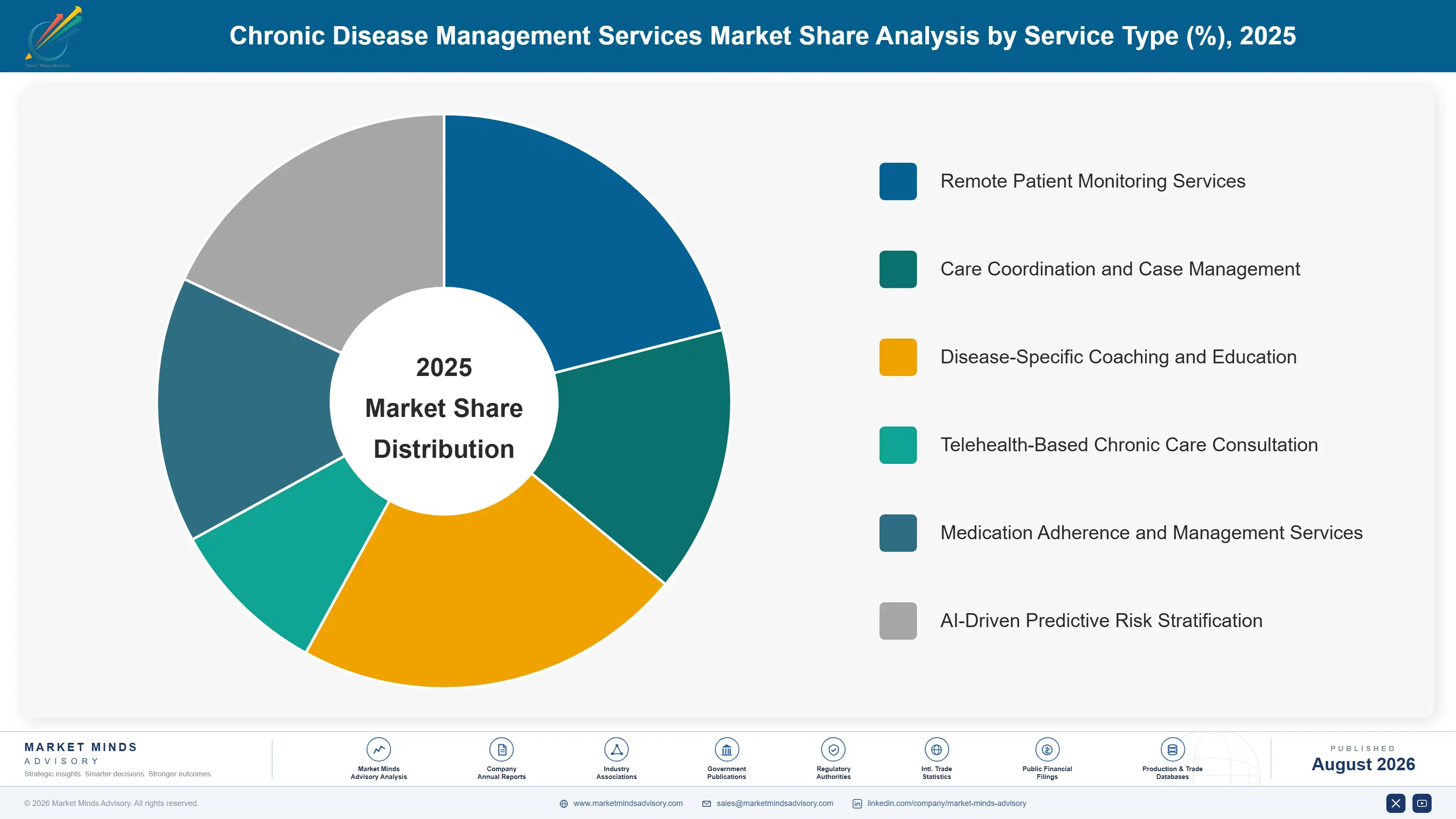
Segmentation follows service type, a single functional logic distinguishing how each offering supports chronic disease management. Payer channel and condition specialty are treated as separate commercial dimensions, not parallel segments within this service-based framework. Each service carries its own clinical role, data requirement, and reimbursement pathway, so commercial position tracks functional purpose rather than condition specialty alone.
chronic-disease-management-services-market-market-share-analysis-1787306347637

AI-Driven Predictive Risk Stratification Services

Predictive risk stratification services grow fastest at 16.5%, about 1.62 times the overall rate, as payers and providers increasingly prioritize identifying which patients will deteriorate before an expensive acute episode occurs rather than managing conditions purely reactively after symptoms worsen. These services analyze claims, clinical, and remote monitoring data using machine learning models to generate actionable risk scores that trigger earlier clinical intervention, commanding premium pricing that reflects genuine analytical sophistication few smaller vendors can replicate reliably. Adoption is fastest for high-prevalence conditions like diabetes and heart failure, where large training datasets support more reliable model performance than for rarer conditions still accumulating sufficient clinical data for reliable validation. That validation gap represents the segment's clearest near-term growth constraint.
CAGR 16.5%

Remote Patient Monitoring Services

Remote patient monitoring services grow at 11.5%, the second-fastest category, as expanding reimbursement codes and improving connected device technology both make continuous physiological monitoring more commercially viable and clinically actionable than in past years. These services generate the continuous data stream predictive risk models increasingly depend on, creating a genuine commercial link between monitoring and analytics categories that vendors offering both capture more fully than monitoring-only competitors. Philips and several specialized device manufacturers anchor this category's hardware component, while software and clinical monitoring services increasingly determine which vendor wins the broader program contract beyond device supply alone. Vendors combining monitoring hardware with proprietary analytics increasingly capture more of the total contract value than device-only suppliers can.
CAGR 11.5%
Full segment breakdown across 6 segments available in the complete report.

Regional Architecture and Country Demand Map

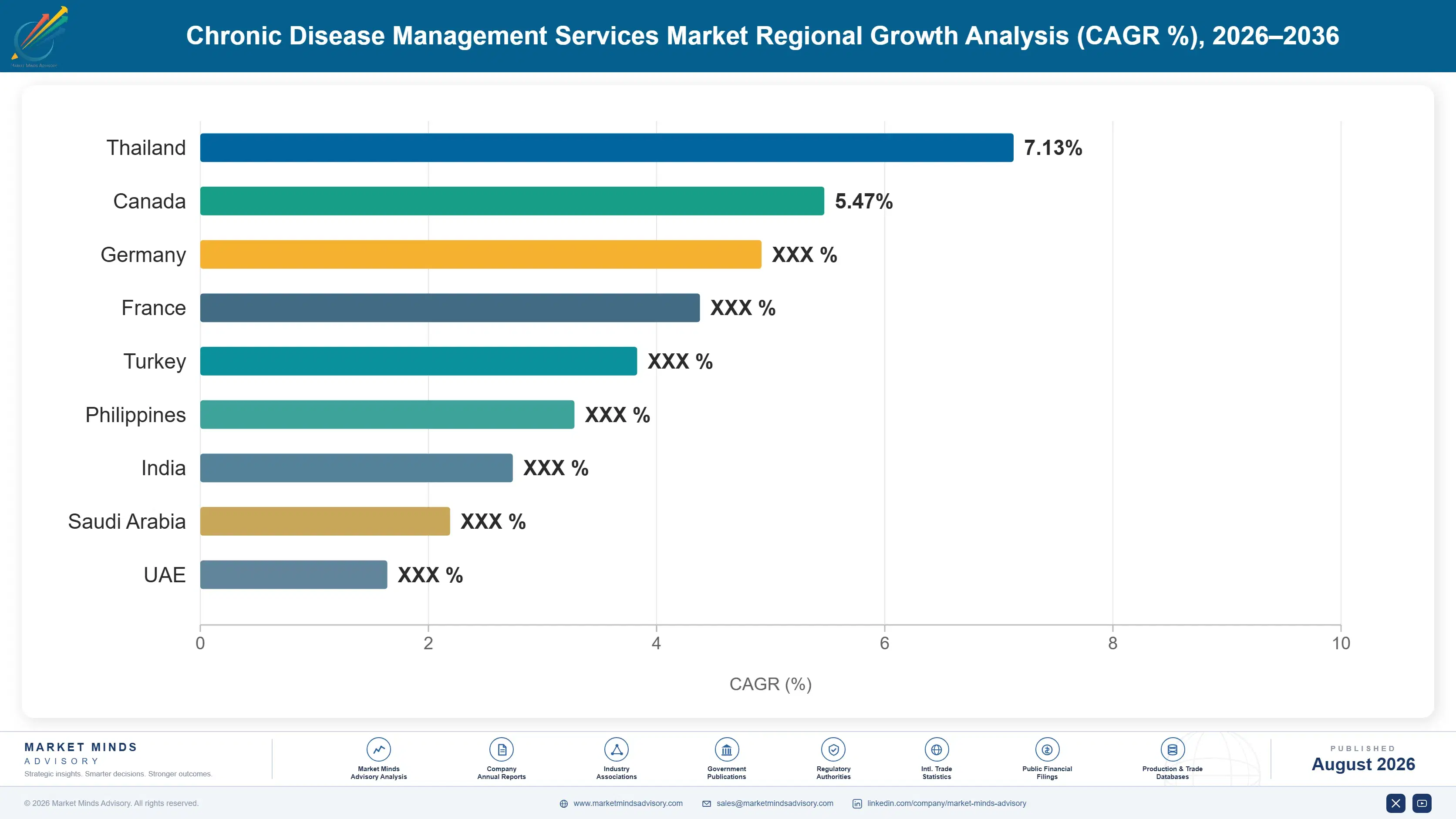
North America leads on concentrated digital health reimbursement infrastructure and payer investment, East Asia follows on expanding chronic care technology adoption, and South Asia and Pacific grows fastest among major regions off a smaller base. Latin America and the Middle East grow steadily off smaller current program bases.

North America

United States chronic disease management spending anchors the world's largest market, supported by Medicare and commercial payer reimbursement codes for remote monitoring and chronic care management that most other markets have not yet matched at comparable scale. Teladoc Health and UnitedHealth Group's Optum both run substantial domestic commercial and clinical operations, serving both health plan and direct employer customer relationships across the country. Canada's smaller but stable digital health sector follows similar reimbursement and adoption patterns, though generally trailing the pace of American commercial payer investment specifically. Growth trails East Asia and South Asia and Pacific because the region's chronic care technology adoption is already comparatively mature, leaving incremental program expansion as the primary driver going forward.
Share: 32% | CAGR: 9.5% (2026 to 2036)

Western Europe

The United Kingdom's National Health Service has invested meaningfully in remote monitoring and digital chronic care pilots, though national procurement processes have moved more cautiously than the more fragmented, faster-moving American commercial payer market historically has. Germany and France both maintain growing digital health sectors, with German reimbursement pathways for approved digital health applications creating a distinctive regulatory model other European markets increasingly reference directly. Philips, headquartered in the Netherlands, anchors substantial regional remote monitoring device and software development capability. Growth trails East Asia and South Asia and Pacific as the region's healthcare digitization and chronic care adoption are both already comparatively advanced relative to faster-growing markets. That combination increasingly shapes how other European markets approach digital health reimbursement design.
Share: 21% | CAGR: 8.6% (2026 to 2036)
Regional intelligence for 5 additional markets available in the complete report: East Asia, South Asia and Pacific, Latin America, Middle East and Africa, Eastern Europe. Contact sales@marketmindsadvisory.com.
chronic-disease-management-services-market-country-cagr-analysis-1787306348158

Where Chronic Care Vendors Defend and Grow Margin

Four commercial moves separate vendors capturing durable payer contracts from those losing ground to consolidation pressure: predictive analytics investment, multi-condition platform breadth, engagement science depth, and value-based contracting structures. Each move converts a technical or contracting advantage into a defensible commercial position competitors without matching analytics depth or platform breadth cannot easily replicate quickly.

Invest in Predictive Risk Stratification as a Core Capability

Payers increasingly view predictive analytics as a genuine differentiator rather than an optional add-on, and vendors who build this capability internally rather than treating it as a future roadmap item capture the largest, longest multi-year contracts before competitors catch up to where buyer expectations have already moved. Early evidence suggests vendors with demonstrated predictive accuracy win contracts averaging meaningfully larger scope than those offering monitoring and coaching alone without a predictive analytics component included. Vendors with proven predictive accuracy report winning contracts averaging 30% to 50% larger in scope than monitoring-only competitors secure.
Market Impact: Wins contracts 30% to 50% larger on

Build Multi-Condition Platform Breadth Through Targeted Acquisition

Health plans increasingly prefer consolidating chronic care purchasing around fewer vendor relationships rather than managing dozens of separate point-solution contracts, and vendors expanding condition coverage through targeted acquisition of specialized single-condition companies capture this consolidation trend faster than organic product development alone could achieve. This acquisition strategy has already reshaped the competitive field meaningfully, and vendors moving slowly on platform breadth risk losing renewal negotiations to broader competitors health plans increasingly prefer. Vendors pursuing this strategy actively now win roughly 60% of large new multi-condition deals across the broader payer market.
Market Impact: Multi-condition vendors win 60% of

Invest in Behavioral Science to Improve Program Engagement

Patient engagement decline remains the single biggest threat to program outcomes and renewal, and vendors investing in behavioral science-informed program design, including personalized outreach timing and motivation-focused coaching approaches, sustain meaningfully higher engagement over program duration than generic, one-size-fits-all outreach strategies most competitors still rely on. This engagement advantage translates directly into stronger clinical outcomes data, which in turn supports premium contract renewal terms and reduces the cost of demonstrating value to skeptical payers. Vendors investing here report improving one-year patient retention by 15% to 25% relative to generic outreach approaches used previously.
Market Impact: Improves one-year retention by 15%

Structure Value-Based Contracts Tied to Outcomes

Payers increasingly favor vendors willing to accept value-based contracting structures tying a meaningful portion of compensation to demonstrated clinical and cost outcomes rather than pure per-member-per-month fees regardless of program performance. Vendors confident in their program's effectiveness capture this trend as a competitive advantage, since value-based terms signal genuine confidence competitors offering only fee-for-service pricing structures cannot credibly match, differentiating on commercial structure as much as clinical capability itself. These value-based arrangements now cover roughly 25% to 35% of total vendor revenue among leading platforms pursuing this approach actively today.
Market Impact: Value-based contracts now cover 25%

Who Controls the Margin Pool

Concentration sits at a moderate CR5 of 36%, with a real gap separating large multi-condition platforms from smaller specialized point-solution vendors. Teladoc Health and UnitedHealth Group's Optum compete on platform breadth and payer relationship depth, while Omada Health and CVS Health anchor strong positions in coaching-based programs and pharmacy-integrated services respectively. Numerous smaller specialized vendors compete for narrower single-condition contracts.
Current competitive activity runs along three lines: predictive analytics capability development, where leading platforms race to prove actionable risk scoring accuracy; multi-condition platform consolidation, increasingly central to winning large health plan contracts; and value-based contracting adoption, as vendors compete on willingness to tie compensation to outcomes. All participants are assessed on one consistent basis, annual revenue from chronic disease management service contracts.

Pressure is building from two directions. Predictive analytics-focused vendors are capturing disproportionate contract value as payers prioritize this capability, a dynamic monitoring-only competitors cannot easily counter through pricing alone. Meanwhile consolidation continues reshaping the field as larger platforms acquire specialized vendors to build comprehensive coverage, squeezing standalone single-condition companies without acquisition interest or platform partnership. Rankings over the next five years will likely shift toward vendors combining predictive analytics depth with genuine multi-condition breadth.
chronic-disease-management-services-market-company-positioning-matrix-1787306348681

Competitive Moat and Risk Dimensions

TELADOC HEALTH INC.

Moat: Largest virtual chronic care network

Teladoc's combined virtual care and Livongo chronic condition management platform gives it one of the broadest multi-condition service offerings in the industry, letting it serve large health plan and employer accounts as a single-vendor relationship covering multiple chronic conditions few narrower competitors can match at comparable scale.
TELADOC HEALTH INC.

Risk: Livongo integration goodwill impairment history

Teladoc recorded substantial goodwill impairment charges related to its Livongo acquisition in recent years, reflecting integration challenges and valuation pressure that have drawn investor scrutiny toward the company's broader acquisition-driven growth strategy. Any further integration difficulty across its combined platform could damage both financial performance and market confidence in future consolidation moves.
UNITEDHEALTH GROUP

Moat: Deep payer-provider data integration

Optum's position within UnitedHealth Group gives it direct access to combined payer claims and provider clinical data at a scale few standalone chronic care vendors can replicate, supporting predictive analytics model performance and care coordination capability built on genuinely integrated data infrastructure rather than assembled third-party data partnerships.
UNITEDHEALTH GROUP

Risk: Antitrust and vertical integration scrutiny

UnitedHealth Group's combined payer, provider, and pharmacy operations have drawn sustained regulatory and antitrust scrutiny in recent years, and any regulatory action limiting how Optum's chronic care services can leverage the parent company's combined data assets could meaningfully constrain the data integration advantage underlying its competitive position.

Players Tracked

Prominent Players

Teladoc Health Inc.
Omada Health Inc.
UnitedHealth Group
CVS Health Corporation
Koninklijke Philips N.V.

Other Key Players

Included Health
Cecelia Health
Welldoc Inc.
Ontrak Inc.
Hinge Health
Virta Health
DarioHealth Corp.
Vivante Health
Lightbeam Health Solutions
Prealize Health
Vim
Wellframe
Airstrip Technologies
Health Recovery Solutions
Vida Health

Recent Developments

JUNE 2025

Omada Health completes initial public offering

Omada Health completed its initial public offering, raising capital to expand its chronic condition coaching and remote monitoring platform across additional health plan and employer accounts. This was a public listing event, not an acquisition or merger, providing expanded capital access for continued growth. Momentum has continued since.
Signal: A successful public listing signals contin
SEPTEMBER 2024

Teladoc Health signs multi-year contract with national payer

Teladoc Health signed a multi-year chronic disease management services contract with a major national health payer, covering multiple chronic conditions across the payer's covered member population. This was a commercial services contract, not a joint venture or acquisition, securing recurring revenue tied to the payer's enrolled membership.
Signal: A large multi-condition contract win reinf
JANUARY 2025

Optum acquires remote patient monitoring technology start-up

Optum completed the acquisition of a privately held remote patient monitoring technology company, adding complementary device and data integration capability to its existing chronic care service portfolio. This was an acquisition, not a joint venture or minority investment, giving Optum full ownership of the acquired technology and team.
Signal: Continued acquisition activity confirms la

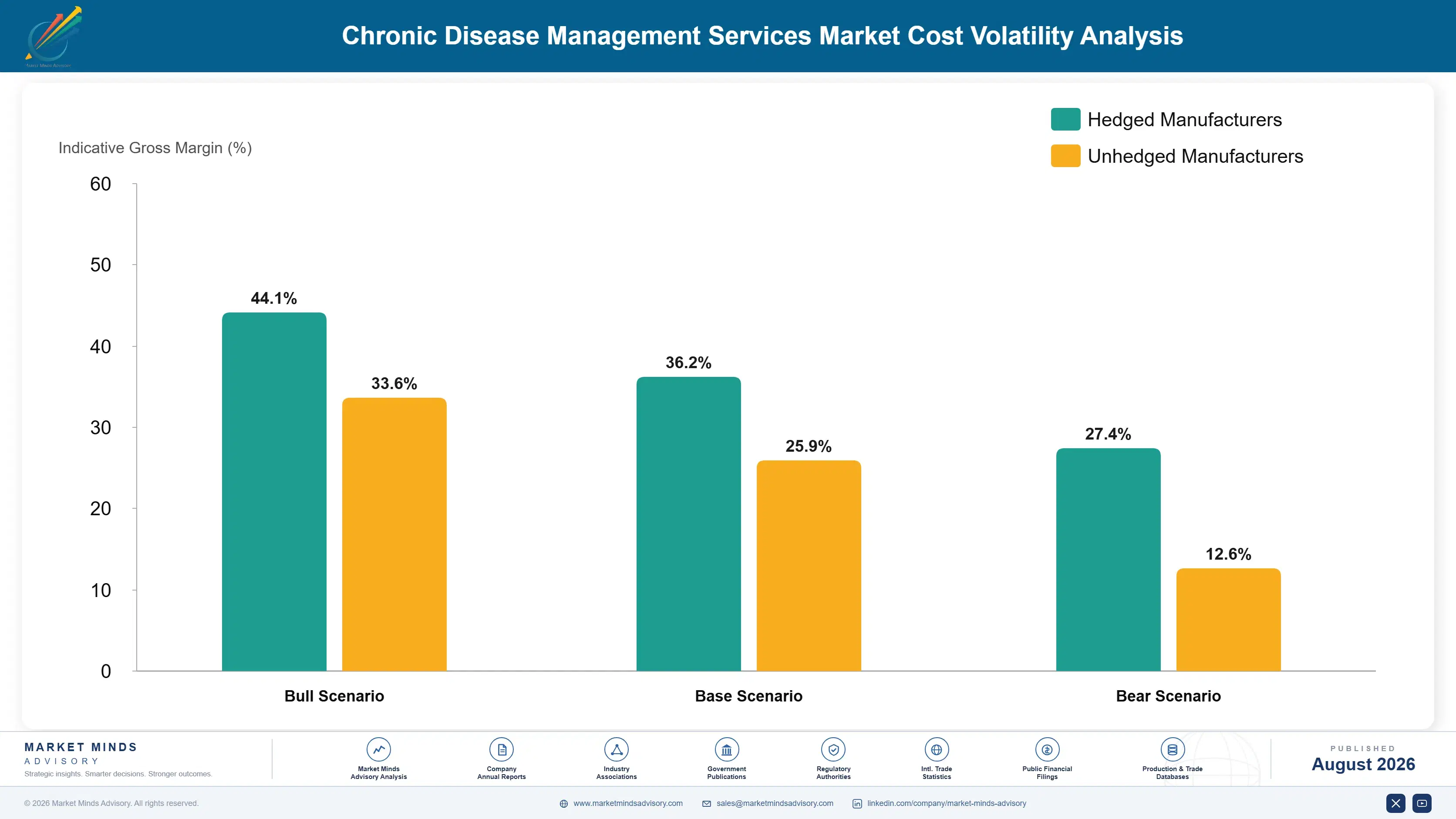
Data Infrastructure and Clinical Staffing Drive Cost

Cloud data infrastructure, software development talent, and clinical staffing for coaching and care coordination together account for roughly thirty-four percent of operating COGS, with clinical staffing representing an increasingly significant and competitively priced cost category given persistent healthcare workforce shortages across most major markets. Connected device hardware and data integration engineering add further meaningful cost layers specific to remote monitoring service delivery.
The clearest recent volatility event traces to 2022 and 2023, when the Bureau of Labor Statistics documented meaningful wage inflation across healthcare and technology talent categories simultaneously, directly raising both clinical staffing and software development cost for chronic care vendors competing for the same constrained talent pools. Several vendors reported margin compression during this period as compensation costs rose faster than contract pricing could adjust under existing multi-year payer agreements.

Exposure varies by vendor scale and staffing model. Larger vendors with scaled clinical staffing operations and established software development teams absorbed wage inflation with less disruption than smaller vendors dependent on contract staffing and external development resources. Vendors relying heavily on human coaching rather than automated engagement tools faced cost pressure, since staffing costs scale directly with enrolled volume in ways software-driven engagement does not.
chronic-disease-management-services-market-cost-volatility-analysis-1787306348876

Automate Routine Engagement to Reduce Clinical Staffing Dependence

Vendors are increasingly automating routine patient check-ins and low-acuity engagement through software-driven tools, reserving human clinical staff time for higher-acuity interventions where human judgment matters most, reducing overall clinical staffing cost per enrolled patient without compromising care quality for the cases that genuinely require it. This shift also improves engagement consistency across the enrolled population.

Build Internal Software Development Capability Over Contractors

Larger vendors are increasingly building internal software development teams rather than depending on external contractors, reducing cost volatility tied to competitive external talent markets while building proprietary technical capability that compounds in value over successive platform generations. Vendors adopting this approach report meaningfully more stable development costs across successive product release cycles compared to contractor-dependent competitors.

Index Multi-Year Payer Contracts to Labor Cost Benchmarks

Vendors are increasingly negotiating labor cost pass-through clauses into multi-year payer contracts, tying a portion of program pricing to published healthcare wage benchmark indices rather than absorbing the full risk of wage inflation under fixed-price agreements signed years before delivery. Payers generally accept these clauses now, having watched vendors absorb painful margin losses without comparable protection previously.

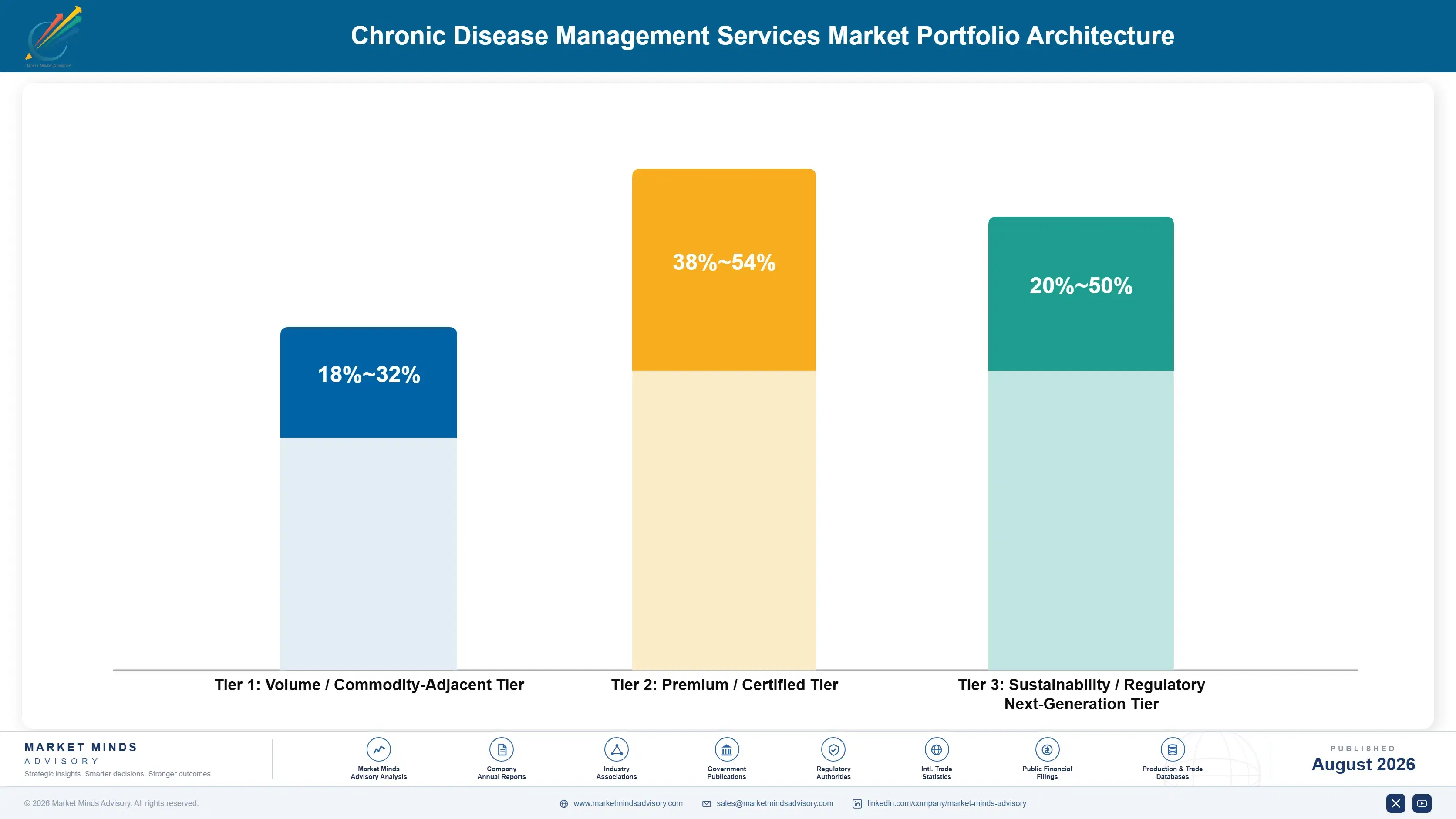
Portfolio Architecture for Margin Defence

The portfolio splits into three tiers with substantial margin separation. Volume single-condition coaching and monitoring programs compete on price and enrolled patient volume for standard chronic conditions, earning solid but not exceptional margins given competitive payer negotiating power. Certified premium multi-condition platforms with predictive analytics earn substantially more because health plans pay for comprehensive coverage and demonstrated outcomes rather than accepting fragmented p
The tension between volume enrollment and premium platform positioning shapes vendor strategy directly: single-condition programs build steady baseline revenue and clinical evidence, but vendors that let volume enrollment crowd out predictive analytics and platform breadth investment risk losing the highest-margin comprehensive contracts to more capable competitors. Vendors that manage this balance well capture both the volume and the margin across their combined service portfolio.

High-value pools concentrate in predictive analytics services and multi-condition platform contracts, where technical differentiation and comprehensive coverage justify premium economics few single-condition competitors can match. The emerging value-based contracting tier currently earns unevenly as vendors absorb outcomes risk against still-maturing clinical evidence and contract structure standardization. That unevenness should ease as value-based contract structures accumulate more standardized terms and clinical evidence.

Volume / Commodity-Adjacent Tier

Standard single-condition coaching and monitoring programs sold through payer contracts at negotiated per-member pricing., where enrolled volume and payer negotiating power determine which vendors can sustain acceptable margin under fee compression pressure.
Gross Margin: 18-32%

Premium / Certified Tier

Multi-condition platforms with predictive analytics commanding premium pricing from health plans seeking comprehensive, consolidated vendor relationships., who pay durable premiums for comprehensive coverage rather than manage fragmented vendor relationships across every chronic condition separately.
Gross Margin: 38-54%

Sustainability / Regulatory / Next-Generation Tier

Value-based contracting arrangements still absorbing outcomes risk against developing clinical evidence and standardized contract structures., where vendors are betting outcomes risk on contract structures they expect payers to demand as standard within several years.
Gross Margin: 20-50%
chronic-disease-management-services-market-portfolio-architecture-1787306349370

High-value Sub-segments and Strategic Watch-out

Predictive Risk Stratification Platforms

High value and high growth as payers prioritize earlier intervention, commanding durable premium pricing once clinical validation supports broader deployment across additional chronic conditions fully. Vendors with the strongest validated accuracy increasingly win contracts competitors offering monitoring alone cannot secure at all today, regardless of price, industry-wide.
Gross Margin: 42-56%

Multi-Condition Platform Contracts

High value with strong current growth as health plans consolidate purchasing, priced above single-condition alternatives while remaining accessible to mainstream payer program budgets. Adoption is broadening steadily beyond the largest health plans into mainstream regional payers seeking comparable consolidation and cost efficiency benefits consistently now.
Gross Margin: 38-54%

Standard Single-Condition Programs

The volume core, sold through payer contracts at negotiated per-member pricing, defended mainly through enrolled volume and thin per-patient margin discipline. Competitive pressure here concentrates on enrolled volume and payer contract renewal rather than the analytics differentiation reshaping premium and platform tiers specifically overall today.
Gross Margin: 18-32%

Legacy Non-Integrated Point Solutions

The strategic watch-out, facing continued displacement as consolidated multi-condition platforms increasingly outperform on both data integration and payer contracting simplicity. Vendors still dependent on this declining tier should be actively pursuing platform partnership or acquisition rather than defending point solutions payers increasingly consider inadequate for comprehensive coverage needs.
Gross Margin: 10-28%

How Chronic Care Demand Actually Recurs

Demand here runs on continuous per-member-per-month service consumption tied directly to enrolled patient volume rather than discrete purchase events. A health plan enrolling a patient in a chronic care program generates recurring monthly revenue tied to that patient's continued participation, making a single contract win worth years of recurring revenue rather than a standalone transaction. That pattern gives vendors predictable, multi-year revenue visibility.
Adoption depth varies sharply by buyer type. Health plans integrate chronic care vendors deeply into standardized member benefit programs once contracted, making vendor switching costly and rare absent clear performance failure or contract expiration. Individual employer-sponsored programs, by contrast, evaluate vendor options more flexibly based on cost and specific workforce health needs, creating more frequent switching opportunities between competing vendors at contract renewal. That difference forces vendors to split strategy accordingly.

Buyer profiles are shifting generationally as younger health plan clinical leaders, trained on value-based care models and data-driven decision-making, increasingly expect predictive analytics and outcomes data as standard vendor evaluation criteria rather than an optional differentiator. Older clinical leadership trained primarily on traditional disease management models are adapting more gradually, but that generational shift is accelerating steadily across most major payer organizations.
chronic-disease-management-services-market-end-use-penetration-index-1787306349863

Where Chronic Care Value Concentrates Next

These are among the four positions where our research anticipates prominent divergence between winners and laggards over the coming forecast period. Each is grounded in the demand model, the regulatory perimeter, and the announced capacity pipeline.
01 / PREDICTIVE ANALYTICS INVESTMENT

Build risk stratification before it becomes table stakes

Payers are increasingly explicit that predictive analytics capability influences contract decisions, and vendors who wait until this becomes a universal requirement will find themselves negotiating from a weaker position than competitors who invested proactively during the current window. This capability compounds in value as clinical validation accumulates and payers grow more sophisticated about evaluating predictive accuracy claims. Vendors moving decisively now will own the credibility advantage before this becomes simply the baseline cost of competing for major contracts., a lead that compounds every additional contract cycle competitors spend catching up.
02 / MULTI-CONDITION PLATFORM CONSOLIDATION

Pursue platform breadth actively rather than defensively

Health plan consolidation preference toward fewer, broader vendor relationships is not reversing, and standalone single-condition vendors without a credible platform or acquisition partner strategy face genuine strategic risk as larger competitors absorb the multi-condition contracts that increasingly define the category's largest deals. Vendors pursuing acquisition or partnership proactively control their own positioning far better than those waiting to be acquired or displaced by broader competitors moving faster on platform breadth. Vendors pursuing this consolidation proactively will define the category's remaining winners over the next several years.
03 / ENGAGEMENT SCIENCE INVESTMENT

Treat behavioral science as a durable clinical differentiator

Patient engagement decline remains the single biggest threat to program outcomes across the entire category, and vendors treating engagement design as a peripheral feature rather than a core clinical investment are underestimating how directly it determines renewal-critical outcomes data. This investment compounds as stronger engagement produces better outcomes, which in turn supports premium contract terms and reduces the burden of proving value to increasingly skeptical payers evaluating vendor performance. Companies that treat engagement as core clinical infrastructure will consistently outperform those still treating it as a marketing afterthought.
04 / VALUE-BASED CONTRACTING READINESS

Build outcomes confidence before payers demand it contractually

Value-based contracting is expanding steadily across the category, and vendors confident enough in their clinical outcomes to accept compensation tied to demonstrated performance signal a genuine differentiator competitors offering only fixed fee-for-service pricing cannot credibly match. Vendors who wait for payers to mandate value-based terms before building the internal outcomes measurement infrastructure required will find themselves scrambling to catch up once this contracting model becomes the expected industry standard rather than a competitive advantage. Building that measurement infrastructure early positions vendors to negotiate from strength.

Engagement Snapshot From the Field

A live engagement with an industry participant carrying material or product regulatory and market exposure ahead of a defining policy shift, showing how our research translates into a defensible multi-year portfolio strategy.
MARKET MINDS ADVISORY · CLIENT ENGAGEMENT SUMMARY
Chronic Disease Management Services Producer Strategic Portfolio Review and Transition Roadmap 2026·Investment Scenario on Chronic Disease Management Services Exposure Evaluation 2025-26
CLIENT PROFILE
A regional health plan covering roughly 850,000 members approached MMA while evaluating consolidation of its fragmented chronic care vendor relationships, which spanned eleven separate point-solution contracts across different chronic conditions. The client reported approximately USD 42 million in combined annual chronic care vendor spending, with significant administrative burden managing separate data integrations for each vendor relationship (client-reported, unverified by MMA).
STRATEGIC CHALLENGE
Leadership wanted to consolidate vendor relationships to reduce administrative burden and improve member experience, but needed to weigh the risk of disrupting clinical outcomes at conditions where existing point-solution vendors had demonstrated strong performance against the operational benefits of consolidation. The board wanted a defensible consolidation plan before the next renewal cycle, not another year of fragmented vendor management.
MMA APPROACH
MMA benchmarked clinical outcomes and predictive analytics capability across four multi-condition platform vendors against the client's specific member population and condition mix, modeled transition risk and cost under different consolidation scenarios, and assessed each vendor's data integration timeline and member disruption risk during transition. We also interviewed clinical leadership directly to confirm real-world transition concerns the quantitative model alone could not capture.
KEY FINDINGS
  1. A phased consolidation approach, migrating conditions with the weakest current vendor performance first, reduced clinical disruption risk meaningfully compared to an all-at-once transition across all eleven existing vendor relationships simultaneously.
  2. One platform vendor's predictive analytics capability, validated specifically against the client's regional population data, outperformed the client's current point-solution vendors on early risk identification accuracy.
  3. Consolidating administrative and data integration functions was projected to reduce total program administrative cost meaningfully, independent of any change in core program service pricing itself.
  4. Two conditions where existing point-solution vendors had achieved unusually strong outcomes warranted continued standalone contracts rather than forced consolidation, avoiding disruption to genuinely high-performing existing relationships (client-reported, unverified by MMA).
CLIENT PROFILE
A regional health plan covering roughly 850,000 members approached MMA while evaluating consolidation of its fragmented chronic care vendor relationships, which spanned eleven separate point-solution contracts across different chronic conditions. The client reported approximately USD 42 million in combined annual chronic care vendor spending, with significant administrative burden managing separate data integrations for each vendor relationship (client-reported, unverified by MMA).
STRATEGIC CHALLENGE
Leadership wanted to consolidate vendor relationships to reduce administrative burden and improve member experience, but needed to weigh the risk of disrupting clinical outcomes at conditions where existing point-solution vendors had demonstrated strong performance against the operational benefits of consolidation. The board wanted a defensible consolidation plan before the next renewal cycle, not another year of fragmented vendor management.
MMA APPROACH
MMA benchmarked clinical outcomes and predictive analytics capability across four multi-condition platform vendors against the client's specific member population and condition mix, modeled transition risk and cost under different consolidation scenarios, and assessed each vendor's data integration timeline and member disruption risk during transition. We also interviewed clinical leadership directly to confirm real-world transition concerns the quantitative model alone could not capture.
KEY FINDINGS
  1. A phased consolidation approach, migrating conditions with the weakest current vendor performance first, reduced clinical disruption risk meaningfully compared to an all-at-once transition across all eleven existing vendor relationships simultaneously.
  2. One platform vendor's predictive analytics capability, validated specifically against the client's regional population data, outperformed the client's current point-solution vendors on early risk identification accuracy.
  3. Consolidating administrative and data integration functions was projected to reduce total program administrative cost meaningfully, independent of any change in core program service pricing itself.
  4. Two conditions where existing point-solution vendors had achieved unusually strong outcomes warranted continued standalone contracts rather than forced consolidation, avoiding disruption to genuinely high-performing existing relationships (client-reported, unverified by MMA).
RECOMMENDED STRATEGY
Phase 1: Phase 1 (0 to 6 months): Migrate the three weakest-performing point-solution conditions to the selected multi-condition platform vendor. under close clinical oversight. Phase 2: Phase 2 (6 to 15 months): Complete migration of remaining conditions while preserving standalone contracts for the two high-performing exceptions identified. Phase 3: Phase 3 (15 to 30 months): Evaluate consolidated platform performance against baseline outcomes and negotiate expanded predictive analytics scope for future contract renewal.
OUTCOME
The health plan began Phase 1 migration on schedule, reporting an estimated 22% reduction in administrative cost associated with vendor management once the initial consolidation phase completed. Early clinical outcomes data for migrated conditions tracked in line with or above the client's prior point-solution vendor benchmarks (client-reported, unverified by MMA).

Frequently Asked Questions

Foundational context covering the market sizes, CAGR, scope, country, region and competition that inform every finding below. This section is provided to cover basics and most often pre-purchase conversations, answered from the MMA Primary Research Dataset.

What is the current size of the Chronic Disease Management Services Market?

The chronic disease management services market was valued at USD 8.6 billion in 2025. Growth is driven by expanding remote monitoring reimbursement, predictive analytics adoption, and rising chronic disease prevalence.

How large will the Chronic Disease Management Services Market be by 2036?

The market is projected to reach USD 25.0 billion by 2036 under the base case scenario. That reflects an expansion multiple of roughly 2.64 times the 2026 value.

What is the CAGR for the Chronic Disease Management Services Market 2026 to 2036?

The base case CAGR is 10.2%, with a bull case of 11.5% and a bear case of 8.9%. Predictive analytics adoption speed is the main swing factor between scenarios.

Which segment is growing fastest?

AI-driven predictive risk stratification services grow fastest at 16.5% CAGR, roughly 1.62 times the overall market rate. Remote patient monitoring services follow as the second-fastest segment at 11.5%.

Who are the major companies in the Chronic Disease Management Services Market?

Leading companies include Teladoc Health Inc., Omada Health Inc., UnitedHealth Group, CVS Health Corporation, and Koninklijke Philips N.V. The top five hold a combined 36% of the market.

Which country is growing fastest?

India is the fastest-growing country at 16.8% CAGR, driven by rising chronic disease prevalence and rapidly expanding digital health infrastructure investment. Private sector and employer-sponsored programs anchor much of that growth.

Report Segmentation Architecture

The full report scope spans multiple orthogonal segmentation dimensions, with cross-tabulated demand data provided for each dimension pair. Coverage extends further to regional breakdowns, trend trajectories, and the competitive detail needed to support segment-level decision-making.

By Service Type

  • Remote Patient Monitoring Services
  • Care Coordination and Case Management
  • Disease-Specific Coaching and Education
  • Telehealth-Based Chronic Care Consultation
  • Medication Adherence and Management Services
  • AI-Driven Predictive Risk Stratification

By Chronic Condition Focus

  • Diabetes and Metabolic Conditions
  • Cardiovascular and Heart Failure
  • Respiratory and Pulmonary Conditions
  • Musculoskeletal and Chronic Pain
  • Behavioral and Mental Health Comorbidities

By Commercial Dimension

  • Health Plan and Payer Contracts
  • Employer-Sponsored Program Contracts
  • Value-Based and Outcomes-Linked Contracts
  • Direct-to-Provider Platform Licensing

By Region

  • North America
  • Western Europe
  • East Asia
  • South Asia and Pacific
  • Latin America
  • Middle East and Africa
  • Eastern Europe

Scope, Methodology, and Coverage

Every figure in this report is reproducible from documented input assumptions. The scope below maps the historical period, the forecast horizon, the segmentation dimensions, and the countries covered, alongside the underlying primary and qualitative methodology.
Historical Period
2020 to 2025
Forecast Period
2026 to 2036
Base Year
2025 (USD billions; MMA Primary Research Dataset, August 2026)
Market Definition
The chronic disease management services market comprises services and technology-enabled programs that monitor, coordinate, and support care for patients with chronic conditions outside acute hospital settings, including remote patient monitoring, care coordination, disease-specific coaching, telehealth consultation, medication adherence support, and predictive risk stratification. Acute hospital-based treatment, pharmaceutical products themselves, and general wellness programs not targeted at diagnosed chronic conditions are excluded.
Quantitative Units
USD billions (current prices); enrolled patient volume where applicable
Segmentation Dimensions
By Service Type; By Chronic Condition Focus; By Commercial Dimension; By Region
Regions Covered
North America, Western Europe, East Asia, South Asia and Pacific, Latin America, Middle East and Africa, Eastern Europe
Countries Covered
USA, China, Germany, France, UK, Japan, South Korea, India, Australia, Canada, Brazil, Mexico, Indonesia, Vietnam, Thailand, Malaysia, UAE, Saudi Arabia, South Africa, Nigeria, Turkey, Poland, Netherlands, Italy, Spain, Sweden, Switzerland, Argentina, Colombia, Singapore, and additional markets relevant to this sector
Key Companies Profiled
Teladoc Health Inc., Omada Health Inc., UnitedHealth Group, CVS Health Corporation, Koninklijke Philips N.V., Included Health, Cecelia Health, Welldoc Inc., Ontrak Inc., Hinge Health, Virta Health, DarioHealth Corp., Vivante Health, Lightbeam Health Solutions, Prealize Health, Vim, Wellframe, Airstrip Technologies, Health Recovery Solutions, Vida Health
Quantitative Methodology
Primary survey, n=3,800 respondents, Q4 2025, six countries; demand-side model with trade association cross-validation
Qualitative Methodology
47 expert interviews, Q4 2025; applied to validate demand model assumptions, identify emerging dynamics, and assess competitive positioning
Report Format
PDF and XLSX data workbook (Word format preview document)
Publisher
Market Minds Advisory
Report Code
MMA-2026-HLT-901
Published
August 2026
Contact
sales@marketmindsadvisory.com | www.marketmindsadvisory.com

Purchase the full Chronic Disease Management Services Market Report (2026 to 2036).

The full MMA Chronic Disease Management Services Market report sizes demand across six service types, five chronic condition focuses, four commercial dimensions, and seven regions through 2036. It profiles twenty companies on a consistent revenue basis, scoring each on predictive analytics capability, platform breadth, and value-based contracting readiness. Scenario models quantify how reimbursement expansion and predictive analytics adoption move both demand and realizable pricing. The report includes delivered-cost modeling by service type and a vendor outcomes-readiness screen built for payer and provider strategy teams. Regional reimbursement tracking rounds out the coverage for payer and provider strategy teams.
Service type cost-curve modeling across all major categories
Predictive analytics capability and validation tracking by vendor
Multi-condition platform consolidation deal database across major payers
Value-based contracting adoption benchmarking across payers
Regional reimbursement and technology adoption tracking
Predictive analytics adoption scenarios under bull and bear cases

Built For The People Who Decide

From boardroom strategy to bench-side execution, this report is read cover-to-cover by leaders shaping the next decade of their industry, turning demand scenarios, market dynamics and valuation benchmarks into decisions.
CXOs/ Presidents/ VPs/ Managers
M&A and Corporate Development
Strategy Teams and R&D Heads
Procurement and Product Directors
Regulatory and Compliance Leaders
Investor Relations and Equity Analysts