Market Minds Advisory
Cholesterol API Market

Cholesterol API Market: Lipid Nanoparticle Demand, Animal-Origin Risk, and the Narrow Base of Qualified Supply

Lipid nanoparticle medicines turned a sleepy lanolin derivative into a qualified pharmaceutical ingredient with fewer than a dozen credible global suppliers and animal-origin questions that regulators keep pressing harder every year.

Lead Analyst

Alice Ballenger

Published

September 2026

Make Smarter Decisions with Customized Research Insights

Request a free sample report and evaluate market opportunities, growth trends, and competitive dynamics relevant to your business needs.

2025 MARKET VALUE$0.4BMarket Size 2025
2036 FORECAST VALUE$1.1BBase Case , 2026 to 2036
CAGR 2026 TO 20369.6 %Bull 10.8% / Bear 8.3%
INCREMENTAL OPPORTUNITY$0.7BNet 10- year value creation
EXPANSION MULTIPLE2.50x2036 value over 2026 base
Strategic Levers
M&A Pipeline
Regional Outlook
Country Rankings
Competitive Intelligence
Segmental Deep-dive
Call-Us : 91 93563 13602

Executive Snapshot and Market Trajectory

Cholesterol stopped being a bulk chemical the day lipid nanoparticles became a delivery platform. It now sits inside regulatory filings as a named excipient with a qualified supplier, which changes pricing, switching cost, and who can compete. Supply security replaced price as the argument. Volume alone wins nothing here.
Commercial power sits with the handful of producers holding drug master files and documented animal-origin control rather than with anyone able to purify the molecule. Microbial fermentation derived material grows fastest at 14.6%, roughly 1.52 times the market, from a base that is still barely commercial. East Asia holds 29% of global value measured on a manufacturing basis, and Japan supplies a disproportionate share of it.
Concentration is high at roughly 58% for the top five, and the practical number of suppliers a formulator will consider is smaller still. Transmissible spongiform encephalopathy documentation, elemental impurity control, and endotoxin limits eliminate most chemical suppliers before commercial discussion begins. Qualification takes close to two years. Nobody switches supplier casually here, and that explains most of how the market prices. Documentation, not chemistry, is the whole barrier to entry.
Market Definition
The market comprises cholesterol manufactured to pharmaceutical, cell culture, and injectable grade specifications for use as an active pharmaceutical ingredient or named functional excipient. Value is measured at producer level across wool grease, animal tissue, plant phytosterol, synthetic, and fermentation routes. Cholesterol-lowering therapeutics, diagnostic reagents containing cholesterol, cosmetic-grade lanolin alcohols, food-grade sterol esters, and finished lipid nanoparticle formulations fall outside scope.
Base Year Value
$0.4B in 2025 (MMA Primary Research Dataset, August 2026)
Forecast Period
2026 to 2036, eleven discrete annual values
CAGR
9.6% base case. Bull 10.8%. Bear 8.3%.
Fastest Growth Segment
Microbial Fermentation Derived Cholesterol: 14.6% CAGR
Fastest Growth Country
India: 12.4% CAGR
Fastest Growth Region
South Asia and Pacific: 11.8% CAGR
Largest Region
East Asia: 29% of 2025 global value
Market Leaders
Nippon Fine Chemical, Dishman Carbogen Amcis, Croda International, Merck KGaA, and NK Chemicals lead on qualified pharmaceutical grade cholesterol supply. Source: company annual reports and MMA Analysis, July 2026.
Primary Survey
n=3,800 procurement and R&D decision-makers, Q4 2025, six countries
Methodology
Demand-side build-up, cross-validated against public data, 47 expert interviews

Cholesterol API Market Forecast Scenarios

cholesterol-api-market-size-forecast-scenario-1787465381403
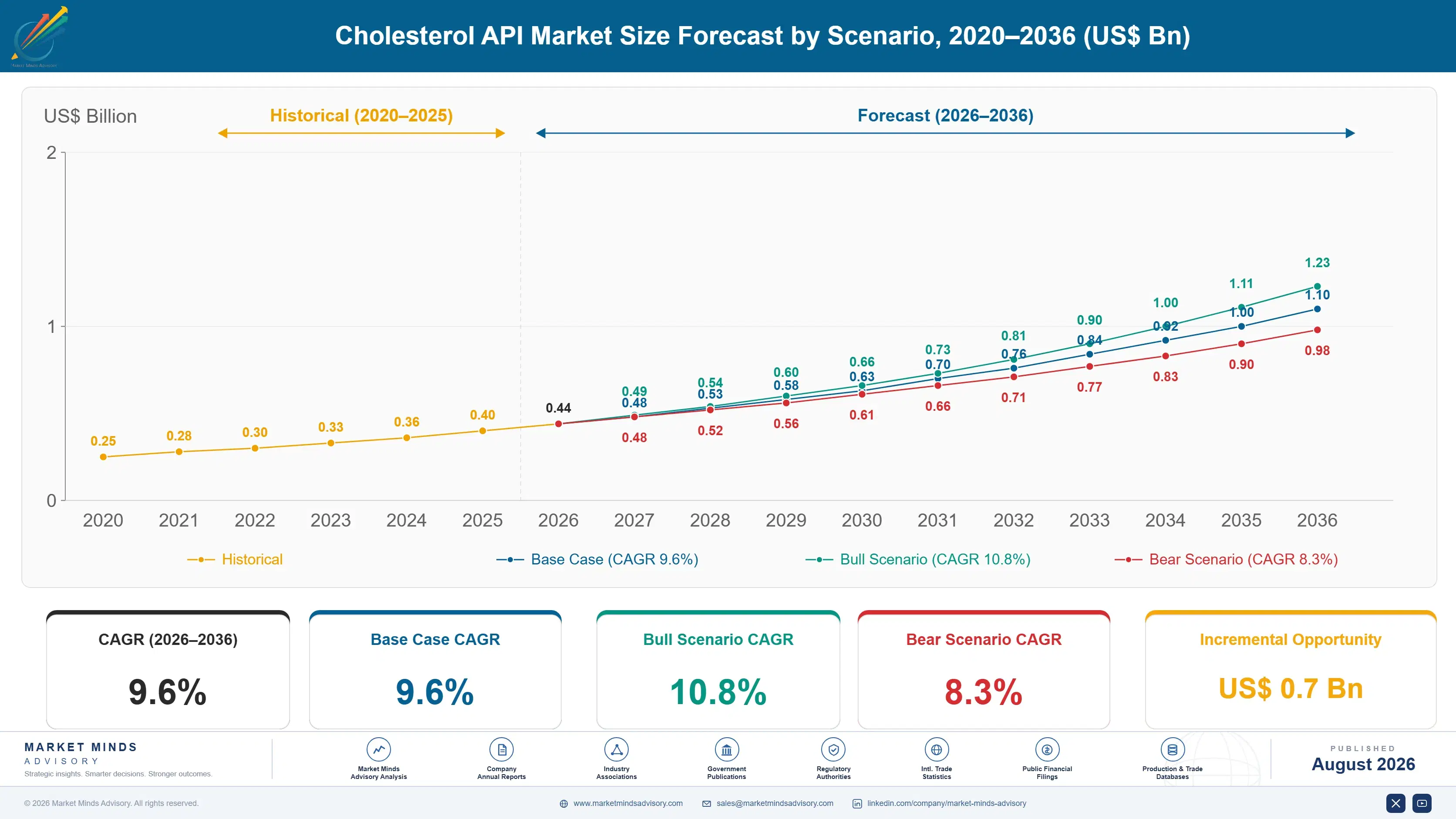
Between 2020 and 2025 this market changed character rather than simply growing. Messenger RNA vaccine production created sudden demand for injectable grade cholesterol at volumes the qualified supply base had never served, prices rose sharply, and allocation replaced ordering for roughly eighteen months. Volumes then fell back as vaccine campaigns wound down. The 8.4% historical growth conceals a spike and a correction rather than describing any steady trend at all.
The 9.6% base case rests on three mechanisms. Lipid nanoparticle delivery is moving beyond vaccines into gene editing, RNA interference, and protein replacement, each of which needs the same four-lipid formulation and therefore the same cholesterol. Cell culture media demand grows with monoclonal antibody and cell therapy manufacturing capacity being commissioned worldwide. And regulatory pressure on animal-derived inputs is pushing formulators toward higher-priced synthetic and fermentation material rather than away from cholesterol itself.
The 10.8% bull case assumes several lipid nanoparticle therapies reach commercial approval and scale, pulling qualified demand up in steps rather than smoothly. The 8.3% bear case reflects clinical failures in the pipeline, continued substitution work aimed at cholesterol-free lipid systems, and pricing compression as Chinese and Indian producers complete their own drug master files.

A Small Molecule With an Unusually Narrow Supply Base

Three things set the commercial shape of this market, and none of them is chemistry. Regulatory qualification comes first, because a formulator who has named a supplier in a filing cannot change it without work that takes the better part of two years. Animal origin comes second, since most cholesterol still starts as wool grease and every regulator wants documentation proving the sheep were sourced from countries free of transmissible spongiform encephalopathy. Price comes a distant third.
TOP-FIVE CONCENTRATION58%Share of qualified pharmaceutical grade supply held by leading producers
AVERAGE SELLING PRICEUSD 1,450 per kgTypical pharmaceutical grade contract pricing across qualified supply agreements
LIPID NANOPARTICLE SHARE34%Portion of demand arising from lipid nanoparticle formulation work
LANOLIN FEEDSTOCK SHARE41%Wool grease input cost within total pharmaceutical grade production
QUALIFICATION CYCLE LENGTH22 monthsTypical time to qualify a new supplier into regulatory filings
CAPACITY UTILISATION76%Average loading across dedicated pharmaceutical grade purification lines globally
That ordering explains why a molecule available from any fine chemical catalogue commands well over a thousand dollars a kilogram in injectable grade. Buyers are not purchasing cholesterol. They are purchasing a drug master file, an audited facility, twenty years of batch records, and the confidence that supply will not fail during a commercial launch.
Feedstock creates the second unusual feature. Wool grease is a by-product of wool scouring, and wool production responds to textile and meat economics rather than to pharmaceutical demand. When lipid nanoparticle demand spiked, the lanolin supply chain could not expand to meet it, which is precisely why synthetic and fermentation routes attracted serious investment for the first time in decades.
"The strangest thing about this market is that the product is trivially easy to make and almost impossible to sell. Anyone can purify cholesterol; almost nobody can put a drug master file, a spongiform encephalopathy dossier, and a decade of audited batch history behind it. That gap is the entire business."
Practice Director, Pharmaceutical Ingredients and Contract Manufacturing · MMA Healthcare and Pharmaceuticals Practice · August 2026

Market Trends

Lipid Nanoparticle Delivery Expands Well Beyond Vaccine Applications

The four-lipid formulation proven at scale by messenger RNA vaccines is now the default delivery approach for gene editing, RNA interference, and several protein replacement programmes moving through clinical development. Cholesterol sits in every one of those formulations at roughly 38 to 45 mole percent, so pipeline breadth converts directly into qualified demand. Around 34% of current volume already goes to lipid nanoparticle work, up from almost nothing a decade ago. What matters commercially is that each approved product locks its named supplier in for the product lifetime, which makes early qualification worth far more than any price advantage.
Market Impact: Biologics capacity growing above 9%
Animal-Origin Scrutiny Pushes Formulators Toward Non-Animal Routes

European and American regulators have tightened expectations on animal-derived pharmaceutical inputs steadily, and cholesterol from wool grease carries a documentation burden that synthetic and plant-derived material simply avoids. New filings increasingly specify non-animal origin at the development stage rather than converting later, because converting later means a comparability exercise nobody wants. Plant phytosterol conversion and fermentation routes therefore grow faster than the market despite costing more per kilogram. Producers still dependent entirely on lanolin feedstock face a slow erosion of addressable pipeline rather than any sudden loss of business. The erosion is invisible in current revenue.
Market Impact: Pricing holds near USD 1,450

Market Opportunities and Growth Drivers

Cell Therapy and Antibody Manufacturing Expand Culture Media Demand

Chemically defined cell culture media replaced serum precisely because serum was variable and animal-derived, and cholesterol is one of the components that had to be added back in a controlled form. Every new monoclonal antibody line and every cell therapy manufacturing suite commissioned worldwide adds recurring demand, and global biologics capacity has grown above 9% annually through the past five years. This demand behaves very differently from clinical supply: it is production-linked, repeats every batch, and scales with manufacturing volume rather than with regulatory approvals. Media formulators qualify suppliers with the same rigour drug makers apply.
Market Impact: Lanolin is 41% of cost

Qualified Supplier Scarcity Supports Pricing Above Chemical Value

Fewer than a dozen producers worldwide hold the drug master files, facility audits, and origin documentation that injectable grade cholesterol requires, against hundreds able to purify the molecule chemically. That gap holds pharmaceutical grade pricing near USD 1,450 per kilogram while technical grade sells for a small fraction of it. Qualification takes roughly 22 months and costs the formulator real money, so incumbents defend positions that competitors cannot simply undercut. Scarcity of this kind usually erodes, and here it is eroding slowly because the barrier is documentation and audit history rather than any process secret.
Market Impact: Qualification runs about 22 months

Market Restraints and Challenges

Wool Grease Feedstock Supply Responds to Textile Economics

Roughly 41% of production cost is lanolin feedstock, and lanolin is a by-product of scouring wool for the textile trade. The root cause of the constraint is that nobody keeps sheep to make cholesterol, so supply follows wool prices, flock sizes, and scouring capacity in Australia, New Zealand, and China. When lipid nanoparticle demand spiked in 2021 the feedstock could not respond and allocation followed. Producers are mitigating through multi-year scouring contracts, strategic inventory, and investment in synthetic and fermentation routes that break the dependence entirely. None of it helps inside a single wool season.
Market Impact: Reaches 34% of total volume

Qualification Cycles Slow Every Commercial Move in This Market

A formulator cannot switch cholesterol suppliers quickly, and neither can a new entrant win business quickly. The root cause is regulatory: the supplier is named in the filing, so change means comparability data, stability work, and in some cases a regulatory submission. Around 22 months is normal. That protects incumbents but also caps how fast anyone grows, and it means capacity investment must be committed years before the revenue arrives. Producers mitigate through second-source qualification programmes funded jointly with customers, and through development-stage engagement where switching costs have not yet formed.
Market Impact: Non-animal routes grow above 12%
4 additional market trends, 3 additional growth drivers, and 2 additional restraints and challenges are covered in the full report. Contact sales@marketmindsadvisory.com to access the complete intelligence.

Segment CAGR and Growth Architecture

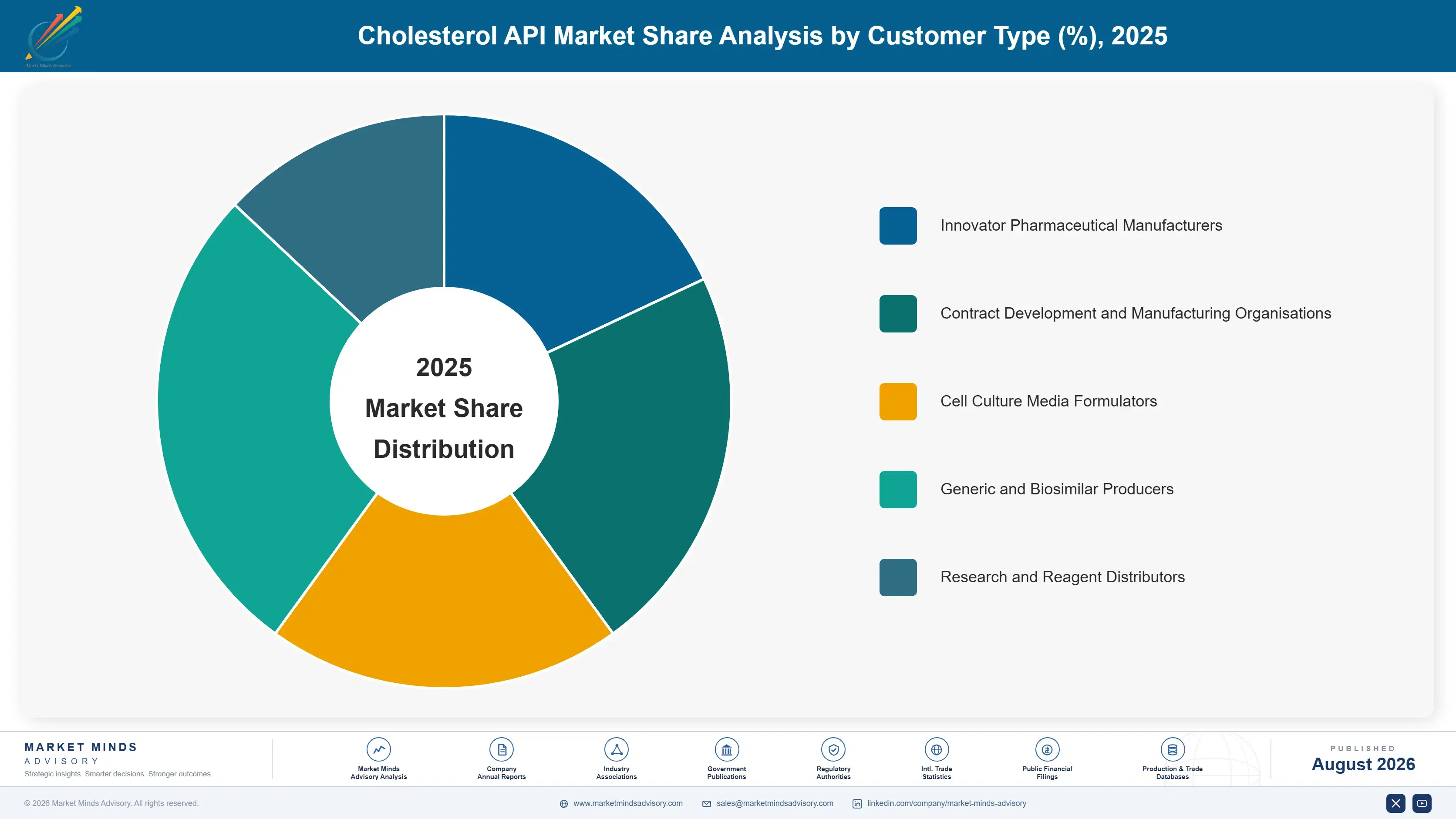
Segmentation follows production source and route, because origin determines regulatory documentation burden, feedstock exposure, cost position, and which filings the material can enter. Five routes cover commercial supply, and they compete only partially, since animal-origin restrictions in newer filings exclude two of them from a growing share of the addressable pipeline entirely. Cost per kilogram varies threefold across them.
cholesterol-api-market-market-share-analysis-1787465382229

Microbial Fermentation Derived Cholesterol

The fastest-growing route at 14.6%, roughly 1.52 times the market, and easily the smallest by volume. Engineered yeast strains producing cholesterol directly remove animal origin, remove the wool supply chain, and give a consistent impurity profile that purification chemists genuinely prefer. The commercial obstacles are cost and qualification history rather than technical feasibility: fermentation material costs meaningfully more per kilogram today and carries none of the twenty-year batch record that lanolin-derived supply offers. Development-stage programmes are where it wins, because there is no incumbent to displace and no comparability exercise required. Scale economics should close much of the cost gap over the forecast period, though not all of it. Strain stability across scale remains the technical question.
CAGR 14.6%

Fully Synthetic Chemical Route Cholesterol

Second fastest at 13.2%, and the established answer for formulators who want non-animal origin with a supply history behind it. Total synthesis from simple precursors is well documented and several producers run it commercially, though step count makes it expensive against lanolin extraction. What sells it is the documentation package: no transmissible spongiform encephalopathy dossier, no wool sourcing questions, no regulatory conversation about animal husbandry. For a filing intended to hold for twenty years, that simplicity has genuine value. The route also decouples cost from wool markets entirely, replacing it with exposure to organic solvent and intermediate pricing that behaves quite differently across cycles. Step count keeps the cost floor high.
CAGR 13.2%
Full segment breakdown across 5 segments available in the complete report.

Regional Architecture and Country Demand Map

Regional shares reflect where qualified manufacturing sits rather than where medicines are consumed, since the market is measured at producer level. Japanese, Chinese, and Indian capacity dominates supply, while formulation demand concentrates in North America and Western Europe. Qualification history, not capacity, decides who holds each position.

North America

Demand rather than manufacturing explains most of the position here, and the share reflects material produced by domestic and inward-investing suppliers serving that demand. The lipid nanoparticle pipeline is concentrated around Boston, the San Francisco Bay Area, and the Research Triangle, and those programmes qualify suppliers early and then hold them. Food and Drug Administration expectations on excipient documentation are the strictest applied anywhere, which raises the barrier and protects whoever clears it. Cell culture media producers add a steady production-linked stream that grows with biologics capacity across the region. Growth of 10.2% reflects pipeline breadth rather than any manufacturing expansion. Domestic supply security has become a policy conversation since the vaccine allocation period.
Share: 27% | CAGR: 10.2% (2026 to 2036)

Western Europe

Croda in the United Kingdom and Merck in Germany anchor supply here, and both entered through lipid businesses rather than through cholesterol specifically. European Medicines Agency guidance on animal-derived inputs is applied consistently and has pushed development-stage formulators toward synthetic and plant-derived routes faster than elsewhere. Swiss and German contract manufacturers add purification capacity that serves both regional and export demand. The region's disadvantage is cost: energy, labour, and regulatory overhead all run high, and none of it is recoverable in a market where Asian producers are completing their own documentation. Growth of 8.0% is the slowest of the major regions, reflecting a mature base rather than any loss of technical position.
Share: 22% | CAGR: 8.0% (2026 to 2036)
Regional intelligence for 5 additional markets available in the complete report: East Asia, South Asia and Pacific, Latin America, Middle East and Africa, Eastern Europe. Contact sales@marketmindsadvisory.com.
cholesterol-api-market-country-cagr-analysis-1787465383033

Four Moves That Change the Economics

Commercial advantage in cholesterol comes from documentation, origin position, and timing of customer engagement rather than from purification capability, which is widely held. Four moves are worth capital and management attention across the forecast period, and three of them cost far less than a plant expansion would. The fourth is a plant loading decision most producers never model.

Qualify at development stage, before switching costs form

Once a supplier is named in a filing, displacing them requires comparability work and roughly 22 months, which is why incumbents rarely lose accounts. The corollary is that the only cheap way in is at development stage, before any incumbent exists. Development-stage engagement costs perhaps $200,000 to $400,000 per programme in technical support, sampling, and documentation, against a commercial contract that may run for the twenty-year product lifetime. Producers who staff for that engagement win positions their pricing could never buy. It requires patience most sales organisations are not measured on.
Market Impact: Locks in supply across full 20 year lifetimes

Build a non-animal origin range alongside lanolin supply

New filings increasingly specify non-animal origin at development stage, and lanolin-only producers are quietly losing access to that pipeline without losing a single existing customer. Synthetic and fermentation material costs 30 to 60% more per kilogram today, and formulators developing long-lifetime products accept it because the documentation is simpler. Adding the range does not require abandoning lanolin, which remains the volume base. It requires a second route, its own drug master file, and the patience to build batch history before the demand fully arrives. Development-stage programmes are where the new range earns its return.
Market Impact: Commands a 30 to 60% unit price premium

Contract wool grease supply on multi-year terms

Lanolin is 41% of production cost and comes from a by-product stream that responds to textile economics rather than pharmaceutical demand. The 2021 allocation period showed what happens when it cannot respond. Multi-year scouring contracts with volume commitments typically secure feedstock 10 to 18% below spot during tight periods, and more importantly they secure it at all. The cost is carrying commitment through soft periods when spot would be cheaper. For a producer whose customers cannot switch quickly, supply continuity is worth more than the price optionality being given up.
Market Impact: Secures feedstock 10 to 18% under spot pricing

Serve cell culture media as a production-linked annuity

Clinical and commercial drug supply is lumpy and follows approvals. Cell culture media demand repeats with every manufacturing batch and grows with installed biologics capacity, which has expanded above 9% annually for five years. Media grade carries lower unit pricing than injectable grade but converts into predictable recurring volume that smooths the whole plant's loading. Producers weighted entirely toward clinical supply carry utilisation risk they do not need to. Media qualification is also less onerous, which shortens the sales cycle considerably against drug filings. The volume also loads purification capacity that would otherwise sit idle between clinical campaigns.
Market Impact: Adds recurring media volume growing above 9% annually

Who Controls the Margin Pool

Concentration is high: the top five producers hold roughly 58% of qualified pharmaceutical grade supply, and the practical shortlist a formulator considers is shorter than that figure suggests. Nippon Fine Chemical leads on qualification history and lipid breadth rather than on capacity. Dishman Carbogen Amcis competes on cost position combined with genuine international documentation, and Croda and Merck both entered through lipid and excipient businesses where cholesterol is one component of a wider offer.
Competitive activity runs on three fronts. Drug master file coverage across regulatory jurisdictions is the first, because a file that satisfies both American and European authorities is worth considerably more than one that satisfies either alone. Origin documentation is the second, and it now decides which pipelines a producer can address. Technical service at development stage is the third, and it is where positions are actually won.

Pressure is building from two directions. Chinese producers completing their own drug master files bring a cost position that incumbents cannot match on lanolin-derived material. And fermentation entrants, several of them venture-funded rather than established chemical companies, are competing for development-stage programmes where no incumbent advantage exists.
cholesterol-api-market-company-positioning-matrix-1787465383829

Competitive Moat and Risk Dimensions

NIPPON FINE CHEMICAL

Moat: Decades of qualification history

The company has supplied pharmaceutical grade cholesterol and phospholipids into regulated filings for long enough that its batch record and audit history cannot be replicated by any competitor at any price. For a formulator choosing a supplier who will be named in a filing for twenty years, that history carries more weight than cost position or capacity ever will.
NIPPON FINE CHEMICAL

Risk: Lanolin feedstock origin dependence

The position rests substantially on wool grease derived material, and new filings increasingly specify non-animal origin at development stage. That erodes addressable pipeline slowly rather than costing existing business, but the erosion compounds. Building fermentation or synthetic capability requires new documentation history that takes years to accumulate, whatever the process capability.
DISHMAN CARBOGEN AMCIS

Moat: Cost position with credible documentation

Indian manufacturing economics combined with drug master files accepted in both American and European filings is a combination few competitors hold together. The company can quote against Western producers on price while satisfying the same regulatory scrutiny, which makes it the default second source in a market where formulators increasingly want two qualified suppliers rather than one.
DISHMAN CARBOGEN AMCIS

Risk: Chinese qualification progress narrowing advantage

The cost-plus-documentation position depends on Chinese producers not holding equivalent files, and several now do. As that gap closes the differentiation reduces to service and reliability rather than a genuine defensible barrier. Competing on those terms against producers with a lower cost base is a materially weaker position than the one held today.

Players Tracked

Prominent Players

Nippon Fine Chemical
Dishman Carbogen Amcis
Croda International
Merck KGaA
NK Chemicals

Other Key Players

Lipoid GmbH
CordenPharma
Evonik Industries
Zhejiang Garden Biopharmaceutical
Anhui Xinbo Pharmaceutical
Wuxi Bipharm Technology
FUJIFILM Wako Pure Chemical
Kensing LLC
BASF
Cargill
Ashland
Chemos GmbH
BOC Sciences
Sisco Research Laboratories
Wilshire Technologies

Recent Developments

FEBRUARY 2025

Croda expands lipid systems capacity in North America

The company brought additional pharmaceutical lipid manufacturing capacity into service at its American operations, extending the position acquired with Avanti Polar Lipids. The expansion was organic and directed at lipid nanoparticle programmes moving from clinical into commercial supply across the coming years. Commercial timing remains uncertain.
Signal: Suppliers are building ahead of approvals, betting that lipid nanoparticle pipeline breadth converts into sustained commercial volume
AUGUST 2025

Indian producer files additional drug master files

Dishman Carbogen Amcis extended regulatory coverage for pharmaceutical grade cholesterol into further jurisdictions, adding to files already accepted by American and European authorities. The filings support second-source qualification programmes that formulators have pursued more actively since the vaccine allocation period exposed concentration risk. Coverage breadth is the selling point.
Signal: Second sourcing is becoming standard practice, which favours credible challengers more than it threatens the established incumbents
NOVEMBER 2025

Fermentation cholesterol reaches pilot commercial supply

Engineered yeast derived cholesterol moved from laboratory quantities into pilot commercial availability for development-stage formulation work. Volumes remain very small against lanolin-derived supply and pricing sits well above it, but the material carries no animal-origin documentation burden of any kind. Formulators are qualifying it on documentation grounds.
Signal: Non-animal origin is the entry argument, and development-stage programmes are the only place it can currently win

What Sets the Cost Base Here

Wool grease accounts for roughly 41% of pharmaceutical grade production cost, sourced from scouring operations in Australia, New Zealand, China, and South Africa. Purification consumables, chromatography media, and solvents take a further 19%. Quality control, documentation, and regulatory maintenance absorb an unusually high 14%, which reflects what buyers are actually paying for. Energy, labour, and facility overhead cover the balance.
The 2021 and 2022 period showed the exposure clearly. Lipid nanoparticle demand for messenger RNA vaccine production arrived faster than the lanolin chain could respond, spot pharmaceutical grade pricing rose several times over, and suppliers moved customers onto allocation. Wool data from the Australian and New Zealand statistical offices showed flock sizes falling across the same period for unrelated reasons. Croda and Merck both referenced lipid demand and supply tightness across their reporting.

Exposure divides on feedstock route rather than on scale or geography. Producers dependent entirely on wool grease carry a cost line they cannot hedge, because no forward market exists for lanolin and the supply responds to textile economics. Synthetic and fermentation producers carry solvent, intermediate, and utility exposure instead, which is higher in absolute cost but far more predictable. Neither position is comfortable during a demand spike.
cholesterol-api-market-cost-volatility-analysis-1787465384126

Contract scouring supply on multi-year volume commitments

Multi-year agreements with wool scouring operations secure both volume and price during tight periods, typically 10 to 18% below spot when the market moves. The cost is commitment through soft periods when spot would be cheaper. For producers whose customers cannot switch suppliers quickly, continuity of supply is worth considerably more than the price optionality being surrendered.

Develop a second production route independent of wool

Synthetic and fermentation routes remove lanolin exposure entirely, replacing it with solvent and utility costs that behave predictably and can be contracted. The material also carries no animal-origin documentation burden, which opens pipeline that lanolin-derived supply is losing access to. Capital cost and the years required to build batch history are the genuine obstacles rather than any technical difficulty.

Hold strategic feedstock inventory against demand spikes

Cholesterol demand arrives in steps as products win approval, and the feedstock chain cannot respond inside a wool season. Carrying six to nine months of lanolin inventory costs working capital but preserves the ability to serve a customer launch. Producers who could not do this in 2021 lost positions to competitors who could, and several have not recovered them since.

Portfolio Architecture for Margin Defence

Margin here follows documentation and grade rather than volume. Technical and cosmetic grade cholesterol sells against chemical catalogue pricing and earns modest margin, because anyone with a purification train can supply it and buyers switch on price without consequence. Injectable and cell culture grade earn several times that, since the buyer is purchasing a drug master file, an audit history, and the certainty that supply will hold through a commercial launch.
The volume and premium tension is unusual because the same plant makes both. Purification capacity is expensive and must run, so producers take technical grade business to hold utilisation even though it earns a fraction of the margin. That works until injectable demand spikes and the capacity is committed elsewhere, which is exactly what caught several suppliers during the vaccine period and cost them positions they had held for years.

High-value pools concentrate in three places: injectable grade for lipid nanoparticle formulation, non-animal origin material for new development-stage filings, and cell culture grade sold as a production-linked annuity. Each is defended by qualification rather than by price. Qualification is slow to build and hard to cross, which is why the margin structure has held.

Volume / Commodity-Adjacent Tier

Technical, cosmetic, and nutraceutical grade cholesterol sold against catalogue pricing where buyers switch freely. Holds purification capacity loaded between pharmaceutical campaigns. The range reflects large differences in feedstock position and plant scale.
Gross Margin: 12%-20%

Premium / Certified Tier

Injectable and cell culture grade supported by drug master files, audited facilities, and origin documentation. The buyer purchases regulatory certainty rather than the molecule, and switching requires comparability work taking most of two years.
Gross Margin: 38%-52%

Sustainability / Regulatory / Next-Generation Tier

Synthetic, plant phytosterol, and fermentation derived material carrying no animal-origin documentation burden. Small volumes at premium pricing sold into development-stage filings. The range is wide because fermentation pricing has not yet settled commercially.
Gross Margin: 35%-55%
cholesterol-api-market-portfolio-architecture-1787465384904

High-value Sub-segments and Strategic Watch-out

Injectable Grade for Lipid Nanoparticles

The highest-value pool in the market and the one growing fastest in absolute terms. Qualification locks the supplier in for the product lifetime, so each win is an annuity rather than a contract. Pipeline breadth is the whole opportunity here. Early engagement is the only cheap entry.
Gross Margin: 40%-55%

Non-Animal Origin Development Supply

New filings increasingly specify non-animal origin before any incumbent exists, which is the only point where positions change cheaply. Pricing runs 30 to 60% above lanolin-derived material. Documentation simplicity, not sustainability argument, is what actually sells it. Timing matters more here than pricing ever will.
Gross Margin: 35%-50%

Cell Culture Grade Media Supply

The annuity in this market. Demand repeats with every manufacturing batch and scales with installed biologics capacity rather than with regulatory approvals. Lower unit pricing than injectable grade, but predictable loading that smooths the whole plant economics considerably. Qualification is faster than any drug filing route.
Gross Margin: 28%-38%

Technical and Cosmetic Grade Supply

The strategic watch-out. Competes on catalogue pricing against Chinese and Indian producers with permanently lower cost, and buyers switch without consequence. It holds utilisation between pharmaceutical campaigns and should be priced for exactly that purpose. Expect contribution and loading from it, nothing more at all.
Gross Margin: 12%-19%

How Demand Actually Reaches Suppliers

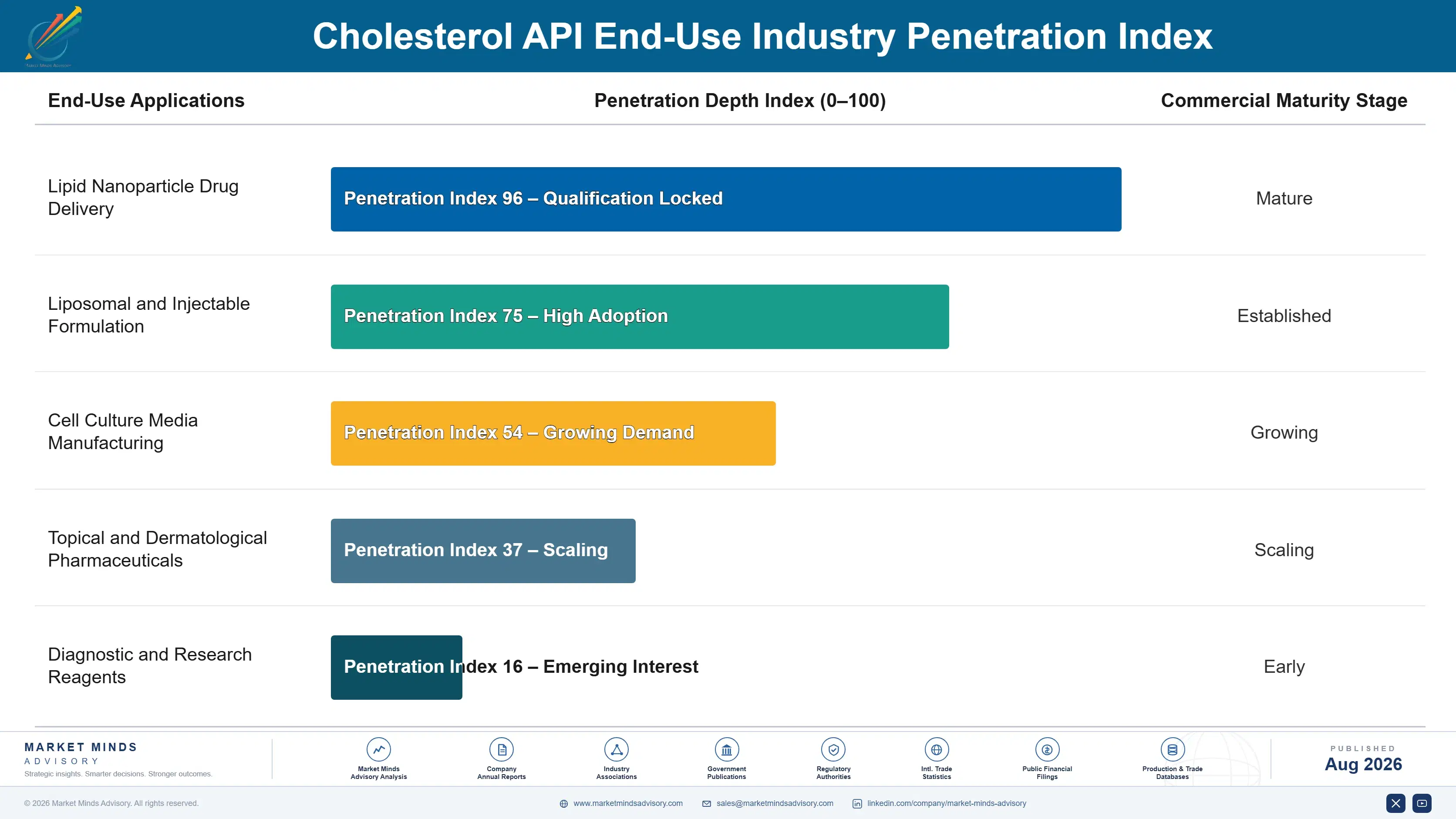
This market has two demand types that behave nothing alike. Drug supply is lumpy and approval-driven: a programme consumes small clinical quantities for years, then steps up sharply if it reaches commercial approval, and stays there for the product lifetime. Cell culture media demand is the opposite, repeating with every manufacturing batch and growing steadily with installed biologics capacity worldwide. Producers weighted entirely toward the first carry utilisation risk that the second would smooth considerably.
Adoption depth varies sharply by application. Lipid nanoparticle formulation uses cholesterol at 38 to 45 mole percent with no practical substitute identified, which makes that demand close to unconditional. Liposomal injectables have used it for decades and specifications rarely change. Cell culture media demand is deep but price-sensitive, since media formulators compete on cost per litre. Diagnostic and research use is shallow and switches freely.

The buyer has changed as well. Purchasing decisions that once sat with procurement now sit with formulation scientists and regulatory affairs, who read drug master files and audit reports rather than price lists. That audience reads audit findings and origin dossiers before any quotation, and treats supply failure as a far larger risk than overpaying for material.
cholesterol-api-market-end-use-penetration-index-1787465385686

Where the Money Sits

These are among the four positions where our research anticipates prominent divergence between winners and laggards over the coming forecast period. Each is grounded in the demand model, the regulatory perimeter, and the announced capacity pipeline.
01 / DEVELOPMENT STAGE ACCESS

Win the programme before an incumbent exists to displace

Qualification takes roughly 22 months and a named supplier holds the position for the product lifetime, which makes displacement economics hopeless once a filing is written. Development-stage engagement costs perhaps $200,000 to $400,000 per programme against contracts that may run twenty years, and it is the only entry route that price cannot buy. Producers who properly staff technical service for that patient development work end up winning positions that their competitors will never subsequently take from them at any price.
02 / ORIGIN ROUTE DIVERSIFICATION

Add a non-animal route before the pipeline closes quietly

Lanolin-derived producers are losing access to new filings without losing a single existing customer, which makes the erosion invisible in current revenue and dangerous over a decade. Synthetic and fermentation material commands 30 to 60% price premiums today because the documentation package is simpler rather than because the molecule differs. Building the second route requires a separate drug master file and years of batch history, so the decision cannot sensibly wait for the revenue case to become obvious to everyone.
03 / FEEDSTOCK CONTINUITY PLANNING

Secure lanolin supply, because the spike will happen again

Wool grease is 41% of production cost and comes from a by-product stream governed entirely by textile economics that no pharmaceutical buyer anywhere can influence. The 2021 allocation period cost several suppliers customer positions they had held for many years and have not managed to recover them since. Multi-year scouring contracts plus six to nine months of strategic inventory cost real working capital, and what they buy is the ability to serve a customer launch at the moment when competitors simply cannot.
04 / MEDIA ANNUITY BALANCE

Balance lumpy drug supply with recurring media volume

Drug programme demand arrives in steps tied to approvals, while cell culture media demand repeats every batch and grows with biologics capacity that has expanded above 9% annually for five years. Purification capacity is expensive and must stay loaded, so a portfolio weighted entirely toward clinical supply carries utilisation risk with no compensating return. Media qualification also runs far faster than drug filings, which shortens the sales cycle considerably and starts building the audited batch history that later drug work will demand.

Engagement Snapshot From the Field

A live engagement with an industry participant carrying material or product regulatory and market exposure ahead of a defining policy shift, showing how our research translates into a defensible multi-year portfolio strategy.
MARKET MINDS ADVISORY · CLIENT ENGAGEMENT SUMMARY
Cholesterol API Producer Strategic Portfolio Review and Transition Roadmap 2026·Investment Scenario on Cholesterol API Exposure Evaluation 2025-26
CLIENT PROFILE
A European fine chemical manufacturer with strong purification capability and an established position in cosmetic and technical grade sterols, generating roughly EUR 90 million in annual revenue (client-reported, unverified by MMA). The business held no pharmaceutical grade cholesterol position and no drug master file, but management believed existing purification assets and quality systems could support entry into the regulated segment.
STRATEGIC CHALLENGE
Technical grade pricing had eroded steadily under Chinese competition while the pharmaceutical segment appeared to be growing at several times the rate on far better margins. The board needed to know whether entry was realistic given qualification timelines, what the entry route should be, and whether the window was already closing behind established suppliers holding decades of history.
MMA APPROACH
MMA mapped the qualified supplier base against active lipid nanoparticle and cell culture programmes, modelled qualification timelines and cost by entry route, and assessed where incumbency was weakest. Forty-seven expert interviews with formulation scientists, regulatory affairs leads, and media producers established what actually drives supplier selection, which published filings cannot reveal.
KEY FINDINGS
  1. Displacing a named supplier in an approved filing proved economically hopeless in every case examined, with switching costs and comparability work consistently exceeding any credible price advantage on offer.
  2. Development-stage programmes carried no incumbent advantage at all, and roughly forty active lipid nanoparticle programmes in the region had not yet fixed a commercial cholesterol supplier.
  3. Cell culture media qualification took under nine months against twenty-two for drug filings, offering a faster route to revenue and to the batch history that later drug qualification would require.
  4. Non-animal origin was specified in a clear majority of new development-stage formulation work, making the client's lack of lanolin infrastructure an advantage rather than the disadvantage assumed.
CLIENT PROFILE
A European fine chemical manufacturer with strong purification capability and an established position in cosmetic and technical grade sterols, generating roughly EUR 90 million in annual revenue (client-reported, unverified by MMA). The business held no pharmaceutical grade cholesterol position and no drug master file, but management believed existing purification assets and quality systems could support entry into the regulated segment.
STRATEGIC CHALLENGE
Technical grade pricing had eroded steadily under Chinese competition while the pharmaceutical segment appeared to be growing at several times the rate on far better margins. The board needed to know whether entry was realistic given qualification timelines, what the entry route should be, and whether the window was already closing behind established suppliers holding decades of history.
MMA APPROACH
MMA mapped the qualified supplier base against active lipid nanoparticle and cell culture programmes, modelled qualification timelines and cost by entry route, and assessed where incumbency was weakest. Forty-seven expert interviews with formulation scientists, regulatory affairs leads, and media producers established what actually drives supplier selection, which published filings cannot reveal.
KEY FINDINGS
  1. Displacing a named supplier in an approved filing proved economically hopeless in every case examined, with switching costs and comparability work consistently exceeding any credible price advantage on offer.
  2. Development-stage programmes carried no incumbent advantage at all, and roughly forty active lipid nanoparticle programmes in the region had not yet fixed a commercial cholesterol supplier.
  3. Cell culture media qualification took under nine months against twenty-two for drug filings, offering a faster route to revenue and to the batch history that later drug qualification would require.
  4. Non-animal origin was specified in a clear majority of new development-stage formulation work, making the client's lack of lanolin infrastructure an advantage rather than the disadvantage assumed.
RECOMMENDED STRATEGY
Phase 1: Phase one: enter through cell culture media grade, where qualification is fastest, to generate revenue and begin accumulating the audited batch history that drug filings later demand. Phase 2: Phase two: commit to a synthetic route drug master file rather than building lanolin capability, positioning directly against the animal-origin question incumbents are exposed to. Phase 3: Phase three: staff development-stage technical service against named lipid nanoparticle programmes, accepting a long sales cycle in exchange for product-lifetime positions.
OUTCOME
The client qualified with two media producers within ten months and filed a synthetic route drug master file the following year. Pharmaceutical and media grade revenue reached 22% of the total by the second year at blended gross margin 19 percentage points above the technical grade base business (client-reported, unverified by MMA).

Frequently Asked Questions

Foundational context covering the market sizes, CAGR, scope, country, region and competition that inform every finding below. This section is provided to cover basics and most often pre-purchase conversations, answered from the MMA Primary Research Dataset.

What is the current size of the Cholesterol API Market?

The market was valued at USD 0.4 billion in 2025, rising to an estimated USD 0.44 billion in 2026. East Asia holds the largest share at 29% of global value on a manufacturing basis.

How large will the Cholesterol API Market be by 2036?

MMA forecasts USD 1.10 billion by 2036 under the base case, an expansion multiple of 2.50 times the 2026 value. That represents USD 0.66 billion of incremental value across the forecast period.

What is the CAGR for the Cholesterol API Market 2026 to 2036?

The base case CAGR is 9.6%, with a bull case of 10.8% and a bear case of 8.3%. The spread reflects uncertainty over lipid nanoparticle clinical pipeline outcomes and qualified supply pricing.

Which segment is growing fastest?

Microbial fermentation derived cholesterol grows fastest at 14.6%, roughly 1.52 times the market rate. Fully synthetic route material follows at 13.2%, both driven by non-animal origin requirements in new filings.

Who are the major companies in the Cholesterol API Market?

Nippon Fine Chemical, Dishman Carbogen Amcis, Croda International, Merck KGaA, and NK Chemicals lead on qualified pharmaceutical grade supply. The top five hold roughly 58% of that supply between them.

Which country is growing fastest?

India grows fastest at 12.4%, driven by producers combining competitive manufacturing cost with drug master files accepted in American and European filings. Second-source qualification programmes favour credible lower-cost challengers.

Report Segmentation Architecture

The full report scope spans multiple orthogonal segmentation dimensions, with cross-tabulated demand data provided for each dimension pair. Coverage extends further to regional breakdowns, trend trajectories, and the competitive detail needed to support segment-level decision-making.

By Production Source and Route

  • Wool Grease Lanolin Derived
  • Animal Tissue Derived
  • Plant Phytosterol Conversion Route
  • Fully Synthetic Chemical Route
  • Microbial Fermentation Derived

By End-Use Industry

  • Lipid Nanoparticle Drug Delivery
  • Liposomal and Injectable Formulation
  • Cell Culture Media Manufacturing
  • Topical and Dermatological Pharmaceuticals
  • Diagnostic and Research Reagents

By Customer Type

  • Innovator Pharmaceutical Manufacturers
  • Contract Development and Manufacturing Organisations
  • Cell Culture Media Formulators
  • Generic and Biosimilar Producers
  • Research and Reagent Distributors

By Region

  • North America
  • Western Europe
  • East Asia
  • South Asia and Pacific
  • Latin America
  • Middle East and Africa
  • Eastern Europe

Scope, Methodology, and Coverage

Every figure in this report is reproducible from documented input assumptions. The scope below maps the historical period, the forecast horizon, the segmentation dimensions, and the countries covered, alongside the underlying primary and qualitative methodology.
Historical Period
2020 to 2025
Forecast Period
2026 to 2036
Base Year
2025 (USD billions; MMA Primary Research Dataset, August 2026)
Market Definition
The market comprises cholesterol manufactured to pharmaceutical, injectable, and cell culture grade specifications for use as an active pharmaceutical ingredient or named functional excipient in regulated filings. Value is measured at producer level across wool grease, animal tissue, plant phytosterol, fully synthetic, and microbial fermentation routes. Cholesterol-lowering therapeutics, diagnostic test reagents, cosmetic-grade lanolin alcohols, food-grade sterol esters, and finished lipid nanoparticle drug products fall outside scope.
Quantitative Units
USD billions (current prices); metric tonnes of pharmaceutical grade cholesterol shipped annually; USD per kilogram by grade
Segmentation Dimensions
By Production Source and Route; By End-Use Industry; By Customer Type; By Region
Regions Covered
North America, Western Europe, East Asia, South Asia and Pacific, Latin America, Middle East and Africa, Eastern Europe
Countries Covered
United States, Canada, Germany, United Kingdom, Switzerland, France, Italy, Netherlands, Poland, Hungary, Japan, China, South Korea, India, Australia, New Zealand, Singapore, Brazil, Argentina, Saudi Arabia, United Arab Emirates, Egypt, South Africa
Key Companies Profiled
Nippon Fine Chemical, Dishman Carbogen Amcis, Croda International, Merck KGaA, NK Chemicals, Lipoid GmbH, CordenPharma, Evonik Industries, Zhejiang Garden Biopharmaceutical, Anhui Xinbo Pharmaceutical, Wuxi Bipharm Technology, FUJIFILM Wako Pure Chemical, Kensing LLC, BASF, Cargill, Ashland, Chemos GmbH, BOC Sciences, Sisco Research Laboratories, Wilshire Technologies
Quantitative Methodology
Primary survey, n=3,800 respondents, Q4 2025, six countries; demand-side model with trade association cross-validation
Qualitative Methodology
47 expert interviews, Q4 2025; applied to validate demand model assumptions, identify emerging dynamics, and assess competitive positioning
Report Format
PDF and XLSX data workbook (Word format preview document)
Publisher
Market Minds Advisory
Report Code
MMA-2026-HLT-133
Published
August 2026
Contact
sales@marketmindsadvisory.com | www.marketmindsadvisory.com

Purchase the full Cholesterol API Market Report (2026 to 2036).

The full report sizes pharmaceutical grade cholesterol demand across five production routes, five end-use categories, and seven regions with 2026 to 2036 forecasts under base, bull, and bear cases. It models lipid nanoparticle pipeline conversion against qualification timelines to separate committed demand from clinical optionality. Competitive profiles cover twenty producers assessed consistently on qualified pharmaceutical grade supply, drug master file coverage, and origin position. Cost analysis traces wool grease feedstock exposure against synthetic and fermentation alternatives. Commercial guidance addresses development-stage qualification, origin diversification, feedstock continuity, and cell culture media positioning.
Five production routes sized separately by region
Lipid nanoparticle pipeline mapped to qualified demand
Drug master file coverage compared across twenty producers
Wool grease feedstock exposure modelled against synthetic routes
Qualification timelines quantified by grade and application
Non-animal origin premium measured across development-stage filings

Built For The People Who Decide

From boardroom strategy to bench-side execution, this report is read cover-to-cover by leaders shaping the next decade of their industry, turning demand scenarios, market dynamics and valuation benchmarks into decisions.
CXOs/ Presidents/ VPs/ Managers
M&A and Corporate Development
Strategy Teams and R&D Heads
Procurement and Product Directors
Regulatory and Compliance Leaders
Investor Relations and Equity Analysts