Market Minds Advisory
Chloroplatinic Acid Market

Chloroplatinic Acid Market: Hydrogen Economy Redraws Platinum Chemistry Demand

Chloroplatinic acid producers are scaling hydrogen fuel cell catalyst precursor capacity as decarbonization policy and platinum group metal refining consolidation reshape supply strategy across catalytic converter, fuel cell, and specialty chemical manufacturing channels worldwide.

Lead Analyst

Bilal Shaikh

Published

September 2026

Make Smarter Decisions with Customized Research Insights

Request a free sample report and evaluate market opportunities, growth trends, and competitive dynamics relevant to your business needs.

2025 MARKET VALUE$0.8BMarket Size 2025
2036 FORECAST VALUE$2.0BBase Case , 2026 to 2036
CAGR 2026 TO 20368.2 %Bull 9.5% / Bear 6.9%
INCREMENTAL OPPORTUNITY$1.1BNet 10- year value creation
EXPANSION MULTIPLE2.20x2036 value over 2026 base
Strategic Levers
M&A Pipeline
Regional Outlook
Country Rankings
Competitive Intelligence
Segmental Deep-dive
Call-Us : 91 93563 13602

Executive Snapshot and Market Trajectory

Chloroplatinic Acid Market demand is shifting toward hydrogen fuel cell catalyst precursor applications as decarbonization policy and platinum group metal refining consolidation reshape sourcing strategy across catalytic converter, electroplating, and specialty chemical manufacturing channels globally today and quite well beyond entirely.
Hydrogen fuel cell catalyst precursor and pharmaceutical reagent applications are the fastest-expanding categories as clean energy policy and platinum-based drug development accelerate demand beyond traditional catalytic converter volume. East Asia holds the largest share of global consumption, anchored by China's expansive catalyst and electronics manufacturing base, while Western Europe sustains strong demand through its established automotive catalyst and fine chemical production sector nationwide and quite well beyond it entirely still.
Competition splits between large diversified platinum group metal refiners with integrated chemical production capability and numerous smaller specialty chemical producers competing mainly on price for standard catalytic converter precursor grades sold into automotive supply chains. Refining capacity concentration in South Africa and Russia creates persistent supply risk that buyers increasingly manage through diversified sourcing contracts, while hydrogen fuel cell catalyst demand accelerates adoption across every clean energy manufacturing program and geographic market worldwide today.
Market Definition
The Chloroplatinic Acid Market comprises the specialty chemical intermediate used as a platinum precursor across catalytic converter, fuel cell, electroplating, petrochemical reforming, glass manufacturing, and pharmaceutical applications. It excludes elemental platinum trading and unrelated platinum group metal jewelry or investment products.
Base Year Value
$0.8B in 2025 (MMA Primary Research Dataset, August 2026)
Forecast Period
2026 to 2036, eleven discrete annual values
CAGR
8.2% base case. Bull 9.5%. Bear 6.9%.
Fastest Growth Segment
Hydrogen Fuel Cell Catalyst Precursor: 16.0% CAGR
Fastest Growth Country
China: 9.3% CAGR
Fastest Growth Region
South Asia and Pacific: 10.2% CAGR
Largest Region
East Asia: 30% of 2025 global value
Market Leaders
Johnson Matthey, BASF SE, Umicore, Heraeus, and Anglo American Platinum lead by global production volume and refining depth. Source: MMA Analysis based on company annual reports.
Primary Survey
n=3,800 procurement and R&D decision-makers, Q4 2025, six countries
Methodology
Demand-side build-up, cross-validated against public data, 47 expert interviews

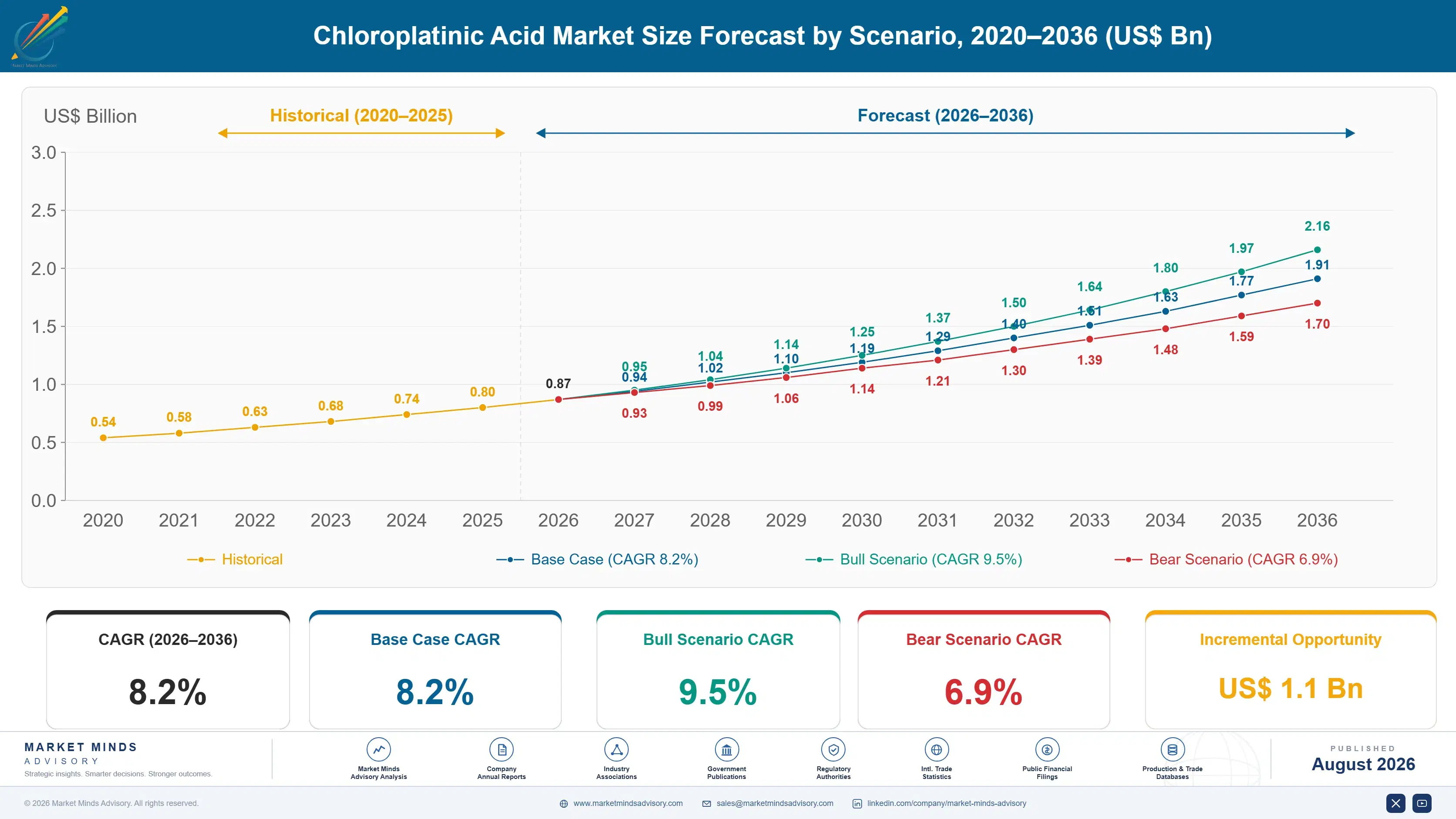
Chloroplatinic Acid Market Forecast Scenarios

chloroplatinic-acid-market-trends-size-forecast-scenario-1787464897329
Between 2020 and 2025, chloroplatinic acid volumes grew at an estimated 7.2% compound rate as catalytic converter demand recovered from pandemic-related vehicle production disruption while hydrogen fuel cell catalyst applications began scaling from a small base worldwide. Electroplating and pharmaceutical reagent demand grew steadily through this period, while automotive catalyst volume still dominated total consumption.
The base case assumes continued expansion as three mechanisms compound: hydrogen fuel cell manufacturers scaling catalyst precursor procurement as clean energy policy accelerates fuel cell vehicle and stationary power deployment, tightening automotive emission standards sustaining catalytic converter precursor demand despite slowing internal combustion vehicle production, and pharmaceutical developers expanding platinum-based drug compound research. Refiners are expanding chemical conversion capacity to meet anticipated demand across multiple end-use applications and geographic markets simultaneously.
The bull case turns on hydrogen fuel cell adoption accelerating faster than expected as clean energy infrastructure investment scales globally, pulling volumes sharply higher across catalyst manufacturing channels. The bear case centers on platinum price volatility discouraging fuel cell catalyst loading reduction research, which would constrain the strongest single demand driver behind chloroplatinic acid investment across the entire industry.

Refining Economics and the Clean Energy Transition

Chloroplatinic Acid Market sits at the intersection of two converging forces: enduring baseline demand tied to automotive catalytic converter manufacturing across a still-large internal combustion vehicle fleet and an accelerating technology shift toward hydrogen fuel cell catalyst applications required by clean energy infrastructure. Producers that once treated chloroplatinic acid as a simple refining intermediate now invest heavily in purity control and formulation to serve fuel cell and pharmaceutical customers, betting that specialized grades will command durable premiums over commodity precursor material.
MARKET CONCENTRATIONCR5 44%Leading five suppliers hold under half of total supply
AVERAGE SELLING PRICE$62 per gram platinum equiv.Fuel cell grades command meaningfully higher unit pricing overall
TOP PRODUCING REGION SHARESouth Africa 38%South Africa's refining base anchors global feedstock supply share
CAPACITY UTILIZATION77%Conversion facilities run near full rates amid rising demand
FEEDSTOCK SHARE OF COGS74%Platinum feedstock dominates total production expense by a wide margin
CATALYST REPLACEMENT CYCLE5-7 yearsCatalyst formulations typically require replacement every five to seven years
Commercially, the market still behaves partly like a mature specialty chemical category: standard catalytic converter precursor grades trade on delivered cost and platinum content, with margins tied closely to platinum group metal spot prices and refining capacity utilization. Hydrogen fuel cell catalyst and pharmaceutical reagent grades command distinctly different economics, priced on purity specification and validation rather than raw platinum content alone, giving producers who master these technologies a differentiated margin position across clean energy programs.
Looking ahead, the decade defining forces are technological and geopolitical: how quickly hydrogen fuel cell deployment scales globally will determine demand diversification, while refining capacity concentration in South Africa and Russia determines which producers can reliably secure feedstock for these emerging applications.
"Platinum has been a catalytic converter metal for fifty years. The fuel cell buyers now showing up at refiners' doors want something else entirely: documented purity, not just tonnage."
Director, Specialty Chemicals and Catalysts Practice · MMA Specialty Chemicals and Catalysts Practice · August 2026

Market Trends

Hydrogen Fuel Cell Catalyst Demand Accelerates Sharply

Fuel cell manufacturers across Asia, Europe, and North America are qualifying chloroplatinic acid derived catalyst formulations at higher purity specifications, responding to expanding hydrogen fuel cell vehicle and stationary power deployment tied to national decarbonization programs across the entire industry today. Several leading platinum group metal refiners have disclosed catalyst precursor production line expansion during 2024 and 2025, targeting both mobility and stationary fuel cell programs specifically. This shift is compressing the addressable market available to producers offering only standard catalytic converter grades, pushing refiners toward deeper investment in purity control and application validation capability.
Market Impact: Emission compliance adds roughly 4%
Pharmaceutical Platinum Compound Research Expands Steadily

Pharmaceutical developers are expanding research into platinum-based drug compounds derived from chloroplatinic acid intermediates, responding to continued oncology drug development pipelines that rely on platinum coordination chemistry distinct from catalytic converter or electroplating applications across the industry worldwide. Several specialty chemical suppliers have disclosed pharmaceutical-grade chloroplatinic acid production expansion during 2024 and 2025, targeting the growing base of drug development programs requiring high-purity platinum intermediates. This shift is compressing development timelines for suppliers without pharmaceutical-grade purity capability, rewarding producers who can deliver validated ultra-high-purity chloroplatinic acid rather than standard industrial grades.
Market Impact: Fuel cell policy adds 18% demand

Market Opportunities and Growth Drivers

Tightening Emission Standards Sustain Catalytic Converter Demand

Governments across major automotive markets continue tightening vehicle emission standards even as electric vehicle adoption accelerates, sustaining catalytic converter demand across the still-substantial internal combustion and hybrid vehicle fleet that requires platinum group metal catalyst loading to meet compliance thresholds. Every incremental emission standard tightening cycle typically requires higher catalyst loading per vehicle rather than lower, since compliance margins narrow and manufacturers add safety buffer against enforcement testing variability across production runs. This directly sustains addressable demand for catalytic converter precursor material regardless of the pace of electric vehicle adoption, benefiting established refiners across the industry.
Market Impact: Platinum prices can swing over 25%

Clean Energy Policy Expands Fuel Cell Catalyst Demand

National decarbonization programs across Asia, Europe, and North America increasingly fund hydrogen fuel cell vehicle and stationary power deployment, creating a rapidly expanding addressable market for fuel cell catalyst precursor material distinct from traditional automotive catalyst applications entirely across the industry today. Every incremental hydrogen infrastructure investment program now specifies fuel cell catalyst procurement as a core component of national clean energy strategy rather than a research curiosity, extending demand into commercial vehicle and stationary power segments previously reliant on conventional combustion technology. This expands addressable demand for chloroplatinic acid well beyond what automotive catalyst volume alone would suggest.
Market Impact: Two countries supply 80% of feedstock

Market Restraints and Challenges

Platinum Price Volatility Compresses Producer Margins

Chloroplatinic acid pricing tracks platinum group metal spot markets closely, a dependency rooted in the fact that platinum feedstock represents the overwhelming majority of production cost regardless of downstream chemical conversion complexity or purity specification across the wider industry. This volatility complicates long-term contract pricing for both producers and buyers, since a sustained platinum price spike can compress refiner margins mid-contract while buyers hesitate to lock in fixed pricing during periods of elevated spot volatility. Producers are investing in index-linked pricing mechanisms and platinum recycling programs to narrow this remaining margin exposure over time considerably.
Market Impact: Fuel cell catalyst demand grows 22%

Refining Capacity Concentration Creates Supply Risk

Global platinum group metal refining capacity remains heavily concentrated in South Africa and Russia, a geographic concentration rooted in the underlying distribution of economically viable platinum ore deposits rather than deliberate industry structuring choices across the wider supply chain. This concentration creates persistent supply risk for downstream chloroplatinic acid buyers, since a single regional disruption such as labor action or export restriction can constrain global feedstock availability across multiple application categories simultaneously. Buyers are increasingly diversifying supplier relationships and building strategic inventory buffers to narrow this remaining supply risk over time.
Market Impact: Pharma-grade demand grows roughly 15%
4 additional market trends, 3 additional growth drivers, and 2 additional restraints and challenges are covered in the full report. Contact sales@marketmindsadvisory.com to access the complete intelligence.

Segment CAGR and Growth Architecture

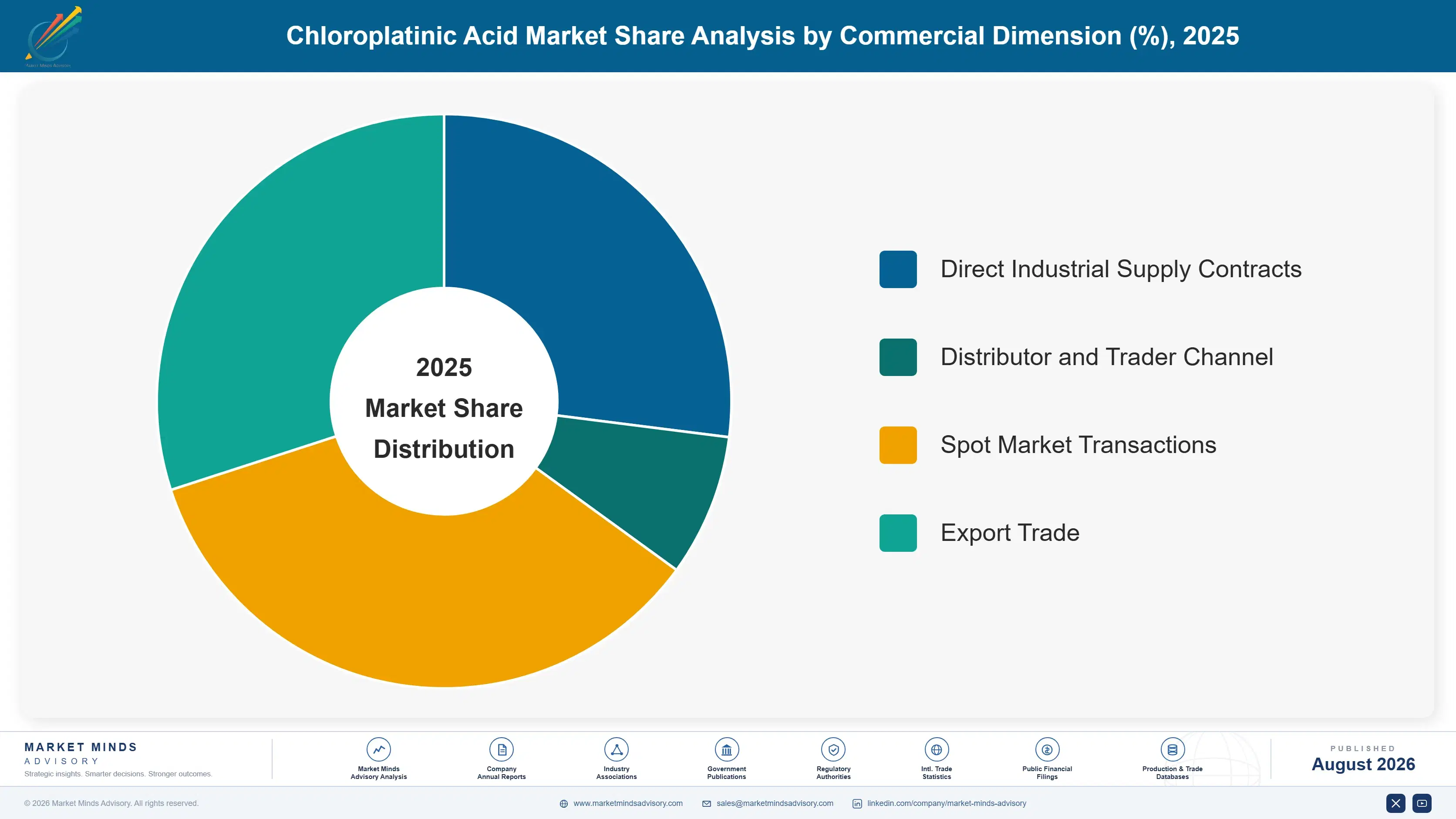
Chloroplatinic Acid Market segments by end-use application rather than purity grade alone, since the specific application determines purity specification, validation requirements, and pricing structure across automotive, energy, and pharmaceutical manufacturing channels sold worldwide today. Six categories span mature catalytic converter demand through emerging clean energy and pharmaceutical applications across the entire global chemical industry.
chloroplatinic-acid-market-trends-market-share-analysis-1787464897863

Hydrogen Fuel Cell Catalyst Precursor

Hydrogen fuel cell catalyst precursor applications require chloroplatinic acid processed into ultra-fine platinum nanoparticle catalyst formulations that maximize surface area and catalytic efficiency within proton exchange membrane fuel cell stacks used in both mobility and stationary power applications worldwide today and quite well beyond still indeed consistently. This is the fastest-growing category, expanding at an estimated 16.0 percent annually as national decarbonization programs fund hydrogen fuel cell vehicle and stationary power deployment across major economies. Producers with proprietary nanoparticle catalyst formulation technology and validated fuel cell performance testing are capturing outsized share of this category's growth, while standard catalyst precursor makers without fuel cell specific capability struggle to compete for these emerging contracts nationwide.
CAGR 16.0%

Pharmaceutical and Laboratory Reagent Applications

Pharmaceutical and laboratory reagent applications use ultra-high-purity chloroplatinic acid as an intermediate for platinum-based drug compound synthesis and analytical chemistry reagents, requiring purity specifications and documentation distinct from industrial catalyst or electroplating grade material across the industry today and quite well beyond still indeed consistently worldwide and beyond. This is the second-fastest category, expanding at an estimated 11.0 percent annually as pharmaceutical developers expand oncology drug research pipelines requiring high-purity platinum coordination chemistry intermediates. Producers with established pharmaceutical-grade purification and documentation capability are winning these contracts fastest, since drug developers increasingly require validated supply chain traceability rather than standard industrial grade material lacking proper certification nationwide and well beyond considerably.
CAGR 11.0%
Full segment breakdown across 6 segments available in the complete report.

Regional Architecture and Country Demand Map

Chloroplatinic Acid Market demand spans all major regions, with East Asia leading given China's expansive catalyst and electronics manufacturing base, Western Europe sustaining strong automotive catalyst demand, and South Asia and Pacific expanding fastest as regional manufacturing capacity scales upward worldwide today and well beyond.

North America

US catalytic converter and fuel cell manufacturers process substantial chloroplatinic acid volume given the country's large automotive production base and growing hydrogen infrastructure investment tied to federal clean energy incentive programs nationwide and well beyond it entirely and quite consistently indeed still today and well beyond that too indeed still. The region's demand also includes substantial pharmaceutical reagent procurement tied to drug developers researching platinum-based oncology compounds across multiple research centers nationwide and well beyond considerably. Canada's chemical suppliers follow similar sourcing patterns on a smaller scale given shared supply chain integration with the United States. Demand concentrates in catalytic converters, fuel cell stacks, and pharmaceutical intermediates nationwide and beyond.
Share: 22% | CAGR: 8.9% (2026 to 2036)

Western Europe

Germany anchors European chloroplatinic acid demand given its large automotive catalyst manufacturing sector and early adoption of hydrogen fuel cell technology across passenger and commercial vehicle platforms, both increasingly bundled into national decarbonization strategy ahead of most other global markets nationwide and well beyond entirely and quite consistently. France and the United Kingdom follow closely, where fuel cell developers have expanded catalyst precursor procurement faster than the broader category overall this cycle across most markets nationwide and beyond considerably. The European Union's emission regulation framework is among the strictest globally, sustaining steady catalytic converter precursor demand. Growth trails East Asia given the region's comparatively mature, slower-expanding manufacturing base overall today.
Share: 22% | CAGR: 6.8% (2026 to 2036)
Regional intelligence for 5 additional markets available in the complete report: East Asia, South Asia and Pacific, Latin America, Middle East and Africa, Eastern Europe. Contact sales@marketmindsadvisory.com.
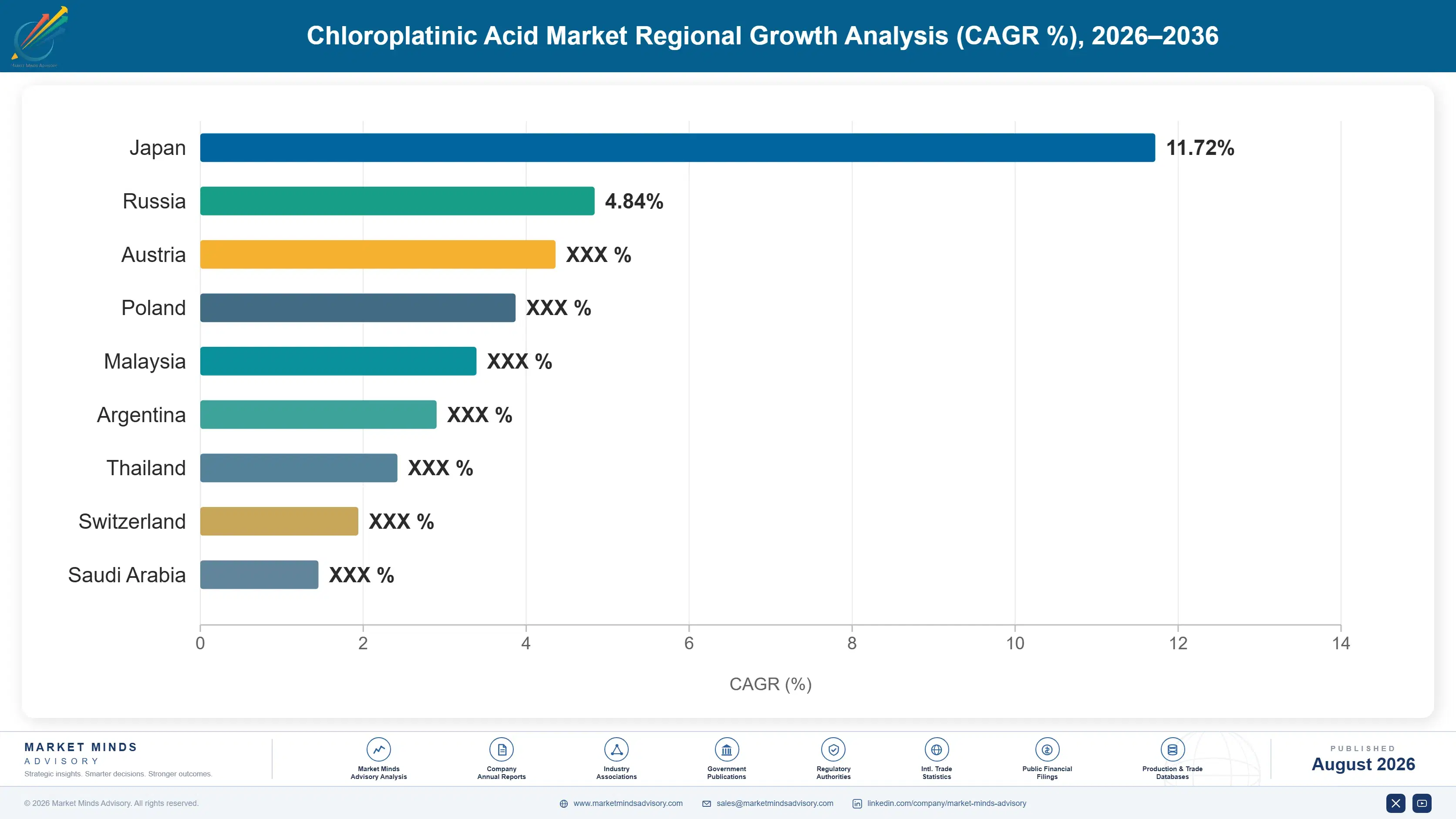
chloroplatinic-acid-market-trends-country-cagr-analysis-1787464898392

Where Chloroplatinic Acid Margins Concentrate

Margin expansion in chloroplatinic acid flows through four distinct commercial levers: fuel cell catalyst grade premiums over standard industrial precursor, pharmaceutical purity certification attachment, refining and conversion capacity integration, and long-term supply agreements that lock in durable multi-year customer positions across every major consuming market across the entire wider world today still quite consistently.

Fuel Cell Catalyst Grades Command Premium Pricing

Fuel cell catalyst precursor grades command a price premium of roughly 1.5 to 2.0 times standard catalytic converter precursor material, reflecting both specialized nanoparticle formulation technology cost and the performance validation premium fuel cell manufacturers pay for to meet stack efficiency and durability requirements. Producers who develop differentiated formulation technology capture pricing power that standard catalyst precursor makers competing purely on platinum content cannot access. This premium has proven durable because fuel cell formulation expertise is difficult to replicate quickly, giving early movers a multi-year head start over competitors still building comparable technical capability from scratch.
Market Impact: Fuel cell grades price 1.5 to 2.0 times standard

Pharmaceutical Purity Certification Builds Pricing Power

Producers offering rigorous pharmaceutical-grade purity certification and supply chain traceability documentation capture additional value from drug developers seeking verified ultra-high-purity intermediates for platinum-based compound synthesis, a certification distinct from standard industrial grade material sold without any independent validation whatsoever across the supply chain. This certification capability requires sustained investment in purification technology and documentation infrastructure that smaller regional producers typically cannot commit to building independently. Suppliers with established certification programs are capturing an additional premium of roughly 30 percent beyond uncertified competitors, often embedding themselves more deeply into a drug developer's quality assurance process.
Market Impact: Pharma-certified suppliers command roughly a 30 percent premium

Refining Integration Secures Reliable Feedstock Access

Producers with direct refining relationships into platinum group metal mining operations secure feedstock at meaningfully more stable delivered cost than competitors purchasing through intermediary metal traders, particularly during periods of price volatility when spot platinum prices can swing more than 25 percent within a single year across the affected supply chain. This integration lever requires capital investment in refining infrastructure and mining relationships that smaller specialty chemical producers typically lack, reinforcing a durable cost advantage for producers who have already built these relationships across major producing regions including South Africa and Russia over time.
Market Impact: Integrated refiners cut feedstock cost by 15 percent

Long-Term Supply Agreements Lock In Customer Volume

Producers increasingly secure exclusive, multi-year supply agreements with fuel cell manufacturers and pharmaceutical developers rather than selling into spot markets, with disclosed agreements often spanning 3 to 5 years and covering entire production program requirements across multiple manufacturing sites, applications, and years. Producers who win these agreements secure both predictable revenue and long-term customer relationships difficult for competitors to displace once a supply agreement has been established. This lever favors producers with dedicated key account teams and requires sustained investment that smaller regional producers often cannot commit at comparable scale.
Market Impact: Supply agreements often span 3 to 5 years

Who Controls the Margin Pool

Chloroplatinic Acid Market concentration sits at a CR5 of 44 percent, evaluated on global chemical production volume, with Johnson Matthey and BASF SE holding the largest positions built on diversified refining and application-specific formulation portfolios spanning multiple end-use industries. The gap between these established leaders and numerous smaller specialty chemical producers remains wide on fuel cell and pharmaceutical grade purification capability, though narrower on delivered cost position for standard catalytic converter precursor categories.
Current competitive activity concentrates in three areas: fuel cell catalyst formulation technology investment to meet accelerating hydrogen infrastructure demand, pharmaceutical-grade purification capacity expansion to capture drug development contracts, and long-term supply agreement negotiation with fuel cell manufacturers seeking fewer, larger strategic feedstock partners.

Rankings are most likely to shift as fuel cell and pharmaceutical grade material become larger shares of total demand, a dynamic that could let producers with the strongest specialty formulation technology pull meaningfully ahead of conventional catalytic converter precursor specialists. Smaller producers without dedicated purification capability face the greatest pressure, and several are pursuing supply partnership arrangements with larger refiners rather than building purification technology internally, a defensive posture that could reshape the competitive leaderboard within the next five years.
chloroplatinic-acid-market-trends-company-positioning-matrix-1787464898914

Competitive Moat and Risk Dimensions

JOHNSON MATTHEY

Moat: Broad Platinum Chemistry Portfolio

Johnson Matthey operates the industry's broadest platinum group metal chemical portfolio spanning automotive catalyst, fuel cell, and pharmaceutical intermediate applications, supported by dedicated refining and application engineering teams serving customers globally. This breadth lets Johnson Matthey offer integrated chemical solutions across every end-use category that narrower regional producers cannot match at comparable technical depth.
JOHNSON MATTHEY

Risk: Diluted Application Priority

Johnson Matthey broad chemical portfolio means chloroplatinic acid represents one of several strategic priorities relative to competitors more narrowly focused on specialty platinum chemistry specifically, potentially slowing dedicated investment pace in any single application area. Intensifying competition from fuel cell catalyst specialists could erode its share in premium clean energy contracts if broader investment pace fails to keep up.
BASF SE

Moat: Established Catalyst Chemistry Heritage

BASF SE's decades of catalyst chemistry engineering heritage and deep automaker qualification relationships give it distinctive credibility with manufacturers seeking proven, high-purity chloroplatinic acid formulations. This established reputation and specialized fuel cell catalyst technology give the company a durable position in the clean energy segment specifically across multiple regions.
BASF SE

Risk: Limited Adjacent Diversification

BASF SE's specialized focus on catalyst chemistry technology leaves it comparatively less diversified into pharmaceutical and electroplating intermediate applications relative to broader competitors, potentially limiting its exposure to these adjacent growth categories. Sustained platinum price volatility could pressure its catalyst chemistry margins more directly given its concentrated positioning.

Players Tracked

Prominent Players

Johnson Matthey plc
BASF SE
Umicore N.V.
Heraeus Precious Metals
Anglo American Platinum Limited

Other Key Players

Sino-Platinum Metals Co., Ltd.
Furuya Metal Co., Ltd.
Tanaka Kikinzoku Kogyo K.K.
American Elements
Alfa Aesar (Thermo Fisher Scientific)
Merck KGaA (Sigma-Aldrich)
Heesung Metal Ltd.
Solaris Chem Inc.
Colonial Metals, Inc.
Kojima Chemicals Co., Ltd.
Ames Goldsmith Corporation
Vale S.A.
Impala Platinum Holdings Limited
Sibanye-Stillwater Limited
Metalor Technologies

Recent Developments

FEBRUARY 2025

Johnson Matthey Expands Fuel Cell Catalyst Precursor Capacity

Johnson Matthey announced an expansion of its fuel cell catalyst precursor production capacity to increase nanoparticle formulation output, responding to sustained demand from hydrogen mobility and stationary power manufacturers seeking validated high-performance catalyst material. The expansion adds meaningful annual production volume at an existing European facility.
Signal: Signals established platinum group metal refiners are prioritizing fuel cell catalyst capacity ahead of accelerating hydrogen demand.
SEPTEMBER 2024

BASF SE Launches Pharmaceutical-Grade Chloroplatinic Acid Line

BASF SE launched a new pharmaceutical-grade chloroplatinic acid product line specifically engineered to meet drug developer purity and traceability requirements without compromising supply chain documentation standards across demanding regulatory environments. The launch includes documented purity testing data benchmarked against standard industrial grade material currently in wide use.
Signal: Signals established chemical producers are prioritizing pharmaceutical-grade purification as a distinct competitive battleground across the industry.
APRIL 2025

Umicore Opens Platinum Recycling And Refining Facility

Umicore opened a new platinum group metal recycling and refining facility to expand chloroplatinic acid feedstock diversification closer to European customer demand centers, reducing supply risk for regional buyers significantly across multiple markets and applications. The facility includes dedicated processing infrastructure supporting closed-loop platinum recovery requirements.
Signal: Signals producers are investing in recycling capability to diversify feedstock away from concentrated mining regions across the industry.

Platinum Feedstock Input Cost Exposure

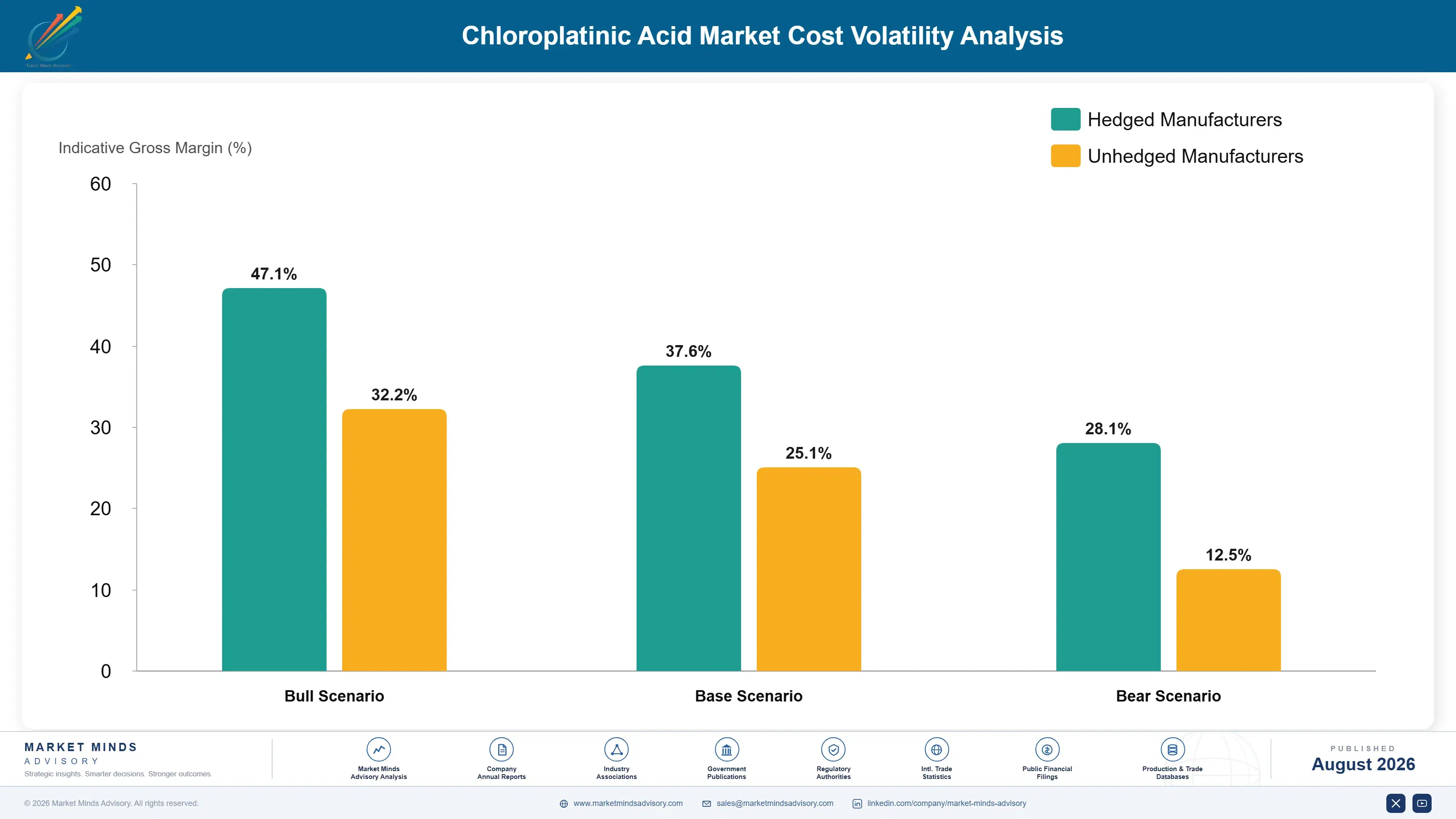
Platinum group metal feedstock accounts for an estimated 70 to 78 percent of cost of goods sold for chloroplatinic acid production, representing the overwhelming majority of total cost regardless of downstream chemical conversion complexity or purity specification sold across the industry worldwide today. Platinum feedstock originates mainly from South Africa and Russia mining and refining operations.
Platinum spot prices spiked more than 22 percent during 2024 following supply disruptions at major South African mines and export restrictions affecting Russian material, according to World Trade Organization data cited by industry associations, pushing chloroplatinic acid production costs up substantially and squeezing margins for producers who could not pass costs through mid-contract. Several suppliers disclosed platinum-linked cost inflation as a pressure on segment margins in recent annual reporting periods, prompting wider adoption of indexed pricing clauses.

Producers without diversified platinum sourcing relationships face a persistent cost disadvantage during price spikes, since chloroplatinic acid production cannot easily substitute alternative metals on short notice without triggering separate qualification and validation requirements from fuel cell and pharmaceutical customers. Exposure concentrates most heavily among smaller regional producers who lack the balance sheet to hold buffer inventory that larger diversified competitors maintain across multiple sourcing geographies.
chloroplatinic-acid-market-trends-cost-volatility-analysis-1787464899113

Diversify Platinum Sourcing Across Supplier Geographies

Producers are qualifying additional platinum sourcing regions across multiple mining geographies including North America and recycled secondary platinum streams, reducing single-region dependence across the chloroplatinic acid feedstock supply base considerably and consistently. This diversification adds logistics complexity but meaningfully lowers the probability that a single regional supply disruption disrupts total production volume across a producer's portfolio.

Expand Platinum Recycling And Recovery Capacity

Capital allocation is shifting toward platinum recycling from spent catalysts and electronic scrap precisely because recycled feedstock trades on more stable, controllable supply cycles with far more availability than primary mining tied to South African and Russian production cycles. Producers pursuing this path reduce long-run exposure to platinum price volatility, even though recycling systems still carry meaningfully higher processing cost.

Negotiate Indexed Cost Pass-Through Clauses In Contracts

Producers are increasingly building indexed cost pass-through mechanisms into multi-year customer supply agreements, tying pricing to published platinum spot benchmarks rather than fixed unit prices negotiated years in advance. This protects margins during volatility events but requires customer buyers accustomed to fixed pricing to accept periodic adjustment clauses, a negotiation favoring suppliers with strong bargaining position.

Portfolio Architecture for Margin Defence

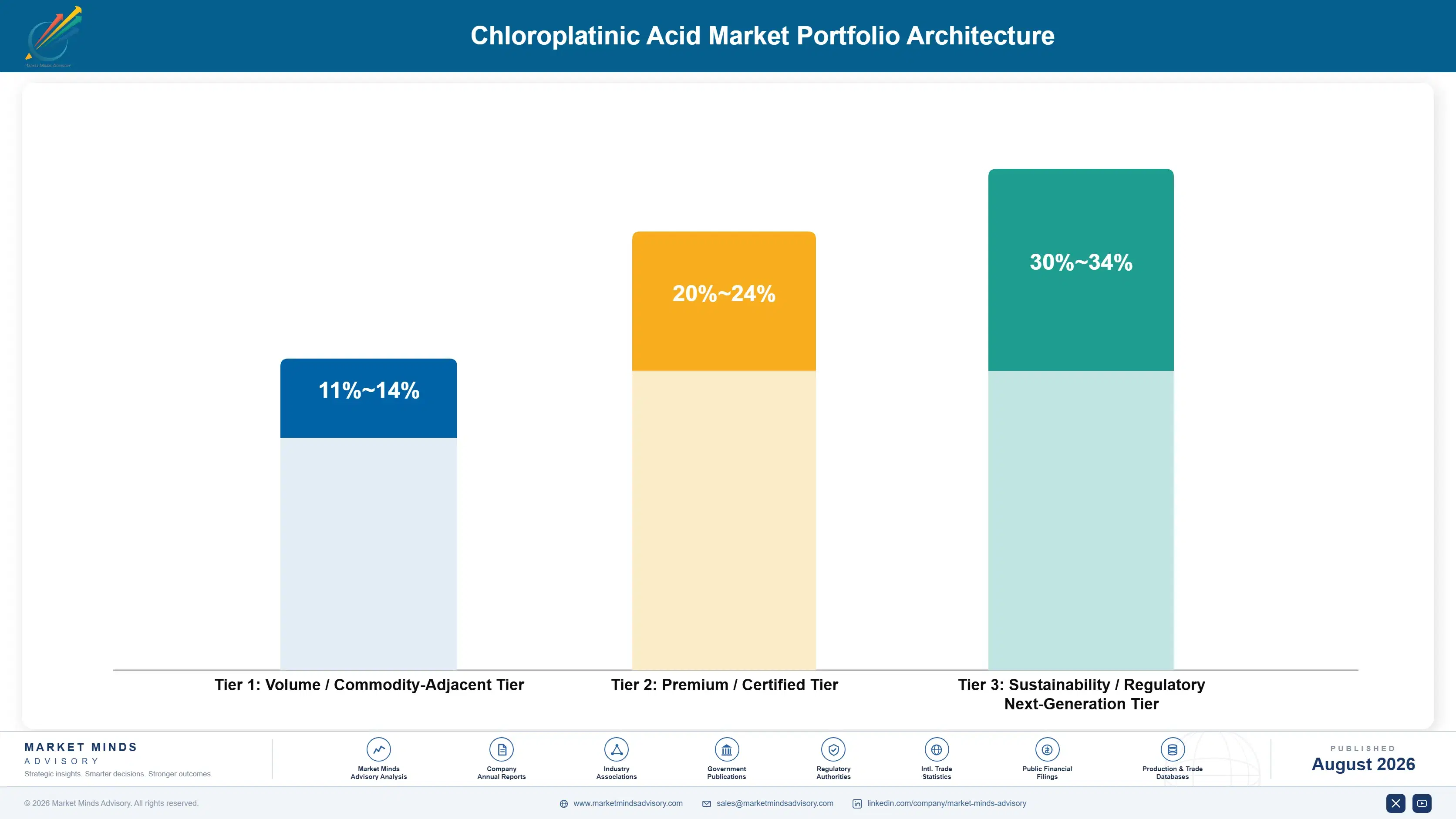
Chloroplatinic Acid Market splits into three commercial tiers with different margin economics: a volume tier built on standard catalytic converter precursor material sold into mainstream automotive production, a premium tier built on high-purity electroplating and petrochemical reforming grades commanding differentiated positioning, and a next-generation tier built on fuel cell and pharmaceutical grades still scaling toward full commercial economics. Gross margins range from roughly 11 percent to over 34 percent for differentiated grades sold under long-term customer agreements.
Volume-tier producers compete primarily on price and reliable delivery into commodity catalytic converter precursor formulations, where purity specification matters less than consistent supply at lowest deliverable cost. Premium-tier producers instead compete on purification sophistication and validation capability for customers unwilling to compromise on application-critical performance positioning, accepting materially higher research costs in exchange for pricing power volume-tier competitors cannot access.

High-value margin pools concentrate in fuel cell and pharmaceutical grade contracts sold under long-term agreements to clean energy manufacturers and drug developers, where buyers pay for both purity validation and technical partnership simultaneously. Standard catalytic converter precursor remains the volume backbone of the market, but its margin ceiling is capped by an increasingly competitive set of regional specialty chemical producers.

Volume / Commodity-Adjacent Tier

Standard catalytic converter precursor material sold into mainstream automotive production at competitive pricing, prioritizing reliable volume delivery over purity sophistication, serving mid-tier catalyst manufacturers and volume vehicle segments across mature automotive categories.
Gross Margin: 11-14%

Premium / Certified Tier

High-purity electroplating and petrochemical reforming grades with documented purity specification sold to premium industrial customers requiring verified performance standards, commanding higher unit prices than standard precursor equivalents under multi-year supply contracts.
Gross Margin: 20-24%

Sustainability / Regulatory / Next-Generation Tier

Fuel cell and pharmaceutical grade chloroplatinic acid marketed on purity validation and application-specific formulation benefits, targeting clean energy manufacturers and drug developers pursuing product differentiation, commanding the highest margins as purification technology continues improving cost competitiveness.
Gross Margin: 30-34%
chloroplatinic-acid-market-trends-portfolio-architecture-1787464899617

High-value Sub-segments and Strategic Watch-out

Fuel Cell And Pharmaceutical Grade Material

Fuel cell and pharmaceutical grade chloroplatinic acid are both the highest-margin and fastest-growing segment as clean energy manufacturers and drug developers fund exclusive purification development to meet performance certification and validation demands, attracting the bulk of all new global research investment from leading producers worldwide during this current strong cycle.
Gross Margin: 30-34%

High-Purity Electroplating And Reforming Grades

High-purity electroplating and petrochemical reforming grades for conventional industrial applications continue generating strong margins even as growth moderates relative to fuel cell co-development, supported by established customer relationships and purity validation depth that newer entrants still need many long years to replicate credibly with major customers globally today.
Gross Margin: 20-24%

Standard Catalytic Converter Core Volume

Standard catalytic converter precursor sold at competitive volume pricing into mainstream automotive production remains the market's core revenue base even as margins compress under rising competition from lower-cost regional specialty chemical producers entering the segment at a very meaningful scale across many quite different geographies worldwide still today.
Gross Margin: 11-14%

Platinum Feedstock Supply Risk

Platinum feedstock supply tied to mining output and geopolitical cycles in South Africa and Russia represents the segment producers and investors should watch most closely, since a sustained multi-year platinum price spike could strand chemical conversion capacity and force very costly reformulation across the entire global industry at once.
Gross Margin: 7-10%

Why Supply Relationships Persist

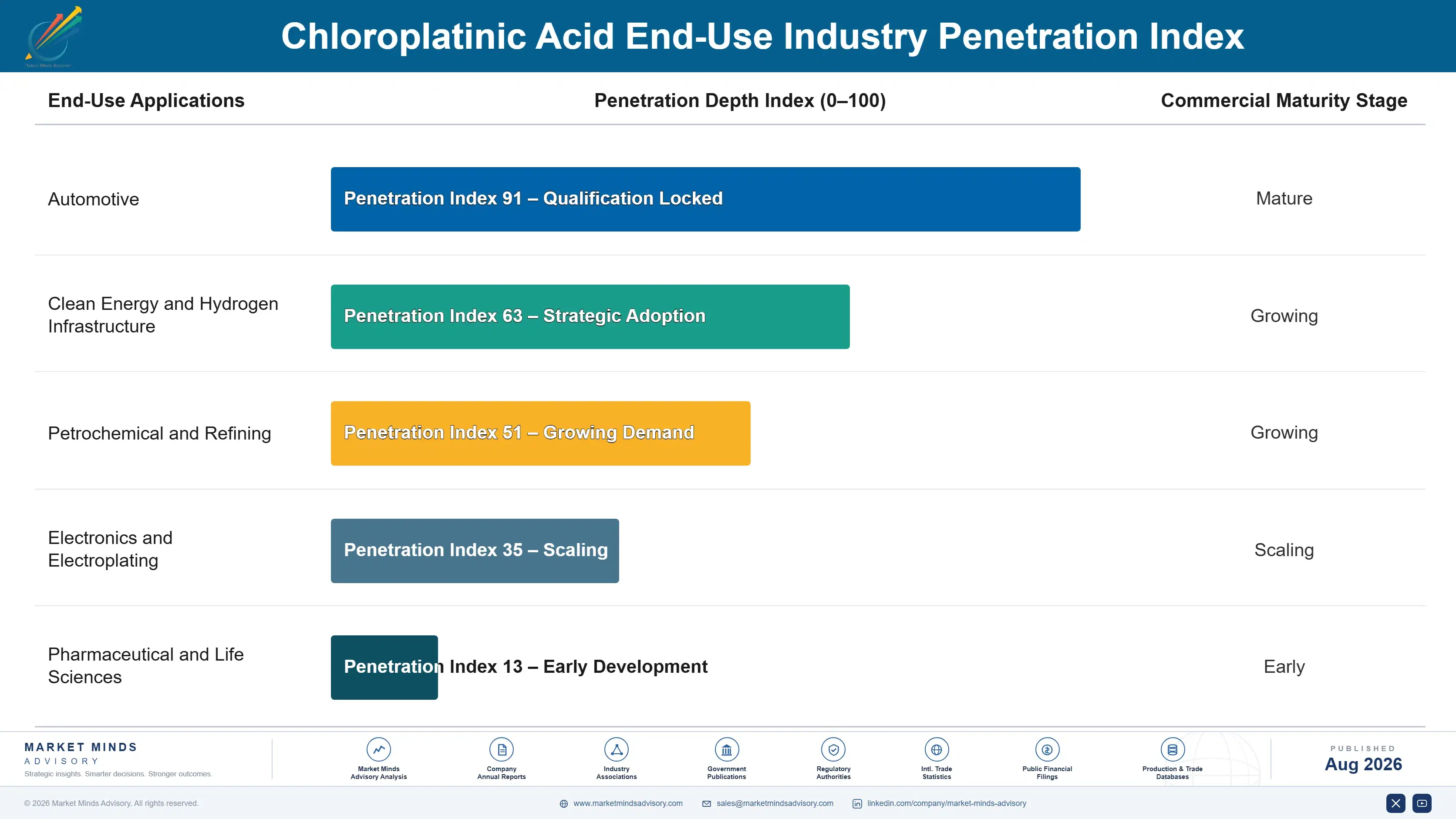
Once a customer qualifies a chloroplatinic acid producer against its purity and consistency benchmarks for a specific application, the relationship tends to persist across the full production program lifecycle rather than being re-tendered annually, since re-qualification carries real cost and validation risk. This qualification stickiness gives incumbent producers reliable, repeat revenue once a supply agreement is won, a dynamic that rewards established relationships over aggressive price competition alone.
Adoption of fuel cell and pharmaceutical grade material runs deepest in clean energy and drug development programs, where purity validation is a defining performance and safety requirement that customers cannot substitute with standard industrial grades without risking application failure, and shallowest in commodity electroplating and reforming applications retaining standard purity specifications. Petrochemical and automotive catalyst segments sit between these extremes, adopting specialty grades selectively as application requirements tighten over time.

A younger cohort of procurement managers at fuel cell and pharmaceutical manufacturers, now negotiating chloroplatinic acid contracts, treats validated purity documentation as a baseline requirement rather than a cost consideration their predecessors debated case by case. This generational shift is compressing the qualification timeline for new specialty grade formulations at customers that previously relied on standard industrial grade material exclusively.
chloroplatinic-acid-market-trends-end-use-penetration-index-1787464900111

Where To Place Chloroplatinic Acid Bets

These are among the four positions where our research anticipates prominent divergence between winners and laggards over the coming forecast period. Each is grounded in the demand model, the regulatory perimeter, and the announced capacity pipeline.
01 / FUEL CELL FORMULATION INVESTMENT

Back Fuel Cell Formulation Technology Before Rivals

Fuel cell catalyst precursor material is growing faster than any other segment as clean energy manufacturers demand validated nanoparticle formulations that generic industrial precursor increasingly cannot deliver at required performance levels. Producers that invest in fuel cell formulation technology now will lock in preferential access to premium clean energy contracts before conventional competitors complete their own capability build-out. Waiting for hydrogen infrastructure to fully mature before investing risks ceding the most defensible long-term position to competitors who moved earlier and already control the strongest formulation technology portfolios.
02 / PHARMACEUTICAL PURITY CERTIFICATION

Build Pharmaceutical Purity Certification Now

Pharmaceutical-grade purity certification offers producers a durable, multi-year growth position as drug developers expand platinum-based compound research across oncology and other emerging therapeutic categories, a category standard industrial grade producers are not naturally positioned to serve without dedicated purification investment. Producers that invest in dedicated purification and documentation capability now capture preferential access to this emerging category before competitors recognize the shift and respond with their own dedicated investment programs. This capability requires sustained investment but offers durable, multi-year returns once firmly established.
03 / PLATINUM SUPPLY DIVERSIFICATION

Diversify Platinum Sourcing Before Next Disruption

Platinum feedstock supply remains tied to mining and geopolitical cycles in South Africa and Russia that have already produced sharp cost spikes in recent years, and further disruption at major producing regions remains a credible risk given concentrated global production geography. Producers that diversify sourcing across recycling streams and North American supply now protect margin during the next inevitable disruption rather than scrambling for alternative supply after prices have already moved sharply higher. This diversification is a comparatively low-cost hedge relative to the downside it protects against.
04 / LONG-TERM SUPPLY AGREEMENT CAPABILITY

Build Long-Term Customer Supply Relationships Now

Long-term supply agreements have become a genuine competitive differentiator for producers serving fuel cell and pharmaceutical customers who increasingly demand predictable, validated supply rather than exposure to spot market volatility across the industry today. Producers that build rigorous key account relationships now capture preferential access to premium contracts that spot-market competitors increasingly cannot fulfill under tightening customer supply security requirements and expectations. Early movers in this specific capability will likely retain preferred-supplier status well beyond the current demand diversification wave and into the next one.

Engagement Snapshot From the Field

A live engagement with an industry participant carrying material or product regulatory and market exposure ahead of a defining policy shift, showing how our research translates into a defensible multi-year portfolio strategy.
MARKET MINDS ADVISORY · CLIENT ENGAGEMENT SUMMARY
Chloroplatinic Acid Producer Strategic Portfolio Review and Transition Roadmap 2026·Investment Scenario on Chloroplatinic Acid Exposure Evaluation 2025-26
CLIENT PROFILE
The client is a multinational fuel cell manufacturer generating approximately 1.9 billion dollars (client-reported, unverified by MMA) in annual revenue across North America and East Asia. The company had committed publicly to securing dedicated chloroplatinic acid catalyst precursor supply within a sixteen-month procurement timeline tied to stack production scale-up and hydrogen infrastructure deployment commitments overall.
STRATEGIC CHALLENGE
The client's existing catalyst precursor sourcing relied on spot market purchases without dedicated formulation partnership, risking supply disruption as hydrogen infrastructure demand accelerated industry-wide across every major producing region. Management needed an independent assessment of platinum group metal producers to determine which could realistically deliver comparable formulation quality within the required timeline.
MMA APPROACH
MMA conducted primary interviews with sourcing and technical leadership across five platinum group metal producers, benchmarking fuel cell catalyst formulation readiness, refining capacity depth, and prior large-scale fuel cell supply experience against the client's procurement timeline. The analysis included catalyst performance testing review and stress-tested each candidate's production scale-up timeline against the client's stack manufacturing schedule.
KEY FINDINGS
  1. Two of five evaluated producers had prior commercial experience supplying fuel cell catalyst precursor to comparably sized manufacturers within a ten-month transition window.
  2. Catalyst performance testing showed one candidate's formulation achieving stack efficiency within 96 percent of the client's existing benchmark specification across standard conditions.
  3. Production transition timelines across candidates ranged from eight to eighteen months, with the fastest candidate requiring meaningfully less lead time before full supply readiness.
  4. Pricing structures varied significantly across candidates, with delivered material cost ranging from 1.3 to 1.8 times the client's existing spot market cost depending on formulation scope.
CLIENT PROFILE
The client is a multinational fuel cell manufacturer generating approximately 1.9 billion dollars (client-reported, unverified by MMA) in annual revenue across North America and East Asia. The company had committed publicly to securing dedicated chloroplatinic acid catalyst precursor supply within a sixteen-month procurement timeline tied to stack production scale-up and hydrogen infrastructure deployment commitments overall.
STRATEGIC CHALLENGE
The client's existing catalyst precursor sourcing relied on spot market purchases without dedicated formulation partnership, risking supply disruption as hydrogen infrastructure demand accelerated industry-wide across every major producing region. Management needed an independent assessment of platinum group metal producers to determine which could realistically deliver comparable formulation quality within the required timeline.
MMA APPROACH
MMA conducted primary interviews with sourcing and technical leadership across five platinum group metal producers, benchmarking fuel cell catalyst formulation readiness, refining capacity depth, and prior large-scale fuel cell supply experience against the client's procurement timeline. The analysis included catalyst performance testing review and stress-tested each candidate's production scale-up timeline against the client's stack manufacturing schedule.
KEY FINDINGS
  1. Two of five evaluated producers had prior commercial experience supplying fuel cell catalyst precursor to comparably sized manufacturers within a ten-month transition window.
  2. Catalyst performance testing showed one candidate's formulation achieving stack efficiency within 96 percent of the client's existing benchmark specification across standard conditions.
  3. Production transition timelines across candidates ranged from eight to eighteen months, with the fastest candidate requiring meaningfully less lead time before full supply readiness.
  4. Pricing structures varied significantly across candidates, with delivered material cost ranging from 1.3 to 1.8 times the client's existing spot market cost depending on formulation scope.
RECOMMENDED STRATEGY
Phase 1: Phase 1 (0 to 3 months): Complete catalyst performance and formulation testing across shortlisted producers and select a partner based on fit. Phase 2: Phase 2 (3 to 13 months): Transition catalyst precursor supply across stack production lines, running validation testing across multiple configurations. Phase 3: Phase 3 (13 to 16 months): Complete full production ramp with documented performance validation, finalizing long-term supply pricing and delivery terms.
OUTCOME
Within fifteen months, the client completed its dedicated catalyst precursor supply transition across its stack production lines, achieving 95 percent (client-reported, unverified by MMA) formulation consistency versus prior spot market material. The transition was completed ahead of schedule, with catalyst precursor now sourced under a long-term dedicated supply agreement.

Frequently Asked Questions

Foundational context covering the market sizes, CAGR, scope, country, region and competition that inform every finding below. This section is provided to cover basics and most often pre-purchase conversations, answered from the MMA Primary Research Dataset.

What is the current size of the Chloroplatinic Acid Market?

The Chloroplatinic Acid Market was valued at approximately 0.85 billion dollars in 2025. Growth is driven by hydrogen fuel cell catalyst demand and pharmaceutical compound research expansion.

How large will the Chloroplatinic Acid Market be by 2036?

The market is projected to reach approximately 2.02 billion dollars by 2036, up from 0.92 billion dollars in 2026. That represents roughly a 2.20 times expansion over the ten-year forecast window.

What is the CAGR for the Chloroplatinic Acid Market 2026 to 2036?

The market is forecast to expand at a compound annual growth rate of 8.2 percent between 2026 and 2036. Bull and bear scenarios range from 9.5 percent to 6.9 percent depending on adoption pace.

Which segment is growing fastest?

Hydrogen fuel cell catalyst precursor is the fastest-growing segment, expanding at an estimated 16.0 percent annually, roughly 2.0 times the overall market rate. Pharmaceutical reagent applications follow at 11.0 percent.

Who are the major companies in the Chloroplatinic Acid Market?

Johnson Matthey, BASF SE, Umicore, Heraeus, and Anglo American Platinum lead the market by global production volume. Combined, the top five suppliers hold a CR5 of approximately 44 percent.

Which country is growing fastest?

China is the fastest-growing single country, expanding rapidly as its catalyst and fuel cell manufacturing base scales across every application. India follows closely given rising industrial manufacturing demand.

Report Segmentation Architecture

The full report scope spans multiple orthogonal segmentation dimensions, with cross-tabulated demand data provided for each dimension pair. Coverage extends further to regional breakdowns, trend trajectories, and the competitive detail needed to support segment-level decision-making.

By End-Use Application

  • Automotive Catalytic Converter Catalyst Precursor
  • Hydrogen Fuel Cell Catalyst Precursor
  • Petrochemical Reforming Catalyst Precursor
  • Electroplating and Electroforming Applications
  • Glass Manufacturing Catalyst Precursor
  • Pharmaceutical and Laboratory Reagent Applications

By End-Use Industry

  • Automotive
  • Clean Energy and Hydrogen Infrastructure
  • Petrochemical and Refining
  • Electronics and Electroplating
  • Pharmaceutical and Life Sciences

By Commercial Dimension

  • Direct Industrial Supply Contracts
  • Distributor and Trader Channel
  • Spot Market Transactions
  • Export Trade

By Region

  • North America
  • Western Europe
  • East Asia
  • South Asia and Pacific
  • Latin America
  • Middle East and Africa
  • Eastern Europe

Scope, Methodology, and Coverage

Every figure in this report is reproducible from documented input assumptions. The scope below maps the historical period, the forecast horizon, the segmentation dimensions, and the countries covered, alongside the underlying primary and qualitative methodology.
Historical Period
2020 to 2025
Forecast Period
2026 to 2036
Base Year
2025 (USD billions; MMA Primary Research Dataset, August 2026)
Market Definition
The Chloroplatinic Acid Market comprises the specialty chemical intermediate used as a platinum precursor across catalytic converter, fuel cell, electroplating, petrochemical reforming, glass manufacturing, and pharmaceutical applications. It excludes elemental platinum trading and unrelated platinum group metal jewelry or investment products.
Quantitative Units
USD billions (current prices); platinum-equivalent gram volume where disclosed
Segmentation Dimensions
End-Use Application; End-Use Industry; Commercial Dimension; By Region
Regions Covered
North America, Western Europe, East Asia, South Asia and Pacific, Latin America, Middle East and Africa, Eastern Europe
Countries Covered
USA, China, Germany, France, UK, Japan, South Korea, India, Australia, Canada, Brazil, Mexico, South Africa, Russia, UAE, Saudi Arabia, Nigeria, Turkey, Poland, Netherlands, Italy, Spain, Sweden, Switzerland, Argentina, Egypt, Indonesia, Vietnam, Thailand, Singapore, and additional markets relevant to this sector
Key Companies Profiled
Johnson Matthey plc, BASF SE, Umicore N.V., Heraeus Precious Metals, Anglo American Platinum Limited, Sino-Platinum Metals Co., Ltd., Furuya Metal Co., Ltd., Tanaka Kikinzoku Kogyo K.K., American Elements, Alfa Aesar (Thermo Fisher Scientific), Merck KGaA (Sigma-Aldrich), Heesung Metal Ltd., Solaris Chem Inc., Colonial Metals, Inc., Kojima Chemicals Co., Ltd., Ames Goldsmith Corporation, Vale S.A., Impala Platinum Holdings Limited, Sibanye-Stillwater Limited, Metalor Technologies
Quantitative Methodology
Primary survey, n=3,800 respondents, Q4 2025, six countries; demand-side model with trade association cross-validation
Qualitative Methodology
47 expert interviews, Q4 2025; applied to validate demand model assumptions, identify emerging dynamics, and assess competitive positioning
Report Format
PDF and XLSX data workbook (Word format preview document)
Publisher
Market Minds Advisory
Report Code
MMA-2026-CHM-307
Published
August 2026
Contact
sales@marketmindsadvisory.com | www.marketmindsadvisory.com

Purchase the full Chloroplatinic Acid Market Report (2026 to 2036).

The full Chloroplatinic Acid Market report delivers a complete application segmentation model spanning automotive catalyst, fuel cell, petrochemical reforming, electroplating, glass manufacturing, and pharmaceutical reagent categories. It includes detailed regional demand and feedstock data across all seven world regions. The report profiles twenty producers, including detailed capacity, refining positioning, and moat and risk assessment for the top five, supported by primary interviews with sourcing and technical leadership. It also includes ten-year forecast scenarios under base, bull, and bear cases, platinum cost exposure analysis by region and player type, and a strategic verdict framework for sourcing and product development decisions.
Ten-Year Base, Bull, and Bear Forecasts
Application Segmentation Across Six Chemical Categories
Full Seven-Region Demand and Feedstock Breakdown
Twenty-Company Competitive Profiles With Moat Analysis
Platinum Cost Exposure and Mitigation Playbook
Primary Interview Data From Technical Leadership Teams

Built For The People Who Decide

From boardroom strategy to bench-side execution, this report is read cover-to-cover by leaders shaping the next decade of their industry, turning demand scenarios, market dynamics and valuation benchmarks into decisions.
CXOs/ Presidents/ VPs/ Managers
M&A and Corporate Development
Strategy Teams and R&D Heads
Procurement and Product Directors
Regulatory and Compliance Leaders
Investor Relations and Equity Analysts