Market Minds Advisory
Chlorinated Isocyanurates Market

Chlorinated Isocyanurates Market: Chlorinated Isocyanurates Market: Made In Two Provinces, Used In A Million Backyards

A commodity made almost entirely in two Chinese provinces and consumed mostly in American backyards, held in place by antidumping duties running since 2005 and threatened by pools that make their own chlorine.

Lead Analyst

Published

August 2026

Make Smarter Decisions with Customized Research Insights

Request a free sample report and evaluate market opportunities, growth trends, and competitive dynamics relevant to your business needs.

2025 MARKET VALUE$2.6BMarket Size 2025
2036 FORECAST VALUE$4.5BBase Case , 2026 to 2036
CAGR 2026 TO 20365.2 %Bull 6.4% / Bear 4.0%
INCREMENTAL OPPORTUNITY$1.8BNet 10- year value creation
EXPANSION MULTIPLE1.67x2036 value over 2026 base
Strategic Levers
M&A Pipeline
Regional Outlook
Country Rankings
Competitive Intelligence
Segmental Deep-dive
Call-Us : 91 93563 13602

Executive Snapshot and Market Trajectory.

Every tablet dissolved in a swimming pool leaves cyanuric acid behind, and it never leaves on its own. That accumulation eventually suppresses the chlorine the tablet was bought to deliver, which is the quiet technical problem sitting under this entire category. Nobody sells against it.
North America takes 31% of value on residential pool density alone, while East Asia at 28% holds almost all of the production capacity, which is an unusual split. SDIC effervescent tablets grow at 7.8%, half again the market rate of 5.2%, driven by drinking water and sanitation programmes rather than by leisure. Antidumping duties in force since 2005 are what keeps two Western producers operating at all.
Five producers hold 44% of nameplate capacity and the concentration in China runs far higher than that figure suggests. The real competitive threat is not another producer: salt chlorine generators make hypochlorite on site and remove the tablet purchase entirely, and their installed base grows every year. Producers have responded with multifunction tablets carrying clarifier and algaecide, which defends value per unit rather than volume. That defence works for now. It will not work forever.
Market Definition
The market covers chlorinated isocyanurate compounds used as chlorine donors for disinfection, comprising trichloroisocyanuric acid and sodium dichloroisocyanurate in tablet, granular, powder and technical grades, together with stabilised multifunction formulations built on them. Cyanuric acid sold as a standalone stabiliser, calcium hypochlorite, sodium hypochlorite and salt chlorine generation equipment are excluded. Pool servicing, water treatment engineering and packaging fall outside scope.
Base Year Value
$2.6B in 2025 (MMA Primary Research Dataset, August 2026)
Forecast Period
2026 to 2036, eleven discrete annual values
CAGR
5.2% base case. Bull 6.4%. Bear 4.0%.
Fastest Growth Segment
SDIC Effervescent Tablets: 7.8% CAGR
Fastest Growth Country
India: 8.4% CAGR
Fastest Growth Region
South Asia and Pacific: 7.4% CAGR
Largest Region
North America: 31% of 2025 global value
Market Leaders
Occidental Chemical, Hebei Jiheng Chemical, Juancheng Kangtai Chemical, Clearon Corp, Ercros. Source: MMA Analysis based on nameplate production capacity, company disclosures 2025.
Primary Survey
n=3,800 procurement and R&D decision-makers, Q4 2025, six countries
Methodology
Demand-side build-up, cross-validated against public data, 47 expert interviews

Chlorinated Isocyanurates Market Forecast Scenarios

chlorinated-isocyanurates-market-size-forecast-scenario-1787676819824
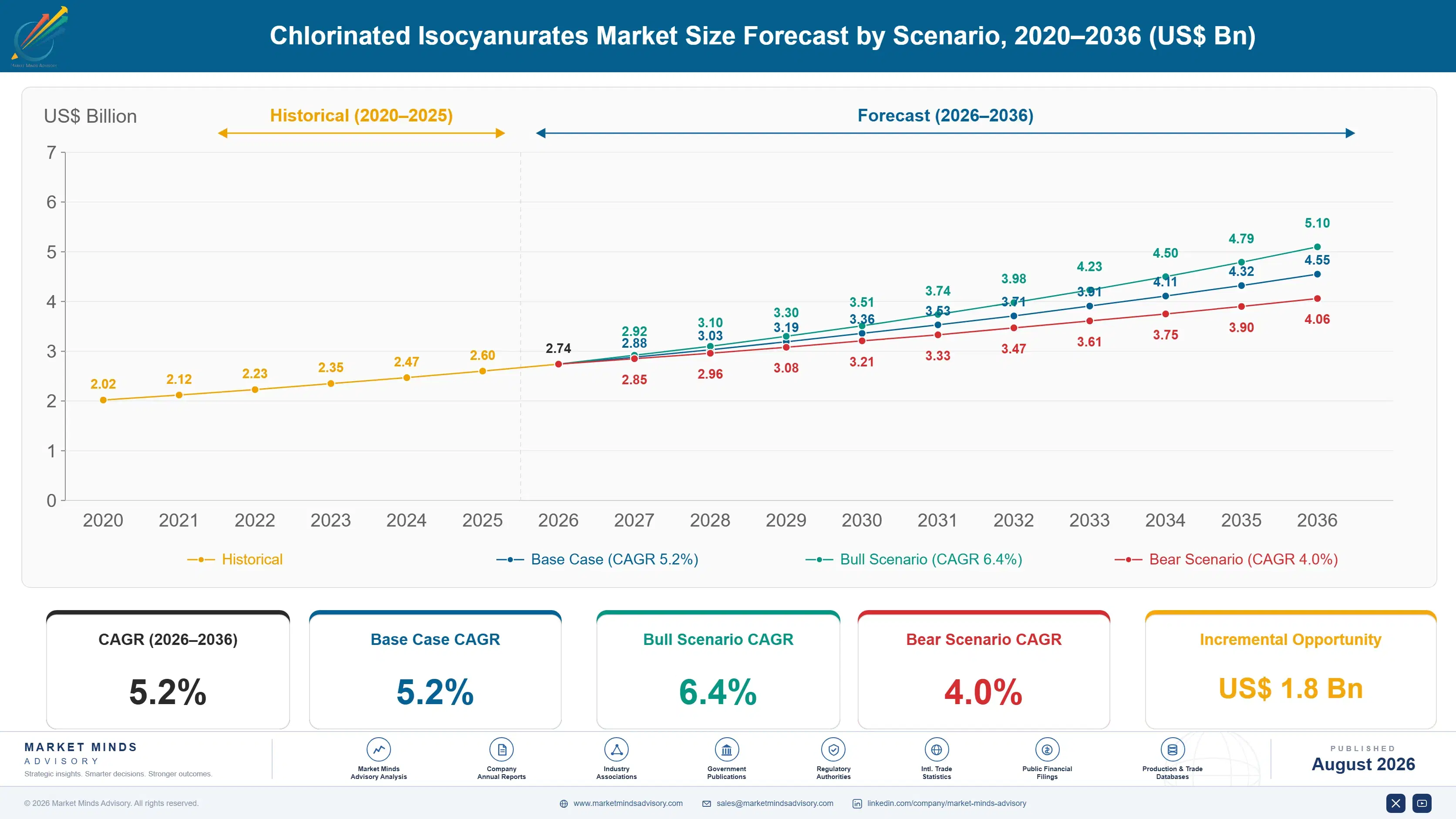
Growth from 2020 to 2025 ran at 4.0% and it was violently uneven. Pool construction and chemical demand spiked through 2020 and 2021 when households stayed home, then collapsed into an inventory correction that took most of two years to clear. Sanitation demand behaved the opposite way, surging on disinfection protocols and then normalising. Nothing about that period tells you much about the underlying rate.
The 5.2% base case rests on three mechanisms. Municipal drinking water disinfection in South Asia and Africa is converting from gas chlorine to solid chlorine donors, because tablets need no pressurised storage and no trained gas handler. Pool installed base keeps growing in Latin America and the Gulf even as North American construction normalises. And multifunction tablets carrying clarifier, algaecide and scale inhibitor command higher prices per kilogram than plain sanitiser, which lifts value where volume is flat.
The bull case at 6.4% turns on municipal conversion moving faster than expected across African and South Asian utilities, where the operational argument is already won and only procurement lags. The bear case at 4.0% is salt chlorine generator penetration accelerating in North America, which would remove tablet demand from the pools that consume the most.

Where The Tablets Are Made And Used

Chlorinated isocyanurates exist because chlorine gas is dangerous and liquid bleach degrades. Press the same chlorine into a stable tablet that dissolves slowly and releases on demand, and you have a product a homeowner can handle without training. The cyanurate ring that makes this possible also protects the chlorine from sunlight, which in an outdoor pool is worth more than the convenience is.
FIVE-FIRM CONCENTRATION44%Share of nameplate capacity held by leading producers
AVERAGE TABLET PRICE$3.20 per kgTypical bulk selling price for trichloroisocyanuric acid tablets
TOP PRODUCING COUNTRYChina 78%Chinese share of global chlorinated isocyanurate production capacity
CAPACITY UTILISATION67%Average operating rate across the global producer base
TRADE INTENSITY71%Share of output crossing at least one national border
CYANURIC ACID ACCUMULATION38 ppm yearlyStabiliser buildup in a typical residential pool annually
The same ring is the problem. Cyanuric acid accumulates at roughly 38 parts per million a year in a typical residential pool and does not degrade or evaporate. Past a certain concentration it holds the chlorine too tightly to sanitise, and the only fix is draining and refilling. Pool service professionals know this well. Homeowners buying tablets from a retail shelf mostly do not.
Production geography is the other defining fact. Roughly 78% of global capacity sits in China, most of it in Hebei and Shandong, and the United States has kept two domestic producers alive through antidumping duties in force since 2005. Those duties have been reviewed and extended repeatedly. Without them the American industry would consist of importers, which is a policy judgement rather than an economic one and everybody involved knows it.
"The product sells itself for about four years, and then the pool owner discovers what has been building up in the water. Nobody in this industry wants that conversation."
Director, Water Treatment Chemicals Practice · MMA Chemicals and Materials Practice · August 2026

Market Trends

Salt Chlorine Generators Erode The Tablet Purchase

A salt chlorine generator electrolyses dissolved salt into hypochlorite continuously, which removes the tablet purchase and the trip to buy it. Installation costs more than a year of chemicals and pays back over three or four. Adoption is heaviest in new pool construction in North America and Australia, where installers now offer it as standard rather than as an option. Retrofit is slower because it requires plumbing work. The important detail for producers is that a salt pool still needs cyanuric acid as a stabiliser, so a smaller and entirely different product opportunity remains.
Market Impact: Sustains 2 domestic production sites
Municipal Utilities Convert From Gas Chlorine To Tablets

Chlorine gas requires pressurised cylinders, containment scrubbers, emergency planning and a trained operator on site, which small utilities in South Asia and Africa cannot reliably provide. Solid chlorine donors need none of that. A tablet feeder on a distribution line delivers a controlled residual with equipment a municipal engineer can maintain. WHO drinking water guidance and national programmes in India have both pushed this direction, and the operational argument is already settled among engineers. What lags is procurement, which still buys on cost per kilogram of available chlorine rather than on total operating cost.
Market Impact: Lifts realised price 46% higher

Market Opportunities and Growth Drivers

Antidumping Duties Sustain Western Production Capacity

United States antidumping orders on Chinese chlorinated isocyanurates have run since 2005 and have survived every sunset review since. Duty rates on some producers exceed the landed value of the goods. That arrangement is the only reason domestic production exists, because Chinese cash costs sit far below anything a Western plant can achieve on scale, power and integration. The commercial consequence is a North American price level disconnected from world pricing, and an import trade that routes through countries without orders. Producers plan capital investment around review calendars rather than around demand.
Market Impact: Caps concentration at 100 ppm

Multifunction Tablets Raise Value Per Kilogram Sold

A plain sanitiser tablet competes on price per kilogram of available chlorine and nothing else. Add clarifier, algaecide, scale inhibitor and a pH buffer to the same tablet and the comparison stops working, because no competitor tablet contains the same combination. Retail pricing on multifunction products runs well above plain trichloroisocyanuric acid for a marginal formulation cost. Homeowners buy them because a single tablet replaces four purchases and four decisions. Pool professionals dislike them, since dosing four chemicals on one schedule suits none of them properly, and they buy separately.
Market Impact: Holds utilisation near 67%

Market Restraints and Challenges

Cyanuric Acid Buildup Limits Long Term Tablet Use

Every kilogram of trichloroisocyanuric acid delivers chlorine and leaves cyanuric acid behind permanently. Concentration climbs roughly 38 parts per million a year in a typical residential pool, and past 100 the chlorine present stops working as expected. The root cause is chemistry rather than product quality: the stabiliser that protects chlorine from sunlight also binds it. Commercially this caps how much of a pool's annual chemical budget tablets can hold before the owner must drain and refill. Producers mitigate by promoting periodic testing and by offering non-stabilised alternatives for shock treatment.
Market Impact: Removes 22% of new pools

Chinese Overcapacity Keeps Global Pricing Persistently Weak

Nameplate capacity across the Chinese producer base exceeds global demand by a wide margin, and operating rates run near 67% as a result. Root cause is a decade of provincial industrial investment that treated chlor-alkali derivatives as a growth industry without coordinating additions. The commercial impact is that any demand recovery gets met with idle capacity rather than with higher prices, which caps returns for everyone including the low-cost producers themselves. Consolidation is the mitigation under way, with environmental enforcement closing smaller plants faster than commercial pressure would have. Regulation is doing the market's work.
Market Impact: Converts 3,400 municipal treatment sites
3 additional market trends, 4 additional growth drivers, and 2 additional restraints and challenges are covered in the full report. Contact sales@marketmindsadvisory.com to access the complete intelligence.

Segment CAGR and Growth Architecture

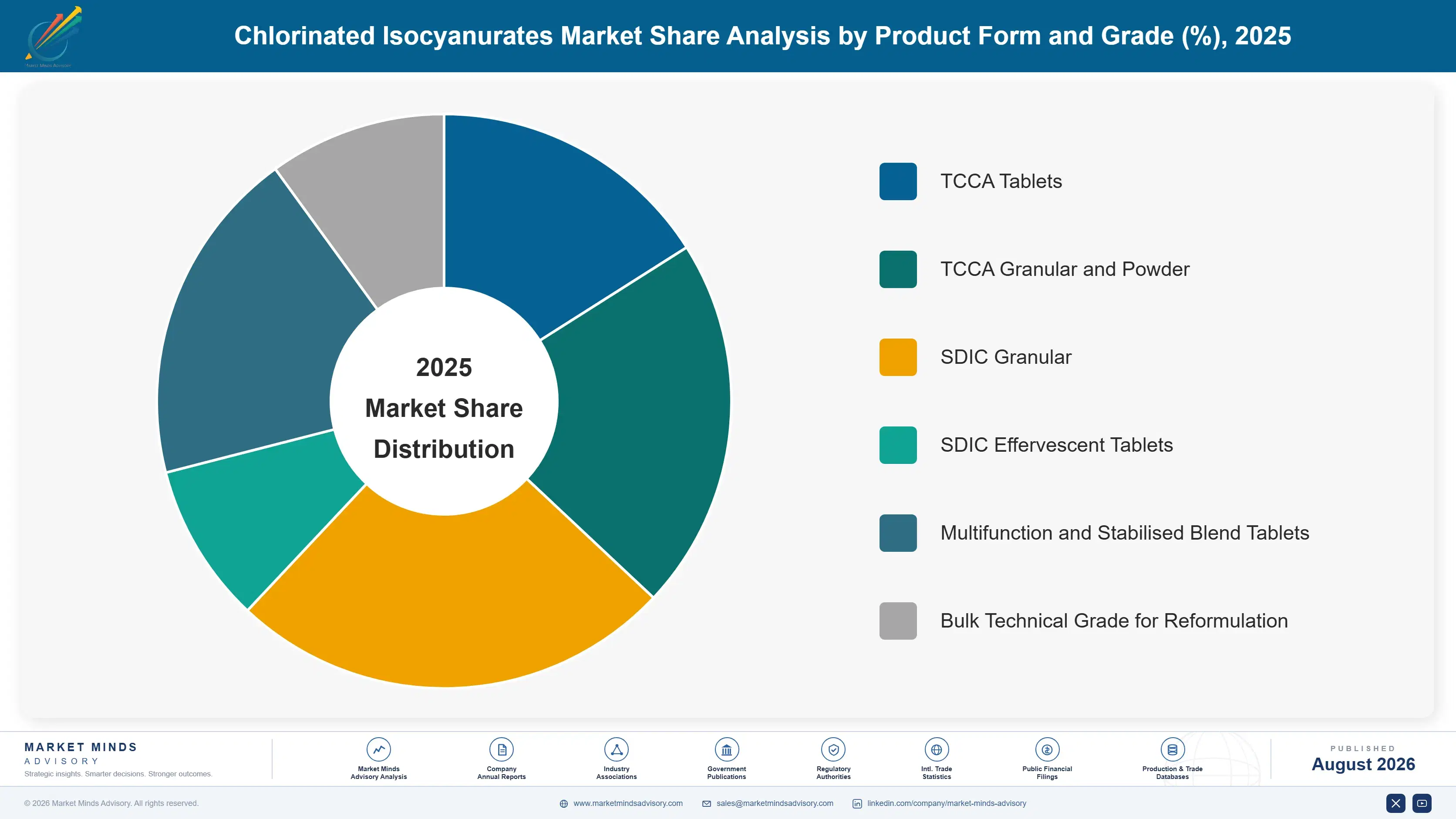
Segmentation follows product form and grade: what the buyer physically receives and how it dissolves, rather than which application it serves or who sells it. Six forms cover the market without overlap, from pressed tablets through to bulk technical material for reformulation. End-use application and distribution channel are treated separately, because both cut across every form.
chlorinated-isocyanurates-market-market-share-analysis-1787676820431

SDIC Effervescent Tablets

An effervescent sodium dichloroisocyanurate tablet dissolves in seconds rather than over days, which makes it the wrong product for a pool and the right one for a bucket of drinking water. Growth at 7.8%, half again the market rate of 5.2%, comes almost entirely from municipal disinfection, emergency response stockpiles and household water treatment in places where the tap is not trusted. Dose accuracy is the selling point: one tablet treats a known volume, which removes the judgement that liquid bleach requires. Manufacturing is more demanding than pressing a pool tablet, since effervescence needs a controlled acid and carbonate system that stays dry through storage. Humidity ruins more product than anything else does.
CAGR 7.8%

Multifunction and Stabilised Blend Tablets

These carry sanitiser plus clarifier, algaecide, scale inhibitor and buffer in one pressed unit, and they exist to escape a price comparison rather than to solve a technical problem. Growth at 6.9% tracks retail rather than professional demand, because pool service technicians prefer to dose each function on its own schedule. Retail pricing runs well above plain sanitiser for a formulation cost premium measured in cents. The commercial risk is credibility: a tablet delivering four functions on one dissolution curve compromises at least three of them, and pool professionals say so publicly. So far homeowners have preferred convenience to that argument. Retail shelf space rewards the simpler story every single time.
CAGR 6.9%
Full segment breakdown across 6 segments available in the complete report.

Regional Architecture and Country Demand Map

Production and consumption sit on opposite sides of the world, which defines almost everything about this market. North America consumes the most through residential pool density. East Asia makes nearly all of it. South Asia grows fastest as municipal utilities convert away from chlorine gas.

North America

American residential pools outnumber those of any other country by a wide margin, and each one consumes chemicals every week of the season. That installed base is what makes this the largest consuming region despite producing almost none of the product. Demand splits between big-box retail selling to homeowners and a professional service channel that buys differently and knows more. Antidumping duties in force since 2005 keep two domestic plants running and hold regional pricing above world levels. Canadian demand is seasonal and small. Mexican consumption is growing in both residential pools and municipal water, sourced largely from Chinese imports without duty exposure. That asymmetry irritates American producers a great deal.
Share: 31% | CAGR: 4.2% (2026 to 2036)

Western Europe

European demand is mature and shrinking in places, held back by pool ownership rates far below American levels and by cooler seasons that shorten the chemical year. Spanish, French and Italian consumption dominates the region for obvious climatic reasons. Ercros in Spain is the only meaningful European producer, and its position depends on proximity and service rather than on cost. Biocidal product regulation is stricter here than anywhere, and registration costs have pushed smaller formulators out of the market entirely. German and Nordic demand runs toward municipal and industrial water rather than leisure, which behaves quite differently on price. Registration cost has done more consolidating than competition ever did here.
Share: 18% | CAGR: 3.4% (2026 to 2036)
Regional intelligence for 5 additional markets available in the complete report: East Asia, South Asia and Pacific, Latin America, Middle East and Africa, Eastern Europe. Contact sales@marketmindsadvisory.com.
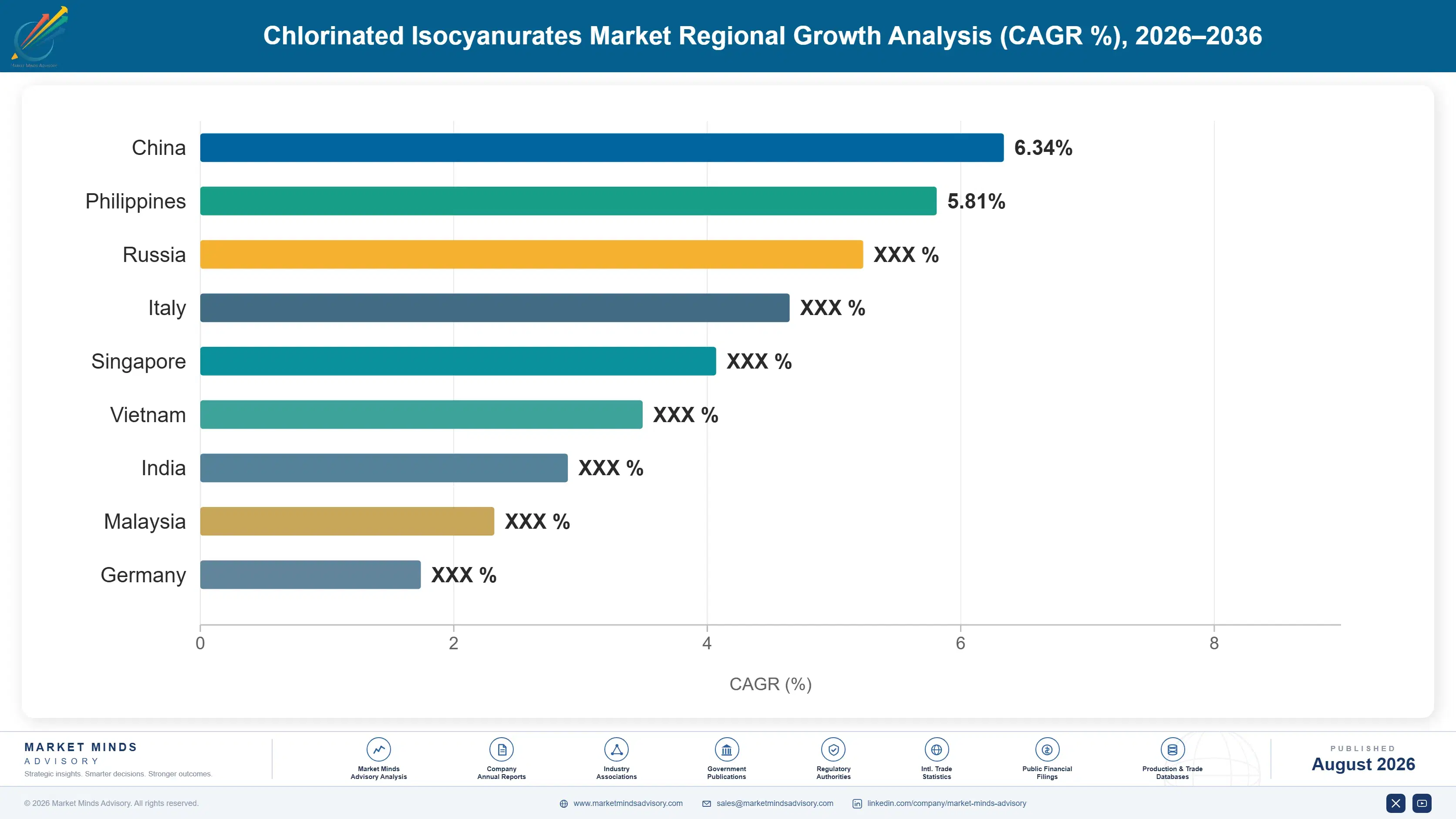
chlorinated-isocyanurates-market-country-cagr-analysis-1787676820982

Escaping The Price Per Kilogram

Available chlorine per kilogram is a number any buyer can compare, and comparison is exactly what destroys margin in this business. Four levers move the sale onto ground where that number stops deciding, and each requires building something the commodity trade never needed: a formulation, a registration, a service relationship or a specification. None is quick to build.

Formulate Multifunction Tablets That Defeat Direct Comparison

Adding clarifier, algaecide and scale inhibitor to a sanitiser tablet costs a formulator a few cents per kilogram and lifts realised price by roughly 46%. The mechanism is not chemistry, it is the removal of a like-for-like comparison: a buyer cannot benchmark a four-function tablet against a plain one on available chlorine. Retail channels prefer them because they simplify the shelf. Pool professionals object on technical grounds and will keep objecting, which limits how far this can extend into the service channel where volumes are steadier. The retail ceiling is real and it is high.
Market Impact: Lifts realised price by roughly 46% per kilogram

Register Municipal Grades Where Utilities Cannot Switch

A municipal utility that has written a specific product into its treatment protocol does not change it casually, because the change requires regulatory notification and operator retraining. Getting registered as an approved drinking water disinfectant takes 18 months and real money in most jurisdictions. What it buys is a position no importer can undercut on price, since the alternative product is not on the approved list. Producers who registered early across African and South Asian markets now hold tender positions that competitors cannot bid against at any price. Registration is the whole barrier here.
Market Impact: Takes 18 months and then blocks every competitor

Sell Cyanuric Acid Testing Into The Service Channel

Stabiliser accumulation at roughly 38 parts per million a year is the technical problem the industry has spent decades avoiding discussing. A producer who raises it first, with testing protocols and a non-stabilised product for the pools that need one, becomes the honest supplier in a category with a credibility problem. Service technicians respond to this because they already know and are tired of explaining it to customers who bought tablets elsewhere. The cost is admitting a limitation competitors will happily ignore for another decade. Honesty is an underused commercial position here.
Market Impact: Addresses the 38 ppm annual stabiliser accumulation problem

Supply Cyanuric Acid To Salt Pool Installations

A salt chlorine generator removes the tablet purchase and does not remove the need for a stabiliser, since the hypochlorite it makes degrades in sunlight exactly like any other. Every salt pool needs cyanuric acid at initial fill and periodic top-up. That is a smaller product opportunity than the tablet it replaces, running perhaps 20% of the chemical value, and it grows with the technology that is displacing the core business. Producers already make cyanuric acid as an intermediate. Selling it as a finished product requires nothing new except a decision.
Market Impact: Recovers roughly 20% of the displaced chemical value

Who Controls the Margin Pool

Measured on nameplate production capacity, the five largest producers hold a CR5 of 44%. That figure understates the geographic concentration entirely: roughly 78% of world capacity sits in China regardless of who owns it. Occidental Chemical and Hebei Jiheng lead from different positions, one protected by trade policy in a high-price market and the other operating at costs nobody outside China can approach.
Three contests run simultaneously and barely overlap. Chinese producers compete with each other on cash cost and increasingly on environmental compliance, which is closing plants faster than price ever did. Western producers compete on trade policy outcomes and on service to the professional pool channel, not on manufacturing economics. Formulators compete on multifunction blends and retail shelf position, buying technical material from whoever is cheapest. Almost nobody competes across two of these, and the ones who try tend to do neither well.

The pressure that matters is not competitive at all. Salt chlorine generation removes the customer rather than taking them, and every new pool installed with one is a permanently lost tablet account. Rankings shift wherever municipal conversion outruns pool substitution, which currently favours producers with registration positions rather than those with capacity.
chlorinated-isocyanurates-market-company-positioning-matrix-1787676821555

Competitive Moat and Risk Dimensions

OCCIDENTAL CHEMICAL

Moat: Protected Domestic Production Position

Occidental operates North American capacity behind antidumping orders that have survived every sunset review since 2005, giving it a domestic supply position importers cannot match on delivered cost or lead time. Professional pool distributors value that reliability during peak season, when a container delayed at a port costs them a month of selling. Trade policy is the moat.
OCCIDENTAL CHEMICAL

Risk: Trade Policy Dependency

A business whose competitive position rests on a duty order is exposed to a decision it does not control. Sunset reviews recur, trade policy shifts, and importers keep finding routes through countries the orders do not cover. The cost gap against Chinese production has widened, so any relief in duty protection would arrive at a plant with no defence.
HEBEI JIHENG CHEMICAL

Moat: Integrated Chlor-Alkali Cost Position

Hebei Jiheng makes its own chlorine and cyanuric acid on the same site, which removes two purchased inputs and the freight between them. Combined with Chinese industrial power tariffs and a plant scaled well beyond Western equivalents, the resulting cash cost is one no importer can match. Integration takes a decade and considerable capital to replicate.
HEBEI JIHENG CHEMICAL

Risk: Trade Barrier Market Exclusion

The lowest cost position in the world is worth little in markets the product cannot enter. Antidumping orders exclude Hebei Jiheng from the largest consuming market on price terms, and other jurisdictions have investigated similar measures. Growth therefore depends on markets with lower prices and thinner margins, and on domestic Chinese demand competing against equally capable neighbours.

Players Tracked

Prominent Players

Occidental Chemical
Hebei Jiheng Chemical
Juancheng Kangtai Chemical
Clearon Corp
Ercros

Other Key Players

Heze Huayi Chemical
Zhucheng Taisheng Chemical
Nankai Chemical
Shikoku Chemicals
Tosoh Corporation
Nippon Soda
Innovative Water Care
Solenis
Westlake Corporation
Shandong Befar Group
Sichuan Golden-Elephant Sincerity Chemical
Puyang Cleanway Chemical
Hebei Xingfei Chemical
Shandong Dongtai Chemical
Weifang Xinlong Biomaterials

Recent Developments

FEBRUARY 2025

Occidental Chemical announces capacity debottlenecking at its isocyanurates plant

Occidental Chemical announced a debottlenecking project at its North American chlorinated isocyanurates facility, an organic capacity investment rather than an acquisition. The company linked the decision to continued antidumping protection and to professional channel demand, noting that domestic supply reliability during peak season carries a premium distributors will pay.
Signal: Capital is being committed on the assumption that duty protection continues, which is a substantial bet on policy.
JUNE 2025

Chinese authorities close smaller isocyanurate plants under environmental enforcement

Provincial environmental authorities in Shandong ordered the closure of several smaller chlorinated isocyanurate production sites failing wastewater and emissions standards. These were regulatory enforcement actions rather than commercial consolidation. Remaining producers absorbed the volume without difficulty, since operating rates across the region had been running well below nameplate capacity.
Signal: Environmental enforcement is consolidating Chinese capacity faster than price competition managed across the whole previous decade.
SEPTEMBER 2025

Ercros secures drinking water disinfectant registrations across additional African markets

Ercros obtained approved drinking water disinfectant registrations in several additional African jurisdictions, a regulatory approval process rather than a partnership or acquisition. Registration places its product on utility approved lists, where competing material cannot be substituted without a separate regulatory submission and operator retraining at each treatment site.
Signal: Registration positions in municipal markets are worth more than cost advantage, because they exclude competitors outright.

What Goes Into A Chlorine Tablet

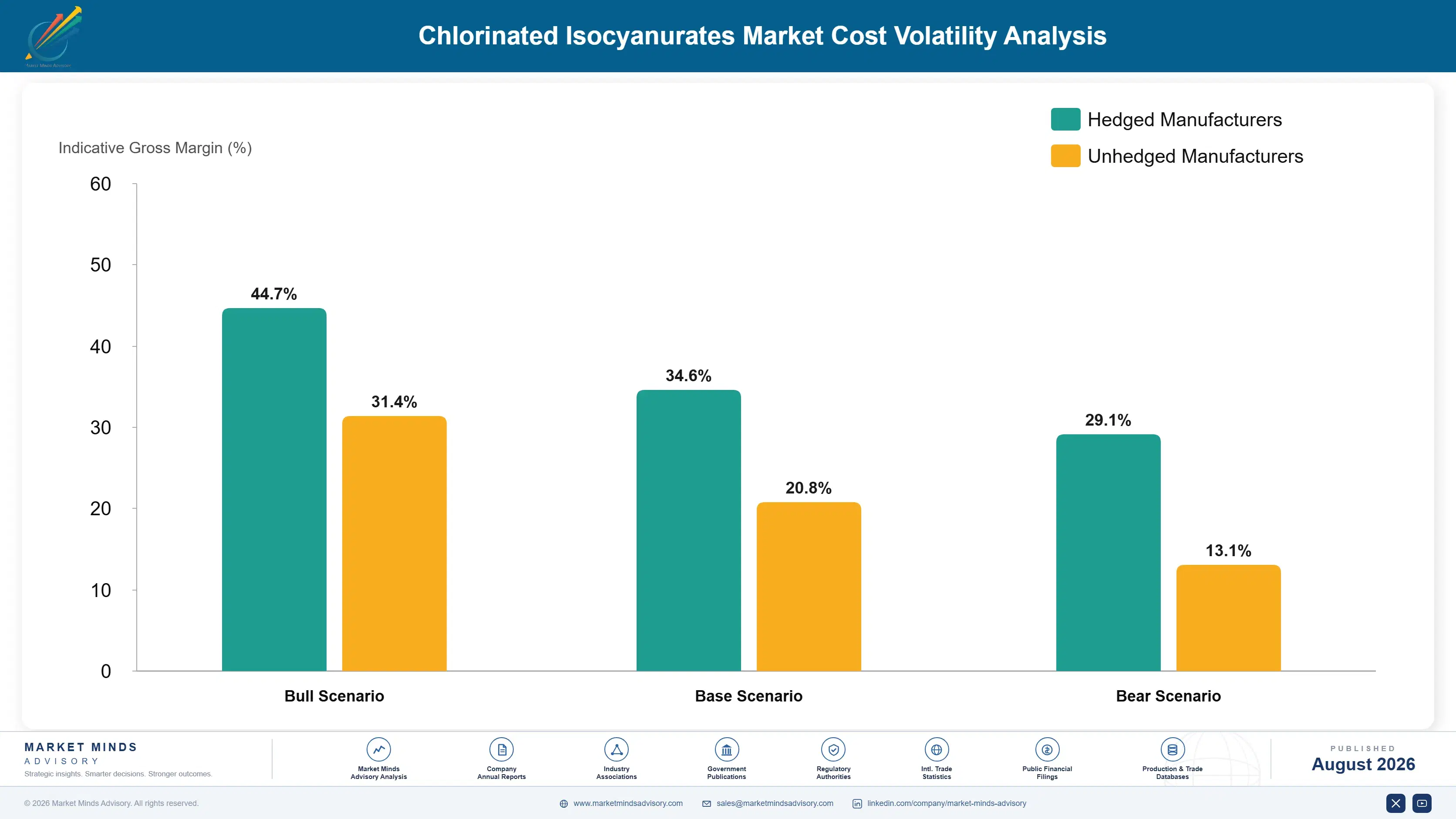
Two inputs dominate. Cyanuric acid and chlorine together account for 61 to 64% of production cost, and both are chlor-alkali derivatives whose pricing follows electricity and salt rather than any specialty market. Chinese producers make both on site. Western plants buy at least one, which is where the cost gap begins. Electricity for the chlor-alkali step adds a further share that varies enormously by location.
The 2022 European energy crisis made this concrete. IEA data on European industrial electricity prices through that period documents increases that pushed chlor-alkali operations across the continent to curtail output, and Ercros disclosed the resulting cost pressure in its annual report for the year. Chinese producers running on regulated industrial tariffs saw none of it and gained share in export markets. The gap that opened has not fully closed since, and European buyers noticed which supply held price.

Exposure follows integration precisely. Producers making chlorine and cyanuric acid on site carry electricity risk and nothing else. Those buying cyanuric acid carry supplier margin plus freight on a bulky intermediate. Formulators pressing tablets from purchased technical material carry everything and control none, which is why they compete on brand and blend rather than on price.
chlorinated-isocyanurates-market-cost-volatility-analysis-1787676821754

Integrate cyanuric acid production onto the chlorination site

Buying cyanuric acid means paying a supplier margin and freight on a low-density intermediate that ships badly. Producers who built both steps on one site removed roughly a fifth of delivered input cost permanently. The capital requirement is substantial and the payback runs over a decade, which is why almost every plant built this way sits in China.

Contract industrial power on multi-year fixed terms

Electricity is the largest variable in chlor-alkali economics and the one most exposed to political events. Producers holding multi-year power contracts through 2022 kept operating while spot-exposed competitors curtailed. The contracts look expensive in calm years, which is exactly why most operations decline them and then discover the reason they existed. That lesson gets relearned regularly.

Move revenue mix toward registered and formulated products

Technical grade material competes on cost per kilogram of available chlorine and nothing insulates it. Registered municipal grades and multifunction retail formulations both price on something other than input cost, which reduces the exposure without changing the plant at all. The barrier is regulatory work and formulation capability, neither of which a commodity producer typically has.

Portfolio Architecture for Margin Defence

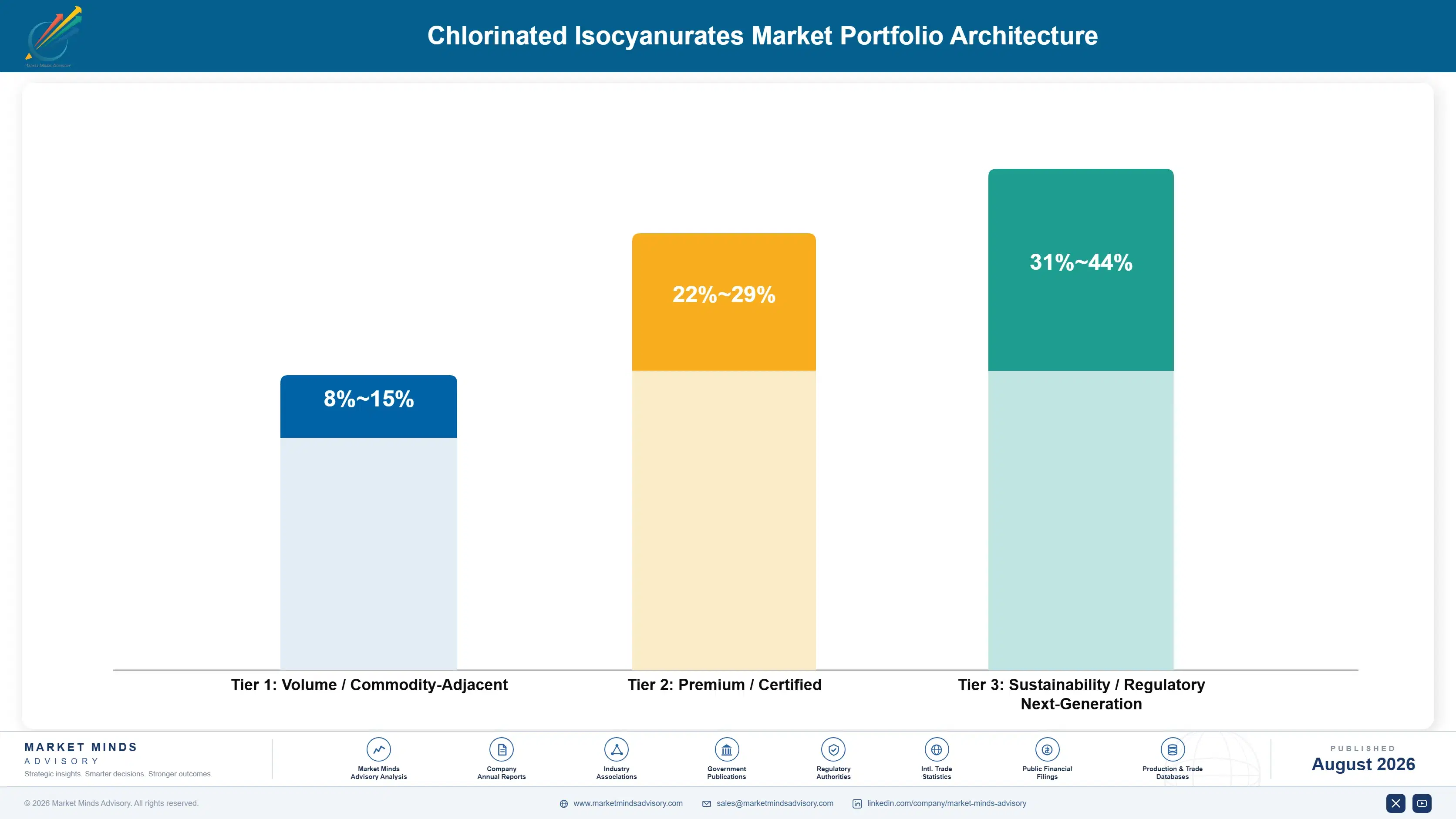
Margin here is decided by what stops a buyer comparing. Technical grade material sold on available chlorine content earns commodity chemical margins and nothing more, because the specification is identical from every producer. A registered municipal grade or a multifunction retail tablet earns two to three times that, and the difference is regulatory position or formulation rather than any change in the chlorine.
The tension is that most producers sell both from the same plant and the same sales team. A trader buying technical material and a municipal utility buying registered product should never be in the same conversation, yet in many organisations they are handled by one commercial function measured on tonnage. Producers who separated the two, running registered and formulated products through a different team with different targets, report materially better realised pricing. Those who did not keep discovering that tonnage targets destroy premium positions.

High-value pools sit in three places. Registered municipal grades, where approval lists exclude competitors entirely. Multifunction retail tablets, where blending defeats price comparison. And effervescent dosing formats, where manufacturing difficulty limits how many producers can supply them at all. None of the three carries the tonnage that technical grade does.

Volume / Commodity-Adjacent

Technical grade trichloroisocyanuric acid and sodium dichloroisocyanurate sold in bulk to traders and formulators. The 7-point range separates integrated Chinese producers from Western plants buying cyanuric acid. Price follows available chlorine content and nothing else influences it.
Gross Margin: 8-15%

Premium / Certified

Registered drinking water disinfectant grades and branded professional pool products sold through service distribution. The 7-point spread separates products on utility approved lists from those competing on brand alone. Registration and channel relationships rather than product performance hold this pricing.
Gross Margin: 22-29%

Sustainability / Regulatory / Next-Generation

Multifunction retail tablets, effervescent dosing formats and cyanuric acid sold to salt pool installations. The 13-point range is unusually wide because multifunction blends price on convenience while effervescent grades price on manufacturing difficulty, and the two mechanisms behave very differently under competitive pressure.
Gross Margin: 31-44%
chlorinated-isocyanurates-market-portfolio-architecture-1787676822274

High-value Sub-segments and Strategic Watch-out

Registered Municipal Disinfectant Grades

Highest value and strong growth, protected by approval lists that exclude unregistered competitors regardless of price. Municipal conversion from chlorine gas drives the volume, and registration takes 18 months to obtain. The risk is procurement practice, since many utilities tender on cost per kilogram rather than on total operating cost.
Gross Margin: 27-30%

Multifunction Retail Pool Tablets

High value with steady growth, earning a large premium for a formulation cost measured in cents. The advantage rests on defeating price comparison rather than on technical merit. Pool professionals object publicly to four functions on one dissolution curve, which caps how far this can extend beyond retail.
Gross Margin: 38-41%

Bulk Technical Grade Material

The volume core, carrying most tonnage shipped and the thinnest margin anywhere in the market. Chinese integrated capacity sets the price and nothing else moves it. Most producers run this line to hold plant utilisation rather than to earn anything, which is rational and entirely unsatisfying.
Gross Margin: 9-12%

Residential Pool Tablet Volume

The strategic watch-out. Residential pools carry most of the market's consumption and face salt chlorine generation taking new installations steadily, which removes customers permanently rather than losing them to a competitor. The risk is capacity committed against demand that substitution is quietly draining away. Nobody models it honestly.
Gross Margin: 19-22%

Why The Season Sets Everything

Pool chemical demand is an annuity with a calendar attached. A pool consumes tablets every week it is open and none of the weeks it is closed, which produces revenue that is entirely predictable in shape and entirely concentrated in half the year. Working capital in this business is a seasonal problem rather than a growth problem, and distributors carry most of it.
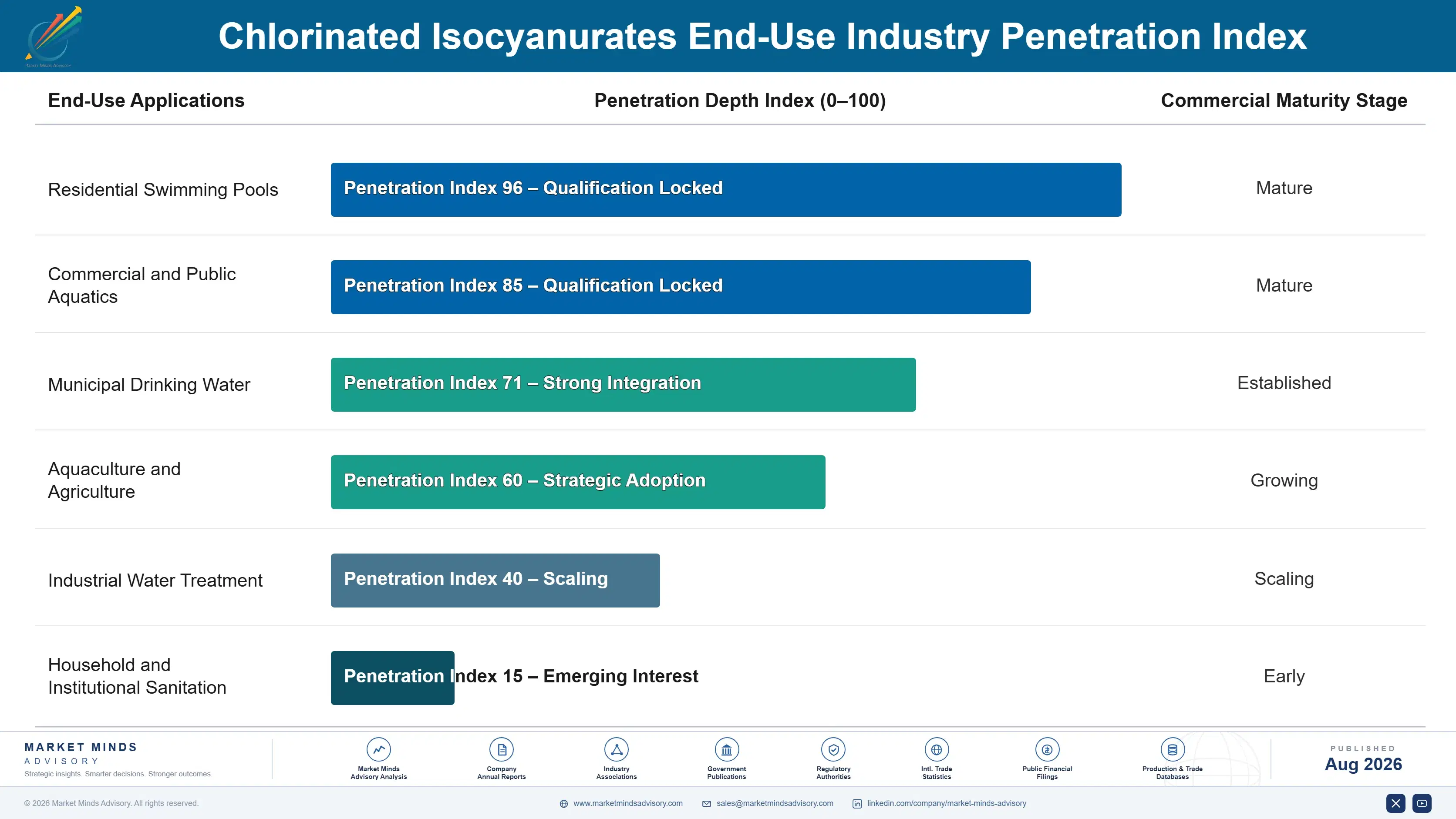
Stickiness varies by who does the buying. A municipal utility with a registered product in its protocol essentially never switches, because the change requires notification and retraining. A pool service company switches when a distributor offers better terms, which happens annually. A homeowner switches whenever the retailer changes what is on the shelf, which is to say constantly. Three different businesses share one production line.

The buyer profile is changing in a way that works against the category. New pool owners are being sold salt chlorine generation at installation, before they ever buy a tablet, which means the tablet habit never forms. Older pools convert more slowly because retrofit needs plumbing work. The effect compounds: each year's new construction cohort arrives outside the market, and nobody notices until the installed base turns over.
chlorinated-isocyanurates-market-end-use-penetration-index-1787676822779

Where The Margin Still Exists

These are among the four positions where our research anticipates prominent divergence between winners and laggards over the coming forecast period. Each is grounded in the demand model, the regulatory perimeter, and the announced capacity pipeline.
01 / REGISTRATION POSITION BUILDING

Register municipal grades before competitors consider it

A drinking water disinfectant registration takes 18 months and real money to obtain, and once a utility writes the product into its treatment protocol the position is not contestable on price by anyone lacking the same approval. Municipal conversion from chlorine gas is running across thousands of small treatment sites in South Asia and Africa, and each conversion is a registration decision rather than a purchasing decision. Producers who registered early hold tender positions that competitors cannot bid against at any price, which is the only genuinely defensible ground here.
02 / SALT POOL HEDGING

Sell cyanuric acid into the technology displacing you

Salt chlorine generators remove the tablet purchase permanently and take roughly 22% of new pool installations, which is a customer loss rather than a competitive one. Every salt pool still needs cyanuric acid as a stabiliser, because electrolytic hypochlorite degrades in sunlight exactly as any other chlorine does. That is a smaller opportunity at roughly 20% of the displaced chemical value, it grows with the technology taking the core business, and producers already make the material as an intermediate anyway.
03 / FORMULATION VALUE CAPTURE

Blend the tablet so nobody can benchmark it

A plain sanitiser tablet competes on available chlorine per kilogram, a number every buyer can compare and every competitor can match. Adding clarifier, algaecide, scale inhibitor and buffer costs cents per kilogram and lifts realised price by roughly 46%, because there is no equivalent product to hold it against. The limitation is credibility with pool professionals, who object to four functions sharing one dissolution curve, so this works in retail and does not travel into the service channel at all.
04 / TRADE POLICY EXPOSURE

Do not build capacity against a duty order

North American production exists because antidumping orders have run since 2005 and survived every sunset review, not because the plants are competitive against integrated Chinese capacity on any cost measure. The underlying gap has widened rather than narrowed, so committing new capital on the assumption that protection continues is a bet on policy dressed up as a bet on demand. Capacity investment in this market belongs where registration positions or formulation capability create the defence, not where a duty schedule does.

Engagement Snapshot From the Field

A live engagement with an industry participant carrying material or product regulatory and market exposure ahead of a defining policy shift, showing how our research translates into a defensible multi-year portfolio strategy.
MARKET MINDS ADVISORY · CLIENT ENGAGEMENT SUMMARY
Chlorinated Isocyanurates Producer Strategic Portfolio Review and Transition Roadmap 2026·Investment Scenario on Chlorinated Isocyanurates Exposure Evaluation 2025-26
CLIENT PROFILE
A European chlorinated isocyanurates producer operating one integrated plant and supplying pool distributors across 22 countries, with chemical revenue reported at 180 million euros (client-reported, unverified by MMA). Roughly 78% of volume moved as technical grade material into formulators and traders. Margins had compressed for four consecutive years against Chinese import pricing, and the plant was operating well below nameplate capacity.
STRATEGIC CHALLENGE
The commercial team was measured on tonnage and had been defending volume with price, which held utilisation and destroyed margin simultaneously. Management believed the answer was cost reduction at the plant. The plant was already efficient by European standards and could not close a gap created by Chinese integration and power costs. Nobody had asked whether the tonnage target was the problem.
MMA APPROACH
MMA rebuilt the profitability picture by customer and product grade rather than by plant, which the company had never done because its accounting stopped at the gate. Eleven expert interviews with municipal utilities and pool distributors established what each channel would actually pay for beyond available chlorine content. The analysis treated the tonnage target, not the cost base, as the variable worth changing.
KEY FINDINGS
  1. Technical grade material at 78% of volume contributed 31% of gross profit, and three trader accounts were being supplied at or below cash cost.
  2. Municipal utilities in seven countries would pay a premium for registered product, and the company held registrations in only two of them.
  3. Pool distributors valued reliable peak-season delivery above price and had been switching to imports only because the company kept discounting to hold trader volume.
  4. Cutting tonnage by 19% and reallocating capacity to registered and formulated grades modelled higher absolute gross profit within two years (client-reported, unverified by MMA).
CLIENT PROFILE
A European chlorinated isocyanurates producer operating one integrated plant and supplying pool distributors across 22 countries, with chemical revenue reported at 180 million euros (client-reported, unverified by MMA). Roughly 78% of volume moved as technical grade material into formulators and traders. Margins had compressed for four consecutive years against Chinese import pricing, and the plant was operating well below nameplate capacity.
STRATEGIC CHALLENGE
The commercial team was measured on tonnage and had been defending volume with price, which held utilisation and destroyed margin simultaneously. Management believed the answer was cost reduction at the plant. The plant was already efficient by European standards and could not close a gap created by Chinese integration and power costs. Nobody had asked whether the tonnage target was the problem.
MMA APPROACH
MMA rebuilt the profitability picture by customer and product grade rather than by plant, which the company had never done because its accounting stopped at the gate. Eleven expert interviews with municipal utilities and pool distributors established what each channel would actually pay for beyond available chlorine content. The analysis treated the tonnage target, not the cost base, as the variable worth changing.
KEY FINDINGS
  1. Technical grade material at 78% of volume contributed 31% of gross profit, and three trader accounts were being supplied at or below cash cost.
  2. Municipal utilities in seven countries would pay a premium for registered product, and the company held registrations in only two of them.
  3. Pool distributors valued reliable peak-season delivery above price and had been switching to imports only because the company kept discounting to hold trader volume.
  4. Cutting tonnage by 19% and reallocating capacity to registered and formulated grades modelled higher absolute gross profit within two years (client-reported, unverified by MMA).
RECOMMENDED STRATEGY
Phase 1: Phase one: exit the three loss-making trader accounts immediately and stop measuring the commercial team on tonnage from that quarter. Phase 2: Phase two: begin drinking water registrations in the five countries where utilities would pay a premium and no registration currently exists. Phase 3: Phase three: build a multifunction tablet line for the professional pool channel, priced against convenience rather than against available chlorine content.
OUTCOME
Tonnage fell 17% in the first year and gross profit rose despite it, which settled the internal argument about the target. Registrations completed in three of the five countries within 20 months and two utility tenders were won at premium pricing (client-reported, unverified by MMA). The multifunction line is in commissioning and the plant now runs at a lower utilisation.

Frequently Asked Questions

Foundational context covering the market sizes, CAGR, scope, country, region and competition that inform every finding below. This section is provided to cover basics and most often pre-purchase conversations, answered from the MMA Primary Research Dataset.

What is the current size of the Chlorinated Isocyanurates Market?

The market was worth 2.6 billion dollars in 2025, covering trichloroisocyanuric acid and sodium dichloroisocyanurate in tablet, granular and technical grades. It reaches 2.7 billion dollars in 2026.

How large will the Chlorinated Isocyanurates Market be by 2036?

MMA forecasts 4.5 billion dollars by 2036, an increase of 1.8 billion dollars over the 2026 base. That represents an expansion multiple of 1.67 times across the forecast period.

What is the CAGR for the Chlorinated Isocyanurates Market 2026 to 2036?

The base case compounds at 5.2% annually. MMA's bull case reaches 6.4% if municipal conversion accelerates across African and South Asian utilities, while the bear case sits at 4.0% on faster salt generator adoption.

Which segment is growing fastest?

SDIC effervescent tablets, at 7.8%, half again the market rate of 5.2%. Municipal drinking water disinfection and household water treatment drive the volume, not swimming pools.

Who are the major companies in the Chlorinated Isocyanurates Market?

Occidental Chemical, Hebei Jiheng Chemical, Juancheng Kangtai Chemical, Clearon Corp and Ercros lead on nameplate production capacity. Heze Huayi, Zhucheng Taisheng, Nankai Chemical, Shikoku Chemicals and Tosoh compete strongly in specific grades.

Which country is growing fastest?

India at 8.4%, driven by municipal utilities converting from chlorine gas to tablet dosing across thousands of small treatment sites. Vietnam and Indonesia follow on aquaculture demand.

Report Segmentation Architecture

The full report scope spans multiple orthogonal segmentation dimensions, with cross-tabulated demand data provided for each dimension pair. Coverage extends further to regional breakdowns, trend trajectories, and the competitive detail needed to support segment-level decision-making.

By Product Form and Grade

  • TCCA Tablets
  • TCCA Granular and Powder
  • SDIC Granular
  • SDIC Effervescent Tablets
  • Multifunction and Stabilised Blend Tablets
  • Bulk Technical Grade for Reformulation

By End-Use Industry

  • Residential Swimming Pools
  • Commercial and Public Aquatics
  • Municipal Drinking Water
  • Aquaculture and Agriculture
  • Industrial Water Treatment
  • Household and Institutional Sanitation

By Commercial Dimension

  • Direct Producer Supply
  • Chemical Trader and Distributor
  • Retail and Big-Box Channel
  • Pool Service Professional Channel
  • Municipal Tender Supply
  • Private Label Formulation

By Region

  • North America
  • Western Europe
  • East Asia
  • South Asia and Pacific
  • Latin America
  • Middle East and Africa
  • Eastern Europe

Scope, Methodology, and Coverage

Every figure in this report is reproducible from documented input assumptions. The scope below maps the historical period, the forecast horizon, the segmentation dimensions, and the countries covered, alongside the underlying primary and qualitative methodology.
Historical Period
2020 to 2025
Forecast Period
2026 to 2036
Base Year
2025 (USD billions; MMA Primary Research Dataset, August 2026)
Market Definition
Scope covers chlorinated isocyanurate chlorine donors, comprising trichloroisocyanuric acid and sodium dichloroisocyanurate supplied as pressed tablets, granules, powder, effervescent dosing formats and bulk technical material, together with multifunction formulations built on those actives. Cyanuric acid sold as a standalone stabiliser, calcium hypochlorite, sodium hypochlorite and salt chlorine generation equipment are excluded. Pool servicing, water treatment engineering, dosing hardware and packaging fall outside the boundary.
Quantitative Units
USD billions (current prices); tonnes of product; tonnes of available chlorine; nameplate capacity; capacity utilisation rate
Segmentation Dimensions
By Product Form and Grade; By End-Use Industry; By Commercial Dimension; By Region
Regions Covered
North America, Western Europe, East Asia, South Asia and Pacific, Latin America, Middle East and Africa, Eastern Europe
Countries Covered
USA, China, Germany, France, UK, Japan, South Korea, India, Brazil, Mexico, Italy, Spain, Poland, Saudi Arabia, South Africa
Key Companies Profiled
Occidental Chemical, Hebei Jiheng Chemical, Juancheng Kangtai Chemical, Clearon Corp, Ercros, Heze Huayi Chemical, Zhucheng Taisheng Chemical, Nankai Chemical, Shikoku Chemicals, Tosoh Corporation, Nippon Soda, Innovative Water Care, Solenis, Westlake Corporation, Shandong Befar Group, Sichuan Golden-Elephant Sincerity Chemical, Puyang Cleanway Chemical, Hebei Xingfei Chemical, Shandong Dongtai Chemical, Weifang Xinlong Biomaterials
Quantitative Methodology
Primary survey, n=3,800 respondents, Q4 2025, six countries; demand-side model with trade association cross-validation
Qualitative Methodology
47 expert interviews, Q4 2025; applied to validate demand model assumptions, identify emerging dynamics, and assess competitive positioning
Report Format
PDF and XLSX data workbook (Word format preview document)
Publisher
Market Minds Advisory
Report Code
MMA-2026-CHM-158
Published
August 2026
Contact
sales@marketmindsadvisory.com | www.marketmindsadvisory.com

Purchase the full Chlorinated Isocyanurates Market Report (2026 to 2036).

The full report runs to 185 pages and covers all six product form segments, seven regions and 20 profiled companies in detail. It includes the complete segment CAGR set, regional consumption and capacity data, and trade flow analysis across the principal export routes. Company profiles carry evaluation on nameplate production capacity, with moat and risk assessment for the top five producers. The competitive section extends to 15 tracked corporate developments across 2024 and 2025, each with commercial interpretation. Primary research inputs include a quantitative survey of 3,800 respondents and 47 expert interviews conducted in Q4 2025.
Six product form segments with individual CAGR forecasts
Seven regional markets with consumption and capacity data
Twenty company profiles on consistent capacity evaluation basis
Fifteen tracked corporate developments with commercial interpretation notes
Trade flow analysis across principal global export routes
Antidumping duty exposure mapping by producer and market

Built For The People Who Decide

From boardroom strategy to bench-side execution, this report is read cover-to-cover by leaders shaping the next decade of their industry, turning demand scenarios, market dynamics and valuation benchmarks into decisions.
CXOs/ Presidents/ VPs/ Managers
M&A and Corporate Development
Strategy Teams and R&D Heads
Procurement and Product Directors
Regulatory and Compliance Leaders
Investor Relations and Equity Analysts