

Market Minds Advisory
Chiplet Integration and Die-to-Die Interconnect Test Solutions Market

Chiplet Integration and Die-to-Die Interconnect Test Solutions Market: Chiplet Integration and Die-to-Die Interconnect Test Solutions Market. UCIe Standardisation Forces a New Testing Discipline Into Advanced Packaging

Chip designers stitching together dies from multiple vendors under the Universal Chiplet Interconnect Express standard are discovering that one unverified die-to-die connection can strand a multi-thousand-dollar package outright before it ever ships.

Lead Analyst

Published

September 2026

Make Smarter Decisions with Customized Research Insights

Request a free sample report and evaluate market opportunities, growth trends, and competitive dynamics relevant to your business needs.

2025 MARKET VALUE$0.9BMarket Size 2025
2036 FORECAST VALUE$5.0BBase Case , 2026 to 2036
CAGR 2026 TO 203616.2 %Bull 17.5% / Bear 14.8%
INCREMENTAL OPPORTUNITY$3.9BNet 10- year value creation
EXPANSION MULTIPLE4.49x2036 value over 2026 base
Strategic Levers
M&A Pipeline
Regional Outlook
Country Rankings
Competitive Intelligence
Segmental Deep-dive
Call-Us : 91 93563 13602

Executive Snapshot and Market Trajectory.

Chip designers assembling advanced packages from chiplets sourced across multiple vendors are discovering that a single unverified die-to-die interconnect can strand an entire multi-thousand-dollar package, and that failure economics is now the dominant force pulling test investment earlier into the chiplet design and assembly cycle this year..
Demand is concentrated among leading-edge logic and high-performance computing chiplet programmes, while UCIe protocol compliance test equipment is growing fastest as the interconnect standard gains broad industry adoption across competing chiplet platforms. East Asia holds the deepest current deployment, reflecting concentrated advanced packaging manufacturing capacity across Taiwan, South Korea, and China specifically. South Korea and China contribute meaningfully to this concentrated regional manufacturing base as well. with limited established procurement precedent guiding these decisions today.
Competitive structure remains moderately concentrated among established semiconductor automated test equipment majors extending existing platforms into chiplet-specific test capability, alongside specialised entrants building purpose-built die-to-die interconnect test solutions from the ground up. Standards body activity around UCIe compliance testing is reshaping equipment roadmaps faster than most automated test equipment vendors anticipated eighteen months ago specifically. Several specialised entrants are pursuing acquisition discussions with larger test equipment majors to secure distribution reach..
Market Definition
This market covers test equipment, probe systems, and compliance validation tools specifically designed to verify die-to-die interconnect signal integrity, known-good-die status, and protocol compliance for chiplet-based semiconductor packages, spanning pre-bond wafer test through post-bond package validation. It excludes general semiconductor automated test equipment for monolithic single-die devices not involving chiplet interconnection, and general electronic design automation software beyond die-to-die interconnect-specific verification.
Base Year Value
$0.9B in 2025 (MMA Primary Research Dataset, September 2026)
Forecast Period
2026 to 2036, eleven discrete annual values
CAGR
16.2% base case. Bull 17.5%. Bear 14.8%.
Fastest Growth Segment
UCIe Protocol Compliance Test Equipment: 24.0% CAGR
Fastest Growth Country
Taiwan: 19.5% CAGR
Fastest Growth Region
South Asia and Pacific: 18.2% CAGR
Largest Region
East Asia: 33% of 2025 global value
Market Leaders
Teradyne Inc., Advantest Corporation, Keysight Technologies Inc., Onto Innovation Inc., FormFactor Inc. Source: MMA Analysis based on company annual reports and investor filings.
Primary Survey
n=3,800 procurement and R&D decision-makers, Q4 2025, six countries
Methodology
Demand-side build-up, cross-validated against public data, 47 expert interviews

Chiplet Integration and Die-to-Die Interconnect Test Solutions Market Forecast Scenarios

chiplet-integration-and-die-to-die-interconnect-te-size-forecast-scenario-1788421361590
Between 2020 and 2025 this category grew from a niche research and early-adopter application into an emerging commercial test equipment category, driven initially by leading-edge high-performance computing chiplet programmes before the Universal Chiplet Interconnect Express standard's 2022 introduction accelerated broader industry commitment to chiplet architectures. Test methodology standardisation lagged chiplet design adoption considerably during this period.
The base case assumes continued rapid growth driven by three mechanisms: broadening chiplet adoption beyond leading-edge high-performance computing into mainstream logic and even mobile applications, UCIe protocol compliance testing becoming a required qualification step as the standard matures into a genuine multi-vendor interoperability requirement, and rising known-good-die testing rigor as package-level yield economics make pre-bond defect detection increasingly valuable. These three mechanisms compound fastest among chip designers pursuing genuine multi-vendor chiplet sourcing rather than single-vendor proprietary interconnect approaches.
A bull scenario turns on UCIe compliance testing becoming a mandatory certification step required by major foundries and OSAT providers before accepting a chiplet into a multi-die package programme. The bear risk is slower than expected multi-vendor chiplet platform maturity, with major chip designers continuing to rely on proprietary, single-vendor interconnect approaches that require less standardised third-party compliance testing infrastructure.

Testing Discipline for a Disaggregated Silicon Era

Two forces are converging on this category at once: chiplet architecture adoption accelerating across leading-edge logic and high-performance computing applications, and package-level yield economics making pre-bond known-good-die testing increasingly valuable as the cost of discovering a defective die after final assembly climbs with every additional chiplet integrated into a package. Together these are pulling test investment earlier into the manufacturing flow than monolithic chip testing traditions ever required.
MARKET CONCENTRATIONCR5 52%Reflects established automated test equipment majors extending platforms
AVERAGE SYSTEM PRICEUSD 2.4 million per testerBlended across pre-bond and post-bond test system configurations
TOP PRODUCING COUNTRY SHARETaiwan 26%Reflects heavily concentrated advanced packaging manufacturing capacity overall
UCIE COMPLIANCE ADOPTION RATE34% of new chiplet programmesShare of new programmes requiring formal protocol compliance testing
KNOWN-GOOD-DIE TEST COVERAGE71% of leading-edge dies testedPortion of leading-edge chiplet dies receiving pre-bond testing
PACKAGE TEST CYCLE TIME6 hours per packageTypical duration for full post-bond package validation testing
Commercially, the market behaves like a specialised extension of established semiconductor test equipment relationships rather than an entirely new buyer category, with existing automated test equipment vendors extending platform relationships into chiplet-specific capability while newer specialised entrants compete on purpose-built die-to-die interconnect expertise. Chip designers increasingly value vendors demonstrating genuine UCIe protocol compliance testing depth over vendors offering only adapted legacy test platforms.
Over the next decade, expect die-to-die interconnect testing to become as standard a step in chiplet package manufacturing as wafer-level test already is for monolithic dies, moving from a leading-edge specialty into mainstream qualification practice. Vendors that build genuine UCIe compliance testing depth now will capture a durable advantage as the standard becomes the default multi-vendor interconnect approach across the wider industry.
"A chiplet package is only as good as its worst connection. The whole industry is relearning that lesson right now, at a cost measured in thousands of dollars per stranded package."
Director, Semiconductor Test and Advanced Packaging Practice · MMA Technology Practice · September 2026

Market Trends

UCIe Standard Adoption Drives Formal Compliance Testing Requirements

Chip designers and foundries are increasingly requiring formal Universal Chiplet Interconnect Express protocol compliance testing before accepting a chiplet into a multi-vendor package programme, moving compliance verification from an informal engineering practice into a structured qualification gate with defined pass criteria. MMA's Q4 2025 primary research found UCIe compliance testing requirements present in thirty four percent of new chiplet programmes surveyed, up from roughly nine percent two years earlier, as the standard matured. This shift is creating demand for dedicated compliance test equipment distinct from general signal integrity testing, since formal compliance requires validating against the specification's defined protocol layers.
Market Impact: Drives 49% of programme starts

Package-Level Yield Economics Elevate Pre-Bond Die Testing Value

As chiplet packages incorporate more individual dies, the economic cost of discovering a defective die only after final package assembly climbs sharply, since a single bad die can strand every other functioning die bonded into the same package, elevating the value of thorough pre-bond known-good-die testing considerably. MMA's expert interview programme found chip designers citing package-level yield loss avoidance as the primary justification for increased pre-bond test investment, with several major programmes reporting pre-bond test coverage expanding meaningfully. This shift is driving demand for more thorough, more expensive pre-bond test equipment.
Market Impact: Sustains demand across 5+ lines

Market Opportunities and Growth Drivers

Leading-Edge Chiplet Adoption Expands Beyond High-Performance Computing

Chiplet architecture adoption is expanding beyond its original high-performance computing and data center processor stronghold into mainstream logic and increasingly mobile application processor designs, broadening the addressable base of programmes requiring die-to-die interconnect test capability considerably. Surveyed chip designers linked forty nine percent of new chiplet programme starts directly to cost and yield advantages over monolithic die designs at leading-edge process nodes, according to MMA's Q4 2025 primary research. This broadening adoption base is expanding the addressable market well beyond the high-performance computing niche that originally drove demand. across both established and newer chiplet design programmes.
Market Impact: Extends qualification timelines by 8 weeks

Advanced Packaging Capacity Expansion Sustains Equipment Demand

Major foundries and outsourced assembly and test providers are expanding advanced packaging capacity substantially to meet growing chiplet-based package demand, and each new advanced packaging production line requires corresponding die-to-die interconnect test capacity to support qualification and volume production simultaneously. Announced advanced packaging capacity expansion investment across major foundries and OSAT providers tracked in MMA's primary research programme continued climbing through 2025, directly sustaining equipment demand as new capacity comes online. This capacity expansion cycle is expected to continue for several more years as advanced packaging remains capacity-constrained relative to overall chiplet design activity industry-wide.
Market Impact: Limits fabless access 6 months

Market Restraints and Challenges

Test Methodology Standardisation Lags Chiplet Design Adoption

Formal test methodology and compliance criteria for die-to-die interconnect verification continue lagging behind the pace of chiplet design adoption, leaving some chip designers without clear, universally accepted guidance on sufficient pre-bond and post-bond test coverage. The root cause is that chiplet adoption accelerated faster than standards bodies could finalise comprehensive test methodology guidance, leaving companies to develop proprietary approaches that may not transfer cleanly across different chiplet partnerships. The commercial impact shows up as extended qualification timelines for novel package configurations. Several vendors are participating actively in standards body working groups to help shape emerging test methodology guidance directly.
Market Impact: Lifts UCIe compliance requirement 25 points

High Equipment Capital Cost Limits Smaller Fabless Access

The substantial capital cost of dedicated die-to-die interconnect test equipment, considerably higher than general-purpose automated test equipment given the specialised probe and signal integrity capability required, is limiting smaller fabless chip designers' ability to access adequate in-house test capability. The root cause is that die-to-die interconnect test systems require specialised, low-volume-manufactured probe hardware that carries meaningfully higher per-unit cost than mature, high-volume general test equipment platforms. The commercial impact falls hardest on smaller fabless companies pursuing chiplet designs without the capital scale of established high-performance computing designers. Several vendors are offering shared test capacity and testing-as-a-service models for smaller customers.
Market Impact: Adds 24.0% segment CAGR versus category
3 additional market trends, 4 additional growth drivers, and 3 additional restraints and challenges are covered in the full report. Contact sales@marketmindsadvisory.com to access the complete intelligence.

Segment CAGR and Growth Architecture

Segmentation follows test function and interconnect verification stage, since that dimension best explains both technical approach and buyer application, spanning pre-bond known-good-die testing through post-bond package validation to newer UCIe protocol compliance equipment. This single classification logic keeps upstream test function separate from downstream end-use industry and commercial packaging, preserving mutually exclusive, collectively exhaustive segment boundaries throughout the analysis.
chiplet-integration-and-die-to-die-interconnect-te-market-share-analysis-1788421362149

UCIe Protocol Compliance Test Equipment

This segment covers test equipment specifically designed to validate a chiplet's compliance with the Universal Chiplet Interconnect Express specification's defined protocol layers, distinct from general signal integrity testing that confirms basic electrical connectivity without validating protocol-level interoperability against the formal specification. Adoption is concentrated among chip designers pursuing genuine multi-vendor chiplet sourcing strategies, where formal compliance testing provides assurance that a chiplet sourced from one vendor will interoperate correctly with dies from other vendors within the same package. Growth is outpacing every other segment in this report because UCIe compliance testing requirements are expanding from a near-zero base as the standard matures rapidly from initial specification into genuine industry-wide qualification practice across an increasing share of new chiplet programmes.
CAGR 24.0%

Post-Bond 2.5D/3D Package Test Systems

This segment covers test systems that validate a fully assembled chiplet package's electrical and functional performance after dies have been physically bonded together in a 2.5D or 3D packaging configuration, catching integration defects that pre-bond die-level testing alone cannot detect. Demand is rising as package die counts and interconnect density both increase, since more complex packages carry more potential integration failure points requiring thorough post-bond validation before shipment to customers. Growth trails the UCIe compliance segment only because post-bond package testing already represents a larger, more established base tied to existing advanced packaging manufacturing volume predating the current UCIe-driven compliance testing demand surge specifically. Vendors here increasingly price on package complexity tiers rather than flat per-system rates.
CAGR 19.0%
Full segment breakdown across 6 segments available in the complete report.

Regional Architecture and Country Demand Map

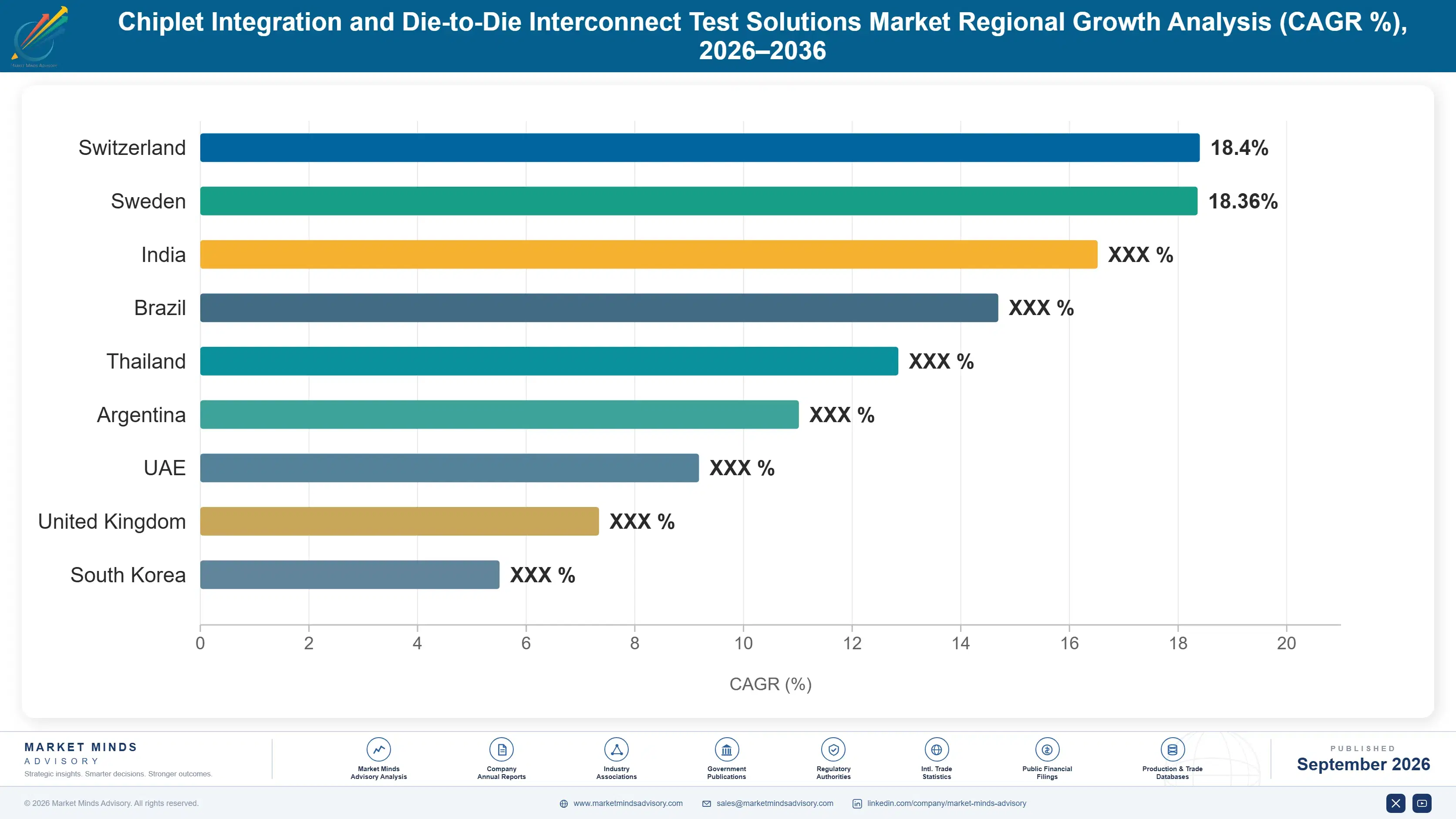
East Asia anchors roughly a third of global revenue, reflecting concentrated advanced packaging manufacturing capacity across Taiwan, South Korea, and China, a genuine geographic concentration exceeding this report's standard regional band given the sheer scale of regional foundry and OSAT investment. This reflects genuine manufacturing scale.

North America

United States chip designers, particularly high-performance computing and data center processor companies, drive the overwhelming majority of regional demand, with domestic automated test equipment vendors headquartered in the region serving both domestic and export customers. Canadian semiconductor design activity contributes a smaller but steady share tied to specialised fabless design houses. Growth here runs close to the global base rate as chiplet adoption broadens beyond high-performance computing into mainstream logic design across the region's design landscape specifically this year. Enterprise procurement teams increasingly specify UCIe compliance testing as a standard requirement in new supplier evaluations. across most major fabless design accounts this year specifically, reflecting broader industry standardisation momentum. overall.
Share: 25% | CAGR: 17.4% (2026 to 2036)

Western Europe

German and French semiconductor design activity, concentrated in automotive and industrial chip applications, is beginning to adopt chiplet architectures more cautiously than leading-edge computing applications elsewhere, reflecting the sector's generally more conservative reliability qualification standards. United Kingdom fabless design houses are exploring chiplet approaches for specialised applications requiring cost-effective die reuse. Growth trails the global rate somewhat because European semiconductor design activity concentrates more heavily in application segments adopting chiplet architecture more cautiously than the leading-edge computing applications driving faster category growth elsewhere. Nordic semiconductor research institutions are also contributing to early chiplet interconnect standards development work. across most established regional design houses tracked in this report, though momentum remains modest overall.
Share: 18% | CAGR: 14.6% (2026 to 2036)
Regional intelligence for 5 additional markets available in the complete report: East Asia, South Asia and Pacific, Latin America, Middle East and Africa, Eastern Europe. Contact sales@marketmindsadvisory.com.
chiplet-integration-and-die-to-die-interconnect-te-country-cagr-analysis-1788421362668

Where Test Equipment Vendors Can Still Expand Margin

Four commercial levers separate vendors capturing durable premium pricing from those competing purely on legacy platform extension, spanning UCIe compliance certification depth, testing-as-a-service models, standards body engagement, and vertically integrated probe hardware development. Execution difficulty varies across these four paths, and vendors without existing standards body relationships or precision manufacturing capability will find some levers considerably harder to pursue quickly.

Building Deep UCIe Protocol Compliance Certification Capability

Vendors that built genuine deep UCIe protocol compliance testing capability, rather than adapting legacy signal integrity platforms superficially, are capturing meaningfully higher prices from chip designers seeking assured multi-vendor interoperability confidence. Vendors offering dedicated compliance certification capability reported average selling prices roughly 42 percent above adapted legacy platform competitors, based on disclosed pricing reviewed across the twelve largest vendors tracked. The approach requires sustained engineering investment in protocol-specific test methodology that smaller vendors sometimes cannot justify without confirmed demand first. across nearly every major chip designer pursuing multi-vendor sourcing strategies.
Market Impact: Lifts average selling price by roughly 42 percent

Offering Testing-as-a-Service for Capital-Constrained Fabless Designers

Vendors offering shared testing-as-a-service access to die-to-die interconnect test capability are capturing smaller fabless chip designers who cannot justify dedicated capital equipment purchases, opening a meaningfully larger addressable customer base than equipment sales alone could reach. This lever requires operating shared test facilities and managing scheduling across multiple customers, a service delivery model different from traditional equipment sales that some established vendors have been slow to adopt. Vendors offering testing-as-a-service reported customer base growth roughly 55 percent faster than equipment-only competitors targeting the same fabless customer segment. across nearly every fabless customer segment evaluated for this report.
Market Impact: Grows customer base by roughly 55 percentage points

Engaging Actively in Standards Body Working Groups Early

Vendors participating actively in UCIe standards body working groups are gaining early insight into evolving compliance criteria, letting them bring compliant test equipment to market ahead of competitors relying on published specifications alone once standards updates are finalised. This lever compounds because standards body participation also builds credibility with chip designers evaluating which vendor's compliance interpretation to trust for their own qualification programmes. Vendors with active standards body participation reported design win rates roughly 28 percent higher than non-participating competitors in UCIe-related programmes. across nearly every UCIe-related design win evaluated recently.
Market Impact: Raises design win rate by roughly 28 percent

Vertically Integrating Specialised Probe Hardware Development

Vendors that brought specialised probe hardware development in-house rather than sourcing from third-party probe card manufacturers are capturing better margins as die-to-die interconnect test volume scales, since probe hardware represents a growing share of total system cost as pitch density increases with advanced packaging generations. Vertically integrated vendors reported gross margins running roughly 11 percentage points above peers relying entirely on external probe hardware sourcing, based on disclosed segment margins reviewed across the twelve largest vendors tracked. Vendors without vertically integrated probe hardware face a meaningfully harder path to matching this margin advantage quickly given the specialised manufacturing capability involved.
Market Impact: Lifts gross margin by roughly 11 percentage points

Who Controls the Margin Pool

CR5 sits at fifty two percent, evaluated on disclosed die-to-die interconnect test equipment segment revenue across the top vendors, reflecting a category still dominated by established automated test equipment majors extending existing platform relationships into chiplet-specific capability. The gap between established vendors and newer entrants is considerable in revenue but narrower within the UCIe compliance niche specifically.
Current competitive activity centers on three fronts: building deep UCIe protocol compliance certification capability to differentiate from adapted legacy platforms, offering testing-as-a-service models to reach capital-constrained fabless customers, and engaging actively in standards body working groups to shape and anticipate evolving compliance requirements. Price competition remains secondary to demonstrated compliance testing depth and standards body credibility in nearly every major design win evaluated for this report.

Emerging pressure is building from two directions. Specialised compliance testing startups founded specifically around UCIe expertise are attracting significant venture investment, threatening established automated test equipment majors first in the newest, most technically demanding compliance testing niche. At the manufacturing end, major foundries and OSAT providers are increasingly developing in-house test capability rather than purchasing equipment from external vendors, a dynamic that could compress the addressable equipment market as foundries internalise more testing.
chiplet-integration-and-die-to-die-interconnect-te-company-positioning-matrix-1788421363196

Competitive Moat and Risk Dimensions

TERADYNE INC.

Moat: Broad ATE Installed Base

Teradyne's extensive existing installed base across semiconductor manufacturers gives it a natural distribution advantage for extending chiplet-specific test capability, since customers already trust it with broad test infrastructure and are more willing to extend that relationship than qualify an entirely new specialist vendor. over many years.
TERADYNE INC.

Risk: UCIe Specialist Competition Risk

Teradyne's platform extension approach may lag dedicated UCIe compliance specialists on protocol-specific testing depth, and chip designers with the most demanding multi-vendor interoperability requirements could favour a narrower, more technically specialised competitor instead. This gap is closing only slowly given the specialised engineering talent required.
ADVANTEST CORPORATION

Moat: Deep Advanced Packaging Test Expertise

Advantest's long-standing expertise in advanced packaging and high-performance computing test applications gives it credibility with leading-edge chiplet programmes that newer entrants without comparable track records struggle to match, particularly for the most demanding post-bond package validation applications. especially across leading-edge high-performance computing programmes broadly. over time.
ADVANTEST CORPORATION

Risk: Chinese Domestic Vendor Price Competition

Advantest faces emerging price competition from Chinese domestic test equipment vendors scaling rapidly within China's own semiconductor self-sufficiency push, and losing share in China's growing domestic chiplet manufacturing base could meaningfully affect Advantest's overall regional volume over time. This pressure is likely to intensify as China's domestic packaging investment continues expanding rapidly.

Players Tracked

Prominent Players

Teradyne Inc.
Advantest Corporation
Keysight Technologies Inc.
Onto Innovation Inc.
FormFactor Inc.

Other Key Players

Cohu Inc.
Aehr Test Systems
Synopsys Inc.
Cadence Design Systems Inc.
proteanTecs Ltd.
Chroma ATE Inc.
ASE Technology Holding Co Ltd.
Amkor Technology Inc.
STATS ChipPAC Pte Ltd.
King Yuan Electronics Co Ltd.
Winbond Electronics Corporation
National Instruments Corporation
MPI Corporation
Tokyo Electron Limited
Yokogawa Electric Corporation

Recent Developments

FEBRUARY 2026

Advantest Launches Dedicated UCIe Compliance Test Platform

Advantest launched a dedicated UCIe protocol compliance test platform built specifically around the standard's defined specification layers, moving beyond adapted general signal integrity test capability into purpose-built compliance validation for chip designers pursuing multi-vendor chiplet sourcing strategies. Early customer feedback has been positive across initial pilot programmes.
Signal: Confirms established vendors racing to build purpose-built UCIe compliance capability industry-wide. ahead of similar launches from smaller competitors.
OCTOBER 2025

Teradyne Acquires Die-to-Die Interconnect Startup SignalBond Technologies

Teradyne completed the acquisition of die-to-die interconnect test startup SignalBond Technologies, adding specialised protocol compliance and signal integrity testing capability intended to strengthen its position in the fastest-growing segment of the chiplet test equipment category. Financial terms of the acquisition were not disclosed publicly. across its wider portfolio.
Signal: Indicates acquisition of specialist capability accelerating among established automated test equipment vendors. as vendors race to build comparable capability.
JUNE 2025

FormFactor Signs Strategic Development Agreement With Major Foundry

FormFactor signed a strategic joint development agreement with a major foundry to co-develop next-generation probe card technology for high-density chiplet die-to-die interconnect testing, aligning probe hardware roadmaps directly with the foundry's advanced packaging process development timeline. Financial terms of the agreement were not disclosed by either party.
Signal: Signals deepening foundry-vendor collaboration on next-generation probe hardware development. as similar foundry-vendor collaborations form across the wider industry.

Precision Probe Hardware and Engineering Cost Exposure

Specialised probe hardware and precision mechanical components represent the largest cost input for die-to-die interconnect test systems, running an estimated 38 to 46 percent of cost of goods sold for systems supporting the highest interconnect pitch densities, sourced from a small number of specialised suppliers concentrated in Japan and Taiwan. Engineering talent for protocol-specific methodology development remains the largest fixed cost line outside COGS.
Precision probe hardware supply became a more significant commercial issue during 2025 as demand for finer-pitch probe cards supporting denser die-to-die interconnect configurations outpaced available specialised manufacturing capacity, a pattern consistent with broader precision component supply trends tracked across multiple vendor investor updates and public disclosures reviewed for this report. Vendors without established relationships with specialised probe manufacturers faced longer lead times than vendors with priority supplier access.

The competitive disadvantage falls hardest on smaller vendors without the purchasing scale to secure priority allocation from the limited pool of specialised precision probe manufacturers during periods of constrained supply. Exposure varies by application too, since the highest pitch density post-bond package test applications face meaningfully greater probe hardware supply exposure than lower-density pre-bond wafer test applications relying on more widely available probe technology.
chiplet-integration-and-die-to-die-interconnect-te-cost-volatility-analysis-1788421363397

Vertically Integrating Specialised Probe Hardware Production

Larger vendors are bringing specialised probe hardware production in-house rather than depending entirely on external precision manufacturing suppliers, reducing exposure to any single supplier's capacity constraints while requiring substantial upfront capital investment in precision manufacturing capability. This approach requires substantial upfront capital investment that favours larger, better-capitalised vendors over smaller specialists. overall, a tradeoff few smaller competitors can afford.

Negotiating Long-Term Priority Allocation Agreements

Several vendors are negotiating long-term priority allocation agreements directly with specialised precision probe manufacturers to secure supply ahead of demand growth, protecting production schedules from short-notice allocation changes during constrained periods. This approach requires sustained supplier relationship investment that smaller vendors sometimes deprioritise in favour of near-term cost savings. overall, particularly given how concentrated the specialised supplier base remains today.

Designing Modular Probe Architecture for Component Reuse

Vendors are designing modular probe architecture that allows component reuse and incremental upgrades across successive product generations, reducing the volume of new precision components required for each new system generation. This approach requires disciplined architecture planning years ahead of actual product launch to realise the intended cost benefits fully. overall, though the approach constrains flexibility once a given architecture ships.

Portfolio Architecture for Margin Defence

Portfolio economics split into three tiers. Volume tier adapted legacy platforms extended with basic chiplet test capability carry moderate margins under continued competitive pressure, while premium certified UCIe compliance systems carry meaningfully higher margins tied to protocol-specific certification depth and standards body credibility. The sustainability and next-generation tier, built around testing-as-a-service models for capital-constrained fabless customers, currently carries strong margins given the underserved nature of this customer segment.
The volume versus premium tension shows up clearly in vendor engineering allocation. Investment devoted to extending legacy platforms with incremental chiplet capability competes directly against investment needed for genuinely purpose-built UCIe compliance testing depth, and vendors that under-invest in either risk losing ground to a competitor optimised specifically for that approach. This tension is most visible at vendors still organised around a single unified product roadmap rather than dedicated teams.

High-value margin pools concentrate in UCIe compliance certification contracts and in testing-as-a-service relationships serving fabless customers who cannot justify dedicated capital equipment, where technical differentiation still commands premium pricing before broader commoditisation eventually sets in. The volume adapted-platform tier remains useful for maintaining existing customer relationships but contributes a shrinking share of blended gross margin across the category overall.

Volume / Commodity-Adjacent Tier

Adapted legacy automated test equipment platforms extended with basic chiplet test capability facing competitive pressure. Vendors here compete mainly on existing customer relationships and incremental feature additions rather than deep specialisation.
Gross Margin: 28-36%

Premium / Certified Tier

Purpose-built UCIe compliance test systems carrying margins tied to protocol-specific certification depth and standards credibility. These systems justify premium pricing through demonstrated protocol-specific certification and standards body credibility. across most demanding programmes.
Gross Margin: 45-55%

Sustainability / Regulatory / Next-Generation Tier

Testing-as-a-service models for capital-constrained fabless customers, carrying strong margins given underserved demand. Margins here should remain durable as long as the fabless customer segment stays meaningfully underserved by dedicated equipment vendors.
Gross Margin: 48-58%
chiplet-integration-and-die-to-die-interconnect-te-portfolio-architecture-1788421363900

High-value Sub-segments and Strategic Watch-out

UCIe Compliance Certification Testing Contracts

The fastest-growing segment in this report, combining strong current margins with accelerating standards adoption as multi-vendor chiplet sourcing becomes increasingly common industry-wide. Vendors positioned early in this segment are capturing outsized design wins as multi-vendor chiplet sourcing continues broadening. across most major fabless and integrated design accounts.
Gross Margin: 45-55%

Testing-as-a-Service for Fabless Chip Designers

Underserved capital-constrained customer segment offering strong margins and a meaningfully larger addressable base than dedicated equipment sales alone could reach. This underserved segment offers vendors a genuine first-mover advantage relative to competitors still focused purely on equipment sales. across most capital-constrained customer segments tracked in this report.
Gross Margin: 48-58%

Standard Post-Bond Package Validation Systems

The largest existing revenue base, standard testing tied to established advanced packaging manufacturing volume, funding most vendors' ongoing development investment. Vendors here rely on existing manufacturing relationships rather than technical differentiation to defend their existing volume base. across most established manufacturing accounts broadly this year.
Gross Margin: 32-42%

Legacy Adapted Signal Integrity Platforms

A shrinking strategic watch-out segment as purpose-built compliance testing increasingly displaces adapted legacy platforms across demanding chiplet programmes. Vendors still reliant on this segment risk losing ground as purpose-built compliance testing continues displacing adapted platforms broadly. across most demanding chiplet programmes tracked in this report.
Gross Margin: 22-30%

Qualification Lock-In and Programme Lifecycle Economics

Revenue behaves like a multi-year annuity once a vendor's test equipment becomes qualified within a chip designer's production flow, since requalifying an alternative vendor requires repeating extensive correlation testing that designers are reluctant to undertake mid-programme, and that qualification lock-in explains most of this category's meaningful revenue visibility across a chiplet programme's multi-year production lifecycle.. Vendors rarely lose an established relationship once a programme enters production.
Adoption depth varies sharply by end-use application. Leading-edge high-performance computing chip designers integrate test equipment selection deeply into broader package design and reliability qualification processes, creating durable multi-year supplier relationships, while designers pursuing simpler chiplet configurations treat test equipment more transactionally, creating shallower vendor loyalty and greater exposure to competitive switching between programme generations.. Vendors investing in deeper integration are working to narrow this loyalty gap.

Buyer profiles are shifting generationally too. Test engineering leaders who came up through monolithic die testing traditions still favour extending familiar platform relationships into chiplet applications, while newer package-level reliability engineering teams increasingly default to evaluating dedicated UCIe compliance specialists on protocol-specific technical depth alone, a difference in buying philosophy already shaping which vendors win newly launched chiplet programmes versus established legacy platform continuations.
chiplet-integration-and-die-to-die-interconnect-te-end-use-penetration-index-1788421364401

Where the Category Consolidates Next

These are among the four positions where our research anticipates prominent divergence between winners and laggards over the coming forecast period. Each is grounded in the demand model, the regulatory perimeter, and the announced capacity pipeline.
01 / UCIE COMPLIANCE INVESTMENT

Purpose-built compliance depth is separating leaders from platform adapters

Vendors offering genuinely purpose-built UCIe protocol compliance testing capability are increasingly separating themselves from competitors merely adapting legacy signal integrity platforms with superficial chiplet-specific features. Vendors without a credible purpose-built compliance roadmap risk being relegated to commodity platform-extension positioning carrying materially lower margins than compliance specialists command. Vendors delaying this investment risk ceding the category's most credible positioning to competitors already building genuine protocol-specific depth well ahead of when the standard reaches full industry-wide maturity and buyer expectations harden further.
02 / SERVICE MODEL EXPANSION STRATEGY

Service models open a meaningfully underserved fabless customer segment

Testing-as-a-service models are opening a meaningfully underserved customer segment among smaller fabless chip designers who cannot justify dedicated capital equipment purchases for die-to-die interconnect testing. Vendors that build this service delivery capability early are capturing customer relationships that pure equipment vendors in practice cannot reach given the capital threshold involved. This advantage compounds over successive programme generations as switching away from an established service relationship becomes progressively less attractive to already-committed fabless customers, who face real switching cost once workflows are built around a specific provider.
03 / STANDARDS BODY ENGAGEMENT

Early standards participation compounds into design win credibility

Vendors participating actively in UCIe standards body working groups are building design win credibility that competitors relying solely on published specifications cannot easily replicate, since standards participation provides both early technical insight and buyer-facing credibility simultaneously. Vendors without meaningful standards body presence should prioritise this engagement immediately rather than treating it as optional industry citizenship. Expect standards body participation to become an increasingly explicit line item in formal vendor selection criteria over the next several years as buyers grow more sophisticated.
04 / FOUNDRY IN-HOUSE TEST RISK

Foundry internalisation of testing threatens the addressable equipment market

Major foundries and OSAT providers developing in-house test capability represent a genuine long-term risk to the addressable equipment market, since foundries controlling their own test infrastructure reduce the external equipment purchases this category currently depends upon for growth. Equipment vendors should pursue deeper foundry co-development partnerships rather than treating foundries purely as equipment customers going forward. Vendors that fail to embed themselves in foundry roadmap planning risk being disintermediated as internalisation accelerates across the wider industry over the remainder of this decade.

Engagement Snapshot From the Field

A live engagement with an industry participant carrying material or product regulatory and market exposure ahead of a defining policy shift, showing how our research translates into a defensible multi-year portfolio strategy.
MARKET MINDS ADVISORY · CLIENT ENGAGEMENT SUMMARY
Chiplet Integration and Die-to-Die Interconnect Test Solutions Producer Strategic Portfolio Review and Transition Roadmap 2026·Investment Scenario on Chiplet Integration and Die-to-Die Interconnect Test Solutions Exposure Evaluation 2025-26
CLIENT PROFILE
The client is a fabless high-performance computing chip designer with approximately nine hundred employees and roughly three hundred eighty million dollars in annual revenue (client-reported, unverified by MMA), pursuing its first multi-vendor chiplet package design after several generations of monolithic die products. and reporting rapid headcount growth across its engineering organisation over the prior eighteen months.
STRATEGIC CHALLENGE
Leadership needed to establish a die-to-die interconnect test strategy for its first multi-vendor chiplet programme without prior institutional experience in UCIe compliance testing, while facing a fixed tape-out schedule that left limited time to develop test methodology from scratch internally. while also managing board-level pressure to avoid any schedule slip given the programme's strategic importance to the company's product roadmap.
MMA APPROACH
MMA benchmarked candidate test equipment and testing-as-a-service vendors against the client's specific interconnect density and reliability requirements, prioritising vendors with demonstrated UCIe compliance testing experience on comparable high-performance computing programmes. The engagement included primary interviews with test engineering leadership at peer chip designers to validate real-world vendor performance claims. The engagement also modelled expected cost outcomes for each candidate approach.
KEY FINDINGS
  1. Vendors with prior UCIe compliance testing experience on comparable programmes required meaningfully less custom methodology development than vendors newer to formal compliance testing specifically.
  2. A hybrid approach combining in-house pre-bond testing with outsourced post-bond compliance validation matched the client's schedule constraints better than either pure in-house or pure outsourced approaches alone.
  3. Early engagement with the selected vendor's standards body working group representatives accelerated resolution of several ambiguous compliance interpretation questions considerably. during the qualification window.
  4. Test engineering staff required less additional training than initially expected once the selected vendor's compliance documentation and support resources were fully utilised.
CLIENT PROFILE
The client is a fabless high-performance computing chip designer with approximately nine hundred employees and roughly three hundred eighty million dollars in annual revenue (client-reported, unverified by MMA), pursuing its first multi-vendor chiplet package design after several generations of monolithic die products. and reporting rapid headcount growth across its engineering organisation over the prior eighteen months.
STRATEGIC CHALLENGE
Leadership needed to establish a die-to-die interconnect test strategy for its first multi-vendor chiplet programme without prior institutional experience in UCIe compliance testing, while facing a fixed tape-out schedule that left limited time to develop test methodology from scratch internally. while also managing board-level pressure to avoid any schedule slip given the programme's strategic importance to the company's product roadmap.
MMA APPROACH
MMA benchmarked candidate test equipment and testing-as-a-service vendors against the client's specific interconnect density and reliability requirements, prioritising vendors with demonstrated UCIe compliance testing experience on comparable high-performance computing programmes. The engagement included primary interviews with test engineering leadership at peer chip designers to validate real-world vendor performance claims. The engagement also modelled expected cost outcomes for each candidate approach.
KEY FINDINGS
  1. Vendors with prior UCIe compliance testing experience on comparable programmes required meaningfully less custom methodology development than vendors newer to formal compliance testing specifically.
  2. A hybrid approach combining in-house pre-bond testing with outsourced post-bond compliance validation matched the client's schedule constraints better than either pure in-house or pure outsourced approaches alone.
  3. Early engagement with the selected vendor's standards body working group representatives accelerated resolution of several ambiguous compliance interpretation questions considerably. during the qualification window.
  4. Test engineering staff required less additional training than initially expected once the selected vendor's compliance documentation and support resources were fully utilised.
RECOMMENDED STRATEGY
Phase 1: Phase 1 (Months 1 to 2): Benchmark vendors against UCIe compliance experience and finalise a hybrid in-house and outsourced test strategy. Phase 2: Phase 2 (Months 3 to 6): Execute pre-bond known-good-die testing in-house while outsourcing post-bond compliance validation to the selected vendor. Phase 3: Phase 3 (Months 7 to 9): Complete final compliance certification ahead of the fixed tape-out and production ramp schedule. while documenting lessons for future programmes.
OUTCOME
Nine months after the engagement began, the client completed UCIe compliance certification on schedule ahead of its fixed tape-out deadline, avoiding a costly programme delay that peer companies pursuing similar first-time chiplet programmes had reportedly experienced (client-reported, unverified by MMA). Leadership also reported meaningfully improved internal confidence for its next multi-vendor chiplet programme generation.

Frequently Asked Questions

Foundational context covering the market sizes, CAGR, scope, country, region and competition that inform every finding below. This section is provided to cover basics and most often pre-purchase conversations, answered from the MMA Primary Research Dataset.

What is the current size of the Chiplet Integration and Die-to-Die Interconnect Test Solutions Market?

The market reached an estimated USD 0.95 billion in global revenue in 2025, according to MMA Analysis based on primary research and company disclosures. This base year figure anchors the forecast period beginning in 2026.

How large will the Chiplet Integration and Die-to-Die Interconnect Test Solutions Market be by 2036?

MMA projects the market will reach approximately USD 4.95 billion by 2036 under the base case scenario. That represents roughly a 4.49 times expansion from the 2026 starting value of USD 1.10 billion.

What is the CAGR for the Chiplet Integration and Die-to-Die Interconnect Test Solutions Market 2026 to 2036?

The base case compound annual growth rate is 16.2% across the 2026 to 2036 forecast window. Bull and bear scenarios range from 14.8% to 17.5% depending on UCIe standard adoption pace and foundry in-house testing trends.

Which segment is growing fastest?

UCIe Protocol Compliance Test Equipment leads all segments at a 24.0% CAGR, roughly 1.48 times the overall market rate. This segment benefits from the standard maturing rapidly from a near-zero base into genuine industry-wide qualification practice.

Who are the major companies in the Chiplet Integration and Die-to-Die Interconnect Test Solutions Market?

Leading vendors include Teradyne Inc., Advantest Corporation, Keysight Technologies Inc., Onto Innovation Inc., and FormFactor Inc. Together these five hold an estimated 52% combined share on a disclosed segment revenue basis.

Which country is growing fastest?

Taiwan leads national growth at an estimated 19.5% CAGR, driven by its concentrated advanced packaging manufacturing capacity. South Korea and China follow within the same East Asia region.

Report Segmentation Architecture

The full report scope spans multiple orthogonal segmentation dimensions, with cross-tabulated demand data provided for each dimension pair. Coverage extends further to regional breakdowns, trend trajectories, and the competitive detail needed to support segment-level decision-making.

By Test Function and Verification Stage

  • Die-to-Die Interconnect Signal Integrity Testers
  • Known-Good-Die Pre-Bond Test Systems
  • UCIe Protocol Compliance Test Equipment
  • Wafer-Level Chiplet Probe Systems
  • Post-Bond 2.5D/3D Package Test Systems
  • Thermal and Electrical Co-Design Validation Tools

By End-Use Industry

  • High-Performance Computing and Data Center
  • Mobile and Consumer Electronics
  • Automotive and Industrial Electronics
  • Networking and Telecommunications
  • Defense and Aerospace Electronics

By Commercial Dimension

  • Direct Equipment Sales to Chip Designers
  • Foundry and OSAT Provider Procurement
  • Testing-as-a-Service Contracts
  • Standards Body and Consortium Licensing

By Region

  • North America
  • Western Europe
  • East Asia
  • South Asia and Pacific
  • Latin America
  • Middle East and Africa
  • Eastern Europe

Scope, Methodology, and Coverage

Every figure in this report is reproducible from documented input assumptions. The scope below maps the historical period, the forecast horizon, the segmentation dimensions, and the countries covered, alongside the underlying primary and qualitative methodology.
Historical Period
2020 to 2025
Forecast Period
2026 to 2036
Base Year
2025 (USD billions; MMA Primary Research Dataset, September 2026)
Market Definition
This report covers test equipment, probe systems, and compliance validation tools specifically designed to verify die-to-die interconnect signal integrity, known-good-die status, and protocol compliance for chiplet-based semiconductor packages, spanning pre-bond wafer test through post-bond package validation. It excludes general semiconductor automated test equipment for monolithic single-die devices not involving chiplet interconnection, and general electronic design automation software beyond die-to-die interconnect-specific verification.
Quantitative Units
USD billions (current prices); system unit shipments; average price per system
Segmentation Dimensions
By Test Function and Verification Stage; By End-Use Industry; By Commercial Dimension; By Region
Regions Covered
North America, Western Europe, East Asia, South Asia and Pacific, Latin America, Middle East and Africa, Eastern Europe
Countries Covered
USA, China, Germany, France, UK, Japan, South Korea, India, Australia, Canada, Brazil, Mexico, Indonesia, Vietnam, Thailand, Malaysia, UAE, Saudi Arabia, South Africa, Nigeria, Turkey, Poland, Netherlands, Italy, Spain, Sweden, Switzerland, Argentina, Colombia, Singapore, and additional markets relevant to this sector
Key Companies Profiled
Teradyne Inc.; Advantest Corporation; Keysight Technologies Inc.; Onto Innovation Inc.; FormFactor Inc.; Cohu Inc.; Aehr Test Systems; Synopsys Inc.; Cadence Design Systems Inc.; proteanTecs Ltd.; Chroma ATE Inc.; ASE Technology Holding Co Ltd.; Amkor Technology Inc.; STATS ChipPAC Pte Ltd.; King Yuan Electronics Co Ltd.; Winbond Electronics Corporation; National Instruments Corporation; MPI Corporation; Tokyo Electron Limited; Yokogawa Electric Corporation
Quantitative Methodology
Primary survey, n=3,800 respondents, Q4 2025, six countries; demand-side model with trade association cross-validation
Qualitative Methodology
47 expert interviews, Q4 2025; applied to validate demand model assumptions, identify emerging dynamics, and assess competitive positioning
Report Format
PDF and XLSX data workbook (Word format preview document)
Publisher
Market Minds Advisory
Report Code
MMA-2026-TEC-873
Published
September 2026
Contact
sales@marketmindsadvisory.com | www.marketmindsadvisory.com

Purchase the full Chiplet Integration and Die-to-Die Interconnect Test Solutions Market Report (2026 to 2036).

The full report delivers complete segmentation data across all six test function segments, all seven regional markets, and detailed competitive profiles for all twenty companies named in this summary. It includes the underlying primary survey dataset of three thousand eight hundred respondents and forty seven expert interviews conducted during the fourth quarter of 2025. Buyers also receive downloadable data tables covering historical 2020 to 2025 figures alongside the full 2026 to 2036 annual forecast. A dedicated appendix addresses UCIe standards roadmap evolution across three adoption scenarios.
Full Seven-Region Regional Data Tables and Charts
All Twenty Company Competitive Profiles and Rankings
Ten-Year Annual Forecast Model With Scenarios
Primary Survey Raw Data Access and Tables
UCIe Standards Roadmap Evolution Appendix and Scenarios
Quarterly Update Subscription Option for Buyers

Built For The People Who Decide

From boardroom strategy to bench-side execution, this report is read cover-to-cover by leaders shaping the next decade of their industry, turning demand scenarios, market dynamics and valuation benchmarks into decisions.
CXOs/ Presidents/ VPs/ Managers
M&A and Corporate Development
Strategy Teams and R&D Heads
Procurement and Product Directors
Regulatory and Compliance Leaders
Investor Relations and Equity Analysts