Market Minds Advisory
Chip Warmers Market

Chip Warmers Market: Merchandising Visibility as the Purchase Driver

Convenience store chains now specify heated merchandising display units to lift impulse snack purchases, cinema and stadium concessionaires expand combo cheese-and-chip warming stations, and manufacturers without NSF-certified units lose national chain contracts outright.

Lead Analyst

David Horsley

Published

September 2026

Make Smarter Decisions with Customized Research Insights

Request a free sample report and evaluate market opportunities, growth trends, and competitive dynamics relevant to your business needs.

2025 MARKET VALUE$0.4BMarket Size 2025
2036 FORECAST VALUE$0.8BBase Case , 2026 to 2036
CAGR 2026 TO 20366.2 %Bull 7.5% / Bear 4.9%
INCREMENTAL OPPORTUNITY$0.3BNet 10- year value creation
EXPANSION MULTIPLE1.83x2036 value over 2026 base
Strategic Levers
M&A Pipeline
Regional Outlook
Country Rankings
Competitive Intelligence
Segmental Deep-dive
Call-Us : 91 93563 13602

Executive Snapshot and Market Trajectory

Concessionaires increasingly treat chip warmer placement as a merchandising and impulse-purchase decision rather than a simple equipment procurement line, since visible heated display units measurably lift snack attach rates at the point of sale across convenience and quick-service channels nationwide and across an increasingly wide range of international markets.
Mobile and cart-based warmers lead growth at 9.0%, roughly 1.45 times the overall rate, as food truck operators and event concessionaires expand portable heated merchandising into venues that fixed countertop units cannot reach across outdoor festivals and pop-up retail settings. North America now holds the largest regional share at 30%, driven by the region's dense convenience store, cinema, and stadium concession infrastructure built up over several decades of sustained retail and entertainment investment.
Competitive intensity stays moderate at 35% held by five suppliers, since NSF certification requirements and foodservice equipment durability standards fragment share across dozens of regional manufacturers rather than concentrating around a handful of global platforms the way more capital-intensive equipment categories often do. Buyers increasingly select suppliers on documented merchandising lift data rather than unit price alone across most large chain procurement decisions and multi-unit rollout programs.
Market Definition
Base Year Value
$0.4B in 2025 (MMA Primary Research Dataset, August 2026)
Forecast Period
2026 to 2036, eleven discrete annual values
CAGR
6.2% base case. Bull 7.5%. Bear 4.9%.
Fastest Growth Segment
Mobile and Cart-Based Warmers: 9.0% CAGR
Fastest Growth Country
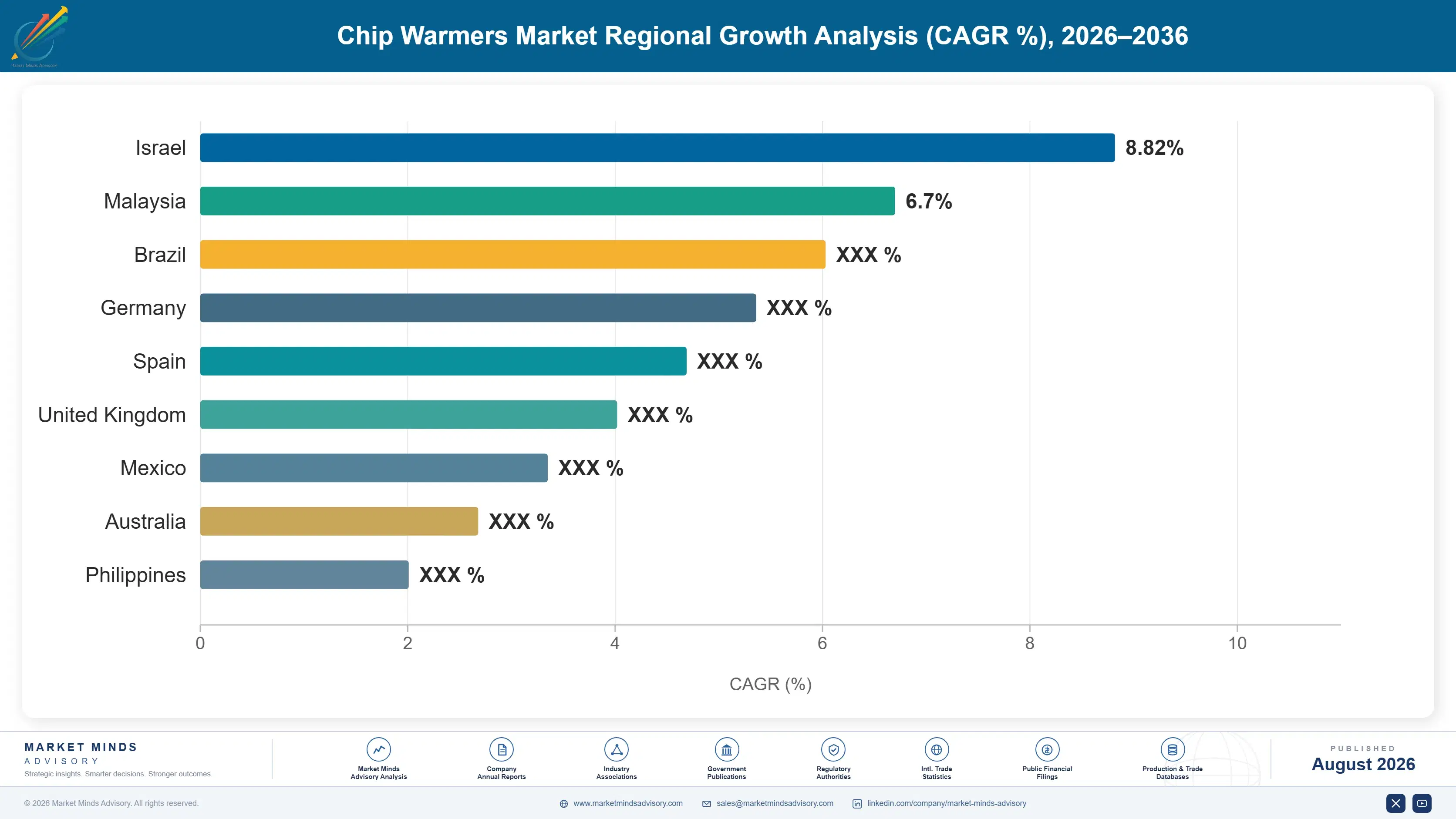
China: 9.2% CAGR
Fastest Growth Region
South Asia and Pacific: 8.3% CAGR
Largest Region
North America: 30% of 2025 global value
Market Leaders
Primary Survey
n=3,800 procurement and R&D decision-makers, Q4 2025, six countries
Methodology
Demand-side build-up, cross-validated against public data, 47 expert interviews

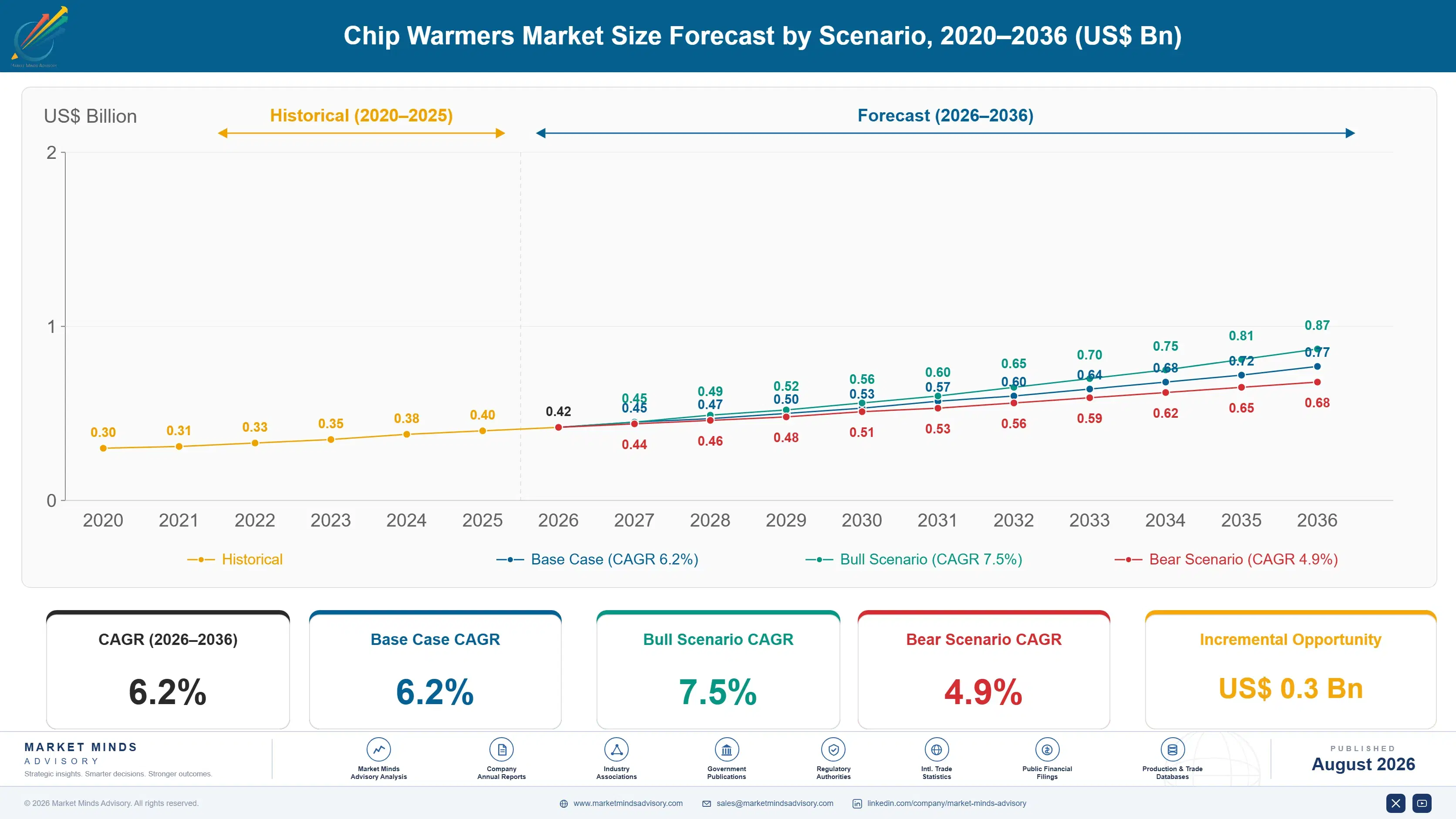
Chip Warmers Market Forecast Scenarios

chip-warmers-market-size-forecast-scenario-1787301128775
Between 2020 and 2025 the market grew at an estimated 5.5% annually, dipping during pandemic-driven venue closures before recovering sharply as convenience stores, cinemas, and stadiums resumed full concession operations and expanded merchandising footprint across reopened locations, from suburban gas stations to downtown entertainment districts and major transit hubs and major sports and entertainment event venues nationwide and internationally.
Three mechanisms carry the base case to 6.2%. First, convenience store chains keep expanding heated merchandising footprint as snack attach rate data justifies the equipment investment. Second, mobile food vending and event concession operators keep adopting portable warming equipment as outdoor festivals and pop-up retail venues proliferate nationwide. Third, cinema and stadium concessionaires keep upgrading combo warming stations as per-visit spending targets rise across the industry and food service revenue expectations climb.
The bull case at 7.5% assumes accelerating convenience retail expansion across emerging markets pulls forward equipment placement faster than currently planned by most regional chain operators. The bear case at 4.9% assumes budget-constrained venue operators delay planned equipment upgrades, slowing the pace of new merchandising placement growth across affected retail, cinema, and entertainment venue segments broadly.

Merchandising Lift as the Purchasing Rationale

Chip warmers sit at the intersection of foodservice equipment reliability and retail merchandising psychology for any operator selling heated snack products, since visible product display and consistent holding temperature both directly affect impulse purchase conversion at the point of sale across most retail channels. Documented attach-rate lift, not raw heating capacity, increasingly separates competing suppliers across major chain procurement decisions.
MARKET CONCENTRATION (CR5)35%Five suppliers hold moderate share across fragmented manufacturer field
AVERAGE UNIT PRICEUSD 400 to 1,200Typical price range for standard countertop warming units today
TOP PRODUCING COUNTRY SHARE22%United States supplies largest share of installed manufacturing capacity
EQUIPMENT REPLACEMENT CYCLE6 to 9 yearsWarming units typically operate before major hardware replacement
STAINLESS STEEL COST SHARE25-32% of COGSSheet metal and heating element inputs weigh heavily on costs
TRADE INTENSITY26% cross-borderWarming unit components frequently cross borders before final assembly
Commercially, the category behaves like a specialized foodservice equipment business wrapped inside a broader retail merchandising relationship. Suppliers bundle equipment hardware with merchandising design consultation and multi-unit chain rollout support, which locks buyers into a single primary vendor across an entire retail footprint rather than encouraging location-by-location shopping on price. Switching suppliers requires retraining staff and redesigning the merchandising layout across the entire store footprint.
Over the next decade, expect mobile and cart-based warming units to keep gaining share as outdoor event and pop-up retail concepts proliferate across major markets worldwide. Combo units integrating multiple warming functions into a single footprint will also keep displacing standalone single-function warmers as retailers optimize limited counter space across increasingly compact store formats and smaller urban retail footprints nationwide.
"Nobody walks into a gas station planning to buy nachos. The warmer sitting right at eye level next to the register is the entire sales pitch."
Director, Foodservice Equipment and Retail Merchandising Practice · MMA Foodserv

Market Trends

Convenience Store Chains Expand Heated Merchandising Footprint

Major convenience store chains have expanded heated food merchandising programs considerably over the past several years, adding chip and snack warmers alongside existing hot dog and pizza display equipment as fresh and prepared food sales become a larger share of overall store revenue. 7-Eleven and Circle K have both disclosed expanded foodservice programs specifically targeting higher-margin prepared and heated snack categories across their store networks. Equipment suppliers report growing demand for combo units that integrate multiple warming functions into the limited counter space available at typical convenience store locations. The shift is turning warmer selection into a revenue-per-square-foot decision.
Market Impact: Adds 3,000 new store buildouts yearly
Stadium and Cinema Concessions Upgrade Combo Warming Stations

Sports venues and movie theater chains continue upgrading concession equipment as per-visit spending targets rise and operators seek to maximize revenue per available counter space during peak event traffic periods. AMC Theatres and major stadium concessionaires have both expanded combo cheese and chip warming stations designed to serve high volume quickly during limited intermission and pregame windows. Equipment reliability under sustained high-volume operation matters considerably more in these settings than in lower-traffic convenience retail applications, pushing operators toward suppliers with documented durability track records validated across many prior seasons of continuous use.
Market Impact: Adds 8,000 mobile vendors yearly

Market Opportunities and Growth Drivers

Fresh Food Program Expansion Sustains Equipment Demand

Convenience store chains keep expanding fresh and prepared food programs as fuel margin pressure pushes operators toward higher-margin foodservice revenue streams, and each new or renovated store location specifies heated merchandising equipment as core buildout content. Industry trade data indicates foodservice now represents a meaningfully larger share of total convenience store gross profit than fuel sales at many chains, a durable shift in revenue mix that sustains equipment investment independent of broader retail capital cycles. Each new store opening or major renovation creates fresh equipment procurement volume regardless of existing store replacement timing.
Market Impact: Cuts standby energy use 20%

Event and Festival Concession Growth Expands Mobile Demand

Outdoor festivals, food truck rallies, and pop-up retail events continue proliferating across major markets, and each new event operator specifies portable warming equipment capable of operating without fixed electrical or gas infrastructure connections. Food truck registration and licensing data indicates sustained growth in mobile foodservice operators across major metropolitan markets, each representing a potential equipment buyer independent of traditional fixed-location retail channels entirely. Suppliers with proven battery-powered and propane-compatible warming designs are capturing disproportionate share of this genuinely new mobile demand segment as more independent operators enter the growing mobile foodservice space.
Market Impact: Compresses margin 8 to 12 points

Market Restraints and Challenges

Energy Cost Sensitivity Limits Continuous Operation Appeal

Chip warmers designed for continuous all-day operation draw meaningful electricity over a full operating shift, and rising commercial electricity rates in some markets have pushed cost-conscious operators to question whether continuous heating justifies the energy expense against actual snack sales volume. The root cause is utilization mismatch: many locations run warmers continuously regardless of actual customer traffic patterns, wasting energy during genuinely low-demand periods throughout the day. That inefficiency erodes the equipment's effective return on investment in lower-traffic locations specifically. Suppliers are responding with programmable timers and energy-efficient heating elements designed to reduce standby power consumption.
Market Impact: Lifts snack attach rate 25%

Limited Product Differentiation Pressures Commodity Pricing

Basic countertop chip warmers face limited technical differentiation between competing suppliers, since the underlying heating technology has remained largely unchanged for decades and most units meet comparable NSF certification standards. The root cause is design maturity: the category lacks the kind of ongoing technical innovation that sustains premium pricing in more rapidly evolving equipment categories. That commoditization pressure pushes price-sensitive buyers toward the cheapest qualified option regardless of brand reputation or documented merchandising performance. Suppliers are responding by shifting competitive emphasis toward merchandising design and combo functionality rather than heating technology alone.
Market Impact: Adds 12% concession revenue per visit
3 additional market trends, 4 additional growth drivers, and 2 additional restraints and challenges are covered in the full report. Contact sales@marketmindsadvisory.com to access the complete intelligence.

Segment CAGR and Growth Architecture

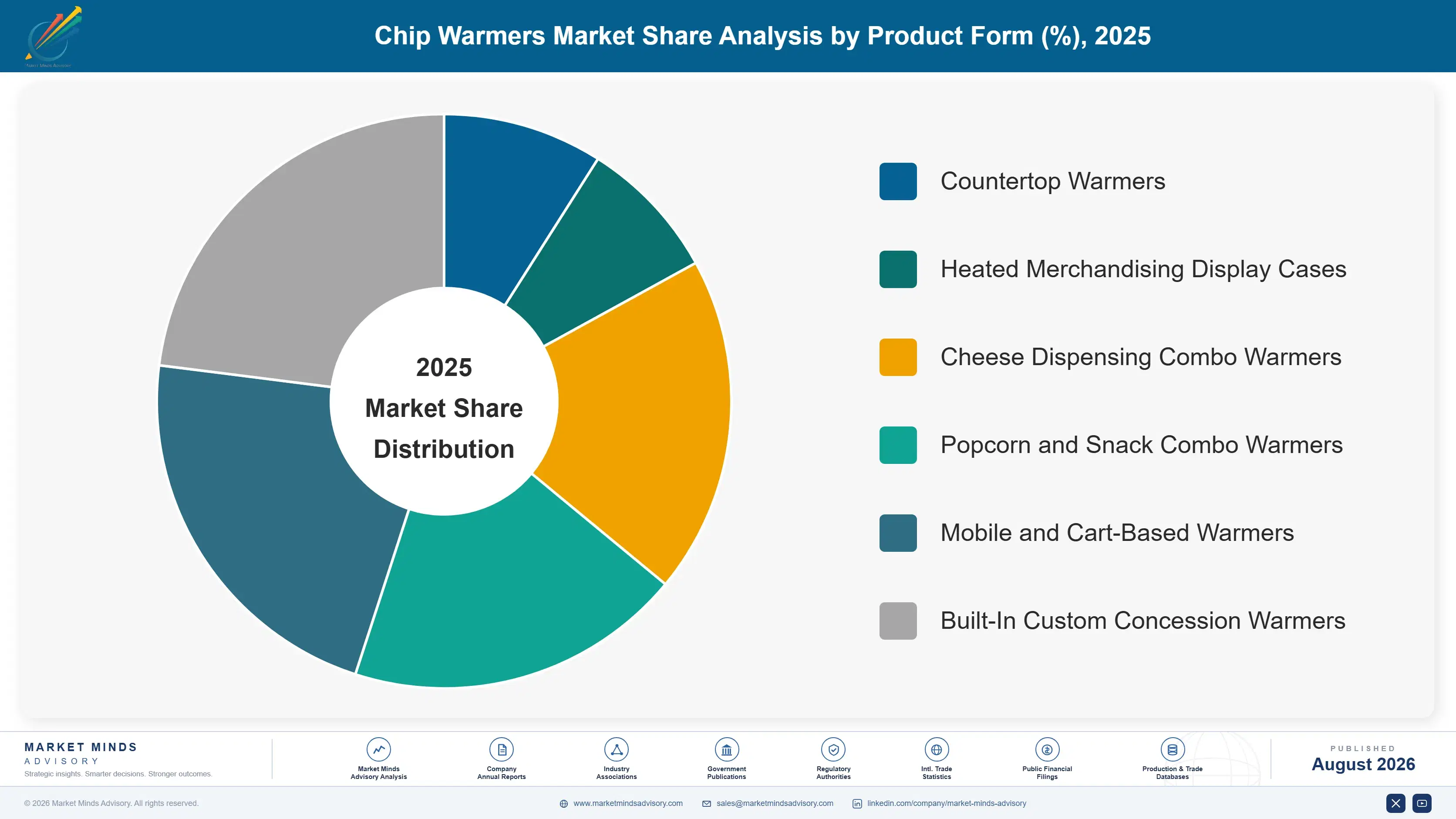
Segmentation follows product form, a single equipment-configuration logic spanning countertop warmers, heated merchandising display cases, cheese dispensing combo units, popcorn and snack combo units, mobile and cart-based warmers, and built-in custom concession warmers. Each configuration carries distinct installation method, venue fit, and buyer group, so commercial position tracks the equipment form rather than the specific snack product it holds.
chip-warmers-market-market-share-analysis-1787301129346

Mobile and Cart-Based Warmers

Mobile and cart-based warmers grow fastest at 9.0%, about 1.45 times the overall market rate, as food truck operators and event concessionaires expand portable heated merchandising into outdoor festivals, pop-up retail events, and venues that fixed countertop equipment simply cannot reach without dedicated electrical infrastructure. Battery-powered and propane-compatible designs have opened entirely new venue categories previously unavailable to warming equipment suppliers, from beachfront concession stands to rural festival grounds lacking grid power access. Suppliers with proven portable designs are capturing disproportionate share of this genuinely new demand segment, and mobile vendors increasingly specify documented battery life and heat retention performance during equipment selection and vendor qualification processes ahead of large seasonal orders.
CAGR 9.0%

Cheese Dispensing Combo Warmers

Cheese dispensing combo warmers grow second-fastest at 8.5%, driven by convenience stores and cinema concessions integrating chip warming and cheese dispensing into a single compact footprint that maximizes revenue per square foot of limited counter space. Combo units eliminate the need for separate cheese warmer equipment, reducing both capital cost and counter space requirements compared with purchasing standalone units for each function. Gold Medal Products and Server Products have both expanded combo unit product lines specifically targeting convenience retail and cinema concession customers, and operators increasingly specify integrated units as default equipment during new store buildout and renovation projects across their expanding national and regional convenience and cinema retail networks alike.
CAGR 8.5%
Full segment breakdown across 6 segments available in the complete report.

Regional Architecture and Country Demand Map

North America leads at 30% of global value on dense convenience store, cinema, and stadium concession infrastructure, followed by East Asia at 23% and Western Europe at 19% on expanding retail foodservice programs. Remaining regions together account for the balance of overall global demand today.

North America

United States convenience store chains anchor North American demand, where 7-Eleven, Circle K, and regional operators have all expanded foodservice programs specifically targeting higher-margin heated snack categories as fuel margin compression pushes revenue diversification across the industry. Stadium and cinema concessions add substantial secondary demand, with major venue operators upgrading combo warming stations to maximize revenue during limited intermission and pregame windows. Canada's convenience and cinema sectors follow comparable merchandising patterns at meaningfully smaller absolute scale across fewer provincial markets. Growth of 6.9% outpaces the global rate as fresh food program expansion and event concession growth compound across an already substantial installed equipment base spanning thousands of retail and entertainment locations.
Share: 30% | CAGR: 6.9% (2026 to 2036)

Western Europe

Germany and the United Kingdom host substantial cinema and stadium concession infrastructure, though convenience store foodservice programs trail North America considerably given different retail fuel station business models across the region. France's cinema chains maintain steady combo warming equipment demand tied to established concession merchandising practices. Scandinavian countries lead in event and festival concession equipment adoption given their extensive outdoor summer festival culture, dense event calendars, and shorter operating seasons requiring portable, weather-resistant equipment solutions specifically suited to shorter operating seasons. Growth of 4.6% trails the global average because the region's foodservice retail formats have not embraced heated merchandising as aggressively as North American convenience chains have across their store networks.
Share: 19% | CAGR: 4.6% (2026 to 2036)
Regional intelligence for 5 additional markets available in the complete report: East Asia, South Asia and Pacific, Latin America, Middle East and Africa, Eastern Europe. Contact sales@marketmindsadvisory.com.
chip-warmers-market-country-cagr-analysis-1787301129881

Where Manufacturers Can Defend Equipment Margin

Suppliers can defend margin against commoditized warmer pricing in several distinct ways beyond simply selling more units into a growing venue base. The four levers below identify genuine commercial advantage: merchandising lift documentation, chain rollout contracting, combo functionality design, and manufacturing positioned ahead of seasonal demand spikes across major foodservice and entertainment markets and their seasonal buying cycles.

Document Merchandising Lift Data From Retail Trials

Chain buyers increasingly demand documented attach-rate lift data before approving equipment for national rollout, not just heating performance specifications alone submitted by the manufacturer. Suppliers that fund independent retail trials quantifying incremental snack sales, typically showing lift of 15% to 30% versus unheated display, move faster through chain approval processes than competitors relying on generic marketing claims without underlying data. Gold Medal Products has built a repeatable playbook around retail trial documentation that shortens sales cycles considerably across its largest chain accounts nationwide and increasingly internationally as well across several new chain accounts.
Market Impact: Commands a durable 20% to 30% price premium

Secure Multi-Year Chain Rollout Contracts Early

Winning a national chain's equipment standard creates a multi-year revenue relationship that smaller regional competitors cannot easily displace, since switching suppliers requires requalification against chain specifications across thousands of individual locations simultaneously and often years of prior performance history. Suppliers that secure these contracts early, often locking in multi-year exclusivity commitments, gain guaranteed volume independent of individual store-level negotiations entirely. Hatco and Middleby both hold long-standing chain equipment standard relationships worth well over 20 million dollars annually across their combined national accounts spanning multiple retail, cinema, and entertainment venue channels nationwide.
Market Impact: Secures multi-year contracts worth well over 20 million

Design Combo Units for Limited Counter Space

Retailers increasingly favor equipment that integrates multiple warming functions into a single compact footprint, since counter space at typical convenience store and cinema locations remains genuinely limited and valuable real estate. Suppliers with proven combo designs can charge premiums of 25% to 35% over standalone single-function units, since operators value the space efficiency and simplified installation more than the incremental unit cost involved in the purchase. Server Products has built a specific reputation around combo unit design innovation targeting exactly this space-constrained retail segment directly across most major chain accounts.
Market Impact: Commands a durable 25% to 35% price premium

Position Manufacturing Ahead of Seasonal Demand Spikes

Manufacturing capacity for warming equipment has repeatedly struggled to keep pace with seasonal demand spikes tied to stadium season openings and summer festival calendars, creating temporary shortages that reward suppliers who invested ahead of the season rather than reactively scrambling. Suppliers with pre-positioned inventory ahead of peak ordering windows can capture premium pricing of 10% to 20% during the seasonal scramble, since venue operators facing hard opening deadlines cannot wait for new production elsewhere. Star Manufacturing has repeatedly timed inventory builds to anticipate seasonal ordering patterns well ahead of peak demand windows each year.
Market Impact: Captures a durable 10% to 20% scramble premium

Who Controls the Margin Pool

Concentration stays moderate at 35% held by the top five suppliers, evaluated on revenue from chip and snack warming equipment product lines specifically. Middleby and Hatco lead on scale and chain relationship depth, while Gold Medal Products, Server Products, and Nemco compete across different application specialties and distribution channels. The gap between leader and challenger is meaningful but not decisive, since chains often qualify multiple suppliers per equipment category.
Competitive activity currently runs along three dimensions. Merchandising lift documentation matters most, as suppliers race to quantify incremental sales data supporting national chain approval decisions. Combo functionality design runs a close second, as retailers favor space-efficient equipment over standalone single-function units. Chain rollout contracting is the third, converting facility-level sales into multi-year national equipment standard agreements.

Pressure is building from two directions. Chinese domestic manufacturers are scaling rapidly and narrowing the technology gap on conventional equipment, threatening incumbents' share in price-sensitive emerging markets. Meanwhile specialty mobile equipment startups are commercializing novel battery-powered and propane-compatible designs that could reshape the event and festival concession segment entirely. Rankings will shift toward suppliers combining defensible merchandising evidence with genuine mobile equipment innovation.
chip-warmers-market-company-positioning-matrix-1787301130419

Competitive Moat and Risk Dimensions

THE MIDDLEBY CORPORATION

Moat: Broad Foodservice Equipment Portfolio

Middleby's broad foodservice equipment portfolio spans warming, cooking, and refrigeration categories, giving it breadth that narrower specialists cannot match while also letting it bundle chip warmers into larger kitchen equipment packages sold to national chain accounts across multiple foodservice segments simultaneously, from convenience retail to full-service restaurant chains.
THE MIDDLEBY CORPORATION

Risk: Warmers a Small Portfolio Slice

Chip warmers represent a relatively small segment within Middleby's much larger diversified equipment portfolio, meaning specialized competitors sometimes out-innovate Middleby on warmer-specific merchandising technology since their entire focus concentrates there exclusively, without the competing internal capital priorities Middleby's much broader portfolio must constantly balance across brands.
HATCO CORPORATION

Moat: Deep Heating Technology Specialization

Hatco has built decades of specialized heating and holding technology expertise focused specifically on foodservice applications, giving it engineering depth that broader equipment generalists cannot easily replicate across comparable temperature control specifications and reliability standards over extended operating periods spanning many years of continuous commercial use.
HATCO CORPORATION

Risk: Narrower Category Focus Than Rivals

Hatco's warming and holding equipment focus leaves it more exposed than diversified competitors if that specific category faces a demand slowdown, since it lacks the broader kitchen equipment exposure that balances demand across foodservice capital cycles for larger, more broadly diversified rivals in the category.

Key Players

The Middleby Corporation
Hatco Corporation
Gold Medal Products Co.
Server Products, Inc.
Nemco Food Equipment, Ltd.

Others

Global Solutions
Vollrath Company, LLC
Star Manufacturing International, Inc.
Wells Manufacturing
APW Wyott
Grindmaster-Cecilware Corp.
Benchmark USA, Inc.
Paragon International, Inc.
C. Cretors & Company
Nostalgia Products Group, LLC
Waring Commercial
Adcraft Manufacturing
Winco Foodservice
Admiral Craft Equipment Corp.
Eagle Group

Recent Developments

MAY 2025

Middleby acquires specialty combo warming equipment maker

Middleby acquired a privately held combo warming equipment manufacturer specializing in space-efficient convenience store applications for an undisclosed sum. The acquisition was a full corporate purchase, not a licensing arrangement or joint venture, giving Middleby direct ownership of the underlying combo design technology and its associated patents.
Signal: Shows leading suppliers continuing to consolidate specialty combo warming capability through direct corporate acquisition activity now.
OCTOBER 2024

Hatco launches expanded merchandising lift documentation program

Hatco launched an expanded retail trial program specifically designed to document merchandising lift data supporting national chain equipment approval decisions across major convenience retail accounts. This was an internal program launch, not a corporate transaction, extending Hatco's documented performance evidence base across additional retail categories.
Signal: Indicates suppliers increasingly compete on documented sales data rather than heating specifications alone today across the industry.
JANUARY 2025

Gold Medal Products signs supply agreement with major cinema chain

Gold Medal Products entered a multi-year supply agreement to provide combo warming equipment across a major cinema chain's national concession renovation program. The arrangement was a supply agreement, not an acquisition or joint venture, extending Gold Medal's cinema customer relationships meaningfully across the chain's national footprint.
Signal: Signals cinema chains increasingly standardize equipment procurement through centralized national supplier relationships and long-term binding contracts.

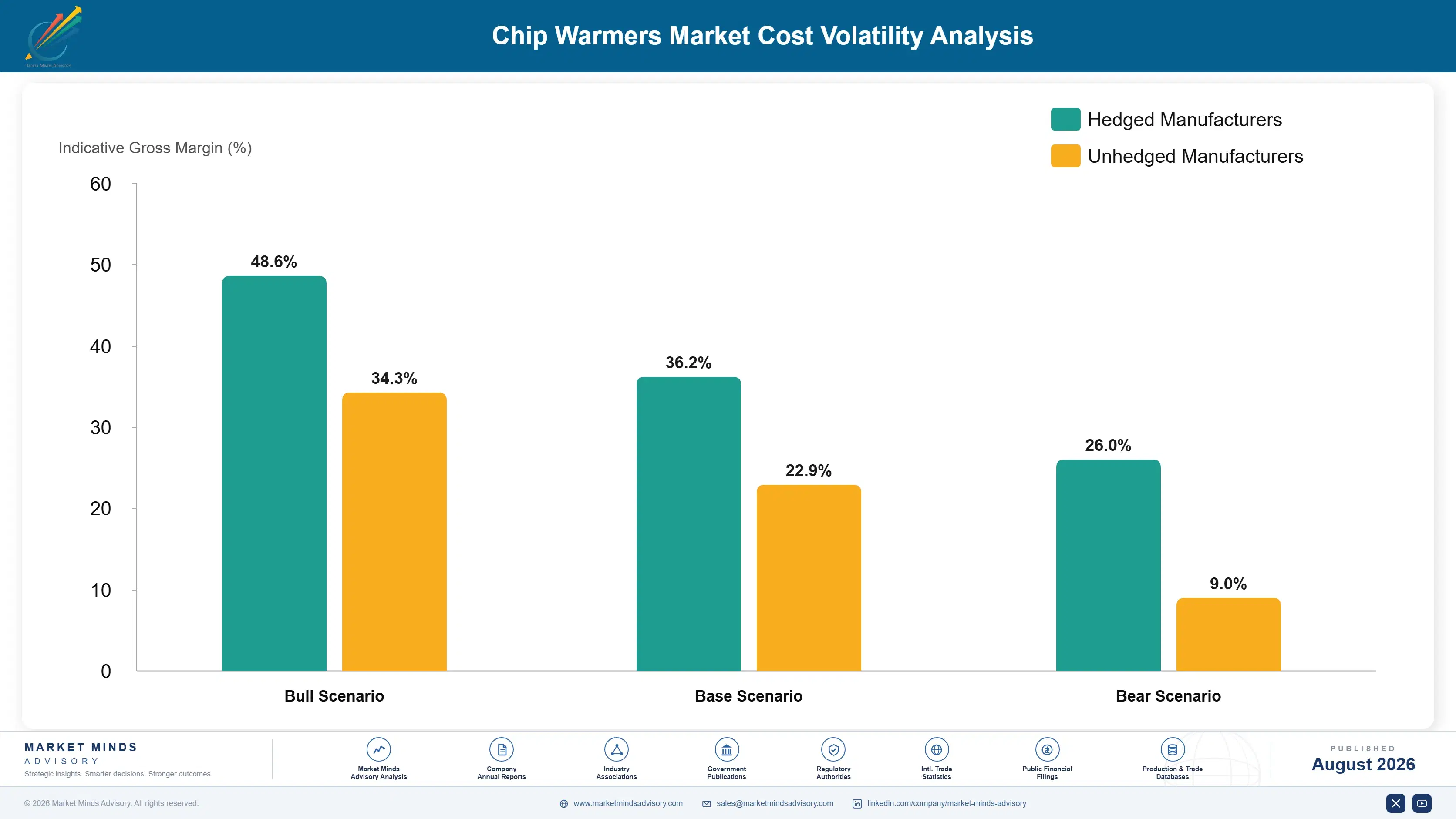
Stainless Steel and Heating Element Exposure

Stainless steel sheet metal and electric heating elements together account for roughly 25% to 32% of warmer system COGS, sourced primarily from steel producers in the United States and from specialty heating element manufacturers concentrated in the United States and China. Glass and acrylic display components add a further 8% to 12%, sourced from specialty materials suppliers across multiple qualified regions.
Stainless steel prices rose meaningfully through 2024 as tariff policy shifts and construction demand recovery pushed benchmark steel prices higher across most major producing regions worldwide, according to trade data. Middleby's 2024 annual report disclosed higher input costs attributable to steel inflation, noting that fabrication cost rose meaningfully faster than the company could pass through to chain customers without meaningful margin compression across its foodservice equipment segment.

Smaller regional equipment manufacturers carry more exposure than the largest diversified suppliers, since they lack the purchasing scale to negotiate favorable long-term steel contracts with primary mills. Suppliers sourcing heating elements from a concentrated set of manufacturers face additional exposure to capacity constraints, while diversified suppliers absorb volatility more predictably across their broader, globally diversified supply chain.
chip-warmers-market-cost-volatility-analysis-1787301130615

Lock Steel Pricing Through Annual Supply Contracts

Stainless steel is the largest single volatile input across most warmer product lines and increasingly competed for by broader construction and industrial steel demand. Annual supply agreements with fixed or collared pricing, common practice among larger diversified manufacturers, smooth quarter-to-quarter volatility and let commercial teams quote chain contracts with genuine confidence rather than repricing constantly against volatile spot markets.

Diversify Heating Element Sourcing Across Suppliers

Reliance on a single heating element manufacturer concentrates both price and availability risk unnecessarily across an entire product line. Qualifying secondary suppliers across multiple regions, even at modestly higher unit cost, protects continuity when any single manufacturer faces capacity outage or a sudden demand spike from competing appliance and industrial equipment sectors alike worldwide.

Vertically Integrate Sheet Metal Fabrication

Suppliers that bring sheet metal fabrication in-house rather than purchasing finished components capture manufacturing margin previously paid to a third party while gaining direct visibility into actual material consumption and lead times. That integration also shortens delivery timelines meaningfully during periods of tight global steel supply and rising fabrication demand from competing industrial sectors.

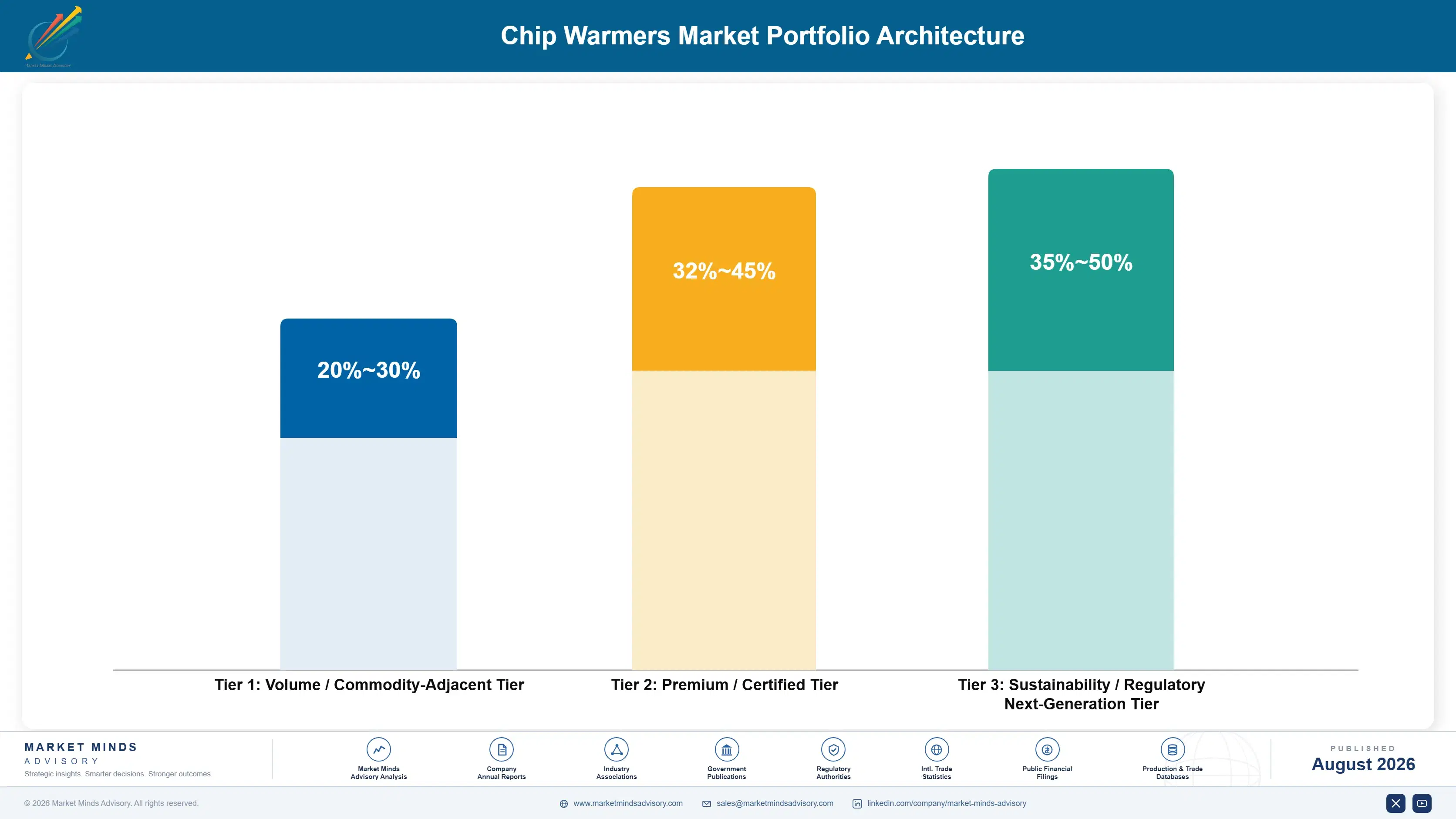
Portfolio Architecture for Margin Defence

The portfolio splits into three tiers with meaningful margin separation tied to merchandising evidence and combo functionality. Volume tier products carry basic countertop warmers for conventional convenience applications, competing largely on price against a crowded field of regional manufacturers. Premium certified products carry combo units backed by documented merchandising lift data. Sustainability and next-generation products, meaning mobile and cart-based designs, attract the sector's mos
The tension between volume and premium runs through nearly every supplier's product roadmap. Volume products fund the manufacturing scale and distribution network premium products eventually depend on, yet volume margins keep compressing as regional manufacturers scale aggressively on conventional countertop units. Suppliers that under-invest in premium combo and mobile capability risk commoditization within their own category, while those chasing premium exclusively struggle to fund the manufacturing base needed to serve routine convenience demand.

High-value margin pools concentrate specifically in combo units and mobile equipment where merchandising performance and venue flexibility carry the largest commercial stakes, and where documented lift data commands genuine pricing power. Conventional countertop warmers generate steadier volume but thinner margin, since that segment competes against a wider set of lower-cost regional suppliers with adequate but unremarkable merchandising differentiation.

Volume / Commodity-Adjacent Tier

Basic countertop warmers for conventional convenience applications, competing largely on price against a crowded field of regional manufacturers offering broadly comparable specifications, materials, and heating performance across most competing product lines in the industry.
Gross Margin: 20-30%

Premium / Certified Tier

Combo units backed by documented merchandising lift data and formal chain qualification, commanding meaningful pricing premiums over conventional equivalents across most major convenience, cinema, and stadium concession markets worldwide today.
Gross Margin: 32-45%

Sustainability / Regulatory / Next-Generation Tier

Mobile and cart-based designs still scaling across festival and event concession channels, targeting venue flexibility conventional fixed equipment simply simply cannot achieve at any comparable price point or venue configuration currently available.
Gross Margin: 35-50%
chip-warmers-market-portfolio-architecture-1787301131123

High-value Sub-segments and Strategic Watch-out

Mobile and Cart-Based Warming Units

High value and high growth, driven by expanding festival, event, and pop-up retail concession channels, with proven design and battery performance barriers protecting incumbent suppliers from new entrant price competition on the largest mobile vendor and event operator accounts nationwide and increasingly internationally as well.
Gross Margin: 35-50%

Chain-Standard Combo Warming Units

High value with moderate growth, anchored by national convenience and cinema chain equipment standardization programs, where documented merchandising lift increasingly decides vendor qualification for large multi-unit procurement contracts across national retail, cinema, and entertainment venue chains alike operating hundreds of individual locations across multiple states.
Gross Margin: 32-45%

Standard Countertop Warmers

The category's largest volume base by unit count, competing on price against a crowded field of regional suppliers, generating steady but thin margin as conventional convenience demand matures across most developed and increasingly price-sensitive emerging markets worldwide, from Latin America to Southeast Asia and beyond.
Gross Margin: 20-30%

Legacy Single-Function Warmer Formats

Strategic watch-out where combo units increasingly threaten to displace legacy single-function warmers across most retail applications, creating genuine competitive risk for suppliers slow to transition product lines toward integrated combo formats quickly enough to retain valuable chain accounts and their ongoing loyalty to a single trusted equipment supplier.
Gross Margin: 12-20%

Chain Standard Economics of Warmer Placement

Warmer demand behaves like an annuity once a chain establishes an equipment standard, since new store openings, renovations, and replacement cycles all draw from the same approved supplier list regardless of whether any single procurement event triggers new demand. That structure rewards incumbency heavily: a supplier that wins the initial chain standard designation keeps the relationship through multiple store generations unless a competitor demonstrates a decisive merchandising or cost advanta
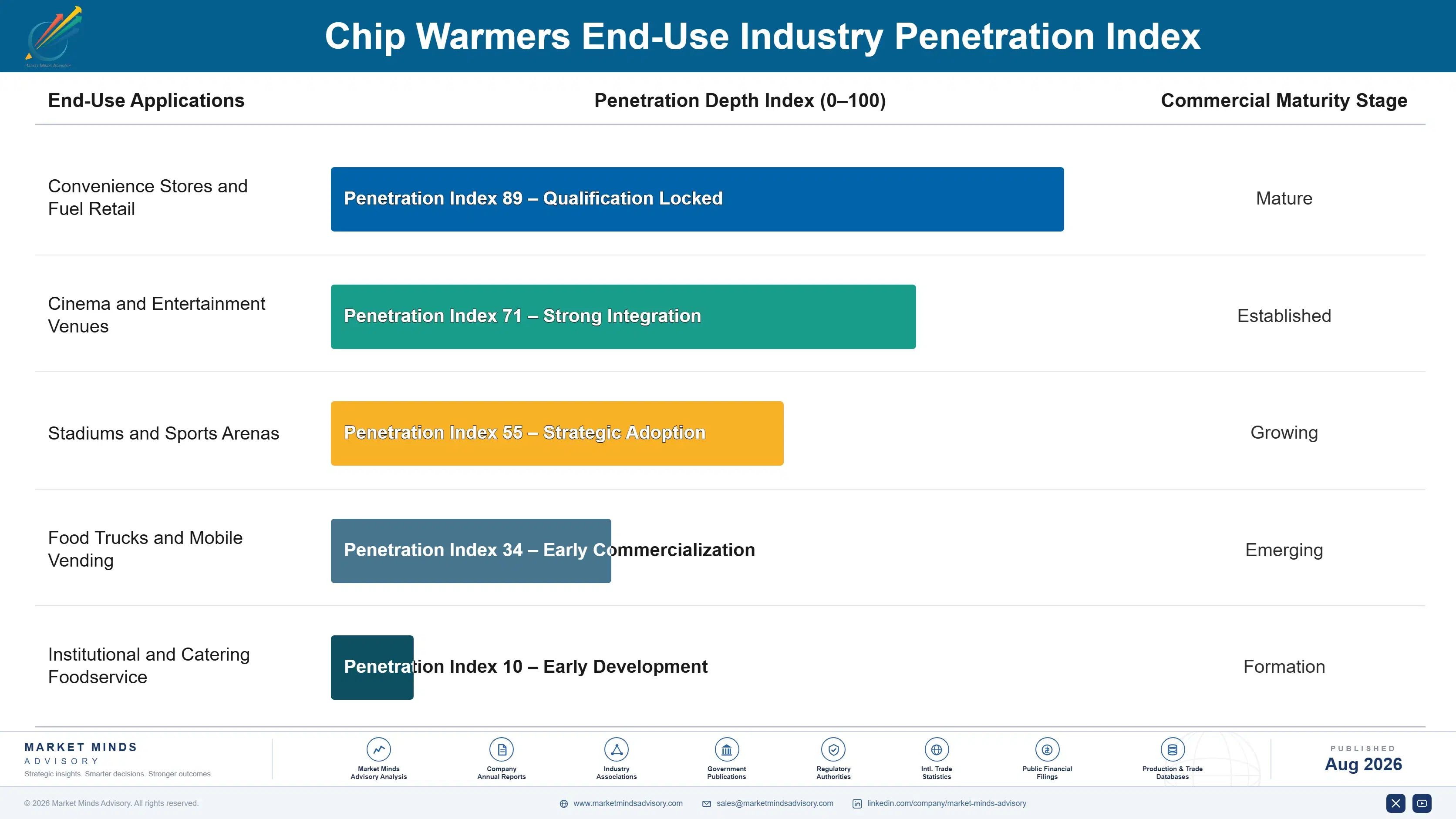
Adoption depth varies sharply by end-use vertical. National convenience and cinema chains have adopted documented merchandising lift evaluation almost universally, since attach-rate performance directly affects chain-wide revenue at scale. Independent operators and smaller regional chains lag well behind, treating equipment upgrades as optional rather than standard, partly because per-location volume is genuinely lower and partly because budget scrutiny favors the cheapest qualified option.

Buyer profiles have shifted generationally. Procurement decisions that once sat primarily with individual store managers now route through centralized category management and merchandising committees at larger chains, rewarding suppliers able to present integrated sales lift data rather than relationship selling alone. Younger category managers entering leadership roles treat documented attach-rate performance as a baseline procurement input rather than a marketing claim.
chip-warmers-market-end-use-penetration-index-1787301131641

MMA's Read on Concession Warming

These are among the four positions where our research anticipates prominent divergence between winners and laggards over the coming forecast period. Each is grounded in the demand model, the regulatory perimeter, and the announced capacity pipeline.
01 / MERCHANDISING EVIDENCE STRATEGY

Documented lift data will separate winners from commoditized equipment sellers

Bare warming hardware is becoming commoditized across most conventional applications, which means suppliers competing solely on heating specifications rather than documented merchandising lift will see margin compress steadily over the next several years across most volume segments. Retail trial evidence addresses the exact question chain buyers actually ask, whether the equipment pays for itself through incremental sales, that heating capacity alone cannot answer. Suppliers that build this evidence base now, before competitors establish comparable documentation, will hold chain accounts rivals cannot easily dislodge.
02 / COMBO DESIGN INVESTMENT

Space-efficient functionality will define share gains through 2036

Retailers keep facing tighter counter space constraints as stores shrink and product assortment expands, rewarding suppliers who integrate multiple warming functions into a single compact footprint over standalone single-function alternatives. Suppliers without proven combo designs increasingly lose bids among space-constrained convenience and cinema accounts, regardless of reputation built in conventional countertop equipment over decades. Those investing in combo functionality now, ahead of competitors still selling single-function units, will capture disproportionate share as counter space keeps shrinking across most new and renovated store formats.
03 / MOBILE EQUIPMENT POSITIONING

Portable warming capability will decide who wins the event concession segment

Outdoor festivals, food truck rallies, and pop-up retail concepts keep proliferating across major markets, creating a genuinely new demand category that fixed countertop equipment simply cannot serve regardless of its merchandising performance in traditional retail settings. Suppliers without proven battery-powered and propane-compatible designs cannot compete for this segment quickly, since mobile vendors need equipment that works reliably without fixed infrastructure access. Incumbent suppliers with proven mobile designs are positioned to capture a disproportionate share of this expanding event and festival concession market.
04 / CHAIN STANDARDIZATION EXPOSURE

National equipment standards will permanently reshape supplier competitive geography

National chains are increasingly consolidating equipment procurement into single approved-supplier standards rather than allowing location-by-location purchasing discretion, permanently rewarding suppliers with proven national rollout capability and consistent quality across every store. Suppliers without that scale cannot simply buy their way into these standardization decisions quickly, since chains will not risk inconsistent equipment performance across thousands of locations on unproven regional suppliers. The net effect redraws competitive geography in ways unlikely to reverse regardless of future price competition from smaller regional rivals.

Engagement Snapshot From the Field

A live engagement with an industry participant carrying material or product regulatory and market exposure ahead of a defining policy shift, showing how our research translates into a defensible multi-year portfolio strategy.
MARKET MINDS ADVISORY · CLIENT ENGAGEMENT SUMMARY
Chip Warmers Producer Strategic Portfolio Review and Transition Roadmap 2026·Investment Scenario on Chip Warmers Exposure Evaluation 2025-26
CLIENT PROFILE
A regional convenience store chain operating 180 locations across three states, reporting approximately 240 million dollars in annual foodservice revenue, approached MMA while evaluating whether to standardize on a single chip warmer supplier ahead of a planned multi-year store renovation and modernization program spanning the entire chain footprint across all three states (client-reported, unverified by MMA).
STRATEGIC CHALLENGE
Leadership faced a decision between continuing its historical practice of allowing store-level equipment choice versus mandating a single chain-wide standard that could simplify procurement and maintenance contracts. Operations wanted the equipment with the best documented merchandising performance, while finance needed a defensible cost comparison justifying any premium over the cheapest qualified option available.
MMA APPROACH
MMA benchmarked merchandising lift data across three candidate suppliers using the chain's own point-of-sale data from pilot locations, modeled total cost of ownership including maintenance and replacement over a seven-year equipment life, and assessed each supplier's capacity to support the planned renovation rollout timeline without introducing meaningful supply chain risk.
KEY FINDINGS
  1. The supplier with the strongest documented merchandising lift also carried a meaningfully higher upfront cost, but total cost of ownership favored it once incremental sales were included in the model.
  2. Standardizing on a single supplier reduced projected maintenance contract costs meaningfully compared with the chain's historical multi-supplier approach across its store network.
  3. Pilot location data showed measurably higher snack attach rates at stores using combo warming units compared with standalone single-function equipment (client-reported, unverified by MMA).
  4. The selected supplier's production capacity comfortably supported the chain's renovation timeline without requiring any schedule adjustments to the original store rollout plan whatsoever.
CLIENT PROFILE
A regional convenience store chain operating 180 locations across three states, reporting approximately 240 million dollars in annual foodservice revenue, approached MMA while evaluating whether to standardize on a single chip warmer supplier ahead of a planned multi-year store renovation and modernization program spanning the entire chain footprint across all three states (client-reported, unverified by MMA).
STRATEGIC CHALLENGE
Leadership faced a decision between continuing its historical practice of allowing store-level equipment choice versus mandating a single chain-wide standard that could simplify procurement and maintenance contracts. Operations wanted the equipment with the best documented merchandising performance, while finance needed a defensible cost comparison justifying any premium over the cheapest qualified option available.
MMA APPROACH
MMA benchmarked merchandising lift data across three candidate suppliers using the chain's own point-of-sale data from pilot locations, modeled total cost of ownership including maintenance and replacement over a seven-year equipment life, and assessed each supplier's capacity to support the planned renovation rollout timeline without introducing meaningful supply chain risk.
KEY FINDINGS
  1. The supplier with the strongest documented merchandising lift also carried a meaningfully higher upfront cost, but total cost of ownership favored it once incremental sales were included in the model.
  2. Standardizing on a single supplier reduced projected maintenance contract costs meaningfully compared with the chain's historical multi-supplier approach across its store network.
  3. Pilot location data showed measurably higher snack attach rates at stores using combo warming units compared with standalone single-function equipment (client-reported, unverified by MMA).
  4. The selected supplier's production capacity comfortably supported the chain's renovation timeline without requiring any schedule adjustments to the original store rollout plan whatsoever.
RECOMMENDED STRATEGY
Phase 1: Phase 1 (0 to 6 months): Standardize on the selected supplier for all stores included in the first renovation wave, prioritizing the highest-volume locations first. Phase 2: Phase 2 (6 to 24 months): Complete the chain-wide equipment transition as remaining store renovations proceed according to the original planned schedule. Phase 3: Phase 3 (24 to 36 months): Evaluate mobile warming equipment for expansion into event and festival concession opportunities identified during the renovation program.
OUTCOME
The chain completed its standardization decision and began the renovation rollout on schedule, with early data from converted stores showing snack attach rates tracking ahead of the original pilot projections and store managers reporting positive feedback on the simplified single-supplier maintenance process (client-reported, unverified by MMA).

Frequently Asked Questions

Foundational context covering the market sizes, CAGR, scope, country, region and competition that inform every finding below. This section is provided to cover basics and most often pre-purchase conversations, answered from the MMA Primary Research Dataset.

What is the current size of the Chip Warmers Market?

The market reached an estimated 0.4 billion dollars in 2025. That figure reflects global revenue across countertop, display case, combo, popcorn, mobile, and built-in warmer configurations.

How large will the Chip Warmers Market be by 2036?

MMA projects the market will reach approximately 0.8 billion dollars by 2036 under the base case scenario. That represents roughly 1.83 times the 2026 market value.

What is the CAGR for the Chip Warmers Market 2026 to 2036?

The base case CAGR is 6.2% annually across the full ten-year forecast period. Bull and bear scenarios run 7.5% and 4.9% respectively, reflecting venue investment timing uncertainty.

Which segment is growing fastest?

Mobile and cart-based warmers grow fastest at 9.0% CAGR, about 1.45 times the overall market rate. Expanding festival, event, and pop-up retail concession channels are the primary driver.

Who are the major companies in the Chip Warmers Market?

Middleby, Hatco, Gold Medal Products, Server Products, and Nemco lead the category by a consistent revenue basis. Together they hold roughly 35% of equipment revenue.

Which country is growing fastest?

China leads national growth at an estimated 9.2% CAGR, driven by expanding convenience store and cinema infrastructure across major metropolitan markets. Retail modernization keeps intensifying steadily.

Report Segmentation Architecture

The full report scope spans multiple orthogonal segmentation dimensions, with cross-tabulated demand data provided for each dimension pair. Coverage extends further to regional breakdowns, trend trajectories, and the competitive detail needed to support segment-level decision-making.

By Product Form

  • Countertop Warmers
  • Heated Merchandising Display Cases
  • Cheese Dispensing Combo Warmers
  • Popcorn and Snack Combo Warmers
  • Mobile and Cart-Based Warmers
  • Built-In Custom Concession Warmers

By End-Use Industry

  • Convenience Stores and Fuel Retail
  • Cinema and Entertainment Venues
  • Stadiums and Sports Arenas
  • Food Trucks and Mobile Vending
  • Institutional and Catering Foodservice

By Commercial Dimension

  • Direct Chain Contract Sales
  • Distributor and Wholesale Sales
  • Combo Unit Bundled Sales
  • Original Equipment Manufacturer Licensing

By Region

  • North America
  • Western Europe
  • East Asia
  • South Asia and Pacific
  • Latin America
  • Middle East and Africa
  • Eastern Europe

Scope, Methodology, and Coverage

Every figure in this report is reproducible from documented input assumptions. The scope below maps the historical period, the forecast horizon, the segmentation dimensions, and the countries covered, alongside the underlying primary and qualitative methodology.
Historical Period
2020 to 2025
Forecast Period
2026 to 2036
Base Year
2025 (USD billions; MMA Primary Research Dataset, August 2026)
Market Definition
The chip warmers market covers countertop warmers, heated merchandising display cases, cheese dispensing combo units, popcorn and snack combo units, mobile and cart-based warmers, and built-in custom concession warming equipment used to hold and display heated snack products for sale. It includes equipment hardware and associated merchandising design services. General commercial ovens, refrigerated display cases, and beverage dispensing equipment are excluded.
Quantitative Units
USD billions (current prices); unit shipment volume where applicable
Segmentation Dimensions
By Product Form; By End-Use Industry; By Commercial Dimension; By Region
Regions Covered
North America, Western Europe, East Asia, South Asia and Pacific, Latin America, Middle East and Africa, Eastern Europe
Countries Covered
USA, China, Germany, France, UK, Japan, South Korea, India, Australia, Canada, Brazil, Mexico, Indonesia, Vietnam, Thailand, Malaysia, UAE, Saudi Arabia, South Africa, Nigeria, Turkey, Poland, Netherlands, Italy, Spain, Sweden, Switzerland, Argentina, Colombia, Singapore, and additional markets relevant to this sector
Key Companies Profiled
The Middleby Corporation; Hatco Corporation; Gold Medal Products Co.; Server Products, Inc.; Nemco Food Equipment, Ltd.; Global Solutions; Vollrath Company, LLC; Star Manufacturing International, Inc.; Wells Manufacturing; APW Wyott; Grindmaster-Cecilware Corp.; Benchmark USA, Inc.; Paragon International, Inc.; C. Cretors & Company; Nostalgia Products Group, LLC; Waring Commercial; Adcraft Manufacturing; Winco Foodservice; Admiral Craft Equipment Corp.; Eagle Group
Quantitative Methodology
Primary survey, n=3,800 respondents, Q4 2025, six countries; demand-side model with trade association cross-validation
Qualitative Methodology
47 expert interviews, Q4 2025; applied to validate demand model assumptions, identify emerging dynamics, and assess competitive positioning
Report Format
PDF and XLSX data workbook (Word format preview document)
Publisher
Market Minds Advisory
Report Code
MMA-2026-CON-205
Published
August 2026
Contact
sales@marketmindsadvisory.com | www.marketmindsadvisory.com

Purchase the full Chip Warmers Market Report (2026 to 2036).

The full MMA Chip Warmers report sizes the market across six product form categories, five end-use industries, four commercial contracting models, and seven regions through 2036. It profiles twenty participants on a consistent basis of equipment revenue, scoring the top five on merchandising evidence depth, chain rollout capability, and combo design innovation. Scenario models quantify how convenience retail foodservice expansion, mobile concession growth, and steel price volatility move both demand and achievable pricing. The report also includes delivered cost modeling by product form, a chain standardization tracker across major markets, and a supplier displacement risk assessment built for operators, manufacturers, and investors.
Six-segment product form demand model through 2036
Chain standardization and rollout program tracker
Merchandising lift documentation competitive assessment tool
Combo unit design benchmarking dataset and analysis
Stainless steel and heating element cost sensitivity model
Supplier displacement risk scoring by product form

Built For The People Who Decide

From boardroom strategy to bench-side execution, this report is read cover-to-cover by leaders shaping the next decade of their industry, turning demand scenarios, market dynamics and valuation benchmarks into decisions.
CXOs/ Presidents/ VPs/ Managers
M&A and Corporate Development
Strategy Teams and R&D Heads
Procurement and Product Directors
Regulatory and Compliance Leaders
Investor Relations and Equity Analysts