Market Minds Advisory
Chip Resistor Market

Chip Resistor Market: Chip Resistor Market: Component Classes, Qualification Premium and Availability Economics 2026 to 2036

A part costing three tenths of a cent can stop a production line worth a great deal more. Since 2021 nobody negotiates the price of these components, only the availability.

Lead Analyst

Published

September 2026

Make Smarter Decisions with Customized Research Insights

Request a free sample report and evaluate market opportunities, growth trends, and competitive dynamics relevant to your business needs.

2025 MARKET VALUE$4.3BMarket Size 2025
2036 FORECAST VALUE$7.7BBase Case , 2026 to 2036
CAGR 2026 TO 20365.4 %Bull 6.7% / Bear 4.2%
INCREMENTAL OPPORTUNITY$3.1BNet 10- year value creation
EXPANSION MULTIPLE1.69x2036 value over 2026 base
Strategic Levers
M&A Pipeline
Regional Outlook
Country Rankings
Competitive Intelligence
Segmental Deep-dive
Call-Us : 91 93563 13602

Executive Snapshot and Market Trajectory.

A general purpose chip resistor costs around USD 0.003 and a modern electric vehicle contains roughly 4,200 of them. The 2021 shortage taught every manufacturer that a component worth almost nothing can halt a line worth an enormous amount. Buffer inventory near 16 weeks is now normal.
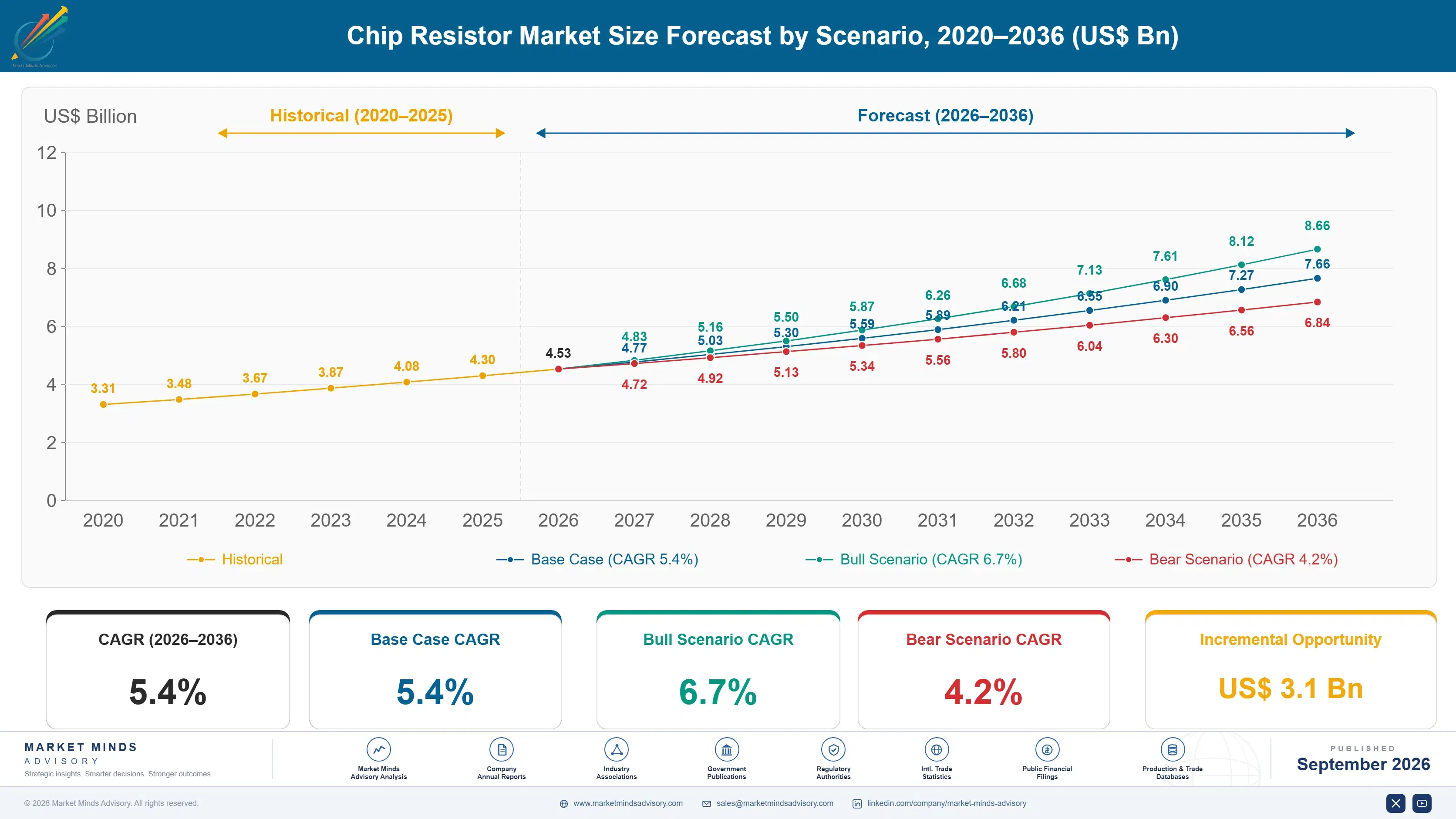
The market reaches USD 4.53 billion in 2026 and USD 7.67 billion by 2036, a 1.69 times expansion at 5.4%. Current sense and shunt resistors grow at 8.1%, half again the market rate of 5.4%, because every battery pack, inverter and converter measures current by passing it through a precision resistor. East Asia holds 62% of unit shipment revenue, and India compounds fastest at 11.2%. Content per vehicle rose with every power conversion stage added.
Five manufacturers hold 66% of unit shipment revenue and every one of them is Asian, which reflects where these components are both made and consumed. Yageo, Panasonic, Rohm, KOA Corporation and Samsung Electro-Mechanics hold automotive qualification portfolios accumulated across decades. Qualification rather than manufacturing capability separates them from everybody else attempting entry, and it takes around 19 months per approval campaign. Nobody outside that group has cleared the barrier.
Market Definition
This report covers surface mount chip resistors by component class: automotive qualified high reliability resistors, current sense and shunt resistors, thin film precision chip resistors, high power and high voltage chip resistors, anti-sulphur and environmentally hardened resistors, and thick film general purpose chip resistors. It excludes resistor networks and arrays, through-hole and wirewound resistors, potentiometers and trimmers, thermistors and varistors, and other passive component categories including capacitors and inductors.
Base Year Value
$4.3B in 2025 (MMA Primary Research Dataset, September 2026)
Forecast Period
2026 to 2036, eleven discrete annual values
CAGR
5.4% base case. Bull 6.7%. Bear 4.2%.
Fastest Growth Segment
Current Sense And Shunt Resistors: 8.1% CAGR
Fastest Growth Country
India: 11.2% CAGR
Fastest Growth Region
South Asia and Pacific: 7.4% CAGR
Largest Region
East Asia: 62% of 2025 global value
Market Leaders
Yageo, Panasonic, Rohm, KOA Corporation and Samsung Electro-Mechanics lead on chip resistor unit shipment revenue. Source: MMA Analysis.
Primary Survey
n=3,800 procurement and R&D decision-makers, Q4 2025, six countries
Methodology
Demand-side build-up, cross-validated against public data, 47 expert interviews

Chip Resistor Market Forecast Scenarios

chip-resistor-market-size-forecast-scenario-1789991912509
Between 2020 and 2025 the category compounded at 4.3%, and the middle of that period reset how the entire electronics industry thinks about passive components. Shortages during 2021 stopped production lines at manufacturers who had treated these parts as unlimited and free, and the response was permanent inventory rather than higher pricing. Buffer stock near 16 weeks is now normal where almost none was held before.
The base case holds 5.4% on three mechanisms. Vehicle electrification multiplies resistor content per vehicle by a wide margin, with a battery electric vehicle carrying around 4,200 chip resistors against far fewer in a combustion equivalent. Current sensing requirements grow with every power conversion stage added anywhere. And automotive qualification carries a premium near six times commercial grade for physically comparable material, which lifts value faster than unit volume alone suggests.
The bull case at 6.7% assumes electrification accelerates across commercial vehicles and industrial equipment as well as passenger cars, which would multiply current sensing content considerably further. The bear case at 4.2% is general purpose pricing eroding further: thick film parts at USD 0.003 have room to fall and Chinese manufacturers continue expanding capacity against a segment that is genuinely interchangeable.

Cheap Parts With Expensive Consequences

Nobody negotiates the price of a chip resistor anymore. A general purpose part costs around USD 0.003 and the shortages of 2021 demonstrated that its absence stops a production line worth several orders of magnitude more, which reordered purchasing across electronics. Manufacturers now carry buffer inventory near 16 weeks, and availability commitments matter more than pricing.
TOP FIVE CONCENTRATION66%Concentrated among Asian manufacturers holding automotive qualification portfolios
GENERAL PURPOSE UNIT PRICEUSD 0.003Average across standard thick film chip resistor shipments today
RESISTORS PER ELECTRIC VEHICLE4,200Individual chip resistors fitted across a modern battery vehicle
AUTOMOTIVE QUALIFICATION PERIOD19 monthsFrom sample submission to approved production part status
BUFFER INVENTORY HELD16 weeksComponent stock carried by manufacturers after the last shortage
AUTOMOTIVE PRICE PREMIUM6 timesQualified part cost against physically comparable commercial grade
The value sits in qualification rather than in the resistor itself, which is the fact that explains this market. A general purpose thick film part is genuinely interchangeable between suppliers and grows at 2.4%. An automotive qualified part with documented process control, production part approval submission and full traceability costs around six times more for physically comparable material and grows at 7.2%. The premium buys paperwork and process discipline.
Electrification did something unusual to a mature component category. A battery electric vehicle carries roughly 4,200 chip resistors against far fewer in a combustion equivalent, and a substantial share of the additional content is current sensing. Measuring current means passing it through a very low value precision resistor with tight temperature behaviour, which is a genuinely harder part and the one segment where technical differentiation actually exists.
"A purchasing director told me they had stopped asking suppliers for a price and started asking for a commitment. The part costs a third of a cent. Not having it costs a shift. That arithmetic changed the entire industry in about eighteen months."
Director, Passive Components and Electronic Materials Practice · MMA Technology Practice · September 2026

Market Trends

Availability Displaced Price As The Purchasing Conversation

A general purpose chip resistor costs around USD 0.003 and the 2021 shortages demonstrated that its absence stops production lines worth several orders of magnitude more than the entire component spend. Electronics manufacturers responded with buffer inventory near 16 weeks where they had previously held almost none, and purchasing conversations shifted from unit pricing to allocation commitments and capacity visibility. Suppliers who honoured commitments during the shortage retained customers afterwards regardless of price, which is not how this component was bought for the preceding thirty years. Commitment history now shapes allocation directly.
Market Impact: Vehicles carry around 4,200 resistors
Current Sensing Became The Electrification Component

Every battery pack, motor inverter and direct current converter has to measure current, and measuring current means passing it through a very low value precision resistor with tightly controlled temperature behaviour. That is a materially harder part than a general purpose resistor and the one class in this category where genuine technical differentiation exists. Current sense and shunt resistors compound at 8.1% against 5.4% for the market, with content per vehicle rising alongside every additional power conversion stage that electrification adds to a design. Materials and trimming capability decide who competes here at all.
Market Impact: India compounds at 11.2% annually

Market Opportunities and Growth Drivers

Electrification Multiplied Resistor Content Per Vehicle

A battery electric vehicle carries around 4,200 chip resistors against considerably fewer in a combustion equivalent, and the additional content concentrates in battery management, inverter control and charging systems rather than being spread thinly across the whole vehicle. That makes vehicle electrification a volume driver for a component category that had grown with general electronics production for decades. Automotive qualified resistors compound at 7.2% on that alone, and the qualified segment carries a premium near six times commercial grade material. The qualified segment carries the growth and the premium together.
Market Impact: General purpose parts cost USD 0.003

Indian Electronics Assembly Is Adding Genuine Volume

Production linked incentive support has drawn mobile device, appliance and automotive electronics assembly into India at a scale that changes regional component demand rather than merely relocating it. India compounds at 11.2%, ahead of every other country, on assembly volume that did not previously exist anywhere in the region. Component supply still arrives almost entirely from East Asia, and domestic passive component manufacturing remains limited despite policy attention, which makes this demand growth rather than any supply shift. Approved vendor lists get built from scratch at every new plant, which is an opening established sites never present.
Market Impact: Qualification takes about 19 months

Market Restraints and Challenges

General Purpose Parts Are Genuinely Interchangeable

A standard thick film chip resistor at a given value, size and tolerance performs identically whoever manufactures it, which is why that segment grows at 2.4% while pricing near USD 0.003 continues to erode. The root cause is that the function is completely specified by a handful of parameters with no room for design differentiation whatsoever. Commercially this leaves manufacturers competing on cost and capacity in the highest volume part of the market. Mitigation runs through qualified, precision and current sensing classes where specification alone does not determine the choice.
Market Impact: Buffers now near 16 weeks

Qualification Takes Nineteen Months Before Any Revenue

Automotive qualification runs around 19 months from sample submission to approved production part status, covering environmental testing, process capability demonstration and production part approval documentation. The root cause is that a vehicle programme cannot risk a component failure and the approval process is designed accordingly rather than for supplier convenience. Commercially this means a manufacturer entering automotive commits considerable expense long before any order arrives. Mitigation runs through qualifying platforms rather than individual values, and beginning approval ahead of any customer requirement. Expense arrives long before any order does. Approval is designed for safety, not convenience.
Market Impact: Current sense compounds at 8.1%
3 additional market trends, 4 additional growth drivers, and 2 additional restraints and challenges are covered in the full report. Contact sales@marketmindsadvisory.com to access the complete intelligence.

Segment CAGR and Growth Architecture

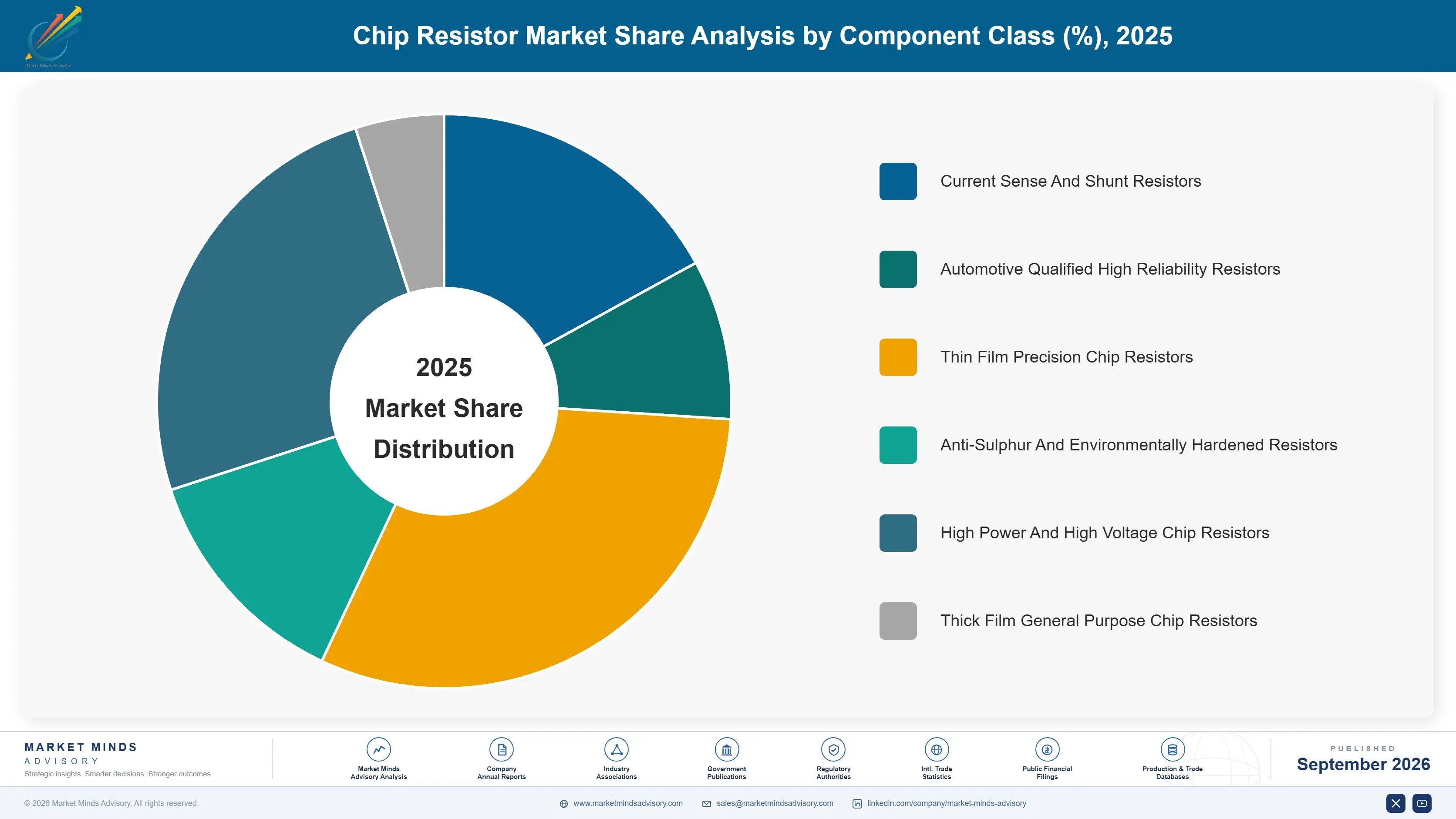
Segmentation follows component class, since construction and qualification determine whether a part is interchangeable and what premium it carries. Six classes cover the market: current sense and shunt resistors, automotive qualified high reliability parts, thin film precision resistors, anti-sulphur and hardened parts, high power and high voltage resistors, and thick film general purpose parts. End application is a separate dimension.
chip-resistor-market-market-share-analysis-1789991913046

Current Sense And Shunt Resistors

Current sense and shunt resistors grow at 8.1%, half again the market rate of 5.4%, and this is the one class in the category where genuine technical differentiation exists. Measuring current means passing it through a very low value precision resistor while controlling temperature coefficient, thermal electromotive force and long term drift, none of which matters for a general purpose part. Every battery pack, inverter and converter needs several, so content rises with each power conversion stage electrification adds. Manufacturers with materials and trimming capability here command pricing that the interchangeable segments simply cannot support at any volume. Nothing else in the category rewards engineering this way, which is why specialists concentrate here.
CAGR 8.1%

Automotive Qualified High Reliability Resistors

Automotive qualified resistors compound at 7.2% and cost around six times a physically comparable commercial grade part, which buys paperwork and process discipline rather than any measurable performance difference. Qualification runs around 19 months covering environmental testing, process capability demonstration and production part approval documentation, and a manufacturer entering automotive commits substantial expense long before receiving any order. That barrier is the reason five Asian manufacturers hold 66% of this market. A modern battery electric vehicle carries roughly 4,200 chip resistors, most of which now require exactly this qualification level. Qualification rather than performance is what the premium actually buys, and every vehicle manufacturer selects only from parts already carrying it.
CAGR 7.2%
Full segment breakdown across 6 segments available in the complete report.

Regional Architecture and Country Demand Map

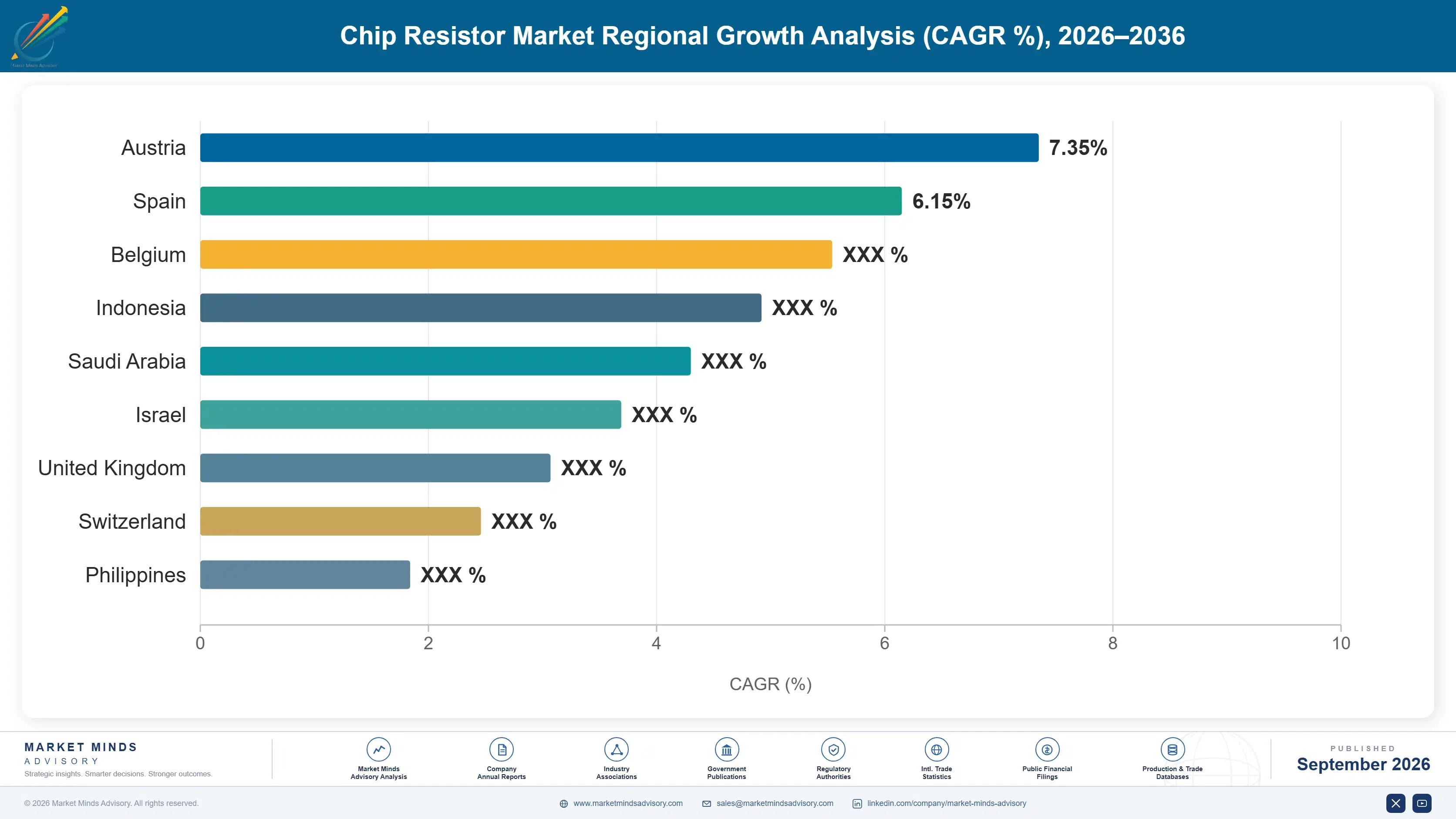
East Asia holds 62% of unit shipment revenue, far beyond any standard band, because these components are both manufactured and consumed within one single region. Every single leading supplier is Japanese, Taiwanese, Korean or Chinese, and the electronics assembly consuming their output sits alongside them.

East Asia

East Asia holds 62% of unit shipment revenue, far above the 30% band ceiling, for the simple reason that this component is made here and used here. Yageo and Walsin operate from Taiwan, Panasonic, Rohm, KOA and Susumu from Japan, Samsung Electro-Mechanics from Korea, and Fenghua and Uniroyal from China, which is very nearly the entire industry. Electronics assembly consuming those parts sits in the same region. Japanese manufacturers hold the deepest automotive qualification portfolios and Chinese producers compete hard in general purpose classes. Growth at 6.2% sits above the global rate on electrification content. Nothing about this concentration is likely to change in any timeframe worth modelling. Chinese producers compete hard on price.
Share: 62% | CAGR: 6.2% (2026 to 2036)

North America

At 12% North America sits far below the 22% band floor, and the gap is manufacturing location rather than any lack of design activity. Vishay Intertechnology, Bourns, Ohmite and Stackpole Electronics all operate from here with substantial specialist positions in current sensing and high power classes. Automotive, aerospace, medical and defence electronics designed here specify components manufactured almost entirely in Asia. Domestic passive component capacity is limited and has been for decades. Growth at 4.6% sits below the global rate on a design led rather than volume led position across the whole region. Design authority here considerably exceeds any manufacturing presence. Domestic passive capacity has been limited for decades and shows no sign of expanding materially.
Share: 12% | CAGR: 4.6% (2026 to 2036)
Regional intelligence for 5 additional markets available in the complete report: Western Europe, South Asia and Pacific, Latin America, Middle East and Africa, Eastern Europe. Contact sales@marketmindsadvisory.com.
chip-resistor-market-country-cagr-analysis-1789991913565

Where Component Margin Actually Exists

The highest volume part in this whole category is genuinely interchangeable and priced accordingly, qualification rather than manufacturing capability is what separates the leaders, and customers now buy availability rather than any better price. Each of the four levers below works with those facts rather than pretending a general purpose resistor can be meaningfully differentiated.

Sell Commitment Rather Than Unit Price

A general purpose chip resistor costs around USD 0.003 and its absence stops production lines worth several orders of magnitude more, which the 2021 shortages demonstrated to every electronics manufacturer simultaneously. Buyers now hold buffer inventory near 16 weeks and value allocation commitments and capacity visibility far above unit pricing. Suppliers who honoured commitments through the shortage retained customers afterwards regardless of price. Manufacturers still competing on cost per thousand are answering a question their customers stopped asking several years ago. Commitment history is now scored in sourcing decisions. Price per thousand is the wrong pitch.
Market Impact: Buffers near 16 weeks reordered all of purchasing

Qualify Platforms Rather Than Individual Values

Automotive qualification runs around 19 months from sample submission to approved production part status, and manufacturers frequently repeat much of that work for each resistance value and package size. Qualifying a process platform so one approval campaign covers a whole family spreads that expense across far more revenue. The qualified part carries around six times the price of comparable commercial material, so the return is substantial once approval exists. Manufacturers treating qualification as a per part exercise are paying repeatedly for the same demonstration. Repeating the same demonstration is expensive.
Market Impact: A 19 month approval can cover whole families

Build Current Sensing Capability Very Deliberately

Current sense and shunt resistors compound at 8.1% against 5.4% for the market and are the only class here where technical capability genuinely differentiates. Controlling temperature coefficient, thermal electromotive force and long term drift at very low resistance values requires materials science and trimming capability that general purpose manufacturing does not develop. Every additional power conversion stage in an electrified design adds content. Manufacturers competing only in interchangeable classes are absent from the one segment where their engineering could actually matter. Their engineering has nowhere else to matter. Volume classes reward nothing technical at all.
Market Impact: Current sensing compounds at 8.1% every single year

Follow Assembly Into Newly Built Capacity

India compounds at 11.2% on electronics assembly that did not previously exist rather than on volume relocated from somewhere else, and component supply still arrives almost entirely from East Asia. New assembly plants specify approved vendor lists from scratch, which is a genuine opening that established plants never present to anybody. Reaching those specifications requires local application support and inventory availability before production starts. Manufacturers serving the region through distribution alone keep arriving after the approved vendor list has already closed. Distribution alone arrives after the list closes. Local support has to precede production.
Market Impact: India compounds at 11.2% on genuinely new assembly

Who Controls the Margin Pool

Five manufacturers hold 66% of chip resistor unit shipment revenue and every one is Asian, which follows from these components being made and consumed within the same region. Yageo, Panasonic, Rohm, KOA Corporation and Samsung Electro-Mechanics hold automotive qualification portfolios accumulated across decades. Western manufacturers including Vishay Intertechnology and Bourns hold specialist positions in current sensing and high power classes rather than competing on interchangeable volume. All participants are assessed on unit shipment revenue.
Competition differs entirely by component class and the aggregate figure conceals that completely. General purpose parts compete on cost and capacity where Chinese manufacturers have taken substantial share against a genuinely interchangeable specification. Automotive qualified and current sensing parts compete on approval portfolios and materials capability, where a customer will not accept an unqualified supplier at any discount whatsoever.

Rankings shift on electrification content rather than on general electronics volume, since current sensing and automotive qualification carry the growth and the premium together. The second pressure is supply commitment: buyers who lost production in 2021 now allocate business partly on capacity assurance, which favours manufacturers who continued investing through the downturn that followed it.
chip-resistor-market-company-positioning-matrix-1789991914091

Competitive Moat and Risk Dimensions

YAGEO

Moat: Scale And Qualification Breadth

Yageo manufactures passive components at volumes supporting both cost leadership in general purpose classes and the qualification investment automotive parts require. That combination is genuinely rare, since specialists lack volume to fund broad approval portfolios and volume producers rarely commit to qualification. Acquisitions extended the range into precision and current sensing classes.
YAGEO

Risk: General Purpose Price Erosion

A substantial share of volume sits in thick film parts at around USD 0.003 that perform identically whoever makes them, and Chinese manufacturers keep expanding capacity into that specification. Scale defends against it and does not reverse it. The growth and premium both sit in qualified and current sensing classes instead.
KOA CORPORATION

Moat: Automotive Approval Portfolio Depth

KOA holds automotive qualification across an unusually wide range of resistance values, package sizes and specialist constructions, accumulated through decades of supplying Japanese vehicle programmes. Each approval represents around 19 months of testing and documentation that cannot be compressed. Vehicle manufacturers select from qualified parts, so the portfolio itself is the market access rather than any performance advantage over competitors.
KOA CORPORATION

Risk: Limited General Purpose Scale

A position weighted toward qualified automotive parts depends on vehicle production volumes and on programme cycles measured in years rather than quarters. It lacks the general purpose volume that funds process investment at competitors operating across both. Chinese manufacturers building qualification capability alongside existing scale represent the more serious long term challenge here.

Players Tracked

Prominent Players

Yageo
Panasonic
Rohm
KOA Corporation
Samsung Electro-Mechanics

Other Key Players

Vishay Intertechnology
Bourns
TE Connectivity
Susumu
Walsin Technology
Uniohm
Ralec Electronics
Fenghua Advanced Technology
Uniroyal Electronics
TT Electronics
Cyntec
Viking Tech
Ohmite
Stackpole Electronics
Riedon

Recent Developments

MARCH 2025

Yageo Expands Current Sense Resistor Capacity For Electrification

Yageo expanded manufacturing capacity for current sense and shunt resistors serving vehicle electrification applications, an organic capacity expansion rather than an acquisition or joint venture. Every battery pack, inverter and converter measures current through a low value precision resistor, and content rises with each power conversion stage a design adds.
Signal: The one class where engineering genuinely differentiates is also the one that electrification has now multiplied.
SEPTEMBER 2024

KOA Extends Automotive Qualification Across Wider Value Range

KOA Corporation extended automotive qualification across additional resistance values and package sizes, an organic development rather than any transaction or partnership. Qualification runs around 19 months from sample submission through to approved production status, and vehicle manufacturers select only from parts already carrying that approval.
Signal: The approval portfolio is the market access in this category, and it cannot be compressed or purchased.
JUNE 2025

Vishay Expands Precision Resistor Output For Industrial Applications

Vishay Intertechnology expanded precision and current sensing resistor manufacturing for industrial and automotive customers, an organic capacity expansion rather than a partnership or merger. Western manufacturers hold specialist positions in classes where materials capability matters, while general purpose volume remains concentrated across East Asian production entirely.
Signal: Specialist classes are where non-Asian manufacturers can still compete on something other than pure unit price.

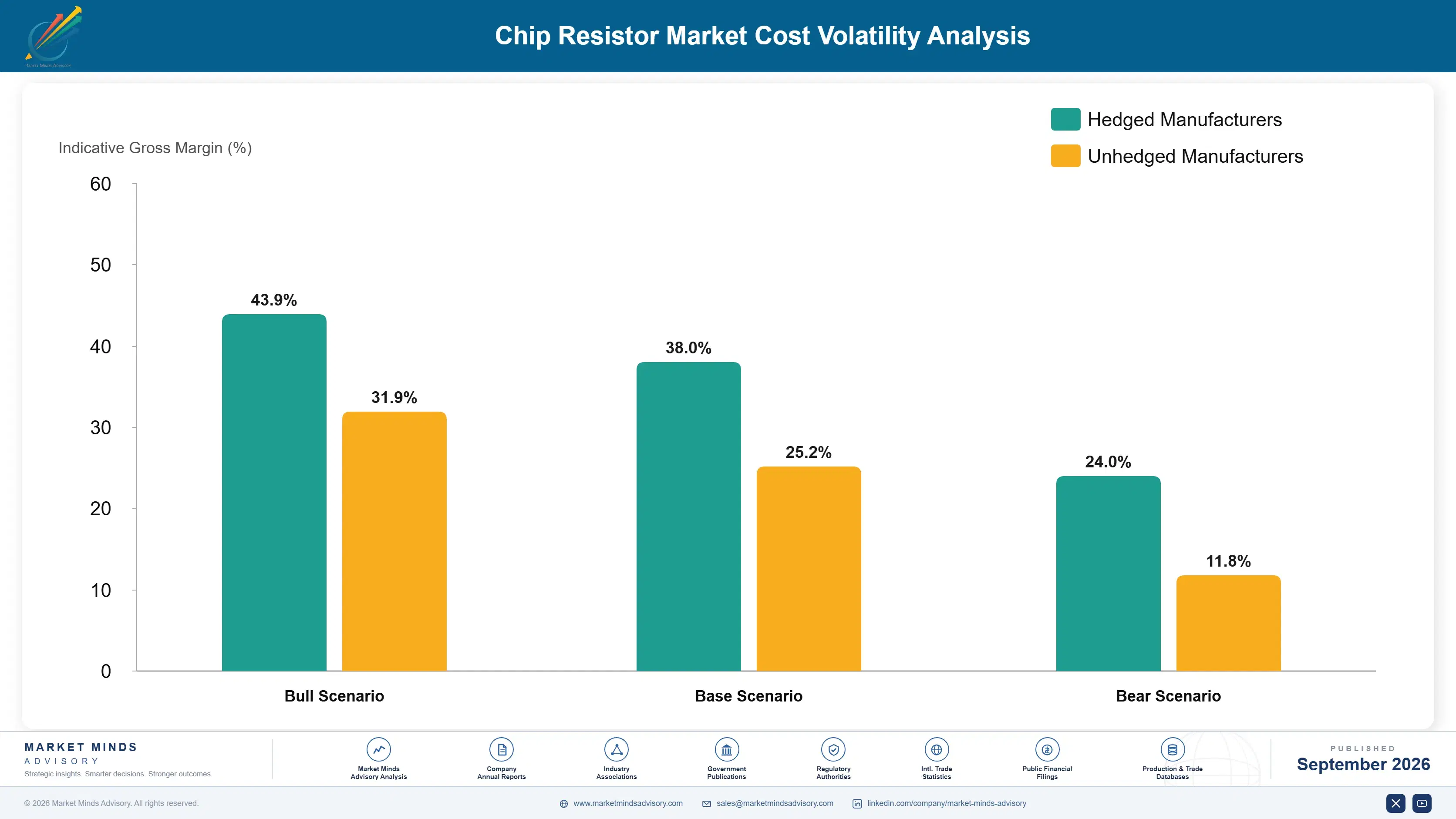
What A Chip Resistor Costs

Ceramic substrate and resistive paste materials account for roughly 27% of general purpose chip resistor cost, with palladium and ruthenium content in thick film pastes carrying most of the metal exposure. Termination metallisation adds around 18%. High volume automated manufacturing absorbs about 31%, which is why scale matters so much, and testing plus packaging take the remaining balance.
Palladium and ruthenium pricing moved considerably through 2023 and 2024, and the IEA has documented how far critical mineral demand diverged from historical patterns across that period. Yageo Annual Report 2024 and Rohm Annual Report 2024 both record raw material and energy cost as operating variables. Manufacturers on annual customer pricing agreements absorbed those movements directly, since a price set for a year does not adjust when metal costs move partway through it.

The competitive disadvantage mechanism is manufacturing scale rather than material access. Automated lines cost the same to operate at half capacity as at full, so a manufacturer shipping billions of units carries a fraction of the fixed cost per part a smaller producer does. Exposure concentrates among Western and specialist manufacturers in general purpose classes, which is why they retreated toward precision and current sensing.
chip-resistor-market-cost-volatility-analysis-1789991914287

Reduce Precious Metal Loading In Resistive Pastes

Ceramic and paste materials run around 27% of general purpose cost and palladium and ruthenium content carries most of the price exposure within that. Paste formulations reducing precious metal loading while holding electrical performance have been available for years and adoption remains uneven across the industry. Requalifying an approved automotive part after a paste change is what deters most manufacturers.

Run Automated Lines At Genuine Full Capacity

Manufacturing absorbs about 31% of cost and automated resistor lines cost the same to operate at half utilisation as at full. Product mix planning that keeps lines loaded, including accepting lower margin general purpose volume to fill the gaps, beats idling capacity while awaiting premium orders. Manufacturers optimising per product margin rather than utilisation reach worse overall results.

Qualify Once Across A Whole Product Platform

Automotive approval runs around 19 months and manufacturers frequently repeat substantial parts of it for each resistance value and package size within the same process family. Designing qualification around the process platform rather than the individual part lets one campaign cover a whole family. The discipline is programme planning rather than testing expertise, and few quality organisations do it.

Portfolio Architecture for Margin Defence

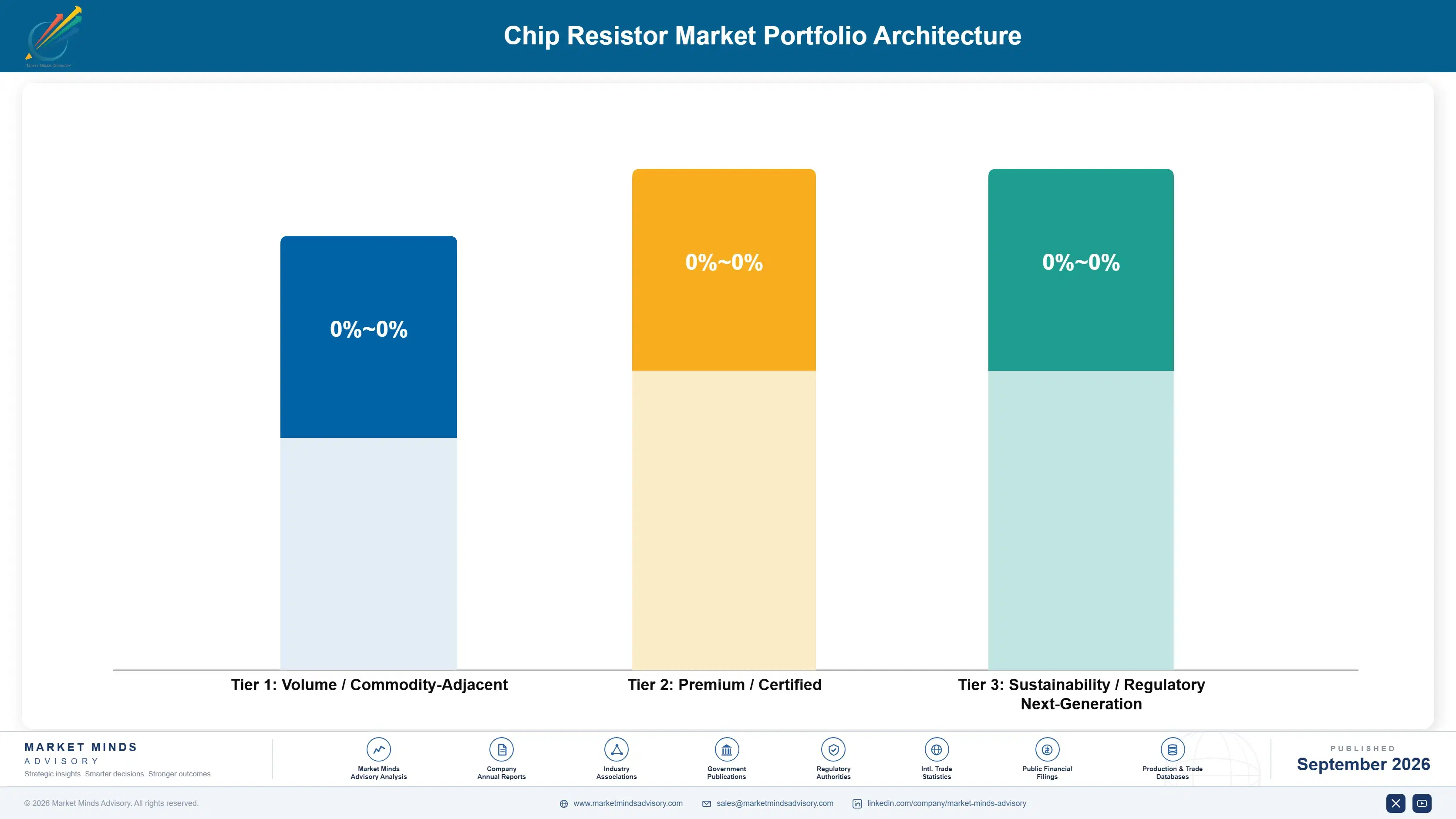
Margin architecture separates on whether the specification alone determines the choice. Thick film general purpose parts earn least, since they perform identically whoever manufactures them and compete purely on cost at around USD 0.003. High power and anti-sulphur classes sit in the middle on modest specialisation. Automotive qualified, thin film precision and current sensing parts earn most, each because something other than the datasheet decides selection.
The volume versus premium tension is a capacity utilisation problem rather than a positioning choice. Automated lines cost the same running half loaded, so general purpose volume that earns little still contributes to fixed cost recovery and keeps equipment productive. Manufacturers who abandoned commodity classes entirely discovered their premium lines running below capacity with nothing to fill them. The two segments are more connected than their margins suggest.

High-value pools concentrate in current sensing and in automotive qualification, and neither is reached by manufacturing improvement alone. Current sensing requires materials science and trimming capability that general purpose production never develops. Automotive qualification requires 19 month approval campaigns funded before any order exists. Both are commitments made years ahead of revenue, which is why the same five manufacturers have held this position for decades.

Volume / Commodity-Adjacent

Thick film general purpose chip resistors, performing identically whoever manufactures them and competing purely on cost at around three tenths of a cent. The eight point spread separates manufacturers with fully utilised automated lines from those running capacity below the level fixed costs assume.
Gross Margin: 12% to 20%

Premium / Certified

High power, high voltage and anti-sulphur hardened resistors, carrying modest specialisation and serving applications where general purpose parts fail. The ten point spread tracks how much of a manufacturer's volume sits under multi-year supply agreements rather than in spot and distribution sales negotiated repeatedly.
Gross Margin: 26% to 36%

Sustainability / Regulatory / Next-Generation

Automotive qualified, thin film precision and current sensing resistors, where approval portfolios and materials capability rather than published specification decide selection. The fourteen point spread reflects qualification breadth and trimming capability, neither of which can be assembled quickly by anybody entering the category now.
Gross Margin: 40% to 54%
chip-resistor-market-portfolio-architecture-1789991914782

High-value Sub-segments and Strategic Watch-out

Current Sense And Shunt Resistors

Grows at 8.1% because every battery pack, inverter and converter measures current by passing it through a precision resistor. The fourteen point spread reflects materials capability. This is the one class in the whole category where engineering genuinely differentiates one supplier from another. Specialists concentrate here deliberately.
Gross Margin: 40% to 54%

Automotive Qualified High Reliability Resistors

Grows at 7.2% and costs around six times comparable commercial grade material for paperwork and process discipline rather than performance. The fourteen point spread reflects approval breadth. A modern battery vehicle carries roughly 4,200 chip resistors, most needing this qualification. Vehicle makers select only from approved parts.
Gross Margin: 40% to 54%

Thin Film Precision Chip Resistors

Grows at 6.1% on instrumentation, medical and high accuracy industrial applications requiring tolerance and stability thick film construction cannot deliver. The fourteen point spread reflects trimming capability. Volumes are modest and the pricing bears no relation to general purpose economics at all. Calibration records lock these in place.
Gross Margin: 40% to 54%

Thick Film General Purpose Chip Resistors

Grows at 2.4%, slowest of the six classes, on parts that perform identically whoever makes them at around USD 0.003 each. The eight point spread reflects line utilisation. Chinese capacity expansion continues against a specification offering no room for differentiation whatsoever. Chinese capacity keeps expanding into it.
Gross Margin: 12% to 20%

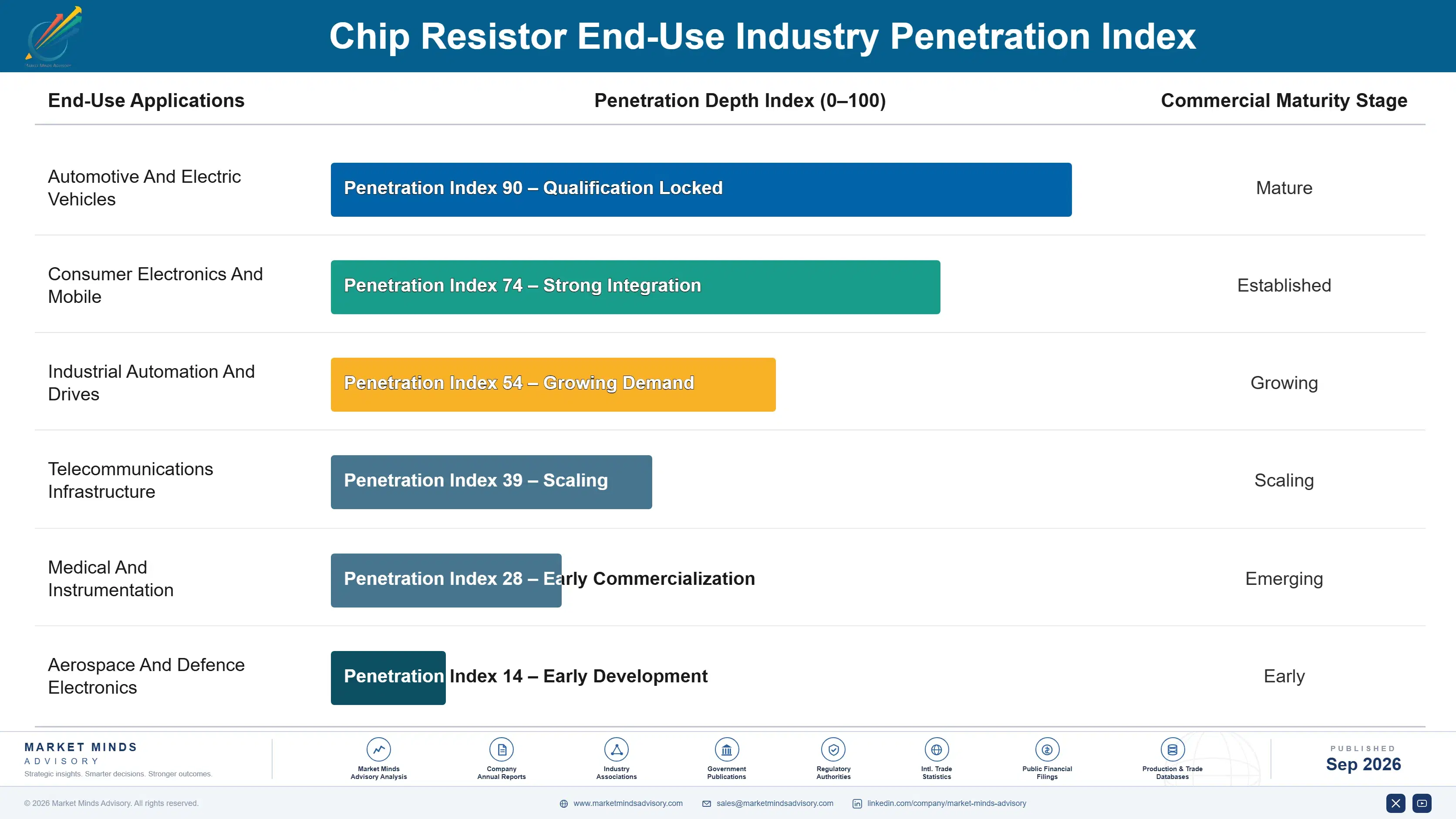
How Component Positions Persist

The annuity is the approved vendor list rather than any supply agreement. A component qualified into a vehicle or industrial programme stays for that programme's production life, because requalifying costs around 19 months and a manufacturer will not undertake it to save fractions of a cent on a part. Programme lives run years and often extend into successor designs, which makes winning at specification worth far more than the order.
Depth varies entirely by qualification level. An automotive qualified part inside an approved bill of materials is effectively fixed for the programme and often beyond it. A precision resistor in calibrated instrumentation is similarly locked, since changing it invalidates calibration records. A general purpose part in consumer electronics is substituted at every cost reduction exercise and frequently at every purchase order, since alternatives are genuinely identical.

The buyer changed after 2021 and has not changed back. A purchasing organisation previously optimised unit cost across interchangeable suppliers and held minimal inventory as a matter of discipline. It now holds around 16 weeks of buffer and allocates business partly on capacity assurance and commitment history through the shortage. Manufacturers leading with price per thousand address a purchasing philosophy that stopped existing.
chip-resistor-market-end-use-penetration-index-1789991915273

What Decides Position Here

These are among the four positions where our research anticipates prominent divergence between winners and laggards over the coming forecast period. Each is grounded in the demand model, the regulatory perimeter, and the announced capacity pipeline.
01 / SUPPLY COMMITMENT SELLING

Promise Availability, Not A Better Price

A general purpose chip resistor costs around USD 0.003 and its absence stops production lines worth several orders of magnitude more than the entire annual component spend, which the 2021 shortages demonstrated to every electronics manufacturer at once. Buyers now hold buffer inventory near 16 weeks and value allocation commitments and capacity visibility considerably above unit pricing. Suppliers who honoured their commitments through that shortage retained customers afterwards regardless of price, which reversed roughly thirty years of established purchasing practice in a single year.
02 / PLATFORM QUALIFICATION DESIGN

Approve The Process, Not The Part

Automotive qualification runs around 19 months from sample submission to approved production part status, and manufacturers routinely repeat substantial portions of that work for each resistance value and package size within the same process family. Designing the qualification campaign around the process platform rather than the individual part lets one approval effort cover an entire family of products. The qualified part carries around six times commercial grade pricing, so the return once that approval exists is both substantial and repeated across every part in the family.
03 / CURRENT SENSING INVESTMENT

Build The Part That Cannot Be Copied

Current sense and shunt resistors compound at 8.1% against 5.4% for the market and represent the only class in this entire category where technical capability genuinely differentiates one manufacturer from another. Controlling temperature coefficient, thermal electromotive force and long term drift at very low resistance values requires materials science and trimming capability that general purpose production never develops at all. Every additional power conversion stage in an electrified design adds further content, and manufacturers competing only in interchangeable classes are absent from it.
04 / NEW ASSEMBLY COVERAGE

Reach The Vendor List Before It Closes

India compounds at 11.2% on electronics assembly that did not previously exist rather than on volume relocated from elsewhere, and component supply still arrives almost entirely from East Asian manufacturers. New assembly plants build approved vendor lists from scratch, which is a genuine opening that an established plant never presents to any supplier. Reaching those specifications requires local application support and inventory availability before production begins, and manufacturers serving the region through distribution alone consistently arrive after the list has closed.

Engagement Snapshot From the Field

A live engagement with an industry participant carrying material or product regulatory and market exposure ahead of a defining policy shift, showing how our research translates into a defensible multi-year portfolio strategy.
MARKET MINDS ADVISORY · CLIENT ENGAGEMENT SUMMARY
Chip Resistor Producer Strategic Portfolio Review and Transition Roadmap 2026·Investment Scenario on Chip Resistor Exposure Evaluation 2025-26
CLIENT PROFILE
A European automotive tier one supplier producing battery management and inverter electronics across four plants, sourcing chip resistors from six manufacturers with qualification held across an inconsistent set of part numbers. The 2021 shortage had forced emergency requalification on two programmes at considerable cost. Purchasing was negotiating annual pricing across all six suppliers as it always had.
STRATEGIC CHALLENGE
Purchasing measured performance on unit cost and had improved it steadily for years. Engineering wanted supply assurance after the shortage experience and had no mechanism to influence sourcing. Nobody had costed the emergency requalification against the cumulative price savings, and a supplier consolidation decision was scheduled without that comparison being available to anybody.
MMA APPROACH
MMA costed the two emergency requalification programmes fully, including engineering time, testing and production disruption, and compared that against cumulative purchasing savings across the same period. We mapped qualification coverage by supplier and part family, and assessed which suppliers had honoured allocation commitments during the shortage. The work drew on 47 expert interviews conducted in Q4 2025 with manufacturers, distributors and comparable tier one suppliers.
KEY FINDINGS
  1. Emergency requalification on the two programmes cost roughly 9 times the cumulative purchasing savings achieved across the preceding four years (client-reported, unverified by MMA).
  2. Only 2 of the six suppliers had honoured allocation commitments during the shortage, and both had been under pricing pressure from purchasing throughout.
  3. Qualification coverage was held on individual part numbers rather than process families, so 40% of parts had no qualified alternative from the same supplier.
  4. Current sensing resistors came from a single supplier with no qualified second source at all across any of the four production plants.
CLIENT PROFILE
A European automotive tier one supplier producing battery management and inverter electronics across four plants, sourcing chip resistors from six manufacturers with qualification held across an inconsistent set of part numbers. The 2021 shortage had forced emergency requalification on two programmes at considerable cost. Purchasing was negotiating annual pricing across all six suppliers as it always had.
STRATEGIC CHALLENGE
Purchasing measured performance on unit cost and had improved it steadily for years. Engineering wanted supply assurance after the shortage experience and had no mechanism to influence sourcing. Nobody had costed the emergency requalification against the cumulative price savings, and a supplier consolidation decision was scheduled without that comparison being available to anybody.
MMA APPROACH
MMA costed the two emergency requalification programmes fully, including engineering time, testing and production disruption, and compared that against cumulative purchasing savings across the same period. We mapped qualification coverage by supplier and part family, and assessed which suppliers had honoured allocation commitments during the shortage. The work drew on 47 expert interviews conducted in Q4 2025 with manufacturers, distributors and comparable tier one suppliers.
KEY FINDINGS
  1. Emergency requalification on the two programmes cost roughly 9 times the cumulative purchasing savings achieved across the preceding four years (client-reported, unverified by MMA).
  2. Only 2 of the six suppliers had honoured allocation commitments during the shortage, and both had been under pricing pressure from purchasing throughout.
  3. Qualification coverage was held on individual part numbers rather than process families, so 40% of parts had no qualified alternative from the same supplier.
  4. Current sensing resistors came from a single supplier with no qualified second source at all across any of the four production plants.
RECOMMENDED STRATEGY
Phase 1: Phase one: allocate volume toward the two suppliers who honoured commitments, and accept the pricing implication as the cost of assurance. Phase 2: Phase two: requalify by process family rather than by part number, so alternatives exist within a supplier without a new approval campaign. Phase 3: Phase three: qualify a second source for current sensing resistors immediately, since the single source exposure sits on the highest value products.
OUTCOME
The supplier reallocated volume toward the two committed manufacturers and began family level requalification (client-reported, unverified by MMA). Unit pricing rose slightly and qualified alternatives now exist across most part families. A second current sensing source was approved within the year. Supply commitment history is now a scored criterion in sourcing, which is the change that outlasted the engagement.

Frequently Asked Questions

Foundational context covering the market sizes, CAGR, scope, country, region and competition that inform every finding below. This section is provided to cover basics and most often pre-purchase conversations, answered from the MMA Primary Research Dataset.

What is the current size of the Chip Resistor Market?

Global value reaches USD 4.53 billion in 2026, measured as chip resistor unit shipment revenue across all six component classes. The 2025 base is USD 4.3 billion.

How large will the Chip Resistor Market be by 2036?

Unit shipment revenue reaches USD 7.67 billion by 2036, an increase of USD 3.14 billion over the forecast period. That represents 1.69 times expansion from the 2026 base.

What is the CAGR for the Chip Resistor Market 2026 to 2036?

The base case runs at 5.4% annually, with a bull case at 6.7% if electrification extends across commercial vehicles and industrial equipment and a bear case at 4.2% if general purpose pricing erodes further.

Which segment is growing fastest?

Current sense and shunt resistors grow at 8.1%, half again the market rate of 5.4%. Every battery pack, inverter and converter measures current by passing it through a low value precision resistor.

Who are the major companies in the Chip Resistor Market?

Yageo, Panasonic, Rohm, KOA Corporation and Samsung Electro-Mechanics lead on unit shipment revenue, together holding 66%. Vishay Intertechnology, Bourns and Walsin Technology hold smaller specialist positions.

Which country is growing fastest?

India leads at 11.2%, on electronics assembly drawn in by production linked incentives that creates genuinely new component demand rather than relocating existing volume. Vietnam and Indonesia follow.

Report Segmentation Architecture

The full report scope spans multiple orthogonal segmentation dimensions, with cross-tabulated demand data provided for each dimension pair. Coverage extends further to regional breakdowns, trend trajectories, and the competitive detail needed to support segment-level decision-making.

By Component Class

  • Current Sense And Shunt Resistors
  • Automotive Qualified High Reliability Resistors
  • Thin Film Precision Chip Resistors
  • Anti-Sulphur And Environmentally Hardened Resistors
  • High Power And High Voltage Chip Resistors
  • Thick Film General Purpose Chip Resistors

By End-Use Industry

  • Automotive And Electric Vehicles
  • Consumer Electronics And Mobile
  • Industrial Automation And Drives
  • Telecommunications Infrastructure
  • Medical And Instrumentation
  • Aerospace And Defence Electronics

By Commercial Dimension

  • Direct Manufacturer Supply Agreements
  • Electronics Distributor Channel
  • Contract Manufacturer Procurement
  • Automotive Tier One Sourcing
  • Approved Vendor List Specification
  • Spot And Broker Market Purchase

By Region

  • North America
  • Western Europe
  • East Asia
  • South Asia and Pacific
  • Latin America
  • Middle East and Africa
  • Eastern Europe

Scope, Methodology, and Coverage

Every figure in this report is reproducible from documented input assumptions. The scope below maps the historical period, the forecast horizon, the segmentation dimensions, and the countries covered, alongside the underlying primary and qualitative methodology.
Historical Period
2020 to 2025
Forecast Period
2026 to 2036
Base Year
2025 (USD billions; MMA Primary Research Dataset, September 2026)
Market Definition
This report covers surface mount chip resistors by component class: automotive qualified high reliability resistors, current sense and shunt resistors, thin film precision chip resistors, high power and high voltage chip resistors, anti-sulphur and environmentally hardened resistors, and thick film general purpose chip resistors. It excludes resistor networks and arrays, through-hole and wirewound resistors, potentiometers and trimmers, thermistors and varistors, and other passive component categories including capacitors and inductors.
Quantitative Units
USD millions, unit shipment revenue basis; shipped units annually; unit prices in USD; qualification periods in months; buffer inventory coverage in weeks.
Segmentation Dimensions
Component class; end-use industry; commercial supply channel; geography across seven regions.
Regions Covered
North America, Western Europe, East Asia, South Asia and Pacific, Latin America, Middle East and Africa, Eastern Europe
Countries Covered
Taiwan, Japan, South Korea, China, India, Vietnam, Indonesia, Australia, United States, Canada, Mexico, Brazil, Germany, Italy, France, Poland, Czechia, Slovakia, Romania, Israel.
Key Companies Profiled
Yageo, Panasonic, Rohm, KOA Corporation, Samsung Electro-Mechanics, Vishay Intertechnology, Bourns, TE Connectivity, Susumu, Walsin Technology, Uniohm, Fenghua Advanced Technology, TT Electronics, Cyntec, Stackpole Electronics.
Quantitative Methodology
Primary survey, n=3,800 respondents, Q4 2025, six countries; demand-side model with trade association cross-validation
Qualitative Methodology
47 expert interviews, Q4 2025; applied to validate demand model assumptions, identify emerging dynamics, and assess competitive positioning
Report Format
PDF and XLSX data workbook (Word format preview document)
Publisher
Market Minds Advisory
Report Code
MMA-2026-TEC-621
Published
September 2026
Contact
sales@marketmindsadvisory.com | www.marketmindsadvisory.com

Purchase the full Chip Resistor Market Report (2026 to 2036).

This report sizes the global chip resistor market from 2026 to 2036 across six component classes, six end-use industries and seven regions. It explains why a part costing USD 0.003 reordered purchasing practice across all of electronics after 2021, how a qualification premium near six times separates identical material into different businesses, and why a battery electric vehicle carrying 4,200 resistors changed a mature component category. Cost composition is sourced to IEA minerals analysis and company annual reports, with line utilisation analysed as the margin determinant. Regional analysis explains why East Asia holds 62% of shipment revenue.
Six component classes sized through to 2036
Qualification premium modelled across the whole category
Material and manufacturing cost composition from company filings
Twenty named manufacturers assessed on shipment revenue
Four revenue levers with quantified commercial impact
Anonymised automotive tier one sourcing engagement included in full

Built For The People Who Decide

From boardroom strategy to bench-side execution, this report is read cover-to-cover by leaders shaping the next decade of their industry, turning demand scenarios, market dynamics and valuation benchmarks into decisions.
CXOs/ Presidents/ VPs/ Managers
M&A and Corporate Development
Strategy Teams and R&D Heads
Procurement and Product Directors
Regulatory and Compliance Leaders
Investor Relations and Equity Analysts